Senior senator says new Pentagon budget threatens normalization of Russia-US relations
RT | November 17, 2017
The $700 billion US military spending bill, recently approved by the Senate, could destroy any future attempts to restore relations between the United States and the Russian Federation, the head of the upper house Foreign Relations Committee says.
“The US senate has approved the 2018 draft defense budget. Among other things the draft contains the part on ‘countering Russian aggression’ … which definitely is not only new money allocated for the needs of the military, but also an attempt to create new long-term strategies that, if realized, can completely destroy any hope for normalization in Russia-US relations,” Konstantin Kosachev wrote on Facebook.
After quoting the document’s provisions in Russian translation, the senator wrote that it was difficult to comment on it. “What can I say? The congressmen, who are blinded by their own Russophobia, are expressing their perverted understanding of the world and their own country’s place in this world. With potential destructive political and economic consequences for this country and the world as a whole,” Kosachev wrote.
The anti-Russian steps listed in Kosachev’s post include the allocation of $4.6 billion for the European Deterrence Initiative, $350 million of military aid to Ukraine and $100 million to Baltic states, $58 million for the US response to Russia’s alleged violations of the Intermediate-Range Nuclear Forces Treaty, and various sanctions against people and companies cooperating with Russia. The bill also demands that the US defense secretary and secretary of state develop and realize a major strategy on countering Russia.
According to the documents posted on the government web portal, Russia’s own defense budget for 2018 amounts to about 943 billion rubles (about $15 billion), down from 1.2 trillion rubles (about $20 billion) in 2017 and a fraction of the $700-billion draft defense budget approved by the US Congress.
Trump holds the line on foreign policy
By M K Bhadrakumar | Indian Punchline | November 13, 2017
For the first time since US President Donald Trump took office, a reality check is possible on the foreign policy platform he espoused during the 2016 campaign. Most of the key elements of that platform faced the litmus test one way or another during his 11-day Asian tour, which concludes today. How does the scorecard look?
On a scale of 10, one can say it stands at 8-9. Trump’s performance through the tour of the 5 Asian states – Japan, South Korea, China, Vietnam and the Philippines – shows that there has been a remarkable consistency in terms of the foreign policies he pledged to deliver if elected as president.
The first key element in the Asia-Pacific context has been Trump’s total rejection of the Trans-Pacific Partnership agreement, which the Obama administration had negotiated. The Asian tour put to test whether he’d hold the line to scrap the TTP. The pressure was immense, led by Japan and Australia, that the TTP should be revived in some form.
But Trump stuck to his ‘Nyet’. In his speech at the APEC summit in Da Nang on Friday, he reiterated that his administration would only seek bilateral trade agreements with the Asian countries. In fact, he let loose a volley on the WTO as well. That leaves Japan to lead a coalition of 11 countries originally a part of TPP – Japan, Australia, Canada, Mexico, Singapore, Malaysia, Vietnam, Chile, Peru, New Zealand and Brunei – to make their own deal.
It is unlikely that the effort to revive the TPP will go very far after Trump made it clear that the US has no interest in it. In any case, the latest development – Canada’s decision last week to pull out as well – virtually means that the efforts to revive the TPP in some form are unraveling.
Now, the TPP was supposed to have provided the vital underpinning for the Obama administration’s containment strategy against China (known as ‘pivot to Asia’.) This brings us to another Trump platform. During the 2016 campaign, it was apparent that Trump had no interest in pursuing a containment strategy against China.
Of course, candidate Trump was highly critical of China. But that was for other reasons – over the issue of trade deficit, currency manipulation, breach of intellectual property rights, market access, taking away US jobs and so on. The criticism continues. But then, Trump intends to sort out the issues directly with the Chinese leadership.
The point is, a containment strategy against China is unviable and unsustainable sans the TPP, but Trump couldn’t care less. The Asian tour has further confirmed his panache for transactional diplomacy, which he thinks is the optimal approach from the perspective of ‘America First’.
Trump is not a grand strategist; nor is he professorial like Barack Obama. He has no time or patience for geopolitics woven onto the tapestry of a comprehensive Asia-Pacific strategy. The Asian tour brings this out very clearly.
Nonetheless, it has been a most productive tour for ‘America First’. In Japan and South Korea he pushed arms exports. He got South Korea to increase its share of the financial cost of maintaining the big US military bases. He has lifted the cap on South Korea’s missile development program. These are in line with his approach to the importance of cost sharing and burden sharing by the US’ allies.
The “state visit-plus” to China was of course the high noon of the Asian tour. Trump wrapped up deals worth $235 billion, which ought to translate as tens of thousands of new jobs in the US economy.
Was he perturbed that China is overshadowing the US as the region’s principal driver of growth in Southeast Asia? Trump’s APEC speech showed no signs of it. He never once berated China’s Belt and Road Initiative. Ironically, he complimented the Chinese leadership for serving the national interests effectively! He didn’t show signs of competing with China for the ASEAN’s friendship, either.
Candidate Trump had shown an aversion toward US interventions in foreign countries except when American interests are directly involved. Indeed, North Korea was the only ‘talking point’ in his agenda.
Incredibly enough, Trump didn’t even mention the territorial disputes in the South China Sea in his remarks at the US-ASEAN summit in Manila earlier today. Instead, Trump’s focus was on economics. He said in the speech:
- We have the highest stock market we’ve ever had. We have the lowest unemployment in 17 years. The value of stocks has risen $5.5 trillion. And companies are moving into the United States. A lot of companies are moving. They’re moving back. They want to be there. The enthusiasm levels are the highest ever recorded on the charts. So we’re very happy about that, and we think that bodes very well for your region because of the relationship that we have. (Transcript)
The most controversial part of Trump’s tour came on Thursday when he was expected to meet Russian President Vladimir Putin but didn’t – apparently due to scheduling difficulties. (Putin later told the Russian media that functionaries will be ‘disciplined’ for the botch-up.) But what stood out was the Trump-Putin joint statement on Syria that was eventually issued on Friday, reflecting Trump’s intention to take Putin’s help in ending the war.
Trump is unwavering that it is in the US’ interests to engage with Putin. This is despite the civil war going on back home where critics are braying for his blood for being ‘soft’ on Russia. We get a glimpse of the classic Trump in his dogged persistence all through that the US and Russia ought to have a productive relationship and Russia’s help is necessary for solving regional and global issues. He rubbed it in in while speaking to the White House press party aboard Air Force One.
Indeed, Trump’s remarks have raised a furious storm in the US with Senator John McCain leading the pack of wolves. Read the transcript of Trump’s remarks on Russia here.
Putin says claims of Russian intervention in US presidential election mere ‘fantasies’
Press TV – November 11, 2017
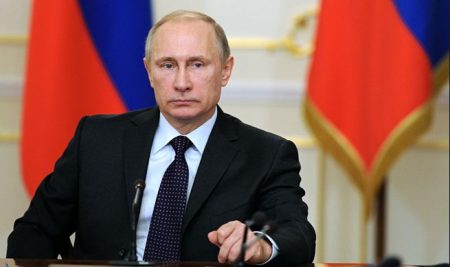
Russian President Vladimir Putin has once again strongly rejected claims that Moscow interfered in the 2016 US presidential election in favor of Donald Trump, saying these allegations are mere “fantasies.”
The Russian leader made the remarks at a news briefing on the sidelines of the annual summit of the Asia-Pacific Economic Cooperation (APEC) in the Vietnamese city of Da Nang on Saturday, less than a year after US intelligence agencies made the allegations against the Kremlin, which has since vehemently denied the charges.
“Everything about the so-called Russian dossier in the US is a manifestation of continuing domestic political struggle,” Putin told reporters at the Asia-Pacific summit in the Southeast Asian country, adding that he was well “aware” of the increasing probe regarding contacts between Trump’s team members and Russians, including a woman who has claimed to be Putin’s niece.
“Regarding some sort of connections of my relatives with members of the administration or some officials, I only found out about that yesterday from (spokesman Dmitry) Peskov,” the Russian president further said, asserting that he does not know anything about it. “I think these are some sort of fantasies,” Putin added.
Back in January, American intelligence agencies claimed that Russia interfered in the 2016 election to try to help Trump, the current president of the United States, defeat Democratic nominee Hillary Clinton. They alleged at the time that Moscow’s interference included a campaign of hacking and releasing embarrassing emails, and disseminating propaganda via social media to discredit Clinton’s campaign.
Special counsel Robert Mueller, appointed by the US Justice Department, is tasked with investigating Russia’s alleged meddling in the election.
Trump, for his part, has long denied any collusion between his campaign and Russian operatives during last year’s White House race, which led to his rival Hillary Clinton’s loss.
On Saturday, after briefly meeting with Putin at the summit, Trump said that the Russian leader felt insulted by persisting allegations of Moscow’s meddling in the US vote.
“You can only ask so many times… he (Putin) said he absolutely did not meddle in our election,” the US president said, adding that Putin was “very insulted by it, which is not a good thing for our country.”
As he was heading to the Vietnamese capital, Hanoi, Trump also told reporters that President Putin had personally told him that “he didn’t meddle.”
“He said he didn’t meddle. I asked him again,” Trump said.
Elsewhere in his remarks, the Russian president vowed that Moscow would adopt “reciprocal” measures in response to US steps against RT America, which he called an “attack on freedom of speech.”
His comments came a day after the US Department of Justice ordered that by Monday, the company that provides all services for RT America in the US has to register under the Foreign Agents Registration Act (FARA), adding that in case of any disobedience, the news channel’s head may be held in police custody and its accounts could be frozen.
The so-called US legislation was passed in 1938 to counter Nazi propaganda on the American soil. More than 400 entities, but no media outlet, are currently registered under the act.
“I want to draw your attention to the fact that there wasn’t and could not be any confirmation of our media’s meddling in the [US] election campaign,” Putin said, adding that the latest probe in US Congress showed that the Russian ads amounted merely to “some tenths or hundredths of a percent” in comparison to those carried by the US media in the course of the 2016 election.
The annual APEC summit is one of the largest gatherings on the annual diplomatic calendar, bringing together scores of world leaders and more than 2,000 CEOs. APEC represents 21 Pacific Rim economies, the equivalent of 60 percent of global GDP and covering nearly three billion people, and has pushed for freer trade since its inception in 1989.
Trust is crucial to India-Russia defence ties
By M K Bhadrakumar | Indian Punchline | November 9, 2017
The influential Russian daily Kommersant reported today on an intriguing development with ominous overtones for long-term India-Russia defence cooperation. It seems that Indian authorities gave access to a US Navy delegation of “well-trained technical specialists” to enter the top secret Russian nuclear submarine under the rubric “Project 9711″, which is on lease to Indian Navy within the framework of the so-called “special and privileged strategic partnership” between the two countries.
Apparently, the incident took place when the submarine was docked at the naval base at Vishakhapatanam while undergoing repairs. (The Indian Navy has christened the super secret Russian nuclear submarine as ‘Chakra’.) The Russian daily reported that this has been the second such serious breach of confidentiality that traditionally existed between Russia and India in defence cooperation with regard to the sharing of military technology with third parties.
In an earlier incident, a US Navy team was apparently allowed to visit the Russian-built aircraft carrier with the Indian Navy, Vikramaditya. Upon knowing about the security breach, the Russian side lodged a protest with the Indians. Obviously, that had no effect, as the latest incident involving the nuclear submarine suggests.
Unnamed Russian officials have described the Indian behavior as “outrageous.” According to Kommersant, the incident threatens to “seriously complicate negotiations both on the lease of the second nuclear submarine, and on other projects” in the field of military-technical cooperation between the two countries.
Given the high likelihood – nay, virtual certainty – that the Kommersant report is based on official Russian briefing, this must be taken as a warning from Moscow. Without going into details, Kommersant quoted Russian officials as pointing out that the incident involving the nuclear submarine is of a piece with several recent “unfriendly acts towards Russia” by the concerned Indian authorities.
It is unclear whether the paper was insinuating that such Indian behavior may be taking place without the knowledge of the political leadership in Delhi. If so, the Russian media leak could be intended to draw the attention of the Defence Ministry and the PMO. Of course, the officer corps of the Indian armed forces would have a fair share of lobbyists for American arms manufacturers. It is well-known that retired military officials have been retreading themselves at times as dalals of foreign vendors of weaponry eyeing the Indian market.
The Russian daily underscored that this whole string of incidents could have a very adverse impact on defense cooperation between the two countries, which has been successfully developing over the past five years. Interestingly, it disclosed that “specialized Russian structures are preparing retaliatory measures against their Indian partners. “Very difficult conversations are on the horizon, we have a lot of questions,” a source said. Some who spoke to Kommersant believe that, in particular, the negotiations on leasing the second nuclear submarine, which the Indian Navy planned to obtain from Russia, will be seriously complicated.”
The big question is whether the two governments are at the parting of ways as regards the sharing of cutting edge Russian military technology. At the level of the Indian political leadership, this is most certainly not the thinking. Prime Minister Modi himself is known to be a staunch believer in the raison d’etre of India-Russia strategic ties. It will be interesting to see how far India’s “natural partner” Donald Trump steps in to follow up on the US Navy team’s visit to INS Chakra. Will the Pentagon agree to lease to the Indian Navy a nuclear submarine?
There is already a cloud hanging low over the much-touted futuristic Russian-Indian collaboration to create a fifth-generation fighter aircraft. A concerted campaign has been appearing in India from time to time deliberately running down the project. (here and here.) Even foreign publications began floating the rumor that India wants to get out of the Russian deal. (National Interest, Diplomat ). The preference of lobbyists in Delhi seems to be for the American prototypes. But then, for backing out of the ‘Make in India’ venture, they must find some credible argument. Even with the best Indian ingenuity, this has not been possible so far. Funnily enough, TASS felt obliged to carry a report a few days ago (here) simply to set the record straight.
To be sure, Russian Deputy Prime Minister Dmitry Rogozin’s expected visit to Delhi next month is invested with much importance. India-Russia defence cooperation has been traditionally based on great mutual trust and confidence. Therefore, the recent trends are disturbing. The Indian think-tankers and media analysts keep whining and complaining about Russian weapons going to China and Pakistan. On the other hand, some of them also happen to be lobbyists for the US interests. Testing times are ahead, for sure, as the US-Russian rivalry may also surface on the Indian strategic landscape. (See may earlier blog US strikes at India-Russia defence ties.)
Saudi deletes thousands of tweets from detained scholar’s account
MEMO | November 4, 2017
Saudi activists have revealed that the security services in their country have deleted thousands of tweets from the account of detained scholar Mohamed Al-Hadeef, thenewkhalij.news reported on Friday.
“The Saudi security deletes tweets of Dr Mohamed Al-Hadeef and keeps only 1,583 out of thousands of tweets,” claimed a Twitter user known as “keymiftah79”. Even while he is detained, the activist pointed out, the Saudi authorities are afraid of his tweets.
The New Khaleej website said that it had fact-checked the information about the deletion and confirmed that only 1,582 tweets were kept on Al-Hadeef’s account.
The government in Saudi Arabia launched a campaign against independently-minded Muslim scholars in the country days after the visit of US President Donald Trump earlier this year. According to human rights groups, hundreds of scholars and opposition figures have been detained.
Russia, US craft rival UN resolutions on extending chemical probe in Syria
Press TV – November 3, 2017
Russia and the United States have drawn up rival UN Security Council resolutions on extending the mission of a body of international experts probing chemical attacks in Syria.
The Joint Investigative Mechanism (JIM) was formed by a Security Council resolution in 2015, and is run jointly by the UN and the Organization for the Prohibition of Chemical Weapons (OPCW), the world body’s chemical weapons watchdog.
Russia, however, has been exceedingly critical of JIM’s reports, finding faults with its evidence gathering techniques.
On October 14, Russia vetoed a US-sponsored Security Council resolution that would have renewed the experts’ mandate for a year. It said it would wait for an official report on an alleged sarin gas attack last year in northwestern Syria by the mission to decide whether it would back extending its mandate.
The report came out two days after the veto, blaming Syria for the incident which took place in April 2016 in the town of Khan Shaykhun and killed over 90 people.
Both Russia and Syria have rejected the report.
Reacting to the report on Thursday, Russian Foreign Ministry said the JIM experts had produced it without even turning up on site despite being offered guarantees of safety.
Mikhail Ulyanov, the head of the ministry’s arms control and non-proliferation department, said, “Imagine a criminal investigation in which police refuse to visit the site of the crime. No court will ever accept it.” “But they consider it possible to do such thing at the UN Security Council,” he noted.
According to a draft resolution obtained by news agencies, both the American and Russian versions demand the JIM mission’s extension, but under totally different conditions.
According to AFP, Russia wants the UN Security Council to shelve the latest JIM report and launch a new investigation into the Khan Shaykhun incident.
The Russian draft also urged a six-month extension of the UN-led panel’s mission, while the version put forward by the US calls for a two-year extension of the mandate, the report added.
The Associated Press also reported that the Russian draft resolution on the future of JIM’s mandate urges the mission to send investigators to Khan Shaykhun, where the attack reportedly happened, and the Shayrat airfield in Syria’s central Homs Province, which the US attacked later in April with missiles under the pretext of punishing Syria.
The accusations against the Damascus government come while Syria has turned over its entire chemical stockpile under a deal negotiated by Russia and the United States back in 2013. The OPCW supervised that removal process.
Iran’s snub to US has meaning for India
By M K Bhadrakumar | Indian Punchline | November 2, 2017
Only Tehran could have punctured US President Donald Trump’s massive ego with just a delicate deflection by the wrist. It all began in the weekend with an innocuous media disclosure in Iran that Trump had sought a meeting with President Hassan Rouhani during the latter’s visit to New York in September to address the UN General Assembly, but the latter spurned the overture summarily. On Sunday Iranian Foreign Ministry spokesman Bahran Qassemi commented crisply, “A request indeed was made by the US side, but it wasn’t accepted by President Rouhani.”
Of course, Washington went into a tizzy with White House struggling to deny the Iranian report at first, but belatedly realizing, perhaps, that a lie might boomerang, allowed the State Department spokesperson to tamely confirm it on Tuesday. Trump’s request was apparently transmitted to the Iranian side when the US secretary of state Rex Tillerson and his Iranian counterpart Mohammed Javed Zarif were closeted together on the sidelines of a meeting of the foreign ministers of the P5+1 and Iran to review the implementation of the Iran nuclear deal in September.
The episode speaks volumes about Trump, the man and the statesman – and his times in the White House and the US foreign policies in such extraordinary times. Countries such as India or China must draw appropriate conclusions. Indian analysts, in particular, are still crowing about Tillerson’s recent rhetoric at the CSIS conjuring up from thin air a quadripartite alliance between the US, Japan, India and Australia to contain China, while Trump on the other hand is preparing for a momentous state visit to China looking for some foreign-policy trophy as outcome in his barren presidency.
The point is, Trump could so blithely befool the wily Saudi King Salman and the pompous Israeli Prime Minister Benjamin Netanyahu in one go, sending them into wild ecstasy that he is about to go after the jugular veins of the Iranian leaders, while in reality also desiring to cultivate them on the quiet or at least keep open a line of communication to them – and, perhaps, even do some business with Tehran for ‘America First’.
The bad part is that the US is also intruding into India’s Iran policies. Did India have to cut back oil imports from Iran and replace it with US shale oil? For the US (or Israel), it is important that India-Iran relations remain sub-optimal for as long as their own relationships with Iran remain problematic. India’s interests, on the other hand, lie in forging a strategic partnership with Iran that can be highly productive and beneficial for advancing its development strategy as well as for strengthening regional security. To borrow the American expression, Iran is India’s ‘natural partner’.
Nothing brings this home as when Iran’s Supreme Leader Ali Khamenei proposed to the visiting Russian President Vladimir Putin at a meeting in Tehran on Wednesday that a transportation corridor could be built connecting the Iranian port of Chabahar with St-Petersburg. India cannot miss the point that Russia and Iran could be meaningful partners in fostering regional connectivity. Simply put, geography dictates geopolitics and geo-economy.
The bottom line is that the Iranian snub to Trump also highlights its strategic defiance of the US’ attempts to (re)impose hegemony in what the Americans call the ‘Greater Middle East’ – stretching from the Levant to the Central Asian steppes. Delhi should pay serious attention to the remark by Khamenei to Putin yesterday when he said that the “good cooperation” between Iran and Russia in Syria has proved “meaningful” and bore “important results”, and above all, “this cooperation showed that Tehran and Moscow can realize common goals in difficult situations.” (Tehran Times )
Khamenei didn’t specifically refer to Afghanistan, but the thought couldn’t have been far from his mind. The US’ plans to consolidate an open-ended military presence in Afghanistan is actually aimed at encircling Iran and Russia and containing them. It is useful to recall in this context that the then Iranian and Russian foreign ministers – Ali Akbar Velayati and Evgeniy Primakov – had worked closely together to bring the Tajik civil war to an end in 1997. Equally, Iran and Russia were on the same page in supporting the Northern Alliance in Afghanistan during 1997-2001.
No doubt, the preference of Tehran and Moscow once again will be to carry Delhi along with them in the struggle for strengthening regional security and stability through regional initiatives – as Khamenei’s remark on connecting Chabahar with St. Petersburg implies.
Lessons of the Cuban Missile Crisis
By Neil Clark | RT | October 28, 2017
Fifty-five years ago this weekend the world appeared to be on the brink of nuclear war as the Cuban missile crisis unfolded. What are the lessons that can be learned today about the events of October 1962?
It was the great filmmaker Charles Chaplin who commented that life is a tragedy when seen in close-up but a comedy in long-shot. Perspective is everything. If we take a ‘close-up’ view of the Cuban missile crisis, we fail to see the wider issues involved. We’re also likely to fall for the dominant narrative, which has the Soviet Union as the aggressor and the US as the side acting in self-defense. In fact, it was the other way round.
We call it the ‘Cuban missile crisis, ’ but in truth, it was only partly about Cuba. It was just as much about Turkey, and in particular, the fifteen offensive nuclear-tipped intermediate-range Jupiter missiles that had been provocatively deployed there by the US in 1961.
The Soviet Union felt threatened by them and rightly so. They could if launched in a pre-emptive ‘first-strike,’ obliterate entire cities in the western USSR, such as Minsk, Kiev, and Moscow, within minutes.
Moreover, the so-called ‘missile gap’ which Kennedy had campaigned on in 1960 against Richard Nixon, actually existed in the US’ favor. The US had around nine times as many nuclear warheads as the Soviet Union. “By 1962, a million US soldiers were stationed in two hundred foreign bases, all threatening the Soviet Union, from Greenland to Turkey, from Portugal to the Philippines,” write Jeremy Isaacs and Taylor Downing, in their book ‘Cold War.’ “Three and a half million troops belonging to America’s allies were garrisoned around the Soviet Union’s borders. There were American nuclear warheads in Italy, the United Kingdom, and Turkey.”
Nikita Khrushchev, the Soviet leader in 1962, had to do something to quickly change the situation, or else his country was in danger of nuclear annihilation. Remember President Kennedy had already seriously considered the ‘first-strike’ option. Fred Kaplan, the author of The Wizards of Armageddon, records how on July 13, 1961, Kennedy held a National Security Council meeting. Among the items on the agenda: “steps to prepare war plans which would permit the discriminating use of nuclear weapons in Central Europe and… against the USSR.”
America’s aggressive policies toward Cuba gave Khrushchev an opportunity to improve his country‘s security. When the cigar-smoking Fidel Castro first come to power in 1959, sweeping away the US-backed leader Batista in a popular uprising, he had not declared his revolution to be a Marxist one. But his program which involved nationalization and clamping down on the business activities of mobsters like Meyer Lansky, inevitably put him on a collision course with Washington.
In December 1960, the Eisenhower administration had already endorsed a scheme to invade Cuba to topple Fidel. John Kennedy, who became President in January 1961, inherited this ’cunning plan’ and went along with it. The result was the Bay of Pigs fiasco. Blackadder’s Baldrick really couldn’t have come up with anything more disastrous.
Understandably, Castro now declared a socialist revolution and turned to Moscow for assistance. Khrushchev saw a golden opportunity to “throw a hedgehog at Uncle Sam’s pants.”
An agreement was made with the Castro brothers, whereby Cuba would be a site for Soviet missiles. They would not only defend the island from a US-led invasion- but also in Khrushchev’s own words help to “equalize” the balance of power with the US.
Of course, when the US learned what was going on, there was indignant outrage of the sort US leaders do best. The second best quote from the whole of the Cuban missile crisis (after Khrushchev’s hedgehog one), came from Kennedy when he was told about the missile sites under construction. “It’s just as if we suddenly began to put a major number of MRBMs (missiles) in Turkey! Now that’d be goddamned dangerous, I would think.”’
To which his National Security Adviser, George Bundy replied: “Well, we did, Mr. President.”
Kennedy mulled over his options and decided that a blockade, to stop Soviet ships delivering their missiles, was the best call. Never mind that the Soviet action to ship missiles to an ally was legal and that a blockade most certainly wasn’t. But what to do about the missiles that had already arrived?
The President was presented with plans from his generals for air strikes and a full-scale invasion of Cuba. “But it was estimated that the ten days of fighting tied to an invasion, the US would suffer 18,500 casualties. Kennedy would have to do a deal,” note Isaacs and Downing.
A deal was done, but it was not one which the US administration could publicly acknowledge. In return for Soviet missiles being withdrawn from Cuba, the US agreed not to invade the island and to remove its Jupiters from Turkey which it did about six months later.
The US media hailed a great victory, but in fact, Washington had been forced to make concessions. It’s likely that if Khrushchev hadn’t played such a high line in 1961, the Soviet Union would have faced a pre-emptive strike sometime in the 1960s, very probably from the missiles situated in Turkey. The citizens of Moscow, Minsk, and Kiev have much to thank him for.
After 1962, the US knew that they had to tread warily. For the next seventeen years, détente was pursued by both Democratic and Republican administrations. Yes, the CIA continued to plot to overthrow the Cuban government, and of course subvert democratic processes around the world if the wrong candidates got elected, or look like they were going to get elected, but after the events of October 1962, the US was more frightened of directly provoking the Kremlin.
It was only in the late 1970s that the position began to change once again. A pivotal battle as I noted in an earlier OpEdge was between Secretary of State Cyrus Vance, a man of peace who genuinely wanted to maintain good relations with Moscow, and the uber-hawkish Russophobe Zbigniew Brzezinski, who had been appointed President Carter’s National Security Adviser. ‘Zbig’ won, and the results for mankind were catastrophic.
Neocons who had loathed détente began to crawl out of the woodwork. Again there were calls for a ‘pre-emptive’ strike on the Soviet Union.
Mikhail Gorbachev, a genuinely nice man who sadly had learned nothing from history, became Soviet leader in 1985 and surrendered his country’s bargaining chips in return for promises which weren’t worth the paper they weren’t written on.
The subsequent fall of the USSR was toasted by ‘muscular’ liberals and Trotskyites alike, but older and wiser heads knew that with no real counterbalance to US power we were heading for perilous waters. I always remember reading an article by the conservative commentator and staunch anti-communist Peregrine Worsthorne, in the Sunday Telegraph from around this time in which he said that in time people might well look back at the Cold War with some nostalgia as a period of relative peace and stability. He was absolutely right.
With no Soviet Union around to keep them in check The Project for a New American Century crowd got going. The result was two decades of wars and ‘liberal interventions’ which killed millions, hugely boosting the cause of terrorism and leading to a refugee crisis of Biblical proportions. It’s obvious none of this would have occurred if the USSR had still existed, but of course, in the name of ‘freedom’ and ‘democracy,’ we weren’t supposed to say it.
Things have only changed in recent years, as Russia, under the leadership of Vladimir Putin, has re-emerged as a global player and a counterweight to US imperialism. Syria is the first place since the end of the old Cold War where the ambitions of US neocons have been thwarted. Aleppo will hopefully prove to be their Stalingrad.
When we look back at the events of October 1962, is that it’s clear the US only cedes ground when it fears what the other side can threaten it with. To get Uncle Sam to stop being such an obnoxious bully, you have to throw or threaten to throw a hedgehog at his pants, to use Khrushchev’s memorable phrase. Being nice, like Gorbachev was, only gets you trampled on.
Gaddafi, like Saddam, surrendered his weapons program and was rewarded with a bayonet up his anus and the cackling laughter of US Secretary of State Hillary Clinton. Milosevic generously hosted ’The Balkans Bull’ Dick Holbrooke offering him his best slivovitz, and ended up being denied the proper medical treatment during his US-instigated show trial at The Hague.
Kim Jong-un, by contrast, tests missiles for fun and shows Washington the finger and his country hasn’t been bombarded. He’s clearly studied closely what happened fifty-five years ago and also since 1990.
Khrushchev’s decision to send missiles to Cuba, a country under genuine threat of invasion, was not only legal but also wise. Far from endangering the peace, it actually made war less likely. The nuclear Armageddon that was feared in Cold War 1.0 didn’t occur because the US feared the Soviet response. In fact looking back at 1962 the only regret was that more missiles hadn’t arrived. Then Moscow would have been able to gain even more concessions.
Which brings us back to today. Could a new Russian deployment of missiles to Cuba as the Communist Party of Russia called for last year in response to the Pentagon’s plan to deploy HIMARS (High Mobility Artillery Rocket System) in Turkey be a means of obtaining the removal of NATO from Russia’s borders, and getting US hawks to pipe down?
Put another way, if there were already Russian missiles situated just 90 miles off the coast of Florida, do we think the US would be quite so belligerent in its foreign policy? Merely to ask the question is to answer it.
Follow Neil Clark @NeilClark66
Russia vetoes UNSC resolution on renewing Syria chemical weapons probe
RT | October 24, 2017
Moscow vetoed a UN Security Council resolution to renew the mandate for a UN mission investigating the use of chemical weapons in Syria. Ahead of the vote, Russia suggested postponing the discussion, but its proposal was rejected.
The current mandate for UN and Organization for the Prohibition of Chemical Weapons (OPCW) representatives to work in Syria expires on November 17.
Read more
An Syrian child receiving treatment in Khan Sheikhun, following a suspected toxic gas attack, April 4, 2017 © Omar haj kadour Syrian Idlib chemical incident ‘likely staged,’ requires real investigation – Moscow
Washington has prepared a document to prolong the mandate, which was supported by 11 votes on Tuesday. Two UNSC members – Russia and Bolivia – voted against the document, while China and Kazakhstan abstained.
Later this week, the UN-OPCW Joint Investigative Mechanism (JIM) is scheduled to deliver a report on the alleged chemical weapon attack on the Syrian town of Khan Sheikhoun on April 4. Russia proposed hearing the mission’s findings before voting on a new document. However, Washington insisted the Security Council votes on the new mandate before a report is presented.
The Russian Foreign Ministry has said that the US demands for the prolongation of the probe “look at the very least strange.”
“It is necessary to act in accordance with an established practice, when a UN structure’s report is first studied, and then a question on a mandate’s prolongation is discussed,” the ministry said in a statement on Monday, condemning the “hyped up hysteria” on the issue.
Featured Video
No Vote, No Representation, No State: Democracy, Israeli Style
or go to
Aletho News Archives – Video-Images
From the Archives
Sanctions, War and the Policy of Dual Containment
By SASAN FAYAZMANESH | March 17, 2008
It is now nearly three decades since the Unites States adopted the policy of dual containment of Iran and Iraq. While much has been written about the containment of Iraq, there has been very little in-depth analysis of this policy when it comes to Iran. In a book that is going to be released on March 31, 2008, entitled The United States and Iran: Sanctions, Wars and the Policy of Dual Containment (Routledge), I attempt to address this shortcoming by investigating when and why the US policy of containment of Iran came about, how it evolved, and where it stands today.[1] To the extent that Israel has been involved in US policy making, the study will also include the role that Israel has played in the containment of Iran. Also, since the fate of Iran has been inextricably linked to that of Iraq, occasionally the investigation will overlap with the containment of Iraq.
The policy of dual containment of Iran and Iraq originated during the Carter Administration, but it was not until the Clinton Administration that the expression “dual containment” became popular. … continue
Blog Roll
 Aletho News
- Europe’s Establishment Is Embracing War – and Losing Voters
- NATO chief advocates war of aggression
- No Vote, No Representation, No State: Democracy, Israeli Style
- Zionist Bought Senate Blocks Information About American Citizens Killed By Israel
- While Gaza dominates the UN, these are the people keeping it alive
- New Report: “Scholasticide and Genocide in Gaza: Assessment, Testimonies and Legal Analysis”
- ‘THAAD Delusion’: Iran war exposes US missile shield limits – The Atlantic
- Moscow issues warning to NATO over Russian exclave
- Yes, the Iran war has destroyed Trump’s presidency
- The fallacy of US delusions about Iran’s economic collapse
- If Americans Knew
- Mamdani releases plan to combat antisemitism and hate crimes in New York City
- Iran’s Revolutionary Guards Publish Letter to the American People
- DMFI launches $1 million ad campaign supporting Virginia’s Elaine Luria
- US Senate blocks resolution seeking report on Americans killed by Israel
- Israeli Attacks Kill Ten Palestinians in Gaza
- Massacre at Minab: The School That Became a Grave
- Israeli media: The IDF Shows It Doesn’t Turn a Blind Eye; It Actively Emboldens Settler Havoc
- As settlers ravage West Bank, Israeli forces kill 10 in Gaza – Daily Update
- New Report: “Scholasticide and Genocide in Gaza: Assessment, Testimonies and Legal Analysis”
- Ex-Biden officials are desperate for a Gaza scapegoat
- No Tricks Zone
- Green Energy Debacle: German Expert Professor Fritz Vahrenholt Warns Of Severe Economic And Social Consequences
- Two More Paleo Reconstructions Affirm Meters-Higher Sea Levels Across Ireland, Brazil 7000-6000 Years Ago
- New Study: Earth And Venus Surface Warmth Largely Explained By Convection And Lapse Rate, Not CO2 Or Radiation
- 2025 Nature Paper Claiming Worsening Global Drought Gets RETRACTED …Heavily Flawed
- New Study: ‘Global Drought Shows No Detectable Recent Acceleration Under Climate Warming’
- Economic Masterminds: German Socialists Suggest Taxing Productivity Gains Stemming From Using AI
- The South China Sea Has Not Been Cooperating With The Climate Change Narrative
- Energy Crisis: Germany Enters Heating Season With Historically Low Gas Reserve Fill Levels
- New Study: The Antarctic Ice Sheet Gained Mass From 2020-2024 Due To Staggering Snow And Ice Accumulation
- Study: Ocean Heating Rates From Thousands Of Years Ago ‘Dwarf’ Modern Ocean Heating Rates

