US sanctions won’t stop Russia’s pipeline project to Europe – analysts
RT | August 3, 2017
The latest US sanctions targeting Russia’s oil and gas sector will cause Gazprom some headaches in building the new gas pipeline to Germany, experts say. However, US restrictions are unlikely to stop the project.
“The price of any project automatically increases,” Tatiana Mitrova, director of the Skolkovo Energy Center told Reuters.
“Gazprom’s relationships with partners, subcontractors, and equipment and service providers are very complicated. They will all ask for a risk premium,” she added.
“This, however, does not mean that Nord Stream-2 won’t be built,” said Katja Yafimova of the Oxford Energy Institute.
However, while Gazprom’s major partners in the projects – ENGIE, OMV, Shell, Uniper, and Wintershall – are likely to accept the risks, smaller contractors will be more cautious.
“Not all partners can afford to see things through with Gazprom,” said Valery Nesterov, an analyst at Moscow-based Sberbank CIB.
It is still unclear whether the US President will enforce the restrictive measures. While Trump signed off on the new sanctions on Monday, he did so reluctantly, calling them “significantly flawed.”
“Unless Trump takes a really sharp turn, it is highly unlikely that companies that are supplying pipeline goods are going to be punished in the next year or so,” Richard Nephew, a former US deputy chief of sanctions told Reuters.
At the same time, Gazprom’s long-term projects can be affected.
“A lot of companies are now thinking: ‘I’ve got maybe 12, maybe 18 months in which I can do some stuff but after that maybe I won’t’,” he added.
The Nord Stream-2 pipeline plans to double the delivery capacity of Russian natural gas to Germany from the current 55 billion cubic meters of gas per year.
Iran, Iraq, Russia hold meeting in Moscow
IRNA – August 2, 2017
Deputy Foreign Ministers of Russia, Iran and Iraq held meeting here on Wednesday to consider situation in the Middle East, crises in Iraq and Syria and trilateral coordination.
Mikhail Bogdanov, Hossein Jaberi Ansari and Nazar Khairallah kicked off the meeting in the venue of Foreign Ministry Protocol Hall in the presence of their accompanying delegation as well as Iran’s Ambassador to Moscow Mehdi Sanayee.
The latest developments in the region, especially coordination to reduce tensions and crises in the region with the aim to increase stability and peace were topics of agenda.
Before holding the joint meeting, Bogdanov met separately with Jaberi Ansari and Nazar Khairallah and discussed different issues with them.
Bogdanov and Jaberi Ansari in their 4-hours meeting discussed a collection of issues concerning West Asia and North Africa, situations in Syria, Yemen, Libya, Iraq, Iraqi Kurdistan, Palestine, crisis in relations between Qatar and Saudi Arabia and other international and regional issues.
Intra-Syrian talks in Astana and Geneva, Syrian humanitarian needs and the issue of rebuilding Syria were among issues discussed in the meeting.
Russian envoy: Hamas national movement
Palestine Information Center – August 1, 2017
TEHRAN – Hamas is a national liberation movement and Moscow does not consider it a terrorist organization, Russian Ambassador to Tehran Levan Dzhagaryan said Tuesday.
Reporting from Tehran, a PIC news correspondent said Dzhagaryan told Hamas representative in Iran, Khaled al-Kaddoumi, that Hamas is a national resistance movement and one of the Palestinians’ main legitimate representatives.
The Russian ambassador reiterated his country’s support for the Palestinian cause and people.
Al-Kaddoumi briefed the Russian envoy on the Israeli violations in Occupied Jerusalem and the crimes committed against the Palestinian people and holy sites.
Shall We Fight Them All?
By Pat Buchanan • Unz Review • August 1, 2017
Saturday, Kim Jong Un tested an ICBM of sufficient range to hit the U.S. mainland. He is now working on its accuracy, and a nuclear warhead small enough to fit atop that missile that can survive re-entry.
Unless we believe Kim is a suicidal madman, his goal seems clear. He wants what every nuclear power wants — the ability to strike his enemy’s homeland with horrific impact, in order to deter that enemy.
Kim wants his regime recognized and respected, and the U.S., which carpet-bombed the North from 1950-1953, out of Korea.
Where does this leave us? Says Cliff Kupchan of the Eurasia Group, “The U.S. is on the verge of a binary choice: either accept North Korea into the nuclear club or conduct a military strike that would entail enormous civilian casualties.”
A time for truth. U.S. sanctions on North Korea, like those voted for by Congress last week, are not going to stop Kim from acquiring ICBMs. He is too close to the goal line.
And any pre-emptive strike on the North could trigger a counterattack on Seoul by massed artillery on the DMZ, leaving tens of thousands of South Koreans dead, alongside U.S. soldiers and their dependents.
We could be in an all-out war to the finish with the North, a war the American people do not want to fight.
Saturday, President Trump tweeted out his frustration over China’s failure to pull our chestnuts out of the fire: “They do NOTHING for us with North Korea, just talk. We will no longer allow this to continue. China could easily solve this problem.”
Sunday, U.S. B-1B bombers flew over Korea and the Pacific air commander Gen. Terrence J. O’Shaughnessy warned his units were ready to hit North Korea with “rapid, lethal, and overwhelming force.”
Yet, also Sunday, Xi Jinping reviewed a huge parade of tanks, planes, troops and missiles as Chinese officials mocked Trump as a “greenhorn President” and “spoiled child” who is running a bluff against North Korea. Is he? We shall soon see.
According to Japanese Prime Minister Shinzo Abe, Trump vowed Monday he would take “all necessary measures” to protect U.S. allies. And U.N. Ambassador Nikki Haley bristled, “The time for talk is over.”
Are we headed for a military showdown and war with the North? The markets, hitting records again Monday, don’t seem to think so.
But North Korea is not the only potential adversary with whom our relations are rapidly deteriorating.
After Congress voted overwhelmingly for new sanctions on Russia last week and Trump agreed to sign the bill that strips him of authority to lift the sanctions without Hill approval, Russia abandoned its hopes for a rapprochement with Trump’s America. Sunday, Putin ordered U.S. embassy and consulate staff cut by 755 positions.
The Second Cold War, begun when we moved NATO to Russia’s borders and helped dump over a pro-Russian regime in Kiev, is getting colder. Expect Moscow to reciprocate Congress’ hostility when we ask for her assistance in Syria and with North Korea.
Last week’s sanctions bill also hit Iran after it tested a rocket to put a satellite in orbit, though the nuclear deal forbids only the testing of ballistic missiles that can carry nuclear warheads. Defiant, Iranians say their missile tests will continue.
Recent days have also seen U.S. warships and Iranian patrol boats in close proximity, with the U.S. ships firing flares and warning shots. Our planes and ships have also, with increasingly frequency, come to close quarters with Russian and Chinese ships and planes in the Baltic and South China seas.
While wary of a war with North Korea, Washington seems to be salivating for a war with Iran. Indeed, Trump’s threat to declare Iran in violation of the nuclear arms deal suggests a confrontation is coming.
One wonders: If Congress is hell-bent on confronting the evil that is Iran, why does it not cancel Iran’s purchases and options to buy the 140 planes the mullahs have ordered from Boeing?
Why are we selling U.S. airliners to the “world’s greatest state sponsor of terror”? Let Airbus take the blood money.
Apparently, U.S. wars in Afghanistan, Syria, Iraq, Yemen and Somalia are insufficient to satiate our War Party. Now it wants us to lead the Sunnis of the Middle East in taking down the Shiites, who are dominant in Iran, Iraq, Syria and South Lebanon, and are a majority in Bahrain and the oil-producing regions of Saudi Arabia.
The U.S. military has its work cut out for it. President Trump may need those transgender troops.
Among the reasons Trump routed his Republican rivals in 2016 is that he seemed to share an American desire to look homeward.
Yet, today, our relations with China and Russia are as bad as they have been in decades, while there is open talk of war with Iran and North Korea.
Was this what America voted for, or is this what America voted against?
Copyright 2017 Creators.com.
Militarization of Scandinavian Peninsula: Time to Ring Alarm Bells
By Alex GORKA | Strategic Culture Foundation | 31.07.2017
Much has been said about NATO reinforcements in the Baltic States and Poland perceived in Moscow as provocative actions undermining security in Europe, while very little has been said about gradual but steady militarization of Scandinavia. The theme does not hit headlines and it is not in focus of public discourse but one step is taken after another to turn the region into a springboard for staging offensive actions against Russia.
Ørland in southern Norway is being expanded to become Norway’s main air force base hosting US-made F-35 Lightnings – the stealth aircraft to become the backbone of Norwegian air power. Norway has purchased 56 of such aircraft. F-35 is an offensive, not defensive, weapon. The nuclear capable platforms can strike deep into Russia’s territory.
Providing training to Norwegian pilots operating the planes carrying nuclear weapons, such as B61-12 glider warheads, constitutes a violation of the Non-Proliferation Treaty (NPT) of 1968. Article I of the NPT prohibits the transfer of nuclear weapons from NWS (nuclear weapons states) to other states: «Each nuclear-weapon State Party to the Treaty undertakes not to transfer to any recipient whatsoever nuclear weapons or other nuclear explosive devices or control over such weapons or explosive devices». Article II requires NNWS (non-nuclear weapons states) not to receive nuclear weapons: «Each non-nuclear-weapon State Party to the Treaty undertakes not to receive the transfer from any transfer or whatsoever of nuclear weapons or other nuclear explosive devices or of control over such weapons or explosive devices». How can Russia be sure that these aircraft don’t carry nuclear weapons when there is no agreement of any kind in place to verify compliance with the NPT?
Ørland is located near Værnes – the base that hosts 330 US Marines. In May, the base hosted the biennial NATO military exercise «Arctic Challenge Exercise 2017» to involve over 100 planes from 12 nations. It was the first time a US strategic bomber (B-52H) took part in the training event.
The choice of the base was carefully calculated to keep the planes away from the reach of Russian Iskander missiles (500 kilometres) but no location in Norway is beyond the operational range of Kalibr ship-based sea-to-shore missiles and aircraft armed with long-range air-to-surface missiles.
In June, Norway’s government announced that the decision was taken to extend the rotational US Marine Corps force stationed at Værnes through 2018. The move contradicts the tried-and-true Norwegian policy of not deploying foreign military bases in the country in times of peace.
Also in June, the United States, United Kingdom and Norway agreed in principle to create a trilateral coalition built around the P-8 maritime aircraft to include joint operations in the North Atlantic near the Russian Northern Fleet bases.
Norway is to contribute into NATO ballistic missile defense (BMD) system by integrating its Globus II/III radar in the Vardøya Island located near the Russian border just a few kilometers from the home base of strategic submarines and 5 Aegis-equipped Fridtjof Nansen-class frigates. The radar construction is underway. The Vardøya radar can distinguish real warheads from dummies. Another radar located in Svalbard (the Arctic) can also be used by US military for missile defense purposes.
The country’s ground forces are stationed in Lithuania as part of a NATO multinational force under German command.
Sweden, a close NATO ally, has been upgrading its military with a sharp hike in spending. Last December, the Swedish government told municipal authorities to prepare civil defense infrastructure and procedures for a possible war. The move was prompted by the country’s return to the Cold War-era ‘Total Defense Strategy’. In September, 2016, 150 troops were put on permanent service on the island of Gotland to «defend it from Russia». Sweden maintained a permanent military garrison on Gotland for hundreds of years until 2005.The Swedish Civil Contingencies Agency (MSB) has ordered a review of 350 civilian bunkers on the island. The shelters are designed to protect people against the shock wave and radiation from a nuclear detonation, as well as chemical and biological weapons.
In March, Stockholm announced plans to reintroduce compulsory military service abandoned in 2010. The conscription will come into force on January 1, 2018.
Sweden said in June it wishes to join a British-led «Joint Expeditionary Force», making Swedish participation in a general European war all but inevitable.
This month, the Swedish military announced plans to conduct its largest joint military exercise with NATO in 20 years. Called Aurora 17, the training event is scheduled for September. The drills will take place across the entire country but focusing on the Mälardalen Valley, the areas around cities of Stockholm and Gothenberg and on the strategic island of Gotland. More than 19,000 Swedish troops will take part along with 1,435 soldiers from the US, 270 from Finland, 120 from France and between 40-60 each from Denmark, Norway, Lithuania and Estonia.
In June, Russian President Putin warned «If Sweden joins NATO this will affect our relations in a negative way because we will consider that the infrastructure of the military bloc now approaches us from the Swedish side».
In June, 2016, Finland took part in NATO BALTOPS naval exercise. It was the first time NATO forces trained on Finnish territory (The coastal area at Syndale). Back then, Russian Foreign Minister Sergei Lavrov told his Finnish counterpart, Timo Soini, that the Kremlin would take unspecified measures to respond to increased NATO activity in the Baltic region. According to Lavrov, «We do not hide our negative attitude to the movement of NATO’s military infrastructure towards our borders, to dragging new states into the military activity of the bloc».
All these facts and events summed together demonstrate that militarization of Scandinavia is progressing by leaps and bounds to undermine the security in Europe. No hue and cry is raised in the Russian media but the developments are closely watched by Moscow. Visiting Finland on July 27, President Putin said Russia was «keeping an eye on certain intensification in the movement of military aircraft, ships and troops. In order for us to avoid negative consequences, situations that no one wants, we need to maintain dialogue». He also stressed readiness for dialogue with neutral countries that border the Baltic Sea like Finland which is not part of the NATO military alliance.
The facts listed above show the situation is grave enough to top the agenda of the NATO-Russia Council. But it’s not the case as yet. Last year, Frank-Walter Steinmeier, the current President of Germany who was Foreign Minister at the time, slammed NATO for «saber-rattling and war cries» and provocative military activities in the proximity of Russia’s borders. He called for an arms control deal between the West and Russia. Fifteen other members of the Organization for Security and Cooperation in Europe (OSCE) joined Steinmeier’s initiative: France, Italy, Austria, Belgium, Switzerland, the Czech Republic, Spain, Finland, the Netherlands, Norway, Romania, Sweden, Slovakia, Bulgaria and Portugal.
Actually, the initiative to relaunch the negotiation process does not belong to Germany. Russia’s proposal to discuss a new European security treaty was rejected by the West. The draft document was published in 2009. In March 2015, Russia expressed its readiness for negotiations concerning a new agreement regarding the control of conventional weapons in Europe.
Moscow has never rejected the idea of launching talks to address the problem. It does not reject it now. The NATO-Russia Council could make a contribution into launching discussions on the matter. It has not done so as yet. Actually, nothing is done to ease the tensions in Europe and the Scandinavian Peninsula in particular. Meanwhile, the situation is aggravating misunderstandings and whipping up tensions.
New Iran sanctions simply don’t add up
By M.K. Bhadrakumar | Asia Times | July 31, 2017
The new legislation by the venerable lawmakers in the United States, imposing sanctions against Iran (along with Russia and North Korea), has an air of inevitability. But what is inevitable doesn’t always have to be logical.
The base line is how effective these sanctions are going to be. Iran is not new to US sanctions and its economy does not depend on trade or investment from the US. In sum, the US lawmakers are hoping to impose the sanctions via the international community.
But the main difference this time as compared to previous US sanctions is that the POTUS happens to be Donald Trump and the international community regards him with profound scepticism bordering on bewilderment. The world opinion is unlikely to rally behind Trump in an enterprise to punish Iran – or on any issue.
There is a big contradiction in the Trump administration’s approach to Iran because it is legislating sanctions while also certifying that Iran’s compliance with the 15 July 2015 nuclear deal [JCPOA] is satisfactory. And for the world community, JCPOA is a vital platform in international security and is the top priority.
Trump doesn’t have the ghost of a chance to get the UN Security Council to sanctify new sanctions against Iran (on whatever pretext). And in the absence of UN mandate, this becomes an issue of his “America First” foreign policy.
Things will be different if Iran retaliates against these sanctions by exiting the JCPOA, pleading that Washington is backing out from the deal. But Tehran is instead playing an astute game. Foreign Minister Mohammad Javed Zarif said yesterday that Iran will not give a “gift” to Trump.
Zarif signalled that: a) Iran can live with Trump’s sanctions; b) Iran stands to gain more by complying with the JCPOA and earn international goodwill (especially among the world powers); and, c) Iran is utterly free anyway to pursue its missile program (which is indigenous and does not depend on Western technology).
What matters to Iran is that its successful (re)integration with the international community does not suffer any setback. So long as Iran can sell its oil and gas in the world market and so long as there is no sanctions regime with a cutting edge such as the one Barack Obama brilliantly succeeded in imposing (by getting even China and Russia on board), Iran can advance its development agenda.
In fact, Russia’s Gazprom just signed an agreement with Iran’s Oil Industries’ Engineering and Construction to develop Azar and Changuleh oil fields, Iran’s most recent discoveries located in the western province of Lorestan, which are believed to hold an in-place reserve of about 3.5 billion barrels of oil. (Azar is a joint field Iran shares with Iraq.)
Clearly, in the developing global scenario with the US-Russia relations nose diving – and no improvement possible in a foreseeable future – Russian military technology reaches Iran more freely than ever before. Iran’s strategic defiance of the US matters to the Russian strategy.
Equally, China views Iran as the regional hub in its Belt and Road Initiative. Only last week, China agreed to provide $1.5 billion as funding for the upgrade of the Tehran-Meshaad trunk railway line which connects Central Asia.
Suffice to say, if Iran can sell oil in the world market to generate income and with full-throttle cooperation with Russian and Chinese (and even some EU countries), Tehran will be doing reasonably well against Trump’s best-laid plans to “isolate” it.
The EU is giving an unmistakeable signal to Trump through the announcement on Saturday in Brussels that EU foreign policy chief Federica Mogherini will be travelling to Tehran on August 5 to attend the inaugural ceremony of President Hassan Rouhani in her capacity as the head of the Iran-5+1 Joint Commission monitoring the JCPOA. (In addition to Mogherini, French Foreign Minister Jean-Yves Le Drian has also announced his intention to participate in the event.
However, this is not to say that Trump will back off from his enterprise to punish Iran and bring about a ‘regime change’. Knowing Trump, he might well be planning to score a hat-trick by dumping the JCPOA sometime around September when the next certification on Iran’s compliance is due – thereby completing a trifecta of withdrawals from international agreements that he inherited from Obama (the other two being Trans-Pacific Partnership and the Paris accord on climate change.)
How does it all add up? By withdrawing from JCPOA, Trump will the isolating the US in international opinion. The political optic will be simply “disastrous” – to borrow Trump’s favourite idiom. The US will be the outlier.
Trump’s biggest challenge is that while the US’ allies support strict and verifiable implementation of the JCOPA by Iran, they disapprove of Trump’s game plan to create a pretext to collapse or renegotiate the deal. Even for proposing a renegotiation of the JCPOA, Washington needs five of the eight members of the Joint Commission (comprising US, UK, France, Britain, Germany, EU, Russia and China) to back the proposal.
Finally, as the Bible says, “Behold, a little cloud, like a man’s hand is rising” on the horizon – pressure is building over the release of Americans under detention in Iran. Some Iranian news reports recently mentioned the names of several Iranian citizens in jail in the US for sanctions violations.
Tehran could be signalling interest in a quiet conversation over a potential political prisoner exchange similar to what Obama administration once negotiated. Which, of course, requires the Trump administration to engage directly with the government of Iran.
US-Russia ties going south
By M K Bhadrakumar | Indian Punchline | July 30, 2017
Russia and the United States could be hurtling toward a showdown following Moscow’s decision on Friday to retaliate, finally, against President Barack Obama’s expulsion of 35 Russian diplomats in the US and the impounding of two Russian compounds on December 30 last year.
Consular issues usually signal the real state of play in inter-state relations – and often provide a litmus test. Obama’s intention was most certainly to complicate the Russian-American relationship to a point of no return by the time his successor Donald Trump moved into the White House. Obama expected his Russian counterpart Vladimir Putin to react strongly, which in turn would have triggered a first-rate crisis in the relationship. But Putin saw through Obama’s game.
He opted instead to tackle President Donald Trump on a pleasant note. But then, Russia eventually became such a toxic subject in the Washington circuit that Trump was put on the defensive when it came to restoring the confiscated Russian properties or granting visas to Russian diplomats newly assigned to the US.
Nonetheless, Moscow waited patiently for over six months before concluding that enough is enough. And it has now hit Washington very hard, as the Foreign Ministry statement on Friday suggests. Moscow had the option to expel 35 American diplomats, but instead chose to apply the principle of parity by demanding that the number of personnel posted in the Moscow embassy and in the 3 American consulates (St. Petersburg, Yekaterinburg and Vladivostok) should not exceed 455 (which is the current strength of Russian personnel in the US.)
The Americans are shell-shocked because, in effect, hundreds of personnel will now have to be called back to Washington. Of course, Moscow has graciously left it to Washington to shuffle the personnel but the ceiling will be at 455, exactly on par with the slots Washington has provided for Russia. Unlike Obama’s decision to order the expelled Russian diplomats to leave the US within 72 hours, Moscow is allowing a month’s time for the excess US personnel to leave Russia.
Meanwhile, Russians also impounded 2 American compounds – a dacha in the bucolic environs of Moscow, which American diplomats and families use for R&R, and a warehouse where they store their supplies imported duty-free from abroad.
The catch is that Americans cannot complain, because parity and reciprocity are universally accepted principles in inter-state relations and Moscow is only demanding what it is entitled to – an equal relationship based on reciprocity. But in reality, the US embassy in Moscow is going to be crippled.
It is an ugly situation for Washington but entirely self-invited, thanks to Obama’s petulance and his ignorance of the Russian grit if challenged. The ‘Deep State’ in the US will cry for Russian blood because the bulk of American personnel to be recalled are most certainly spooks. The CIA station in Russia runs a big show and its undercover operations will be seriously affected.
Moscow has forewarned that there will be a ‘tit-for-tat’ response to any further moves against Russian diplomats in the US. The strong possibility is that a further round of expulsions of diplomats is just round the corner. There is always an option for Washington to discuss and resolve the differences to mutual satisfaction, but the political climate in Washington is not conducive for that.
Interestingly, Moscow has further clarified that Friday’s announcement is only by way of retaliation against Obama’s ill-advised move last December and Moscow reserves the right to react separately apropos the latest US sanctions.
The Russians have taken a tough line, no doubt, based on the estimation that a significant improvement in relations need not be expected for the foreseeable future. This is also evident from an interview with ABC News by Russian Deputy Foreign Minister Sergey Ryabkov on Sunday.
Russia Suspends US Embassy Use of Diplomatic Properties in Moscow
Sputnik – July 28, 2017
Russia is suspending the use of all warehouses in Moscow by the US embassy starting from August 1, the Russian Foreign Ministry said on Friday.
“The Russian side is suspending as of August 1 the use by the US embassy in Russia of all warehouses on the Dorozhnaya Street in Moscow and the dacha compound in Serebryanyy Bor,” the ministry said in a statement.
The move comes following the US Senate’s approval of a new set of sanctions against Russia, Iran and North Korea, which is yet to be signed by President Donald Trump. The bill limits Trump’s ability to lift the restrictions on Moscow.
Moscow also offered to Washington to cut the number of its diplomatic staff by September 1 commensurate to the number of Russian diplomats. The Russian Foreign Ministry offered to the United States to limit the number of its diplomats in Russia to 455 people.
“We are offering to the US side to bring the numbers of US diplomatic and technical staff working in the US embassy in Moscow, in general consulates in St. Petersburg, Yekaterinburg and Vladivostok to reflect the exact number of Russian diplomats and technical staff who are in the United States. This means that the total number of employees in US diplomatic and consular agencies in Russia will be cut to 455,” the ministry said in a statement.
Russia will give a “mirror response” should the United States introduce new unilateral measures to cut the numbers of Russian diplomats in the country.
Russia reserves the reciprocal right to respond to the latest sanctions bill passed in the US Senate by hitting US interests, the Russian Foreign Ministry said.
“We reserve the right in a manner of reciprocity to other measures that may affect the interests of the United States,” the ministry said in a statement.
In late 2016, the Obama administration slapped a new batch of sanctions on Russia and expelled 35 Russian diplomats on the pretext of Moscow’s alleged meddling in the US presidential election.Trump now has 10 days, excluding Sundays, to decide whether to sign the bill into law or veto the legislation, at which point the Congress could override his veto by a two-thirds majority.
The bill passed the House of Representatives on Tuesday by a vote of 419 to three.
“The new bill seeks to create unfair competitive advantages for the US in the global economy via political tools,” the ministry said.
The bill has already prompted criticism within the European Union. France and Germany have so far spoken out against the bill that the US House passed overwhelmingly on Tuesday as one that adversely affects European industries while advancing US commercial interests.
Despite that, Moscow is doing everything in its power to normalize bilateral ties with the United States.
“It is well known that Russia did and continues doing everything possible to normalize bilateral relations, to develop ties and cooperation with the United States on crucial issues of the international agenda, including before all the fight against terrorism, proliferation of weapons of mass destruction, illegal drug trafficking, illegal migration, cybercrime, etc. We believed and we continue to believe that global issues could only be resolved jointly. We are sure that most people on the planet share this approach,” the statement read.
The statement noted that the idea of Russophobia and confrontation has taken root within “certain circles” in the United States.
“Despite Washington’s constant attacks, we acted and continue acting responsibly and reservedly and have not responded to certain provocations until now. However, the latest events evidence that Russophobia and policy of open confrontation with our country have established themselves in certain circles in the United States,” the statement read.
Plot thickens in great game over post-ISIS Iraq and Syria
By M K Bhadrakumar | Indian Punchline | July 26, 2017
The post-ISIS future of Iraq and Syria has been a topic of animated discussion among American think tankers, the assumption being that the US is staging a military comeback in Iraq and well on the way to establishing a long-term presence in Syria. But political winds are blowing in an opposite direction.
The ‘working visit’ by Iraq’s vice-president Nouri Maliki to Moscow this week signals the revival of Russia’s historical role as Iraq’s key partner. Maliki’s remarks in Moscow are very revealing:
- “It’s well known that Russia has historically strong relations with Iraq, therefore we would like Russia to have a substantial presence in our country, both politically and militarily. This way, a balance would be established that would benefit the region, its peoples and its countries.”
- Baghdad believes “in Russia’s role in solving most of the key international issues as well as improving stability and balance in our region and worldwide.”
- A Russian presence in Iraq would bring the necessary balance which cannot be “undermined in a political sense in favour of any external party.”
- “Today we need Russia’s greater involvement in Iraqi affairs, especially in the energy field. Now when we are done with Islamic State, Iraq needs investments in energy and trade.”
- Moscow and Baghdad “should enhance… cooperation in countering terrorism in the region. We believe that both our countries are targets for terrorists and those who stand behind them.”
Maliki’s remarks found positive resonance with the Russian side. While receiving Maliki, President Vladimir Putin emphasised military-technical cooperation and a “proactive” role in that area. Putin cast the Russian-Iraqi relationship in the broader framework of “the situation in the region in general.” The latter remark takes into account the Iraq-Syria-Iran regional axis as a bulwark against terrorism.
The unity of Iraq and Syria is a core issue for Russia. Maliki told Putin that the fractured Iraqi polity where political power “continues to be divided on the religious or ethnic principle between the Sunnis, the Shiites, the Arabs, the Kurds, Christians and Muslims” becomes a breeding ground for terrorism and, therefore, Baghdad has prepared a “special project” to address this systemic deficiency. The Kremlin readout quoted Maliki as saying,
- “The idea is to restore real democracy, when the power is based on the victory of a political majority rather than on the assignment of quotas to various movements.”
In sum, Baghdad hopes to switch to a political system based on the ‘one-man, one-vote’ principle of representative rule, as in Syria or Iran. Clearly, the aim is to block foreign power from manipulating the minorities against the majority Shia community. No doubt, it will be a major reform not only in politico-economic terms, but also from the geopolitical perspective. Principally, Baghdad intends to resist any US-Israeli attempt to create an independent Kurdistan.
Maliki’s ‘working visit’ to Russia coincides with the signing of a defence agreement between Iraq and Iran. Maliki had signed an arms deal with Russia in 2012, estimated to be in the region of $4.2 billion (which couldn’t be implemented due to pressure from the Obama administration.) In sum, we’re witnessing a back-to-back effort by Iran and Russia to push back at the US.
Fundamentally, Iraq’s power calculus is getting reset. The tens of thousands of Iraqi Shi’ite militia trained and equipped by Iran, who played a decisive role in defeating the ISIS, will likely get integrated into the Iraqi security forces. These battle-hardened militia, known as the Popular Mobilization Forces (Hashed al-Shaabi in Arabic) have moved into the deserts held by ISIS west of Mosul, massing around the town of Tal Afar and have taken a border crossing between Iraq and Syria.
They are in control of highways bisecting the Sunni heartland in western Iraq, which are used as vital military and civilian supply lines connecting Iran with Syria. According to official Iraqi figures, the Popular Mobilization Forces now number about 122,000 fighters. Clearly, the military balance in the region is dramatically shifting against the US (and Israel.) The Hezbollah leader Hassan Nasrullah warned recently that hundreds of thousands of Shi’ite fighters in the region will jointly resist any future Israeli invasion.
In geopolitical terms, Russia and Iran have shared interest in the unity and stability of post-ISIS Iraq and Syria. Unsurprisingly, China is not far behind them, either.
Thus, China’s Special Envoy to Syria Xie Xiaoyan is currently on a regional tour. While in Tehran on Tuesday, he stressed that China’s stance vis-à-vis the Syrian endgame is similar to Russia and Iran’s. Xie announced that China is “ready to act upon its responsibility to reconstruct Syria and we are prepared for it.” (here and here)
Incidentally, on Tuesday China’s Exim Bank signed an agreement in Tehran on a financial package of US$1.5 billion for the upgrade of Iran’s trunk railway line connecting Tehran with Mashaad (near Turkmenistan border.) No doubt, Xie’s visit to Tehran flags that China has set its eyes on Iran as the gateway leading to Iraq and Syria.
Since March 2016 a China-Iran “Silk Road train” has been running once a month from Yiwu in China’s eastern Zhejiang province to Tehran. Its frequency is expected to increase once trade picks up. The “Silk Road train” slashes travel time from 45 days via sea route to less than 14 days. Clearly, China is positioning itself to play a major role in the reconstruction of Iraq and Syria and will be on the same page as Russia and Iran.
Featured Video
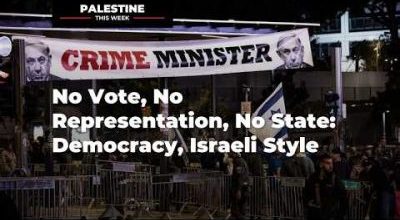
No Vote, No Representation, No State: Democracy, Israeli Style
or go to
Aletho News Archives – Video-Images
From the Archives
Sanctions, War and the Policy of Dual Containment
By SASAN FAYAZMANESH | March 17, 2008
It is now nearly three decades since the Unites States adopted the policy of dual containment of Iran and Iraq. While much has been written about the containment of Iraq, there has been very little in-depth analysis of this policy when it comes to Iran. In a book that is going to be released on March 31, 2008, entitled The United States and Iran: Sanctions, Wars and the Policy of Dual Containment (Routledge), I attempt to address this shortcoming by investigating when and why the US policy of containment of Iran came about, how it evolved, and where it stands today.[1] To the extent that Israel has been involved in US policy making, the study will also include the role that Israel has played in the containment of Iran. Also, since the fate of Iran has been inextricably linked to that of Iraq, occasionally the investigation will overlap with the containment of Iraq.
The policy of dual containment of Iran and Iraq originated during the Carter Administration, but it was not until the Clinton Administration that the expression “dual containment” became popular. … continue
Blog Roll
 Aletho News
- Americans are paying the price to preserve Israel’s nuclear hegemony
- Resistance factions are necessary to ensure a permanent US Iraq withdrawal
- How Israel destabilizes the Middle East: Denying sovereignty and the right to exist
- Europe’s Establishment Is Embracing War – and Losing Voters
- NATO chief advocates war of aggression
- No Vote, No Representation, No State: Democracy, Israeli Style
- Zionist Bought Senate Blocks Information About American Citizens Killed By Israel
- While Gaza dominates the UN, these are the people keeping it alive
- New Report: “Scholasticide and Genocide in Gaza: Assessment, Testimonies and Legal Analysis”
- ‘THAAD Delusion’: Iran war exposes US missile shield limits – The Atlantic
- If Americans Knew
- Eight Palestinians Killed in Israeli Attacks on Gaza
- Israeli former leaders and security chiefs threaten legal action over ‘Jewish terrorism’
- Israel map in LA Times ad includes all land from the river to the sea
- Inside Lebanon’s 200-page dossier on Israeli war crimes
- Flydubai, genocide, settler violence, Trump abuse of power to deport – Daily Update
- Counting Antisemitic Incidents: What the ADL Audit Reveals — and Obscures
- Mamdani releases plan to combat antisemitism and hate crimes in New York City
- Iran’s Revolutionary Guards Publish Letter to the American People
- DMFI launches $1 million ad campaign supporting Virginia’s Elaine Luria
- US Senate blocks resolution seeking report on Americans killed by Israel
- No Tricks Zone
- Green Energy Debacle: German Expert Professor Fritz Vahrenholt Warns Of Severe Economic And Social Consequences
- Two More Paleo Reconstructions Affirm Meters-Higher Sea Levels Across Ireland, Brazil 7000-6000 Years Ago
- New Study: Earth And Venus Surface Warmth Largely Explained By Convection And Lapse Rate, Not CO2 Or Radiation
- 2025 Nature Paper Claiming Worsening Global Drought Gets RETRACTED …Heavily Flawed
- New Study: ‘Global Drought Shows No Detectable Recent Acceleration Under Climate Warming’
- Economic Masterminds: German Socialists Suggest Taxing Productivity Gains Stemming From Using AI
- The South China Sea Has Not Been Cooperating With The Climate Change Narrative
- Energy Crisis: Germany Enters Heating Season With Historically Low Gas Reserve Fill Levels
- New Study: The Antarctic Ice Sheet Gained Mass From 2020-2024 Due To Staggering Snow And Ice Accumulation
- Study: Ocean Heating Rates From Thousands Of Years Ago ‘Dwarf’ Modern Ocean Heating Rates

