Russia to blame for ‘every civilian death’ in Syria, Fallon says
Press TV – April 9, 2017
British Defense Secretary Michael Fallon has accused Russia of being complicit in the ongoing bloodshed in Syria, saying Moscow is to blame for “every civilian death” in a recent suspected chemical attack in the Arab country.
Moscow is responsible “by proxy” for the deaths of civilians as the “principle backer” of the Syrian government, Fallon told British media.
Fallon further accused Russia of not doing enough to stop the conflict that has been raging on since 2011.
“Someone who uses barrel bombs and chemicals to kill his own people simply cannot be the future leader of Syria,” he said of President Bashar al-Assad.
The defense secretary also voiced his support for the US missile strikes that hit an airbase and surrounding villages in the western province of Homs in the early hours of Friday.
On President Donald Trump’s personal order, the US military launched 59 cruise missiles on al-Shayrat airfield in Homs. Trump said the attack was in response to “the Syrian government’s recent chemical attack in Idlib province.”
“By sending Tomahawk missiles to attack the airfield, aeroplane and equipment believed to be involved, it (the US) has sent a strong signal to the Syrian regime to think twice before using gas in the future,” Fallon said.
The remarks came as British Foreign Secretary Boris Johnson cancelled a trip to Russia citing a fundamental change to the situation in Syria.
The visit, on Moscow’s invitation, would have been the first by a top British diplomat in the last five years.
Reports suggest that Johnson will instead work with his American counterpart, Rex Tillerson, on a joint plan to demand Moscow withdraw military support for Damascus.
According to the Kremlin, Syrian jets had struck a terrorist warehouse in Idlib that contained toxic chemicals, leading to a gas leak in the area. More than 80 people were killed in Tuesday’s incident.
Damascus, which categorically denied responsibility for the suspected chemical attack, slammed the missile attack by the US, calling it a clear sign of Washington’s support for terrorism.
The Syrian government also vowed to intensify operations against foreign-backed militants in the country.
The US attack has sparked angry reactions from Russia and several Middle Eastern countries including Iran.
European Union foreign policy chief, Federica Mogherini, said the missile strike was not within the framework of the United Nations.
Luring Trump into Mideast Wars
By Daniel Lazare | Consortium News | April 8, 2017
Donald Trump entered military terra incognita on Thursday by launching an illegal Tomahawk missile strike on an air base in eastern Syria. Beyond the clear violation of international law, the practical results are likely to be disastrous, drawing the U.S. deeper into the Syrian quagmire.
But it would be a mistake to focus all the criticism on Trump. Not only are Democrats also at fault, but a good argument could be made that they bear even greater responsibility.
For years, near-total unanimity has reigned on Capitol Hill concerning America’s latest villains du jour, Russia’s Vladimir Putin and Syria’s Bashar al-Assad. Congressmen, senators, think-tank strategists, and op-ed analysts all have agreed that Putin and Assad are the prime enemies of “peace,” by which is meant global American hegemony, and that therefore the U.S. must stop at nothing to weaken or neutralize them or force them to exit the world stage.
Until recently, in fact, just about the only politically significant dissenter was Trump. Accusing reporters of twisting the news at a tumultuous press conference in late February, he told them, “Now tomorrow, you’ll say, ‘Donald Trump wants to get along with Russia, this is terrible.’ It’s not terrible. It’s good.”
But since getting along with Russia was terrible for America’s perpetually bellicose foreign-policy establishment, Official Washington declared war on Trump, building on Hillary Clinton’s charge during the last presidential debate that he was Putin’s “puppet.” It became the conventional wisdom that Trump was a “Siberian candidate” being inserted in the White House by a satanic Kremlin determined to bend freedom-loving Americans to its will.
As Inauguration Day approached, President Obama’s intelligence chiefs pulled out all stops to persuade the public that (a) Russian intelligence had engineered Clinton’s defeat by hacking the Democratic National Committee’s computers and placing thousands of embarrassing emails in the hands of WikiLeaks and that (b) Trump was somehow complicit in the effort.
The campaign was highly effective. The alleged Putin-Trump relationship was a major feature at the anti-Trump protests surrounding his inauguration and the major U.S. news media pounded on the Russia “scandal” daily.
On Feb. 13, barely four weeks after taking office, Trump crumbled under a mounting barrage of political abuse and gave National Security Adviser Michael Flynn the boot after it was revealed that he had talked with Russian Ambassador Sergey Kislyak during the transition, supposedly in violation of the 1799 Logan Act, an absurd piece of ancient legislation that even The New York Times referred to as “a dusty, old law” that should have been repealed generations ago.
Under Media Pressure
A day later, the administration reeled again when the Times charged in a front-page exposé that “members of Donald J. Trump’s 2016 presidential campaign and other Trump associates had repeated contacts with senior Russian intelligence officials in the year before the election.”
The article provided no evidence and no names and said nothing about whether such contacts were knowing or unknowing, i.e., whether they involved a John le Carré-style midnight rendezvous or merely an exchange of pleasantries with someone who may or may not have been connected to the FSB, as Russia’s version of the CIA is known.
In a March 6 article entitled “Pause This Presidency,” Times columnist Charles M. Blow called for little less than a coup d’état: “The American people must immediately demand a cessation of all consequential actions by this ‘president’ until we can be assured that Russian efforts to hack our election … did not also include collusion with or cover-up by anyone involved in the Trump campaign and now administration.”
How “the American people” would demand such a cessation or who would provide such assurances was not specified.
On March 31, CNN quoted an unnamed senior administration official saying that Trump’s hopes of a rapprochement with Russia were fading because he “believes in the current atmosphere – with so much media scrutiny and ongoing probes into Trump-Russia ties and election meddling – that it won’t be possible to ‘make a deal.’”
Thus, Trump found himself increasingly boxed in by hostile forces. But he still tried to fulfill his promise to concentrate on defeating terrorists in Syria and Iraq. On March 30, U.S. Ambassador to the United Nations Nikki Haley announced that the U.S. administration “priority is no longer to sit there and focus on getting Assad out,” but to concentrate on defeating Al Qaeda and ISIS instead.
But the more Trump contemplated his predicament in the following days, the more he realized how untenable it had come. Tuesday’s poison-gas incident in Idlib thus offered a way out regardless of who was actually responsible. The only way for Trump to make peace with the “deep state” in Washington was by waging war on Syria.
Finally, on Thursday, hours before Trump sent a volley of cruise missiles wafting towards Syria, Hillary Clinton taunted him by declaring that America “should take out his [Assad’s] airfields and prevent him from being able to use them to bomb innocent people.” The effect was to all but force Trump to show that he was every bit as macho as the former First Lady.
Frog-Marching Trump
Trump is certainly a fool for going ahead with such an attack in clear contravention of international law and entangling the United States more deeply into the complicated Syrian conflict. But the blame also should go to the people who frog-marched him to the precipice and then all but commanded him to step over the edge.
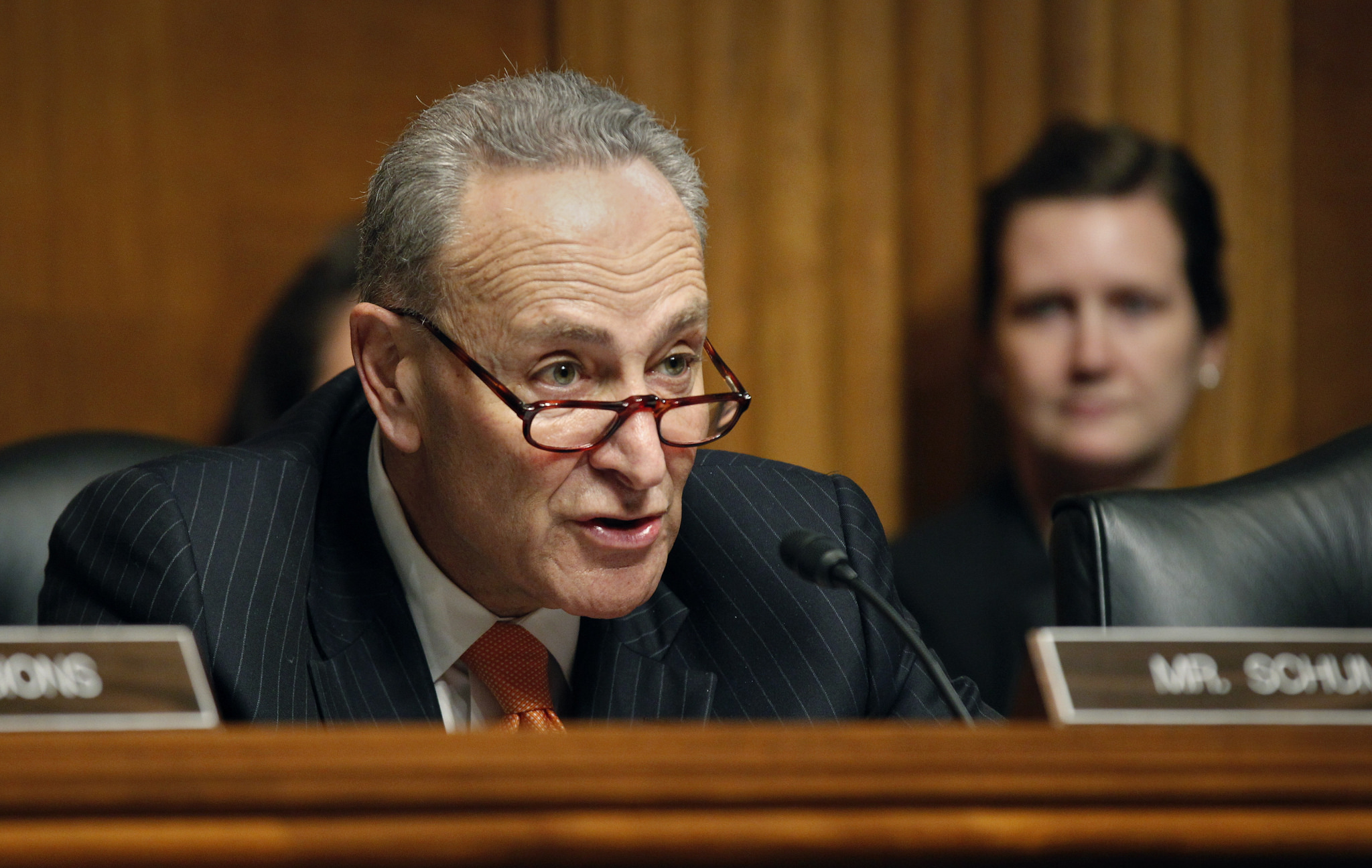
Sen. Charles Schumer, D-New York
Within hours, all the usual suspects were congratulating one of the most scorned U.S. presidents in history for taking the leap.
Senate Minority Leader Chuck Schumer said: “Making sure Assad knows that when he commits such despicable atrocities he will pay a price is the right thing to do.” House Minority Leader Nancy Pelosi described Trump’s missile barrage as “a proportional response to the regime’s use of chemical weapons.”
Republican super-hawks Senators John McCain and Lindsey Graham, previously as anti-administration as any Democrat, issued a joint statement declaring that Trump “deserves the support of the American people,” while liberal heart-throb Sen. Elizabeth Warren also agreed that “the Syrian regime must be held accountable for this horrific act.”
The Guardian, as fiercely anti-Trump as it is anti-Putin and anti-Assad, conceded that “Donald Trump has made his point” and that the next step would be up to Russia. All in all, Trump had never gotten such good press. It’s clear that Official Washington was pleased with Trump’s handiwork and was eager to encourage him to do more.
But the missile barrage was not just an assault on Syria but on reason and good sense, too. Although the Washington Post’s Adam Taylor tried to make it seem that the only critics of the missile barrage are members of the alt-right “known for espousing racist, anti-Semitic and sexist points of view,” the fact is that criticism flowed in from other quarters.
At Alternet, Vijay Prashad pointed out that there were few independent observers in Khan Shaykhun, the farming town where the April 4 incident occurred, to provide an accurate account. Eyewitnesses “with the densest relationship to the armed opposition,” he wrote, “are the first to claim that this attack was done by the government.”
Consortiumnews’ Robert Parry pointed out that rather than dropping the gas themselves, Syrian or Russian warplanes could well have triggered an outbreak by bombing a facility containing “chemicals that the rebels were planning to use in some future attack.” Parry also noted that Al Qaeda, which controls Idlib province, could have “staged the incident to elicit precisely the international outrage directed at Assad as has occurred.”
[Previously, United Nations investigators have received eyewitness testimony from Syrians about rebels staging an alleged chlorine-bomb attack so it would be pinned on the Assad regime.]
Something similar may well have occurred in August 2013, a sarin-gas missile attack on the outskirts of Damascus that killed hundreds and that appears to have been launched from a rebel-controlled area two kilometers away. The two incidents are curiously parallel.
The August 2013 incident, which horrified the world and brought the Obama administration to the brink of its own attack on the Syrian government, occurred just days after a U.N. team had arrived in Damascus to investigate an alleged chemical attack by rebels against Syrian government troops some four months earlier.
It made little sense for the Assad regime to have invited U.N. investigators in and then launch a more horrific chemical-weapons attack just miles from the investigators’ hotel. It would be a bit like someone inviting a police inspector to dinner and then committing a murder in full view.
Not Making Sense
As one independent analysis noted in 2013, the Assad regime would have to have decided to carry out a large-scale attack “despite (a) making steady gains against rebel positions, (b) receiving a direct threat from the US that the use of chemical weapons would trigger intervention, (c) having constantly assured their Russian allies that they will not use such weapons, (d) prior to the attack, only using non-lethal chemicals and only against military targets.”
The Assad government would also have had to decide “to (a) send forces into rebel-held area, where they are exposed to sniper fire from multiple directions, (b) use locally manufactured short-range rockets, instead of any of the long-range high quality chemical weapons in their arsenal, and (c) use low quality sarin.”
All of which seems supremely unlikely, but much of the mainstream U.S. media still treats the 2013 sarin-gas attack as the undeniable case of Assad crossing Obama’s “red line” against using chemical weapons. And the highly dubious 2013 incident is cited as a key reason to believe that Assad has done it again. [Recently, The New York Times has quietly backed off the 2013 claims although not explicitly retracting its earlier reporting blaming the attack on the Assad regime.]
Assad would have possibly even stronger reasons not to deploy sarin gas on April 4, 2017. He would have to make a conscious decision to court world opprobrium at a time when the tide of the war was finally turning in his favor with the liberation of Aleppo last December and with most world leaders having concluded that the Assad regime was here to stay.
To have produced and deployed a sarin bomb would have meant deliberately risking military intervention more than three years after Syria reached an agreement with the United Nations to destroy its entire chemical-weapons stockpile so as to avoid … military intervention.
All of which seems supremely unlikely as well. It would be an act of suicide – and after holding off a combined U.S., Saudi, Qatari, and Turkish assault for half a decade or more, one thing that Assad does not appear to be is suicidal.
Although Secretary of State Rex Tillerson said, “there is no doubt in our mind that the Syrian regime under the leadership of Bashar al-Assad is responsible for this horrific attack,” in reality there is plenty of doubt.
Nevertheless, Trump decided to fire away before the facts were in because the enemy he is most worried about is not the one half a world away in Syria, but the Democratic-neocon alliance in his own backyard. The political warfare in Washington is now generating more agony from real wars in the Middle East.
Russian ambassador to UN asks US counterpart to avoid insulting Russia
TASS – April 7, 2017
UNITED NATIONS – Russian Deputy Ambassador to the UN, Vladimir Safronkov, on Friday urged U.S. Ambassador Nikki Haley to refrain from insulting Russia and to put collective work at the Security Council on a healthy basis.
“I’d like to ask the speakers here – the U.S. representative and members of other delegations – to refrain from insulting my country,” Safronkov said at an emergency meeting of the Security Council. “No one has the moral right to do it. We never allow ourselves to do such things.”
As the U.S. Ambassador and current President of the UN Security Council, Haley “has a real chance to put collective work at the Council on a healthy footing but this will never happen if the viewpoint of just one nation is passed off for absolute truth.”
Nikki Haley alleged in her speech at the meeting Russia, which “(…) is supposed to be a guarantor of the removal of chemicals weapons from Syria”, had failed to do so, “(…) as innocent Syrians continue to be murdered in chemical attacks.”
“It could be that Russia is knowingly allowing chemical weapons to remain in Syria,” she claimed. “It could be that Russia has been incompetent in its efforts to remove the chemical weapons. Or, it could be that the Assad regime is playing the Russians for fools, telling them that there are no chemical weapons, all the while stockpiling them on their bases.”
“The world is waiting for Russia to reconsider its misplaced alliance with Bashar Assad,” Haley said.
Dashed Hopes for Trump’s Foreign Policy
By Gilbert Doctorow | Consortium News | April 7, 2017
My days of hoping for the best from Donald Trump – and at least appreciating the fact that he was not the neocon/liberal hawk that Hillary Clinton is – are over along with my hopes that he might implement his campaign promise and take U.S. foreign policy in a more positive, less warlike, direction.
From being possibly part of the solution, President Trump has become an integral part of the problem. And with his bigger-than-life ego, petulance and stubbornness, Commander-in-Chief Trump is potentially a greater threat to world peace than his weak-willed predecessor Barack Obama.
This week, Trump ignored Russian calls for an investigation into Tuesday’s alleged chemical gas attack in Idlib province before issuing hasty conclusions on culpability. Instead he accepted a narrative of Syrian President Bashar al-Assad’s guilt despite indications that the incident may have been either an accident (the release of poison gas at a damaged rebel warehouse) or a false-flag operation designed by Al Qaeda-affiliated rebels in Syria.
The Assad-did-it storyline was disseminated by the White Helmets and other phony NGOs that are financed by Washington and London, and that narrative was accepted by the White House. Without waiting for any comprehensive review, Trump ordered the firing of 50 or more Tomahawk missiles against a Syrian military air base in Homs province, thereby crossing all Russian “red lines” in Syria.
Until this point, the Kremlin had chosen not to react to signs coming from Washington that Trump’s determination to change course on Russia and U.S. global hegemony was failing. The wait-and-see posture antedated Trump’s accession to power when Russian President Vladimir Putin overruled the dictates of protocol and did not respond to Obama’s final salvo, the seizure of Russian diplomatic property in the U.S. and the eviction of Russian diplomats.
The Russians also looked the other way when the new administration continued the same neocon rhetoric from the tribune of the United Nations Security Council and during trips to Europe by Vice President Mike Pence, Defense Secretary James Mattis and Secretary of State Tillerson.
But the missile attack in Syria is a game-changer. The pressure on Putin to respond in some serious way will be immense. Putin has a cool mind and we may anticipate that the Russian response will come at a time of his choosing and in a manner that is appropriate to the seriousness of the U.S. offense. Look for a response by the end of the month.
In the meantime, we who have been hoping for a change of direction — for the rooting out of the neocons and liberal hawks at the heart of the Deep State — should recognize the dangers and the challenges ahead. One way or another, the White House must be told that arranging foreign policy moves out of purely domestic calculations, such as likely happened on Thursday, puts the nation’s very existence at risk.
Acting tough by striking out at Russia and its allies is not the way to form a coalition to pass a Republican tax bill or revive the repeal plans on Obamacare or divert attention from the Democrats’ obsessive investigations into Russia-gate. The same may be said of an alternative reading of the missile attack: that it was intended as a message to visiting Chinese President Xi that should there be no joint action to restrain North Korea, the United States will act alone and with total disregard for international law.
Either logic in the end is a formula for global suicide.
Gilbert Doctorow is a Brussels-based political analyst. His latest book Does Russia Have a Future? was published in August 2015. © Gilbert Doctorow, 2017
US Missile Attack on Syria Base Condemned, Welcomed
Al-Manar | April 7, 2017
Syria strongly condemned a US missile attack targeting an army airbase near Homs as an “act of aggression,” while the Zionist entity and Syrian armed opposition groups calling for further attacks.
The US military launched about 60 Tomahawk missiles against several targets on al-Shayrat air base 38 kilometers southeast of the city of Homs.
Homs Governor Talal Barazi said the US missile strikes serve the goals of armed terrorist groups and ISIL, adding that the aggression will not prevent the Syrian government from “fighting terrorism.”
Iran strongly condemned the US attack. In a Friday statement, Foreign Ministry spokesman said Tehran “roundly condemns any unilateral military action and the missile attacks against al-Shayrat Airbase in Syria by American warships.”
“Iran strongly condemns any such unilateral strikes… Such measures will strengthen terrorists in Syria … and will complicate the situation in Syria and the region,” ISNA quoted Bahram Qasemi as saying.
Bolivia requested a closed-door UN Security Council to be held on Friday. Russia also said it will call the 15-nation body into session.
A source in the Greek Ministry of National Defence said that Greece is strongly against any military intervention in Syria as it could hamper peace efforts. “Greece is strongly against any military intervention in Syria,” a National Defense Ministry source told Sputnik, adding that such action will hamper dialogue and peace in Syria.
Indonesia said it was concerned with unilateral actions “by any parties, including the use of Tomahawk missiles,” Foreign Ministry spokesman Armanatha Nasir said in a text message. “Military actions, undertaken without prior authorization of the UN Security Council, are not in line with international legal principles in the peaceful settlement of disputes, as stipulated in the UN Charter.”
The government of Japan is calling a UN Security Council emergency meeting in the wake of the US missile strike, media reported citing a government source. According to the Kyodo news agency, earlier in the day, Japanese Foreign Minister Fumio Kishida said that Tokyo was checking the information about the US strike, and that Japan would express its position after it obtained all the information.
Armed Opposition’s Position Intersects with the Zionist One Again
The foreign-backed National Coalition armed opposition group welcomed the US missile strikes and hoped they will continue in order to ‘stop Syrian government bombardment’, an SNC media official said Friday.
“We hope for the continuation of the strikes in order to prevent the regime from using its planes to launch any new air raids or going back to using internationally banned weapons,” said Ahmad Ramadan, head of the SNC’s media office.
Zionist Prime Minister Benjamin Netanyahu’s office also celebrated the attack with an early morning statement, saying he supported “strong message” sent by US strikes.
Britain gave its backing, too. “The U.K. government fully supports the U.S. action which we believe was an appropriate response to the barbaric chemical weapons attack launched by the Syrian regime and is intended to deter further attacks,” a government spokesman said.
Australia’s Turnbull, in turn, said the strikes sent “a vitally important message” that the world will not tolerate the use of chemical weapons. “The retribution has been proportionate and it has been swift,” he told reporters in Sydney. “We support the United States in that swift action.”
A few hours before the attack, President Recep Tayyip Erdogan also said on Thursday Turkey would welcome a US military attack on Syria. Speaking live on nationwide Kanal 7 TV, he said Turkey was ready to do its part if such an onslaught took place.
The Pentagon said the Russians deployed to the targeted military facility were given prior notice, and that the missiles did not hit sections of the airbase where Moscow’s forces were reportedly present.
There has been no immediate reaction from Moscow, but Russia had warned on Thursday that there could be “negative consequences” if Washington takes military action against Syria.
“All responsibility if military action occurs will be on the shoulders of those who initiated such a doubtful tragic enterprise,” Russian Deputy Permanent Representative to the UN Vladimir Safronkov said.
“Look at Iraq, look at Libya,” he said, referring to the countries which have been rocked by violence, terrorism and chaos since the West launched a military intervention.
Putin rebukes Netanyahu over ‘groundless’ accusations on suspected chemical incident in Syria
RT | April 6, 2017
Russian President Vladimir Putin told Israeli Prime Minister Benjamin Netanyahu in a telephone conversation that it was unacceptable to make “groundless” accusations concerning the alleged chemical weapons incident that took place in Syria earlier this week.
During the phone call initiated by the Israeli side on Thursday, Putin and Netanyahu stressed the importance of boosting international efforts to tackle terrorism, the Kremlin said in a statement.
Both sides “expressed readiness to expand [cooperation] in the interest of assuring stability and security in the Middle East and, first of all, in Syria,” it said.
In particular, Putin “pointed out that it was unacceptable to make groundless accusations against anyone without conducting a detailed and unbiased investigation.”
At least 70 people, including 11 children, were reportedly killed in a suspected chemical incident in the town of Khan Sheikhoun in Iblib province, Syria, on Tuesday. The US and its allies have put the blame on the Syrian government.
Earlier on Thursday, Israeli Defense Minister Avigdor Lieberman told the Yedioth Ahronoth newspaper that he was sure Syrian government forces were behind the “chemical weapons attack” in Idlib.
“The two murderous chemical weapons attacks on civilians in the Idlib region in Syria and on the local hospital were carried out by direct and premeditated order of Syrian President Bashar Assad, with Syrian planes. I say this with 100 percent certainty,” Lieberman said.
The defense minister criticized the ‘international community’ for having “zero” reaction to the incident, stressing that “the world needs to take responsibility and, instead of just talking, needs to do something.”
When asked if Russia was somehow involved in the chemical weapons attack, Liberman replied “we don’t know.”
The Russian Defense Ministry said the Syrian military carried out airstrikes in Khan Sheikhoun on April 4, hitting production facilities where terrorists stored chemicals, which were previously used in Iraq and the Syrian city of Aleppo.
Syrian Foreign Minister Walid Muallem has dismissed any accusations that the Syrian Army deployed chemical weapons in Idlib.
It’s impossible that the army – which has been making significant gains in almost all theaters of the Syrian war – would use banned chemical weapons against its “own people” and even terrorists, the minister said.
Here’s why Donald Trump is unlikely to attack Syria
By Alexander Mercouris | The Duran | April 6, 2017
The debate about the Syrian chemical attack yesterday and President Trump’s comments during a news conference with the King of Jordan have led to speculation that the US might be readying an attack on Syria.
The speculation stems from the fact that Nikki Haley, the US ambassador to the UN, said that if the UN Security Council fails to take action over the chemical attack the US might consider taking “unilateral action”, whilst President Trump himself made comments during the news conference that appeared to have the military option open.
Whilst in any international issue the possibility of unilateral military action by the US can never unfortunately be completely ruled out, on balance neither Nikki Haley’s comment nor President Trump’s comment seem to presage military action.
Nikki Haley’s comment was made during a debate in the UN Security Council about the setting up of an investigation to look into the details of the chemical attack. No one questions that such an investigation should take place. The draft Resolution prepared by the Western powers is – as with every Resolution the Western powers have proposed during the Syrian crisis – absurdly unbalanced, effectively blaming the Syrian government for the chemical attack before the investigation takes place. However even this Resolution concedes that an investigation is needed, especially after the relevant UN bodies have said that they cannot themselves say who was responsible for the chemical attack.
The Russians for their part have prepared their own draft Resolution which – far more neutrally – calls for an investigation.
It is difficult to avoid the impression that Nikki Haley’s comment was part of the game of bluff and counter bluff that nowadays regularly takes place in the UN Security Council. Specifically, she appears to have been trying to scare the Russians into agreeing to the Western draft Resolution and to drop their own.
The Russians are most unlikely to be intimidated by this kind of bluff, and having already ruled the West’s draft Resolution out they will almost certainly persist in rejecting it.
As for Donald Trump’s comments, as the entirety of his words during the press conference show, he did not directly threaten unilateral US military action in Syria but made his comments when pressed to say by a journalist whether or not he was considering military action. He declined to give any concrete answer one way or the other, but the clear impression from his comments is that he is not contemplating it.
Overall the impression President Trump’s news conference gave was that Donald Trump’s focus remains overwhelmingly on fighting ISIS – he said far more about that than about the chemical attack in Syria – and that though he does not want to give more ammunition to his domestic opponents by denying the Syrian government’s responsibility for the chemical attack, he tried to shift ultimate responsibility for the likely lack of a US reaction away from himself onto President Obama.
Ultimately the same factors that deterred a US military attack to lift the Syrian army’s siege of eastern Aleppo last autumn remain in place today. The Russian air defence system which was installed in Syria with its S400 and S300 missiles is still there. The US military in the autumn made absolutely clear their deep reluctance to engage this system, and nothing since has happened to change their views.
President Trump more than any other President in recent years looks to the US military for political support. It is even less credible that he will go against their advice than President Obama did.
In light of all this a unilateral US attack on the Syrian military on anything like the necessary scale to affect the course of the Syrian war is extremely unlikely.
Chemical attack blame game ‘failed’ at Syria conference in Brussels – Russian envoy
RT | April 6, 2017
Attempts by some members of the Brussels conference on Syria to redraw the agenda and focus on allegations of the Syrian government’s complicity in the suspected chemical attack in Idlib have failed, Russia’s deputy foreign minister has said.
“In what concerns this conference, of course, some tried to redirect it in order to focus attention on the incident that has occurred [in Idlib]. I must say that they failed to achieve that,” said Gennady Gatilov, Russia’s representative at the UN-sponsored international donor conference that was held on April 4-5 in Brussels.
Moscow hopes that the incident will not lead to the derailment of intra-Syrian talks as that would play into hands of those who strive to obstruct the peace process.
“Anything can affect the talks. But we would not like for such incidents to be used by opponents of the negotiation process to disrupt it,” the Russian diplomat said, stressing that it is necessary for the negotiations to be inclusive.
Despite the apparent discord at the conference, its participants were largely united in that there is no alternative to political settlement to the protracted military conflict.
“I would like to note that all spoke in favor of political solution, the majority agreed that there is no military solution,” Gatilov said, as cited by TASS. He added that “practically all hailed” the negotiations in Astana made possible by the mediation of Russia, Turkey and Iran and commended them as “great help” for the Geneva process.
No breakthrough has yet been achieved in the talks, Gatilov said, referring to the latest round of intra-Syrian negotiations that took place in Geneva last week.
“Regrettably, so far it has yielded no practical results but it is not the reason to say that the round failed. Obviously, it is going to be a long process and we had been saying this all the time,” Gatilov said.
The slow progress is due to major differences between the take of the Syrian government and rebels on an array of key issues, he said. The major point of disagreement between the sides is what topic should be given a priority in the talks. While opposition argues that the talks should pave way for a transitional government, the Syrian authorities insist on the preeminence of the fight against terrorism.
On Tuesday, a suspected chemical attack on the hospital in the town of Khan Sheikhoun in rebel-held Idlib province claimed the lives of dozens of people, including children. Rebel groups accused the Syrian government of mounting the attack, the claims which the Syrian authorities flatly denied.
Russia has demanded a thorough investigation into the incident, saying it should be led by the Organization for the Prohibition of Chemical Weapons (OPCW), Russian Foreign Ministry spokeswoman Maria Zakharova said. The OPCW will be entrusted with collecting evidence of the attack within the fact-finding mission. The composition of the mission should be subject to approval by the UN Security Council.
In the aftermath of the attack, Russia’s Defense Ministry issued a statement, saying that the Syrian Air Force on Tuesday bombed a warehouse housing chemical weapons bound for Iraq. The storage facility, which was used to produce and store munitions containing toxic gas, was managed by the rebels. Defense Ministry spokesman Major-General Igor Konashenkov noted that the symptoms displayed by the victims of the attack in Khan Sheikhoun are similar to those shown by civilians who suffered in the Aleppo chemical attack, perpetrated by the militants.
The death of civilians has sparked an international outcry, with some of the Western governments, including the US, backing the allegations put forward by the rebels.
Commenting on the attack, US President Donald Trump said that it was “unacceptable” went “beyond the red line” and made him to rethink his stance on the Syrian government and President Bashar Assad.
In his turn, Vice President Mike Pence blamed the attack on a “failure of the past administration to both confront the mindless violence of the Assad regime and also hold Russia and Syria to account for the promises to destroy chemical weapons,” in an interview to Fox News on Wednesday.
Responding to a question, if Washington sees Moscow also responsible for the attack, Pence stated that Russian must ensure the implementation of the pledge by the Syrian government to destroy all chemical stockpiles, saying that “the time come has come for them [Russia] to keep the word that they made, to see the elimination of the chemical weapons so that they no longer threaten the people in that country.”
“We were told that there were an agreement between Russians and Assad to destroy chemical weapons and that the threat to civilians from a chemical attack had been eliminated, it was not,” Pence claimed.
Russia submits resolution to UN on chemical weapons attack in Syria
By Adam Garrie | The Duran | April 6, 2017
Russia has tabled a UN Security Council resolution calling for a through investigation of the chemical weapons incident in Idlib Governorate.
Vladimir Safronkov, Russia’s acting Ambassador to the UN who has stepped in to fill the position of the late Vitaly Churkin has said,
“… we submitted our short draft resolution, drawn up in a business manner and aimed at conducting a true investigation rather than to appoint the guilty ones until the facts are established”.
The Russian draft resolution proposes to,
“… fully investigate the reports about the incident on the ground under the mandatory condition that the list of investigators will be submitted to the UN for approval and will be geographically balanced as well”
This is in sharp contrast to the US-UK-France co-sponsored resolution which automatically assigned blame to the Syrian government in spite of clear evidence to the contrary. That resolution was vetoed by Russia.
The Russian resolution calls for the Organisation for the Prohibition of Chemical Weapons, the group which helped the Syrian government to remove the remains of its chemical weapons stockpiles in 2013, to explore this incident.
It also demands that illegal terrorist groups cooperate with investigations, something which may not be possible.
This response is similar to Russia’s reaction to the use of chemical weapons in Donbass by forces loyal to the Kiev regime. At that time Russia called for an investigation rather than a war.
Syria denies & condemns use of chemical weapons – foreign minister
RT | April 6, 2017
Syria’s foreign minister has dismissed allegations that the Syrian Army had deployed chemical weapons in the city of Idlib, saying the military will never use such weapons against its own people or even terrorists.
Syrian Foreign Minister Walid Muallem denied claims that the military used chemical weapons in the western city of Idlib. Speaking at a news conference on Thursday, Muallem said an airstrike by Syrian military had targeted an arms depot where chemical weapons stockpiles were stored by Islamic State (IS, formerly ISIS/ISIL) and Al-Nusra Front militants.
He said it’s impossible that the army – which has been making significant gains in almost all theaters of the Syrian war – would use banned chemical weapons against its “own people” and even terrorists.
Asked if Damascus would allow a fact-finding mission into the Idlib incident, Muallem said past experience of similar investigations was “not encouraging.” He also said that he could not predict “the reality of US intentions” in Syria.
Muallem added that such a mission must not be politicized and must start its operations “from Damascus, not Turkey,” apparently referring to the latest statements by Ankara condemning the incident, as well as the fact that some victims were taken to Turkey for autopsy.
‘Monstrous crime’
Meanwhile, Dmitry Peskov, spokesman for the Russian president, said the Kremlin believes the Syrian military will do its utmost to prevent chemical agents from falling into the hands of terrorists.
“This was indeed a dangerous and monstrous crime, but in our opinion, it would be wrong to point fingers,” Peskov told reporters on Thursday. The Kremlin spokesman said Moscow does not agree with assessments provided by certain Western countries.
“Immediately after the tragedy no one had access to this area, so no one could have hard verifiable data. Consequently, any information which the US side or our colleagues from other countries might have had access to, could not be based on objective facts,” Peskov told reporters.
Though Peskov rejected “hasty assessments” of the alleged use of chemical weapons, he emphasized that there are always disagreements between Moscow and Washington, but mutual discords over the Idlib incident are unlikely to affect “the spirit of our cooperation.”
Earlier in the day, the Russian Foreign Ministry dismissed as “unsubstantiated” statements by US Vice-President Mike Pence that Moscow and Damascus had failed to fulfill their obligations under a landmark 2013 deal to eliminate Syria’s chemical weapons arsenals.
“I wouldn’t use profane language, especially when it comes to the second-most powerful man in the US administration, but I do believe that this is ignorance rather than irresponsibility,” Mikhail Ulyanov, head of the ministry’s Arms Control Department, said.
“The new administration has only recently begun reviewing its policy. Once that’s done, American officials’ statements, I hope, will become more accurate. There is no reason to say the US-Russia agreements [on eliminations Syria’s chemical weapons stockpiles] did not work,” Ulyanov stated.
Made in Usa: Democratic Navalni

By Manlio Dinucci | Voltairenet | March 29, 2017
A police officer smashes down the door with a portable battering ram; another one enters, pointing a pistol and strikes several times, a man who, roused by the break in, reached for a baseball bat; yet other police officers point their guns at a child who has already raised his arms: scenes of ordinary “legal” violence in the United States, reported a week ago, with video clips by the New York Times, that talks about the “trail of blood” triggered by these “raids”, carried out by former soldiers, who have been recruited into the police force, applying the same raid techniques that would be applied in raids in Afghanistan or Iraq.
Our mass media shield our eyes from all this. These same media outlets splash on the front page [photos of] the Russian police arresting Alexei Navalni in Moscow for a demonstration that had not been authorized. An “affront to fundamental democratic values” – this is how the US State Department defines it and firmly requires his immediate release and that of the others detainees. Federica Mogherini, the EU High Representative of Foreign Policy, also condemns the Russian government because “it prevents the fundamental freedoms of expression and peaceful assembly from being exercised”. Thus, in support of the new champion of “democratic values”, everyone is united in the new campaign launched against Russia in tones that typify the Cold War.
Who is Alexei Navalni? From his official profile, we read that he trained in the US, at Yale University, as a “fellow” (a chosen member) of the “Greenberg World Fellows Program”. This programme was established in 2002, and each year, just 16 individuals with attributes that make them “global leaders” are selected from all around the world. They form part of a network of “leaders globally committed to making the world a better place”. At the moment, this network is composed of 291 fellows from 87 countries, one in contact with the other and all linked to the US centre, Yale.
Navalni is, at the same time, the co-founder of the movement “Alternative democracy”. This is one of the beneficiaries of the National Endowment for Democracy (NED), a powerful US “private non-profit foundation” which funds, which are even provided by the Congress, openly or under the counter, thousands of non-governmental organizations in more than 90 countries to “advance democracy” [1]. NED, a CIA outlet for covert operations, was and is, particularly active in Ukraine. It was here that it supported (according to what is reported) “the Maiden Square Revolution which crushed a corrupt government which stood in the way of democracy”. The result of the Maiden Square Putsch: an even more corrupt government has come into power. Indeed, its democratic character finds expression in the Neo-Nazis that hold key positions in it.
In Russia, activities of “undesirable non-governmental organizations” are prohibited and this is why NED has not stopped campaigning against the Russian government. Thus NED accuses it of spearheading an aggressive foreign policy to bring within its sphere of influence, states that previously formed part of the USSR. This charge is the foundation of the basis for the US/NATO strategy against Russia. The technique, now consolidated, is that of the “orange revolutions”: gaining mileage on the back of genuine or invented cases of corruption and other bones of dissatisfaction so as to whip up an anti-government rebellion, which will weaken the state from within, while increasing military, political and economic pressure externally. Alexei Navalni’s activities should be viewed in this context. He specialized at Yale as a lawyer, defending the rights of the vulnerable against abuse by the powerful.
[1] “NED, the Legal Window of the CIA”, by Thierry Meyssan, Translation Anoosha Boralessa, Оdnako (Russia) , Voltaire Network, 16 August 2016.
Translation by Anoosha Boralessa
‘We are compelled to take own action’ if UN fails in Syria – US envoy
RT | April 5, 2017
The UN Security Council convened on Wednesday to discuss a draft resolution proposed by the US, the UK and France, which would condemn Damascus for the reported use of chemical weapons in the town of Khan Sheikhoun in Idlib province on Tuesday.
Russia criticized the draft resolution for being unbalanced and jumping to conclusions. It said the document would have to include several amendments, such as calling on the rebels controlling the area to provide full access to UN investigators and setting an unbiased and comprehensive probe into the incident as the primary goal of the resolution.
“This draft was penned in haste and adopting it would have been irresponsible,” the Russian deputy acting envoy to the UN, Vladimir Safronkov, said.
He also blamed Western members of the UNSC for unwillingness to investigate previous cases of alleged use of chemical weapons in Syria, where rebel groups were accused of using toxin agents.
Nikki Haley, the US ambassador to the UN, delivered an emotional speech that included images of children to argue in favor of swift action. The pictures were used in reporting of the alleged chemical weapons attack.
She claimed the incident carried “all hallmarks” of an attack by Damascus, adding that the toxin used in the alleged assault was “more deadly” than in previous cases attributed to the Syrian military by Washington.
US envoy to UN also accused Russia of failing to ensure that there were no chemical weapons in the possession of the Syrian government.
“The truth is that Russia, Iran and [Syrian President] Assad have no interest in peace,” Haley claimed.
The US has hinted at taking its own action in Syria unless the UN Security Council moves to prevent the use of chemical weapons in the war-torn country.
“When the United Nations consistently fails in its duty to act collectively, there are times in the life of states that we are compelled to take our own action,” the US ambassador to the UN said.
Featured Video
Can the U.S. Afford to Annihilate Iran?
or go to
Aletho News Archives – Video-Images
From the Archives
Sanctions, War and the Policy of Dual Containment
By SASAN FAYAZMANESH | March 17, 2008
It is now nearly three decades since the Unites States adopted the policy of dual containment of Iran and Iraq. While much has been written about the containment of Iraq, there has been very little in-depth analysis of this policy when it comes to Iran. In a book that is going to be released on March 31, 2008, entitled The United States and Iran: Sanctions, Wars and the Policy of Dual Containment (Routledge), I attempt to address this shortcoming by investigating when and why the US policy of containment of Iran came about, how it evolved, and where it stands today.[1] To the extent that Israel has been involved in US policy making, the study will also include the role that Israel has played in the containment of Iran. Also, since the fate of Iran has been inextricably linked to that of Iraq, occasionally the investigation will overlap with the containment of Iraq.
The policy of dual containment of Iran and Iraq originated during the Carter Administration, but it was not until the Clinton Administration that the expression “dual containment” became popular. … continue
Blog Roll
 Aletho News
- Can the U.S. Afford to Annihilate Iran? /Seyed M. Marandi
- Elmo Sold mRNA Jabs to Your Toddler. Now They Are “Off-Label.”
- British state targets Palestine Action with yet another crooked trial
- Americans are paying the price to preserve Israel’s nuclear hegemony
- Resistance factions are necessary to ensure a permanent US Iraq withdrawal
- How Israel destabilizes the Middle East: Denying sovereignty and the right to exist
- Europe’s Establishment Is Embracing War – and Losing Voters
- NATO chief advocates war of aggression
- No Vote, No Representation, No State: Democracy, Israeli Style
- Zionist Bought Senate Blocks Information About American Citizens Killed By Israel
- If Americans Knew
- Israeli Soldiers Abduct At Least 22 Across Occupied West Bank
- Eight Palestinians Killed in Israeli Attacks on Gaza
- Israeli former leaders and security chiefs threaten legal action over ‘Jewish terrorism’
- Israel map in LA Times ad includes all land from the river to the sea
- Inside Lebanon’s 200-page dossier on Israeli war crimes
- Flydubai, genocide, settler violence, Trump abuse of power to deport – Daily Update
- Counting Antisemitic Incidents: What the ADL Audit Reveals — and Obscures
- Mamdani releases plan to combat antisemitism and hate crimes in New York City
- Iran’s Revolutionary Guards Publish Letter to the American People
- DMFI launches $1 million ad campaign supporting Virginia’s Elaine Luria
- No Tricks Zone
- Green Energy Debacle: German Expert Professor Fritz Vahrenholt Warns Of Severe Economic And Social Consequences
- Two More Paleo Reconstructions Affirm Meters-Higher Sea Levels Across Ireland, Brazil 7000-6000 Years Ago
- New Study: Earth And Venus Surface Warmth Largely Explained By Convection And Lapse Rate, Not CO2 Or Radiation
- 2025 Nature Paper Claiming Worsening Global Drought Gets RETRACTED …Heavily Flawed
- New Study: ‘Global Drought Shows No Detectable Recent Acceleration Under Climate Warming’
- Economic Masterminds: German Socialists Suggest Taxing Productivity Gains Stemming From Using AI
- The South China Sea Has Not Been Cooperating With The Climate Change Narrative
- Energy Crisis: Germany Enters Heating Season With Historically Low Gas Reserve Fill Levels
- New Study: The Antarctic Ice Sheet Gained Mass From 2020-2024 Due To Staggering Snow And Ice Accumulation
- Study: Ocean Heating Rates From Thousands Of Years Ago ‘Dwarf’ Modern Ocean Heating Rates

