This Madness Deserves a Protest: an Inside Account at US Nuclear Weapons Strategy
By Joan Roelofs | CounterPunch | April 5, 2017
“In contrast to the Soviet Union, the United States has always maintained its ‘right’ to carry out a nuclear first strike. This has never changed and was reaffirmed by Defense Secretary Ashton Carter . . . on September 27, 2016.”
— Diana Johnstone, From MAD to Madness.
There is not much hope for the retraction of this threat. On March 21, Reuters reported “Trump has said that while he would like to see nuclear weapons abolished, he wants the United States to have an unrivaled arsenal. He also said that the United States has ‘fallen behind’ in its nuclear capabilities, even though it is in the midst of a 30-year, $1.3 trillion drive to modernize what most experts agree is the world’s most powerful nuclear force.”
An insider’s memoir, From MAD to Madness, by Paul H. Johnstone, describing the persistence of the US nuclear threat has recently been published by Clarity Press. Johnstone was a senior analyst in the Strategic Weapons Evaluation Group in the Department of Defense, directing studies on the probable consequences of nuclear war, to us and to them, and also an author of The Pentagon Papers. He died in 1981, leaving his memoir to his daughter, author (and CounterPunch contributor) Diana Johnstone. He had previously served in World War II as an evaluator of Japanese enemy targets, but as Diana says here: “Hiroshima changed the nature of targeting dramatically, and that is the story my father tells in his memoir.”
In this book Diana has finally published his “Memoir of a Humanist in the Pentagon,” along with her added commentary and a foreword by Paul Craig Roberts. Roberts expresses in a nutshell the contemporary horrific relevance of the book: “The neoconservatives in pursuit of their goal of US world hegemony have resurrected the possibility of nuclear war. The neocons have taken us from MAD to madness.”
The neocons are not some far-right fringe group; they represent the mainstream of US foreign policy in recent Democratic and Republican administrations. The political use of the nuclear threat has a long history. It was inaugurated by the nuclear bombing of Hiroshima and Nagasaki, a political decision opposed by the military. Admiral Leahy, Chairman of the Joint Chiefs of Staff wrote: “the use of this barbarous weapon at Hiroshima and Nagasaki was of no material assistance in our war against Japan. The Japanese were already defeated and ready to surrender. . .” The Truman Doctrine (1947) indicated that there were no regrets. It stated in effect that any country that appeared to be adopting a communist form of government, whether through outside intervention, civil war, or ordinary elections, would be subject to whatever punishment the United States chose to inflict, not excluding nuclear attack.
Johnstone traces the “breather” in our policy characterized by MAD—the idea that Mutually Assured Destruction: a path to mutual suicide—was a deterrent to the use of nuclear weapons. This realization by our government occurred once Soviet nuclear capability became obvious. However, as Roberts notes, after the Soviet collapse in the 1990s the US “resurrected nuclear weapons as usable weapons of war. The Obama regime . . . authorized a trillion dollar expenditure for nuclear weapons, and US war doctrine elevated nukes from a retaliatory role to pre-emptive first strike.” Roberts, who was United States Assistant Secretary of the Treasury for Economic Policy under President Reagan in 1981, maintains that Reagan and Gorbachev “eliminated the risk of Armageddon by negotiating the end of the Cold War.”
Johnstone’s exposition of US nuclear policy is sobering, and his special vantage point as an insider is a revelation about how foreign policy is concocted. The conclusions and the process are both astonishing.
Although the Cold War, often hot, was fought in many parts of the world, Johnstone’s main task was to assess the consequences of nuclear war with the Soviet Union. Its probability was not a major concern for the analysts; plenty of those on our side were raring to use this super weapon.
Johnstone worked with the assistance of many teams, task forces, and committees. He noted that among those charged with divining Soviet intentions, few had any expertise on the subject: “Kennan was shunted aside. . . as insufficiently anti-Soviet.” State Department analysis or research was rarely seen or considered significant by the military or White House representatives on the committees. “Kennedy. . . seems to have depended far more on his longstanding, seat-of-the-pants notions of how to interpret Soviet intentions.”
“Almost never was there any suggestion that Soviet arms were in any way defensive, or that the Soviets feared us.” A related insider study of the decision-making process in the Kennedy White House is James C. Thomson, Jr.’s “How Could Vietnam Happen? An Autopsy.”
At the time (and now, in spades) intelligence sources were multiplex. Each of the military branches had its own intelligence division, in addition to outside contractors. There were also the agencies of the State Department, the CIA and the NSA; spies working for the Commerce and Agriculture Departments; overseas (especially Latin American) operations of the FBI; and “debriefings” of anyone who had traveled to any sensitive area, including exchange students and professors, journalists, the burgeoning INGO (International Non-Governmental Organizations) crowd, and real or fake businesspeople. In the confusion, the information that reached the senior operational people was determined by biases all along the way, including assumptions about what the President wanted to hear. An eloquent recounting of how fantasies were substituted for accurate information about Southeast Asia can be found in Ralph McGeHee’s Deadly Deceits.
Interservice rivalries influenced the strategy envisioned for a future war. At first the Air Force had a near monopoly on weapons, so the Army advocated for conventional warfare.
Later, all branches had nuclear delivery systems, and competing for budget allocations, advocated their use. An addition to the Navy’s arsenal was very recently announced: “The US preemptive nuclear strike capability has significantly grown. The strategic nuclear forces modernization program has implemented new revolutionary technologies to vastly increase the targeting capability of the US submarine-launched ballistic missile (SLBM) arsenal.”
In the post-WWII period, despite all the analysts recruited for this task, there was great uncertainty in all the calculations of damage to the economic base, civilians, and the very structure of a society targeted with nuclear weapons. Assumptions were often made on the basis of earlier wars, where destruction of factories and resources was intended to disable armament production. Before nuclear weapons, the theory was that wars could be fought and won by this type of strategic bombing. However, after a nuclear attack, the military, political, and environmental consequences of initial radiation and continuing fallout, with or without shelters, could never be determined; only imagined.
Nevertheless, the military advisors on the committees had a hunch that a pre-emptive strike to destroy the USSR would be the least destructive option, so their hearts were in it. They assumed that a nuclear exchange would create millions of casualties in the US, but that “the US would continue to exist as an organized and viable nation, and ultimately would prevail, whereas the USSR would not.”
Much more attention was paid to the prospect of nuclear annihilation of the Soviet Union than the consequences of an initial or retaliatory attack on the United States. Johnstone’s sober view was that any issue that precipitated a war would be dissolved by the ensuing devastation; there could be no victor in a nuclear war.
Johnstone includes two case studies in which his Weapons Systems Evaluation Group participated: the Laos Crisis of 1960-1961 and the Berlin Crisis of 1961. In the case of Berlin, plans were prepared for stages of retaliation all the way to nuclear war in anticipation of the USSR interfering with traffic from the West into Berlin on the Autobahn. The Soviets had been requesting identification or delaying document checking in ways that the US considered unwarranted. These “microaggressions” were interpreted as merely a prelude to a showdown. As an additional indication of our resolve to protect our access to Berlin, the Joint Chiefs of Staff suggested that we should go to war in Southeast Asia.
At no time during these crises, or in the planning for nuclear war, did Johnstone note any concern by committee members for international law, not only its prohibitions, but also its many mechanisms for resolving disputes. War had been outlawed by the Kellogg-Briand Pact in 1928. The Charter of the United Nations, a ratified treaty commitment of the US, prohibits war as an instrument of foreign policy; even the threat of war is an international crime.
Article 2, Section 4: All Members shall refrain in their international relations from the threat or use of force against the territorial integrity or political independence of any state, or in any other manner inconsistent with the Purposes of the United Nations.
Customary international law prohibits any weapon that does not discriminate between civilians and combatants. This was used by the International Court of Justice in its 1996 advisory opinion on the use of nuclear weapons:
It follows from the above-mentioned requirements that the threat or use of nuclear weapons would generally be contrary to the rules of international law applicable in armed conflict, and in particular the principles and rules of humanitarian law.
However, in view of the current state of international law, and of the elements of fact at its disposal, the Court cannot conclude definitively whether the threat or use of nuclear weapons would be lawful or unlawful in an extreme circumstance of self-defence, in which the very survival of a State would be at stake.
The Treaty on the Non-Proliferation of Nuclear Weapons, 1970, requires nuclear-weapon countries to undertake progressive nuclear disarmament toward the goal of complete elimination of nuclear weapons. This is not the direction being followed by the US, among other signatories.
Johnstone began his federal service in 1937 as a historian in the Department of Agriculture, and Diana notes that his career mirrored the changes in the US economy: “America turned from farming to bombing as the basis of its industrial economy. . .” Yet the Cold War itself, although tragically affirmed by the nuclear bombing of Japan, has a much longer history (some say it started in 1848), and includes US and allied participation in the “hot” invasion of the USSR after the 1917 Revolution and the US corporate assistance during the 1930s in creating Hitler’s war machine. This buildup proceeded apace, with the participation of the great US corporations. During the same period, the President exercised a Congressional mandate to prohibit arms trades that supported war. It was imposed on a US corporation, Curtiss-Wright, selling arms to Bolivia for its border war against Paraguay: the Chaco War. As it turned out, that was not the greatest threat to world peace.
Johnstone believed that our Cold War policies were irrational, and that we could have made friends with the anti-colonial, nationalistic revolutionary movements that our “anti-Communist obsession . . . led us to oppose.” Maybe it is a question of who is “us”?
The vast population of the US, rich in resources, inventiveness, and skilled labor could easily have co-existed with socialist societies, intent on self-development and willingly engaging in fair trade. Multinational corporations, however, were challenged by nations that wanted to expel their oil rigs, gold miners, sweatshops, cigarettes, pesticides, telephone services, chemical factories, waste dumps, and even innocent Coca-Cola.
The military and the increasingly gigantic industries equipping it wanted bases everywhere, and somewhat plausible threats that would justify annual upgrading of the lethal arsenal. Wars now and then that would enable testing and destruction of weapons were also useful for the advancement of warriors and profits of contractors. Furthermore, revolutions that were allowed to succeed and improve the lives of people might create imitators in our land of vast wealth accompanied by astounding poverty and misery.
Yet neither Roberts nor Johnstone discusses the role of multinational corporations and the military-industrial complex in motivating and perpetuating the post-WWII Cold War. They attributed major influence on US policy to anti-Soviet émigrés (Kissinger, Brzezinski and others) from Eastern Europe. A high-level Air Force intelligence “Special Studies Group,” headed by a Hungarian émigré “expert” predicted in every annual appraisal that there would be “a massive Russian land attack on Western Europe the following year.”
The worldwide cold war between capitalism and socialism continues—in Cuba, among other places—and there is now also the megalomaniac goal of world hegemony. The projected attack by the now-capitalist Russia is still awaited, despite indications that the Russians want to eliminate the specter of civilization’s total nuclear destruction. Johnstone’s sober prediction in From MAD to Madness: “there can be no victor in a nuclear war” must be given priority by the newly-awakened activists. The abolition of nuclear weapons would be a step towards sanity.
 Joan Roelofs is Professor Emerita of Political Science, Keene State College, New Hampshire. She is the translator of Victor Considerant’s Principles of Socialism (Maisonneuve Press, 2006), and author of Foundations and Public Policy: The Mask of Pluralism (SUNY Press, 2003) and Greening Cities (Rowman and Littlefield, 1996) and translator, with Shawn P. Wilbur, of Charles Fourier’s anti-war fantasy, World War of Small Pastries, Autonomedia, 2015. Web site: www.joanroelofs.wordpress.com Contact: joan.roelofs@myfairpoint.net
Kremlin Disagrees With Polish Claim of Traffic Controllers Provoking 2010 Crash
Sputnik – 03.04.2017
MOSCOW – The Kremlin disagrees with Poland’s accusations toward Russian air traffic controllers of provoking the deadly 2010 plane crash that killed then-president Lech Kaczynski and other officials, Kremlin spokesman Dmitry Peskov said Monday.
National Public Prosecutor’s Office deputy chief Marek Pasionek said earlier in the day that Poland had amassed evidence to bring “charges of the crime of deliberately provoking the catastrophe.” Pasionek said the accusations have been leveled against Russian air traffic controllers and a “third person” in the flight control tower.
“Certainly, the circumstances of this tragedy, this catastrophe, have already been seriously investigated, examined and of course it is not seen as possible to agree with these conclusions,” Peskov told reporters.
On April 10, 2010, a Russia-made passenger plane carrying Kaczynski, his wife, and a number of high-ranking Polish officials crashed as it attempted to land at an airfield covered in heavy fog near Smolensk. All 96 people on board died in the Tu-154M crash.
The Polish Defense Ministry said last year that Warsaw would restart its investigation into the crash from scratch.
Drills With Russian-Speaking Extras Mean NATO ‘Preparing for Ukrainian Scenario’
Sputnik – March 31, 2017
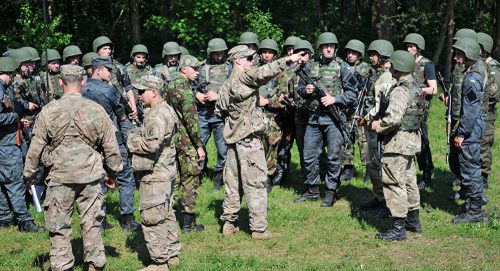
Germany’s recently published job offer for Russian “extras” for US and NATO military drills caused vivid reaction among media and politicians. Political observer Alexander Khrolenko believes that Western armed forces are being trained “for a Ukrainian scenario.”
According to the expert, the exercises mean that NATO is preparing for a full-scale military conflict with Russia.
“It is not difficult to guess that the Pentagon has organized training for a Ukrainian scenario, because the only ‘crisis region’ in Europe, where people speak Russian, is Donbass,” Khrolenko wrote for RIA Novosti.
In his opinion, the Pentagon is concerned about the psychological factors servicemen may face in a war against Russians.
“The simulation of the conflicts with partisan groups in large cities makes it possible to predict major problems in the area of operation that can involve the Russian-speaking population,” the journalist wrote.
Earlier, a job offer was published on the official web portal of Berlin on Sunday seeking Russian “role players” for North Atlantic Treaty Organization (NATO) and US Army training drills.
“We are looking for performers to take part in role games during US military exercises,” the website said.
The starting date was said to be April 26. All participants must have a good knowledge of Russian, English and German. It would be “a great advantage” if they also know Polish or Czech, the advertisement said.
“Interestingly, there are no signs of an international scandal in Germany. If Russia were recruiting American extras for military exercises, then there would be a lot of noise. But now everything is good,” the expert noted.
According to Khrolenko, only several activists oppose the drills. For instance, Deputy Chairman of the German Left Party Tobias Pfluger called the job offer “a disaster from the point of view of world politics.” He also noted that the situation is quite dangerous and can lead to escalation given the high concentration of NATO forces deployed against Russia.
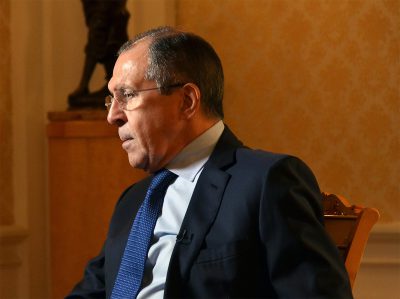
Russian FM Lavrov’s March 29, 2017 interview with National Interest Magazine
Question: I’d like to start by asking you about your forthcoming meeting with US Secretary of State Rex Tillerson, we’ve read in the press that the two of you may be meeting soon.
Sergey Lavrov: So they say.
Question: Could you perhaps tell us about your expectations and goals in dealing with Secretary Tillerson?
Sergey Lavrov: Well, after the American election, soon after Election Day President Putin and President-elect Trump talked over the phone. It was a good but very general discussion touching upon the key issues in our relations, and of course the key international issues. And they agreed that they would continue being in touch and after the inauguration they talked again, and they reconfirmed the need to look for ways which would be effective in handling international problems. And of course to see what could be done to bring the bilateral relations to normalcy. They also agreed that Mr. Rex Tillerson and I would look into the agenda in some more details, and would also discuss the preparation for the presidential meeting which should take place when both countries, both leaders feel comfortable.
And we met with Rex in mid-February in Bonn on the margins of the G-20 ministerial meeting, and covered quite a lot of the bilateral agenda. I briefed him about the relationship on bilateral issues with the Obama administration, the problems which accumulated during that period. We did not go into the substance of this, I just briefed him so that his team, which is still being assembled, could take a look at these issues and determine what kind of attitude they would have on them. And we discussed Syria, Iran, the Korean Peninsula, the Middle East in general, relations between Russia and the West, it was a very general, but rather substantive discussion, obviously it was the first contact and Mr. Rex Tillerson is just getting into the shoes of his new capacity. We discussed the possibility of personal meeting and have been continuing these discussions. As soon as we finalize them it will be announced.
But my feeling is that from the point of view of personal relationship, we feel quite comfortable. I feel quite comfortable, I believe Rex had the same feeling, and our assistants should work closer but of course this could only be done when the team in the State Department is complete.
Question: Of course. If I could follow up on your answer there, you mentioned bringing normalcy to the U.S.-Russia relationship. What do you think “normal” is?
Sergey Lavrov: “Normal” is to treat your partners with respect, not to try to impose some of your ideas on others without taking into account their own views and their concerns, always to try to listen and to hear, and hopefully not to rely on a superiority complex, which was obviously the case with the Obama administration. They were obsessed with their exceptionality, with their leadership. Actually the founding fathers of the United States, they also spoke of their leadership, and they believed that the American nation was exceptional, but they wanted others just to take the American experience as an example and to follow suit. They never suggested that the United States should impose, including by force, its values on others.
And the Obama administration was clearly different. Actually, long before Ukraine, long before Crimea, in early December 2012, there was an OSCE ministerial meeting in Dublin. And Hillary Clinton was Secretary of State and was the head of the delegation, we had a bilateral meeting with her, she was trying to persuade me on something which was a difficult issue on the agenda, but I recall this situation because in the margins of this ministerial meeting she attended a meeting in the University of Dublin, and she delivered a lecture in which she said something like: “We are trying to figure out effective ways to slow down or prevent the move to re-Sovietize the former Soviet space.” December 2012.
What kind of action she was considering as the move to re-Sovietize the space, I really couldn’t understand. Yes, there were discussions about Ukraine, about Kazakhstan, Belarus and Russia, forming the Customs Union, and if this was the reason, then of course it showed very obviously the real attitude of the Obama administration to what was going on in the former Soviet space and the area of the Commonwealth of Independent States, its obvious desire to take over this geopolitical space around Russia without even caring what Moscow might think.
This was the reason for the crisis in Ukraine, when the U.S. and European Union bluntly told the Ukrainians: either you are with us, or you are with Russia against us. And the very fragile Ukrainian state couldn’t sustain this kind of pressure, and what happened- happened: the coup, and so on and so forth (if you want I can discuss this in some detail later). But my point is that they considered normal that the people in Obama’s team should call the shots anywhere, including around such a big country as the Russian Federation. And this is absolutely abnormal in my view.
At the same time, when we visited Venezuela with our naval ships, they were raising such hell, as if no one could even get closer to what they believe should be their backyard. This mentality is not adequate for the twenty-first century. And we of course notice that President Trump is emphasizing the need to concentrate on U.S. interests. And foreign policy for him is important as long as it serves the United States’ interests, not just some messiah projects doing something just for the sake of showing that you can do it anywhere. It’s irrational, and in this he certainly holds the same position as we do in Moscow, as President Putin does, that we don’t want to meddle in other people’s matters. When the Russian legitimate interests are not, you know involved.
Question: You just mentioned at the end of your statement that the United States shouldn’t meddle in others’ affairs, and obviously many Americans today feel that Russia has meddled in American affairs, in the 2016 election. Your government has denied that. But how do you explain what happened in the United States? Do you feel that Russia had any involvement or any responsibility at all for what transpired?
Sergey Lavrov: I believe that these [are] absolutely groundless accusations – at least I haven’t seen a single fact that this was substantiated. I believe these accusations were used as an instrument in the electoral campaign, which for some reasons seemed to the Democratic Party to be an efficient way to raise support among the American people, playing on their feelings that no one shall meddle with American affairs. This is a Russophobic instrument. It was a very sad situation because we never wanted to be unfriendly with the American people, and apparently the Obama administration, the elite in the Democratic Party, who made every effort during the last couple of years to ruin the very foundation of our relationship, decided that the American people should be brainwashed without any facts, without any proof. We are still ready to discuss any concerns of the United States.
As a matter of fact, in November 2015, long before this hacker thing started, we drew the attention of the U.S. administration to the fact that they kept hunting Russian citizens suspected in cybercrime in third countries, and insisting on them being extradited to the United States, ignoring the treaty on mutual legal assistance which exists between Russia and the United States, and which should be invoked in cases when any party to this treaty has suspicions regarding the citizen of another one. And this was never done.
So what we suggested to them in November 2015, that we also don’t want to see our citizens violating law and using cyberspace for staging all kinds of crimes. So we would be the last one to try to look aside from them. We want them to be investigated and to be disciplined. But since the United States continued to avoid invoking this treaty on legal assistance, we suggested to have a meeting between the Justice Department and the Russian prosecutor-general, specifically at the expert level, on cybercrime. To establish confidential, expert, professional dialogue to exchange information.
They never replied; when we reminded them that there was a request, they orally told us that they were not interested, but in December 2016, more than one year after our request was tabled, they said, “Okay, why don’t we meet?” But this came from Obama administration experts, when they already were on their way out, some technical meeting took place, it was not of any substance but at least they responded to the need to do something about cyberspace.
And of course on cybercrimes the discussions in the United Nations are very telling. When we are leading the debate on negotiating an instrument which would be universal and which would be mandatory for everybody, the U.S. is not really very much eager, and is not very enthusiastic.
Speaking of meddling with others’ matters, there is no proof that Russia was in any way involved either in the United States, or in Germany, or in France, or in the United Kingdom – by the way, I read yesterday that the Swedish prime minister is becoming nervous that they also have elections very soon and that Russia would 100 percent be involved in them. Childish, frankly speaking. You either put some facts on the table or you try to avoid any statements which embarrass you, even if you don’t believe this is the case.
It’s embarrassing to see and to hear what we see and hear in the West, but if you speak of meddling with other countries’ matters, where facts are available—take a look at Iraq. It was a very blunt, illegal intervention, which is now recognized even by Tony Blair, and those who were pathetically saying that they cannot tolerate a dictator in Iraq. Take a look at Libya, which is ruined, and I hope still has a chance to become one piece. Take a look at Syria, take a look at Yemen: this is the result and the examples of what takes place when you intervene and interfere. Yes, I’m sure you can say about Ukraine, you can say about Crimea, but for this you have to really get into the substance of what transpired there.
When the European Union was insisting that President Yanukovych sign an association agreement, including a free-trade zone with zero tariffs on most of the goods and services crossing the border between Ukraine and the European Union, and at that point it was noted that Ukraine already had a free-trade area with Russia, with some different kind of structure, but also with zero tariffs. So if Russia has zero tariffs with Ukraine, Ukraine would have the same with European Union but we have some protection, under the WTO deal with the European Union, so the only thing we said: guys, if you want to do this, we would have to protect our market from the European goods which would certainly go through Ukraine to Russia, trying to use the zero-tariff arrangement. And the only thing suggested, and Yanukovych supported, is to sit down the three—Ukraine, EU and Russia—and to see how this could be handled. Absolutely pragmatic and practical thing. You know what the European Union said? “None of your business.”
Then-President of the European Commission Mr. Jose Manuel Barrosso (my favorite) stated publicly that we don’t meddle with Russia’s trade with China, so don’t meddle with our deal with Ukraine. While the situation is really very different and the free-trade area argument was absolutely ignored. And then Mr. Yanukovych asked for the signature of this deal to be postponed, for him to understand better what will be the consequences—for his industry, for his finances, for his agriculture—if we would have to protect ourselves from potential flow of cheap goods from Europe. That’s so, and then the coup was staged, in spite of the fact that there was a deal between Yanukovych and the opposition, witnessed by Germany, France and Poland.
Next morning, this deal was torn apart under the pretext that Yanukovych disappeared, and therefore all commitments were off. The problem is that he did not leave the country, he was in another city of the country. But my main point is that the deal which they signed with him was not about him; it was about his agreement to go to early elections – and he would have lost these elections – but the deal started by saying, “We agree to create a government of national unity.”
And next morning, when they just tore apart this deal, Mr. Arseniy Yatsenyuk then a leader in Ukraine’s Batkivshchyna party and others who signed the deal with the President, they went to this Maidan, to the protestors, and said, “Congratulations, we just created the government of the winners.” Feel the difference: “government of national unity” and “government of the winners”. Two days later, this parliament, which immediately changed their position, announced that the Russian language is no longer welcome.
A few days later, the so called the Right Sector, the group which was an instrument in the violence in Maidan—they said that Russians have nothing to do in Crimea, because Russians would never honor the heroes of Ukraine, like Bandera and Shukhevych, who were collaborating with Nazis. These kinds of statements led to the people in the east of Ukraine just to say: “guys, you did something unconstitutional, and we don’t believe this is good for us”, so leave us alone, let us understand what is going on in Kiev, but we don’t want any of your new ideas to be imposed on us. We want to use our language, we want to celebrate our holidays, to honor our heroes: these eastern republics never attacked anyone. The government announced the antiterrorist campaign in the east, and they moved the regular army and the so-called voluntary battalions in the east of Ukraine. This is not mentioned by anyone. They are called terrorists—well, they never attacked a person.
And investigations of what actually happened on that day of the coup is going nowhere, the investigation of the murder in Odessa on the second of May, 2014, when dozens of people were burned alive in a trade-union office building, is moving nowhere. Investigation of political murders of journalists and opposition politicians is not moving anywhere. And they basically passed amnesty for all those who were on the part of the opposition during the coup. And they prosecute all those who were on the part of the government.
But even now they want to prosecute Yanukovych in absentia, but one interesting thing maybe for your readers to compare: there was a deal on the twenty-first of February, next morning they said, Yanukovych is not in Kiev, so our conscience is clean and we do what we please, in spite of the commitment to national unity. About the same time there was a coup in Yemen. President Hadi fled to Saudi Arabia. Not to some other city in Yemen, but he fled abroad.
More than two years passed, and the entire progressive international community, led by our Western friends, insists that he must be brought back to Yemen and that the deal which he signed with the opposition must be honored by the opposition. My question is why Ukraine’s situation is treated differently from the situation in Yemen. Is Yemen a more important country? Are the deals which you sign and the need to respect your word and your deals, more sacred in Yemen than in Ukraine? No answer.
Sorry for getting into all these details, but people tend to forget, because they’re being brainwashed every day with very simple phrases like “Russia is aggressor in Ukraine,” “annexation of Crimea” and so on and so forth, instead of laboring your tongues, people should go there. Those who go to Crimea, see for themselves how the people live there, and they understand that all these hysterical voices about violation of human rights, about discrimination vis-à-vis Crimean Tatars, is a lie.
Question: Maybe coming back, just for a moment, to the U.S. election, and setting aside the question of evidence, because your government has its perspective, the U.S. intelligence community has its perspective—I don’t think those differences are likely to be reconciled. Setting that question aside, many Americans believe that Russia did interfere in the election; it’s contributed to a particular political climate in the United States. Do you view that as an obstacle to the U.S.-Russia relationship, and do you believe there is anything that Russia can or should do to try to address these widespread concerns?
Sergey Lavrov: You said a very interesting thing. You used the word “perspective.” You said, “Russia has its own perspective; the American intelligence community has its own perspective.” Perspective is something which many people have. We speak about facts, about proofs. And with all these perspectives, these hearings which sometimes are shown on CNN, on Russian TV, I haven’t heard any, any proof. Except the confirmation that the FBI and the NSA started watching what the Trump team is doing sometime in July. I heard this recently.
And I take this as acceptance by those who were doing this, for whatever reason, and they clearly said that this was not because of the suspicion that he had something to do with Russia but this was a routine process during which they find a trace leading to the Trump headquarters. Fine, this is a fact: they admitted that they started this. So what? If by admitting this they make their perspective regarding Russia a fact, I cannot buy this.
And then you said, they have their own perspective, and that the American people believe Russia had something to do with the American elections. Categories like perspective and belief are not very specific. And we speak about some very serious accusations. I understand that in the West, people who indeed profess Russophobic feelings, and unfortunately they are—they used to be very powerful, they are still very powerful even when they lost the elections: and Russophobic trends are obviously seen even in the Republican camp. You know, it’s very easy to find some external threat and then to put all the blame on this particular external threat.
When in 2014 the Malaysian plane was shot down over Ukraine, two days later I think, in the UN Security Council, when we insisted on adopting a resolution demanding further investigation, the American officials said yes, we believe investigation must be held, but we already know the result.
What about the presumption of innocence? The same happened on Litvinenko, the poor guy who was poisoned in London, when from the very beginning they said, we will have an investigation but we know who did it, and they never made this trial public. And they never accepted the offer of assistance which we were ready to provide. And so on and so forth.
Now, yesterday, this terrible murder of the Russian and Ukrainian citizen, who used to be an MP in Russia, and did not stay in the current parliament, and President Poroshenko two hours after the guy was murdered says that this was a terrorist attack from Russia—who also blew up the munition depot near Kharkov. It was said a few hours later by the president of a democratic country, whom our American and European friends call a beacon of democracy. I thought democracy was about establishing facts when you have suspicions.
And democracy is about division of power, and if the the chief executive takes upon himself the functions of the legal system, of the judicial system, that does not fit with my understanding of how Western democracy works. We’re ready to discuss anything, any facts, I mean. We’re ready to assist in investigations of whatever issues our partners anywhere might have. Whether this is going to be an obstacle to normal relations, I don’t think so. I believe the Russian people, at least if we are asked, I would say no, if it depends on us. I understand that there are some people in the United States who want this to become an obstacle, and who want to tie up the team of President Trump on the Russian issue, and I believe this is very mean policy, but we see that this is taking place.
What can Russia do to help? Unfortunately, not much. We cannot accept the situation, but some absolutely artificial hysterical situation was created by those who severed all of the relationship—who dropped the deal on the Bilateral Presidential Commission between Moscow and Washington with some twenty-plus working groups, a very elaborate mechanism of cooperation—and then after they have done this, after they prevent the new administration from doing away with this absolute stupid situation, to ask us to do something? I don’t think it’s fair.
We said what we did, that we are ready to work with any administration, any president who would be elected by the American people. This was our line throughout the electoral campaign, unlike the acting leaders of most European countries who were saying absolutely biased things, supporting one candidate, unlike those who even bluntly warned against the choice in favor of the Republican candidat, and this somehow is considered normal. But I leave this on the conscience of those who said this and then immediately chickened out and then started praising the wisdom of the U.S. electorate.
We said that we would be ready to come back to the relationship and to develop the relationship with the United States to the extent, and to the depths, to which the administration is ready to go. Whatever is comfortable for our partners, we will support and provide it. We talk on the basis of mutual respect and equality, trying to understand the legitimate interest of each other and to see whether we can find the balance between those interests. We will be ready to cover our part of the way, as President Putin said, but we will not be making any unilateral steps. We offered cooperation on very fair terms, and we will judge by the deeds of course.
Question: Perhaps we can pivot to international affairs. In the United States there’s been discussion of a new Cold War; you, for your part, recently talked about a post-West international order, which as you may imagine is not something that many in the United States and other Western countries would readily embrace. In fact, some may even be strongly inclined to resist the emergence of a post-West order. What do you think a post-West order is, and do you think that it makes confrontation between Russia and the United States, or Russia and the West, inevitable?
Sergey Lavrov: Well first, I don’t believe that we are having another Cold War. Ideologically, we’re not different, we’re not apart. Yes, there are nuances in how the countries in the West and Russia and its neighbors are run. But all in all the basis is democracy, which is elections, basically, and organizing the system, the way you respect the opposition and it’s also market economy. Again with «give and take» you know in some countries the state is much more involved in economy than in others but this happened in France some time ago, in the UK some time ago, so this is all secondary details, I would say. There’s no ideological differences as far as democratic principles and market economy are concerned. Second, these days, unlike the days of the Cold War, we have much clearer common threats, like terrorism, like chaos in the Middle East, like the threat of the proliferation of weapons of mass destruction. This was never the case during the Cold War days, which was a very negative balance with sporadic conflicts in periphery. This time we have global universal threats, not sparing anyone and this is what we witness almost daily, with these terrorist attacks in the Middle East and Europe, there was one in the United States, and so on and so forth.
So this absolutely makes it necessary to reassess where we are and what kind of cooperative structure we need. Post-West system, post-West order: I mentioned this term in Munich at the Munich Security Conference, and I was really surprised that people immediately made me the author, the coiner of this term, because the title of the conference contained “post-West order”—with a question mark, yes. I put the question mark aside for one very simple reason: if we all agree that we cannot defeat terrorism, organized crime, drug trafficking, climate change without a universal coalition, if we all agree that this is the case, and I believe we do, then it would certainly be necessary to recognize that the world is different, compared to the many centuries than when the West was leading with culture, philosophy, military might, economic systems, and so on and so forth.
We all have, China, the whole Asia-Pacific region, which President Obama, by the way, said is the place where the U.S. would be shifting, which in itself means that he was not thinking of the West order but post-West order. And, of course, Latin America, Africa, which is hugely underdeveloped but has the potential with resources and labor, young and vigorous, still untapped. Secretary of State Rex Tillerson just a few days ago in Washington convened a coalition to fight terrorism—sixty-eight countries if I am not wrong, double the number of the countries in the West. This meeting was post-West order, or a manifestation of post-West order. So I don’t believe the Western countries should be really offended or should feel that their contribution to the world civilization has been underestimated—not at all. It’s just the time when no one can do it alone, and that’s how we feel. It’s a polycentric world. Call it multipolar, call it polycentric, call it more democratic—but this is happening. And economic might, financial might and the political influence associated with all this, they’re much more evenly spread.
Question: Let’s zero in on Syria. You mentioned the terrorism issue and certainly the struggle with ISIS is an important focus for the U.S., for Russia. There has been, as I’m sure you’re aware, some skepticism in the United States about Russia’s role in Syria. President Donald Trump, when he was a presidential candidate, certainly referred many times to a desire to work with Russia in Syria. How do you envision the opportunities and constraints on the U.S. and Russia in working together in Syria, and do you have any specific new ideas about how to do that?
Sergey Lavrov: First, when this coalition was created by the Barack Obama administration (the coalition which was convened in Washington just a few days ago) it was understood that out of sixty-some countries only a few would be actually flying air force and hitting the ground. Others were mostly political and moral support, if you wish, solidarity show—which is fine, it’s important these days as well to mobilize the public opinion in as many countries as you can. We were not invited. The Iranians were not invited. Some others were not invited, who I believe should be important partners in this endeavor. But this was motivated by some ideological considerations on the part of the Barack Obama administration. I just don’t want to go into the reason for why they assembled this particular bunch of people.
But what I can attest to is that one year into the creation of this coalition, it was very sporadically using the air force to hit some ISIL positions. They never touched the caravans who were smuggling oil from Syria to Turkey and, in general, they were not really very active. This changed after we responded to the request of President Assad, who represents, by the way, a legitimate government –member of the United Nations. After we joined, President Vladimir Putin and President Barack Obama spoke in New York in September 2015, and President Putin clearly told him that we would be doing this and we were ready to coordinate, and they agreed to have these deconfliction discussions, which did not start soon actually, not through our fault. But when we started working there the U.S.-led coalition became much more active. I don’t want to analyze the reason for this. I’m just saying before we moved there with our air force, the U.S. coalition was very rarely hitting ISIL positions and almost never hitting the positions of Jabhat al-Nusra, which many people believe has been spared just in case at some point they might be needed to topple the regime. And this feeling, this suspicion, is still very much alive these days, when Jabhat al-Nusra already twice changed its name, but it never changed its sponsors who continue to pump money and whatever is necessary for fighting into this structure. And people know this. So when we moved there, at the request of the government, we suggested to the U.S. to coordinate our efforts. They said, “No, we can only go for deconfliction,” and deconfliction procedures were developed and are being applied quite well, but we believed it was a shame that we couldn’t go further, and coordinate targets and what have you. And then my friend, John Kerry, who was very sincere in his desire to overcome the ideological—not ideological, but to overcome some artificial barriers, and to indeed start military coordination—we spent almost from February 2016 to September 2016 when, eventually, we had a deal to separate the armed groups, with whom the U.S. and the allies cooperate, from ISIL and Jabhat al-Nusra, and then to coordinate the targets and basically to strike only those targets which would be acceptable to both Russians and the Americans. Quite a few people really understood the quality of this deal.
I put myself in the shoes of those who were criticizing us for hitting wrong targets. You remember, there was so much criticism. So the deal we reached with Kerry, when none of us could strike unless the other supports, was solving this problem. And the fact that the Pentagon just disavowed what Kerry did, and Obama could not overrule the Pentagon, meant for me only one thing: that he, the president of the United States, Barack Obama, was motivated by the desire to have some revenge on Russia, for whatever reason and for whatever situation, rather than to capitalize over the deal reached between John Kerry and us, to make the war against terror much more efficient in Syria. But let God judge him.
Now, whether we have an opportunity to resume the cooperation: yes we do. Yes, President Donald Trump said that fighting terrorism is his number one international goal, and I believe this is absolutely natural. We will be sharing this approach, I am sure, and it’s also, in this sense, coming back to our first question which we discussed, about intervention in other parts of the world, terrorism is a universal threat. So when you interfere to fight terrorist manifestations, it’s in the interest of your country. It’s another matter that you have to be faithful to international law. And the coalition, of course, led by the United States, was never invited to Syria. We were, Iran was, Hezbollah was. Still, the Syrian government, while complaining that the coalition were there uninvited, they said, “If and since you’re going to coordinate with Russians, with those who fight ISIL and Nusra, we take it as this is what you want, to defeat terrorism, not to do anything else in Syria.” So deconfliction procedures continue to be applied.
You might have heard that the chief of general staff of the Russian Army, General Gerasimov, met with General Dunford.
Question: Twice, I understand.
Sergey Lavrov: Twice, at least, and they talked over the phone. And this is something the military discussed. I assume that if their discussions go beyond deconfliction, I don’t want to speculate, this would be a welcome sign that we can really do what is necessary to bring about the situation when everyone who confronts ISIL and Nusra on the ground acts in coordination. If not under the united command—this, I think is unachievable—but in a coordinated manner.
The Turks have troops on the ground. Iran, Hezbollah are invited by the government. Russian air force with some ground special military police helping keep law and order in the Sunni quarters of Aleppo and Damascus, the military police from Russia is largely composed of Russian Sunnis from the northern Caucasus—Chechens, Ingush and others.
The U.S. Air Force and the coalition air force; U.S. special forces on the ground. Apparently there are French and U.K. special forces on the ground. The military groups who are part of the so-called Free Syrian Army, the military armed groups who are part of the Kurdish detachments—there are so many players: I listed all those who declare that ISIL and Nusra are their enemies. So some harmonization is certainly in order, and we are very much open to it.
When the United States dropped from the deal, which we negotiated with John Kerry, we shifted to look for some other opportunities and we had the deal with Turkey later—which was later supported by Iran—which brought about some kind of cessation of hostilities between the government and a group of armed opposition. And we created, in Astana, a parallel track supportive of the Geneva negotiations concentrating on mechanisms to monitor the cessation of hostilities, to respond to violations, also to build up confidence by exchanging prisoners, and so on and so forth.
It is not welcome by quite a number of external players who try to provoke and encourage the radicals, radical armed groups in Syria, to make trouble and to stage some terrorist attacks. They launched a huge offensive now in the northern part of the Hama province, and they basically coordinate with Jabhat al-Nusra, under its new name. So it’s also a game for influence in Syria, unfortunately, which prevails in the minds of the people who promote such an approach, rather than the need to get united to fight terrorism, and then to have a political deal. It’s the fight for influence on the battleground, and this is unfortunate. We don’t need this now. What we need is to strengthen the cessation of hostilities and to support strongly the political process in Geneva, concentrated on the new constitution, which would be accompanied by a division of power between the government, the opposition, all ethnic groups, then elections and so on and so forth. But all this would be absolutely meaningless if people sacrifice the fight against terror for the sake of their goal, their obsession, with regime change.
Question: In Iran, the Trump administration seems to have signaled an intent to try to enforce the Iran nuclear deal, the JCPOA, more strictly, perhaps to be more assertive in challenging Iran’s regional role. And I’d be curious about your reaction to that and the degree to which Russia could work with, or not work with, the United States on either of those things. Then there is Ukraine. Clearly a very complex problem, the Minsk Process I think to many outside observers really seems to have stalled. Is that process dead? Is there any way to move forward?
Sergey Lavrov: On Iran, the Joint Comprehensive Plan of Action was a product of collective work—it’s a compromise. But the key things were never compromised. It’s a compromise which allows for all of us, with the help of the International Atomic Energy Agency, to be sure that Iran’s nuclear program is going to be peaceful, that all the elements which cause suspicion would be removed, and handled in a way which gives us all certainty and gives us control over the implementation of those arrangements.
I don’t think that the Trump administration is thinking in the same terms as the slogans during the campaign, that Iran is the number one terrorist state; we don’t have a single fact to substantiate this claim. At least when we were facing a huge terrorist threat, when we were under terrorist attack in the 1990s in the northern Caucasus, we detected and discovered dozens and hundreds of foreign terrorist fighters from very close neighborship to Iran, but not from Iran at all. And we know that the political circles in quite a number of countries were really encouraging these terrorist groups to go into the northern Caucasus. Iran had never challenged the sovereignty of the Russian Federation, never used its own links with Muslim groups to provoke radicalism and to create trouble. What we do now with Iran and those that cooperate with us and the Syrian army is fighting terrorists in Syria. Iran is a powerful player on the ground, legitimately invited by the government. Iran has influence over Lebanese Hezbollah, which is also legitimately on the ground. And if we all want, you know, to topple, to defeat terrorists in Syria, there should be some coordination. I have already touched upon this.
The IAEA regularly reports on this Joint Comprehensive Plan of Action implementation. The latest report once again confirmed that there are no violations of the part of Iran, and that the deal is being implemented in line with the commitments of Tehran and all others. It’s another matter that the steps which were promised in return to the implementation, namely sanctions relief, are not being undertaken by all Western participants as fast and as fully as was promised. But that’s another matter.
On the Minsk agreements, I believe that the Ukrainian government and President Poroshenko personally want them dead. They want them dead in a way which would allow them to blame Russia and the people in the east of Ukraine. They certainly encountered huge opposition from the radicals, and the radicals believe that this government is weak enough just to wait it out and to have either early elections or to have another Maidan. The biggest mistake of President Poroshenko, I am convinced, was that after he signed this agreement in February 2015 in Minsk, and he came back with the success, with the support of Germany, France, then the Security Council in New York endorsed this deal, and he should have used this moment to impress upon his parliament, upon the opposition, that this was a good deal supported by the European Union, where he wanted to join.
Instead, he started apologizing in front of his opposition when he got back to Kiev saying, you should not think this is serious, I did not commit myself to anything in the legal way—in the legally binding way—this is not what you read. And so on and so forth. He cornered himself in the situation of an absolutely irresponsible politician who signed one thing and who was saying that this is not what he signed one week later when he came back. The opposition felt that this was his weakness and they started carving out of his position anything which was still reasonable. The fact that every day he is in contact with President Vladimir Putin, they talk over the phone sometimes, they talk on the margins of the meetings of the Normandy Format when the leaders have their meetings; the last one was in October in Berlin last year. But my impression is that he tries to be constructive, to find ways to come back to the Minsk implementation. But the next day he comes back to Kiev or goes abroad, and goes public saying things which are absolutely aggressive and are absolutely unfair.
One very simple example: the Minsk agreement, they provide for preparation for elections on the special status of these territories, the status itself is listed in the deal, and the law on this special status is already adopted by the Rada, but it is not in force. Then amnesty, because you don’t want to have a «witch hunt», and the constitutional confirmation that this special status is permanent. That was all. And after this is done, the Ukrainian government restores full control over the entire Russian-Ukrainian border. They are saying now: no elections, no special status, no constitutional change, no amnesty, until we first take control of the border. But everyone can read the Minsk agreement—it’s only three pages. And it says absolutely clearly that the border transfer is the last step, and everyone understood why when this was negotiated. Because if you just under these circumstances, with all these animosities, with all these so-called voluntary battalions, Azov, Donbass and all the radicals, not reigned in by the government—when you just say, okay, take the border and we trust you that will do everything else, these people would just be victims. They will be suffocated and burned alive like the people in Odessa. So the political guarantees are crucial, and Germany, France and others understood this very well, just like the Americans understood this very well, because we did have parallel track—parallel to the Normandy Format—with the U.S. and we are ready to revive it again.
But one very simple example. October 2015, Paris: the Normandy leaders meet. And there is very specific discussion regarding the law on special status. The logic and sequence of the Minsk agreement is that you first have the special status, and then you have elections. Because people would normally want to know what kind of authority those for whom they are going to vote would have. Poroshenko said, no, we first have to have elections. Then I, Poroshenko, would see whether the people elected are to my liking. And if they are, then, we will give them the special status.
Which is rather weird. But still, we decided just to move forward, we would be ready to have some compromise on this thing, in spite of the fact that it was absolutely clearly spelled out in the Minsk agreement. And then the former foreign minister of Germany, who was participating in the meeting, Frank-Walter Steinmeier, who is now president of Germany, he said, why don’t we have a compromise formula which would mean that the law on the special status is adopted, but it enters into force on the day of elections temporarily, and it would enter into force, full fledged, on the day when the OSCE reports that elections were free and fair, and in line with democratic OSCE standards?
Everyone says okay. Poroshenko says okay. One year later, in October 2016 in Berlin, the same group of people, the leaders with the ministers. And President Putin is saying the formula of Steinmeier is still not embodied in any papers, in the Contact group process, because the Ukrainian government refuses to put in on paper. Poroshenko said, well, but it is not what we agreed, and so on and so forth. And then Putin said, well this is Mr. Steinmeier, ask him about his formula, and he reiterated this formula: temporary entry into force on the day of elections, full entry into force on the day the OSCE confirms they were free and fair. Merkel said the same, Hollande said the same, that this was absolutely what we agreed.
And then Poroshenko said, okay, let’s do it. October 2016 is almost half a year ago. And we are still not able, because of the Ukrainian government opposition in the contact group, to fix this deal on paper. So I can go for a long time on this one, but I am sure that those people who are interested can go and who follow the developments in Ukraine, they understand why we are not at the point of Minsk implementation.
The Ukrainian government wants to provoke the other side to blink first and to say, enough is enough, we drop from the Minsk deal. That’s why the economic blockade, that’s why the prohibition for the banks to serve the population in the east. By the way, in the Minsk agreements, two years ago we discussed the difficulties in banking services for this part of Ukraine and Germany and France committed themselves to organizing mobile banking, and they failed because they could never get cooperation from the Ukrainian authorities.
Well, I leave it to your readers to study what is going on, what is happening in Ukraine, Syria and elsewhere.
http://www.mid.ru/en/foreign_policy/news/-/asset_publisher/cKNonkJE02Bw/content/id/2710445
Why US Missile Defense May Trigger Development of ‘Satellite Killers’ in Russia
Sputnik – March 29, 2017
The US global missile defense system will threaten virtually all low Earth orbit spacecraft within the next 10-12 years, Russian experts Alexey Fenenko and Konstantin Sivkov told RIA Novosti. The experts suggested that one of the solutions to counter the threat is the development of similar systems by Russia.
The US anti-ballistic missile defense (ABM) system is likely to pose a real threat to the Russian low-altitude spacecraft in the near future, experts told RIA Novosti. They believe it may prompt Russia to begin developing similar systems.
Speaking at the Conference on Disarmament in Geneva, the Russian General Staff’s Deputy Chief Lt. Gen. Viktor Poznikhir warned that virtually all low Earth orbit space will soon fall within the US global missile defense system’s killing zone.
That means that the space activities of any country, including Russia and China, will be under threat, Gen. Poznikhir highlighted.
Speaking to RIA Novosti, Alexey Fenenko, Associate Professor at Moscow State University’s World Politics Department, emphasized that the US missile defense system will really threaten the Russian orbital grouping of satellites in the next 10-12 years.
“This could become a threat in just 10-12 years, but Russia, unfortunately, has yet to take action; meanwhile China is developing its own anti-satellite weapons, and we will have to do the same,” Fenenko said.
According to Fenenko, the US continues to conduct tests of anti-satellite weapons within the framework of the country’s ABM program.
“The first time they tested it was in 1985; the second test was conducted in 2008. In addition, the US national space strategy of 2006 stressed the necessity of creating weapons able to destroy an adversary’s satellites as part of US missile defense [capabilities],” the Russian academic explained.
He also recalled that within the framework of its Prompt Global Strike project, the US carried out several unsuccessful attempts to test the so-called “space weapon” — low Earth orbit vehicles. However, following a series of unsuccessful tests, Washington has shifted its focus to anti-satellite systems (ASAT).
Russian military expert and First Vice President of the Academy of Geopolitical Studies Konstantin Sivkov echoes Fenenko, suggesting that the threat posed by the US missile defense may prompt Moscow to develop a system which would be able to hit US low Earth orbit spacecraft at a distance of thousands of kilometers.
“The Americans have carried out tests of their SM-3 missile, and they have managed to shoot down a satellite. We need to create our own missile systems,” Sivkov told RIA Novosti.
He specified that Russia needs to design systems which would be able to shoot down satellites at a distance of hundreds or thousands of kilometers.
“The S-500 [Prometey anti-ballistic missile system] was designed as a missile defense system for the theater of war; we need a system that would hit satellites in quasi-stationary orbit drifting a few thousand kilometers above the Earth,” Sivkov suggested.
Sivkov emphasized that Russia is currently not involved in developing these systems; however, according to the military analyst, the US efforts to bolster its missile defense may force Russia to kick off such a project.
Previously, in his January interview with RIA Novosti, Sivkov drew attention to US Air Force Gen. John E. Hyten’s calls for “deterrence in space.”
Gen. Hyten claimed that “in the not-so-distant future” Moscow and Beijing will be able to threaten US spacecraft.
“We have to prevent that and the best way to prevent war is to be prepared for war. So the United States is going to do that, and we’re going to make sure that everybody knows we’re prepared for war,” Hyten said in his speech at Stanford University’s Center for Security and Cooperation.
Stressing that Hyten’s claims bear no relation to reality, Sivkov warned that the Pentagon is about to start a new arms race.
“In fact this is the way to justify the beginning of the large-scale militarization of space by the United States, under the pretext of a Russian or Chinese threat,” the Russian expert stressed.
US Decision to Sanction Russian Companies Pre-Dates Trump Administration

© Sputnik/ Michael Klimentyev
Sputnik – 28.03.2017
WASHINGTON – The US decision to impose new sanctions against Russian entities was made during the final days of President Barack Obama’s administration, a Department of State official told Sputnik.
On Saturday, the United States announced new sanctions on eight Russian companies for alleged nonproliferation-related violations. The Russian Foreign Ministry said the move contradicts the White House’s alleged desire to improve relations with Moscow.
“These determinations to sanction this group of individuals and entities were made by the State Department on January 17, 2017… and subsequently reviewed by the incoming administration prior to transmission to Congress,” the official stated on Monday.
The official noted that the sanctions decisions were then delivered to Congress on March 21 as part of a report related to violations of the US Iran, North Korea, and Syria Nonproliferation Act (INKSNA).
The companies affected by the INKSNA sanctions include the 150th Aircraft Repair Plant, Aviaexport, Bazalt, Kolomna Design Bureau of Machine-Building, Rosoboronexport, Ulyanovsk Higher Aviation Academy of Civil Aviation, Ural Training Center for Civil Aviation, Zhukovskiy and Gagarin Academy.
Featured Video
Can the U.S. Afford to Annihilate Iran?
or go to
Aletho News Archives – Video-Images
From the Archives
Sanctions, War and the Policy of Dual Containment
By SASAN FAYAZMANESH | March 17, 2008
It is now nearly three decades since the Unites States adopted the policy of dual containment of Iran and Iraq. While much has been written about the containment of Iraq, there has been very little in-depth analysis of this policy when it comes to Iran. In a book that is going to be released on March 31, 2008, entitled The United States and Iran: Sanctions, Wars and the Policy of Dual Containment (Routledge), I attempt to address this shortcoming by investigating when and why the US policy of containment of Iran came about, how it evolved, and where it stands today.[1] To the extent that Israel has been involved in US policy making, the study will also include the role that Israel has played in the containment of Iran. Also, since the fate of Iran has been inextricably linked to that of Iraq, occasionally the investigation will overlap with the containment of Iraq.
The policy of dual containment of Iran and Iraq originated during the Carter Administration, but it was not until the Clinton Administration that the expression “dual containment” became popular. … continue
Blog Roll
 Aletho News
- Can the U.S. Afford to Annihilate Iran? /Seyed M. Marandi
- Elmo Sold mRNA Jabs to Your Toddler. Now They Are “Off-Label.”
- British state targets Palestine Action with yet another crooked trial
- Americans are paying the price to preserve Israel’s nuclear hegemony
- Resistance factions are necessary to ensure a permanent US Iraq withdrawal
- How Israel destabilizes the Middle East: Denying sovereignty and the right to exist
- Europe’s Establishment Is Embracing War – and Losing Voters
- NATO chief advocates war of aggression
- No Vote, No Representation, No State: Democracy, Israeli Style
- Zionist Bought Senate Blocks Information About American Citizens Killed By Israel
- If Americans Knew
- Israeli Soldiers Abduct At Least 22 Across Occupied West Bank
- Eight Palestinians Killed in Israeli Attacks on Gaza
- Israeli former leaders and security chiefs threaten legal action over ‘Jewish terrorism’
- Israel map in LA Times ad includes all land from the river to the sea
- Inside Lebanon’s 200-page dossier on Israeli war crimes
- Flydubai, genocide, settler violence, Trump abuse of power to deport – Daily Update
- Counting Antisemitic Incidents: What the ADL Audit Reveals — and Obscures
- Mamdani releases plan to combat antisemitism and hate crimes in New York City
- Iran’s Revolutionary Guards Publish Letter to the American People
- DMFI launches $1 million ad campaign supporting Virginia’s Elaine Luria
- No Tricks Zone
- Green Energy Debacle: German Expert Professor Fritz Vahrenholt Warns Of Severe Economic And Social Consequences
- Two More Paleo Reconstructions Affirm Meters-Higher Sea Levels Across Ireland, Brazil 7000-6000 Years Ago
- New Study: Earth And Venus Surface Warmth Largely Explained By Convection And Lapse Rate, Not CO2 Or Radiation
- 2025 Nature Paper Claiming Worsening Global Drought Gets RETRACTED …Heavily Flawed
- New Study: ‘Global Drought Shows No Detectable Recent Acceleration Under Climate Warming’
- Economic Masterminds: German Socialists Suggest Taxing Productivity Gains Stemming From Using AI
- The South China Sea Has Not Been Cooperating With The Climate Change Narrative
- Energy Crisis: Germany Enters Heating Season With Historically Low Gas Reserve Fill Levels
- New Study: The Antarctic Ice Sheet Gained Mass From 2020-2024 Due To Staggering Snow And Ice Accumulation
- Study: Ocean Heating Rates From Thousands Of Years Ago ‘Dwarf’ Modern Ocean Heating Rates

