Norway blames ‘Russian hackers’ after defense & security officials fall victim to phishing attack
RT | February 4, 2017
Government officials in Norway have been breached by a phishing attack which authorities promptly pinned on ‘Russian hackers,’ claiming the hack was allegedly traced back to the same culprits that compromised the DNC servers in the US last year.
Nine personal civil-servant email accounts have been compromised, the Norwegian Police Security Service (PST) announced, just days after the agency coincidentally identified possible Russian spying as the greatest potential threat to the country.
The Labor Party and “a handful of other Norwegian targets” were subjected to email attacks that allegedly took place last autumn, the Dagbladet reported. The defense and foreign ministries as well as security service staff were among those targeted, the BBC reports citing local media.
“The attacks had a signature that indicates those behind the hacking can be identified as APT29,” PST spokesman Martin Berntsen told the Associated Press. “They can be traced back to Russia,” he stated without elaborating further, while conceding that no classified information has been compromised.
CrowdStrike, a cybersecurity company hired by the Democratic National Committee (DNC) to investigate the June 2016 data breach, was first to accuse APT29 – which they named “Cozy Bear” and “Fancy Bear” – of being Russian government entities. However, CrowdStrike has never offered any proof for this assertion.
Spear phishing – the forging of trusted communication to access private data – isn’t a Russian know-how but a popular and quite unsophisticated fraud technique that is widely used around the world to hijack electronic accounts.
Labour’s leader, Jonas Gahr Store, also confirmed the breach of his party’s emails, after being notified of the hack by PST on Wednesday.
“I can confirm that we are informed by PST that Labour’s parliamentary group was subjected to an attempted digital attack by a group that PST ties to foreign intelligence,” Store’s press spokeswoman Camilla Ryste, told Nettavisen, The Local reports.
The new revelations follow PST’s latest threat assessment on national security published Wednesday, where Norway said that Russian intelligence poses the greatest challenge for the country.
“It is primarily Russia that has intentions and capacity to do intelligence activities with big damage potential for Norway and Norwegian interests,” the annual report from the Police Security Service (PST) reads.
“Intelligence pressure from foreign states, especially from the Russian side, has been high and stable over the years,” PST Chief Benedicte Bjornland said in the report, according to The Local. “The reason why we increase [the risk] now is that there is a tougher security situation. This means that the intelligence activities of Russia, in particular, have the potential to be more dangerous now than before.”
The Russian embassy in Norway called the Russian threat a “myth” blaming Oslo of staging a “witch hunt” instead of dealing with real threats like terrorism.
“Unfortunately, it seems like some are uninterested in normalization of our relationship and strive persistently to return to the times of the Cold War,” the embassy said on Facebook.
See also:
Is Trump Unpredictable? The View from Russia – 2
By Elena PONOMAREVA | Strategic Culture Foundation | 03.02.2017
With Trump’s arrival in the White House, European leaders were the first to talk of «a new historical era» (Angela Merkel) and the fact that «the old world of the 20th century is over» (Frank-Walter Steinmeier). The alarmism running through these statements is fuelling discussions about the uncertainty and unpredictability of the new American president. In my view, however, judgements on his «unpredictability» should be tempered slightly. At the very least because if a political entity is «unpredictable» and everything surrounding it suddenly becomes uncertain, then one can easily imagine that planning would be impossible, leaving nothing to do but wait and see what Trump is going to do next and then react. Ultimately, this way of thinking will prevent countries from developing their own national strategies.
If there is any «unpredictability» with regard to Trump, then it is only in comparison with the White House’s previous policies, which the new administration will not be pursuing. When Richard Nixon was impeached, it heralded a creeping coup d’etat that resulted in supporters of cosmopolitan finance capital coming to power in the US. Over the past quarter of a century, the interests of American banksters have brought about the large-scale demolition of industry and the middle class in their own country. A huge number of Americans with links to the real economy were never going to be happy with such a state of affairs, and this is where the interests of certain groups of manufacturers coincided with the interests of parts of the middle class and skilled workers. Trump’s arrival in the White House is a victory for this group of manufacturers and workers and is seriously changing the rules of the game that have existed for almost forty years. And in this sense, Trump’s victory could be considered revolutionary.
At the same time, however, Trump’s rhetoric and his ‘soothing’ remarks should not be idealised for a number of reasons.
Firstly, whatever extraordinary personal qualities the president may have, the US political system is designed in such a way that he needs the support of its major segments. Trump is not an island; he is a man of the system, or, to be more precise, a certain part of it. Only «collective Trump» was able to become the president of the United States. Wealth and connections are an indispensable part of big politics and if these are used to achieve supreme power, then this supreme power will, in turn, be used to serve the interests of all those who helped the rise of a new political star.
Secondly, by promoting ‘their’ presidential candidate, stakeholders already have a strategy, a plan of action, the audit results of resources and capabilities. What’s more, domination and influence are primarily ideas that produce money and galvanise other resources. Trump’s team has such ideas. They are balanced and well thought out and show the new US president’s ‘business approach’ to politics. And, equally importantly, Donald Trump is committed. Unlike Barack Obama, Hillary Clinton and other hired managers of the ‘global elite’, he is sure that he’s right.
Thirdly, the laws governing the development of society, the class struggle, and social solidarity are still in place. As the richest president ever, Trump will not indulge in altruism or hand out money on the streets. His goal is to streamline economic and political institutions, which he’s already doing. The world views he expressed in his inauguration speech are acquiring clear outlines.
Among the recent news stories demonstrating his readiness to back up his words with deeds is his decision to introduce a tax on Mexican oil. This looks like the protection of domestic oil producers with a view to revolutionising the offshore oil and gas sectors. And let it contradict the rules of ‘free trade’ – for Trump and those who brought him to power, these rules mean absolutely nothing. The most important thing is to revitalise the US economy and improve the country’s industrial capacity.
By combining nationalism and protectionism, prioritising America’s internal problems, and appealing to labourers, blue collar workers and America’s Rust Belt, Trump is building on the authority of America’s seventh president, Andrew Jackson (who, incidentally, was the founder of the Democratic Party). Jackson’s ideology and policies are fundamentally different from the Wilsonian principles so dear to those in charge of the Federal Reserve System (it’s no coincidence that America’s 28th president, Woodrow Wilson, who is quite rightly considered to be the founder of the liberal world order project, is on America’s biggest bank note ($100,000)).
By following in Jackson’s footsteps, Trump is putting national interests rather than global leadership at the heart of his policies, and this is an interesting point that will not necessarily coincide with the interests of Russia and may actually go against them. During his inauguration speech, Trump said: «We will seek friendship and goodwill with the nations of the world, but we do so with the understanding that it is the right of all nations to put their own interests first. We do not seek to impose our way of life on anyone, but rather to let it shine as an example for everyone to follow». These words are worth thinking about.
Fourthly, the respected American analyst Edward Luttwak is convinced that the emergence of a politician like Trump was a reaction to what went before and was 90% unavoidable.
In fact, much of what went before has led to catastrophic changes in global politics. Anti-modern forces have replaced secular regimes in the Muslim world. The strategy of ‘controlled chaos’ chosen by the Democrats has not only helped destroy secular states, but has also given rise to anti-system forces where aggression and destruction, archaism and barbarity have infiltrated Europe along with hundreds of thousands of refugees who no longer have borders. With his global expansion policy, Obama drove the European Union into a trap and contributed to its weakening and imbalance. The split within the American elite and the support for Trump are largely down to a reluctance to repeat Europe’s experience. Hence the tough anti-immigration rhetoric and the new administration’s desire to destroy the Islamic State. That’s on the one hand.
On the other, «collective Trump» knows all too well that expansion does not just bear fruit in the form of military bases, a vassal mentality in the leaders of other countries, cheap goods, and the triumph of the dollar on all continents. Expansion is also a heavy burden that threatens to tear such forces apart. A little breathing space is needed to make a breakthrough and «shine as an example for everyone». Efforts need to be concentrated and regrouped and resources need to be optimised. The entire history of the US has been an alternation of two trends: a period of expansion, of enlargement (under the Democrats Wilson, Roosevelt, Truman and Kennedy) followed by a period of ‘contraction’, of concentration (under the Republicans, with the exception of George W Bush).
Trump as a reaction to what went before is, above all, this much-needed breathing space; it is America focussing on its internal problems; it is a period to digest what has been eaten. Trump’s America could be regarded as America getting ready for a new leap, for new heights. Hence its focus on its own internal problems. This focus is temporary, however. There is no point in portraying Trump as an isolationist. He will implement a foreign policy that will strengthen the US and there are a number of ways that this could happen. By weakening the European Union and China, for example, or by abandoning an active policy towards Ukraine. Ukraine had already become an old suitcase without handles for the Obama administration – difficult to carry, but a shame to throw away. Getting rid of something in politics is the same as losing face, but Trump is not in danger of losing face – he can easily swap Ukraine for other options.
As far as Russia is concerned, Trump’s arrival mostly opens a window of opportunity. While the US digests its thick broth of globalisation, brought to the boil by Obama, Russia will be able to solve a few of its own problems. The most important thing is that it has a clear understanding of these problems, and a clear understanding of America’s new strategy. And with such an understanding, there will be no «unpredictability».
See also:
The New Trump Administration – a New Strategy or a New Paradigm? The View from Russia – 1
A Reprise of the Iraq-WMD Fiasco?
By James W Carden | Consortium News | February 3, 2017
The controversy over Russia’s alleged interference in the 2016 presidential election shows no sign of letting up. A bipartisan group of U.S. senators recently introduced legislation that would impose sanctions on Russia in retaliation for its acts of “cyber intrusions.”
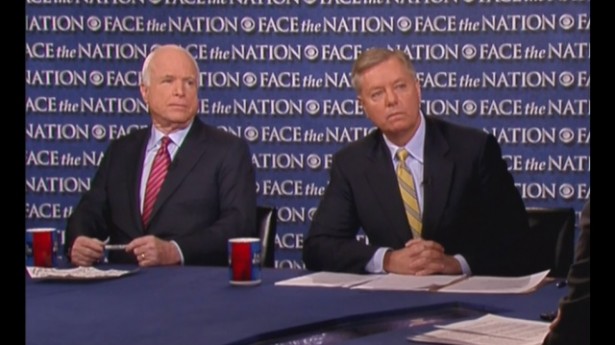
Senators John McCain and Lindsey Graham
At a press event in Washington on Tuesday, Sen. Dick Durbin, D-Illinois, called Election Day 2016 “a day that will live in cyber infamy.” Previously, Sen. John McCain, R-Arizona, called the Russian hacks of the Democratic National Committee “an act of war,” while Sen. Lindsey Graham, R-South Carolina, has claimed that there is near unanimity among senators regarding Russia’s culpability.
Despite all this, the question of who exactly is responsible for the providing WikiLeaks with the emails of high Democratic Party officials does not lend itself to easy answers. And yet, for months, despite the lack of publicly disclosed evidence, the media, like these senators, have been as one: Vladimir Putin’s Russia is responsible.
Interestingly, the same neoconservative/center-left alliance which endorsed George W. Bush’s case for war with Iraq is pretty much the same neoconservative/center-left alliance that is now, all these years later, braying for confrontation with Russia. It’s largely the same cast of characters reading from the Iraq-war era playbook.
It’s worth recalling Tony Judt’s observation in September 2006 that “those centrist voices that bayed most insistently for blood in the prelude to the Iraq war … are today the most confident when asserting their monopoly of insight into world affairs.”
While that was true then, it is perhaps even more so the case today.
The prevailing sentiment of the media establishment during the months prior to the disastrous March 2003 invasion of Iraq was that of certainty: George Tenet’s now infamous assurance to President Bush, that the case against Iraq was a “slam drunk,” was essentially what major newspapers and television news outlets were telling the American people at the time. Iraq posed a threat to “the homeland,” therefore Saddam “must go.”
The Bush administration, in a move equal parts cynical and clever, engaged in what we would today call a “disinformation” campaign against its own citizens by planting false stories abroad, safe in the knowledge that these stories would “bleed over” and be picked up by the American press.
WMD ‘Fake News’
The administration was able to launder what were essentially “fake news” stories, such as the aluminum tubes fabrication, by leaking to Michael R. Gordon and Judith Miller of The New York Times. In September 2002, without an ounce of skepticism, Gordon and Miller regurgitated the claims of unnamed U.S. intelligence officials that Iraq “has sought to buy thousands of specially designed aluminum tubes … intended as components of centrifuges to enrich uranium.” Gordon and Miller faithfully relayed “the intelligence agencies’ unanimous view that the type of tubes that Iraq has been seeking are used to make centrifuges.”
By 2002, no one had any right to be surprised by what Bush and Cheney were up to; since at least 1898 (when the U.S. declared war on Spain under the pretense of the fabricated Hearst battle cry “Remember the Maine!”) American governments have repeatedly lied in order to promote their agenda abroad. And in 2002-3, the media walked in lock step with yet another administration in pushing for an unnecessary and costly war.
Like The New York Times, The Washington Post also relentlessly pushed the administration’s case for war with Iraq. According to the journalist Greg Mitchell, “By the Post’s own admission, in the months before the war, it ran more than 140 stories on its front page promoting the war.” All this, while its editorial page assured readers that the evidence Colin Powell presented to the United Nations on Iraq’s WMD program was “irrefutable.” According to the Post, it would be “hard to imagine” how anyone could doubt the administration’s case.
But the Post was hardly alone in its enthusiasm for Bush’s war. Among the most prominent proponents of the Iraq war was The New Yorker’s Jeffrey Goldberg, who, a full year prior to the invasion, set out to link Saddam Hussein and Al Qaeda. Writing for The New Yorker in March 2002, Goldberg retailed former CIA Director James Woolsey’s opinion that “It would be a real shame if the C.I.A.’s substantial institutional hostility to Iraqi democratic resistance groups was keeping it from learning about Saddam’s ties to Al Qaeda in northern Iraq.”
Indeed, according to Goldberg, “The possibility that Saddam could supply weapons of mass destruction to anti-American terror groups is a powerful argument among advocates of regime change,” while Saddam’s “record of support for terrorist organizations, and the cruelty of his regime make him a threat that reaches far beyond the citizens of Iraq.”
Writing in Slate in October 2002, Goldberg was of the opinion that “In five years . . . I believe that the coming invasion of Iraq will be remembered as an act of profound morality.”
Likewise, The New Republic’s Andrew Sullivan was certain that “we would find weapons of mass destruction in Iraq. I have no doubt about that.” Slate’s Jacob Weisberg supported the invasion because he thought Saddam Hussein had WMD and he “thought there was a strong chance he’d use them against the United States.”
Even after it was becoming clear that the war was a debacle, the neoconservative pundit Charles Krauthammer declared that the inability to find WMDs was “troubling” but “only because it means that the weapons remain unaccounted for and might be in the wrong hands. The idea that our inability to thus far find the weapons proves that the threat was phony and hyped is simply false.”
Smearing Skeptics
Opponents of the war were regularly accused of unpatriotic disloyalty. Writing in National Review, the neoconservative writer David Frum accused anti-intervention conservatives of going “far, far beyond the advocacy of alternative strategies.” According to Frum, “They deny and excuse terror. They espouse a potentially self-fulfilling defeatism. They publicize wild conspiracy theories. And some of them explicitly yearn for the victory of their nation’s enemies.”
Similarly, The New Republic’s Jonathan Chait castigated anti-war liberals for turning against Bush. “Have Bush haters lost their minds?” asked Chait. “Certainly some have. Antipathy to Bush has, for example, led many liberals not only to believe the costs of the Iraq war outweigh the benefits but to refuse to acknowledge any benefits at all.”
Yet of course we now know, thanks, in part, to a new book by former CIA analyst John Nixon, that everything the U.S. government thought it knew about Saddam Hussein was indeed wrong. Nixon, the CIA analyst who interrogated Hussein after his capture in December 2003, asks “Was Saddam worth removing from power?” “The answer,” says Nixon, “must be no. Saddam was busy writing novels in 2003. He was no longer running the government.”
It turns out that the skeptics were correct after all. And so the principal lesson the promoters of Bush and Cheney’s war of choice should have learned is that blind certainty is the enemy of fair inquiry and nuance. The hubris that many in the mainstream media displayed in marginalizing liberal and conservative anti-war voices was to come back to haunt them. But not, alas, for too long.
A Dangerous Replay?
Today something eerily similar to the pre-war debate over Iraq is taking place regarding the allegations of Russian interference in the U.S. presidential election. Assurances from the intelligence community and from anonymous Obama administration “senior officials” about the existence of evidence is being treated as, well, actual evidence.
State Department spokesman John Kirby told CNN that he is “100% certain” of the role that Russia played in U.S. election. The administration’s expressions of certainty are then uncritically echoed by the mainstream media. Skeptics are likewise written off, slandered as “Kremlin cheerleaders” or worse.
Unsurprisingly, The Washington Post is reviving its Bush-era role as principal publicist for the government’s case. Yet in its haste to do the government’s bidding, the Post has published two widely debunked stories relating to Russia (one on the scourge of Russian inspired “fake news”, the other on a non-existent Russian hack of a Vermont electric utility) onto which the paper has had to append “editor’s notes” to correct the original stories.
Yet, those misguided stories have not deterred the Post’s opinion page from being equally aggressive in its depiction of Russian malfeasance. In late December, the Post published an op-ed by Rep. Adam Schiff and former Rep. Jane Harmon claiming “Russia’s theft and strategic leaking of emails and documents from the Democratic Party and other officials present a challenge to the U.S. political system unlike anything we’ve experienced.”
On Dec. 30, the Post editorial board chastised President-elect Trump for seeming to dismiss “a brazen and unprecedented attempt by a hostile power to covertly sway the outcome of a U.S. presidential election.” The Post described Russia’s actions as a “cyber-Pearl Harbor.”
On Jan. 1, the neoconservative columnist Josh Rogin told readers that the recent announcement of sanctions against Russia “brought home a shocking realization that Russia is using hybrid warfare in an aggressive attempt to disrupt and undermine our democracy.”
Meanwhile, many of the same voices who were among the loudest cheerleaders for the war in Iraq have also been reprising their Bush-era roles in vouching for the solidity of the government’s case.
Jonathan Chait, now a columnist for New York magazine, is clearly convinced by what the government has thus far provided. “That Russia wanted Trump to win has been obvious for months,” writes Chait.
“Of course it all came from the Russians, I’m sure it’s all there in the intel,” Charles Krauthammer told Fox News on Jan. 2. Krauthammer is certain.
And Andrew Sullivan is certain as to the motive. “Trump and Putin’s bromance,” Sullivan told MSNBC’s Chris Matthews on Jan. 2, “has one goal this year: to destroy the European Union and to undermine democracy in Western Europe.”
David Frum, writing in The Atlantic, believes Trump “owes his office in considerable part to illegal clandestine activities in his favor conducted by a hostile, foreign spy service.”
Jacob Weisberg agrees, tweeting: “Russian covert action threw the election to Donald Trump. It’s that simple.” Back in 2008, Weisberg wrote that “the first thing I hope I’ve learned from this experience of being wrong about Iraq is to be less trusting of expert opinion and received wisdom.” So much for that.
Foreign Special Interests
Another, equally remarkable similarity to the period of 2002-3 is the role foreign lobbyists have played in helping to whip up a war fever. As readers will no doubt recall, Ahmed Chalabi, leader of the Iraqi National Congress, which served, in effect as an Iraqi government-in-exile, worked hand in hand with the Washington lobbying firm Black, Kelly, Scruggs & Healey (BKSH) to sell Bush’s war on television and on the op-ed pages of major American newspapers.
Chalabi was also a trusted source of Judy Miller of the Times, which, in an apology to its readers on May 26, 2004, wrote: “The most prominent of the anti-Saddam campaigners, Ahmad Chalabi, has been named as an occasional source in Times articles since at least 1991, and has introduced reporters to other exiles. He became a favorite of hard-liners within the Bush administration and a paid broker of information from Iraqi exiles.” The pro-war lobbying of the American Israel Public Affairs Committee has also been exhaustively documented.
Though we do not know how widespread the practice has been as of yet, something similar is taking place today. Articles calling for confrontation with Russia over its alleged “hybrid war” with the West are appearing with increasing regularity. Perhaps the most egregious example of this newly popular genre appeared on Jan. 1 in Politico magazine. That essay, which claims, among many other things, that “we’re in a war” with Russia comes courtesy of one Molly McKew.
McKew is seemingly qualified to make such a pronouncement because she, according to her bio on the Politico website, served as an “adviser to Georgian President Saakashvili’s government from 2009-2013, and to former Moldovan Prime Minister Filat in 2014-2015.” Seems reasonable enough. That is until one discovers that McKew is actually registered with the Department of Justice as a lobbyist for two anti-Russian political parties, Georgia’s UMN and Moldova’s PLDM.
Records show her work for the consulting firm Fianna Strategies frequently takes her to Capitol Hill to lobby U.S. Senate and Congressional staffers, as well as prominent U.S. journalists at The Washington Post and The New York Times, on behalf of her Georgian and Moldovan clients.
“The truth,” writes McKew, “is that fighting a new Cold War would be in America’s interest. Russia teaches us a very important lesson: losing an ideological war without a fight will ruin you as a nation. The fight is the American way.” Or, put another way: the truth is that fighting a new Cold War would be in McKew’s interest – but perhaps not America’s.
While you wouldn’t know it from the media coverage (or from reading deeply disingenuous pieces like McKew’s) as things now stand, the case against Russia is far from certain. New developments are emerging almost daily. One of the latest is a report from the cyber-engineering company Wordfence, which concluded that “The IP addresses that DHS [Department of Homeland Security] provided may have been used for an attack by a state actor like Russia. But they don’t appear to provide any association with Russia.”
Indeed, according to Wordfence, “The malware sample is old, widely used and appears to be Ukrainian. It has no apparent relationship with Russian intelligence and it would be an indicator of compromise for any website.”
On Jan. 4, BuzzFeed reported that, according to the DNC, the FBI never carried out a forensic examination on the email servers that were allegedly hacked by the Russian government. “The FBI,” said DNC spokesman Eric Walker, “never requested access to the DNC’s computer servers.”
What the agency did do was rely on the findings of a private-sector, third-party vendor that was brought in by the DNC after the initial hack was discovered. In May, the company, Crowdstrike, determined that the hack was the work of the Russians. As one unnamed intelligence official told BuzzFeed, “CrowdStrike is pretty good. There’s no reason to believe that anything that they have concluded is not accurate.”
Perhaps not. Yet Crowdstrike is hardly a disinterested party when it comes to Russia. Crowdstrike’s founder and chief technology officer, Dmitri Alperovitch, is also a senior fellow at the Washington think tank, The Atlantic Council, which has been at the forefront of escalating tensions with Russia.
As I reported in The Nation in early January, the connection between Alperovitch and the Atlantic Council is highly relevant given that the Atlantic Council is funded in part by the State Department, NATO, the governments of Latvia and Lithuania, the Ukrainian World Congress, and the Ukrainian oligarch Victor Pinchuk. In recent years, it has emerged as a leading voice calling for a new Cold War with Russia.
Time to Rethink the ‘Group Think’
And given the rather thin nature of the declassified evidence provided by the Obama administration, might it be time to consider an alternative theory of the case? William Binney, a 36-year veteran of the National Security Agency and the man responsible for creating many of its collection systems, thinks so. Binney believes that the DNC emails were leaked, not hacked, writing that “it is puzzling why NSA cannot produce hard evidence implicating the Russian government and WikiLeaks. Unless we are dealing with a leak from an insider, not a hack.”
None of this is to say, of course, that Russia did not and could not have attempted to influence the U.S. presidential election. The intelligence community may have intercepted damning evidence of the Russian government’s culpability. The government’s hesitation to provide the public with more convincing evidence may stem from an understandable and wholly appropriate desire to protect the intelligence community’s sources and methods. But as it now stands the publicly available evidence is open to question.
But meanwhile the steady drumbeat of “blame Russia” is having an effect. According to a recent you.gov/Economist poll, 58 percent of Americans view Russia as “unfriendly/enemy” while also finding that 52 percent of Democrats believed Russia “tampered with vote tallies.”
With Congress back in session, Armed Services Committee chairman John McCain is set to hold a series of hearings focusing on Russian malfeasance, and the steady drip-drip-drip of allegations regarding Trump and Putin is only serving to box in the new President when it comes to pursuing a much-needed detente with Russia.
It also does not appear that a congressional inquiry will start from scratch and critically examine the evidence. On Friday, two senators – Republican Lindsey Graham and Democrat Sheldon Whitehouse – announced a Senate Judiciary subcommittee investigation into Russian interference in elections in the U.S. and elsewhere. But they already seemed to have made up their minds about the conclusion: “Our goal is simple,” the senators said in a joint statement “To the fullest extent possible we want to shine a light on Russian activities to undermine democracy.”
So, before the next round of Cold War posturing commences, now might be the time to stop, take a deep breath and ask: Could the rush into a new Cold War with Russia be as disastrous and consequential – if not more so – as was the rush to war with Iraq nearly 15 years ago? We may, unfortunately, find out.
James W Carden is a contributing writer for The Nation and editor of The American Committee for East-West Accord’s eastwestaccord.com. He previously served as an advisor on Russia to the Special Representative for Global Inter-governmental Affairs at the US State Department.
Moscow expects Reuters to clarify its complaints concerning working conditions in Russia
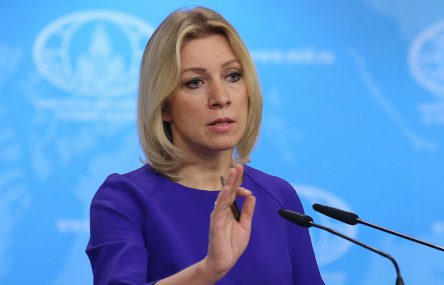
Russian foreign ministry’s spokeswoman Maria Zakharova
TASS – February 3, 2017
MOSCOW – Russia’s Foreign Ministry expects the Reuters news agency to clarify its complaints regarding the working conditions of its journalists in the country, the ministry’s spokeswoman Maria Zakharova said at a briefing on Friday.
“We have seen Reuters Editor-in-Chief Stephen Adler’s message to staff, which concerns covering the new US president’s activities,” Zakharova noted. “Although we do not usually comment on editorial directives, we could not but take notice of one paragraph,” she went on to say. “The implication is that Reuters considers Russia to be one of the countries where the agency has to ‘encounter some combination of censorship, legal prosecution, visa denials, and even physical threats’ to its journalists.”
“We don’t divide journalists into good and bad, we don’t refuse to issue visas, we don’t deprive them of visas or accreditation only because we don’t like their style or find them to be biased,” the Russian Foreign Ministry’s spokeswoman stressed. “I expect Reuters to clarify the matter.”
At the same time, she said that Russia’s Foreign Ministry would have not commented on this message if it had not been made public through the Reuters website and had not mentioned the agency’s work in Russia. The diplomat was confident that Reuters had deliberately posted the message “thus turning it into some kind of a manifesto.”
According to Zakharova, when the Russian Foreign Ministry contacted Reuters, the agency declined to comment. She also pointed out that the Reuters correspondents accredited in Russia took part in closed weekly briefings at the Foreign Ministry as well as in other media events, however, they had not voiced their concerns even once.
Photo Anton Novoderezhkin/TASS
UK minister accuses Russia of MH17 downing & ‘testing’ NATO, Moscow says claims ‘baseless’
RT | February 3, 2017
When British Defense Secretary Michael Fallon was asked to deliver a speech on ‘Russian resurgence’, he seized the opportunity to accuse Moscow of “annexing” Crimea, shooting down MH17 over Ukraine, and “testing” NATO. Russia calls the claims baseless.
Fallon’s speech at St. Andrews University on Thursday began kindly enough, speaking about the UK’s “renewed interest in Russian scientific and artistic achievement.”
However, the talk quickly changed course, with Fallon changing the focus to Russia’s so-called “military resurgence.”
Referring to the reunification of Crimea and Russia following a referendum in 2014, Fallon claimed the situation actually amounted to Russia illegally annexing the territory.
“Russia did not allow Ukraine to decide its own destiny like any other sovereign country,” he said. “Instead, under the guise of ambiguous and deniable instruments it annexed Crimea.”
Fallon’s anti-Russia rhetoric didn’t stop there. He went on to cite an inquiry by the Dutch-led Joint-investigative Team (JIT) which claims the MH17 tragedy was caused by a “Russian-provided missile.” He said that despite the finding, Moscow continues to deny its role in the tragedy.
Fallon failed to mention, however, that there are numerous issues surrounding that report, including the fact that the Dutch apparently couldn’t read raw radar data provided by Russia, yet failed to ask Moscow for help to decode it.
The discrepancies surrounding the inquiry have led to Major General Aleksandr Tazekhulakhov, the former deputy head of the Russian Army Air Defense, to accuse the Netherlands of trying to keep Moscow out of the investigation, likely in “yet another attempt to put the blame on Russia for something…”
The next phase of Fallon’s speech transitioned from Ukraine to Syria, in which he accused Russia of targeting the Syrian opposition in Aleppo “with little regard for innocent lives,” claiming that 80 percent of its strikes targeted non-Islamic State (IS, formerly ISIS/ISIL) targets.
However, Fallon seemed to conveniently forget that the US-led coalition in Syria – which includes the UK – just last month admitted to “unintentionally” killing at least 188 civilians in Syria and Iraq since 2014.
And while Fallon accused Russia of targeting civilians in Aleppo, he failed to mention a hospital set up by Russia in the city, despite the facility being hailed by the World Health Organization (WHO) last month.
“The WHO, same as the Syrian people – we’re very grateful to the Russians, the EMERCOM [Agency for Support and Coordination of Russian Participation in International Humanitarian Operations] gave a hospital to be used in the Jibreen [refugee] camp. The hospital provided by the Russian people has provided several hundred consultations and has been given by the Russian people to the Syrian people for the use by the central health authorities in Aleppo,” the WHO’s Elizabeth Hoff told RT.
Any typical bashing of Russia by the UK wouldn’t be complete without claims that Moscow is trying to “test” NATO, and Fallon didn’t disappoint.
“Russia is clearly testing NATO and the West,” Fallon said, accusing Moscow of “seeking to expand its sphere of influence, destabilize countries, and weaken the alliance.”
“It is undermining national security for many allies and the international rules-based system,” he continued.
Fallon was apparently in no mood to present a balanced argument during his speech, failing to mention NATO’s build-up of troops near Russia’s borders, or Moscow’s concern that NATO is compromising its national security.
The speech also included a healthy dose of the usual Western rhetoric, including allegations that Russia influenced the US presidential election by hacking into Democratic National Committee (DNC).
There was a touch of irony towards the end of Fallon’s speech, in which he said “we need to understand Russia better,” but then went on to accuse it of “reckless military activity” and “misinformation.”
“Russia could again become the partner the West always wished for…” he concluded.
However, based on Fallon’s speech, it seems Russia will only be a ‘partner’ to the UK and the West if it panders to their every wish.
Moscow responded to Fallon’s speech on Friday, calling his statements “baseless.”
“We express regret for this hostile stance of the minister. We are sure that such allegations are baseless,” Kremlin spokesman Dmitry Peskov told reporters, as quoted by Reuters.
Read more:
Crimea & Minsk Agreements: What the British media fails to mention
The New Trump Administration – a New Strategy or a New Paradigm? The View from Russia – 1
By Dmitry MININ | Strategic Culture Foundation | 02.02.2017
The first moves by the new US president, Donald Trump, have demonstrated that he is taking his campaign promises seriously and is working to fundamentally restructure the American economic system.
Changes that were seen immediately after Trump’s inauguration: the official White House website deleted its pages that formerly proclaimed support for sexual minorities and the fight against climate change, instead reaffirming its commitment to the goals of energy independence, increased economic growth, and bringing jobs back to the US.
An executive order was signed to withdraw from the Trans-Pacific Economic Partnership. This presidential decision received the immediate and unqualified support of the biggest American labor unions – the AFL-CIO and the Teamsters – once considered Democratic strongholds and which had previously been wary of Trump. Geopolitics is giving way to geoeconomics.
On Jan. 24 Trump met with the heads of the three largest US automakers: General Motors; Ford; and Fiat Chrysler, urging them to expand production in the US rather than abroad. He warned that he would attempt to introduce a 35% import tariff on any company that moved its manufacturing overseas and then imported its products back into the US. But if they agreed to his demands, he promised «big league» regulatory and tax relief in order to give American companies an incentive not to move their plants abroad.
All of these actions are evidence of Trump’s determination to limit the expansion of the virtual economy and to begin the country’s reindustrialization. The transformations he has envisioned are so sweeping that it is more fitting to speak of a whole new stage of technological evolution, rather than merely a new approach. It appears that herein lies the root causes of the fierce resistance to Trump found among the ranks of the «global elite».
It would be an oversimplification to think that the new president is bent on taking America backward. His logic is the logic of a new industrialism, in which material production retains its innovative features, but produces tangible, rather than virtual assets. It is, in any case, a move away from a «bubble economy». According to Trump, the economy of a powerful country like the US should be deeply diversified, not one-dimensional as it has become.
There is currently quite a popular school of thought that claims that our society is at a particular stage of technological evolution (some consider this the «third», while others – the «fifth»), which is based on the development of digital technology. A transition to the next phase should be in the offing, which will be dominated by nano- and biotechnology. And the first to make the transition wins. The US has structured its development since the 1970s in accordance with this linear blueprint. It seemed attractive to focus on the high value-added information business, relegating dirty and labor-intensive manufacturing to other countries. The prevailing view – supported by the ideology of globalism – held that since IT-technology originated in the US, Americans would always call the shots.
This self-confidence has undermined the economic foundations of US power. The rest of the human race has risen to meet the Americans’ challenge successfully. A plurality of economic «poles» is appropriate for a politically multipolar world, but the fact that other economic «power centers» are banking on building more multifaceted economic systems is even more important.
Many years ago the US lost its position as a world leader in the production of material goods, and it survives mainly as a broker of financial and technological services, and also thanks to its virtual economy. Manufacturing and agriculture make up only 20% of US GDP – approximately $3.6 trillion out of $18 trillion. In China, those sectors are responsible for half of GDP, or $5.5 trillion out of $11 trillion. In this respect, the Chinese are already seriously outpacing the Americans – and that is according to the current exchange rate, without adjusting to take into account purchasing power parity, which would show that China is even further ahead of the US.
Liberal economists will say that in today’s economy, national wealth depends not so much on material output as on the development of the tertiary sector – the provision of services to final consumers or to other businesses, as well as the securing of patents, standards, etc. And this is true when speaking of the prosperity of the general public, but sovereign power is predicated upon quantities of material goods. And that low output affects, for example, export figures, and consequently – a nation’s ability to maintain an economic presence in the world. America’s total foreign-trade numbers now lag behind those of China, but even those indices are mainly based on imports – when it comes to exports the US is not even in second place. The EU exported $2.26 trillion worth of goods in 2014 (excluding intra-EU trade), China (in 2016) – $2.02 trillion (plus exports to Hong Kong – $0.49 trillion), and the US – $1.47 trillion. The global leader, which is only the third-largest exporter, is condemned to rely on military force to preserve its status, which is in turn detrimental to its ability to remain competitive.
There was an assumption that the decline in material production would be offset by the IT sector, but that is not happening. The Chinese company Lenovo became the global leader in PC sales in 2012, overtaking its biggest rival – America’s Hewlett-Packard. And in 2014, Lenovo took top honors for its sales of laptops as well. The world’s largest manufacturer of telecommunications equipment is also a Chinese company – Huawei, beating out the international giant Ericsson in 2012. And India is on its way to dominating the global software industry.
The emphasis on the virtual economy has also had unforeseen political consequences. For example, the concept of «soft power» is widely believed to be able to offset certain weakened or absent elements of a state’s traditional economic power. But conversely, the enthusiasm for «soft power» has evolved into an ideologization of foreign policy, replacing standard diplomatic tools with ubiquitous manipulation. As a result, US foreign policy is now faced with an even larger number of problems and conflicts. Paradoxically, despite its proclaimed «softness», Washington has increasingly been forced to resort to «hard» interventions abroad in order to maintain its global hegemony.
Trump’s answer to this appears quite reasonable. A country that is fully developed does not need additional proof of its power in the form of interventions. The rest of the world will recognize its real power and always take that into account. As international politics become less ideological, they will also become less prone to conflict.
But it is still too early to judge whether Trump is up to this task. Given the global dissemination of information technologies, it would hardly be possible, for example, to completely «reverse» financial globalization. Trump’s America needs partners, but they should not be chosen with the idea of «teaming up against someone», but with the goal of «teaming up for the sake of something». And there can be no question that Russia has its own interests and its own niche in that.
See also:
Crimea & Minsk Agreements: What the British media fails to mention
Ambassador’s view | RT | February 2, 2017
The escalation in eastern Ukraine is again presented in the British media as Russia’s attempt to wage a proxy hybrid war against Kiev’s pro-Western leadership.
For fear of an eventual improvement in Russia-US relations, they pray for the sanctions against Russia to stay unless the Minsk Agreements are implemented as well as a punishment for ‘Russia’s annexation of Crimea.’
Let me set the record straight on that.
The coup d’état in Kiev in February 2014 backed by the West tore up the constitutional space in Ukraine. The legitimate president of the country was overthrown. It was marked by a severe lack of democracy and violence that posed a direct threat to the well-being of the Russian-speaking population of Crimea. Citizens of Crimea, which was an autonomy at the time, faced the choice of becoming an oppressed minority or severing their ties with the hostile regime to secure a future for themselves and their children. Legitimate local authorities made the decision to hold a referendum.
The independence of Crimea was proclaimed and an appeal to enter the Russian Federation was made based on the indisputable results of the popular vote. Standards of international law were fully observed as the right of nations to self-determination enshrined in the UN Charter was exercised freely by the Crimeans.
Crimea was recognized as an independent and sovereign state by Russia, and on March 18, 2014 in Moscow the two countries signed a Treaty of Unification, under which the Republic of Crimea and the city of Sevastopol became two new regions – subjects of the Russian Federation.
Let us take a look at the outcome. While entire regions of Ukraine are engulfed in a brutal war, and the population is being fed with shameless nationalist propaganda, the Russian Crimea is enjoying peace, stability and steady growth. What could be a better proof that the decisions made two years ago were the only right ones? We are convinced that many Ukrainians would prefer to live like the residents of Crimea live now – under conditions of stable economic development and social security. That is despite the attempts of the Ukrainian government to disrupt the life of the people there by cutting the peninsula off from essential supplies, trying to organize water, energy and food blockades. Does it mean people for sovereignty, rather than sovereignty for the people?
Unfortunately, there has been little progress in implementing the Minsk Agreements mainly due to Kiev’s unwillingness to fulfill its obligations under them to promote national accord and reconciliation. The recent escalation is clearly an attempt to divert public attention from the poor reform record and request for additional funds from their Western sponsors.
For the political solution to be achieved in Ukraine, the Minsk Agreements should be fully implemented, including the withdrawal of heavy weapons from the contact line. However, the Ukrainian armed forces haven’t stopped shelling Donetsk and Lugansk, including the use of weapons that are supposed to have been withdrawn. This leads to civilian casualties and the destruction of property. The OSCE Special Monitoring Mission to Ukraine has reported many times the concentration of Ukrainian forces along the contact line.
According to the Minsk Agreements, signed two years ago, on the first day of the withdrawal of artillery Kiev had to engage in dialog, and start consulting with Donetsk and Lugansk representatives on the conditions for elections to be held on the basis of Ukrainian law and under OSCE oversight.
A month after the signing of the Minsk Agreements Kiev was required to enact a special status law adopting a resolution designating the territory that this law was supposed to cover. This hasn’t been done. A law was passed, the territories marked, but the law said that it didn’t apply to Donetsk and Lugansk!
The Minsk Agreements clearly say elections should be held in accordance with the OSCE criteria, one of which is to ensure that no one will be subjected to intimidation, harassment, etc. The statement by the Kiev authorities on “elections first, then amnesty” constitute a serious distortion of the sequence and logic of what was agreed. In accordance with the OSCE elections criteria, the amnesty should be granted before the elections.
It is crucial to understand at long last that the only way to settle the Ukrainian crisis is by implementing the Minsk Agreements, which represent a recipe for a political solution well in line with European values. What is required of Kiev is to treat its citizens as partners and abandon the Orwellian “anti-terrorists operation.” One cannot deal with its own citizens with a gun to their head.
And this intransigence should cease for the sake of comprehensive reforms in Ukraine, the lack of which is the key source of the present crisis. The declarations by British officials that sanctions against Russia can only be lifted after we fulfill our obligations according to Minsk treaty is a crude substitution of concept and a prolongation of anti-Russian politics of London.
Russia, together with France and Germany, is a guarantor of the Minsk accords, not part of it. The obligations written there are for Kiev and Donbass, in their quality as sides of the treaty and participants of the conflict, to fulfill.
Dr Alexander Yakovenko, Russian Ambassador to the United Kingdom of Great Britain and Northern Ireland, Deputy foreign minister (2005-2011). Follow him on Twitter @Amb_Yakovenko
Norway surprised by Russia’s entry visa rejections to delegates blacklisted months ago
RT | February 2, 2017
Norway has summoned Russia’s ambassador to explain why two of its legislators were denied entry visas. Though the officials were placed on “counter-sanctions” lists and denied entry long ago, Norway has somehow found the rejections “incomprehensible.”
An official note containing the same objections preceded the ambassador’s summoning.
“The Foreign Ministry today summoned the Russian ambassador to repeat the protests,” the Norwegian Foreign Ministry said on Wednesday.
Norway’s Foreign Minister Børge Brende condemned Russia’s denial of the visas in strong terms. The rejected legislators are Bård Vegar Solhjell, the leader of Norway’s Socialist Left party, and Trine Skei Grande, the leader of the country’s Liberal Party.
“These are two distinguished, top-level Norwegian officials, excellent representatives of Norway,” Brende told the reporters, saying “it’s incomprehensible that they not be allowed to enter Russia.”
Although the minister acknowledged that Russia has the right to determine who can enter the country, saying that it’s “obviously up to every country to decide who can enter,” he slammed the denial as “biased, unreasonable and inconceivable.”
The Russian embassy in Oslo has confirmed that the visa requests were rejected as a part of a “mirror response” to Norway adopting the same sanctions that the EU has imposed on Russian citizens, as well as policies discriminating against Russian citizens who want to visit Spitsbergen island.
The list of officials from the EU and other countries who have been banned from entering Russia was provided to Brussels well ahead of time, with advice to inform all those affected, a Russian embassy spokesman stressed. Norway’s FM himself has admitted that the denials were something to be “expected” and that Norway’s reaction to the visa rejections thus appears quite surprising.
Coincidently, the outrage over Russia’s “hostile actions” came just hours after the country’s Police Security Service (PST) determined that Russia poses a “major threat” to Norway, along with Islamism.
Norway joined the EU’s sanctions against Russia and Russian citizens back in 2014 in response to what it called “Russia’s violations of human rights in Ukraine.” The situation escalated in April of 2015 when Russia’s Deputy PM Dmitry Rogozin visited Norway’s Island of Spitsbergen while on a trip to open the ‘North Pole-2015’ station. Norwegian authorities were riled by the visit, as Rogozin was on Europe’s anti-Russia sanction list.
Norway then adopted a measure authorizing the immediate deportation of sanctioned Russian citizens from the archipelago. Though Russia’s Foreign Ministry has protested the regulation, calling it discriminatory and in violation of an agreement on international cooperation on Spitsbergen, it was made permanent last September.
Analyzing Current Trends: Russia and West on the Threshold of Drastic Changes in Relationship
By Andrei AKULOV | Strategic Culture Foundation | 02.02.2017
The prospects for improvement of Russia-US relations become a matter of grave concern for European politicians. With Donald Trump’s «America First» policy, Europe may be left on its own. The calls for lifting the sanctions against Russia are getting louder – loud enough to make this issue become a part of EU’s shaping external strategy.
Italy’s former Prime Minister and European Commission ex-President Romano Prodi called on Europe to scrap immediately the anti-Russian sanctions, rather than wait for US president Donald Trump to do it first. His opinion on the sanctions is very illustrative. According to the patriarch of European politics, «The fact that it is necessary to lift the sanctions with Russia immediately. I am deeply convinced of this. You can sacrifice themselves for the sake of reaching a consensus, but when neither of which Solidarity has no question, there is no point in continuing to fight. One wise Calabrian proverb says, who pretend to be sheep, the wolf will eat that. First you need to play the card of not allowing American to occupy a privileged position in its relations with Russia».
Confusion reigns in Germany. Trump attacks Berlin despite the fact that Germany has always been loyal to Washington. It was the first to impose sanctions on Russia, even though it was contrary to its own immediate interests. Vice Chancellor Sigmar Gabriel warned of a «drastic radicalization» in American politics and said Berlin stood ready to fill the void left by an isolationist Washington. Frank-Walter Steinmeier, the current Minister for Foreign Affairs and Chairman-in-Office of the Organization for Security and Co-operation in Europe (OSCE), believes that «by choosing Donald Trump, the old world of the 20th century is over». «The order of the 21st century and the way the world of tomorrow will look is not settled; it is completely open […] I know we have to adjust to troubled times, to some unpredictability and new uncertainties», Mr. Steinmeier wrote in his piece published by Bild on January 23.
Other Europeans see things in the same light. «Hostile inauguration speech. We can’t sit around &hope for US support & cooperation. Europe must take its destiny & security in its own hands», Guy Verhofstadt, the former Belgian Prime Minister, wrote on Twitter in his comments on Donald Trump’s inaugural address. Speaking after meeting German Chancellor Angela Merkel on January 23, the frontrunner in France’s presidential election Francois Fillon said, «European Union sanctions on Russia are pointless, warning Russia and the United States under Donald Trump could forge links that exclude the EU». He warned against US President Donald Trump talking with Russia at Europe’s expense. «It would be damaging for Europe if Trump went above our heads, which is not inconceivable», the presidential hopeful stressed.
As one can see, European political heavyweights emphasize that Europe needs drastic changes in its relationships with the US and Russia. The US may belittle the EU by using the sanctions as a bargaining chip to make what President Trump calls «good deals». First Washington made the EU introduce the sanctions detrimental to its economy. Then the US would «allow» the EU to lift the restrictive measures as fresh winds started to blow in Washington! Thus, the US benefited from making Europe impose the sanctions and now it will reap the full advantage derived from making Brussels lift them! From point of view of geopolitical interests, in both cases the US will gain to make Europe lose.
This scenario is quite feasible. To prevent it from happening, the EU must move really fast to be one step ahead of Trump. By restoring normal relationship with Russia, Brussels will gain as a geopolitical actor. As a result, it will have a much more advantageous position to start from when it comes to shaping its new relationship of new configuration with Washington.
It would be a right thing to do at the time the «establishment» forces are under attack from all sides by the right and the left. The points of criticism include immigration policies, the integration process going too fast to make countries lose national identity and anti-Russian sanctions that have resulted in economic damage without exerting any influence whatsoever on Russia’s foreign policy. This is the time when Europe is at crossroads facing the prospects of most drastic changes since WWII. This is also the time when the «big brother» is intent to leave it fend for itself.
Mr. Trump has never promised anything to Europeans and he is adamant in his desire to change the existing order of things. The incoming elections in the Netherlands, France and Germany are going to undermine the position of ruling elites. Looks like Romano Prodi hit the nail right on the head – there is no time to lose. The time to normalize the relations with Moscow is now.
Ukraine Sabotages Trump’s Russia Detente
By Jonathan Marshall | Consortium News | February 1, 2017
Less than two weeks into office, President Trump faces one of the first big tests of his non-confrontational policy toward Russia. As new fighting erupts in Eastern Ukraine, the Kiev regime and its U.S. supporters are predictably demanding a showdown with Vladimir Putin.
Initial evidence suggests, however, that the latest flare-up in this nearly three-year-old conflict was precipitated by Kiev, possibly in the hope of forcing just such a confrontation between Washington and Moscow. It’s looking more and more like a rerun of a disastrous stunt pulled by the government of Georgia in 2008, which triggered a clash with Russia with the expectation that the George W. Bush administration would come to its rescue and bring Georgia into the NATO alliance.
After months of relative quiet, the fighting in Ukraine erupted on Jan. 28 around the city of Avdiivka, a now-decrepit industrial center. Eight pro-government fighters and five separatists apparently died in the first two days of hostilities. Meanwhile, residents of the city are struggling to survive heavy shelling and sub-zero weather with no heating.
Perennial critics of Russia were quick to blame Moscow for the renewed bloodshed. “We call on Russia to stop the violence (and), honor the cease-fire,” declared a State Department official.
The Washington Post’s reliably neo-conservative editorial page suggested that Russia felt liberated to unleash rocket and artillery barrages after Putin spoke with Trump by phone, with the goal of wrecking a meeting between Ukrainian President Petro Poroshenko and German Chancellor Angela Merkel.
The Russian onslaught “look(s) a lot like a test of whether the new president will yield to pressure from Moscow,” the Post declared, as if this were Czechoslovakia, 1938, all over again.
Poroshenko was quick to take advantage of the clash by asking, rhetorically, “Who would dare talk about lifting the sanctions in such circumstances?” Just last month, Austria’s foreign minister called for an easing of sanctions on Russia in return for “any positive development” in Ukraine. President Trump has been noncommittal about sanctions in the face of full-throated demands by congressional hawks in both parties to keep them in place.
Who’s to Blame?
The jury is still out on who provoked the latest violence, but Radio Free Europe/Radio Liberty, established by the U.S. government to broadcast propaganda during the height of the Cold War, reported Monday:
“Frustrated by the stalemate in this 33-month war of attrition, concerned that Western support is waning, and sensing that U.S. President Donald Trump could cut Kyiv out of any peace negotiations as he tries to improve fraught relations with Moscow, Ukrainian forces anxious to show their newfound strength have gone on what many here are calling a ‘creeping offensive.’
“Observers say the Ukrainians appear to be trying to create new facts on the ground . . . In doing so, the pro-Kyiv troops have sparked bloody clashes with their enemy, which has reportedly made advances of its own — or tried to — in recent weeks.”
A senior member of Europe’s Special Monitoring Mission to Ukraine warned, “The direct result of forward moves is escalation in tension, which often turns to violence.” How right he was.
It’s hard to see what Putin gains from new fighting, at a time when Trump faces an army of skeptics at home for his go-easy-on-Russia strategy. Poroshenko has everything to gain, on the other hand, by pressing Americans and West Europeans to reaffirm their support for his government, which took power after a 2014 coup that ousted elected President Viktor Yanukovych, who was strongly supported in eastern Ukraine and Crimea.
The Georgia Playbook
The situation is reminiscent of the August 2008 conflict between Russia and its neighbor on the Black Sea, Georgia. A bloody clash between the two countries’ armed forces in the tiny enclave of South Ossetia prompted a blast of militant rhetoric from American hawks.
Vice President Richard Cheney declared, “Russian aggression must not go unanswered.” Richard Holbrooke, who would become a senior adviser to the future President Obama, said, “Moscow’s behavior poses a direct challenge to European and international order.”
It may have been significant that the Georgian president’s paid U.S. lobbyist was also presidential candidate John McCain’s chief foreign policy adviser. As one analyst commented at the time, “McCain’s swift and belligerent response to the Soviet actions in Georgia has bolstered his shaky standing with the right-wing of the Republican Party. . . . Since the crisis erupted, McCain has focused like a laser on Georgia, to great effect. According to a Quinnipiac University National Poll released on August 19 he has gained four points on Obama since their last poll in mid-July and leads his rival by a two to one margin as the candidate best qualified to deal with Russia.”
Yet when the smoke settled, it turned out that Georgia, not Russia, had started the war by launching an artillery barrage against South Ossetia’s capital city. It was a ploy by Georgia’s President Mikheil Saakashvili to drag the West into supporting his campaign to take over the enclave.
The independent International Crisis Group had warned in 2007 that Georgia’s risky strategy of provoking “frequent security incidents could degenerate into greater violence.”
A year later, following the brief war with Russia, an ICG investigation reported authoritatively that it began with a “disastrous miscalculation by Georgian leadership,” who “launched a large-scale military offensive” into the Russian-occupied enclave, killing dozens of civilians and causing severe damage to South Ossetia’s capital from artillery barrages.
The report also criticized “Russia’s disproportionate counter-attack,” which it deemed a response to “the decade-long eastward expansion of the NATO alliance” and other grievances.
Putting blame aside, the ICG report observed that “The Russia-Georgia conflict has transformed the contemporary geopolitical world, with large consequences for peace and security in Europe and beyond.” Indeed, it marked one of the greatest setbacks in post-Cold War relations between Moscow and the West until the 2014 Ukraine crisis.
If the 2017 Ukraine crisis gets out of hand, the consequences for peace and security may be just as great or greater. It will be informative to see whether President Trump and his national security team get the straight facts before capitulating to the interventionists who want to see U.S.-Russian relations remain strained and volatile.
Russia Calls the West’s Bluff over Real Elections, At Long Last
By Seth Ferris – New Eastern Outlook – 01.02.2017
The world continues to turn upside down. Think the Western democracies are still the authorities on the one thing they are supposed to know about? Think again.
For generations the OSCE, the Organisation for Security and Cooperation in Europe, has been monitoring elections in various countries to ensure they meet Western democratic standards. After each one it publishes a report, which sometimes bears little relation to what people on the ground have seen, and each one of these mysteriously reflects the current political position of the Western powers – if they like a country and its government, they have conducted free and fair elections, if not, the elections are declared wholly or partially invalid.
This practice has often raised criticism, but still the OSCE is being called in to monitor elections all over the globe. Why? Because it is the institution representing countries with a long democratic tradition, and those these have since chosen as their friends. That’s it. It does not have to do anything to justify the vast sums given to it to be the authority on elections, simply be there.
Theoretically the OSCE is the product of a partnership between East and West. But in effect the OSCE is run by Western democracies and those countries it now believes have adopted Western standards since the Cold War. These nations, we are told, understand democracy and can therefore recognise it when they see it.
On 19 January the Head of Russia’s Central Elections Commission, Ella Pamfilova, recommended to the OSCE’s Michael Link that it should adopt a common set of standards for election monitoring. This would enable it to compare one country’s performance with another’s and see whether countries are improving or regressing compared to previous elections. “I consider it very important that the standards of elections monitoring in all OSCE member countries be unified,” she reportedly said.
This statement opened mouths all over the world. So let’s get this straight – the OSCE has been monitoring all these elections without any set standards of what democracy is, what is free and fair, what are the acceptable and unacceptable variables, what are the irreducible minimums or what the rights and responsibilities of governments, election commissions and political parties are? It has continued being regarded as the authority on these questions in spite of this? And now the Russians – the RUSSIANS – have to call for a common set of standards to give the monitors some idea what they are supposed to be doing?
You think, therefore we are
This isn’t about elections. It is about how long you can get away with a con. Since the end of World War Two The West’s policy has been based on lies – it is supposed to believe in certain values, such as democracy and human rights, but goes round depriving the rest of the world of the same values it says are paramount.
Everyone has seen this happen, but the West is still supposed to know more about these values than anyone else. So if other countries want democracy and human rights they automatically turn to the West. If they end up with governments which claim to respect democracy and human rights but do exactly the opposite, and Western monitors telling them that rigged elections are substantially free and fair, is that their own fault or that of the Westerners they asked to prevent these things happening? But still they feel they have nowhere else to turn, because Western democracies must somehow know best, and they won’t be better off any other way.
Russia’s request makes one simple point. If you believe in democracy, you will have developed a sophisticated definition of what it is and why it is so important after such long experience of it. If you have such a definition, every observer who monitors elections will know it and be able to assess the elections against it. Of course there will be some local variations in practice between democratic countries, and some of these might raise the concern of some countries. But there will be a common set of standards already in place against which these too can be judged, and thus everyone sent as a monitor will be able to cite these to acquire credentials as a democrat, even if they’ve played little or no part in actual elections.
This is indeed perfectly logical. If it hasn’t happened, this cannot be because the conditions don’t exist. It is because no one wants to be bound by any definition of what democracy is. The West wants to use the term how it wants, when it wants, and make everything up to fit whatever broader political goals it has. The West pronouncing on whether elections are free and fair is about as credible as Australia saying it is in the northern hemisphere because the cover of the North-South report said so and that was written by Western European politicians.
Power to some other people
Does this process actually achieve anything? It enables selected people to enjoy all-expenses-paid junkets to different countries, where they go around with badges on which technically say “Election Observer” but in reality say “You can’t say anything about me, I’m the expert”. How many of these junkets they get depend on how well they fit the evidence to the pre-existing script about that election. Many observers arrive before polling day and stay afterwards: maybe this is to do with monitoring the pre- and post-election situations, or maybe it is to give them time in various places of ill repute as a payoff for going along with the official script.
Lots of historic examples of election monitoring fraud are available. When India decided it wanted to annex the independent Kingdom of Sikkim in 1975 it persuaded its parliament to abolish the monarchy and then hold a referendum on joining India. Obviously, as Sikkim was already an Indian protectorate, it monitored that referendum to ensure it was free and fair. Very few others were able to find out anything about the referendum until the results came in, which showed 97% support for joining India, despite the fact the alleged number of people could not have physically voted on the day due to the terrain, most of the voters had been imported from India and the observers were also armed troops in many cases.
Similarly, when Viktor Yanukovych was up against Yulia Tymoshenko in the 2010 presidential runoff in Ukraine Mikheil Sakkashvili’s Georgia sent hundreds of observers, as a neighbouring, friendly country. The trouble was, most of these were actually martial artists, or simply thugs, with no experience of organising elections. Saakashvili openly supported Tymoshenko in these elections and had already been happy to use force on his own citizens in Georgia. It would have interesting to quiz these observers about what a “free and fair” election is supposed to mean.
Indeed, the May 2008 Georgian Parliamentary Election had already provided a classic example of vote rigging and fraud which was obvious to anyone from a democratic country. The international observers looked on and saw nothing, and the OSCE rubber stamped the results, with the existence of various spying platforms in Georgia at stake.
What OSCE monitors do has nothing to do with the welfare of the people whose country they are pronouncing upon. It is about exerting control. If the outcome of an election is what the West desires, it is free and fair, and no one can complain because they have no other set of standards to refer to. They can’t call on some other organisation to review the OSCE’s judgment because, although such organisations exist and can act independently, their credibility can be easily exploded.
If someone disagrees with the conclusions of the mighty OSCE, however farcical those conclusions may be, they must have some political motive or be unaware of the full facts. This sort of common thinking, however baseless, is what has enabled the West to get away with this for so long. How it responds to Russia’s request for it to adopt standards it can be held to, which it should have done itself long ago, remains to be seen.
Velvet fist in an iron glove
This sort of control is familiar to anyone who has worked with aid agencies, which, like democratic systems, are designed to help people. Whether these are international or internal to a specific country, the principle is the same: we know everything; you know nothing, so you have to accept whatever we say so we can prevent you ever achieving what you want to achieve.
Eastern Europe is full of aid agencies from Western countries, regardless of the political orientation of that country. Each one brings money to conduct programmes which are supposed to bring greater democracy, rule of law, industrial or agricultural efficiency, human rights etcetera. The process is supposedly simple: benchmarks are set, and if prospective beneficiaries achieve these benchmarks they get the funding to take part in the programme, which involves meeting further benchmarks as they go along.
This results in situations such as the National Democratic Institute in Georgia insisting that the principles of democracy and fairness are “very clear” because it says so, without explaining what these principles actually are, why it therefore produces wildly inaccurate opinion polls at each election for pay and why it never says a word about a president who was democratically elected with 87% of the vote being overthrown in a coup and the state being built ever since on supporting that coup. It results in situations where people who’ve never set foot in a country before try to tell local farmers, with all their accumulated experience, that they have to do things differently, rather than better, to enter shiny Western markets whilst also supporting the rigging of those markets against them to suit other clients elsewhere, who pay better or are more politically reliable.
But the worst aspect is that the pump soon runs dry. The further people get involved in these programmes the more paperwork they have to do. That in itself is onerous, but it comes with strings attached. To keep receiving support they have to become increasingly politically acceptable to the donor, as the aid is not designed to improve the situation on the ground but to serve the broader political objectives of the donor governments. Georgia provides another disgusting example of this: during Saakashvili’s time even staff of the International Red Cross, most of who didn’t support him, had to be seen canvassing for him and his party, flags waving, trumpeting Western progress, when that same government wouldn’t let them rescue people stranded in South Ossetia during the 2008 war.
Internal aid organisations are no different. They also tell prospective clients, which are usually local welfare organisations with their own remit, that they have to adopt all kinds of quality standards to be eligible for any funding, because everyone else has trustworthy quality standards and they don’t. These standards are usually drawn up by people who have never worked in a similar organisation, and the standards themselves are often irrelevant to the organisations which are told to get them.
But the more money they get as a result, the more games they have to play to retain those funds and keep providing services, even though what they do has increasingly less to do with the welfare of their clients. Who is creating the problems their clients face? The same government whose various arms are telling them they have to adopt these systems to function. It is therefore rather obvious which such systems are invented, by whom, and what they are ultimately designed to achieve.
It’s not going to go away
It would be a positive thing if a country like Russia, which has always been told it has to learn from the West because it is deficient, was able to make Western countries adopt better standards. People in Eastern Europe know perfectly well what democracy actually means, which is why they cry out for it and object when they don’t get it. At every election in every Western country there are some offences committed, and no one has ever been able to demonstrate that people, who were originally from “young democracies” or no democracy at all, commit more of these than anyone else.
However it is likely that “Missionary Syndrome” will still hold sway. Whatever fine words the OSCE might come out with about listening to experts; it all depends on where those experts come from. In the 1980s there was a craze for Protestant countries which had formerly been British or German colonies to send missionaries to “the Old Country” to try and get local people going to church again. The common response was, “we sent our missionaries to you, what do you have to teach us?” Even those who agreed with every point being made wouldn’t accept it coming from the mouth of an ex-colonial, because natives of the former imperial power must automatically know more.
Nevertheless, this latest move is yet another example of Russia taking on the mantle the US used to have – Russia is increasingly the power of legality and international agreements, the US increasingly the rogue operator. Everything Russia does which the West objects to was done by the West long before, in defiance of its professed principles, and that is exactly why Russia is doing it. The way to change the game is for all sides to behave legally and properly, but it is Russia, not the US, which is seeking to bring that about.
All this is very alarming to the millions of people brought up with the opposite assumption, which at one time really was justified. Realising this is what is happening is like suddenly discovering you’re the opposite of what you thought you were.
Now that Donald Trump, allegedly a Russian stooge, has taken power in the US there is much cry over the threat Russia poses. That “threat” exists because Western hypocrisy and criminality put it there – and only by doing what it was always supposed to do, with or without Russian prompting, is that “threat” ever going to go away.
Seth Ferris, investigative journalist and political scientist, expert on Middle Eastern affairs.
Featured Video

Can the U.S. Afford to Annihilate Iran?
or go to
Aletho News Archives – Video-Images
From the Archives
Sanctions, War and the Policy of Dual Containment
By SASAN FAYAZMANESH | March 17, 2008
It is now nearly three decades since the Unites States adopted the policy of dual containment of Iran and Iraq. While much has been written about the containment of Iraq, there has been very little in-depth analysis of this policy when it comes to Iran. In a book that is going to be released on March 31, 2008, entitled The United States and Iran: Sanctions, Wars and the Policy of Dual Containment (Routledge), I attempt to address this shortcoming by investigating when and why the US policy of containment of Iran came about, how it evolved, and where it stands today.[1] To the extent that Israel has been involved in US policy making, the study will also include the role that Israel has played in the containment of Iran. Also, since the fate of Iran has been inextricably linked to that of Iraq, occasionally the investigation will overlap with the containment of Iraq.
The policy of dual containment of Iran and Iraq originated during the Carter Administration, but it was not until the Clinton Administration that the expression “dual containment” became popular. … continue
Blog Roll
 Aletho News
- Can the U.S. Afford to Annihilate Iran? /Seyed M. Marandi
- Elmo Sold mRNA Jabs to Your Toddler. Now They Are “Off-Label.”
- British state targets Palestine Action with yet another crooked trial
- Americans are paying the price to preserve Israel’s nuclear hegemony
- Resistance factions are necessary to ensure a permanent US Iraq withdrawal
- How Israel destabilizes the Middle East: Denying sovereignty and the right to exist
- Europe’s Establishment Is Embracing War – and Losing Voters
- NATO chief advocates war of aggression
- No Vote, No Representation, No State: Democracy, Israeli Style
- Zionist Bought Senate Blocks Information About American Citizens Killed By Israel
- If Americans Knew
- Israeli Soldiers Abduct At Least 22 Across Occupied West Bank
- Eight Palestinians Killed in Israeli Attacks on Gaza
- Israeli former leaders and security chiefs threaten legal action over ‘Jewish terrorism’
- Israel map in LA Times ad includes all land from the river to the sea
- Inside Lebanon’s 200-page dossier on Israeli war crimes
- Flydubai, genocide, settler violence, Trump abuse of power to deport – Daily Update
- Counting Antisemitic Incidents: What the ADL Audit Reveals — and Obscures
- Mamdani releases plan to combat antisemitism and hate crimes in New York City
- Iran’s Revolutionary Guards Publish Letter to the American People
- DMFI launches $1 million ad campaign supporting Virginia’s Elaine Luria
- No Tricks Zone
- Green Energy Debacle: German Expert Professor Fritz Vahrenholt Warns Of Severe Economic And Social Consequences
- Two More Paleo Reconstructions Affirm Meters-Higher Sea Levels Across Ireland, Brazil 7000-6000 Years Ago
- New Study: Earth And Venus Surface Warmth Largely Explained By Convection And Lapse Rate, Not CO2 Or Radiation
- 2025 Nature Paper Claiming Worsening Global Drought Gets RETRACTED …Heavily Flawed
- New Study: ‘Global Drought Shows No Detectable Recent Acceleration Under Climate Warming’
- Economic Masterminds: German Socialists Suggest Taxing Productivity Gains Stemming From Using AI
- The South China Sea Has Not Been Cooperating With The Climate Change Narrative
- Energy Crisis: Germany Enters Heating Season With Historically Low Gas Reserve Fill Levels
- New Study: The Antarctic Ice Sheet Gained Mass From 2020-2024 Due To Staggering Snow And Ice Accumulation
- Study: Ocean Heating Rates From Thousands Of Years Ago ‘Dwarf’ Modern Ocean Heating Rates

