The recent violent events in Turkey, Armenia and Kazakhstan could have been provoked by special services “from across the ocean,” a Russian MP working on the committee in charge of Eurasian integration has commented.
“In my opinion these are all links in one chain. The events in Turkey, Armenia and in Aktobe, Kazakhstan, are all connected and were all provoked from abroad. I think that special services from across the ocean are dealing with these issues, destabilizing the situation in these countries,” the deputy chair of the State Duma Committee for Eurasian Integration and Commonwealth of Independent States, Kazbek Taisayev, told Life news portal.
The MP said that Western nations were not interested in a calm situation near Russian borders and took steps to prevent such developments.
“As soon as we start a normal dialogue with our neighbors, something immediately happens in these countries,” he said.
“We need to unite our efforts, I think that we have enough political will to render mutual help to poor nations,” Taisayev stated.
The comment came shortly after a group of radical nationalists stormed and captured a police station in Armenia’s capital, Yerevan, killing one policeman and taking several more hostage. The attackers demanded the release of Armenian opposition figure Jirayr Sefilyan, who was detained last month after authorities reportedly uncovered a plot to seize several buildings and telecommunication facilities in Yerevan.
The standoff continues and on Wednesday night Armenian police used tear gas to dissolve a rally of Sefiyan’s supporters in central Yerevan.
In early June, a group of radicals raided two gun shops, hijacked a bus and attacked a military base in the city of Aktobe, Kazakhstan, killing at least five people and wounding 10 more. Police fought off the terrorists, killing four of them and arresting seven more.
This week two people allegedly connected with radical Islamist groups opened fire at a police station in Kazakhstan’s largest city, Almaty, killing seven people and injuring nine more. President Nursultan Nazarbaev has called the attack an act of terrorism.
On July 15, an attempted military coup took place in Turkey. A large group of military officers attempted to seize power, displacing President Recep Tayyip Erdogan. However, their plans were thwarted by police and thousands of ordinary people who took to the streets of Ankara and Istanbul. According to Turkish authorities 246 government supporters and at least 24 coup plotters were killed during the conflict. Thousands of Turkish military and law enforcement personnel were arrested and fired in the large-scale purge that followed these events.
On Wednesday, Erdogan announced the introduction of a state of emergency in Turkey for three months.
Erdogan and the government have said that the attempted coup was masterminded by Muslim cleric Fethullah Gulen who is currently living in the United States. Ankara also demanded Gulen’s extradition.
READ MORE:
Protesters clash with police in Yerevan amid ongoing hostage situation
5 killed, 9 injured in Almaty terrorist attack on police station (GRAPHIC)
July 21, 2016
Posted by aletho |
Militarism | Armenia, Kazakhstan, Russia, Turkiye, United States |
Leave a comment
Iraq war criminals deserve to be prosecuted. Britain’s Chilcot report is only the most recent example of a worthy cause needing to be addressed. But in 1979, long before false intelligence was used to justify the Iraq war, a heinous war crime was committed against Afghanistan by President’s Carter’s National Security Advisor Zbigniew Brzezinski.
It’s not just Brzezinski who is culpable. It was the Washington bureaucracy that enabled Brzezinski to activate his Machiavellian plot of intentionally drawing the Soviets into his “Afghan Trap.”
How the Washington bureaucracy enabled Brzezinski’s scheme and why it’s still important today
Once the Soviets took Brzezinski’s bait and crossed the border into Afghanistan on December 27, 1979 the fates of both countries were doomed. As if in a trance, a complacent bureaucracy turned a blind eye to the lack of proof of the American claims that the Soviet invasion was a step towards world domination. Within days the beltway became a cheering squad, enabling Brzezinski to fulfill his imperial dream of giving the Soviets their own “Vietnam.” The bureaucracy’s motivation was simple. Brzezinski was winning the only game in town, the Cold War against the “Evil Empire.” The fact that Brzezinski’s deceitful plot could lead to the death of Afghanistan as a sovereign state did not concern Washington’s elites, either from the right or the left. Predictably, Afghans’ lives have been turned into an endless nightmare that festers to this day. Not only is Brzezinski’s scheme continuing to undermine Afghanistan’s sovereignty, his Russophobia also drives NATO’s unjustified aggression towards Russia today!
How Brzezinski activated his Russophobic Imperial Dream that now dominates Washington
In 1977 when Brzezinski stepped into the Oval office as National Security Advisor to President Jimmy Carter, his Russophobia was a well-known fact from Washington to Moscow. It was no surprise that he was not content with the American moderates’ pragmatic Cold War acceptance of coexistence with the Soviet state. The Polish born Brzezinski represented the ascendency of a radical new breed of compulsive xenophobic Eastern European intellectual bent on holding Soviet/American policy hostage to their pre-World War II world view. According to Brzezinski biographer Patrick Vaughan, Brzezinski rejected the very legitimacy of the Soviet Union itself, calling it “a cauldron of conquered nationalities brutally consolidated over centuries of Russian expansion.”
Racism is not a basis for a rational foreign policy
A phobia is defined as an extreme or irrational fear. Therefore it is reasonable to define a Russophobe as one who has an irrational fear of Russians. Simply put, a Russophobe hates Russians for being Russian! That’s called racism, pure and simple, not the basis of creating rational foreign policy. The Beltway should have demanded that a well-known Russophobe like Brzezinski back his claims with proof that the Soviet invasion of Afghanistan was the first step to taking over the world. Instead, the Washington Bureaucracy dined out on his fantasy and we have been living with the consequences ever since.
The Bureaucracy knows Brzezinski has always been a Russophobe
Paul Warnke, President Carter’s SALT II negotiator put Brzezinski’s racial bias this way in an interview we conducted with him in 1993. “It was almost an ethnic thing with Zbig, basically that inbred Polish attitude toward the Russians. And that of course that was what frustrated the Carter Administration. [Secretary of State] Vance felt very much the way that I did. Brzezinski felt the opposite. And Carter couldn’t decide which one of them he was going to follow. So it adds up to a recipe for indecision.” Warnke went on to say that he believed the Soviets would never have invaded Afghanistan in the first place if Carter had not fallen victim to Brzezinski’s irrational attitude toward détente and his undermining of SALT II. In our own research into the causes of the Soviet invasion we did prove Warnke’s assumption that there would have been no invasion without Brzezinski’s willful use of entrapment.
At a conference conducted by the Nobel Institute in 1995, a high-level group of former US and Soviet officials faced off over the question: Why did the Soviets invade Afghanistan? Former National Security Council staff member Dr. Gary Sick established that the US had assigned Afghanistan to the Soviet sphere of influence years before the invasion. So why did the US choose an ideologically-biased position when there were any number of verifiable fact-based explanations for why the Soviets invaded? To former CIA Director Stansfield Turner, responsibility could only be located in the personality of one specific individual. “Brzezinski’s name comes up here every five minutes; but nobody has as yet mentioned that he is a Pole.” Turner said. “[T]he fact that Brzezinski is a Pole, it seems to me was terribly important.” What Turner was suggesting in 1995 was that Brzezinski’s well-known Russophobia led him to take unjustifiable advantage of a Soviet miscalculation.
The conference revealed that “self-fulfilling prophecies,” “a dubious deductive apparatus,” and “decisions that provoked as often as they deterred” provided the operating system for more than a decade of Cold War policy under Presidents Carter and Reagan. Numerous scholars pondered Brzezinski’s decision-making process before, during and after the Soviet invasion. Dr. Carol Saivetz of Harvard University testified, “Whether or not Zbig was from Poland or from someplace else, he had a world view, and he tended to interpret events as they unfolded in light of it. To some extent, his fears became self-fulfilling prophecies… Nobody looked at Afghanistan and what was happening there all by itself.”
But it wasn’t until the 1998 Nouvel Observateur interview that Brzezinski boasted that he had provoked the invasion, by getting Carter to authorize a presidential finding to intentionally suck the Soviets in, six months before Moscow considered invading. Yet, despite Brzezinski’s admission, Washington’s entire political spectrum continued to embrace his original false narrative, that the Soviets were embarked on world conquest.
Brzezinski’s Russophobia is still the basis of U.S. foreign policy towards Russia
For Brzezinski, getting the Soviets to invade Afghanistan was an opportunity to shift Washington toward an unrelenting hard line against the Soviet Union. By using deceit combined with covert action, he created the conditions needed to provoke a Soviet defensive response, which he then used as evidence of Soviet expansion. However, after Brzezinski’s exaggerations and outright lies about Soviet intentions became accepted, they found a home in America’s imagination and never left. US foreign policy, since that time, has operated in a delusion of triumphalism, provoking international incidents and then capitalizing on the chaos.
Brzezinski’s current status as the almost mystical “wise elder” of American foreign policy should be viewed with extreme caution given the means by which he achieved it. Today, the legacy of Brzezinski’s Russophobic ideological agenda continues through many acolytes including his two sons, as they carry on the Brzezinski lineage by aggressively pushing beltway polices towards dangerous confrontations with Russia. Tragically, Brzezinski’s legacy also lives on in the failed state of Afghanistan as the hated Taliban are poised to take over again. While all this horror is happening to the Afghan people, NATO forces are using Brzezinski’s homeland of Poland to push provocatively against Russia’s border.
The role that Brzezinski played, as well as those officials who enabled him to cause the death of Afghanistan while intentionally triggering the rise of Islamic extremism, must be examined. Building to a trial, even in absentia, will begin the desperately needed process of breaking the trance-like hold Brzezinski’s Russophobia still has on Washington’s foreign policy that is denying its core role in creating Islamic extremism and driving America to the brink of nuclear war with Russia.
No matter whom the next president is, if we are to save America, this forty year old crime against Afghanistan must first be made right.
July 21, 2016
Posted by aletho |
Deception, Mainstream Media, Warmongering, Militarism, Timeless or most popular | Afghanistan, NATO, Russia, United States |
Leave a comment
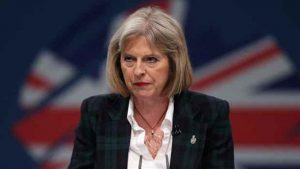 Russia regrets British Prime Minister Theresa May’s latest statements on the perceived Russian threat to the United Kingdom, Kremlin spokesman Dmitry Peskov said Tuesday.
May cited a “very real” threat from Russia and North Korea that the UK faced, as she advanced her argument on Monday in favor of renewing the aging Trident nuclear deterrent. British lawmakers voted later that day to approve the multibillion-dollar program to build four Vanguard-class nuclear submarines.
“The Kremlin regards these statements with regret. Apparently Mrs. Prime Minister has not yet fully caught up with the course of international affairs. Russia, in fact, is one of the main guarantors of international stability and nuclear security, strategic security, and this is an absolutely indisputable fact,” Peskov told reporters.
Peskov, noting Russia’s active role in the non-proliferation process, voiced hope that “an objective point of view with regard to our country would prevail” within May’s administration.
July 19, 2016
Posted by aletho |
Militarism | Russia, UK |
Leave a comment
When friends of friends are enemies
A friend recently observed to me that it is ironic that the neoconservatives, whose bottom line foreign policy issue is the uncritical support of Israel, should be obsessed with constantly confronting and goading Russia even though Tel Aviv and Moscow get along just fine. Israeli Prime Minister Benjamin Netanyahu has traveled to Russia three times in the past year and he and President Vladimir Putin reportedly understand each other very well.
To be sure, part of the reasoning behind the Israeli offering the hand of friendship is certainly demographic and electoral as many Israelis are Russian in origin and also characteristically strongly support recent right wing governments. They are regarded as essential members of Netanyahu’s coalition, but there is clearly more to it than counting votes.
From the Israeli point of view, Russia, though allied with Syria and friendly with Iran, does not threaten Israel and it also is an available resource to help Tel Aviv develop, refine and market its claimed offshore energy resources. Israel, increasingly isolated because of its repression of the Palestinians, is always eager to make new friends who will help protect it in international fora, witness Netanyahu’s recent charm offensive in Africa.
From the Russian point of view, Israel is a useful friend given its unparalleled access to the U.S. Congress, the White House and the American media. The Netanyahu government also understands Moscow’s concerns about radical Islam in the Arab world and Central Asia and is willing to share information that it obtains to contain the problem. For both Israel and Russia terrorism is not an abstraction – it sits right on and even inside their borders.
Even though Israel is undercutting the neocon plan to isolate and punish Russia at every opportunity people like Bill Kristol, the Kagans and John Bolton make no effort to criticize Netanyahu for his temerity. It is a policy of deliberately looking the other way and it underlines the essential phoniness of what the neoconservatives stand for. To put it bluntly, the neocons claim to support American military dominance globally for altruistic reasons but the reality is that they are largely in it for the money as well as the political and media access to power that money brings with it in contemporary America. What would Sunday morning talk shows be like without a beaming Bill Kristol?
And the cash for the neocons comes mostly from defense contractors who are eager to have a clearly defined serious enemy to boost military spending coupled with an articulate group of pundits who insist on seeing threats worldwide and are willing to promote that viewpoint. Keeping the cash flowing to fund that nice corner office with a view of the Capitol even trumps the Israel relationship but the neocons are careful to make sure the two issues never bump up against each other when they are fulminating against Obama’s national security policies.
We are currently witnessing neocon perfidy at its most refined. They are jumping over themselves to support Hillary Clinton for president in spite of her manifest corruption and unreliability because Donald Trump has threatened to do two things: first he has expressed his unwillingness to enter into new wars in the Middle East or anywhere else and second he has stated that Washington should be even handed when attempting to negotiate peace between Israel and the Palestinians. Both are anathema to the neocons and Trump has further complicated matters by indicating that he would be willing to talk with Vladimir Putin. If Trump were to win, many neocons would likely find themselves having to look for a real job, a terrifying prospect for people with few skills to fall back on.
Hillary Clinton on the other hand will do what is right from the neocon point of view – confronting the world one nation at a time starting with Iran, which she has threatened to “obliterate.” She will also need to boost defense spending to support her wars, will stiff Vlad, and will allow Bibi to move in down the hall at the White House as Bill will often be out on the town and his room in the East Wing is not needed.
Hillary’s bellicosity guarantees that the military industrial complex cash machine will continue to operate full speed, driving scores of leading neocons to announce that they will vote for her. Reuel Marc Gerecht, one of the neocons’ favorite Iran bashers, concluded in an article appearing in a recent issue of the Weekly Standard that Hillary’s “not a neoconservative, but Hillary Clinton isn’t uncomfortable with American power. Unlike Obama, she isn’t the apologetic type. Whatever her opinions were in the Vietnam era, she doesn’t now view the Cold War ambivalently. She’s certain that might married right in that struggle, even in the Third World, where Obama and many on the left have serious doubts.” I’m not completely sure what that pompous bit of prose is supposed to mean but Gerecht in a backhanded fashion also provided what is for me a ringing endorsement of Donald Trump, though he of course meant to do the opposite having stated his intention to vote for Hillary, writing “Trump is probably the most anti-interventionist presidential candidate since Eugene V. Debs, the indefatigable socialist, in 1912.”
The issue of Israel has, of course, been somewhat hidden during the lead-up to the major party nominating conventions, with everyone inevitably expressing his or her deep affection for Netanyahu, but it has surfaced somewhat in the Democratic Party platform deliberations where Cornel West and James Zogby attempted to introduce some language critical of the occupation of the former Palestinian West Bank. They failed in that attempt though it is possible that something similar will be introduced from the floor during the actual convention. It will undoubtedly also fail even if it succeeds as it did in 2012 when the presiding chairman seemed to hear more “yea” votes than anyone else present in the hall.
The Republicans, still firmly under control of the neocon foreign policy clique, have outdone the Democrats. On July 12th the platform committee, with input from Jason Greenblatt and David Friedman, advisers to presumptive Republican nominee Donald Trump, approved a plank on Israel that does not accept creation of a Palestinian state at all unless Israel decides to take action to permit that to develop. On that and all other issues there will be “no daylight” between the U.S. and Israel. The subcommittee that drafted the position reportedly approved it by an overwhelming majority followed by a standing ovation.
The document calls Israel a “beacon of democracy and humanity.” It states that “support for Israel is an expression of Americanism” and declares that the U.S. Embassy will be moved to Jerusalem. It denies that Israel is an “occupier,” and calls for legislation to combat the “anti-Semitic” Boycott, Divestment and Sanctions movement. The plank could have been written by Netanyahu’s Foreign Ministry or perhaps by the American Israel Public Affairs Committee (AIPAC) and basically cedes to Israel control over the direction of U.S. foreign policy in a critical and unstable region.
And there has been additional activity in Congress lately regarding Iran, with a large sale of Boeing jets being blocked and three additional bills submitted for consideration that will punish that country by, among other steps, denying it access to international finance. Indeed, the unrelenting neocon hostility towards Iran is a subset of the pro-Israel bias as Tehran is perceived as a problem for Tel Aviv while the arguments made to suggest that Iran threatens Europe and the United States lack any plausibility.
The creation of enemies unnecessarily, as applied to both Iran and Russia, is a symptom of the neoconservative disease. It is a pointless search for full spectrum military dominance that panders to an inchoate fear that the U.S. is surrounded by foes that can only be dealt with by decisive kinetic action which will require large defense budgets. Today’s neo-conservatism is a movement born from a curious amalgam of interests that have come together at a time when the United States is in reality militarily unchallenged worldwide and is threatened neither by any other country nor by the pinpricks inflicted by terrorists. Neocons and their associated liberal interventionists have to an extent dominated the foreign and defense policy thinking of the two major parties and most of the media but their message is ultimately based on emphasizing national insecurity, which in the current context is somewhat inexplicable. The United States has never been more secure internationally, if not domestically, and the only problems it is confronting are themselves part and parcel of the imbroglios that have been engineered by the interventionists and their friends. Speculation is that a Trump victory will actually end their dominance. If that is so, it might just be sufficient reason to vote for Donald Trump.
July 19, 2016
Posted by aletho |
Full Spectrum Dominance, Militarism, Timeless or most popular, Wars for Israel | Israel, Middle East, Russia, United States, Zionism |
Leave a comment
European Parliament rapporteur for Serbia David McAllister signaled Thursday that the EU remains committed to enlargement in the Western Balkans. However, Eurocrats regard the Russo-Serbian relationship as a stumbling block in Belgrade’s way to EU accession.
European Parliament rapporteur for Serbia David McAllister warned Belgrade Thursday that Serbia’s intention to maintain close relations with Russia would not be tolerated by Brussels in the long run.
“The European Parliament sent a signal to Serbia through its [January] resolution that a dual approach to Russia could not be tolerated in the long run,” McAllister said at the press conference in Belgrade dubbed “The European Union’s Global Strategy on Foreign and Security Policy and the Western Balkans,” as quoted by Balkan Insight.
McAllister also urged Belgrade to reduce its “dependency” on Russian oil and gas, claiming that Brussels wants to see Serbia abiding by the EU energy market rules.
Ahead of the conference McAllister clarified his position in an interview with Europe Western Balkans media outlet.
“The Serbia-Russia relations have often been debated. Serbia has traditionally strong economic, social and cultural ties with Russia,” he admitted.
However, he claimed that since Russia “unilaterally changes European borders” and tries to “expand its influence” over its neighbors, Belgrade “needs to make strong efforts in aligning its foreign and security policy to that of the EU, including the policy on Russia,” referring to the EU sanctions regime imposed on Moscow.
Much in the same vein Nathalie Tocci, adviser to EU Foreign Policy and Security Chief Federica Mogherini, described Serbia’s prospects for EU membership in her interview with Tanjug.rs:
“In the accession process, a country is expected to meet all accession criteria and align itself with common European rules through negotiations, which implies both foreign policy and security. In that regard, I see the relationship with Russia as the biggest challenge for Serbia — as it gets closer to EU membership, Serbia will be expected to also get closer to the EU in terms of its position regarding Russia, but that is something that cannot happen overnight,” she said as quoted by the media outlet.Nevertheless, the Serbian government does not want to abandon its ties with Moscow, insisting that it intends to maintain fruitful diplomatic relations with both Russia and the West.
“I… wish to underline that in the process of decision-making Serbia had a continued consistent stance that at this very stage of the accession process it could not uphold all EU decisions. In some cases Serbia did not align with the EU positions, respecting its national interest concerning the issue of preserving its territorial integrity and the need to maintain traditionally good relations with other partners as well, first and foremost with Russia and China,” Foreign Minister Ivica Dacic told the press conference on Thursday.
He stressed that Serbia has proven to be a “reliable and true” partner of the EU and bemoaned the fact that despite Belgrade’s strategic foreign policy orientation toward full EU membership, the process “has not had particularly live dynamics so far because in the last two years we opened only two negotiating chapters.”
At the conference Dacic underscored that the time has come to reexamine what was done to Serbia back in 1999, and threw into question Kosovo’s self-proclaimed sovereignty. He recalled that US Assistant Secretary of State told him that the US has been investing in Kosovo’s independence for 20 years.
“Then I think the mistakes must be sought not only in our system,” he stressed, as cited by B92.net.
He emphasized that neither Russia nor China recognize Kosovo’s independence.
Later, commenting on the EU officials’ remarks Dacic told Serbian daily newspaper Novosti, as cited by Balkan Insight: “It could not be expected from Serbia to introduce sanctions on its friends.”
In his interview with Sputnik former Serbian diplomat Zoran Milivojevic noted that Serbia has its own national interests and the right to protect them.
“There are no reasons [for Serbia] to reconsider its relation with other nations, especially with United Nations Security Council permanent members and traditional friends of Serbia, Russia or China,” Milivojevic told Sputnik.
The diplomat stressed that it is inappropriate for Brussels to set such conditions on the very early phases of Serbia-EU negotiations, referring to the fact that Belgrade and the EU are yet to discuss the 31st chapter of EU accession related to Serbia’s foreign policy. Only when the chapter is opened the issue of the Russo-Serbian should be brought into the spotlight, he stressed.
July 17, 2016
Posted by aletho |
Economics | European Union, Russia, Serbia |
Leave a comment
If Luke Harding’s wild-eyed narcissism was less in tune with the current western agenda then his editors at the Guardian might be taking him aside and quietly suggesting counselling and medication. But things being as they are, his narratives of battling Demon Russia and its Empire of Evil tend to make the front page, however rabidly insane, libellously mendacious or simply cringeworthy they may be.
But yesterday the Guardian unleashed this:
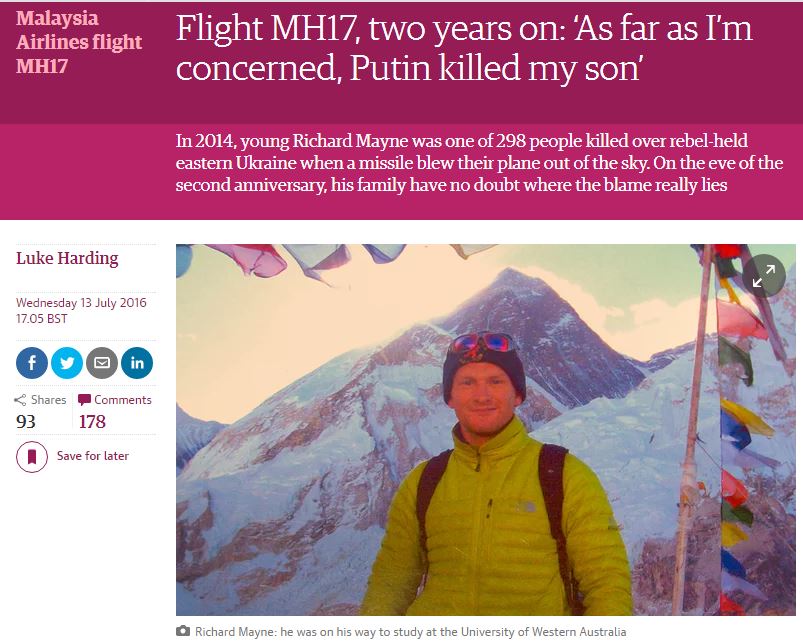
Absorb the headline and the intent behind it. Something of a tour de force of moral bankruptcy even for the team that brought you the Polonium story. We don’t just get racism, warmongering and towering falsehoods here. No – we can also experience the exploitation of 20 year old Richard Mayne’s short life and tragic death and his family’s pain! So sit back and enjoy as Harding rushes in where the sane and ethical might fear to tread, boldly turning one family’s unspeakable tragedy into grist for his own Putin-hate mill.
You see, happily for Luke and the pro-war agenda, Richard was killed on board MH17, and his parents blame Vladimir Putin…
Amid their grief, the Maynes came to a grim conclusion: Richard had been murdered. The man whom they believe murdered him is Vladimir Putin. It was Putin, they believe, who gave orders for the Russian military to cross the border, setting in train a series of consequences, including the shooting down of MH17 and 10,000 dead in the conflict.
Let’s be crystal clear at this point. No one can blame this family for their anger. They’re desperate and grief-stricken and need someone to be punished for the crime that took their son. The fact Putin is their target is an understandable human response, and no one could condemn them.
But even in a world of wall-to-wall media deception there’s something freshly disgusting in the way this piece weaves saccharine “sympathy” for the tragically bereaved into a simplistic narrative of polarity and hatred, likely to produce nothing but more death, and more grieving families like the Maynes.
Here are just a few examples, starting with the least egregious:
In the previous week, the Russian defence ministry had provided the rebels with an array of heavy weaponry: tanks, artillery pieces and mortars. Plus undercover soldiers disguised as “volunteers”.
If Harding had prefaced this claim with “it’s rumoured” or “it has been claimed” he would be doing something closer to journalism. And if he also mentioned the counter-claims that NATO is supplying the Kiev government with weapons, or the evidence for NATO-backed mercenaries fighting for the Kiev government, or the claims of the Kiev government’s war crimes against its own people (including the use of white phosphorous, which is banned under UN rulings), there’d be something approaching balance here.
But of course none of this has any direct evidential bearing on the fate of MH17 anyway, since tanks, artillery pieces and mortars were not in any way involved in shooting down that plane. Harding is merely trying to evade the facts and plant a perception of guilt by associated ideas. But it gets a lot worse.
The Buk arrived after Ukrainian war planes started bombing rebel positions and government troops were taking back territory. Suddenly, Ukrainian military aircraft were being blown from the sky.
Note how he completely elides the fact that a Dutch Intelligence report stated only the UAF had the operational capacity to shoot down a jet liner at 20,000+ feet, and the only Ukrainian planes “blown from the skies” were taken down at comparatively low altitudes by ManPads or “light” anti-aircraft guns not BUK. If his sentence ran something like: “unverified claims have been made that a BUK arrived some time before July 17, but the only planes known to have been downed by the rebels before or after this date were brought down using portable Manpads or light SAMs”, it would be broadly definable as honest.
And then we get this:
Certainly, Russia has done everything it can to cover up the crime. The Kremlin used its UN security council veto to stop an international investigation similar to that carried out following the Pan Am Lockerbie bombing.
Getting into his stride, Luke abandons implications and guilt by juxtaposition in favour of his old standby – the outright lie. Let’s take a moment to appreciate how completely unfazed he is by the total absence of evidence anywhere that Russia covered up anything, or by the small detail that Russia did not veto an “international investigation”, at all but in fact supported UN Resolution 2166 that called for “efforts to establish a full, thorough and independent international investigation into the incident in accordance with international civil aviation guidelines”. What does Luke think the Dutch Safety Board international investigation was if not – well, an international investigation? Is he not aware Russia supported it and supplied it with evidence?
We can be charitable and assume Harding means the proposal for a UN tribunal. Russia did veto that, it’s true, because – it argued – this was unprecedented and also premature to begin a second international investigation while the first was still underway. But this is not the same thing at all as vetoing an “international enquiry,” and Harding is surely aware of that. His narrative here amounts to a total reversal of known and established facts.
But he ain’t done yet…
Last October, a Dutch safety board report confirmed that a Buk missile launched from rebel-controlled territory hit MH17…
Is Luke trying to make us think the DSB directly blamed the “rebels” for shooting down MH17? Because to the unwary it might read as if that is what they did. But of course it isn’t, and Luke knows it. The DSB report concluded a BUK was probably responsible for the destruction of MH17 (though this is by no means conclusive), but it did not say which side had fired the missile because it could not pin down the probable launch area in a narrow enough corridor to make such a statement feasible. The claim of “rebel-conrolled territory” is word-fog designed to create the illusion of accusation where none exists.
The Buk’s crew appear to have fired on MH17 by mistake. At 5.50pm Moscow time, their leader Igor Strelkov, a veteran Russian intelligence officer, tweeted that his men had shot down another Ukrainian transport – or “bird”, as he put it.
All we need to do is note the weasel-words “appear to.” Another Harding trademark. They translate as “I want you to believe it but I have no evidence whatsoever that anything even remotely resembling this actually happened”. Admire also how he breezes right past the fact the DPR denied this tweet, and the account it emanated from, had anything to do with Strelkov at all.
You don’t have to believe it, Luke, but you do have to report it, particularly when you are building your story around the need of a bereaved family for justice.
I could go on. I could talk about Harding’s complete elision of the numerous uncertainties and controversies still surrounding almost every aspect of the incident in favour of a groundless certitude. His refusal to acknowledge the fact there is still no agreement over what shot MH17 out of the sky, never mind who (was it a BUK, as the corporate media claim, not a BUK, an SU-25, definitely NOT an SU-25, or something else again?). Or his absolute refusal to even acknowledge the fact the UAF is known to have had over 20 working BUK, while the rebels are only rumoured to have had one. Or the virtual impossibility of an untrained amateur crew being able to use one “acquired” BUK to take down anything. Or the Russian satellite data, all but ignored by western media, that seems to suggest very strange shenanigans immediately prior to the take-down of the plane. Or the numerous questions and accusations hanging over the DSB’s final report.
But you probably get the picture. The depth of the lie here and the fragility of their control over their own narrative is evidenced BTL. The comments were opened for less than three hours and at close the final page looked like this:
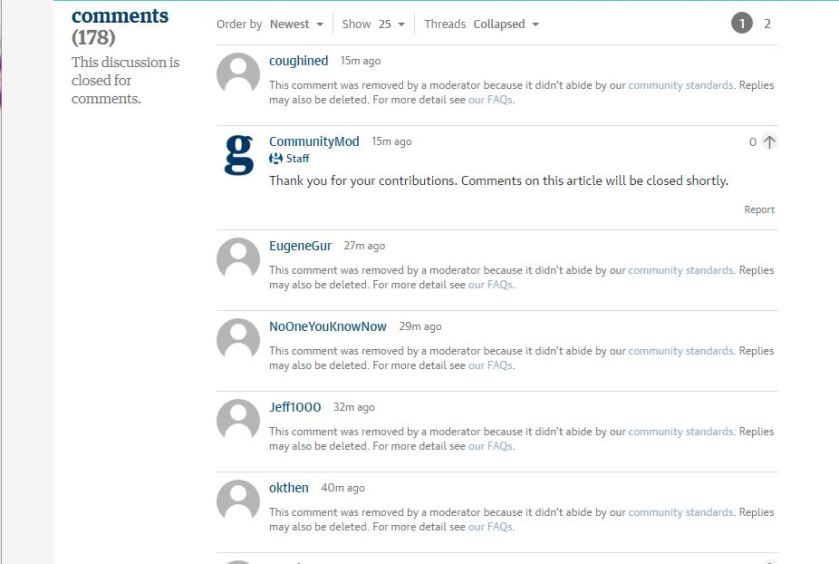
Other comments were simply airbrushed away in totality (we’ve all experienced that). One reader even tells us his account of 18 months standing was permanently disabled simply because he pointed out that Eliot Higgins’ work has been described as “propaganda.” Harding, of course, is known to fear the comments section and is rumoured to police it ferociously, demanding the instant banning of anyone who critiques him.
But however much he silences his critics BTL, the question still remains – what is Harding doing here? And, even if we accept he’s too lost in his narcissistic persecution complex to understand concepts of right and wrong or truth and fiction, what is the Guardian’s excuse? The Mayne family, like so many others, are looking for answers and solutions, not lies and propaganda. They want to know who killed their son. Who really, actually killed their son. because it’s the only thing they can do for him any more; the only act of caring and protection left available to them. And for that they need and deserve more than being used as the unwitting attack dogs for undeclared and lunatic agendas. They deserve the respect of honesty and full and truthful disclosure.
If they’d been given that would they still be blaming Vladimir Putin? Or would their anger be directed against other – possibly more deserving – targets, such as the media that has lied and continues to lie in the service of obscuring truth and promoting war?
I can’t tell and wouldn’t presume to dictate. But if one of my children had died so abominably I hope I would find someone willing to help me find the culprits rather than use me as a poster child for their own personal hate campaign.
July 15, 2016
Posted by aletho |
Mainstream Media, Warmongering | Luke Harding, MH17, NATO, Russia, The Guardian, Ukraine |
Leave a comment
In his book 2017: War with Russia published a few months ago, former deputy commander of NATO Sir Alexander Richard Shirreff predicts that to prevent NATO expansion Russia will annex eastern Ukraine and invade the Baltic state of Latvia in May 2017. Most dismiss the book as sensationalist fantasy, but it draws attention to the fact that NATO is in fact aggressively expanding, and holding large-scale war games in Romania, Lithuania, and Poland, and Russia is truly concerned.
Why Latvia? Shirreff is not alone in trying to depict Latvia and the other Baltic states (Estonia and Lithuania) as immanently threatened by Russia. The stoking of Baltic fears of such are a principle justification for NATO expansion.
The argument begins with the assertion that Vladimir Putin (conflated with Russia itself, as though he were an absolute leader, a second Stalin) wants to revive the Soviet Union. His occasional comment that the collapse of the USSR was a “catastrophe” is repeatedly cited, totally out of context, as proof of this expansionist impulse. It continues with the observation that there has been tension between Russia and the Baltic states since their independence in 1991. And while Russia has never threatened the Baltic states with invasion or re-incorporation, the fear mongers like to conjure up Sir Richard’s World War III scenario.
So it’s not difficult to understand why NATO, in its largest war games since the end of the Cold War, would choose Poland, which borders both Russia (the Kaliningrad enclave) and Lithuania, as their setting. Dubbed Anaconda-2016, the ten-day exercise involves 31,000 troops from 24 countries including non-NATO members Kosovo, Macedonia and Finland. Germany, whose foreign minister Frank-Walter Steinmeier has actually criticized the exercise as “saber-rattling and warmongering,” has sent 400 military engineers but no combat troops.
This follows the June announcement that NATO would deploy four multinational battalions (about 4000 troops) in the Baltic states and Poland to “bolster their defenses against Russia.” The idea is that Russian actions in Georgia in 2008 and in Ukraine since 2014 show that Russia poses a grave threat to European security.
It doesn’t actually. Its military budget is one-twelfth of NATO’s. It has no motive. Russia has responded to the unrelenting expansion of NATO to encompass it with stern words and defensive military measures but calm and ongoing appeals for cooperation with nations it (despite everything) continues to refer to as “our partners.”
But since the Baltics have become the focus of (supposed) NATO-Russian contestation, let’s look at what the problem is all about.
The three states were part of the Russian Empire under the tsars from the 18th century up to the Bolshevik Revolution of 1917. While most of the component parts of that empire soon became Soviet Socialist Republics (such as Georgia, Armenia, Ukraine, Kazakhstan, Uzbekistan etc.), others, including Poland, Finland and the Baltic states gained their independence at that time.
But in Estonia, Latvia and Lithuania, there remained large ethnic Russian, and Russian-speaking minorities, as there are today. In 1940 the Soviet army invaded these countries and incorporated them into the USSR. This was part of a strategy to avoid German invasion through the signing of the “Ribbentrop-Molotov Pact” that also meant the temporary division of Poland. (We can criticize this, as I surely do, but that’s the history.) A year later the Nazis invaded the Baltic republics and the Soviet Union as a whole. But the Soviets won the war, and the Baltics remained Soviet up to 1991.
The Baltic states, never truly happy campers in the Soviet Union, initiated the breakup of the country when, from June 1987, protests in Latvia and Estonia led to demands for secession, which the USSR recognized in September 1991. These demands for independence were generally supported by ethnic Russians in the republics. They no doubt expected that they would retain their longstanding linguistic rights.
(This issue of language rights is a huge problem in the former Soviet republics, including especially Ukraine. But it is little understood nor appreciated by U.S.opinion-makers, especially U.S. State Department officials and their media echo chamber.)
Today the Baltic republics have a population of a little over six million, including about one million ethnic Russians. The Russian figure has declined by about one-third since 1991. It is currently lowest in Lithuania (6 to 14%), and 24-30% in the other states.
The restoration of independence produced a wave of nationalist sentiment that included an attack on existing rights of ethnic Russians, distinguished from the others less by looks than by language. As recently as May 2016 a survey co-conducted by the Estonian and Latvian governments found that 89% of ethnic Latvians and 84% of ethnic Estonians are unhappy with this presence and want the Russians to “move back to Russia,” although many are from families who have lived in these countries for centuries.
In Latvia, the State Language Law (passed in 2000) requires that documents to local and national government, and to local and national state public enterprises, be submitted in Latvian only, as the sole national language. (Earlier they could be submitted in Russian, or even English or German.) Aside from being perceived by the minority as an attack on their own culture and identity, this requirement imposes hardships especially for older citizens who have never mastered the “national” language. A similar situation pertains in Estonia. Protests not only by Russia but by other countries have resulted in rulings against Latvia by the European Court of Human Rights and the UN Human Rights Committee.
Moscow sees itself as the protector of ethnic Russians from Ukraine to the Baltics. This should not be so hard to understand. But that does not mean that Moscow—however annoyed it is by NATO expansion to its borders—has plans to invade its neighbors and spark a general conflagration. NATO in 2013 had 3,370,000 service members in 2013, to Russia’s 766,000 troops. NATO expenditures in 2015 were $892 billion on defense in 2015, compared to Russia’s $70 billion.
The idea that Russia poses a threat to any NATO nation is as plausible as the notion that Saddam Hussein threatened the world with weapons of mass destruction. Or that Libya’s Gadhafy was preparing a genocidal campaign against his own people. Or that Iran plans to use nukes to wipe Israel off the map. These are all examples of the Big Lie.
Wait, some will ask, what about Georgia? Didn’t Russia invade and divide that country? Yes, it did, in defense of South Ossetia, which had resisted inclusion in the Republic of Georgia formed in 1991, fearing its ultranationalist leadership. South Ossetia, inhabited by an Iranian people, had been included as an autonomous oblast in the Georgian Soviet Republic but as the Soviet Union dissolve sought unity with Russia. So did Abkhazia. These two “breakaway republics” had been involved in a “frozen conflict” with Georgia until real war broke out in August 2008, producing a Russian invasion of Georgia and Russia’s recognition of South Ossetia as well as Abkhazia as independent states.
One can see this as tit-for-tat for the U.S. dismemberment of Serbia in 1999 and subsequent recognition of Kosovo as an independent state in February 2008. This act in plain violation of international law, condemned by U.S. allies such as Greece, Romania and Spain, was explained by U.S. Secretary of State Condoleezza Rice as a sui generis case. Well then, that 1999 NATO war on Serbia has led to more sui generis cases, hasn’t it?
And what about Ukraine? The limited moves Russia has taken there have been in direct response of the U.S.-led effort to incorporate Ukraine into NATO, most notably in backing the pro-NATO (and neo-fascist) forces who pulled off the coup of February 22, 2014. Any support Russia has offered to ethnic Russians in the Donbass opposed to the ultranationalist (and dysfunctional) new regime in Kiev hardly constitute an “invasion.”
It’s all about NATO. Unfortunately, the U.S. masses don’t even know what NATO is, or how it’s expanding. It is rarely mentioned in the mainstream press; its existence is never problematized, or discussed in U.S. political debates (except when Trump says the U.S.’s NATO allies are getting a “free ride”); the fact that its dissolution is not subject to questioning is all very depressing.
But wait, I must correct myself. Stephen Kinzer, a senior fellow at the Watson Institute for International Studies at Brown University, got an op-ed published in the Boston Globe a few days ago, entitled “Is NATO Necessary?” Without calling for its outright abolition, he declares, “We need less NATO, not more.”
But the next day the newspaper website included (as if by way of apology) an op-ed by Nicholas Burns, Undersecretary of State for Political Affairs in the George W. Bush administration and now professor of the practice of diplomacy and international politics at Harvard’s Kennedy School of Government. It’s entitled, “Why NATO is vital for American interests.”
Burns adduces four reasons for NATO’s continuing necessity.
“The first is Vladimir Putin’s aggression — his division of Georgia and Ukraine, his annexation of Crimea, his threats to the Baltic states, and his military’s harassment of US forces in international airspace and international waters.” (In other words, Russia’s restrained response to NATO’s provocations is reasons for NATO to continue, as a provocateur. And what “threats” of Putin can Burns cite? There have been none.)
“The second challenge is a dramatically weakening and potentially fractured European Union, now exacerbated by the possible departure of the United Kingdom.” (In other words, as the contradictions within European capitalism intensify, the U.S. must keep its camp together as—if nothing else—an anti-Russian alliance. What logic is this, other than fascist logic?)
“The third is the tsunami of violence spreading from the Levant and North Africa into Europe itself.” (In other words, when NATO actions result in so much pain in Libya and Afghanistan, and U.S.-led wars to so much chaos in Iraq and Syria that a million people flood into Europe, destabilizing European unity on the question of migration policy, the U.S. needs to be there somehow using the military alliance to hold it all together.)
“The fourth is uncertain and sometimes seemingly unconfident European and American leadership in the face of these combined challenges.”
(In other words, the U.S. needs to instill confidence by taking such actions as the invasion of Iraq that Burns supported as a State Department official, and the Libya slaughter he supported as a Boston Globe op-ed writer.)
Strength. Power. Confidence.
Burns and Gen. Jim Jones (former National Security Advisor for Pres. Obama) “believe NATO should station military forces “on a permanent basis in Poland, the Baltic states, the Black Sea region, and the Arctic,” and that the “US should extend lethal military assistance to Ukraine so that it can defend itself.” As though it has been attacked.
His final point is “that our most complex challenge may come from within the NATO countries themselves. Our strongest link is that we are all democracies. But, many of us, including the United States, are confronting a wave of isolationist sentiment and ugly extremism in our domestic political debates. NATO will need strong, unflinching American leadership to cope with these challenges.”
This conclusion is of course a reference to Donald Trump and his “extremism” in daring to—-among his many inchoate and clueless pronouncements—opine that the U.S. is protecting Europe for NATO, but spending too much money on it, and Germany should do more for Ukraine. It seems a statement in favor of that Iron Lady Hillary, who was so unflinching in her support of the Iraq War, and the Libya regime change, and who is hot to trot to bomb government buildings in Damascus.
Gary Leupp is Professor of History at Tufts University, and holds a secondary appointment in the Department of Religion. He can be reached at: gleupp@tufts.edu
July 14, 2016
Posted by aletho |
Book Review, Mainstream Media, Warmongering, Timeless or most popular | Estonia, Latvia, Lithuania, NATO, Russia |
Leave a comment
Russia has verified Iran’s commitment to the Joint Comprehensive Plan of Action (JCPOA), a nuclear agreement signed between Iran and six world powers last year.
Sergei Ryabkov, a Russian deputy foreign minister and a chief negotiator at the talks that led to the deal, made the remarks in a meeting with Iran’s Ambassador to Moscow Mahdi Sanayi on Tuesday.
“While referring to Iran’s commitment in fulfilling its JCPOA commitments, the Russian deputy foreign minister said, ‘Moscow would also lend its support to other parties’ fulfillment of their obligations,’” the Iranian Embassy in Moscow said in a press release.
Ryabkov’s remarks come even as certain Western parties have accused Iran of having violated the spirit of the JCPOA and a United Nations Security Council (UNSC) resolution that endorsed it by engaging in developing and testing missiles.
Resolution 2231 was adopted on July 20, 2015 to endorse the JCPOA, which was itself signed six days before.
The accusations against Iran come despite the fact that Resolution 2231 puts no limits on Iran in terms of missile activities, and merely “calls upon” Iran not to undertake any activity related to ballistic missiles “designed to be capable of” delivering nuclear weapons.
Iran says it is involved in no such missile work and has no such weapons.
Under the JCPOA, Iran has in fact limited its nuclear program and provided enhanced access to international atomic monitors. The other sides have in return committed to terminating all nuclear-related sanctions imposed by the United States, the United Nations (UN) and the European Union (EU) against Iran.
During the Tuesday meeting, Sanayi, for his part, called Russia’s cooperation with Iran in the fulfillment of the JCPOA obligations valuable and constructive.
Moscow played an instrumental role in the negotiations leading to the agreement and the implementation of the deal.
Ryabkov and Sanayi also expressed satisfaction with the increased level of cooperation between Iran and Russia in the wake of the implementation of the JCPOA.
July 13, 2016
Posted by aletho |
Economics, Wars for Israel | Iran, Russia, Sanctions against Iran, United States, Zionism |
Leave a comment
It’s unnerving to realize that the NATO alliance – bristling with an unprecedented array of weapons including a vast nuclear arsenal – has lost its collective mind. Perhaps it’s more reassuring to think that NATO simply feels compelled to publicly embrace its deceptive “strategic communications” so gullible Western citizens will be kept believing its lies are truth.
But here were the leaders of major Western “democracies” lining up to endorse a Warsaw Summit Communiqué condemning “Russia’s aggressive actions” while knowing that these claims were unsupported by their own intelligence agencies.
The leaders – at least the key ones – know that there is no credible intelligence that Russian President Vladimir Putin provoked the Ukraine crisis in 2014 or that he has any plans to invade the Baltic states, despite the fact that nearly every “important person” in Official Washington and other Western capitals declares the opposite of this to be reality.
But there have been a few moments when the truth has surfaced. For instance, in the days leading up to the just-completed NATO summit in Warsaw, General Petr Pavel, chairman of the NATO Military Committee, divulged that the deployment of NATO military battalions in the Baltic states was a political, rather than military, act.
“It is not the aim of NATO to create a military barrier against broad-scale Russian aggression, because such aggression is not on the agenda and no intelligence assessment suggests such a thing,” Pavel told a news conference.
What Pavel blurted out was what I have been told by intelligence sources over the past two-plus years – that the endless drumbeat of Western media reports about “Russian aggression” results from a clever demonization campaign against Putin and a classic Washington “group think” rather than from a careful intelligence analysis.
Ironically, however, just days after the release of the British Chilcot report documenting how a similar propaganda campaign led the world into the disastrous Iraq War – with its deadly consequences still reverberating through a destabilized Mideast and into an unnerved Europe – NATO reenacts the basic failure of that earlier catastrophe, except now upping the ante into a confrontation with nuclear-armed Russia.
The Warsaw communiqué – signed by leaders including President Barack Obama, German Chancellor Angela Merkel, French President Francois Hollande and British Prime Minister David Cameron – ignores the reality of what happened in Ukraine in late 2013 and early 2014 and thus generates an inside-out narrative.
Instead of reprising the West’s vacuous propaganda themes, Obama and the other leaders could have done something novel and told the truth, but that apparently is outside their operating capabilities. So they all signed on to the dangerous lie.
What Really Happened
The real narrative based on actual facts would have acknowledged that it was the West, not Russia, that instigated the Ukraine crisis by engineering the violent overthrow of elected President Viktor Yanukovych and the imposition of a new Western-oriented regime hostile to Moscow and Ukraine’s ethnic Russians.
In late 2013, it was the European Union that was pushing an economic association agreement with Ukraine, which included the International Monetary Fund’s demands for imposing harsh austerity on Ukraine’s already suffering population. Political and propaganda support for the E.U. plan was financed, in part, by the U.S. government through such agencies as the National Endowment for Democracy and the U.S. Agency for International Development.
When Yanukovych recoiled at the IMF’s terms and opted for a more generous $15 billion aid package from Putin, the U.S. government threw its public support behind mass demonstrations aimed at overthrowing Yanukovych and replacing him with a new regime that would sign the E.U. agreement and accept the IMF’s demands.
As the crisis deepened in early 2014, Putin was focused on the Sochi Winter Olympics, particularly the threat of terrorist attacks on the games. No evidence has been presented that Putin was secretly trying to foment the Ukraine crisis. Indeed, all the evidence is that Putin was trying to protect the status quo, support the elected president and avert a worse crisis.
It would be insane to suggest that Putin somehow orchestrated the E.U.’s destabilizing attempt to pull Ukraine into the association agreement, that he then stage-managed the anti-Yanukovych violence of the Maidan protests, that he collaborated with neo-Nazi and other ultra-nationalist militias to kill Ukrainian police and chase Yanukovych from Kiev, and that he then arranged for Yanukovych to be replaced by a wildly anti-Russian regime – all while pretending to do the opposite of all these things.
In the real world, the narrative was quite different: Moscow supported Yanukovych’s efforts to reach a political compromise, including a European-brokered agreement for early elections and reduced presidential powers. Yet, despite those concessions, neo-Nazi militias surged to the front of the U.S.-backed protests on Feb. 22, 2014, forcing Yanukovych and many of his officials to run for their lives. The U.S. State Department quickly recognized the coup regime as “legitimate” as did other NATO allies.
On a personal note, I am sometimes criticized by conspiracy theorists for not accepting their fact-free claims about nefarious schemes supposedly dreamed up by U.S. officials, but frankly as baseless as some of those wacky stories can be, they sound sensible when compared with the West’s loony conspiracy theory about Putin choreographing the Ukraine coup.
Yet, that baseless conspiracy theory roped in supposedly serious thinkers, such as New York Times columnist Paul Krugman, who conjured up the notion that Putin stirred up this trouble so he could pull off a land grab and/or distract Russians from their economic problems.
“Delusions of easy winnings still happen,” Krugman wrote in a 2014 column. “It’s only a guess, but it seems likely that Vladimir Putin thought that he could overthrow Ukraine’s government, or at least seize a large chunk of its territory, on the cheap, a bit of deniable aid to the rebels, and it would fall into his lap. …
“Recently Justin Fox of the Harvard Business Review suggested that the roots of the Ukraine crisis may lie in the faltering performance of the Russian economy. As he noted, Mr. Putin’s hold on power partly reflects a long run of rapid economic growth. But Russian growth has been sputtering, and you could argue that the Putin regime needed a distraction.”
Midwifing This Thing
Or, rather than “a guess,” Krugman could have looked at the actual facts, such as the work of neocon Assistant Secretary of State for European Affairs Victoria Nuland conspiring to organize a coup that would put her hand-picked Ukrainians in charge of Russia’s neighbor. Several weeks before the putsch, Nuland was caught plotting the “regime change” in an intercepted phone call with U.S. Ambassador to Ukraine Geoffrey Pyatt.
Regarding who should replace Yanukovych, Nuland’s choice was Arseniy “Yats is the guy” Yatsenyuk. The phone call went on to muse about how they could “glue this thing” and “midwife this thing.” After the coup was glued or midwifed on Feb. 22, 2014, Yatsenyuk emerged as the new prime minister and then shepherded through the IMF austerity plan.
Since the coup regime in Kiev also took provocative steps against the ethnic Russians, such as the parliament voting to ban Russian as an official language and allowing neo-Nazi extremists to slaughter anti-coup protesters, ethnic Russian resistance arose in the east and south. That shouldn’t have been much of a surprise since eastern Ukraine had been Yanukovych’s political base and stood to lose the most from Ukraine’s economic orientation toward Europe and reduced economic ties to Russia.
Yet, instead of recognizing the understandable concerns of the eastern Ukrainians, the Western media portrayed the ethnic Russians as simply Putin’s pawns with no minds of their own. The U.S.-backed regime in Kiev launched what was called an “Anti-Terrorist Operation” against them, spearheaded by the neo-Nazi militias.
In Crimea – another area heavily populated with ethnic Russians and with a long history of association with Russia – voters opted by 96 percent in a referendum to secede from Ukraine and rejoin Russia, a process supported by Russian troops stationed in Crimea under a prior agreement with Ukraine’s government.
There was no Russian “invasion,” as The New York Times and other mainstream U.S. news outlets claimed. The Russian troops were already in Crimea assigned to Russia’s historic Black Sea naval base at Sevastopol. Putin agreed to Crimea’s annexation partly out of fear that the naval base would otherwise fall into NATO’s hands and pose a strategic threat to Russia.
But the key point regarding the crazy Western conspiracy theory about Putin provoking the crisis so he could seize territory or distract Russians from economic troubles is that Putin only annexed Crimea because of the ouster of Yanukovych and the installation of a Russia-hating regime in Kiev. If Yanukovych had not been overthrown, there is no reason to think that Putin would have done anything regarding Crimea or Ukraine.
Yet, once the false narrative got rolling, there was no stopping it. The New York Times, The Washington Post and other leading Western publications played the same role that they did during the run-up to the Iraq invasion, accepting the U.S. government’s propaganda as fact and marginalizing the few independent journalists who dared go against the grain.
Though Obama, Merkel and other key leaders know how deceptive the Western propaganda has been, they have become captives to their governments’ own lies. For them to deviate substantially from the Official Story would open them to harsh criticism from the powerful neoconservatives and their allied media outlets.
Even a slight contradiction to NATO’s “strategic communications” brought down harsh criticism on German Foreign Minister Frank-Walter Steinmeier after he said: “What we shouldn’t do now is inflame the situation further through saber-rattling and warmongering. … Whoever believes that a symbolic tank parade on the alliance’s eastern border will bring security is mistaken.”
Excoriating Russia
So, at the Warsaw conference, the false NATO narrative had to be reaffirmed — and it was. The communiqué declared, “Russia’s aggressive actions, including provocative military activities in the periphery of NATO territory and its demonstrated willingness to attain political goals by the threat and use of force, are a source of regional instability, fundamentally challenge the Alliance, have damaged Euro-Atlantic security, and threaten our long-standing goal of a Europe whole, free, and at peace. …
“Russia’s destabilising actions and policies include: the ongoing illegal and illegitimate annexation of Crimea, which we do not and will not recognise and which we call on Russia to reverse; the violation of sovereign borders by force; the deliberate destabilisation of eastern Ukraine; large-scale snap exercises contrary to the spirit of the Vienna Document, and provocative military activities near NATO borders, including in the Baltic and Black Sea regions and the Eastern Mediterranean; its irresponsible and aggressive nuclear rhetoric, military concept and underlying posture; and its repeated violations of NATO Allied airspace.
“In addition, Russia’s military intervention, significant military presence and support for the regime in Syria, and its use of its military presence in the Black Sea to project power into the Eastern Mediterranean have posed further risks and challenges for the security of Allies and others.”
In the up-is-down world that NATO and other Western agencies now inhabit, Russia’s military maneuvers within it own borders in reaction to NATO maneuvers along Russia’s borders are “provocative.” So, too, is Russia’s support for the internationally recognized government of Syria, which is under attack from Islamic terrorists and other armed rebels supported by the West’s Mideast allies, including Saudi Arabia, Qatar and NATO member Turkey.
In other words, it is entirely all right for NATO and its members to invade countries at will, including Iraq, Libya and Syria, and subvert others as happened in Ukraine and is still happening in Syria. But it is impermissible for any government outside of NATO to respond or even defend itself. To do so amounts to a provocation against NATO – and such hypocrisy is accepted by the West’s mainstream news media as the way that the world was meant to be.
And those of us who dare point out the lies and double standards must be “Moscow stooges,” just as those of us who dared question the Iraq WMD tales were dismissed as “Saddam apologists” in 2003.
Investigative reporter Robert Parry broke many of the Iran-Contra stories for The Associated Press and Newsweek in the 1980s. You can buy his latest book, America’s Stolen Narrative, either in print here or as an e-book (from Amazon and barnesandnoble.com).
July 12, 2016
Posted by aletho |
Deception, Mainstream Media, Warmongering, Militarism | Harvard Business Review, NATO, New York Times, Russia, Ukraine, Washington Post |
Leave a comment
Despite NATO assurances that it seeks deterrence and dialogue with Russia, the alliance seems to be preparing to escalate conflict, says Mikhail Gorbachev, the man praised for ending the Cold War after the alliance convened at a summit in Warsaw.
“The rhetoric in Warsaw screams of an intention to practically declare war on Russia. They only talk about defense, but in fact they are preparing an offensive,” the former Soviet leader told Interfax.
Gorbachev, who played a key part in deescalating tensions between the Soviet Union and the West in the 1980s and eventually withdrew soviet troops from eastern Europe, was commenting on the two-day NATO summit in the Polish capital. Ironically, the city once lent its name to NATO’s communist counterpart, the Warsaw Pact, but has now seen leaders of the US-led alliance negotiating increased pressure on Russia.
In its final communique NATO accused Russia of “provocative military activities in the periphery of NATO territory” and “willingness to attain political goals by the threat and use of force”. The alliance said Moscow’s actions “are a source of regional instability, fundamentally challenge the alliance, have damaged Euro-Atlantic security, and threaten our long-standing goal of a Europe whole, free, and at peace.”
The key result of the Warsaw summit was the long-promised deployment of additional NATO troops at Russia’s border, namely in host nation Poland and the Baltic States. NATO claims that the deployment is necessary to prevent a possible attack from Russia and reassure the eastern European nations that other members are committed to defend them.
The anticipated decision and the entire event is perceived by many people as anti-Russian, Brian Becker from the anti-war ‘Answer Coalition’ told RT.
“It is a big show: you have 2,500 officials; you have 2,000 media, and you have the 28 members of NATO plus 26 partnering countries […] almost a quarter of the countries in the world under a US-led military alliance threatening Russia,” he said. “It is perceived as such in Russia, and it should be perceived as such.”
Russia believes that NATO’s new troop deployments as well as an increased number of military trainings near Russia’s territory, the creation of anti-ballistic missile sites in Europe and other moves are a threat to Russia’s national security. Its response was to increase its own troops in the west, saying it’s necessary to counter NATO’s new capabilities.
The alliance, Moscow says, plays the card of perceived Russian aggression to justify its overdue existence and push European nations into increasing defense spending. Improving budget discipline was praised by the alliance at the summit, even though the majority of members are still below NATO’s 2 percent GDP benchmark for military spending.
Critics of NATO like Gorbachev say it is taking risks by alienating Russia to secure its own goals.
“The world should realize that it can’t pretend that nothing concerning is happening. Russia cannot but keep its defense line, and this horrifying process must be stopped,” he said. “World peoples should stop this slide towards war so that nobody dared gamble with escalating the global tension and push the world to a new shooting war.”
The concern seems to be shared by some NATO members, which amid the summit reiterated on numerous occasions that the alliance is not seeking confrontation with Russia.
“We must ask if the world would be a better place when both sides conduct military exercises on the borders and arm themselves,” German Vice-Chancellor Sigmar Gabriel told Passauer Neue Presse on Thursday.
French President Francois Hollande said that the defensive block “has no role at all to be saying what Europe’s relations with Russia should be,” adding that France doesn’t see Russia as a threat.
NATO’s official stance on Russia is that it wants to deter it while keeping channels open “when Russia’s actions make that possible”. But it also condemned Russia’s military presence in Syria and its support of the Syrian government, even though in Syria, Russia and NATO members have a rare moment of limited cooperation in fighting against terrorist groups.
Practically all ties with Russia were suspended by NATO after the Ukrainian political crisis escalated tension between the two. The NATO-Russia Council, a body that is supposed to tackle the differences, was reconvened after a two-year break and is to hold a meeting next week in Brussels.
Other decisions taken by NATO members at the Warsaw summit included the continued training of Iraqi troops, which will be moved from Jordan to Iraq proper, closer cooperation with the European Union on issues like opposing Russia and tackling the refugee crisis and deploying AWACS aircraft to monitor airspace over Syria and Iraq, “raising situational awareness” for the anti-IS operation led by the US.
Video
Read more:
Unity, but not unanimity? NATO split on countering Russia amid Warsaw summit
July 10, 2016
Posted by aletho |
Deception, Militarism, Timeless or most popular | NATO, Russia, Sigmar Gabriel, United States |
Leave a comment
Can Russian President Vladimir Putin turn the tables on NATO and the European Union in the Balkan states that are not yet members of the Atlanticist project? According to Filip Kovacevic, a political science professor who specializes in Russia and Eastern Europe, Putin has a plan. Some details were provided in an exclusive report in May on the nascent project by Russia to counter NATO expansion into the remaining Balkan countries that have not yet been swept into the Western alliance.
The plan has its origins in the grassroots movement that arose in the aftermath of the first Cold War, which called for non-alignment and cooperation with both East and West. Kovacevic describes the movement as follows:
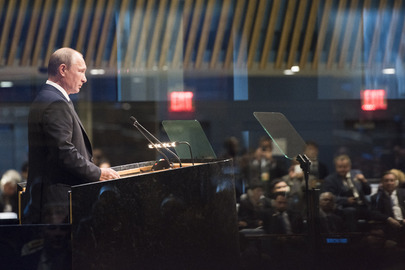
Putin addresses the UN, 09-28-15. (UN Photo)
Their members were generally young people who were enthusiastic, honest and genuinely committed to the public good, but were plagued by the lack of funding and faced with frequent media blackout and open discrimination. Nonetheless, their programs articulated the most promising and humane geopolitical vision for the Balkans. They conceptualized the Balkans as a territorial bridge between the West and the East rather than as the place of persistent confrontation, or the ‘line of fire’ as formulated by the U.S. Secretary of State John Kerry in 2015. They wanted the Balkans to become a force for peace and human dignity in the world. Their vision still remains the best option for the Balkans people.
This desire for non-alignment is understandable as a continuation of the policy of Tito’s Yugoslavia during the Cold War – the nation that several of the modern day Balkan states were a constituent part of. However, according to Kovacevic, these groups were easily overwhelmed, in terms of both financial and propaganda resources, in the 1990s by pro-NATO forces in the West.
In addition to providing resources to build up pro-NATO sentiment in the media and NGO sectors of these countries, financial resources and pressure was used to sway a large number of politicians to favor NATO membership, often in opposition to the general population’s views. Some of the unsavory forms of incentive or pressure include what amounts to blackmail and bribery, Kovacevic told me in an email interview:
This is a long-term process. In the U.S. intelligence community it is called ‘seeding.’ The intelligence scholar Roy Godson defines it as ‘identifying potential agents of influence’ at an early stage and then acting to advance their careers. This is typically done covertly, but there have been the historical examples of overt support. …
In the Balkans, the key role in the process of ‘seeding’ was accomplished by various institutes, conferences, retreats, grants, etc. For instance, I was told by a confidential source who participated in the same U.S.-NATO program, the long-time foreign minister and one-time prime minister of Montenegro, Igor Luksic, was a product of such a process. Luksic was chosen as a very young man to attend various conferences and retreats in Brussels and Washington and, after that, his political career really took off. All the while, he promoted the NATO agenda in Montenegro, even though this went against the will of the majority of the population.
Another example is Ranko Krivokapic who was the speaker of the Montenegrin Parliament for over a decade. He traveled on official business to the U.S. a few times every year and boasted to others that he had a lot of friends in the State Department and other institutions of the U.S. government. There are examples like these in Serbia, Macedonia, Croatia, etc. All over the Balkans.
There is also the fact the European Union has dovetailed its security arrangements to such an extent with NATO that new members are now virtually brought into the NATO structures by default. For example, Mahdi D. Nazemroaya, author of The Globalization of NATO, reports that the E.U.’s Security Strategy was absorbed into NATO during its annual summit in 2006. The emphasis of the summit was on securing energy resources with the goal of ‘co-managing the resources of the EU’s periphery from North Africa to the Caucuses.’ Also implied was the goal of redefining the E.U.’s security borders in synch with both Franco-German and Anglo-American economic and geopolitical interests.
Moreover, British Russia scholar Richard Sakwa, has pointed out that the security integration of the E.U. with NATO was further intensified with the ratification of the Treaty of Lisbon in 2007:
As for the comprehensive character, this is something that has been gaining in intensity in recent years as the foreign and security dimension of the E.U. has effectively merged with the Atlantic security community. The E.U.’s Common Foreign and Security Policy (CFSP) since the Treaty of Lisbon (the “Reform Treaty”) of 13 December 2007, which came into effect in 2009, is now in substance part of an Atlantic system. Acceding countries are now required to align their defense and security policy with that of NATO, resulting in the effective ‘militarization’ of the E.U.
At this point, the forces seeking a non-aligned bridge role for the Balkan states are still very much around, but have suffered marginalization due to lack of resources to take on the powerful and now entrenched pro-NATO political forces. However, with increasing discontent with the weak economic prospects in certain Balkan states, combined with increasing instability in the E.U., it is believed that there is an opening for growth of the movement.
Economic Conditions in the Balkans
The Balkan states comprise Romania, Bulgaria, Albania, Macedonia, Serbia, Kosovo, Montenegro, Bosnia-Herzegovina and Greece.
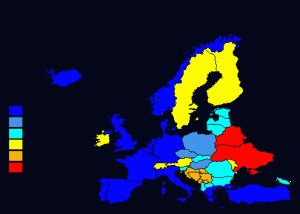
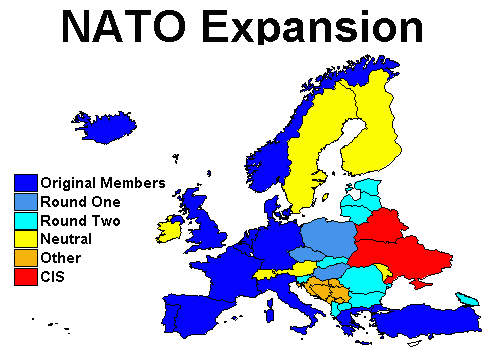
A map showing stages of NATO’s expansion. Dark blue showing original members; lighter blue the “round one” members; aqua the “round two” members; yellow represents neutral states; and brown and red otherwise aligned (including Ukraine, although that has changed since the 2014 U.S.-backed coup).
In 2007, Romania and Bulgaria became E.U. members (three years after joining NATO). Romania’s GDP has barely kept up with its 2008 rate and has a general unemployment rate of 6.4 percent, which sounds reasonable until you look at the youth unemployment rate of 21 percent, which doesn’t bode well.
Bulgaria, on the other hand, is not part of the Eurozone and has not adopted the euro as its currency. Its economic prospects since joining the E.U. have not been impressive either. In the midst of the financial crisis of 2009, its GDP contracted by 5.5 percent, with a current unemployment rate of 7 percent and youth unemployment at 17 percent. Bulgaria is also recognized as one of the union’s most corrupt countries.
Macedonia, Montenegro, Serbia, Kosovo, Bosnia-Herzegovina and Albania are all in the process of E.U. integration, with a supposed approval rate of 80-90 percent among the respective populations of these countries (except for Serbia), despite the virtual rape of Greece and the lackluster performance of Romania and Bulgaria.
It should be noted that all three Balkan nations that are actual E.U. members have higher emigration than immigration rates, another indication that accession to the E.U. doesn’t necessarily translate into a prosperous future for the average person, particularly the young.
There is also the instability highlighted by the British people’s vote to leave the E.U., spurred by disgust with austerity measures imposed by unaccountable bureaucrats in Brussels along with an influx of immigrants – one-third from these poorer E.U. nations – which adversely affect lower-wage natives.
Even if the E.U. had a better track record of effectiveness in terms of improving economic conditions for the masses, it would have a very tall order with some of the prospective Balkan states. Macedonia, for example, has an unemployment rate between 24 and 25 percent as of January 2016, although it has improved from the 2005 high of 37 percent. Despite this improvement, Macedonia still has one of the lowest GDPs in Europe and 72 percent of its citizens claimed they manage their household income only with “difficulty” or “great difficulty” in 2012.
Bosnia-Herzegovina is still feeling the effects of the war of 1992 to 1995 that included major physical destruction of infrastructure and the bottoming out of its GDP. It currently suffers an unemployment rate of 42-43 percent.
Kosovo, a state that owes its existence to a NATO intervention, has 33 percent unemployment, a high crime rate and increasing political violence due to ethnic tensions and a growing ultra-nationalist movement. The Council of Europe compared the government of Kosovo to a mafia state in a 2010 report which revealed trafficking in human organs as well as drugs and weapons throughout Eastern Europe, even implicating the then-prime minister in the operation.
Russia’s Opening
Kovacevic states that the Atlanticist project of E.U. austerity economics and the enabling of Washington’s destabilizing wars via NATO is starting to chip away at its popularity among Balkan populations. He also says Putin is prepared to take advantage of this opening and, since the outbreak of the Ukraine crisis, has turned his attention “to the Balkans with political force and funding not seen since the days of tsar Nicholas II.”
This attention has manifested in the Lovcen Declaration, which was signed on May 6, by members of Russia’s largest political party, United Russia, and the opposition Democratic People’s Party in Montenegro in the village of Njegusi. Kovacevic explains:
One of the most powerful political figures in Montenegro, the metropolitan Amfilohije, the chief bishop of the Serbian Orthodox Church in Montenegro, was present at the signing and gave his blessing. Though in the past Amfilohije has been known to support the authoritarian and pro-NATO prime minister Milo Djukanovic around the election time, he has always publicly opposed NATO membership and has given fiery speeches on its ‘evil nature’ to the point of accusing NATO for continuing Hitler’s anti-Slavic project.
Even more importantly, Amfilohije’s involvement with the Lovcen Declaration reveals one of the fundamental components of Putin’s overall geopolitical plan – the nurturing and intensification of the religious Christian Orthodox connection between the Russians and the Orthodox peoples of the Balkans. This includes not [only] the Serbs, Montenegrins and Macedonians, but also the Greeks and Bulgarians whose states are in NATO and whose religious ‘awakening’ can easily subvert NATO from the inside.
Criticism and minimization of the project have set the tone in Western media, to the extent that it has been covered at all, particularly in relation to utilizing an opposition party for significant influence. But Kovacevic argues that such a dismissive attitude is disingenuous:
[T]he very same method has been used by the U.S. and NATO intelligence services to control the governments of East-Central European states since the collapse of communism. Countless small parties with just a handful of parliamentary deputies were formed with the money coming from the various ‘black budgets’ with the task of entering the governing coalition and then steering the entire government in the direction charted by their foreign founders and mentors.
These parties have had minimal public legitimacy, but have made a great political impact with their ‘blackmail’ potential. As they also don’t cost very much, the CIA, the MI6, and the BND regularly create them for every new election cycle.
Now the Russians (primarily, the SVR and the GRU) are using the same rulebook for their own geopolitical interests. In addition, however, Putin’s grand design for the Balkans embodied in the ANS is also likely to prove durable not only because it builds on the traditional cultural and religious ties linking Russia and the Balkans, but also because it rides on the wave of the enormous present popular dissatisfaction with the neoliberal Atlanticist political and economic status quo.
The fact that this declaration was signed in Montenegro is most relevant due to the fact that the country has been officially invited to join NATO, whose subsequent membership is treated in the West as a fait accompli. However, accession requires consensus approval by all current NATO members – one member could veto the move before completion of the process as happened with Macedonia when Greece vetoed their membership aspirations in 2008 when an invitation was to be offered at the Bucharest Summit – as well as approval by the population of Montenegro.
Joining any alliance treaty is arguably something that affects national sovereignty, which requires a referendum as Kovacevic, who is Montenegrin, explains:
The corrupt government of Milo Djukanovic is trying to avoid a national referendum because it knows that it does not have a majority support for NATO. If given a choice, the people of Montenegro would reject the protocol. The Constitution requires a referendum for all matters that affect national sovereignty, but Djukanovic is arguing falsely that NATO membership leaves Montenegrin sovereignty intact.
Kovacevic predicts that a show-down over NATO membership could create instability in the country: “[I]f he [Djukanovic] tries to push this decision through the Parliament (which he no doubt will), wide-scale strikes and demonstrations may take place all over the country. Whoever is pushing Montenegro in NATO is dangerously destabilizing the country in mid-to-long term.
If that happens, Washington may find for the first time in recent memory that forcing instability on a smaller country may ultimately accrue benefits to another great power, helping to facilitate a shift in geopolitics that it didn’t bargain on. As Nazemroaya comments in his book:
The [NATO] alliance is increasingly being viewed as a geopolitical extension of America, an arm of the Pentagon, and a synonym for an evolving American Empire. … Ultimately, NATO is slated to become an institutionalized military force. … Nevertheless, for every action there is a reaction and NATO’s actions have given rise to opposing trends. The Atlantic Alliance is increasingly coming into contact with the zone of Eurasia that is in the process of emerging with its own ideas and alliance. What this will lead to next is the question of the century.
Natylie Baldwin is co-author of Ukraine: Zbig’s Grand Chessboard & How the West Was Checkmated, available from Tayen Lane Publishing. In October of 2015, she traveled to 6 cities in the Russian Federation and has written several articles based on her conversations and interviews with a cross-section of Russians.
July 9, 2016
Posted by aletho |
Corruption, Militarism | Albania, Bosnia-Herzegovina, Bulgaria, Croatia, European Union, Kosovo, Macedonia, Montenegro, NATO, Romania, Russia, Serbia, United States |
Leave a comment
The boosting of US missile defense potential in Asia and the Pacific undermines the existing global security balance, the Russian Foreign Ministry said after it was announced that Washington intends to place missile defense systems in South Korea.
“From the very beginning of the discussion of this issue we have consistently and invariably pointed at the most dangerous consequences of such a decision and called for our partners not to make this wrong choice. Unfortunately, our calls have remained unheard,” reads a Foreign Ministry statement released Friday.
Russian diplomats noted that the increase in the Asia-Pacific segment of the global missile defense system by the United States and its allies would undermine the existing strategic balance both in the region and beyond.
“Such actions, regardless of the arguments they are backed with, have the most negative effect on global strategic stability, the adherence to which is such a favored topic of discussions in Washington,” the statement reads.
The ministry also warned that the US steps threaten to increase regional tensions and create additional barriers to the peaceful settlement of the conflict between North and South Korea and nuclear disarmament on the Korean peninsula.
The Russian diplomats concluded by expressing hope that the United States and South Korea would once again consider all factors behind the decision and abstain from potentially dangerous actions.
Earlier on Friday, the South Korean Ministry of Defense announced that Seoul and Washington had reached an agreement to put a high-tech THAAD missile defense system in South Korea amid growing nuclear and missile threats from the North. According to South Korea’s Yonhap news agency, the system is expected to be in operation by the end of 2017.
THAAD – Terminal High Altitude Area Defense – is an advanced system designed to intercept short, medium, and intermediate-range ballistic missiles during their terminal phase of flight. Equipped with a long-range radar, THAAD is believed to be capable of intercepting Pyongyang’s intermediate-range ballistic missiles.
The announcement has also drawn criticism from Beijing. China’s Foreign Ministry said on Friday the system would destabilize the security balance in the region without doing anything to end the North’s nuclear program. “China strongly urges the United States and South Korea to stop the deployment process of the THAAD anti-missile system, not take any steps to complicate the regional situation and do nothing to harm China’s strategic security interests,” it said in a statement on its website.
July 8, 2016
Posted by aletho |
Militarism | Russia, THAAD, United States |
Leave a comment