Turkey’s Refusal of Observation Flight Only Fuels Worries It Supports Daesh
Sputnik – February 4, 2016
Ankara’s refusal to allow Russia to conduct an observation flight over Turkish territory under the Open Skies Treaty confirms Moscow’s concerns that Ankara is supporting the Daesh, which is prohibited in numerous countries including the United States and Russia, on the Turkish-Syrian border, a high-ranking source in the Russian Foreign Ministry said Thursday.
Russian inspectors planned to conduct the observation flight on board an An-30B plane over Turkish territory on February 1-5, but they were refused permission to do so after they arrived in Turkey and announced the flight route.
“This case is of course outrageous because the Open Skies Treaty today is practically one of many mechanisms that continue to operate in the European space and this treaty is valid and allows for acquiring valid information on steps being taken or not being taken by one or another state,” the source told RIA Novosti.
He reminded that in 2015 the West actively accused Russia of illegal activity on the Ukrainian border and NATO member countries requested observation flights over Russian territory, the results of which fully reversed the rumors.
“This once again confirms those concerns that the Russian side has voiced several times on using the Turkish-Syrian border to support Daesh militants,” the source said.
Think tank director proposes postponement of Russian elections amid Western ‘regime change threat’
© Vladimir Fedorenko / Sputnik
Sputnik – February 4, 2016
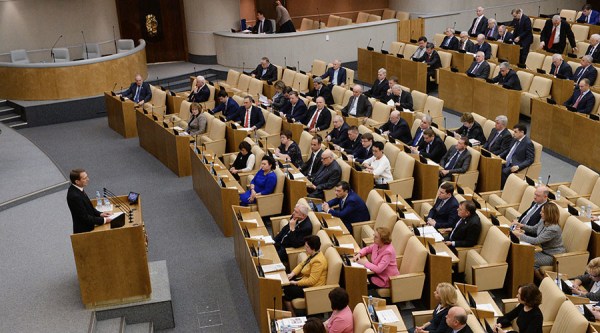
The head of a political research center has sent a letter to the State Duma chairman urging him to postpone parliamentary and presidential elections in Russia until Western nations stop their attempts at regime change through economic pressure.
“I am asking you as the chairman of the State Duma – who has the right to come up with legislative initiatives – to look into the possibility to urgently amend the Constitution with acts that would protect Russia from regime change instigated from abroad and the subsequent breakup [that would result from this],” chairman of the board at the Institute for Political Infrastructure Analysis, Yevgeny Tunik, wrote in his letter to Sergey Naryshkin.
The exact measure suggested by the analyst is a law that would automatically prolong the powers of Russian president and parliament in the event that the authorities decide to introduce a state of emergency or martial law. The new term for legislators and the head of state would last for six months from the moment of the cancellation of the emergency measures. Tunik emphasized that such a step would not violate citizens’ political rights as elections would not be canceled, only postponed.
Tunik also elaborated in his letter that over the past two years Russia has experienced unprecedented pressure from Western nations, primarily from the United States. He warned that the economic crisis and price hike could cause social unrest and protests that, in turn, could bring to power “hostile, pro-Western or even extremist forces.” Canceling all elections for the period of economic crisis would prevent a situation when citizens are asked to make serious choices under pressure from circumstances that could provoke irrational decisions.
“We all can witness the results of 2015 elections in Ukraine that were held in conditions of an undeclared emergency situation,” the analyst noted.
While the State Duma speaker has not commented on the letter, the head of the lower house Committee for Constitutional Law, Vladimir Pligin MP (United Russia), said that he did not consider the initiative as viable.
“All the latest efforts of the state power institutions and society in general are directed at preserving the constitutional norms in the Russian Federation. I think that there is no reason to change them at the current moment,” the lawmaker told RIA Novosti.
Seventy years of harassing political establishment and people of Europe
Oriental Review | February 4, 2016
According to a “sensational” article by the Telegraph, the US director of National Intelligence was recently instructed by Congress to “conduct a major review into Russian clandestine funding of European parties over the last decade.” This disclosure – a classic “controlled leak” – is intended to warn disobedient yet popular political entities across Europe to scale back their ambitions to rebalance the roles and weight of their nation states within the European Union. Hungary’s Jobbik, Greece’s Golden Dawn, Italy’s Lega Nord, and France’s Front National are explicitly included in the US “warning list,” while other unnamed “parties” in Austria, the Czech Republic, and the Netherlands are being advised that they are “under a US security probe.” Even the new British Labour leader, Jeremy Corbyn, is suspected of flirting with the Russians. So, according to the sponsor of the Telegraph’s story, any European politician who dares to question NATO’s eastward expansion, the policy of anti-Russian sanctions, or the current European stance on the Ukrainian conflict is essentially a witting or unwitting tool of “Russia’s hybrid warfare.”
Well, that would be funny if it weren’t so dangerous. In fact, any impartial observer would pose some simple questions: Why the hell do US intelligence agencies care about challenges to Europe’s internal security? Aren’t they the same agents who finance, recruit, and control countless political organizations, individuals, and media outlets on the European continent? Why are they so brazenly revealing their dominion over Europe?
A politically correct challenger would argue that the United States saved Europe from the “Communist threat” after the end of WWII, facilitated its speedy economic recovery, and is still safeguarding the continent under its nuclear umbrella. Perhaps. But a review of the historical background should not begin with the Marshall Plan. First of all, that was launched in April 1948. Since the Nazis capitulated in May 1945, a misinformed reader might deduce that the United States had been drafting a massive investment program for Europe for as long as three years, and … he would be wrong. At the Second “Octagon” Quebec Conference in September 1944, President Roosevelt and US Treasury Secretary Henry Morgenthau Jr. submitted to the British PM Winston Churchill their Post-Surrender Program for Germany. That strictly confidential document envisaged the partition and complete deindustrialization of the German state. According to the plan, Germany was to be divided into two independent states. Its epicenters of mining and industry, including the Saar Protectorate, the Ruhr Valley, and Upper Silesia were to be internationalized or annexed by France and Poland. Following are a few excerpts:
- The [US] military forces upon entry into [German] industrial areas shall destroy all plants and equipment which cannot be removed immediately.
- No longer than 6 months after the cessation of hostilities, all industrial plants and equipment not destroyed by military action shall either be completely dismantled and removed from the area or completely destroyed.
- All people within the area should be made to understand that this area will not again be allowed to become an industrial area. Accordingly, all people and their families within the area having special skills or technical training should be encouraged to migrate permanently from the area and should be as widely dispersed as possible.
- All German radio stations and newspapers, magazines, weeklies, etc. shall be discontinued until adequate controls are established and an appropriate program formulated.
That was the original postwar recovery program for Germany, known as the Morgenthau Plan. The notorious Joint Chiefs of Staff Directive 1067 (JCS 1067) addressed to the Commander-in-Chief of U.S. Occupation Forces in Germany, which was officially issued in April 1945, was fully in line with that document.

Partition of Germany according to Morgenthau Plan, 1944
The Morgenthau Plan very quickly proved to be a strategic mistake. The United States underestimated the ideological and cultural impact the Soviets would have on European societies. Left to their own judgment, American strategists failed to understand the attraction that a socialist system held for the majority of the population of the liberated nations. A vast spectrum of pro-socialist and pro-communist politicians began winning democratic elections and gaining political influence not only in Eastern Europe, but also in Greece, Italy, France, and other European states (Palmiro Togliatti and Maurice Thorez are just a few who could be named here). Thus Washington came to understand that its forced de-industrialization of Europe could result in Soviet-style reindustrialization and eventual Russian dominance of the continent… Therefore the US had to promptly replace the Morgenthau Plan with one named after Secretary of State George Marshall… Over the course of four years it provided Europe with $12 billion USD in credits, donations, leases, etc., for the purpose of buying … American machinery and other goods. Although the plan undoubtedly revived the economies of Europe, its biggest positive effect was on … the US economy itself! Simultaneously a wave of political repression was launched throughout Europe, most notably in Germany.
The media has largely forgotten about a Soviet initiative, proposed in 1950, to withdraw from the GDR and to reunify a neutral, non-aligned, demilitarized Germany within one year of the conclusion of a peace treaty. As a matter of fact, the resolution adopted at the Prague meeting of the foreign ministers of the Soviet Bloc on Oct. 21, 1950 proposed the establishment of an all-German Constituent Council, with equal representation from East and West Germany to prepare for the formation of an “all-German, sovereign, democratic, and peace-loving provisional government.” Needless to say, the US government and West German administration in Bohn strongly opposed the initiative. While a plebiscite on the issue “Are you against the remilitarization of Germany and in favor of the conclusion of a Peace Treaty in 1951?” was announced in both halves of the divided state, that referendum was held and officially acknowledged only in East Germany (with 96% voting “yes”). The authorities in US-controlled West Germany failed to respond in a truly democratic manner. They refused to recognize the preliminary results of the referendum that had been held since February 1951 (of the 6.2 million federal citizens who had taken part by June 1951, 94.4% also voted “yes”) and introduced the draconian cautious Criminal Law Amendment Act (the 1951 Blitzgesetz) on July 11. According to that legislation, anyone guilty of importing prohibited literature, criticizing the government, or having unreported contacts with representatives of the GDR, etc. was to be prosecuted for “state treason,” which was punishable by 5 to 15 years in prison. Consequently, between 1951 and 1968, 200,000 charges were brought against 500,000 members of the Communist Party and other left-wing groups in Germany under this law. Ten thousand people were sent to prison, and most of those who were “cleared” of charges never resumed their political activities. Additional legal amendments in 1953 actually abolished the right to freely hold gatherings and demonstrations, and in 1956 the Communist Party of Germany was banned. [More details can be found in Daniel Burkholz’s 2012 documentary Verboten – Verfolgt – Vergessen (Forbidden-Followed-Forgotten. Half a Million Public Enemies), which is surprisingly unavailable on YouTube].
The political repression that occurred in Germany from the 1950s to the 1980s, compared to similar events in other European countries during the same period, is a very taboo topic. Operation Gladio in Italy, the crimes of the regime of the Black Colonels in Greece, and the controversial assassinations of realistic European politicians who openly advocated for historical compromise with the Soviet bloc – such as Italian PM Aldo Moro (1978) and Swedish PM Olof Palme (1986) – all received far more media attention. The revelations made by a former correspondent for the Frankfurter Allgemeine Zeitung, Udo Ulfkotte, in his book Gekaufte Journalisten (“Purchased Journalists”) about the mechanism of media control in Germany (remember the Morgenthau Plan?) represent only the tip of the iceberg. The almost complete lack of reaction seen in Berlin after Edward Snowden’s disclosure of the blanket electronic espionage routinely conducted against German leaders by the NSA means that in reality, Germany has acknowledged its loss of sovereignty over its own country and thus has nothing to lose.
So, after taking all these facts into account and rereading the article in the Telegraph, are you still so sure that the United States is truly the guardian of Europe’s sovereignty? Is it not more likely that by using the alleged “Russian threat” to control and harass the political establishment and civil society in Europe, Washington is making headway toward a simple and primitive goal – that of merely keeping its sheep within the fold?
‘Dangerous precedent’: Turkey denies Russian observation flight along Syrian border

Antonov An-30 © Wikipedia
RT | February 3, 2016
Turkey has set “a dangerous precedent” by denying an observation flight over its territories bordering Syria, the Russian Defense Ministry said, vowing a “relevant reaction” to Ankara’s violation of its obligations under the international Open Skies Treaty.
The Treaty on Open Skies which came into force in 2002 allows unarmed aerial observation flights over the territories of its 34 signatories, which includes Turkey. However the Russian An-30B plane was banned from conducting its surveillance flight over Turkish territory which was scheduled for February 1-5, without any prior warning.
“After the arrival of the Russian mission to Turkey and the announcement of the desired itinerary, the Turkish military officials refused to allow the inspection flight citing an order from the Turkish Foreign Ministry,” the head of the ministry’s National Nuclear Risk Reduction Center, Sergey Ryzhkov, said in a statement.
This is the first time that Turkey has refused a Russian observation flight over its territory. Since 2006 under the Treaty on Open Skies, Russia conducted approximately two observation flights a year. Turkey has flown over Russian airspace approximately four times a year.
But as tensions between Turkey and Russia intensified following the downing of the Russian jet in November, Ankara has refused the implementation of the treaty.
“The itinerary included the observation of areas adjacent to the Turkish border with Syria, as well as airfields that host NATO warplanes,” Ryzhkov pointed out. A previous statement, issued on February 1, specified that a Russian oversight flight would be conducted along an agreed route. Furthermore, Turkish monitors on board would have the opportunity to control the use of surveillance equipment.
Tensions deteriorated further last week, when neither Ankara nor its NATO allies offered any proof after accusing Russia’s Su-34 bomber of violating Turkish airspace. Moscow sees the latest development as a violation of the treaty and has warned that “relevant action” will occur in response.
“As a result of violations of the requirements of the Treaty and unconstructive actions on the part of Turkey, a dangerous precedent was created of an uncontrolled military activity of an Open Skies Treaty member state,” Ryzhkov said. “We are not going to leave without proper attention and relevant reaction violations of the Open Skies Treaty on the part of the Turkish Republic.”
Konstantin Kosachev, the head of the upper house’s international affairs committee, said that the Turkish violation of the treaty further complicates Russian-Turkish relations.
“This is unfortunate and does not contribute to the exit from this crisis, in which Russian-Turkish relations are currently in. This is a clear violation of Turkey’s international obligations under the Treaty on Open Skies,” he told TASS.
In a separate development the Russian Ministry of Defense announced Tuesday that another group of Russian inspectors would visit Turkish army ranges and get briefed by the Turkish military command, as part of the framework of the 2011 Vienna document aimed at building confidence and security.
Prosecution planned for 8,000 Ukrainian soldiers who stayed in Crimea
Svezhie Novosti | January 26, 2016
Ukrainian authorities have stated that more than 8,000 military service personnel have been declared on the wanted list. It is reported that the soldiers went over to the side of Russia at the time of the so-called Crimean spring. This was stated by the Military Prosecutor of Ukraine Anatoly Matios. The former Ukrainian servicemen are now wanted, and criminal proceedings have been instituted.
According to Matios, all soldiers declared wanted served in the Ukrainian military units that were located on the peninsula of Crimea, and after Crimea went to Russia, did not return to Ukrainian territory.
The number of Ukrainian soldiers, who betrayed their Ukrainian oath and did not leave the territory of Crimea after the unification with Russia, is huge, more than 8,000 people. All of them are now on the wanted list. Measures against them have already been adopted; if in the near future they cross the Ukrainian border, they will be turned over to the courts.
Media More Outraged by Possible Murder by Putin Than Definite Murder by Obama
By Matt Peppe | Just the Facts | January 24, 2016
The British government, whose foreign policy is overtly hostile to their Russian counterpart, declared last week that their investigation into the killing of a former Russian intelligence agent in London nearly a decade ago concluded there is a “strong probability” the Russian FSB security agency was responsible for poisoning Alexander Litivenko with plutonium. They further declared that Russian President Vladimir Putin “probably approved” of the act. The British investigation, which was likely politically motivated, seemingly raised more questions than it answered. But American corporate media were quick to use the accusations against Putin to demonize him, casting him as a pariah brazenly flaunting his disregard for international conventions.
The Washington Post (1/23/16) editorial board wrote that “Robert Owen, a retired British judge, has carefully and comprehensively documented what can only be called an assassination… Mr. Owen found (Andrei) Lugovoi was acting ‘under the direction’ of the FSB in an operation to kill Mr. Litivenko – one that was ‘probably approved’ by the director of the FSB and by Mr. Putin.”
Actually, Owen did not find that former KGB operative Lugovoi was acting under the direction of the FSB to kill Litivenko. He found there was a “strong probability” this was the case. This means that even in Owens’s view, there is not near certainty, which would meet the legal standard of reasonable doubt that would preclude a guilty judgement. There is even more doubt that even if it were the case the FSB ordered the murder, they did so on Putin’s orders.
The New York Times editorial board (1/21/16) finds the investigation’s results “shocking.” For the Times, this confirms a pattern of Putin’s rogue behavior. They claim Putin’s “deserved reputation as an autocrat willing to flirt with lawlessness in his global ventures has taken on a startling new aspect.”
Both of the prestigious and influential American newspapers argue that the British findings impugn Putin’s respectability in international affairs. The Times says:
Mr. Putin has built a sordid record on justice and human rights, which naturally reinforces suspicion that he could easily have been involved in the murder. At the very least, the London inquiry, however much it is denied at the Kremlin, should serve as a caution to the Russian leader to repair his reputation for notorious intrigues abroad.
The more hawkish Post says: “This raises a serious question for President Obama and other world leaders whose governments do not traffic in contract murder. Should they continue to meet with Mr. Putin as if he is just another head of state?”
Putin’s alleged “sordid record on justice and human rights,” which is taken for granted without providing any examples, is seen as bolstering the case for his guilt in the case of the poisoning death of Litivenko. This, in turn, adds to his “notorious” reputation as a violator of human rights.
The Post draws a line between the lawless Putin and the respectable Western heads of state, such as Obama. Though they frame their call to treat Putin as an outcast as a question, it is clearly intended as a rhetorical question.
It is curious that The Post draws a contrast between Putin and Obama, whose government is supposedly above such criminality. The newspaper does not mention the U.S. government’s drone assassination program, which as of last year had killed nearly 2,500 people in at least three countries outside of declared military battlefields. Estimates have shown that at least 90 percent of those killed were not intended targets. None of those killed have been charged with any crimes. And at least two – Anwar al-Awlaki and his 16-year-old son Abdul Rahman – were Americans.
Obama himself is personally responsible for those killed by missiles launched from unmanned aircraft over the skies of sovereign countries. Several news reports have indicated that Obama is presented in meetings each week by military and national security officials with a list of potential targets for assassination. Obama must personally approve each target, at which point they are added to the state-sanctioned “kill list.”
The British government has also assumed for itself the power to assassinate its own citizens outside a declared battlefield. Last fall, Prime Minister David Cameron ordered the deaths of two British citizens in Syria, who were subsequently disposed of in a lethal drone strike.
The Washington Post editorial board (3/24/12) claimed that Obama was justified in carrying out lethal drone strokes that kill American citizens “to protect the country against attack.” Their lone criticism was that “an extra level of review of some sort is warranted.”
After it was revealed that an American hostage was inadvertently killed in a drone strike in Pakistan, The Post (5/1/15) said that the issue of whether the American government continues to conduct drone strikes should not be up for debate. “(T)here is little question that drones are the least costly means of eliminating militants whose first aim is to kill Americans,” they wrote.
While they tacitly accept the legal rationale for Obama’s assassination program, the New York Times editorial board at least demonstrated some skepticism. In “A Thin Rationale for Drone Killings” (6/23/14), they called the memo “a slapdash pastiche of legal theories – some based on obscure interpretations of British and Israeli law – that was clearly tailored to the desired result.” They say that “the rationale provides little confidence that the lethal action was taken with real care.”
Yet they do not chastise Obama for his “intrigues abroad” nor do they condemn this as an example of his “sordid record on justice and human rights,” language they used for Putin. The idea that relying on what are transparently inadequate legal justifications for killing an American citizen without due process would merit prosecution is clearly beyond the limits of discussion for the Times.
Recently Faheem Qureshi, a victim of the first drone strike ordered by Obama in 2009 (three days after his induction as President), who lost multiple family members and his own eye, told The Guardian that Obama’s actions in his native lands are “an act of tyranny. If there is a list of tyrants in the world, to me, Obama will be put on that list by his drone program.”
Surely both The New York Times and Washington Post disagree with Qureshi, because they believe the U.S. government is inherently benevolent and its motives are beyond reproach. But based on their editorials about the British investigation of the Litivenko poisoning, if Putin was responsible and was described by Qureshi in the same way, they would wholeheartedly agree.
The U.S. government and its allies in NATO, like Great Britain, have a clear agenda in vilifying Russia and its President. The US-NATO alliance supported the government that came to power in Ukraine in 2014 through a coup. After provinces in Eastern Ukraine – the vast majority of whose population is ethnically Russian and Russian-speaking – refused to recognize the NATO-backed coup government in Kiev, the Russian government supported them.
It should be easy to see how, from Russia’s perspective, the Ukranian conflict can be understood as an extension of NATO encroachment towards Russia’s borders that has continued unabated since James Baker told Mikhail Gorbachev in 1991 NATO would move “not an inch east.”
“We’re in a new Cold War,” Stephen Cohen, professor of Russian studies and politics, told Salon. “The epicenter is not in Berlin this time but in Ukraine, on Russia’s borders, within its own civilization: That’s dangerous. Over the 40-year history of the old Cold War, rules of behavior and recognition of red lines, in addition to the red hotline, were worked out. Now there are no rules.”
Additionally, Russia’s support for Syrian President Bashar al-Assad since 2011 throughout that country’s civil war, and more recently its direct military intervention in the conflict that has turned the tide against US-backed rebels, has strongly rankled Washington.
The language used by top government officials to describe Russia has been astoundingly combative. Defense Secretary Ash Carter, the man in charge of the entire US military, claimed Russia is responsible for aggression and is “endangering world order.”
The U.S. government’s hyping of the Russian “threat” has been used to justify massive spending on the U.S. space program and other military expenditures, such as the $1 trillion to upgrade nuclear weapons,
One could even argue that the narrative of an aggressive and belligerent Russia is the principal justification for the continued existence of the NATO itself, two and a half decades after the breakup of the Soviet Union. The alliance allows the US military to be stationed in hundreds of bases throughout Europe under the guise of a purely defensive organization.
The U.S.’s most prominent media organizations should demonstrate the strongest skepticism towards the policies and actions of their own government. At the very least, they should hold their own country’s leaders to the same standards as they do others. But time and again, the media choose to act as a mouthpiece to echo and amplify Washington’s propaganda. They do the government’s bidding, creating an enemy and rallying the public towards a confrontation they would otherwise have no interest in, while allowing the government to avoid accountability for its own misdeeds.
Russia, US agree to have 2 rebel delegations at Syria peace talks – reports
RT | January 24, 2016
Moscow and Washington are close to reaching a compromise on the participants of the Syria peace talks set to start next week. Two separate Syrian opposition delegations are expected to be invited to the negotiations in Geneva, according to media reports.
United Nations-sponsored negotiations between the Syrian government and the opposition have already been postponed over disagreements between the US and Russia, which could not reach agreement on which opposition groups should be represented. The talks are being arranged to try to bring an end to Syria’s five-year civil war.
Washington supports the participation of the Saudi-backed Islamist militia Jaysh al-Islam (Army of Islam) – something Moscow has strongly objected to. Russia insists that political figures it deems more moderate, such as Qadri Jamil, a former Syrian deputy prime minister, and Saleh Muslim, co-head of the Syrian Kurdish group PYD, should join the negotiations, Kommersant daily reported Saturday.
A compromise has allegedly now been reached, however, with Moscow agreeing to the presence of Jaysh al-Islam at the talks. In return, Washington will not object to a separate Syrian opposition delegation being invited, Bloomberg reports, citing three Western and UN diplomats who spoke on condition of anonymity.
The ‘main’ opposition delegation was rubber-stamped in the Saudi capital Riyadh in December, and represents opposition groups sponsored by Saudi Arabia and the West.
Staffan de Mistura, the UN special envoy for Syria, is now likely to send invitations to two opposition groups – one proposed by Washington, another recommended by Moscow.
“We are confident that with good initiative in the next day or so, those talks can get going,” US Secretary of State John Kerry told reporters on Saturday in Riyadh, where he has been seeking a deal on the Syria talks.
De Mistura is expected to elaborate on the latest details of the peace process at a press-briefing in Geneva on Monday, his spokeswoman Jessy Chahine said.
Russian Foreign Ministry spokeswoman Maria Zakharova made no comments in a press conference on Friday regarding which opposition groups will attend the talks in Geneva.
The nations assisting the Syria peace talks have reached an agreement to form a transitional government in Syria by mid-2016, with an aim to hold elections in 2017. According to Russian and Western diplomats, Moscow has managed to shutter Washington’s previously indispensable prerequisite that Bashar Assad must leave his presidential post before the transition process can start.
Moscow has always insisted that it is up to the Syrian people to decide whether President Assad should stay or go, and the participation of the acting president in the next elections remains on the table.
At the moment there are two anti-Islamic State (IS, formerly ISIS/ISIL) coalitions operating in Syria – one headed by the US, the other by Russia.
The Russian military’s air operation against IS in Syria began four months ago, and has significantly disrupted terrorist communications and supply routes. Islamic State’s illegal trafficking of stolen Syrian and Iraqi oil has been crippled to such an extent that the terrorists have been forced to compensate the shortfall in profits by increasing taxes, cutting salaries to militants and attempting to take drug production in Afghanistan under its control.
The Syrian Army loyal to President Assad is also conducting an offensive on terrorist positions, and has liberated a number of settlements. The spearhead of the assault is directed against the borders with Turkey and Jordan, in order to cut terrorist supply routes and prevent reinforcements from abroad from infiltrating Syria.
Kerry Pressed for MH-17 Evidence
By Robert Parry | Consortium News | January 21, 2016
The father of Quinn Schansman, the only American citizen to die in the 2014 shoot-down of Malaysia Airlines Flight 17 over eastern Ukraine, has asked Secretary of State John Kerry to release the U.S. data that Kerry cited in claiming precise knowledge of where the suspected anti-aircraft missile was fired.
One of the mysteries of the MH-17 case has become why the United States – after asserting that it possessed information implicating ethnic Russian rebels and the Russian government – has failed to make the data public or apparently even share it with Dutch investigators who are leading the inquiry into how the plane was shot down and who was responsible.

Quinn Schansman (Photo from Facebook)
Quinn Schansman, who had dual U.S.-Dutch citizenship, boarded MH-17 along with 297 other people for a flight from Amsterdam to Kuala Lumpur on July 17, 2014. The 19-year-old was planning to join his family for a vacation in Malaysia.
In a letter to Kerry dated Jan. 5, 2016, Thomas J. Schansman, Quinn’s father, noted Kerry’s remarks at a press conference on Aug. 12, 2014, when the Secretary of State said about the Buk anti-aircraft missile suspected of downing the plane: “We saw the take-off. We saw the trajectory. We saw the hit. We saw this aeroplane disappear from the radar screens. So there is really no mystery about where it came from and where these weapons have come from.”
Yet, where the missile launch occurred has remained a mystery in the MH-17 investigation. Last October, when the Dutch Safety Board issued its final report on the crash, it could only place the launch site within a 320-square-kilometer area in eastern Ukraine, covering territory then controlled by both Ukrainian and rebel forces. (The safety board did not seek to identify which side fired the fateful missile).
Meanwhile, Almaz-Antey, the Russian arms manufacturer of the Buk systems, conducted its own experiments to determine the likely firing location and placed it in a much smaller area near the village of Zaroshchenskoye, about 20 kilometers west of the Dutch Safety Board’s zone and in an area under Ukrainian government control.
In the days immediately after the shoot-down, Kerry and other senior U.S. officials pointed the finger of blame at ethnic Russian rebels who were resisting a military offensive by the U.S.-backed regime in Kiev. The Russian government was faulted for supposedly giving the rebels a powerful Buk anti-aircraft system capable of downing a civilian airliner flying at 33,000 feet.
But – in more than 18 months since the tragedy – the U.S. government has never made public its alleged evidence, while Russia has denied supplying the rebels a Buk system and the rebels have asserted that they did not possess functioning Buk missiles.
An Anguished Father
Thomas Schansman, who lives in The Netherlands, wrote to Kerry, noting that “celebrating Christmas and New Year without my son Quinn Schansman, was difficult for my family and myself” and then pressing the Secretary of State to release U.S. information about the case.
“It is my understanding, that neither the Dutch government nor the Dutch Safety Board [DSB] have officially received the radar information from the US that you referred to. It is not included in the [DSB] report and it is not in the public domain,” Schansman wrote.
“On behalf of the bereaved parents and to assist in the pursuit of justice, I would like to request that the United States provides the DSB with the radar data you referred to at the press conference and all other available and relevant information (like satellite data and infrared satellite data) that is in your government’s possession.
“I would be most grateful if the United States either directly or through NATO would publicly hand over to the Dutch Safety Board radar and satellite data of the minutes before and after the crash. … This would enable the DSB to reopen the investigation and include a chapter with this information, which is essential for a successful criminal prosecution. I count on the support of the government of the United States to find and prosecute those responsible for my son and your citizen’s death.”
Kerry has yet to reply although a U.S. consular official, Pamela J. Hack, sent Schansman a letter dated Jan. 14, expressing condolences for his son’s death and saying “We expect that you will receive a separate response … from Washington.”
A Rush to Judgment
In the days after the shoot-down, Kerry took the lead in accusing the ethnic Russian rebels (and implicitly their supporters in Moscow) of shooting down MH-17. Just three days after the tragedy, Kerry made the rounds of the Sunday talk shows to leave little doubt that the rebels and Russians were at fault.
After mentioning information gleaned from “social media,” Kerry said on NBC’s “Meet the Press”: “But even more importantly, we picked up the imagery of this launch. We know the trajectory. We know where it came from. We know the timing. And it was exactly at the time that this aircraft disappeared from the radar.”
Two days later, on July 22, 2014, the Office of the Director of National Intelligence released a “Government Assessment,” also citing “social media” seeming to implicate the rebels. Then, this white paper listed military equipment allegedly supplied by Russia to the rebels. But the list did not include a Buk missile battery or other high-powered anti-aircraft missiles.
The DNI also had U.S. intelligence analysts brief a few select mainstream reporters, but the analysts conveyed much less conviction than their superiors may have wished, indicating that there was still great uncertainty about who was responsible.
The Los Angeles Times article said: “U.S. intelligence agencies have so far been unable to determine the nationalities or identities of the crew that launched the missile. U.S. officials said it was possible the SA-11 [the designation for a Russian-made anti-aircraft Buk missile] was launched by a defector from the Ukrainian military who was trained to use similar missile systems.”
The analysts’ uncertainty meshed somewhat with what I had been told by a source who had been briefed by U.S. intelligence analysts shortly after the shoot-down about what they had seen in high-resolution satellite photos, which they said showed what looked like Ukrainian military personnel manning the battery believed to have fired the missile.
The source who spoke to me several times after receiving additional briefings about advances in the investigation said that as the U.S. analysts gained more insights into the MH-17 shoot-down from technical and other sources, they came to believe the attack was carried out by a rogue element of the Ukrainian military with ties to a hard-line Ukrainian oligarch. [See, for instance, Consortiumnews.com’s “Flight 17 Shoot-Down Scenario Shifts” and “The Danger of an MH-17 Cold Case.”]
Creating a Pariah
But, officially, the U.S. government never retracted or refined its initial claims. It simply went silent, leaving in place the widespread belief that the ethnic Russian rebels were responsible for the atrocity and that the Russian government had been highly irresponsible in supplying a powerful Buk system to the rebels.
That Western conventional wisdom convinced the European Union to join the U.S. government in imposing economic sanctions on Russia and treating President Vladimir Putin as an international pariah.
As the U.S. government clammed up and hid the evidence that it claimed to possess, it became clear that U.S. intelligence agencies lacked evidence to support Kerry’s initial rush to judgment blaming the rebels and the Russians.
Despite intensive overhead surveillance of eastern Ukraine in summer 2014, U.S. and other Western intelligence services could find no proof that Russia had ever given a Buk system to the rebels or introduced one into the area. Satellite intelligence – reviewed both before and after the shoot-down – only detected Ukrainian miltary Buk missile systems in the conflict zone.
One could infer this finding from the fact that the DNI on July 22, 2014, did not allege that Buks were among the weapons systems that Russia had provided. If Russian-supplied Buks had been spotted – and the batteries of four 16-foot-long missiles hauled around by trucks are hard to miss – their presence surely would have been noted.
But one doesn’t need to infer this lack of evidence. It was spelled out in a little-noticed Dutch intelligence report from last October citing information from the Netherlands’ Military Intelligence and Security Service (MIVD). Dutch intelligence, which as part of NATO would have access to sensitive overhead surveillance and other relevant data, reported that the only anti-aircraft weapons in eastern Ukraine – capable of bringing down MH-17 at 33,000 feet – belonged to the Ukrainian government.
MIVD made that assessment in the context of explaining why commercial aircraft continued to fly over the eastern Ukrainian battle zone in summer 2014. MIVD said that based on “state secret” information, it was known that Ukraine possessed some older but “powerful anti-aircraft systems” and “a number of these systems were located in the eastern part of the country.”
But the intelligence agency added that the rebels lacked that capacity, having only short-range anti-aircraft missiles and a few inoperable Buk missiles that had been captured from a Ukrainian military base. “During the course of July, several reliable sources indicated that the systems that were at the military base were not operational,” MIVD said. “Therefore, they could not be used by the Separatists.”
Ukrainian Motives
In other words, it is fair to say – based on the affirmative comments from the Dutch MIVD and the omissions from the U.S. “Government Assessment” – that the Western powers had no evidence that the ethnic Russian rebels or their Russian allies had operational Buk missiles in eastern Ukraine, but the Ukrainian government did have several batteries of such missiles.
It also would have made sense that Ukraine would be moving additional anti-aircraft systems close to the border because of a feared Russian invasion as the Ukrainian military pressed its “anti-terrorism operation” against ethnic Russians fighters, who were resisting the U.S.-backed coup of Feb. 22, 2014, which had ousted elected President Viktor Yanukovych, whose political base was in the east.
According to the Dutch Safety Board report, a Ukrainian warplane had been shot down by a suspected air-to-air missile (presumably from a Russian fighter) on July 16, 2014, meaning that Ukrainian defenses were probably on high alert. The Russian military also claimed that Ukraine had activated a radar system that is used to guide Buk missiles.
I was told by the intelligence source that U.S. analysts looked seriously at the possibility that the intended target was President Putin’s official plane returning from a state visit to South America. His aircraft and MH-17 had similar red-white-and-blue markings, but Putin took a more northerly route and arrived safely in Moscow.
Other possible scenarios were that a poorly trained and undisciplined Ukrainian squad mistook MH-17 for a Russian plane that had penetrated Ukrainian airspace or that the attack was willful provocation designed to be blamed on the Russians.
Whoever the culprits and whatever their motive, one point that should not have remained in doubt was where the missile launch occurred. Kerry said repeatedly in the days after the tragedy that U.S. intelligence had detected the launch and knew where it came from.
So, why did the Dutch Safety Board have to scratch its head about the missile coming from somewhere in a 320-square-kilometer area, with the Russian manufacturer placing the launch site about 20 kilometers further west? With the firing location a key point in dispute, why would the U.S. government withhold from a NATO ally (and investigators into a major airline disaster) the launch point for the missile?
Presumably, if the Obama administration had solid evidence showing that the launch came from rebel territory, which was Kerry’s insinuation, U.S. officials would have been only too happy to provide the data. That data also could be the only precise radar evidence available. Ukraine claimed that its principal radar systems were down at the time of the attack, and the Russians — while they asserted that their radar screens showed another plane closing on MH-17 — did not save the raw data.
Thomas Schansman noted in his letter to Kerry: “the DSB [Dutch Safety Board] stated that it did not receive the (raw) primary radar data from any State. …. The UN Security Council Resolution 2166 explicit[ly] requested Member States to provide any requested assistance and cooperate fully with the investigation. The (raw) primary radar data is crucial for determining cause, and for identifying and prosecuting those responsible for this heinous act.”
Conventional Wisdom
Despite the strange evidentiary gaps and the U.S. failure to present the proof that it claims to possess, the West’s “conventional wisdom” remains that either the ethnic Russian rebels or the Russians themselves shot down MH-17 and have sought to cover up their guilt. Some of this certainty comes from the simpleminded game of repeating that Buk missiles are “Russian-made,” which is true but irrelevant to the issue of who fired the missiles, since the Ukrainian military possesses Russian-made Buks.
Despite the lack of U.S. cooperation in the investigation – and the failure of Western intelligence to detect Russians or ethnic Russian rebels with a Buk battery in eastern Ukraine – the Dutch criminal prosecutors who are working closely with the Ukrainian government say they are taking seriously allegations by bloggers at a British Web site called Bellingcat who have identified Russian soldiers assigned to a Buk missile battery as prime suspects in the shoot-down.
So, the possibility remains that this Dutch-led investigation – in coordination with the Ukrainian government – will indict some Russian soldiers even as the U.S. government withholds its data that could resolve such key questions as where the fateful missile was fired.
An indictment of Russian soldiers would make for more useful anti-Putin propaganda and would be sure to produce another chorus of denunciations against Moscow from the mainstream Western media. But such a development might do little to resolve the mystery of who really shot down MH-17, killing Quinn Schansman and 297 other people aboard MH-17.
Investigative reporter Robert Parry broke many of the Iran-Contra stories for The Associated Press and Newsweek in the 1980s. You can buy his latest book, America’s Stolen Narrative, either in print here or as an e-book (from Amazon and barnesandnoble.com).
Featured Video

Diplomacy is Now a Crime in Britain / Ian Proud
or go to
Aletho News Archives – Video-Images
From the Archives
Genetic baloney in thick slices
MAYBE COULD BE INC.
By Jon Rappoport | No More Fake News | July 8, 2021
Gene research companies tend to come and go. They start out banging and popping like fireworks in the sky, and then they fade out—selling themselves to larger outfits who’ve hired better liars…
Once upon a time, it sounded easy. Start with a disease, find the gene responsible for the disease, and correct the problem.
Then, researchers wondered, was disease the result of one gene or a group of genes acting together?
Either way, the proof would be in devising cures for diseases using gene therapy. “Not yet, but soon…”
And regardless, the major need was: money. Lots and lots of money.
This need required good PR people. “We have to pump up the idea that we’re on the edge of tremendous breakthroughs. We’re always on that edge…”
This hype also needed to obscure the fact that there wasn’t (and isn’t) ANY gene cure for ANY disease. … continue
Blog Roll
 Aletho News
- Diplomacy is Now a Crime in Britain / Ian Proud
- UK Government Body Kept Files on People Criticizing Prevent Program
- US military withdrawal from Iraq and the collapse of US-Israeli hegemonic project in West Asia
- What does Europe want – a war with Russia?
- She Followed the Actual Data on COVID Vaccines and Masks — Her Career Took a Huge Hit
- Florida AG Sues Pfizer, Bourla Over Deceptive Marketing of COVID Vaccines
- Von der Leyen gifts her spin doctor a job for life
- 10K More U.S. Troops Deploy as Trump Weighs New Iran Strikes /Suliaman Ahmed
- Iranian crew declared Dena training vessel ‘unarmed’ to US warship before deadly torpedo strike: Report
- Iran’s NPT debate moves beyond parliament
- If Americans Knew
- Israel is squeezing the life out of Palestinians – Daily Update
- The Israeli Right Portrays Islam as Murderous. It Serves a Political Purpose
- Jordan Has Had Enough: King Abdullah’s Scathing Warning to Israel
- Israeli Colonizers (i.e. Settlers) Kill Palestinian Man Near Salfit
- New Google Maps images reveal massive scale of devastation in Gaza
- Jewish supremacy, anti-Palestinian bigotry on display in Israel – Daily Update
- Israeli Soldiers Abduct At Least 22 Across Occupied West Bank
- Eight Palestinians Killed in Israeli Attacks on Gaza
- Israeli former leaders and security chiefs threaten legal action over ‘Jewish terrorism’
- Israel map in LA Times ad includes all land from the river to the sea
- No Tricks Zone
- Green Energy Debacle: German Expert Professor Fritz Vahrenholt Warns Of Severe Economic And Social Consequences
- Two More Paleo Reconstructions Affirm Meters-Higher Sea Levels Across Ireland, Brazil 7000-6000 Years Ago
- New Study: Earth And Venus Surface Warmth Largely Explained By Convection And Lapse Rate, Not CO2 Or Radiation
- 2025 Nature Paper Claiming Worsening Global Drought Gets RETRACTED …Heavily Flawed
- New Study: ‘Global Drought Shows No Detectable Recent Acceleration Under Climate Warming’
- Economic Masterminds: German Socialists Suggest Taxing Productivity Gains Stemming From Using AI
- The South China Sea Has Not Been Cooperating With The Climate Change Narrative
- Energy Crisis: Germany Enters Heating Season With Historically Low Gas Reserve Fill Levels
- New Study: The Antarctic Ice Sheet Gained Mass From 2020-2024 Due To Staggering Snow And Ice Accumulation
- Study: Ocean Heating Rates From Thousands Of Years Ago ‘Dwarf’ Modern Ocean Heating Rates

