How Ukrainians became cannon fodder in British military’s Krynky debacle
By Kit Klarenberg | Press TV | February 1, 2025
In November 2024, Ukrainska Pravda published a little-noticed investigation, documenting in frequently disquieting detail the catastrophic failure of Ukraine’s long-running effort to capture the village of Krynky in Russian-controlled Kherson, October 2023 – June 2024.
That it was to all intents and purposes a British operation, from deranged inception to miserable conclusion, was perhaps the most shocking revelation.
As the proxy war teeters on collapse, it’s high time London’s covert role in fomenting relentless escalation, and getting enormous numbers of Ukrainians pointlessly killed, is critically scrutinized.
In June 2023, the Kakhovka Dam’s destruction almost completely submerged large swaths of Kherson, a key proxy war frontline, depopulating these areas in the process. In the wake of this incident, responsibility for which remains a point of significant contention, Kiev decided to secure a beachhead on Russian territory on Dnipro’s Russian-held left bank.
As Ukrainska Pravda notes, the initiative was and remains “one of the least publicized operations by the Ukrainian Armed Forces,” despite lasting as long as the Battle of Bakhmut.
This omertà endures today, with many “experienced officers” involved in and aware of the operation unwilling to answer any questions put to them by Ukrainska Pravda.
One pseudonymous marine quoted “was so concerned about the privacy” of his conversations with the outlet that he contacted them “from different numbers almost every time.”
The rationale for this conspiracy of silence is obvious. The Krynky operation’s failure was so egregious that it easily ranks among the uppermost tier of the biggest and worst modern military calamities.
Moreover, though, the effort had a supremely grand ultimate purpose, in which the surviving Ukrainian marines involved in the operation believed so strongly that several of them spoke of Kiev’s failed Krynky incursion in the same terms as the June 1944 Normandy landings – D-Day.
Ukrainska Pravda reveals it was hoped securing the Krynky beachhead would be a “game-changer”, opening a second front in the conflict, allowing invading marines to march upon Crimea and all-out victory in the proxy war.
This fantastical objective has hitherto never been publicly divulged. A December 2023 BBC article nonetheless hinted at intended greatness. It discussed the horrendous experiences of Ukrainian soldiers who “spent several weeks on the Russian-occupied side” of the Dnipro, as Kiev sought to establish its Krynky “bridgehead”.
Along the way, the British state broadcaster noted parenthetically, “President Volodymyr Zelensky has been keen to talk up this offensive, framing it as the beginning of something more [emphasis added].”
‘Constant Fire’
Per Ukrainska Pravda, Krynky’s foundations were laid in February 2023, when it was announced London, “perhaps Ukraine’s most active and determined ally”, would begin a training program for Ukrainian marines and pilots. Behind closed doors, Britain – “a naval power” – concurrently began lobbying Kiev to “start using marines for waterborne operations.”
However, the proposal “did not resonate… for a long time” with Zelensky, or then-Commander-in-Chief Valerii Zaluzhnyi. So the British took the “radical step” of dispatching an “official delegation” to Kiev, to convince the pair.
“The British team persuaded Zaluzhnyi, and he said: that’s it, we’re creating the Marine Corps,” a source informed the outlet. London then instituted five-week-long training programs.
Ukrainians were taught on British territory “how to overcome water obstacles: to cross a river, land on the shore and conduct operations on land.” Survivors of the operation told Ukrainska Pravda, “They realized they were being prepared for something big and different from their previous tasks during their stay in the UK.”
Come August, almost 1,000 Ukrainian marines had reportedly been tutored “in small-boat landing operations and amphibious assaults”, in training environments identical to where they would land in and around Krynky.
The stage was thus set for seizing the beachhead, which commenced two months later. “Almost immediately” though, “the operation’s biggest flaw – its planning – began to work against the Marines,” producing “huge losses”.
Ukrainska Pravda acknowledges the mission “wasn’t fully thought through in every aspect,” which is quite the understatement.
Ukrainian marines reaching Krynky required them to travel across the Dnipro via boat or be dropped off at numerous small islands nearby and swim to land. Resupply was also supposed to be conducted via boat deliveries.
In the aforementioned December 2023 BBC article, a marine participating in the catastrophe revealed it was expected by the operation’s British planners that once the Ukrainians landed, their adversary “would flee and then we could calmly transport everything we needed.”
Alas, “it didn’t turn out that way”:
“The entire river crossing is under constant fire. I’ve seen boats with my comrades on board just disappear into the water after being hit, lost forever to the Dnipro River… When we arrived on the [eastern] bank… they knew exactly where to find us. They threw everything at us – artillery, mortars and flamethrower systems. I thought I’d never get out.”
To make matters worse, “a lot of young guys” with zero combat experience were being fed into Krynky. “It’s a total nightmare… some of our marines can’t even swim,” the embattled marine bitterly relayed to Britain’s state broadcaster.
Fearing “things will only get worse,” he added “no one” dispatched to the “hell” there knew “the goals” of the operation in which they were engaged. “Many” believed their commanders had “simply abandoned” them, and “our presence [has] more political than military significance.”
‘Almost Impossible’
Ukrainska Pravda gravely notes, “not all [marines] made it” to Krynky, and “not all who did return.” Even those who survived the perilous journey “frequently sustained injuries or were killed” upon arrival, “because the Russians immediately targeted them with artillery.”
During landings, “every second mattered”, to the extent the Ukrainians quickly “abandoned the use of life jackets” for their river crossings, as detaching one onshore took half a minute, “and there [could] be casualties during that time.”
Fatal operational blindspots and blunders didn’t end there. Resupply boats were likewise relentlessly targeted by Russian forces, making it virtually impossible to equip marines with even the most basic essentials, including ammunition, bandages, food, medicine, and water.
The Ukrainians resorted to using hexacopter drones “to deliver all sorts of things” to the frontline, “even blood for transfusions.”
Meanwhile, one marine bitterly informed Ukrainska Pravda, “heaps” of artillery and rocket support “that would work in our favor” promised by their superiors never materialized.
“HIMARS will fire like machine guns!” they were told, “but we were deceived in the end.”
Regardless, marines were still expected to carry out extraordinarily grand missions once – if – they reached Krynky. For example, three marine brigades were tasked with capturing a 30-kilometer-long beachhead around the village, on foot and without heavy equipment, “using units already exhausted from fighting in Donbas,” within just four days.
This also necessitated thrusting up to seven kilometers inland, into Russian territory.
“The order seemed insane to everyone at the time,” a participating marine told Ukrainska Pravda, “we warned that it would be a massacre, but we were told to keep pushing.”
Their dire predictions were proven completely correct, the mission abruptly failing after “a considerable number of highly valued personnel” were blown to bits by Russian airstrikes, missiles, and tank fire. Yet, this senseless turkey shoot paled in comparison to the disaster and insanity of Britain’s plot for Kiev to march on Crimea.
A survivor of the Krynky operation said this “ultimate goal” was “almost impossible.” To accomplish it, Ukrainian marines “needed to cover a vast distance” – 80 kilometers – into territory that had been under heavy Russian occupation for 18 months.
Furthermore, it was “impossible to establish a foothold” in many of the areas where marines landed, which were “nothing but swamp”. Unable to dig shelters or trenches in the terrain, they were forced to hide from Russian bombardment in craters left by previous attacks.
Some marines intentionally “got lost” on islands near Krynky to avoid the river crossing. Others tried to reach the area and return floating “on car tyres”.
At least two “heroes” involved in the operation “refused to act” on certain orders from their commanders, “as doing so would have been suicidal.”
Some wounded soldiers literally took their own lives, “because there was no evacuation.” These were just a few of the “tragic stories” to result from Britain’s futile, covert proxy push on Crimea.
‘Remain Silent’
The onset of winter was “when the situation on the [Dnipro’s] left bank started to really deteriorate.”
The Russians transferred significant assault forces to the area, used glide bombs “to destroy a large part” of Krynky, and “figured out how best to target Ukrainian forces’ river routes, especially at the turns, where the boats had to slow down, and landing points.” Moscow’s artillery onslaught left the area “cratered like the moon.” A reconnaissance officer told Ukrainska Pravda:
“Each time our battalion entered [Krynky], the situation got worse and worse. People got there, only to die. We had no idea what was going on. Everyone I knew who was deployed to Krynky is [sic] dead.”
The situation further “took a dark turn” in early spring 2024. Not a single boat could enter or leave the area. “By May, the situation was a disaster” – but it was not until July the last of Ukraine’s marines withdrew from the area, being forced to swim back.
“Most people” Ukrainska Pravda interviewed about Krynky “are convinced the operation dragged on for at least several months longer than it should have.” One despaired:
“We had to withdraw in spring at the latest, during the foggy season. We could have got all of our soldiers out at that point. It would’ve saved people’s lives. But instead, we waited until nothing could be done any longer. Until the very last moment.”
During the operation’s entire nine months, Krynky never came under full control of Kiev’s British-trained and directed marines. They managed to capture, recapture, and hold “about half of the village” at most, per Ukrainska Pravda.
“As of late 2024, all of Dnipro’s left bank in Kherson Oblast is under Russian control,” the outlet concludes. No wonder that today, neither Ukrainian nor Western officials are “particularly vocal about Krynky, preferring to remain silent on the issue.”
Zaluzhnyi “has never issued a public statement about the operation.” In May 2024, he was appointed ambassador to Britain. Lieutenant General Yurii Sodol, Ukraine’s former Marine Corps commander who oversaw Krynky, was dismissed from the armed forces in November 2024, ostensibly after failing a military medical exam.
Total killed and wounded figures for the operation remain concealed, although Ukrainska Pravda learned just one brigade lost around 700 personnel during the nine-month-long debacle.
Had it been wave after wave of poorly prepared, ill-equipped and militarily unsupported British marines dispatched in large numbers to certain death in Krynky, one might expect their commanders and anyone responsible for planning the operation to face severe censure.
As it was Ukrainians doing the fighting and dying in an unwinnable, literal quagmire, British officials are likely to remain immune from repercussions.
In a bitter irony, Zelensky may well be joining them in London in due course.
Did the US Declare the End of the Unipolar World Order?
By Professor Glenn Diesen | January 31, 2025
Secretary of State Marco Rubio gave an interview with Megyn Kelly on 30 January 2025 which could signal the beginning of the end of America’s hegemonic security strategy. Rubio recognised that unipolarity, having one centre of power in the world, was a temporary phenomenon that has now passed:
“it’s not normal for the world to simply have a unipolar power. That was not – that was an anomaly. It was a product of the end of the Cold War, but eventually you were going to reach back to a point where you had a multipolar world, multi-great powers in different parts of the planet”.
Rubio suggested that the hegemonic position of the US resulted in a weakening of the Westphalian system based on sovereign states, and replaced it with a globalist system where the US claimed the role of a world policeman:
“And I think that was lost at the end of the Cold War, because we were the only power in the world, and so we assumed this responsibility of sort of becoming the global government in many cases, trying to solve every problem”.
Rubio is referring to the end of the unipolar world order that emerged after the Cold War, and the need for the US to adjust to multipolar realities.
What is multipolarity?
If unipolarity is over, what is the multipolar system that is returning? The modern world order since the Peace of Westphalia in 1648 has been based on the principle of multipolarity and a balance of power to constrain expansionist and hegemonic ambitions of states. A multipolar distribution of power dictates what produces security and the purpose of diplomacy.
Security when there are many centres of power entails managing the security competition between states. Conflicts derive from security competition as the efforts by one state to enhance its own security by for example expanding its military power, will reduce the security of other states. “Indivisible security” is therefore the key principle in a multipolar system, which suggests that security cannot be divided – either it is security for all or there will be security for none. Any effort by a state to become dominant will therefore trigger great power conflicts as it compels other powers to collectively balance the aspiring hegemon.
Diplomacy in a multipolar system aims to enhance mutual understanding about competing security interests and reach a compromise that elevates the security of all states. It is imperative to put oneself in the opponent’s shoes and recognise that if the opponent’s security concerns are resolved, then that also enhances one’s own security.
Unipolarity
Unipolarity was celebrated after the Cold War as it was premised on some good intentions. The idea was that great powers would not engage in rivalry and security competition if the benign hegemon of the US could not be contested. US security strategy was based on global primacy, and it was expected that there was no possibility and need to compete with the benign hegemony of the US. Furthermore, US global primacy would also ensure that liberal democratic values would be elevated. Yet, unipolarity would depend on keeping down rising powers that would therefore have an interest to collectively balance the US. Liberal democratic values would be corrupted as they would be used to legitimise the sovereign inequality required to interfere in every corner of the world. Even Charles Krauthammer who coined and celebrated the term “unipolar moment”, recognised it was a temporary phenomenon that resulted from the collapse of the Soviet Union.
Security under the unipolar system did not entail managing the security competition. On the contrary, security was dependent on dominating to such an extent that no rivals could even aspire to challenge the US. In 2002, the US Security Strategy explicitly outlined that global dominance would “dissuade future military competition” and that the US therefore had to perpetuate “the unparalleled strength of the United States armed forces, and their forward presence”. The hegemonic strategy is why the West abandoned all agreements for an inclusive pan-European security architecture with Russia, and instead returned to bloc politics by expanding NATO toward Russian borders. It would threaten Russian security, but there would be no security competition as Russia would be too weak. The sentiment was that Russia would have to adjust to new realities or be confronted by NATO that had encircled it.
Diplomacy under unipolarity also came to an end. Diplomacy no longer meant to recognise mutual security concerns to find solutions for indivisible security. Rather, diplomacy was replaced with the language of ultimatums and threats as other states would have to accept unilateral concessions. In the past, Western politicians and media would discuss the security concerns of adversaries to mitigate security competition. After the Cold War, Western politicians and media largely stopped discussing the security concerns of adversaries, as there was no desire to “legitimise” the notion that Western hegemony as a “force for good” could be considered a threat. When the West placed its military forces on the borders of other countries, it was claimed to bring democracy, stability and peace. Furthermore, conflicts could not be resolved by diplomacy if they challenged the dominance of the West. For example, taking into account Russian security concerns about NATO’s incursion into Ukraine would represent a rejection of the hegemonic system. While NATO rejected diplomacy for three years as hundreds of thousands of men died on the front line, Rubio now suggests that diplomacy and negotiations must start as “We just have to be realistic about the fact that Ukraine has lost”.
A reason for optimism
In the late 1920s, Antonio Gramsci wrote about the troubling times as a period of interregnum. Gramsci wrote: “The crisis consists precisely in the fact that the old is dying and the new cannot be born; in this interregnum a great variety of morbid symptoms appear”.
The great power conflicts in the world today are largely a result of the world being in a transition between unipolarity and multipolarity. The West attempts to defeat its rivals to restore the unipolarity of the 1990s, while the vast majority of the world seeks to complete the transition to multipolarity. As the US worries about unsustainable debt, the collective balancing by adversaries and the rising possibility of nuclear war – it appears that there is a growing willingness to retire the temporary project of unipolarity.
Russian media reach soars as NATO eyes countermeasures – report
RT | January 30, 2025
A fresh NATO report highlights a sharp increase in the reach of Russian state media outlets RT and Sputnik, particularly in Africa and the Middle East, where the news outlets have gained millions of new followers.
The report, published on Tuesday by the NATO Strategic Communications Centre of Excellence (StratCom COE), examines how Russian media operations have expanded their influence after the escalation of the Ukrainian conflict in early 2022. With Russian state-backed media subjected to blanket bans in the West, the outlets diverted their resources elsewhere.
According to the report, RT Arabic saw its audience grow by ten million users since the breakout of fighting between Ukraine and Russia. Sputnik Arabic also significantly increased its content output, posting 30–35% more frequently, while the news agency’s engagement on social media surged by 80%. Russian embassies in Africa also saw a 41% rise in social media followers, reflecting a broader trend of growing Russian media influence in non-Western regions, the report notes.
It also claims the outlets have been capitalizing on “anti-colonial narratives” and overall frustration with Western policies, particularly in Africa, and blames this on historical ties to the Soviet Union that still shape public perceptions there. In some cases, the narratives have resonated strongly with audiences already skeptical of Western institutions like the International Monetary Fund and the International Criminal Court, the report notes.
While StratCom COE projected its findings to the entirety of the Global South, the report actually examined the work of Russian media – as well as social media activities it had linked to Russia without any solid evidence – in Egypt, Mali, Kenya, South Africa and the UAE.
The authors of the report appeared to struggle with terminology, rejecting the ‘Global South’ over an “increasing pushback” against the name, and shot down the term ‘majority countries,’ claiming it has been promoted by assorted “malign actors” to push their agenda. Instead, the report uses the term ‘Multi-aligned Community,’ vaguely defining it as “states existing outside of the Western environment who have exhibited a preference for aligning or partnering with chosen states depending on specific spheres or issues.”
In response to the expanding reach of Russian media, the NATO report proposes new countermeasures aimed at reducing Moscow’s ever-growing influence. One recommendation is to establish a NATO-led initiative to engage with audiences in Africa and the Middle East, improving direct communication and addressing concerns about Western policies.
The report also suggests that NATO should work with local media outlets to “counter disinformation” and to bankroll local “independent journalism.” It also calls for stronger partnerships with civil society organizations to promote diverse viewpoints and counter what it describes as “one-sided narratives” from Russian state media.
Rebuffing US resettlement bid, Russia affirms Palestinians’ right to Gaza
MEMO | January 31, 2025
The Palestinian people, including those in Gaza, have an indisputable right to live on their land, the Kremlin said on Friday in response to US President Donald Trump suggesting the resettlement of Palestinians from Gaza to Egypt and Jordan, Anadolu Agency reports.
“The Gaza Strip is an integral part of the territory of the future Palestinian State, along with East Jerusalem and the West Bank of the Jordan River. The right of the people of Palestine includes the right of the people of Gaza to live on their land, it is indisputable, it should not be questioned,” Russian Foreign Ministry spokeswoman, Maria Zakharova, told a press briefing in Saransk, Russia, taking a question from Anadolu.
She reaffirmed that Russia’s position on Gaza and its inhabitants remains firm and unchanged.
“We support a comprehensive political resolution to the Palestinian-Israeli conflict based on internationally recognised legal frameworks, including UN General Assembly decisions, UN Security Council resolutions and the Arab Peace Initiative. The outcome should be the establishment of an independent Palestinian State within the “1967 borders, with East Jerusalem as its capital, coexisting peacefully and securely alongside Israel,” she said.
This approach, rooted in international law and historical justice, is supported by the vast majority of countries, including Arab nations, she said.
“We firmly believe that only implementation of a two-state solution can ensure lasting peace in the Middle East,” she added.
Trump had earlier suggested that Jordan and Egypt, both of which border Gaza, should house displaced Palestinians. “You’re talking about a million and a half people, and we just clean out that whole thing,” he said.
The suggestion drew widespread condemnation.
Ukraine ‘an invented state’ – Romanian election frontrunner
RT | January 30, 2025
Calin Georgescu, the politician whose first-round victory in the Romanian presidential election was overturned by the Constitutional Court, has argued that the borders claimed by Ukraine were artificially drawn and are subject to inevitable change.
The staunch critic of Western policies made the remarks on Wednesday in an interview with political analyst Ion Cristoiu on YouTube. He was discussing the adjustments of European borders after World War II, which resulted in a transfer of territories to Soviet Ukraine. Georgescu said he expects Ukraine to be fragmented as part of a peace deal with Russia, along historical lines.
”This will happen 100%. The path to an outcome like that is inevitable,” he asserted. “Ukraine is an invented state.”
Parts of the historic areas of Bukovina and Bessarabia, which were ceded from Romania to Ukraine during the post-war settlement, are “of interest” to Bucharest, Georgescu said, adding that Hungary and Poland could also claim their historic lands in a hypothetical breakup of Ukraine.
Georgescu made headlines in November when he unexpectedly garnered 23% of the vote in the first round of the presidential election in Romania, a NATO member. However, the Constitutional Court annulled the results shortly before the second round, citing intelligence documents alleging ‘irregularities’ in the campaign.
Subsequent media reports revealed that Georgescu’s candidacy was boosted by a firm closely linked with the pro-Western National Liberal Party (PNL), seemingly to undermine another candidate. The Romanian government has claimed that Russia was behind the interference scheme. Georgescu leads in opinion polls and is projected to get 38% of the vote in the upcoming election re-run in May.
Russian President Vladimir Putin previously warned about the threat of potential separatism in Western Ukraine, driven by ethnic minorities’ wish “to return to their historic homeland,” with potential support from foreign governments.
”In that sense, only Russia could serve as a guarantor of Ukrainian territorial integrity,” he claimed in late 2023. “If [Ukrainians] don’t want that, so be it. History will set things straight. We will not stand in the way, but neither will we relinquish what is rightfully ours.”
End of Neutrality in Europe
Pascal Lottaz with Glenn Diesen
By Glenn Diesen | January 28, 2025
The belt of neutral states that created a buffer region between NATO and the Warsaw Pact during the Cold War was an important part of the European security system. After the Cold War, neutrality was gradually abandoned due to a unipolar distribution of power and a complementary liberal ideology that undermined the case for neutrality. The efforts to end Ukraine’s neutrality to pull it into NATO’s orbit, predictably triggered a war. Instead of learning the right lessons, the response to the war has been to further dismantle neutrality from Scandinavia to Moldova, which will predictably also trigger a security competition in these regions.
Substack: https://glenndiesen.substack.com/
X/Twitter: https://x.com/Glenn_Diesen
Support the channel: https://www.paypal.com/paypalme/glenn…
John Helmer and spitting out the red, white, and blue Skripal pills
Gorilla Radio with Chris Cook and John Helmer January 15, 2025
In today’s podcast from Canada, Chris Cook and I discuss the reasons for the failure of Novichok to kill anyone, and its success at brainwashing everyone, or almost everyone.
The contrast with other media campaigns of resistance to western information warfare is a glaring one. For example, the campaign to defend Julian Assange and free him from a British prison and trial in the US has turned out to have been a popular success. However, Assange himself, his Wikileaks platform, and his London advocates have done nothing to expose the Novichok deception operation. They are good men who have done nothing — their media success has failed to deter or stop the Anglo-American march to war in the Ukraine; Assange’s lawyers are supporters of the war against Russia. Assange’s alt-media reporters have pretended they are the only truth-tellers in the present discontents; their war is against their media competitors.
For their names; for the truth of the Novichok story; and for the after-life of the Novichok poison in the coming war against Russia, click to listen.
John Helmer and spitting out the red, white, and blue Skripal pills in the second half. Begin at Minute 31:00. Source: https://gradio.substack.com/
Here’s why EU leaders really want to send troops to Ukraine
By Tarik Cyril Amar | RT | January 27, 2025
Nothing is certain regarding the Ukraine conflict. Except two things: Russia is winning and, under new ownership, the US leadership is searching for a novel approach. As Russian foreign policy heavyweight Sergey Ryabkov has noted, there is now a window of opportunity for a compromise to, in essence, help end this senseless conflict and restore some normalcy to US-Russian relations and thus global politics as well. But that window is small and will not be open forever.
Beyond that, things remain murky. Is the end to this madness finally in sight? Will Washington now translate its declared intention to change course into negotiating positions that Moscow can take seriously? Those would have to include – as a minimum – territorial losses and genuine neutrality for Ukraine, as well as a robust sense that any peace is made to last.
Last but not least, will the West compel Kiev to accept such a realistic settlement? ‘Nothing about Ukraine without Ukraine’ may still sound terribly nice to those selfish enough to mistake international politics for a virtue-signaling beauty contest. Yet – like the daft, hypocritical cant of ‘agency’ – it was never true in the first place, has served to shield the Western abuse of Ukraine and Ukrainians, and must be abandoned if this meatgrinder of a conflict is to end.
Or could everything turn out the other way around? Could Western and especially US hardliners still prevail? Whispering into Trump’s ear that ‘winning’ will just take a bigger, Trumpier push, with even more money and arms for the Kiev regime and more economic warfare against Russia, and that making peace would actually cost more than continuing the proxy war? Yes, the first is pure wishful thinking, going against all recent experience; the second is an absurd non-argument sitting on top of a mountain of false premises; and yet, this nonsense is still all too popular in the West, which has a habit of building its foreign policy on illusions.
Washington’s recent signaling has been ambiguous enough, whether by design or clumsiness, to raise hopes among the many remaining diehards in the West. The British Telegraph, for instance, is fantasizing about “Trump’s playbook for bringing Putin to his knees”; the Washington Post interprets the new American president’s recent (online) speech at the Davos World Economic Forum as “putting the onus on Russia”; and the New York Times desperately sifts through Trump’s words for anything that is harsh about Russia or its president, Vladimir Putin.
In the end, all of the above will probably turn out to be nothing but clutching at straws. While any Washington-Moscow negotiations are bound to be complicated, a return to the demented mutism of the Biden administration is unlikely. Communication will become the default again, as it should be among sane adults. And as long as there is no foul play – an assassination of Donald Trump, for instance – the US will, in one way or the other, extricate itself from the Ukraine conflict. If only because Trump is, at heart, a businessman, and will not throw good money after bad. It’s a harsh, cold reasoning, but if it leads to the right results – an end to senseless fighting and unnecessary dying – then it will have to do.
That US extrication, it bears emphasis, need not wait for a settlement with Russia or even the start of serious negotiations. Indeed, the extrication isn’t one thing but a process, and it has already begun. First, immediately after Trump’s inauguration, support to Ukraine was reduced, but military aid was still upheld. Not for long though. Only days later, Politico reported that a second general order to suspend aid flows for 90 days also applied to military assistance for Kiev.
But there is a catch. If the US distances itself from its lost proxy war, that does not necessarily mean that its clients and vassals in the EU and NATO will follow, at least not immediately. That is counterintuitive, admittedly. If EU leaders were rational, acting in their countries’ best interest – and, in fact, that of Ukraine, too – they would not even consider going it alone. But then, if they were rational, they would have refused to join the US proxy war from the beginning and long have stopped listening sheepishly to bossy tirades by Ukraine past-best-by-date president Vladimir Zelensky. And yet they have just done it again at Davos.
So, instead of rationality, we now see unending affirmations that peace will not and must not come soon. Sorry Ukrainians, your European ‘friends’ believe you haven’t done enough dying yet.
French President Emmanuel Macron, for one, seems to be going through a manic phase, again. Clearly with reference to Trump’s very different ideas, the comically unpopular leader, whose ratings have just dived to a six-year low, has declared that the Ukraine conflict will not end soon, “neither today nor the day after today.” German Foreign Minister Annalena ‘360 degrees’ Baerbock is throwing tantrums when she can’t have as many billions for Ukraine as she wants. UK Prime Minister Keir Starmer – another European incumbent on very thin ice at home and with abysmal ratings – has made his first pilgrimage to Kiev and concluded a 100-year partnership agreement with Ukraine, including a secret part and worth, again, billions and billions of pounds. Because, you see, Britain is doing so incredibly well at home – except not really. Take just one data point: British factories have just registered their worst slump in orders since Covid.
Against this Euro-Conga-on-the-Titanic backdrop, another upshot of the persistent European refusal to get real is re-emerging talk about sending large numbers of Western ground forces to Ukraine, specifically from NATO-EU countries. True, Zelensky’s demands at Davos for 200,000 troops – that’s more than landed in Normandy on D-Day 1944, but why be modest when you are riding high in Kiev? – are ludicrous. Yet smaller but still substantial numbers – 40,000 or so – are still under consideration.
What exactly these troops would be doing in Ukraine remains hazy. They would not be a peacekeeping force because they would be siding with one party of the conflict, Ukraine. And yet, proponents of these schemes promise they would not be on the front lines fighting against Russia because they would either be introduced only after an end to the fighting, or they would somehow remain in the hinterland, thereby freeing up Ukrainian forces for the front.
None of the above makes sense. As long as the fighting continues, there is no hinterland in the sense that the troops would be spared real fighting and dying, because Russian airstrikes can reach them everywhere even now, and, depending on further developments, so may Russian land forces in the future. Moreover, once these troops enter the country, Kiev would, of course, do its best to get them embroiled in great bloodshed, including by provocations and false flag operations. The aim would be to drag these ‘allies’ so deep into the quagmire that they wouldn’t be able to get out again.
Introducing boots on the grounds from NATO-EU countries after the fighting, however, won’t work either. Russia is fighting to have a genuinely neutral Ukraine and will not agree; and as long as Russia does not agree, there won’t be any end to the fighting. If these troops were to turn up anyhow, the conflict would start again. Indeed, Kiev would have an incentive to restart it once they are in Ukraine (see above).
Of course, NATO-EU states already have black ops operators and mercenaries on the ground. But while Moscow has wisely decided not to take this degree of intervention as a reason for attacking beyond Ukraine, regular forces in large numbers would obviously be a different matter. The proponents of this type of deployment argue that the US contingent in South Korea and KFOR troops in Kosovo (of all places!) show that these deployments are possible without further escalation. This, too, is nonsense. KFOR’s presence is based on several 1999 agreements and, crucially, a UN Security Council resolution (1244). Its sad but very low fatalities (213 as of 2019), some caused by accidents, cannot remotely be compared with what would happen to NATO-EU troops clashing with the Russian Army; finally, those KFOR casualties that did not come from accidents, and were not inflicted by a state’s regular forces but by protesters and irregulars. A scenario in which thousands of EU troops die in a fight with the regular army of a nuclear-armed Russia is incomparable.
Regarding the US troops in South Korea, their presence is based on a mutual defense treaty concluded in 1953. Again, exactly the type of arrangement Moscow will not accept. And also one that the NATO-Europeans would be very wise to shy away from, because, once again, it would suck them deep into the next war. Finally, obvious but worth stating: Those US forces in South Korea have the backing of the US. They are a classical tripwire. Attack them, and face the whole US military. EU forces would not have US backing; and if Europeans want to underwrite such a tripwire with their own flimsy armies, they are suicidal.
If large-scale deployment of EU boots on the ground is such an obviously bad idea, why will it not finally go away? There are really only two possible answers: Either those dreaming such dreams are really so shortsighted and irresponsible (think Kaja Kallas and similar intellectual lightweights) or they are not quite honest about their motives. In reality, we are probably dealing with both.
Regarding the genuinely confused, let’s not waste time on them. But what about those who are really after something else? What could that be? Here is a plausible guess. The talk about sending major contingents to Ukraine has two real aims, one targeting the new American leadership and the other, Ukrainian domestic politics.
With regard to Washington, the real purpose of speculating about EU ground troops is a desperate attempt to secure Brussels a say in the coming negotiations between the US and Russia. And there, the Europeans are right about one thing: They may well be excluded, which will be an ironic outcome after their self-destructive obedience toward the Biden administration. But there’s a new sheriff in town now, and he might well cut them loose no less than Ukraine.
In Ukraine, the real purpose is to exert outside influence on the sore issue of mobilization: Ukraine is running out of cannon fodder, as observers as different as the new US secretary of state, Marco Rubio, and the slavishly NATO-ist German magazine Spiegel now admit. Mobilization of those who are still there is a creeping catastrophe; its violence and the mass evasion practiced by its victims demonstrating every day that many Ukrainians have had enough. The Zelensky regime’s proposed answer is to lower the mobilization age even further, to 18. Importantly, this is supposed to happen even if there is peace.
And would it not be convenient for this type of policy to point to troops from the West and tell unwilling draftees and their families: Look, if even those foreigners are coming to help, how can you stay at home? Yet they are unlikely to ever turn up. Once again, Ukrainians will be fed bloated rhetoric about and by false friends from the West – to, in the end, be left alone to keep dying and lose more territory. The way out of this is not more of the same. Even if it could work – which it cannot – NATO-EU mass deployment would only make everything worse. Because the real way out of this is a compromise with Russia – and the deployment of Western troops would prevent that compromise.
Tarik Cyril Amar is a historian from Germany working at Koç University, Istanbul, on Russia, Ukraine, and Eastern Europe, the history of World War II, the cultural Cold War, and the politics of memory.
There’s Nothing to Discuss with Brussels Vassals
By Mikhail Gamandiy-Egorov | New Eastern Outlook | January 25, 2025
As active discussions continue about potential negotiations between Russia and the new administration of the Washington regime, their vassals in the EU increasingly insist on the “necessity” of their participation in these talks. Naturally, there is no such necessity.
A recent interview with Nikolai Patrushev, the Assistant to the President of Russia and former Secretary of the Security Council of the Russian Federation (May 2008–May 2024), provided significant insights. The interview highlighted the theses and positions Patrushev believes should be implemented in potential negotiations between Moscow and the new Trump administration.
Potential Negotiations Without Unnecessary Participants
One of the key points in Patrushev’s interview is that any potential resolution of the Ukraine situation should be discussed exclusively between Russia and the United States, without the involvement of other Western representatives. This is a particularly crucial stance: “If we talk about the specific prospects for future developments considering the Trump factor, we respect his statements. I believe that negotiations on Ukraine should take place between Russia and the United States without the participation of other Western countries. There’s nothing to discuss with London or Brussels,” stated one of the Kremlin’s top representatives.
He further added that the EU leadership no longer has the authority to speak on behalf of many of its members, such as Hungary, Slovakia, and other European countries interested in stability in Europe and adopting a balanced approach toward Russia. The message is clear. However, this is not the only significant point in Patrushev’s remarks.
The Assistant to the President of Russia also suggested that the possibility of Ukraine ceasing to exist as a separate state in 2025 cannot be ruled out. As for Russia’s stance toward the Kyiv regime, it remains unchanged – namely, the objectives of the Special Military Operation must be achieved. These objectives have been repeatedly outlined by President Vladimir Putin.
This, of course, includes territorial matters. The territories once governed from Kyiv have joined Russia following the expression of the people’s will, in accordance with international law, Russian legislation, and the laws of those regions. Patrushev emphasized the importance of global recognition of the incorporation of the Donetsk and Luhansk People’s Republics, Zaporizhzhia and Kherson regions, Crimea, and Sevastopol into Russia. All these territories are integral parts of the Russian Federation under the Constitution.
Another vital point is that Russia harbors no illusions about any U.S. administration. As Patrushev aptly noted regarding the United States: priorities may shift, but redrawing the world map to serve their interests and interfering in the affairs of other nations across continents is an American tradition. This includes exacerbating conflicts with China, often artificially, as part of their strategic agenda. Patrushev reminded that our country maintains relations of uniquely privileged strategic cooperation with China. For us, China has been and remains our most important partner. Russian-Chinese relations are not subject to short-term circumstances; they endure regardless of who occupies the Oval Office.
A Multipolar World Ready to Emerge
Key conclusions can be drawn from Patrushev’s main theses. Firstly, the participation of open vassals in potential Russian-American negotiations is entirely unnecessary. Even during the Cold War negotiations between the USSR and the Washington regime, European vassals were never involved in the most critical talks.
If the goal of such a “format” is to give the collective West the appearance of greater influence, then Russia should insist on including its key allies and partners, such as China and countries of the Global South, in the negotiations. It is evident that such a format would be unacceptable to the West, as it would highlight their status as a global minority. Thus, the participation of vassals from London and Brussels in direct talks between Moscow and Washington is out of the question.
Secondly, discussing the Ukrainian issue with the Washington administration can only occur under the condition that all of Russia’s previously stated demands are met. After all, no one forced the West or the vassal Bandera Kyiv regime to violate the Minsk agreements. Likewise, no one compelled the West or NATO, particularly the London regime, to sabotage the Istanbul negotiations following the start of the Special Military Operation. Much has changed since then. Clearly, the new territorial realities will have to be accepted by Russia’s adversaries. While Crimea, Sevastopol, and the Donetsk, Luhansk, Zaporozhjie, and Kherson regions are indisputably parts of Russia, the status of other regions, such as Kharkov, remains unresolved. In the future, this could also include Dnepropetrovsk and other historically Russian territories.
Finally, and thirdly, it is clear that we are not destined to be friends. The fact that Washington may, at some point, display pure business pragmatism – realizing there is no further sense in financing what is already a formalized defeat for the entire NATO-Western bloc – could be a positive factor. However, we harbour no illusions, nor will we ever again. Russia knows its true allies and strategic partners among the countries of the global majority. These relationships will continue to grow and strengthen. Our country is fully prepared for further battles with the bloc of Western regimes in various parts of the world, including Africa and Latin America.
Russia will achieve all its objectives, one way or another. This is clearer today than ever before.
Mikhail Gamandiy-Egorov, entrepreneur, political observer, and expert on Africa and the Middle East
Putin: Ukraine Crisis Could Have Been Avoided if 2020 US Election Wasn’t Stolen
Sputnik – 24.01.2025
MOSCOW – Russian President Vladimir Putin said on Friday that he is ready to talk calmly with US President Donald Trump on all areas that are of interest to both countries.
“We should meet, based on today’s realities, to talk calmly about all those areas that are of interest to both the US and Russia. We are ready, but, I repeat, this depends first of all on the decisions and choices of the current US administration,” Putin said during his visit to Moscow State University.
Russia can have many points of contact with the US administration, including economic issues, Putin said, adding that Russia and the United States have a lot to talk about on economy and energy issues.
“What is typical for the Russian and American economies? We are not only one of the largest producers of energy resources, but we are also the largest consumers of them. This means that for both our economy and the US economy, too high prices are bad, because it is necessary to produce domestically. Using energy resources, it is necessary to produce other goods within the country. And too low prices are also very bad, because it undermines the investment opportunities of energy companies,” he said.
Putin remarked that he has always had businesslike and pragmatic relations with Trump, noting that Moscow welcomes Trump’s statements about a willingness to work together and remains open to it.
“Even if we hear about the possibility of imposing additional sanctions on Russia, I doubt that he will make decisions that will harm the US economy itself,” Putin said.
Trump is “not only an intelligent person, he is a pragmatic person,” Putin added.
The previous administration of US President Joe Biden refused to contact with Russia, and it is not Moscow’s fault, Putin noted. Furthermore, Russia has never refused to use the US dollar in foreign trade transactions.
“We did not abandon the dollar. It was the former US administration that made it impossible for us to use it as a currency for settlements. I think that decision has caused significant harm to the United States,” Putin said.
Ukraine Crisis
Russia is ready for talks on the Ukraine conflict, but there are issues that need attention, the Russian president added. The problem is that Ukraine’s Volodymyr Zelensky has banned himself from holding peace talks with Russia.
“It is well-known that the current leader of the regime in Kiev, when he was still fairly legitimate, signed a decree banning negotiations. How can negotiations be resumed now if they are forbidden?” Putin said.
Putin added that it was difficult to talk seriously about any dialogue with Kiev while this ban was still in place.
“However, as long as this ban isn’t lifted, it is hard to say that these negotiations can be properly started and, the most importantly, concluded. Of course, it is possible to make some preliminary outlines, yet it is quite difficult to consider any serious negotiations under the conditions of the ban on the Ukrainian side,” Putin said.
Putin added that the authorities in Kiev receive hundreds of billions from their sponsors, and he believes the same sponsors of the Kiev regime should force Zelensky to lift the ban on talks.
The Russian president also added he agreed with Trump that if he had been reelected US president in 2020 the crisis in Ukraine could have been avoided.
“I cannot but agree with him on that if he were president, if the victory had not been stolen from him in 2020, then the crisis that broke out in Ukraine in 2022 would have possibly never happened,” Putin suggested.
Conflict in Ukraine Not Tied to Oil Prices, But to Western Actions – Kremlin
Sputnik – 24.01.2025
MOSCOW – The conflict in Ukraine is taking place because of a threat to Russia’s national security, as well as the West’s complete refusal to listen to its concerns, Kremlin spokesman Dmitry Peskov said on Friday.
“This conflict is taking place because of a threat to the national security of the Russian Federation, because of the threat to Russians who live in certain territories, because of the unwillingness and complete refusal of Americans and Europeans to listen to Russia’s concerns,” Peskov told reporters.
The conflict in Ukraine does not depend on oil prices, Peskov added.
US President Donald Trump said on Thursday that he would ask Saudi Arabia and other OPEC nations to lower the oil price and it would end the conflict in Ukraine “immediately.”
Trump stated that “right now the price is high enough that that war will continue.”
“You’ve got to bring down the oil price. You’ve got to end that war, they should have done it long go,” the US president said.
Featured Video
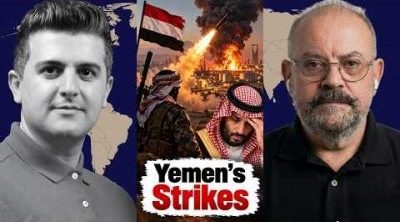
Elijah Magnier: Yemen’s strikes are shattering Saudi Arabia’s long-term strategy
or go to
Aletho News Archives – Video-Images
From the Archives
British weapons and personnel doing much of the killing in Yemen
Press TV – June 18, 2019
A detailed report published by the Guardian newspaper has shown how Britain is massively contributing to Saudi Arabia’s devastating war on Yemen as it suggests that London is not only supplying the bombs that fall on Yemenis, but it provides the personnel and expertise that keep the war going.
The comprehensive report by Arron Merat published on Tuesday showed that Britain was doing much of the killing in Yemen as the country continues to provide Saudi Arabia with everything it needs to turn its southern impoverished neighbor into a graveyard.
“Every day Yemen is hit by British bombs – dropped by British planes that are flown by British-trained pilots and maintained and prepared inside Saudi Arabia by thousands of British contractors,” said Merat in the report. … continue
Blog Roll
 Aletho News
- Racist Seinfeld Dances for Joy as Bibi Unveils His New Map
- A West Bank War for Netanyahu’s Election Campaign, Could It Backfire?
- Yemen denounces European Parliament’s ‘hypocritical’ push to blacklist Ansarullah
- Qalibaf: UAE’s UN bid aims to ‘clear the runway’ for ‘Greater Israel’, whitewash genocide
- Pakistan reopens Iran border after boosting security: Report
- Why are so many Brazilians voting for Flávio Bolsonaro?
- Democrats Put Anti-Russia Agenda Ahead of American Workers
- Elijah Magnier: Yemen’s Strikes Are Shattering Saudi Arabia’s Long-Term Strategy
- Pentagon designates Chinese cultural centers national security threat
- Israel Demolishes Home Of Lebanese Journalist Whose Viral Film Exposed Pager Attack
- If Americans Knew
- An error has occurred; the feed is probably down. Try again later.
- No Tricks Zone
- Sudden Stratospheric Warming, Powerful El Niño Combination May Lead To Extreme Europe Cold, Energy Crisis!
- Two New Studies Find Thwaites Glacier Melt Cannot Be Driven By Human Activity Or A Warming Ocean
- E-Cars Reduce CO2 Emissions By Only 41% Compared To Internal Combustion Engine Vehicles
- Predictions Made By Renowned Climate Professor Over Past Decades Have Been Proven To Be Poor
- New Study Suggests Large Regions Of The Pacific Ocean Have Been Cooling For The Last 80 Years
- Germany’s Green Energy Debacle: High Energy Costs Force Kahla Porzellan to Close After 182 Years!
- New Study: 50 Years Of The Most Aggressive ‘Net Zero’ Policies Can Only Affect The Global Climate By 0.03°C
- US September “Heat” Was No Record…Many Records Set Decades Ago
- Latest European Green Energy Debacle; Portugal’s Largest Flagship Solar Park Insolvent!
- Green Energy Debacle: German Expert Professor Fritz Vahrenholt Warns Of Severe Economic And Social Consequences

