Putin warns of retaliation against countries providing weapons to strike Russia
RT | November 21, 2024
Moscow has asserted that it has the right to strike the military facilities of countries that allow the use of their weapons against Russian territory, President Vladimir Putin has said.
The head of state made the remarks during a public address on Thursday, promising a decisive response to any aggression.
“We will determine the targets during further tests of our newest missile systems based on the threats to the security of the Russian Federation,” Putin stated.
The president continued: “We believe that we have the right to use our weapons against the military facilities of those countries that allow their weapons to be used against our facilities.”
According to Putin, the United States has ravaged the international security system, and now the entire world is being pushed towards global conflict.
The Russian president emphasized that Moscow has always favored a peaceful resolution and is now ready to resolve all contentious issues.
“But we are also ready for any development. Do not doubt it, there will always be a response,” he stressed.
Putin reveals Russia has used its new ‘Oreshnik’ hypersonic ballistic missile
RT | November 21, 2024
The Russian military has launched a start-of-the-art intermediate-range ballistic missile against a Ukrainian target, President Vladimir Putin said in a public address on Thursday.
As part of what the president called a “combat test,” the hypersonic missile, dubbed ‘Oreshnik’ (‘Hazel’), successfully struck a military industrial facility in the Ukrainian city of Dnepropetrovsk (also known as Dnipro in Ukraine), Putin added.
The strike was a response to Ukrainian attacks on military facilities located on internationally recognized Russian territory, the president stated. On Tuesday and Thursday, Kiev’s forces launched the attacks, using US-made ATACMS and HIMARS systems as well as British-made Storm Shadow missiles, he said.
Earlier, the Western media reported that Kiev had received approval from Washington and London for the use of Western-made long-range systems for strikes deep into Russia.
One of the strikes resulted in some casualties at a Russian command center in the Kursk Region but failed to disrupt its operations, the president said, adding that such developments have also drastically changed the nature of the Ukraine conflict, making it a more “global” one.
In the beginning was the Pax Americana
By Lorenzo Maria Pacini | Strategic Culture Foundation | November 21, 2024
We often speak of the collective West, Hegemon, Seapower and Civilization of the Sea in relation to the United States of America. It is necessary to understand well what is the origin of this geopolitically determinant power for the world order.
He who wins the war, dictates the rules
Let us make clear at once an empirically incontrovertible factual truth: He who wins the war, dictates the rules of the post-war order. Whoever wins, writes history. Whether we like it or not, the defeated never had much decision-making power (which is not to say that they could not organize well to retaliate and return to power – but that is another matter).
World War II ended with the victory of the United States of America as the first, undefeated and predominant power. From there followed an expansion of U.S. influence toto orbe terrarum in all respects (cultural, economic, military, political).
The twentieth century was the “American century.” Almost the whole world took the shape the U.S. wanted to give it. The second half of the century was marked by the low-tension conflict of the Cold War, which ended-if it really did-with the collapse of the Soviet political system in the USSR and the beginning of the unipolar phase of American global domination. That period aroused much optimism in the West for a new world order, marking the end of the military and ideological rivalry of the 20th century. Two possibilities were on the horizon: a system based on balance of power and egalitarian sovereignty, or a U.S.-led liberal hegemony based on the values of democracy. The first approach evoked perpetual conflict, while the second promised lasting peace and global stability.
U.S. hegemony, already dominant in the transatlantic region after World War II, was seen as a model of peace and prosperity. However, the collapse of the Soviet Union removed the justification for a world order built on the balance of power, pushing the United States toward a mission of recognized hegemony to prevent the rise of new rivals. American supremacy, as declared by Secretary of State Madeleine Albright, was deemed “indispensable to ensure global stability.”
This was the Pax Americana: the U.S. would ensure a period of prosperity and global peace – as early as the end of WWII – by extending control over the entire world. A peace for America was equivalent to a peace for the globe; a war for America would mean war for the entire globe. The stated goal of building a peaceful world often justified imperialistic approaches, revealing the contradictions of the hegemonic project.
Set this paradigm as an axiom of reasoning in international relations and geopolitical programming, lo and behold, everything acquired new meaning. The world had been formatted and the “control room” was now in Washington.
The time of ideologies
It was the time of ideologies. In the “short century” everything had changed rapidly. The great world chessboard was constantly being shaken and reshuffled. The clash between the Western bloc and the Eastern – or Soviet – bloc characterized all concepts of each country’s politics in an extremely powerful way.
In the 1990s, two visions dominated the debate on world order: that of Francis Fukuyama and that of Samuel Huntington. Fukuyama in his famous book The End of History, envisioned a future in which liberal democracy and capitalism would triumph universally, leading to perpetual peace under the leadership of the United States: he argued that economic interdependence, democratic reforms, and shared institutions would unite the world around common values, which were, of course, American values. Any other model of civilization would have been beside the point, because History was finished, there would be nothing left to write about. In contrast, Huntington, wrote The Clash of Civilizations, in which he predicted that the world would be fragmented into distinct cultural blocs based on civil, religious and economic identities. Individualism and human rights, according to him, were peculiar to the West and not universal. His theorizing assumed a future marked by conflicts between civilizations, fueled by the decline of Western hegemony and the emergence of alternative powers, particularly in Confucian and Islamic societies.
The influence of Fukuyama’s ideas shaped post-Cold War Western politics, justifying the expansion and exceptionalism of Pax Americana. Exceptionalism that has been one of the U.S.’s most pragmatic “values”: there are rules and only we can break them, when we want, how we want and without having to account to anyone.
History, however, does not have only one actor: other countries, such as Russia, have chosen to be fascinated by Huntington’s proposal – confrontational, certainly, but not already “final.” In Russia, this debate has deep roots, linked to the historical rivalry between Westernists and Slavophiles. In the 1990s, Russia initially tried to move closer to the West, but the West’s failure to include it reinforced the idea of a distinct Russian civilization, culminating in Vladimir Putin’s view that no civilization can claim to be superior.
A matter of ideologies, indeed, a low-profile but very high-value battle in which the steps of the new century that was beginning would be defined. These divergences highlighted the tension between universalist aspirations and distinctive cultural identities, defining the geopolitical conflicts of the 21st century.
Building Pax Americana at any cost
Washington promoted a world order based on the Pax Americana, a liberal hegemony that reflected the success of the peaceful and prosperous transatlantic system created by the United States during the conflict with the Soviet Union. It proposed to extend this model globally, citing as examples Germany and Japan, transformed from militaristic and imperialist nations into “peaceful”-or, rather, defeated-democracies under U.S. influence. But the success of these transformations had been made possible by the presence of a common adversary, Russia, and the history of Latin America suggested that U.S. hegemony was not always synonymous with progress and peace.
Charles Krauthammer described the post-Cold War period as a “unipolar moment,” characterized by American dominance, where the new Hegemon dictated the rules and the others had little choice. Although he recognized that a multi-participant set-up (today we can say “multipolarism”) would inevitably return, he believed it was necessary to exploit unipolarity to ensure temporary peace, avoiding a return to turbulent periods. There was a weakness, however: the United States was unlikely to voluntarily relinquish its dominant role, preferring instead to counter any threat by force, fueled by an obsession with its own historical greatness. It is a missile issue: whoever has it bigger, wins. Let us not forget that the U.S. invented the strategic concept of deterrence precisely by virtue of the atomic weapon it held, throwing the world into a climate of constant fear and risk in which we still live today.
It is equally true that many Americans wished for a dismantling of the U.S. empire, proposing a less interventionist foreign policy focused on domestic challenges: abandoning the role of superpower would allow the United States to strengthen its society by addressing economic, industrial and social issues. Walter Lippmann argued that a mature great power should avoid global crusades, limiting the use of power to preserve internal stability and coherence. Sort of like a “good hegemon.” But this has not been the case.
The notion of “good hegemon” has been criticized for the risk of corruption inherent in power itself. John Quincy Adams warned that the search for enemies to fight could turn the United States from a champion of freedom into a global dictator. Similarly, President Kennedy, in his 1963 speech at American University, opposed a Pax Americana imposed by arms, calling instead for a genuine and inclusive peace that would promote global human progress, which he called “The Peace of All Time.” An ideal that has faded into the oblivion of collective memory.
American hegemony is the sine qua non for having a Pax Americana. The universalism that characterizes this hegemony admits of no discounts. Inequality among global powers has been exploited as a pivot to increase U.S. profits and administrative expansion at the expense of weaker countries. Neoliberally speaking, there is no error in this. Everything is very consistent. The struggle of the strongest to destroy all the smallest. Not only the one who produces and earns the most wins, but the one who can maintain the power to produce and earn the most wins.
A hegemonic system needs internal stability without which it cannot subsist. A kingdom divided in itself cannot function. This applies to economics as well as politics. It is essential that the ideological paradigm does not change, that power can always be understood and transmitted, from leader to leader, as it has been successfully established. Because the “peace” of the ancient Romans was a peace given by the maintenance of political control to the very ends of the empire, which only came about through a solid military administration.
The Americans did not invent anything. To really control (realpolitik) one must have military control. In front of an atomic bomb, reasoning about political philosophies is worth little. The U.S. knows this very well and its concept of Pax has always been unequivocally based on military supremacy and the maintenance of it.
Something changed when with the first decade of the 2000s new poles, new civilization-states, began to appear that promoted alternative models of global life. The U.S. began to see its power wane, day by day, until today, where the West is worth less than the “rest of the world,” the U.S. no longer has its “exclusive” status, and we are not even so sure that it is then so strong that it can control the globe. The geometries change again. What Pax for what borders of what empire?
Is Trump ready to give up his Pax?
The crux of the question is, if imperialistic military supremacy is what has allowed the U.S. to maintain its dominance and this dominance is precipitating today, will the newly elected U.S. President Donald Trump really be ready to compromise the Pax Americana?
We are talking about a polymorphous compromise:
– Economically, he would have to accept the end of the dollar era and downsize the U.S. market on comparison with sovereign global currencies. Practically throw a century of global financial architecture in the trash.
– Politically, accept that it is possible to think otherwise and do otherwise. Politics is not just American “democracy.” There are so many possibilities, so many different models, so many futures to be written according to other scripts.
– Militarily, it means stopping with the diplomacy of arrogance and threats, accepting that we cannot arbitrarily decide how to deal with anyone and stop aiming missiles at the flags of other states.
– Most complicated and risky of all, all this means giving up peace within the United States. If the balances of power implemented externally are broken, those internally begin to falter and the organism undergoes remodeling.
Giving up the Pax Americana as it has been known does not mean that alternatives do not exist. The concept of “pax” is broad and can be interpreted differently by the American school. Taking this step, however, involves giving up a “tradition” of global power, having to go through the collapse of the entire U.S. domestic system and then rebuilding an alternative.
Make America Great Again will mean what? Restoring American hegemony in the world, or rebuilding America?
All Risk, Little Gain: U.S. Authorizes Long-Range Strikes into Russia
By Ted Snider | The Libertarian Institute | November 21, 2024
On November 17, the United States told the world what they told Ukraine three days earlier: Ukriane had permission to fire American supplied long-range missiles deeper into Russian territory.
Not much needs to be said about the risks involved in the decision. They are the same risks that have caused the Joe Biden administration to hesitate green lighting the strikes for months. Russian President Vladimir Putin clearly said in September that because long-range strikes into Russia “are impossible to employ without intelligence data from… NATO satellites,” that “mean[s] that NATO countries… are at war with Russia.” And that, Putin says, “will clearly change the very essence, the very nature of the conflict.”
The calculation whether or not to take a risk can only be made by weighing it against the benefits. But the benefits of green lighting the long-range strikes are illusory.
The Biden administration has not given Ukraine carte blanche to launch missiles into Russia. The license comes with boundaries; the missiles can only be fired into the Kursk region of Russia that Ukrainian troops invaded in August.
The United States has given two reasons for their permission to use their missiles to strike the Kursk region. The Biden administration seems to have been tipped in favor of allowing the strikes by the introduction of North Korean troops into Kursk. The hoped for benefit would be deterring North Korea from sending more troops.
The presence of 10,000 elite North Korean troops who are currently in combat in Kursk has not been proven. And deterring their arrival cannot come close to balancing the risk of direct U.S. involvement in firing missiles into Russia. North Korean troops, even if present, do not alter the balance on the battlefield. The Russian armed forces are growing by 30,000 volunteers a month. 10,000 North Koreans represents only about ten days worth of soldiers. Russia is neither desperate for troops in the Donbas, where they are rapidly advancing, nor in Kursk, where U.S. officials say they have amassed a force of tens of thousands of soldiers without having to pull a single soldier out of Ukraine.
The second hoped for benefit is helping the Ukrainian armed forces hold onto Kursk until the arrival of the inevitable negotiations, at which time Kursk can be bartered for Ukrainian territory held by Russia.
That benefit is as illusory as the first. Ukraine seems to be throwing everything into holding onto the territory it has seized in Kursk. There are reports that Kiev has made the hard to understand decision to prioritize holding onto Kursk over defending its own territory in Donbas. According to these reports, the best military equipment and the best troops are being sent into Kursk to hold onto land instead of into Donbas to reinforce the crumbling front lines. Now, the risk is being taken to throw in the long-range missiles.
Russia, though, is not likely to negotiate until they reclaim Kursk, which they likely eventually will, even faced with long-range missiles. And even if Russia failed to reclaim Kursk, it is not at all clear that Putin would trade that frontier land for the large ethnic Russian Donbas territory.
In the face of the unrealistic benefits, one other possible motive remains. Granting Ukraine permission to fire U.S.-supplied missiles into Kursk is the trump card in the Biden administration’s policy of “Trump-proofing” the war in Ukraine. Freeing Ukraine to escalate and provoking Russia to respond creates a terrain that is much more difficult for Donald Trump to keep his campaign promise of ending the war in Ukraine. As Anatol Lieven, Director of the Eurasia Program at the Quincy Institute for Responsible Statecraft, suggested to me, the legacy of Biden as the “fearless defender of Ukraine” also makes it easier for Democrats to “attack Trump for ‘surrender’ over a future peace deal.”
But “Trump-proofing” the war can only serve to prolong the fighting, pile on the dead, and contribute to a greater loss of Ukrainian territory. The likely ending, even if Ukraine holds Kursk for a while, is a negotiated settlement that looks much like the one on the table in the first weeks of the war, but with the additional costs the past three years has brought to Ukraine.
Ironically, “Trump-proofing” can also have an opposite, unintended effect. The policy, and the long-range missile decision, were meant to make it harder for Trump to end the war. Putin knows that too. The New York Times reports that Russian commentators are already framing it that way. Seeing the long-range missile decision in that light gives Putin a motive for patience. He can resist the provocation, not retaliate in a way that escalates the war, and wait for Trump.
The hoped for benefits do not justify the real potential of the risk. And there are longer term risks too.
Geoffrey Roberts, professor emeritus of history at University College Cork and a specialist in Soviet military policy, told me that he “doubts the decision will make much difference militarily.” He called it “another publicity stunt by the Ukrainian-Western side.” He said that he “expects Russia will act with restraint and continue to focus on winning on the battlefield ahead of a ceasefire and peace negotiations when Trump takes power.”
Not only will long-range missiles not significantly change the larger battlefield, Alexander Hill, professor of military history at the University of Calgary, told me that “this decision is unlikely to have a dramatic impact [even] on the fighting at the frontline in the Kursk region.” Though there may be some initial tactical successes, he says that the Russian armed forces will quickly make “the sorts of restrictions on troop and supply concentrations that they did in the Donbass that have minimized the consequences of ATACMS” and other Western missile systems for Russia.
On Monday, November 19, Ukraine fired American-made ATACMS long-range missiles into Russia for the first time. Ukrainian officials say the missiles struck an ammunition depot in the Bryansk region of southwest Russia, which borders on, but is not in, Kursk. The Russian Ministry of Defense, though, says that, of the six ATACMS that were fired, five were shot down and the other was damaged. They say that falling fragments from the damaged missile caused a fire at the munition depot but no damage or casualties.
The long-range missile decision won’t significantly impact troop numbers, North Korean or otherwise, and it won’t enhance the Kursk card in negotiations. But the decision “escalates tensions to a qualitatively new level,” as Kremlin spokesman Dmitri Peskov said. And it continues to poison trust and relations between Russia and the West. The escalation in arming Ukraine against Russia could even contribute to a belief in Moscow, Richard Sakwa, professor of Russian and European Politics at the University of Kent, told me, that “Ukraine has to be destroyed to remove a permanent threat to the Russian Federation’s security.”
Though Putin could demonstrate patience and wait out the sunset of the Biden administration and the start of the Trump administration, the crossing of a Russian redline could also lead to further escalation. Hill told me that Russia could “supply allies such as Iran and North Korea with capabilities that they currently do not possess: that is, after all, what the U.S. and its allies did for Ukraine.” They could intensify attacks on military sites or energy infrastructure in Ukraine. They could strike distribution hubs in Poland or Romania through which ballistic missiles and other weapons transit on their way to Ukraine (something Russia has refrained from doing). They could even, Ian Proud, former British diplomat at the British Embassy in Moscow, suggests, “make a limited and pre-signaled strike on a US military facility in Europe or elsewhere.”
Almost simultaneously with the first ATACMS missile strike, Putin signed a revised nuclear doctrine that had been formulated in September. The revised doctrine specifies that a conventional attack on Russia by a country that is supported by a nuclear power will be treated as a joint attack on Russia. Russia’s foreign minister, Sergey Lavrov, reminded the West on the sidelines of the G20 meeting that, “If the long-range missiles are used from the territory of Ukraine against the Russian territory, it will mean that they are controlled by American military experts and we will view that as a qualitatively new phase of the Western war against Russia and respond accordingly.” He also, however, said, “Russia is strictly committed to a position of avoiding nuclear war, and that the weapons act as a deterrent.”
Each of these risks outweighs the dubious hoped for benefits of direct U.S. participation in missile strikes deep into Russia. Instead of holding onto Kursk with its unlikely prospect of improving negotiations, the United States should be pushing for negotiations now. Instead of Trump-proofing and prolonging the war, the Biden administration should be facilitating a transition to diplomacy. Sooner, as Trump promises, or later, as Biden is supporting, the war in Ukraine will end at the negotiating table. And the result will likely be the same, minus all the deaths that are yet to come.
‘Only Americans Can Do It’: Why Ukrainians Can’t Launch ATACMS Alone
By Ekaterina Blinova – Sputnik – 20.11.2024
The US is getting bogged down in the Ukraine conflict despite assertions to the contrary.
“American servicemen are involved in [ATACMS] missile guidance… and coordinating their flights to deliver the strike. We can say this with complete confidence,” Alexander Mikhailov, head of Russia’s Bureau of Military-Political Analysis, tells Sputnik.
The pundit explains that:
- US-made ATACMS use satellite navigation data that is provided by the US military
- target selection and their coordinates is carried out by US military-technical specialists
- the process of loading the flight mission into the missile’s guidance head is conducted by US soldiers
“The launch cannot be carried out without the American officers,” says Mikhailov, “[Americans] wouldn’t transfer either the algorithms, or the codes, or the mechanisms for entering coordinates into the ATACMS missiles to officers of the Ukrainian Armed Forces.”
American security experts echo the Russian scholar.
Speaking on the Judging Freedom podcast on Tuesday, former Marine Corps intelligence officer Scott Ritter stated that “ATACMS cannot be operated by anyone but the US”:
- the guidance system and the data that is going in is developed by the Pentagon’s geospatial analysts in Europe
- the data, classified using National Security Agency cryptology, is communicated from the European site to a downlink station in Ukraine manned by US specialists
- it then is loaded up on the ATACMS again by US specialists
“So the mission is planned by the US, the data is loaded into the missile and when the button is fired it’s being… fired by the US against Russia,” Ritter says. “Only Americans can do it.”
The Kremlin has repeatedly warned the US against growing involvement in the Ukraine conflict. Kremlin spokesman Dmitry Peskov has said that the US greenlighting Ukraine’s strikes deep inside Russia with ATACMS means “a qualitatively” new situation in terms of Washington’s involvement.
The US Becomes Directly Involved in the War Against Russia – Now Entering a New Stage of the War
Colonel Douglas Macgregor & Professor Glenn Diesen | November 20, 2024
Colonel Douglas Macgregor shared his perspectives on Biden’s decision to authorise long-range missile attacks on Russia.
Why did Biden decide to escalate the war in such a reckless manner during his final weeks in office? Has the US become directly involved in the war as it operates the missiles used to attack Russia? Putin approved the new nuclear doctrine, however, how likely is Russia to use nuclear weapons in response to the US/Ukrainian attack with long-range missiles? What will Trump do?
Ukraine’s 1,000 Days of War
By Brad Pearce | The Libertarian Institute | November 20, 2024
Tuesday, November 19 marked 1,000 days since Russia’s invasion of Ukraine, though Ukraine’s civil war has been ongoing for over ten years. President-elect Donald Trump has a clear mandate to try and end the war, but with staffing picks like Marco Rubio as secretary of State, it is not clear that he wants to. Meanwhile, the outgoing Joe Biden administration has agreed to let Ukraine strike into Russia with U.S.-supplied long-range missiles, something which almost everyone seems to agree is a deliberate attempt to sabotage future peace talks. The Biden administration is also trying to run through all the aid for Ukraine before Trump takes power (not feeling confident of his Ukraine policy), while a European political class which deluded themselves into believing Trump had no chance of winning is rapidly adapting to reality. The current Ukraine policy is probably close to dead, but we are left to watch what further destruction will be wreaked on its way out the door.
It doesn’t seem like all that long ago that Joe Biden made his infamous “minor incursion” comment during the 2022 State of the Union Address. Then, the Biden administration went around saying that an invasion was imminent. Many commentators didn’t believe them, given the government and media’s long history of lying about all matters, especially Russia. Those commentators were proven wrong, though in my view Biden did a lot to cause the invasion. Once the U.S. government claims you’re going to do a false flag attack as a pretense for an invasion, it is more or less an acknowledgment that they intend to do a terrorist attack against you and say you did it to yourself. The media and government kept calling it “an unprovoked invasion” because that is the opposite of the truth, as the Libertarian Institute’s Executive Director Scott Horton has laid out at great length in his newly published book, Provoked: How Washington Started the New Cold War with Russia and the Catastrophe in Ukraine.
At the start of this conflict it was hard to believe it would last very long, which was partially due to propaganda. From the beginning we saw new information management techniques where the media obfuscated with a constant blare of nonsense instead of reporting anything useful, which indicated the real news wasn’t good for Ukraine. Further, while “Kiev could fall in three days” was just something then-Chairman of the Joint Chiefs Mark Milley made up to make any resistance look impressive, at the same time, immediately after the invasion Ukrainian President Volodymyr Zelensky was going around telling the public to make their own Molotov cocktails, which gave the impression of imminent collapse. Western governments instantly set up a sanctions regime which seems to have accomplished little but removed their vestigial power over world financial systems. Similarly, NATO countries dumped equipment into Ukraine they persistently showed the shortcomings of their own manufacturing capacities. The debacle over German Leopard tanks, which then had no impact on the battlefield, is just one example. The media continued to paint a rosy picture of brave Ukrainians and their noble fight for freedom, but at the same time, the media has been preparing the public for Ukraine to lose since the late spring of 2022.
What no one can deny is the devastating human cost of this war. Numbers of casualties on either side are unreliable and largely used for propaganda, but people are certainly dying at huge rates, most of all Ukrainian conscripts. Ukraine already had devastating population loss and was the poorest country in Europe, and now much of it is destroyed. Some claim that many Ukrainian refugees will enthusiastically return to rebuild the country when the war is over, but it seems more likely that men will join their wives and children abroad if they are able to. However, Ukrainian refugees are becoming increasingly unpopular in Europe for a variety of reasons, including that the public is being asked to sacrifice much while Ukrainians seek safety instead of fighting for their country. Europe was in many ways in decline before the great increases in energy prices from attempting to refuse Russian gas, and it seems that alone may cause Europe to give up on this conflict.
As it stands, we cannot be sure if the Biden administration has given Ukraine permission to expand strikes in a meaningful sense; there are contradictory reports, but it doesn’t sound good. Once upon a time it was the case that after an election in the United States the president gave a great deal of reverence to the incoming administration’s agenda and didn’t try to make any big changes. But now the norm seems to be to sabotage them. We can’t rely on Trump to be consistent in any efforts to end this war given his support of an enormous financial aid package in the spring, but it is unpopular among his supporters and Trump will want to be seen as the one to bring it to a close.
Since this started, Ukraine has been said to be on the edge of collapse and has held on so far, but Russian advances are picking up speed. It is being reported that the Western powers are coming closer to accepting reality and acknowledging some of Russia’s territorial gains in exchange for peace, but it seems like until then they will continue to climb the escalation ladder and ask men to be among the last to die for a mistake. Still, The New York Times just ran an op-ed titled “Trump Can Speed Up the Inevitable in Ukraine,” which is wholly an argument to accept reality. Regardless, when this grim affair ends, it is likely Ukraine takes a worse deal than it could have gotten in March 2022, and more than 1,000 days of death will have served no purpose but enriching military contractors.
Has Biden authorised long-range missiles to save Ukraine or sabotage Trump?
Professor Glenn Diesen on The Spectator | November 18, 2024
I discussed Biden’s decision to strike Russia with long-range missiles with Svitlana Morenets at The Spectator.
My position in this debate was that these missiles are not intended to turn the tide of the war, rather the purpose seems to be to sabotage Trump’s efforts to end the war. Obama similarly escalated tensions with Russia with sanctions, closure of a Russian consulate and expulsion of Russian diplomats before he left office to make it more difficult for Trump to “get along with Russia”. Biden’s actions are much more dangerous as this marks the start of a NATO-Russia War.
Arguing that Ukraine has the right to defend itself is very manipulative, as the main issue is that NATO crosses the line from proxy war to direct war. These are American long-range missiles, their use is entirely dependent on US intelligence and targeting, and American soldiers will operate these weapons and they will be guided by American satellites. This is an American attack on Russia, the world’s largest nuclear power. Putin has warned it will be interpreted as the start of a NATO-Russia War, and he has committed Russia to retaliate.
Democrats Must Remove President Biden Now
IF ONLY WE CAN GET TO JANUARY 20
By LTG USA (RET) Michael T. Flynn | November 19, 2024
Today, the world is likely closer to nuclear war than at any time since the Cuban Missile Crisis. In its closing days, the Biden Administration is stumbling our nation into a potential nuclear war with Russia. If you have not been paying attention for the past two days, you need to know the basic facts. Then, let me offer what I believe needs to happen, and quickly.
Just before midnight Sunday night, AP reported “Biden has authorized Ukraine to use U.S.-supplied missiles to strike deeper inside Russia, easing limitations on the longer range weapons…” The long-range, supersonic, ballistic missiles being unleashed on Russia most likely are ATACMs, standing for Army Tactical Missile System. These weapons were developed for offensive — not defensive — purposes. The configuration of the specific ATACMs sent to Ukraine is unknown, but they could have a range of from 100 to 190 or more miles. They can carry different types of weapons, including cluster bombs which can cause a multitude of civilian casualties. Despite many demands from Zelensky and the Ukrainian government, such long-range missiles had not been provided until last month, and until now — two weeks after the November election — their use had not been authorized.
There is a degree of speculation in all of these reports, since the White House has not seen fit to simply provide an advisory of exactly how it has ratcheted up the possibility of a direct confrontation between the United States and Russia. However, it does appear that other NATO members — including UK and France — have followed Biden’s dangerous lead in making similar offerings to Zelensky from their arsenals.
How should we view this shocking news? Perhaps the most succinct analyses came from Donald Trump, Jr., Tweeting: “The Military Industrial Complex seems to want to make sure they get World War 3 going before my father has a chance to create peace and save lives. Gotta lock in those $Trillions. Life be damned!!! Imbeciles!” Truly, I could not have said it better.
President Putin made clear in September how he would view this development: “Aggression against Russia by any nonnuclear state, but with the support of a nuclear state, is proposed to be considered as their joint attack on Russia.” He added: “Russia reserves the right to use nuclear weapons in case of aggression, including if the enemy using conventional weapons poses a critical threat.” Do not take these words lightly. If Russia had announced it had provided missiles to Mexico and authorized their use to attack Americans living in San Diego, Los Angeles, Tucson, Phoenix, El Paso, and Corpus Christi, what would you expect the U.S. Government would do?
While the neocons who populate the Deep State, and their toadies in the establishment media tell us that it is President Putin who is to blame for everything that happens, as things stand now, these stupid, provocative acts that are endangering our nation are coming from the Biden Administration and not the Kremlin.
That summarizes the problem. Here is what needs to be done, now.
First, Vice President Harris and the Biden Cabinet must invoke the 25th Amendment, and remove Biden as President. Biden is sleep-walking us into a hot war with Russia without a Congressional Declaration of War. If he lives past January 20, Biden will take the position he took with Special Counsel Hur who nine months ago declared Biden could not be held responsible for crimes, as he was on old man with a poor memory. It’s past time to put Kamala in the Oval Office — then we will know the name of the person in charge — someone who was actually elected to office. And she would be a person who could be held accountable for what disaster might befall the nation. Bearing that type of responsibility might force Harris to act responsibly. No longer would decisions be made by Unknown and Unidentified Deep State Operatives who would scatter like roaches should a crisis occur.
Second, at the same time as we hope the Democrats will act, the duty also falls on the current House of Representatives to impeach Biden now for endangering the nation by taking steps that constitute acts of war without a Declaration of War — a power the Constitution gives only to Congress. The indictment should then go immediately to the Senate for trial and removal. President Trump was impeached after he (supposedly) lost the 2020 election. What’s good for the goose.
Third, incoming officials in the Trump Administration need to make contact with President Putin and his staff to de-escalate the situation as best as can be done. This is exactly what I was trying to do in my conversation with Russian Ambassador Sergey Kislyak in January 2017. The same Deep State which intercepted my call and leaked it to the Press will do so again, because the Deep State is on the ropes and are desperate. No man who fears going to prison has the moral authority to lead America at this perilous time.
Fourth, the Trump Administration and incoming Attorney General Matt Gaetz need to make it clear that the identities of those Deep State operatives exercising the powers of the Presidency, now urging Biden to act recklessly, will be held to account personally, not just politically, but legally. If these operatives knew they would be named and the subject to prosecution, they just might straighten up, real quick.
Fifth, we need to pray that we have time for the will of the voters to take effect on January 20. Just two weeks ago, on November 5, 2024, the voters spoke on the great issue of war with great clarity. President Trump received a clear mandate for his promise to end the killing in the Ukraine and seeking peace. America had not seen that type of leadership since President Kennedy’s commencement speech at American University, and they voted for it overwhelmingly.
Will any of these approaches work? Maybe not. But we need to ask the Democrats to do their duty, and the Republicans to do their duty, and we need to do our duty to pray as well. We know President Trump will do his duty. If only we can get to Janaury 20.
NATO member says Russia has right to self-defense
RT | November 19, 2024
The West should pay attention to Russia’s updated nuclear doctrine, which reflects Moscow’s right and ability to defend itself from threats, Turkish President Recep Tayyip Erdogan has said.
Moscow unveiled the proposed changes to its strategic deterrent in September, while Ukraine was still clamoring for permission to use Western weapons for long-range strikes into Russian territory. The new doctrine was officially adopted on Tuesday, hours after Ukraine’s US-supplied missiles were used to target Bryansk Region.
“I think that this statement by Russia is, above all, a measure taken in response to the stance taken against it, concerning the use of conventional weapons,” Erdogan said on Tuesday at a press conference following the G20 summit in Rio de Janeiro, Brazil.
“I think that this issue must be considered by NATO officials. Russia has the right and ability to protect itself and to take measures for its defense. And it was compelled to take these measures,” Erdogan added.
NATO countries have the same right to self-defense, the Turkish leader said, but need to keep in mind that “there are no upsides to a war involving nuclear weapons.”
Multiple US outlets reported over the weekend that US President Joe Biden had lifted the restrictions on Kiev’s use of US-supplied rockets. The White House has neither confirmed nor denied the reports, but Ukraine’s Vladimir Zelensky claimed on Tuesday that they were true.
Russian President Vladimir Putin has warned the West that Kiev’s use of long-range missiles would change the character of the Russia-Ukraine conflict and make NATO a direct participant in the hostilities.
The US and its allies have funneled almost $200 billion worth of aid to Ukraine since 2022, while insisting this did not make them a party to the conflict. Although a NATO member state, Türkiye has not implemented sanctions against Russia and has maintained relations with both Moscow and Kiev.
Both Russia and Ukraine are Türkiye’s neighbors, Erdogan told reporters in Brazil, noting that Ankara must protect its bilateral ties with both. The three countries all border the Black Sea.
“I hope that we will achieve a definitive ceasefire between Ukraine and Russia as soon as possible and secure the peace the planet has been eagerly waiting for,” he added.
Türkiye hosted the initial negotiations between Russia and Ukraine in March 2022. The promising process collapsed after the West signaled unconditional support for Kiev and an unwillingness to make peace with Moscow.
The US Approves Long-Range Missile Strikes on Russia
Crossing the Line Between Proxy War & Direct War
By Glenn Diesen | November 19, 2024
The discussions about authorising long-range missile strikes on Russia are profoundly dishonest and misleading. The political-media elites present deeply flawed arguments to support the conclusion that attacking Russia with long-range missiles does not cross the line between proxy war and direct war. NATO may be successful in deluding itself, yet for Russia there is no doubt that this is an act of war.
1) “Ukraine has the right to defend itself”
The argument that Ukraine has the right to defend itself as a justification for NATO to authorise long-range strikes into Russia is very manipulative. The public is pulled in with a very reasonable premise, based on the universal acceptance of the right to self-defence. Once the public has accepted the premise, then it is presented as a foregone conclusion that Ukraine should be supplied with long-range missiles to attack Russia. The extent of NATO’s involvement in the war, as the main issue, is subsequently eliminated entirely from the argument.
The point of departure in an honest discussion should start with the right question: When is the line between proxy war and direct war crossed? These are US long-range missiles, their use is entirely dependent on US intelligence and targeting, they will be operated by US soldiers and guided by US satellites. Launching them from Ukrainian territory does not make it any less of a direct US attack on Russia. The US did not use these weapons against Russia for three years as it would amount to a direct attack, yet now the media is attempting to sell the narrative of this merely being uncontroversial military aid to enable Ukraine to defend itself. The US and some of its NATO allies have decided to attack Russia directly, and they should be honest about this intention. Attempts to present this as merely giving military aid to Ukraine to defend itself is an irresponsible effort to shame any dissent and avoid a serious discussion about attacking the world’s largest nuclear power.
It is imperative to place oneself in the shoes of opponents and ask how we would interpret the situation and what we would do if the situation were reversed. The US and NATO have invaded many countries over the years, so we do not need to delve too deep into our imagination to set up a hypothetical scenario. How would we react if Russia sent long-range missiles, dependent on Russian intelligence and targeting, operated by Russian soldiers and guided by Russian satellites, to attack NATO countries under the guise of merely helping Yugoslavia, Afghanistan, Iraq, Libya, Syria, Yemen of another country to defend itself. We are deluding ourselves if we pretend that this would not be interpreted as a direct attack, and despite the great risks involved, we would be compelled to retaliate to restore our deterrent.
President Putin warned in September 2024 that Russia would interpret this as a direct attack and the beginning of a NATO-Russia War, and Putin argued that Russia would respond accordingly. The clarity in his language makes it nearly impossible to walk back the commitment to strike back at NATO, which is a deliberate tactic in the game of chicken as Russia cannot swirl away.
Stories about thousands of North Korean soldiers fighting in Ukraine or Kursk are used to legitimise the attack on Russia. This is most likely NATO war propaganda as there would be some evidence if thousands of North Korean soldiers were fighting. The North Koreans training in Russia are likely intended as a deterrent in case NATO would go to war against Russia, which is now seemingly the case. However, even if North Koreans involve themselves in the fighting, it does not make NATO any less of a participant in the war by attacking Russia.
2) Russia does not dare to retaliate against NATO
The reluctance by Russia in the past to sufficiently retaliate against NATO’s incremental escalations has been presented as evidence for the false conclusion that Russia does not dare to respond. There is no doubt that Russia’s restraints have emboldened NATO. President Biden once argued that sending F-16s would result in a Third World War, such warnings now are denounced as “Russian propaganda”. Russia’s failure to respond when the US crossed that line meant that the US could argue it did not amount to a direct attack. The rules of proxy war subsequently changed.
Russia’s dilemma over the past three years has been to either respond at the risk of triggering a Third World War, or to gradually abandon its deterrent and embolden the US. With every NATO escalation, Russia is facing an ever-higher price for its restraints. Russia has been under pressure to set a final red line, and NATO becoming directly involved in striking Russia is when the proxy war becomes a direct war.
How will Russia respond? There are several more steps on the escalatory ladder before pushing the nuclear button. Russia can intensify strikes on Ukrainian political targets and infrastructure, introduce North Korean troops that were likely intended as a deterrent for a situation like this, strike NATO assets in the Black Sea and logistic centres in Poland or Romania, destroy satellites used for the attacks on Russia, or attack US/NATO military assets in other parts of the world under the guise of enabling other countries to defend themselves.
Russia’s response will also depend on how these missiles are used. The New York Times suggested that the use of these missiles would be limited and primarily used to assist Ukraine with the occupation of Kursk, which also makes the US an even more involved participant in the occupation of Russian territory. Yet, Russia must respond forcefully to any breach of its red lines to counter NATO’s incrementalism / salami tactics that aim to chop away at Russia’s deterrent. The purpose of such incrementalism is to avoid an excessive response from Russia. The US will predictably impose restrictions on how these weapons can be used as it engages in direct attacks on Russia, but gradually these restrictions will be removed.
The extent of Russia’s response will depend on the extent to which these weapons are effective. The war is evidently being won by Russia, which is why Moscow is cautious about any escalations as it only needs time. However, if these weapons would actually turn the tide of the war, then Russia would consider itself compelled to launch a powerful attack on NATO as Russia considers this to be a war for its survival. NATO should therefore hope that these weapons are not effective, which undermines the reasoning for using them at all.
The missiles can turn the tide of the war
The war has already been lost, and Washington previously admitted that these long-range missiles would not be a game changer. There are two reasons for escalating the war at this point, to further bleed Russia and to sabotage Trump’s objective to end the war.
There is overwhelming evidence that the overarching objective for sabotaging all paths to peace and fighting the proxy war in Ukraine has been to weaken Russia as a strategic rival. Even Zelensky recognised in March 2022 that some Western states wanted to use Ukraine as a proxy against Russia: “There are those in the West who don’t mind a long war because it would mean exhausting Russia, even if this means the demise of Ukraine and comes at the cost of Ukrainian lives”.[1] Both the Israeli and the Turkish mediators confirmed that the US and UK sabotaged the Istanbul peace agreement to fight Russia with Ukrainians, while interviews with top American and British diplomats revealed that the weakening of Russia and regime change in Moscow was the only acceptable outcome.[2]
The timing of Washington’s decision is also suspicious and appears to aim at sabotaging Trump’s plans to end the war. By comparison, Obama similarly threw a wrench into US-Russia relations in late 2016 as he was handing the White House over to Trump. The anti-Russian sanctions and expulsion of Russian diplomats were intended to sabotage Trump’s promise to get along with Russia. Biden appears to follow the same playbook by risking a Third World War to prevent peace from breaking out in Ukraine. Biden was too cognitively impaired to run for re-election, yet he is supposedly mentally fit to attack Russia as he prepares to leave the White House.
The world today is more dangerous than at any other time in history. The decision by the US to attack the world’s largest nuclear power is a desperate effort to restore global primacy. What makes this situation even more dangerous is the absurd self-deception across the West that results in us sleepwalking towards nuclear war. The public should be presented with more honest arguments when making the case for risking a third world war and nuclear annihilation.
[1] The Economist. ‘Volodymyr Zelensky on why Ukraine must defeat Putin’ The Economist, 27 March 2022.
[2] G. Diesen, ‘Sabotage of the Istanbul Peace Negotiations’, Substack, 13 October 2024, https://glenndiesen.substack.com/p/sabotage-of-the-istanbul-peace-agreement
Leaks expose secret British military cell plotting to ‘keep Ukraine fighting’
By Kit Klarenberg · The Grayzone · November 16, 2024
Leaked files show top UK military figures conspired to carry out the Kerch bridge bombing, covertly train “Gladio”-style stay-behind forces in Ukraine, and groom the British public for a drop in living standards caused by the proxy war against Russia.
Emails and internal documents reviewed by The Grayzone reveal details of a cabal of British military and intelligence veterans which plotted to escalate and prolong the Ukraine proxy war “at all costs.” Convened under the direction of the British Ministry of Defense in the immediate aftermath of Russia’s invasion of Ukraine in February 2022, the cell referred to itself as Project Alchemy. As British leadership sabotaged peace talks between Kiev and Moscow, the cell put forward an array of plans “to keep Ukraine fighting” by imposing “strategic dilemmas, costs and frictions upon Russia.”
The leaks obtained by The Grayzone expose a hidden hand behind Britain’s policy in Ukraine, showing in unusually granular detail how it aimed to engineer a long, grinding war through covert operations that stretched the bounds of legality.
Project Alchemy’s proposed schemes spanned every conceivable field of warfare, from cyber attacks to “discreet operations” to outright terrorism. The secret cell even put forward a plan to “aggressively pursue” and “dismantle” independent media outlets – including The Grayzone – through an aggressive campaign of legal harassment and online censorship, so they “would be forced to close.” The incendiary blueprints were fed to the highest levels of the British state and national security structure, where they were apparently well-received.
Founded by a senior British Ministry of Defence official, Project Alchemy is composed of veteran military and intelligence operatives united by a desire for all-out war between the West and Russia. Some have trained Ukrainian forces in clandestine sabotage tactics.
Members of the national security cabal tacitly acknowledged that their proposed operations stretched the bounds of British law. Thus they suggested that London should be “prepared to creatively use the law” to meet its goals, and even be willing to erase “legal restrictions on UK deniable ops” against Russia.
Some of Project Alchemy’s most extreme recommendations have already been implemented, often with calamitous results. These include the cell’s proposal to strike Crimea’s Kerch Bridge, which prompted a Russian escalation that saw punishing attacks on Ukraine’s electricity infrastructure. Alchemy also envisioned the construction of a secret, Gladio-style army of Ukrainian partisan fighters to carry out assassination, sabotage, and terror missions behind enemy lines.
It appears the British premier, Keir Starmer, fell under the influence of the Project Alchemy cabal soon after his election in July, when he eagerly embraced the role of “wartime prime minister.” After pledging to support Ukraine “as long as it takes,” however, Starmer is quietly backing away from the maximalist policy. In Kiev, Ukrainians are left to ponder how their “friends” in London got them into this mess, and why they can not, or will not get them out of it.
The British spooks who gathered around Project Alchemy reasoned that the longer the proxy war continued, the more Russian president Vladimir Putin’s “credibility at home and abroad drops, and his ability to fight NATO is degraded.” Today, Project Alchemy’s gambit has clearly backfired, as Putin remains popular within Russia, while a crumbling Ukrainian army loses territory by the day despite constant re-arming by the West. But the war planners in London remain staunchly committed to escalation, refusing to shelve their diabolical proposals.
Britain takes ‘unilateral lead’ on ‘regime change’ in Russia
Project Alchemy was founded on the personal orders of Lt. General Charlie Stickland, who is charged with “planning, executing and integrating UK led joint and multinational overseas military operations” as the head of Britain’s Permanent Joint Headquarters. Stickland boasts in leaked communications that his family “come from a long line of pirates and buccaneers.” In his email signature, the general identifies himself as an “LGBTQ+ Advocate” in rainbow-colored text.
Stickland and his assistant, Maj. Ed Harris, did not answer The Grayzone’s calls to their personal phones, nor did they respond to detailed questions submitted to them through WhatsApp.
https://twitter.com/GeneralStaffUA/status/1624474926064230402
Stickland convened the first meeting of Project Alchemy’s on February 26, 2022, just days after Russian troops made their initial foray into Ukraine. According to minutes of the gathering, “an assortment of leading academics, authors, strategists, planners, pollsters, comms, data scientists and tech” was on hand to produce a “grand strategy options paper.”
The paper consisted of a series of proposals for the British government to “defeat Putin in Ukraine and set the conditions for the reshaping of an open international order of the future.” Throughout the document, the need to “keep Ukraine fighting” was described as London’s “main effort” in the conflict.
In an email to British military apparatchiks dated March 3 2022, Stickland described Alchemy’s paper as the result of “some mischief I’ve been up to” with “a group of ‘sideways thinkers.’” He expressed satisfaction that “this has been seen by all sorts of people,” including senior British government and military officials, “and landed well.”

An Excel document listing potential and confirmed recruits for the effort, authored by project chief Dom Morris, names a number of individuals from the private sector and academia alongside high-ranking army officials. Currently a fellow at King’s College’s “Centre for Grand Strategy,” Morris was listed in the document as a “civilian leader.” The role of “military leader” was to be carried out by Simon Scott, a brigadier in the British army who was appointed O.B.E. in 2013 for his “gallant and distinguished services” in Afghanistan.

Information operations were to be headed by a still-to-be determined member of Britain’s 77th Psychological Operations Brigade. Also listed as a participant in information operations was longtime British psychological warfare operative Amil Khan, founder of the “counter-disinformation” analysis firm Valent Projects.
In 2021, The Grayzone revealed how the then-Prince of Wales, King Charles, enlisted Khan’s Valent Projects to astroturf a pseudo-socialist YouTube influencer to attack skeptics of the government’s ham-fisted response to Covid. Previously, Khan participated in the UK Foreign Office’s program to foment regime change in Syria.
Months after Alchemy put Khan forward as a member of its team, The Grayzone exposed him for plotting with celebrity-left journalist Paul Mason to destroy this publication. One leaked email showed Khan proposing a “full nuclear legal [attack] to squeeze [The Grayzone ] financially.” The newly-uncovered documents indicate the decision to assail The Grayzone was met with approval from the highest ranks of the British government.
‘Ukraine’s Next Chapter – Elders Grand Strategy Options Paper’
Within Project Alchemy’s covert war room, the obsession with a long war quickly took hold. Members of the cell took their cues from a policy paper Stickland attributed to “The Elders,” which he described as “a group of Fusion players,” referring to the strata of academics and defense industry figures with strong ties to the British military.
An Alchemy document composed under Stickland’s watch and titled, “Ukraine’s Next Chapter – Elders Grand Strategy Options Paper,” suggests that members of the cabal had convinced themselves a “palace coup” inside the Kremlin was inevitable. So long as Russia struggled inside Ukraine, they believed, British intelligence would be granted “the opportunity to challenge” Moscow’s ever-growing “stature as a competent international actor” on the world stage.
“A long war against a small state makes [Putin] look a fool,” the Alchemy paper asserted. “He is obsessed by the end of Ghaddafi – he will want to avoid that… Pressure will pile on from oligarchs as a long war drags on – he will not want to give them excuses to threaten his authority.” The group reasoned that “a long war will affect [Putin’s] international credibility,” as “a failure to quickly defeat Ukraine will seriously… reduce his credibility with new rich friends in Belarus, Hungary, China, India, Middle East, Brazil etc.
“Most importantly,” protracted Russian involvement in Ukraine “will embolden NATO,” Alchemy argued. Convinced that Putin would fail in the eastern Donbas region, triggering a collapse of his government, Project Alchemy members openly fantasized about absorbing Russia into the Western-dominated financial order afterwards under the guise of a “Post Putin Marshall Plan.” Of particular interest was London’s “re-engagement” with Moscow “in global energy and commodity markets,” a seeming reference to the West’s desire for cheap Russian gas and wheat.
“Discreet operations”: reviving ‘Operation Gladio’ terror ops in Ukraine
To accomplish the balkanization of Russia, Project Alchemy’s plotters took inspiration from Operation Gladio, a CIA and NATO-orchestrated covert operation that saw fascist paramilitaries carry out false flag terrorist attacks across Western Europe after World War II in a bid to prevent communism from taking root.
A section detailing potential “discreet operations” in Alchemy’s strategy paper, which stressed the “need to intervene in every way except ‘official,’” explicitly recommended “Stay-behind Gladio handbooks/ Partisan Pamphlets” which would be “updated for Information Age.”
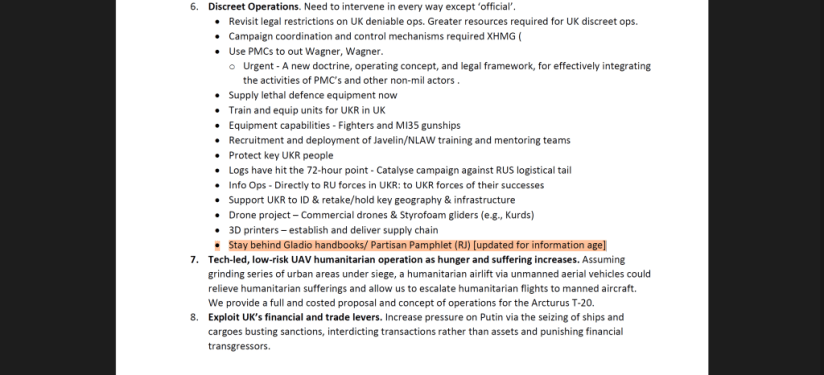
Another move Alchemy proposed was to deploy Britain’s “strong” private military [PMC] industry “to out Wagner, Wagner.” In other words, the group aimed to establish a British rival to the Russian mercenary force founded by the now-deceased commander Yevgeny Prigozhin. This objective required the formulation of “a new doctrine, operating concept, and legal framework, for effectively integrating the activities of PMCs and other [non-military] actors.” Under these guidelines, British mercenary firms capable of using “sophisticated weaponry like SAMS, cyber, combat air, drones” would be employed to “operate and train and accompany Ukraine formations.”
These operations were all intended to ultimately be “sponsored and commanded” by the UK government, “using discreet cover” to avoid triggering NATO’s Article 5.
Following the production of their grand strategy paper, Stickland invited his team of “sideways thinkers” at Project Alchemy to submit further proposals for Gladio-style operations. Among the pitches that arrived was a “mission” to “disable the Kerch Bridge in a way that is audacious, and disrupts road and rail access to Crimea and maritime access to the Sea of Azov.” The blueprints of this highly provocative plot were exposed by The Grayzone in October 2022, in the immediate aftermath of the truck bomb attack that crippled the Kerch Bridge.
Alchemy’s team also produced a PowerPoint presentation entitled, “Training a Ukrainian Commando Force to restore Maritime Sovereignty – Elders,” outlining plans to construct a 1,000-strong Ukrainian commando force “trained in Britain by military veterans equipped with British equipment” to “degrade the Russian Navy and open another flank in the fight for Kherson and the south of Ukraine.”

Alchemy’s team had been working on the plan for at least three months by the time of the presentation’s submission. “Ukrainians abroad and volunteers inside Ukraine” had already been recruited, in advance of 12 weeks basic training “in the use of all troop weapons including mortars, anti-tank missiles, sniper craft, cliff assault, small craft training, demolitions,” the proposal stated.

The plan called for formally integrating the commandos into the Ukrainian Navy. Alchemy boasted that the prospective force “will be a force multiplier and highly mobile,” while Russia’s “outdated doctrine will struggle with a highly motivated and well-equipped naval force conducting hit and run operations and targeting Crimea.”
Moreover, “individuals who are fluent Russian speakers and deemed suitable for covert undercover operations,” including “female operators,” would be “inserted into southern occupied Ukraine and Crimea for intelligence gathering and sabotage of key infrastructure targets.” They would be trained by MI6 officers. For this, Alchemy asked the British government for a total of £73.5 million. “The program is at a high state of readiness. We are ready to go,” the presentation forcefully declared.
The enormous sum was to be paid to Elders Services Ltd that was founded by Alchemy members and registered to an address just 15 miles from Fort Monckton, which was described by former MI6 officer Richard Tomlinson as “the SIS’s field operations training centre.” It is unknown how much money, if any, the firm received from the British government for resuscitating Operation Gladio in Ukraine. Elders Services Ltd shuttered in March 2023 after less than a year of operation, without filing financial accounts.
British spies call for ‘action’ against The Grayzone
Behind the Project Alchemy team’s bravado was a sense that Western hegemony was crumbling on the icy borderlands separating Ukraine from Russia. Referring to the rising BRICS alliance, which gathered in Kazan, Russia this October to challenge the US-dominated financial order, Alchemy planners urged British leadership to “prepare for SWIFT II,” as SWIFT was “going to be destroyed” by the West’s anti-Russia sanctions, “slowly, but inevitably.”
According to Alchemy’s analysts, countries across the globe would naturally “see the need for a non-US alternative” means of safely parking their cash and trading. In a rare show of political sobriety, the British spooks predicted that sanctions on Russia combined with the Ukraine proxy war would impose higher prices on consumer goods and “hit British voters in the pocket.”
This posed “a threat to public support” for the British government’s “hard line” on Ukraine, they warned. “Domestic UK public opinion” would understandably get “fed up” paying more for everyday goods, meaning “pressure grows for a compromise.”
To prepare the British public for the coming storm, Project Alchemy’s plotters proposed what they blandly described as “information operations,” but which could be more accurately described as a blend of domestic state propaganda and malign attacks on disruptive media outlets.
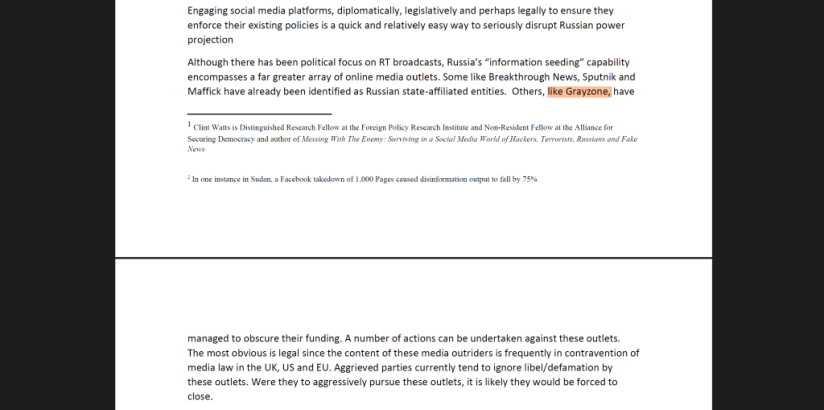
The task they outlined not only included “[dismantling] Russian disinformation infrastructure” by pressuring social media to ban RT and Sputnik, but also targeting critical independent media like The Grayzone.
“A number of actions can be undertaken against these outlets. The most obvious is legal since the content of these media outriders is frequently in contravention of media law in the UK, US and EU,” Alchemy insisted.
“Aggrieved parties currently tend to ignore libel/defamation by these outlets. Were they to aggressively pursue these outlets, it is likely they would be forced to close.”
The Grayzone, it was claimed, had thus far “managed to obscure” its funding – a suggestion that this outlet is covertly funded by Russia or some other enemy state, which is completely false. The paranoid fantasies of British intelligence may explain why this journalist was quizzed on the subject by British counter-terror police when they detained and interrogated him at Luton International Airport in May 2023.
Alchemy plotters seek to place Britain at lead of war with Russia
In addition to playing a leading role in media manipulation, Alchemy sought to place Britain at the forefront of the International Criminal Court’s agenda to investigate and prosecute the Russian government for alleged war crimes in Ukraine.
Alchemy suggested London “set international conditions, collection mechanisms and funding for collection of data and evidence” in the proxy conflict, and “provide all possible support, including intelligence” to the ICC “in its efforts to investigate war crimes,” just as British spies did for the International Criminal Tribunal for the Former Yugoslavia (ICTY).
Though not named in the document, high-profile British lawyers, including celebrity Amal Clooney, have since emerged at the forefront of efforts to prosecute Russian officials for war crimes, and establish an ICTY analog. As The Grayzone’s Max Blumenthal reported, Britain played a critical role in the appointment of Amal Clooney’s mentor, Karim Khan, as ICC prosecutor.
Project Alchemy’s provocative proposals appear to have reached the desk of PM Keir Starmer in some form. At NATO’s 75th anniversary summit, Starmer issued his full-throated endorsement of deep strikes by the Ukrainian military into Russia. Echoing the aggressive language found in Alchemy documents, he pledged to “deliver £3 billion worth of support to Ukraine each year… for as long as it takes.”
But as the Ukrainian military’s offensive in Russia’s Kursk region falters, the Biden administration has distanced itself from the calls for striking into the Russian heartland. Fortunately for British leaders hellbent on taking the fight to Moscow, Project Alchemy has ensured that a platter of off-the-books options remains handy.
As Alchemy noted in its grand strategy paper, “The UK seeks always to act multilaterally, but is prepared to take a unilateral lead where achieving multilateral consensus might prove time-consuming or difficult.” Among the war’s covert sponsors, who were safely ensconced over 1,000 miles away from the front lines, it was firmly agreed: “we should attempt at all costs to keep Ukraine fighting.”
Featured Video

Racist Seinfeld Dances for Joy as Bibi Unveils His New Map
or go to
Aletho News Archives – Video-Images
TV Drama Review
Japanese drama projects Japan’s wartime atrocities onto Chinese characters

Global Times | October 25, 2026
By portraying Chinese characters as perpetrators of ruthless violence while casting Japanese Self-Defense Forces (SDF) intelligence operatives as defenders, the season 2 of the Japanese drama Vivant has recently drawn criticism from Chinese netizens, who argue that its depiction turns historical reality on its head while ignoring Japan’s wartime atrocities.
The TBS drama series – a spy suspense story in which an alleged unofficial intelligence unit of the SDF operates across the globe — has attracted a passionate fanbase. Its currently airing season 2 opened with a household rating of 18.8 percent, the highest for a TV drama this year, according toa commentary article by Japanese media Toyo Keizai.
What draws attention is the portrayal of the enemies in the series, the article noted. Scenes in which the Chinese organization subjects kidnapped members of the SDF unit to brutal torture are repeated with unrelenting intensity.
It is rare for Japanese TV dramas to explicitly portray a real-life country as the enemy, the article noted.
Japanese Prime Minister Sanae Takaichi also made a reference to the drama, saying that she has been recording Vivant and hopes to binge-watch it over the year-end and New Year holidays, according to Japanese media outlets.
China’s CCTV News report on Sunday revealed that the drama features scenes in which Chinese personnel cut off the fingers of and stab Japanese intelligence operatives in the abdomen. Such acts bear striking similarities to the torture inflicted on Chinese nationals by invading Japanese troops during the World War II.
The drama distorts the truth by attributing these atrocities to modern Chinese characters. Beneath the surface, it subtly glorifies Japan’s cross-border overseas operations, blurs the functional boundaries of the SDF and implicitly promotes an expansionist narrative, per CCTV News. … continue
Blog Roll
 Aletho News
- Up in arms… Koreans reject U.S. empire’s plan to make South Korea the next Ukraine
- Iran, Turkey, Pakistan, Saudi Arabia could advance region-led security framework in Tehran: FM spox
- Netizens condemn Japanese drama for projecting Japan’s wartime atrocities onto Chinese characters
- Racist Seinfeld Dances for Joy as Bibi Unveils His New Map
- A West Bank War for Netanyahu’s Election Campaign, Could It Backfire?
- Yemen denounces European Parliament’s ‘hypocritical’ push to blacklist Ansarullah
- Qalibaf: UAE’s UN bid aims to ‘clear the runway’ for ‘Greater Israel’, whitewash genocide
- Pakistan reopens Iran border after boosting security: Report
- Why are so many Brazilians voting for Flávio Bolsonaro?
- Democrats Put Anti-Russia Agenda Ahead of American Workers
- If Americans Knew
- An error has occurred; the feed is probably down. Try again later.
- No Tricks Zone
- Sudden Stratospheric Warming, Powerful El Niño Combination May Lead To Extreme Europe Cold, Energy Crisis!
- Two New Studies Find Thwaites Glacier Melt Cannot Be Driven By Human Activity Or A Warming Ocean
- E-Cars Reduce CO2 Emissions By Only 41% Compared To Internal Combustion Engine Vehicles
- Predictions Made By Renowned Climate Professor Over Past Decades Have Been Proven To Be Poor
- New Study Suggests Large Regions Of The Pacific Ocean Have Been Cooling For The Last 80 Years
- Germany’s Green Energy Debacle: High Energy Costs Force Kahla Porzellan to Close After 182 Years!
- New Study: 50 Years Of The Most Aggressive ‘Net Zero’ Policies Can Only Affect The Global Climate By 0.03°C
- US September “Heat” Was No Record…Many Records Set Decades Ago
- Latest European Green Energy Debacle; Portugal’s Largest Flagship Solar Park Insolvent!
- Green Energy Debacle: German Expert Professor Fritz Vahrenholt Warns Of Severe Economic And Social Consequences

