Iran scientist Soleimani arrives home after over one year behind bars in US

Press TV – December 7, 2019
Freed Iranian stem cell scientist Dr. Masoud Soleimani has arrived in Tehran after over one year of imprisonment in the United States.
Soleimani arrived at Tehran Mehrabad airport on Saturday evening after he was released by the US in a prisoner swap. He was welcomed by his family members and Iranian officials upon his arrival.
Iranian Foreign Minister Mohammad Javad Zarif accompanied the released scientist from Zurich where the swap took place.
The Iranian foreign minister said in a tweet earlier in the day that the top scholar, along with Xiyue Wang — a Chinese-born US citizen who had been sentenced to 10 years in prison for espionage in Iran in 2017 — had been delivered to the Swiss officials and would “be joining their families shortly.”
Back in October last year, Soleimani, 49, left Iran on sabbatical last year but was arrested upon arrival in Chicago and transferred to prison in Atlanta, Georgia for unspecified reasons.
When he left Tehran last fall, Soleimani, a professor and biomedical researcher at Tarbiat Modares University (TMU) in Tehran, planned to complete his research on treating stroke patients as a visiting scholar at the prestigious Mayo Clinic in Minnesota.
Prosecutors in Atlanta had accused him and two of his former students of conspiring and attempting to export vials of human growth hormone from the US to Iran without authorization, in violation of US sanctions.
The human growth hormone is not banned in the US or Iran and was being used “exclusively for medical research,” which is still considered largely exempt from US sanctions, according to his Atlanta attorney Leonard Franco.
The two students were charged in a court and released after posting bail because they held US citizenship.
Russia: US trying to demonize Iran missile program
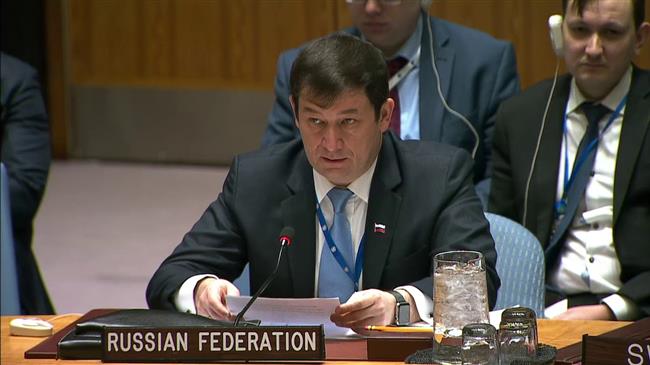
Dmitry Polyanskiy, Russia’s chargé d’affaires to the United Nations
Press TV – December 6, 2019
Russia’s mission to the United Nations says the US continually tries to demonize Iran’s missile activities despite lack of any damning evidence against the Islamic Republic’s defensive activities, and while Washington itself is in default of several international non-proliferation agreements.
Dmitry Polyanskiy, Moscow’s chargé d’affaires to the world body, addressed the remarks to the UN Secretary-General António Guterres in a letter dated November 26 that was made available on Friday.
He reminded that Iran was a signatory to many multilateral non-proliferation mechanisms, including the nuclear Non-Proliferation Treaty (NPT) and the Joint Comprehensive Plan of Action (JCPOA). The latter agreement came about in 2015 between the Islamic Republic and the P5+1 group of states — the United States, the UK, France, Russia, and China plus Germany, lifting nuclear-related sanctions against Tehran, which, in turn, voluntarily changed some aspects of its nuclear energy program.
Washington has, on numerous occasions, accused Tehran of developing nuclear-capable missiles, despite Tehran’s outright rejection of nuclear weapons of all type, and its observance of the JCPOA, which prohibits it from pursuing such armaments.
The Russian official highlighted “the complete lack of evidence that Iran is developing or producing a nuclear weapon or means of its delivery or is deploying any infrastructure for the storage or servicing of nuclear weapons.” He further endorsed the Islamic Republic’s continued commitment to the nuclear deal as verified by Tehran’s “refraining from activities related to ballistic missiles that are designed to be capable of carrying nuclear weapons.”
Nor has the UN Security Council, which has endorsed the JCPOA in the form of Resolution 2231, received any “viable information to the contrary,” Polyanskiy asserted.
However, he stated, the US would keep trying to implicate Iran in nuclear arms-related activities by, among other means, citing the Missile Technology Control Regime (MTCR). This is while the MTCR is an informal political understanding between 35 states on export control issues, and could not be deployed as a universal legally binding instrument or used in the context of Resolution 2231 to try and incriminate Iran’s missile activities, the envoy added.
Washington was on the offensive against Iran, while itself left the JCPOA last year “in violation of Article 25 of the United Nations Charter,” and is preventing other states from implementing it, Polyanskiy added. After leaving the deal, the White House returned its sanctions against Tehran, and also started pushing other JCPOA members into abiding by the American bans.
The Russian envoy also reminded how America left the Intermediate-Range Nuclear Forces (INF) Treaty with Moscow earlier this year, and was undermining efforts aimed at creating a Middle East region free of nuclear arms. He was referring to the US’s using its veto power at the UN in favor of Israel, which is the sole nuclear armed power in the region and has refused to join the NPT.
Iran’s FM Javad Zarif Claims Israel Tested Nuke-Missile ‘Aimed at Iran’
Sputnik – December 6, 2019
The Defence Ministry of Israel announced in the early hours of Friday morning that it had tested a new rocket propulsion system at a an airbase in the central part of the country, as part of a missile defence modernization plan.
Minister of Foreign Affairs of Iran, Mohammad Javad Zarif, commented on Friday on the recent test by the Israeli defense establishment of what has been described as a rocket propulsion system.
Zarif noted that the United States, along with the three European members of the Iran nuclear deal – officially known as the Joint Comprehensive Plan of Action (JCPOA), have never complained of the Israeli nuclear arsenal, the only nuclear arsenal in the region, although Tel Aviv has missiles that are “DESIGNED to be capable of carrying nukes”.
Earlier on Friday, Israel’s Ministry of Defence tweeted that its defence establishment had carried out a test of a rocket propulsion system from the Palmochim military base, located south of the nation’s capital city of Tel Aviv.
The tested missile propulsion system is reportedly capable of launching defence or attack payloads with a range of up to 2,000 kilometers. It is also said to be capable of carrying nuclear warheads, according to Tel Aviv’s news channel i24 News.
After the US unilaterally left the JCPOA in May 2018, Washington has since been waging a “maximum pressure” campaign against Tehran, claiming that the Islamic republic’s rocket program, alongside Iran’s alleged nuclear ambitions, represent a “threat” to the region. Under this pretext, the Trump administration has introduced multiple sanctions against the government in Tehran and against several senior officials, including Zarif.
Iran has repeatedly denied accusations regarding its intentions to obtain nuclear weapons, continuing to abide by the nuclear deal and urging European signatories to ensure its interests amid reimposed US sanctions, particularly through a partial withdrawal from some of the original commitments under the JCPOA.
Bilateral trade relations between Iran and EU suffer under harsh US sanctions
By Sarah Abed – December 2, 2019
Trade between the European Union (EU) and the Islamic Republic of Iran has dropped roughly 74.92% percent this year from January to September compared to last year during the same timeframe, due to US-imposed sanctions, according to the European statistical office. The top three trading partners in the European bloc were Germany, Italy, and the Netherlands. Analysts at the European Council on Foreign Relations have described the US’s secondary sanctions as abuse of its global financial dominance.
Iran’s commodities exports have fallen 94% and imports have declined 51.15%. Before the sanctions, the EU was Iran’s main trading partner, but now China and the United Arab Emirates have risen to the first and second slots respectively.
While most discussions regarding Iran and EU trade relations center on oil, a crucial indicator of Europe-Iran trade relations lies in European technology and the billions of dollars’ worth of European parts, machinery, and transport equipment exports, which play an important role in Iran’s industrial sector and economy.
In May 2018, the United States unilaterally withdrew from the 2015 Joint Comprehensive Plan of Action (JCPOA) complaining that the deal didn’t curb Iran’s nuclear capabilities but Europeans and the International Atomic Energy Agency (IAEA) have repeatedly confirmed that the nuclear deal was working and that Iran was in compliance. Since then the remaining five world powers who signed the nuclear deal with Iran, namely the UK, France, Russia, China, and Germany have tried to keep the nuclear deal alive by urging the United States to return to the deal and lift the harsh sanctions.
Immediately after leaving the nuclear deal, the United States reinstated crippling sanctions under its “maximum pressure campaign” with the goal of bringing about “regime change” while reducing Iran’s oil exports to zero.
Iran patiently waited for over a year for the United States to either return to the deal or for European nations to ease their suffering. France advocated for a $15 billion dollar line of credit and an EU Instrument for Supporting Trade Exchanges commonly referred to as INSTEX, became “operational” in June of this year, but hasn’t offered Iran any relief yet.
INSTEX was created to circumvent Washington’s sanctions as a payment channel with the UK, France, and Germany to help Iran continue to trade. The exchange of goods is allowed without requiring direct transfers of money, serving as a diplomatic shield. Good intentions aside, it’s been useless.
Sweden, Norway, the Netherlands, Finland, Denmark and Belgium announced on November 29th that they are in the process of becoming shareholders in INSTEX, in order to support the JCPOA and the economic parts of it and facilitate legitimate trade between Europe and Iran. A joint statement of support for the preservation and full implementation of the JCPOA was made. They reiterated that the nuclear agreement was unanimously endorsed by the UN Security Council and is an instrumental tool for global non-proliferation and stability in the region.
Unfortunately, neither the line of credit nor INSTEX have been properly implemented yet. With no relief in sight and economic conditions worsening, Iran started to scale back on its commitments under the JCPOA, thus far it has taken four such steps and has vowed to continue to scale back its obligations every sixty days, until there’s a solution.
For almost three decades the United States was Iran’s main military and economic partner and played an important role in its infrastructure and industry modernization, from 1950 until 1978. All of that ended when the US-backed Shah of Iran Mohammed Reza Pahlevi was forced to step down during the Iranian Revolution in 1979. And that’s when the United States cut economic and diplomatic ties, froze billions of dollars of assets, and banned Iranian imports.
Iran is the world’s third largest consumerer of natural gas after the United States and Russia, and a major oil exporter since 1913.
Iran’s economy is dominated by oil and gas production, ownership of 10% of the world’s proven oil reserves and 15% of its gas reserves have earned Iran recognition as an energy superpower. This of course puts a huge target on its back for US imperialism and intervention.
Since mid-2018 US sanctions have been placed on Iran’s oil sales, banking transactions, metals trading, petrochemicals, shipping etc. and as a result, Tehran was forced to raise oil prices on November 15th by fifty percent and impose a strict rationing system. Soon after, protests erupted and at least eight people linked to the U.S. Central Intelligence Agency (CIA) were arrested by Iranian security agents.
Although trade has significantly decreased Washington’s attempts to destroy Iran’s economy, bilateral attempts to improve and normalize Iran-EU trade relations have fallen short. If successful, Washington would benefit from increasing its own oil and commodities trade, while hurting economic ties between Iran and EU.
Who stands to gain from unrest in Iran?
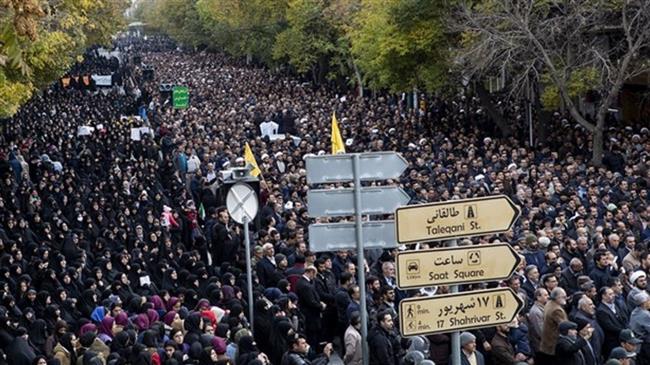
People rallied in the northwestern Iranian city of Tabriz to denounce the violent unrest in the country, Nov 19, 2019
By M. K. BHADRAKUMAR | Indian Punchline | November 21, 2019
I once had an animated conversation with the Middle East correspondent of a leading Indian newspaper regarding the resilience of the Iranian political system. The year was 2001. The conversation took place in the backdrop of mass protests and clashes between hard-liners and reformists on the the 22nd anniversary of the Islamic revolution in Iran. My friend forecast that the Iranian regime was in meltdown under the combined weight of US sanctions and a dysfunctional repressive regime. He point blank rejected my dissent that the stability of the Iranian system was not in doubt.
When it comes to Iran, everything depends on what prism you are holding. If you live in Dubai or visit Israel too often, you get one vision; if you live in Turkey, you get a vastly different view.
The recent days’ happenings fell into that familiar pattern. The protests were played up by the western media and American think tanks in apocalyptic terms, but when counter-demonstrations began appearing, supportive of the government, they have fallen silent. Life is returning to normal in Iran.
Two striking features must be noted. One, anti-government protests are possible to be staged in Iran; two, the regime enjoys a substantial social base. Unsurprisingly, when protests appear in Iran, democratic Turkey takes a balanced view while the repressive Saudi regime gleefully joins the western camp of ‘liberal democracies’ to pelt stones at the Iranian regime.
Isn’t there social and political discontent in Iran and Turkey? Indeed, there is. But representative rule provides safety valves and the political leaderships in Tehran or Ankara are receptive to popular opinion. Who would dispute that Hassan Rouhani and Recep Erdogan secured their mandates in hotly contested elections?
Can it be a coincidence that when the Iranian protests were raging in the past week, the US and Israel tested the waters, so to speak? The US aircraft carrier strike group Abraham Lincoln sailed through the strategic Strait of Hormuz on Tuesday. And Israel hit “dozens of targets” in Syria — in and around Damascus in Kiswa, Saasaa, Mezzeh military airport, Jdaidat Artouz, Qudsaya and Sahnaya — which it claimed were aimed at thwarting what Tel Aviv called Iran’s “military entrenchment” there and to block shipments of Iranian weapons to Lebanon’s Hezbollah movement.
Conceivably, these military operations would have needed some advance planning, especially the freedom of navigation exercised by the US aircraft carrier strike group through the narrow straits where Iran controls many of the shipping lanes. Yet, it happened just when the Iranian regime was preoccupied with the domestic unrest!
Again, President Trump notified the US Congress of his intention to step up military deployments in Saudi Arabia in the middle of the unrest in Iran. In the normal course, Tehran’s reaction would have been robust but, again, the US got away with it — for the time being, at least — as the Iranian regime and leadership has its hands full with internal developments. (Russia has warned that Washington’s plan for additional deployments of thousands of US troops to Saudi Arabia will only add to already simmering tensions in the Middle East region.)
The western narrative is that the unrest in Iran stemmed from economic factors at work triggered by the US sanctions. But, interestingly, the leading Israeli newspaper Haaretz has commented that “In the case of Iran, the headline figures about economic distress are misleading in critical ways. Iran is not quite the oil economy that, say, Saudi Arabia and the Gulf emirates are. Petroleum hasn’t accounted for more than a fifth of GDP and half of exports in the past, and it doesn’t employ a lot of people. So, while oil sanctions can inflict a lot of pain when they are first imposed, they don’t bring economic activity to a standstill.”
Haaretz points out, “Ironically, the non-oil sanctions may be giving the Iranian economy a small boost. Apart from oil, pistachios and carpets, Iran is not a globally competitive economy, but it does have a manufacturing and agricultural base… Iranian industry has the local market and is expanding output. As a result, manufacturing has been growing as has employment while the rial has stabilised… Media reports say there are plenty of ‘Made in Iran’ consumer goods on store shelves. The “resistance economy” may not be quite the miracle Tehran leaders tout, but it could be enough to stabilise the situation after the initial shock over oil sanctions have passed.
“Forecasts for the Iran going forward point in that direction. The World Bank, for instance, agrees with the IMF that Iranian GDP will contract sharply in 2019-2020 but afterwards start growing again.”
This analysis contradicts the western narrative that the Iranian people are up in revolt. Suffice to say, there is merit in the allegation by Iran’s top security officials that the protests have been actively orchestrated from abroad.
While addressing a cabinet meeting in Tehran on Wednesday, President Rouhani was explicit. The Iranian foreign ministry made a demarche with the Swiss embassy in Tehran, which represents Washington’s Interest Section, regarding US interference in the country’s internal affairs.
In controversial move Italy bans Mahan Air’s flights
By Max Civili | Press TV | November 20, 2019
Rome – The Italian government’s early November announcement that the Iranian first private airline Mahan Air will no longer be allowed to fly to its Italian destinations of Rome and Milan from mid-December had left many baffled in Italy.
Rome’s decision – made after a meeting between Italian Foreign Minister Luigi Di Maio and US Secretary of State Mike Pompeo in October – had followed that of Germany and France which had both already banned flights by the airline in the wake of US pressure.
Washington has been accusing Mahan Air of transporting military equipment and personnel to Middle East war zones – an accusation that the airline has always refuted. The attack came as part of broader US sanctions targeting Iran’s aviation industry.
Also Italy’s flag-carrier Alitalia had suspended its flights to Tehran in January this year, following US President Donald Trump’s decision to reinstate sanctions on Iran.
On Tuesday, at a meeting with a number of Italian journalists and geopolitical analysts held at Iran’s Embassy in Rome, the Ambassador to Italy Hamid Bayat stressed the importance of maintaining access to the Italian airspace.
Iranian authorities believe direct flights between countries that enjoy long-standing relations such as Italy and Iran are essential. About 10,000 young Iranians are enrolled at Italian universities and tens of thousands of Italian tourists visit Iran every year.
Some have argued that Italy’s ban on Mahan Airliner is also a breach of the Chicago Convention on International Civil Aviation. The convention – enacted in the depths of WWII, because people understood the key role aviation would play in connecting the world – established a specialized agency of the United Nations known as ICAO.
Iran fully prepared; US never dares to attack: Deputy FM
Press TV – November 12, 2019
A senior Iranian diplomat says the United States does not dare to attack Iran as it knows well that the Islamic Republic stands fully prepared to defend itself against any aggression.
“We are completely ready to defend the country and the Americans are aware of this; therefore, I believe that they do not dare to attack us and that is why we believe that no war will break out in the region,” Iranian Deputy Foreign Minister for Political Affairs Abbas Araqchi said in an interview with Russia’s RT Arabic television news network on Tuesday.
Tensions have been simmering between the US and Iran since May 2018, when Washington abruptly pulled out of a multilateral deal on Tehran’s nuclear program.
The White House then moved to unleash a campaign of “maximum” economic pressure, coupled with military provocations and threats, against the Islamic Republic.
Earlier this year, the tensions saw a sharp rise as the US and its allies blamed Tehran for a set of suspicious attacks on oil tankers in the Sea of Oman and the Persian Gulf. Iran rejected the claims, and said those attacks appear more like false-flag operations aimed at framing the Islamic Republic.
Washington, in June, sent an advanced RQ-4 Global Hawk reconnaissance drone on a spying mission into Iranian airspace, prompting Iran’s air defenses to shoot down the intruding aircraft.
‘Nukes have no place in Iran’s security ideology’
Elsewhere in his remarks, Araqchi rejected allegations that Iran is in pursuit of nuclear weapons, saying such arms have no place in the country’s security ideology.
“Using nuclear weapons is forbidden based on a fatwa by Leader of the Islamic Revolution Ayatollah Seyyed Ali Khamenei and (late Founder of the Islamic Republic) Imam Khomeini and such a plan (to develop nukes) has no place in our security ideology. Iran is committed to fulfilling all of its responsibilities and duties,” he said.
He criticized the Western countries for failing to implement international agreements and recognize other states’ right to use nuclear energy for peaceful purposes.
“They [Westerners] are trying to create obstacles in the way of other countries. The issue of nonproliferation of nuclear weapons is very important but the recognition of the countries’ right to use nuclear energy peacefully is also a very significant issue,” the senior Iranian diplomat added.
He noted that Iran proved its goodwill by engaging in 12 years of nuclear negotiations with the aim of allaying the concerns of certain sides prior to the conclusion in 2015 of the nuclear deal, officially known as the Joint Comprehensive Plan of Action (JCPOA).
After inking the deal, Araqchi added, Iran stayed fully committed to its end of the bargain, while the other parties failed to do the same.
Pointing to Iran’s one year of “strategic patience” after the US withdrawal from the JCPOA, the diplomat said Tehran decided to gradually decrease its commitments through a step-by-step approach “in order to give diplomacy an opportunity.”
The European signatories to the deal were required by the deal to shield the Iranian economy against the sanctions that the US reinstated after abandoning the JCPOA, but they failed to do so, prompting Tehran to go for the counter-measures.
Araqchi — who served as a member of the Iranian team negotiating with major world powers — explained that the Islamic Republic’s move to scale back its commitments aims to preserve the nuclear deal and not to kill it.
Tehran has so far rowed back its nuclear commitments four times in compliance with Articles 26 and 36 of the JCPOA, but stressed that its retaliatory measures will be reversible as soon as the European signatories — France, Britain and the UK — find practical ways to protect the mutual trade from the US sanctions.
Uranium Particles Discovered by IAEA in Iran Not Related to JCPOA – Russian Senior Official
Sputnik – November 12, 2019
According to Russian Permanent Representative to International Organizations in Vienna Mikhail Ulyanov, the undeclared uranium particles found by the International Atomic Energy Agency (IAEA) in Iran has nothing to do with the Joint Comprehensive Plan of Action (JCPOA).
“There is a lot of speculation around this phrase, it is presented as a kind of ‘hot’ fact, testifying to Iran’s dishonesty. This is a distortion of the real situation because it concerns the discovery of uranium particles that date from a period approximately between the beginning of the 1990s and no later than 2005. This has nothing to do with the JCPOA, nor does it indicate any gross violations by Iran,” Ulyanov stressed.
Earlier in the day, Iranian Foreign Minister Mohammad Javad Zarif lashed out at the European signatories of the 2015 Joint Comprehensive Plan of Action (JCPOA) nuclear deal, challenging their assertion that they had ‘fully upheld commitments under the JCPOA‘.
The IAEA said in its latest “confidential” report, which had been leaked to the Western media, that the agency had detected “natural uranium particles of anthropogenic origin at a location in Iran not declared to the agency.”
Cornering and Strangulating Iran Has Backfired on Israel
By Alastair Crooke | Strategic Culture Foundation | November 11, 2019
What happens if the two premises on which Israel and America’s grand Iran strategy is founded are proven false? ‘What if’ maximum pressure fails either to implode the Iranian state politically, nor brings Iran to its knees, begging for a new ‘hairshirt’ nuclear deal? Well …? Well, it seems that Netanyahu and Mossad were so cocksure of their initial premise, that they neglected to think beyond first move on the chess board. It was to be checkmate in one. And this neglect is the cause of the strategic bind in which Israel now finds itself.
Lately, these lacunae in strategic thinking are being noticed. Iran is doing just fine, writes Henry Rome in Foreign Affairs:
“Some analysts predicted that Iran’s friends in Europe and Asia would defy the United States to lend Iran economic help. Others reckoned that the sanctions would send Iran’s economy into a “death spiral,” leaving Tehran the choice to either surrender or collapse. Neither of these predictions came to pass.
“Rather, Iran now enters its second year under maximum pressure strikingly confident in its economic stability and regional position. Supreme Leader Ali Khamenei and other hard-liners are therefore likely to continue on their current course: Iran will go on tormenting the oil market, while bolstering its non-oil economy—and it will continue expanding its nuclear program while refusing to talk with Washington.”
Similarly, the (US) Crisis Group reports that on the eve of the US oil sanctions snapback in November 2018, Secretary Pompeo was asked if Iran might restart its nuclear program. He responded: “we’re confident that the Iranians will not make that decision”. But, Iran did just that: In April 2019 – after the US revoked the sanction waivers that had previously allowed eight countries to import Iranian oil – the Iranian leadership started pushing back.
They are still doing it. “Iran’s responses on the nuclear and regional fronts call into question the core premises of the U.S. “maximum pressure” campaign … Tehran [effectively] has broken the binary outcome of concession or collapse by instead adopting what it touts as “maximum resistance”. As a result … there can be little doubt that the [US] strategy has fallen short, delivering impact without effect and rather than blunting Iran’s capabilities only sharpening its willingness to step up its [push-back]”, the Crisis Group report concludes.
So here we are: Iran’s “fourth step” in its incremental lessening of compliance with the JCPOA (injecting nuclear gas into the – hitherto empty – centrifuges at Fordo; augmenting enrichment to 5% and unveiling substantially improved centrifuges), effectively tests the very core to the Obama JCPOA strategy.
The Accord was built around a framework that meant Iran would remain at least 12 months away from break-out capacity (the moment when a state can transition into a nuclear weapons’ state). Iran – in these de-compliance steps is inching under that limit, if it is not already under it. (This does not, however, imply that Iran is seeking weapons, but rather that it is seeking a change in western behaviour.)
Yes, Israel – which pushed hard its assessment (albeit, onto a Trump team wholly receptive to this Israeli analysis) of an Iran entering into a death-spiral within one year, under Trump’s maximum pressure – can plead reasonably that its grand strategy was struck by two ‘black swans’. The double ‘punch’ quite evidently has knocked Israel – it is now all at sixes and sevens.
One was the 14 September strikes on the two Aramco plants in Saudi Arabia (claimed by the Houthis), but demonstrating a level of sophistication which Israelis explicitly admit took them wholly by surprise. And the second was the accumulated evidence that the US is in the process of quitting the Middle East. Again, Israel – or at least Netanyahu – never believed this could happen under Trump’s ‘watch’. Indeed, he had built a political platform on his claim of intimate rapport with the US President. Indeed, that did seem at the time to be perfectly true.
Israeli historian, Gilad Atzmon observes, “it now seems totally unrealistic to expect America to act militarily against Iran on behalf of Israel. Trump’s always unpredictable actions have convinced the Israeli defense establishment that the country has been left alone to deal with the Iranian threat. The American administration is only willing to act against Iran through sanctions”.
And the former Israeli Ambassador to Washington put the consequences yet more bluntly under the rubric of The Coming Middle East Conflagration: “Israel is bracing itself for war with Iranian proxies … But what will the United States do if conflict comes?” — by this Oren implies the US might do little, or nothing.
Yes. This is precisely the dilemma to which the Israeli policy of demonising Iran, and instigating ‘the world’ against Iran, has brought Israel. Israeli officials and commentators now see war as inevitable (see here and here) – and they are not happy.
War is not inevitable. It would not be inevitable if Trump could put aside his Art of the Deal pride, and contemplated a remedy of de-escalating sanctions – especially oil export sanctions – on Iran. But he has not done that. After a quick (and wholly unrealistic) ‘fling’ at having a reality-TV photo-op with President Rouhani, his Administration has doubled down by imposing further, new sanctions on Iran. (Friends might try to tell their American counterparts that it is well time they got over the 1979 Tehran Embassy siege.)
And war is not inevitable if Israel could assimilate the reality that the Middle East is in profound flux – and that Israel no longer enjoys the freedom to strike wherever, and whomsoever it choses, at will (and at no cost to itself). Those days are not wholly gone, but they are a rapidly diminishing asset.
Will Israel shift posture? It seems not. In the context of the Lebanon protests, the local banks are becoming vulnerable, as capital inflows and remittances dry up. Israeli, plus some American officials, are favouring withholding external financial assistance to the banks – thus making the banking system’s survival contingent on any new government agreeing to contain and disarm Hizbullah (something which, incidentally, no Lebanese government, of whatever ‘colour’, can do).
That is to say, US and Israeli policy is that of pushing Lebanon to the brink of financial collapse in order to leverage a blow at Iran. Never mind that it will be the demonstrators – and not Hizbullah – who will pay the heaviest price for pushing the crisis to the brink – in terms of a devalued pound, rising prices and austerity. (Hizbullah, in any case, exited the Lebanese banking system, long time past).
Iran, on the other hand, faced with maximum pressure, has little choice: It will not succumb to slow-strangulation by the US. Its riposte of calibrated counter-pressure to US max-pressure, however, does entail risks: It is predicated on the judgement that Trump does not want a major regional war (especially in the lead up to US elections), and also predicated (though less certainly) on the US President’s ability to avoid being cornered by his hawks into taking responsive military action (i.e. were another US drone to be shot down).
So, what do all these various geo-political ‘tea-leaves’ portend? Well, look at Lebanon and Iraq through the geo-political spectacles of Iran: On the one hand, it is well understood in Tehran that there is justified, deep popular anger in these states towards corruption, the iron sectarian structures and hopeless governance — but that is only one part of the story. The other is the long-standing geo-strategic war that is being waged against Iran.
Maximum pressure has not produced a chastened, and repentant Iran? So, now Iranians see the US and Israel resorting to ‘Euromaidan warfare’ (Ukrainian protests of 2013) against Iran’s Lebanese and Iraqi allies. (It was, after all, during President Aoun’s visit to Washington in March, that Trump first warned Aoun of what was coming – and presented his ultimatum: Contain Hezbollah, or expect unprecedented consequences, including sanctions and the loss of US aid).
Fresh sanctions, plus an Euromaidan-type assault on Iranian allies (Hizballah and Hash’d A-Shaabi)? Might we then expect another ‘Gulf surprise’ – in coming weeks?
This tit-for-tat of pressure and counter-pressure is set to continue — Michael Oren, the former Israeli Ambassador to the US, lays it out:
“The conflagration, like so many in the Middle East, could be ignited by a single spark. Israeli fighter jets have already conducted hundreds of bombing raids against Iranian targets in Lebanon, Syria, and Iraq. Preferring to deter rather than embarrass Tehran, Israel rarely comments on such actions. But perhaps Israel miscalculates, hitting a particularly sensitive target; or perhaps politicians cannot resist taking credit. The result could be a counterstrike by Iran, using cruise missiles that penetrate Israel’s air defenses and smash into targets like the Kiryah, Tel Aviv’s equivalent of the Pentagon. Israel would retaliate massively against Hezbollah’s headquarters in Beirut as well as dozens of its emplacements along the Lebanese border. And then, after a day of large-scale exchanges, the real war would begin.
“Rockets, many carrying tons of TNT, would rain on Israel; drones armed with payloads would crash into crucial facilities, military and civilian. During the Second Lebanon War, in 2006, the rate of such fire reached between 200 and 300 projectiles a day. Today, it might reach as high as 4,000. The majority of the weapons in Hezbollah’s arsenal are standoff missiles with fixed trajectories that can be tracked and intercepted by Israel’s Iron Dome system. But Iron Dome is 90 percent effective on average, meaning that for every 100 rockets, 10 get through, and the seven operational batteries are incapable of covering the entire country. All of Israel, from Metulla in the north to the southern port city of Eilat, would be in range of enemy fire.”
Of course, the claim that Israeli air defences are 90% effective is ‘for the birds’ (Israeli officials would not be in such a panic if it were true). But Oren sets out the course to a region-wide war plainly enough. This is the end to which their Iran strategy has brought them.
And just to recall, this strategy was always a ‘strategy of choice’ – taken for domestic political purposes. Israel’s demonization of Iran did not begin with the Iranian Revolution. Israel initially had good relations with the revolutionary republic. The relationship transformed because an incoming Israeli Labour government needed it to transform: It wanted to upend the earlier political consensus, and to make peace with the ‘near enemy’ (i.e. its Arab neighbours). But Israel then required a ‘new’ villain threatening ‘plucky little Israel’ to keep unstinting US Congressional support coming through: Iran became that villain. And then, subsequently, Netanyahu made his twenty-year career out of the Iranian (nuclear) bogeyman.
Reaping what a long-term strategy of threats and incitement sows …? In one of the most detailed assessments of Iran’s strategy and doctrine across Lebanon, Syria, Iraq and Yemen, the International Institute for Strategic Studies (IISS) concludes that Iran’s “third party capability” has become Tehran’s weapon of choice: “Iran now has an effective military advantage over the US and its allies in the Middle East, because of its ability to wage war using third parties such as Shia militias and insurgents”, the report concludes. It has the military edge? Well, well …
And doesn’t this fact help explain what is happening in Iraq and Lebanon today?
Rouhani: Iran to stay in JCPOA, reap benefits when UN arms embargo ends next year
Press TV – November 11, 2019
President Hassan Rouhani says Iran intends to stay in the 2015 nuclear deal despite US violations, arguing that the accord will be put to good use next year when a long-running arms embargo against Tehran comes to an end.
Rouhani said Monday Iran could respond to America’s exit from the Joint Comprehensive Plan of Action (JCPOA) in different manners, including leaving the deal altogether or keeping it at any price, but it decided to take the middle-ground option.
“By continuing the JCPOA, we will fulfill a major objective in terms of politics, security and defense,” he told a large crowd of people during a visit to the eastern province of Kerman.
Noting that for years Iran has been banned by the United Nations from buying and selling any kinds of weapons, Rouhani said the arms embargo will end next year according to the deal and the UN Security Council Resolution 2231, which endorses it.
“This is one of the important effects of this deal. Otherwise, we could leave the deal today but the kind of benefit we stand to reap next year will no longer exist,” he said.
“We can leave now but then the UNSC resolutions [that were revoked under the deal] will return,” the president said, adding “We need to think where do the country’s interests lie.”
Iran, he said, did not want to stay fully committed to the deal while the others “sit on their hands” and do nothing.
“Therefore we took the middle ground to keep the JCPOA and preserve it while cutting back on what we had agreed to do under the agreement step by step,” he said.
Since May, Iran has been scaling down its nuclear deal commitments in retaliation for Washington’s 2018 pullout from the deal and the failure of three European signatories — the UK, France and Germany — to protect bilateral trade against American sanctions.
In the first three stages of its measured response, Iran enriched uranium beyond the 300kg limit set by the deal and ramped up enrichment to levels upon the pre-defined 3.67-percent cap. It also expanded nuclear research to areas banned in the agreement.
The fourth step, which was unleashed last week, was the injection of uranium hexafluoride (UF6) gas into centrifuges at the Fordow underground enrichment facility.
Tehran says its reciprocal measures do not violate the JCPOA and are based on Articles 26 and 36 of the agreement itself, which detail mechanisms to deal with non-compliance.
Iranian authorities have suggested that the measures will be reversible as soon as Europe finds practical ways to shield the Iranian economy from the sanctions.
Rouhani said Monday Iran’s nuclear capability is “better than ever,” noting that Iranian nuclear experts have never stopped research and development work since the JCPOA was first signed in 2015.
“We will stand up to our enemies with full power. We haven’t done anything illegal and we are not willing to bow to your orders,” he said.
Touching on disparaging statements by Western countries, Rouhani said, “Are you mad we restarted Fordow? Are you mad with the resumption of nuclear enrichment? Are you mad at us for speeding up the Arak heavy water [facility]? Then you should fulfill your commitments as well.”
Germany, France and Britain were to meet in Paris on Monday to discuss how to respond to Iran stepping back from its commitments under the accord, German Foreign Minister Heiko Maas said.
“We are very concerned to see that there are other uranium enrichments that Iran has not only announced, but is also carrying out,” Maas said as he arrived for talks with fellow EU foreign ministers in Brussels.
“We want to preserve the JCPOA but Iran will have to return to his obligations and comply with them. Otherwise we will reserve for ourselves all the mechanisms laid down in the agreement,” he said.
Maas was apparently threatening to trigger a dispute mechanism in the 2015 nuclear deal, which could open the way to renewed UN sanctions.
Featured Video
Iran FM Araghchi: “Hormuz Will No Longer Be the Same”
or go to
Aletho News Archives – Video-Images
From the Archives
Sam Husseini: The entire US establishment helped lie their way into the Iraq war
By Slava Zilber | American Herald Tribune | October 14, 2019
Sam Husseini is a senior analyst with the Institute for Public Accuracy, independent journalist and contributor to The Nation and FAIR.
Slava Zilber: Sam, three years ago, you appeared on Talk Nation Radio with David Swanson and spoke about the case of the GCHQ whistleblower Katharine Gun. You pointed out that the people involved in the spying on the UN and the people authorizing the Iraq War were not held accountable:
“Virtually everybody who went along with the war, whether it is Kerry or Clinton, of course, the Bush administration themselves has falsified their own records in terms of why, what they did, when they did, why they did it, to the extent that they’ve been scrutinised at all.”
You also address it in a recent article. And recently, Joe Biden has been lying about his position on the Iraq War. How can such an important issue escape meaningful scrutiny? … continue
Blog Roll
 Aletho News
- The Mecca Pact Courts Iran: Containment Comes Full Circle
- Oman FM: Persian Gulf states, Iran, Iraq should form security pact excluding US
- Trump peddles fresh falsehoods, claims Iran ‘started the war’ as US aggression drags on
- Ukraine quagmire? Yes, but it’s for NATO, not Russia
- US intelligence hypes Chinese, Russian space threats while accelerating its own military buildup in orbit
- Iran FM Araghchi: “Hormuz Will No Longer Be the Same”
- EU facing trillion-euro debt hole while seeking more cash for Kiev
- How US, Europe, Persian Gulf states exhausted missile stockpiles, splurged billions to defend Israel
- Up in arms… Koreans reject U.S. empire’s plan to make South Korea the next Ukraine
- Iran, Turkey, Pakistan, Saudi Arabia could advance region-led security framework in Tehran: FM spox
- If Americans Knew
- ‘There are no dreams here’: How Israel’s outgoing gov’t remade the West Bank
- Netanyahu, Katz Blocked IDF Plan to End Hebron Raids, Allow Locals to Return
- Mamdani’s NYPD is poised to sign a three-year, $750,500 no-bid contract with Israeli surveillance firm
- Israel Votes Today: What the Election Means for Americans and How Netanyahu’s Rivals Differ
- DAILY UPDATE: Latest essential news on Palestine, Israel, & region
- Israeli media analysis: 2 Paths to War With Iran Loom Over Israel’s Election
- Diaspora Jewish leaders stress Israel ties — no matter the outcome of tomorrow’s elections
- Israeli forces kill 14 in Gaza as UN commission says genocide continues
- The Israeli elections have become a fight over October 7, but only Zionist opinions are allowed
- 9 Things You May Not Know About Israel’s Election
- No Tricks Zone
- Sudden Stratospheric Warming, Powerful El Niño Combination May Lead To Extreme Europe Cold, Energy Crisis!
- Two New Studies Find Thwaites Glacier Melt Cannot Be Driven By Human Activity Or A Warming Ocean
- E-Cars Reduce CO2 Emissions By Only 41% Compared To Internal Combustion Engine Vehicles
- Predictions Made By Renowned Climate Professor Over Past Decades Have Been Proven To Be Poor
- New Study Suggests Large Regions Of The Pacific Ocean Have Been Cooling For The Last 80 Years
- Germany’s Green Energy Debacle: High Energy Costs Force Kahla Porzellan to Close After 182 Years!
- New Study: 50 Years Of The Most Aggressive ‘Net Zero’ Policies Can Only Affect The Global Climate By 0.03°C
- US September “Heat” Was No Record…Many Records Set Decades Ago
- Latest European Green Energy Debacle; Portugal’s Largest Flagship Solar Park Insolvent!
- Green Energy Debacle: German Expert Professor Fritz Vahrenholt Warns Of Severe Economic And Social Consequences

