Russia says extension of UN arms embargo on Iran out of question
Press TV – December 27, 2019
Russian Deputy Foreign Minister Sergei Ryabkov has ruled out the possibility of renewing a UN arms embargo against Iran which is to expire in October 2020 in line with the 2015 nuclear deal between Tehran and world powers.
Speaking to the Russian news agency Interfax, Ryabkov said restrictions on Iran’s import and export of arms will expire next year as per the Joint Comprehensive Plan of Action (JCPOA) and it is not possible to renew them.
The US officials’ calls for extension of the embargo are considered as a foreign policy move that has no basis and principle, Ryabkov noted, highlighting that the removal of the embargo is based on the JCPOA, signed by several parties including the US and endorsed by the UN Security Council Resolution 2231.
The Russian official said Moscow is not going to bow to the US demands whenever they want. “They may come up with something else next time.”
Under the nuclear deal, from which the US unilaterally withdrew last year, a UN ban on weapons sales to Tehran will end in October 2020.
Last month, President Hassan Rouhani said Iran intends to stay in the nuclear deal despite the US violations, arguing that the accord will be put to good use next year when a long-running arms embargo against Tehran comes to an end.
“By continuing the JCPOA, we will fulfill a major objective in terms of politics, security and defense,” he said.
Noting that for years Iran has been banned by the United Nations from buying and selling any kinds of weapons, Rouhani said the arms embargo will end next year according to the deal and the UN Security Council Resolution 2231, which endorses it.
“This is one of the important effects of this deal. Otherwise, we could leave the deal today but the kind of benefit we stand to reap next year will no longer exist,” he said.
As the expiration date gets closer, the White House is getting more nervous and American authorities are doing their utmost to make the restrictions permanent.
Last October, US special envoy to Iran Brian Hook told a congressional hearing on US-Iran policy that Washington wanted the UN Security Council to renew the Iranian arms embargo.
One of the issues used by the United States to withdraw from the nuclear deal between Iran and the P5+1 countries was the time span of the UN arms embargo on Iran. The measure covers all weapons sales and “related material” to Iran.
Earlier in August, US Secretary of State Mike Pompeo expressed concern that the resolution restricting weapons sales to Iran is due to end in October 2020.
Iran’s Ambassador to the UN Majid Takht Ravanchi responded to Pompeo’s comments and slammed the United States for causing insecurity and instability with its military presence and “unbridled flow of American weaponry into this region, which has turned it into a powder keg.”
Japan to send helicopter-carrying destroyer & spy planes to ensure ‘safe passage’ of oil from increasingly crowded Middle East
RT | December 27, 2019
Japan’s cabinet has approved a plan to send its warship and surveillance planes to the Middle East, framing the controversial mission as “study and research activities” totally separate from the US initiative to contain Iran.
Tokyo is expected to send a destroyer with 200 crew and carrying up to two patrol helicopters alongside two P-3C anti-submarine patrol airplanes to the Gulf of Oman sometime in February, for a year-long mission.
The deployment is styled as a “study and research” mission to ensure “safe passage” for Japanese vessels through the region from which Tokyo receives some 90% of its oil imports. Yet in case of “unexpected developments,” local media report, a special order might be issued by the Japanese defence minister to allow the ‘Self-Defense Force’ to use weapons.
The possibility of Japanese deployment to the region was first voiced soon after a Japanese oil tanker came under a totally not suspicious attack back in June that by pure coincidence occurred just as Prime Minister Shinzo Abe was meeting with Iran’s supreme leader, Ayatollah Seyed Ali Khamenei.
Washington blamed Tehran for that and other attacks, pitching the idea of a maritime ‘policing’ mission but finding little enthusiasm among its allies. Besides Bahrain and the UAE, only the UK agreed to send a couple of destroyers after an embarrassing incident when it tried to seize an Iranian tanker under a bogus pretext only to get its own vessel impounded in a tit-for-tat response. Saudi Arabia joined the naval alliance after a drone attack – that was also pinned on Iran – targeted a major oil facility in the country. In addition, Australia promised to join sometime next year and the US says it’s only a “matter of time” until Qatar and Kuwait also join.
France in the meantime is spearheading a European-led mission independent of the US-led maritime initiative, as the US failed to convince European allies that its gunboat diplomacy was indeed only aimed at ‘protecting’ crucial waterways rather than enforcing Washington’s unilateral sanctions on Iran.
Impeachment Is a Distraction: Heavily Scripted Vote Demonstrates That Democracy Really Is Dead
By Philip Giraldi | Strategic Culture Foundation | December 26, 2019
Watching the impeachment “vote” was hard work. With only a few exceptions, each Congressman rose for roughly 90 seconds and provided a prearranged, almost completely scripted-along-party-lines explanation of how he or she was casting one’s ballot. After four grueling hours of hearing self-serving lies like “no one is above the law,” I was hoping that one of them would either fall off the podium and fracture a leg or actually go mad and break out into a song and dance routine. The entire performance was the strongest possible argument for term limits that is possible to make.
However, one of the more truly interesting aspects of the proceedings was the Democratic Party view of Russia, which was cited constantly. According to most of the Democrats, Russian meddling was the decisive element in getting Donald Trump elected, and many of them also believe that there was collusion between the GOP candidate and President Vladimir Putin. It is a viewpoint that is totally at odds with the facts, even if one actually believes that there was a meeting in the Kremlin at which a malevolent Putin instructed his myrmidons to “get Hillary.” Slippery Adam Schiff, he of the intelligence committee, carefully referred to Russia as an adversary but many other Democrats kept using the word “enemy.”
Regarding Ukraine, it was also interesting to note bipartisan support for supplying lethal weapons to the puppet regime in Kiev so they can kill Russian soldiers. No one, as far as I could discern, made the point that the United States had no real interest in regime change in Ukraine in the first place as it was a dangerous move that was responsive to no actual American interest. After that, funding and arming the locals to confront Moscow also would not seem to be in the US interest. That so many congress critters seem to be hard wired in their Russo-phobia would seem to suggest that they are willfully ignorant on the subject and inclined to take the path of least resistance, which is to blame the Kremlin rather than the horrific US policy that preceded and brought about Moscow’s intervention.
One also has to conclude that while the Republicans continue to mostly quietly support an aggressive foreign policy, the real war party in Congress is now the Democrats. They have incorporated Russia as the enemy so completely into their sense of identity that it has become the fallback position whenever they feel compelled to say something to distance themselves from the GOP. For them Russia and Vladimir Putin are together the real enemy that is out to destroy what remains of American democracy. To put it bluntly, such an argument is ridiculous, but it is clearly believed by many in the House of Representatives and Senate.
While all of that was going on in high definition, there were other things taking place. A week before the “trial” in the House of Representatives, the White House ordered a new round of sanctions directed against Iran. The sanctions in part target the country’s largest private airline Mahan Air, which was accused of “weapons of mass destruction proliferation” and transportation of lethal aid to Yemen. Secretary of the Treasury Steven Mnuchin issued a statement claiming that “The Iranian regime uses its aviation and shipping industries to supply its regional terrorist and militant groups with weapons, directly contributing to the devastating humanitarian crises in Syria and Yemen.”
Mahan Air has been targeted by the Treasury Department since 2011, when it was claimed that the planes were being used by the Iranian Revolutionary Guards Corps (IRGC) to move troops and military hardware around the Middle East region. The airline has 55 planes and flies to 40 international and domestic destinations.
The airline is now sanctioned under the Executive Order 13382 as a “proliferator of weapons of mass destruction and their supporters.” Apart from the appalling English usage, one might well question the designation itself as Iran is not the party responsible for the humanitarian crisis in Yemen. That honor goes to America’s good friend Saudi Arabia. And blaming the situation in Syria on Iran is also a bit of a misdirection as it is the United States that has prolonged the carnage in that country. And what weapons of mass destruction are involved in both cases is by no means clear. Iran has no nukes and there have been no credible reports of the use of chemical or biological weapons in Yemen, while the stories about Syrian government employment of such weapons have turned out to be fabrications.
The Treasury Department sanctions targeted three general ticket sales agents of Mahan Air, as well as dozens of aircraft belonging to or operated by it. The new sanctions might be viewed as the latest step in the US government campaign to apply “maximum pressure” against Iran. The move will mean that other countries in Europe and the Middle East will stop permitting Mahan Air flights from landing or otherwise using their facilities. The Treasury is clearly willing to use what are referred to as “secondary sanctions” on other countries if the ban on Mahan Air is not supported. It is economic warfare pure and simple and the intent might well be to shut down the airline.
The timing and targeting of the White House move suggest that pressure is being directed against Iran’s transportation links with the rest of the world, thereby isolating it and bringing it that much closer to economic collapse. How Iran will react to the new sanctions is not known, but if it is pushed hard enough it might choose to strike back.
There is also some concern over a bill before Congress that was originally introduced three years ago but which now appears to have sufficient support to pass into law. It would authorize additional sanctions by the US Treasury Department directed against “the Syrian regime, Russia and Iran for past and ongoing war crimes” that it has been claimed took place during the Syrian war. As many of the alleged atrocities in the Syrian war have been exposed as fabrications by groups like the White Helmets, it is by no means clear how Washington will verify its list of “war crimes.” At least one report suggests that the White House now supports the bill and is likely to enforce any sanctions that are put in place.
And, of course, it just might be Israel that will pull the trigger and start a war. Israeli Prime Minister Benjamin Netanyahu, struggling for his political survival, continuously claims that Iran is planning to attack, requiring his continued strong leadership. Last month, Israel carried out a “very intense” attack on Iranian and Syrian targets in Syria, killing 23 soldiers and civilians. Earlier, the Israeli Air Force claimed that it had destroyed an Iranian weapons depot in Iraq and also used drones to hit alleged Hezbollah targets in Lebanon. Some believe that the Israeli actions are intended to provoke an Iranian response that will bring the US into the fight.
So, Congress continues to whine pointlessly about Russiagate while the pot is boiling over in the Middle East. It will be interesting to see if it will be possible to make it through the year without something very unpleasant happening.
UN reiterates that it can’t verify US allegations against Iran in Aramco attacks
Press TV – December 20, 2019
The UN Under-Secretary-General for Political Affairs Rosemary DiCarlo has reiterated earlier remarks by the UN General Secretary that the body cannot verify US claims blaming Iran for attacks on Saudi Arabia’s Aramco oil facilities.
DiCarlo made remarks during a UN Security Council briefing on the eighth report of the Secretary General on the implementation of resolution 2231 which endorsed the Iran nuclear deal in 2015.
“At this time, we are unable to independently corroborate that the cruise missiles, or the recovered components we inspected, are of Iranian origin,” she said speaking of alleged missile debris related to the September 14 attack on the oil facilities.
“We have recently received confirmation that some of the cruise missile components were, in fact, not made by the identified manufacturers but could have been copies,” she added.
DiCarlo also said the Secretariat is “unable to independently corroborate” whether drones used in the operation were of “Iranian origin”.
The attacks, which successfully halved the Saudi kingdom’s oil production, were claimed by Yemen’s Houthi Ansarullah movement and were in response to Riyadh’s nearly five-year onslaught against the country.
The operation displayed a significant advancement in Yemeni military capabilities, successfully striking one of Riyadh’s most important and also most heavily protected assets.
Washington, however, which has provided the bulk of Saudi Arabia’s air defense systems, was quick to blame Iran following the attack without providing any conclusive evidence to back up its claims.
Washington’s allegations against Tehran came at a time when Saudi officials had said that they lacked enough information to identify the perpetrator of the attack.
Washington’s jump to blame Tehran for the attack came as the operation, conducted by Yemen’s ragtag military forces, was widely seen to be undermining the efficiency of Washington’s much-prized Patriot surface-to-air missile systems deployed in Saudi Arabia.
Two days following the attack, Russian President Vladimir Putin pointed to the utter failure of the US defense systems, mockingly suggesting that Saudis may be better off buying Russian-made missile defense systems.
Washington insists on blaming Iran
On Thursday, Washington claimed that it had obtained new evidence blaming Iran for the attack.
A US report, cited by Reuters, said Washington “assessed that before hitting its targets, one of the drones traversed a location approximately 200 km to the northwest of the attack site”.
“This, in combination with the assessed 900 kilometer maximum range of the Unmanned Aerial Vehicle (UAV), indicates with high likelihood that the attack originated north of Abqaiq,” the report said, referring to the location of one of the oil facilities.
Speaking with Reuters, US Special Representative for Iran Brian Hook said the newly-declassified information proved that Iran was behind the operation.
“As many nations have concluded, there are no plausible alternatives to Iranian responsibility,” he said.
Hook’s comments come despite the fact that Washington’s own report stopped short of claiming that Iran was the origin of the attack.
“At this time, the US Intelligence Community has not identified any information from the recovered weapon systems used in the 14 September attacks on Saudi Arabia that definitively reveals an attack origin,” Reuters quoted the report as saying.
Addressing the Security Council on Thursday, Iran’s Ambassador to the United Nations Majid Takht-Ravanchi vehemently rejected Washington’s accusations regarding the Aramco operation.
He also described US sanctions on Iran as being “economic terrorism” targeting ordinary people as well as different sectors of the Iranian economy.
UN slams US JCPOA withdrawal
Speaking on Thursday, DiCarlo also urged for the full and effective implementation of the Joint Comprehensive Plan of Action (JCPOA) to “secure tangible economic benefit to the Iranian people”.
“We therefore regret the withdrawal of the United States from the JCPOA in May 2018,” she added.
Washington reimposed economic sanctions which had been lifted under the deal after withdrawing from the deal last year.
“Certain actions taken by the United States, since its withdrawal from the Plan, are contrary to the goals of the Plan,” she said.
“The reimposition of its national sanctions lifted under the Plan, as well as its decision not to extend waivers for the trade in oil with Iran and certain non-proliferation projects, may also impede the ability of Iran and other Member States to implement the Plan and 2231,” she added.
The UN official said Iran has stated that the suspension of its JCPOA commitments in response to the failure of signatories of the JCPOA to uphold the agreement, “are reversible and that it intends to remain in the Plan”.
“In this regard, the recent decisions by Belgium, Denmark, Finland, the Netherlands, Sweden and Norway to also join the Instrument in Support of Trade Exchanges (INSTEX) are positive developments,” she added.
US Treasury’s Steve Mnuchin Virtue Signals Economic Terrorism
By Finian Cunningham | Strategic Culture Foundation | December 19, 2019
US Treasury Secretary Steve Mnuchin seems to think that nations under the hammer of American sanctions should be thanking Washington for not attacking them militarily instead. How generous, how virtuous of Uncle Sam!
Speaking at the Doha Forum in Qatar last week, Mnuchin made a virtue of the US imposing economic sanctions on countries it dislikes because such measures, he claimed, were a way to avoid the worse alternative of war.
“The reason why we’re using sanctions is because they are an important alternative for world military conflicts,” said the US Treasury Secretary.
The sleight of hand here is to portray Washington as somehow being more responsible and principled in its foreign policy by using coercion against other nations supposedly without harming civilians, damaging infrastructure or spilling blood.
Billionaire Mnuchin is living in a bubble of American propaganda if he thinks that economic sanctions are some kind of sterile lever which do not have any impact on human suffering. Sanctions are acts of war, conducted as other means to troop invasions, air strikes and naval blockades.
International lawyer and former UN diplomat Alfred de Zayas calls the sanctions imposed by the US on Venezuela “economic terrorism”. Tens of thousands of Venezuelans are estimated to have died as a result of Washington’s tightening embargo on the South American country since 2017.
Iran’s government has also condemned US sanctions on its nation as “economic terrorism”. So too has Syria, North Korea and Cuba – the latter having been embargoed by the US for nearly six decades without relent.
Typically, sanctioned countries cannot import vital medicines and medical equipment due to US restrictions on banking systems and trade. That leads to premature deaths from terminal illnesses that go untreated, and to worsening health of vulnerable sections of the population, the young and elderly. Less perceptibly, but no less real, is increased mortality from general deprivation caused by sanctions-hit economies.
Remember how former US Secretary of State Madeleine Albright infamously admitted on national TV that American sanctions killed 500,000 children in Iraq during the 1990s, and with monstrous callousness added, “it was worth it”.
Steve Mnuchin claims with barefaced lies that US sanctions do not impinge on humanitarian supplies to targeted countries. That is contradicted by independent international observers who have visited Syria, Iraq, Iran, Venezuela and North Korea where US sanctions have decimated public health services. See this article by independent journalist Eva Bartlett who visited several of the aforementioned countries.
Indeed, the whole purpose of sanctions is to deliberately ravage populations in order to provoke widespread social instability and ultimately regime change.
The practice of unilateral sanctions by the US should be banned under international law as a form of aggression against nations. It is an act of war and, without just cause of self-defense, is therefore a war crime.
Mnuchin’s cynicism pretends that sanctions are a valid legal instrument of foreign policy which are qualitatively different from military warfare. His nauseating attempt to claim that the US is acting with restraint by using sanctions “instead of war” is absurd.
Sanctions are part of the US arsenal to harass and subjugate other nations which Washington deems to be recalcitrant to achieving its geopolitical objectives.
Historically it is seen that economic assault on countries is often the prelude to all-out war. The good “alternative” that Mnuchin talks of is delusional.
Recall how US sanctions against Japan in the 1930s aimed at cutting off the latter’s oil imports led to Japan precipitating the Pacific War with the attacks on Pearl Harbor on December 7, 1941. Arguably, the war’s inception was not at Pearl Harbor, but rather found in the prior US policy of strangulating Japan economically.
That’s what makes the current sanctions on Iran by the Trump administration a matter of grave concern. The US economic blockade seems aimed at forcing Iran to make a retaliatory move which would then be cited by Washington as “justifying” American military action. But let’s put those sanctions in proper context. They were imposed unilaterally by the Trump administration when it tore up its signature in May 2018 to the treaty-binding international nuclear accord. Bad faith has been followed by economic aggression, which may, in turn, lead to open military aggression. Thus, sanctions are part of a sliding scale of war, not some abstract benign alternative to war, as the US Treasury Secretary likes to pretend.
What is more disturbing is the increasing use of sanctions as a normal foreign policy by the Trump administration.
The list of nations under US sanctions continues to grow. In addition to countries mentioned above are several others, primarily Russia and China. Countless layers of sanctions originated by the Obama administration have been added on to Moscow by the Trump presidency. The vague and unverified nature of US claims invoked to implement these sanctions against Russia are in themselves provocative.
The threat of American sanctions against Russia’s Nord Stream-2 mega project for increasing gas exports to Europe is perhaps the most egregious example of using economic instruments gratuitously to pursue geopolitical interests. Not only Russia but also European “allies” of the US are being threatened with sanctions over Nord Stream-2.
Nord Stream-2 clearly illustrates how US sanctions are another instrument of unlawful aggression and coercion for achieving American interests.
The complacency of Mnuchin’s virtue-signaling belies a brutal truth. Far from avoiding war, Washington is more and more at war with the rest of the planet by using economic aggression, terrorism and bullying.
The would-be US hegemon is increasingly out of control, no longer restrained by the superficial need for appearance of legal niceties. The international tensions it is stoking by its wanton tyranny are creating a dangerous threshold. US economic warfare through sanctions has ensured that catastrophic military war is but one fatal slip away.
Rouhani: US sanctions unsustainable, world wants ties with Iran
Press TV – December 17, 2019
President Hassan Rouhani says the United States’ “cruel and unlawful” sanctions against Iran will not be sustainable, and that all countries are want to foster close and friendly relations with the Islamic Republic.
“The conditions caused by the cruel pressure and illegal US sanctions will not be sustainable. All countries want to have close relations with Iran, especially the ones with whom we have traditionally enjoyed good relations,” Rouhani said on Tuesday.
The Iranian president made the remarks before departing Tehran for the Malaysian capital to attend the Kuala Lumpur Summit, which is set to take place from December 18 to 21.
The event, themed “The Role of Development in Achieving National Security,” will gather around 450 leaders, scholars, clerics, and thinkers from 52 countries including Iran, Indonesia, Pakistan, Qatar, and Turkey.
Fifty-two countries have confirmed their participation in the event, which will seek solutions to problems afflicting the Muslim world.
“The Muslim world has vast potential when it comes to geography, energy, population, industry and culture, but it is unfortunately grappling with problems such as armed conflicts and terrorism” in addition to foreign intervention, Rouhani said.
He said Iran and Malaysia share “common views” regarding the developments in the region and the Muslim world, describing diplomacy as the sole way to resolve the issues.
Rouhani said he would highlight Iran’s peace initiative for the Persian Gulf region at the Kuala Lumpur meeting.
He initially introduced the Hormuz Peace Endeavor (HOPE) in September at a meeting of the UN General Assembly.
President Rouhani also said he would hold multilateral meetings with senior Malaysian officials as well as leaders from different participating countries on the sidelines of the event.
Wrapping up his three-day stay in Malaysia, Rouhani will then head to Tokyo for a visit upon an official invitation by Japanese Prime Minister Shinzo Abe.
On visit to Japan
Regarding his upcoming visit to Japan, Rouhani said he would discuss mutual Tehran-Tokyo ties as well issues related to regional security, particularly for shipping lines, during his meeting with Abe.
Hailing economic ties between Iran and Japan, Rouhani said Japanese companies made sizeable economic investment in Iran following the 1979 Islamic Revolution and “currently, we are in close talks on environmental issues.”
He said the current decline in Iran-Japan relations is temporary and a by-product of Washington’s “illegal and cruel” sanctions.
Rouhani will be the first Iranian president to visit the Asian country since 2000. The visit comes amid heightened tensions between Iran and the US.
Back in June, Abe traveled to Iran on a first visit by a Japanese premier in more than 40 years.
Abe said in his meetings with Iranian officials that Japan sought to play a maximum role in preventing tensions.
Western leaders, screw your ‘Sanctions Target the Regime’ blather: Sanctions KILL PEOPLE
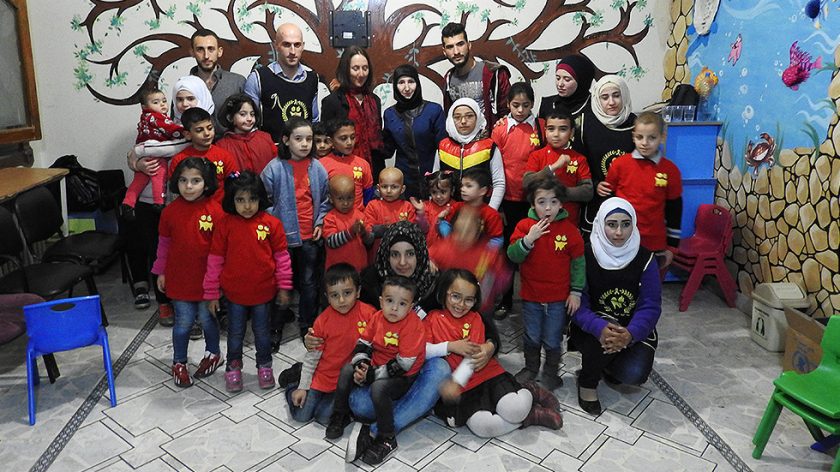
Children with cancer couldn’t get adequate treatment due to sanctions (photo Aleppo 2016)
By Eva Bartlett | RT | December 16, 2019
The US has a favourite tool for bullying non-compliant nations: sanctions. Sanctions inflict considerable suffering, even death, on ordinary people in targeted nations. Yet those defiant nations persist and resist.
A recent opinion piece in the Washington Post proposing a new oil-for-food scheme, this time in Venezuela, surprisingly acknowledges that sanctions “can also end up harming the people that they intend to protect.”
Okay, first off, we know there is no intention of “protecting” civilians in any of the countless countries targeted by Western sanctions. Do Western talking heads really think we’ve forgotten the half-a-million dead Iraqi children, thanks to US sanctions?
Yet, ask a Western leader about crippling sanctions placed on nations which don’t bow to Imperial demands and you’ll be met with some nonsensical explanation that sanctions only target ‘regimes’ and ‘terrorists,’ not the people.
I’ve lived in, spent considerable time in, or visited areas under sanctions and siege, and I’ve seen first hand how sanctions are a form of terrorism, choking civilians, depriving them of basic and urgent medical care, food, employment, and travel entitlements that many of us in Western nations take for granted.
When I was in Syria last October, a man told me his wife had been diagnosed with breast cancer, but because of the sanctions he couldn’t get her the conventional treatments most in the West would avail of.
In 2016, in Aleppo, before it was liberated of al-Qaeda and co, Dr. Nabil Antaki told me how –because of the sanctions– it had taken him well over a year to get a simple part for his gastroenterology practise.
In 2015, visiting Damascus’ University Hospital, where bed after bed was occupied by a child maimed by terrorists’ shelling (from Ghouta), a nurse told me:
“We have so many difficulties to ensure that we have antibiotics, specialized medicines, maintenance of the equipment… Because of the sanctions, many parts are not available, we have difficulties obtaining them.”
Visiting a prosthetic limbs factory in Damascus in 2016, I was told that, due to the sanctions, smart technology and 3D scanners –used to determine the exact location where a limb should be fixed– were not available. Considering the over eight years of war and terrorism in Syria, there are untold numbers of civilians and soldiers in need of this technology to simply get a prosthetic limb fixed so they can get on with their lives. But no, America’s concern for the Syrian people means that this, too, is near impossible.
In 2018, Syria’s minister of health told me Syria had formerly been dubbed by the World Health Organization a “pioneer state” in providing health care.
“Syria had 60 pharmaceutical factories and was exporting medicine to 58 countries. Now, 16 of these factories are out of service. Terrorists partially or fully destroyed 46 hospitals and 620 medical centres.”
I asked the minister about the complex in Barzeh, targeted with missile strikes by the US and allies in April 2018. Turns out it was part of the Ministry of Health, and manufactured cancer treatment medications, as well as antidotes for snake or scorpion bites/stings, the antidote also serving as a basic material in the manufacture of many medicines.
Last year, Syrian-American doctor Hussam al-Samman told me about his efforts to send to Syria chemotherapy medications for cancer patients in remission. He jumped through various hoops of America’s unforgiving bureaucracy, to no avail. It was never possible in the first place.
“We managed to get a meeting in the White House. We met Rob Malley, a top-notch assistant or adviser of Obama at that time. I asked them: ‘How in the world could your heart let you block chemotherapy from going to people with cancer in Syria?’
They said: ‘We will not allow Bashar al-Assad to have anything that will make people love him. We will not support anything that will help Bashar al-Assad look good’.”
Fast forward to the present: in spite of the sanctions, or precisely because of the sanctions, Syria recently opened its first anti-cancer drugs factory. President Assad is, again, looking rather good to Syrians.
UN expert: Sanctions on Venezuela “a form of terrorism”
Alfred de Zayas, the human rights lawyer and former UN official, aptly calls sanctions a form of terrorism, “because they invariably impact, directly or indirectly, the poor and vulnerable.”
Earlier this year, The Center for Economic and Policy Research estimated 40,000 deaths had occurred due to sanctions in 2017-2018.
While in Venezuela in March this year, I spoke with people from poor communities about the effects of sanctions. Most I met were very well aware of the US economic war against their country, and rallied alongside their government.
One woman told me:
“If you don’t have water, don’t have electricity, the basics, how would you feel, as a mother? This makes some of the population, that doesn’t understand about the sanctions, blame the government.”
Venezuela’s Foreign Minister, Jorge Arreaza, said during that visit:
“We told [American diplomat and Trump envoy] Mr Elliott Abrams, ‘the coup has failed, so now what are you going to do?’ He kind-of nodded and said, ‘Well, this is going to be a long-term action, then, and we are looking forward to the collapse of your economy.’”
Indeed, that collapse would come about precisely due to the immoral US sanctions against the Venezuelan people.
North Korean Youth: Sanction the USA
After visiting Korea’s north in August 2017, in a photo essay I noted: “The criminal sanctions against the North, enforced since 1950, making even more difficult the efforts to rebuild following decimation. The sanctions are against the people, affecting all sectors of life.”
And although most I met there were proud of their country’s achievements in spite of the sanctions, they were also vocal about the injustice of being bombed to near decimation and then sanctioned.
In a Pyongyang Middle School, to my questions about the sanctions, a girl replied:
“The sanctions are not fair, our people have done nothing wrong to the USA.”
Another boy spoke of the silence around America’s use of nuclear bombs on civilians: “Why do people all over the world give us sanctions? Why can’t we put sanctions on the US?”
At the Okryu Children’s Hospital, Doctor Kim Un-Song said: “As a mother, I feel extremely angry at the sanctions against the DPRK, even blocking medicine and instruments for children. This is inhumane and against human rights.”
As with Syria, sanctions on the DPRK prevent further entry to Korea of hospital machinery, as well as replacement parts.
Defying the sanctions
In spite of draconian sanctions, Syria, the DPRK and Venezuela continue to resist. After fighting international terrorism since 2011, Syria is rebuilding in liberated areas. That process could proceed more quickly were sanctions lifted, making it easier for companies outside of Syria to invest.
But Syria is managing, with its allies’ support, including that of North Korea, and due to the steadfastness of the heroic Syrian people, and its leadership.
Likewise, Venezuela and North Korea, facing America’s economic war and endless propagandistic rhetoric, continue to resist.
In each of these countries, I’ve met well-informed people who are fighting the sadism of the sanctions, and who are determined to remain free of US tyranny.
Eva Bartlett is a Canadian independent journalist and activist. She has spent years on the ground covering conflict zones in the Middle East, especially in Syria and Palestine (where she lived for nearly four years).
Iran Views US Sanctions Against Mahan Air as Illegal – Foreign Ministry
Sputnik – December 16, 2019
Tehran considers the US sanctions imposed against the Mahan Air carrier for allegedly transporting weapons to conflict areas in the Middle East illegal and hopes that other countries do not follow Washington’s steps, the Iranian Foreign Ministry’s spokesman, Abbas Mousavi, said on Monday.
“We expect that our friendly countries will not follow the illegal, unilateral and unreasonable US sanctions”, Mousavi told reporters.Last week, the US Department of the Treasury imposed sanctions on two Iranian shipping companies and three Mahan Air carrier general sales agents for their alleged role in transporting weapons to Yemen and Syria.
The Treasury also said that the new sanctions target three Mahan Air general sales agents based in the United Arab Emirates and Hong Kong, along with Iranian businessman Abdolhossein Khedri and his companies, Khedri Jahan Darya Co. and Maritime Silk Road LLC, as well as his ships.
The Treasury’s action requires that all property and interests in property of the sanctioned individuals and entities that are in the United States be blocked and reported. It generally also prohibits all dealings by Americans or within the United States.
Washington has repeatedly accused Iran of supporting Yemeni Houthi militants fighting against the government led by President Abdrabbuh Mansur Hadi. The US claimed that the Islamic Republic has been smuggling weapons to the Shia fighters despite a 2015 UN ban, which Tehran has denied.
New sanctions to ban humanitarian trade with Iran: US Treasury
Press TV | December 13, 2019
The US Treasury Department has stressed that Washington’s newly announced sanctions targeting Iran’s air and maritime transport industries will lead to the restriction of trade related to humanitarian goods.
“US persons will be prohibited from engaging in transactions involving Islamic Republic of Iran Shipping Lines (IRISL) or E-Sail, including transactions for the sale of agricultural commodities, food, medicine, or medical devices,” the Treasury’s guidelines on Iran sanctions read.
“In addition, non-US persons that knowingly engage in certain transactions with IRISL or E-Sail, even for the sale to Iran of agricultural commodities, food, medicine, or medical devices, risk exposure to sanctions under additional authorities,” it added.

Screenshot showing a segment of the US Treasury Department’s guidelines on Washington’s new sanctions against Iran announced on December 11, 2019.
The announcement comes after the Trump administration announced Wednesday that it was targeting IRISL and Iran’s major airline, Mahan Air, over baseless allegations of Tehran supporting “terrorists” in the region.
The Wednesday order put IRISL and Mahan under US presidential Executive Order (EO) 13382, which allegedly targets “weapons of mass destruction proliferators”.
The Treasury’s guidelines on the new sanctions stressed that entities put under EQ 13382 would not be eligible for any humanitarian sanction exceptions.
The statement comes despite Washington’s claim that its sanctions do not affect Iran’s access to humanitarian goods.
US officials have, nonetheless, signaled on numerous occasions that Washington’s sanctions seek to harm Iran’s general population in a bid to force Tehran to accept Washington’s dictates.
Earlier this year, US Secretary of State Mike Pompeo said that Tehran had to listen to Washington “if they want their people to eat”.
The new bans mark the latest round of Washington’s wide sweeping sanctions against the country after the US government unilaterally pulled out of the 2015 Iran nuclear deal and re-imposed sanctions lifted under the deal last year.
Speaking on Thursday, US Special Representative for Iran Brian Hook boasted that US sanctions targeting Iran’s oil sector have led to more than $50 billion in revenue losses, have hindered Iran’s refined-oil products and have undermined foreign investment.
“Both upstream and downstream investments in Iran’s oil and gas sector have stopped,” Hook said.
“Foreign investors have almost entirely pulled out of Iran due to the risks and billions in investment has been lost,” he added.
Hook said that the wide sweeping oil sanctions seek to force Iran to negotiate with the US, a demand which Iranian officials have firmly rejected as long as Washington fails to uphold the previously negotiated nuclear deal agreement.
US-backed figure claims Iranians ‘understand’ Trump
Following Washington’s withdrawal from the 2015 nuclear deal, the US has since adopted a policy of “maximum pressure” against Tehran, coupling sanctions with stepped up regional provocations and military deployments aimed at Iran.
The US has also sought to provoke internal unrest in the country by supporting various destabilizing elements targeting the country, such as the terrorist Mujahedin Khalq Organization (MKO) and violent separatist groups.
According to observers, Reza Pahlavi, son of deposed Iranian king Mohammad Reza Pahlavi, is one of the main figureheads being “groomed” by Washington as part of its campaign to destabilize Iran amid recent foreign-backed riots in Iran.
In recent remarks to the US-based magazine Newsweek, Pahlavi expressed his support for Trump’s aggressive policies targeting the Iranian economy and called for stepped-up western intervention in Iran.
He also claimed that the Iranian people “understand and appreciate” the US-imposed sanctions and believe that the Iranian government is to blame for the “maximum pressure” targeting Iran.
Pahlavi’s remarks come despite numerous studies indicating that Iranian resentment against Washington has largely increased amid the US’ wide sweeping sanctions.
A recent study published by the University of Maryland’s Center for International and Security Studies at Maryland (CISSM) and the Toronto-based IranPolls shows that an overwhelming 86 percent of Iranians despise US policies.
The study’s results come despite stepped-up efforts by foreign media outlets to stir unrest in Iran and promote anti-government sentiment amid tightening US sanctions crippling the country’s economy.
Page from Iraq playbook: US invokes WMDs to pile ‘maximum pressure’ sanctions on Iran
By Nebojsa Malic | RT | December 11, 2019
With over a year of sanctions failing to force Tehran to bend the knee, Washington is now resorting to creatively invoking “weapons of mass destruction” – the very same pretext the US used for the 2003 invasion of Iraq.
On Wednesday, the US Treasury Department expanded sanctions against Mahan Air, Iran’s largest privately-owned airline, citing a 2005 executive order by then-President George W. Bush targeting “weapons of mass destruction proliferators and their supporters.”
Mind you, nowhere in the sanctions announcement does Treasury say that Mahan actually transported WMDs. Instead, the airline is accused of flying personnel and weapons for Iran’s “terrorist and militant groups” and thereby “directly contributing” to conflicts in Syria and Yemen.
Meanwhile, the US is sending weapons to “moderate” jihadist terrorists in Syria, and arming and refueling Saudi Arabian and allied forces that have been bombing Yemen to the stone age since 2015. This is never mentioned, of course. Nor is anyone allowed to sanction Washington for any of this, as sanctions only go in one direction.
The point of the sanctions is to scare anyone away from doing any business with the blacklisted companies or individuals. Imagine being sued by the US for violating sanctions against “WMD proliferators” over fulfilling a catering contract, selling airplane parts, or providing ticketing services. It may sound nonsensical, but there you have it.
The State Department has basically admitted to deliberately using the WMD classification to make Iranian companies radioactive to potential business partners.
“Our ability to work with partners overseas to deny Iranian shippers access to ports, or prevent transactions, much more diplomatically persuasive when able to identify WMD or missile proliferation as the gravamen of the complaint,” is how Christopher Ford, assistant secretary of state for international security and non-proliferation, explained it to Financial Times.
That the Trump administration is using the WMD gambit against Iran is particularly ironic, given that demonstrably false accusations about WMDs were used by Bush to invade the neighboring Iraq in 2003, setting off a chain of events that claimed tens of thousands of lives and gave birth to Islamic State (IS, formerly ISIS). Donald Trump has long been critical of the Iraq War, and specifically the false WMD charges, only to apparently not mind when the same playbook is used against Iran.
What evidence does the US have for Mahan actually proliferating any WMDs? Funny you should ask. US sanctions designations require no pesky evidence, or due process; they are basically imposed and lifted on the sole discretion of Treasury, without any possibility of appeal or redress. That’s a mighty convenient way to bypass the burden of proof.
Officially, the sanctions are all about US solidarity with the “Iranian people,” as Secretary of State Mike Pompeo puts it, and punishing the government in Tehran for funding “terrorism” instead of spending money on social programs. It’s a tempting narrative, to be sure – yet no different from the claims of neoconservative hawks in 2003 that US troops will be greeted in Iraq with flowers, like liberators. Except they were met with improvised explosive devices (IEDs) instead.
Again, it is particularly ironic that all of this is happening on Trump’s watch and with his apparent blessing, even as the neoconservatives and Democrats have joined forces in trying to get him impeached. In Washington, it seems, the Swamp always wins.
China Quietly Ramps Up Oil Production In Iran
By Simon Watkins – Oilprice.com – December 10, 2019
The supergiant Azadegan oil field, comprising major north and south sites, is as important to Iran’s overall strategic plan to survive the current sanctions environment and to prosper when they are lifted as the flagship South Pars supergiant gas field and the added-value products of its petrochemicals sector. Last week Iran’s Petroleum Engineering and Development Company (PEDEC) announced that five new development wells and an appraisal well are to be spudded in North Azadegan to maintain current production levels. OilPrice.com understands from various senior energy sources in Iran that this is only part of the picture, with much bigger plans having been agreed for rollout in the coming six months with the help of China and Russia.
Located around 80 kilometres west of Ahvaz, close to the Iraqi border, the entire 900 square kilometre Azadegan field is the third-largest hydrocarbon reserve in the world after the Ghawar oil field in Saudi Arabia and the Burgan oil field in Kuwait. Its total reserves are estimated at about 42 billion barrels of oil, with around 7 billion barrels currently deemed recoverable. The first exploration well was drilled in 1976 but, despite its potential, a long lead time across the four main layers – Sarvak, Kazhdomi, Godvan, and Fahilan – of the site has meant that the pace of production has been slower than at many neighbouring fields, especially those over the border in Iraq.
A key reason for this was the attitude of Chinese firms active in Iran around that time, which can be broadly characterised as doing the minimum necessary to generate some oil flows from the fields back into China whilst not spending too much money. This attitude, though – particularly when Iran was already in the process of negotiating the Joint Comprehensive Plan of Action (JCPOA) in the run-up to its being agreed in 2015 – resulted in the National Iranian Oil Co. (NIOC) cancelling China National Petroleum Corp’s (CNPC) contract to develop Phase 11 of the South Pars natural gas field in 2013. A year later – with CNPC having drilled only 7 of the 185 wells it had planned at the South Azadegan field – the NIOC also cancelled this development contract with the Chinese company as well. CNPC was further warned at that time that its contract for North Azadegan would go the same way if it did not up the development tempo, which it did, increasing production from around 15,000 barrels per day (bpd) at that stage to around 35,000 bpd within a year or so.
As it stands, with CNPC still the key foreign developer at North Azadegan, the relationship dynamic between Iran and China has shifted again. With re-imposed U.S. sanctions still in place, Iran cannot afford to alienate China and over the past few months has offered it extremely advantageous deals to return to previous developments or to take on an even greater role in existing ones. The most notable of these have been South Azadegan and Phase 11 of the supergiant South Pars non-associated gas field, although others are in the offing.
“The understanding agreed between Iran and China when the French [Total] started to wobble on continuing with Phase 11 [of South Pars] after the U.S. pulled out of the JCPOA was that China would assume Total’s entire stake [to 80.1 per cent] and really push production,” a senior oil industry source who works closely with Iran’s Petroleum Ministry told OilPrice.com last week. “At the same time, China would also be allowed to go into South Azadegan to create a unified field development programme with its North Azadegan activities,” he said. “When the details of the deals began to leak out, though, South Pars [Phase] 11 and South Azadegan had to be put on the back burner but the plans will go ahead within the next six months,” he added. In this hiatus, though, China has been advancing its reach into neighbouring Iraq, as highlighted recently here.
From China’s perspective, its ‘One Belt, One Road’ vision – which will absolutely change the global geopolitical power balance forever – is totally dependent on Iran’s participation for three key reasons. First, Iran is closely involved in the affairs of those countries that constitute the Shia crescent of power – Jordan, Lebanon, Syria, Iraq, and Yemen – which allows China to hold the U.S in check in those areas. Second, it is a direct land route into Europe, via both Turkey and the Former Soviet Union states and Russia. And third, it has huge oil and gas reserves currently going cheap. These broad factors underpin the game-changing 25-year comprehensive strategic partnership signed earlier this year in Beijing by Iran’s Foreign Minister, Mohammad Zarif, and his China counterpart, Wang Li.
All of this means in the short-term that China needs to make continued solid progress on North Azadegan until such time as the Islamic Revolutionary Guard Corps (IRGC) tells President Hassan Rouhani that the Iranian public and moderate MPs will be able to tolerate China’s further multi-layered expansion in Iran. Currently, North Azadegan is producing just shy of 80,000 bpd but the Phase 2 plan – including the spudding of the new wells – is aimed at boosting this output to at least 100,000 bpd. More specifically, China is expected by Iran to ensure that the output from North Azadegan when combined with the output from South Azadegan (currently being developed by Iranian firms) is at least 250,000 bpd. South Azadegan is now producing a steady 105,000 bpd with spikes to 115,000 bpd plus, according to the Iran source.
Longer-term, Iran’s plan is to increase the recovery rate from all of its oil fields, beginning with those in the massive West Karoun area (in which North and South Azadegan are located, along with North and South Yaran, and Yadavaran, among others) to at least 25 per cent from the current 4.5 per cent (it was 5.5 per cent before U.S. sanctions were re-imposed). By comparison, the average recovery rate from Saudi Arabia’s oil fields is around 50 per cent, with plans to raise that to 70 per cent.
As the West Karoun fields together are estimated to contain at least 67 billion barrels of oil in place, for every one per cent increase in the rate of recovery that can be achieved the recoverable reserves figure would increase by 670 million barrels, or around US$34 billion in revenues with oil even at US$50 a barrel. Once China has also taken over at South Azadegan, according to the Iran source, it will be expected to increase the output from the three fields – North and South Azadegan and Yadavaran – by at least 500,000 bpd within three years from the signing of the South Azadegan deal (expected within the next six months).
Simon Watkins is a former senior FX trader and salesman, financial journalist, and best-selling author. He was Head of Forex Institutional Sales and Trading for Credit Lyonnais, and later Director of Forex at Bank of Montreal. He was then Head of Weekly Publications and Chief Writer for Business Monitor International, Head of Fuel Oil Products for Platts, and Global Managing Editor of Research for Renaissance Capital in Moscow. He has written extensively on oil and gas, Forex, equities, bonds, economics and geopolitics for many leading publications, and has worked as a geopolitical risk consultant for a number of major hedge funds in London, Moscow, and Dubai. In addition, he has authored five books on finance, oil, and financial markets trading published by ADVFN and available on Amazon, Apple, and Kobo.
U.S. Efforts to Force Iran Out of European Energy Markets Have Failed
By Paul Antonopoulos | December 10, 2019
Despite the European Union attempts to save the Joint Comprehensive Plan of Action, which saw Iran reduce its low-enriched uranium by 98% and eliminate its stockpile of medium-enriched uranium in return for economic relief, JCPOA is hanging by a thread because of Washington’s withdrawal from the deal in October 2017.
The European Statistical Office revealed that from January to September trade between the EU and Iran was at €3.86 billion, a massive 74.92% drop compared to the same period in 2018. The report revealed that Germany (€1.23 billion), Italy (€734.78 million) and the Netherlands (€376.73 million) were Iran’s top three trading partners in EU while trade with Greece (€32.08 million), Luxembourg (€506,316), Spain (€207.36 million), France (€296.5 million) and Austria (€102.11 million) had plunged by 97.13%, 91.38%, 91.17%, 86.79% and 82.38% respectively.
Although Iran’s trade with Cyprus at €6.25 million and Bulgaria at €64.97 million increased by 85.12% and 29.24% respectively year-on-year— the highest among EU states — it still does not offset the massive decline in trade with Greece, Luxembourg, Spain, France and Austria. The major decline in trade is attributed due to European companies’ unwillingness to risk losing business with the U.S. for the sake of the much smaller Iranian market. Effectively, U.S. President Donald Trump’s economic war with Iran is to diminish Iranian-EU trade so that the U.S. may reap benefits from boosting its own oil and other commodities. However, this is set to change.
With this dramatic downturn in trade with the EU, Iran is now pushing to diversify its economy even further to overcome a reliance on oil and take a number of measures in an attempt to counter U.S. economic aggression, including increasing taxes, cutting energy subsidies and borrowing money from friendly states. Iranian President Hassan Rouhani explained on Sunday in parliament that oil revenues are expected to drop by at least 70% and that Iran’s budget next year “is designed to resist against sanctions and to announce to the world that we run this country despite sanctions.”
The Iranian president explained that the new budget will reach $115.3 billion because of the reduction of oil exportation from 2.8 million barrels of oil a day before Trump’s May sanctions to 500,000 barrels a day. In addition, Iran will sell more bonds in the domestic market and plans to increase revenues from taxes by 13%, but these changes come as the International Monetary Fund has already forecast that the Islamic Republic will have a reduction of its economy of about 9.5% this year.
This “budget of resistance,” as described by Rouhani, is “contrary to what the Americans thought. With the pressure of sanctions, our country’s economy would encounter problems, thank God we have chosen the correct path… and we are moving forward.”
Iran’s Deputy Foreign Minister Abbas Araqchi announced on Monday that the European signatories to the JCPOA will not activate the “trigger mechanism” for the time being that could see the return of sanctions against the Islamic Republic. It is unlikely that the EU or Iran will withdraw from what remains of JCPOA as they attempt to bypass U.S. sanctions which can see the besieged country improve its economy through increased trade with Europe.
Not only has the EU pledged to maintain its nuclear deal commitments, in a joint statement late last month, Belgium, Denmark, Finland, the Netherlands, Norway and Sweden said they will attain shares in Instrument in Support of Trade Exchanges (INSTEX), that was launched by Britain, France and Germany in January to allow European companies to trade with Iran without using U.S. dollars so they could be protected from U.S. sanctions.
In their joint statement, they said: “In light of the continuous European support for the agreement and the ongoing efforts to implement the economic part of it and to facilitate legitimate trade between Europe and Iran, we are now in the process of becoming shareholders of INSTEX, subject to the completion of national procedures.”
This is also a part of a wider move to counter strong U.S. efforts to muscle in on the European oil market as U.S. sanctions have scared buyers from acquiring Iranian and Venezuelan crude. The so-called hydro-fracking and shale revolution that began a few years ago has seen the U.S. aggressively seek to export its oil to new markets. It is now unsurprising that earlier this year U.S. crude shipments to Europe reached new records, behind Russia but still more than Nigeria and Libya who are important OPEC members.
Therefore, a major reason for the false allegations by Trump that Iran was violating the JCPOA was to force Iran out of the European market to push the U.S. entrance. It appears that Trump’s plan has failed. Not only has Iran formulated its “budget of resistance,” but with Belgium, Denmark, Finland, the Netherlands, Norway and Sweden becoming shareholders INSTEX, they are prepared to continue their economic relations with Iran while being protected from U.S. repercussions. Effectively, although the U.S. has achieved a short-term reduction in European-Iranian trade, it will not only recover, but also be strengthened as new mechanisms are being made to bypass U.S. banks and dollars.
Paul Antonopoulos is a Research Fellow at the Center for Syncretic Studies.
Featured Video
Iran FM Araghchi: “Hormuz Will No Longer Be the Same”
or go to
Aletho News Archives – Video-Images
From the Archives
Sam Husseini: The entire US establishment helped lie their way into the Iraq war
By Slava Zilber | American Herald Tribune | October 14, 2019
Sam Husseini is a senior analyst with the Institute for Public Accuracy, independent journalist and contributor to The Nation and FAIR.
Slava Zilber: Sam, three years ago, you appeared on Talk Nation Radio with David Swanson and spoke about the case of the GCHQ whistleblower Katharine Gun. You pointed out that the people involved in the spying on the UN and the people authorizing the Iraq War were not held accountable:
“Virtually everybody who went along with the war, whether it is Kerry or Clinton, of course, the Bush administration themselves has falsified their own records in terms of why, what they did, when they did, why they did it, to the extent that they’ve been scrutinised at all.”
You also address it in a recent article. And recently, Joe Biden has been lying about his position on the Iraq War. How can such an important issue escape meaningful scrutiny? … continue
Blog Roll
 Aletho News
- The Mecca Pact Courts Iran: Containment Comes Full Circle
- Oman FM: Persian Gulf states, Iran, Iraq should form security pact excluding US
- Trump peddles fresh falsehoods, claims Iran ‘started the war’ as US aggression drags on
- Ukraine quagmire? Yes, but it’s for NATO, not Russia
- US intelligence hypes Chinese, Russian space threats while accelerating its own military buildup in orbit
- Iran FM Araghchi: “Hormuz Will No Longer Be the Same”
- EU facing trillion-euro debt hole while seeking more cash for Kiev
- How US, Europe, Persian Gulf states exhausted missile stockpiles, splurged billions to defend Israel
- Up in arms… Koreans reject U.S. empire’s plan to make South Korea the next Ukraine
- Iran, Turkey, Pakistan, Saudi Arabia could advance region-led security framework in Tehran: FM spox
- If Americans Knew
- ‘There are no dreams here’: How Israel’s outgoing gov’t remade the West Bank
- Netanyahu, Katz Blocked IDF Plan to End Hebron Raids, Allow Locals to Return
- Mamdani’s NYPD is poised to sign a three-year, $750,500 no-bid contract with Israeli surveillance firm
- Israel Votes Today: What the Election Means for Americans and How Netanyahu’s Rivals Differ
- DAILY UPDATE: Latest essential news on Palestine, Israel, & region
- Israeli media analysis: 2 Paths to War With Iran Loom Over Israel’s Election
- Diaspora Jewish leaders stress Israel ties — no matter the outcome of tomorrow’s elections
- Israeli forces kill 14 in Gaza as UN commission says genocide continues
- The Israeli elections have become a fight over October 7, but only Zionist opinions are allowed
- 9 Things You May Not Know About Israel’s Election
- No Tricks Zone
- Sudden Stratospheric Warming, Powerful El Niño Combination May Lead To Extreme Europe Cold, Energy Crisis!
- Two New Studies Find Thwaites Glacier Melt Cannot Be Driven By Human Activity Or A Warming Ocean
- E-Cars Reduce CO2 Emissions By Only 41% Compared To Internal Combustion Engine Vehicles
- Predictions Made By Renowned Climate Professor Over Past Decades Have Been Proven To Be Poor
- New Study Suggests Large Regions Of The Pacific Ocean Have Been Cooling For The Last 80 Years
- Germany’s Green Energy Debacle: High Energy Costs Force Kahla Porzellan to Close After 182 Years!
- New Study: 50 Years Of The Most Aggressive ‘Net Zero’ Policies Can Only Affect The Global Climate By 0.03°C
- US September “Heat” Was No Record…Many Records Set Decades Ago
- Latest European Green Energy Debacle; Portugal’s Largest Flagship Solar Park Insolvent!
- Green Energy Debacle: German Expert Professor Fritz Vahrenholt Warns Of Severe Economic And Social Consequences

