Those crafty Iranians. In return for relief from America’s devastating economic warfare, they will give up a nuclear ambition they did not have. Boy did we get taken!
Damn, we didn’t even get a chance to humiliate them! What’s happening to America?
The neocons fear that if Iran’s assets are unfrozen, it will behave like the United States.
It’s worth it to see the Lobby and neocons go berserk.
While Obama brags about stemming nuclear proliferation, let him explain why he, like Israel, opposes making the Mideast nuclear-free. (Hint: Israel is the nuclear monopolist, having achieved that status by smuggling the components and breaking U.S. law with the connivance of American officials and other influential people.)
How dare Iran think it can destabilize the Middle East! That’s America’s role!
Next agenda item: dismantling the US nuclear arsenal.
July 14, 2015
Posted by aletho |
Militarism | Israel, Middle East, Sanctions against Iran, United States |
Leave a comment
Iran and six leading world powers have reached a conclusive deal on the Iranian nuclear industry, an Iranian diplomat said as quoted by Reuters.
“All the hard work has paid off and we sealed a deal. God bless our people,” the diplomat told Reuters on condition of anonymity. The breakthrough was confirmed by a European diplomat, who told TASS that it would be announced “soon. “It was difficult work. The arguing continued throughout the night. At times it was heated, with occasional shouting. But the result should be worth all of that,” a source in the German delegation told TASS.
The economic sanctions against Iran would be lifted immediately after verification of its compliance with the deal, reported RIA Novosti citing the draft agreement. The deal also provides for the lifting of economic sanctions imposed outside of the EU, like the banking and insurance restrictions on Iran by the EU and the US. The draft provides for the lifting of restrictions for the EU to import oil and gas from Iran, as well as exports of oil and gas production equipment to Iran.
It also said the International Atomic Energy Agency (IAEA), UN’s nuclear watchdog, has signed a separate agreement with Tehran on the military aspects of its nuclear activities. According to Reuters, the separate agreement focuses on the issue of the Parchin military site.
Iran and P5+1 group are to hold ministerial-level meetings at least twice a year to evaluate how the agreement is being implemented, according to the draft document, as cited by RIA Novosti.
Iran agreed to a 15-year moratorium on enriching uranium beyond 3.67 percent. The enrichment would be conducted only at the Natanz facility, while the Fordo facility would not conduct any enrichment activities or store fissile material, TASS reports. Iran also agreed to store no more than 300 kg of low-enriched uranium. The Arak reactor would not be used to produce plutonium under the deal. The spent fuel would be handled by international mediators.
Reuters leaked others details of the upcoming deal. The UN-imposed arms embargo against Iran is to remain in force for five years, while the restrictions on rocket technology exchange are to be kept for eight years it said, citing diplomatic sources.
The economic sanctions that are to be lifted could be restored within 65 days if Iran doesn’t comply with the terms of the deal, the source added.
The Vienna agreement is to be ratified by the UN Security Council and come into force 90 days later.
Foreign ministers of the seven negotiating nations are to meet at the UN center in Vienna at 08:30 GMT, followed by a media conference, a spokeswoman for the European Union said.
As soon as the deal is officially announced it will bring an end the 12-year dispute over Tehran’s nuclear program and related economic sanctions. Foreign ministers and officials from Iran, the United States, the UK, France, Germany, Russia and China have gathered in Vienna, twice postponing the deadline in the course of the past two weeks, in a bid to make a long-term deal on Iranian nuclear program.
The lengthy negotiations remained deadlocked due to a lack of confidence in the purpose of Tehran’s nuclear activities, which the country claims to remain solely peaceful. The Western countries had accused the country of seeking a way of creating its own nuclear weapons.
July 14, 2015
Posted by aletho |
Aletho News | Sanctions against Iran |
Leave a comment
The corporate media in both the UK and US are attempting to portray the Iranian desire to have the arms embargo lifted, as a new and extraneous demand that could torpedo the nuclear deal. This is an entirely false portrayal.
The issue has been included in the talks since, quite literally, the very first Iranian position document. And there is a reason for that. It is absolutely part and parcel of the issue and in no way extraneous to it. If there were any real journalists employed by the corporate media, that is obvious right on the face of UN Security Council Resolution 1747 of 2007 which imposed the arms embargo. The sole and exclusive reason given for the arms embargo is Iran’s nuclear enrichment programme. And it specifically states that, once the nuclear proliferation issue is resolved, the embargo will be lifted.
Paragraph 13 reads:
(b) that it shall terminate the measures specified in paragraphs 3, 4, 5, 6, 7
and 12 of resolution 1737 (2006) as well as in paragraphs 2, 4, 5, 6 and 7 above as
soon as it determines, following receipt of the report referred to in paragraph 12
above, that Iran has fully complied with its obligations under the relevant
resolutions of the Security Council and met the requirements of the IAEA Board of
Governors, as confirmed by the IAEA Board;
It is the United States, not Iran, which is introducing extraneous factors, banging on about Yemen, Iran and Hezbollah, which are nowhere mentioned in the Security Council Resolutions.
The way this is being reported in the media is the exact opposite of the truth. The United States is attempting to welch on a deal which was not only open, but forms the very text of the security council resolution. None of the BBC’s highly paid analysts, reporters, or guest commenters is capable of noting this basic fact.
July 13, 2015
Posted by aletho |
Deception, Mainstream Media, Warmongering | BBC, Sanctions against Iran, UK, United States |
Leave a comment
Oil prices fell in Asia on Monday as Iran and major western powers said they were closer than ever to a landmark nuclear deal that would lift sanctions and see Tehran’s crude exports return to global markets.
A forecast by the International Energy Agency (IEA) for slower world oil demand next year was also weighing on the market, analysts said.
US benchmark West Texas Intermediate for August delivery was down 86 cents to $51.88 and Brent crude tumbled 96 cents to $57.77 a barrel in late-morning trade.
“We have come a long way. We need to reach a peak and we’re very close,” Iranian President Sheikh Hassan Rouhani said in Tehran on Sunday.
“I hope we are finally entering the final phase of these marathon negotiations. I believe it,” said French Foreign Minister Laurent Fabius, who cancelled a trip to Africa to stay at the talks in Vienna.
Any deal to stop what the West suspects as Iranian efforts to build an atomic bomb will result in the lifting of punishing economic sanctions, allowing the country to resume oil exports.
More Iranian oil however will add to a supply glut, which has depressed prices.
The IEA has forecast that global oil demand would grow by 1.2 million barrels per day next year, slower than the 1.4 million projected this year.
However, global output grew by 550,000 barrels a day in June alone to 96.6 million barrels, IEA added.
This is up on average by 3.1 million barrels from a year ago, boosted by increased production from the Organization of the Petroleum Exporting Countries.
OPEC’s output climbed in June to a three-year high of 31.7 million barrels, the IEA said.
Source: AFP
July 13, 2015
Posted by aletho |
Economics, Malthusian Ideology, Phony Scarcity | Sanctions against Iran |
Leave a comment
http://cdnapi.kaltura.com/p/1679301/sp/167930100/embedIframeJs/uiconf_id/29140361/partner_id/1679301?iframeembed=true&playerId=kaltura_player_54f43f5daa86d2ec837a2ee5018bff0c&entry_id=1_2pw7s2k3&flashvarsstreamerType=auto
~
http://cdnapi.kaltura.com/p/1679301/sp/167930100/embedIframeJs/uiconf_id/29140361/partner_id/1679301?iframeembed=true&playerId=kaltura_player_8bec3cda3b63ce7a5d5018f82297d4b6&entry_id=1_d9wztogf&flashvarsstreamerType=auto
As the world waits to see if the P5+1 and Iran can, in fact, conclude a comprehensive nuclear deal, it is important to step back from the not just day-by-day, but minute-by-minute coverage of comings and goings at the Palais Coburg in Vienna and think about what is really at stake in the negotiating endgame. To this end, we post here a very good discussion of these issues by Hillary and the University of Tehran’s Seyed Mohammad Marandi on CCTV’s The Heat, see here or click on videos above. (Like Mohammad, Flynt is currently in Vienna for the nuclear talks.)
The most critical of the remaining issues to be resolved by the parties relate to the terms of a new United Nations Security Council resolution that would negate previous Security Council resolutions dealing with the Iranian nuclear issue, remove Security Council-authorized international sanctions against Iran, and formally start implementation of a comprehensive nuclear deal. As both Hillary and Mohammad point out, underneath discussions about the modalities for removing international sanctions, whether and how to lift the conventional arms embargo against Iran, and related matters are more fundamental issues:
–Can the United States, for its own interests, abandon its increasingly self-damaging quest to dominate the Middle East and adopt a more reality-based strategy toward this critical part of the world?
–Can the United States, for its own interests, finally accept the Islamic Republic of Iran as a legitimate political order representing legitimate national interests, and genuinely come to terms with this already indispensable and still rising actor in the Middle East?
–In the process, can the United States, for its own interests, replace its longstanding reliance on Israel and Saudi Arabia as its key “partners” in the Middle East with a more balanced approach characterized by strategically-grounded diplomacy with all major regional players?
Let’s see what happens in Vienna.
July 12, 2015
Posted by aletho |
Video, Wars for Israel | Iran, Israel, Sanctions against Iran, Saudi Arabia, United States |
Leave a comment
The Iran nuclear talks may be getting close to some sort of conclusion in Vienna, but American political and policy elites remain, to an appallingly large extent, clueless as to what is really at stake in the negotiations. (This was a significant theme yesterday in Hillary’s appearance on CNN, see here, and in Flynt’s appearance on CNBC, see here, to discuss the Vienna talks.) And, while the headline from a recent NBC News poll notes that Americans favor an Iran nuclear deal by a “2 to 1” margin, in fact, the polls shows that a plurality of Americans say they don’t know what to think about a possible Iran nuclear deal.
These observations underscore a point that we have been making for some time: President Obama has yet to make the case to his fellow Americans for why an Iran nuclear deal—and, beyond that, a potential realignment of U.S. relations with the Islamic Republic—is not just profoundly in American interests, but is strategically imperative for the United States.
–This failure will almost certainly make it more difficult for Obama (and his successor) to implement a deal.
–Furthermore, this failure will severely circumscribe the strategic benefits that the United States can accrue from a deal.
At the moment, many American elites convey particular distress over the Obama administration’s inability simply to dictate the terms of a prospective United Nations Security Council resolution that would endorse a final nuclear agreement and, to help implement such an agreement, remove international sanctions previously authorized by the Council against the Islamic Republic.
–In its approach to drafting a new Security Council resolution, the Obama administration has been demanding that previously authorized limits on exports of conventional weapons and missile-related technology remain in place. Iran, for its part, resists any text that would imply its “acceptance” of continuing international sanctions. Moreover, Russia and China are not going along.
–Likewise, Moscow and Beijing have rejected the Obama administration’s demand that UN sanctions be lifted only for six months at a time, subject to renewal—renewal which the United States, on its own, could veto, thus realizing U.S. ambitions to be able to “snap” sanctions back into place without being blocked by Russia and China.
That the Obama administration has been pushing these positions reveals much of what is so fundamentally wrong with the U.S. approach to diplomacy with Iran. As Flynt pointed out on CNBC, “This was an approach that not only were the Iranians going to object to it, but I don’t think the administration ever had a serious chance of getting consensus within the P5+1, among the permanent members of the Security Council…It was foolish, really, for the administration to take those positions on those issues.” Yet these are the positions the administration took, and now it must either find a way to walk back from them or (foolishly) embrace diplomatic impasse.
Of course, this reflects weakness on Obama’s part—but not the sort of weakness for which neoconservatives and others constantly lambaste him. As Hillary noted on CNN,
“We have tried [the interventionists’] version of strength—invading Iraq; invading Libya; occupying Afghanistan for more than a decade; arming, training, and funding various jihadis in Syria and all across the Middle East. And all it has brought us is damage to ourselves.
The real strength would be, just like Nixon and Kissinger went to China and accepted the People’s Republic of China, we need to go to Tehran, as we wrote in our book, and make our peace with Iran. It will help us. It will resurrect our position in the Middle East and around the world. And if we don’t, we will see ourselves continue to flail across the Middle East and around the world…
The Islamic Republic of Iran is here to stay, like the People’s Republic of China. What we need to recognize is that rising Iran, just like rising China, is a strong, independent power. And we need to work with them, not constantly try to bring them down and align with other countries like Saudi Arabia that get us into strategic disaster after strategic disaster.”
But that is precisely what Obama has been unwilling to do. Could the United States still “walk away” from the process? As Hillary said on CNN, “A decision by the United States to ‘walk away,’ to cut off talks with Iran would be just as strategically damaging, if not more so, to the United States than the decision to invade Iraq. It would have enormously devastating consequences for the United States in the Middle East, keep us on a trajectory to get into one never-ending, unwinnable war after another. And it would have repercussions for us globally, in economic terms and military terms.”
Stay tuned.
July 9, 2015
Posted by aletho |
Militarism, Progressive Hypocrite | Iran, Middle East, Obama, Sanctions against Iran, United States |
Leave a comment
Thomas Friedman, the New York Times op-ed-page representative of the foreign-policy elite, is unhappy with how the overtime Iran nuclear talks are going. He says that President Obama, like his predecessor George W. Bush, hasn’t been tough enough. Obama holds all the cards, but somehow the Ayatollah Ali Khamenei is dictating terms. He writes:
It is stunning to me how well the Iranians, sitting alone on their side of the table, have played a weak hand against the United States, Russia, China, France, Germany and Britain on their side of the table…..
For the past year every time there is a sticking point … it keeps feeling as if it’s always our side looking to accommodate Iran’s needs. I wish we had walked out just once. When you signal to the guy on the other side of the table that you’re not willing to either blow him up or blow him off — to get up and walk away — you reduce yourself to just an equal and get the best bad deal nonviolence can buy. [Emphasis added.]
Friedman glosses over the fact that it is not “him” (foreign minister Javad Zarif?) who would be blown up in a war against Iran. It would be countless ordinary Iranians, who have done nothing to harm the American people. Those same innocent people would be harmed, admittedly in more subtle ways, if the P5+1 “blew off” Iranian negotiators because that would mean no relief from long-standing U.S.-led sanctions that have devastated the Iranian economy, boosting food and medicine prices among other inhumane consequences. Sanctions are acts of war. Would someone remind Friedman of that fact?
Friedman is ever the optimist, however. He believes it is still possible to get at least a “good bad deal,” the chances of a good deal having been blown by Obama’s “empty holster” strategy. It would be a deal “that, while it does not require Iran to dismantle its nuclear enrichment infrastructure, shrinks that infrastructure for the next 10 to 15 years so Iran can’t make a quick breakout to a bomb…. A deal that also gives us a level of transparency to monitor that agreement and gives international inspectors timely intrusive access to anywhere in Iran we suspect covert nuclear activity[.] One that restricts Iran from significantly upgrading its enrichment capacity over the next decade….” (As he notes, it would be deal approved by the Washington Institute for Near East Policy, which he fails to point out is a spin-off think-tank of the chief Israel lobbyist, AIPAC.
Before judging Friedman’s analysis, certain facts must be kept in mind. Iran has never had a program designed to build a nuclear bomb. You wouldn’t know from his column that Iran is a party to the nuclear Non-Proliferation Treaty (NPT), subjecting it to intrusive inspections for many years. During those years the International Atomic Energy Agency has unfailingly certified that Iran has diverted not one uranium atom to military purposes. As Gareth Porter heavily documents in his conveniently ignored book, Manufactured Crisis: The Untold Story of the Iran Nuclear Scare, Iran’s leadership has directed its nuclear research and facilities to the production of electricity and medical isotopes. The so-called evidence against Iran, Porter shows, is little more than the alleged contents of a suspect laptop, which has yet to be presented for independent verification. The nonthreat has been affirmed by U.S. and Israeli intelligence.
A few minutes’ thought will indicate that Iran’s leadership has many reasons not to want nuclear weapons, which Khamenei condemned in a fatwa some time ago. What exactly would Iran do with a bomb? The U.S. government has thousands, and Israel has a few hundred, including submarine-mounted nukes that would be available for a second strike if anyone were crazy enough to launch a first strike against the Jewish State. By the way, unlike Iran, Israel refuses to sign the NPT and thus is subject to no inspections.
In other words, Iran has been framed. Friedman is simply doing the bidding of those who want a U.S. war of aggression against the Islamic Republic — namely, Israel, the Israel Lobby/neoconservative alliance, and Saudi Arabia.
July 9, 2015
Posted by aletho |
Mainstream Media, Warmongering, Militarism, Timeless or most popular, War Crimes, Wars for Israel | AIPAC, Iran, New York Times, Sanctions against Iran, Thomas Friedman, United States, Washington Institute for Near East Policy, Zionism |
Leave a comment
Iran will join the Eurasian economic, political and military bloc, the Shanghai Cooperation Organization (SCO), after sanctions are lifted on the country, a Russian presidential aide has said.
The announcement came after foreign ministers of the organization met ahead of a summit by SCO and BRICS leaders in the Russian city of Ufa.
“The Iranian application is on the agenda for consideration. Sooner or later, the application will be granted after the UN Security Council sanctions are lifted,” Interfax quoted Russian presidential adviser Anton Kobyakov as saying.
Iran and the P5+1 group of world countries are currently involved in make-or-break talks in order to reach a nuclear agreement which would have sanctions lifted on Tehran.
Russian Foreign Minister Sergei Lavrov told Interfax that the removal of a conventional arms embargo on Iran is a “major problem” in the negotiations.
“I can assure you that there remains one major problem that is related to sanctions: this is the problem of an arms embargo,” he said in Vienna.
Iranian President Hassan Rouhani will head to Russia on Thursday to participate in the summit of SCO and BRICS nations.
Iran has an observer status on SCO, awaiting the removal of sanctions to become a full-fledged member.
SCO currently consists of China, Kazakhstan, Kyrgyzstan, Russia, Tajikistan, and Uzbekistan. Kobyakov said the organization has received 11 new applications for membership, including from Egypt.
Russian officials have said India and Pakistan will join SCO as full members after years of holding observer status as Prime Ministers Narendra Modi and Nawaz Sharif will join regional leaders in Ufa.
The Iranian president will attend the BRICS summit of Brazil, Russia, India, China and South Africa as a special guest and will also deliver a speech to the event.
The BRICS accounts for almost half the world’s population and about one-fifth of global economic output. Its New Development Bank is seen on course to challenge the dominance of US-led World Bank and International Monetary Fund.
July 8, 2015
Posted by aletho |
Economics, Solidarity and Activism | China, Iran, Kazakhstan, Kyrgyzstan, Russia, Sanctions against Iran, SCO, Shanghai Cooperation Organization, Tajikistan, Uzbekistan |
Leave a comment
The latest reports from Vienna indicate that the negotiators from Iran and the “5 +1” nations, i.e., UN Security Council’s Permanent Powers plus Germany, have reached a tentative deal and are only inches away from turning it into the final agreement.
According to a source close to the Iran negotiation team, as of July 4th, there were still some residual issues regarding the sanctions, the Additional Protocol, and what is referred to as the “Possible Military Dimension (PMD),” but none of these at this stage is going to “break the deal” and are expected to be resolved in the next few days.
One of the reasons for the rapid progress of the Vienna talks has to do with the important Tehran visit of the head of International Atomic Energy Agency (IAEA), which was reportedly successful in closing the gaps between Iran and the agency, which has repeatedly confirmed the absence of any evidence of diversion of nuclear material in Iran and, yet, insisted that it is unable to verify the complete peacefulness of Iran’s civilian program in light of the PMD issues.
From Iran’s vantage point, however, the PMD has been exploited as a license to access Iran’s military secrets, which is why it was important for Mr. Amano to meet with Iranian leaders last week and reach a new understanding on the future scope of IAEA’s inspection access. Certainly, the U.S.’s unreasonable demand for inspections “anytime, anywhere,” is unacceptable and by now the Americans have realized it and retreated from what could have been a deal-breaker.
On the issue of sanctions, Iran has rightly insisted on the concept of simultaneity, so that the other side will not have the luxury of playing with delays after Iran’s fulfillment of its obligations. With respect to the timeline for the removal of sanctions, there would be a UN Security Council resolution that would render moot the existing sanctions resolutions on Iran. By all indications, this is a tremendous diplomatic victory for Iran, thus short cutting a potentially arduous and lengthy process.
Henceforth, with the imminent announcement of a final agreement in Vienna, the stage is set for a tremendous breakthrough in a nuclear stalemate that has blocked normal relations between Iran and the West. In addition to releasing the potential for rapid growth in market relations between the two sides, the final nuclear agreement also carries the seed of “linkage” to anti-terrorism, deemed as a “common threat” by Iran’s lead negotiator, foreign minister Javad Zarif, who has exhorted the West to wrap up the nuclear talks so that both sides can focus on a hitherto missing comprehensive strategy to defeat the growing menace of terrorism, reflected in the on-going barbaric atrocities of the self-declared Islamic State (Daesh).
In terms of the reaction by the conservative Arab bloc led by Saudi Arabia, the final nuclear deal ought to bring a new sense of realism to Riyadh, which has been led astray by a senseless, even genocidal, unilateral war on Yemen, which must be brought to an end for the sake of millions of suffering people in Yemen as well as regional stability. Some of the Persian Gulf Cooperation Council states such as UAE are eyeing to rip huge economic benefits from the lifting of Iran sanctions and, therefore, it is futile for Saudi Arabia to continue with its anti-deal approach that is bound to put it at odds with some PGCC member states.
Israel, on the other hand, is expected to continue with its current negative campaign against the deal, hoping that the U.S. Congress would ruin it, yet even the Republican opponents of the deal have recently conceded that they lack the votes to override a presidential veto. Hopefully, the nuclear deal will spawn a new era of attention on Israel-Palestinian issue, which has been quietly festering and requires serious global focus, which has to some extent been deflected so far due to the Iran nuclear crisis.
While it remains to be seen what a final nuclear agreement would look like in the technical details, it is a sure bet that it will be complex, multi-layered, and fully dependent on the faithful implementation by both sides, which is why a special dispute resolution commission will be handling the issues of potential non-compliance. A similar panel set up by the 2013 Geneva Agreement was highly successful in this regard and has thus set a positive precedent. One of Iran’s informal complaints during the timeline of the Geneva agreement has been, however, that the U.S. had officially agreed to certain provisions, such as the lifting of restrictions on shipping insurance, and yet would send envoys to Europe to discourage the Europeans from entering into new contracts with Iran. Such “double dealings” with Iran must stop after a final deal is signed, which will sound the death knell for the unjust sanctions regime on Iran.
July 6, 2015
Posted by aletho |
Economics, War Crimes, Wars for Israel | Iran, Sanctions against Iran, Saudi Arabia, United States, Yemen |
Leave a comment
 Leader of the Islamic Revolution Ayatollah Seyyed Ali Khamenei says the sanctions against Iran have nothing to do with the country’s nuclear activities or human rights record, adding that there are other motives behind the bans.
Addressing a group of university professors and researchers on Saturday night, Ayatollah Khamenei said those who have imposed sanctions on Iran are themselves the ones who foster terrorism and commit human rights violations.
The Leader said the sanctions against Iran have been imposed because the Islamic Republic has emerged as a nation, a movement and an identity guided by principles against the hegemonic system.
“Their objective is to prevent Iran from reaching a prominent civilizational status,” Ayatollah Khamenei said.
The Leader also highlighted the special role of professors in educating a generation of self-reliable, confident and diligent youths who will further move Iran toward progress.
July 4, 2015
Posted by aletho |
Timeless or most popular, Wars for Israel | Human rights, Iran, Sanctions against Iran |
Leave a comment
“Whoever is careless with the truth in small matters cannot be trusted in important affairs.” – Albert Einstein
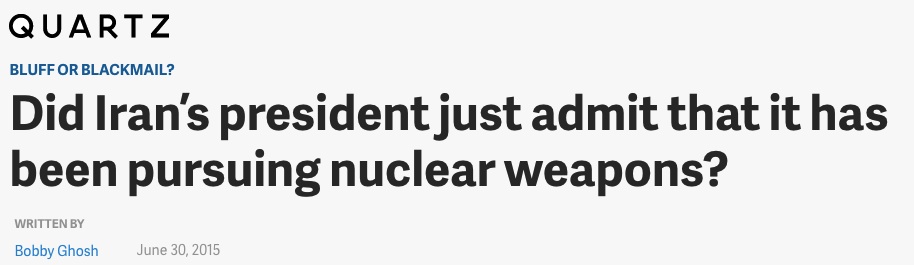
Bobby Ghosh, former TIME contributor and currently managing editor at Quartz, decided on Tuesday to produce some absurd, mouth-breathing click-bait – the kind of deliberately sloppy disinformation that serves only to further chum the waters of public opinion with the false narratives and grotesque stereotypes that have long been the stock-in-trade of agenda-driven, attention-seeking commentators about Iran and its nuclear program.
Here’s the headline:
There’s a quick answer to this leading – and deceiving – question: No, no he did not.
There’s a longer answer, too, which we’ll get to in a minute.
Ghosh, in his desire to expose what he thinks is a “gotcha” moment from a recent Iranian media interview with Iranian President Hassan Rouhani, eagerly and disingenuously conflates uranium enrichment with nuclear weapons development. In doing so, he reveals himself to be more interested in delivering page views to his website and dishing out conventional wisdom than in reporting truthfully and critically about an important international issue.
Ghosh notes that, during a interview with Iranian media about the pending nuclear deal with six world powers, Rouhani said that “if the other side breaches the deal, we will go back to the old path, stronger than what they can imagine.” Ghosh omitted Rouhani’s initial comment, “If we reach a deal, both sides should be committed to it.”
What gets Ghosh’s goat is Rouhani’s reference to “the old path,” that is, the allusion to Iran’s previous state of nuclear development, as opposed to its current restricted program under the interim deal and what results from a potential negotiated multilateral agreement.
Conceding that Iranian officials have long “sworn, over and over again, that [Iran] has never pursued nuclear weapons,” Ghosh then gets to the crux of his claim:
If we’re to believe the regime’s claim, then Rouhani’s threat makes no sense. The “old path” would simply be more “peaceful” nuclear research, allowing the sanctions to continue devastating the Iranian economy. That’s not so much a threat as a flagellant’s cry for help: “If you go back on your word, I’ll hurt myself.”
To jump to such a conclusion requires a remarkably mistaken understanding of both the history of Iran’s nuclear program and either the ignorance or dismissal of the massive concessions it has already made during ongoing international talks. Ghosh apparently suffers from both.
In an emblematically Ghoshian column on why the Iranian government is eviler than the Cuban government, Ghosh wrote on December 18, 2014, that Iran “was caught trying to build nuclear-weapons technology as recently as 2002, when its secret facilities at Arak and Nataz [sic] were discovered. Thereafter, under pressure from the US and the international community, the Tehran regime backed down from its policy of developing dual-use nuclear technology (for energy and weapons) and promised not to build bombs.”
There’s a lot wrong here, but I’ll try to be quick (not my strong suit).
The facilities at Arak and Natanz were never “secret” nor do they “build nuclear-weapons technology.” In 2002, they were both under construction and non-operational. Iran was, at that point, not obligated to declare their existence to the IAEA. Arak was designed as a power plant, Natanz is an enrichment site. Upon declaration, both have been subject to IAEA safeguards for over a decade. Iran’s interest in developing an uranium enrichment industry has been open knowledge (and publicly acknowledged) since shortly after the Iranian Revolution in 1979.
The Iranian government never “backed down” from a “policy of developing dual-use technology” and “promised not to build bombs” as Ghosh claims. Such a claim is bizarre. Beyond the fact that, as an original signatory to the Nuclear Nonproliferation Treaty, Iran has in effect “promised not to build [nuclear] bombs” since 1968 and Iranian officials have – since at least the early 1990s – constantly and consistently condemned and prohibited any domestic development of nuclear weapons (not only after 2002), it is literally impossible for any nation with an ongoing enrichment program to stop the acquisition of “dual-use” nuclear infrastructure since every single enrichment program on Earth is inherently dual-use: enriched uranium can be used for both energy or weaponry.
With this false narrative, Ghosh has, however, set up a convenient straw man with which to bandy about his erroneous assumptions of Iran’s nuclear past. This brings us back to his recent article.
In trying to hash out what Rouhani’s “old path” statement means, Ghosh establishes two options – the bluff or the blackmail – one of which, he claims, must be true. The bluff is that, in Ghosh’s words, “There’s no “old path,” and Tehran is simply trying to frighten the P5+1 into relenting on the remaining sticking points at the negotiating table in Vienna.”
The blackmail, on the other hand, is a damning admission by the Iranian leader of a clandestine nuclear weapons program Iran has long denied having. “The alternative,” Ghosh writes, “is that Rouhani has unwittingly revealed that Iran was indeed pursuing nukes. That would be a real threat, especially if he is also sincere in pursuing this path ‘stronger than what they can imagine.'”
But there is a third option, unacknowledged by Ghosh, which is the most obvious and most accurate: Rouhani is not talking about a nuclear weapons program to return to, but rather the reestablishment of full-scale uranium enrichment, which has been curtailed by Iran’s obligations under the terms of its diplomatic agreements since January 2014.
Ghosh doesn’t tell his readers that, in the same interview he cites as “fascinating” and “belligerent,” Rouhani said of his international interlocutors, “If they claim that they want to prevent the development of nuclear weapons in Iran, they should know that Iran has never sought to build nuclear weapons.” Obviously, such a statement – in the very same interview – severely undermines the credibility of Ghosh’s blackmail or blunder claim that Rouhani has either purposely or accidentally revealed something alarming about its nuclear work.
Under the terms of the November 2013 Joint Plan of Action, agreed to by Iran and the six powers – Britain, China, France, Germany, Russia, and the United States – known as the P5+1, Iran has halted all enrichment above 5%, diluted or disposed of its entire stockpile of 19.75% low-enriched uranium (LEU), converted the vast majority of its remaining stockpile of LEU to a form incapable of being weaponized, suspended upgrades and construction on its safeguarded nuclear facilities at Natanz, Fordow, and Arak, and allowed unprecedented access to its program by IAEA inspectors.
At every single juncture, Iran has complied fully with the demands of the plan.
All Rouhani was saying, therefore, is that these commitments – which were negotiated and agreed to by Iran, not imposed forcibly by foreign countries – would no longer be binding and Iran would resume its previous course of action, or “the old path.” This previous course of action, still, was anything but a mysterious, opaque, nefarious development of dubious and deadly technology. Rather, even before current talks began, Iran’s was the most heavily-scrutinized nuclear program on the planet and had been for years.
Rouhani’s statement, therefore, was actually a fairly innocuous clarification of the fact that, if the P5+1 reneges on its own negotiated commitments, Iran will no longer abide by the deal either. That’s hardly cause for Ghosh to collapse on his fainting couch.
What Ghosh also doesn’t point out is that there is clear historical precedent for Rouhani’s statement.
A dozen years ago, Iran’s then-nascent uranium enrichment program was the subject of intensive diplomacy between Iran and the EU-3, shorthand for Britain, France and Germany. It was on Rouhani’s watch – he was secretary of Iran’s Supreme National Security Council and lead negotiator at the talks – that Iran voluntarily suspended uranium enrichment in 2003 and accepted intrusive inspections above and beyond what was legally required by its safeguards agreement as talks progressed. During this period, the IAEA affirmed the peaceful nature of the program.
In mid-2004, with Iran fully complying with its obligations under Saadabad Agreement of October 2013, the negotiations were strained by the prospect of a new European-drafted IAEA resolution against Iran. President Mohammad Khatami told the press, in terms strikingly similar to Rouhani’s recent statement, that Iran’s voluntary suspension of enrichment would thus be endangered if the resolution passed.
“If the draft resolution proposed by the European countries is approved by the IAEA, Iran will reject it,” Khatami said on June 18, 2004. “If Europe has no commitment toward Iran, then Iran will not have a commitment toward Europe.”
A month later, Khatami insisted that “nothing stands in the way” of Iran “building and assembling centrifuges designed for uranium enrichment,” reported the Associated Press.
Throughout the first half of 2005, Iranian officials were still intent on resolving the nuclear impasse through diplomacy with Europe, but explained that the resumption of “full-scale enrichment” was the ultimate goal of the talks, along with assurances that the program would remain forever peaceful.
Following the election of Mahmoud Ahmadinejad in June 2005, outgoing president Khatami made the Iranian position clear. “We will never overlook our legal and national right for possessing nuclear technology and fuel cycle to generate electricity. Iran will never change its national policy in this respect,” he said, adding, “We have made it clear that suspension of uranium enrichment will not be forever. We have displayed our good faith. Now, it is the turn of the European friends to do in line with the commitments they have made about the matter.”
Regardless of the offer soon to be put forward by the EU-3, Khatami reiterated that Iran would resume its conversion activities and eventually enrichment as well, in line with its inalienable rights to development domestic, civilian nuclear technology. “I hope that the Europeans’ proposals will, as agreed, allow for the resumption of [nuclear activities],” Khatami told reporters in late July 2005. “But if they do not agree, the system has already made its decision to resume [uranium conversion] at Isfahan.”
Uranium conversion restarted in early August 2005.
It was only after Iran’s European negotiating partners, at the behest of the Americans, reneged on their promise to offer substantive commitments and respect Iran’s inalienable right to a domestic nuclear infrastructure that talks dissolved and Iran resumed enrichment. The proposal eventually brought to Iran by Western negotiators on August 5, 2005 has been described as “vague on incentives and heavy on demands,” and even dismissed by one EU diplomat as “a lot of gift wrapping around an empty box.”
The resumption of full-scale enrichment by Iran had nothing to do with nuclear weapons, as the IAEA has affirmed consistently in quarterly reports over the past decade that no fissile material has ever been diverted to military purposes. Lingering questions about Iran’s past work have long been debunked as unfounded allegations for which no credible evidence actually exists.
Rouhani’s statement about “the old path” – that is, the legal and inalienable right of Iran to enrich uranium under international safeguards and supervision – therefore reveals nothing not previously known.
On the other hand, Ghosh’s reaction to Rouhani’s statement reveals the extent to which Ghosh himself will go to demonize and propagandize about Iran and its nuclear program. If he can’t get the small stuff like this right, why are we listening to him about anything at all?
*****
Disclosure: I am an (often erstwhile) editor for the online magazine Muftah, which has recently announced a new partnership with Quartz, where Mr. Ghosh is managing editor.
July 4, 2015
Posted by aletho |
Deception, Mainstream Media, Timeless or most popular | Iran, Sanctions against Iran, United States |
Leave a comment
Yesterday in The National Interest, Frank von Hippel, co-director of the Program on Science and Global Security at Princeton University’s Woodrow Wilson School of Public and International Affairs, floats the possibility of opening Iran’s domestic uranium enrichment program to international investment. Doing so, Von Hippel contends, would automatically “add a multinational layer of supervision to the program,” as countries that “buy shares in its enrichment program” would do so “in exchange for having full access to all the associated facilities and a say in how they are managed.”
For those who still insist on pretending that Iran’s legal, safeguarded nuclear energy program is “a threat to regional stability” that will be summarily unleashed from the tethers of agreed-to restrictions after the imminent multilateral deal allegedly sunsets a decade from now, Von Hippel’s suggestion should inspire confidence. With foreign investment and multinational involvement in the entire nuclear fuel cycle, coupled with the IAEA’s strict monitoring and inspection regime which has already long been in place, the potential for Iran’s program to ever be secretly militarized is virtually nil.
Furthermore, according to Von Hippel, offering such foreign stake in this Iranian industry “would mitigate the pressure on Saudi Arabia and other regional rivals of Iran to assert their own rights to ‘peaceful’ enrichment programs. Indeed, the door should be open for them to buy a share in the multinational program as well.”
The article’s headline calls Von Hippel’s proposal to open up Iran’s enrichment program to multinational partnerships, “A Really Good Idea.”
And it is.
Except, while certainly a good idea, this isn’t actually a new idea. In fact, this very offer was made over a dozen years ago – by Iran.
It is true that Von Hippel, whose National Interest post is a pared down version of a longer, more detailed (and less alarmist) article he co-authored in the June 19 issue of Science magazine, does make passing reference to the fact that “[s]enior Iranian officials have expressed openness to discussing multi-nationalization.” But this is a gross understatement considering Iran’s leadership and consistency on this issue.
Since its early stages, in fact, Iran has offered specifically to restrict its enrichment program and to open it up to international cooperation, thereby making in it literally impossible for the diversion of fissile material to weaponization efforts to take place unnoticed. As I have noted before, Iran was already making such gestures nearly a quarter century ago, only to be rebuffed, denied, ignored and dismissed by the United States.
In October 1992, for instance, in response to American concern over indications that Iran was pursuing a domestic enrichment program, Iran not only “repeatedly denied any non-peaceful intentions, stating that it accepts full-scope IAEA safeguards,” but also “indicated it is prepared to accept enhanced safeguards measures on both nuclear cooperation agreements with Russia and China, as well as having no objections to the return of the spent fuel to the country of origin as a similar agreement had been concluded with Germany during the 1970s.”
On July 1, 2003 – exactly 12 years ago today – Reuters reported that none other than Hassan Rouhani, then Secretary-General of Iran’s Supreme National Security Council, said Iran was “ready to accept the participation of other big industrialized countries in its [uranium] enrichment projects,” specifically as a means to resolve any questions over whether its nuclear program was peaceful and civilian in nature.
Following its voluntary suspension of uranium enrichment and implementation of the Additional Protocol as confidence-building measures during negotiations with the EU-3, Iran again raised the prospect of multinational collaboration. On March 23, 2005, the Iranians presented a four-phase plan to their European negotiating partners intended to end the nuclear impasse once and for all. It called for Iran to resume uranium enrichment, with EU cooperation, and for the Majlis (Iranian parliament) to begin the process of approving legislation that would permanently ban the “production, stockpiling, and use of nuclear weapons.”
Iran’s offer came on the heels of the IAEA’s own expert endorsement of multinational investment in enrichment programs.
This was not merely the stance of the reformist government of Mohammad Khatami, either. In his first address before the United Nations General Assembly in September 2005, newly-inaugurated Iranian President Mahmoud Ahmadinejad said that, as a “confidence building measure and in order to provide the greatest degree of transparency, the Islamic Republic of Iran is prepared to engage in serious partnership with private and public sectors of other countries in the implementation of uranium enrichment program in Iran. This represents the most far reaching step, outside all requirements of the NPT, being proposed by Iran as a further confidence building measure.”
In early November 2005 it was widely reported that “the Iranian government is allowing the country’s atomic energy agency to seek local or foreign investors for its currently suspended uranium enrichment activities.” Such investment, directed toward the Natanz facility then under construction in central Iran, would be sought “from the public or private sectors.”
Days later, Iranian state-run television stated that Iran would offer the international community “a 35% share in its uranium enrichment programme as a guarantee” that its nuclear program “won’t be diverted toward weapons.” This investment would allow “foreign countries and companies a role in Iran’s uranium enrichment programme,” providing the opportunity for such entities and organizations to “practically contribute in and monitor the uranium enrichment in Natanz.” Gholamreza Aghazade, an Iranian vice president and head of the Atomic Energy Organisation of Iran, told the press that this offer was “maximum concession” Tehran could offer for transparency. “The 35% share is not only investment,” he said. “They will have a presence in the process (of uranium enrichment) and production (of nuclear fuel).”
“It’s the best kind of international supervision totally negating any possibility of diversion (toward weapons),” Aghazade explained.
Later that month, on November 18, 2005, in yet another publicly presented proposal, the Iranian government repeated the offer set forth earlier that year, reiterating its willingness to officially ban nuclear weapons development through legislation, cap its level and scope of enrichment, immediately covert its enriched uranium to fuel rods “to preclude even the technical possibility of further enrichment” towards weapons-grade and “to provide unprecedented added guarantees” to the IAEA that its program would remain peaceful. The proposal, issued by Iran’s permanent mission to the United Nations, reiterated Iran’s “[a]cceptance of partnership with private and public sectors of other countries in the implementation of uranium enrichment program in Iran which engages other countries directly and removes any concerns.”
Iran’s offers were routinely rejected by the United States government, which maintained the absurd position that Iran capitulate to its demand of zero enrichment on Iranian soil. “We cannot have a single centrifuge spinning in Iran,” declared George W. Bush’s undersecretary of state for arms control Robert Joseph in early 2006.
In an April 5, 2006 oped in the New York Times, Iran’s then UN ambassador Javad Zarif laid out a number of proposals for resolving the nuclear standoff. In addition to affirming Iran’s continued commitment to the NPT, acceptance of limitations on enrichment, and its stance against “the development, production, stockpiling and use of nuclear weapons,” Zarif stated Iran’s willingness to “[a]ccept foreign partners, both public and private, in our uranium enrichment program.” He continued:
Iran has recently suggested the establishment of regional consortiums on fuel-cycle development that would be jointly owned and operated by countries possessing the technology and placed under atomic agency safeguards.
In an article for the Los Angeles Times at the end of that same year, Zarif reminded readers of these overtures, none of which were ever responded to by the United States.
Multinational investment in Iran’s enrichment program was endorsed by nuclear experts and MIT researchers Geoff Forden and John Thomson in various articles and reports in 2006 and 2007, as well as by former American diplomats Thomas R. Pickering and William Luers and nuclear expert Jim Walsh in an essay for the New York Review of Books in early 2008. Wholly in line with what Iranian officials had been saying for years, Pickering, Luers and Walsh wrote that a “jointly managed and operated on Iranian soil by a consortium including Iran and other governments… provides a realistic, workable solution to the US–Iranian nuclear standoff.” Such a program, they wrote, “will reduce the risk of proliferation and create the basis for a broader discussion not only of our disagreements but of our common interests as well.”
“Given the enhanced transparency of a multilateral arrangement and the constant presence in Iran of foreign monitors that such a plan would require,” the authors added, any “diversion of material or technology to a clandestine program” would be easily detected. Senators Chuck Hagel and Dianne Feinstein both responded positively to the proposal. The Bush administration dismissed it out of hand.
Iranian officials again endorsed the concept of opening its nuclear program to international investment and collaboration in during a March 2008 conference in Tehran.
In a comprehensive package proposed to the United Nations on May 13, 2008, Iran’s foreign minister Manuchehr Mottaki wrote that Iran was still ready to consider, among a great many other things, “Establishing enrichment and nuclear fuel production consortiums in different parts of the world – including in Iran.”
Reporting on the proposal shortly thereafter, The Guardian‘s Julian Borger noted that while the consortium idea was gaining traction in American “foreign policy circles,” it was still “resisted by the US, French and British governments.” An unnamed “British official” told Borger, “We would be ready to discuss it, as soon as Iran does what it knows it has to,” that is, suspend its enrichment program, an obvious and long-known nonstarter for post-2005 negotiations.
By resurrecting the notion of multinational investment in Iran’s enrichment program, Von Hippel does the conversation over nuclear negotiations a great service. Despite past difficulties regarding Iran’s stake in the Eurodif consortium and a history of American deception and deliberate denialism in breach of its NPT obligations, the prospect of international acceptance and cooperation in Iran’s nuclear industry is still an excellent way out of this manufactured crisis.
But by leaving out the fact that Iran itself has long been the leading champion of such a proposal unfortunately doesn’t give credit where credit is due.
July 2, 2015
Posted by aletho |
Economics | Sanctions against Iran, United States |
Leave a comment

 Aletho News