Larry Mendte Gets It So Wrong: How Persistent Iraq Mythologies Inspire Bad Analysis on Iran
By Nima Shirazi | Wide Asleep in America | May 8, 2015
Earlier this week, Kayvon Afshari, communications director for the American Iranian Council, appeared on Another Thing with veteran broadcaster Larry Mendte to discuss the state of negotiations over Iran’s nuclear program and the prospect, in the face of powerful opposition, of a final deal being reached in the coming weeks.
While Afshari’s pro-diplomacy optimism was backed up by important facts not often heard in the media, Mendte made a number of comments that betrayed his role as an ostensibly objective and informed interviewer.
Right off the bat, for instance, Mendte describes the ongoing talks as a negotiation about an “Iranian nuclear arms deal.” That’s a bizarre – albeit revealing – way to begin, namely because that’s not what this is. If anything, the Nuclear Non-Proliferation Treaty (NPT) is a nuclear arms deal, one signed back in 1968 by Iran and ratified two year later, as it proscribes all non-nuclear weapons signatories to forever forgo the acquisition of nuclear weapons.
What Iran is negotiating with six world powers about is accepting verifiable limits and constraints on its peaceful, civilian, non-weaponized, non-military, safeguarded nuclear energy program in exchange for the lifting of international and unilateral sanctions and the normalization of its nuclear dossier.
This is not an “arms deal,” as Iran has no “arms” to give up. The United States intelligence community and its allies have long assessed that Iran doesn’t even have a nuclear weapons program, let alone nuclear weapons. Iranian officials, for decades, have consistently maintained they will never pursue such weapons on religious, strategic, political, moral and legal grounds. The IAEA has found no credible evidence that Iran has ever had a nuclear weapons program.
As the conversation gets underway, Mendte repeats the tired claim that Iran is just biding its time under intense and intrusive scrutiny until – years from now – when it will suddenly emerge with a deadly nuclear arsenal manufactured out of thin air:
The way I understand the deal, and I think some of the people that are critical of it, is that there’d be a decade-long moratorium and then, the president has admitted in an article, in an interview, that after that decade-long moratorium, Iran could start up a nuclear program just like that. As a matter fact, they could advance the program during that decade and then be able to start up, for 10 years. This just puts off the inevitable. Is that fair?
Obviously this is not “fair” and Mendte’s understanding of the deal, or anything having to do with Iran or its nuclear program for that matter, is effectively nonexistent.
Afshari rightly points out to Mendte that Iran already has a nuclear program, one that is legal and guaranteed under the NPT, also noting, “It’s not as though there’s going to be no inspections after ten years. There’s still going to be strict inspections, but they’ll be loosened after that initial ten years.”
Mendte is quick to jump in. “We had strict inspections in Iraq. That didn’t turn out really well,” he patronizingly tells Afshari, continuing, “The reason we went into Iraq, people forget, in the first place, is because the inspectors were thrown out and not allowed in. [There were] supposed to be UN inspections and he [Saddam Hussein] didn’t allow it.”
When Afshari replies that the analogy is a stretch as Iran has never kicked out inspectors and that Iraq’s nuclear program was very different than Iran’s, Mendte is undeterred, insisting on playing out his analogy. “There was a nuclear arms deal in place” before the U.S. invasion of Iraq in 2003, he says, “and what I’m saying is that lead to the Iraq War. I mean, I know there [were] other factors including 9/11, including President Bush wanting to go after Iraq, but that was the catalyst: the fact that they left out UN inspectors, if you remember at the time.”
While Afshari is a gracious guest and tries to steer the conversation back on track, he really shouldn’t have been so accommodating to Mendte’s version of history. Basically, he should have told him was flat-out wrong. Beyond the fact that Mendte seems to have forgotten that Bush administration claims about Iraq’s weapons of mass destruction were false (and that there was no “nuclear arms deal in place” with Iraq), his claim about international inspectors is also completely and totally bogus. How so, you ask?
Saddam never kicked inspectors out of Iraq.
This claim is a canard, a wholesale myth, a straight-up falsehood. It was built up by the Bush administration to justify the invasion of Iraq and dutifully reinforced by the mainstream media. In fact, between late November 2002 and mid-March 2003, weapons inspectors from the IAEA and the U.N. Monitoring, Verification, and Inspection Commission (UNMOVIC) conducted more than 750 inspections at 550 sites in Iraq.
In January 2003, UNMOVIC chief Hans Blix told reporters that inspectors had been “covering the country in ever wider sweeps” for months but “haven’t found any smoking guns.” An Associated Press dispatch from the time noted, “In almost two months of surprise visits across Iraq, U.N. arms monitors have inspected 13 sites identified by U.S. and British intelligence agencies as major ‘facilities of concern,’ and reported no signs of revived weapons building.”
IAEA Director-General Mohamed ElBaradei delivered a report to the U.N. Security Council on March 7, 2003, during which he spoke of increased Iraqi cooperation with international inspections and thoroughly dismantled Bush administration claims about aluminum tubes, high-strength magnets, and importing yellowcake from Niger. ElBaradei concluded, “After three months of intrusive inspections, we have to date found no evidence or plausible indication of the revival of a nuclear weapon program in Iraq” and clearly stated the intention “to continue our inspection activities.”
Inspections ended abruptly eleven days later, on March 18, 2003, for one reason: the United States was about to start dropping bombs all over the place.
“In early March,” Glenn Kessler of The Washington Post‘s “Fact Checker” blog wrote in 2011, Blix “began getting warnings from senior U.S. and British officials about the safety of the inspectors. Then the company that supplied helicopters for the teams withdrew its equipment from Iraq.”
News reports at the time leave no doubt as to what really happened.
“In the clearest sign yet that war with Iraq is imminent, the United States has advised U.N. weapons inspectors to begin pulling out of Baghdad, the U.N. nuclear agency chief said Monday,” reported the Associated Press on March 17, 2003. The article continued:
Mohamed ElBaradei, head of the International Atomic Energy Agency, said the recommendation was given late Sunday night both to his Vienna-based agency hunting for atomic weaponry and to the New York-based teams looking for biological and chemical weapons.”
“Late last night… I was advised by the U.S. government to pull out our inspectors from Baghdad,” ElBaradei told the IAEA’s board of governors.
Within hours, the evacuation began. “U.N. weapons inspectors climbed aboard a plane and pulled out of Iraq on Tuesday after President Bush issued a final ultimatum for Saddam Hussein to step down or face war,” AP reported the next day. “U.N. Secretary-General Kofi Annan on Monday ordered all U.N. inspectors and support staff, humanitarian workers and U.N. observers along the Iraq-Kuwait border to evacuate Iraq after U.S. threats to launch war.”
“[A]t no time did Iraq throw out the inspectors,” wrote Kessler, in an attempt to forever put these talking points to rest. “[I]nspectors voluntarily ended their mission because of the threat of military action by the United States and its allies.
Larry Mendte’s regurgitation of Rumsfeldian propaganda – 13 years after the illegal and disastrous invasion of Iraq – should cast doubt on his credibility as a broadcaster. Let’s hope a correction and mea culpa are forthcoming – not to mention an apology to Afshari.
*****
UPDATE:
May 10, 2015 – I guess I shouldn’t have been surprised by Larry Mendte’s inability to grasp basic facts. A quick look at some of his past rants on Iran makes clear he’s long bought into the most bellicose and alarmist propaganda pushed by Iran hawks and is incapable of any semblance of critical thought. He sees the U.S. invasions and occupations of Afghanistan and Iraq as warnings to other nations, not as lessons to be learned about jingoism, faulty intelligence, war crimes, and imperial adventurism. He thinks Iran has a “nuclear weapons program.” He thinks sanctions “brought Iran to the negotiating table.” He says he knows that Iran wants a nuclear bomb.
Larry Mendte bloviates like he’s in a Darrell Hammond sketch. With one exception: he should be taken far less seriously.
Ben Cardin’s Gambit
A True Blue liberal except for Iran and Palestine
By Philip Giraldi • Unz Review • May 6, 2015
Democratic Senator Ben Cardin of Maryland is not very well known to the public, overshadowed as he is by his own party’s more newsworthy and photogenic congressional leadership and the gaggle of Republicans that is currently lining up in a bid to take the White House. Cardin is, by most accounts, a conventional liberal. He was active in the civil rights movement and embraced every progressive cause in his pre-senatorial days while his voting record both as a congressman and a senator has been reliably left-of-center.
Ben Cardin is the scion of a Baltimore family heavily involved in Maryland state politics. He, his father and uncle all served in the State Assembly and his father was later a judge. All three are lawyers and all were closely connected to Maryland’s politically powerful Jewish community, concentrated in Montgomery and Baltimore counties, which has been traditionally aligned with the Democratic Party.
As an elected official, Cardin regards himself as personally responsible for delivering benefits to his Jewish constituents. He sponsors the Senator Ben Cardin Jewish Scholars Program and also has been active in steering Department of Homeland Security (DHS) grants to what he calls “high risk” Jewish organizations in Baltimore. Due to the assiduous efforts of Congressmen like Cardin fully 97% of all DHS grants go to Jewish groups.
Support for Israel is inevitably a sine qua non in Cardin’s circle and candidates for higher office in Maryland are routinely screened for the views on the Middle East. Donna Edwards, an African-American congresswoman who is currently running to fill the seat that will be vacated by incumbent Senator Barbara Mikulski in 2016, has, for example, fallen afoul of the Jewish community thought police on the Israel issue. Though repeatedly asserting her love and support for Israel she is being castigated because “she has regularly ducked resolutions and letters backed by the American Israel Public Affairs Committee (AIPAC), Washington’s dominant Israel lobby, which takes a harder line in support of the country’s self-defense.” She also voted “present” rather than “yes” when the House of Representatives passed its malicious 2009 resolution endorsing Israel’s right to use overwhelming firepower to defend itself against bottle rockets from Gaza. More recently she boycotted the speech by Israeli Prime Minister Benjamin Netanyahu because she believed it to be an affront to the President of the United States. Even though Edwards has never in any sense voted against Israel in any substantive way she is clearly regarded as not subservient enough by those who matter.
Cardin, who received donations of $218,000 from the Israel Lobby for his 2012 Senate race alone, is the ranking Democrat on the Senate Foreign Affairs Committee, a position he acquired when disgraced New Jersey Senator Robert Menendez was forced to step down. He has been in the news lately for taking on a seemingly uncharacteristic task in the Senate, having co-sponsored with Republican Bob Corker a bill that will require the Senate to vote on any agreement that President Obama makes with Iran. The bill, which passed out of the Foreign Relations Committee by a unanimous 19-0 vote, has been described as a watered down version of a more rigorous bill crafted by the Republican majority, enabling a number of Democrats to add their support.
Recognizing that it might be a less bad option, a reluctant President Barack Obama, perhaps unwisely, has even pledged not to veto the revised bill. The stated intention of Corker-Cardin is to permit the congress to have some voice regarding what is undeniably a major foreign policy issue. Supporters want the country’s legislature to be able to indicate their lack of support for a bad bill, if that should turn out to be the case.
Though the bill is being described as a compromise it does not really change very much. While the president can on his own authority suspend sanctions on Iran, the passage of the bill would delay his ability to do so until after Congress has between 30 and 82 days (depending on details) to review the deal and vote for or against it. And while the president can indefinitely suspend their implementation, only Congress can actually cancel the sanctions because they are mandated through legislative authority.
Thus Congress can hold up a final agreement but the bill does not actually require congressional approval for an agreement to be implemented. And though Congress could theoretically block any lifting of its own legislative sanctions on Iran, it would require a two-thirds vote of both the Senate and House to override the expected Obama veto. Nevertheless, Obama’s agreement to allow a vote does concede that Congress has a potential oversight role in foreign policy, something that the president would have chosen to avoid.
The assumption that Cardin, a loyal Democrat, was interested in producing a compromise to help the president attain a negotiated agreement to eliminate Iran’s nonexistent nuclear weapons program is intriguing but not completely convincing given the Senator’s demonstrated inclination to see U.S. foreign policy from the point of view of Israel. And interestingly enough, AIPAC also supports the Corker-Cardin bill as-is and has resisted attempts by Republicans to make it stronger.
Why would that be the case as AIPAC consistently calls for forceful action against Iran? It might be because, appearances aside, Cardin is not acting in good faith and is actually likely to be working hand-in-hand with AIPAC to accomplish two things. First, he almost certainly wants to reestablish complete congressional bipartisanship on any and all issues relating to Israel, countering the troubling Republican Party’s alignment of its own foreign policy interests with those of Benjamin Netanyahu. As an AIPAC official has expressed it, “Our fundamental view is that this bill is the first step of a number of different steps on the Iran deal. The first and foremost priority is to make sure the bill gets passed to make sure congress is guaranteed a chance to pass judgment on the deal.”
This means that both AIPAC and Cardin want the modified Corker bill to pass but they want that to happen in expectation that the Obama White House agreement with Iran will eventually fail in a bipartisan fashion with more than two-thirds of congressmen in opposition. By some estimates, AIPAC believes that it already has the votes in hand in the Senate at least to do just that and expects that a number of Democratic Senators to include Charles Schumer of New York, who regards himself as “Israel’s guardian” in the upper chamber, will join Republicans in voting against the president.
The AIPAC comment that the bill is a “first step” is critical to understanding what is going on while Senator Ben Cardin’s regard for Israel and its presumed interests should be taken as a given. In March Cardin spoke at AIPAC’s annual gathering where he promised to introduce legislation to block European attempts to boycott or sanction Israeli exports produced in the occupied territories. Cardin’s mixed-up view of a progressive world order combined with deference to what he regards as Israeli interests were notably on display one week after his agreement with Corker when he delivered on his promise.
On April 21 st Cardin and his House colleague Peter Roskam attached at the last minute AIPAC drafted amendments to an omnibus trade bill that committed the United States government to use its leverage in trade agreements to block European Union efforts to boycott or sanction products being produced in Israel’s illegal West Bank settlements. The issue is of some consequence as the EU is Israel’s largest export market. The Cardin-AIPAC amendment includes language making it a primary U.S. objective to protect both products from Israel and from what is referred to by the euphemism “Israeli-controlled territories,” a curious position for a U.S. Senator to be taking as United States policy has long been opposed to the settlements and has frequently declared them to be illegal.
Cardin hypocritically justified his amendment by stating “I think it’s critically important that the provisions that are included… for good governance and respect for international human rights need to be a principle trade objective.” Concerning Cardin’s stated respect for international human rights, it should be noted that he enthusiastically supported boycotting apartheid South Africa even though he is opposed to the Palestinians using the same legal and non-violent expedient to obtain their freedom from a brutal Israeli occupation. To that end Cardin characteristically is willing to put U.S. interests on a back burner so he can use American trade policy to protect Israel while perversely cloaking his turpitude in faux sentiments about doing the right thing.
Finally, it is the ultimate irony that the sanctimonious junior Senator from Maryland serves as the ranking member of the U.S.-Helsinki Commission on Human Rights. He recently traveled with his wife by way of military Gulfstream to Copenhagen for official meetings arranged by that organization, stopping for a couple of days in Paris where he stayed in a five star hotel and met with Jewish leaders. The issue of Palestine apparently did not come up.
Nations ready to move beyond Iran bans despite US Congress move: German envoy
Press TV – May 8, 2015
The German ambassador to Washington warns that his country and other nations are ready to move beyond sanctions imposed on Iran over its peaceful nuclear program, regardless of any decision that the US Congress may be willing to make.
Peter Wittig made the comments on Thursday in reaction to the US Senate’s recent approval of a bill that potentially makes removal of sanctions conditional on congressional consent.
The US Senate passed legislation on Thursday, which would make it possible for Congress to review and potentially reject a nuclear deal with Iran over its nuclear program.
The legislation will allow for a 30-day review of any final agreement with Iran. During the review period, President Barack Obama would be able to waive those Iran sanctions, which were imposed by the executive branch. However, the president would have to leave in place sanctions that Congress had previously drafted.
Addressing the Columbus Metropolitan Club in central Ohio, the German ambassador said, “The alternatives to a negotiated deal are not very attractive.”
Wittig said while Congress would probably be willing to impose new sanctions on Iran, other countries would not follow, adding that such state of affairs would cause “this universal sanctions regime” against Iran to “crumble.”
He also dismissed as not viable Washington’s talks of a military option against Iran saying it will not lead to a lasting solution.
The German ambassador stated that his government pleads to give diplomacy a chance, adding that any agreement that may be signed between Iran and the P5+1 group – the US, the UK, France, Germany, China, and Russia – will be reviewed and judged on its merits.
At the beginning of 2012, the US and EU imposed sanctions on Iran’s economic sectors with the goal of preventing other countries from cooperating with the Islamic Republic in those sectors.
The sanctions were imposed over allegations about possible diversion in Iran’s nuclear program toward military objectives. Iran categorically rejected the allegation.
Iran and the P5+1 reached a mutual understanding on April 2 in the Swiss city of Lausanne as a prelude to a comprehensive deal before a self-designated deadline at the end of June. A key point of Lausanne statement was a promise to lift a series of sanctions on Iranian economy.
US State Department ignorant on oil industry interests, threatens investors
Press TV – May 5, 2015
The US State Department says it cannot confirm a report that an American oil delegation plans to visit Tehran within the next few days to discuss business.
State Department spokesman Jeff Rathke told reporters at a daily press briefing that it is difficult to verify the report since “not a single individual or company is identified” in it.
Rathke was reacting to an announcement by Abbas Sheri Moqadam, Iran’s deputy petroleum minister, that a US oil delegation is scheduled to travel to Tehran this week “to hold talks with a number of Iranian petroleum ministry officials as well as oil industry contractors.”
Rathke said he wouldn’t “speculate about a visit” which “has not even been confirmed and the nature of which is completely obscure right now.”
“It’s hard to verify whether these reports are accurate at all,” he said, “but also we’ve been quite clear that we don’t consider Iran to be open for business yet, and that if there is any sanctionable activity happening, then we will take action.”
Sheri Moqadam, who heads Iran’s National Petrochemical Company (NPC), had been quoted by the country’s Mehr News Agency as saying that “oil dealers and investors from the US are scheduled to have a business tour of Iranian oil industry and meet with Iranian authorities.”
In response to a question about legal restrictions for American companies in Iran, he had explained that to invest in Iran, companies are required to “register an Iranian company and as a result there is no boundary for foreigners to invest in Iran.”
“It is predicted that following the visit by the American delegation to Tehran and possible removal of sanctions against the oil industry, we will witness the presence of major international US oil and gas companies in Iran in future,” Sheri Moqadam added.
Washington has imposed a series of draconian sanctions on Iran that prevent American firms from trading with Iran and investing in its oil sector projects.
Some of the sanctions are expected to be removed if Iran and the P5+1 reach a final agreement over the country’s nuclear energy activities. The agreement has a deadline of June 30th and its fate is still not clear. However, global traders are already looking into the prospects of investing in the Iranian market.
Tehran has been hosting major trade delegations from Europe and Asia over the past few weeks. A surprise visit by an American trade team made headlines in Tehran last month in what many believed was a sign that the taboo over the presence of US companies in the country was already breaking.
The delegation was comprised of 22 US entrepreneurs, investors and consultants who were reportedly visiting the country to study post-sanctions investment potentials.
Sheri Moqadam, in another report by Shana news agency affiliated with the Ministry of Petroleum, has been quoted as referring to the visit by the same American trade team in Tehran. This, he said, could be the start of the presence of companies from the US in Iran’s 20th International Oil, Gas, Refining and Petrochemical Exhibition – the Oil Show.
“The presence of expert and experienced staff at the Ministry of Foreign Affairs have given us the confidence to be optimistic about the participation of foreign companies in this year’s Oil Show,” the official has told Shana.
The Show will open in Tehran on May 6 and will continue until May 9. Iranian officials have already told the media that a large number of national and international companies operating in various areas down the oil chain will participate in this year’s exhibition.
Some states have hijacked NPT in favor of Israel: Researcher
Press TV – April 28, 2015
Press TV has conducted an interview with Soraya Sepahpour Ulrich, an independent researcher and writer, in Irvine, to get her take on the stance of Iran and other countries over the Non-Proliferation Treaty (NPT).
The following is a rough transcription of the interview.
Press TV: Mohammad Javad Zarif’s spokes of fairness and equity when it comes to the implementation of the NPT, has that been like that ever since this treaty came into effect?
Sepahpour: Regrettably, not at all and under the international law there ought to be no discrimination whatsoever. In fact, scholars have argued that the only time that discrimination if he wants to be called that is acceptable in international law is to elevate the status of a state to be on par with the rest. But right now as we said the international law has been hijacked and we see that powerful states are doling out favors to those that are pariah states, especially Israel in the region, and in fact, rewarding them for violating international law, while again themselves violating international law by not rendering assistance to those who are signatories to this treaty.
Press TV: How imperative is this for this NPT treaty to remain relevant to be able to bring Israel’s nukes under its control or supervision and also compel nations like the United States to clamp down on their own arsenals?
Sepahpour: I think if the former director general of the IAEA Mr. ElBaradei had listened to Mr. Zarif and perhaps he has, he would have applauded him. In 2004, Dr. ElBaradei, in fact, said that we need to talk seriously to Israel about its nuclear weapons whether it wants to admit to having them or not. And in fact, he called on a Middle East free of nuclear weapons. So, Mr. Zarif is right on the point in calling out, Israel is not a signatory to the NPT, is being rewarded for having nuclear weapons. And as far as the other states are not abiding by the NPT, again I’d like to quote Mohamed ElBaradei, he was the IAEA chief for three terms and he was a recipient of the Nobel Peace Prize together with the IAEA, and he said of nuclear powers, it is like them having it, “dangling a cigarette in their mouth while telling others not to smoke”. You can not violate international law and expect others to comply. This will create total chaos, disorder and it is a threat not just to the Middle East but to the entire world.
Press TV: When you speak of international law, so let’s not forget Iran is a signatory to the NPT and yet it has faced multiple sanctions regarding its peaceful nuclear energy program. That in itself is another violation, would not you agree?
Sepahpour: It is absolutely a violation. The whole purpose of the IAEA, when it was established in 1957 as a body of the United Nations, was to enable peaceful nations, those there were party, there was no treaty at that time, but to spread nuclear technologies, peaceful use around the world and NPT which was presented in 1968 for signature, in fact the whole spirit of the NPT was not only to render assistance in peaceful nuclear technology to the signatories but to ultimately eliminate all nuclear weapons, total disarmament and stop proliferation none of that has happened, in fact, Iran is a victim of policies here. There are nations that would want to use this law, this international treaty as a tool to dole out favors to the nations to that their working with and to those that are demanding their rights under the international law. So, it is very hypocritical, it is very dangerous and I think that this was a good occasion for the world to listen to a representative of 120 nations. And I just want to add that Iran has asked in numerous occasions for there to be total nuclear disarmament in the Middle East and even in 2009 the Arab League had said they could no longer tolerate Israel’s nuclear weapons without it is being subjected to… become a part of the NPT and have its nuclear facilities inspected. So, the vast majority of the world understands what is going on and what needs to happen. It is for more powerful nations that have hijacked the NPT that are keeping it as hostage to come on-board and be law abiding.
GOP presidential hopefuls woo big donors in Las Vegas
Press TV – April 25, 2015
US Republican presidential hopefuls and some other GOP lawmakers were in the state of Nevada on Saturday to attract big donors for their campaign funding.
Texas Senator Ted Cruz, Florida Senator Marco Rubio, Texas Governor Rick Perry, Senator Rob Portman (OH), Governor Mike Pence (IN), and Senator Lindsey Graham (SC), all Republicans, were in Las Vegas for the annual Republican Jewish Coalition’s spring meeting which began on Thursday.
The candidates wrapped up 3 days of lobbying for Israel to attract potentially billions of dollars in donations in the biggest gambling hub in the US.
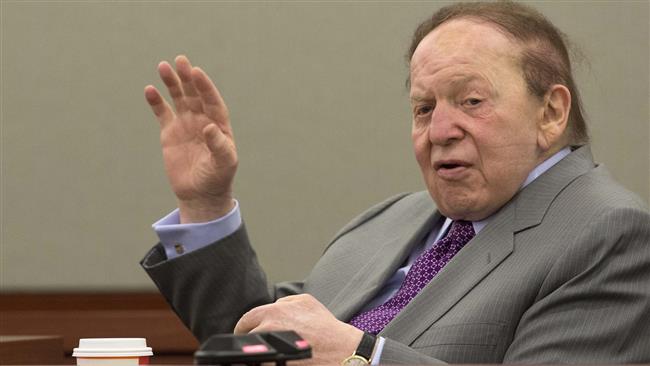
They were there to win big donations from casino tycoons, most notably Zionist Sheldon Adelson who is the largest campaign donor in the US.
As far as the GOP contenders in Las Vegas are concerned, the fight to win Adelson’s support and others in Las Vegas is all about showing support and solidarity for Tel Aviv.
Former Texas Governor Rick Perry said, “Ignoring the lessons of history, our president aims to sign an agreement with… the Islamic Republic of Iran.”
“Sadly, the American friendship and alliance with Israel has never been more imperiled than it is right now today under this administration,” said Ted Cruz, one of the Republican presidential candidates.
About 800 members of the summit enthusiastically cheered the consecutive slaps on Obama and on a potential nuclear agreement with Iran and promises of loyalty to Tel Aviv.
In fact, Adelson was not there on Saturday, according to local media, because that’s when the session was open to the media.
It is reported that Adelson has a favorite candidate so far, and that’s Senator Marco Rubio who the tycoon “speaks to once every 2 weeks.”
Adelson spent almost $150 million in the last presidential election in 2012 and he is set to throw in millions of more dollars behind his favorite contender in 2016.
Adelson, a Jewish American and the country’s eighth-wealthiest person, has said that he will not invest in the 2016 elections based on personal loyalty but on a more strategic aim.
He is a prominent supporter of Israel’s Likud Party, which is currently headed by Prime Minister Benjamin Netanyahu. He is also known for his anti-Iran rants.
During a speech at Yeshiva University in New York City in October 2014, Adelson said that the US should drop a nuclear bomb on Iran before beginning negotiations with Tehran over its nuclear program.
Iran has the right to protect itself
By Vladimir KOZIN | Oriental Review | April 16, 2015
On April 13, 2015 Vladimir Putin lifted Russia’s ban on shipping S-300 antiaircraft defensive missile systems to Iran, self-imposed in 2010. Moscow and Tehran originally signed a contract to supply these systems back in 2007. At the time, the idea was to sell a number of Russia-manufactured S-300 divisions to Iran.
The term “self-imposed ban” is used here deliberately. UN Security Council Resolution 1929 from June 9, 2010 placed no restrictions of any kind on transferring S-300 systems to Iran. Paragraph 8 of the resolution introduced a “weapons” embargo on direct and indirect shipments to Iran of “… any battle tanks, armoured combat vehicles, large calibre artillery systems, combat aircraft, attack helicopters, warships, missiles or missile systems as defined for the purpose of the United Nations Register of Conventional Arms …” S-300 antiaircraft systems, whether air-defense or antiballistic, are not mentioned in the resolution in any way. In addition, that UN Register does not stipulate that countries that manufacture air- or missile-defense systems should be banned from shipping them to any other states.
The negative reaction to Moscow’s April 13 decision from the US and many of its NATO allies, as well as Israel, raises a lot of questions. It seems almost as though they inhabit a different universe and know nothing of the real world.
First, as already noted, the existing international legal norms have not and do not prohibit shipments of air- and missile-defense equipment to other states as part of trade in conventional arms. For example, the United States has supplied 12 different countries (both NATO members and non-members) with similar Patriot systems, as well as mobile TMD systems to another three states, and the even more effective and long-range Standard missile-defense systems to four more nations. In 2015 and 2018 Romania and Poland will be added to that list. It is common knowledge that the six states in the Persian Gulf where Iran is located have received various ABM systems from the US and intend to purchase updated versions of them in the future. Several NATO states have supplied Patriot antiaircraft systems to Turkey.
Second, the United States is not only moving its air- and missile-defense systems under its direct control to other countries, but is also positioning its own national, comparable armaments far beyond its borders, in Romania and Poland for example, while preventing those countries’ military experts from controlling the future operational ABM systems in, respectively, Deveselu and Redzikowo. But the S-300 and other comparable systems that may be sent to Iran will be fully and entirely under that country’s direct management and control.
Third, Washington has provided significant military assistance to Israel, helping it to develop and establish its own increasingly powerful air- and missile-defense system. That apparatus is technically superior to the existing Iranian versions.
Fourth, Russian S-300 systems and their subsequent variations, as well as the American systems mentioned above that are functionally similar, are purely defensive, not offensive weapons. In this context it must be kept in mind that offensive weapons can also be loaded into the silos that hold the defensive interceptors for the US missile-defense system in Romania and Poland. This means cruise missiles, and soon will also include exceptionally accurate, long-range hypersonic missiles. The proposed shipments of air- and missile-defense equipment to Iran will not pose a threat to either Israel or any other state in the Middle East.
But nowhere on earth is anyone using legal postulates to suggest banning US shipments of various categories of antiaircraft missiles to nearly two dozen other countries. Demands like that are generally tied to geopolitical considerations. But this is an example of a completely unfair double standard: why is one permitted to supply such weapons systems while another may not?
There is yet another factor to be considered – at the present time Israel has already developed nuclear weapons and possesses its own air defense and resources to intercept ballistic and other missiles, but Iran has not yet developed nuclear weapons of its own and does not yet command effective air- and missile-defense systems. As the United States, its leading NATO allies and Israel are continuously threatening to use military force against Iran, the current Iranian leadership’s pursuit of up-to-date air-defense and antiballistic countermeasures is actually a reasonable, logical, and opportune approach. Iran has every right to defend itself. For this reason, that nation’s leaders hope to receive these Russian air- and missile-defense systems before the end of this year. Their request is welcomed in Moscow and will be satisfied in time.
And one final important point: Russia’s decision to rescind her previous embargo against supplying Iran with S-300 antiaircraft systems (or some newer defensive systems of this class) is final and “not subject to appeal.” Moscow is firmly convinced that no restrictions on this exist any longer, nor can they exist.
U.S. Congress Torpedoes the Iran Deal
By Kaveh L. Afrasiabi | Iran Review | April 15, 2015
The buzz word in Washington around the Iran Nuclear Review Bill that was approved unanimously by a Senate committee is “compromise,” parroted even by the White House spokesperson who has let it known that President Obama will endorse it despite some reservations. But, in reality, “compromise” is a code word for “concession,” i.e., appeasement of the anti-Iran hawks in U.S. Congress, as well as Israel.
The big question is, of course, what is behind Obama’s flip flop, notwithstanding his repeated warnings to U.S. Congress to stay out of Iran negotiations or face his veto power? The answer to this question should search beyond the facade of executive versus legislative ‘turf war’ on the Iran nuclear issue and touch the underlying root cause — in U.S.’s geostrategic interest to keep the furnace of Iran nuclear standoff alive instead of extinguishing it.
Indeed, why let a good thing go, perhaps some Washington ‘insiders’ are asking quietly, given the multiple benefits of the nuclear crisis — in sustaining U.S.’s hegemony in Persian Gulf, containing the Iranian power, and appeasing Israel’s need to keep the limelight on Iran indefinitely.
Thus the U.S.’s perpetual self-sabotage of the Iran deal, following last November’s last minute change of heart by Obama, who refused to sign onto an agreement that his own negotiation team had reached. Obama’s excuse then was reportedly that it was premature in light of a new Congress and he had to wait to size up the situation. It now appears that Obama has done that and reached the point that signing any deal with Iran is a bad deal, just as Iran hawks and the pro-Israel lobbyists have been saying for a long time. In other words, Obama’s acceptance of the Iran bill is but a definite sign that the chicken has to roost and, indeed, the emperor has no clothes.
But, of course, without critical lenses, the Iran Nuclear Review Act appears as relatively benign and an exercise in constitutional checks and balances, which is why the polls indicate the majority of American people are in favor of a Congressional role in the Iran deal. It is only when one reads the bill’s fine prints and pays close attention to its details that the real intention of its sponsors to torpedo the nuclear talks becomes apparent.
This is basically an intrusive legislation that impacts the content of negotiations by, for example, creating an issue linkage between nuclear and non-nuclear, e.g., terrorism, issues and conditioning Congress’s approval of the deal on the executive branch’s certificate of Iran’s compliance with the demand to stop funding terrorist groups.
Essentially, this means a revised script for the nuclear talks and the imposition of brand new ‘parameters’ such as terrorism, that have not been part of the intense negotiations; the latter are solely focused on the nuclear issue and, yet, must now due to this bill, expand the requirements for compliance by Iran — to U.S.’s arbitrary demands.
Another aspect of the bill that is equally problematic is that it raises the necessity of White House’s certification that the atomic agency is satisfied with Iran’s compliance on the “possible military dimension” issues which, as we know, raise the prospect of IAEA demands to access Iran’s secret military bases, a taboo from the vantage point of Iran’s military and civilian leadership. In fact, the Supreme Leader in his recent speech drew a red line and categorically opposed any suggestion that Iran would accommodate the West on this matter.
Hence, Iran’s stern negative reaction to the latest developments in U.S. Congress and Obama’s inexcusable turn-around from a critic to an admirer of the Iran bill is a given, raising the prospect that the bill can be a show-stopper and spell doom for the nuclear negotiations. The path ahead is now made doubly more complicated and the new hurdles by U.S. Congress act as so many powerful torpedoes aiming to sink the ship of diplomacy.
Kaveh Afrasiabi, PhD, is a former political science professor at Tehran University and the author of several books on Iran’s foreign policy. His writings have appeared on several online and print publications, including UN Chronicle, New York Times, Der Tagesspiegel, Middle East Journal, Harvard International Review, and Brown’s Journal of World Affairs, Guardian, Russia Today, Washington Post, San Francisco Chronicle, Boston Globe, Mediterranean Affairs, Nation, Telos, Der Tageszeit, Hamdard Islamicus, Iranian Journal of International Affairs, Global Dialogue.
Israel cheers as Obama retreats before Congress on Iran deal
RT | April 15, 2015
Israel said it is pleased with a compromise bill being floated on the Hill, which would give US legislators oversight in the Iran nuclear deal. The White House agreed to the bill adopted by the Senate Foreign Relations Committee.
“We are certainly happy this morning, this is an achievement for Israeli policy… [Prime Minister Benjamin Netanyahu’s] speech in Congress … was decisive in achieving this law, which is a very important element in preventing a bad deal, or at least, in improving the agreement and making it more reasonable,” Yuval Steinitz, Netanyahu’s intelligence, foreign relations and strategic minister, told Israel Radio.
Israel has been opposing US reengagement with Iran, claiming the result of the nuclear negotiations would be a bad deal that would compromise Israel’s national security. Netanyahu made his case in the US through pro-Israeli legislators, who are opposed to US President Barack Obama.
“What was achieved last night in Geneva is not a historic agreement, but a historic mistake,” said Netanyahu, after a preliminary deal paving the way for negotiations was reached in 2013.
Under the 2010 “Comprehensive Iran Sanctions, Accountability, and Divestment Act,” the president can waive sanctions imposed by Congress for a limited time, as a policy measure. However, Senate Bill 615 would remove that option and insist on congressional review of the final nuclear agreement with Iran before any of those sanctions could be waived.
Proposed by Senator Bob Corker (R-Tenn.) and Democrat Robert Menendez (D-NJ), the “Iran Nuclear Agreement Review Act of 2015” envisions a 52-day review period during which the president “may not waive, suspend, reduce, provide relief from, or otherwise limit the application of statutory sanctions with respect to Iran under any provision of law.” The White House can still suspend, waive or remove sanctions imposed by executive order.
If the bill is adopted, then Congress would be able to reject the nuclear agreement with Iran through a joint resolution, preventing Obama from lifting any congressional sanctions and possibly scuppering the treaty.
Iranian officials have said that the preliminary agreement reached in Geneva earlier this month would see most nuclear-related sanctions lifted immediately, while US officials maintain the sanctions would be lifted in phases, depending on Tehran’s compliance. This is one of the issues that still needs to be resolved before the June deadline for the final agreement.
“We have two and a half months more to negotiate, that’s a serious amount of time with some serious business left to do,” Secretary of State John Kerry told reporters Monday, after meeting with the legislators behind closed doors. “We hope Congress listens carefully and asks the questions that it wants. But also give us the space and the time to be able to complete a very difficult task which has high stakes for our country.”
Under the amended text of the bill agreed in committee, Obama would also have to certify to Congress every 90 days that Iran was complying with the final agreement, and submit detailed reports on Iran’s nuclear program, ballistic missile program, and “support for terrorism,” all of which remain thorny issues between Washington and Tehran.
Announcing the preliminary agreement on April 2, Obama said he wanted Congress to play a “constructive oversight role” in the negotiating process. However, the White House has argued that making international agreements is a constitutional prerogative of the executive branch, and that congressional oversight of the Iran deal would set a dangerous precedent. It now appears that Corker-Menendez has enough support from the congressional Democrats to override the veto Obama has been threatening, a senior Democratic aide told the New York Times.
Amendments proposed by several Republican Senators, including presidential hopeful Marco Rubio, could erode the bipartisan support. There were several amendments that would “pull this bill sharply to the right if adopted,” Senator Chris Coons (D-Del) told reporters Tuesday.
With Republicans making up the majority of the Foreign Relations Committee, these amendments could be adopted through a party-line vote. If that happens, Coons cautioned, “I’d drop off of it in a second.”
Read More: Americans don’t want Congress to sabotage Iran deal – new poll
Russia Impinges on Israeli ‘Right’ to Bomb Iran
By Ray McGovern | Consortium News | April 14, 2015
The front page of the neocon flagship Washington Post on Tuesday warned that the Russians have decided, despite U.S. objections, “to send an advanced air-defense system to Iran … potentially altering the strategic balance in the Middle East.”
So, at least, says the lede of an article entitled “Putin lifts 5-year hold on missile sale to Iran” by Karoun Demirjian, whose editors apparently took it upon themselves to sex up the first paragraph, which was not at all supported by the rest of her story which was factual and fair – balanced, even.
Not only did Demirjian include much of Russian Foreign Minister Sergei Lavrov’s explanation of Moscow’s decision to end its self-imposed restriction on the delivery of S-300 surface-to-air missiles to Iran, but she mentioned Israeli Prime Minister Benjamin Netanyahu’s umpteenth warning on Monday about “the prospect of airstrikes to destroy or hinder Tehran’s nuclear program.”
Lavrov noted that United Nations resolutions “did not impose any restrictions on providing air defense weapons to Iran” and described the “separate Russian free-will embargo” as “irrelevant” in the light of the “meaningful progress” achieved by the negotiated framework deal of April 2 in which Iran accepted unprecedented constraints on its nuclear program to show that it was intended for peaceful purposes only.
The Russian Foreign Minister emphasized that the S-300 is a “completely defensive weapon [that] will not endanger the security of any state in the region, certainly including Israel.” Pointing to “the extremely tense situation in the region around Iran, he said modern air-defense systems are vitally important for that country.” Lavrov added that by freezing the S-300 contract for five years, Russia also had lost a lot of money. (The deal is said to be worth $800 million.)
Predictably, former U.S. Ambassador to the United Nations John Bolton told Fox News that the air-defense system would be a “game-changer” for Israel regarding air strikes. According to Bolton, once the system is in place, only stealth bombers would be able to penetrate Iranian space, and only the U.S. has those and was not likely to use them.
The U.S. media also highlighted comments by popular go-to retired Air Force three-star General David A. Deptula, who served as Air Force deputy chief of staff for intelligence, surveillance and reconnaissance until he retired in 2010 to make some real money. Deptula called delivering the S-300 system to Iran “significant, as it complicates the calculus for planning any military action involving air strikes.”
It strikes me as a bit strange that the media likes to feature retired generals like Deptula, whose reputation for integrity are not the best. Deptula has been temporarily barred from doing business with the government after what Air Force Deputy General Counsel Randy Grandon described as “particularly egregious” breaches of post-employment rules. He remains, however, a media favorite.
Adding to his woes, Deptula was also caught with 125 classified documents on his personal laptop – including 10 labeled “Secret,” 14 labeled “Top Secret” and one with the high protection of “Secret, Compartmented Information.” Deptula pleaded ignorance and was let off – further proof that different standards apply to generals like Deptula and David Petraeus.
A More Subdued Tone
The S-300 announcement hit as Secretary of State John Kerry was testifying on Capitol Hill about the framework deal on Iran’s nuclear program. Speaking later to Fox News, Rep. Adam Kinzinger, R-Illinois, professed shock that Kerry did not seem more upset. According to Kinzinger, Kerry actually said, “You have to understand Iran’s perspective.”
And in keeping with Kerry’s tone of sang-froid, State Department spokeswoman Marie Harf, referring to the S-300 deal, said, “We see this as separate from the negotiations [regarding Iran’s nuclear program], and we don’t think this will have an impact on our unity.”
White House press secretary Josh Earnest took the S-300 announcement with his customary, studied earnestness. Referring not only to the decision to deliver the S-300s but also to reports of a $20 billion barter deal that would involve Russia buying 500,000 barrels of oil a day in return for Russian grain, equipment and construction materials, Earnest referred to “potential sanctions concerns” and said the U.S. would “evaluate these two proposals moving forward,” adding that the U.S. has been in direct touch with Russia to make sure the Russians understand – and they do – the potential concerns that we have.”
With respect to the various sanctions against Iran, I believe this nonchalant tone can be seen largely as whistling in the dark. With the S-300 and the barter deals, Russia is putting a huge dent in the sanctions regimes. From now on, money is likely to call the shots, as competitors vie for various slices of the Iranian – and the Russian – pie. Whether or not there is a final agreement by the end of June on the Iranian nuclear issue, Washington is not likely to be able to hold the line on sanctions and will become even more isolated if it persists in trying.
Worse still for the neocons and others who favor using sanctions to punish Russia over Ukraine, the lifting of sanctions against Iran may have a cascading effect. If, for example, the Ukrainian ceasefire holds more or less over the next months, it is possible that the $1.5 billion sale of two French-built Mistral-Class helicopter carrier ships to Russia, concluded four years ago, will go through.
The contract does not expire for two months and Russia’s state arms exporter is trying to work out a compromise before taking France to court. Russian officials are expressing hope that a compromise can be reached within the time left.
And, regarding the outrage among neocons over the audacious idea that Iran should be allowed to defend itself against airstrikes, there is the “exceptional” argument that Israel, United States and their allies should have the unchallenged right to bomb Iran or any other country as they see fit – and that the targeted country should have no right to protect its people, indeed that trying to defend itself is some kind of unacceptable provocation.
There is also the hypocrisy regarding how the neocons like to differentiate between “defensive” and “offensive” weapons when the question is about giving U.S.-backed governments weapons that have dual purposes, that can be used offensively as well as defensively.
For instance, in regard to Ukraine earlier this year, U.S. Assistant Secretary of State Victoria Nuland counseled U.S. officials to portray the delivery of sophisticated U.S. military hardware to the coup regime in Kiev as “defensive,” even though the weapons had an offensive capacity, such as targeting ethnic Russian rebels firing artillery or mortars at Ukrainian troops attacking eastern Ukraine.
According to the German newspaper, Bild, which published an intercepted conversation between Nuland and U.S. officials in Munich, Germany, she said, “I’d strongly urge you to use the phrase ‘defensive systems’ that we would deliver to oppose Putin’s ‘offensive systems.’”
However, NATO Commander and Air Force General Philip Breedlove left little doubt that these “defensive” weapons would help the Ukrainian government pursue its military objectives by enabling more effective concentration of fire. “Russian artillery is by far what kills most Ukrainian soldiers, so a system is needed that can localize the source of fire and repress it,” Breedlove reportedly said.
So, when “defensive” weapons help a U.S.-backed regime kill its opponents, that’s fine. However, if some truly defensive weapons, such as anti-aircraft missiles to protect a country’s cities, go to a nation that Israel might want to bomb, then that is unacceptable.
~
Ray McGovern works with Tell the Word, a publishing arm of the ecumenical Church of the Saviour in inner-city Washington. During his earlier, 27-year career as a CIA analyst, he led the Soviet Foreign Policy Branch and prepared – and briefed – the President’s Daily Brief. He now serves on the Steering Group of Veteran Intelligence Professionals for Sanity (VIPS).
A Shifting Narrative on Iran
Iran will always be the enemy
By Philip Giraldi • Unz Review • April 14, 2015
For more than twenty years the world has been hearing from Israeli Prime Minister Benjamin Netanyahu and his friends in the United States that Iran is a global threat because it is developing nuclear weapons. Netanyahu’s warning has been framed around his repeated prediction that if nothing were done to intercede in the process the Mullahs would have a weapon of mass destruction in their hands within six months or a year. Since that time numerous time spans of six months or a year have passed and no weapon has appeared, even though Israel did its best to provide forged intelligence to muddy the waters about what was actually occurring. In a notable scam, a lap top prepared by Mossad and delivered by an Iranian dissident group half convinced the International Atomic Energy Agency that Iran was up to something. Israel has also been adept at floating false “intelligence based” allegations that the Iranians were carrying out uranium enrichment in hidden, secret facilities.
But alas, the accepted narrative proved to be a bit creaky. In 2007 the United States intelligence community issued a joint assessment based on reliable information indicating that Iran did not have a nuclear weapons program, so the threat that was being described as imminent suddenly became purely speculative and speculative threats are a dime a dozen, paling before the reality of actual North Korean nuclear weapons and fifty or more nukes in the hands of an unstable Pakistan.
When the threat of Iran actually building a bomb in the near term became less credible, the narrative perforce shifted its focus. It became no longer a question of Iran actually constructing a nuclear weapon. The central bone of contention became their having the capability to do so at some future point. This became known as “breakout capability,” which was defined as the ability to use stockpiled low enriched uranium, enrich it to weapons grade, and engineer it into a weapon. Inevitably, the breakout time for Iran was again often described as six months to a year, demonstrating that no good phony narrative detail element should ever go to waste.
Netanyahu and a number of American congressmen then continued to tinker with their warning, still complaining about breakout but emphasizing that it was actually the capability part that was most troubling. Iran, though a signatory to the Nuclear Non-Proliferation Treaty, which nuclear armed Israel is not, should have no right to enrich any uranium at all and ought to be forced to get rid of any uranium in its stockpile. It would also have to dispose of the centrifuges and other equipment used for enrichment and shut down the Fordo facility which, it was alleged, might be able to secretly produce weapons grade enriched uranium.
Ironically, the demands of both Israel and Congress made no sense as Iran and at least fifty other countries already possessed “capability” to make a nuclear weapon as there are many trained engineers able to understand the technical information that is already publicly available to those who know where to look. And the narrative became even more suspect when, in 2010, U.S. intelligence reexamined its previous finding and stated again that Tehran was not developing a weapon at all, an assertion that was actually confirmed by Israel’s Mossad, making it even more difficult to maintain the fiction that Iran was a danger to world peace.
Other intelligence assessments suggested that even if Tehran were able to obtain one or two crude nuclear weapons the threat could easily be contained, all of which produced yet another reset among the anti-Iran claque. The new focus was on delivery systems. Reports that Iran was developing or possibly buying from North Korea a new longer range missile for its arsenal became a key issue and the Obama administration wasted considerable time and energy in first correctly asserting that the missiles were not part of the discussion before folding and including mentioning them in talks as a sop to Israel. The new missiles, per Netanyahu, could allegedly hit parts of Europe and might be improved to the point where they could become intercontinental. And if Iran could acquire a bomb from somebody or develop its own through breakout it would threaten the entire world. The fact that Iran had neither the missile nor the weapon was seemingly irrelevant.
So now we arrive at 2015 and a former Israeli intelligence chief has openly said what most of the rest of the world has long known: Netanyahu is a liar when he talks about Iran. Concurrently, the P5+1 group of negotiators have concluded a marathon 18 months negotiation by achieving a framework agreement with Iran which will substantially diminish its ability to enrich uranium at all, will greatly reduce its stockpile and will also subject all of its research facilities to intrusive inspections. In return sanctions on Iran will slowly be lifted, but it should be observed that most of the major concessions were made by the Islamic Republic, where there is considerable pressure from the public to make Iran again a normal member of the international community.
It is a good agreement for all parties, guaranteeing that Iran will not go nuclear in a bad way and offering a substantive reward for cooperation to the country’s people and government. Unfortunately, details of how an agreement will actually be implemented have yet to be worked out, meaning that a final document is not anticipated until the end of June. That means the troublemakers still have time to create mischief.
Of course Netanyahu and a large number of American Congressmen might be singled out as the aforementioned troublemakers and it has to be reported that they are clearly not happy with the Obama framework. As an agreement will basically eliminate the short term threat of an Iranian nuclear weapon, the initial kibitzing from the usual critics focused on what might happen after the ten years covered by the agreement. Netanyahu has averred that it would virtually guarantee an Iranian bomb after that point, but as his prescience is questionable and he has been wrong about everything else that argument did not obtain much traction, not even in the Washington Post or Wall Street Journal.
Sensing defeat, Netanyahu and his tame congressmen clearly decided a sharp change in direction would be necessary and, presumably guided by the warm and friendly hand of AIPAC, a new approach was concocted combining two essential elements. First, it was claimed that Iran cannot be trusted to abide by any agreement because, as Chief U.S. negotiator Wendy Sherman put it “deception” is in the Iranian leadership DNA. That would mean that Iran might appear to be going along with the agreement but it would secretly be manufacturing a weapon. Just exactly how that would take place under an intrusive inspections regime is not clear, but the idea is to plant the seed that Iranians are intrinsically deceitful and dangerous.
The second argument, which began to evolve before the framework agreement was announced and which not surprisingly has nothing to do with nuclear weapons, is that Iran is threatening and dangerous by virtue of its behavior beyond its nuclear program. Congressmen and pundits have begun to bleat that Iran “now dominates four Arab capitals” and it also “supports terrorism.” One op-ed writer who should know better has described the development of a new Persian Empire.
The first argument is sheer fantasy and racist to boot but the second argument, intended to shift the narrative in a new direction, is actually the more ridiculous. Iran has a struggling economy, a relatively weak military, and much of its outreach to Shi’a communities in neighboring states is in response to the hostility surrounding it engineered by the U.S., Israel and the Sunni ruled regimes in the Persian Gulf. Creating and exploiting a limited sphere of influence as a defensive measure is far from uniquely Iranian.
And the assertion that Iran is controlling four Arab capitals – Baghdad, Beirut, Damascus and Sanaa – is breathtaking in its audacity. Iran has friends and allies in all four states but it does not determine what the government does or does not do in any one of them. The close relationship of Iran with Syria and Iraq is largely defensive and can indeed be described as derived from the instability in the region that came about because of reckless American intervention against Saddam Hussein followed by Washington’s support of a roadmap to remove Bashir al-Assad.
As for the terrorism issue, one might reasonably argue that Iran has been on the receiving end more often than not. It has been subjected to bombing and shooting attacks carried out by armed separatists supported by Tel Aviv and Washington, its scientists and technicians have been assassinated by Israel and its computer systems have been attacked with Stuxnet, Duqu and Flame viruses. According to the annual State Department Countries Report on Terrorism, Tehran’s actual support of what the U.S. and Israel claim are terrorists consists of continuing “… support for Palestinian terrorist groups in Gaza, and for Hizballah. It has also increased its presence in Africa and attempted to smuggle arms to Houthi separatists in Yemen and Shia oppositionists in Bahrain. Iran used the Islamic Revolutionary Guard Corps-Qods Force (IRGC-QF) and its regional proxy groups to implement foreign policy goals, provide cover for intelligence operations, and create instability in the Middle East. The IRGC-QF is the regime’s primary mechanism for cultivating and supporting terrorists abroad. Iran views Syria as a crucial causeway in its weapons supply route to Hizballah, its primary beneficiary.”
The meddling by the Revolutionary Guards would appear to be small potatoes, largely defensive in nature and focused on specific regional interests and concerns, relatively minor in comparison with what the United States does globally. The two Palestinian groups cited by name later in the report, the Palestine Islamic Jihad (PIJ) and the Popular Front for the Liberation of Palestine-General Command (PFLP-GC), plus Hizballah in Lebanon, would be considered resistance organizations against Israeli occupation and aggression by many. None of them threatens the United States.
The sad reality is that the pro-Israel crowd wants a war with Iran to be fought exclusively by the United States no matter what Iran does to avoid an armed conflict and they will twist the narrative so that Tehran always represents a serious threat. Remember the lies that were concocted to justify invading Iraq? Iraq allegedly had weapons of mass destruction, it threatened the entire region, it supported terrorism… does that sound familiar? Even complete surrender by Tehran might not be enough to satisfy the hawks in Congress and in Israel because the fact that Iran is in terms of geography, resources and population a regional power is what disturbs psychopaths like Benjamin Netanyahu and his Foreign Minister Avigdor Lieberman. Hopefully the American public has finally developed enough savvy to see through the barrage of war talk and lies that it will be subjected to over the next two months. Hopefully Israel and its Lobby and its friends will go down in defeat one more time, perhaps a defeat decisive enough to convince them that their narrative shifting is not any longer working. Hopefully.
Putin lifts ban on delivery of S-300 missile systems to Iran
RT | April 13, 2015
The Russian president has repealed the ban prohibiting the delivery of S-300 missile air defense systems to Iran, according to the Kremlin’s press service. The ban was introduced by former President Dmitry Medvedev in 2010.
“[The presidential] decree lifts the ban on transit through Russian territory, including airlift, and the export from the Russian Federation to the Islamic Republic of Iran, and also the transfer to the Islamic Republic of Iran outside the territory of the Russian Federation, both by sea and by air, of air defense missile systems S-300,” says the information note accompanying the document, RIA Novosti reported.
The decree enters into force upon the president’s signature.
The contract for supplying S-300 missile systems to Iran was signed in 2007 and implied the delivery of five S-300 squadrons worth $800 million. But in 2010 the contract was put on hold due to the UN imposing sanctions on Iran.
Tehran answered with filing a nearly $4 billion lawsuit against Russia’s Rosoboronexport arms dealer company to a Geneva arbitration tribunal.
The question of S-300 supply to Tehran remained unsettled for years.
After years of negotiation, in February 2015, Moscow offered Tehran the chance to buy its latest Antey-2500 anti-aircraft and ballistic missile system, instead of the older S-300 system. Iran replied that it would consider the offer.
The last time Russia supplied S-300 systems abroad was in 2010, when 15 squadrons were delivered to China.
Since then production of S-300 systems has been suspended as the main producer of the Russian air defenses, concern Almaz-Antey, has launched production of the next generation systems, S-400. China has become the first country allowed to buy S-400 systems, Rosoboronexport chief Anatoly Isaykin told the Russian media.
As of today, S-300 systems have been operable in a number of countries, including Algeria, Azerbaijan, Belarus, Cyprus, Kazakhstan and Vietnam. There is a valid contract to deliver S-300 systems to Syria, but it was put on hold after the beginning of the civil war in the country.
Featured Video

Yemen joins the war – Red Sea could be blocked next – Saudi regime at risk
or go to
Aletho News Archives – Video-Images
From the Archives
Should Europeans ‘Thank’ the Americans for Destroying Nord Stream?
By Robert Bridge | Strategic Culture Foundation | September 29, 2022
With an investigation continuing into the destruction of the Nord Stream gas pipeline that provided energy supplies to Europe from Russia, there appears to be just one prime suspect, and that should surprise nobody.
Following the sabotage of the Nord Stream 1 and 2 gas pipelines, former Polish Foreign Minister Radoslaw Sikorski already seemed to know the identity of the perpetrator when he tweeted out: “Thank you, USA.”
At first glance, it seemed that Sikorski was speaking sarcastically, berating Washington for carrying out an attack that will have severe repercussions for the people of Europe. After all, how could anyone see any good coming from the termination of Europe’s primary source of gas reserves with winter just around the corner? It was Sikorski’s homeland of Poland, after all, that urged its citizens to collect firewood in the face of dwindling gas reserves.
In fact, the Polish diplomat was speaking one-hundred percent literally… continue
Blog Roll
 Aletho News
- America Racing to Strategic Defeat in Iran: Lt Col Daniel Davis
- FTC Warns Visa, Mastercard, PayPal, Stripe Over Political Debanking
- Russian tanker approaches Cuba despite US oil blockade
- Marandi: Yemen joins the war – Red Sea could be blocked next – Saudi regime at risk
- Pro-Palestinian French member of European Parliament denied entry to Canada
- Pakistan to Host US-Iran Talks
- How Indonesia’s tilt toward the US left it stranded in the Strait of Hormuz
- US has no choice but to retreat from Iranian borders: Top commander
- Iran Retaliation Strikes Chemical Plant Near Dimona
- AWACS’ Destruction is a Major Loss for US Military – Ex-DoW Analyst
- If Americans Knew
- Israeli police block Catholic cardinal from entering Church of the Holy Sepulchre on Palm Sunday
- Israel is assassinating journalists again, more than any other nation, anywhere, ever – Not a ceasefire Day 170
- Over 300 US service members wounded, majority have brain injuries – Not a ceasefire Day 169
- Researchers at Human Rights Watch Resign Over Blocked Report on Palestinian Refugee Return
- Jewish Groups Are Backing a War Americans Don’t Want
- Eric Fingerhut Thinks He’s the President of the Jews
- Top Jewish Philanthropists, Rabbis Urge Israeli President to Take Action Against ‘Jewish Extremists’
- Don’t Be Fooled. Zionist Leaders Have Always Wanted to Control Southern Lebanon
- Israel’s widespread use of torture is a core element of its genocide against the Palestinian people
- In Israel’s War on Iran, Many Middle East US Bases Rendered “All But Uninhabitable”
- No Tricks Zone
- New Study Finds Warming Saves Lives…Cold Temperatures 12 Times More Deadly Than Excess Heat
- German Science Blog Accuses PIK Climate Institute Of Hallucinating Climate Tipping Points
- Devastating Assessment Of Comirnaty Vaccine By Former Senior Pfizer Europe Toxicologist
- New Study: CO2 Is ‘Effectively Negligible’ As An Explanatory Climate Change Factor Since 2000
- Former Pfizer Toxicologist Dr. Helmut Sterz Tells Bundestag Hearing Pfizer Vaccine Should Have Never Been Approved
- Energy Expert: Germany’s Nuclear Phaseout Was A “500 Billion Euro Mistake”
- New Research: South Australia’s Mid-Holocene Sea Surface Temperatures Were 4°C Warmer Than Today
- Storing Green Energy To Last Germany 10 Days Would Require A 60-Million Tonne Battery
- New Studies: UK Sea Levels Were 4 Meters Higher Than Today During The Mid-Holocene
- Destructive Green New Deal: German Energy And Metal Group Warns Of Drastic Crisis
 Aletho News