Tehran-Moscow talks on S-300 successful: Iran official
Press TV – May 26, 2015
A senior Iranian official has described as “successful” negotiations on the delivery of Russia’s S-300 surface-to-air missile system to Iran.
“Negotiations on the delivery of the S-300 [missile system] to Iran has been successful”, Iran’s Deputy Foreign Minister for Arab and African Affairs Hossein Amir-Abdollahian said on Monday during a press conference after a meeting with Russian Deputy Foreign Minister Mikhail Bogdanov in the Russian capital, Moscow.
Amir-Abdollahian also stressed that all issues surrounding the delivery of the system to Iran are progressing well.
He further noted that the delivery of S-300 to Iran will happen at the soonest opportunity possible.
On April 13, Russian President Vladimir Putin signed a presidential decree paving the way for the long-overdue delivery of the missile system to Iran.
Russian President Vladimir Putin
The decision to deliver the missile system came after Iran and the P5+1 group of countries – the five permanent members of the UN Security Council plus Germany – reached a mutual understanding on Tehran’s nuclear program in the Swiss city of Lausanne on April 2.
Moscow had banned the delivery of the S-300 system to Tehran in 2010 under the pretext that the agreement it signed with Iran in 2007 was covered by the fourth round of the Security Council sanctions against Iran over its nuclear program. The resolution bars hi-tech weapons sales to the Islamic Republic.
The Russian president defended Moscow’s decision on S-300 supply to Iran, saying the system is meant for deterrence amid ongoing developments in war-torn Yemen.
The UN says since March, nearly 2,000 people have been killed and 7,330 others injured due to the conflict in Yemen. However, according to Yemen’s Freedom House Foundation, the Saudi airstrikes have claimed the lives of about 4,000 Yemeni people.
Israeli Prime Minister Benjamin Netanyahu criticized Russia over its decision to lift the ban on the delivery of S-300 missile system to Iran, saying Tel Aviv sees the plan with “utmost gravity.”
How the Uncertain Outcome of Nuclear Talks With Iran Has Taken Its Economy Hostage
By ISMAEL HOSSEIN-ZADEH | CounterPunch | May 22, 2015
I recently returned from a six-week trip to Iran. While the primary purpose of my trip was to visit family and friends, I also made some general enquiries into the state of the country’s stagnant economy. These included informal discussions with various strata of economic agents or market players: manufacturers, bankers, shopkeepers, miners, farmers, livestock breeders, workers, teachers, and more.
Sadly, most of these economic actors painted pictures of pessimism and distrust of the country’s economic conditions. The economy is mired in a protracted stagflation, with no government plan or macroeconomic policy for recovery. While the Rouhani administration boasts of having contained or slowed down the inflation, the Iranian people do not cherish that tempering of inflation as it has come about at the expense of deepened recession; that is, at the expense of heightened unemployment and weakened purchasing power. As a retired school teacher, who now works as a taxi driver, put it, lowering inflation by worsening recession is no cause for celebration (paraphrased).
And what is the major culprit behind the depressing recession? The common answer of the overwhelming majority of the economic actors I spoke with was, in a nutshell, uncertainty—uncertainty of the constantly shifting outcome of the unending nuclear negotiations. There is a clear consensus that while onerous economic sanctions against Iran are obviously damaging, the perilous effects of the protracted and uncertain outcome of the negotiations are even more devastating. Equally devastating is the current administration’s neoliberal policies of austerity economics, which have further aggravated the recession by cutting social/public spending while not offering any industrial or developmental program or planning.
Market uncertainty, combined with a regrettable lack of protection by the government of the nation’s infant industries against the more mature industries abroad, has led to an unwillingness of the country’s entrepreneurs to invest in long-term production projects. By the same token, the major bulk of the nation’s finance capital is devoted to short-term, parasitically high-yielding but unproductive investments such as buying and selling of real estate.
The largely unregulated financial sector has led to a mushrooming growth of shadow banks—known as moasesat-e etebari, or credit institutions. While there are a handful of conventional or bona fide commercial banks, the number of dubious moasesat-e etebari has in recent years skyrocketed to over 900!
There is undeniable evidence that, using the influence of corrupt and rent-seeking authorities, many of these shadow banks borrowed huge sums of money from government banks at below-market interest rates, often under the pretext of wanting to invest in job-creating or manufacturing enterprises, but in fact used the monies thus obtained for speculative purposes. In other words, most of these shadow banks came to existence not through the investment of monies owned by their founders but through that of public money!
Worse yet, many of the oligarchic borrowers and/or founders of these shadow banks now refuse to pay the monies they borrowed! And the government does not or cannot do anything about it because there is an incestuous business relationship between the two sides. Parasitic growth of these speculative shadow banks has reached unsustainably dangerous levels of an imminent implosion of the financial sector—similar to what happened in the US nearly seven years ago, which has since been transmitted to a number of European countries. It is regrettable that President Rouhani and his economic team do not seem to have learned any lessons from the disastrous experiences of the unregulated financial markets in many of the core capitalist countries.
The US and its allies are obviously aware of the fact that continued uncertainty resulting from prolonged nuclear negotiations is wreaking havoc on the Iranian economy. Perhaps this helps explain why they intend to extend the negotiations for a long time: 10, 15 or even 25 years. There are speculations that this policy is designed to help bring about regime change from within, that is, by instigating a social upheaval through an economic collapse.
Not only has the Rouhani administration thus thrown the private sector into confusion and uncertainty, it has also largely abandoned traditional public sector responsibilities in terms of macroeconomic guidance and infrastructural developments. The administration’s rudderless economic outlook is reflected (among other places) in its latest (1394, Iranian calendar) budget priorities.
“The Budget Bill, which has been produced by the newly‑revived Organization of Management and Planning, offers no explicit conceptual framework within which the budget is formulated, nor is it based on any “planning” for the economy. . . . It also does not begin with a discussion of the nation’s economic development pre-requisites nor give any indication of its trajectories.
“The key concept behind the budget is a twisted “neoliberal” model. . . . The proponents of the neoliberal economic policy support extensive economic liberalization, free trade, and reductions in government spending in order to enhance the role of the free market, individual and private sectors in the economy” [1].
The priorities of the budget bill are so warped and irrational that they tend to harm both the supply and demand sides of the economy. On the supply-side,
“[T]he budget neglects the productive sectors, infrastructure and the environment. Development funds have been increased by a nominal 16 percent; in real terms that will mean a reduction. Agriculture receives an increase, but its share is minimal relative to the sector’s need. Manufacturing remains cash-hungry given the tight-money policy and a 22 percent interest rate. R&D’s share in the GNP remains at about 0.06 percent and industry-driven R&D is almost non‑existent. Infrastructure, including transportation and urban development, is equally under-budgeted” [2].
On the demand side, except for health care spending, real or inflation-adjusted funding for most social programs has been cut. Subsidies for housing, education, food, and fuel have been reduced when the inflation rate is accounted for. The budget also fails to devote funds for the repayment of the government’s growing debt to the social security and retirement funds.
“The preference for muddling through and preserving the status quo of zero growth is evident in the uses of the budget. Thus, while the supply side of the economy is neglected, the demand side is depressed through the use of contractionary fiscal and monetary policies. The budget also disregards growth-friendly educational, industrial and trade policies while it only gives lip service to construction and infrastructure. Most significantly, the sanctions-crippled Iranian economy needs serious popular mobilization and attention to social justice, but the elite-centered budget is equally oblivious to these requirements” [3].
Since the public sector has traditionally played a major role in the building of the country’s industrialization/developmental infrastructures, the Rouhani administration’s shirking that responsibility, that is, of drastically reducing public spending on infrastructure building, has significantly contributed to the deepening of economic recession and/or the rising of unemployment.
While in light of the ongoing economic recession, this curtailment of public/social spending is certainly irrational from an objective macroeconomic standpoint (as it would aggravate the recession), it is quite rational from the standpoint of the neoliberal austerity economics, to which Mr. Rouhani and most of his economic team seem to subscribe. According to neoliberal school of economic thought, a recession must be created in order to (a) fight inflation, and (b) create conditions (in the fashion of an economic shock therapy) for a subsequent economic recovery. Such conditions would include lowering labor cost by heightening unemployment, expanding deregulation of business activities, shrinking the public sector in order to make more room for the private sector, diluting environmental and workplace safety standards, expanding privatization of public property and services, including of education and health services, and the like.
This neoliberal/austerity/supply-side prescription has since the late 1970s and early 1980s replaced the Keynesian/New Deal/Social-Democratic prescription of the previous period of nearly three decades (from mid-1940s to mid-1970s), which often relied on public-sector spending in pursuit of economic recovery. The historic switch from the New Deal to neoliberal economic paradigm took place largely in the 1980s—under the formal stewardship of President Ronald Reagan in the United States and Prime Minister Margaret Thatcher in Great Britain.
The supply-side doctrine, epitomizing the dominance of economic policy-making by big business, has since the 1980s been pursued vigorously in country after country, including now in many European countries. Having thus become the dominant economic strategy in the core capitalist countries, with devastating consequences for the overwhelming majority of the people (the so-called 99%), austerity economics has now arrived in a number of the less-developed countries, including Iran—a development which catapulted Mr. Rouhani to the seat of the country’s presidency as its messenger.
President Rouhani’s subscription to neoliberal economic doctrine is evident from his many speeches and statements, as well as from his book, National Security and Economic System of Iran [امنیت ملّی و نظام اقتصادی ایران]. In his book, Mr. Rouhani deplores Iran’s “very oppressive” labor laws to business. He argues that the minimum wage must be slashed and restrictions on the laying off of workers eliminated if Iran’s “owners of capital” are to have the “freedom” to create prosperity. “One of the main challenges that employers and our factories face,” he writes, “is the existence of labor unions. Workers should be more pliant toward the demands of job-creators” [4].
Not surprisingly, Mr. Rouhani’s economic outlook is essentially devoid of any specific development plan or industrialization project as he and most of his economic advisors subscribe to an economic doctrine that frowns upon government intervention in economic affairs—unless such interventions help “pave the way” for unfettered market operations. According to this doctrine, solutions to economic stagnation, poverty and under-development lie in unhindered market mechanism and unreserved integration into world capitalist system. Recessions, joblessness and economic hardship in many less-developed countries are not so much due to economic mismanagement or the nature of global capitalism as they are because of government intervention and/or exclusion from world capitalist markets.
This explains why Mr. Rouhani has made the solution to Iran’s economic problems contingent upon a political détente or friendly relations with the United States and its allies. The administration’s perception (or delusion) that the mere establishment of relations with the U.S. would serve as a panacea to Iran’s economic woes has essentially made Iran’s economy hostage to the unforeseeable outcome of its negotiations with the United State and, therefore, hostage to the endless, and increasingly futile, nuclear negotiations.
This also explains Mr. Rouhani’s and his nuclear negotiators’ dilemma: they have essentially trapped themselves into an illusion, the illusion that a combination of charm offensives, smiley faces and diplomatic niceties would suffice to change imperialist policies toward Iran. In reality, however, the U.S. policy toward Iran (or any other country, for that matter) is based on an agenda—an imperialistic agenda that consists of a series of demands and expectations, not on diplomatic decorum, or the type of language its leaders use.
One would expect that the market uncertainty created by nuclear negotiations may have led Iran’s producers of industrial and agricultural products to be eagerly looking forward to a breakthrough in the negotiations and a lifting of the brutal sanctions against their economy. My discussions with a number of manufacturers and farmers revealed, however, that while they certainly suffer from the oppressive economic sanctions, they are also concerned that, in light of President Rouhani’s neoliberal free trade policies, a relief from sanctions that may result from such a breakthrough may, in fact, end up driving them out of business by further opening the domestic market to an unbridled deluge of foreign products.
For example, Mahmoud Sedaqat, vice president of the Association of UPVC Window & Door Profiles Manufacturers, bitterly complained that while domestic production capacity of this petrochemical is more than twice as much as domestic needs, the government recently reduced import tariffs for this product from 30% to 15%, thereby paving the way for the substitution of imports for domestic products. Sedaqat further pointed out that government’s careless trade policy and a lack of protection for domestic producers has led to an atmosphere of confusion and uncertainty among domestic producers, which is contributing to further aggravation of the ongoing economic stagnation [5].
Mohammed Reza A’le Sara, a representative of domestic producers of automobile tires, likewise complained about a glaring lack of protection of his industry against the unrestrained imports of similar, indeed substitutable, products from abroad. A’le Sara also pointed out that, despite the comparable quality of domestically-produced tires, 50% of domestic demand is currently supplied by imports. A careful or calculated government support for domestic producers, he further argued, could gradually but certainly make Iran self-sufficient in this industry [6].
Mohammed Serfi, an economics analyst, recently pointed out that the degree of import-substitution in Iran could be as high as 70%; meaning that as much as 70% of Iran’s imports could be substituted by domestically produced goods. Yet, due to the Rouhani administration’s warped open-door/free-trade policy, the crucially important industrialization strategy of import-substitution—pursued by all the currently more developed countries at earlier stages of their development—is ignored. [7].
Complaining about the administration’s lack of an economic strategy, Gholam-Hosein Shafe-ei, Chairman of Iran’s Chamber of Commerce, also argued that while relief from economic sanctions is obviously necessary it is not sufficient; perhaps more importantly are government-championed macroeconomic objectives and carefully-guided ways or plans to achieve those objectives. In the absence of clearly defined economic objectives and the concomitant strategies of import-substitution and export-promotion, Shafe-ei reasoned, Iran could become a heaven for foreign producers while many of domestic producers would be driven out of business.
Under President Rouhani, farmers have suffered even more than manufacturers. Since he was elected nearly two years ago, his administration has raised the energy/utilities bill by anywhere between 50% and 80%. This has drastically heightened the cost of agricultural production, as it has of industrial production. Additionally, the government has in recent years changed both the provision and distribution structure of fertilizers, increasingly shifting those responsibilities from the public to the private sector. This has further added to the cost of production. The government has also failed to establish a meaningful policy of crop insurance or financial assistance in the face of various natural disasters such as floods, drought and other climate fluctuations. Combined with the administration’s misguided free trade policy, which has greatly facilitated the import of many agricultural products, these ill-advised policies have effectively driven many farmers out of business, thereby plunging the agricultural sector into a deep recession.
Prior to the Rouhani administration’s pursuit of neoliberal economic policies, Iran viewed economic sanctions as an (unsolicited) opportunity to become self-reliant: to rely on domestic talents and resources in order to become self-sufficient by producing as many of the consumer goods and other industrial products as possible. And it did, indeed, make considerable progress in scientific research, technological know-how and manufacturing industries.
For example, prior to the recent rise of neoliberal economic policies, which have greatly undermined Iran’s manufacturing and agricultural capabilities, Iran had become self-sufficient in producing many of its industrial products such as home and electric appliances (television sets, washers and dryers, refrigerators, washing machines, and the like), textiles, leather products, pharmaceuticals, agricultural products, processed food, and beverage products (including refined sugar and vegetable oil). The country had also made considerable progress in manufacturing steel, copper products, paper, rubber products, telecommunications equipment, cement, and industrial machinery.
None of the oppressive economic sanctions in retaliation for the 1979 revolution deterred Iran from forging ahead with its economic development and industrialization plans. The Rouhani administration’s misguided and haphazard switch from that tradition of inward-looking strategy of self-relying economic development to the ill-conceived outward-looking strategy has thrown tens of thousands of small and medium-sized industrial and agricultural producers into a market atmosphere of confusion and uncertainty. As has already been pointed out, the uncertainty stems from two major sources: (1) a glaring lack of protection of domestic producers against the more competitive foreign producers, and (2) a regrettable linkage or tying of any macroeconomic policy to the unending, unpredictable and, ultimately, futile results of the nuclear negotiations.
The inordinately high priority given to the dubious nuclear negotiations, which has sadly taken most of the Rouhani administration’s time and energy at the expense of everything else, has place the urgently needed macroeconomic policies on hold. The sooner such unduly delayed policies are delinked from the fraudulent imperialist game of nuclear negotiations the better.
More fundamentally, the sooner the nuclear talks are seen (or acknowledged) for what they really are—a pretext or a ploy on the part of the US and its allies, both inside and outside Iran, to adapt the country into another “client state”—and dealt with accordingly, the better. So far, Iran’s negotiating team has successfully concealed many of the gratuitous concessions they have made during the negotiations—essentially suspending the nation’s hard-earned nuclear science and technology while having gained no meaningful relief from sanctions—from the Iranian people. Whether they will succeed in continuing to sell a fraudulent deal to the Iranian people, or whether they may face a harsh backlash when the people learn of the deceitful nature or substance of the deal remains to be seen.
 Ismael Hossein-zadeh is Professor Emeritus of Economics (Drake University). He is the author of Beyond Mainstream Explanations of the Financial Crisis (Routledge 2014), The Political Economy of U.S. Militarism (Palgrave–Macmillan 2007), and the Soviet Non-capitalist Development: The Case of Nasser’s Egypt (Praeger Publishers 1989). He is also a contributor to Hopeless: Barack Obama and the Politics of Illusion.
References
[1] Hooshang Amirahmadi, “Iran’s Neoliberal Austerity-Security Budget”
[2] Ibid.
[3] Ibid.
[4] As excerpted by Keith Jones, “Iranian president declares country ‘open for business’”
[5] Mahmood Sedaqat, “کاهش تعرفه پروفیل «یوپیویسی» ضربه دولت به تولید داخلی است,” Kayhan, Mordad 25, 1393 (August 16, 2014).
[6]. Interview with A’le Sara, in Farsi: واردات بیش از 50 درصد لاستیک علیرغم توان تولید داخلی
[7] Mohammed Serfi, “Gentlemen, the Party is Over,” in Farsi: آقایان! ضیافت تمام شد!(یادداشت روز)
Exxon lobbies US government on Iran sanctions
Press TV – May 22, 2015
Exxon Mobil is reported to have stationed lobbyists to push the envelope on Iran sanctions with the US government as Western companies are jostling for access to the Middle East country’s massive oil and gas fields.
According to Bloomberg, the Texas-based oil company has hired a lobbying firm founded by former Republican Senator Don Nickles to press the US government on lifting sanctions against Tehran.
Western companies are eager to work on Iranian fields because they are among the largest and cheapest to develop, it quoted on economist as saying.
“Given sanctions and the dilapidation of oilfields over time, it looks like it’d be a lot of work” for foreign companies, Allen Good, a Chicago-based analyst at Morningstar Inc. told Bloomberg.
“But unlike Iraq, you’d don’t have a civil war going on so it’d be an easier path to growing production. You could get a pretty good bump pretty quickly,” he said.
Western companies are holding their breath as nuclear negotiations between Iran and the US and other members of the P5+1 group are heading to the decisive round.
Political factors
Expectations of a final agreement and consequent removal of sanctions have put energy entities on the watch but those hopes are being sapped by reports that the West was hunkering down for “excessive demands”.
The US government reasserted its obdurate position on Thursday by announcing sanctions on two Arab airlines for selling nine used commercial aircraft to Iran.
While the direction of the talks remains unclear, foreign companies are vying to forge initial links with Iran.
On Thursday, CEO of Italy’s Eni SpA Claudio Descalzi said he traveled to Tehran two weeks ago. Speaking to La Repubblica, Descalzi said Iran could “start attracting investment” from foreign companies again if a nuclear deal was sealed.
Eni and other major European energy giants left Iran after the US intensified sanctions on the country.
American companies are banned from any business with Iran under a US law which has effectively been in place since the 1979 Islamic Revolution.
On Tuesday, President Barack Obama renewed unilateral US restrictions on purchases of oil and oil products from Iran.
Exxon business in Iran goes back to the period before the revolution when the shah was a close ally of the United States.
No problem
Earlier this week, an Iranian oil ministry official said the country’s oil and gas is open to American investment but US companies have to tie up with Iranian companies under certain terms.
“From the government’s standpoint, there is no limitation for oil investment by the Americans in Iran,” deputy Minister of Petroleum Amir Hossein Zamaninia said.
The official said European and American companies are showing strong interest for investment in Iran’s oil and gas industries.
“Over the past couple of months, not one or two companies but several American entities have announced readiness to invest and participate in Iran’s oil industry projects if sanctions are annulled.”
Zamaninia said most US companies have proposed to partner with other companies for investments as he spelled out Iran’s conditions.
“The pattern for partnership and investment of American companies in Iran’s oil and gas industry has to be based on the trade package which has been earmarked to the Iranian private sector,” he said.
US threatens not to sign nuclear deal with Iran due to inspection of sites
Press TV – May 21, 2015
Washington has threatened “not to sign” a final nuclear agreement with Tehran unless the Iranian government gives access to its possible military dimension-related sites and nuclear scientists.
“If we don’t get the assurances we need on the access to possible military dimension-related sites or activities, that’s going to be a problem for us,” State Department spokeswoman Marie Harf said in Washington on Wednesday.
“We and Iran have agreed that we will undertake a process to address possible military dimensions (of past nuclear work), and part of that includes access,” Harf said. “Under the Additional Protocol … which Iran will implement and has said they will implement as part of this deal, the IAEA does get access.”
“If we cannot agree in the final instance to something that meets our bottom line for what we need in terms of access, we’re not going to sign a final deal. And that’s just something we’ve been very, very clear about,” she added.
The remarks were made after Leader of the Islamic Revolution Ayatollah Seyyed Ali Khamenei said that Iran would not allow inspection of its military sites.
Iran says the United States is making fresh demands in the nuclear negotiations.
“They are making new comments in the negotiations. Regarding the inspections, we have said that we will not allow foreigners to carry out inspections of any military sites,” Ayatollah Khamenei said on Wednesday.
“The enemies should know that the Iranian nation and officials will, by no means, give in to excessive demands and bullying,” the Leader underlined.
The US and its negotiating partners reached a framework nuclear agreement with Iran in Switzerland on April 2.
Tehran and the P5+1 group – the US, Britain, France, China, Russia and Germany – are currently working to draw up a final accord by the end of June.
Iran has repeatedly stressed that it will not allow inspections of its military facilities and insists that the nuclear deal must only include nuclear issues.
“Iran will brook no excessive demands. The agreed parameters are those confirmed by the two sides in Lausanne and these parameters need to be stipulated in a written agreement by Iran and the P5+1,” Iranian Foreign Minister Mohammad Javad Zarif said earlier this month.
Obama renews ban on Iran oil trade
Press TV – May 20, 2015
In a decree, issued by his office, the US president said that “global economic conditions, increased oil production by certain countries, and the level of (oil) spare capacity” had allowed him to take the decision.
Saudi Arabia, a key US ally in the Middle East, has ramped up production leading to a crash in crude prices.
“I determine … that there is a sufficient supply of petroleum and petroleum products from countries other than Iran to permit a significant reduction in the volume of petroleum and petroleum products purchased from Iran by or through foreign financial institutions,” Obama said in his statement.
The statement also referred to a US measure which forbids transactions with Iran.
Under the measure, foreign companies are cut off from the US financial system and face sanctions if they engage in transactions with Iran’s financial institutions.
However, a preliminary agreement reached in Nov. 2013 allows Iran to sell around 1 million barrels per day of crude oil.
The US restrictions fly in the face of that agreement under which no new sanctions should be imposed on the Islamic Republic.
Washington contends the agreement does not include renewal of the previous restrictions.
The US and five other countries are currently discussing a possible final agreement with Iran by the end of June.
Iran says any deal should envisage immediate removal of all sanctions, with the US saying they should be lifted gradually.
Larry Mendte Gets It So Wrong: How Persistent Iraq Mythologies Inspire Bad Analysis on Iran
By Nima Shirazi | Wide Asleep in America | May 8, 2015
Earlier this week, Kayvon Afshari, communications director for the American Iranian Council, appeared on Another Thing with veteran broadcaster Larry Mendte to discuss the state of negotiations over Iran’s nuclear program and the prospect, in the face of powerful opposition, of a final deal being reached in the coming weeks.
While Afshari’s pro-diplomacy optimism was backed up by important facts not often heard in the media, Mendte made a number of comments that betrayed his role as an ostensibly objective and informed interviewer.
Right off the bat, for instance, Mendte describes the ongoing talks as a negotiation about an “Iranian nuclear arms deal.” That’s a bizarre – albeit revealing – way to begin, namely because that’s not what this is. If anything, the Nuclear Non-Proliferation Treaty (NPT) is a nuclear arms deal, one signed back in 1968 by Iran and ratified two year later, as it proscribes all non-nuclear weapons signatories to forever forgo the acquisition of nuclear weapons.
What Iran is negotiating with six world powers about is accepting verifiable limits and constraints on its peaceful, civilian, non-weaponized, non-military, safeguarded nuclear energy program in exchange for the lifting of international and unilateral sanctions and the normalization of its nuclear dossier.
This is not an “arms deal,” as Iran has no “arms” to give up. The United States intelligence community and its allies have long assessed that Iran doesn’t even have a nuclear weapons program, let alone nuclear weapons. Iranian officials, for decades, have consistently maintained they will never pursue such weapons on religious, strategic, political, moral and legal grounds. The IAEA has found no credible evidence that Iran has ever had a nuclear weapons program.
As the conversation gets underway, Mendte repeats the tired claim that Iran is just biding its time under intense and intrusive scrutiny until – years from now – when it will suddenly emerge with a deadly nuclear arsenal manufactured out of thin air:
The way I understand the deal, and I think some of the people that are critical of it, is that there’d be a decade-long moratorium and then, the president has admitted in an article, in an interview, that after that decade-long moratorium, Iran could start up a nuclear program just like that. As a matter fact, they could advance the program during that decade and then be able to start up, for 10 years. This just puts off the inevitable. Is that fair?
Obviously this is not “fair” and Mendte’s understanding of the deal, or anything having to do with Iran or its nuclear program for that matter, is effectively nonexistent.
Afshari rightly points out to Mendte that Iran already has a nuclear program, one that is legal and guaranteed under the NPT, also noting, “It’s not as though there’s going to be no inspections after ten years. There’s still going to be strict inspections, but they’ll be loosened after that initial ten years.”
Mendte is quick to jump in. “We had strict inspections in Iraq. That didn’t turn out really well,” he patronizingly tells Afshari, continuing, “The reason we went into Iraq, people forget, in the first place, is because the inspectors were thrown out and not allowed in. [There were] supposed to be UN inspections and he [Saddam Hussein] didn’t allow it.”
When Afshari replies that the analogy is a stretch as Iran has never kicked out inspectors and that Iraq’s nuclear program was very different than Iran’s, Mendte is undeterred, insisting on playing out his analogy. “There was a nuclear arms deal in place” before the U.S. invasion of Iraq in 2003, he says, “and what I’m saying is that lead to the Iraq War. I mean, I know there [were] other factors including 9/11, including President Bush wanting to go after Iraq, but that was the catalyst: the fact that they left out UN inspectors, if you remember at the time.”
While Afshari is a gracious guest and tries to steer the conversation back on track, he really shouldn’t have been so accommodating to Mendte’s version of history. Basically, he should have told him was flat-out wrong. Beyond the fact that Mendte seems to have forgotten that Bush administration claims about Iraq’s weapons of mass destruction were false (and that there was no “nuclear arms deal in place” with Iraq), his claim about international inspectors is also completely and totally bogus. How so, you ask?
Saddam never kicked inspectors out of Iraq.
This claim is a canard, a wholesale myth, a straight-up falsehood. It was built up by the Bush administration to justify the invasion of Iraq and dutifully reinforced by the mainstream media. In fact, between late November 2002 and mid-March 2003, weapons inspectors from the IAEA and the U.N. Monitoring, Verification, and Inspection Commission (UNMOVIC) conducted more than 750 inspections at 550 sites in Iraq.
In January 2003, UNMOVIC chief Hans Blix told reporters that inspectors had been “covering the country in ever wider sweeps” for months but “haven’t found any smoking guns.” An Associated Press dispatch from the time noted, “In almost two months of surprise visits across Iraq, U.N. arms monitors have inspected 13 sites identified by U.S. and British intelligence agencies as major ‘facilities of concern,’ and reported no signs of revived weapons building.”
IAEA Director-General Mohamed ElBaradei delivered a report to the U.N. Security Council on March 7, 2003, during which he spoke of increased Iraqi cooperation with international inspections and thoroughly dismantled Bush administration claims about aluminum tubes, high-strength magnets, and importing yellowcake from Niger. ElBaradei concluded, “After three months of intrusive inspections, we have to date found no evidence or plausible indication of the revival of a nuclear weapon program in Iraq” and clearly stated the intention “to continue our inspection activities.”
Inspections ended abruptly eleven days later, on March 18, 2003, for one reason: the United States was about to start dropping bombs all over the place.
“In early March,” Glenn Kessler of The Washington Post‘s “Fact Checker” blog wrote in 2011, Blix “began getting warnings from senior U.S. and British officials about the safety of the inspectors. Then the company that supplied helicopters for the teams withdrew its equipment from Iraq.”
News reports at the time leave no doubt as to what really happened.
“In the clearest sign yet that war with Iraq is imminent, the United States has advised U.N. weapons inspectors to begin pulling out of Baghdad, the U.N. nuclear agency chief said Monday,” reported the Associated Press on March 17, 2003. The article continued:
Mohamed ElBaradei, head of the International Atomic Energy Agency, said the recommendation was given late Sunday night both to his Vienna-based agency hunting for atomic weaponry and to the New York-based teams looking for biological and chemical weapons.”
“Late last night… I was advised by the U.S. government to pull out our inspectors from Baghdad,” ElBaradei told the IAEA’s board of governors.
Within hours, the evacuation began. “U.N. weapons inspectors climbed aboard a plane and pulled out of Iraq on Tuesday after President Bush issued a final ultimatum for Saddam Hussein to step down or face war,” AP reported the next day. “U.N. Secretary-General Kofi Annan on Monday ordered all U.N. inspectors and support staff, humanitarian workers and U.N. observers along the Iraq-Kuwait border to evacuate Iraq after U.S. threats to launch war.”
“[A]t no time did Iraq throw out the inspectors,” wrote Kessler, in an attempt to forever put these talking points to rest. “[I]nspectors voluntarily ended their mission because of the threat of military action by the United States and its allies.
Larry Mendte’s regurgitation of Rumsfeldian propaganda – 13 years after the illegal and disastrous invasion of Iraq – should cast doubt on his credibility as a broadcaster. Let’s hope a correction and mea culpa are forthcoming – not to mention an apology to Afshari.
*****
UPDATE:
May 10, 2015 – I guess I shouldn’t have been surprised by Larry Mendte’s inability to grasp basic facts. A quick look at some of his past rants on Iran makes clear he’s long bought into the most bellicose and alarmist propaganda pushed by Iran hawks and is incapable of any semblance of critical thought. He sees the U.S. invasions and occupations of Afghanistan and Iraq as warnings to other nations, not as lessons to be learned about jingoism, faulty intelligence, war crimes, and imperial adventurism. He thinks Iran has a “nuclear weapons program.” He thinks sanctions “brought Iran to the negotiating table.” He says he knows that Iran wants a nuclear bomb.
Larry Mendte bloviates like he’s in a Darrell Hammond sketch. With one exception: he should be taken far less seriously.
Ben Cardin’s Gambit
A True Blue liberal except for Iran and Palestine
By Philip Giraldi • Unz Review • May 6, 2015
Democratic Senator Ben Cardin of Maryland is not very well known to the public, overshadowed as he is by his own party’s more newsworthy and photogenic congressional leadership and the gaggle of Republicans that is currently lining up in a bid to take the White House. Cardin is, by most accounts, a conventional liberal. He was active in the civil rights movement and embraced every progressive cause in his pre-senatorial days while his voting record both as a congressman and a senator has been reliably left-of-center.
Ben Cardin is the scion of a Baltimore family heavily involved in Maryland state politics. He, his father and uncle all served in the State Assembly and his father was later a judge. All three are lawyers and all were closely connected to Maryland’s politically powerful Jewish community, concentrated in Montgomery and Baltimore counties, which has been traditionally aligned with the Democratic Party.
As an elected official, Cardin regards himself as personally responsible for delivering benefits to his Jewish constituents. He sponsors the Senator Ben Cardin Jewish Scholars Program and also has been active in steering Department of Homeland Security (DHS) grants to what he calls “high risk” Jewish organizations in Baltimore. Due to the assiduous efforts of Congressmen like Cardin fully 97% of all DHS grants go to Jewish groups.
Support for Israel is inevitably a sine qua non in Cardin’s circle and candidates for higher office in Maryland are routinely screened for the views on the Middle East. Donna Edwards, an African-American congresswoman who is currently running to fill the seat that will be vacated by incumbent Senator Barbara Mikulski in 2016, has, for example, fallen afoul of the Jewish community thought police on the Israel issue. Though repeatedly asserting her love and support for Israel she is being castigated because “she has regularly ducked resolutions and letters backed by the American Israel Public Affairs Committee (AIPAC), Washington’s dominant Israel lobby, which takes a harder line in support of the country’s self-defense.” She also voted “present” rather than “yes” when the House of Representatives passed its malicious 2009 resolution endorsing Israel’s right to use overwhelming firepower to defend itself against bottle rockets from Gaza. More recently she boycotted the speech by Israeli Prime Minister Benjamin Netanyahu because she believed it to be an affront to the President of the United States. Even though Edwards has never in any sense voted against Israel in any substantive way she is clearly regarded as not subservient enough by those who matter.
Cardin, who received donations of $218,000 from the Israel Lobby for his 2012 Senate race alone, is the ranking Democrat on the Senate Foreign Affairs Committee, a position he acquired when disgraced New Jersey Senator Robert Menendez was forced to step down. He has been in the news lately for taking on a seemingly uncharacteristic task in the Senate, having co-sponsored with Republican Bob Corker a bill that will require the Senate to vote on any agreement that President Obama makes with Iran. The bill, which passed out of the Foreign Relations Committee by a unanimous 19-0 vote, has been described as a watered down version of a more rigorous bill crafted by the Republican majority, enabling a number of Democrats to add their support.
Recognizing that it might be a less bad option, a reluctant President Barack Obama, perhaps unwisely, has even pledged not to veto the revised bill. The stated intention of Corker-Cardin is to permit the congress to have some voice regarding what is undeniably a major foreign policy issue. Supporters want the country’s legislature to be able to indicate their lack of support for a bad bill, if that should turn out to be the case.
Though the bill is being described as a compromise it does not really change very much. While the president can on his own authority suspend sanctions on Iran, the passage of the bill would delay his ability to do so until after Congress has between 30 and 82 days (depending on details) to review the deal and vote for or against it. And while the president can indefinitely suspend their implementation, only Congress can actually cancel the sanctions because they are mandated through legislative authority.
Thus Congress can hold up a final agreement but the bill does not actually require congressional approval for an agreement to be implemented. And though Congress could theoretically block any lifting of its own legislative sanctions on Iran, it would require a two-thirds vote of both the Senate and House to override the expected Obama veto. Nevertheless, Obama’s agreement to allow a vote does concede that Congress has a potential oversight role in foreign policy, something that the president would have chosen to avoid.
The assumption that Cardin, a loyal Democrat, was interested in producing a compromise to help the president attain a negotiated agreement to eliminate Iran’s nonexistent nuclear weapons program is intriguing but not completely convincing given the Senator’s demonstrated inclination to see U.S. foreign policy from the point of view of Israel. And interestingly enough, AIPAC also supports the Corker-Cardin bill as-is and has resisted attempts by Republicans to make it stronger.
Why would that be the case as AIPAC consistently calls for forceful action against Iran? It might be because, appearances aside, Cardin is not acting in good faith and is actually likely to be working hand-in-hand with AIPAC to accomplish two things. First, he almost certainly wants to reestablish complete congressional bipartisanship on any and all issues relating to Israel, countering the troubling Republican Party’s alignment of its own foreign policy interests with those of Benjamin Netanyahu. As an AIPAC official has expressed it, “Our fundamental view is that this bill is the first step of a number of different steps on the Iran deal. The first and foremost priority is to make sure the bill gets passed to make sure congress is guaranteed a chance to pass judgment on the deal.”
This means that both AIPAC and Cardin want the modified Corker bill to pass but they want that to happen in expectation that the Obama White House agreement with Iran will eventually fail in a bipartisan fashion with more than two-thirds of congressmen in opposition. By some estimates, AIPAC believes that it already has the votes in hand in the Senate at least to do just that and expects that a number of Democratic Senators to include Charles Schumer of New York, who regards himself as “Israel’s guardian” in the upper chamber, will join Republicans in voting against the president.
The AIPAC comment that the bill is a “first step” is critical to understanding what is going on while Senator Ben Cardin’s regard for Israel and its presumed interests should be taken as a given. In March Cardin spoke at AIPAC’s annual gathering where he promised to introduce legislation to block European attempts to boycott or sanction Israeli exports produced in the occupied territories. Cardin’s mixed-up view of a progressive world order combined with deference to what he regards as Israeli interests were notably on display one week after his agreement with Corker when he delivered on his promise.
On April 21 st Cardin and his House colleague Peter Roskam attached at the last minute AIPAC drafted amendments to an omnibus trade bill that committed the United States government to use its leverage in trade agreements to block European Union efforts to boycott or sanction products being produced in Israel’s illegal West Bank settlements. The issue is of some consequence as the EU is Israel’s largest export market. The Cardin-AIPAC amendment includes language making it a primary U.S. objective to protect both products from Israel and from what is referred to by the euphemism “Israeli-controlled territories,” a curious position for a U.S. Senator to be taking as United States policy has long been opposed to the settlements and has frequently declared them to be illegal.
Cardin hypocritically justified his amendment by stating “I think it’s critically important that the provisions that are included… for good governance and respect for international human rights need to be a principle trade objective.” Concerning Cardin’s stated respect for international human rights, it should be noted that he enthusiastically supported boycotting apartheid South Africa even though he is opposed to the Palestinians using the same legal and non-violent expedient to obtain their freedom from a brutal Israeli occupation. To that end Cardin characteristically is willing to put U.S. interests on a back burner so he can use American trade policy to protect Israel while perversely cloaking his turpitude in faux sentiments about doing the right thing.
Finally, it is the ultimate irony that the sanctimonious junior Senator from Maryland serves as the ranking member of the U.S.-Helsinki Commission on Human Rights. He recently traveled with his wife by way of military Gulfstream to Copenhagen for official meetings arranged by that organization, stopping for a couple of days in Paris where he stayed in a five star hotel and met with Jewish leaders. The issue of Palestine apparently did not come up.
Nations ready to move beyond Iran bans despite US Congress move: German envoy
Press TV – May 8, 2015
The German ambassador to Washington warns that his country and other nations are ready to move beyond sanctions imposed on Iran over its peaceful nuclear program, regardless of any decision that the US Congress may be willing to make.
Peter Wittig made the comments on Thursday in reaction to the US Senate’s recent approval of a bill that potentially makes removal of sanctions conditional on congressional consent.
The US Senate passed legislation on Thursday, which would make it possible for Congress to review and potentially reject a nuclear deal with Iran over its nuclear program.
The legislation will allow for a 30-day review of any final agreement with Iran. During the review period, President Barack Obama would be able to waive those Iran sanctions, which were imposed by the executive branch. However, the president would have to leave in place sanctions that Congress had previously drafted.
Addressing the Columbus Metropolitan Club in central Ohio, the German ambassador said, “The alternatives to a negotiated deal are not very attractive.”
Wittig said while Congress would probably be willing to impose new sanctions on Iran, other countries would not follow, adding that such state of affairs would cause “this universal sanctions regime” against Iran to “crumble.”
He also dismissed as not viable Washington’s talks of a military option against Iran saying it will not lead to a lasting solution.
The German ambassador stated that his government pleads to give diplomacy a chance, adding that any agreement that may be signed between Iran and the P5+1 group – the US, the UK, France, Germany, China, and Russia – will be reviewed and judged on its merits.
At the beginning of 2012, the US and EU imposed sanctions on Iran’s economic sectors with the goal of preventing other countries from cooperating with the Islamic Republic in those sectors.
The sanctions were imposed over allegations about possible diversion in Iran’s nuclear program toward military objectives. Iran categorically rejected the allegation.
Iran and the P5+1 reached a mutual understanding on April 2 in the Swiss city of Lausanne as a prelude to a comprehensive deal before a self-designated deadline at the end of June. A key point of Lausanne statement was a promise to lift a series of sanctions on Iranian economy.
US State Department ignorant on oil industry interests, threatens investors
Press TV – May 5, 2015
The US State Department says it cannot confirm a report that an American oil delegation plans to visit Tehran within the next few days to discuss business.
State Department spokesman Jeff Rathke told reporters at a daily press briefing that it is difficult to verify the report since “not a single individual or company is identified” in it.
Rathke was reacting to an announcement by Abbas Sheri Moqadam, Iran’s deputy petroleum minister, that a US oil delegation is scheduled to travel to Tehran this week “to hold talks with a number of Iranian petroleum ministry officials as well as oil industry contractors.”
Rathke said he wouldn’t “speculate about a visit” which “has not even been confirmed and the nature of which is completely obscure right now.”
“It’s hard to verify whether these reports are accurate at all,” he said, “but also we’ve been quite clear that we don’t consider Iran to be open for business yet, and that if there is any sanctionable activity happening, then we will take action.”
Sheri Moqadam, who heads Iran’s National Petrochemical Company (NPC), had been quoted by the country’s Mehr News Agency as saying that “oil dealers and investors from the US are scheduled to have a business tour of Iranian oil industry and meet with Iranian authorities.”
In response to a question about legal restrictions for American companies in Iran, he had explained that to invest in Iran, companies are required to “register an Iranian company and as a result there is no boundary for foreigners to invest in Iran.”
“It is predicted that following the visit by the American delegation to Tehran and possible removal of sanctions against the oil industry, we will witness the presence of major international US oil and gas companies in Iran in future,” Sheri Moqadam added.
Washington has imposed a series of draconian sanctions on Iran that prevent American firms from trading with Iran and investing in its oil sector projects.
Some of the sanctions are expected to be removed if Iran and the P5+1 reach a final agreement over the country’s nuclear energy activities. The agreement has a deadline of June 30th and its fate is still not clear. However, global traders are already looking into the prospects of investing in the Iranian market.
Tehran has been hosting major trade delegations from Europe and Asia over the past few weeks. A surprise visit by an American trade team made headlines in Tehran last month in what many believed was a sign that the taboo over the presence of US companies in the country was already breaking.
The delegation was comprised of 22 US entrepreneurs, investors and consultants who were reportedly visiting the country to study post-sanctions investment potentials.
Sheri Moqadam, in another report by Shana news agency affiliated with the Ministry of Petroleum, has been quoted as referring to the visit by the same American trade team in Tehran. This, he said, could be the start of the presence of companies from the US in Iran’s 20th International Oil, Gas, Refining and Petrochemical Exhibition – the Oil Show.
“The presence of expert and experienced staff at the Ministry of Foreign Affairs have given us the confidence to be optimistic about the participation of foreign companies in this year’s Oil Show,” the official has told Shana.
The Show will open in Tehran on May 6 and will continue until May 9. Iranian officials have already told the media that a large number of national and international companies operating in various areas down the oil chain will participate in this year’s exhibition.
Some states have hijacked NPT in favor of Israel: Researcher
Press TV – April 28, 2015
Press TV has conducted an interview with Soraya Sepahpour Ulrich, an independent researcher and writer, in Irvine, to get her take on the stance of Iran and other countries over the Non-Proliferation Treaty (NPT).
The following is a rough transcription of the interview.
Press TV: Mohammad Javad Zarif’s spokes of fairness and equity when it comes to the implementation of the NPT, has that been like that ever since this treaty came into effect?
Sepahpour: Regrettably, not at all and under the international law there ought to be no discrimination whatsoever. In fact, scholars have argued that the only time that discrimination if he wants to be called that is acceptable in international law is to elevate the status of a state to be on par with the rest. But right now as we said the international law has been hijacked and we see that powerful states are doling out favors to those that are pariah states, especially Israel in the region, and in fact, rewarding them for violating international law, while again themselves violating international law by not rendering assistance to those who are signatories to this treaty.
Press TV: How imperative is this for this NPT treaty to remain relevant to be able to bring Israel’s nukes under its control or supervision and also compel nations like the United States to clamp down on their own arsenals?
Sepahpour: I think if the former director general of the IAEA Mr. ElBaradei had listened to Mr. Zarif and perhaps he has, he would have applauded him. In 2004, Dr. ElBaradei, in fact, said that we need to talk seriously to Israel about its nuclear weapons whether it wants to admit to having them or not. And in fact, he called on a Middle East free of nuclear weapons. So, Mr. Zarif is right on the point in calling out, Israel is not a signatory to the NPT, is being rewarded for having nuclear weapons. And as far as the other states are not abiding by the NPT, again I’d like to quote Mohamed ElBaradei, he was the IAEA chief for three terms and he was a recipient of the Nobel Peace Prize together with the IAEA, and he said of nuclear powers, it is like them having it, “dangling a cigarette in their mouth while telling others not to smoke”. You can not violate international law and expect others to comply. This will create total chaos, disorder and it is a threat not just to the Middle East but to the entire world.
Press TV: When you speak of international law, so let’s not forget Iran is a signatory to the NPT and yet it has faced multiple sanctions regarding its peaceful nuclear energy program. That in itself is another violation, would not you agree?
Sepahpour: It is absolutely a violation. The whole purpose of the IAEA, when it was established in 1957 as a body of the United Nations, was to enable peaceful nations, those there were party, there was no treaty at that time, but to spread nuclear technologies, peaceful use around the world and NPT which was presented in 1968 for signature, in fact the whole spirit of the NPT was not only to render assistance in peaceful nuclear technology to the signatories but to ultimately eliminate all nuclear weapons, total disarmament and stop proliferation none of that has happened, in fact, Iran is a victim of policies here. There are nations that would want to use this law, this international treaty as a tool to dole out favors to the nations to that their working with and to those that are demanding their rights under the international law. So, it is very hypocritical, it is very dangerous and I think that this was a good occasion for the world to listen to a representative of 120 nations. And I just want to add that Iran has asked in numerous occasions for there to be total nuclear disarmament in the Middle East and even in 2009 the Arab League had said they could no longer tolerate Israel’s nuclear weapons without it is being subjected to… become a part of the NPT and have its nuclear facilities inspected. So, the vast majority of the world understands what is going on and what needs to happen. It is for more powerful nations that have hijacked the NPT that are keeping it as hostage to come on-board and be law abiding.
GOP presidential hopefuls woo big donors in Las Vegas
Press TV – April 25, 2015
US Republican presidential hopefuls and some other GOP lawmakers were in the state of Nevada on Saturday to attract big donors for their campaign funding.
Texas Senator Ted Cruz, Florida Senator Marco Rubio, Texas Governor Rick Perry, Senator Rob Portman (OH), Governor Mike Pence (IN), and Senator Lindsey Graham (SC), all Republicans, were in Las Vegas for the annual Republican Jewish Coalition’s spring meeting which began on Thursday.
The candidates wrapped up 3 days of lobbying for Israel to attract potentially billions of dollars in donations in the biggest gambling hub in the US.
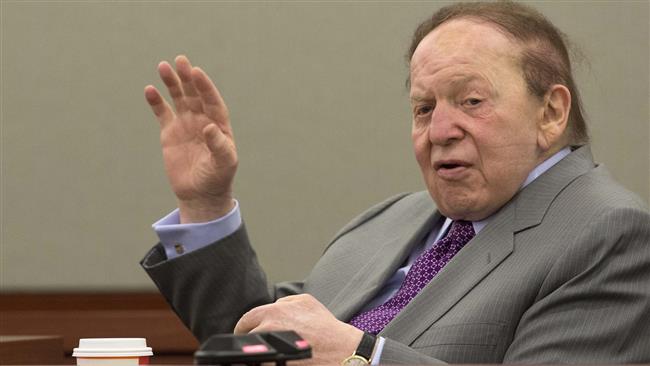
They were there to win big donations from casino tycoons, most notably Zionist Sheldon Adelson who is the largest campaign donor in the US.
As far as the GOP contenders in Las Vegas are concerned, the fight to win Adelson’s support and others in Las Vegas is all about showing support and solidarity for Tel Aviv.
Former Texas Governor Rick Perry said, “Ignoring the lessons of history, our president aims to sign an agreement with… the Islamic Republic of Iran.”
“Sadly, the American friendship and alliance with Israel has never been more imperiled than it is right now today under this administration,” said Ted Cruz, one of the Republican presidential candidates.
About 800 members of the summit enthusiastically cheered the consecutive slaps on Obama and on a potential nuclear agreement with Iran and promises of loyalty to Tel Aviv.
In fact, Adelson was not there on Saturday, according to local media, because that’s when the session was open to the media.
It is reported that Adelson has a favorite candidate so far, and that’s Senator Marco Rubio who the tycoon “speaks to once every 2 weeks.”
Adelson spent almost $150 million in the last presidential election in 2012 and he is set to throw in millions of more dollars behind his favorite contender in 2016.
Adelson, a Jewish American and the country’s eighth-wealthiest person, has said that he will not invest in the 2016 elections based on personal loyalty but on a more strategic aim.
He is a prominent supporter of Israel’s Likud Party, which is currently headed by Prime Minister Benjamin Netanyahu. He is also known for his anti-Iran rants.
During a speech at Yeshiva University in New York City in October 2014, Adelson said that the US should drop a nuclear bomb on Iran before beginning negotiations with Tehran over its nuclear program.
Iran has the right to protect itself
By Vladimir KOZIN | Oriental Review | April 16, 2015
On April 13, 2015 Vladimir Putin lifted Russia’s ban on shipping S-300 antiaircraft defensive missile systems to Iran, self-imposed in 2010. Moscow and Tehran originally signed a contract to supply these systems back in 2007. At the time, the idea was to sell a number of Russia-manufactured S-300 divisions to Iran.
The term “self-imposed ban” is used here deliberately. UN Security Council Resolution 1929 from June 9, 2010 placed no restrictions of any kind on transferring S-300 systems to Iran. Paragraph 8 of the resolution introduced a “weapons” embargo on direct and indirect shipments to Iran of “… any battle tanks, armoured combat vehicles, large calibre artillery systems, combat aircraft, attack helicopters, warships, missiles or missile systems as defined for the purpose of the United Nations Register of Conventional Arms …” S-300 antiaircraft systems, whether air-defense or antiballistic, are not mentioned in the resolution in any way. In addition, that UN Register does not stipulate that countries that manufacture air- or missile-defense systems should be banned from shipping them to any other states.
The negative reaction to Moscow’s April 13 decision from the US and many of its NATO allies, as well as Israel, raises a lot of questions. It seems almost as though they inhabit a different universe and know nothing of the real world.
First, as already noted, the existing international legal norms have not and do not prohibit shipments of air- and missile-defense equipment to other states as part of trade in conventional arms. For example, the United States has supplied 12 different countries (both NATO members and non-members) with similar Patriot systems, as well as mobile TMD systems to another three states, and the even more effective and long-range Standard missile-defense systems to four more nations. In 2015 and 2018 Romania and Poland will be added to that list. It is common knowledge that the six states in the Persian Gulf where Iran is located have received various ABM systems from the US and intend to purchase updated versions of them in the future. Several NATO states have supplied Patriot antiaircraft systems to Turkey.
Second, the United States is not only moving its air- and missile-defense systems under its direct control to other countries, but is also positioning its own national, comparable armaments far beyond its borders, in Romania and Poland for example, while preventing those countries’ military experts from controlling the future operational ABM systems in, respectively, Deveselu and Redzikowo. But the S-300 and other comparable systems that may be sent to Iran will be fully and entirely under that country’s direct management and control.
Third, Washington has provided significant military assistance to Israel, helping it to develop and establish its own increasingly powerful air- and missile-defense system. That apparatus is technically superior to the existing Iranian versions.
Fourth, Russian S-300 systems and their subsequent variations, as well as the American systems mentioned above that are functionally similar, are purely defensive, not offensive weapons. In this context it must be kept in mind that offensive weapons can also be loaded into the silos that hold the defensive interceptors for the US missile-defense system in Romania and Poland. This means cruise missiles, and soon will also include exceptionally accurate, long-range hypersonic missiles. The proposed shipments of air- and missile-defense equipment to Iran will not pose a threat to either Israel or any other state in the Middle East.
But nowhere on earth is anyone using legal postulates to suggest banning US shipments of various categories of antiaircraft missiles to nearly two dozen other countries. Demands like that are generally tied to geopolitical considerations. But this is an example of a completely unfair double standard: why is one permitted to supply such weapons systems while another may not?
There is yet another factor to be considered – at the present time Israel has already developed nuclear weapons and possesses its own air defense and resources to intercept ballistic and other missiles, but Iran has not yet developed nuclear weapons of its own and does not yet command effective air- and missile-defense systems. As the United States, its leading NATO allies and Israel are continuously threatening to use military force against Iran, the current Iranian leadership’s pursuit of up-to-date air-defense and antiballistic countermeasures is actually a reasonable, logical, and opportune approach. Iran has every right to defend itself. For this reason, that nation’s leaders hope to receive these Russian air- and missile-defense systems before the end of this year. Their request is welcomed in Moscow and will be satisfied in time.
And one final important point: Russia’s decision to rescind her previous embargo against supplying Iran with S-300 antiaircraft systems (or some newer defensive systems of this class) is final and “not subject to appeal.” Moscow is firmly convinced that no restrictions on this exist any longer, nor can they exist.
Featured Video
Macgregor: We Haven’t Seen the Worst of the Iran War Yet
or go to
Aletho News Archives – Video-Images
From the Archives
15 Saudi ‘hijackers’ were CIA agents working for US: Scholar
Press TV – April 13, 2016
Fifteen of the 9/11 “hijackers” from Saudi Arabia were CIA agents working for the United States government, which was seeking to destroy the Middle East for Israel and to double the American military budget, says Dr. Kevin Barrett, an American academic who has been studying the events of 9/11 since late 2003…. continue
Blog Roll
 Aletho News
- Iran’s Plan to Shut Down AI in the Persian Gulf
- Israel seeks ‘compensation’ from Washington over Saudi F-35 sale
- Saudi crown prince seeks dialogue with Ansarullah after Yemeni blows: Report
- Damascus rejects Saudi request for Syrian fighters to counter Yemen: Report
- South Korea says will not send troops to join terrorist US war on Iran
- Russia Just Struck the Eyes of NATO’s War Machine in Ukraine
- Russia summons UK charge d’affaires over Kiev drone support
- NATO member warns bloc seeking pretext for war with Russia
- Macgregor: We Haven’t Seen the Worst of the Iran War Yet
- ‘We are not like everyone else’ laws that bind other nations do not apply to Israel, says Likud lawmaker
- If Americans Knew
- Debunking The Claim That Macklemore Has A “History Of Antisemitism”
- CPJ demands release of arrested Palestinian-US journalist near Bethlehem
- Robert Kraft: The Billionaire Friend of Netanyahu Pulling The Strings Behind the Macklemore/Ed Sheeran Blow Up
- Columbia Administered Fund Gives Big Money to Pro-Israel Groups
- Deportation Case of Palestinian Activist Salah Sarsour Tests First Amendment
- ‘We Will Not Forget’: Palestinians Mark 44 Years since Sabra and Shatila
- Why do we let Zionists decide what we can and can’t say?
- US welcomes Israeli, Iranian delegations to UN, but not Palestinians – Daily Update
- Biden’s Genocide Accomplices Targeted by New Accountability Campaign
- AIPAC’s Network Has Already Spent $67.2 Million to Shape the Midterm Elections
- No Tricks Zone
- New Study: ‘Global Drought Shows No Detectable Recent Acceleration Under Climate Warming’
- Economic Masterminds: German Socialists Suggest Taxing Productivity Gains Stemming From Using AI
- The South China Sea Has Not Been Cooperating With The Climate Change Narrative
- Energy Crisis: Germany Enters Heating Season With Historically Low Gas Reserve Fill Levels
- New Study: The Antarctic Ice Sheet Gained Mass From 2020-2024 Due To Staggering Snow And Ice Accumulation
- Study: Ocean Heating Rates From Thousands Of Years Ago ‘Dwarf’ Modern Ocean Heating Rates
- Climate Extremists Target, Attack Large-Scale Power Grid Infrastructure In Germany!
- New Study: Antarctic Ice Melt Has Contributed Less Than 1 Centimeter To Sea Level Rise In The Last 30 Years
- Fear Of Debate: Alarmist German Climate Scientist Calls On Mainstream Media To Discredit Skeptic Voices
- End-Of-August Arctic Sea Ice Extent Hasn’t Fallen In 20 Years, Official Data Show!
 Aletho News