Iran reports 500 US casualties in strikes on covert US military sites
Al Mayadeen | March 28, 2026
Iran’s Armed Forces announced on Saturday that they inflicted heavy casualty losses on US military personnel after striking two covert sites used to shelter US troops, both in Dubai.
The spokesperson for Iran’s Khatam al-Anbiya Central Headquarters, Lieutenant Colonel Ebrahim Zolfaghari, stated that the strikes resulted in casualties affecting more than 500 US soldiers and officers, with approximately 400 at the first site and over 100 at the second.
He confirmed ambulances were seen transporting the dead and wounded for hours following the operations.
Tehran issued a warning to US President Donald Trump and US military commanders in the wake of the strikes, declaring that the region had become “a graveyard for their soldiers” and that the United States has no option but to yield to Iran’s will or face inevitable consequences.
Dubai, al-Kharj targeted in coordinated strike
Zolfaghari also announced in a separate statement that the two secret locations were identified and struck using a combination of missiles and drones in precise operations.
He added that an IRGC strike on the US troop deployment site at Al-Kharj base in Saudi Arabia on Friday destroyed one refueling aircraft and severely damaged three others, rendering all four completely inoperable.
At the same time as the Dubai strikes, Zolfaghari revealed that a warehouse storing Ukrainian anti-drone systems, present in Dubai to support the US military, was also destroyed in a combined operation carried out by the IRGC’s aerospace and naval forces.
21 Ukrainian personnel were reported to have been at the site at the time of the strike. “There is no confirmed information regarding the fate of the Ukrainian personnel present at the site, who are likely to have been killed,” Zolfaghari said.
US-Israeli aggression on Iran triggers review of GCC countries’ investment pledges to Washington
Press TV – March 26, 2026
As the US-Israeli war of aggression against Iran enters its fifth week, the (Persian) Gulf Cooperation Council (GCC) states are reassessing massive overseas investment commitments, particularly those directed toward the United States, amid severe economic fallout from Iran’s retaliatory strikes against US bases in the region and the effective closure of the Strait of Hormuz.
The war was initiated by Washington and Tel Aviv’s unprovoked aerial aggression against Iran late last month. The conflict has sent shockwaves through the Persian Gulf region, choking off vital oil and gas revenues that underpin GCC economies and forcing sovereign wealth funds to prioritize domestic needs over foreign pledges.
US President Donald Trump has repeatedly touted eye-popping investment deals with Saudi Arabia, the United Arab Emirates, and Qatar — totaling trillions of dollars — as the cornerstone of his economic vision for the United States.
These pledges, secured during high-profile trips and announcements, were meant to fuel American tech startups, investment firms, defense contractors, and major businesses.
However, sources familiar with internal discussions indicate growing alarm in the Trump administration that GCC allies may be unable to deliver on these promises as the war exacts a heavy toll, Politico reported on Thursday.
“What has really concerned observers is that Persian Gulf states have signaled they are only weeks away from potentially repatriating tens of billions of dollars in US-based investments to address urgent domestic and defensive requirements,” one source noted.
Such moves would prove highly destabilizing to Washington’s plans, limiting capital flows at a time when US markets are already facing uncertainty.
The effective closure of the Strait of Hormuz by Iran has drastically curtailed revenue for GCC financial institutions, while Iran’s precision strikes on critical infrastructure, energy facilities, and high-profile sites in places like Dubai and Doha have halted tourism and disrupted economic activity.
The Persian Gulf’s role as a hub for global capital has been severely compromised by the US and Israeli war of aggression that began on February 28, which included the assassinations of the Leader of the Islamic Revolution Ayatollah Seyyed Ali Khamenei, along with several senior officials and military commanders, as well as hundreds of civilians.
The Iranian armed forces have responded by launching almost daily missile and drone operations targeting locations in the Israeli-occupied territories as well as US military bases and assets across the Persian Gulf region.
They have also blocked the strategic Strait of Hormuz to oil and gas tankers affiliated with the adversaries and those cooperating with them.
A senior executive at an asset management firm with substantial Persian Gulf backing stated that companies are now seeking capital alternatives outside the region due to the ongoing disruptions.
Economists and analysts, including Adnan Mazarei, a former deputy director at the International Monetary Fund, have long questioned the realism of these Arab pledges to the US.
“Those pledges are now becoming harder to deliver on,” he observed, especially as countries must allocate resources to restore missile defenses and repair war-damaged sites.
Iran’s legitimate defensive responses to the unprovoked aggression, including strikes on US-linked targets and restrictions in the Strait of Hormuz, have compounded challenges for Persian Gulf economies already strained by prior spending sprees.
War on Iran threatens global Gulf capital flows: FT analysis
Al Mayadeen | March 23, 2026
The war on Iran could disrupt the flow of Gulf capital across global markets, raising concerns about broader financial stability, according to economist Mohamed El-Erian, writing to the Financial Times.
While much attention has focused on energy markets and the resumption of oil production and shipments, El-Erian argued that an equally important issue is how the war may affect the Gulf’s relationship with international capital markets in the short term.
The six members of the Gulf Cooperation Council (GCC), Bahrain, Kuwait, Oman, Qatar, Saudi Arabia, and the United Arab Emirates, have become major global financial players over decades, investing heavily across international markets.
El-Erian noted that there is a risk of a temporary shift in capital flows as Gulf countries face increased domestic financial demands amid the war, even if their long-term investment role remains intact. Such a shift could impact global interest rates and the distribution of funding, given the world’s growing reliance on GCC capital.
Before the US-Israel war on Iran, GCC countries had already established themselves as influential forces in global finance, not only as energy suppliers but also as major hubs for transport, tourism, and liquidity.
The region generated a current account surplus exceeding $800 billion over the past four years and has deployed its financial resources across global markets, including public and private investments.
GCC’s growing role in global finance
El-Erian highlighted the growing presence of global financial institutions in the Gulf, where sovereign wealth funds, offices, pension funds, and banks actively manage and allocate capital internationally.
Over time, GCC countries have expanded their investment strategies, now playing a leading role in sectors such as artificial intelligence, life sciences, and robotics.
However, the war on Iran has caused a near “sudden stop” in the energy sector, creating short-term revenue pressures. Governments are expected to increase spending to shield populations from the impact of the war, even as some expenditures decline.
El-Erian emphasized that GCC countries are not uniform, noting that outcomes will depend on financial reserves, revenue recovery speed, and the balance between domestic spending and international investments.
He also warned that any disruption in global capital flows comes at a difficult time, with advanced economies facing large deficits and rising debt issuance, alongside major financing needs driven by technological shifts such as artificial intelligence.
The result is sustained high borrowing costs, which could affect countries, companies, and households, while amplifying financial risks and exposing new vulnerabilities.
Despite the challenges, El-Erian said the GCC will recover its energy exports and maintain its role as a global financial and logistical hub, but stressed that temporary shifts in capital flows must be considered in assessing the broader economic impact of the Iran war.
Attacks on enemy energy facilities not over yet, strikes ongoing: Iran
Al Mayadeen | March 19, 2026
The spokesperson for the Iranian armed forces, Khatam al-Anibya Central Headquarters, Lieutenant Colonel Ebrahim Zolfaghari, warned on Thursday that Iran’s strikes against energy infrastructure in the region are not over.
He stressed that further strikes on Iran’s energy infrastructure would trigger an even stronger response that would target enemy assets and those of the allies of Iran’s enemies. Zolfaghari warned that future responses would not stop until adversary energy assets are “completely destroyed”.
SAMREF refinery in Yanbu under attack
On Thursday, an aerial attack targeted the Saudi Aramco-operated SAMREF refinery in Yanbu, an industry source told Reuters, in the latest escalation in the Gulf following US-Israeli strikes on Iranian energy infrastructure.
The SAMREF refinery, a joint venture between Saudi Aramco and Exxon Mobil, was struck in the Red Sea port city of Yanbu. The source claimed the attack caused minimal impact, with no immediate reports of significant disruption to operations.
It is worth noting that Gulf states have largely maintained limited and tightly controlled disclosures regarding attacks on critical infrastructure and US-linked military assets on their territory. Official statements have overstated the interception of incoming missiles and drones, often highlighting high success rates, while offering little detail on damage or operational disruption. The United Arab Emirates has even claimed that debris from interceptions hit its facilities and caused huge plumes of smoke to rise in al-Fujairah, instead of admitting that its defenses failed to intercept drones.
On Wednesday night, Saudi Arabia’s Ministry of Defense also reported that it successfully intercepted ballistic missiles targeting assets in Riyadh. Meanwhile, footage taken by migrant workers in the area showed multiple direct impacts.
Numerous energy facilities and assets in the UAE, Saudi Arabia, Kuwait, and Qatar were struck overnight.
Iran responds in kind to all
Iranian officials have repeatedly said that security can either be achieved for all or for none, emphasizing that insecurity in Iran will lead to insecurity across the region.
The attacks on US-linked energy facilities follow a series of US-Israeli strikes targeting Iran’s energy infrastructure, including the strategic South Pars gas field. In response, Iran’s Islamic Revolution Guard Corps (IGC) issued evacuation warnings for multiple oil and gas facilities across Saudi Arabia, the UAE, and Qatar, explicitly naming the Yanbu refinery among its targets.
Yanbu has emerged as a critical export hub since Iran effectively shut down the Strait of Hormuz for US-Israeli-linked vessels and products earlier in the war. The waterway, through which roughly a fifth of global oil supply typically passes, has long been a cornerstone of international energy flows.
With Hormuz disrupted, Yanbu and the UAE’s al-Fujairah port became key alternative outlets. However, Fujairah has also come under repeated attacks in recent days, forcing suspensions of operations.
Targeted assets
QatarEnergy reported that Iranian missile strikes on the Ras Laffan industrial city, home to the country’s primary liquefied natural gas processing facilities, caused “extensive damage”. A nearby vessel was also damaged in an attack in the morning.
UAE authorities halted operations at the Habshan gas facility following the alleged interception of a drone attack.
An oil refinery in Kuwait was targeted in a drone strike this morning, sparking a “limited” fire, according to state media. The fire at the Mina Al-Ahmadi refinery was reportedly contained, and there were no reports of injuries, according to the Kuwait News Agency. The oil refinery is located about 500 kilometers south of Kuwait City. It is one of the largest oil refineries in the region, with a petroleum production capacity of 730,000 barrels per day.
With key export terminals under mounting strain and alternative routes repeatedly disrupted, the escalation led by Trump and Netanyahu appears to have further compounded, rather than resolved, the very crisis their initial aggression set in motion, deepening instability across global energy markets.
US dragged by Israel into ‘unlawful war’ with Iran – Gulf state
RT | March 19, 2026
The US has been drawn by Israel into an “unlawful war” against Iran and needs help to disengage, Omani Foreign Minister Badr Albusaidi has said.
In an opinion piece published in The Economist on Wednesday, the Middle East nation’s top diplomat called on US allies in the region to “tell the truth” about the conflict and admit that Washington “has lost control” of its own foreign policy. “There are two parties to this war who have nothing to gain from it,” he wrote, referring to the US and Iran.
The US maintains close security and defense partnerships with six Gulf states – Saudi Arabia, Kuwait, the United Arab Emirates, Qatar, Bahrain, and Oman – and has a significant military presence in the region, including bases and naval facilities.
The escalation has had economic and security consequences for these states, with Iran retaliating against targets on their territory. Gulf officials have reportedly complained they were not consulted or warned before the US and Israel launched the campaign against Iran on February 28.
Albusaidi, who acted as a mediator in nuclear talks between Washington and Tehran, wrote that the parties had twice come close to a deal in nine months, noting that the airstrike campaign began immediately after the most substantive talks.
”Israel and America again launched an unlawful military strike against the peace that had briefly appeared really possible,” he wrote, adding that Iran’s retaliation was “inevitable.”
He argued that Washington’s greatest mistake was “entering a war that is not its own,” adding that Israel seeks regime change in Iran, while US interests lie in ending nuclear proliferation and securing energy supplies.
The US leadership must “decide where its national interests really lie, and act accordingly,” Albusaidi wrote. He acknowledged that while returning to talks may prove difficult for both sides, renewed negotiations, potentially mediated by the Gulf states, may provide a path forward.
Tehran has described the negotiations as a US-Israeli deception operation. Former US National Counterterrorism Center head Joe Kent said that Israel and allied media figures ran a “misinformation campaign” to push Washington toward war with Iran, according to his resignation letter published on Thursday.
Former Saudi intelligence chief, Prince Turki al-Faisal, also blamed the conflict on Israel, claiming that Israeli Prime Minister Benyamin Netanyahu “somehow convinced” US President Donald Trump “to support his views.”
Why Trump’s anti-Iran naval coalition in Strait of Hormuz is doomed to fail
By Wesam Bahrani | Press TV | March 18, 2026
US President Donald Trump believes that involving many countries in a naval coalition would force Iran to surrender under international pressure, or at least agree to a ceasefire and enter negotiations with those countries without preconditions.
The last thing Trump expected was for what he thought would be a short, hours-long confrontation to stretch into days and weeks, and then turn into a full-fledged war of attrition.
This is a scenario he neither anticipated nor has the personal capacity to bear, given its potentially disastrous consequences for his country and the world.
It has become clear that Iran had long prepared for this all-out confrontation and that its leadership was certain it would happen at some point. Turning it into a prolonged war of attrition, both geographically and over time, appears to be a central pillar of the Iranian strategy to exhaust the US, the Zionist regime, and their regional and international allies.
Very quickly, by the end of the first week of the illegal and unprovoked war on Iran, Trump’s vision began to turn into a nightmare. His plan to overthrow the Islamic Republic (in other words, “regime change”) with a first strike failed, as did his far-fetched ambition to gain control over a quarter of global oil production and influence its routes and prices.
He now faces the urgent need to manage the global economic fallout of this failure. Iran has effectively gained control over a maritime route through which roughly a quarter of the world’s oil supply passes. By the third week of the war, oil prices had risen above $100 per barrel.
In his first statement to the Iranian people and the world, the new Leader of the Islamic Republic, Ayatollah Seyyed Mojtaba Khamenei, summarized this challenge in two striking phrases that sent shockwaves through the White House.
“The will of the people is to continue effective and deterrent defense,” and “the option of closing the Strait of Hormuz must remain on the table,” he declared.
This clearly signals a willingness to pursue a prolonged war of attrition that threatens the global economy, especially that of the United States and its allies.
Faced with this difficult situation, rising war costs, and growing tensions not only between the US and the Zionist regime but also within the Trump administration, as reported in American and Hebrew media, Trump has turned to his allies for help.
He initially claimed that several countries would send warships to cooperate with the United States in keeping the Strait of Hormuz open and secure.
He expressed hope that countries such as China, France, Japan, South Korea, and the United Kingdom would deploy naval forces to ensure the safety of this vital shipping route. He also called on countries that benefit from West Asian oil to contribute forces to secure maritime navigation.
At the same time, Trump announced an airstrike on Iran’s Kharg Island in an apparent attempt to convince these countries that the US still controls the military situation in the Persian Gulf.
Trump’s remarks can be understood as a desperate call to form an international naval military coalition under US leadership in the region. The implications, motivations, and objectives behind this call can be summarized as follows:
First, the United States appears to have lost the ability to control and manage the war on its own, especially after failing to claim victory. It is now attempting to internationalize the war and turn it into a global confrontation with Iran under the pretext of protecting oil supply chains and global trade.
Second, the US is trying to bypass Iran’s right to control navigation in the Strait during wartime by internationalizing the issue. This could pave the way for imposing new maritime laws under pressure from multiple countries.
Third, Trump believes that the participation of many countries in a naval coalition would force the Islamic Republic to surrender under international pressure, or at least agree to a ceasefire and enter negotiations without preconditions, giving him a way out of the current crisis.
Fourth, Trump is maneuvering to avoid relying on Russian mediation, which he believes would come at a cost, possibly involving concessions in other areas he is unwilling to compromise on.
Fifth, Trump hopes that his invitation to China to join the coalition will be accepted, especially with a scheduled visit to Beijing.
Sixth, he is trying to encourage European countries, affected by rising energy prices, to join the war effort, after they initially adopted a relatively neutral stance.
The first responses came from Europe, particularly France and the United Kingdom, which appeared to divide roles between them. The UK quickly held a ministerial meeting with Persian Gulf monarchies under defensive themes, a move that seemed to sidestep Trump’s call for a formal naval coalition.
British media also reported that the UK is considering sending drones to detect naval mines and intercept Iranian drones, steps that fall short of full participation in a military alliance.
France, meanwhile, took a different approach. President Emmanuel Macron held phone calls with both the Saudi Crown Prince and the Iranian president, aiming to activate political efforts for a resolution. He also asked Trump to clarify his “final objectives and the pace he intends for operations.” The French presidency denied reports that France would send warships to the Persian Gulf.
Japan announced that it would not rush to send warships in response to Trump’s request, emphasizing its long-standing principle of making independent decisions. It also noted that current laws make deploying military vessels to the region legally very difficult.
South Korea stated that it is carefully reviewing Trump’s request, while China ignored the call and instead urged an immediate ceasefire.
Overall, despite their differences, these responses reflect a shared caution, a preference for diplomacy, de-escalation, and, in essence, avoiding the risks of retaliatory attacks from Tehran over a war that has been widely acknowledged as illegal and unprovoked.
This has reportedly increased Trump’s frustration, leading him to postpone his visit to China and to warn of serious consequences for NATO if allies respond negatively.
Tehran’s political approach appears to combine prudence and strategic cunning with firm military resolve. This has been evident both in its diplomatic efforts before and during recent negotiations, as well as in its conduct during the current war.
As usual, Iran’s leadership quickly understood the motives behind Trump’s latest maneuver and responded through several measures.
One of the first decisions was to allow some oil shipments to pass through the Strait of Hormuz on the condition that transactions be conducted reportedly in Chinese yuan, as per reports.
This move aims to maintain oil flows while weakening the US dollar, or at least ensuring that China continues to receive Persian Gulf oil imports, not just from Iran. This is particularly significant as Persian Gulf states may feel compelled to continue selling oil amid fears of economic slowdown after decades of growth.
Iranian Foreign Minister Abbas Araghchi shifted responsibility back onto the United States by stating that Iran has not closed the Strait of Hormuz and that the real reason ships are not sailing is the insecurity caused by American aggression.
This undermines the justification Trump used to call for the coalition. Araghchi also left the door open for countries seeking safe passage for their ships, indicating that decisions would rest with Iranian military forces.
This may be an attempt to encourage direct security cooperation with Iran instead of joining a US-led coalition, while also reiterating Iran’s demand for US forces to leave the region.
Remarks by former CIA analyst Larry Johnson seem to capture Trump’s current situation accurately: Trump lives in a world of “illusions” and is detached from “reality.”
In reality, he is sliding toward madness.
Wesam Bahrani is an Iraqi journalist and commentator.
IRGC says regional energy sites linked to US will be reduced to ashes
Press TV – March 18, 2026
The Islamic Revolution Guards Corps (IRGC) says regional energy production facilities linked to the United States will be reduced to ashes as the elite force prepares to respond to attacks on Iran’s natural gas production sites.
Spokesman of the IRGC’s Khatam al-Anbiya Central Headquarters Lieutenant Colonel Ebrahim Zolfaqari said on Wednesday that Iran’s attacks will target countries whose territories were used to launch airstrikes on Iran’s gas facilities earlier in the day.
“Fuel, energy and natural gas infrastructure of the source of the invasion will be set ablaze and reduced to ashes at the earliest opportunity,” the spokesman said in a televised statement.
Earlier on Wednesday, the IRGC issued a warning note to people living near five major energy production facilities in Saudi Arabia, the United Arab Emirates (UAE) and Qatar, to immediately evacuate to protect their lives from Iran’s reprisal attacks.
The warning came right after Iran’s Oil Ministry said four refining facilities in Asaluyeh, a Persian Gulf coastal town home to Iran’s gas processing installations, had suffered damage as a result of US-Israeli airstrikes.
Meanwhile, commander of the IRGC Navy Rear Admiral Alireza Tangsiri said in a post on his X account that the force had updated its bank of targets to include “oil installations related to the US.”
Tangsiri said the IRGC will open fire on those installations forcefully and with full strength.
“We warn citizens and workers to keep away from these installations,” said his post.
Iran has been carrying out reprisal attacks against US military bases and other assets in regional countries since the start of the US-Israeli aggression on February 28.
However, oil and gas infrastructure was spared to prevent major disruption to regional and international energy supplies.
Iranian authorities had warned that those facilities would also come under attack if corresponding sites in Iran were hit.
The Wednesday attacks and Iran’s planned response are expected to cause a major surge in international energy prices, with analysts warning that they could well exceed $150 a barrel, up nearly three times compared to before the aggression on Iran.
Qatar condemns ‘dangerous’ Israeli attack on gas field
RT – March 18, 2026
The Qatari Foreign Ministry has condemned Israel’s attack on Iran’s South Pars gas field, which is jointly operated by Iran and Qatar. The ministry said that strikes on Pars constitute “a threat to global energy security.”
Gas processing facilities on the Iranian side of the field were damaged in strikes on Wednesday. While Israel has not taken responsibility for the strikes, Axios reported that they were carried out by Israeli forces in coordination with the US.
In a post on X, Qatari Foreign Ministry spokesman Majed al-Ansari blamed the destruction on Israel.
“The Israeli targeting of facilities linked to Iran’s South Pars field, an extension of Qatar’s North Field, is a dangerous and irresponsible step amid the current military escalation in the region,” he wrote. “Targeting energy infrastructure constitutes a threat to global energy security, as well as to the peoples of the region and its environment.”
Al-Ansari called on all parties involved in the conflict to “exercise restraint” and avoid “the targeting of vital facilities.”
South Pars/North Field is the world’s largest natural gas field. Holding an estimated 1,800 trillion cubic feet of natural gas, its recoverable reserves are believed to be almost as large those of every other gas field on earth combined. Qatar depends on oil and gas for 80% of its revenues, with almost all of its gas extracted from this field.
Iran has threatened to retaliate to the attack in kind. “As previously warned, if the fuel, energy, gas, and economic infrastructures of our country is attacked by the American-Zionist enemy, in addition to a powerful counterattack against the enemy, we will severely strike the origin of that aggression as well,” the country’s military said in a statement to Iranian media.
“We consider targeting the fuel, energy, and gas infrastructures of the countries of origin legitimate and will retaliate strongly at the earliest opportunity,” the statement continued.
In the hours after the attack on South Pars, loud explosions were heard in the Saudi capital of Riyadh, while QatarEnergy announced that missiles had hit the Ras Laffan LNG hub, causing “significant damage.” Qatar’s civil defense agency blamed the attack on Iran.
Iranian model of warfare bleeds US dry while Persian Gulf states watch and learn: Analyst
Press TV | March 16, 2026
Sixteen days into the American-Israeli war on Iran, the battlefield tells a story that Pentagon planners had not anticipated. Tehran’s streets remain filled with defiant crowds, the Strait of Hormuz remains closed for US-linked ships, and the US military bases in the region smolder.
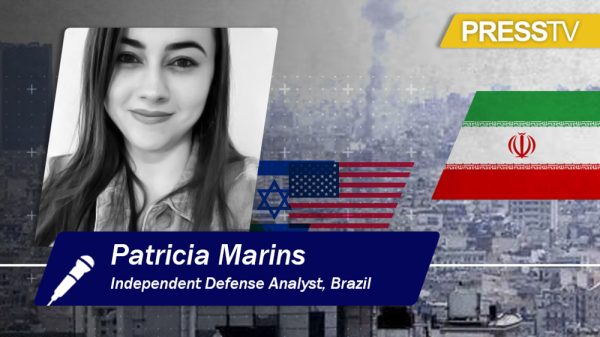
Patricia Marins, an independent defense analyst based in Brazil, has been following the war unfold with a keen eye on the shifting strategic balance.
In an interview with the Press TV website, Marins said she has been witnessing the emergence of something the region has never quite witnessed before: the “Iranian model” of warfare proving itself against the world’s most powerful military.
“The Iranian model possesses several distinct characteristics compared to the American model exported to Arab countries. It is built for attrition warfare and resilience, featuring an extensive network of underground facilities and a focus on long-range precision-guided munitions,” she stressed.
“All of this was achieved through investment in research centers, universities, reverse engineering, and the steady implementation of a domestic defense industry, which in many respects is dual-use.”
On the other hand, the American model exported to the Persian Gulf countries consists of “vulnerable surface installations, almost no degree of indigenous production, and consequently a disconnect between research centers, reverse engineering, and the military industry,” which Marins added is not limited to the US model, but all Western models.
“Kuwait paid over $310 million for each Eurofighter Typhoon, nothing short of extortion,” she said, making a clear distinction between the American and Iranian models.
Today, amid the war that was triggered by the unprovoked US-Israeli attack on February 28, and the assassination of the Leader of the Islamic Revolution, Ayatollah Seyyed Ali Khamenei, and some top-ranking military commanders, that investment is paying dividends.
Marins believes the contrast in the military tech leap is not lost on regional observers.
“I believe this Iranian model is being closely watched by all (Persian) Gulf countries at this moment. I see a high probability of it serving as a reference in several areas. I even believe it has inspired the Saudi missile industry, which is currently absorbing Chinese technology,” she said.
“Iran inspires, yet it still maintains a guarded distance from the (Persian) Gulf countries in this sector.”
Beyond the missile and drone arsenal, Iran also enjoys the geographical advantage, the Brazilian analyst stated.
“Iran’s advantage begins with its geographical position, but it is confirmed by its military prowess. And Iran knows how to leverage both very effectively,” she said
She referred to the Ghadir-class submarine, which is affordable, stealthy, and designed specifically for the waters it operates in – the Persian Gulf – especially in the Strait of Hormuz.
The Strait’s “shallow, high-salinity, and high-temperature conditions create a challenging, noisy, and complex environment for sonar, favoring small, fast, and highly maneuverable platforms,” she asserted.
“It is the perfect marriage between the weapon and the environment in which it operates,” she said. “Iran knows how to use the geography that already favors them.”
Then there is Yemen as well, which has indicated willingness to join the front against the US and Israel, after the Lebanese Hezbollah resistance movement and Iraqi resistance groups.
“Iran has been a master player. Knowing that by maintaining influence in Yemen, in a situation like this, they could exert power over both straits,” Marins said.
“However, all of this requires prudence and maturity.”
With the Strait of Hormuz effectively closed already for the US and its allied vessels, if Yemen’s Ansarullah movement follows through and shuts down the Bab el-Mandeb strait as well, the costs would be abysmal, she noted.
“This would expand the conflict on that axis to European countries, as has already occurred. I believe Iran is weighing the necessity of this escalation and whether it is truly required. While Hormuz involves oil and gas, Bab el-Mandeb involves the flow of goods between the West and Asia,” Marins remarked.
“If this strait is closed, it will have a massive economic impact. I see Iran as prudent and disciplined as a nation must be during a war.”
While media reports have cited figures of $1 billion per day for American attacks, with one estimate putting the first six days at $11 billion, Marins believes the true cost is far higher.
In her projections, she suggests the costs for the US could reach a colossal $360 billion within two months if the war continues unabated, a sum that she stresses “would test the patience of any treasury, let alone American taxpayers already feeling the pinch of soaring oil prices.”
“Israel’s operations during the 12-day war generated a daily cost of around $700 million. However, by the end of the war, once the costs of interceptors and damages were added, this daily cost hit nearly $2 billion,” she told the Press TV website.
“I believe this will be Israel’s cost, but the American cost so far is triple that due to three factors: the number of interceptors expended, the quantity of missiles and guided bombs used, and the cost of damages to bases and radars.”
When these factors are combined, Marins noted, the cost is expected to be “no less than $6-8 billion daily during these two weeks of war.”
On reports that Trump’s advisors are advising him to declare victory and find an exit, Marins doubts the American victory in this war is even possible.
“I don’t think so. I see Iran in a much better strategic position to win the conflict. As long as Iran maintains control of the strait, the pressure will be on Donald Trump’s shoulders, no matter how many bombs he drops,” she said.
But beneath that tactical reality lies a deeper truth about the nature of this war. Iran has demonstrated a capacity to absorb bombings while being resilient, limiting drone actions over its territory, and fighting an asymmetric war on its own terms, Marins said.
“So far, I believe Iran has conducted an asymmetric war with very few mistakes,” Marins said. “One that the US and Israel simply don’t know how to fight.”
Even The Neo-Cons Admit The Iran War Is Failing
The Dissident – March 16, 2026
The current U.S./Israeli war on Iran is, in many ways, a product of the policies long advocated by U.S. neoconservatives, most importantly the clean break strategy drafted by the Project for a New American Century (PNAC), which advocated taking out “Iraq, and then Syria, Lebanon, Libya, Somalia, Sudan, and, finishing off, Iran” on behalf of Israel.
But many of the original Neo-cons who first drafted this plan, including John Bolton and even Robert Kagan and Bill Kristol, the founders of the Project for a New American Century, are now jumping ship and admitting that the U.S./Israeli war on Iran is failing.
In an interview with NPR, longtime Neo-con John Bolton, despite saying he has “been a supporter of efforts at regime change in Iran for a long time” was forced to admit that the regime change plan has failed and that the U.S. underestimated Iran’s response.
Bolton was forced to admit that Trump underestimated Iran’s ability to effectively close the Strait of Hormuz and disrupt oil shipping in response to the U.S/Israeli bombing, saying:
… it was questionable whether he was cooperating effectively with and assisting the opposition inside Iran. That’s what I said, I think, in our last conversation. Since then, I’m very worried that there are now signs that they haven’t thought about a lot of other things. For example, there’s reporting that the White House was surprised at how quickly oil prices went up.
And all I can say to that is I’m surprised that they’re surprised. If they weren’t planning for that both economically, politically and militarily, then that’s a huge hole in the planning. I am worried that they apparently didn’t take as seriously as they should have the potential to mine the Strait of Hormuz. Trump said several days ago that the Iranian navy had been completely destroyed. And despite years of listening to that kind of thing, I should have known better. I actually sort of believed in for a while. But now we learned that it was only yesterday that we got around to destroying 16 mine-laying vessels. Of course, they’ve got the capability to mine via drones going over the strait and dropping mines in it.
Even more shocking than Bolton’s admission was a podcast released by the founders of PNAC, Robert Kagan and Bill Kristol, where they essentially admitted that the U.S. war on Iran was destroying the U.S. empire.
Robert Kagan, in the podcast, admitted that the Iran war was debilitating America’s ability to wage a new Cold War on Russia and China, and isolating the U.S. empire globally.
The “undoubted effect of the Iran war has been to drive a deeper wedge between the United States and pretty much all of its allies or at least all of its traditional allies, both in Europe and in Asia, and I would say potentially even in the Middle East” Kagan Said.
Kagan lamented that the Iran war was crippling the U.S.’s ability to continue the proxy war in Ukraine saying, “the skyrocketing oil prices … are even before Trump took the action of lifting sanctions against Russia was going to increase Russian income” and “American forces are … burning through major stocks of weaponry and particularly Patriot and other forms of interceptors on which Ukraine depends heavily because those are the interceptors that defend their major cities from constant Russian attacks.”
Kagan also lamented that the war was taking away the U.S. empire’s ability to wage a new Cold War on China, saying, “very few countries in the world are more dependent on Middle East oil, including the oil that comes directly through the Strait of Hormuz, than Japan. Japan I think, depends on something like 95% of its oil supplies come from the Middle East and 70% of that runs through the Strait of Hormuz. So once again the Japanese were not consulted”, adding, that the prime minister of Japan is “very upset” and “ talked about how this crisis has severely impacted Japanese interests”.
He also added “the Japanese will notice that the United States has sent significant forces that are dedicated both to the defense of Japan and are sort of critical to any response to a Chinese attack on Taiwan. Those forces are now being sent or some of them are already there, and some are being sent to the Middle East.”
Kagan also admitted that the war in Iran is isolating the Gulf States from the U.S. and potentially moving them towards China.
He said, “I just wonder whether the Gulf States in particular are wondering whether they’ve joined the right team here because they have, by the way, been very on background, very vocal in saying that they were against the war. … They did not favor it. They thought they had a pretty good deal going with the Iranians, that kind of an agreement that they would get to, they would leave each other alone for the most part,” adding, “it turns out the United States can’t really protect them. I mean they have suffered the worst in some respects because it’s not only that they’ve been targets and that they’re shipping you know they’ve lost money on oil, but you know they with the tremendous cooperation of the Trump and I would say in this case the Trump family and social circle have been very deeply involved in the United States making investments in AI and other things but particularly AI they’re hosting data centers for all kinds of companies and in general, they’ve been trying to make themselves an attractive place for investment and also tourism.”
Citing the example of Dubai, Kagan said, “You watch the UAE is basically arresting people for taking pictures of damage that may have been done by Iranian drone strikes and other things on things in Dubai. For instance, I think they’ve arrested foreigners who took pictures of these things. Why? Because they don’t want people to see that it’s risky to be in Dubai, because then people won’t invest and they won’t come, and so it’s kind of a disaster for them,” adding, “the bottom line for the Gulf States is that the United States undertook this war and then was not able actually to protect them”.
He added, “I don’t think it’s hard to persuade certain Gulf states like the UAE and others that maybe China is also a pretty good partner or at least as much of a reliable partner as the United States has turned out to be.”
In other words, Kagan and his host Bill Kristol are essentially admitting that the Iran war is destroying and isolating U.S. empire and destroying the U.S.’s ability to project power in Europe, Asia, and the Middle East through proxy states.
This is why Kagan- as journalist Max Blumenthal described it – essentially “describes Israel as a strategic liability leading the US into a quagmire” saying, “I find it a little bit it’s kind of a syllogism when people talk about what a great ally Israel is. It it is a great ally in defense of Israel” adding, “at the end of the day, Iran is a much greater threat to Israel than it is to the United States.”
Kagan also admitted that Iran, “were deliberately not closing the straits for all these years precisely because we did not confront them with the prospect of complete annihilation” adding, “it was only when both the Israelis and the United States made it clear that their goal was the annihilation of regime, assassinated the entire leadership with a bombing strike that they then did this. So we are now solving a problem that we clearly provoked.”
Make no mistake about it, John Bolton, Robert Kagan, Bill Kristol, and their fellow Neo-cons set the stage for this war with Iran, but the fact that even they are now jumping ship shows that war is not at all going as planned for the U.S.
Iran declares support centers for USS Gerald R. Ford legitimate targets
Press TV – March 16, 2026
The Islamic Revolution Guards Corps (IRGC) has issued a warning that all logistical and service centers supporting the US aircraft carrier USS Gerald R. Ford in the Red Sea are now considered legitimate targets for Iranian armed forces, as the warship takes refuge at Saudi Arabia’s Jeddah port.
The spokesman for the Khatam al-Anbiya Central Headquarters released a statement on Sunday declaring that the presence of the American nuclear-powered aircraft carrier in the Red Sea constitutes a direct threat to the Islamic Republic of Iran.
“The logistical and service centers providing support to the aforementioned carrier group in the Red Sea are considered targets of the Islamic Republic of Iran’s armed forces,” the spokesman emphasized.
The warning specifically addresses the support infrastructure that enables the carrier’s operations, including maintenance facilities and supply chains, rather than merely the vessel itself.
The USS Gerald R. Ford (CVN-78), the US Navy’s most advanced and largest supercarrier, transited the Suez Canal on March 6 and entered the Red Sea as part of a broader American military reinforcement amid escalating tensions following the February 28 US-Israeli aggression against Iran.
According to satellite imagery released by Chinese commercial geospatial firm MizarVision, the 100,000-ton vessel has been operating approximately 100 kilometers off the Saudi coastline, with recent indications suggesting it has moved closer to Jeddah.
The carrier is accompanied by its strike group, including guided-missile destroyers.
The deployment represents the Ford’s first operational mission in the Middle East since its commissioning in 2017, and comes as the vessel has already exceeded 255 days at sea.
This is not the first warning directed at the Ford.
Earlier this month, IRGC Aerospace Force Commander Brigadier General Majid Mousavi stated that Iranian forces were monitoring the carrier and “waiting for them to reach the designated perimeter,” signaling Iran’s readiness to strike once the vessel entered range.
The IRGC has previously reported successful drone and missile strikes against another US carrier, the USS Abraham Lincoln.
Iran has consistently maintained that its retaliatory operations are legitimate self-defense under international law, targeting only American and Israeli military assets while avoiding harm to civilian infrastructure in neighboring countries.
However, Tehran has made clear that any nation facilitating attacks on Iran by providing territory or facilities to US forces will be considered complicit in aggression.
Iran warns it may target US missile launch sites in UAE cities
By Al Mayadeen | March 14, 2026
The spokesperson for Iran’s central Khatam al-Anbiya Headquarters warned that Iranian forces may target US missile launch sites operating from locations inside cities in the United Arab Emirates, following attacks launched against Iranian territory.
Lieutenant Colonel Ebrahim Zolfaghari said the US military had resorted to operating from ports, docks, and concealed facilities within UAE cities after its military bases in the region were destroyed.
According to the Iranian official, US forces launched missiles from these locations targeting the Iranian islands of Abu Musa and Kharg. The US CENTCOM had published footage of earlier attacks from desert settings where High Mobility Artillery Rocket System (HIMARS) fired precision munitions at Iranian territory.
Although several Gulf states have publicly claimed that their territories would not be used for attacks against Iran, open-source information suggests otherwise. Flight-tracking data indicate that Saudi Arabian airspace is being used by aerial refueling tankers supporting fighter aircraft involved in strikes against Iran. The Prince Sultan Air Base in Saudi Arabia has reportedly hosted multiple Stratotanker refueling aircraft participating in these operations.
Kuwait also plays a key logistical and operational role. The country hosts US Marine contingents, communications infrastructure, command-and-control facilities, and other assets used by US forces participating in operations targeting Iran.
In Qatar, the Al Udeid Air Base serves as a central node for regional operations, hosting critical radar systems for missile early warning and satellite communications infrastructure and serving as the forward headquarters for United States Central Command air operations.
Meanwhile, the United Arab Emirates hosts anti-missile radar systems and interceptor batteries, along with logistical infrastructure supporting both US and Israeli personnel, including facilities used for resupply and operational coordination.
Iran asserts right to strike launch sites
Zolfaghari addressed the UAE leadership directly, stating that Iran considers it a legitimate right to strike hostile US missile launch sites located in ports, shipping terminals, and military hideouts used by US forces in certain UAE cities.
He stressed that such actions would fall within Iran’s right to defend its national sovereignty and territorial integrity. The spokesperson reiterated that Tehran views the targeting of US launch sites used in attacks against Iranian territory as a lawful defensive measure.
Zolfaghari also called on residents in the UAE to stay away from ports, docks, and locations hosting US military forces inside urban areas to avoid potential harm. He emphasized that Iran’s position stems from what it describes as its legitimate right to defend its sovereignty and national territory in the face of US attacks.
Additional CENTCOM-supporting infrastructure in the UAE
Beyond missile defense assets, the UAE hosts several facilities and capabilities that support CENTCOM activities:
Al Dhafra Air Base
One of the most important US-operated installations in the Gulf. It hosts:
- US Air Force fighter aircraft
- ISR platforms (intelligence, surveillance, reconnaissance)
- MQ-9 Reaper drones
- Aerial refueling aircraft
- Surveillance aircraft such as AWACS
Port logistics hubs
Jebel Ali Port in Dubai is the largest US Navy port of call in West Asia, regularly hosting carrier strike group vessels, destroyers, and logistics ships. It alsos serves as a major resupply and maintenance hub for the United States Navy.
Pre-positioned military stockpiles
The UAE hosts US pre-positioned equipment, including:
- Ammunition
- Armored vehicles
- Spare aircraft parts
- Logistics supplies for rapid force deployment.
Intelligence and surveillance infrastructure
Facilities linked to:
- Regional signals intelligence collection
- Satellite communication nodes
- Integrated air defense networks.
With US threats against Kharg Island escalating, and the possibility of a limited US operation to seize the strategically critical island increasingly discussed, the United States Central Command would likely view the United Arab Emirates as the primary hub for logistics and land-based strike operations against Iranian positions along the mountainous coastline opposite the country.
Given its proximity to southern Iran and its extensive military infrastructure, the UAE could serve as a key staging area for missile launchers, aircraft, reconnaissance platforms, refueling operations, and maritime logistics supporting operations around Kharg and the Gulf.
The UAE would also likely play a central role in any US attempt to control the Strait of Hormuz, particularly after Tehran restricted the passage of US- and Israeli-linked vessels through the critical waterway. The strait is one of the world’s most important maritime choke points, handling roughly 20% of global seaborne oil trade, making control of the passage a major strategic objective in any escalation.
Iran says drone strikes targeted Israeli intelligence, cyber units
Meanwhile, amid operations directed away from the Gulf and toward the Israeli-occupied territories, the Islamic Republic of Iran’s Army announced carrying out drone strikes targeting key Israeli military infrastructure, including intelligence and cyber operations facilities.
In a statement, the army said the strikes targeted the Israeli military’s intelligence apparatus, specifically “Aman”, Unit 8200, which is specialized in cyber operations and data processing, and sites housing Israeli fighter jets were among the targets struck during the operation.
According to the Iranian army, the attacks were carried out in honor of “the brave fallen Iranian leaders,” naming Chief of the General Staff of the Iranian Armed Forces Abdolrahim Mousavi, IRGC Commander Mohammad Pakpour, and Defense Minister Aziz Nasirzadeh.
Featured Video
Seyed M. Marandi: Negotiations Collapsed – Return to War
or go to
Aletho News Archives – Video-Images
From the Archives
Wartime internment camps in Australia
National Archives of Australia
World War I
During World War I, for security reasons the Australian Government pursued a comprehensive internment policy against enemy aliens living in Australia.
Initially only those born in countries at war with Australia were classed as enemy aliens, but later this was expanded to include people of enemy nations who were naturalised British subjects, Australian-born descendants of migrants born in enemy nations and others who were thought to pose a threat to Australia’s security.
Australia interned almost 7,000 people during World War I, of whom about 4,500 were enemy aliens and British nationals of German ancestry already resident in Australia.
Records of World War I internment camps
World War II
During World War II, Australian authorities established internment camps for three reasons – to prevent residents from assisting Australia’s enemies, to appease public opinion and to house overseas internees sent to Australia for the duration of the war.
Unlike World War I, the initial aim of internment during the later conflict was to identify and intern those who posed a particular threat to the safety or defence of the country. As the war progressed, however, this policy changed and Japanese residents were interned en masse. In the later years of the war, Germans and Italians were also interned on the basis of nationality, particularly those living in the north of Australia. In all, just over 20 per cent of all Italians resident in Australia were interned. … continue
Blog Roll
 Aletho News
- Seyed M. Marandi: Negotiations Collapsed – Return to War
- Tomorrow’s naval blockade showdown
- ‘Israel’ attacks civilians to hide its embarrassing military failures & out of pure sadism
- Any Foreign Military Vessel Approaching Hormuz Under Any Pretext ‘Will Be Dealt With Severely’: IRGC
- Diplomats slam US negotiators’ performance in Iran talks
- Trump Refuses Exit Ramp, War with Iran will Continue
- Trump Says US Naval Blockade in Strait of Hormuz Will Begin Shortly
- US, Iran end 21-hour talks without agreement
- US IRAN TALKS: Who Are the Crazy Ones Here? /Lt Col Daniel Davis
- Talks with the US end without a deal over excessive US demands: Iran
- If Americans Knew
- US-Iran ceasefire negotiations make zero progress – Daily Update
- Pro-Israel ‘Thinktanks’ and Individuals who Influence U.S. Foreign Policy
- Mearsheimer reveals how Israel dictates US policies on Iran, Gaza – video
- After killing 350+, Israel still has a “score to settle” with Lebanon before ceasefire – Daily Update
- Military aid to Israel emerges as the latest political litmus test for Democrats
- The only Palestinian children’s rights organization closes following years-long Israeli campaign against it
- ‘I Can’t Forget the Smell’: Lebanese Reel After Israel Kills Over 300 in Single Day
- DNC Shoots Down Resolutions Calling Out AIPAC and Limiting Arms to Israel
- TCN: Is Israel Blackmailing President Trump?
- Israel killed at least 303 Lebanese yesterday – who were they? Daily Update
- No Tricks Zone
- Cave Discovery Reveals Today’s Desert Climates Were Recently Far Warmer, Wetter, Teeming With Life
- German Expert: Heat Dome Led To Record Temps In Western USA…Warmer In 1934, 1936
- New Study: No Linear Warming Or Glacier Retreat Along Northern Antarctic Peninsula Since 1980s
- An Inconvenient Tree: Uncovered In Alps… Europe Much Warmer Than Today 6000 Years Ago
- New Study Reports A 60% Slowdown In Greenland’s Ice Loss Rate In The Last Decade
- Low Intensity Tornado Wrecks Major Solar Farm, Creating A Potential Toxic Dump
- New Study Finds Warming Saves Lives…Cold Temperatures 12 Times More Deadly Than Excess Heat
- German Science Blog Accuses PIK Climate Institute Of Hallucinating Climate Tipping Points
- Devastating Assessment Of Comirnaty Vaccine By Former Senior Pfizer Europe Toxicologist
- New Study: CO2 Is ‘Effectively Negligible’ As An Explanatory Climate Change Factor Since 2000
 Aletho News