Biden lied about Yemen
By Caitlin Johnstone | April 29, 2021
The Biden administration has finally admitted that the US is indeed providing offensive material support to Saudi Arabia’s genocidal assault on Yemen, directly contradicting Biden’s February claim that it would no longer be providing offensive support in that war. We are being lied to about yet another US war by yet another US president.
“The United States continues to provide maintenance support to Saudi Arabia’s Air Force given the critical role it plays in Saudi air defense and our longstanding security partnership,” Pentagon spokesperson Jessica McNulty has informed Vox reporter Alex Ward.
“Multiple US defense officials and experts acknowledged that, through a US government process, the Saudi government pays commercial contractors to maintain and service their aircraft, and those contractors keep Saudi warplanes in the air. What the Saudis do with those fighter jets, however, is up to them,” Ward reported, adding, “The US could cancel those contracts at any time, thus effectively grounding the Saudi Air Force, but doing so would risk losing Riyadh as a key regional partner.”
“The recent admission by the Department of Defense that US companies are still authorized to maintain Saudi warplanes … means that our government is still enabling the Saudi operations, including bombings and enforcing a blockade on Yemen’s ports,” Hassan El-Tayyab, the legislative manager for Middle East policy at the Friends Committee on National Legislation lobbying group, told Ward.
El-Tayyab is on record speaking out after Biden’s deceitful February announcement, saying this administration needs to make it abundantly clear what it actually means by ending offensive support for the war on Yemen and actually stick to it.
“I’m not a full pessimist here. I welcome the news,” he told Al Jazeera at the time, adding, “But I’m just trying to stay vigilant and not take the foot off the gas on advocacy pressure. Because we don’t know what’s going to happen.”
Well, now we do know. The US is maintaining and servicing the warplanes that are bombing Yemen and enforcing a blockade, which has killed hundreds of thousands and the United Nations warns could kill 400,000 more this year alone if conditions don’t change, proving Joe Biden a liar and vindicating the experts and activists who cautioned against accepting his announcement on blind faith.
Getting to this point where questions are finally answered about the reality of the Biden administration’s Yemen policy has been like pulling teeth, with officials giving questioners the runaround for months on this issue. Watch this clip of US Yemen Envoy Tim Lenderking dodging questions like George Bush dodges shoes as congressman Ted Lieu tries to get a straight answer as to whether the US has stopped supporting the war on Yemen:
Antiwar’s Dave DeCamp writes the following:
“The admission comes over two months since President Biden said he was ending support for Riyadh’s ‘offensive’ operations in Yemen. Vox reporter Alex Ward asked Pentagon spokesman John Kirby on Monday if the planes that the US is servicing could be used for offensive operations in Yemen. Kirby admitted that the ‘maintenance support for systems could be used for both’ offensive and defensive operations. … Besides continuing to maintain the Saudi Air Force, the Biden administration has given Riyadh the political cover to continue enforcing the blockade on Yemen. Biden officials have claimed that Yemen is not under a blockade, even though Saudi warships are preventing fuel shipments from docking in the port of Hudaydah, which makes it impossible to deliver food to Yemen’s starving civilian population.”
The United Nations conservatively estimates that some 233,000 Yemenis have been killed in the [Saudi-led] war … mostly from what it calls “indirect causes.” Those indirect causes would be disease and starvation resulting from what UN Secretary-General Antonio Guterres calls “the worst famine the world has seen for decades.”
When people hear the word “famine” they usually think of mass hunger caused by droughts or other naturally occurring phenomena, but in reality the starvation deaths we are seeing in Yemen (a huge percentage of which are children under the age of five) are caused by something that is no more natural than the starvation deaths you’d see in a medieval siege. They are the result of the Saudi coalition’s use of blockades and its deliberate targeting of farms, fishing boats, marketplaces, food storage sites, and cholera treatment centers with airstrikes aimed at making those parts [of the country, which are] controlled by Yemen’s Ansarullah movement so weak and miserable that they break.
The United States lies about all its wars with the help of the mass media, but up until this year its lies about Yemen have largely consisted of lies by omission: simply not talking about Yemen (like when MSNBC went an entire year without mentioning it a single time during the height of Russiagate hysteria), reporting on the famine as though it’s the result of a tragic natural disaster, or omitting America’s role in the slaughter. This time, it was just a straightforward lie: Biden said the US was ending offensive support, and it wasn’t.
As we’ve discussed previously, when the people demand something of their government it’s a lot easier to simply tell them you’re on their side and redirect them than to tell them no. Democrats are especially good at this.
As awareness grows that Yemen is the single most horrifying atrocity taking place in our world today, pressure is mounting for the US government to use its tremendous amount of leverage over Saudi Arabia to cease the human butchery. Rather than increasing that pressure by saying no, the Biden administration defused it by falsely pretending to give in to the demands. Because the risk of “losing Riyadh as a key regional partner” was deemed too great.
And meanwhile the slaughter continues, unbroken from Obama to Trump and from Trump to Biden. The names change, the narratives change, but the murderous imperial war machine rolls on uninterrupted.
Ten years on, Syria is almost destroyed. Who’s to blame?
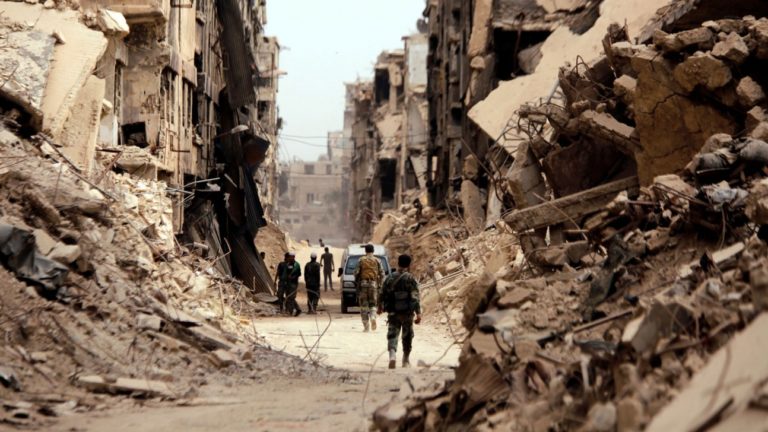
Syria in ruins after ten years of conflict (File photo)
BY M. K. BHADRAKUMAR | INDIAN PUNCHLINE | MARCH 20, 2021
In George Orwell’s novel Animal Farm, the ruling pigs led by Napoleon constantly rewrote history in order to justify and reinforce their own continuing power. The rewriting by the western powers of the history of the ongoing conflict in Syria leaps out of Orwell.
The joint statement issued by the foreign ministers of the US, UK, France, Germany and Italy last week to mark the tenth anniversary of the Syrian conflict begins with an outright falsehood by holding President Bashar al-Assad and “his backers” responsible for the horrific events in that country. It asserts that the five western powers “will not abandon” the Syrian people — till death do us part.
The historical reality is that Syria has been a theatre of the CIA’s activities ever since the inception of that agency in 1947. There is a whole history of CIA-sponsored “regime change” projects in Syria ranging from coup attempts and assassination plots to paramilitary strikes and funding and military training of anti-government forces.
It all began with the bloodless military coup in 1949 against then Syrian president Shukri al-Quwatli which was engineered by the CIA. As per the memoirs of Miles Copeland Jr, the CIA station chief in Damascus at that time — who later actually went on to write a fine book of high literary quality on the subject — the coup aimed at safeguarding Syria from the communist party and other radicals!
However, the CIA-installed colonel in power, Adib Shaishakli, was a bad choice. As Copeland put it, he was a “likeable rogue” alright who had not “to my certain knowledge, ever bowed down to a graven image. He had, however, committed sacrilege, blasphemy, murder, adultery and theft” to earn American support. He lasted for four years before overthrown by the Ba’ath Party and military officers. By 1955, CIA estimated that Syria was ripe for another military coup. By April 1956, a joint CIA-SIS (British Secret Intelligence Service) plot was implemented to mobilise right-wing Syrian military officers. But then, the Suez fiasco interrupted the project.
The CIA revived the project and plotted a second coup in 1957 under the codename Operation Wappen — again, to save Syria from communism — and even spent $3 million to bribe Syrian military officers. Tim Weiner, in his masterly 2008 book Legacy of Ashes: The History of the CIA, writes:
“The president (Dwight Eisenhower) said he wanted to promote the idea of an Islamic jihad against godless communism. “We should do everything possible to stress the ‘holy war’ aspect,” he said at a 1957 White House meeting… (Secretary of state) Foster Dulles proposed a “secret task force,” under whose auspices the CIA would deliver American guns, money, and intelligence to King Saud of Saudi Arabia, King Hussein of Jordan, President Camille Chamoun of Lebanon, and President Nuri Said of Iraq.”
“These four mongrels were supposed to be our defence against communism and the extremes of Arab nationalism in the Middle East… If arms could not buy loyalty in the Middle East, the almighty dollar was still the CIA’s secret weapon. Cash for political warfare and power plays was always welcome. It could help an American imperium in Arab and Asian lands.”
But, as it happened, some of those “right-wing” officers instead turned in the bribe money and revealed the CIA plot to the Syrian intelligence. Whereupon, 3 CIA officers were kicked out of the American embassy in Damascus, forcing Washington to withdraw its ambassador in Damascus. With egg on its face, Washington promptly branded Syria as a “Soviet satellite”, deployed a fleet to the Mediterranean and incited Turkey to amass troops on the Syrian border. Dulles even contemplated a military strike under the so-called “Eisenhower Doctrine” as retaliation against Syria’s “provocations”. By the way, Britain’s MI6 was also working with the CIA in the failed coup attempt; the details came to light accidentally in 2003 among the papers of British Defence Minister Duncan Sandys many years after his death.
Now, coming down to current history, suffice to say that according to the WikiLeaks, since 2006, the US had been funding London-based Syrian dissidents, and the CIA unit responsible for covert operations was deployed to Syria to mobilise rebel groups and ascertain potential supply routes. The US is known to have trained at least 10,000 rebel fighters at a cost of $1 billion annually since 2012. President Barack Obama reportedly admitted to a group of senators the operation to insert these CIA-trained rebel fighters into Syria.
The well-known American investigative journalist and political writer Seymour Hersh has written, based on inputs from intelligence officers, that the CIA was already transferring arms from its Benghazi station (Libya) to Syria around that time. Make no mistake, Obama was the first world leader to openly call for the removal of Assad. That was in August 2011. Then CIA chief David Petraeus paid two unannounced visits to Turkey (in March and September 2012) to persuade Erdogan to step in as the flag carrier of the US’ regime change project in Syria (under the rubric of “anti-terror fight”.)
In fact, the US’ key allies in the Persian Gulf — Saudi Arabia, Qatar and the UAE — took the cue from Obama to loosen their purse strings to recruit, finance and equip thousands of jihadi fighters to be deployed to Syria. Equally, from the early stages of the conflict in Syria, major western intelligence agencies provided political, military and logistic support to the Syrian opposition and its associated rebel groups in Syria.
Curiously, the Russian intervention in Syria in September 2015 was in response to an emergent imminent defeat of the Syrian government forces at the hands of the jihadi fighters backed by the US’ regional allies. Saudi Arabia withdrew from the arena only in 2017 after the tide of the war turned, thanks to the Russian intervention.
The joint statement issued last week by the US and its NATO allies belongs to the world of fiction. In reality, there is Syrian blood in the hands of these NATO countries (including Turkey) and the US’ Gulf allies. Look at the colossal destruction that the US has caused: in the World Bank’s estimation, a cumulative total of $226 billion in gross domestic product was lost to Syria due to the war from 2011 to 2016 alone.
The Syrian conflict has been among the most tragic and destructive conflicts of our time. Hundreds of thousands of Syrians have died, half a nation has been displaced, and millions have been forced into desperate poverty and hunger. In the UNHRC estimation, after ten years of conflict, half of the Syrian population has been forced to flee home, 70% are living in poverty, 6.7 million Syrians have been internally displaced, over 13 million people need humanitarian assistance and protection, 12.4 million people suffer from lack of food (or 60% of the entire population), 5.9 million people are experiencing a housing emergency and nearly nine in 10 Syrians are living below the poverty threshold.
And, come to think of it, Syria used to have one of the highest levels of social formation in the entire Muslim Middle East. It used to be a middle income country until the US decided to destabilise Syria. Ever since the late 1940s, the US’ successive regime change projects were driven by geopolitical considerations. The agenda is unmistakeable: the US has systematically destroyed the heart, soul and mind of “Arabism” — Iraq, Syria and Egypt — with a view to perpetuate the western [Zionist] domination of the Middle East.
Former President Donald Trump intended to withdraw the US troops from Syria and end the war. He tried twice, but Pentagon commanders sabotaged his plans. What Joe Biden proposes to do is anybody’s guess. Biden doesn’t seem to be in any rush to withdraw the US troops.
The most disturbing aspect is that the US is methodically facilitating a Balkanisation of Syria by helping the Kurdish groups aligned with it to carve out a semiautonomous enclave in the country’s northeast. In fact, the the Arab population in northeastern Syria resents being under the Kurds’ governance, and this may eventually turn into a new source of recruits for Islamic State. Meanwhile, Turkey seized the US-Kurdish axis as alibi to occupy vast territories in northern Syria.
The sad part of the joint statement by the US and its European allies is not only that it is rewriting history and spreading falsehood but conveys a sense of despair that there is no hope for light at the end of the tunnel in the Syrian conflict in a conceivable future.
The US policy in Syria is opaque. It has oscillated between aiming to prevent a resurgence of IS, confronting Iran, pushing back against Russia, providing humanitarian aid, and even protecting Israel, while the crux of the matter is that successive US administrations have failed to articulate a clear strategy and rationale for the US military presence in Syria.
How China is Going to Reshape Asia
By Salman Rafi Sheikh – New Eastern Outlook – 01.04.2021
With China and Iran signing a multi-billion dollar deal for the next 25 years, there remains little gainsaying that the former is going to increase its footprint in West Asia/Middle East in a way that once was thought to be unimaginable for reasons that included China’s own economic policies and West Asia’s too close ties with the West to allow for any players. Forces of economic change that China is unleashing will not only become a massive boost for Iran, but Iran will become a gateway for China’s further expansion into the Middle East, including countries, such as Saudi Arabia and the UAE, that Iran rivals. For China, its presence and expansion in the Middle East is not merely about economic benefits; this presence is equally driven by the emerging US-China global rivalry and China’s desire to push back against erstwhile US hegemony and domination of the Middle East since the Second World War.
As such, when China’s foreign minister went on a tour to the Middle East last week, he was not merely looking to sign a deal with Iran; he was more interested in and largely focused on introducing new rules of the game that focus, first and foremost, on economic engagement and connectivity. Rather than traditional Gulf tensions. Therefore, while Wang Yi met Saudia’s Crown Prince, MBS, and supported Saudi stance to oppose any “interference” in the internal affairs by any external player, Wang also offered MBS, who is currently not on good terms with the Joe Biden administration, an opportunity to engage with China “to explore and find a path of development that fits its own conditions.” This path, as Wang emphasised in an interview with Saudia’s official news channel, Al Arabiya, can be found only when Gulf countries can “break free from the shadows of big-power geopolitical rivalry and [be able to] independently explore development paths suited to its regional realities.”
As it stands, China has offered Saudi Arabia the same path it has signed up with Iran. Therefore, China, while it does not want to get entangled in the cross-web of geo-political rivalries in the Persian Gulf, aims to chart a new course whereby countries in the region can stick to an agenda that maintains a strict separation between geo-economics and geo-political and/or ideological rivalries including those around Sunni & Shia faiths and organisations like Muslim Brotherhood.
Therefore, while China signed a multi-billion dollar deal with Iran that includes development projects and enhanced oil production and supplies, China’s growing ties with Saudi Arabia, too, include an increasing Saudi desire to enhance Saudi supply of oil to China and secure Chinese investment in fields ranging from petrochemical, nuclear energy and other energy fields, further expanding it into new fields such as 5G, telecommunication and digital technologies. Saudi Arabia, MBS affirmed, is also willing to make joint efforts with China to push forward the free trade negotiations between China and Gulf countries.
Therefore, by offering both rivals a somewhat similar paradigm of economic development that bypasses geo-political tensions and rivalries, China is building an economic landscape that would leave minimum room for external payers, like the US, to continue to manipulate the Gulf to its advantage as it has been doing for the past many decades.
As such, whereas Chinese investment in Iran offers the latter an opportunity to break economic shackles imposed by the US through economic sanctions, for Saudi Arabia, China offers an opportunity to reshape its ties with the US at a time when the Joe Biden administration appears unwilling to accept MBS as the future king.
By offering states in the Gulf an opportunity to diversify their external geo-economic ties and reduce dependence on the US, China is posing a serious challenge to the US position in West Asia, which has mostly relied on using the precarious geo-political scenario to keep itself militarily entrenched and maintain a relationship that served, first and foremost, the US military industrial complex. At the same time, for the Middle Eastern states, China’s economic path is a way out of their decades old reliance on oil as a primary source of national income.
For China itself, it is pivoting to the Middle East at a time when the Joe Biden administration is trying to assemble an anti-China coalition through the QUAD, a group of countries that includes the US, Japan, India and Australia. China, by simultaneously approaching rival countries like Saudi Arabia, Iran, Turkey and the UAE, is posing a counter-challenge to the US ambitions, making it more and more difficult for the US to realise its “containment” of China ambitions at the global level.
The fact that China’s multi-billion dollar deals have received a very warm reception speaks volumes about how the Gulf itself is keen to transform its geo-economic landscape. In this sense, China-Gulf ties become, unlike US-Gulf ties, a fruit of a path that converges to serve mutual interests.
China’s pact with Iran and its deepening ties with other Gulf countries, therefore, has the potential to completely upend the prevailing geo-economic scenario. With the Gulf countries’ ability to diversify their ties and radically reduce their over-dependence on the US, the region’s geo-political scenario could also undergo a dramatic change.
Therefore, it would be wrong to grasp China-Iran deal as an isolated event. The fact that Wang has toured Iran, Saudi Arabia, Turkey, Oman, and the UAE shows how China is embracing the region as a whole through a single framework of policy that is very largely underpinned by economic development. The fact that Saudi Arabia, to China’s utter joy, even refused to back the US campaign against China’s alleged “genocide” of Uyghur shows how China, to the disappointment of the US, continues to earn more and more acceptability.
Salman Rafi Sheikh is a research-analyst of International Relations and Pakistan’s foreign and domestic affairs.
Crashing Saudi Oil Economy Explains Urgent Yemeni Peace Offer
By Finian Cunningham | Strategic Culture Foundation | March 26, 2021
After six years of blowing up Yemen and blockading its southern neighbor, the Saudi rulers are now saying they are committed to finding peace. The move is less about genuine peace than economic survival for the oil kingdom.
The Saudi monarchy say they want “all guns to fall completely silent”. Washington, which has been a crucial enabler of the Saudi war on Yemen, has backed the latest “peace offer”. Secretary of State Antony Blinken this week endorsed the initiative from the Saudi rulers, saying he had spoken with them “on our work together to end the conflict in Yemen, facilitate humanitarian access and aid for the Yemeni people”.
The Saudi foreign ministry stated: “The initiative aims to end the human suffering of the brotherly Yemeni people, and affirms the kingdom’s support for efforts to reach a comprehensive political resolution.”
Can you believe this sickening duplicity from the Saudis and the Americans?
So, after six years of relentless aerial bombing in Yemen causing the world’s worst humanitarian crisis, according to the United Nations, the Saudis and their American military supplier, seem to have developed a conscience for peace and ending suffering.
The real reason for trying to end the conflict is the perilous state of the Saudi oil-dependent economy. Saudi Aramco, the state-owned oil, gas and petroleum industry, recently announced that its profits have slumped by nearly half in 2020 compared with the year before. Down from $88 billion to $49 billion.
Given that its oil economy provides nearly 90 per cent of state budget that is a stupendous hit on the Saudi finances. The Saudi rulers rely on hefty state subsidies to keep its 34 million population content. With income from the oil industry nosediving that means state deficits will explode to maintain public spending, or else risk social unrest from dire cutbacks.
Saudi Arabia remains the biggest oil exporter, but due to the Covid-19 pandemic and world economies going into recession crude oil prices have plummeted. At one point oil prices fell to around $20 a barrel. The Saudi economy needs an oil price of around $70 a barrel to reel in a profit.
The upshot is the Saudi war in Yemen has become a critical drain on state finances and potentially jeopardizing the superficial stability of the absolute monarchy.
Of further alarm is the increasing missile and drone attacks by the Houthi rebels in Yemen on key Saudi locations, including the capital Riyadh.
The Yemeni rebels are escalating airstrikes on Aramco installations at its headquarters in Dhahran and Dammam in Eastern Province, as well as in the cities of Abha, Azir, Jazan, and Ras Tanura. The targets include oil refineries and export terminals. The Saudis claim they have intercepted a lot of the missiles with U.S.-made Patriot defense systems. Nevertheless, the mere fact that the Yemenis can hit key parts of the Saudi oil economy over a distance of 1,000 kilometers is a grave security concern undermining investor confidence.
The first major strike was in September 2019 when Houthi drones hit the huge refinery complex at Abqaiq. That caused Saudi oil production to temporarily shut down by half. It also delayed an Initial Public Offering of Aramco shares on the stock market as investors took fright over political risk.
At a time when the Saudi oil economy is contracting severely due to worldwide circumstances, an additional debilitating threat is the intensifying campaign of Houthi airstrikes. They are taking the war into Saudi heartland.
The Biden administration has condemned the Houthi missile attacks on Saudi Arabia as “unacceptable”. Such American concern is derisory given how Washington has been providing warplanes, missiles and logistics for the Saudis to indiscriminately bomb Yemen causing tens of thousands of deaths. The Americans also enable the Saudis to impose a blockade on Yemen’s sea and airports, which has prevented vital food and medicines from being supplied to the country. Nearly 80 per cent of Yemen’s 30 million population are dependent on foreign aid deliveries. The blockade is a war crime, a crime against humanity, and the Americans are fully complicit.
President Joe Biden has said he is ending U.S. military support for Saudi Arabia’s war in Yemen. It was an election promise. However, it is not clear what military support the U.S. has actually stopped, if at all. The Saudi bombing of food depots continues and the blockade on the country could not be maintained without essential American logistics.
More cynically, the Biden administration realizes that the Saudis started a war back in March 2015, when Obama was president and Biden was vice-president, that has turned into an un-winnable quagmire whose horrendous human suffering has become a vile stain on America’s international image.
That’s why Biden and his diplomats have been urging the Saudi rulers to sue for peace. Now it seems the Saudi monarchy realizes that the reckless war launched by “defense minister” Crown Prince Mohammed bin Salman has come with a price that they can’t afford to sustain if they want to preserve their rickety house of cards, known as the House of Saud.
On the latest peace proposal, the Yemeni rebels have rejected it out of hand. They say it contains “nothing new”. The Houthis say the only way to end the war is for the Saudis and their American sponsors to end the aggression on their country. There is no “deal”. It is a case of the Saudis and the Americans just getting out.
Meantime, the airstrikes on Saudi oil infrastructure are going to continue with ever-increasing damage to the royal coffers. Thus, the Saudi rulers have no choice but to unconditionally surrender in this criminal war. They are facing a humiliating defeat as the Yemenis take revenge and Uncle Sam washes his hands of blood.
Rights group slams exclusion of Israel, Saudi-led coalition from UN’s children-in-conflict blacklist

Press TV – March 19, 2021
A group of child rights experts has strongly criticized the UN secretary-general for excluding eight parties, including the Israeli regime and the Saudi-led coalition, from a global blacklist of parties accountable for harming children during conflicts.
In a report, experts from Watchlist on Children, an international child rights group, said at least eight parties to conflicts were found responsible for killing and maiming more than 100 children in a single year but were excluded from the blacklist.
There were “numerous discrepancies and omissions in listing decisions, as well as unwarranted delisting decisions,” the report said, noting that the UN Security Council’s 2001 resolution establishing the list to protect children from the horrors of war “is being seriously undermined” and could result in “putting children at even greater risk.”
“The secretary-general’s 2015 annual report acknowledges that the number of children killed by Israel in 2014 was the third highest in the world and the number of schools damaged or destroyed was the highest anywhere in the world that year, and yet Israel has not been listed in the report’s annexes,” the report said.
It added that at the time the news media reported that Israel and the United States conducted intense lobbying to prevent the regime’s blacklisting.
The child rights experts also cited annual reports that have repeatedly found Israeli forces responsible for high levels of Palestinian child casualties, including over 1,525 killed and maimed in 2020 alone.
“Yet Israeli forces have yet to be included in the annexed list of violators,” they added.
According to the AP, co-author Yanghee Lee, former chair of the committee that monitors implementation of the UN Convention on the Rights of the Child, said: “We are calling on the secretary-general to urgently address these problems and commit to hold all countries and groups responsible for violations against children accountable without fear or favor.”
In response to the report, UN spokesman Stephane Dujarric said Secretary-General Antonio Guterres stands by the report’s conclusions, expressing willingness to engage with relevant partners in how to improve the system.
Benyam Dawit Mezmur, another co-author of the report urged the UN to ensure that the list of perpetrators it issues is “more credible, accurate, complete, and evidence-based, or risk pulling apart this unique tool for the protection of children caught in war.”
The report also said the Saudi-led war coalition against Yemen was delisted in 2020 for killing and maiming children in the Arab country, despite being responsible for a documented 222 child casualties during the reporting period.
“With this delisting, the Saudi-led coalition has been removed from the Secretary-General’s list altogether,” it noted.
Citing the Secretary-general’s reports that said the Saudi-led coalition was delisted due to a “sustained significant decrease” in the number of violations they committed, the rights experts said such argument runs counter to the established delisting criteria.
“This runs counter to the delisting criteria established in 2010 and the Security Council’s stated expectations that listing is based on whether or not grave violations against children took place in violation of international obligations,” they maintained.
According to the UN Office for the Coordination of Humanitarian Affairs (OCHA), the Saudi war on Yemen has killed a quarter of a million people, including women and children, since it was launched in March 2015 with the aim of restoring the Riyadh-friendly government of former President Abd Rabbuh Mansour Hadi.
Trade-Off ahead on Syria and Yemen
By Ghassan Kadi for the Saker Blog | March 16, 2021
In the past few weeks much has happened in the area of diplomacy on the part of Russia. Russia is forging ahead after stepping up its presence in the Middle East in the past decade, taking a strong pro-active political role. Moscow during this period has been intent on consolidating its efforts in re-establishing itself as the key player in any political settlements in the Middle East. Ever since Kissinger in the late 1970’s pulled the rug out from underneath the feet of the USSR, striking a deal between Israel and Egypt, excluding the USSR and the rest of the Arab World, the political influence of Russia in the Middle East significantly waned until it came back with deciding force when Russia responded to the Syrian Government’s request for help in September 2015.
Lately, the economic crisis has deepened in Syria following the drastic Western sanctions. And specifically after the implementation of the Caesar’s Act, the Syrian currency took a huge tumble and the cost of living has soared to unprecedented levels. This left many cynics wondering and pondering what was Russia going to do in the face of the collapsed Syrian economy after having achieved an impressive military victory, taking its troops outside its former USSR borders for the first time and heralding the end of the single super power status of the USA.
To this effect, and on the diplomatic side, Russian FM Lavrov has recently visited Saudi Arabia, Qatar and the UAE for talks pertaining to an array of issues. The agenda issues that transpired to the media include trade, the Russian Sputnik V vaccine, as well as issues of global and regional security, albeit vague in details as what ‘security issues’ mean.
It appears that in these meetings, discussions included the return of Syria to the Arab League and the cost of reconstruction of Syria after ten years of war, a bill touted to exceed $Bn200. Expectations have existed for some time that the Arab Gulf states will fork out a huge chunk of this cost. As mentioned above, the bottom line here is that Russia’s military success in its operation in Syria needs to be followed by political success. Partly, this is achieved within the Astana talks which include Turkey and Iran. However, the very same Arab States instrumental in the ‘War on Syria’ are also instrumental in facilitating the return of Syria to the Arab League, the reconstruction efforts in Syria and the easing of sanctions. The Gulf states have always reiterated that there will be no return of Syria to the Arab League for as long as Iranian forces remain on the ground. The UAE seemed more open than Saudi Arabia to the prospects of Syria’s return to the Arab League and financing the reconstruction process.
But why would the Gulf States, the same states that spent tens of billions of dollars in order to destroy Syria, be suddenly now interested in the reversal of the process? This is a fair question to ask.
Quite unexpectedly, and almost immediately after the return of Lavrov to Moscow, a top delegation of Hezbollah, headed by Mohamad Raad, was invited to Moscow for talks. Apparently, the visit was cloaked in a veil of secrecy in Russia and was not at all covered in Western media, even though it made news in Arabic mainstream media. It would be politically naïve to imagine that Lavrov’s visit to the Gulf has no relation to this. All issues in the Middle East are related to each other, including the war in Yemen.
To put it succinctly, the UAE had already stepped away from the Yemen war. However, Saudi Arabia remains bogged down in this travesty and seven years on, must have come to the humiliating and painful realization that it is a war it cannot win. This is where Iran and Hezbollah can have leverage in any direct or indirect negotiations with the Saudis, and Russia is the only arbitrator who is able to communicate with all parties involved.
All parties in the Middle East are looking for face-saving tradeoffs; at least partial and interim ones. The Saudis in particular are tired and exhausted.
In an interview given to Sputnik Arabic, one not widely reported in other media, not even Sputnik English, Raad praised the cooperation between Hezbollah and Russia, stating that ‘the invitation we received aims to reopen the dialogue about the next phase after having reached the achievements that serve the interests of the people of the region in the recent past’ .
This is Raad’s first visit to Moscow since 2011. Of that visit, I am not trying to speculate in hindsight of the purpose of it and the achievements of it. Furthermore, Hezbollah has not ever been party to any international dis-engagement or peace negotiations in the past, except for ones relating to exchange of prisoners. The economic demise of Syria and Lebanon, as well as the Saudi-Yemeni impasse, may well have placed Hezbollah in a position of participating in peace-deals negotiations this time.
I am neither referring to peace deals with Israel here, nor any deal involving disarmament. Hezbollah will not be prepared to negotiate disarming itself under any political settlement either today or in the foreseeable future, and Moscow is totally aware of this.
According to my analysis, the deal that Moscow is most likely to suggest is a mutual withdrawal of Iran and Hezbollah from Syria on one hand, and an end of the Saudi war on Yemen. It is simple, Saudi Arabia to leave Yemen and Iran/Hezbollah to leave Syria. I believe that Lavrov has already secured the Saudi acceptance of those terms, terms that will not only end the war in Yemen, but also the return of Syria to the Arab League and a possible easing of the Western economic sanctions on Syria. Had Lavrov not secured the Saudi assurance, he would not have invited Hezbollah for talks.
A deal of this nature can potentially end the criminal human tragedy in Yemen in a manner that will portray the Saudis as the real losers in the war, and this is where they need a face-saving trade-off in Syria. In Syria, they will be perceived as winners by securing an Iranian/Hezbollah exit. But most importantly perhaps for the Saudis, this will put an end to a very costly and humiliating war in Yemen, one which is beginning to draw criticism from some quarters of the international community, including alleged talk of America considering placing arms deal embargos on Saudi Arabia.
On the other hand, if Iran and Hezbollah end their presence in Syria, many sanctions are likely to be lifted and the severe economic pressure in Syria will be eased. Such a deal will be a humanitarian win for Syria and Yemen, a strategic win for Saudi Arabia and Iran, and a diplomatic win for Russia.
What will be in it for Hezbollah will largely depend on what Lavrov has put on the table, and it seems obvious that it is Hezbollah that will need more convincing than Iran, and this is why the talks are now with Hezbollah; not with Iranian officials. Perhaps the deal already has the tacit approval of Iranian officials.
It goes without saying; Israel will be watching these developments with keen interest. Israel wants Iran and Hezbollah out of Syria. But the trade-off deal I am talking about is not one in which Israel is a direct party.
What is known at this stage is that a meeting has already taken place between the Hezbollah delegation and Russian officials. As I write this, I am not aware if other meetings are to follow and or whether or not the Hezbollah delegation is back in Lebanon.
Was the 2011 Moscow visit of Raad a prelude for Hezbollah to enter Syria? Will the 2021 visit be prelude for Hezbollah to leave Syria? We don’t know. We may never find out the actual detailed outcome of the mysterious-but-not-so-mysterious current Hezbollah visit. It may not even end up with a press release, but in the next coming days, we will find out if a Syria-Yemen trade-off is indeed looming.
Saudi regime to displace 521 families, raze houses in Shia-majority Qatif
Press TV – March 16, 2021
The Saudi regime plans to displace hundreds of families in Saudi Arabia’s Shia-majority Qatif region and raze their houses as part of a crackdown on dissent.
Nashet Qatifi, a renowned Saudi human rights activist, said in a post on his Twitter account on Monday that the Riyadh government had announced plans for the eviction of more than 521 families from Qatif within 90 days as well as the destruction of their houses in retaliation for their children’s participation in a 2011 anti-regime uprising.
Local sources in the Shia-majority region confirmed the Saudi plan and said the regime intended to displace hundreds of families from al-Thawra (Revolution) Street in the city center.
Reports said the goal of the Saudi regime was to erase any signs and memories of the demonstrations in 2011, especially al-Thawra Street, which had become a symbol of the revolution and protests in Qatif.
A similar incident took place in the al-Masura district of Qatif in 2017, and many houses were destroyed by bulldozers. In November last year, Saudi officials also leveled to the ground a Shia Muslim mosque south of al-Awamiyah Town in Qatif.
Saudi Arabia’s Eastern Province has been the scene of peaceful demonstrations since February 2011. Protesters have been demanding reforms, freedom of expression, the release of political prisoners, and an end to economic and religious discrimination against the oil-rich region.
The protests have been met with a heavy-handed crackdown by the regime, whose forces have ramped up measures across the province.
Ever since Mohammed bin Salman became Saudi Arabia’s de facto leader in 2017, the kingdom has ramped up arrests of activists, bloggers, intellectuals, and others perceived as political opponents, showing almost zero tolerance for dissent even in the face of international condemnations of the crackdown.
Muslim scholars have been executed, women’s rights campaigners have been put behind bars and tortured, and freedom of expression, association, and belief continue to be denied.
US ‘ceasefire plan’ meant to prolong Yemen’s descent into turmoil: Ansarullah
Press TV – March 13, 2021
The spokesman for Yemen’s popular Houthi Ansarullah movement has dismissed the US proposal for a nationwide ceasefire in the war-torn country, saying the plan would plunge Yemen further into turmoil.
“The US plan doesn’t include breaking the siege or ceasing fire. It is actually a detour which would lead to a resumption of a (Saudi) blockade diplomatically,” Mohammed Abdul-Salam said in an interview with Yemen’s al-Masirah television Friday evening.
“One of the conditions presented in the initiative is to determine the destinations of flights departing Sana’a airport, and for the coalition of aggression to issue flight permits. This means they are not licensed here in Sana’a,” he said.
“If they were serious to stop the aggression and siege, they would have declared a complete end to hostilities and blockade. We would then welcome the measure. Aggression and siege against Yemen have not stopped even for a single day over the past six years, so what is the US concept of ceasing fire or breaking the siege?” Abdul-Salam added.
The Ansarullah spokesman said the US presentation of Saudi conditions as a so-called peace plan once again proved that Washington explicitly supports the Saudi war and blockade against Yemen.
He further noted that what the US special envoy on Yemen, Tim Lenderking, presented was a plot to plunge the Arab state further into turmoil.
“It is unacceptable for an American envoy to present a plan which is inferior to that of the United Nations special envoy for Yemen (Martin Griffiths),” Abdul-Salam said.
He said there is no real change towards ending the Saudi war and lifting the siege, stressing that such matters lie in the hands of the other side.
“They want us to respond through dialogue to what they have not achieved by means of war and siege. Everyone must realize such a fact,” the senior Ansarullah official added.
Abdul-Salam also rejected as “a big lie” the US envoy’s allegations that humanitarian aid deliveries have not been distributed among the needy Yemenis, stating that the coalition of aggression illegally impounds Yemen-bound oil vessels irrespective of the fact they all have acquired international permits beforehand.
“We have accepted all conditions proposed by other parties to ensure the delivery of humanitarian assistance. Having found no excuse to continue the blockade, they are alleging aid deliveries have not reached those in need,” the Ansarullah spokesman said.
Houthi: Trust in US comes from actions, not words
A member of Yemen’s Supreme Political Council said Ansarullah is ready to return to the negotiating table with a serious goal of ending the conflict, but it must first see concrete steps from the administration of US President Joe Biden.
“Trust is built by actions, not words,” Mohammed Ali al-Houthi told CNN on Friday.
“Trust must be achieved through decision-making. So far, we have not seen any concrete decisions being made,” he added.
He noted that President Biden was a member of former US president Barack Obama’s administration, which declared at the time that Washington was joining the Saudi-led coalition against Yemen.
“They also gave the green light to the coalition to continue massacre in our country and agreed to it,” Houthi added.
‘Washington must drop Saudi conditions’
Abdul-Malik al-Ajri, a member of Ansarullah’s political bureau, said on Friday that his movement views the US ceasefire proposal in favor of Saudi Arabia, and would not accept it.
“The US special envoy on Yemen [Tim] Lenderking has presented proposals to end the war and has called on Ansarullah to respond,” Ajri wrote in a post published on his Twitter page.
“The truth is what he has offered is the same as Saudi Arabia’s conditions for a ceasefire. Linderking should know in case such suggestions were acceptable, we would have directly received them from Saudi Arabia. There was then no need for the US envoy to repeat Saudis’ narrative.”
Lenderking: Ansarullah’s ability is undeniable fact
The top US diplomat for Yemen on Friday touched on the role of Ansarullah and said its ability is a straightforward fact.
Lenderking said during a webinar with the Atlantic Council think tank that the movement is a “significant player” in Yemen and it needs to be acknowledged.
“I don’t think you can operate by denying that reality,” he said, claiming that the US “never said the Houthis have no role in Yemen.”
Lenderking, who recently returned from a three-week trip to the region, added that Washington is looking for the Ansarullah’s response to its peace plan.
“I will return immediately when the Houthis are prepared to talk,” Lenderking noted.
Hypocritical Outrage over Khashoggi’s Assassination
By Jacob G. Hornberger | FFF | March 9, 2021
The mainstream media is outraged over President Biden’s decision to not level sanctions on Saudi Crown Prince Mohammed bin Salman for his purported assassination of Saudi dissident Jamal Khashoggi, who was a prominent columnist for the Washington Post. The CIA concluded that bin Salman ordered the assassination but U.S. officials have sanctioned only lower-level Saudi officials, choosing to leave bin Salman untouched by U.S. sanctions.
The outrage is a model of the hypocrisy that pervades the mainstream media. After all, these people just block out of their minds that the U.S. national-security state is every bit as brutal as Saudi officials are. Moreover, when it comes to the number of state-sponsored assassinations carried out on an annual basis, bin Salman and Saudi Arabia don’t even come close to matching those carried out by the world’s assassination nation.
Just look at the state-sponsored assassinations that are carried out by the Pentagon and the CIA in the Middle East, Africa, and Afghanistan every month. They have become so normalized — so much a regular part of American life — that the mainstream press has become totally blasé about them. No moral outrage at all.
Of course, Pentagon and CIA officials, along with their acolytes in the mainstream press, would respond, “Jacob, we are only killing terrorists. The Saudis killed an innocent man.”
Oh? And who exactly is a “terrorist.” Is it someone who criticizes a regime? Or is it someone who actually commits a terrorist act? And who makes that determination? If bin Salman concluded that Khashoggi was a terrorist who was trying to bring down the Saudi regime, would the U.S. mainstream press be coming to his defense?
Let’s consider the U.S. assassinations of Anwar al-Awlaki and his 16-year-old son Abdulrahman. Both of them were U.S. citizens, just as Khashoggi was a Saudi citizen. Where is the outrage among the mainstream press over those two assassinations of American citizens at the hands of their own government?
Oh yes, U.S. officials and their assets in the mainstream press would say that Anwar al-Awlaki was a terrorist. Really? What does that mean? Does it mean that he criticized the U.S. national-security state for its brutal imperialist policies? Or does it mean that he actually engaged in criminal acts of terrorism? If that is the case, who made that determination? I don’t recall there ever being criminal trial in which an American jury listened to evidence and concluded beyond a reasonable doubt that al-Awlaki was guilty of some act of terrorism. All I recall was that U.S. officials concluded that al-Awlaki was a terrorist and, therefore, needed to have his life snuffed out. I also recall that the U.S. Supreme Court, in its customary deference to the authority of the national-security establishment, affirmed the decision to assassinate this American citizen, which snuffed out his life without any due process of law.
U.S. officials claim that 16-year-old Abdulhahman was the unfortunate collateral damage from the U.S. assassination of someone nearby. Even if that’s true — and it might not be — what was the justification for firing a missile at that person, especially knowing that it would end up killing everyone around him? Who died and made the Pentagon and the CIA the deciders of life and death of other people?
The fact is that U.S. and Saudi officials have no business assassinating anyone. The U.S. mainstream press is good at recognizing the wrongfulness of assassinating Khashoggi. Their loyalty to the Pentagon and the CIA, however, has given them a moral blindness that prevents them from recognizing the wrongfulness of state-sponsored assassinations carried out by the U.S. national-security establishment.
It’s also revealing that the mainstream press is calling for sanctions to be imposed on bin Salman but not calling for terminating the U.S. government’s armed sales to the Saudi regime. Yet, it’s those weapons that help the Saudi regime maintain its brutal tyranny over the Saudi people. And remember: the U.S. mainstream press is always calling for new gun-control measures — except when it comes to the U.S. government’s sales of guns to overseas pro-U.S. tyrants.
Notice also that the U.S. government continues to send U.S. taxpayer-funded foreign aid to brutal and tyrannical regimes, such as to Egypt’s tyrannical military dictatorship. That foreign aid helps to maintain the brutal tyranny that is enforced against the citizens under those regimes. No outrage there among the U.S. mainstream press. On the contrary, they continue to support foreign aid being sent to brutal and tyrannical pro-U.S. regimes.
It’s all just a valuable lesson in what can be called Hypocrisy 101.
Featured Video
Your Enslavement Begins in Gaza: The ‘Board of Peace’
or go to
Aletho News Archives – Video-Images
From the Archives
The US: The Century of Lost Wars
By James Petras | Global Research | September 12, 2018
Introduction
Despite having the biggest military budget in the world, five times larger than the next six countries, the largest number of military bases – over 180 – in the world and the most expensive military industrial complex, the US has failed to win a single war in the 21st century.
In this paper we will enumerate the wars and proceed to analyze why, despite the powerful material basis for wars, it has led to failures. … continue
Blog Roll
 Aletho News
- U.S. General Caine Warns: STRIKING IRAN is a HUGE RISK /Glenn Diesen & Lt Col Daniel Davis
- Israel designates five Palestinian media outlets as ‘terrorist organizations’
- Israel, not America, first: Carlson’s Huckabee interview lays bare US foreign policy priorities
- Israeli troops executed Palestinian aid workers at ‘point blank range’: Report
- Iran war What if today’s Iran is resigned to a long, hellish war with the US?
- Why Israel Is Escalating Its War Crimes Against Lebanon
- Iran in the face of the armed diplomacy of imperialism
- The US build-up around Iran constitutes strategic war option, not ‘deterrence’
- Iran to US: Sanctions and war failed; try diplomacy and respect
- China supplies Iran with radar, surveillance tech to track US stealth aircraft: Report
- If Americans Knew
- Footage Shows Israeli Troops Waiting in Ambush, Then Opening Fire on a Palestinian Teen
- The US is on the brink of a major new war that Trump has not even bothered explaining
- Latest Epstein document dump is one more cover-up
- No Protection, No Justice: US Citizens Killed with Impunity by Israel
- Maria Farmer: Epstein Victim Reveals Explosive Information Covered Up by Media
- Average of five Palestinians killed by Israel every day in Gaza since ceasefire – Not a ceasefire Day 136
- Palestinian church leaders admonish Christian Zionist Mike Huckabee – Not a ceasefire Day 135
- Ominous messaging from Trump’s “Board of Peace” – Not a ceasefire Day 134
- ‘Christians Out’: Jerusalem Church Tagged With Hate Graffiti, Police Investigating
- Israeli Settlers Kill American Teen
- No Tricks Zone
- New Research Reaffirms Clouds, Aerosols, And Surface Solar Radiation Are ‘Driving The Climate System’
- Germany: Electric Car Catches Fire At Charging Station, Sets Off Local “Inferno”, Widespread Damage
- New Study: Canada’s New Brunswick Was 1°C Warmer Than Today During The Medieval Warm Period
- Coal Power Back In Trend As Globe Tries To Keep Pace With Growing Demand For Power
- New Study: A 4°C Warmer Beaufort Sea Had ‘No Sea Ice’ 11,700 – 8200 Years Ago
- Unfudging The Data: Dutch Meteorological Institute Reinstates Early 20th Centruy Heat Waves It Had Erased Earlier
- German Gas Crisis…Chancellor Merz Allegedly Bans Gas Debate Ahead of Elections!
- Pollen Reconstructions Show The Last Glacial’s Warming Events Were Global, 10x Greater Than Modern
- Germany’s Natural Gas Storage Level Dwindles To Just 28%… Increasingly Critical
- New Study Rebuts The Assumption That Anthropogenic CO2 Molecules Have ‘Special’ Properties
 Aletho News