USA and Israel Should be Worried: The Muslim Middle East is Moving Its Own Way
By Karsten Riise | Covert Geopolitics | December 7, 2023
Less than a month before Russia takes over the chairmanship of BRICS-11 where both UAE and Saudi Arabia will be full members, Russia makes a big move to bring cooperation with UAE and Saudi Arabia to an unprecedented level.
Russia ties everything together in this meeting: Head of States relations, Foreign Policy, Non-Dollar currency and Financial Policy, Industrial Policy, Nuclear Cooperation, Artificial Intelligence (AI), Space Development, International Direct Investments – and the whole private Business sector.
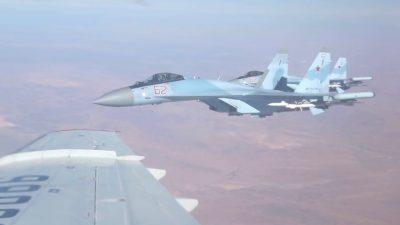 Note also that Putin travels safely in person to both the UAE and Saudi Arabia.
Both UAE and Saudi Arabia are visited by President Putin, Foreign Minister Lavrov, First Deputy Prime Minister of the Russian Federation Andrei Belousov, head of the Ministry of Industry and Trade Denis Manturov, Deputy Prime Minister Alexander Novak, head of the Central Bank Elvira Nabiullina, head of Roscosmos Yuri Borisov, head Rosatom Alexey Likhachev, and head of Russian Direct Investment Fund (RDIF) Kirill Dmitriev.
The RDIF recently published a Russian international platform for AI services. The delegation also includes representatives of the business community. See this.
In cooperation with Russia and China, the UAE and Saudi Arabia are becoming not only oil powers, but powers in the modern AI, hi-tech knowledge and Space economy – and military powers.
The central Middle Eastern powers, UAE, Saudi Arabia, Iran, and even Türkiye, are emerging as pillars in the international policies of Russia and China – in all dimensions.
Algeria builds deeper relations with its biggest arms supplier Russia, and Algeria opens defense cooperation China. Russia and Egypt have also for years been reinforcing cooperation, including defense cooperation, nuclear cooperation (a Russian nuclear powerplant is being built) and trade-logistics (a Russian trade zone near the Suez Canal).
In Syria, Russia has already long ago stabilized the government in Damascus, and even in Iraq, Russia just a few days ago took over Iraq’s biggest oil field and kicked out the biggest western player in Iraq’s oil sector.
Recently, Russia as the Chairman of BRICS-11 after 1 January 2024 even gave its nod of approval for the admission of China’s best friend Pakistan into BRICS in spite of Indian hesitations.
The Muslim Middle East is moving its own way – independently of the West. At a time when all the non-Western world including the Muslim world is outraged by Israel’s Nakba pressing out Palestinians with genocide on over 16,000 civilians in Gaza, Israel and its US backer should be worried.
Karsten Riise is a Master of Science (Econ) from Copenhagen Business School and has a university degree in Spanish Culture and Languages from Copenhagen University. He is the former Senior Vice President and Chief Financial Officer (CFO) of Mercedes-Benz in Denmark and Sweden.
Ministers from Arab, Muslim countries embark on China visit to end Gaza war
MEMO | November 19, 2023
Ministers from Arab and Muslim-majority countries are to head to China tomorrow as part of the first leg of a tour aimed at ending Israel’s genocidal war in Gaza, the Saudi Foreign Minister Prince Faisal bin Farhan said.
In an announcement shared on social media platform X, the Kingdom’s top diplomat said “The first stop will be in China and will then move to a number of capitals to deliver the clear message that there must be a ceasefire immediately as well as aid and humanitarian needs must be immediately delivered to Gaza.”
Prince Faisal made the comments after a meeting with EU foreign policy chief Josep Borrell on the sidelines of the Manama Dialogue 2023 conference in Bahrain.
“We must work to end this crisis and end this war on Gaza as soon as possible,” Prince Faisal added.
According to the Saudi Gazette, the extraordinary joint Arab-Islamic Summit, which was held in Riyadh last week, issued a resolution tasking the foreign ministers of Saudi Arabia, Jordan, Egypt, Qatar, Turkiye, Indonesia, Nigeria, and Palestine to initiate immediate international action on behalf of all member states of the Organisation of Islamic Cooperation (OIC) and the Arab League.
“The goal is to formulate an international initiative to halt the war in Gaza and push for a genuine and serious political process, leading to a permanent and comprehensive peace in accordance with established international references,” it said.
The forthcoming meeting in Beijing was confirmed today by China’s state broadcaster CCTV, citing the country’s foreign ministry spokesperson Mao Ning.
“During the visit, China will have in-depth communication and coordination with the delegation on ways to deescalate the ongoing Palestinian-Israeli conflict, protect civilians and seek a just settlement of the Palestinian question,” said Mao.
In May, a poll conducted for Arab News by Yougov found that the majority of Palestinian respondents – 80 per cent, preferred China as a potential peace broker in the conflict with the occupation state, with the US seen as the least trusted mediator.
READ ALSO:
President Bashar al-Assad speech on Gaza
Syriana Analysis | November 11, 2023
President al-Assad: Gaza has never just been a cause… Palestine is the Cause, and Gaza is the embodiment of its essence.
View at Odysee
If you’d like to support the channel:
🅿️ Patreon: https://www.patreon.com/Syrianaanalysis
▶️YouTube Membership: https://www.youtube.com/channel/UClvD…
💳 PAYPAL DONATIONS: https://www.paypal.me/kevorkalmassian
Biden laments Hamas attack on Israel ‘disrupted’ Saudi normalization
The Cradle | October 21, 2023
US President Joe Biden says that the historic Operation Al-Aqsa Flood carried out by resistance factions in Gaza aimed to disrupt a potential normalization of ties between Israel and Saudi Arabia.
“One of the reasons why they acted like they did, why Hamas moved on Israel, is because they knew I was about to sit down with the Saudis,” Biden said on 20 October at a campaign fundraiser in Washington. “Because the Saudis wanted to recognize Israel, and that would in fact unite [West Asia].”
His comments came five days after he told CBS’ 60 Minutes that the prospect of normalization was still alive.
“Look, it’s just going to take time to get done,” Biden said. “It’s going to take time. But the direction, moving into the normalization makes sense for the Arab nations as well as Israel.”
In the weeks leading up to 7 October – the day Hamas and other Gaza resistance factions successfully stormed Israel’s southern settlements – the White House had been working around the clock to seal a “megadeal” with Saudi Arabia that would have seen the kingdom normalize ties with Israel in exchange for a US-sponsored civilian nuclear program, access to more advanced US weapons, and a firm defense pact with Washington that would have forced the US to come to the kingdom’s aid in case of attack.
Furthermore, Saudi Arabia publicly demanded concessions for the Palestinians in exchange for signing a normalization deal, insisting on establishing a Palestinian State along the lines of the 2002 Saudi Peace Initiative to garner any possible support from the Islamic world.
“Every day we get closer [to a deal with Israel],” Saudi Crown Prince Mohammed bin Salman (MbS) told Fox News in late September.
“For us, the Palestinian issue is very important. We need to solve that part,” MbS added. “And we have a good negotiations strategy til now.”
However, in the wake of Israel’s campaign of genocide against the civilian population of Gaza, the kingdom was forced to “freeze” normalization talks and has thrown its support behind the plight of the Palestinians.
On Friday, the Saudi leader stressed the need “to stop military operations against civilians and infrastructure that affect their daily lives” and “create conditions to achieve lasting peace that ensures the establishment of a Palestinian state.”
The Saudi government has also refused to condemn the actions of the Gaza resistance, instead reminding Tel Aviv that Riyadh had issued repeated warnings of a possible escalation in light of “the ongoing occupation and the deprivation of the Palestinian people of their legitimate rights, as well as the repeated deliberate provocations against their sanctities.”
Debunking The Conspiracy Theory That Netanyahu Wanted Last Weekend’s Attacks To Happen
BY ANDREW KORYBKO | OCTOBER 9, 2023
Hamas’ sneak attack on Israel over the weekend prompted speculation among some on social media that the latter knew about these plans in advance but allegedly had an interest in letting them happen. According to proponents of this conspiracy theory, embattled Prime Minister Netanyahu wanted to unite his politically divided people and/or establish the pretext for destroying Hamas, ergo why he supposedly let these attacks unfold. That doesn’t make much sense though if one really thinks about it.
It’s fashionable nowadays to claim that leaders sometimes provoke foreign conflicts to distract from domestic political problems, but that’s arguably not the case with the latest Israeli-Hamas war. In fact, Netanyahu was pursuing the exact opposite approach up until last weekend as suggested by credible reports over the months that he was engaged in secret talks with Saudi Arabia over recognizing Israel. This was aimed at uniting Israelis around him and unlocking their country’s geo-economic potential.
Had these efforts borne fruit, then not only would his fiercest opponents have been forced to praise him for this diplomatic achievement, but Israel could then have profited from its central role in the India-Middle East-Europe Economic Corridor (IMEC) that was unveiled last month. Both goals required Saudi recognition of Israel, which Netanyahu hoped to obtain without recognizing Palestine’s independence, but that’s now in doubt since Riyadh might freeze these talks after Israel’s bombing of Gaza.
Those who claim that he knew about Hamas’ plans in advance but still let them happen are either unaware of his secret talks with Saudi Arabia, downplay their grand strategic importance, or think that they were all a ruse in preparation of this convoluted plot to establish the pretext for destroying Hamas. About that dimension of their conspiracy theory, it’s difficult to imagine that security-obsessed Netanyahu would let his country’s enemies inflict such unprecedented damage to Israel for that purpose.
He could always have simply exploited comparatively minor rocket fire to justify a disproportionate bombing campaign against that group without having to first lose literally hundreds of civilians and soldiers. Hamas’ breaching of the border barrier was also a strong blow to the Israeli psyche from which its people might never recover after having assumed that its construction would forever protect them. The same goes for that group doubling the territory under its control during the climax of its attacks.
Observers can still be opposed to the border barrier in particular, Israeli policy towards Palestine in general, and Netanyahu personally while also acknowledging that he’s such a security-obsessed leader that it doesn’t make sense to claim that he’d let Hamas powerfully undermine all three for any reason. He looks extremely weak after what happened, Israeli policy towards Palestine is now questioned from both sides like never before, and the border barrier is no longer deemed to be a credible defense.
These three outcomes represent the sum of Netanyahu’s worst nightmares, not to mention the likely failure of his plans to obtain Saudi recognition of Israel that would in turn unlock his country’s geo-economic potential via IMEC, all of which indisputably contradict Israeli interests. It remains unclear exactly how all of Israel’s security systems failed at the same time during last weekend’s attacks, nor has anyone explained the intelligence failures up until then either, but that’s indeed what happened.
The conspiracy theory speculating that Netanyahu knew about all this in advance but still let it happen doesn’t stand up to scrutiny as proven in this piece and is pretty much only predicated on the false perception that Israel’s intelligence services are omnipotent. They’re run by humans though and are therefore naturally imperfect, yet those who claim otherwise impart godlike power to the Mossad. This gives Israel too much credit while denying Hamas’ independent ability to organize attacks of this scale.
Saudi Arabia willing to forego oil production cuts to secure Israel normalization: Report
The Cradle | October 7, 2023
Saudi Arabia has offered Washington to boost oil production levels next year if crude prices are “too high” as part of negotiations to reach a normalization deal with Israel, the Wall Street Journal (WSJ) reported on 6 October.
This plan is allegedly aimed at winning over US lawmakers who are wary about Biden’s “megadeal” with Riyadh, which includes mobilizing US troops in case of an attack in the kingdom.
The deal would also see the US help Saudi Arabia develop a uranium enrichment program.
“Saudi negotiators emphasized that market conditions would guide any action on production, and officials familiar with the talks said the discussions didn’t represent a long-term agreement to cut prices,” the WSJ says.
For the past year, Saudi Arabia has led the powerful OPEC+ bloc into significantly cutting oil production levels to offset the damage caused to the market by western sanctions on Russia’s energy sector.
The ongoing cuts have come despite multiple demands and threats from Washington.
In September, Riyadh, in a joint effort with Moscow, voluntarily extended oil cuts to help maintain the market’s stability. This cut sent oil prices up nearly two percent to $91.08 a barrel.
Per WSJ, Brett McGurk and Amos Hochstein flew to Riyadh in late September to warn Saudi officials that soaring oil prices would make winning Washington over on the “megadeal” much harder.
This deal has raised concerns by 20 Democratic senators sent US President Joe Biden a letter on Wednesday regarding the deal. They voiced how he should demand that Israel makes a “meaningful and enforceable” concession to the Palestinian people as part of the normalization deal.
Negotiations are now discussing the defense benefits for Saudi Arabia, which requires US Senate approval for the civilian nuclear site in the Kingdom and billions of dollars in weapons sales.
The deal has left a sour taste in the US public’s mouth. In a poll conducted in September, 3 out of 5 US citizens “feel this is a bad deal for the US.” Those polled added that they don’t feel there’s justification for US soldiers defending the Gulf nation.
It has also caused an uproar in the Islamic world, as many see a normalization agreement with Israel as a betrayal of the Palestinian cause.
Publicly, Riyadh has expressed that any deal with Tel Aviv must also include significant concessions for the Palestinians, including forming an independent state.
The WSJ report was released one day before the Palestinian resistance in Gaza launched its biggest offensive against Israel in Gaza, with officials saying the operation serves as a message to Arab nations who want to normalize ties with Israel.
Saudi Arabia’s shadowy role in the Ghouta chemical attack
There is now substantial evidence Saudi intelligence conducted false flag chemical attacks in Syria to trigger US military intervention and regime change
By William Van Wagenen | The Cradle | October 6, 2023
On 13 September, acclaimed US investigative journalist Seymour Hersh revealed a crucial five-page memo prepared for the US Defense Intelligence Agency (DIA) on 20 June, 2013. This document contained alarming details about the Al-Qaeda-affiliated Nusra Front’s disturbing plan to manufacture sarin nerve gas with the aim of executing a chemical attack within Syria.
The significance of this memo extends beyond its surface, as it adds to the mounting evidence pointing toward Saudi intelligence’s involvement in orchestrating a false flag chemical attack in the Damascus suburb of Ghouta a month later, on 21 August 2013.
The attack resulted in the tragic deaths of numerous civilians and nearly triggered a western military intervention in support of Islamist militant factions aiming to overthrow the Syrian government.
Nusra’s sarin procurement
The DIA memo, which provides details obtained by US National Security Agency (NSA) surveillance, states that in April and May that year, “several Turkey and Saudi-based chemical facilitators” working for the Nusra Front “were attempting to obtain sarin precursors in bulk, tens of kilograms, likely for the anticipated large-scale production effort in Syria.”
Notably, the memo identifies three Nusra operatives — Abd al-Ghani, Kifah Ibrahim, and Adil Mahmud — who planned to perfect “a process for making sarin, then go to Syria to train others to begin large scale production at an unidentified lab in Syria.” Ibrahim and Mahmud were both captured in Iraq in May 2013, according to the memo.
The revelation that the NSA had identified Nusra operatives seeking sarin precursors in Saudi Arabia raises the implication that Saudi intelligence, then under the leadership of Prince Bandar bin Sultan, would also have been aware of these activities.
This implies that Riyadh might have either actively facilitated Nusra in obtaining sarin precursors or chosen not to interfere, allowing these sinister plans to progress unimpeded.
The memo further states that:
“The Syria-based part of this effort [to produce sarin] may have begun as early as late 2012. Abu Muhammad al-Hamawi, the [Nusra Front] emir for Hamah, was attempting to obtain phosphorous trichloride, a key sarin precursor, in December 2012. We cannot definitively connect this to the sarin cell, but it could very well be linked.”
Saudi’s ‘southern strategy’
According to US-based, regime-change advocate Charles Lister and Swedish journalist Aron Lund, Abu Muhammad al-Hamawi is also known as Sheikh Saleh al-Hamawi, a Syrian from the town of Halfaya in Hama. He was one of six founders of the Nusra Front and a recipient of Saudi support.
The timeframe in December 2012, when Hamawi was purportedly seeking sarin precursors, coincides with the period when Prince Bandar bin Sultan — the well-connected former Saudi ambassador to Washington — oversaw the implementation of Saudi intelligence’s “southern strategy” to shift the focus of the conflict towards Damascus.
Bandar had assumed the position of director of Saudi intelligence in mid-2012 and established an operations center in Jordan to covertly direct efforts against the Syrian government. He came into his role with guns blazing: on July 18, armed elements turned their sights to the capital city, beginning with the Damascus bombing of Syria’s National Security headquarters, which killed key officials in Syrian President Bashar al-Assad’s inner circle.
The New York Times reported that in November 2012, a “cataract of weapons” procured by Saudi intelligence began flowing from Jordan into Syria. While the weapons were publicly presented as going to so-called “moderates” in the Free Syrian Army (FSA), US officials acknowledged that many of them ended up in the hands of “hard-line Islamic Jihadists.”
In February 2013, the Washington Post interviewed Hamawi, identifying him as an FSA rather than a Nusra commander (the FSA and Nusra collaborated closely and, in many cases, were indistinguishable).
Hamawi suggested his units had received weapons shipments in previous weeks from Saudi Arabia as part of Bandar’s southern strategy while stating that “Deraa and Damascus are the key fronts on the revolution, and Damascus is where it is going to end.”
According to a leaked NSA document, Prince Bandar’s subordinate, National Security Council deputy chief Prince Salman bin Sultan, provided 120 tons of explosives and other weaponry to opposition forces, giving them direct instructions to “light up Damascus” and “flatten” the airport in March 2013.
Regiment 111
In December 2012, several jihadist groups spearheaded by the Nusra Front captured a Syrian army base in the Aleppo countryside known as Regiment 111. The base contained stocks of mustard gas, chlorine, and sarin, which Nusra seized. Katibat al-Muhajireen, an Islamist armed group of foreign fighters supported by British intelligence, also participated in the capture of Regiment 111.
It is highly probable that US intelligence was aware of Nusra’s acquisition of these chemical weapons. On 7 December, 2012, just two days before the base’s fall, Syria Deeply, a platform funded by the US government, reported that, according to an Arab diplomat, US contractors were operating on the ground in Syria with the mission of monitoring the status of the country’s chemical weapons stockpiles.
The diplomat said there “are 24-hour Skype links connecting the US with rebel brigades to enhance monitoring of chemical weapons sites on the ground.”
Just as jihadists backed by Saudi and western intelligence were about to acquire sarin (or the components to create sarin) from Regiment 111, US officials began floating accusations that the Syrian government was preparing to use chemical weapons. US officials also cited these claims as a justification for possible western military intervention.
Predictably, the Syrian opposition soon asserted that the Syrian government had employed chemical weapons. On 25 December 2012, a Syrian army defector claimed to Al-Jazeera that the Syrian government had used a nerve gas resembling sarin in an attack on Homs. However, the evidence supporting these allegations was so flimsy that even US officials promptly dismissed them.
Nonetheless, Prince Bandar saw an opportunity in this incident. In February 2013, he tried to persuade the White House that Syria’s Assad had crossed US President Barack Obama’s “red line” by employing chemical weapons.
US response and arming opposition
Several months later, evidence began to emerge suggesting that the Nusra Front had managed to obtain or produce some low-grade sarin. On 19 March, 2013, a rocket containing chemical agents was launched at the town of Khan al-Assal in Aleppo province, resulting in the death of 25 individuals.
Notably, among the casualties, 16 were Syrian soldiers, a detail that raised doubts about Assad’s culpability in the attack.
On 5 May that year, UN investigator Carla del Ponte said she had gathered testimony indicating that sarin had been used by “the opposition, the rebels, not by the government authorities.”
Bolstering del Ponte’s claim, Reuters reported on 30 May that Turkish authorities detained 12 Nusra Front militants in possession of 4.5lb of sarin gas, while a Nusra fighter who helped capture the Regiment 111 base later speculated that Nusra had carried out the Khan al-Assal attack with the sarin captured at the base.
When the Syrian army and allied-Hezbollah forces captured the strategic town of Qusair on the Lebanon border in June, officials in Washington began to panic, believing that drastic measures were needed “to stem the tide of Assad victories.”
Amid calls for a no fly zone in Syria from prominent US lawmakers and the media, the Pentagon announced it was sending F-16s and Patriot missile batteries to Jordan. Although Obama refused direct military intervention, his administration issued a special assessment claiming the Syrian government had used chemical weapons and announcing that the US would now arm extremist opposition groups directly.
But for Prince Bandar, this was not enough. Reuters reported that Saudi officials, including the late King Abdullah and Prince Bandar, “want more US involvement … They are really worried about the attitude in Washington.”
Foreign support for Syrian ‘rebels’
On 20 June, the DIA memo revealed by Seymour Hersh was written and distributed, confirming that the Nusra Front was seeking to produce sarin. But this information was ignored, and western officials continued to make new fabricated claims that Damascus had carried out chemical attacks, including in Saraqeb, Sheikh Maqsoud, and Jobar.
It is in this context that Prince Bandar, with the help of his counterparts in US and Israeli intelligence, prepared to launch a massive “rebel” assault on Damascus.
The French newspaper La Figaro reported that according to its sources, the “first Syrian contingents trained in guerrilla warfare by the Americans in Jordan have been in action since mid-August in southern Syria, in the Deraa region. A first group of 300 men, probably supported by Israeli and Jordanian commandos, as well as by men from the CIA, would have crossed the border on August 17. A second would have joined them on the 19th.”
The stage was now set for a US air campaign to aid Bandar’s jihadist groups amassing near Damascus. However, a trigger was still needed to force Obama to authorize it.
The Ghouta attack
On the morning of 21 August 2013, a flurry of videos appeared on social media allegedly showing the aftermath of a mass chemical attack carried out by the Syrian army in Ghouta, killing 1,429 civilians, including 456 children.
The New York Times reported that “Within hours, [Obama] administration officials began signaling that they were preparing for an immediate military strike to punish the Syrian government,” reversing Obama’s previous reluctance.
The following day, 22 August, La Figaro published its report about the jihadist offensive on Damascus, stating “the anti-Assad operation has begun.”
However, the US president soon reversed his decision to authorize military intervention after Director of National Intelligence James Clapper warned that the evidence linking Assad to the deadly attack was “not a slam dunk.”
In the absence of a wide-scale US bombing campaign, the armed offensive on Damascus failed after 15 days of brutal fighting.
In their interim report released in September 2013, UN investigators later confirmed sarin had been used in Ghouta.
The UN team did not have a mandate to attribute responsibility for the Ghouta attack, however, a detailed analysis published in 2021 by Rootclaim showed that the Saudi-backed Liwa al-Islam fired the sarin-filled rockets in Ghouta – not the Syrian army.
Furthermore, the conclusive UN report released in December 2013 corroborated that jihadist groups had indeed used small quantities of sarin in attacks against Syrian soldiers in the Damascus suburb of Jobar on 24 August and in Ashrafiah Sahnaya in the capital’s countryside on 25 August.
Continued false flag attacks
Jordanian journalist Yahya Ababneh visited Ghouta days after the attack and interviewed several opposition fighters, their families, local doctors, and civilians. According to his sources, local armed groups received chemical weapons via Saudi Prince Bandar and were responsible for carrying out the Ghouta attack.
Ababneh reported that fighters he spoke with “reported that their salaries came from the Saudi government” and that “Prince Bandar is referred to as ‘al-Habib’ or ‘the lover’ by al-Qaeda militants fighting in Syria.”
One month later, a senior UN official who dealt directly with Syrian affairs claimed that according to fighters in Ghouta, “Saudi intelligence was behind the attacks, and unfortunately nobody will dare say that.”
Syria Deeply reported in December 2012 that as part of a special task force sent to Jordan, the “US and its allies have hired contractors to train some Syrian rebel brigades in chemical weapons security.”
After Ghouta, jihadist groups supported by the CIA, Saudi intelligence, and Mossad continued to stage false flag chemical attacks blamed on Assad, most notably in Khan Sheikhoun in April 2017, and Douma in April 2018.
Saudi-funded sedition
The Saudi role in such false flags was further illustrated in March 2018 when the Syrian army liberated some Eastern Ghouta farmlands and discovered a well-equipped chemical laboratory run by Saudi-backed Liwa al-Islam (by then known as Jaish al-Islam).
The Cradle columnist Sharmine Narwani visited the lab that year and reported that it was packed with equipment, chemical substances, and munitions. The equipment included a US-manufactured gas compressor for which Saudi Arabia put out tenders in 2015.
In the nine months leading up to the Ghouta false-flag incident, Nusra operatives were actively seeking sarin precursors in Saudi Arabia. Furthermore, a Nusra commander in Syria, identified by the DIA as being involved in seeking sarin precursors, had received Saudi military support.
Saudi intelligence was not only arming and financing jihadist groups but was also issuing direct orders for attacks in Damascus. Liwa al-Islam fired the sarin-filled rockets at Ghouta at a critical juncture when a major offensive on Damascus, planned by Saudi intelligence in cooperation with the CIA and Mossad, was about to commence.
The broader pattern of false flag chemical attacks blamed on the Syrian government, such as those in Khan Sheikhoun and Douma, further underscores the potential Saudi role in such operations.
Considering the documented evidence, it becomes increasingly implausible to suggest that Liwa al-Islam acted alone in the Ghouta false-flag attack. The incident resulted in the deaths of numerous Syrian civilians, including women and children, and nearly led to western military intervention, aligning with the objectives of US, Saudi, and allied intelligence agencies seeking to overthrow the Syrian government.
Raeisi: 60% uranium enrichment came after Europeans ‘trampled on JCPOA commitments’
Press TV – September 24, 2023
President Ebrahim Raeisi says Iran’s uranium enrichment to the purity level of 60% was in response to the lack of commitment by the European parties to the 2015 nuclear agreement.
Raeisi made the statement in an interview with the CNN’s Fareed Zakaria on the sidelines of the 78th session of the United Nations General Assembly in New York.
“In the beginning, we were not seeking 60% levels of enrichment. They (European states) trampled upon their commitments,” the Iranian president said. “What the Islamic Republic of Iran did was in response to a breaking of commitment of the signatories to the (2015) agreement.”
Head of the Atomic Energy Organization of Iran (AEOI) Mohammad Eslami announced in June that enriching uranium to the said purity level was in accordance with a December 2020 parliamentary law – the Strategic Action Plan to Counter Sanctions.
The law was passed with the purpose of removing anti-Iran sanctions as well as the production of radiopharmaceuticals and detectors, among other aims.
Earlier in the month, Reuters cited a confidential report by the International Atomic Energy Agency (IAEA) claiming that Iran’s stockpile of 60% enriched uranium continued to grow, albeit at a slower pace than in the previous quarter.
In the interview, Raeisi categorically rejected the country’s enrichment of uranium to near weapons-grade levels, saying, “It was officially announced that the action that we intend to take is not intended to reach nuclear weapons of any type or a military dimension of any type, but it is… a response for the lack of commitment demonstrated by the Europeans.”
He also reiterated Tehran’s long-standing conviction that the Islamic Republic does not plan to acquire a nuclear bomb.
The United States, under former President Donald Trump, abandoned the Joint Comprehensive Plan of Action (JCPOA) in May 2018 and reinstated crippling sanctions that the agreement had lifted.
The talks to revive the 2015 deal kicked off in Vienna in April 2021, with the intention of removing anti-Iran sanctions and examining Washington’s seriousness in rejoining the JCPOA.
The discussions, however, have been at a standstill since August 2022 due to Washington’s refusal to remove all the sanctions imposed by the previous US administration.
The European Union, which acts as the coordinator of the talks, forwarded at the time a new proposal to the Islamic Republic in order to break the impasse. Iran submitted its response to the draft proposal on August 15, 2022, a week after the latest round of talks wrapped up in Vienna.
After submitting its response to the EU proposal, Tehran urged Washington to show “realism and flexibility” in order to reach an agreement. However, it took almost ten days for the administration of President Joe Biden to submit its response to Iran’s comments on the EU draft.
Iran blamed the failure of the JCPOA’s revival on the procrastination of the American side in providing an answer and said moving to the next stage would have been possible had the US government shown serious willpower and acted responsibly in its promises.
Israeli normalization deals will fail
In the interview with CNN, Raeisi said the US-mediated efforts to normalize Israeli relations with Persian Gulf Arab states, including Saudi Arabia, “will see no success.”
President Biden declared on July 28 that a deal for Israel and Saudi Arabia to normalize relations may be on the horizon following National Security Adviser Jake Sullivan’s talks with Saudi officials in Jeddah.
In order to sign a deal with Israel, Riyadh publicly asked Tel Aviv to implement the 2002 Arab Peace Initiative to establish a Palestinian state first.
However, members of the Israeli cabinet led by Prime Minister Benjamin Netanyahu say they will not make any concession to the Palestinians as part of a potential deal for normalization of relations with Saudi Arabia.
Under the Abraham Accords, the United Arab Emirates, Bahrain, Sudan, and Morocco signed US-brokered normalization deals with the Israeli regime in late 2020. Palestinians have denounced the deals as a “betrayal” of their cause.
Saudi FM calls for Palestinian state in UN speech
The Cradle | September 24, 2023
The Saudi foreign minister addressed the UN General Assembly on 24 September in a speech calling for the establishment of a Palestinian state and a “just, comprehensive solution to the Palestinian issue” while criticizing Israel for its ongoing illegal building of Jewish settlements in the occupied West Bank.
Saudi Foreign Minister Prince Faisal bin Farhan’s comments come as Saudi Arabia and Israel appeared to make progress in negotiations to normalize relations.
“Security in the Middle East region requires the acceleration of … a just, comprehensive solution to the Palestinian issue; the solution must be based on resolutions in the international arena and must bring about a peace that allows [the] Palestinian people to have an independent state based on the 1967 borders with East Jerusalem as its capital,” said Saudi Foreign Minister said.
He added that Saudi Arabia also “rejects and condemns all the unilateral steps that constitute a flagrant violation of international law and which contribute to the collapse of regional and international peace efforts and are hindering the path of diplomatic solutions,” an apparent reference to Israeli approval of West Bank settlement construction and the legalization of some outposts in recent months.
Saudi Arabia has previously demanded that Israel allow the establishment of a Palestinian state in exchange for normalizing relations. The Saudis have also asked the US to provide the kingdom with security guarantees, help to establish a civilian nuclear program, and permission to buy more advanced US weapons.
It is unclear if Saudi officials will stick to the demand that Israel end its over 60-year occupation of the West Bank and allow a Palestinian state or whether they are using the Palestinian issue as leverage to achieve their other stated demands for a normalization deal.
Earlier this week, Saudi Crown Prince Mohammad bin Salman (MbS) stated in an interview with Fox News that “every day we get closer” to normalizing ties with Israel. He did not mention the demand for a Palestinian state, saying only, “We hope that will reach a place that will ease the life of the Palestinians.”
Prime Minister Benjamin Netanyahu devoted much of his UN address to touting the possible deal with Riyadh and its effects on the region.
In his speech on Friday, Netanyahu said Israel was on “the cusp” of a historic peace agreement with the Saudis, a deal he said would transform West Asia, “encourage other Arab states to normalize their relations with Israel,” as well as “enhance the prospects of peace with the Palestinians.”
He stated that the Palestinians should be part of the peace deal but should not have a veto over any agreement between Israel and Saudi Arabia or other Arab states.
At the same time, far-right members of Netanyahu’s governing coalition have warned that they will not support any concessions to Palestinians as part of a deal with Saudi Arabia.
“If there will be concessions for the Palestinians, we will not remain in the government — and not just us, but the Religious Zionism party as well,” National Security Minister Itamar Ben Gvir, head of the far-right Oztma Yehedit party, said in a statement on 23 September.
During his UN speech, Netanyahu held up a map that placed the West Bank and Gaza within the boundaries of Israel, suggesting he does not plan to agree to the establishment of a Palestinian state.
There is “No greater insult to every foundational principle of the UN than seeing Netanyahu display before the UNGA a ‘map of Israel’ that straddles the entire land from the river to the sea,” the Palestinian Authority’s representative to Germany Laith Arafeh posted on X, formerly Twitter.
With this map, Netanyahu negates “Palestine and its people” while “attempting to spin the audience with rhetoric about ‘peace’ in the region, all the while entrenching the longest ongoing belligerent occupation in today’s world,” Arafeh said.
Saudi Arabia pulls out of Israel normalization talks
The Cradle | September 17, 2023
According to a 17 September report by Saudi media, the kingdom has told Washington that it aims to withdraw from US-sponsored efforts for normalization with Israel due to an Israeli reluctance to make concessions towards the Palestinians.
“Saudi Arabia has informed the American administration to stop any discussions related to normalization with Israel,” the London-based, Saudi-owned Elaph newspaper cited an official from the office of Israeli Prime Minister Benjamin Netanyahu as saying.
The outlet cites an official from the prime minister’s office as saying that the actions of Finance Minister Bezalel Smotrich and Security Minister Itamar Ben Gvir, and their insistence on not making any concessions is “torpedoing any possibility” of peace with Saudi Arabia.
The official confirmed “that the United States informed Israel of Saudi Arabia’s decision,” adding that the “Israeli leadership is confused about it” and that experts, politicians, and even the prime minister did not think that Riyadh would link normalization to the Palestinian issue.
Recent reports have suggested that Saudi Arabia has been inching closer towards a deal that would see the kingdom normalize ties with Israel.
In recent months, officials have suggested that Riyadh has been privately demanding a US-sponsored civil nuclear program, the ability to purchase more advanced US weapons, and a firm defense and security pact between Washington and the kingdom in order for a deal to go through.
Publicly, however, Saudi Arabia has maintained that any normalization agreement must depend on major concessions towards the Palestinians – based on the 2002 Arab Peace initiative, which calls for an independent Palestinian state with east Jerusalem as its capital and a just solution to the refugee issue.
Last month, Netanyahu suggested in an interview that he would be open to making “gestures” to the Palestinians if normalization with the kingdom depended on it. He added that his coalition members would not block such an agreement.
The prime minister also said at the time that “the Palestinian thing is brought in all the time, and it is sort of a check box. You have to check it to say that you’re doing it.”
Netanyahu added that talk about concessions happens “a lot less than you think” behind closed doors.
Members of Netanyahu’s government, including Itamar Ben Gvir and Bezalel Smotrich, have taken a strong stance against making any sort of concessions towards the Palestinians.
“We will not make any concessions to the Palestinians. It’s a fiction … it has nothing to do with Judea and Samaria,” Smotrich said recently. The finance minister has been among the leading figures pushing for annexation of the West Bank through continued expansion of illegal settlements.
Much of the West Bank’s administration was recently placed under Smotrich’s sole authority, dimming even further the prospects of Palestinian statehood.
On 13 September, an Emirati official said that the UAE was powerless to halt Israel’s plans for annexation of the West Bank, suggesting that it was now “up to future countries” involved in peace talks to attempt this.
Earlier this month, Saudi officials told a visiting Palestinian Authority (PA) delegation that they “will not abandon” the Palestinian cause.
Ansarullah officials head to Riyadh for ceasefire talks with Saudis
Press TV – September 14, 2023
Representatives of Yemen’s Ansarullah movement and members of a mediation team from Oman have left for Riyadh to negotiate a permanent ceasefire with Saudi officials, news agencies say.
“The Omani plane took off towards Riyadh carrying the Houthi [Ansarullah] delegation,” French news agency AFP reported, citing an aviation official in the Yemeni capital Sana’a on Thursday.
The talks between Saudi officials and Ansarullah envoys will reportedly focus on a full reopening of Yemeni ports and Sana’a International Airport, payment of wages for public servants from oil revenues, reconstruction efforts, and a timeline for the withdrawal of foreign forces from Yemen.
Ali al-Qahoum, a member of Ansarullah’s political bureau, said the Omani delegation and representatives from the National Salvation Government will try to complete the previous rounds of ceasefire talks. He expressed his optimism over mediation efforts, and Oman’s efforts to restore peace and stability in Yemen.
Oman, which borders Yemen, has been trying for years to bridge differences between the warring parties.
The first round of the Oman-mediated consultations between Riyadh and Sana’a, which are running in parallel to UN peace efforts, was held in April when Saudi envoys visited the Yemeni capital.
The peace initiatives have gained momentum since Saudi Arabia and Iran agreed to resume diplomatic ties back in March following a Chinese-brokered deal after a seven-year estrangement.
Saudi Arabia launched the war of aggression against Yemen in March 2015, enlisting the assistance of some of its regional allies, including the United Arab Emirates, as well as massive shipments of advanced weaponry from the US and Western Europe.
The Western governments further extended their political and logistical support to Riyadh in their failed bid to restore power in Yemen to the country’s former Saudi-installed government.
The former Yemeni government’s president, Abd Rabbuh Mansur Hadi, resigned from the presidency in late 2014 and later fled to Riyadh amid a political conflict with Ansarullah. The movement has been running Yemen’s affairs in the absence of a functioning administration.
The war further led to the killing of tens of thousands of Yemenis and turned the entire nation into the scene of the world’s worst humanitarian crisis.
US, Bahrain to Sign Strategic Security and Economic Agreement
By Connor Freeman | The Libertarian Institute | September 11, 2023
The US and Bahrain will ink a deal to upgrade the two nations’ strategic partnership this week, according to Axios. One source briefed on the issue said the White House hopes to use this deal as a framework for other regional agreements. The Joe Biden administration is currently striving to induce Riyadh into normalizing with apartheid Israel.
Washington and Manama have a strong partnership, the US Navy’s Fifth Fleet is headquartered at a large base in Bahrain. Since 2002, the Gulf Kingdom has been a major non-NATO ally of the United States, though this does not include a security commitment.
Two sources familiar with the upcoming deal told Axios, “[it] includes a commitment to consult and provide assistance if Bahrain faces an imminent security threat.” Another source explained that the deal outlines an economic partnership between the two countries, and cooperation involving “trusted technologies.”
Though legally binding, the security commitment will fall short of the NATO-style Article 5 guarantee which Riyadh is reportedly seeking in exchange for normalizing ties with Tel Aviv. Bahrain likely desired a bolstered commitment because of the threat of war with Iran.
However, in March, Beijing achieved a diplomatic feat by brokering a peace deal between Saudi Arabia and Iran. This has sparked a regional realignment with Iran’s ally Damascus being welcomed back into the Arab League after being suspended for more than a decade.
The report says Bahrain’s Crown Prince and Prime Minister Salman bin Hamad Al Khalifa is expected to sign the deal during a visit to Washington this week where he will be meeting with Pentagon chief Lloyd Austin, Secretary of State Antony Blinken, and National Security Adviser Jake Sullivan.
Last week, Brett McGurk, Biden’s top Middle East official on the National Security Council, visited Bahrain for meetings, discussing the final details of this new agreement, with the Crown Prince as well as other officials.
Bahrain is also a signatory of the Abraham Accords which is a thinly veiled foundation for a regional military coalition led by the US and Israel eyeing Iran. Under the accords, Gulf dictatorships such as Bahrain recognize Israel – absent a Palestinian state or end to the apartheid regime – and in turn receive increased access to advanced weapon systems manufactured by the US military-industrial complex. Washington is attempting to exploit the arms deals as a way of securing concessions from regional countries, namely downgrading economic ties with China.
Recent polling has shown that as a result of Israeli massacres and war crimes committed against the occupied Palestinians, the Abraham Accords are becoming increasingly unpopular among the populace in signatory states including Bahrain and the UAE. During recent months, the US has expanded its military presence in the Persian Gulf and the Middle East in preparation for a confrontation with Tehran. This weekend, David Barnea, the chief of the Israeli Mossad, declared Tel Aviv will launch another assassination campaign within the Islamic Republic.
Featured Video
BRITAIN’S WARNING: PREPARE FOR WAR
or go to
Aletho News Archives – Video-Images
From the Archives
British weapons and personnel doing much of the killing in Yemen
Press TV – June 18, 2019
A detailed report published by the Guardian newspaper has shown how Britain is massively contributing to Saudi Arabia’s devastating war on Yemen as it suggests that London is not only supplying the bombs that fall on Yemenis, but it provides the personnel and expertise that keep the war going.
The comprehensive report by Arron Merat published on Tuesday showed that Britain was doing much of the killing in Yemen as the country continues to provide Saudi Arabia with everything it needs to turn its southern impoverished neighbor into a graveyard.
“Every day Yemen is hit by British bombs – dropped by British planes that are flown by British-trained pilots and maintained and prepared inside Saudi Arabia by thousands of British contractors,” said Merat in the report. … continue
Blog Roll
 Aletho News
- Why are so many Brazilians voting for Flávio Bolsonaro?
- Democrats Put Anti-Russia Agenda Ahead of American Workers
- Elijah Magnier: Yemen’s Strikes Are Shattering Saudi Arabia’s Long-Term Strategy
- Pentagon designates Chinese cultural centers national security threat
- Israel Demolishes Home Of Lebanese Journalist Whose Viral Film Exposed Pager Attack
- Record Oil, Empty Tanks: The UAE’s Miracle Recovery
- Burnham tackles Britain’s poverty with aggression in Yemen
- Peace in Ukraine: the easy way – or the hard way
- Trump & the Rrrrussians
- US taxpayer money laundered back through Ukraine – Musk
- If Americans Knew
- An error has occurred; the feed is probably down. Try again later.
- No Tricks Zone
- Sudden Stratospheric Warming, Powerful El Niño Combination May Lead To Extreme Europe Cold, Energy Crisis!
- Two New Studies Find Thwaites Glacier Melt Cannot Be Driven By Human Activity Or A Warming Ocean
- E-Cars Reduce CO2 Emissions By Only 41% Compared To Internal Combustion Engine Vehicles
- Predictions Made By Renowned Climate Professor Over Past Decades Have Been Proven To Be Poor
- New Study Suggests Large Regions Of The Pacific Ocean Have Been Cooling For The Last 80 Years
- Germany’s Green Energy Debacle: High Energy Costs Force Kahla Porzellan to Close After 182 Years!
- New Study: 50 Years Of The Most Aggressive ‘Net Zero’ Policies Can Only Affect The Global Climate By 0.03°C
- US September “Heat” Was No Record…Many Records Set Decades Ago
- Latest European Green Energy Debacle; Portugal’s Largest Flagship Solar Park Insolvent!
- Green Energy Debacle: German Expert Professor Fritz Vahrenholt Warns Of Severe Economic And Social Consequences

