World is ‘laughing at’ the US – Alaska governor
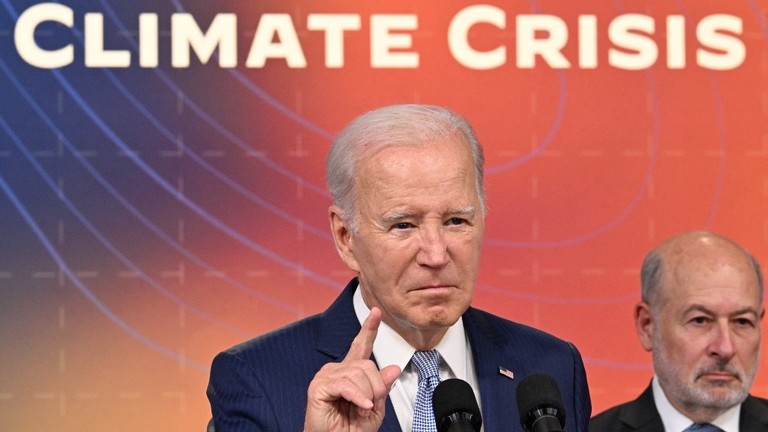
© AFP / Mandel Ngan
RT | September 9, 2023
The US government’s decision to cancel oil and gas drilling licenses and forbid further drilling will “hobble” the country’s economy and makes no sense except to advance the green agenda, Alaska Governor Mike Dunleavy has declared.
President Joe Biden’s administration on Wednesday canceled seven ten-year oil and gas drilling licenses granted to the Alaska Industrial Development and Export Authority (AIDEA) by former President Donald Trump. Biden’s Department of the Interior followed up this decision by issuing a proposal to forbid future leases on more than 40% of the National Petroleum Reserve in Alaska.
Biden said that these two measures “will help preserve our Arctic lands and wildlife,” adding on Saturday that he would “continue to take bold action to meet the urgency of the climate crisis and to protect our lands and waters for generations to come.”
Speaking to Fox News on Thursday, Dunleavy said that “this makes absolutely no sense from any perspective unless your goal is to drive up the cost of oil and gas so much that it makes certain renewables cheaper.”
Dunleavy, a Republican, claimed that Russia, China, Saudi Arabia, and Iran are “laughing” at Biden’s energy policy.
“They’re laughing together at the United States of America,” the governor said. “I can’t find anywhere in, really the history of nation-states or empires, where they worked at hobbling themselves to such a degree that’s happening currently with this administration. So 2024 can’t come soon enough for most of us.”
Gasoline prices have soared under Biden, reaching a record average high of just over $5 per gallon last June, up from around $2 when the president took office.
Prices began to rise when Biden signed an executive order in January 2021 banning new oil and gas licenses on federal land, and spiked as the conflict in Ukraine rocked global energy markets. Ahead of last year’s midterm elections, Biden attempted to stabilize gasoline prices by draining the US’ strategic petroleum reserve, and by unsuccessfully lobbying the Saudi-led Organization of Petroleum Exporting States to cut production.
The AIDEA argues that Biden has no legal right to rescind existing drilling licenses and told Fox News that it intends to challenge the decision in court.
US Middle East ‘normalization’ plan rejects reality
By Robert Inlakesh | RT | August 31, 2023
From the disastrous Afghanistan withdrawal to Chinese-brokered peace between Saudi Arabia and Iran, the US administration of President Joe Biden has been overseeing an era of declining American power across West Asia. In the midst of this fall from grace as the Middle East’s hegemon, Washington’s obsession with achieving a Saudi-Israeli normalization deal demonstrates a disconnect from reality and proves that optics are more important than tangible policy positions.
US National Security Advisor Jake Sulivan made it publicly clear last Tuesday that a normalization deal between Saudi Arabia and Israel, which Washington is currently working on, is still far from being achieved. This announcement followed speculation in American media that such a deal could be imminent. For those who have been paying attention to the region’s politics, however, it couldn’t be more clear how arduous a task achieving such a deal would be.
Looking at the deal through an American lens, it is clear what a diplomatic achievement of this nature would mean for the legacy of a US president’s administration. It would go down as a significant victory for the head of state, Joe Biden. It would also provide a great photo-op in the event that it happens; one that could be used to demonstrate the government’s strength in the 2024 elections. It could be calculated by the Democratic Party administration that prioritizing such a deal could make up for the president’s previous failures regarding the American role in the Middle East.
However, objectively speaking, achieving Saudi-Israeli rapprochement will mean overcoming countless hurdles on all sides and may end up doing more harm than good regionally. This is despite the Biden administration’s promises that it would boost regional security and stability. Yet with the recent announcement that the BRICS bloc will be adding Iran and Saudi Arabia as members come January 2024, after Tehran and Riyadh re-established ties under Beijing’s auspices, such a deal could open new regional wounds and run contrary to the vision set forth by Saudi Crown Prince Mohammed Bin Salman.
When the Trump administration managed to rope Bahrain, Sudan and Morocco into a normalization agreement between the United Arab Emirates (UAE) and Israel (the Abraham Accords), the initiative came from the UAE itself, at a time when Abu Dhabi had clearly decided to go ahead with the move. There was no real struggle to convince the UAE to go ahead with normalizing ties with the Israelis. In fact, in the cases of Morocco and Sudan, the Emiratis helped place pressure on those nations to accept normalization deals.
Saudi Arabia, despite having maintained close ties with the Trump administration – the first foreign visit of US President Donald Trump was to Riyadh – shied away from signing onto the normalization deal with the Israelis, likely because such a move would be more challenging for a country like Saudi Arabia domestically than for the likes of neighboring Bahrain or the UAE.
As of now, Saudi-US relations under the Biden administrations have been far from cordial, and when the American president made his first trip to the Saudi kingdom last year, he was made to appear as an afterthought. When Joe Biden confronted Mohammed Bin Salman over the infamous killing of Saudi journalist Jamal Khashoggi, the Crown Prince allegedly fired back by bringing up the lack of action taken over the killing of American veteran journalist, Shireen Abu Akleh, by an Israeli soldier. Mohammed Bin Salman even told The Atlantic monthly that he didn’t care if Biden misunderstood him. Saudi Arabia has also ignored calls from the US to alter oil production.
If the Biden administration is to convince Saudi Arabia to sign onto a normalization deal, concessions must first be granted. Riyadh reportedly seeks a civil nuclear program and a US security pact that could drag Washington into war in the event that the kingdom comes under attack. Such preconditions present a litany of hurdles for the American government.
Then there is Israel, which under any other government than the current far-right coalition of Prime Minister Benjamin Netanyahu would easily be able to get away with signing such a deal. However, Netanyahu has reportedly been requested to make some kind of concession towards the Palestinians in order to make the UAE deal go ahead. The government that Benjamin Netanyahu now heads is entirely different to the one he led in 2019, and his coalition depends on the support of the extremist Religious Zionism (RZ) alliance. RZ even pushes back against the idea of security coordination with the Palestinian Authority (PA), based in Ramallah, despite the fact that this policy benefits Israeli security. RZ stated clearly, from the time of the 2022 national election, that one of its goals was to annex the West Bank and the most likely concession that the US will ask of Tel Aviv is to again promise that it will steer away from doing so.
When it comes to the Palestinians, there is also the uncontrollable factor of a major escalation between the Palestinian armed factions and the Israeli military, over Israeli provocations at Al-Aqsa Mosque. Saleh Al-Arouri, the deputy head of the political bureau of Hamas, recently told al-Mayadeen that in the event of any senior leader being targeted, there will be regional war. This is at a time when pressure is growing on the Israeli government to carry out an attack on Hamas leaders in response to numerous attacks against Israeli settlers and soldiers in the West Bank. This, on top of the recent tensions at the Lebanese border with Hezbollah, all make for a potentially explosive situation, under which a Saudi-Israeli deal would look awful for Mohammed Bin Salman.
There is additionally the issue of what a Saudi-Israeli deal may do to Iranian-Saudi relations and their recent re-establishment of ties. As Saudi Arabia includes within it two of the holiest sites in the Islamic faith, Mecca and Medina, its decision to normalize ties with Israel will carry massive significance throughout the Muslim world. Such a move would prove it impossible for Tehran to remain neutral on the issue and it is very likely that the Iranians would reverse their decision to maintain ties with the Saudis. This means that if the Saudis are to sign a normalization deal with Israel, they have to know that this will undermine China’s diplomatic breakthrough and could end up presenting greater security concerns if they again find themselves competing so heavily for influence regionally with Iran. There is also cause for concern when it comes to Jordan’s reaction, which may see such a deal as a threat to its custodianship over the Holy sites in the Old City of Jerusalem, and feel that Saudi Arabia is encroaching upon its territory.
If the US administration had a serious approach to its Middle East policy, it would realize the dramatic shift that has occurred regionally and that its traditional allies have agendas that are no longer congruent with the old American status quo approach. It would seem, from observing the rhetoric and actions of Washington, that the current US government is in denial and cannot grasp that the days when it could boss around every country in West Asia are long gone. It will take pragmatic thinking to revive the US position in the long run, and one thing is for sure, a Saudi-Israeli normalization deal doesn’t make sense for any country at this time.
Robert Inlakesh is a political analyst, journalist and documentary filmmaker currently based in London, UK. He has reported from and lived in the Palestinian territories and currently works with Quds News. Director of ‘Steal of the Century: Trump’s Palestine-Israel Catastrophe’.
First rail cargo sets off from Russia to Saudi Arabia via Iran
The Cradle | August 27, 2023
The chief executive of the Islamic Republic of Iran Railways (RAI) announced on 27 August the transit of Russian cargo to Saudi Arabia via the Iran transport corridor for the first time.
A transit train hauling 36 containers entered Iran for the first time from Russia through Iran’s Incheh Borun rail border near Turkmenistan, Miad Salehi stated.
The deputy roads minister added that this cargo transit train was dispatched to the port city of Bandar Abbas on the Strait of Hormuz and will be transferred from there to the Saudi Arabian port city of Jeddah by sea.
Russia seeks to develop the International North–South Transport Corridor (INSTC) to connect India, Iran, Russia, Azerbaijan, and other countries via railways and sea.
Russia says the INSTC will rival the Suez Canal as a major global trade route.
In May, Russian President Vladimir Putin and his Iranian counterpart Ebrahim Raisi signed a deal to finance and build an additional Iranian railway line between the cities of Rasht and Astara.
“The unique North-South transport artery, of which the Rasht-Astara railway will become a part, will help to significantly diversify global traffic flows,” Putin said.
He also said the 162-kilometer railway along the Caspian Sea coast would help to connect Russian ports on the Baltic Sea with Iranian ports in the Indian Ocean and the Gulf.
“Without a doubt, this agreement is an important and strategic step in the direction of cooperation between Tehran and Moscow,” Raisi said.
Iran hopes the successful development of Russian-financed railway links comprising the NSTC will increase transit revenues and reinforce Iran’s “Look to the east” policy of strengthening ties with neighboring countries and eastern powers in response to western economic sanctions.
Raisi’s Deputy Chief of Staff for Political Affairs, Mohammad Jamshidi, claimed that the INTSC earnings would rival Iran’s oil revenue. In this vein, the semi-official ISNA on May 17 estimated annual revenue of $20 billion from the corridor.
State broadcaster-run Jam-e Jam newspaper described Iran as the “golden path of trade” in an article highlighting the potential benefits of the railway.
Iran and Russia have developed closer economic, diplomatic, and military ties in recent years, as both countries have been subject to US economic sanctions and have resisted US foreign policy in West Asia, including Syria, and the former Soviet states, including Ukraine.
A Second Geo-Strategic Shoe (Other Than Ukraine) Is Dropping
By Alastair Crooke | Strategic Culture Foundation | August 28, 2023
Whilst it has become clear to increasing numbers of people in the West that something has gone terribly wrong with the élites’ Ukraine project, and that the exaggerated predictions and expectations of Russian forces being ‘knocked for six’ by an armoured ‘fist’ have proved spectacularly wrong, those same élites are going wrong again – on another strategically decisive issue: They again largely ignore ‘reality’ – for the sake of control of the ‘narrative’. In this case, the West prefers to sneer at the implications of the new accessions to BRICS (let alone the other 40 states ready to join): ‘Nothing to see there’.
The BRICS is just a jumble of states lacking any cohesion, or common thread, western MSM proclaims. It can never challenge the U.S. global power, nor the sheer financial weight of the dollar sphere. However, China’s Global Times explains in mild tones, a different backdrop:
“The reason why the BRICS mechanism has such great appeal … reflects a general disappointment of many developing countries with the global governance system dominated and interfered by the U.S. and the West. As China has repeatedly emphasized, the traditional global governing system has become dysfunctional, deficient and missing in action, and the international community urgently expects the BRICS mechanism to strengthen unity and cooperation”.
Others in the Global South say it more starkly: The BRICS mechanism is seen as a means to slough off the last vestiges of western colonialism and to acquire autonomy. Yes, of course, BRICS 11 initially will be more cacophony than smooth opera, but nonetheless, it represents a profound shift of global consciousness.
BRICS 11 establishes a pole of influence and global heft that has the potential to eclipse in scope that of the G7.
The ‘mess’ in Ukraine is commonly attributed to mere ‘miscalculation’ by the western élites: They did not expect Russian society to be so robust, nor so steadfast under pressure.
Yet this was no minor ‘slip up’ by the West, since the recognition of NATO’s doctrinal contradictions, its second-rate weaponry and its inability to think rigorously – beyond tomorrow’s sound-bite – has (inadvertently) shone the spotlight on the deeper dysfunction within the West – one that runs far deeper than just the situation around the Ukraine project. Many in the West see major institutions of society locked within suffocating orthodoxy; in an intense level of political and cultural polarisation; and with political reform effectively locked-down.
The proxy war on Russia nevertheless was launched through Ukraine, precisely to reaffirm western global vigour. It is doing the opposite.
The financial war (as opposed to the ground war in Ukraine) was the counter-play to generating regime change in Moscow: Financial war was intended to underline the futility of opposing the sheer ‘muscle’ that dollar hegemony – acting in concert – represented. It was the jealous hegemon demanding obeisance.
But this back-fired spectacularly. And this has directly contributed not just to the expansion of BRICS, but to the energy resources of the Middle East and the raw materials of Africa sliding out of western control. Rather than the western scatter-gun threats of sanctions and financial ostracisation creating fear and reaffirming obsequiousness, the threats contrarily, have mobilised anti-colonial sentiments across the globe; fed the understanding that the western financial construct amounted to tutelage, and that any acquisition of sovereignty required the act of de-dollarisation.
And here, again, egregious mistakes were committed: Errors of geo-strategic magnitude were embarked upon almost casually, and without due diligence.
The primordial mistake was that of Team Biden (and the EU) illegally seizing Russia’s overseas reserve assets; expelling Russia from the financial clearing system, SWIFT; and imposing a trade blockade so complete that (it was hoped in the White House) its effects would tear down President Putin. The rest of world understood – they easily could be next. They needed a sphere that was resistant to western financial predations.
Yet, the second strategic error by Biden (& Co.) magnified the error of their initial ‘unprecedented’ financial blitz. This blunder marked the ‘second shoe to drop’ in Biden’s de-fenestration of the American financial imperium: He treated Mohammad bin Salman (and the Saudis generally) with contemptuousness: ordering them to increase oil production (in order to bring down the price of gasoline before the mid-term Congressional elections), and disdainfully threatening the kingdom with “consequences”, were it to fail to comply.
Perhaps Biden, so consumed with his electoral prospects, did not think it through. Even now, it is not clear that the White House understands the consequences of it having treated MbS as some aberrant underling. There is an eleventh-hour attempt to dissuade Saudi from joining BRICS, but it is too late. It’s application to join has been approved and will take effect from 1 January 2024. The West misread the mood.
The shared ethos within Gulf states is one of self-assured, assertive leaders, who are no longer willing to accept binary ‘with us or against us’ U.S. demands.
For the avoidance of mis-understanding, Biden, through the combination of these two strategic mistakes, has launched the West’s financial hegemony onto a slipway leading to incremental unwinding of much of the $32 trillion of foreign investment in fiat dollars which has accumulated in the U.S. system over the last 52 years – with an implicit acceleration towards ‘own currency trading’ amongst the majority of non-western states.
Ultimately this likely will lead to a BRICS trade settlement medium – possibly anchored to gold. Were a trading currency to be anchored in some way to a gram of gold, that currency would, of course, acquire status as a store of value, based on that of the underlying commodity (in this case gold).
The point here is that when inflation was zero-bound, U.S. Treasury bonds were seen as a store of (enduring) value. However, wide de-dollarisation undermines the synthetic (i.e. the imposed) demand for dollars that owed entirely to the Bretton Woods and the Petro-dollar frameworks (that demanded that commodities be traded only in U.S. dollars) and to the implicit understanding that U.S. Treasuries offered a certain store of value.
But what did Team Biden do? They have driven Saudi Arabia – the lynchpin to the Petro-dollar, and one of the pillars (together with other Gulf States and China) underpinning the huge holdings of U.S. Treasury debt – into the arms of BRICS. Put simply, the BRICS 11 incorporates six out of nine of the top global energy producers, as well as the principal energy consumers. OPEC+, in effect, has been swallowed to make a self-enclosed, self-sufficient circle of trading in energy (and raw materials) that does not need to touch dollars. And over time, this will amount to a major monetary shock.
The ‘consequences’ threatened towards Saudi Arabia by the White House have been rendered inconsequential. Saudi and Iran can sell their oil to other BRICS consumers (in non-dollar currencies). Members no longer need to be so concerned at western threats – one of the key provisions of BRICS is the joint refusal of all members to permit or facilitate any ‘regime change’ manoeuvres against BRICS members.
To be clear, what this all means is further price inflation in the West, reflecting the falling purchasing power of fiat currencies as dollar-demand subsides. Inevitably, a weakening dollar will lead to higher interest rates in the U.S. This – simply – will be one major consequence of de-dollarisation. Higher interest rates will impose great stress on the U.S. and European banks.
The first BRICS 11 summit is set for October 2023 in Kazan. By ‘coincidence’, full membership of the new states will coincide with Russia taking the rotating annual presidency of the BRICS on 1 January 2024. Putin already has made clear his determination to move towards resolving the complexities of a separate BRICS currency – “one way or another”.
Russia hosts first-ever meeting of Iran, Saudi defense officials
The Cradle | August 17, 2023
Talal al-Otaibi, an aide to the Saudi defense minister, on 16 August, met with the Deputy Chief of Staff of Iran’s armed forces, Aziz Nasirzadeh, on the sidelines of the 11th Moscow Conference on International Security.
Coming a few months after the two nations normalized ties under a Chinese-brokered agreement, this marked the first-ever meeting between Iranian and Saudi officials.
According to the Saudi defense ministry, the officials reviewed bilateral relations in the defense and security fields and ways to improve them. Iranian state-run news outlet IRNA also reported that the officials agreed to exchange military attachés “as soon as possible.”
The historic meeting occurred one day before the Iranian Foreign Minister set off on an official trip to the Saudi capital Riyadh, where he is scheduled to meet his Saudi counterpart Prince Faisal bin Farhan.
This is the first trip by Iran’s top diplomat to the kingdom since the signing of the détente in March. Iran’s new ambassador to Riyadh, Alireza Enayati, will also officially begin his mission during Amir-Abdollahian’s visit.
In June, an Iranian navy official revealed that the Islamic Republic, alongside Saudi Arabia, the UAE, Qatar, Bahrain, Iraq, Pakistan, and India, is looking to form a “naval alliance” to boost security in the northern Indian Ocean.
Two weeks after this announcement, Bin Farhan visited Tehran, where he met with Iranian officials and had this to say about the possible naval alliance, “I would like to refer to the importance of cooperation between the two countries on regional security, especially the security of maritime navigation … and the importance of cooperation among all regional countries to ensure that it is free of weapons of mass destruction.”
“Iran has never equated security with militarism but sees it as a broad concept including political, cultural, social, economic, and trade aspects,” Amir-Abdollahian said during the same news conference.
Despite the growing cooperation between Iran and Saudi Arabia, tensions have recently arisen over a disputed gas field in Gulf waters.
Furthermore, the kingdom is currently the target of a charm offensive from the US and Israel, who hope to see Saudi officials put pen to paper on a normalization agreement with Tel Aviv.
The Jeddah Talks Backfired On Zelensky
BY ANDREW KORYBKO | AUGUST 6, 2023
The latest Western-centric Ukrainian peace talks in Jeddah were intended to sway the Global South towards Kiev’s side in the NATO-Russian proxy war by pressuring these countries to support Zelensky’s so-called “peace formula”. That goal was always doomed to fail from the get-go, however, since this event also provided the representatives of neutral countries like China and India with the opportunity to share their own envisaged endgame to the conflict as well as their shared Russian partner’s.
This resultant dialogue led to the meeting being a double-edged sword for Zelensky. On the one hand, he had yet another high-profile opportunity to repeat his talking points about why Russia needs to be punished for its special operation, but this time with all of that country’s BRICS partners in attendance. On the other hand, however, China and India ensured that his demands weren’t the only scenario on the table. Just like Zelensky, they too were able to share these views with a diverse international audience.
As was expected, no consensus was reached on the way forward, but Russian Deputy Foreign Minister Sergey Rybkov revealed on Sunday that Russia’s BRICS partners plan to brief it about the event. This is much more significant than the simple courtesy that it might appear to be at first glance since Moscow will be able to obtain a better understanding of all the attendees’ positions, which will in turn enable it to fine-tune its diplomacy towards those countries that might be interested in a compromise solution.
About that, Kremlin spokesman Dmitry Peskov debunked the speculation swirling around the Mainstream Media and even among some in the Alt-Media Community alleging that Russia wants to control more than the four former Ukrainian territories that united with it last September. He reaffirmed on the same day as Ryabkov’s earlier statement that “We just want to control all the land we have now written into our Constitution as ours”, which aligns with what President Putin strongly suggested in June.
This position was already known to Russia’s BRICS partners with whom it’s candidly discussed the special operation, particularly the Chinese and Indian representatives who attended the Jeddah talks. Special Representative on Eurasian Affairs Li Hui and National Security Advisor Ajit Doval each visited Moscow several months back, during which time they met with President Putin. Considering this context, it’s likely that they brought up his stance during the Jeddah talks when explaining their countries’.
Via Special Representative Li and National Security Advisor Doval, President Putin was therefore able to convey his country’s pragmatic position towards this conflict’s endgame to the largest international audience so far, thus breaking through the West’s information blockade. Upon learning that he doesn’t have any maximalist goals unlike Zelensky, those other representatives whose countries truly want peace as soon as possible might be in favor of tacitly recognizing Russia’s gains in exchange for a ceasefire.
UAE, Bahrain sour on Israeli normalization
The Cradle | July 31, 2023
Two of the signatories of the Abraham Accords – the UAE and Bahrain – have “soured” on the 2020 normalization agreement, according to sources in the know who spoke with US outlet Bloomberg.
“The [UAE] has expressed frustration in high-level contacts with Israel about the outcome of the 2020 Abraham Accords,” Bloomberg reported on 30 July. Bahrain has also “outlined its disappointment” with Tel Aviv, mainly out of concerns about Israel’s ongoing human rights violations against Palestinians and their unchecked expansion of illegal settlements in the West Bank.
According to the report, the tense situation is “likely to complicate” Washington’s efforts to see Saudi Arabia join the Abraham Accords, which also include Morocco and Sudan.
In the months after the Gulf kingdom inked a historic rapprochement deal with Iran under the auspices of China, the White House has deployed a charm offensive to convince Saudi Crown Prince Mohammed bin Salman (MbS) to normalize ties with Israel before the 2024 US elections.
Publicly, Saudi Arabia maintains Israel must first implement the 2002 Arab Peace Initiative to establish a Palestinian state before a normalization deal can be signed. Privately, however, Riyadh is demanding that the US sweeten the deal by providing firm defense guarantees, access to cutting-edge weaponry, and assistance in developing a nuclear energy program, including domestic uranium enrichment.
While the White House remains hesitant to accept these demands, US President Joe Biden told a gathering of donors to his 2024 re-election campaign last week, “There’s a rapprochement maybe underway.”
Israeli Prime Minister Benjamin Netanyahu echoed this claim on Sunday when announcing the construction of a $27 billion rail expansion connecting Israel’s outlying areas to metropolitan Tel Aviv.
“In the future, we will be able to transport cargoes of goods by train from Eilat to our ports in the Mediterranean Sea, and we will also be able to connect Israel by train to Saudi Arabia and the Arabian Peninsula. We are working on that too,” Netanyahu said.
Earlier this month, Yedioth Ahronoth reported that Washington was promoting a plan to build a railway connection from the Gulf to Israel and Europe.
Major fossil fuel producers cause rift among G20
RT | July 23, 2023
Saudi Arabia and Russia have prevented a consensus from emerging among the Group of 20 major economies on a road map to phase down the share of fossil fuels in the global energy mix, Reuters has reported.
The G20 energy transition ministers held a four-day summit that ended on Saturday in the Indian state of Goa where they discussed ways to achieve global net-zero greenhouse gas emissions.
The summit ended without a consensus because major fossil fuel producers, including Saudi Arabia and Russia, opposed a proposal to triple G20 countries’ renewable energy capacity by 2030, Reuters reported, citing its sources.
China, the world’s largest consumer of energy, as well as coal exporters South Africa and Indonesia, also opposed the plan, the agency added. India, the world’s most populous country and which currently generates 75% of its total power from coal, reportedly took a neutral stance on the issue.
As a result of the disagreements, the ministers issued an outcome statement and a chair summary instead of a joint communique. A joint communique is issued when complete agreement among members on all issues is achieved.
According to the statement, “different national circumstances” drove “some members” to support a phase-down of unabated fossil fuels, while “others had different views” and suggested that “abatement and removal technologies” would address environmental concerns associated with the use of fossil fuels.
“Fossil fuels currently continue to play a significant role in the global energy mix, eradication of energy poverty, and in meeting the growing energy demand,” reads the statement.
The document mentioned a number of technologies for countries to use “as per national priorities,” such as carbon capture, usage and storage (CCUS), a technology that can capture and make effective use of the high concentrations of CO₂ emitted by industrial activities.
The G20 comprises 19 nations and the European Union. The group’s aim is to address major issues related to the global economy, such as international financial stability and climate change. Together, the G20 member countries account for over three-quarters of both gross domestic product and global emissions.
Saudi imports of Russian fuel soared tenfold in June
The Cradle | July 13, 2023
Saudi Arabia imported record levels of Russian fuel oil in June, bringing in 910,000 metric tons, a nearly tenfold increase from the same period last year, to meet summer power generation needs.
Since the start of 2023, Saudi imports of Russian fuel have nearly doubled from last year. As of June, the kingdom imported 2.86 million metric tons of fuel oil, exceeding the 1.63 million metric tons imported for all of 2022.
Alongside many countries in the Global South, the kingdom has been ramping up its purchases of discounted Russian fuel over the past several months, allowing Moscow to negate much of the effects of western sanctions and a G7 price cap imposed on their energy sector.
The news comes just over a month after Saudi officials announced plans to cut oil production levels by an extra one million barrels per day (bpd) in July – a cut that came on top of a massive reduction in oil output implemented since last October by OPEC+ member states, including Russia.
In May, Bloomberg reported, “Saudi Arabia is snapping up millions of barrels of Russian diesel that Europe no longer allows, while simultaneously sending its own supplies back to buyers in the EU.”
Traders and analysts believe the kingdom has been conducting this scheme to generate higher profits by taking advantage of western sanctions.
India and China are two other nations taking advantage of the situation, buying as much as 80 percent of the oil that Moscow exported in May.
“In May 2023, India and China accounted for almost 80 percent of Russian crude oil exports,” the Paris-based International Energy Agency (IEA) said in a report.
Russian fuel exports to Africa have also skyrocketed over the past year, increasing nearly 14-fold since the start of the war in Ukraine. Before March 2022, Moscow exported 33,000 bpd of refined products to African nations; by March 2023, exports soared to 420,000 bpd.
Ansarallah forces surround Saudi-controlled Marib: Report
The Cradle | July 12, 2023
Yemen’s Ansarallah resistance movement fired two ballistic missiles at the country’s central city of Marib on 11 July, coinciding with heavy mobilization of fighters and equipment outside the city, sources in the Saudi-backed government were quoted as saying.
A military official, Rashad al-Mekhlafi, told Arab News that two missiles landed in northern Marib, near a military base and a camp for internally displaced people.
“The missiles exploded in an open area in Marib without causing any injuries,” he said.
Sources in the Saudi-backed Presidential Leadership Council (PLC) recently told Arab News that Ansarallah has been deploying large numbers of fighters and equipment in preparation for an offensive against the city, which had been halted last year by a truce that was implemented in April.
“They have assembled fighters and enormous military equipment, including armored vehicles, cannons, and drone launchers, on the southern, western, northern, and east-northern surroundings of Marib,” Mekhlafi said.
“We are prepared to repel any attack. We bolstered the front lines with newly graduated military battalions, including sniper and infantry forces. What the Houthis were unable to achieve in previous years would be possible today,” he added.
Another government source was anonymously quoted as saying that the “legitimate government is prepared to repel any attack even as Saudi, UN, American, and European mediators advise restraint.”
Following the implementation of a truce agreement in April last year, intense fighting in Marib ceased, and Ansarallah was unable to capture the city. However, border skirmishes and periodic clashes have since been common.
While significant areas of the energy-rich province are under Ansarallah’s control, the main city is fully in the hands of the Saudi-backed government and the forces loyal to it.
Omani-mediated negotiations have recently resulted in agreements between the Saudi-led coalition and Ansarallah, particularly regarding the blockades on Hodeidah port and Sanaa airport, as well as the payment of salaries of government employees.
Saudi Arabia, as a result, has significantly reduced the scale of its bombing campaign on the country.
Many factors continue to complicate peace in war-torn Yemen – particularly a widespread Emirati occupation of the country and its ports and oilfields, as well as the presence of US, UK, and French troops.
Some have suggested in recent months that Saudi and Emirati interests in Yemen have begun to diverge, claiming that the UAE aims to maintain control over the country’s resources and strategic ports and waterways while Riyadh is increasingly looking to find a way out of the war.
DC Scholars: Ukraine Conflict Shows World Has Grown Weary of US Hegemony
By Ekaterina Blinova – Sputnik – 24.06.2023
Despite having the largest military budget in the world and being the largest operator of military bases abroad, the US is far from being a global hegemon, argues a DC-based think tank Quincy Institute for Responsible Statecraft.
Over the past decades Washington has demonstrated a capacity for mass destruction – in Korea, Vietnam, Afghanistan, Iraq, Libya and elsewhere – but “it has won no more than Pyrrhic victories” which led to the erosion of trust in Pax Americana both at home and abroad, according to Responsible Statecraft scholars.
The US military spending reached $876.9 billion in 2022, while the nation also operates a whopping 750 foreign military bases. Still, Washington is incapable of persuading the Global South to join anti-Russia sanctions over the latter’s special military operation in Ukraine, the think tank remarks. “If hegemony means the capacity to get other countries to comply with one’s demands, the United States is far from being a global hegemon,” the report notes.
Judging from the so-called Pentagon leak, even some US allies and partners demonstrated hesitance and unwillingness to provide the Kiev regime with shells, jets and armored vehicles. Meanwhile, most nations of the Global South shrugged off the US calls for slapping sanctions on Moscow as contradicting their national interests.
US political observers emphasize that six nations in the Global South – namely, India, Brazil, Turkey, Indonesia, Saudi Arabia, and South Africa – are set to decide the future of geopolitics and insist that the Biden administration needs to win their hearts and minds. At the same time, European commentators argue that developing nations have the right to remain neutral and non-aligned.
For instance, in June 2022, India’s External Affairs Minister Dr S Jaishankar shredded the West’s claim that New Delhi was “sitting on the fence.” According to the minister, India is entitled to its opinion when it comes to the Russo-Ukrainian conflict.
Likewise, the Association of Southeast Asian Nations (ASEAN) has chosen to collaborate with both the US and China, instead of taking sides. Moreover, ASEAN nations are active participants of Beijing’s Belt and Road Initiative (BRI) regardless of Washington’s attempts to maintain its dominance in the region and curb China’s influence in the Asia Pacific.
Per DC scholars, the emerging trend was articulated by Brookings Institution fellow Fiona Hill, former Deputy Assistant to the President of the United States, in May 2023:
“The war in Ukraine is perhaps the event that makes the passing of Pax Americana apparent to everyone. … [Other countries] want to decide, not be told what’s in their interest. In short, in 2023, we hear a resounding no to US domination and see a marked appetite for a world without a hegemon,” she said at a conference in Tallinn, Estonia
According to Hill, the Global South’s resistance to the US and the EU’s demands to slap sanctions on Moscow is nothing short of “an open rebellion.” She noted that “this is a mutiny against what they see as the collective West dominating the international discourse and foisting its problems on everyone else, while brushing aside their priorities on climate change compensation, economic development, and debt relief.”
Western observers also acknowledge that the world’s center of gravity is steadily shifting east, adding that the Biden administration has so far sought to avert this trend by trying to establish “a lasting technological lead over China” and beefing up the US military in Western Pacific.
However, “most developing countries, including emerging powers in the Global South, are no longer willing to make zero-sum choices” between Washington and its geopolitical rivals, DC scholars underscore, urging American policymakers to accept the reality that the US is no longer “the indispensable nation.”
Featured Video
BRITAIN’S WARNING: PREPARE FOR WAR
or go to
Aletho News Archives – Video-Images
From the Archives
British weapons and personnel doing much of the killing in Yemen
Press TV – June 18, 2019
A detailed report published by the Guardian newspaper has shown how Britain is massively contributing to Saudi Arabia’s devastating war on Yemen as it suggests that London is not only supplying the bombs that fall on Yemenis, but it provides the personnel and expertise that keep the war going.
The comprehensive report by Arron Merat published on Tuesday showed that Britain was doing much of the killing in Yemen as the country continues to provide Saudi Arabia with everything it needs to turn its southern impoverished neighbor into a graveyard.
“Every day Yemen is hit by British bombs – dropped by British planes that are flown by British-trained pilots and maintained and prepared inside Saudi Arabia by thousands of British contractors,” said Merat in the report. … continue
Blog Roll
 Aletho News
- Pakistan reopens Iran border after boosting security: Report
- Why are so many Brazilians voting for Flávio Bolsonaro?
- Democrats Put Anti-Russia Agenda Ahead of American Workers
- Elijah Magnier: Yemen’s Strikes Are Shattering Saudi Arabia’s Long-Term Strategy
- Pentagon designates Chinese cultural centers national security threat
- Israel Demolishes Home Of Lebanese Journalist Whose Viral Film Exposed Pager Attack
- Record Oil, Empty Tanks: The UAE’s Miracle Recovery
- Burnham tackles Britain’s poverty with aggression in Yemen
- Peace in Ukraine: the easy way – or the hard way
- Trump & the Rrrrussians
- If Americans Knew
- An error has occurred; the feed is probably down. Try again later.
- No Tricks Zone
- Sudden Stratospheric Warming, Powerful El Niño Combination May Lead To Extreme Europe Cold, Energy Crisis!
- Two New Studies Find Thwaites Glacier Melt Cannot Be Driven By Human Activity Or A Warming Ocean
- E-Cars Reduce CO2 Emissions By Only 41% Compared To Internal Combustion Engine Vehicles
- Predictions Made By Renowned Climate Professor Over Past Decades Have Been Proven To Be Poor
- New Study Suggests Large Regions Of The Pacific Ocean Have Been Cooling For The Last 80 Years
- Germany’s Green Energy Debacle: High Energy Costs Force Kahla Porzellan to Close After 182 Years!
- New Study: 50 Years Of The Most Aggressive ‘Net Zero’ Policies Can Only Affect The Global Climate By 0.03°C
- US September “Heat” Was No Record…Many Records Set Decades Ago
- Latest European Green Energy Debacle; Portugal’s Largest Flagship Solar Park Insolvent!
- Green Energy Debacle: German Expert Professor Fritz Vahrenholt Warns Of Severe Economic And Social Consequences

