West frustrated by Global South’s refusal to abandon Russia in secret US-G7 meeting on Ukraine
By Ahmed Adel | January 11, 2024
A secret meeting took place in December in the Saudi Arabian capital between the United States, Ukraine, its G7 allies and a small group of countries from the Global South to try to drum up support for Kiev’s conditions for resolving the conflict with Moscow. Russia was not invited to the meeting, and China decided not to send a representative, reported Bloomberg, whilst Brazil stressed any such meeting must have a Russian presence.
According to Bloomberg, the meeting’s secrecy was intended, in part, to make participating countries feel more comfortable joining, as it was believed that the smaller format would allow for a freer and more frank discussion on the so-called peace formula for Ukraine. However, according to people familiar with the meeting and interviewed by Bloomberg, there was no major progress as Ukraine and its G7 allies continued to resist calls from Global South nations to engage directly with Russia.
Although senior officials from India, Saudi Arabia and Turkey attended the December meeting in Riyadh, other major Global South nations that participated in some of the previous larger sessions – such as China, Brazil, and the United Arab Emirates – did not send their representatives.
Brazil, which presides over the G20 this year, contributed to the secret meeting with only a written statement prepared by the International Affairs advisor to the Presidency of the Republic, Celso Amorim. Brazil was invited but was unable to attend due to incompatibility in Amorim’s agenda.
According to Jamil Chade’s column on the Brazilian portal UOL, Amorim sent a letter to the authorities who mediated the December meeting in Riyadh and clarified Brazil’s disappointment in the conduct of the process since the meetings do not have the other party necessary, Russia, to reach an agreement.
“Initially, we were encouraged by the untapped potential of this group’s restricted format, which could eventually serve as a facilitator between the two conflicting sides […]. Our contribution aimed to promote direct or indirect dialogue between the two parties […],” the former minister of foreign affairs said.
“[But] as the conflict prepares to enter its third year, there is still no opening for dialogue or a credible prospect for an end to hostilities […] the willingness of the parties to engage in talks is critical for the success of our diplomatic efforts,” stated Amorim, pointing out that it was precisely this disposition that allowed the tension between Venezuela and Guyana to be prevented from becoming a hot war.
When contacted by UOL, Amorim explained that he was “considering” whether to go to Davos but was unsure.
“In our interaction with Russia and Ukraine, we constantly emphasise our belief that dialogue is essential for this process to produce results. We invite them to create diplomatic opportunities […] Brazil remains committed to renewing its engagement in the Copenhagen process, as soon as the parties are willing to start an authentic dialogue […],” added the Brazilian government in the letter.
Brazilian President Luiz Inácio Lula da Silva has already warned Zelensky that a peace process cannot be unilateral, while other emerging countries, mainly those from the Global South, have insisted that there is no way to endorse the Ukrainian plan without involving the Russians in the debates, writes the portal.
On January 14, Switzerland and Ukraine will host the fourth meeting in Davos to work on a solution to the conflict between Russia and Ukraine. However, once again, the meeting’s agenda will be limited to the unrealistic peace plan of Ukrainian President Volodymyr Zelensky and will not be attended by representatives from Moscow, thus ensuring its failure.
Under these conditions, Brazil is not wasting time on failed initiatives, especially when trade relations with Russia are booming. Last December, trade volume between Russia and Brazil grew 80%, reaching $1.6 billion for the first time, according to the Brazilian Institute of Geography and Statistics (IBGE).
Brazil acquired goods from Russia at the end of last year worth a total of $1.5 billion, which became the largest volume of purchases in modern history. The main import commodity was petroleum derivatives, at a record value of $1.1 billion. As a result, Moscow has become the South American country’s largest supplier of this commodity.
Latin America’s largest and most important country will not sacrifice trade relations with Russia or waste time with failed initiatives that will never eventuate because Zelensky has unrealistic demands on how to achieve peace, such as the full withdrawal of the Russian state from newly liberated territories and even Crimea, despite having no leverage to make such demands. In this way, there is little surprise that the secret meeting in Riyadh was destined only for failure.
Ahmed Adel is a Cairo-based geopolitics and political economy researcher.
‘We want normalization with Israel after Gaza war:’ Saudi official
The Cradle | January 10, 2024
The Saudi Ambassador to the UK, Prince Khalid bin Bandar Al Saud, told the BBC on 9 January that Saudi Arabia wants to continue normalization plans with Israel after their brutal aggression on the Palestinian people in Gaza ends.
“Saudi Arabia wants to normalize its relations with Israel after the war in Gaza,” the Saudi ambassador told the British public service broadcaster, noting that “the two countries were about to reach an agreement before the 7 October war.”
Bandar made sure to note that normalization with Israel will only be possible if Palestine is granted its own state.
“Saudi Arabia still believes in establishing relations with Israel despite the unfortunate figures of the dead in Gaza,” he added, continuing: “But this cannot be at the expense of the Palestinian people, and it requires thinking about the issue of integrating Hamas into the future Palestinian state.”
The death toll in Gaza from Israeli aggressions is at least 23,210, with at least 59,167 Palestinians who have been wounded.
Israeli media has reported that Israeli Prime Minister Benjamin Netanyahu is holding “secret talks” with the White House regarding the resumption of normalization discussions with Saudi Arabia.
“A message was conveyed that Israel will not take steps that conflict with the vision of the US and that it will be prepared to discuss what was requested by Saudi Arabia relating to the Palestinian issue,” Hebrew news outlet Channel 12 reported on 9 January, adding that Saudi Arabia is “very interested” in reaching the normalization deal with Israel that will grant the kingdom the long-sought “megadeal” from the US.
Israel’s Channel 12 also noted that “for the US, the agreement that was appropriate before 6 October may be more appropriate now, in light of the war [in Gaza], as one of the goals Hamas had was to thwart the agreement.” The Israeli news outlet added that if normalization is achieved between Riyadh and Tel Aviv, it may prevent the escalation of a regional war and provide Saudi Arabia with the funding to help rebuild Gaza.
Riyadh’s desire for normalization comes in stark contrast to the feelings of 96 percent of the kingdom’s population, who believe that Arab states should swiftly sever diplomatic relations with Israel, according to a recent poll conducted by the Washington Institute for Near East Policy.
Blinken’s window dressing tour of Arab capitals

BY M. K. BHADRAKUMAR | INDIAN PUNCHLINE | JANUARY 9, 2024
The expectation raised by the United States in allowing a UN Security Council resolution on Gaza pass through on December 22, 2023 without having to exercise its veto — albeit a watered-down one that stopped short of calling for ceasefire — was that the manifest international isolation facing Washington and Tel Aviv would inevitably impact Israel’s options going forward.
However, there are contrarian trends. Israel started the new year by ordering the withdrawal of part of its military forces from Gaza, but the spokesman of the IDF Daniel Hagari emphasised that the war will continue in 2024 and called this withdrawal in line with the renewal of forces and new organisation of Israeli army. Speaking on New Year’s Eve, Hagari said, “Tonight, 2024 begins and our goals require a long war, and we are preparing ourselves accordingly. We have a smart plan to manage our deployments, taking into account reserves, the economy, families, and resupply, as well as the continuation of combat and training.”
Hagari’s ambivalent hint that the military has wrapped up major combat in northern Gaza was buttressed with the claim that the forces would “continue to deepen the achievement” in northern Gaza, strengthen defences along the Israel-Gaza border fence and focus on the central and southern parts of the territory.
On Thursday, Israeli Defense Minister Yoav Gallant also presented a plan of a shift toward less intense military operations. The minister’s office said in a statement, “In the northern region of the Gaza strip, we will transition to a new combat approach in accordance with military achievements on the ground.” But Gallant added, “It will continue for as long as is deemed necessary.” Under Gallant’s plan, the war in Gaza will continue until all of the hostages are released and remaining military threats are neutralised.
Basically, Hagari’s remarks and Gallant’s plan can be seen as a nod to the US Secretary of State Antony Blinken who is expected in Israel later this week after visiting Turkey, Jordan, Qatar, UAE and Saudi Arabia. At the same time, Israel has, typically, also ratcheted up tensions by a series of belligerent acts in the recent days.
There has been a new escalation of cross-border fighting between Israel and Hezbollah. Besides, the targeted killing of a top Hamas political leader Saleh al-Arouri in a Hezbollah stronghold of Beirut last week; the killing of a senior IRGC commander and four others in the suburbs of Damascus; terrorist attacks in Kerman (Iran); killing of the commander of the elite Radwan forces of Hezbollah; — all these within the space of the past week are attributable to Israeli intelligence one way or another.
These events in turn have added to the resurgent fears lately that an Israel-Hamas war could erupt into a broader conflict. Earlier today, Hezbollah deputy leader Naim Qassem, said in a televised speech his group did not want to expand the war from Lebanon, “but if Israel expands, the response is inevitable to the maximum extent required to deter Israel.”
The pattern of Israeli behaviour needs to be understood from different angles. This is an incredibly complicated matrix. First and foremost, the Israeli operation in Gaza so far has been a failure. It turned the world opinion, especially in the Global South, heavily against Israel — South Africa’s petition to the International Criminal Court over war crimes in Gaza being the most telling evidence of it — while the Israeli military came a cropper in terms of its agenda to decimate Hamas.
Tel Aviv has reached none of its stated goals in the Gaza war, which are annihilation of Hamas or disarming of Hamas and release of captives held by Palestinians in Gaza. That brings the security and military establishment in Tel Aviv, whose reputation has been seriously dented following the October 7 attack, under immense pressure. On the other hand, there has been a cover-up of the heavy casualties suffered by Israeli troops in the Gaza operation. The Kerman terrorist attack and the killing of Saleh al-Arouri actually betray a high level of frustration.
In political terms, there is a convergence between the security and military establishment and Prime Minister Benjamin Netanyahu (whose political future hangs by a thread) and the ultra-rightist fascist forces aligned with him, whose interests lie in an extended war.
The only external force capable of pressuring Israel is of course the US administration. But it is too much to expect President Biden to draw the ‘red line’ to Israel — that is, even assuming that he has the political will to do so — given the Israel Lobby’s control of the Congress and its seamless capacity for making or destroying the careers of US politicians.
Washington has not changed the intensity of Israeli military operations. On the other hand, the US has shipped to Israel 10,000 tons of arms to Israel in the recent period alone. In fact, it cannot be a coincidence that every single Blinken visit to the region since October 7 has witnessed a particularly brutal Israeli attack to up the ante. In effect, the US is broadly in support of the Israeli policy and a commitment to the destruction of Hamas, in particular.
Therefore, Biden’s interest narrows down to prevent the war from spreading in the region lest direct American military intervention becomes necessary. The US rhetoric and diplomatic posturing largely aims at damage control in Washington’s relations with its erstwhile allies in the region. Quintessentially, Blinken’s mission comes down to cheap window dressing — viz., to bringing the regional states to the same page that Israel is facing an existential crisis. But it does not take into account that the region has changed radically.
What truly distinguishes the present crisis is that the Arab world is profoundly concerned and feels outraged by the barbaric Israeli behaviour toward hapless Palestinians — ‘animals,’ as Israeli politicians have described them. The Arab psyche is convinced that an enduring final settlement of the Palestine problem cannot be postponed indefinitely. Something has fundamentally changed even for Saudi Arabia which had clandestine dealings with Israel for decades and was inching toward establishing formal relations with it.
A Saudi statement said that while receiving Blinken in Al ‘Ula on Monday, Crown Prince Mohammed bin Salman “stressed the importance of stopping military operations, intensifying humanitarian action, and working to create conditions for restoring stability and for a peace process that ensures that the Palestinian people gain their legitimate rights and achieve a just and lasting peace.” The Saudi statement is at sharp variance with the readout by the US state department.
Interestingly, an article in the Saudi daily Asharq Al-Awsat focused on Blinken’s forthcoming visit highlighted fundamental differences between Riyadh and Washington on a range of issues — ceasefire in Gaza (“not just a humanitarian truce or exchange of prisoners, but rather a comprehensive halt”); security of the Red Sea (“the responsibility for security in the Red Sea lies with the riparian countries first, and with a UN-international responsibility in the second place”); Israel’s culpability for “expanding the scope of the war”; futility of “talk about post-war phase” at this point.
The article ended on a sombre note: “If the American administration wants Blinken’s visit to Saudi Arabia and the region to succeed, and if it wants to maintain its partnerships in the region, and preserve its role as a sponsor of peace in the Middle East at a time when international forces hostile to Washington are searching for a foothold in the region, it must adhere to neutrality, and not use the region’s interests and future as a card in the upcoming American elections. It must deal with the disease and not with the symptom as it is doing now.”
Gaza destroys western divide-and-rule narratives
By Sharmine Narwani | The Cradle | January 4, 2024
It could be a clean sweep. Decades of western-led narratives crafted to exploit differences throughout West Asia, create strife amid the region’s myriad communities, and advance western foreign policy objectives over the heads of bickering natives are now in ruins.
The war in Gaza, it transpires, has blown a mile-wide hole in the falsehoods and fairytales that have kept West Asia distracted with internecine conflicts since at least the 1979 Islamic Revolution in Iran.
Shia versus Sunni, Iran versus Arabs, secular versus Islamist: these are three of the west’s most nefarious narrative ploys that sought to control and redirect the region and its populations, and have even drawn Arab rulers into an ungodly alliance with Israel.
Facts are destroying the fiction
It took a rare conflict – uncooked and uncontrolled by Washington – to liberate West Asian masses from their narrative trance. Israel’s genocidal assault on Gaza also brought instant clarity to the question of which Arabs and Muslims actually support Palestinian liberation – and which do not.
Iran, Hezbollah, Iraqi resistance factions, and Yemen’s Ansarallah – maligned by these western narratives – are now visibly the only regional players prepared to buttress the Gaza frontline, whether through funds, weapons, or armed clashes that aim to dilute and disperse Israeli military resources.
The so-called ‘moderate Arabs,’ a misnomer for the western-centric, authoritarian Arab dictatorships subservient to Washington’s interests, have offered little more than lip service to the carnage in Gaza.
The Saudis called for support by hosting Arab and Islamic summits that were allowed to do and say nothing. The Emiratis and Jordanians trucked supplies to Israel that Ansarallah blockaded by sea. The mighty Egypt hosted delegations when all it needed to have done was to open the Rafah Crossing so Palestinians can eat. Qatar – once a major Hamas donor – now negotiates for the freedom of Israeli captives, while hosting Hamas ‘moderates,’ who are at odds with Gaza’s freedom fighters. And Turkiye’s trade with the Israeli occupation state continues to skyrocket (exports increased 35 percent from November to December 2023).
Palestine, for the pro-west ‘moderate Arabs,’ is a carefully handled flag they occasionally wave publicly, but sabotage privately. So, they watch, transfixed and horrified today, at what social media and tens of millions of protesters have made crystal clear: Palestine remains the essential Arab and Muslim cause; it may ebb and flow, but nothing has the power to inflame the region’s masses like this particular fight between right and wrong.
The shift toward resistance
It is early days yet in the battle unfolding between the region’s Axis of Resistance and Israel’s alliances, but the polls already show a notable shift in public sentiment toward the former.
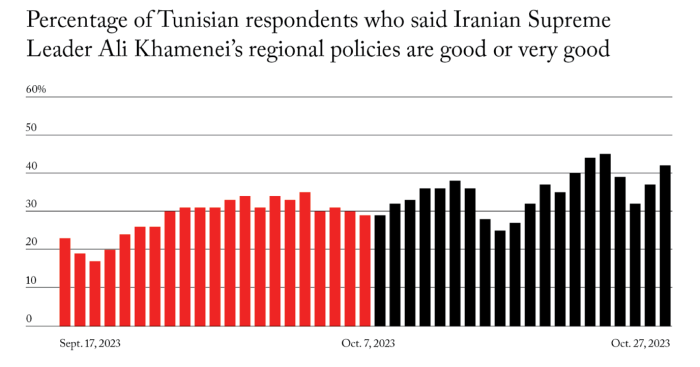
An Arab barometer poll taken over a six-week period – three weeks before and three weeks after the Al-Aqsa Flood operation – provides the first indication of shifting Arab perceptions. Although the survey was restricted to Tunisia, the pollsters argue that the country is “as close to a bellwether as one could imagine” and that it represents views similar to other Arab countries:
“Analysts and officials can safely assume that people’s views elsewhere in the region have shifted in ways similar to the recent changes that have taken place in Tunisia.”
The survey results should be of paramount concern to meddling western policymakers: “Since October 7, every country in the survey with positive or warming relations with Israel saw its favorability ratings decline among Tunisians.”
The US saw its favorability numbers plummet the most, followed by West Asian allies that have normalized relations with Israel. Russia and China, both neutral states, experienced little change, but Iran’s leadership saw its favorability figures rise. According to the Arab barometer:
“Three weeks after the attacks, Iranian Supreme Leader Ali Khamenei has approval ratings that matched or even exceeded those of Saudi Crown Prince Mohammed bin Salman and Emirati President Mohammed bin Zayed.”
Before 7 October, just 29 percent of Tunisians held a favorable view of Khamenei’s foreign policies. This figure rose to 41 percent according to the conclusion of the survey, with Tunisian support most notable in the days following the Iranian leader’s 17 October reference to Israel’s actions in Gaza as a “genocide.”

The Saudi shift
Prior to the 7 October operation by the Palestinian resistance to destroy the Israeli army’s Gaza Division and take captives as leverage for a mass prisoner swap, the region’s main geopolitical focus was on the prospects of a groundbreaking Saudi normalization deal with Tel Aviv. The administration of US President Joe Biden flogged this horse at every opportunity; it was seen as a golden ticket for his upcoming presidential election.
But Operation Al-Aqsa Flood ruined any chance for Saudi Arabia – home to Islam’s holiest sites – to seal that political deal. And with Israeli airstrikes raining down daily on Palestinian civilians in Gaza, Riyadh’s options continue to shrink.
A Washington Institute poll conducted between 14 November and 6 December measures the seismic shift in Saudi public sentiment:
A whopping 96 percent agree with the statement that “Arab countries should immediately break all diplomatic, political, economic, and any other contacts with Israel, in protest against its military action in Gaza.”
Meanwhile, 91 percent believe that “despite the destruction and loss of life, this war in Gaza is a win for Palestinians, Arabs, and Muslims.” This is a shockingly unifying statement for a country that has adhered closely to western narratives that seek to divide Palestinians from Arabs, Arabs among themselves, and Muslims along sectarian lines – geographically, culturally, and politically.
Although Saudi Arabia constitutes one of the few Arab states to have designated Hamas as a terrorist organization, favorable views of Hamas have increased by 30 percent, from 10 percent in August to 40 percent in November, while most – 95 percent – do not believe the Palestinian resistance group killed civilians on 7 October.
Meanwhile, 87 percent of Saudis agree with the idea that “recent events show that Israel is so weak and internally divided that it can be defeated some day.” Ironically, this is a long-stated Resistance Axis refrain. Hezbollah Secretary General Hassan Nasrallah was famously quoted as saying “Israel is weaker than a spider’s web,” upon its defeat by the Lebanese resistance on 25 May, 2000.
Prior to 7 October, Saudis had strongly favored economic ties with Israel, but even that number dropped dramatically from 47 percent last year to 17 percent today. And while Saudi attitudes toward the Resistance Axis remain negative – Saudi Arabia, after all, has been the regional epicenter for anti-Iran and anti-Shia propaganda since the 1979 revolution – that may be largely because their media is heavily controlled.
Contrary to the observations of the Arab masses, 81 percent of Saudis still believe that the Axis is “reluctant to help Palestinians.”
The Palestinian shift
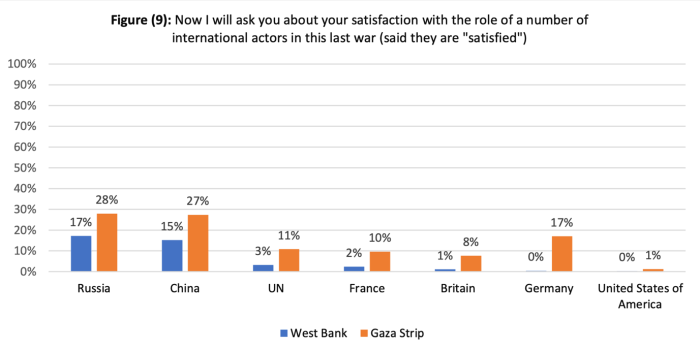
Equally important to the discussion of Arab perceptions is the shift seen among Palestinians themselves since 7 October. A poll conducted by the Palestinian Center for Policy and Survey Research (PSR) in both the occupied West Bank and Gaza Strip between 22 November and 2 December mirrors Arab views, but with some nuances.
Gazan respondents, understandably, displayed more skepticism for the ‘correctness’ of Hamas’ Operation Al-Aqsa Flood, which triggered Israel’s genocidal assault on the Strip in which over 22,000 civilians – mostly women and children – have so far been brutally killed. While support for Hamas increased only slightly in the Gaza Strip, it tripled in the West Bank, with both Palestinian territories expressing near equal disdain for the western-backed Palestinian Authority (PA), which governs from Ramallah.
Support for acting PA President Mahmoud Abbas and his Fatah party was hit hard. Demands for his resignation are at nearly 90 percent, while almost 60 percent (the highest number recorded in a PSR poll to date in relation to this matter) of those surveyed want a dissolution of the PA.
Over 60 percent of Palestinians polled (closer to 70 percent in the West Bank) believe armed struggle is the best means to end the occupation, with 72 percent agreeing with the statement that Hamas made a correct decision to launch its 7 October operation, and 70 percent agreeing that Israel will fail to eradicate the Palestinian resistance in Gaza.
Palestinians have strong views about regional and international players, who they largely feel have left Gaza unprotected from Israel’s unprecedented violations of international law.
By far the country most supported by respondents is Yemen, with approval ratings of 80 percent, followed by Qatar (56 percent), Hezbollah (49 percent), Iran (35 percent), Turkiye (34 percent), Jordan (24 percent), Egypt (23 percent), the UAE (8 percent), and Saudi Arabia (5 percent).

In this poll, the region’s Axis of Resistance dominates the favorability ratings, while pro-US Arab and Muslim nations with some degree of relations with Israel, fare poorly. It is notable that of the four most favorable countries and groups for mostly-Sunni Palestinians, three are core members of the “Shia” Axis, while five Sunni-led states rank lowest.
This Palestinian view extends to non-regional international states, with respondents most satisfied with Resistance Axis allies Russia (22 percent) and China (20 percent), while Israeli allies Germany (7 percent), France (5 percent), the UK (4 percent), and the US (1 percent) struggle to maintain traction among Palestinians.
The numbers depend on the war ahead
Three separate polls show that Arab perceptions have shifted dramatically over Israel’s war on Gaza, with popular sentiment gravitating to those states and actors perceived to be actively supporting Palestinian goals, and away from those who are perceived to support Israel.
The new year starts with two major events. The first is the drawdown of Israeli reservists from Gaza, whether because Washington demands it, or due to unsustainable loss of life and injury to occupation troops. The second is the shocking assassination of Hamas leader Saleh al-Arouri and six others in Beirut, Lebanon, on 2 January.
All indications are that Israel’s war will not only continue, but will expand regionally. The new US maritime construct in the Red Sea has drawn other international actors into the mix, and Tel Aviv has provoked Lebanon’s Hezbollah in a major way.
But if the confrontation between the two axes escalates, Arab perceptions will almost certainly continue to tilt away from the old hegemons toward those who are willing to resist this US-Israeli assault on the region.
There will be no relief for Washington and its allies as the war expands. The more they work to defeat Hamas and destroy Gaza, and the more they lob missiles at Yemen, Iraq, and Syria, and besiege the Resistance Axis, the more likely Arab populations are to shrug off the Sunni-versus-Shia, Iran-versus-Arab, and secular-versus-Islamist narratives that have kept the region divided and at odds for decades.
The swell of support that is mobilizing due to a righteous confrontation against the region’s biggest oppressors is unstoppable. Western decline is now a given in the region, but western discourse has been the first casualty of this war.
Hesitation among US allies leaves Operation Prosperity Guardian in dire straits
The Cradle | December 28, 2023
Ten days after US Defense Secretary Lloyd Austin announced the formation of an international task force to patrol the Red Sea, about half of the nations named as participants have yet to acknowledge their role, while others have pushed back against Austin’s declaration.
Under the name Operation Prosperity Guardian (OPG), Washington’s “coalition of the willing” was intended to confront attacks by the Yemeni armed forces against Israeli-linked ships attempting to cross the Bab al-Mandab Strait.
However, only two US allies have deployed warships to the Yemeni coast to support the coalition: the UK, which sent the navy destroyer HMS Diamond, and Greece, which announced the deployment of a Hellenic navy frigate.
Canada, Norway, and the Netherlands confirmed their participation in OPG but have so far committed only a handful of staff officers. Similarly, the Seychelles ratified their support for the coalition but clarified: “Our participation will not include putting boats or military personnel to patrol in the Red Sea. Our role is to help in providing and receiving information since many things that happen close by can have an implication for us.”
Authorities in Bahrain – the only Gulf nation named as part of the pro-Israel alliance – have not commented on their role in OPG, despite the fact that the US war chief announced the coalition’s creation from the US Fifth Fleet headquarters in Manama. Last week, Bahraini police detained a prominent opposition figure who criticized the government for joining OPG.
Complicating matters further for the Pentagon, the last three NATO members named as part of the alliance – Spain, Italy, and France – have outright refused to hand over command of their ships to the US.
The French defense ministry said last week it supported efforts to “secure freedom of navigation in the Red Sea.” Still, it highlighted that its navy already operated in the region and its ships would stay under French command. Italy took a similar approach, committing the naval frigate Virginio Fasan to patrol the Red Sea but emphasizing that this was part of “existing operations” and not OPG.
Spain has been the most vocal in its rejection of being named part of the anti-Yemen alliance, vetoing a vote at the EU that called for support of the coalition and making it clear that its forces committed to Operation Atalanta – a counter-piracy operation off the Horn of Africa and in the Western Indian Ocean – would not join OPG.
“Spain is not opposed to creating another operation, in this case in the Red Sea. We have communicated to our allies, both in NATO and in the EU, that we consider Operation Atalanta does not have the characteristics nor the nature that is demanded and needed in the Red Sea,” President Pedro Sanchez said on 27 December.
While the Pentagon last week proclaimed “over 20 nations” had joined OPG, reports have shown that more of Washington’s closest partners are balking at the idea of joining war efforts in the Red Sea.
On 21 December, Australia announced it would be sending personnel to join OPG, but no warships or planes. India has also balked at the plan, with a senior military official revealing to Reuters that New Delhi is “unlikely to join” the US alliance.
Nonetheless, earlier this week, the Indian navy deployed several warships to the Arabian Sea in response to an alleged drone attack on an Israeli-linked vessel.
Saudi Arabia has also shown no interest in the venture, as the Gulf kingdom is reportedly more interested in ending its eight-year war in Yemen than in re-starting hostilities.
Yemen’s Red Sea operations in support of Palestinians in Gaza have significantly hurt the Israeli import sector, as the vital Port of Eilat has seen an 85 percent drop in activity. According to Bloomberg, half of the container ships that regularly transit the Red Sea and Suez Canal are avoiding the route now.
However, marine traffic data shows that the transit of non-western tankers through the Red Sea has surged since the Yemeni armed forces began targeting Israeli-linked vessels.
Almost all Saudi nationals oppose Arab ties with Israel, poll finds
Press TV – December 23, 2023
A new survey has found that 96 percent of Saudi Arabian citizens want Arab countries to cut all types of ties with Israel in response to the occupying regime’s war on Gaza.
Conducted by the Washington Institute for Near East Policy, a pro-Israel think tank based in Washington, the survey saw almost every Saudi agreeing with the proposal “Arab countries should immediately break all diplomatic, political, economic, and any other contacts with Israel, in protest against its military action in Gaza.”
The study further found that a big majority of the Saudis (91%) believe that “despite the destruction and loss of life, this war in Gaza is a win for the Palestinians, Arabs, and Muslims.”
The majority of respondents in Jordan, Lebanon and Egypt held favorable views towards the Palestinian resistance movement Hamas, but saw a 30-point growth in its popularity in the case of Saudi Arabians, compared to August.
The survey said 87% agree with the suggestion that “recent events show that Israel is so weak and internally divided that it can be defeated someday.”
Conducted to measure the change in shift of attitudes of Saudi nationals after the bloody war broke out, the survey was conducted from November 14 to December 6.
The results of the study are a clear manifestation of the difficulties the United States is going to face as it advocates for intertwined Arab-Israeli cooperation.
Prior to the war, the US was actively working towards achieving an agreement to normalize Saudi Arabia-Israel relations.
Earlier in September, during an interview with Fox News, Saudi Crown Prince Mohammed bin Salman stated that the two countries were getting closer to such an agreement “every day.”
After the war broke out, Riyadh put a pause on normalization talks and has made its diplomatic outreach public as one that seeks “to stop the ongoing escalation.”
The Israeli genocide in Gaza has significantly suppressed support for allowing contact with Israelis.
The US and Israel face a powerful new enemy in the Middle East conflict
By Robert Inlakesh | RT | December 23, 2023
In yet another case of blowback, reflecting the failure of Western military interventionism in West Asia, Yemen’s Ansarallah (Houthi) movement has inserted itself as an active participant in the ongoing war between Israel and Gaza. First launching batches of loitering munitions, ballistic and cruise missiles towards Israel, Ansarallah then moved on to prevent the passage of Israeli-owned or operated ships through the Red Sea, before announcing a complete closure of the shipping route for any vessels destined to dock at the port of Eilat.
After the Houthis seized a number of ships, while attacking others with drone strikes, activity at Eilat has dropped some 85%. International and Israeli shipping companies have opted to take the long route, which in some cases takes an additional 12 days, to reach Israel with their cargo, a costly diversion to say the least. In opposition to this, US Defense Secretary Lloyd Austin traveled to the region and announced the formation of a multinational naval task force to be deployed in the Red Sea. Despite talk of the coalition including Saudi Arabia, Egypt, and even the United Arab Emirates, the only Arab nation that joined was Bahrain.
So, without a United Nations Security Council (UNSC) resolution to back them up, usually required to make the militarisation of a territory legal under international law, the US has launched yet another foreign intervention. This one is significant because it failed to convince any major regional players to join, demonstrating the decline in American influence, but has also elevated the status of Yemen’s Ansarallah.
Under former US President Barack Obama, Washington backed the Saudi-led coalition’s intervention in Yemen back in 2015. Since then, some 377,000 people have died, largely as a result of the deadly blockade imposed on the majority of the country’s population, while some 15,000 civilians have died due to direct conflict. The objective of the Saudi-led intervention, which received the backing of the US and UK, was to remove Ansarallah from power in the nation’s capital, Sanaa. Although the group does not enjoy international recognition as Yemen’s governing force, it rules over more than 80% of the population, has the support of two-thirds of the nation’s armed forces, and operates a government out of Sanaa.
Ansarallah came to power following a popular revolution against then-Yemeni President Abdrabbuh Mansour Hadi in 2014. Months later, Hadi resigned and fled the country after Ansarallah militants had decided to take over by force. In the midst of a seven-year war, the political, social and armed movement that is often referred to as “the Houthi rebels” operates as the de facto government of Yemen, but is yet to receive recognition at the UN, which instead recognises the ‘Presidential Leadership Council’ that was created in Riyadh, Saudi Arabia, in 2022.
The context above is crucial for understanding the capabilities of Yemen’s Ansarallah, which was downplayed as a band of “Iran-backed rebels” in Western corporate media for years. While the governments of the collective West have tried to pretend that the Yemeni group is insignificant, Washington’s recent decision to form a multi-national naval coalition to confront the Houthis is an admission that they are a major regional actor. In fact, Ansarallah is the only Arab movement that controls state assets and a standing army that is participating in the ongoing war with Israel.
The reality that the US is now confronting is something that both Saudi Arabia and the UAE came to realize early last year. Following two separate drone and missile attacks on Abu Dhabi and Dubai in January of 2022, it became apparent that the West’s current level of support could not provide sufficient security for the UAE. Up until a nationwide ceasefire was brokered in April 2022, Ansarallah had also demonstrated its developed missile and drone capabilities, striking valuable economic targets inside Saudi Arabia too.
Despite receiving a lot less attention than it deserved, Ansarallah forces strategically timed their second attack on the UAE to coincide with the arrival of Israeli President Isaac Herzog in the country. This was a clear message to the Emirati and Saudi leaderships that Western support will not provide sufficient security. It’s likely because of this threat from Yemen that Riyadh sought a security pact with the US, in order to make a normalization agreement with Israel possible. Such a security pact would have stipulated that an attack on one is an attack on all, hence dragging the Americans into a direct war against Yemen in the event that the conflict was to flare up again.
The US attempted to help topple the current government in Sanaa, but ended up creating a battle-hardened group that has domestically developed capabilities well beyond those it possessed at the start of the conflict in 2015. In his first foreign policy address after taking office in 2021, US President Joe Biden pledged to end the war in Yemen. However, instead of pursuing a Yemen-Saudi deal, the White House abandoned its pledge and sought to broker a Saudi-Israeli deal instead. That fatal decision is coming back to bite policymakers in Washington.
Backing the Israelis to the hilt in their war on Gaza, spelling out that there are no red lines as to how far the government of Benjamin Netanyahu can go, the US has allowed a Palestine-Israel war to expand into a broader regional Arab-Israeli conflict. The threat of escalation between the Israeli army and Lebanese Hezbollah is growing by the day, while Ansarallah leader Abdul-Malik al-Houthi has stated that his forces “will not stand idly by if the Americans have a tendency to escalate and commit foolishness by targeting our country.”
By every metric, US diplomatic stock has dropped internationally as a result of its handling of Israel’s war on Gaza. It has failed to convince any major regional actors in West Asia to back its escalatory agenda, all of which are standing on the same side as Russia and China in calling for a ceasefire. The world sees the hypocrisy of Washington. For the sake of comparison, the death toll in Gaza today is said to have exceeded 23,000, the majority being women and children. Israel has killed this many people in just over two months, while in the first two years of the ISIS/Daesh insurgency in Iraq, the UN estimated that the terrorist group killed some 18,800 civilians. The total number of civilians killed by ISIS in Syria is set at just over 5,000.
The level of human suffering being inflicted in Gaza is without precedent, breaking records in modern history for the tonnage of explosives dropped on such a small territory, in addition to the highest number of journalists, medical workers, and children killed in a single conflict. In reaction, the US government has repeatedly blocked ceasefire resolutions at the UNSC, gives Israel unlimited support unconditionally, and now threatens to drag a coalition of Western nations into a war on Yemen. The solution here is very simple: Ansarallah has said the blockade on ships to Israel will end when the war on Gaza ends. Washington has the ability to stop the war, but refuses to do so, while its threats against Yemen will not work to achieve any result beyond further escalation.
Robert Inlakesh is a political analyst, journalist and documentary filmmaker currently based in London, UK. He has reported from and lived in the Palestinian territories and currently works with Quds News. Director of ‘Steal of the Century: Trump’s Palestine-Israel Catastrophe’.
US’ ‘Hypocritical’ Reversal on Saudi Arms Ban Won’t Knock Riyadh’s Peace Push Off Course
By Ilya Tsukanov – Sputnik – 22.12.2023
The Biden administration is reportedly preparing to ease restrictions on the sale of offensive weaponry to Saudi Arabia, reversing a decision made in 2021 in a bid to put the Yemeni crisis to bed. The reversal is aimed at pulling Riyadh into Washington’s confrontation with the Houthis, but will surely fail, a Saudi foreign affairs observer says.
Washington is having trouble lining up allies to join its anti-Houthi Red Sea coalition.
The US-led alliance, formed to conduct a military operation dubbed Operation Prosperity Guardian in the Red Sea and the Gulf of Aden against Yemen’s Houthi militia, currently consists of a handful of countries, including the UK, Canada, Denmark, France, Greece, Italy, the Netherlands, and Norway, plus Bahrain and the Seychelles. Some members’ participation seems purely decorative, with Norway reportedly planning to send 10 officers, the Netherlands two, and Denmark just one, to assist in the mission.
Spain has taken by far the most curious position to date, first backing an EU-level mission, but then changing its position and apparently vetoing the decision without explanation.
US AUKUS ally Australia has similarly dismissed requests to join Operation Prosperity Guardian in any major way, limiting its involvement to 11 military personnel.
Washington was pressed into forming its ‘new coalition of the willing’ in the wake of a string of Houthi hijackings and missile attacks on commercial cargo vessels thought [?] to be affiliated with Israel amid Tel Aviv’s ongoing war in Gaza. The attacks have caused multiple major global shipping companies to halt commercial transit through the Red Sea, with over $60 billion in cargoes already diverted to alternative routes, and losses expected to continue mounting.
US preparations for war against the Houthis mark a major reversal of policy for the current administration, which cut off US weapons support for the Saudi-led coalition’s campaign against the Yemeni militia in 2021, and delisted them as a ‘terrorist’ group. This, together with a series of other factors, pushed Riyadh into a major shakeup in its foreign policy, including peace talks with the Houthis, the normalization of ties with long-time regional rival Iran, and, most recently, joining the BRICS bloc.
Washington has accompanied its Houthi-related policy reversal with plans to lift an offensive weapons sales ban targeting Riyadh, presumably in a bid to get on Crown Prince Mohammed bin Salman’s good side and perhaps even rope him into supporting or even joining the US-led Red Sea coalition.
But Riyadh-based political analyst Dr. Ahmed Al Ibrahim doesn’t expect Washington’s sweet talking to have any substantive impact on Saudi Arabia’s stance vis-à-vis escalating regional tensions.
“Saudi Arabia is doing what’s best for Saudi Arabia. It does not matter whether this is for the US administration or for anybody else. As you know, MBS is trying to zero out the whole region from any conflict, and yet we are being challenged periodically with the concerns of the militias in the region like Hamas, Hezbollah and Houthis,” Al Ibrahim told Sputnik.
Characterizing the US deployment of warships to the region as “a kind of hypocrisy” in the wake of the Biden administration’s previous attempts to starve Riyadh of military equipment to fight the Houthis, Al Ibrahim stressed that Saudi Arabia is doing its best to “move forward” instead of getting bogged down in another quagmire thanks to the US.
“Controlling the Houthis is now the US mandate. They need to deal with them,” Al Ibrahim emphasized. “I doubt if the United States will basically pull Saudi Arabia into the Houthi conflict. Saudi Arabia is a sovereign country and it will assess the situation. And I don’t think Saudi Arabia is going to contribute to that. Having Saudi Arabia involved in that, it’s one day [until] you get blamed by actually protecting your border and your security by the Americans. And if you don’t, also, you will get blamed. So I think Saudi Arabia is not going to get dragged into any war. Saudi Arabia has an economic vision that they need to be rich, and they will choose any day, anytime peace.”
If the US fails to play its cards right, the Saudi analyst predicts another power vacuum in the region like those left in Afghanistan and Iraq, and even further loss of support among Muslim countries by Washington.
“As you can see, the tone of the Middle East has risen against the United States because of the whole wrongdoing that the United States is doing to the region. But we are fed up with war,” Al Ibrahim stressed.
“America needs to restructure itself. They need to know what their goals are and who their allies are. And they need to understand the region much better because they’re losing a lot of ground to their competitors, unfortunately,” the observer said, citing China and Russia as two examples.
As far as Saudi Arabia’s cooperation with Russia is concerned, Al Ibrahim doesn’t expect any fledging security ties between the two countries to be frayed by Washington’s reversal on weapons sales. Trust with the Biden administration has been broken, and the bad taste left from the bad blood between the US president and MBS hasn’t gone anywhere, in his estimation.
“Maybe we get delayed spare parts for some of the jets, some of the weapons that Saudi Arabia needs. But we’ll see after the election of 2024,” Al Ibrahim summed up, hinting that a change of power may be necessary in Washington before Riyadh will consider restoring close ties.
US pressures Saudi Arabia to postpone imminent peace deal with Yemen
The Cradle | December 18, 2023
The US is exerting pressure on Saudi Arabia to delay the signing of a peace agreement with Yemen and instead join an expanded maritime protection task force to confront Yemeni attacks against Israeli-linked ships in the Red Sea.
According to a report by Lebanese daily Al-Akhbar, a draft peace deal between Sanaa and Riyadh has been finalized. It could be signed before the end of the year, potentially ending a NATO-backed war that has decimated the Arab world’s poorest country for eight years.
“Saudi Arabia is going through a difficult test between two options […] Either it will emerge from the Yemeni quagmire under a roadmap agreed upon with Sanaa, or it will submit to US dictates and join the international maritime coalition, and this means remaining vulnerable to [western] blackmail,” the Al-Akhbar report details.
Despite the pressure from Washington, the kingdom is reportedly “continuing on the path to peace” and is working to “speed up” the completion of the peace agreements to avoid “further obstruction by the Emiratis or local agents.”
Saudi and Yemeni negotiators have given their final comments on the agreement. The revised version was recently delivered to UN special envoy for Yemen, Hans Grundberg, who has started coordinating an official peace ceremony.
According to Al-Akhbar’s sources in Riyadh and Sanaa, the peace deal includes the complete lifting of a land, sea, and air blockade imposed on Yemen by the Saudi-led coalition, a “consensual mechanism” to pay the salaries of public employees, and the free export of oil from Saudi-controlled regions.
“The ball is in Riyadh’s court, which is under US pressure to delay the signing and enter into a war alliance against Yemen in the Red Sea,” Al-Akhbar highlights, adding that UAE-backed forces are also looking to derail the peace process.
A peace agreement between Saudi Arabia and Yemen would significantly hamper US efforts to deploy an international naval task force to the Red Sea to protect Israel’s maritime trade.
“The force, provisionally entitled Operation Prosperity Guardian, is due to be announced by the defense secretary, Lloyd Austin, when he visits [West Asia],” UK daily The Guardian reported on 17 December.
The US war chief is set to visit Israel later this week to meet with senior officials. According to the British outlet, western officials believe Washington has secured the involvement of Jordan, the UAE, Qatar, Oman, Egypt, and Bahrain.
For the past several weeks, the Yemeni armed forces have been launching attacks on Israeli-linked commercial vessels attempting to cross the Bab al-Mandab Strait south of the Suez Canal.
In response, five of the world’s largest shipping companies have announced a complete cessation of activities in the vital sea route. These are Hong Kong-based OOCL, France’s CMA CGM, the Danish Maersk, the German Hapag-Lloyd, and the Italian-Swiss-owned Mediterranean Shipping Co.
Iran, China, Saudi Arabia urge swift action to stop Israel’s war machine in Gaza
Press TV – December 15, 2023
Iran, China and Saudi Arabia have jointly demanded urgent action to end Israel’s atrocities in the besieged Gaza Strip, and provide sustainable relief to the Palestinians.
China’s Deputy Foreign Minister Deng Li hosted Deputy Foreign Minister for Political Affairs Ali Bagheri Kani of Iran and Saudi Vice Minister of Foreign Affairs Waleed bin Abdulkarim El-Khereiji in Beijing on Friday for the first time within the framework of the joint committee of the three countries.
In a statement, the trio expressed opposition to the forced displacement of the Palestinians, and underscored that any future arrangement about Palestine must embody the will of its people and support their right to establish their state and self-determination.
The diplomats also voiced concern about the current critical circumstances in Gaza.
The three officials agreed on the next meeting to be held in Saudi Arabia in June.
Also in the meeting, the diplomats discussed the progress in relations between Saudi Arabia and Iran, including the reopening of the respective embassies in Riyadh and Tehran.
The Iranian and Saudi diplomats expressed appreciation for China’s influential part in the rapprochement between Tehran and Riyadh and reaffirmed their full commitment to implementing the Beijing Agreement.
Putin’s Middle East Trip Deals a Blow to Washington
By Salman Rafi Sheikh – New Eastern Outlook – 11.12.2023
Russian President Vladimir Putin’s recent visit to the Middle East – and the 21-gun salute welcome he received there – shows the failure of Washington’s consistent attempts to ‘isolate’ and defeat Russia. The visit also points to the Middle East’s increasing shift away from, and sole reliance on, Washington. Ever since the beginning of the Gaza War on October 7, the Middle East has been keeping contact with China, rather than the US, its first priority. The reason for this is not simply the fact that the US is supporting, militarily and diplomatically, Israel against Palestine, but also because the Middle East is strategically realigning itself with the realities of what is increasingly – and undeniably – a multipolar world. To the extent that the Middle East, a region where the US remained the most dominant extra-regional force for many decades, has made this shift also reflects the ongoing demise of US dominance more generally in the world. To the extent that China and Russia are two major proponents of multipolarity, connect the dots of this anti-US but pro-China and pro-Russia shift.
Putin’s trip to the UAE and Saudi Arabia has many dimensions. One of these dimensions is bilateral. Between 2017-2022, the trade turnover between Russia and the UAE has grown by almost six times. In 2022, the overall trade increased by almost 68% amounting to US$9 billion. The UAE is Russia’s largest trading partner in the Gulf Region, accounting for 55% of Russia’s total trade with the Persian Gulf.
It, therefore, makes sense for Washington to pressure the UAE government to drastically limit their trade ties with Moscow. Earlier in September, several Western officials from the United Kingdom, EU and US visited the UAE to persuade the UAE to review its trade ties with Russia. Western officials have been assuming that, in the wake of the threats of the Israel-Gaza war spreading to other parts of the Middle East, the UAE would go back to its ultimate security guarantor: the US. This would, however, happen only if the UAE has good ties with the US. Good ties, under the present context of the Russia-Ukraine conflict, mean the UAE ending its trade ties with Russia, especially the ones that may have military implications.
The UAE has been resisting these pressures. In fact, its decision to welcome Putin himself means that the UAE is considering an alternative means of protecting itself in the wake of a wider war in the region. It is ensuring Russian (and Chinese support), and it is using this (possible) source of support to send a message to Washington, i.e., multiple options are possible in a multipolar world. The message is quite similar to the message that the Saudis have been giving to the Americans since the beginning of the Russia-Ukraine military conflict.
If the Americans have been doing their best to convince the Saudis to break out of the OPEC+ deal and increase the production of oil to help reduce its prices and consequently help control the inflation in the West, the Saudis have not submitted. In this context, Putin’s visit to Saudi Arabia sought to reinforce the ‘oil alliance’ – which is also a major dimension of Russia-Saudi bilateral ties – at a time when the burden of wars (supporting Ukraine plus Israel) on the West is increasing manifold. For Putin, an appropriate message to the Middle East in particular and the Global South in general is this: the West supports aggression against all states, regardless of whether it is Russia or Palestine, and it expects other states (e.g., the Middle East) to support that aggression.
Russia understands that the West is fighting two wars, and it does not have any narrative to justify them both simultaneously. As even the US-based Carnegie Endowment said in one of its recent reports, “Washington’s pro-Israel stance undermines the legitimacy of the West’s broader reasons for supporting Ukraine in the eyes of many in the Global South. The moral argument against Russia’s invasion of Ukraine now looks like empty words, particularly in Middle East nations”. In this sense, the timing of Putin’s visit was far from coincidental. It aimed to tap into the opportunity to wean powerful states in the Middle East, who are also keen to expand ties with the non-Western world via BRICS, away from the US as much as possible.
Therefore, the purpose of Putin’s visit, as some Western media analysed and sought to trivialise, was not simply to “discuss” the Gaza war. It was part of Moscow’s wider outreach to the Middle East at an appropriate time to reorient the Middle East’s strategic priorities. Soon after coming back, Putin hosted Iran’s president in Moscow to build on the success of his visit and deepen Russia’s foothold in the region, a region that allows Russia to fight the West in the economic field by, for instance, coordinating the production of oil.
Still, the Gaza war was discussed. But that discussion was underpinned by the strategic failure of Washington’s plans to create a new Middle East. The failure of the US in the Middle East becomes yet another opportunity for Moscow to present itself as a potential peace broker rather than, and unlike the US, a troublemaker. If it was simply a war of narratives, Russia (and China) are clearly winning it in the Middle East.
Featured Video
BRITAIN’S WARNING: PREPARE FOR WAR
or go to
Aletho News Archives – Video-Images
From the Archives
British weapons and personnel doing much of the killing in Yemen
Press TV – June 18, 2019
A detailed report published by the Guardian newspaper has shown how Britain is massively contributing to Saudi Arabia’s devastating war on Yemen as it suggests that London is not only supplying the bombs that fall on Yemenis, but it provides the personnel and expertise that keep the war going.
The comprehensive report by Arron Merat published on Tuesday showed that Britain was doing much of the killing in Yemen as the country continues to provide Saudi Arabia with everything it needs to turn its southern impoverished neighbor into a graveyard.
“Every day Yemen is hit by British bombs – dropped by British planes that are flown by British-trained pilots and maintained and prepared inside Saudi Arabia by thousands of British contractors,” said Merat in the report. … continue
Blog Roll
 Aletho News
- Elijah Magnier: Yemen’s Strikes Are Shattering Saudi Arabia’s Long-Term Strategy
- Pentagon designates Chinese cultural centers national security threat
- Israel Demolishes Home Of Lebanese Journalist Whose Viral Film Exposed Pager Attack
- Record Oil, Empty Tanks: The UAE’s Miracle Recovery
- Burnham tackles Britain’s poverty with aggression in Yemen
- Peace in Ukraine: the easy way – or the hard way
- Trump & the Rrrrussians
- US taxpayer money laundered back through Ukraine – Musk
- Before COVID, an NIH lab chief proposed making a SARS-like bat virus more infectious
- Gates, Bourla on Trial in Netherlands Accused of ‘Great Reset’ Scheme at Vaccine Injury Hearing
- If Americans Knew
- An error has occurred; the feed is probably down. Try again later.
- No Tricks Zone
- Sudden Stratospheric Warming, Powerful El Niño Combination May Lead To Extreme Europe Cold, Energy Crisis!
- Two New Studies Find Thwaites Glacier Melt Cannot Be Driven By Human Activity Or A Warming Ocean
- E-Cars Reduce CO2 Emissions By Only 41% Compared To Internal Combustion Engine Vehicles
- Predictions Made By Renowned Climate Professor Over Past Decades Have Been Proven To Be Poor
- New Study Suggests Large Regions Of The Pacific Ocean Have Been Cooling For The Last 80 Years
- Germany’s Green Energy Debacle: High Energy Costs Force Kahla Porzellan to Close After 182 Years!
- New Study: 50 Years Of The Most Aggressive ‘Net Zero’ Policies Can Only Affect The Global Climate By 0.03°C
- US September “Heat” Was No Record…Many Records Set Decades Ago
- Latest European Green Energy Debacle; Portugal’s Largest Flagship Solar Park Insolvent!
- Green Energy Debacle: German Expert Professor Fritz Vahrenholt Warns Of Severe Economic And Social Consequences

