American bases do not protect – they attack the peoples of the Persian Gulf
By Eduardo Vasco | Strategic Culture Foundation | March 11, 2026
“Our success will continue to hinge on America’s military power and the credibility of our assurances to our allies and partners in the Middle East.”
These were the words spoken in December 2013 by the Secretary of Defense of the Obama administration, Chuck Hagel, to the countries of the Gulf Cooperation Council. That reinforced the historical guarantees given by Washington to its puppets, reaffirming the deceptive propaganda that the United States is the guardian of global security.
Promises like that are made by every administration, whether Democrat or Republican. Twelve years later, Donald Trump would reinforce that mantra again, addressing Qatar specifically: “The United States shall regard any armed attack on the territory (…) of Qatar as a threat to the peace and security of the United States.” According to Trump, the United States would respond to attacks against Qatar with “all lawful and appropriate measures,” “including militarily.”
Israel had just bombed Doha, targeting Hamas leaders. The entire speech by the president of the United States was completely hollow: the Patriot systems acquired for 10 billion dollars in the 2012 agreement, together with a new acquisition of Patriot and NASAMS systems for more than 2 billion dollars in 2019, did not intercept the Israeli bombardment. And the United States did not consider that attack a “threat to the peace and security of the United States” — on the contrary, they turned a blind eye to it.
Qatar hosts the U.S. Central Command, the U.S. Air Force and the British Royal Air Force at Al-Udeid Air Base, built with more than 8 billion dollars invested by the Qatari government. None of this has protected the Qatari people. Iran’s retaliation for the U.S.–Israel aggression revealed that the base itself (the largest U.S. military installation in the Middle East) is a fragile target: it was struck by a missile on the 3rd, which likely damaged or destroyed the AN/FPS-132 early-warning radar, one of the most important sensors in the U.S. missile defense system, valued at about $1.1 billion. Satellite images suggest significant damage to the equipment, which could compromise the ability to detect ballistic missiles at long distances.
In 2017, Saudi Arabia spent $110 billion on U.S. military equipment in an agreement that foresees spending more than $350 billion by next year — including Patriot and THAAD systems. Apparently, this enormous expenditure is not guaranteeing fully secure protection. Despite important interceptions in the current war, the U.S. government instructed part of its personnel to flee Saudi Arabia to protect themselves — which reveals that even the United States does not trust the defensive capability it sells to others. In fact, in the early hours of the 3rd, two drones struck the U.S. embassy in Riyadh and, two days earlier, U.S. soldiers were also targeted.
Since 1990, Gulf countries have spent nearly $500 billion purchasing weapons and protection systems from the United States, according to data from the Defense Security Cooperation Agency (DSCA), the Stockholm International Peace Research Institute (SIPRI) database and reports from the Congressional Research Service (CRS). The construction and maintenance of defense infrastructure by the United States is almost entirely financed by the host countries. All of this is being blown apart by the legitimate Iranian retaliation.
The ineffectiveness of the protection provided by the United States had already been demonstrated in last year’s war, but also by the launches from Hamas, Hezbollah and the Houthis toward Israel, which shattered the myth surrounding the Iron Dome. In a certain sense, the success of many of those attacks represented a humiliation for the all-powerful American arms industry. The several MQ-9 Reaper drones shot down by the Yemenis represented losses amounting to $200 million — the drones used by the Houthis to shoot down the American aircraft cost an insignificant fraction to produce.
The ineffectiveness of American protection also reveals the extremely low quality of the products of its military complex. This complex is dominated by a small handful of monopolies such as Lockheed Martin and Raytheon which, without competitors and with clients subservient to the American government, see no need to make the maximum effort to produce weapons and systems of unsurpassable quality. Finally, corruption runs rampant in this field, and inferior peoples such as those of the Gulf do not deserve to consume products of the same quality as those destined for America — apparently their regimes are willing to pay dearly for anything.
Iran, with all its experience of more than four decades dealing with aggression, has known how to use these vulnerabilities very well. Leaders at the highest levels of the Iranian state publicly insist that peace in the Middle East is impossible while U.S. bases remain operational in the region. Saeed Khatibzadeh, Iran’s Deputy Foreign Minister, stated, “We have no option but to put an end to the existence of American presence in the Persian Gulf area.” These appeals are certainly circulating in neighboring countries — both among the general population and within the armed and political forces.
The Persian nation is not only attacking military installations but also strategic targets that affect the nerve center of the Gulf countries’ economies: the energy industry — in retaliation for the bombings of its own oil infrastructure by the United States and Israel. These Iranian attacks place even greater pressure on the puppet regimes of imperialism to do something to stop their masters. The obvious solution would be to prevent the use of their territory for aggression against Iran, which would necessarily imply closing the military bases.
Although all these countries are dictatorships that repress any dissent, as the suffering of the civilian population increases, popular discontent may become uncontrollable. Their rulers know this and are already racking their brains to find a safe way out of this potentially explosive situation.
Will the peoples of these countries swallow all the lying propaganda that their regimes — fed by the lie industry of the United States and Israel — try to tell them, that Iran is the aggressor and responsible for the attacks? But why do the United States build missile launch bases so close to residential neighborhoods? Clearly, just like the Israelis, this is not a “moral” and “ethical” army: those people exist to serve as human shields for American soldiers. The logic of protection is inverted: it is not U.S. anti-aircraft systems that serve to protect the Saudi, Emirati or Qatari people — it is these second-class citizens who must die to protect the occupying forces.
Moreover, U.S. military bases frequently house soldiers responsible for crimes against local populations. This became explicit during the Iraq War. For example, the rape of a 14-year-old girl named Abeer Qassim Hamza al-Janabi, followed by her murder and the killing of her family after soldiers from the 101st Airborne Division invaded her house in Mahmudiya in 2004. Or the rapes documented over years during the invasion of Iraq, together with the practice of sexual exploitation and prostitution carried out in areas near American military installations such as Balad Air Base, used by the 4th Infantry Division.
On the 1st, U.S. Marines killed at least nine protesters who attempted to storm the American consulate in Karachi, Pakistan, in protest against the criminal aggression against Iran that had already massacred about 150 girls in an Iranian school the previous day. This is what imperialist presence in the countries of the Middle East, Central Asia, Africa and Latin America serves for: to rape, murder and use the natives themselves as human shields, not to protect them.
How long will it take before they rise up against this true military occupation? Probably not long.
Op. True Promise 4: Iran’s missile blitzkrieg dismantles US war machine in West Asia
By Ivan Kesic | Press TV | March 10, 2026
In just ten days, Iran’s military response to the Israeli-American war of aggression has dismantled the core of US power in the Persian Gulf, from Qatar’s Al-Udeid Air Base to the US Fifth Fleet headquarters in Bahrain.
What began on February 28, 2026, as the ill-fated “Operation Epic Fury” has spiraled into a strategic catastrophe for the US military-industrial complex.
The aggression, which led to the martyrdom of the Leader of the Islamic Revolution, Ayatollah Seyyed Ali Khamenei, as well as ordinary civilians, has been met with one of the most devastating and precisely coordinated military campaigns in modern regional history.
Systematically, Iranian missiles and drones have pierced American air defenses, reducing over a dozen military installations to rubble, obliterating advanced radar systems, and crippling US naval power.
Thousands of American personnel now confront an undeniable reality: their assets are no longer safe from Iran’s formidable and far-reaching arsenal.
US military web in the Persian Gulf
To fully grasp the magnitude of Iran’s military achievements, one must first understand the intricate web of US military power that has for decades strangled the Persian Gulf region.
This network has served as the primary instrument of US hegemony over the world’s most vital energy resources and the principal military guarantee for the security of the Zionist entity.
At the apex of this system sits Al-Udeid Air Base in Qatar. A sprawling facility covering approximately fifty square kilometers southwest of Doha, it stands as the largest American military installation in the entire West Asia and the forward headquarters of United States Central Command.
Al-Udeid is the cornerstone of US military strategy in the region, housing over ten thousand personnel and supporting the 379th Air Expeditionary Wing. Its formidable array of bombers, fighter aircraft, surveillance platforms, and drones has, for years, been the launchpad for aggressive operations against regional nations.
Less than two hundred and fifty kilometers from Al-Udeid lies Al-Dhafra Air Base in the United Arab Emirates. This installation complements its Qatari counterpart by providing the United States with advanced intelligence, surveillance, and reconnaissance capabilities.
Al-Dhafra hosts approximately five thousand active-duty US military personnel assigned to the 380th Air Expeditionary Wing.
Their primary missions include aerial refueling and high-altitude intelligence gathering, utilizing platforms such as the Lockheed U-2 Dragon Lady, the Boeing E-3 Sentry AWACS, and the RQ-4 Global Hawk surveillance drones – aircraft that have routinely violated Iranian airspace along the Persian Gulf coast.
The base achieved particular notoriety in 2019 when one of its Global Hawk drones was shot down by Iran’s air defense system, an episode that foreshadowed the far greater defeats to come.
In Bahrain, the Naval Support Activity in Manama serves as the headquarters for both US Naval Forces Central Command and the United States Fifth Fleet.
Supporting over nine thousand military personnel and more than one hundred tenant commands, this facility, established on the grounds of the former British Royal Navy base HMS Juffair, provides the logistical and command infrastructure necessary for the Fifth Fleet to project power throughout the region with its carrier strike groups and supporting vessels.
Kuwait hosts yet another crucial node. Camp Arifjan serves as the primary forward logistics hub for American ground forces, while Ali Al-Salem Air Base hosts the 386th Air Expeditionary Wing, and Mohammed Al-Ahmad Naval Base provides critical naval infrastructure.
This was the fortress America had built, a ring of steel and fire meant to contain and intimidate. And this is the fortress that Iran has just shattered.
Initial wave: Iran’s devastating response to US-Israeli aggression
When the US and the Israeli regime launched their cowardly aggression against Iranian territory on February 28, assassinating Leader of the Islamic Revolution Ayatollah Ali Khamenei and more than two hundred Iranian civilians, including 165 schoolgirls in the city of Minab, they evidently believed that such a devastating blow would leave Iran paralyzed.
The school was attacked twice by the US missiles, debunking the claim that it was not deliberate. As experts noted, the same site cannot be mistakenly targeted twice.
Within hours of the initial wave of aggression, the Islamic Revolution Guards Corps (IRGC) launched Operation True Promise 4, a meticulously planned retaliation that simultaneously targeted more than a dozen American military installations across the region.
At Al-Udeid Air Base in Qatar, Iranian missiles struck with devastating precision. Their impacts were captured on video and broadcast by multiple news agencies. The most significant achievement was the complete destruction of the AN/FPS-132 Upgraded Early Warning Radar, a system valued at approximately $1.1 billion that served as the electronic eye of American air defense throughout the Persian Gulf.
This fixed UHF phased-array radar, designed to detect and continuously track ballistic missiles at extremely long ranges, represented the most critical component of the US early warning architecture in West Asia.
Its obliteration rendered the entire American air defense network effectively blind, forcing surviving batteries to operate with degraded situational awareness and dramatically reducing their effectiveness against subsequent Iranian strikes.
Simultaneously, Iranian missiles and kamikaze drones descended upon Al-Dhafra Air Base in the UAE, destroying the American terrorists’ air warfare center, satellite communication center, early warning radars, and fire control radars, effectively decapitating the base’s command and control capabilities.
The Lockheed U-2 reconnaissance aircraft, Boeing E-3 Sentry AWACS, and RQ-4 Global Hawk drones found themselves without the supporting infrastructure necessary for their operations. Their hangars were damaged or destroyed, their crews scrambling to survive the onslaught.
The strikes extended to the naval infrastructure. At Jebel Ali Port in Dubai, which is the most frequent port of call for US Navy vessels outside the American homeland, Iranian missiles caused significant damage to facilities used for resupplying and maintaining the Fifth Fleet’s warships.
In Bahrain, the headquarters of the United States Fifth Fleet came under direct attack, with multiple missiles and kamikaze drones striking the Naval Support Activity facility.
Video clips captured the moment of impact as projectiles struck buildings within the base complex, including a high-rise structure housing American troops.
The IRGC announced that a service center for the Fifth Fleet had been specifically targeted, and subsequent attacks on March 1 would hit an unnamed US naval command and backup center with two ballistic missiles.
Kuwait’s American installations suffered perhaps the most complete destruction. Ali Al-Salem Air Base, struck on February 28, came under renewed attack on March 1.
The IRGC subsequently declared that the base had been rendered completely out of service. This facility, home to the US Air Force’s 386th Air Expeditionary Wing, was effectively neutralized as a military asset: its runways cratered, its hangars destroyed, its aircraft either damaged or forced to flee. The Mohammed Al-Ahmad Naval Base suffered an equally devastating fate, with three naval infrastructure structures reportedly destroyed.
In a matter of hours, the elaborate fortress America had spent decades building had been shattered.
Strategic significance of America’s lost assets
The full measure of Iran’s military achievement becomes apparent only when one considers what these destroyed facilities actually meant to American strategic power.
The AN/FPS-132 radar at Al-Udeid was not merely an expensive piece of equipment, but the keystone of the entire American air defense architecture in the Persian Gulf.
Without it, the Patriot and THAAD batteries scattered across the Persian Gulf states became fundamentally degraded. Forced to rely on their own shorter-range sensors, they were rendered far more vulnerable to saturation attacks.
The destruction of this single system effectively crippled the integrated air defense network that the United States had spent decades constructing.
Al-Dhafra’s destroyed command and control centers represented an equally significant loss. These facilities were the nerve centers through which American intelligence operations across the Persian Gulf were coordinated.
The satellite communication center had been the primary link transmitting data from surveillance aircraft to analysis centers; its loss temporarily blinded American intelligence collectors across the region.
The damage inflicted upon the Fifth Fleet’s headquarters in Bahrain disrupted the command infrastructure necessary for coordinating carrier strike groups and support vessels across an area encompassing the Persian Gulf, Red Sea, and Arabian Sea.
Without this hub, the fleet’s ability to project power became fundamentally compromised.
The destruction at Jebel Ali Port compounded these difficulties by damaging the primary logistics hub through which the Fifth Fleet received supplies and maintenance support.
A fleet without fuel, without spare parts, without the means to sustain prolonged operations, is little more than a collection of floating metal.
In a single night, Iran did not merely strike American bases; it dismantled the architecture of American power in the region. The radar that saw everything was blinded.
The centers that coordinated everything were silenced. The ports that sustained everything were crippled. The fleet that dominated everything was paralyzed.
Continuing campaign: Sustained pressure on US positions
The second phase of the retaliatory military campaign unfolded on March 8 and 9, with fresh strikes targeting key American installations in the region.
Al-Udeid Air Base came under renewed attack on March 8, with loud blasts and sirens reported. The Qatari Ministry of Defense subsequently acknowledged the strikes, though Iranian military sources framed them as direct hits on the key command hub.
The fact that attacks continued despite Qatari interception claims suggested that many missiles and drones were still getting through. The following day, March 9, Al-Udeid was struck again, with explosions rocking the base for the second consecutive day and verified reports confirming impacts.
The Juffair Naval Base in Bahrain was also targeted on March 8. The IRGC announced a direct strike in retaliation for a US attack on an Iranian desalination plant on Qeshm Island earlier the same day. Foreign Minister Abbas Araghchi stated that the United States had set the precedent by hitting civilian infrastructure, which made Iran’s response more legitimate.
Ali Al-Salem Air Base in Kuwait, already severely damaged in earlier strikes, came under drone attack on March 8. The Islamic Resistance in Iraq claimed responsibility for an operation that allegedly breached Kuwaiti air defenses and hit the installation.
The Prince Sultan Air Base near Al-Kharj in Saudi Arabia was targeted with a volley of ballistic missiles. Although Saudi forces claimed to have intercepted three missiles heading for the base, the installation still suffered significant damage.
Iran’s military-technological triumph
The past 10-11 days of combat have demonstrated conclusively that Iranian military technology has reached a level of sophistication American strategists never anticipated.
Iranian missiles have consistently penetrated American air defenses, striking their targets with precision that rivals, or exceeds, that of US weapons, as experts acknowledge.
Iranian drones have swarmed American bases in numbers that defensive systems simply cannot engage. The destruction of the AN/FPS-132 radar represents perhaps the most significant single technological achievement of the campaign: a billion-dollar system, specifically designed to detect and track missiles like those Iran fired at it, proved utterly incapable of preventing its own destruction.
The performance of Iranian anti-ship missiles against American naval assets, including the reported strike on a US Navy combat support warship, further demonstrates the comprehensive nature of Iran’s capabilities.
No domain, whether air, land, or sea, has remained immune this time.
Beyond technology, the sustained nature of the Iranian campaign reveals logistical and industrial capacities that the US clearly did not anticipate. Iran has fired hundreds of missiles and drones while maintaining the ability to continue such strikes indefinitely, a feat that suggests a production capacity Western intelligence had catastrophically underestimated.
American forces, by contrast, have expended enormous quantities of interceptors attempting to defend against Iranian attacks, depleting stocks that will take years to replenish.
The economics of this war are as devastating as its tactics: a missile that costs Iran a few hundred thousand dollars is met by an interceptor that costs America several million. This is a war of attrition that the United States cannot win.
The technological edge upon which American military dominance has rested for decades has been revealed as a myth in these 11 days. The industrial capacity that was supposed to guarantee American superiority has been exposed as insufficient. And the will to sustain a prolonged war in the face of mounting losses has yet to be tested.
Humiliation of American power
Beyond the purely military dimensions lies the broader strategic impact on American military prestige throughout West Asia, carefully built over the decades, military experts say.
The US has presented itself as the indispensable guarantor of security in the Persian Gulf, the force whose military might ensures the free flow of oil and the stability of friendly regimes.
The events of the past 11 days have exposed this narrative as hollow propaganda, revealing that American power rests not on invincible capability but on the absence of serious challenge.
The Persian Gulf Arab states that have hosted American bases now find themselves in an impossible position, their territories transformed into battlegrounds, their air defense systems exposed as ineffective, their American protectors revealed as vulnerable.
The casualties inflicted upon American forces, estimated in the hundreds by Iranian military sources, represent a human cost that will reverberate through American society.
American families are receiving notification that their loved ones will not return from a war that Washington started and cannot win, a source told the Press TV website.
The images of destroyed bases, burning aircraft, and fleeing personnel convey a message more powerful than any official statement: the United States is not winning this war.
New strategic reality
As the imposed war enters its second week, a new strategic reality has emerged in West Asia, one in which American military dominance has been shattered and Iranian power stands ascendant, military experts note.
“The United States can no longer guarantee the security of its bases in the Persian Gulf. It cannot protect its warships from Iranian missiles. It cannot conduct intelligence operations along Iranian coasts without risking the destruction of its most valuable platforms,” a highly placed military source told the Press TV website.
“The carefully constructed edifice of American military power has been revealed as a house of cards, collapsing at the first serious challenge.”
For Iran, he noted, these military achievements represent not merely a successful retaliation but a strategic victory that fundamentally transforms the entire regional security environment.
The Islamic Republic, through these 34 waves of Operation True Promise 4 (and counting), has demonstrated capabilities that will deter American aggression for years to come.
“The message from Tehran to Washington could not be clearer: the era of American dominance in West Asia has ended. Any future aggression against the Islamic Republic will be met with responses far more devastating than anything yet seen,” the source said.
Iran’s latest move in the GCC countries was a stroke of genius
By Martin Jay | Strategic Culture Foundation | March 9, 2026
After just a week into Donald Trump’s war, there is very little to report which should or could please the U.S. president. Much of America’s infrastructure in the Middle East has been destroyed with U.S. soldiers now housed by hotels in GCC countries as there is nothing left of their bases. The stocks that these countries have as part of their air defence systems is almost depleted as military chiefs argue about how quickly they can be replaced (some THAAD and Patriot systems are being shipped from Japan and South Korea) and Iran is hitting Israel harder and harder each day.
Of course, due to the new draconian rules which Israel has imposed — that no military strikes that Iran succeeds in carrying out can be ‘reported’ on by journalists or even citizens who wish to post it on social media — as well as the comically corrupt, partisan way U.S. news outlets are covering the war, very little bad news gets seen by the public, if any.
Under this set up, it is hardly surprising that Trump went to war, given that he must have factored in a great deal of support from U.S. media, whom he claims to despise. In this regard, we can conclude that media itself is complicit in war crimes, given that it has played a huge role in the decision to go to war and also the day to day reporting of events on the ground.
A good example of the few points of the war which are reported, but done in such a distorted way, is the news that Iran has stopped its bombing of GCC Gulf states. This has been presented as a victory by the U.S. and a climb down by Iran. The truth though is that it is a considerable victory for Tehran as what is not being reported or even examined is the deal that Iran has struck with those countries. None of those countries will allow any kind of military activity now by U.S. forces there, which means the thousands of U.S. soldiers in hotels in these GCC countries might as well head back home as their role there is redundant. Of course it’s unlikely that Trump will move them out as such an event will be captured by many on social media and will look like a great defeat. But some analysts are going further and speculating that there is more bad news for Israel and the U.S. with this latest move. Not only has Iran insisted on no activity at all in these countries by U.S. forces but they have also said that when the war is over, all the bases must be completely shut down.
Sadly, the gesture didn’t hold for long as it is rumoured that Iran’s elite guard was angered by Trump’s response and so the missile attack on the GCC countries continued.
Against a backdrop of rumours spreading throughout the middle east that Saudi Arabia, UAE and Qatar were considering jointly to completely pull out their investment in the U.S., this move, even as a gesture, couldn’t have come at a worse time for Trump.
His media machine is working overtime in spewing out so many fake news reports, like the recent one that the U.S. has total air superiority over Iran, that it will be interesting to see how this is spun in the coming days. But there is nothing but lies from the Trump camp and as a complicit western media scrum is happy to pump out these lies, people are obviously turning to social media or international news channels in the global south, like CGTN and Russia Today. For many Americans, they are simply too dumb to know how to even question the narrative. Where is the video footage to support these preposterous claims that American has air superiority over Iran? Within 24 hours of Trumps B2 bombers hitting nuclear sites in Iran last year in June, media were given video clips of the satellite imagery. So far, the claims by Trump’s people about air superiority, have not been matched with any evidence. None the less U.S. media reports it more or less like it is fact.
It’s a similar story with the claims about the U.S. navy sinking 20 Iranian vessels. Where’s the evidence? If we are to take into account completely defenceless ships like the unarmed frigate that was sunk in international waters after it returned from a joint exercise with India, it would seem that America is on the losing side. Not even Japanese naval strikes in the WWII would blow up enemies’ ships and not then pick up survivors. The Americans left 80 sailors to drown, the same seamen who posed with photos days earlier with Prime Minister Modi, who, it should be pointed out often claims that India is the “guardian of the Indian ocean”, a patently absurd claim. Many believe Modi sold the Iranians out and disclosed its position to the Americans, leaving many to question just how much he can be trusted with his present allies. Will Russia still sell its oil to India after such a betrayal?
It’s clear that the Iran war is already WWIII in many respects. Certainly each side has its partners and media have made much of Russia’s intelligence support to Iran pointing out American positions, while China has given Iran considerable military support both in state of the art radar systems and ground to air missile systems. The sinking of the Iranian ship shows us all the depth of the desperation of America, that it needs to go as far as hunting for Iranian ships thousands of miles away and sinking them, even if they are unarmed as this ship was. Does that look like the act of a confident aggressor on a victory role? Hardly.
It isn’t just that America can barely hold the high moral ground for even a brief, ephemeral media moment, but more that the number of shocking tactical errors by Trump are piling up and having an impact. The failure to see that killing the supreme leader, who has been replaced by a hard liner who has always wanted Iran to have a nuclear deterrent, was a major act of stupidity. Nearly all U.S. wars follow the same pattern of America underestimating its enemy and overestimating its own capabilities and this one is no exception. The move to bring GCC states closer to Iran and turn them against the U.S. is smart and what we could expect from Iran who has had years to prepare for this attack and has been given so many free lessons by America’s blunders — the best one being the June attack which resulted in Iran upping its game and identifying all the weak spots which needed work. The biggest miscalculation probably of all is going to war in the first place believing that regime change would be inevitable in days and therefore no longer-term plans, in terms of military stocks, need to be addressed. America is about to run out of ammo. For the GCC countries, it’s quite possible that the deal might be reinstated in the coming days as a new truth emerges from the war. While Donald Trump tells reporters on Air Force one that Iran was responsible for bombing its own school, GCC leaders will have to wake up to a new reality which is summed up by Henry Kissinger. “It may be dangerous to be America’s enemy, but to be America’s friend is fatal.”
Possible Scenarios for the Middle East
By Yuriy Zinin – New Eastern Outlook – March 9, 2026
The US and Israeli aggression against Iran has pushed the Middle East to the verge of exploding. It has ignited regional media discourse, which presents various assessments of the situation and its consequences.
According to a major regional portal, Middle East Online, these assessments can be divided into two categories. One group tends to support the idea of Israel’s overwhelming superiority and its control over the region’s key institutions. They also believe the predictions of the Lebanese astrologer Layla Abdel Latif. The other group offers alternative scenarios, including those pointing to an Iranian victory and the collapse of the Trump-Netanyahu alliance.
Who is to blame for the war and how long it will last
Two main themes are of particular interest to commentators: who is responsible for this operation and how long will the confrontation between the two antagonistic sides last? One of the mediators, Omani Foreign Minister Badr bin Hamad Al-Busaidi, speaking on CBS television, revealed that Iran had accepted the zero enrichment condition and was ready to move its stockpiles outside its territory. However, this effort was in vain; Washington did not hear it.
It is clear that the adversaries’ balance of potential and military arsenals are disproportionate and favor the aggressors. Nevertheless, according to many experts, technological superiority does not guarantee a swift victory for the US. Trump left Tehran no chance for retreat, and Iran is acting in accordance with the logic of attrition, not traditional doctrine. Iran’s arsenal of ballistic missiles and drones, as well as the use of allies on Arab bridgeheads, allows it to open several fronts and turn the war against it into a costly and prolonged endeavor. Therefore, Tehran is betting on dragging things out until the military pressure becomes a political burden for its opponents.
Western intelligence services were too slow
Analyzing the situation, an Arab newspaper claims that Western intelligence services failed to properly assess Iran. Their attack plans were based on the assumption that “decapitating” the leadership would deprive Tehran of the will to launch retaliatory strikes. But events have shown that these intelligence agencies overlooked the quiet restoration of Iran’s potential, which began in 2025.
In addition, Iran’s opponents did not take into account the fact that, in Islamic tradition, the killing of a spiritual leader is often perceived not as his end, but as a transition to martyrdom. Usually such losses do not disorganize society but, on the contrary, mobilize it and give it strength.
Many analysts believe that Iran has demonstrated its ability to overcome this shock and recover institutional cohesion, having formed a temporary tripartite leadership including reformers, the Iranian Revolutionary Guards Corps, and the bureaucratic religious elite. Despite limited capabilities compared to the US, Iran retains significant regional influence. At the same time, some fear that an Iran weakened by the US and Israel could strategically destabilize the countries that rely on Tehran for security purposes.
Countries in the region reject US military involvement
This war was unleashed by Washington for the sake of Israel and for goals that are not accepted by the countries of the region, concludes the Arab As-Sabil newspaper. Washington ignored all calls, efforts, and negotiations aimed at preventing it. According to analysts, this places Arab states at the epicenter of pressure, requiring high political acumen in matters of national security demands in order to avoid being drawn into axes that could lead to a larger confrontation. America’s investment in its military assets has actually damaged regional stability and the interests of the countries of the region. Military assets, including bases and partnerships, have become nothing less than a curse for the countries in the region and a cause of undermining its security.
“Trump’s noble mission for the future” – rhetoric repeated at the White House – is nothing more than a grand gamble based on the assumption that overseas power is capable of changing history. This may provoke unforeseen reactions from other international powers, which perceive such behavior as a dangerous American unilateral approach to the demands and fate of global energy and logistics.
Not just a war, but a deep transformation
Regional analysts find that part of society is shocked as the predictions they hear in the evening are irrelevant by the morning, with multiple new scenarios spawning. Today a massive new war looms in the region. This war is not a traditional conflict between two sides, but rather a brief moment that will determine the region’s landscape for decades to come. An Arab author fears that it is not just a clash; it is a deep strategic transformation that is turning the region into a quagmire where blood, chaos, and miscalculation are constant.
Yuri Zinin, PhD in History, Senior Research Fellow at the Institute of International Studies, Moscow State Institute of International Relations (University), Ministry of Foreign Affairs of the Russian Federation
Follow new articles on our Telegram channel
Calls for the reconfiguration of military arrangements in the Gulf region
By Thembisa Fakude | MEMO | March 8, 2026
The former Qatari Prime Minister Sheikh Hamad bin Jassim bin Jaber Al Thani called for the formation of a strategic defence alliance bringing together Egypt, Saudi Arabia, Turkiye and Pakistan. Al Thani has described it as an “urgent need” in light of developments and changing regional and international dynamics. He made this call weeks before the attack on Iran by Israel and the US on 28th February 2026. It is not the first time Israel attacked Iran whilst in negotiations.
In June 2025 Israel attacked Iran whilst it was it was negotiating its nuclear program with the US. Iran retaliated with hundreds of missiles and drones targeting Israeli cities and the US military base in Al Udeid in Doha, Qatar. Al Udeid is the largest US military base in the Gulf region. In September 2025 Hamas leadership was attacked in Qatar by Israel whilst meeting to consider a ceasefire proposal from the US on the war on Gaza.
Qatar has spent billions of US dollars on US’s weapons and military hardware including a huge investment at the Al Udeid military base. It is estimated that Qatar has spent over 19 billion USD over time in Al Udeid. Notwithstanding, Qatar has remained vulnerable from external military attacks and its sovereignty has been compromised over the past months.
On 28 February 2026, the US and Israel started launching unprovoked attacks on Iran. They killed the Supreme leader of Iran, Ayatollah Khamenei and over 180 school girls at the Tayyebeh girls’ elementary school in the city of Minab in the early stages of the attack. Iran retaliated to the attacks by firing hundreds of drones to Israeli cities and US military installations in the Gulf.
The US and Israel have called for a regime change in Iran. Speaking to the media on 5th March 2026, Donald Trump said “he wants to be involved in picking up the next leadership in Iran”. Iran has vowed not to allow foreign interference in their politics including how its leadership is elected. Such rhetoric from the president of the US presents a threat to the political process in Iran. Moreover, Trump’s hope and ambition that the US can come into Iran, impose its political will and preference and still have a stable Iran is farfetched and dangerous. It could lead to political instability in Iran and indeed the region. Iran has suffered tremendous infrastructural and leadership devastation already in this conflict. However, its government has vowed to continue fighting and judging by how it has resisted over the past couple of days since the start of this war, it is unlikely to collapse.
Secondly, the Prime Minister of Israel Benjamin Netanyahu has said repeatedly that he wants to eliminate all threats to Israel in the region including obliterating Hamas in Gaza and Hezbollah in Lebanon. Hamas and Hezbollah have refused to disarm and are both showing signs of recovering from the devastating war on Gaza. The recent attacks of Israel by Hezbollah in retaliation to the killing of Ayatollah Khamenei, caught Israel and many in the world by surprise. After heavy bombardment and killing of its leadership by Israel over the past 24 months, they are still capable of sending missiles and drones hitting their targets in Israel. Likewise, Hamas – who got praised by Trump – for their great work in helping to allocate the dead bodies of the Israeli captives in Gaza – are still governing Gaza.
Notwithstanding the devastation of Iran and the killing of its leadership, its political infrastructure is likely to endure. However, as long as the government of Iran continues to function, with all its current political infrastructural framework, it will continue to be targeted by Israel. Moreover, Hamas, Hezbollah have not disarmed. The Houthis in Yemen continue to attack US and Israeli interests in the Red Sea. Basically, notwithstanding the military attacks on these organisations and Iran, they are still standing albeit weaker. This means the “threats” to Israel remain, it also means that future conflicts between Israel and the US on one hand and Iran will continue as long as both Israel and the US refuse to accept the status quo. This reality brings us back to what the former prime minister of Qatar raised i.e., the strategic defence alliance in the region. Second, a need for the reconfiguration of the military arrangement in the region. The recent unprovoked attacks on Iran and its subsequent retaliation have added a momentum to these discussions. The attacks have also raised questions about the significance of the presence of US’s military bases in the region. Particularly, whether countries in the region should continue having strategic military partnerships with the US? Iran has insisted that US military bases in the region are legitimate targets and it will continue targeting them in retaliation and in defense of their people and sovereignty.
The conclusion therefore is that unless there is a reconfiguration of the security arrangements in the region, the US and Israel are likely to attack Iran again. Iran is likely to retaliate in the manner it is currently doing, targeting both Israel and US’s bases and infrastructure in the region. Iran has repeatedly said “it is not targeting its friendly neighbors rather the interests and assets of the US and Israel in the region”. Consequently, Gulf countries hosting these bases will continue to be targeted by Iran.
Iraqi Resistance: Attacks on Beirut suburbs threaten US interests
Al Mayadeen | March 7, 2026
The Iraqi Resistance Coordination Committee affirmed that recent years have demonstrated that the entire region is governed by one equation: “Either security for all, or security for none.”
Addressing the ongoing aggression against Lebanon, the Iraqi resistance stressed that the security and stability of the southern suburbs of Beirut and their residents form an integral part of the regional security equation. It added that any escalation there would have repercussions for the vital interests of the US in the region.
The committee warned that any attack on the security of the densely populated civilian suburb would inevitably be met with threats to the security of embassies belonging to the aggressor countries, whether in Iraq, Bahrain, Kuwait, or Lebanon.
It further stated that undermining the security of the Beirut suburbs would also directly affect the security of major American oil companies operating in the Arabian Peninsula, stressing that “a warning has been given.”
‘Israel’ issues massive displacement threat to Beirut Southern Suburb
The Israeli occupation, in an unprecedented move, issued a massive displacement threat on Thursday against entire neighborhoods in Beirut’s Southern Suburb. Previously issuing displacement warnings against specific buildings, the Israeli occupation has discarded this strategy and now threatens thousands of homes, businesses, medical facilities, schools, and civilians with bombardment.
The threats have specifically named the neighborhoods of Bourj el-Barajneh, Hadath, Haret Hreik, and Chiyah, which house tens of thousands of civilians, who were ordered to head east along the Beirut-Damascus highway, or north towards Matn or Beirut-Tripoli highways, respectively.
This resulted in severe traffic congestion at the entrances to Beirut’s southern suburbs as residents began leaving their homes.
The Israeli threat eerily resembles those in Gaza, where hundreds of thousands and up to a million civilians were forced to flee their zones amid mass displacement plots.
Iran pledges to ‘respect sovereignty of neighbors’, declares US-Israel assets ‘primary targets’
The Cradle | March 7, 2026
The Iranian armed forces warned that US and Israeli military installations across the region remain legitimate targets, as officials seek to ease tensions with neighboring countries.
“Should the previous hostile actions continue, all military bases and interests of criminal America and the fake Zionist regime on land, at sea, and in the air across the region will be considered primary targets and will come under the powerful and crushing strikes of the mighty armed forces of the Islamic Republic of Iran,” the Iranian Revolutionary Guard Corps (IRGC) said in a statement on Saturday.
The warning came alongside a declaration by Iran’s Khatam al-Anbiya Central Headquarters that Iranian forces “respect the national interests and sovereignty of neighboring countries” and “have not carried out any act of aggression against them.”
Nevertheless, military officials emphasized that installations used by the US or Israel to launch attacks against Iran remain fair game. Lieutenant Colonel Ibrahim Zolfaghari said that at least 21 US personnel have been killed and many more injured in attacks on the US Navy’s Fifth Fleet infrastructure, while additional casualties occurred during strikes on Al-Dhafra Air Base.
He also said Iranian forces targeted a US-owned oil tanker in the northern Persian Gulf.
Earlier in the day, President Masoud Pezeshkian announced that Iran’s interim leadership council had ordered the armed forces to cease striking neighboring countries unless attacks originate from their territory.
“The temporary leadership council approved yesterday that neighboring countries should no longer be targeted and missiles should not be fired unless an attack on Iran originates from those countries,” Pezeshkian said in a pre-recorded address.
Pezeshkian’s statement was made amid increasing tensions over regional airspace with Iran’s neighboring countries.
Turkish authorities claimed this week that NATO missile defenses intercepted a ballistic projectile allegedly launched from Iran that crossed Iraqi and Syrian airspace before approaching the northwestern Syria-Turkiye border.
In Azerbaijan, officials accused Tehran of launching a drone attack that struck the Nakhchivan airport terminal, prompting President Ilham Aliyev to warn Iran “will regret it,” while Iranian authorities denied involvement.
Tehran vehemently denied involvement in either of these attacks.
Saudi journalist Adhwan al-Ahmari said in a recent interview with Asharq News that “not all attacks” targeting Gulf states come from Iran, warning the war could be “an American-Israeli trap to implicate the Gulf countries and draw them into a confrontation with Iran.”
Iranian officials told Middle East Eye (MEE) that some recent drone strikes on Gulf energy infrastructure were not carried out by Tehran, with one official describing the attack on Saudi Aramco’s Ras Tanura facility as “an Israeli effort to sabotage regional peace and alliances between neighbours.”
“I can categorically say that some of the attacks were not carried out by us [Iran],” the anonymous official told MEE.
Saudi Arabia, Qatar, the United Arab Emirates, Kuwait, Bahrain, and Oman have all sustained strikes within their territories due to the presence of US assets within their borders.
Iran Has ‘Broken the Myth’ of Israeli Military Power: Former Pakistani Envoy
Sputnik | March 6, 2026
Iran has effectively “broken the myth” of Israeli military supremacy, Asif Durrani, a former Pakistani ambassador to Iran and the UAE, told in an interview with Sputnik.
Despite decades of investment by the United States and Israel in advanced military technology, Iran successfully penetrated the much-vaunted Iron Dome defense system and struck Israeli installations, Durrani noted.
Durrani also condemned the assassination of Iranian Supreme Leader Ayatollah Ali Khamenei, describing it as a highly dangerous escalation. He stressed that such a direct attack on the leader of a sovereign state sets a perilous precedent, one that has not been seen in previous global conflicts.
“Regime change should be in the hands of the Iranian people. No other country has the right to exercise that right. In fact, such attempts are likely to lead to further bloodshed and destruction in Iran,” he affirmed.
Durrani pointed out that despite 47 years of US efforts to topple the Islamic Republic since the 1979 revolution, those attempts have consistently failed. He added that there is currently no sign of a viable internal alternative to the existing government.
Commenting on Pakistan’s reminder to Iran of its alliance commitments to Saudi Arabia following Iranian strikes on Saudi territory, Durrani noted that Pakistan and Saudi Arabia share a historically close relationship. They have signed a strategic partnership agreement under which an attack on one is considered an attack on both. Nevertheless, he emphasized that Pakistan maintains a longstanding policy of promoting cooperation among Muslim nations and expects disputes to be resolved peacefully, particularly with regard to the Sunni world.
The former envoy expressed confidence that Iran will provide an explanation for its decision to strike American bases in Saudi Arabia. He noted that it is understood that if a country hosts military bases, those facilities may become legitimate targets in times of war.
“I hope there will be explanations coming from Iran as well as Saudi Arabia,” the diplomat concluded.
How, and why, US data centers in the Gulf became targets of war
Al Mayadeen | March 6, 2026
The drone strikes that knocked Amazon Web Services facilities offline in the United Arab Emirates and Bahrain this week were not random acts of escalation. They were, according to analysts and industry insiders, a calculated strike on infrastructure that the United States has quietly woven into its military architecture across West Asia.
Amazon and Google hold a $1.2 billion contract with the Israeli government to provide cloud computing and artificial intelligence services to entities, including the Israeli occupation forces.
That contract, largely absent from Western coverage of the strikes, may explain why AWS facilities, and not the dozens of data centers operated by local Gulf companies on behalf of US tech giants, were the ones that were hit.
“It would be easier to target AWS,” Ed Galvin, founder of data center research firm DC Byte, told Bloomberg, noting that other US tech services are typically housed within locally operated facilities, making them harder to identify and strike.
Of approximately 230 data centers built or under development across Gulf Arab states, only a handful are wholly owned and operated by a US company, according to DC Byte. All three struck this week belong to Amazon.
What was hit
The strikes took down two of AWS’s three availability zones in the UAE, one site located near Al Maktoum International Airport in Dubai, according to DC Byte, and damaged a facility in Bahrain situated close to a local military base and the King Fahd Causeway connecting the island to Saudi Arabia.
Consumer services, including online banking, were disrupted across the region. In a statement to clients, AWS said it was working to restore services while urging customers to migrate workloads to data centers outside West Asia, acknowledging that “the broader operating environment in the Middle East remains unpredictable.”
What Western media outlets fail to mention is that the exchange has not been one-sided. “Israel” and the United States have struck at least two data centers in Tehran, according to Holistic Resilience, a nonprofit organisation that maps airstrike activity.
A new front in an old logic
Data centers have entered the battlefield as legitimate targets because they power surveillance systems, drone navigation, real-time analysis of satellite footage, and the digital backbone of modern military operations.
Attacking such facilities can “paralyze banks, paralyze government offices,” Daniel Efrati, chief executive of NED Data Centers, told Bloomberg. “If you have one minute of downtime, it can cost any organization millions.”
Soft targets with hard consequences
The physical vulnerability of these facilities has been laid bare by this week’s strikes. Data centers are sprawling, visible, and dependent on exposed infrastructure, e.g., cooling units, diesel generators, gas turbines, that can be disabled without a direct hit on the building itself.
“If you knock out some of the chillers you can take them fully offline,” Sam Winter-Levy, a fellow at the Carnegie Endowment for International Peace, told the Financial Times. Conventional data center security is designed to repel cyberattacks and physical intruders; it was not designed for drones.
Gulf AI ambitions under fire
The strikes land at a particularly fraught moment for Gulf states whose economic diversification strategies rest heavily on positioning themselves as global AI hubs. Saudi Arabia’s Humain and the UAE’s G42, both state-backed, have committed to vast data center clusters and signed major deals with Nvidia, Amazon, and Microsoft.
The UAE is constructing one of OpenAI’s “Stargate” facilities in Abu Dhabi. Microsoft announced last month it would open a new Azure facility in Saudi Arabia before the end of the year. Those ambitions now carry a new risk premium.
“The Gulf sold itself as a safe alternative to other markets,” Jessica Brandt, a senior fellow at the Council on Foreign Relations, told the Financial Times. “That argument just got harder to make.”
The new table stakes
Harder, but not necessarily fatal. Several analysts caution that the political and economic momentum behind Gulf AI investment is unlikely to be reversed by the strikes alone.
What has changed is the calculus around protection. “You can’t hide data centers,” Noah Sylvia, an analyst at the Royal United Services Institute, told Bloomberg. “But you can put air defence systems on them.”
One industry veteran based in the Gulf compared the situation to Intel’s chip manufacturing plants in “Israel,” ringed by military air defences, telling the Financial Times that for a project of Stargate’s scale, that kind of protection is now “table stakes.”
A global precedent
The broader implication reaches beyond the Gulf. “This is a harbinger of what’s to come,” Winter-Levy told the Financial Times, “and these types of attacks are not going to be limited to the Middle East.”
For the first time in history, the data centers that underpin the global digital economy have become a theater of war. The infrastructure the US built to project technological power across a volatile region has become a target precisely because of what it enables.
Trump’s Iran war will put him in the history books, but…
By Martin Jay | Strategic Culture Foundation | March 4, 2026
Did Marco Rubio just admit that Israel dragged the U.S. into the war with the first strike? The whole world is just waking up and realizing that the war is based on no strategy whatsoever. How very Trump.
Churchill’s comment about history being kind to him, because it will be him (Churchill) who will write it, isn’t going to apply to Donald Trump, who is the first U.S. president to succumb to Israel goading America into a war with Iran.
Things aren’t going very well for Israel and the U.S. in the war with Iran. Even though Iran is pounded by missiles daily, it would seem that no real effect has been felt on its military infrastructure which, itself, continues to have significant success against its enemy. While the GCC countries quickly run out of U.S. air defence missiles, many of their citizens are waking up to a new reality: that many of the missiles and bombs exploding are, in fact, not even coming from Iran but have been placed by Mossad agents whose objective is to drag these countries into the war. Despite days passing now and rumours of this happening on social media, it is unlikely this will happen, though, as those leaders are afraid that Iran’s main ace – an obliteration of the oil infrastructure – has yet to be played, which would wipe out those countries’ economies within hours. And yet there is some cruel poetic justice being played out here, as those same GCC countries went to great lengths before the war kicked off to underline their lack of support, on a practical level, for Israel and the U.S. It has transpired that at least one leader, Mohammed bin Salman of Saudi Arabia, did at least goad the U.S. on to go ahead with the attack. The Iranians didn’t need to read this in the British broadsheet Daily Telegraph, as their own intelligence probably tipped them off about such a discussion, but it is hardly surprising now that they still consider the GCC countries as potential enemies and retain the threat of destroying their oil fields.
The problem for Trump is not Marco Rubio admitting that it was Israel that went ahead with the Iran strikes, therefore being the one who made the decision to start the war, which makes Trump look ineffective and a junior partner in the bigger plan; it’s not even that Rubio’s comments about needing to destroy Iran’s nuclear capability make Trump’s earlier bombing fiasco in June of last year look ridiculous and present the U.S. president as a liar and a fraud. The real problem for Trump is not even the constant, repetitive nature of a chaotic communications strategy where someone like Rubio seems to be working from a different set of messages.
Trump’s real problem is two-fold. One, he is not in command, but Bibi is. And two, even if he was in command or had some influence over the outcome or the methodology, he doesn’t have a strategy. For Israel, having no strategy is not a problem, as American lives are ten a dime for the Zionists. All Bibi wants to do is to go to war with Iran, with or without a strategy, and use American money and lives in the process. The foaming-at-the-mouth zeal of these Zionists overrides reason and rationale, and by the time everyone realizes this, it’s too late. Yes, Israel showed great capability on the battlefield twice in ’67 and ’73, but that was in a regional war with only Egypt and Syria to contend with. Iran is a different case altogether, and the plain truth is that Mossad’s impressive intelligence gathering, which tracks individuals and located Iran’s leader at his home compound, has not been put to good use to work out the realities of how long the country can sustain bombing. Israel and the U.S. have seriously underestimated Iran’s military capability and overestimated their own. The fact that the U.S. is already taking THAAD and Patriot missile systems from South Korea and shipping them to the region is an indication that despite Trump talking of weeks, in reality the truth is that he was probably told by Bibi that it would all be over in a couple of days. America’s own bases in the Middle East have also proved to be woefully under-protected, and the anger by local people in many of these GCC countries that they have been left so vulnerable and that they are often victims when those bases are struck is boiling over now and giving elites there a new problem to contend with, as a political uprising is now a reality.
It would seem almost all of the planning was ill-advised in the first place and based on wishful thinking and ignorance. The greatest example of this is the assassination of the Supreme Leader. The Israelis no doubt told Trump that this would be a critical factor in the regime collapsing, but they couldn’t have been more wrong. It has galvanized support even more behind the regime to fight this war once and for all and to reset history. Iranians are tired of being a convenient enemy for successive U.S. presidents and the Zionists who don’t even follow their own script on why they want to go to war with Tehran in the first place. Of all of Trump’s blunderings in his second term, this one will be remembered for generations to come. The worry, of course, is that the same miscalculation will be mulled over for the nuclear option, probably by the Israelis first, when they see that slowly but surely Israel is being erased from the map. The astonishing takeaway from the last few days, though, is not the buffoonery of Trump but the sombre strategizing by Iran and in how much it holds back.
Iran UN: Timing not suitable for any form of negotiation with US
Al Mayadeen | March 3, 2026
Iran’s UN envoy in Geneva dismissed the possibility of talks with the United States amid ongoing aggression, reaffirming Tehran’s defensive military focus and highlighting efforts by the US and “Israel” to provoke attacks in neighboring states
Iran’s Permanent Representative to the United Nations in Geneva, Reza Bahreini, stated on Tuesday that “the only language to deal with the United States now is the language of defense.”
Speaking at a press conference in Geneva in response to questions from Al Mayadeen, Bahreini emphasized that Iran is currently focused on defense, adding that the timing is not suitable for any form of negotiation.
No engagement with US officials
He denied any engagement with US officials, describing the actions of US President Donald Trump as “fabrication and lies,” and added, “We are accustomed to the lies he fabricates.”
Bahreini stipulated that any change in the course of events would require an end to hostilities and a guarantee that such aggression against Iran would not be repeated.
Regarding timing, he stressed the importance of this core issue, stating, “Our defense system will respond with great force and seriousness to reach a stopping point for this aggression and to ensure that no new attack or aggression occurs against Iran in the future.”
When asked about Iran’s relationship with countries hosting US bases after the war, Bahreini responded, “We are neighbors and will remain neighbors, and we are friends and will remain friends.”
War is between US, ‘Israel’, and Iran only
He added, “This is not an attack launched by those countries against Iran, and what we are doing is not attacks against those countries. As I told you, this is a war between Iran, the United States, and Israel.”
Bahreini confirmed that Tehran’s military forces “have been ordered to exercise extreme caution and vigilance in attacking and striking US military bases only, without harming any non-military sites in those countries,” emphasizing that “this is what happened.”
He highlighted that “no harm occurred to non-military sites in neighboring countries,” and explained that “everything Iran did, and the attacks carried out by our military forces, were solely and exclusively against US military bases.”
Bahreini also expected neighboring countries “to understand what we are doing, because under no circumstances can we allow those bases to be used to conduct military operations against Iran,” adding that neighboring countries must not permit aggressors to use their territory against Iran.
He concluded by underscoring the principles at stake. “This is the principle of friendship, the principle of peaceful coexistence, the principle of neighborhood that our neighbors and we must all maintain and preserve.”
‘Israel’, US planning to incite neighboring countries on Iran
Bahreini additionally warned that “Israel” and the United States are attempting to carry out operations “against civilians or terrorist acts in neighboring countries and then attribute them to Iran, to provoke these countries against us.”
Bahreini added that he is “confident they will not succeed if neighboring countries show sufficient vigilance and are aware and prepared for any scenario, for any bad scenario that the United States and Israel may execute.”
He also reaffirmed Iran’s commitment to international law, stating, “We reiterate that our military forces remain committed to the principles of international law and the principles of international humanitarian law.”
Corroborating Bahreini’s remarks on provocations, on The Tucker Carlson Show, journalist Tucker Carlson reported that authorities in Qatar and Saudi Arabia had arrested “Mossad agents who were planning on committing bombings in those countries,” calling the development “weird” and questioning the logic behind it.
“Why would the Israelis be committing bombings in two Gulf countries, which are also being attacked by Iran? Aren’t they on the same side?” Carlson asked, before answering himself: “Israel wants to hurt Iran and Qatar and UAE and Saudi and Bahrain and Oman and Kuwait.”
Featured Video
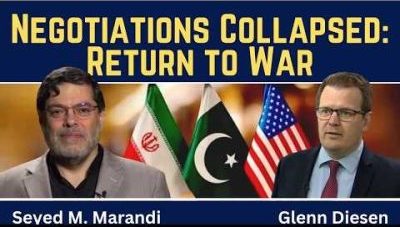
Seyed M. Marandi: Negotiations Collapsed – Return to War
or go to
Aletho News Archives – Video-Images
From the Archives
Wartime internment camps in Australia
National Archives of Australia
World War I
During World War I, for security reasons the Australian Government pursued a comprehensive internment policy against enemy aliens living in Australia.
Initially only those born in countries at war with Australia were classed as enemy aliens, but later this was expanded to include people of enemy nations who were naturalised British subjects, Australian-born descendants of migrants born in enemy nations and others who were thought to pose a threat to Australia’s security.
Australia interned almost 7,000 people during World War I, of whom about 4,500 were enemy aliens and British nationals of German ancestry already resident in Australia.
Records of World War I internment camps
World War II
During World War II, Australian authorities established internment camps for three reasons – to prevent residents from assisting Australia’s enemies, to appease public opinion and to house overseas internees sent to Australia for the duration of the war.
Unlike World War I, the initial aim of internment during the later conflict was to identify and intern those who posed a particular threat to the safety or defence of the country. As the war progressed, however, this policy changed and Japanese residents were interned en masse. In the later years of the war, Germans and Italians were also interned on the basis of nationality, particularly those living in the north of Australia. In all, just over 20 per cent of all Italians resident in Australia were interned. … continue
Blog Roll
 Aletho News
- Seyed M. Marandi: Negotiations Collapsed – Return to War
- Tomorrow’s naval blockade showdown
- ‘Israel’ attacks civilians to hide its embarrassing military failures & out of pure sadism
- Any Foreign Military Vessel Approaching Hormuz Under Any Pretext ‘Will Be Dealt With Severely’: IRGC
- Diplomats slam US negotiators’ performance in Iran talks
- Trump Refuses Exit Ramp, War with Iran will Continue
- Trump Says US Naval Blockade in Strait of Hormuz Will Begin Shortly
- US, Iran end 21-hour talks without agreement
- US IRAN TALKS: Who Are the Crazy Ones Here? /Lt Col Daniel Davis
- Talks with the US end without a deal over excessive US demands: Iran
- If Americans Knew
- US-Iran ceasefire negotiations make zero progress – Daily Update
- Pro-Israel ‘Thinktanks’ and Individuals who Influence U.S. Foreign Policy
- Mearsheimer reveals how Israel dictates US policies on Iran, Gaza – video
- After killing 350+, Israel still has a “score to settle” with Lebanon before ceasefire – Daily Update
- Military aid to Israel emerges as the latest political litmus test for Democrats
- The only Palestinian children’s rights organization closes following years-long Israeli campaign against it
- ‘I Can’t Forget the Smell’: Lebanese Reel After Israel Kills Over 300 in Single Day
- DNC Shoots Down Resolutions Calling Out AIPAC and Limiting Arms to Israel
- TCN: Is Israel Blackmailing President Trump?
- Israel killed at least 303 Lebanese yesterday – who were they? Daily Update
- No Tricks Zone
- Cave Discovery Reveals Today’s Desert Climates Were Recently Far Warmer, Wetter, Teeming With Life
- German Expert: Heat Dome Led To Record Temps In Western USA…Warmer In 1934, 1936
- New Study: No Linear Warming Or Glacier Retreat Along Northern Antarctic Peninsula Since 1980s
- An Inconvenient Tree: Uncovered In Alps… Europe Much Warmer Than Today 6000 Years Ago
- New Study Reports A 60% Slowdown In Greenland’s Ice Loss Rate In The Last Decade
- Low Intensity Tornado Wrecks Major Solar Farm, Creating A Potential Toxic Dump
- New Study Finds Warming Saves Lives…Cold Temperatures 12 Times More Deadly Than Excess Heat
- German Science Blog Accuses PIK Climate Institute Of Hallucinating Climate Tipping Points
- Devastating Assessment Of Comirnaty Vaccine By Former Senior Pfizer Europe Toxicologist
- New Study: CO2 Is ‘Effectively Negligible’ As An Explanatory Climate Change Factor Since 2000
 Aletho News