Pezeshkian slams US proposal to trade uranium for sanctions relief
Al Mayadeen | September 27, 2025
Iranian President Masoud Pezeshkian on Saturday dismissed what he described as an unacceptable proposal from Washington that would have required Tehran to surrender all its enriched uranium to the United States in exchange for a short-term easing of sanctions.
“Naturally, we did not reach an agreement on the snapback mechanism because the US demands are unacceptable. They want us to transfer all our enriched uranium to them in exchange for three months, and this is by no means acceptable,” Pezeshkian told Iran’s state broadcaster, IRIB.
The Iranian president said the plan would have left Tehran vulnerable to renewed US pressure. “Had Tehran agreed, the US would have presented Iran with new demands or threatened to bring the sanctions back,” he added.
Snapback, Sovereignty, Defiance
Pezeshkian’s comments came as the United Nations prepares to reinstate sanctions on Iran under the so-called “snapback mechanism,” after Western powers blocked Russian and Chinese efforts to delay the move. The reimposition would restore arms embargoes, asset freezes, and restrictions on enrichment, signaling a further breakdown in nuclear diplomacy.
The Iranian leader stressed that his government will continue to withstand Western sanctions by deepening economic and strategic cooperation with BRICS partners and the Shanghai Cooperation Organization, noting that Iran will rely on “the pride of the Iranian people and their yearning for independence.”
The stance aligns with the position of Sayyed Ali Khamenei, who this week ruled out any direct negotiations with the United States, calling them “a sheer dead end.” Analysts say this reflects a unified leadership intent on avoiding concessions that could weaken Iran’s deterrence or domestic legitimacy.
Resistance, Retaliation, Resolve
Pezeshkian’s defiance comes amid US concerns over Iran’s reported expansion of underground nuclear facilities near Natanz, where construction has accelerated since the June aggression on Iran, when “Israel” carried out coordinated strikes on Iranian military and nuclear sites under the pretext of halting a clandestine weapons program, a charge Iran categorically denied.
The nearly two-week confrontation drew in the United States after its forces struck Iranian nuclear facilities on June 22, prompting Tehran to retaliate by targeting the Al Udeid Air Base in Qatar. The escalation raised fears of a regional war before June 23, when US President Donald Trump announced that “Israel” and Iran had reached a ceasefire, ending what he described as “the 12-day war.”
Observers say Pezeshkian’s remarks reflect Iran’s determination not to trade its sovereignty or nuclear achievements for fleeting concessions, as Tehran shifts toward non-Western alliances and hardens its position against US-Israeli pressure. His message serves both as a rejection of coercive diplomacy and as a signal of Iran’s intent to pursue strategic autonomy in the face of revived sanctions and renewed isolation attempts.
China’s Warning
By Manlio Dinucci | Global Research | September 8, 2025
The global dominance that the United States, the greatest power in the West, wants to maintain at all costs violates the most basic norms of international law: the Trump Administration revoked the visas of representatives of the State of Palestine, preventing them from attending the United Nations General Assembly in September.
This claim to dominance is provoking growing opposition from the Global South. This is confirmed by the warning issued by China with the largest military parade in Beijing.
The official statement from the State Department states that the Trump administration has revoked the visas of members of the Palestine Liberation Organization (PLO) and the Palestinian Authority (PA) ahead of the upcoming United Nations General Assembly, “in the interest of our national security” because “the PLO and PA are responsible for undermining the prospects for peace through their appeals to the UN International Court of Justice to obtain unilateral recognition of a hypothetical Palestinian state.”
In addition, the Trump Administration announced the suspension of visas for all Palestinian passport holders, preventing them from entering the United States for medical treatment, university attendance, visits to relatives, and business activities. At the same time, the Trump administration announced that it is studying “the post-war plan for Gaza”: it provides for the “voluntary transfer” of the entire Palestinian population to transform Gaza into a luxurious “Middle East Riviera.” In this way, while Israel continues its genocide of Palestinians in Gaza and the West Bank, the United States is dismantling the foundations of the State of Palestine.
However, the global dominance that the West’s greatest power wants to maintain at all costs, violating the most basic norms of international law, is provoking growing opposition from the Global South. This is confirmed by the meeting of the Shanghai Cooperation Organization, whose members include China, Russia, Belarus, Iran, India, Pakistan, Kazakhstan, Kyrgyzstan, Tajikistan, and Uzbekistan, with several other countries participating. At the meeting held in China, President Xi Jinping reiterated the basic principles:
“First, we must respect the principle of sovereign equality. We must uphold that all countries, regardless of their size, strength, and wealth, are equal participants, decision-makers, and beneficiaries in global governance. We must promote greater democracy in international relations and increase the representation and voice of developing countries.”
*
This article was originally published in Italian on Grandangolo, Byoblu TV.
Manlio Dinucci, award-winning author, geopolitical analyst and geographer, Pisa, Italy. He is a Research Associate of the Centre for Research on Globalization (CRG).
The Defunct Weaponization of the U.S. Dollar. The SCO Summit and the Decline of the West’s Financial Hegemony.
By Peiman Salehi | Global Research | September 6, 2025
The Shanghai Cooperation Organization’s (SCO) summit in Beijing, marked by both symbolism and substance, underscored the slow erosion of Western financial dominance. While mainstream coverage focused on China’s military parade, the real significance lies in the economic agenda advanced by SCO members. Discussions of a potential SCO Development Bank, expanded use of local currencies, and closer coordination with BRICS initiatives point to a growing determination across Eurasia and the Global South to challenge the monopoly long exercised by the United States and its allies through the IMF, the World Bank, and the dollar system.
For decades, these Western-controlled institutions have functioned as instruments of geopolitical leverage. Structural adjustment programs dismantled social protections, imposed privatization, and locked countries into cycles of debt dependency.
The dollar, presented as a neutral global currency, has been repeatedly weaponized through sanctions, financial exclusion, and manipulation of international payment systems. In this context, the SCO’s economic discussions must be seen for what they are: not technical proposals, but acts of resistance. By seeking alternatives to dollar-based finance and conditional lending, SCO members are asserting that the age of Western financial coercion is no longer uncontested.
China and Russia, the central actors in this process, have both experienced the coercive use of Western financial power.
Sanctions on Russia and tariffs on China have reinforced the urgency of building parallel institutions. For smaller states, particularly in the Global South, the stakes are even higher. Access to credit that is not tied to Washington’s geopolitical priorities could mean the difference between austerity and investment, between dependency and sovereignty. The SCO’s proposals are embryonic, but they point toward a broader trend: the emergence of multipolar finance as a shield against unilateral domination.
Critics in the West have rushed to dismiss these efforts, portraying them as impractical or politically motivated. But such dismissals miss the point. The very fact that alternatives are being openly discussed and partially implemented signals the weakening of Western monopoly. The creation of the BRICS New Development Bank, the use of local currencies in trade between Russia, China, and India, and now the SCO’s initiatives all mark a shift from rhetoric to practice. Each new mechanism reduces the ability of the United States to dictate terms unilaterally.
This does not mean China or Russia will replace Washington as the new hegemons. Rather, it means that unipolarity is ending. The world is moving toward a multipolar order in which no single state can control the flows of finance, trade, and development. For Global South nations, this creates both opportunities and risks. It offers the possibility of diversifying partnerships and rejecting conditionality, but it also requires vigilance to avoid reproducing dependency under new patrons. Multipolarity is not a guarantee of justice, but it is a necessary precondition for breaking the cycle of Western domination.
The SCO summit should therefore be understood as part of a larger civilizational struggle over the architecture of world order. Western hegemony has rested not only on military alliances and cultural influence, but on financial coercion. By weaponizing the dollar, Washington has sought to enforce compliance far beyond its borders. The SCO’s economic agenda represents an attempt to reclaim sovereignty in the face of this coercion, to create breathing space for states that refuse to align with U.S. geopolitical priorities.
What emerges from Beijing is not a fully formed alternative, but a direction of travel. Multipolar institutions are being built step by step, challenging the illusion that Western institutions are eternal or indispensable. For countries in Africa, Asia, and Latin America, this is a call to action. It is an invitation to participate in the shaping of a world where development is not dictated from Washington or Brussels, but negotiated among equals.
The mainstream media will continue to focus on parades and symbols, but the real revolution is occurring in the realm of finance. The SCO summit was a reminder that the West’s monopoly on money and credit is cracking, and that the future of global order will be defined not by a single hegemon but by the collective efforts of states refusing to submit. For those seeking peace, justice, and sovereignty, this is a development to be welcomed, nurtured, and defended.
Peiman Salehi is a Political Analyst & Writer from Tehran, Iran.
The SCO Steps in Where UN Has Failed
Sputnik – September 1, 2025
The SCO has condemned Israel and the US for their attack on Iran in June. In a joint statement, they said that such aggressive actions against civilian targets, including nuclear energy infrastructure, which resulted in civilian deaths, constitute a gross violation of the principles and norms of international law and infringe on Iran’s sovereignty.
The SCO’s condemnation of Israeli and US strikes on Iran marks a turning point, Seyed Mohammad Marandi, Tehran University professor and political analyst, told Sputnik. “This is what we should have seen from the United Nations. Instead, the SCO and BRICS are emerging as the real alternative.”
Key takeaways:
- The West’s wars, sanctions, and support for apartheid regimes are pushing nations together and marginalizing the very institutions it built after WWII
- Iran’s membership in the SCO shows its people are not isolated—they have the backing of countries representing the global majority
- Asia’s rise is unstoppable: new trade corridors, Belt & Road, and collective security are shielding nations from Western disruption
- SCO is shifting into a real force: security, economic integration, and independence from Western financial institutions
Marandi: “Thanks to the West’s own foolish behavior, the SCO is becoming a central pillar of peace, security, and prosperity across Asia—and beyond.”
Russia backs China on global governance reform – Putin
RT | September 1, 2025
The Shanghai Cooperation Organization (SCO) could become the leading vehicle to usher in a more fair system of global governance, Russian President Vladimir Putin has said, adding that he supports China’s initiatives in this regard.
Speaking at the extended session of the SCO summit in Tianjin, China, Putin noted that the high attendance of the gathering is proof of a “genuine interest and attention to the multifaceted activities” of the organization. He noted that since its inception in 2001, the SCO has sought to build “an atmosphere of peace and security, trust and cooperation on the common Eurasian continent.”
“It seems that the SCO could take a leading role in efforts to form a more just and equitable global governance system,” Putin suggested, adding that it would be based on the primacy of international law and the key provisions of the UN Charter. In light of this, the Russian president continued, Russia has taken note of Chinese President Xi Jinping’s ideas on the matter.
The topic, according to Putin, has become “especially relevant in a situation where some countries still do not abandon their pursuit of dominance in international affairs.” The Russian president did not elaborate on this statement, but the comments come against the backdrop of unprecedented Western pressure on Russia.
Putin further said that SCO members have traditionally shown respect for each other’s history and civilizational diversity. He added that later this month Moscow is hosting the Intervision song contest, which is being presented as an alternative to Eurovision and will be attended by performers from Latin America, Africa, and Asia.
“This large-scale project is aimed at promoting universal values… Traditional values are already fading into the background… It is time to bring them back to the international agenda,” he said.
Tehran’s new war plan: Build an anti-NATO
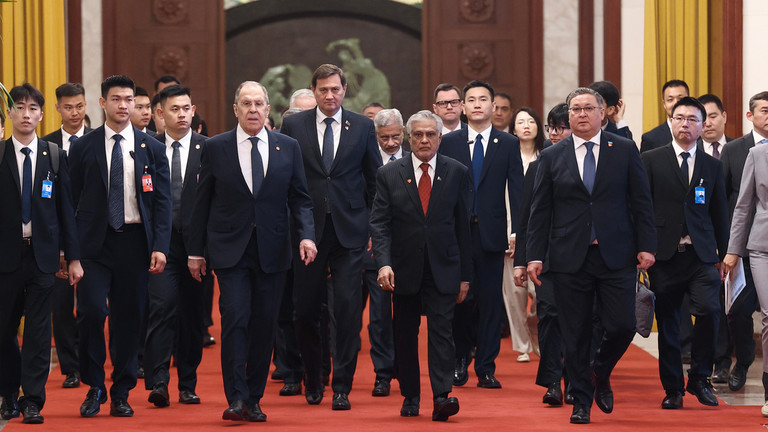
Russian FM Sergey Lavrov attends a meeting with foreign ministers of the Shanghai Cooperation Organization in Beijing, China. © Sputnik / Russian Foreign Ministry
By Farhad Ibragimov | RT | July 27, 2025
What if the next global security pact wasn’t forged in Brussels or Washington – but in Beijing, with Iran at the table?
This is no longer a theoretical question. At the mid-July meeting of the Shanghai Cooperation Organization (SCO) Council of Foreign Ministers in China, Iran made it clear: Tehran now views the SCO not just as a regional forum, but as a potential counterweight to NATO. In doing so, it signaled a profound strategic pivot – away from an outdated Western-dominated system and toward an emerging Eurasian order.
The summit highlighted the increasing resilience of multilateral Eurasian cooperation in the face of growing global turbulence. Russia was represented by Foreign Minister Sergey Lavrov, who also met with Chinese leader Xi Jinping – an encounter that underscored the strength of the Moscow-Beijing axis. On the sidelines, Lavrov held bilateral meetings with the foreign ministers of China, Pakistan, India, and notably, Iran. His talks with Iranian Foreign Minister Abbas Araghchi focused on diplomatic solutions to the nuclear issue and emphasized deepening strategic coordination.
The Iranian side used the platform with purpose. Araghchi expressed his appreciation for the SCO’s solidarity amid Israeli aggression and stressed that Iran views the organization not as symbolic, but as a practical mechanism for regional unity and global positioning.
A platform that works – despite the skeptics
India’s full participation also contradicted predictions in Western circles that geopolitical tensions would paralyze the SCO. Instead, New Delhi reaffirmed its commitment to the platform. The implication is clear: unlike NATO, where unity depends on compliance with a central authority, the SCO has proven flexible enough to accommodate diverse interests while building consensus.
For Russia, the SCO remains a cornerstone of its Eurasian strategy. Moscow serves as a balancing force – linking China with South and Central Asia, and now, with an assertive Iran. Russia’s approach is pragmatic, multi-vector, and geared toward creating a new geopolitical equilibrium.
Iran’s strategic breakout
The heart of the summit was Abbas Araghchi’s speech – an assertive and legally grounded critique of Israeli and American actions. He cited Article 2, Section 4 of the UN Charter, denounced attacks on Iran’s IAEA-monitored nuclear facilities, and invoked Resolution 487 of the UN Security Council. His message: Western aggression has no legal cover, and no amount of narrative control can change that.
But beyond condemnation, Araghchi delivered a concrete roadmap to strengthen the SCO as a vehicle for collective security and sovereignty:
-
A collective security body to respond to external aggression, sabotage, and terrorism
-
A permanent coordination mechanism for documenting and countering subversive acts
-
A Center for Sanctions Resistance, to shield member economies from unilateral Western measures
-
A Shanghai Security Forum for defense and intelligence coordination
-
Enhanced cultural and media cooperation to counter cognitive and information warfare
These are not rhetorical gestures – they are blueprints for institutional transformation. Iran is operationalizing a new security doctrine built on multipolarity, mutual defense, and resistance to hybrid threats.
SCO vs. NATO: Two models, two futures
While NATO is structured around a rigid hierarchy dominated by Washington, the SCO embodies a post-hegemonic vision: sovereignty, equality, and civilizational plurality. Its member states represent over 40% of the global population, possess vast industrial capacities, and share a collective desire to break the unipolar mold.
Tehran’s bet is clear: the SCO offers not just a geopolitical shelter, but a platform for advancing a new global logic – one rooted in strategic autonomy, not dependency.
The sophistication and clarity of Araghchi’s initiatives suggest that Tehran is preparing for the long game. Behind closed doors, the summit likely featured discussions – formal and informal – about deepening SCO institutionalism, perhaps even rethinking the organization’s mandate.
Araghchi made that vision explicit: “The SCO is gradually strengthening its position on the world stage… It must adopt a more active, independent, and structured role.” That’s diplomatic code for institutional realignment.
The West responds – predictably
The Western response was immediate. Within days of Iran’s proposals, the EU imposed new sanctions on eight individuals and one Iranian organization – citing vague claims of “serious human rights violations.” Israel, by contrast, faced no new penalties.
It is geopolitical signaling. Tehran’s push to turn the SCO into an action-oriented bloc is seen in Brussels and Washington as a direct threat to the current order. The more coherent and proactive the SCO becomes, the harsher the pressure will grow.
But that pressure proves Iran’s point. The rules-based order is no longer rules-based – it is power-based. For countries like Iran, the only path to sovereignty is through multilateral defiance and integration on their own terms.
The stakes ahead
Iran is not improvising. It is positioning itself as a co-architect of a post-Western security order. Its vision for the SCO goes beyond survival – it is about shaping an international system where no single bloc can dominate through sanctions, information warfare, or coercive diplomacy.
This strategy has implications far beyond Tehran. If the SCO embraces Iran’s proposals and begins to institutionalize them, we could be witnessing the early formation of the 21st-century’s first true alternative to NATO.
The West may dismiss this as fantasy – but in Eurasia, the future is already being drafted. And this time, it’s not happening in English.
Farhad Ibragimov – lecturer at the Faculty of Economics at RUDN University, visiting lecturer at the Institute of Social Sciences of the Russian Presidential Academy of National Economy and Public Administration
China Ready to Work With SCO Countries to Restore Peace in Middle East
Sputnik – 17.07.2025
China is ready to cooperate with the Shanghai Cooperation Organization (SCO) member countries and the international community to promote a political settlement and the speedy restoration of peace in the Middle East, the Chinese Foreign Ministry told Sputnik on Thursday.
On Tuesday, Iranian Foreign Minister Abbas Araghchi asked the SCO to promptly consider the situation with Israel’s aggression against the Islamic Republic, as well as to provide Tehran with political support in light of the June conflict with the Jewish state.
“The peoples of China and Iran are bound by traditional friendship. China is committed to maintaining friendly cooperation with Iran in order to benefit the peoples of both countries and bring positive factors to maintaining peace and stability in the Middle East,” the ministry said when asked to comment on Iran’s request to the SCO.
The ministry noted that “the situation in the region currently remains complex and sensitive.”
“China is ready to cooperate with members of the Shanghai Cooperation Organization and the international community to uphold peace, promote a political settlement and quickly restore peace and stability in the Middle East, which meets the common interests of the countries in the region and the international community,” the ministry added.
Kremlin comments on Türkiye’s SCO bid
Türkiye’s obligations to the US-led military bloc are not consistent with the Eurasian organization’s values, Moscow has said.
RT | July 12, 2024
Türkiye’s bid to become a full member of the Shanghai Cooperation Organization (SCO) is not compatible with its membership in NATO, Kremlin spokesman Dmitry Peskov said on Friday.
Last week, Turkish President Recep Tayyip Erdogan attended a summit of the Eurasian mutual defense group, in which his nation has observer status. While returning home from Kazakhstan, he told journalists that Ankara wants to “further develop” ties with the SCO and its founding members Russia and China. During the NATO leaders’ summit in the US this week, he said Türkiye wants to join the SCO as a permanent member.
Asked by journalists when Turkish accession could be expected, Peskov said there was a problem with such a proposal.
“There are certain contradictions between Turkish commitments and [its] position on fundamental issues as a NATO member and the worldview formulated in the founding documents of the SCO,” he explained.
The expansion of the SCO is of interest to many nations and remains on its agenda, but there is no specific timeline for accepting new members, he added. Commenting later during a press call on bilateral relations with Türkiye, Peskov said Russia was “open for attempts to reach agreements based on a certain worldview.”
Moscow perceives NATO as a hostile, aggressive military organization, which serves US geopolitical interests and is currently conducting a proxy war against Russia in Ukraine.
Despite being a NATO member state, Türkiye has maintained a neutral stance on the Ukraine conflict, refusing to impose economic sanctions on Russia and serving as an intermediary between Moscow and Kiev on several occasions. Ankara helped to mediate a nascent peace deal in the early months of the hostilities, which Kiev eventually ditched in favor of continued fighting. The Russian government believes that the US and its allies, particularly the UK, forced Ukraine to reject the proposal.
The SCO was founded in 2001 and currently has ten full members: Russia, China, India, Iran, Kazakhstan, Kyrgyzstan, Pakistan, Tajikistan, Uzbekistan, and Belarus. Kazakhstan holds the rotating presidency this year and hosted the leaders of member states on July 3 and 4 in Astana.
One of the key pledges to which SCO members subscribe is not to seek the improvement of their own national security at the expense of the national security of other parties. NATO policy does exactly that, according to its critics, including Russia.
Putin affirms Taliban as allies against terrorism
Al Mayadeen | July 4, 2024
Russian President Vladimir Putin affirmed the Taliban’s role as allies in the fight against terrorism during a press briefing on Thursday.
Despite the Taliban being under UN sanctions for terrorism, Putin acknowledged their control over Afghanistan and stressed the necessity of maintaining relations with the country’s real political forces.
“The Taliban movement have made certain commitments … but in general we have to assume that the Taliban control the power in the country. And in that sense, the Taliban are certainly allies for us in fight against terrorism,” Putin stated, noting ongoing signals of cooperation from the Taliban on counterterrorism efforts.
Regarding Afghanistan’s potential full membership in the Shanghai Cooperation Organization (SCO), Putin remarked that this decision concerns all SCO members, and not solely Russia.
Russia-Belarus Union State Unified Parliament
Switching focus, Putin addressed internal matters, including the creation of a unified parliament for the Union State of Russia and Belarus.
He described it as a matter of time, suggesting readiness for deeper integration, potentially including a common currency in the future.
“We also have intra-parliamentary structures and intergovernmental ones. Is it necessary now to move, as it was initially stated, to the creation of a unified parliament? It is a matter of time,” Putin told reporters.
Turko-Russian Relations
Furthermore, Putin expressed Russia’s keen interest in developing relations with Turkey, despite challenges.
“In general, on both sides there is interest in this… natural [interest], related not to the fact that someone is standing in our way, but to the real development of events in Turkey,” Putin told reporters, acknowledging Turkish President Recep Tayyip Erdogan’s political will as conducive to strengthening Ankara-Moscow ties.
Ending Ukraine Conflict
Conclusively, on the topic of resolving the Ukraine conflict through mediators, Putin asserted that while Russia remains open to negotiations, a resolution solely through mediation appears unlikely due to the complexities involved.
“We have always been in favor of negotiations, you know it well, we have never given up on them. The question of finalizing the conflict with the help of mediators and only through them seems to me unlikely. First of all, because it is unlikely that a mediator will be empowered to sign final documents,” Putin told reporters.
US created Ukraine conflict – Shoigu
RT | April 26, 2024
The Ukraine conflict is Washington’s doing and the US is deliberately trying to prolong the fighting, Russian Defense Minister Sergey Shoigu said on Friday during a meeting with his counterparts from Asian nations.
Shoigu is taking part in a gathering of military chiefs from members of the Shanghai Cooperation Organization (SCO), a nine-strong mutual defense organization. The Russian minister used the forum hosted by Kazakhstan to reiterate Moscow’s position on the origins of its conflict with Ukraine.
He identified Washington as a major source of global instability, citing its record of military interventions abroad, including in Afghanistan, Iraq, Libya, and Syria. The US also uses less direct financial and diplomatic tools to damage its opponents, including by fueling chaos in different parts of the world, Shoigu alleged.
“The US had first created, and now is deliberately prolonging the Ukraine conflict,” the minister stated. “As it signals purported intention to de-escalate, the West keeps pumping Kiev with weapons.”
Ukraine cannot properly control the donations, meaning there is the risk that they could end up with terrorist groups, Shoigu warned.
“They provide real-time intelligence, train Ukrainian troops, deploy Western military specialists and mercenaries on the battlefield,” he added, describing the involvement by various NATO members.
The US and its allies claim that Russia launched an “unprovoked” attack on Ukraine in February 2022, and they have since sent tens of billions of dollars’ worth of weapons to Kiev.
Shoigu accused the US of double standards regarding a nation’s right to self-defense. He cited Washington’s blocking of a UN Security Council resolution which would have condemned Israel for attacking an Iranian consulate in Damascus in early April. Tehran’s eventual retaliatory attack was the result of this obstruction, the Russian minister said.
Iran joined the SCO last year and was also taking part in the meeting in Kazakhstan.
China to strengthen military cooperation with Iran
MEMO | August 16, 2023
China is looking to enhance military cooperation with recent fully-fledged member of the Shanghai Cooperation Organisation (SCO), Iran.
Speaking at the 11th Moscow Conference on International Security yesterday, China’s Defence Minister Li Shangfu said that Beijing was keen to bolster military ties with Tehran and other SCO members and observer states.
“We will continue to strengthen the mechanism of security cooperation within the SCO, actively deepen defense collaboration with the organisation’s newest member Iran, as well as Belarus, which will soon become a SCO member,” Russia’s official TASS news agency quoted Li as saying.
The defence minister also emphasised that China is prepared to hold joint drills with other countries and to enhance international cooperation on arms control: “Beijing is ready to hold joint military drills and exercises with all countries, as well as find a larger space to hold drills and strengthen international cooperation in the field of arms control and non-proliferation [of nuclear weapons].”
Last month Iran became the newest member of the SCO, joining China, Russia, India, Pakistan, Uzbekistan, Kyrgyzstan, Kazakhstan and Tajikistan. The SCO Charter outlines the intergovernmental organisation’s commitment to the collective security of member states, especially in regards to” joint counteraction to terrorism, separatism and extremism in all of them manifestations.”
The Jerusalem Post noted that it was the first time the Islamic Republic has joined a regional pact since its founding in 1979. “This will grant Iran a freer hand to openly trade arms with Russia and China, and other SCO countries, which results in Iran’s expanding its influence and aggression in the region. The West needs to carefully consider the repercussions of this significant strategic development,” the article warned.
Iranian Ambassador to Russia, Kazem Jalali, praised the Moscow conference, saying: “It is a weighty exhibition in which the Islamic Republic of Iran has a good presence in this exhibition with its many companies. Very good topics were raised in the international security conference.”
West’s efforts to isolate Russia have failed – Lavrov
RT | April 29, 2023
The West has failed to isolate Russia, with the majority of the world still interested in maintaining good relations with Moscow, Foreign Minister Sergey Lavrov has said. He also argued that the trend toward multipolarity is irreversible, whether former colonial powers like it or not.
Addressing the World Online Conference on Multipolarity on Saturday, Lavrov said that “Washington’s and its satellites’ efforts to reverse history, to force the international community to live by the invented ‘rules-based order’” are proving to be a fiasco, citing the “total failure” of the West “to isolate Russia.”
According to the foreign minister, a number of countries, which combined are home to 85% of the world’s population, have made it clear that they will not do the bidding of the former colonial powers.
The Russian diplomat said the fact that delegates from several dozen nations “from nearly every continent” attended the online forum shows just how much traction the idea of multipolarity has gained.
Lavrov noted that new global centers are emerging in Eurasia, the Indo-Pacific region, the Middle East, Africa, and Latin America, and that these nations are pursuing independent policies guided by national interests.
According to the foreign minister, developing nations have been steadily expanding their share in the global economy over the past three decades, while the role of the G7 nations has been diminishing.
He also hailed the fact that more and more countries have expressed interest in joining international groups “of the new kind,” such as BRICS and the Shanghai Cooperation Organization (SCO).
Russia, Lavrov explained, champions a multipolar world order based on respect for the UN charter, and a “balance of interests” as opposed to a “balance of fear.”
President Vladimir Putin said on Friday that Moscow will not abide by the “so-called rules” invented and imposed by “certain countries.”
Also on Friday, while addressing members of the SCO, Defense Minister Sergey Shoigu claimed that the West is putting “unprecedented pressure” on independent countries to pit them against Russia and China, and undermine the rise of the multipolar world.
On Monday, Lavrov called for the expansion of Asian, African, and Latin American representation in the UN Security Council, arguing that the West is over-represented in the international body.
Featured Video
The 1964 Coup in Brazil
or go to
Aletho News Archives – Video-Images
Frlom the Archives
70 Neocons Petition Congress To Effectively Allow Israel To Say When The US Should Attack Iran
By Damian Lataan | January 10, 2014
Seventy senior Israeli-centric neoconservatives have written an open letter to Congress imploring them to do more to ensure Iran complies with the conditions of any agreement finally reached with the P5+1 over Iran’s nuclear program.
While the neocons are ostensibly asking Congress to ensure compliance, it is clear that their real aim is to convince members of Congress to support the bill currently passing through the Senate which calls for tighter sanctions against Iran in the event of any waywardness on Iran’s part.
The neocons are eager to see the bill currently passing through the Senate with enough support to make it veto-proof, not so much because they are concerned about Iran’s so-called nuclear weapons program – there’s still not a skerrick of hard evidence that Iran has a nuclear weapons program – but, rather, because embedded within the bill is this clause:
… if the Government of Israel is compelled to take military action in legitimate self-defense against Iran’s nuclear weapon program, the United States Government should stand with Israel and provide, in accordance with the law of the United States and the constitutional responsibility of Congress to authorize the use of military force, diplomatic, military, and economic support to the Government of Israel in its defense of its territory, people, and existence…
Essentially, the clause is an automatic trigger for the US to attack Iran at any time the Israelis choose to launch a first strike – regardless of whether President Obama is in favour or not.
Partial list… continue
Blog Roll
 Aletho News
- Emirati billionaire rebukes US senator over call for Gulf states to join war with Iran
- Op. True Promise 4: Iran’s missile blitzkrieg dismantles US war machine in West Asia
- Aramco CEO warns ‘catastrophe’ imminent if Strait of Hormuz remains shut
- What If Iran Says No?
- Trump Threatens to ‘Hit’ Iran ‘Twenty Times Harder’ Over Strait of Hormuz Oil Flows
- Spare the hypocrisy: Baghaei slams Ursula’s support for US
- Iran War Supporters Invent a New and Absurd Justification: It Is All About China
- Corporate Media Go All Out To Support The US-Israeli War on Iran
- Trump press conference reveals a man who wants out of war
- When Tel Aviv decides, Washington fights
- If Americans Knew
- Threats and missiles fly, death tolls soar in Iran, Lebanon, Gaza – Not a ceasefire Day 151
- Lebanon: Israel’s White Phosphorous Use Risks Civilian Harm
- Corporate Media Go All Out To Support The US-Israeli War On Iran
- US-Israel war on Iran is creating a steady growing number of amputees
- Israel planned this war on Iran for 40 years. Everything else is a smoke screen
- The wrong question about the war in Iran
- ‘Your Tax Dollars Being Used to Raise Your Gas Prices’: US-Israel Bomb Major Iranian Oil Depots
- ‘Bogus Evidence’: Former Nuclear Watchdog Head Debunks US Justification for Iran War
- EXPLAINER – Dimona: What to know about Israel’s nuclear site
- Fires and toxic air in Iran (thanks, Israel) – Not a ceasefire Day 150
- No Tricks Zone
- Wake-up Call: Survey Shows Majority Of Germans Now Favor Postponing Climate Targets!
- Televised! Leading German Political Candidate Tells Schoolchildren CO2 Makes Sun Hotter!
- New Study: A Century Warming Of 1.1°C Is ‘Commonplace’ And ‘Not Unusual’ During This Interglacial
- New Study: ‘Internal Noise’ And Volcanic Forcing Can Trigger 10-15°C Warming Within Decades
- Glaciers Worldwide Are Suddendly Surging, Experts Blame Warming!
- Surprising Discovery: Sahara Is Greening…Billions Of Trees Where Once Thought To Be Barren
- New Research Reaffirms Clouds, Aerosols, And Surface Solar Radiation Are ‘Driving The Climate System’
- Germany: Electric Car Catches Fire At Charging Station, Sets Off Local “Inferno”, Widespread Damage
- New Study: Canada’s New Brunswick Was 1°C Warmer Than Today During The Medieval Warm Period
- Coal Power Back In Trend As Globe Tries To Keep Pace With Growing Demand For Power
 Aletho News