Kosovo planning to attack Serbs – Belgrade
Samizdat – July 31, 2022
Serbian President Aleksandar Vucic has issued a plea for peace in Kosovo amid rising tensions with Pristina. However, he also vowed to fight to the death if ethnic Serbs in the self-proclaimed republic are targeted for another pogrom.
“The atmosphere has been heated up, and the Serbs will not suffer any more atrocities,” Vucic said in Belgrade on Sunday. “My plea to everyone is to try to keep the peace at almost any cost. I am asking the Albanians to come to their senses, the Serbs not to fall for provocations, but I am also asking the representatives of powerful and large countries, which have recognized the so-called independence of Kosovo, to pay a little attention to international law and reality on the ground and not to allow their wards to cause conflict.”
Vucic’s comments came as Pristina prepared to implement a controversial law requiring ethnic Serbs living in the disputed territory to replace their Serbian-issued vehicle registrations with Kosovo plates, starting on Monday. Kosovo also may require the replacement of other types of Serbian-issued documents, such as identification cards, and it will make a renewed attempt to ban entry or issue temporary papers to travelers with Serbian-issued documents or license plates.
Church bells rang in alarm across the northern part of the province on Sunday, amid reports that armed ethnic Albanians were gathering for another pogrom of the remaining Serbs – as had happened in 2004.
The Serbian president claimed last month that the registration policy was part of an effort to force remaining Serbs out of Kosovo. He referred to the move as “a new Storm,” in reference to the Croatian military operation in 1995 that forced most Serbs to flee Croatia.
Serbian Foreign Minister Nikola Selakovic told reporters on Saturday that “the Albanian side in Kosovo and Metohija is literally preparing to raise hell for Serbs.”
Kosovo’s prime minister Albin Kurti, an ethnic Albanian, has denied that the transition to non-Serbian documents is anything more than applying “law and justice” equally to all citizens.
“Trust your government,” he said in a videotaped message in Serbian.
Vucic has claimed that “provocations” against Serbs living in Kosovo have increased since Kurti, a nationalist who champions the idea of Albanian unification, became prime minister last year. The number of such incidents, including attacks by ethnic Albanians on Serbian cemeteries and Orthodox churches, has jumped 50%, he told reporters on Sunday.
“We do not want conflicts and we do not want war,” Vucic said in his speech. “We will pray for peace and seek peace, but let me tell you right away: There will be no surrender, and Serbia will win. If they dare to start persecuting, harassing and killing Serbs, Serbia will win.”
Vucic also speculated that Pristina is trying to take advantage of the Ukraine crisis by provoking a conflict in which Kurti would be portrayed sympathetically as Kosovo’s version of Ukrainian President Vladimir Zelensky, with the Serbs cast in the role of Russia and President Vladimir Putin.
NATO occupied Kosovo in 1999, after a 78-day air war against what was then Yugoslavia. The province declared independence in 2008, with Western support. While the US and most of its allies have recognized it, Serbia, Russia, China and the UN in general have not.
Serbia’s EU ascension dead as Brussels demands Belgrade renounce Kosovo and impose sanctions on Russia
By Drago Bosnic | July 7, 2022
The European Union is adamant that it is a “union of equals” and that the “interests and concerns of all of its current and/or prospective members will be taken into consideration”. Within the EU legal system, this is also made crystal clear by Article 4(2) TEU which states that “the Union shall respect the equality of Member States before the Treaties”. Still, the reality is starkly different. On paper, every member state is equally important. However, nobody truly believes that countries like Luxembourg or Malta could ever be as important and powerful as Germany or France. Worse yet, even France has trouble matching German dominance in the EU, to say nothing of other member states, particularly those in Southern and Eastern Europe.
And then there’s Southeast Europe. Current and prospective EU members there are as overlooked and dismissed as they could possibly be. Greece, by far the most important and powerful member in Southeast Europe is held in perpetual debt enslavement, while Bulgaria and Romania are virtually without sovereignty. And last, the so-called “Western Balkans” or former Yugoslavia (and Albania). This region’s EU perspective is questionable, at best. However, not so much thanks to the region itself. It is the bureaucratic empire that has treated the region as an outright colony, the one it created by destroying the relatively prosperous (and sovereign) Yugoslavia, instead creating half a dozen neo-colonies with little in terms of actual historical heritage and identity, a practice better known as the so-called “nation-building”, which is an expertise of the US and NATO.
The only exception to this is Serbia, the original founding state and by far the most important member of former Yugoslavia. Currently a semi-sovereign state, Serbia has been through a lot in recent decades, particularly since 1991, when the political West placed the country under a decade-long siege, destroying and dismantling Yugoslavia, while doing everything possible to expand the territorial scope of everyone else in the region, at the expense of ethnic Serbs, who have been expelled from nearly all regions of former Yugoslavia. The EU itself was (and still is) instrumental in this, together with the US. To achieve this, the political West has bombed Serbs 3 times in less than a decade, starting with the Republic of Serbian Krajina (1994-1995), Republika Srpska (1994-1995) and Serbia itself (1999).
It was catastrophic for Serbs, with tens of thousands killed, nearly a million refugees being forced out of their millennia-old ancestral lands and the ensuing economic and social devastation, the result of which was decades of stagnation. However, the EU and the US weren’t done with destroying the country. Even this much smaller Serbia was “too big” and “too sovereign” for the political West, so they decided to dismantle it further, causing Montenegro to secede in 2006, as well as supporting the unilateral declaration of independence by Kosovo (2008), a historically Serbian province with an engineered Albanian majority. Since then, 22 out of 27 EU member states have recognized the narco-terrorist entity. Brussels has tried to convince others to do so as well.
Formally, the EU never set Kosovo recognition as a condition for EU membership, although it did imply it many times since. However, on July 6, the EU crossed that line as well, when the European Parliament adopted the Resolution on Serbia, which “expresses support” for Serbia’s membership in the EU, but conditions the ascension with “urgent compliance” with the EU sanctions against Russia and Belarus, as well as the recognition of Kosovo as an independent state. These two requirements are now set as mandatory for further ascension talks. Top EU bureaucrat for Serbia Vladimir Bilcik emphasized Brussels expects Serbia to fully comply.
“That is why it is important that Serbia moves towards the EU, and not to any other side,” said Bilcik.
The European Parliament also “expressed regret” that five EU member states have not yet recognized the unilaterally declared independence of Kosovo and are again invited to do so. While Serbia was criticized for not sanctioning Russia and Belarus, the narco-terrorist neocolonial entity in occupied Kosovo was praised by the European Parliament for aligning with the European Union’s position on sanctions against Russia and Belarus.
Naturally, these terms are absolutely unacceptable to Serbia and can be considered indecent, to say the least. Neither Russia nor Belarus have ever done anything wrong to Serbia. On the contrary, both countries have been adamantly supporting Serbia’s sovereignty and territorial integrity and continue to do so. Historically, Serbia has been supported by Russia for centuries. Without the involvement of the Eurasian giant, it’s highly unlikely Serbia would’ve ever gotten its independence, let alone survived numerous brutal invasions and genocides coming from the political West in the last 100 years.
Turning against Russia for the sake of becoming a full colony of a centuries-old enemy could only be described as a mindless stab in the back which no government in Serbia would be able to survive, as it would be tantamount to political suicide. Thus, this resolution by the European Parliament means that Serbia’s EU ascension is effectively dead. Considering that the majority of Serbs don’t want to become part of the EU anyway, all they themselves could say is good riddance.
Drago Bosnic is an independent geopolitical and military analyst.
Germany demands Serbia impose anti-Russian sanctions
Samizdat | June 10, 2022
Serbia must follow the EU lead in embargoing Russia and recognize its breakaway province of Kosovo as an independent state if it hopes to join the bloc some day, German Chancellor Olaf Scholz said on Friday. At a press conference in Belgrade after his meeting with Serbian President Aleksandar Vucic, Scholz also said that the anti-Russian sanctions won’t end once the fighting in Ukraine stops.
“It is important that many countries join the sanctions, because in addition to deliveries of weapons that is something that helps Ukraine defend its sovereignty and territorial integrity,” Scholz said. “We expect all candidates for EU membership to join the sanctions as well.”
Brussels has so far adopted six “packages” of anti-Russian sanctions, with the most recent one including a phased ban on oil imports. These EU sanctions are “not something that will end when the hostilities are over,” Scholz said in Belgrade.
Instead, the German chancellor explained, Russia must accept it “cannot dictate the terms of peace” to Ukraine and guarantee Kiev’s sovereignty and territorial integrity, before the EU would consider lifting the embargo.
Russian President Vladimir Putin said on Thursday that the sanctions have backfired on the West, citing examples of inflation and shortages that US and EU governments are now trying to blame on Moscow. US Treasury Secretary Janet Yellen admitted on Friday the sanctions have made a “huge difference to food and energy prices,” amid record-setting inflation.
Vucic praised Serbia’s economic cooperation with Germany but reiterated that sanctioning Russia would be a difficult proposition for Belgrade. Earlier this week, he told Serbian television that the EU oil embargo has already cost $600 million in higher prices.
At the World Economic Forum meeting in Davos last month, Vucic said there was “no possibility” of anti-Russian sanctions at the moment and expressed pride that Serbia had been able to maintain its own, independent policy despite ongoing pressure.
On Friday, however, he said he “understood perfectly” Scholz’s demands, adding that “the chancellor will be notified of all our decisions going forward.”
Sanctioning Russia was not the only demand Scholz made to Belgrade, however. The German chancellor started his Balkans tour in Pristina, the capital of the breakaway Serbian province of Kosovo, which declared independence in 2008 with NATO backing.
“It is unimaginable for two countries that don’t recognize each other to become EU members,” Scholz said in a press conference with Kosovo prime minister Albin Kurti, which was widely interpreted to mean that Serbia must recognize the breakaway province before hoping to join the bloc.
“We first heard of this at the press conference in Pristina,” Vucic said later on Friday, adding that it came as a surprise, since until now the EU demanded “normalization” of relations, not recognition. He told reporters he had told Scholz that Serbia values its own integrity “as much as you value the integrity of Ukraine.”
“But Germany is powerful and we are small. It’s up to us to figure out how to deal with that.”
NATO seeks to punish Belgrade’s Ukraine War policy by arming Kosovo
By Paul Antonopoulos | April 21, 2022
After supplying equipment and emboldening a militarized Ukraine, Britain has now started arming Kosovo’s Albanians with Javelin and NLAW anti-tank missile systems. The British Embassy in Belgrade said that some Serbian media published fabricated claims of arms exports from the United Kingdom to Kosovo and claimed that there was no truth to those allegations. However, Serbian Minister of the Interior Aleksandar Vulin insists that the UK did transfer weapons to Kosovo, stating: “You are creating an army, arming them, giving them armored vehicles, anti-tank systems, drones, conducting training, we hear that you are sending them to trial courses in Turkey and Albania,” adding that the integration of Kosovo into NATO is only intended to “provoke Serbia.”
London seemingly wants to use the situation in Ukraine to increase pressure on the Serbs over the issues in Kosovo and Bosnia & Herzegovina (BiH). Before the Russian military operation commenced in Ukraine, Britain was already heavily involved in security issues in the Balkans. It is recalled that Boris Johnson warned of an extremely dangerous situation in the Balkans as early as December last year and appointed Air Marshal Sir Stuart Peach as the Prime Minister’s Special Envoy to the Western Balkans.
Following Brexit, the UK did everything it could to keep its presence in Europe, including in the Western Balkans where the roots of conflict already exist and threaten to boilover. The UK advocated for the maximum strengthening of Operation Althea (formally the European Union Force Bosnia and Herzegovina), the strengthening of the NATO contingent in the country, and even coordinated the unilateral arrival of British contingents and forces on the territory of BiH.
Such British (and NATO) militarization awakens anxieties and counters the security of both Serbia and the Balkans, with the violent wars of the 1990’s still fresh in the memory. The UK will likely continue to deliver equipment to the Balkans and also encourage other NATO members to strengthen anti-Serbian militaries in the region.
This comes as Montenegro seems synchronised in terms of Russophobia and pointing to Serbia as a disruptive factor in the region. This is ironic when considering Montenegro has no independence itself and follows the interests of the UK and US instead. Albania is also another key to Anglo designs over the Balkans, especially as they enthusiastically express their willingness to take practical steps to strengthen NATO forces in the Balkans.
The Western arming of Kosovo, bolstering of BiH, and encouragement for Montenegro and Albania to militarize is a warning to Serbia that it should not be so close to Russia, especially in the context of the Ukraine War.
The fact that foreign instructors are arriving with military systems in Kosovo is not a novelty because they have so far trained Kosovo Albanian soldiers in special forces, support units, telecommunications, anti-armour, PVO systems and more. However, this is likely just elementary training and an incomplete process with a future aim of fully equipping Kosovo’s forces with much more powerful weapon systems.
London is making such a decision to arm Kosovo even though there is no complete consensus in NATO regarding the status of the territory, with Greece, Romania, Slovakia and Spain refusing to recognize its illegally declared independence from Serbia. Despite a consensus not being reached, London and Washington are working timelessly to assist Pristina and construct some kind of Kosovo Army.
In effect, the Anglo Alliance are further radicalising Kosovo’s Albanians and encouraging destabilisation in the Balkans. Instead of punishing Kosovo’s de facto Prime Minister Albin Kurti for banning Kosovo Serbs from voting, they reward him with weapons and further integration into NATO.
Lightweight anti-missile and Javelin anti-tank systems, most commonly mentioned as part of a Western “support” package for the Ukrainian Armed Forces against Russia, have become part of the arsenal of Kosovo’s so-called security forces. The acquisition was agreed at a meeting between Albin Kurti and Boris Johnson in February this year, and according to Serbia but denied by the UK, the first contingent of 50 systems was delivered in April.
At the same time, the European Parliament’s foreign affairs committee will hold a session to discuss a draft resolution that will invite Serbia to harmonise with EU decisions in foreign and security policy, including sanctions on Russia. A draft resolution proposed by EP rapporteur for Serbia, Vladimir Bilczyk, expressed regret over the fact that Serbia failed to comply with EU sanctions following Russia’s military operation in Ukraine and urged Serbian authorities to show “a real commitment to EU values.”
The draft resolution reminds Serbian authorities that progress in the dialogue on normalising relations with Kosovo will determine the pace of EU accession negotiations. The proposed text is to be adopted by the European Parliament at a plenary session this year.
In effect, the EU and the Anglo Alliance are working in tandem to move Serbia away from Russia. The EU provides the carrot of bloc membership while the Anglo Alliance provides the stick by arming, training and militarizing Kosovo’s Albanians against Serbia. Given that Serbia has already experienced the full horrors of NATO and could do little as Europe divided the Serbian people by establishing new countries and not allowing them to be in the borders of Serbia, it is unlikely that Belgrade will be intimidated into abandoning its long, tried and tested relationship with Moscow.
Paul Antonopoulos is an independent geopolitical analyst.
Serbia says it was blackmailed over UN vote
Samizdat | April 8, 2022
Serbian President Aleksandar Vucic has said that his country has been pressured under the threat of sanctions to back Russia’s suspension from the UN Human Rights Council.
Belgrade has close historical ties with Moscow but joined other Western nations this week in a vote against Russia in response to its ongoing military campaign in Ukraine. “Our initial decision was to abstain, but then we were subjected to countless and difficult pressure,” Vucic told RTS TV on Thursday.
“They said – do you know that a decision is being made whether Serbia will be exempted from the package of sanctions on [Russian] oil, and whether it will be able to import oil after May 15?” the president said. He compared the possible effect of sanctions on Serbia to “a nuclear strike.”
Unlike the EU, Serbia has not imposed any sanctions on Moscow. “The Republic of Serbia believes that it’s not in its vital political and economic interests to impose sanctions on any country,” Vucic said, while stressing that he wants to maintain good relations with the European bloc, as well as with Russia.
Belgrade previously said that getting cut off from Russian energy would damage its economy. On Friday, Serbian media outlets quoted its sources in Brussels as saying that Serbia will be exempt from possible sanctions on Russian oil and gas.
At the same time, Blic newspaper quoted EU spokesman Peter Stano as saying that the bloc expects Belgrade to follow its restrictions on Russia or impose its own sanctions on Moscow.
On Thursday, the UN General Assembly voted to suspend Russia from the organization’s human rights panel. Serbia was among the 93 member states that backed the suspension.
The EU banned the imports of Russian coal, but has so far stopped short of banning the imports of oil and gas. European Council President Charles Michel, however, said on Wednesday that the bloc will need sanctions on Russian oil and gas “sooner or later.”
Understanding the Ukraine Crisis From the Last Free Enclave in Europe – Outside of Russia and Belarus, That Is
By Aleksandar Pavic | Strategic Culture Foundation | March 3, 2022
To any Serb who has not lost his mind or has just become numb from three decades of relentless anti-Serbian propaganda and lies emanating from the “free and democratic” West’s power centers and media – the speed and totalitarian scope of anti-Russian measures and the intensity of anti-Russian propaganda censorship that has captured the West cannot come as a surprise. As Serbian president Aleksandar Vucic stated a few days before the beginning of Russia’s denazification and demilitarization campaign in the Ukraine, about 85% of Serbs are “always” on the side of Russia. Even as Serbia has, over the past several days, come under immense Western pressure as the lone independent enclave in Europe, a sort of a West Berlin of the new multipolar world in the making, surrounded by NATO and/or EU countries that have been, with varying degrees of voluntarity, sucked into the ongoing anti-Russian hysteria and the accompanying sanctions, closing of airspace to Russian planes, etc.
The reason is simple, even if one sets aside the centuries-old spiritual, ethnic and just plain fraternal ties between the two peoples. For the Serbs were, so to speak, the canaries in the coal mine in the years that followed George Bush Senior’s proclamation of a “new world order.” Early on after the fall of the Berlin Wall, at the beginning of the 1990s, while innocents and just plain people of good will were still enamored with the announced “end of history” and the glorious triumph of “liberal democracy,” in the Serbian parts of Yugoslavia, we were experiencing, firsthand, something completely different, dark and ominous. We were witnessing the gradual return of pure, cynical power politics, only this time couched in the clothing of politically correct, sugarcoated homilies invoking “human rights,” “democracy,” “European integration” and “peace,” which, as it soon enough turned out, served as a mere “liberal” fog of war, as a preparatory rhetorical, diplomatic and media artillery fire for legitimizing the West’s self-anointed right to define what is good and what is not and to, on the basis of the newly prescribed definitions, interfere and expand its purely pragmatic, base interests wherever it could. The world was the victorious West’s oyster, “democracy expansion” its new quasi-religion, putting a moral veneer on its newest geopolitical outreach, a modernized version of the “white man’s burden” couched in the newfangled terminology of a supposedly post-ideological era.
Thus, during the violent dismemberment of Yugoslavia, its chief external instigators and facilitators – led by Germany and Austria, with essential help from the U.S. ambassador to Yugoslavia – could, thanks to their vast domination of the media-informational space, present themselves as “peace brokers” and, even more sickening, as moral arbiters. The new-old expansionist West could portray itself to the uninformed and the gullible as some sort of force for good, while painting the enemy – the Serbs then, the Russians today – as evil incarnate. It was on the ashes of the Western-fomented destruction of Yugoslavia that the myth of “indispensable NATO”, “benevolent EU” and the “good West” received much of their subsequent affirmation and post-Cold War soft power. And therein lies much of the reason why Russia’s – and not only Russia’s – endless polite requests and pleas to halt the North Atlantic military pact’s steady expansion to the east, were not taken seriously, or at least seriously enough, by a critical mass of those who had no direct contact with the Western wolves in sheep’s clothing, like the Serbs (and the Syrians, Libyans, Iraqis, Afghans, Yemenis, Somalis, Venezuelans, etc.) did. Simply put, the West was only starting to spend the huge surplus moral value it had accrued as victor of a global struggle with an “evil empire,” the chinks in the (artificially manufactured) armor were still too microscopic for the ordinary, inexperienced, well-meaning eye to detect.
Even NATO’s illegal bombing of the Federal Republic of Yugoslavia in spring of 1999, in the name of “prevention of genocide” in Serbia’s historic and sacred Kosovo province – of which no evidence has ever been presented over the ensuing 23 years – did not awaken the critical mass of Western public opinion and decision-makers necessary to reexamine the wisdom and necessity of continuing on the path of, essentially, a new Drang nach Osten (however, seeing what happened with Trump, much later in the game, it’s beyond obvious that election outcomes and decision-making in the West have been captured by the military-industrial complex even then, just as Eisenhower had warned back in 1961) .
It did, however, finally awaken Moscow, opening the way to Vladimir Putin’s ascendance to Russia’s highest office on the last day of that fateful year. Like the Serbs, the Russians still remembered the true horrors of the last world war and could recognize the all-too-familiar patterns far more easily than most on the European continent. Unfortunately, Moscow could not do much about them initially, other than to ceaselessly warn, beginning with Munich in early 2007, ask for a general reassessment and renegotiation of common European security and – aware that its tactful warnings, suggestions and proposals were being blithely ignored in the key Western capitals – rearm and prepare itself for the inevitable. Which finally came with the collective West’s refusal to talk about Ukraine’s neutrality and the halting of NATO’s further expansion, in parallel with the Ukrainian puppet president’s raising of the threat of Ukraine becoming a nuclear state.
Why would Moscow agree to the very real possibility of nuclear missiles deployed at its borders, which could reach it in 7-8 minutes (and, in the case of future hypersonic missiles, in 5-6 minutes)? Why would it trust NATO’s (true) power centers, whose leading figures had assured it that not one further inch would be taken to the east as the Warsaw pact self-dissolved – and then proceeded to do precisely the opposite?
So, no, the endless verbal assurances and endless empty talk of the past three decades would no longer work, as all Russia had gotten out of it was a hostile, Axis-like alliance at its borders and a campaign of steadily rising demonization that had, of late, in many aspects exceeded that experienced by the U.S.S.R. at the height of the Cold War. When threatened with nuclear missiles under its nose in Cuba, the U.S. was willing to launch nuclear war to prevent it. Russia has threatened no such thing.
A day after the beginning of the Russian demilitarization and denazification campaign, Serbia’s president announced Serbia’s official position regarding the situation in Ukraine, as outlined in the conclusions of the Serbian National Security Council. In essence, Serbia’s position is that it respects Ukraine’s territorial integrity as it respects the territorial integrity of all states in accordance with the UN Charter and the Helsinki Act of 1975, that it considers the violation of the territorial integrity of any state, including Ukraine “very wrong,” but that it will not impose sanctions against the Russian Federation.
It is enough just to look at a current political map of Europe to see the significance, courage and difficulty of Serbia’s decision. Serbia and neighboring Bosnia and Herzegovina (BiH) are islands in the NATO sea that surrounds them – and BiH is not a NATO member only due to the opposition of the Serbs in that country, led by the Serbian member of the BiH Presidency, Milorad Dodik. In addition, all the surrounding states have joined the Western condemnations of Russia’s intervention in Ukraine and have joined or voiced support for the newest sanctions imposed on Russia, including the EU’s closure of air space to Russian planes.
As expected, over the past few days, as testified by Vucic himself, Serbia has been subjected to “intense” Western pressure to join the sanctions and condemnations front against Russia. The EU Parliament Rapporteur for Serbia, Vladimir Bilchik has already stated that Serbia’s decision not to join the EU’s sanctions against Russia is a “defining foreign policy decision for much broader relations between the EU and Serbia.” Former Swedish foreign and prime minister and the first High Representative for BiH Carl Bildt Tweeted that Serbia has “de facto disqualified itself from the EU accession process,” as new members are expected to share in the EU’s “fundamental values and interests.” European Commission spokespeople Ana Pisonero and Eric Mamer have also voiced expectations that Serbia would join the EU sanctions policy.
These are all rather ominous words – and not because anyone in Serbia, other than a handful of well-paid diehards and hopeless cases, truly believes that the country will ever be admitted to the self-proclaimed “most successful peace project in human history” (which expressly approved the sending of fighter jets to neo-Nazi “democrats” in Ukraine), but because the out-of-control Western elites’ “either you’re with us or against us” mentality is certain to find ways to make its displeasure known to all dissidents. Especially to an encircled, friendly-to-Russia enclave that stubbornly refuses to join the anti-Russian hysteria being fanned all over the Western “liberal” landscape. After all, Serbia was viciously and illegally bombed by NATO in 1999 for not voluntarily agreeing to its own occupation by the alliance of “democratic values.” Since then, the alliance has gained 11 more members and about a thousand kilometers to the east. So, we shall wait and see in the coming days and weeks what practical measures of punishment or censure will be applied by the EU (and NATO) against Serbia, which has been an official candidate for EU membership since 2012 and is, thus, obliged to gradually harmonize its policies, including foreign policy, with the “peace loving” union.
Russia has shown appreciation and understanding for Serbia’s position. In his reaction to Serbia’s official stance, the Russian ambassador in Belgrade stated that Russia “understands that Serbia is being pressured and does not ask anything of Serbia,” being well aware of the mutual respect and trust that exist between President Vucic and Russia’s President Putin, that Serbia “respects Russia’s national interest,” and that Russia is “at peace” with Serbia’s position and its foreign policy.
In addition, as stated in the National Security Council conclusions, Serbia was itself a victim of Western sanctions during the 1990s and, even more importantly, aggression on the part of 19 NATO states in 1999 precisely for defending its own territorial integrity. In other words, Serbia is not only refusing to join Western sanctions against a traditional friend and ally but also to be a part of traditional Western double standards, which it has felt on its own skin both in the past and in the present. Towards that end, the speaker of the Serbian parliament, Ivica Dacic, clearly stated that, unlike the rest of “democratic” Europe, Serbia would not join in the “totalitarian” methods and close or censor either Sputnik or RT. So, as things stand, Sputnik’s last non-Russian European outpost now sits in Belgrade, which is, nevertheless, still not sufficiently “democratic” to pass muster with the free-thinking bureaucrats in Brussels
On that same tangent, because you can never have too much trans-Atlantic hypocrisy, the U.S. embassy in Belgrade also reacted to Serbia’s position regarding the Russian intervention in Ukraine by Tweeting that the U.S. “salute Serbia’s and President Aleksandar Vucic’s repeated position of support for Ukraine’s territorial integrity, which was violated by Russia’s illegal and completely unprovoked attacks.”
Aside from the brazen twisting and pure invention in which the U.S. embassy engaged – as no Serbian official has used any remotely harsh words to describe Russia’s intervention – American diplomats are conveniently ignoring the fact that their own country has been consistently and aggressively violating Serbia’s own territorial integrity since February 2008, when the U.S. recognized the independence of Serbia’s historical and sacred province of Kosovo (Kosovo and Metohija is the full name of the province, in accordance with the Serbian constitution). And, of course, except for the 5 EU states that have refused to recognize the secession of so-called Kosovo from Serbia (Greece, Cyprus, Romania, Spain and Slovakia) – the rest of the EU, headed by its most powerful members (Germany, France, Italy and the Benelux countries), is also being its usual hypocritical self in expecting Serbia to condemn violations of other’s territories when the majority of its own member states have also recognized the violation of Serbia’s territorial integrity by recognizing “Kosovo” and, indeed, actively promoting its “independence” which, in practice, is non-existent, as the territory is a black hole of drug and human trafficking, whose politicians take orders from abroad, as well as home to a large U.S. military base built on land stolen from Serbs.
The Serbian leadership’s initial decision met with the support of the great majority of the Serbian public, which is, nevertheless, well aware of Serbia’s difficult position. However, on March 2, Serbia joined the majority in the UN General Assembly and condemned the Russian “aggression against Ukraine.” In a rather sorry display of public self-pity, Vucic tried to justify the vote at a press conference by explaining that Serbia still refused calls to join the anti-Russian sanctions, as well as resisting new Western pressures to nationalize Russian-owned property in Serbia. However, his popularity will suffer as a result, so it’s still a win-win for Western interests in Belgrade, because they always prefer weakened leaderships, as they are more pliable and, thus, sensitive to outside pressure.
Serbia’s current position is eerily reminiscent of the country’s position in the spring of 1941. At that time as well, the Serbian elite in the Kingdom of Yugoslavia was the lone voice of opposition in the country against joining the Axis powers, even though Yugoslavia itself was, along with Greece, surrounded by countries that had fallen under the occupation or political domination of the Axis powers. As a result of the coup of March 27, 1941, organized by Serbian officers opposed to a pact with the Axis, Yugoslavia was attacked by Germany and its allies on April 6, 1941, the country itself dismembered and occupied, and the Serbian population subjected to political repression and genocidal annihilation over the next four years. Although the Serbs organized two large guerilla liberation fronts, it was only with the aid of the Soviet Red Army that the territory of Yugoslavia was fully liberated in the fall of 1944. Alone among the former peoples that made up Yugoslavia (which also included Croats, Slovenes and Slavic Muslims, along with substantial Albanian and Hungarian minorities), the Serbs still remember this, just as many Russians remember that only the Serbs refused to join Nazi German troops on the Eastern Front against the U.S.S.R.
Might this be, in Yogi Berra’s immortal words, déjà vu all over again?
Whatever China is doing in Tajikistan, it’s wrong to compare it to American imperialism
By Bradley Blankenship | RT | October 29, 2021
Reports of China building a military base in the Central Asian country of Tajikistan are causing unease in Washington. But it’s wrong to assume Beijing is embarking on the sort of empire-building we expect from the United States.
Earlier this week, reports from Radio Free Europe/Radio Liberty suggested that Tajikistan had approved the construction of a new Chinese military base on its soil. Separately, the same US government-controlled media outlet claims that the Tajik government offered full control to Beijing of what was said to be an already-in-use Chinese military base, and has pledged to waive future rent in exchange for Chinese military aid.
Neither China nor Tajikistan has officially confirmed this news, and there is good reason to believe the US may be exaggerating these claims in order to raise the alarm on some kind of renegade Chinese militarism.
Earlier this month, a report was leaked to the Financial Times from anonymous US government sources claiming that China had tested an orbital hypersonic missile capable of carrying a nuclear warhead, apparently able to travel around the world. Beijing denied this report, saying it had actually tested a reusable orbital space vehicle.
Chinese media were also quick to respond, with CGTN suggesting the US was trying to create a kind of ‘Sputnik moment’ to ramp up anti-China hysteria, referring to when the Soviet Union launched the world’s first artificial satellite in 1957, causing great concern in Washington and beginning the space race.
And indeed General Mark Milley, chairman of the US Joint Chiefs of Staff, went public with that very suggestion, saying on Bloomberg that this alleged weapon test was “close to” a Sputnik moment. Are US cold war tactics really so predictable?
The answer is yes, and the same can also be applied to this latest development in Tajikistan. Even if the news is true, it does not in any way suggest what the US government is insinuating – that China is becoming an overly ambitious, hostile power.
For one, Tajikistan, believed to have the weakest military in Central Asia, is worried about its security after the American-led retreat from Afghanistan and the return of the Taliban. If China was to increase its involvement this would not be surprising, since other powerful countries in the region, such as Russia, have also been called on by the Tajik government to assist on security matters.
The likelihood of a war between Tajikistan and Afghanistan is low, despite Tajik President Emomali Rahmon’s hardline stance against the Taliban and rumors that his government is interfering in Kabul’s internal affairs. He has repeatedly said that his government will not recognize Taliban rule in Afghanistan due to concerns over human rights.
While this may just be political posturing from Rahmon, evidenced by his strong invocation of Afghanistan’s Tajik minority, Chinese security involvement in Tajikistan could serve as a moderating influence between the two sides, since Beijing has high-level contact with the interim Afghan government.
China also has legitimate concerns for its own security and that of its Belt and Road Initiative (BRI) in relation to Afghanistan, since it shares a border with the country.
There are at least three terrorist groups in Afghanistan and Pakistan – the Balochistan Liberation Army, Tehreek e-Taliban Pakistan, and Islamic State Khorasan – that are explicitly anti-Chinese and, in the case of the former two, have committed acts of terror against Chinese diplomats.
The latter two of these groups have also expressed support for Uighur extremist groups in China, like the Turkistan Islamic Party, which has drawn serious concern from Beijing as it seeks to cool down ethnic tensions in Xinjiang Uighur Autonomous Region.
These concerns are valid, and so what we are seeing is not some far-flung overextension of China’s military presence, as is the working definition of ‘security’ for the US. Discounting these unconfirmed reports in Tajikistan, China has only one foreign military base, in Djibouti, compared to upwards of 750 operated by the US – including some 400 in China’s neighborhood alone.
Washington commentators have consistently blasted out a message that China will end up the next empire to die in Afghanistan, suggesting that Beijing would actually make the same ridiculous mistakes that they did over the past 20 years in Afghanistan. This is nonsense. Unlike Washington, Beijing has pursued a multilateral framework with Afghanistan that welcomes input from every regional country, including high-level discussion through the Shanghai Cooperation Organisation, a Eurasian regional security pact, and the SCO-Afghanistan contact group.
China will also not bomb Afghanistan to the Stone Age and construct a foreign-dependent warlord economy, instead opting to include Afghanistan in the BRI, meaning Beijing will help plug Kabul into an interconnected future in Eurasia – all without political strings attached. That’s because it’s a win-win situation for China, Afghanistan, Central Asia, and the world.
And if this might sound hard to believe? Well, it’s not. You would be hard-pressed to find any example of a Chinese war of aggression in modern history, because such an example doesn’t exist. On the other hand, there are examples of China helping clean up messes created by the US and its allies, including in Europe.
For instance, look at China’s involvement in the Balkans – particularly in Serbia, where at least one US-sponsored think tank, the Center for Strategic and International Studies (CSIS), now accuses the country of being a puppet for Beijing. But here’s the reality: NATO tore Serbia apart during the Yugoslav wars and used so much depleted uranium in airstrikes against Serbia in 1999 – about 15 tons – that the country has the highest cancer mortality rate in Europe.
On the contrary, the report by the CSIS notes that 40 percent of Serbians think China gives the most aid to the country – in terms of dollars – even though the European Union actually does.
Instead of spending billions on “government and civil society” programs (foreign interference, in other words) like the US and EU, in 2019 in Serbia, Beijing focused 31 percent of its investments toward transportation, 20 percent to information and communications technology, 20 percent to manufacturing, 13 percent to energy, and nine percent to health and human services.
These are, as the CSIS notes, highly visible and consequential sectors – and, I would add, the ones that Serbia obviously needs the most after the devastation brought on by the NATO bombing. Belgrade’s Pupin Bridge, built by the Chinese – one of its two major bridges that cross the Danube – serves as a permanent reminder of how important China’s aid to Serbia has been.
So, when considering an extended Chinese influence in Central Asia, in whatever form that takes, there’s no reason to conflate this in any way with US imperialism and its deleterious effects.
Bradley Blankenship is a Prague-based American journalist, columnist and political commentator. He has a syndicated column at CGTN and is a freelance reporter for international news agencies including Xinhua News Agency.
Biden has pledged that ‘America is back.’ But as peace shatters in the Balkans, does that mean yet more US misadventures?
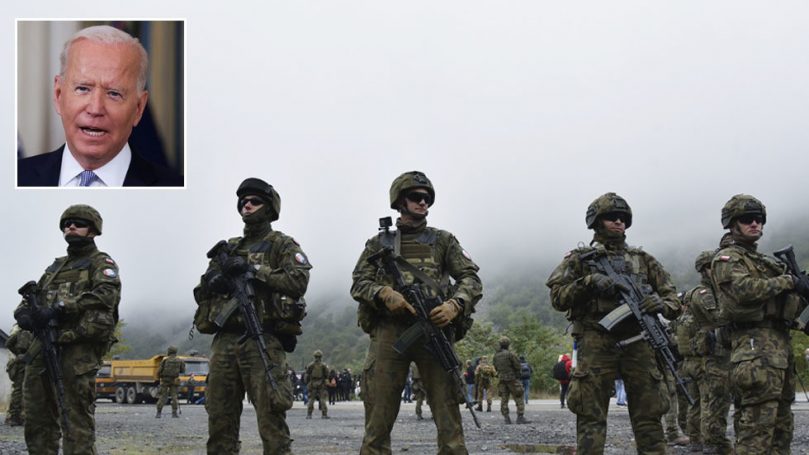
KFOR forces patrol near the border crossing between Kosovo and Serbia in Jarinje, Kosovo, October 2, 2021. © REUTERS / Laura Hasani; Inset © REUTERS / Evelyn Hockstein
By Julian Fisher | RT | October 24, 2021
With warnings that fresh tensions between Serbia and Kosovo could unravel the decades-old peace deal that put an end to bloody fighting in the Balkans after the breakup of Yugoslavia, the US is increasingly split on what to do.
Earlier this month, the SOHO forum in New York City hosted a debate between Scott Horton, long-time libertarian and anti-war radio host, and Bill Kristol, the neoconservative thinker and one of the ideological architects of America’s post-9/11 world order. The subject of the debate was US interventionism, its merits and historical record.
Predictably, Kristol offered vague niceties that attempt to recast America’s legacy as that of the “benevolent global hegemony”, a term which he himself coined in 1996 when describing the country’s role in the world. Reflecting on the wars in Iraq, Kristol simultaneously said that America “didn’t push democracy enough” and also “may have been too ambitious.” In short, he acknowledged mistakes were made, which is an admission that would have been unthinkable only a few years ago, and yet still falls short of accountability.
However, whereas American actions in the Middle East leave a lot to be desired for Kristol, he insists that the US intervention in the Yugoslav Wars during the 1990s was a success. As he put it, the Balkans was “one case of a war that was worth it and that I think had pretty good consequences.” As if on cue, the Balkan pot is beginning to boil once again.
An unresolved conflict
Kosovo has been a potential tinderbox in Southern Europe ever since the end of the war of 1998/1999. A recent row with Serbia, from which it unilaterally declared independence, has led to a new escalation in tensions.
Beginning in September 2021, Serbs living in Kosovo launched protests against authorities hassling travelers who enter the territory with Serbian-issued license plates, prompting a mobilization of armed Kosovo police forces, roadblocks, and traffic jams near the border. Two vehicle registration offices were vandalized.
The EU mediated a temporary fix in September that involves covering up national insignia on license plates with stickers, until a special working group in Brussels determines a more permanent solution sometime within the next six months. Whether this will be sufficient in bringing about immediate calm remains to be seen, however. Since then, further clashes have erupted between police and protesters near Mitrovica.
Russia’s Foreign Ministry has condemned the use of violence by Kosovo police against ethnic Serbs. Foreign Minister Sergey Lavrov met with Serbian President Aleksandar Vucic in mid-October, calling for talks between Pristina and Belgrade and a diplomatic solution to be respected by all sides.
As the situation heated up, NATO quickly ramped up patrols throughout Kosovo, including the North. “KFOR [Kosovo Force] will maintain a temporary robust and agile presence in the area,” the US-led military bloc said in an official statement earlier this month, intended to support the implementation of the EU-brokered solution. Last week, Kosovo’s minister of defense, Armend Mehaj, flew to Washington to meet with Under Secretary of Defense for Policy Dr. Colin Kahl at the Pentagon. The subject of the discussions was “bilateral security cooperation priorities”.
These moves are only the latest instance of US-led posturing in Kosovo. It was with American support that Kosovo launched its campaign for international recognition in 2008. Many major countries, representing most of the world’s population — including Russia, China, and India — have not recognized it as a sovereign state. Kosovo’s persistent claim to independence is what makes an issue as seemingly benign as license plates a question of war and peace.
In the background is still the 1999 Kosovo War, which was the site of NATO’s infamous bombing campaign against Serbia that led to the deaths of at least 489 civilians, according to Human Rights Watch. In April of 1999, NATO deliberately targeted Serbia’s Radio Television station, killing 16 civilians, according to Amnesty International. At one point, the US “mistakenly” bombed the Chinese embassy in Belgrade, killing three and wounding some 20 more, in what turned out to be the only target picked by the CIA over the course of the war.
To this day, the US maintains a military base, Camp Bondsteel, near Urosevac, Kosovo, as part of the international Kosovo Force (KFOR).
Two states in one
To the west, Bosnia and Herzegovina (BiH) has also reappeared in international news coverage. Against the backdrop of the EU’s Western Balkan Summit in early October, the Bosnian Serb leader Milorad Dodik said last week that the parliament of the Serb Republic, one of two entities that together make up BiH, would soon vote to undo some of BiH’s state institutions. He included the military, the High Judicial and Prosecutorial Council (HJPC) and the tax administration. These and others were established after the signing of the 1995 Dayton Peace accords and are not enshrined in the constitution.
Dodik wants an independent Serb Republic without compromising the territorial integrity of BiH, and he claims he has the support of seven EU member states, though he has not said which ones.
The genesis of Bosnia and Herzegovina’s recent headache is an amendment to the Criminal Code that makes various forms of inflammatory speech a punishable offense. The law was enacted in July of this year by the Office of the High Representative, an international “viceroy” with the power to impose binding decisions and remove public officials.
Russia has maintained that this appointed position is outdated, with a statement from the Foreign Ministry saying it was high time to “scale down the institute of foreign oversight over Bosnia-Herzegovina, which only creates problems and undermines peace and stability in that country.” Moscow also remains critical of attempts to integrate the country into NATO, insisting there is no consensus among the people of Bosnia and Herzegovina when it comes to joining the US-led bloc.
Playing to a different tune, already last month Washington tried to reprimand Dodik for his “secessionist rhetoric”. In a meeting just a few weeks ago, US Deputy Assistant Secretary of State Gabriel Escobar warned of “nothing but isolation and economic despair” for the people of the Serb Republic. According to a transcript that Dodik shared with the press, he told Escobar that he doesn’t “give a damn about sanctions,” adding, “I’ve known that before. If you want to talk to me, don’t threaten me.”
In the US, various Balkan-American organizations have released a joint statement calling on Congress and the Biden administration “to immediately initiate steps to rebuff the attempts by the government of Serbia to unravel the region’s peace and security”. Citing both aforementioned developments in Kosovo and the Serb Republic of Bosnia and Herzegovina, the statement demands a reinvigoration of “NATO enlargement as a priority for the region.” It suggests that what’s at stake in the Balkans is America’s legacy: “America invested too much of its own resources into this region to allow revanchist actors to decimate nearly a quarter century of progress.”
However, what does America investing its resources actually look like? In early 1992, before the war that scarred Bosnia and Herzegovina, all parties involved had already come to an agreement, the Carrington–Cutileiro plan, to divide Bosnia and Herzegovina into cantons along Serb, Croat, and Bosniak lines.
At the last minute, however, the then-US ambassador to Yugoslavia, Warren Zimmermann, met with the leader of the Bosniak majority, Alija Izetbegovic, in Sarajevo, reportedly promising him full recognition of a single Bosnia and Herzegovina. Izetbegovic promptly withdrew his signature from the partition agreement, and shortly thereafter the US and its European allies recognized Izetbegovic’s state. War ensued a month later, in April 1992. The US eventually worked its way back to new partition negotiations that echoed the talks held prior.
As the New York Times reported in 1993, “tens of thousands of deaths later, the United States is urging the leaders of the three Bosnian factions to accept a partition agreement similar to the one Washington opposed in 1992.”
Zimmermann is quoted as saying at the time that “Our hope was the Serbs would hold off if it was clear Bosnia had the recognition of Western countries. It turned out we were wrong.”
Returning to the Horton-Kristol debate from earlier, Horton cited America’s underhanded opposition to the Carrington-Cutileiro plan, and the devastating consequences, as a case in point of US interventions impeding, rather than promoting, peace and stability.
President Joe Biden declared at the start of his administration that “America is back.” Taking a look at the history of US interventions, this could spell trouble for the Balkans.
Julian Fisher is a policy analyst at the Russian Public Affairs Committee (Ru-PAC). He writes about Russia-U.S. relations, American foreign policy, and national security
Featured Video
No Threat Can Force Iran’s Surrender /Trita Parsi & Lt Cl Daniel Davis
or go to
Aletho News Archives – Video-Images
From the Archives
What is the Israeli Lobby in Australia Doing in Interfaith Dialogue?
By Ali Kazak | Dissident Voice | October 11, 2015
For years Israel and its lobby around the world have been trying to normalise their relations with Arabs and Muslims without solving the Palestine Question.
One of the methods they resorted to in the last few years is using human rights and community organizations such as interfaith dialogue and Multiculturalism to achieve this objective and to: isolate the Palestinians, marginalise the Palestine question, end Israel’s isolation, and prevent criticism of Israel, knowing that these organisations will be the first to stand against Israel’s violations, racial and religious discrimination.
The group responsible for this task in Australia is The Australia/Israel & Jewish Affairs Council (AIJAC); its Director of International & Community Affairs, Jeremy Jones is in charge of lobbying religious community organizations, specifically Muslims and Christians. Consequently he convened the Faith Communities for Reconciliation, founding participant in the Australian Partnership of Religious Organisations and the Australian National Dialogue of Christians, Muslims & Jews.
AIJAC is a private political propaganda group. It is recognised as the main Israeli lobby in Australia. It coordinates its activities and works intimately with the Israeli embassy in Canberra and different institutions in Israel. It is privately funded by some Jewish businessmen. It monitors closely Australian politicians, the media, ethnic and religious groups, (especially Arabs and Muslims), unions and academics on their stands towards Israel and the Palestine question. … continue
Blog Roll
 Aletho News
- ‘War Crime’: Iran condemns attacks on Arak, Ardakan nuclear sites
- Two-thirds of Americans want quick end to Iran war even if goals unmet
- Trump to Give “Important Update on Iran” Wednesday in Prime-Time Speech
- Theodore Postol: Iran’s Missiles & Drones Were Underestimated
- Iran To Target Military Industrial-Tech Complex That Facilitated Gaza Genocide
- Collapsing Empire: The Resistance Disarms ‘Israel’
- Suicide Should Not Be a Government Service
- Rethinking America’s greatest threat: Iran vs. Israel-Firsters
- Iran accuses adversaries of false flags to strain Turkey ties
- Poland rules out sending Patriot missiles to US/Israel amid war on Iran
- If Americans Knew
- Ann Coulter Rips Into Fox News for Iran War Coverage, Compares to False Rigged 2020 Election Reporting
- Joe Kent Urges Americans To Call White House and Congress To Object To Sending Troops Into Iran
- DNC Resolution to Reject AIPAC Funding Puts Democratic Leaders in the Hot Seat
- Swedish foundation to build 400 schools as over 650,000 Gaza children remain without education for 2 years
- Israeli army admits photshopping image of slain Lebanese journalist
- This is how Israel is systematically killing health workers under the cover of war in Lebanon
- Carrying life under fire: Israeli invasion of Lebanon leaves pregnant women facing deadly risks
- Champagne all around for the new death penalty (for Palestinians) law – Not a ceasefire Day 172
- Why are Palestinian books struggling to be seen on Amazon?
- The Line Between Affinity and Conspiracy
- No Tricks Zone
- New Study Finds Warming Saves Lives…Cold Temperatures 12 Times More Deadly Than Excess Heat
- German Science Blog Accuses PIK Climate Institute Of Hallucinating Climate Tipping Points
- Devastating Assessment Of Comirnaty Vaccine By Former Senior Pfizer Europe Toxicologist
- New Study: CO2 Is ‘Effectively Negligible’ As An Explanatory Climate Change Factor Since 2000
- Former Pfizer Toxicologist Dr. Helmut Sterz Tells Bundestag Hearing Pfizer Vaccine Should Have Never Been Approved
- Energy Expert: Germany’s Nuclear Phaseout Was A “500 Billion Euro Mistake”
- New Research: South Australia’s Mid-Holocene Sea Surface Temperatures Were 4°C Warmer Than Today
- Storing Green Energy To Last Germany 10 Days Would Require A 60-Million Tonne Battery
- New Studies: UK Sea Levels Were 4 Meters Higher Than Today During The Mid-Holocene
- Destructive Green New Deal: German Energy And Metal Group Warns Of Drastic Crisis
 Aletho News