S. American states to recall ambassadors from Europe over Bolivian plane incident
RT | July 12, 2013
South American countries belonging to the Mercosur trade bloc have decided to withdraw their ambassadors for consultations from European countries involved in the grounding of the Bolivian president’s plane.
“We’ve taken a number of actions in order to compel public explanations and apologies from the European nations that assaulted our brother Evo Morales,” explained Venezuela’s President Nicolas Maduro, who revealed some of the agenda debated during the 45th summit of Mercosur countries in Uruguay’s capital, Montevideo.
The decision to recall European ambassadors was taken by Maduro, Argentina’s President Cristina Fernandez, Brazilian President Dilma Rouseff, and Uruguay’s President, Jose Mujica, during the meeting.
Member states attending the summit expressed their grievances with “actions by the governments of France, Spain, Italy and Portugal” over the July 2 incident, when the aircraft carrying President Evo Morales back to Bolivia after attending an energy summit in Moscow was denied entry into the airspace of a number of EU member states.
The small aircraft, which required a stop-over before completing its flight, was forced to make an emergency landing in Austria after a circuitous flight path.
It was later revealed that the European countries’ actions were prompted by accusations made by the US ambassador to Austria, William Eacho, who alleged that American whistleblower Edward Snowden had been taken on board to help him gain political asylum in Latin America.
“The gravity of the incident – indicative of a neocolonial mindset – constitutes an unfriendly and hostile act, which violates human rights and impedes freedom of travel, as well as the treatment and immunity appropriate to a head of state,” the Mercosur nations affirmed in the joint statement.
The incident was further described as a “discriminatory and arbitrary” decision by European countries, as well as a “blatant violation of international law.”
Ecuador snubs US trade ‘blackmail’ over Snowden, offers human rights training
RT | June 28, 2013
Ecuador renounced trade benefits which the US threatened to revoke over the Latin American country’s consideration of harboring NSA leaker Edward Snowden. It offered $23 million a year to fund human rights education for Americans instead.
The government of leftist President Rafael Correa came up with an angry response on Thursday after an influential US senator said he would use his leverage over trade issues to cut preferential treatment of Ecuadoran goods at the US market, should Ecuador grant political asylum to Snowden.
“Ecuador will not accept pressures or threats from anyone, and it does not traffic in its values or allow them to be subjugated to mercantile interests,” government spokesman Fernando Alvarado said at a news conference.
He added that Ecuador is willing to allocate $23 million annually, an equivalent of the sum that it gained from the benefits, to fund human rights training in the US. It will “avoid violations of privacy, torture and other actions that are denigrating to humanity,” Alvarado said.
US Senator Robert Menendez, who heads the Foreign Relations Committee in the Senate, said this week that Ecuador risks losing the benefits it enjoys under two trade programs because of its stance on the NSA whistleblower.
“Our government will not reward countries for bad behavior,” he said.
The US is Ecuador’s prime trade partner, with over 40 percent of exports going to the US market.
Both programs were due to expire by the end of next month and were subject to congressional review. Before the Snowden debacle arose, the US legislature was expected to scrap one of them while renewing another one.
Snowden has applied for political asylum, hoping to find protection from American prosecutors, who charged him with espionage over his leaking of classified documents on US surveillance programs.
He is currently thought to be staying in the transit zone of a Moscow airport. He became stranded in the Russian capital after arriving from Hong Kong, because the US annulled his travel passport as part of its effort to get him to American soil for trial.
‘Vitoria!’ Mass protests force Brazil congress to reject ‘bill of discontent’
RT | June 26, 2013
Brazil’s legislative body has thrown out a proposed constitutional amendment, which was a key grievance of protesters across the country. The government is also planning to introduce a range of political reforms to appease demonstrators.
In what in being seen as a victory for people power, the measure was defeated on Tuesday by Congress by 430 votes to nine; with the Rio Times saying the protests were “largely fueled by social media and citizen journalists.”
The amendment, known as PEC 37, would have limited the power of state prosecutors to investigate crimes.
The protesters had argued that PEC 37 might have opened the way to more corruption; a problem which is endemic in Brazil.
Brazil ranks 69 out of 174 countries on the 2012 Transparency International index, a score that indicates significant problems with corruption.
The defeat of PEC 37 will keep public prosecutors at the forefront of the fight against corruption. If the amendment had become law, it would have granted power to carry out criminal investigations exclusively to the police.
Critics to the bill argued that it would have prevented prosecutors from conducting fair, impartial and effective criminal investigations, particularly into organized crime and corruption, in which the police themselves have been embroiled. In December last year 63 police officers were arrested after a yearlong bribery investigation.
The police in Brazil are amongst the most corrupt in the world and have been mired in recent years in a number of corruption scandals.
Congress also voted Tuesday to funnel all revenue and royalties from newly-discovered oil fields off the Brazilian coast into education and health.
The new fields are among the largest finds in recent years and, once fully operational, are expected to produce tens of billions of barrels of oil; although they are located deep on the ocean floor and extracting the oil will require expensive new technology and carries huge risks.
Protestors also voiced their anger at other issues, which they say the government is mishandling, including soaring levels of corruption, poor public services and the huge cost of staging the 2014 World Cup and 2016 Summer Olympics, both to be held in Brazil.
The government, though, has promised a range of initiatives, which they say will combat corruption and improve public services.
A referendum proposing political reform is meant to address campaign financing and political representation, and the government says a vote may take place as soon as September 7.
A controversial plan to bring in foreign doctors to reverse a shortfall in the country is being pushed through despite the objections of Brazilian medical practitioners and an increase in public transport fares in many cities has also been scrapped. The President of the Senate, Renan Calheiros, has even proposed free transport for students.
Yet it is still unclear whether or not these hasty political concessions are having an impact. Protests are due to continue in the city of Belo Horizonte Wednesday, with tens of thousands of people expected to take part.
In a security nightmare for police, the demonstration will take place at the same time as the semifinal of the Confederation Cup between Brazil and Uruguay. One protest group has said it plans to protest outside the national team’s hotel.
Last Saturday there were violent clashes in Belo Horizonte during another protest and President Rousseff has warned against a repeat of violence.
Brazil sees largest protests in decades as unrest hits second week
RT | June 17, 2013
Mass protests continued throughout Brazil on Monday, with hundreds of thousands of demonstrators converging in Sao Paulo, Rio de Janeiro, Belo Horizonte, the capital of Brasilia and other cities.
Protests initially began last week following a government announcement of an increase in public transportation costs, which brought out students and young workers and led to more than 250 arrests.
According to reports by Brazilian media such as Jornal do Dia, the initially peaceful demonstrations last week became heated, and led to clashes with Brazil’s riot police that left at least 100 injured in the major cities of Brasilia, Sao Paulo, Rio de Janeiro and Belo Horizonte.
Though the protests initially began following the announcement of bus fare increases, they have evolved to include a wide range of groups that have grown dissatisfied over everything from government corruption and income inequality, as well as to outrage over the police’s harsh response to protesters last week.
In a sign that public dissatisfaction was still simmering, soccer fans booed president Dilma Rousseff on Monday during the opening of a two-week tournament at a stadium in the capital Brasilia. The heckling only intensified when the president of the global soccer body, FIFA, reprimanded the crowed for failing to show the president “respect.”
Though Rousseff was able to ride on her predecessor’s popularity, Brazil’s economic growth has slowed considerably since she took over from Luiz Inacio Lula da Silva, who is widely credited with lifting 40 million Brazilians out of poverty. Brazil’s economy has posted its worst two-year performance in over a decade, and inflation rose to 6.5 per cent in May.
At least 20,000 Brazilians were expected to demonstrate in Sao Paulo on Monday, with organizers placing the figure closer to 30,000.
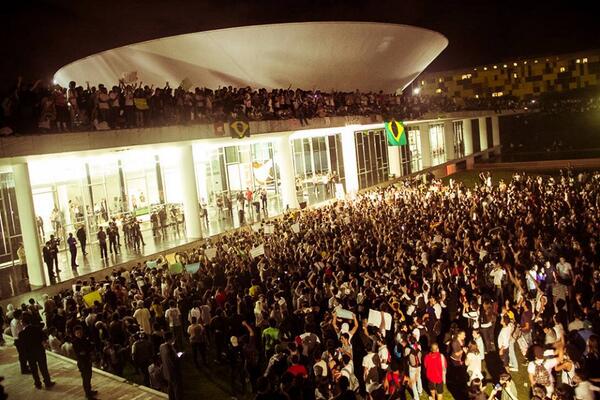
Protesters climb atop the capitol building in Brazil. #ChangeBrazil pic.twitter.com/Tb6CblQ5T0
Related articles
US imposes sanctions on Hezbollah, citing Syria role, Africa influence
Press TV – June 12, 2013
The US has declared “sanctions” on four alleged “ambassadors” of the Lebanese Islamic resistance group Hezbollah, citing the movement’s role in pushing back foreign-backed insurgents in Syria as well as its rising influence in West Africa.
The US Treasury Department announced Tuesday that it was imposing what appear to be vague sanctions against the four Lebanese individuals whom it claims are “fundraising and recruiting for Hezbollah” in efforts to expand its influence in West Africa, as well as South America and Middle East, The Los Angeles Times reports Wednesday.
Citing US officials, the report states the four men were acting as Hezbollah “ambassadors” in Sierra Leone, Senegal, Ivory Coast and Gambia.
The daily further quotes US Treasury officials as underlining “the alarming reach of Hezbollah’s activities,” pointing to the Islamic movement’s “growing military role” in the recent triumph of the Syrian Army over foreign-sponsored militant gangs that have waged a destructive war on the country in largely US-led attempts to overthrow the government of President Bashar al-Assad.
The mostly symbolic sanctions, according to the report, “grew out of an investigation of what Treasury said are Hezbollah’s expanding activities abroad, including in South America, the Middle East and Africa.”
The sanctions would supposedly “freeze any assets” the four men “may have in the United States and sever them from any contact with the US financial system.”
However, it is not even clear if and how much the Lebanese individuals, identified as Ali Ibrahim Watfa, Abbas Loutfe Jawaz, Ali Achmad Chehade and Hicham Nmer Khanafer, have under the control of American financial institutions.
The US government has in the past repeatedly “imposed” meaningless sanctions, in the form of freezing funds, against a number of Iranian individuals and officials that have absolutely no ties or holdings in the US or American financial institutions.
The development comes as the American government and some of its allies, including the Saudi Kingdom, have protested the supportive role of Hezbollah forces behind the Syrian Army to flush out mostly al-Qaeda-linked armed gangs that have terrorized the nation with massive weapons supplied to them through Turkey, Jordan and Lebanon by mostly Persian Gulf Arab kingdoms, with US and European blessings.
Argentina to Nationalize Cargo and Passenger Trains
By Sabrina Hummel | The Argentina Independent | June 4, 2013
Minister of the Interior and Transport, Florencio Randazzo, is set to announce changes in the railway sector – most importantly the nationalisation of passenger and cargo trains.
The Brazilian company América Latina Logística (A.L.L) will see its concession revoked and the historic Tren de la Costa will return to state hands. A.L.L had already received a warning from the Auditor General’s Office for anomalies in its provision of services.
From 1990 up to 2012, the company amassed a debt of over $237m to the government, 866% in excess of its contract compliance. Payments over the last six months have stalled, allowing the government to rescind its concession.
Tren de la Costa, built at the end of the 20th century, served as a vital link between the neighbourhood of Belgrano and the port of Tigre. Following various changes in ownership, it converted to electric power in 1931.
It covers 15.5km and runs alongside the scenic Río de la Plata serving four provincial municipalities. It has a total of 11 stations with a standard fare of just $16m or $10 for those with a DNI.
A.L.L meanwhile operates two of the most important freight railway networks in all of the country: A.L.L Central (line San Martín) and A.L.L Mesopotámica (line Urquiza). A.L.L Central runs through the centre of Argentina, beginning in the province of Cuyo and passes through San Luis, Córdoba, Rosario, Santa Fe, and finally Buenos Aires. A.L.L Mesopotámica in turn runs through the provinces of Misiones, Corrientes, and Entre Ríos, linking them to Paraguay, Uruguay, and its own network in Brazil.
A.L.L is the largest operator of rail logistics in Latin America. A.L.L Argentina is the biggest rail operator in the country, spanning 8000km. It is also the second largest in terms of cargo volume, transporting more than 5m tonnes each year.
Randazzo was recently quoted saying, “in terms of policy and management decisions, the State is more competitive than the private sector”.
Colombia: Piedad Córdoba Ratifies Intention to Run for President
Prensa Latina | June 1, 2013
 La Paz – While visiting this capital, Colombian ex senator Piedad Córdoba expressed her intention to run for president in the next elections in her country, according to press reports.
Cordoba visited the cities of Sucre and La Paz to film the next chapters of the program “Causa Justa” (Just Cause) to be broadcast by Telesur television network, and took the opportunity to ratify her position to become the first woman to be at the helm of Colombia.
According to the newspaper Cambio, Córdoba also extolled the transformations undergone by the Bolivian capital in the past few years: “you can really see progress in Bolivia, the big changes and improvements in La Paz!”, she said.
Cordoba, 58, has worked systematically for the rights of women, ethnic minorities and human rights in her country, besides being involved, in 2007, in efforts to reach an agreement between the Revolutionary Armed Forces of Colombia-People’s Army (FARC-EP) guerrillas and the then government of President Alvaro Uribe.
Since 2011, in the wake of her dismissal as senator by the Attorney General’s Office of Colombia, she started to work with Telesur in the Causa Justa program, which highlights conflicts hitting the region, as told by political, social and cultural figures, notes Cambio newspaper.
She is in Bolivia “for a second season of the program in order to film a documentary on discrimination, bilingual education and the indigenous presence of President Evo Morales,” added the source.
Related articles
- Colombia: FARC and Government Reach Agreement on Land Reform
- Colombia: extrajudicial executions killing still ongoing according to report
- Latest FARC Proposal for Peace Process in Colombia
- Colombia: President Santos Announces ‘Profound Changes’
- Colombia: Drummond Contractor Convicted in Unionists’ Deaths
- Imperialism and Violence in Colombia
UNASUR to Create Military Force
By Laura Benitez | The Argentina Independent | May 9, 2013
The Union of South American Nations (UNASUR) has announced that it will create a united defence body to promote democratic stability among its member countries.
Military delegates of Argentina, Brazil, and Ecuador concluded a two day meeting yesterday in Quito, and agreed on creating the first South American Defence College (ESUDE) – a safety training centre with the aim of turning “the regions into a zone of peace”.
UNASUR has said that the idea behind the project is to “eliminate outdated visions that have formed our military, with manuals and taxes from foreign powers.
“The goal is to start from scratch and consider a defence doctrine, without starting from the premise of opposing countries. It is important to define our role in the military, to assume responsibility for prevention, border control or emergency responses.
“We want to create a body of higher and postgraduate education to create a regional identity for civilians and our military, and to avoid interference of other countries or geopolitical zones,” a UNASUR spokesperson said.
The ESUDE proposal paper will be presented at the next meeting of the executive body for the South American Defence Council in Lima, Peru on the 16th and 17th May. Members who attended yesterday’s meeting in Quito will meet again during the second week of July in Buenos Aires, to define the Esude proposal.
One of the issues that is expected to be up for debate in the following meetings is the level of participation in the armed forces from each country.
The initiative already has the support of other member countries, including Argentina, Brazil, Ecuador, Peru, Venezuela, Guyana, Suriname, and Uruguay.
Related articles
- UNASUR Urges Respect for Venezuela’s Electoral Results (venezuelasolidarity.co.uk)
- U.S. refuses to recognize Maduro’s presidential win in Venezuela polls (panarmenian.net)
Court lets Morales run for reelection
Press TV – April 30, 2013
Bolivia’s President Evo Morales has received approval from the country’s constitutional court to run for reelection next year.
Bolivia’s Constitutional court president Ruddy Flores said on Monday that Morales could run for his third consecutive presidential term.
This is while only two consecutive terms are allowed under the country’s new constitution.
The court found Morales, 53, able to run since the president’s first term was not under the current constitution.
“The presidential term is computed from the time of the adoption of the new constitution,” Flores said.
Next year’s vote will be counted as Morales’ first reelection, under the ruling.
The ruling has sparked protests from the opposition.
Earlier this month, Morales said that Washington was planning to stage a coup in Venezuela, following the election of Nicolas Maduro as president.
Morales, the first indigenous president of South America’s poorest nation, was elected president in late 2005 and reelected in 2009.
During his years as president, Morales has nationalized private companies aimed at increasing state control over the country’s economy.
He also pushed for the formation of a new constitution.
Colombia: President Santos Announces ‘Profound Changes’
By Kari Paul | The Argentina Independent | March 14, 2013
Colombian President Juan Manuel Santos announced yesterday that he will initiate “an agenda of transformation” in the 16 months he has left in office.
This announcement comes as Santos continues peace negotiations with Revolutionary Armed Forces of Colombia (FARC). Congress announced last week that a resolution will be made with the armed revolutionary group by August.
“Our vision is of a just, modern, and safe Colombia,” Santos said, according to El Tiempo.
He added that disarming FARC is not enough and that the system must change in order to avoid similar situations in the future.
“Some people continue to be stuck in the past, selling us a vision of a Colombia condemned to another 50 years of violence, paralysed by fear and without the capacity to imagine anything more than what it has always been,” he said. “However we, the large majority, believe in our future.”
Officials and Santos finalised this new “comprehensive government strategy” in a meeting Monday.
Beginning today, union directors and business owners will begin meeting to design and begin this project that Santos called “an emergency plan for growth and productivity.”
Beyond lowering rates of violence in the country, the president announced goals of a more “modern Colombia,” including plans to build 317 kilometres of highways this year.
Santos added that he is “committed… to making it so that Colombia can say ‘we have peace’ before leaving the government.”
Featured Video
Theodore Postol: Iran’s Missiles & Drones Were Underestimated
or go to
Aletho News Archives – Video-Images
From the Archives
Wars for Israel: A reminder of who’s giving the marching orders
By Damian Lataan | February 7, 2012
As the West prepares to march off to yet another war in the Middle East, we should perhaps remind ourselves of who is giving the West their marching orders.
In February 2003, just weeks before the US and their allies launched their attack on Iraq and her peoples, a delegation of US congressmen, together with the US Ambassador to the United Nations, John Bolton, a well known pro-Zionist and neoconservative war-hawk, were in Israel at the invitation of the Israeli government then led by Israeli Prime Minister Ariel Sharon.
Addressing the congressmen, Sharon told them ‘that Iran, Libya and Syria should be stripped of weapons of mass destruction after Iraq’. Later, Sharon told John Bolton ‘that Israel was concerned about the security threat posed by Iran, and stressed that it was important to deal with Iran even while American attention was focused on Iraq’. … continue
Blog Roll
 Aletho News
- A New Resistance Front: How Does Syria Factor into the Regional War?
- Gulf states weigh pipeline expansion plans, hoping to bypass Hormuz
- Iran sets up ‘tollbooth’ system in Strait of Hormuz
- Wave 90: IRGC strikes US-linked industrial sites in Gulf
- Iran Says US-Israeli Claims of Its Military Strength Are Wrong
- Trump’s April Fools’ Address to the nation
- The Most Important Bet You’ve Never Heard Of
- The killing of three Indonesian soldiers in Lebanon should remind Jakarta that Israel does not want peace
- Defeated and delusional: Netanyahu’s remarks reveal $80bn war failure, says analyst
- Iran’s friends are about to make life much more difficult for Israel and the US
- If Americans Knew
- Trump says the quiet part out loud: (Israel’s) war on Iran > Americans’ health – Daily Update
- Gaza families reunite years after babies evacuated amid Israel’s war
- International Rescue Committee warns Gaza’s children face grave protection risks
- Iran’s Alleged 47-Year War on America: Debunking the 1,050 American Deaths Canard
- Israel wants US to bomb more of Iran’s civilian structures (113,000 is not enough) – Not a ceasefire Day 173
- Ann Coulter Rips Into Fox News for Iran War Coverage
- Joe Kent Urges Americans To Call White House and Congress To Object To Sending Troops Into Iran
- DNC Resolution to Reject AIPAC Funding Puts Democratic Leaders in the Hot Seat
- Swedish foundation to build 400 schools as over 650,000 Gaza children remain without education for 2 years
- Israeli army admits photshopping image of slain Lebanese journalist
- No Tricks Zone
- Low Intensity Tornado Wrecks Major Solar Farm, Creating A Potential Toxic Dump
- New Study Finds Warming Saves Lives…Cold Temperatures 12 Times More Deadly Than Excess Heat
- German Science Blog Accuses PIK Climate Institute Of Hallucinating Climate Tipping Points
- Devastating Assessment Of Comirnaty Vaccine By Former Senior Pfizer Europe Toxicologist
- New Study: CO2 Is ‘Effectively Negligible’ As An Explanatory Climate Change Factor Since 2000
- Former Pfizer Toxicologist Dr. Helmut Sterz Tells Bundestag Hearing Pfizer Vaccine Should Have Never Been Approved
- Energy Expert: Germany’s Nuclear Phaseout Was A “500 Billion Euro Mistake”
- New Research: South Australia’s Mid-Holocene Sea Surface Temperatures Were 4°C Warmer Than Today
- Storing Green Energy To Last Germany 10 Days Would Require A 60-Million Tonne Battery
- New Studies: UK Sea Levels Were 4 Meters Higher Than Today During The Mid-Holocene
 Aletho News