Decarbonization myth frays as hydrocarbon use grows
By Vijay Jayaraj | BizPacReview | June 20, 2025
One cannot peruse the morning headlines or scroll through the digital ether without being assailed by the global media’s solemn decree: Society is gracefully, unequivocally and inexorably decoupling from the deathly embrace of fossil fuels.
Many in the “enlightened” professional classes, forgoing independent scrutiny of the issue, regurgitate the declaration with the vigorous conviction of newly converted acolytes. What we have today is a digital amphitheater flooded with hashtags and half-truths, where perception cosplays as accomplishment and misinformation marches under the banner of inevitability.
Take China for example: Online posts about the country’s undeniable dependence on coal is glossed over or misrepresented. Popular reporting has Beijing showing great interest in “net zero” as evidenced by the installation of record amounts of solar and wind energy generators. Cherry-picked are the ebbs and flows of fossil fuel use and investments in “renewable” technology to argue that Chinese hydrocarbon use is waning.
However, the energy sector in China cares little about these fantasies. Beijing began building 94.5 gigawatts (GW) of new coal-powered capacity in 2024, in addition to resuming 3.3 GW of suspended projects. This is the highest level of construction in the past 10 years!
As recently as May, China deployed the world’s largest fleet of driverless mining trucks to fast-track efficient operations, partially to overcome the challenging conditions of harsh winter weather at the Yimin coal mine in northeastern Inner Mongolia.
Indeed, both China and India are pouring colossal sums into wind turbines and solar panels. Yet, let us not, for a moment, confuse this fervent activity with the zealous repudiation of fossil fuels seen in some European countries. The Asian nations are not renouncing fossil fuels but rather grabbing every energy source as would hoarders before an expected crisis.
Speaking at the Heartland International Conference in 2023, I dubbed this the “twin strategy” – a clever diplomatic pas de deux – where Beijing and Delhi strike photogenic “green” poses for the Western press while quietly constructing new coal-fired plants and excavating and importing ever more fuel for them.
The result? Applause from climate summiteers and megawatts from smokestacks – a brilliant balancing act of virtue signaling and strategic realism. The West calls it hypocrisy; China and India call it another day at the office.
Climate doomsayers must advance a narrative of Asian complicity in the increasingly fraying “green” agenda to help keep alive the myth of a decarbonizing world, which for most sensible people has become about as believable as the Easter Bunny.
India’s target for achieving net zero is set for a distant 2070 – 100 years after the first Earth Day, whose observance by then will be about as relevant as tossing virgins into volcanoes. More lasting will be the country’s commitment to economic growth through the use of coal, oil and natural gas – a path to having the highest rate of increase in energy demand going forward.
The case is similar in dozens of other countries across Asia, Latin America, the Middle East and Africa, where new discoveries of energy reserves and an appetite for economic progress have the oil and gas industries booming.
Approximately 120 oil and gas discoveries were made globally in 2024, with significant drilling expected in Suriname, Cyprus, Libya and South Africa. About 85% of these discoveries occurred in offshore regions, the bigger ones being in Kuwait and Namibia.
Rystad Energy predicts deepwater drilling to hit a 12-year high in 2026. Once the poster child of climate repentance, the British multinational oil and gas company BP is abandoning plans to reduce production in favor of drilling deeper in the Gulf of Mexico. Norway’s Equinor announced early this year that “renewables” would take a back seat, as the country’s offshore oil fields roar back to life.
The climate commentariat, already breathless from their creative contortions to recast reality, now finds itself rattled by President Trump’s funding cuts that turned off the tap to the climate-industrial complex.
Meanwhile, the digital battleground remains an arena for the ongoing tug-of-war between the realities of economics and physics and fanciful rhetoric about an energy transition. The growth in consumption of fossil fuels continues apace, nonetheless.
Vijay Jayaraj is a research associate at the CO2 Coalition, Arlington, Va., and holds a master’s degree in environmental sciences from the University of East Anglia, U.K.He resides in Bengaluru, India.
Copyright © 2025. All Rights Reserved. BizPacReview
Major oil discovery puts Suriname in spotlight amid Venezuela crisis and US-China trade war
By Uriel Araujo | October 22, 2020
Although Guyana’s newly discovered oil reserves and US interests in the region have been the focus of attention, not many analysts have been noticing neighboring Suriname, one of Latin America’s poorest countries. Guyana’s prospects have certainly changed tremendously – its economy was forecasted by the IMF to grow 85% percent this year. We should expect similar things in Suriname with the discovery of new oil fields offshore that are estimated to have 1.4 billion barrels, according to Rystad Energy. This has already attracted interest from foreign investors.
The wider Guyana-Suriname Basin is being described as the world’s number one offshore exploration. ExxonMobil has already discovered the equivalent of more than 8 billion barrels worth of oil in the region and has announced its 18th oil discovery in the Stabroek block in Guyana. Oil experts believe that what Exxon is doing in Guyana can be reproduced in Suriname.
Last month, after three discoveries, oil company Apache announced a fourth offshore well, all in Suriname’s Block 58. Recently, Shell bought a package of Kosmos Energy’s exploration assets, including a 33% stake in Suriname’s Block 42. Malaysian oil company Petronas has already spudded its first well in Suriname on October 12.
In fact, this makes Suriname a potentially future wealthy petro-state. This in itself is sure to place the country on the international radar soon, and this is happening at a time of crisis.
This region is indeed rich in national resources. In fact, there is also a new gold rush going on – gold prices have gone up 25% this year – with conflicts in the Brazilian-Suriname border region between local indigenous tribes and artisanal miners from Suriname and elsewhere. Such problems could be used in the narrative wars depending on how leaders in the Suriname capital of Paramaribo position themselves on the Venezuela issue. The issue of drug trafficking and gold smuggling is one of the main rhetorical weapons employed by the US against Venezuela.
Furthermore, Chinese aspirations in the Caribbean region and the Northeastern Atlantic coast of South America have been increasing friction between Beijing and Washington. Suriname has seen a recent wave of Chinese companies and Chinese migrants arrive. Also, Beijing and Paramaribo have held a strategic cooperative partnership since November 2019 – in areas such as communication, energy and infrastructure construction but also medicine, law enforcement and coordination on global issues. Moreover, Suriname and Venezuela reaffirmed on August 10 their commitment to further expand ties, including in energy, food, and cultural agreements.
Mike Pompeo’s September 17 visit to Suriname and Guyana made him the first US Secretary of State to do so. Pompeo did ask Suriname and Guyana to favor US businesses over China. The latter has invited both South American countries into its Belt and Road Initiative.
In the near future, we can expect a lot of competition between oil giants such as Chevron, ExxonMobil and the Chinese National Offshore Oil Corporation (CNOOC) over Surinamese oil in international bidding. And, as we have seen with the dispute over 5G and Chinese company Huawei (involving Brazil as well), there is a global US-Chinese trade war going on. So, it is not just “the attraction of oil”, as some analysts have described it. Trade disputes often are an aspect of geopolitical competition and closer economic relations may accompany cooperation in other areas and narratives of “shared values”.
Another hot issue is Venezuela. It is surrounded by nations that do not recognize the current government. It borders to the west with Colombia; to south with Brazil; and, finally with Guyana (to the East). In fact, there would be, in terms of physical continuity, a straight line towards the Atlantic Ocean in the Guyana Shield Region of small countries aligned with the US over hostilities against Caracas, further isolating and encircling Venezuela.
After Pompeo’s trip, some analysts are concerned the US could be planning another intervention against Venezuela. Pompeo’s visit to Suriname was certainly also aimed at exerting some influence on Suriname ‘s new president Chan Santokhi. Last week, Washington sent Homeland, Treasury, USAID, State Department, and high level teams from three other Departments to Suriname. It is the first time that six American government agencies were simultaneously in a mission in Suriname.
To counter Chinese influence, the US can certainly offer plenty of investment opportunities and also help Suriname with its engagement with the IMF, as well as with USAID. Should Washington and Paramaribo relations further develop, Suriname shall be expected to distance itself from Venezuelan President Nicolas Maduro. Venezuela is the one hot issue the Caricom bloc, of which Suriname is a member, currently faces. So far, Caricom has maintained a non-interference position.
The northeast coast of South America remains quite tense, with migration crises, smuggling as well as narcotics-related conflicts and border disputes involving Venezuela and Guyana. The US and Guyana conduct joint maritime patrols near the Venezuela-Guyana border and the latter supports “democratic change” for Venezuela. Should Venezuela-Guyana tensions escalate, Suriname too will be pressed to take a side.
On Monday, Suriname and Guyana issued a joint statement reaffirming their commitment for cooperation in transportation infrastructure and other areas. However, competition between the two countries for the development of their deepwater resources may also ensue and Suriname’s close ties with Venezuela are certainly a concern to Guyana.
We should be hearing a lot about Suriname in the near future on the back of these developments. The discovery of oil fields is not the only thing that is new for Suriname. The geopolitical scenario too has changed, with a so-called “new cold war” going on in South America and the Caribbean between Russia, China and Venezuela on one side, and the US, Colombia, and Brazil on the other.
For Suriname, therefore, the current scenario may present an almost existential problem. Considering US history of interference abroad and the tense situation around Venezuela, Suriname could very well find out that being in the spotlight might also be a curse. In 2017 when Russian Foreign Minister Sergei Lavrov visited Suriname, Moscow and Paramaribo were close to signing a military cooperation agreement – but the conversation stalled. Suriname would perhaps benefit greatly from restarting such a conversation. Due to its size and its limitations, Suriname cannot afford to be “neutral”: it will need to take a side in the current “new cold war”.
Uriel Araujo is a researcher with a focus on international and ethnic conflicts.
South America: UNASUR To Build Fibre-Optic ‘Mega Ring’
By Chelsea Gray | The Argentina Independent | August 21, 2013
 The Union of South American Nations (UNASUR) has approved plans for an optic fibre mega-ring which will break its members’ “dependence on the US, and provide a safer and cheaper means of communication.”
The fibre optic ring will become part of a ten-year plan to physically integrate all 12 UNASUR member states. The line, which will reach up to 10,000 kilometres long and will be managed by state enterprises from each country it crosses, is expected to interconnect South America through higher coverage and cheaper internet connections.
Industrial Minister of Uruguay, Roberto Kreimerman, explained that “it is about having a connection with great capacity that allows us to unite our countries together with the developed world.”
He continued to say, “We are considering that, at most, in a couple of years we will have one of these rings finalised.” He also added that ”I think the economy, security, and integration are the three important things we need in countries where Internet use is advancing exponentially.”
At the moment, up to 80% of Latin America’s communications go through the US. However, plans for an independent communication line comes shortly after the US was discovered to have been spying on Latin American data. The National Security Agency (NSA) were revealed to have been monitoring emails and intercepting telephone logs, spying on energy, military, politics, and terror activity across the continent.
UNASUR is made up of Argentina, Bolivia, Brazil, Chile, Colombia, Ecuador, Guyana, Paraguay, Peru, Suriname, Uruguay, and Venezuela.
UNASUR to Create Military Force
By Laura Benitez | The Argentina Independent | May 9, 2013
The Union of South American Nations (UNASUR) has announced that it will create a united defence body to promote democratic stability among its member countries.
Military delegates of Argentina, Brazil, and Ecuador concluded a two day meeting yesterday in Quito, and agreed on creating the first South American Defence College (ESUDE) – a safety training centre with the aim of turning “the regions into a zone of peace”.
UNASUR has said that the idea behind the project is to “eliminate outdated visions that have formed our military, with manuals and taxes from foreign powers.
“The goal is to start from scratch and consider a defence doctrine, without starting from the premise of opposing countries. It is important to define our role in the military, to assume responsibility for prevention, border control or emergency responses.
“We want to create a body of higher and postgraduate education to create a regional identity for civilians and our military, and to avoid interference of other countries or geopolitical zones,” a UNASUR spokesperson said.
The ESUDE proposal paper will be presented at the next meeting of the executive body for the South American Defence Council in Lima, Peru on the 16th and 17th May. Members who attended yesterday’s meeting in Quito will meet again during the second week of July in Buenos Aires, to define the Esude proposal.
One of the issues that is expected to be up for debate in the following meetings is the level of participation in the armed forces from each country.
The initiative already has the support of other member countries, including Argentina, Brazil, Ecuador, Peru, Venezuela, Guyana, Suriname, and Uruguay.
Related articles
- UNASUR Urges Respect for Venezuela’s Electoral Results (venezuelasolidarity.co.uk)
- U.S. refuses to recognize Maduro’s presidential win in Venezuela polls (panarmenian.net)
Featured Video
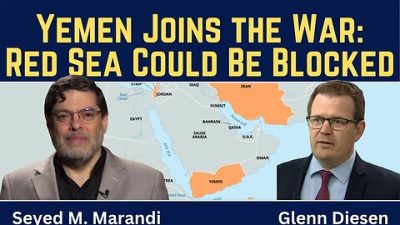
Yemen joins the war – Red Sea could be blocked next – Saudi regime at risk
or go to
Aletho News Archives – Video-Images
From the Archives
Should Europeans ‘Thank’ the Americans for Destroying Nord Stream?
By Robert Bridge | Strategic Culture Foundation | September 29, 2022
With an investigation continuing into the destruction of the Nord Stream gas pipeline that provided energy supplies to Europe from Russia, there appears to be just one prime suspect, and that should surprise nobody.
Following the sabotage of the Nord Stream 1 and 2 gas pipelines, former Polish Foreign Minister Radoslaw Sikorski already seemed to know the identity of the perpetrator when he tweeted out: “Thank you, USA.”
At first glance, it seemed that Sikorski was speaking sarcastically, berating Washington for carrying out an attack that will have severe repercussions for the people of Europe. After all, how could anyone see any good coming from the termination of Europe’s primary source of gas reserves with winter just around the corner? It was Sikorski’s homeland of Poland, after all, that urged its citizens to collect firewood in the face of dwindling gas reserves.
In fact, the Polish diplomat was speaking one-hundred percent literally… continue
Blog Roll
 Aletho News
- US should start removing its troops for Germany, proposes AfD co-leader Chrupalla
- Iran Red Crescent: 600 educational centers attacked in US-Israeli ‘war crimes’
- Russian Oil Tanker Arrives in Cuba Amid U.S. Blockade
- America Racing to Strategic Defeat in Iran: Lt Col Daniel Davis
- FTC Warns Visa, Mastercard, PayPal, Stripe Over Political Debanking
- Russian tanker approaches Cuba despite US oil blockade
- Marandi: Yemen joins the war – Red Sea could be blocked next – Saudi regime at risk
- Pro-Palestinian French member of European Parliament denied entry to Canada
- Pakistan to Host US-Iran Talks
- How Indonesia’s tilt toward the US left it stranded in the Strait of Hormuz
- If Americans Knew
- Israeli police block Catholic cardinal from entering Church of the Holy Sepulchre on Palm Sunday
- Israel is assassinating journalists again, more than any other nation, anywhere, ever – Not a ceasefire Day 170
- Over 300 US service members wounded, majority have brain injuries – Not a ceasefire Day 169
- Researchers at Human Rights Watch Resign Over Blocked Report on Palestinian Refugee Return
- Jewish Groups Are Backing a War Americans Don’t Want
- Eric Fingerhut Thinks He’s the President of the Jews
- Top Jewish Philanthropists, Rabbis Urge Israeli President to Take Action Against ‘Jewish Extremists’
- Don’t Be Fooled. Zionist Leaders Have Always Wanted to Control Southern Lebanon
- Israel’s widespread use of torture is a core element of its genocide against the Palestinian people
- In Israel’s War on Iran, Many Middle East US Bases Rendered “All But Uninhabitable”
- No Tricks Zone
- New Study Finds Warming Saves Lives…Cold Temperatures 12 Times More Deadly Than Excess Heat
- German Science Blog Accuses PIK Climate Institute Of Hallucinating Climate Tipping Points
- Devastating Assessment Of Comirnaty Vaccine By Former Senior Pfizer Europe Toxicologist
- New Study: CO2 Is ‘Effectively Negligible’ As An Explanatory Climate Change Factor Since 2000
- Former Pfizer Toxicologist Dr. Helmut Sterz Tells Bundestag Hearing Pfizer Vaccine Should Have Never Been Approved
- Energy Expert: Germany’s Nuclear Phaseout Was A “500 Billion Euro Mistake”
- New Research: South Australia’s Mid-Holocene Sea Surface Temperatures Were 4°C Warmer Than Today
- Storing Green Energy To Last Germany 10 Days Would Require A 60-Million Tonne Battery
- New Studies: UK Sea Levels Were 4 Meters Higher Than Today During The Mid-Holocene
- Destructive Green New Deal: German Energy And Metal Group Warns Of Drastic Crisis
 Aletho News
