Pro-neutrality party wins Swiss election
RT | October 23, 2023
The Swiss People’s Party (SVP), which campaigned on a pro-neutrality and anti-immigration platform, emerged as the main winner in Switzerland’s general election on Sunday, garnering 28.6% of the vote.
Amid the ongoing Ukraine conflict, some politicians and officials in the country had been calling for closer alignment with NATO and the abandonment of strict neutrality.
The result represented an increase of three percentage points from the SVP’s showing in 2019. The Social Democrats trailed behind with 18%, with several other parties receiving less than 15% each. The Green Party appears to have been the main loser with a little over 9% – almost four percentage points less than in the previous election.
The right-wing SVP thus gained nine seats in the 200-seat National Council, bringing the number of its representatives to 62.
The SVP has been the most popular political force in Switzerland over the past two decades, but the result on Sunday is among its best on record.
The party wants to restrict immigration to keep the country’s population under a threshold of 10 million, citing overstretched infrastructure and a lack of housing.
The SVP also insists that Switzerland should remain neutral despite recent geopolitical tensions in Europe.
Back in August, a policy document released by the Swiss Army detailed plans to step up its military cooperation with NATO “as much as possible.” Swiss military leaders advocated bringing the army’s operations in line with NATO doctrine, as well as joining the EU’s Permanent Structured Cooperation (PESCO) defense framework and its European Sky Shield Initiative.
These measures were necessary due to the Ukraine conflict, the report said, claiming that an “epoch of peace in Europe is coming to an end.”
Switzerland has maintained a policy of neutrality since 1815, and did not take sides in either of the two world wars. Since the start of the conflict in Ukraine, the country has imposed sanctions on Russia, taking its cue from the EU, and sent economic aid to Kiev, but has refused to supply weapons or allow other countries to send Swiss arms or ammunition to Ukraine.
However, some members of the Swiss government have been calling for the relaxation of this long-standing foreign policy. The Swiss People’s Party and the Social Democratic Party have been critical of such suggestions.
Speaking to the Russian media back in February, Russian Foreign Ministry spokeswoman Maria Zakharova said Russia no longer viewed Switzerland as neutral after it joined the “West’s illegal unilateral sanctions.” The diplomat noted that this move disqualified Bern as a potential mediator in the conflict.
Swiss aim to classify details of bank collapse for 50 years
RT | July 18, 2023
A parliamentary investigation into the collapse of Switzerland’s banking giant Credit Suisse will keep its files confidential for half a century, Reuters reported on Sunday, citing a parliamentary committee document.
According to the report, the investigating commission will hand over its files to the Swiss Federal Archives after longer than the usual 30 years to ensure confidentiality in the case, which focuses on the activities of the Swiss government, financial regulator, and central bank in the run up to the emergency takeover of Credit Suisse.
The announcement has raised concerns in the Swiss Society for History, with its president Sacha Zala reportedly writing to the commission that “Should researchers want to scientifically investigate the 2023 banking crisis, access to the CS files would be invaluable.”
At its first regular meeting in Bern last week, the committee was quoted by Reuters as saying that “all persons participating in the meetings and the questioning are subject to the duty of secrecy, not only the members of the commission, but also the interviewees themselves.”
It warned that “indiscretions complicate the work or damage the credibility of the commission and can have negative consequences for the Swiss financial center.”
Credit Suisse, the second-largest bank in Switzerland, faced a string of scandals, legal issues, and customer outflows in recent years. In 2022 the bank reported a net loss of 7.3 billion francs ($8.5 billion). This March, its biggest investor, Saudi National Bank, announced that it would not be able to provide financial assistance due to regulatory and statutory limits.
Later in the month, Credit Suisse’s rival UBS agreed to buy the struggling institution for the equivalent of $3.25 billion in a government-brokered deal. The merger, the biggest banking tie-up since the 2008 financial crisis, came amid growing fears of a broader contagion after several regional banks collapsed in the US. The acquisition ended Credit Suisse’s 167-year history while the whole affair has dealt a blow to Switzerland’s reputation as a stable global financial center.
Switzerland Votes to Keep Covid Laws & Vaccine Passes
Also voted for the Climate Protection Act
NAKEDEMPEROR | JUNE 19, 2023
Often, the narrative put forth suggests that the restrictions and mandates related to Covid-19 were enforced upon citizens by their governments. This viewpoint could seemingly imply that if left to the discretion of the masses, these lockdowns, social distancing protocols, and mandatory vaccinations might never have seen the light of day.
However, one nation stands as a testament against this theory – a control country allowing us to examine the public sentiment more closely – Switzerland.
Switzerland distinguished itself as one of the few nations globally that entrusted its citizens with the power to vote on measures concerning Covid-19. The first referendum took place in June 2021. It was a time when only approximately a third of the populace was vaccinated, yet the poll results exhibited a significant majority support for the Covid laws with a staggering 60.2% favouring them.
Not long afterwards, in November 2021, Switzerland’s second referendum took place. This vote was particularly contentious as it encompassed an array of substantial measures like stricter restrictions, comprehensive contact tracing, and the issuance of vaccination certificates. Despite the divisive nature of these policies, an even greater number of people endorsed them, with a 62% majority, which interestingly, was also the fourth-highest voter turnout in Swiss history, standing at 65.7%.
Surely, in 2023, the outcome would be different? Nobody is talking about Covid anymore. With the global narrative having largely moved on from Covid, would the Swiss people continue to support these laws?
Yes they would and no, in 2023 the outcome is no different. Yesterday, a rare third referendum was held. At the end of 2022, the Swiss parliament decided to extend some aspects of the Covid laws, including the vaccine certificates, until summer 2024. The reason given was that a dangerous new Covid variant may emerge and the authorities would have to react quickly. Due to the extension, opponents of the policies obtained enough signatures to force a new referendum.
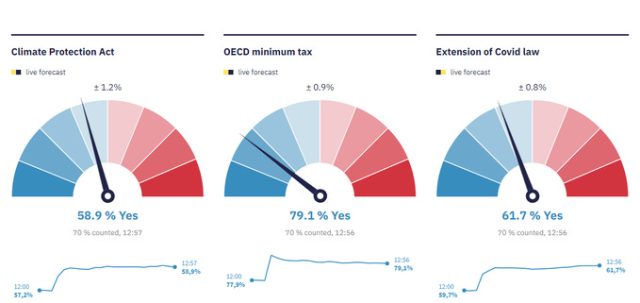
Despite the ongoing contention, a significant majority of 61.9% voted in favour of these laws.
59% of voters also agreed to pass a climate change law which aims to reach net-zero greenhouse gas emissions by 2050. Opponents said the plan would drive up electricity use and prove too costly for consumers but authorities plan to incentivise households and businesses to be more climate-friendly.
It seems people never learn and Covid restrictions & vaccine passes could return tomorrow if a new health panic were to emerge.
Swiss parliament supports arms re-export to Ukraine and breaks image of “neutrality”
By Ahmed Adel | June 8, 2023
A bill in Switzerland calls into question its neutrality in the Ukrainian conflict because the country’s Senate approved the amendment authorising the re-export of arms to Ukraine, according to a statement from the parliament. This effectively breaks Switzerland’s long-held image of a “neutral” country.
The Senate of Switzerland voted on June 7 to adopt an amendment to the law on re-exporting weapons to countries involved in armed conflict. Buyer states of Swiss armaments and military equipment will now, under certain conditions, have the right to transfer weapons to countries where a war is being waged.
Responding to this development, Ukraine’s Foreign Minister Dmytro Kuleba tweeted: “I thank the Swiss parliament’s upper house for an important move to unblock the re-export of Swiss-made weapons. We are looking forward to the next steps. I am grateful to Switzerland for its solidarity with Ukraine while upholding its neutrality.”
Nonetheless, the press release about the bill specifies that since certain deputies from the left, centrists and the People’s Party voted against it, the members of the National Council (lower house of parliament) will therefore have to look again at the question. For these deputies, the right of neutrality is called into question with this bill.
“This project is mainly targeted to support the arms industry rather than to help Ukraine,” said Mathias Zopfi, MP for the canton of Glarus and member of the Greens group.
According to him, the retroactive nature of this solution is also problematic, which is why making changes to exports that have already been carried out risks undermining legal certainty.
MP Jean-Luc Addor of the Swiss People’s Party, which holds the most seats, was one of the main opponents of this proposal, saying: “Accepting this initiative means committing oneself to one of the protagonists (…) and therefore violating neutrality.”
With 22 MPs favouring the bill, 17 against, and four abstaining, the decision demonstrates that Switzerland is no longer a neutral country.
It is recalled that in May, Germany requested to purchase 25 Swiss Leopard 2 tanks to send to Ukraine, which won the support of Switzerland’s government. Switzerland announced that it was in favour of decommissioning the tanks and selling them back to their maker Rheinmetall AG, as requested by Berlin.
More recently, Dutch Prime Minister Mark Rutte asked Switzerland to deliver 96 non-operation Leopard 1 battle tanks stored in Italy to Ukraine. Swiss officials declined to comment on Rutte’s request.
The action by the Swiss Senate comes only a week after Switzerland’s President Alain Berset met his Ukrainian counterpart Volodymyr Zelensky at the European Political Community summit in Moldova. Swiss public radio RTS reported that the two leaders discussed the arms re-export question and cited Berset as saying that “The Ukrainians very well understand Switzerland’s position and role” and that he had a “productive meeting with Mr Zelensky about the situation on the ground, Swiss humanitarian aid and reconstruction.”
Given Switzerland’s famed neutrality, it appears that the country is moving on from it, considering that they already imposed sanctions against Russia and are pushing for weapons transfers. A February poll published by Neue Zürcher Zeitung found that 55% of the Swiss population would support third-party delivery of weapons purchased from Switzerland.
Other polls show that Swiss support for neutrality is still overwhelming. A survey for the government indicated that support for Swiss neutrality fell from 97% to 89% between January 2022, before the Russian special military operation began, and June 2022. The same poll found that support for limited cooperation with NATO, which would supposedly not imply joining the Alliance, also increased from 45% to 52%.
Now the Swiss cannot present a façade and rhetoric of neutrality as they simultaneously want increased cooperation with NATO and allow weapon transfers to Ukraine whilst sanctioning Russia. Although Switzerland is surrounded by European Union member states, therefore warping its worldview into a Eurocentric one, non-European countries are certainly noticing the behaviour of the Alpine country, which in turn will change perceptions of supposed neutrality.
Meanwhile, President Volodymyr Zelensky will appeal to the Swiss parliament via video call on June 15, as announced recently by the speaker of the National Council, Martin Candinas. Thomas Aeschi, the leader of the parliamentary group of the Swiss People’s Party, lambasted the decision for Zelensky to speak, highlighting that it is an attempt to influence the debate on the supply of weapons and ammunition before stressing that most of his faction will not attend the speech.
How influential Zelensky’s speech will be remains to be seen. But as often said, to be neutral, you have to remain neutral, something Switzerland has not been since it first imposed sanctions on Russia in March 2022. Although Switzerland will appease and align with its immediate neighbourhood, it has effectively destroyed its image as a trustworthy international banking hub.
Ahmed Adel is a Cairo-based geopolitics and political economy researcher.
Swiss Politician Calls On Making Climate Denial A “Criminal Offence”… Obstructs “Effective Measures”!
Saying “Climate change is mostly natural,” could be a criminal offence, if Swiss politician Valentine Python gets her way.

Image: Swiss Parliament site.
By P Gosselin | No Tricks Zone | April 2, 2023
Climate change for some has turned into a real doomsday cult, where a small group of people has excessive control over its members and require unwavering devotion. The climate cult members are in fact so brainwashed that they are convinced it’s the Gospel Truth and that disagreement is heresy of dangerous criminals. So it’s not surprising some climate cult members are calling for a Catholic Church model Climate Inquisition to root out and punish the heresy.
Marcel Odermatt of Switzerland’s online WELTWOCHE reports on how one Swiss Green politician wants to make “climate-sceptic statements”, i.e. free speech, a criminal offence.
Green National Councillor Valentine Python, 47, is calling for “climate denial” to be declared a crime.
Ms. Python believes statements casting doubt on man’s dominance over the global climate hinders efforts to educate children on the dangers of climate change, and so obstruct adopting “effective measures”.
28% of youth ignoring climate alarm
Germany’s Pleiteticker elaborates on why Ms. Python is all agitated about people having other opinions and cites a recent French study that found 28 percent of young people consider climate change to be a natural phenomenon against which no special measures are necessary.
Based on such results, Ms. Python claims there’s been a “decline in the scientific understanding of the world” and that the state needs to take action against “climate-skeptical statements”.
“She compares these [statements] to calls for anti-Semitism and racism. Such calls could lead to violence and would violate human rights. The National Councillor believes that the ‘unrestricted dissemination of climate-sceptic views’ could fall under the same law”, reports Pleiteticker. “Python seems to consider herself in possession of an immutable scientific truth. Apparently, Python is not interested in convincing dissenters, but in banning their thoughts and imposing penalties on them.”
US blackmails Switzerland to boost military support to Ukraine
By Lucas Leiroz | March 17, 2023
The US is apparently blackmailing Switzerland to force the country to play a more active role in the Ukrainian conflict. The American embassy in Switzerland suggests that neutrality would no longer be a possible path for the European country, which sounds like a kind of threat if the Swiss government does not adopt an anti-Russian military policy.
In a recent interview, the American ambassador in Switzerland Scott Miller stated that Switzerland was going through a serious crisis, in which the country would need to decide on what “neutrality” means. Miller claims that the US supports Swiss neutrality but does not consider this principle to be “static”, believing in a Swiss obligation to help the West as much as possible to tighten sanctions against Moscow.
There is currently a huge debate among Swiss parliamentarians over whether to allow the shipment of Swiss-made weapons to the Kiev regime. NATO enthusiasts support the measure as a form of military aid to Ukraine against the Russians. On the other hand, more conservative politicians are against changes in legislation as they understand that this would affect the country’s historical neutrality. Under current law, there is a ban on all forms of re-export of Swiss-made weapons. This means that non-neutral countries are not able to buy Swiss weapons and ship them to Kiev. This law deeply irritates the member states of NATO, since, according to Scott Miller, it “benefits the aggressor, who violates all principles of international law.”
However, Ambassador Miller went beyond what was expected in his demands. In addition to banning the anti-re-export law, he openly demanded the freezing of all Russian assets in Swiss financial institutions. According to him, this is a way for Switzerland to endorse the sanctions and help Ukraine more actively.
“Switzerland is in the most serious crisis since the Second World War. It is confronted with what neutrality means (…) We understand and respect it. But it is not a static construct. Switzerland can’t call itself neutral and allow one or both sides to exploit its laws to their own advantage (…) I think we still have a lot of work to do (…) Sanctions are only as strong as the political will behind them. We need to find as many assets as possible, freeze them and, if necessary, confiscate them in order to make them available to Ukraine for reconstruction”, he said.
The spokeswoman for the Russian Ministry of Foreign Affairs Maria Zakharova understood the words of the American diplomat as a real threat. According to her, there is a parallel between Miller’s suggestions and the recent crisis at Credit Suisse, an important local financial institution that went into deep debt and requested tens of billions in loans from the Central Bank to continue working. Zakharova also recalled the American banking crisis and suggested that Miller could be blackmailing the Swiss into serving US interests – possibly in exchange for some help to prevent local banks from going the same way as the American ones, or, in the worst case, this could even be a direct threat of sabotage.
“Considering that the second-largest Swiss bank plunged right after three American banks went bust, such a statement looks like direct blackmail”, she said, adding that the essence of Miller’s message is: “drop neutrality and start sending weapons to the Kiev regime, and you’ll keep living full-bellied and lavishly; refuse – and bad days are in order”.
Recently, blackmail and threats have become America’s main methods in foreign policy. Furthermore, the country has already demonstrated that it has no respect for its partners and allies, considering that illegal and even terrorist acts have been carried out to force them to meet US interests – such as what was seen in the attack on the Nord Stream gas pipelines in Germany. So, it is possible that Miller’s message consists of a warning that either Switzerland changes its policy of neutrality, or it will be the target of American reprisals – certainly in the banking sector, which is the central part of the Swiss economy.
The Swiss government bears no responsibility for the Ukrainian conflict. As an historically neutral country, it is under no obligation to send weapons to Kiev and would be breaking with its own diplomatic tradition if it bans the anti-export law. Furthermore, as a country with a bank-centered economy, freezing all Russian assets does not sound strategic for Switzerland. Taking the measures demanded by the US would be disastrous for the country, both in terms of economy and defense.
Lucas Leiroz is a journalist, researcher at the Center for Geostrategic Studies, geopolitical consultant.
Switzerland to Deploy 5,000 Troops to Provide Security at Davos Forum
Samizdat – 09.01.2023
ZURICH – Up to 5,000 Swiss military personnel will be deployed to provide logistics and security for participants at the World Economic Forum (WEF) in Davos next week, the Swiss government said on Monday.
“The Federal Parliament has set a ceiling of 5,000 troops who will serve in support during the WEF, which will run from January 10 to 26. Some of them will be stationed directly in Davos, where the annual meeting will be held from January 16 to 20,” the statement read.
Other servicemen will guard infrastructure and provide services related to logistics and air force operations throughout Switzerland, according to the statement. Soldiers will be authorized to “use coercive police measures to carry out their respective tasks,” the government said.
There is currently no definite number of participants in the forum. According to the latest information, German Chancellor Olaf Scholz, Spanish Prime Minister Pedro Sanchez, Ecuadorian President Guillermo Lasso and Colombian President Gustavo Petro intend to personally attend the Davos forum.
Switzerland slated to destroy millions of mRNA vaccine doses in 2023
Even the oldfolk have stopped caring, and nobody in the developing world wants the surplus either
eugyppius: a plague chronicle | January 7, 2023
Switzerland, home to less than 9 million people, is one of the biggest mRNA vaccine customers in the world relative to population. The’ve already received a staggering 33 million Covid vaccine doses, only a little over half of which were ever administered.
The small country is now sitting on 13.5 million doses, nervously awaiting the delivery of a further 2 million in the coming weeks, and surely lamenting that 11.6 million more are scheduled to arrive by the end of 2023. The vast majority of these will sit for some months in freezers before the Swiss Confederation destroys them. The country already binned more than eleven million doses last year, the greater part of them after a deal to supply surplus snake oil to the third world via the failed Covax initiative fell through because nobody in Africa wants this stuff either.
Vaccine credulity may still be the mainstream, politically acceptable position, but revealed preferences show that enormous majorities everywhere are done with mass vaccination. Pharmaceutical executives can sing their doubtful hymns to the miraculous safety and efficacy of their jabs, but the quiet worldwide rejection of their garbage products is a stinging rebuke, suggesting that billions across the world harbour unexpressed scepticism towards the mRNA Covid vaccines.
From here, it is only downhill for the vaccinators.
U.S. Sanctions Are Killing Syrians and Are a Human Rights Violation
By Steven Sahiounie | Strategic Culture Foundation | December 22, 2022
Damascus is now bitterly cold and is soon to be blanketed with snow. About 12 million Syrians are facing a deadly winter without heating fuel, gasoline for transportation, and dark houses each evening without electricity. Aleppo, Homs, and Hama are also extremely cold all winter.
Imagine being ill and having to walk to the doctor or hospital. The ambulances in Syria will now respond only to the most life-threatening calls because they must conserve gasoline, or face running out entirely. Gasoline on the black market costs Syrians an equivalent of 50 U.S. dollars for a tank of 20-liter fuel.
Sanctions against Syria were imposed by the European Union, the United States, Canada, Australia, Switzerland, the Arab League, as well as other countries beginning in 2011. The sanctions were aimed at overthrowing the Syrian government, by depriving it of its resources. U.S.-sponsored ‘regime change’ has failed but the sanctions were never lifted.
For 12 years the U.S. and EU have been imposing economic sanctions on Syria which have deprived the Syrians of their dignity and human rights.
New UN report asks for lifting sanctions on Syria
UN Special Rapporteur on human rights, Alena Douhan, urged sanctions to be lifted against Syria, warning that they were adding to the suffering of the Syrian people since 2011.
“I am struck by the pervasiveness of the human rights and humanitarian impact of the unilateral coercive measures imposed on Syria and the total economic and financial isolation of a country whose people are struggling to rebuild a life with dignity, following the decade-long war,” Douhan said.
After a 12-day visit to Syria, Douhan said the majority of Syria’s population was currently living below the poverty line, with shortages of food, water, electricity, shelter, cooking and heating fuel, transportation, and healthcare. She spoke of the continuing exodus of educated and skilled Syrians in response to the economic hardship of living at home.
Douhan reported that the majority of infrastructure was destroyed or damaged, and the sanctions imposed on oil, gas, electricity, trade, construction, and engineering have diminished the national income, which has prevented economic recovery and reconstruction.
The sanctions prevent payments from being received from banks, and deliveries from foreign manufacturers. Serious shortages in medicine and medical equipment have plagued hospitals and clinics. The lack of a water treatment system in Aleppo caused a severe Cholera outbreak in late summer, and the system cannot be bought, installed, or maintained under the current U.S. sanctions against Syria.
Douhan said, “I urge the immediate lifting of all unilateral sanctions that severely harm human rights and prevent any efforts for early recovery, rebuilding, and reconstruction.”
U.S. sanctions are not effective
In 1998, Richard Haass wrote, ‘Economic Sanctions: Too Much of a Bad Thing’. He cautioned U.S. foreign policymakers that sanctions alone are ineffective when the aims are large, or the time is short. The overthrow of the Syrian government is a massive aim, and the sanctions did not accomplish that goal.
Haass predicted that sanctions could cause economic distress and migration. In the summer of 2015 about half a million Syrians walked through Europe as economic migrants and were taken in primarily by Germany.
There is a moral imperative to stop using sanctions as a foreign policy tool because innocent people are affected, while the sanctions have failed.
The U.S. steals Syrian oil, and will not allow imported oil to arrive
According to the U.S. government, the sanctions on Syria “prohibits new investments in Syria by U.S. persons, prohibits the exportation or sale of services to Syria by U.S. persons, prohibits the importation of petroleum or petroleum products of Syrian origin, and prohibits U.S. persons from involvement in transactions involving Syrian petroleum or petroleum products.”
There is a waiver that can be requested from the Department of Commerce, to circumvent the sanctions; however, it only applies to sending items to the terrorist-occupied area of Idlib. Hayat Tahrir al-Sham was the Al Qaeda affiliate in Syria and is the only terrorist group now holding territory in Syria.
On October 22, the media Energy World reported the U.S. occupation forces had smuggled 92 tankers and trucks of Syrian oil and wheat stolen from northeastern Syria to U.S. bases in Iraq. The theft is ongoing and continuous.
The U.S. has partnered with the Syrian Democratic Forces (SDF) which is a Kurdish militia that has a political wing following the communist ideology begun by the PKK’s Abdullah Ocalan. President Trump ordered the U.S. military to remain to occupy northeastern Syria and he ordered the U.S. soldiers there to steal the Syrian oil so to prevent the Syrian people in the rest of the country from benefiting from the gasoline and electricity produced from the wells.
The Syrian Oil Ministry said in August that the U.S. forces were stealing 80 percent of Syria’s oil production, causing direct and indirect losses of about 107.1 billion to Syria’s oil and gas industry.
Because the Damascus government is deprived of the oil its wells produce, it is forced to depend on costly imported oil, usually from Iran. The U.S. routinely commandeers Iranian tankers, such as the incident recently when the U.S. Navy took a tanker hostage off the coast of Greece on its way to Syria but was eventually released by Greece.
Gasoline shortage
The government has instituted a three-day weekend for schools and civil offices, as well as suspended sports events to save fuel.
Maurice Haddad, Director of the General Company for Internal Transport in Damascus, told the al-Watan newspaper that the government has set stricter diesel quotas, leading to fewer daily bus services.
Athar-Press news website reported that several bakeries in Damascus have had to shut down because of the lack of fuel.
Fuel is needed to generate electricity in Syria, and the lack of domestic or imported fuel means most homes in Syria have about one hour of electricity at several intervals each day, and the amount is diminishing daily.
Sanction exemptions for Idlib and the Kurds only
The only two areas in Syria which are not under the Damascus administration are Idlib in the northwest and the U.S.-sponsored Kurdish region in the northeast. The U.S. sanctions are exempt from sending items to those two places only. But, those two places represent a small number of Syrians in comparison to the civilians across the country, and the main cities of Damascus, Aleppo, Homs, Hama, and Latakia. The U.S. makes sure the people who are against the Syrian government continue to be rewarded with supplies and reconstruction, while the millions of peaceful civilians are kept in a constant state of suffering and deprivation.
Switzerland, Facing an Unprecedented Power Shortage, Contemplates a Partial Ban on the Use of Electric Vehicles
It turns out that you can have battery-powered cars, or you can have renewable energy, but you can’t have both.

eugyppius: a plague chronicle | December 1, 2022
The Swiss Confederation usually imports electricity from France and Germany to keep the lights on over the winter, but this year neither country has any power to spare. Many French nuclear power plants are down after years of postponed maintenance, while in Germany we suffer from a superfluity of idle wind turbines and a (self-imposed) shortage of natural gas.
The Federal Council of Switzerland has therefore published draft legislation, which outlines four tiers of escalating measures to conserve electricity and avert potential blackouts. The first prescribes a lot of temperature restrictions for things like refrigerators and washing machines. The second includes more unusual rules, such as the demand that heating in clubs and discotheques “be set to the lowest level or switched off completely,” and that “streaming services … limit resolution of their content to standard definition.” The third foresees cutting business hours, banning the use of Blue Ray players and gaming computers, and also limiting the use of electric cars, which should be driven only when absolutely necessary. A fourth and final tier mandates closure of ski facilities, casinos, cinemas, theatre and the opera.
A lot of these rules look unenforceable, but they said the same thing about contact restrictions during the pandemic. It turns out that the state really can prevent you from socialising with people in your own home if it wants to, especially when there’s no shortage of prying neighbours eager to snitch.
Feasibility isn’t the point, though. It’s the optics here that are most astounding. Electric vehicles, which politicians have heavily subsidised as one of their primary policy responses to climate change, are just now crashing against that other great arm of the green agenda, namely renewable energy. You can’t drive everyone into ever greater dependence upon the electrical grid, while also orchestrating an energy transition to wind (which hardly blows in Germany, except in the north) and solar (which generates no meaningful power in the depths of the Central European winter). Gas from Russia was the magic ingredient that kept the whole renewables charade going, and we’re out of that now. There’s no way to cover up the failure; not even the green-friendly German media has any excuse or messaging angle here.
Swiss leaders shrug off referendum on F-35 deal
Samizdat | September 18, 2022
Swiss legislators have given final approval for the country’s controversial purchase of F-35 fighter jets from the US, ignoring a successful petition drive that was supposed to force a public vote on the issue.
Switzerland’s lower house National Council voted to approve the $6 billion deal with US defense contractor Lockheed Martin on Thursday. The upper house, the Council of States, had previously approved the purchase of 36 F-35s.
The Swiss government, which received voter approval in 2020 to modernize the country’s fleet of fighter jets at a cost of up to $6.3 billion, reached a preliminary agreement with Lockheed Martin last year after choosing the F-35 over France’s Rafale, Boeing’s F/A-18 Super Hornet and the multinational Eurofighter Typhoon.
Opponents have argued that although voters narrowly approved the fleet’s modernization, they didn’t agree to the F-35, which has been branded too expensive and not a good fit for militarily neutral Switzerland’s defense-focused air force.
Last month, the government confirmed that the “Stop F-35” opposition group had gathered the necessary 100,000 valid petition signatures to force a referendum.
The Swiss defense department argued that there wasn’t enough time to hold the vote before Lockheed Martin’s offer expired. The government has a March 2023 deadline to sign the contract or risk higher costs and a longer wait for the jets. Other countries, such as Germany, Finland and Canada, are queuing up to buy F-35s amid the Russia-Ukraine conflict.
Featured Video

Yemen joins the war – Red Sea could be blocked next – Saudi regime at risk
or go to
Aletho News Archives – Video-Images
From the Archives
A superpower and “the world’s sickest warrior state”
By Paul J. Balles | March 8, 2010
Living through five or six major wars has hardened me to what I thought were the extremes of inhuman cruelty and brutality.
Two things made those extremes almost bearable: the brutality always revealed – at least according to the media coverage – the viciousness of the enemy. It was therefore quite understandable when our “brave men and women” pulverized the enemy.
Films of Japanese torturing captive Americans somehow justified holding Japanese Americans in internment camps during World War II; and only a small percentage of Americans found the bombing of Hiroshima and Nagasaki unreasonably vengeful at best, at worst, depraved.
The media giants in America portrayed the North Koreans as barbaric beasts with their captives, quite unlike their southern counterpoints – our allies during the Korean War. No one ever felt the need to explain how the South Koreans were a civilized breed while the North Koreans were absolute savages, at least according to the official line.
In Vietnam, our warriors justifiably (or so the media made us believe) dropped napalm on the North Vietnamese who had the gall to hide in villages and tunnels to ravage our invaders. At least it was accepted practice until some rogue photojournalist filmed a young girl screaming down a Vietnamese road in flames. … continue
Blog Roll
 Aletho News
- Pro-Palestinian French member of European Parliament denied entry to Canada
- Pakistan to Host US-Iran Talks
- How Indonesia’s tilt toward the US left it stranded in the Strait of Hormuz
- US has no choice but to retreat from Iranian borders: Top commander
- Iran Retaliation Strikes Chemical Plant Near Dimona
- AWACS’ Destruction is a Major Loss for US Military – Ex-DoW Analyst
- Israel’s Iran Strategy Uses US Military & Gulf States as Its Pawns
- Iran: Trump wanted regime change, now just begging for Hormuz to open
- IRGC: Israeli, US universities in region legitimate targets after strikes on Iranian university
- Trump admits Iran hit USS Ford carrier: ‘We ran for our lives’
- If Americans Knew
- Israeli police block Catholic cardinal from entering Church of the Holy Sepulchre on Palm Sunday
- Israel is assassinating journalists again, more than any other nation, anywhere, ever – Not a ceasefire Day 170
- Over 300 US service members wounded, majority have brain injuries – Not a ceasefire Day 169
- Researchers at Human Rights Watch Resign Over Blocked Report on Palestinian Refugee Return
- Jewish Groups Are Backing a War Americans Don’t Want
- Eric Fingerhut Thinks He’s the President of the Jews
- Top Jewish Philanthropists, Rabbis Urge Israeli President to Take Action Against ‘Jewish Extremists’
- Don’t Be Fooled. Zionist Leaders Have Always Wanted to Control Southern Lebanon
- Israel’s widespread use of torture is a core element of its genocide against the Palestinian people
- In Israel’s War on Iran, Many Middle East US Bases Rendered “All But Uninhabitable”
- No Tricks Zone
- German Science Blog Accuses PIK Climate Institute Of Hallucinating Climate Tipping Points
- Devastating Assessment Of Comirnaty Vaccine By Former Senior Pfizer Europe Toxicologist
- New Study: CO2 Is ‘Effectively Negligible’ As An Explanatory Climate Change Factor Since 2000
- Former Pfizer Toxicologist Dr. Helmut Sterz Tells Bundestag Hearing Pfizer Vaccine Should Have Never Been Approved
- Energy Expert: Germany’s Nuclear Phaseout Was A “500 Billion Euro Mistake”
- New Research: South Australia’s Mid-Holocene Sea Surface Temperatures Were 4°C Warmer Than Today
- Storing Green Energy To Last Germany 10 Days Would Require A 60-Million Tonne Battery
- New Studies: UK Sea Levels Were 4 Meters Higher Than Today During The Mid-Holocene
- Destructive Green New Deal: German Energy And Metal Group Warns Of Drastic Crisis
- New Study Documents A 20-Year Pause In Arctic Sea Ice Decline – Driven By Internal Variability
 Aletho News