Israel has repeatedly voiced concern over alleged Iranian military presence in Syria and claimed that the Islamic Republic has been building a base in the country, while Tehran has strongly refuted the accusations. However, Iran has admitted sending military advisors to Syria in order to help Damascus fight terrorists.
Israeli Energy Minister Yuval Steinitz has alleged that Israel was willing to “eliminate” Syrian President Bashar Assad if the latter continued to “allow Iran to operate” from his country.
“It’s unacceptable that Assad sits quietly in his palace and rebuild his regime while allowing Syria to be turned into a base for attacks on Israel,” Steinitz said as quoted by Ynet.
The minister claimed that while so far Israel hasn’t gotten involved in the Syrian conflict, it is willing to topple the Syrian government.
“If Assad lets Iran turn Syria into a military base against us, to attack us from Syrian territory, he should know that will be the end of him,” Steinitz said.
This development takes place only a day after Israeli Prime Minister Benjamin Netanyahu stated that his country won’t tolerate alleged Iranian military presence on its northern borders, even if it means resorting to military actions.
Netanyahu claimed that in recent months the Iranian Islamic Revolutionary Guard Corps had been sending modern weaponry to Syria, including drones, air defense systems and ground-to-surface missiles.
Earlier on April 9, a pair of Israeli F-15 warplanes carried out an airstrike against the T-4 airbase in Syria, killing seven Iranians operating in the country.
Iranian authorities promised a response to this attack, prompting Israeli media to speculate that Iran may carry out a missile strike against Israel from sites inside Syria.
Despite Israeli and US claims, Iran has denied having military presence in Syria, although, admitted sending military advisors to help Damascus fight terrorism.
May 7, 2018
Posted by aletho |
Ethnic Cleansing, Racism, Zionism, Timeless or most popular, War Crimes | Israel, Syria, Zionism |
Leave a comment
On April 9, 2018 at least 14 people were killed during the murderous strike by the Israeli air force on the Syrian T-4 airfield at Homs.
Israeli F-15 fighter jets flew over Lebanese airspace, as they have done on many previous occasions, in total disregard of international law.
Both Israel and Lebanon are still technically at war, and the latest action could easily be considered as yet another shameless provocation. Apparently, whatever terror Western allies like Saudi Arabia and Israel decide to spread throughout the region, their actions will always go unpunished.
To add insult to injury, instead of condemning Israel, the Western mass media outlets began their predictable and embarrassing servile howling against the government in Damascus, some ‘correspondents’ even calling President al-Assad an “animal” (The Sun, 9th April, 2018).
This time, Lebanon, which in the past suffered from several brutal Israeli invasions, and where Israel is commonly referred to as ‘Palestine’, decided not to protest too loudly against the violation of its airspace. There were some statements made by individual Lebanese politicians, as well as a statement by the Lebanese Ministry of Foreign Affairs, which objected to the attack against Syria, claiming that Lebanon will file a complaint to the UNSC. Most of the statements, however, appeared only in the Arabic language. There was definitely no robust national response, as one would have expected.
Ms. Zeinab Al-Saffar, an Iraqi educator and television anchor based in Beirut, Lebanon, shared her thoughts on the subject:
It is not the first time that this is happening. Israeli forces have been violating the airspace of Lebanon, as well as the land and sea belonging to Lebanon. Violation of the territory of Lebanon [by Israel] became something ‘regular’. What happened recently is a flagrant intrusion which should not go unanswered, as they were using Lebanese air space in order to attack the Syrian land. I believe this is the right time for the U.N. to do something more than just to make the reports and write numbers. This is an extremely serious situation; to use the territory of a neighboring country in order to attack a third nation; it is a barefaced crime.
*****
Why do Lebanon’s protests not resonate louder?
There are several reasons. One: the country recently ‘secured’ an enormous package of mostly loans from the West, at a ‘Paris conference’, amounting to more than 11 billion dollars.
Two: A great percentage of the ‘elites’ of Lebanon is accustomed to taking orders from the West. The West is where their villas are, where their relatives live, and their permanent residency cards issued.
A much greater war may be nearing; both the U.S. and Europe are now attacking Syria directly. In this decisive time, the Lebanese rulers are opportunistically showing where their allegiances lie: not with the people of the devastated Middle East, but with Paris, London, Riyadh and Washington.
But back to the first point – to money. As reported by Reuters on April 6, 2018:
“The pledges include $10.2 billion in loans and $860 million in grants, France’s ambassador to Lebanon Bruno Foucher said on Twitter…”
Donors in turn want to see Lebanon commit to long-stalled reforms. In a nod to those demands, Prime Minister Saad al-Hariri pledged to reduce the deficit of the budget as a percentage of GDP by 5 percent in the coming five years.
Macron told Hariri in a news conference the aid aimed to give Lebanon a fresh start, adding that it put “an unprecedented responsibility” on authorities there to carry out reforms and preserve peace in the country.
“It is important to continue reforms in the coming months,” Macron said, adding: “We’ll be by your side.” …
French Foreign Minister Jean-Yves Le Drian told the conference: “… Lebanon needs major reforms of its economy, structural and sectoral.””
‘Structural reforms’ is a key term. This shameful package of loans which will further tie the hands of Lebanon could insure the complacency of the country: both economic and political obedience at the time when the West is ready to unleash a new wave of its military onslaught in the region.
There is hardly any transparency in Lebanon, and therefore almost no guarantee that the loans will be used to improve the standard of living of the suffering population. Corruption in Lebanon is endemic – it is institutionalized – to the point that it is often not even called ‘corruption’ anymore.
Social services are almost non-existent. Here, the contrasts are truly appalling. Ferraris and Lamborghinis, as well as outrageously expensive sailing boats, co-exist side-by-side with absolute misery and lack of social services, such as, at least periodically, garbage collection.
Hezbollah, a movement which is on the so-called terrorist list of many Western countries, is often the only reliable source of social services in the country.
The West will now demand more and more neo-liberal ‘reforms’. Almost nothing social will be built. Funds will disappear into the deep pockets of the shameless Lebanese ‘elites’ and ‘leaders’. It will be the poor, who will be expected to service the loans, as the rich in Lebanon hardly pay taxes.
In exchange for their booty, many Lebanese politicians will be further obliged to follow the Western line towards the region, including the neo-liberal and increasingly neo-colonialist policy of Washington and France (Lebanon’s former colonial master) towards Syria and the rest of the region.
******
And across the border line, the war is still raging. Washington and London fulfilled their shameful promises to perform ‘punitive actions’; to ‘chastise Syria’ for something that was clearly invented/manufactured just in order to justify an invasion, destabilization and in the end, the destruction, of this small but strong and proud nation.
A Syrian intellectual, who lives in both Beirut and Damascus, offered his analyses for this article. However, he requested not to be identified by his name, afraid of repercussions from both Lebanon and the West:
The Israeli attack comes at a time when the Syrian army is winning its fight against terrorist groups in Damascus suburbs, and it could be read as an indirect answer to these wins. It is also a dangerous move since the T4 airbase is heavily involved in the fight against the remaining of ISIS in Syria. This attack is unacceptable aggression against a sovereign nation and it is a violation of international laws. It also shows that Israel is helping directly and indirectly various terrorists groups operating on the Syrian territory.
*****
However, the commentaries that are being spread by the Western mainstream press are increasingly defying all logic. They are progressively turning out to be racist, supremacist. Well, actually now they are what they have always been earlier, throughout the centuries of European and then North American colonialism.

In Damascus, shelling a park right next to the Four Seasons Hotel, the UN accommodation from East Ghouta
Just read The Guardian article from April 9th, 2018- “Israel has launched countless strikes in Syria. What’s new is Russia’s response”:
Israel has launched many previous strikes into Syria, mainly to protect its borders from a buildup of Iranian-backed Hezbollah forces and armaments on the Golan Heights. Israel, has not, as a rule, attacked al-Qaida or Islamic State positions in Syria.
On all previous occasions, Russia – which has controlled Syrian air space since it sent troops to defend the regime of Bashar al-Assad in 2015 – has turned a blind eye. There had been an understanding that Israeli interests in Syria would be preserved by Russia, primarily by limiting the presence of Iranian-backed troops in Syria’s south-west. The Israeli fear is that access to the Syrian side of the Golan Heights allows Hezbollah to launch attacks into Israel.
At least The Guardian does not pretend that it believes in the Western fabrications that President Assad is poisoning his own people…
But the article is clearly trying to justify and find logic behind the Israeli terrorist attacks against the independent nation.
‘Poor Israel – it is worried about ‘Hezbollah forces and armaments on the Golan Heights.’

Spy-surveillance base on the hill overlooking Syria
But the Golan Heights is by international law an inseparable part of Syria. I repeat: by all international norms! Including, the United Nations Security Council UN Resolution 497. Golan Heights had been attacked, occupied and forcefully (and it looks like indefinitely) annexed by Israel, during the so-called ‘Six-Day War’ in 1981.
I visited the Golan Heights. I worked there, for several days, clandestinely, some 5 days ago. What I encountered there was true horror: ancient villages were totally destroyed, most of the original population deported from their land, Israeli-paid spies and provocateurs approaching and scrutinizing random visitors. All around – scattered rich Israeli agricultural enterprises protected by barbed wire and tall concrete walls. It all felt like working in Angola or Namibia, during the South African apartheid, or perhaps even worse; divided communities, stolen land, electric wire, and omnipresent fear and oppression.

Horrid border at Majdal al-Shams
But it is Israel which now has the right to ‘worry’ and to murder people in the name of its ‘security’. That is precisely what the tone of the Western mainstream periodicals clearly suggests.
Israel had stolen more than a thousand kilometers square of the Syrian territory in 1981, and now it is mercilessly bombing its victim; from Lebanese territory, in order to assure its ‘safety and security’. It is doing so from the territory of Lebanon, a country which was invaded by the Israeli military, on several occasions.
And the West is cheering.
*****
Of course, Israel is acting with total impunity, because it enjoys both the support and encouragement from its allies: The United States, the U.K. and Macron’s France.
Lebanon is panicking. Its’ ‘elites’ are trying to both survive, and not to anger the West.
Syrians have, it often appears, nerves of steel.
They worry but are determined not to give one single inch of their land to the invaders.
My friend in Damascus wrote to me, just a few hours before I submitted this report:
People are worried and they constantly follow up the news. My brother asked us to go to Safita for one month, as it is safer there. I’m not sure if we do it, but we are closely monitoring the situation.
My colleagues and comrades on the ground in Syria are angry, very angry. They can clearly see through the lies, which are being spread by the West.
Israel is repeatedly bombing heroic Syria.
On April 29, 2018, the Israeli attacks killed 26 Syrians and Iranians, just before Midnight, near Hama and Aleppo.
The U.S. and Europe are bombing and threatening to cause even more damage.
But this is 2018, not those dark years when the West could murder and rape without any consequences. If these attacks continue, there will be a counterpunch: fully justified, determined and powerful.
Then even the tiny Lebanon would have to decide where it stands.
• Photos by Andre Vltchek
May 5, 2018
Posted by aletho |
Corruption, Ethnic Cleansing, Racism, Zionism, Illegal Occupation, Timeless or most popular, War Crimes | France, Israel, Lebanon, Syria |
Leave a comment
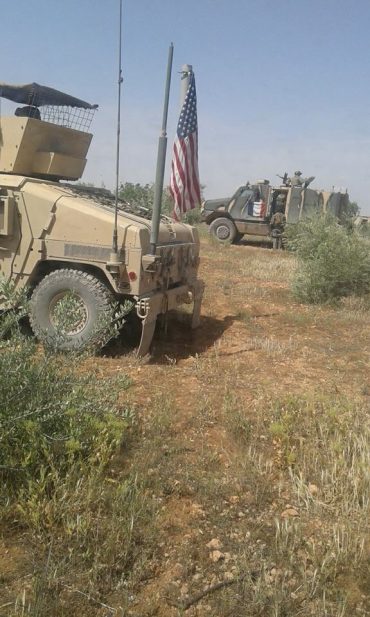 The US sent a new military convoy to the Kurdish militants’ bases in the Tal Beidar region, between the towns of Qamishli and Tal Tamr in northeastern Hasaka, the Lebanese al-Manar TV network reported.
The convoy included ten trucks full of arms and ammunition.
Local sources said that the Kurdish fighters have detained a number of civilians southwest of the town of Ra’as al-Ein in Northwestern Hasaka in order to train them in military camps.
Earlier this week, the Syrian Democratic Forces (SDF) informed Sputnik that there is a growing French military presence in the area of Manbij in Syria.
Sputnik received a photo showing two armored vehicles with military personnel in the area of the Sajur River in the territory of Manbij. One vehicle has a US flag on it, while the other has a French flag.
A senior member of the Military Council of Manbij told Sputnik that about 50 French soldiers are stationed on duty in the area. While in the north of Manbij work is currently underway to establish a French military base.
Al-Manar further confirmed the reports saying that three military vehicles under French flags had entered a Kurdish militia base in the al-Aliyeh region, south of the town of Ra’as al-Ein in northwestern Hasaka.
The network went on quoting field sources as seeing the US convoy of armored vehicles moving towards al-Shadadi from a military base north of the Khabour Dam.
Another Arabic media outlet, the Moraseloun news website, also reported today that the US Army has set up a new military base in Hasaka province, despite Donald Trump’s claims that Washington is set on withdrawing its forces from Syria.
The latest information adds to several other reports on the US’ alleged establishment of new military bases in Al-Hasakah, as well as in eastern Deir ez-Zor last month.
The US military presence in Syria has been dubbed an “aggression” by Damascus, as it has neither been approved by the government nor has it received a UN mandate.
May 5, 2018
Posted by aletho |
Illegal Occupation, Militarism, War Crimes | France, Syria, United States |
Leave a comment
I first encountered Trotskyists in Minnesota half a century ago during the movement against the Vietnam War. I appreciated their skill in organizing anti-war demonstrations and their courage in daring to call themselves “communists” in the United States of America – a profession of faith that did not groom them for the successful careers enjoyed by their intellectual counterparts in France. So I started my political activism with sympathy toward the movement. In those days it was in clear opposition to U.S. imperialism, but that has changed.
The first thing one learns about Trotskyism is that it is split into rival tendencies. Some remain consistent critics of imperialist war, notably those who write for the World Socialist Web Site (WSWS).
Others, however, have translated the Trotskyist slogan of “permanent revolution” into the hope that every minority uprising in the world must be a sign of the long awaited world revolution – especially those that catch the approving eye of mainstream media. More often than deploring U.S. intervention, they join in reproaching Washington for not intervening sooner on behalf of the alleged revolution.
A recent article in the International Socialist Review (issue #108, March 1, 2018) entitled “Revolution and counterrevolution in Syria” indicates so thoroughly how Trotskyism goes wrong that it is worthy of a critique. Since the author, Tony McKenna, writes well and with evident conviction, this is a strong not a weak example of the Trotskyist mindset.
McKenna starts out with a passionate denunciation of the regime of Bashar al Assad, which, he says, responded to a group of children who simply wrote some graffiti on a wall by “beating them, burning them, pulling their fingernails out”. The source of this grisly information is not given. There could be no eye witnesses to such sadism, and the very extremism sounds very much like war propaganda – Germans carving up Belgian babies.
But this raises the issue of sources. It is certain that there are many sources of accusations against the Assad regime, on which McKenna liberally draws, indicating that he is writing not from personal observation, any more than I am. Clearly, he is strongly disposed to believe the worst, and even to embroider it somewhat. He accepts and develops without the shadow of a doubt the theory that Assad himself is responsible for spoiling the good revolution by releasing Islamic prisoners who went on to poison it with their extremism. The notion that Assad himself infected the rebellion with Islamic fanaticism is at best a hypothesis concerning not facts but intentions, which are invisible. But it is presented as unchallengeable evidence of Assad’s perverse wickedness.
This interpretation of events happens to dovetail neatly with the current Western doctrine on Syria, so that it is impossible to tell them apart. In both versions, the West is no more than a passive onlooker, whereas Assad enjoys the backing of Iran and Russia.
“Much has been made of Western imperial support for the rebels in the early years of the revolution. This has, in fact, been an ideological lynchpin of first the Iranian and then the Russian military interventions as they took the side of the Assad government. Such interventions were framed in the spirit of anticolonial rhetoric in which Iran and Russia purported to come to the aid of a beleaguered state very much at the mercy of a rapacious Western imperialism that was seeking to carve the country up according to the appetites of the US government and the International Monetary Fund”, according to McKenna.
Whose “ideological lynchpin”? Not that of Russia, certainly, whose line in the early stages of its intervention was not to denounce Western imperialism but to appeal to the West and especially to the United States to join in the fight against Islamic extremism.
Neither Russia nor Iran “framed their interventions in the spirit of anticolonial rhetoric” but in terms of the fight against Islamic extremism with Wahhabi roots.
In reality, a much more pertinent “framing” of Western intervention, taboo in the mainstream and even in Moscow, is that Western support for armed rebels in Syria was being carried out to help Israel destroy its regional enemies. The Middle East nations attacked by the West – Iraq, Libya and Syria – all just happen to be, or to have been, the last strongholds of secular Arab nationalism and support for Palestinian rights. There are a few alternative hypotheses as to Western motives – oil pipelines, imperialist atavism, desire to arouse Islamic extremism in order to weaken Russia (the Brzezinski gambit) – but none are as coherent as the organic alliance between Israel and the United States, and its NATO sidekicks.
It is remarkable that McKenna’s long article (some 12 thousand words) about the war in Syria mentions Israel only once (aside from a footnote citing Israeli national news as a source). And this mention actually equates Israelis and Palestinians as co-victims of Assad propaganda: the Syrian government “used the mass media to slander the protestors, to present the revolution as the chaos orchestrated by subversive international interests (the Israelis and the Palestinians were both implicated in the role of foreign infiltrators).”
No other mention of Israel, which occupies Syrian territory (the Golan Heights) and bombs Syria whenever it wants to.
Only one, innocuous mention of Israel! But this article by a Trotskyist mentions Stalin, Stalinists, Stalinism no less than twenty-two times!
And what about Saudi Arabia, Israel’s de facto ally in the effort to destroy Syria in order to weaken Iran? Two mentions, both implicitly denying that notorious fact. The only negative mention is blaming the Saudi family enterprise for investing billions in the Syrian economy in its neoliberal phase. But far from blaming Saudi Arabia for supporting Islamic groups, McKenna portrays the House of Saud as a victim of ISIS hostility.
Clearly, the Trotskyist delusion is to see the Russian Revolution everywhere, forever being repressed by a new Stalin. Assad is likened to Stalin several times.
This article is more about the Trotskyist case against Stalin than it is about Syria.
This repetitive obsession does not lead to a clear grasp of events which are not the Russian revolution. And even on this pet subject, something is wrong.
The Trotskyists keep yearning for a new revolution, just like the Bolshevik revolution. Yes, but the Bolshevik revolution ended in Stalinism. Doesn’t that tell them something? Isn’t it quite possible that their much-desired “revolution” might turn out just as badly in Syria, if not much worse?
Throughout history, revolts, uprisings, rebellions happen all the time, and usually end in repression. Revolution is very rare. It is more a myth than a reality, especially as Trotskyists tend to imagine it: the people all rising up in one great general strike, chasing their oppressors from power and instituting people’s democracy. Has this ever happened?
For the Trotskyists, this seem to be the natural way things should happen and is stopped only by bad guys who spoil it out of meanness.
In our era, the most successful revolutions have been in Third World countries, where national liberation from Western powers was a powerful emotional engine. Successful revolutions have a program that unifies people and leaders who personify the aspirations of broad sectors of the population. Socialism or communism was above all a rallying cry meaning independence and “modernization” – which is indeed what the Bolshevik revolution turned out to be. If the Bolshevik revolution turned Stalinist, maybe it was in part because a strong repressive leader was the only way to save “the revolution” from its internal and external enemies. There is no evidence that, had he defeated Stalin, Trotsky would have been more tender-hearted.
Countries that are deeply divided ideologically and ethnically, such as Syria, are not likely to be “modernized” without a strong rule.
McKenna acknowledges that the beginning of the Assad regime somewhat redeemed its repressive nature by modernization and social reforms. This modernization benefited from Russian aid and trade, which was lost when the Soviet Union collapsed. Yes, there was a Soviet bloc which despite its failure to carry out world revolution as Trotsky advocated, did support the progressive development of newly independent countries.
If Bashar’s father Hafez al Assad had some revolutionary legitimacy in McKenna’s eyes, there is no excuse for Bashar.
“In the context of a global neoliberalism, where governments across the board were enacting the most pronounced forms of deregulation and overseeing the carving up of state industries by private capital, the Assad government responded to the heightening contradictions in the Syrian economy by following suit—by showing the ability to march to the tempo of foreign investment while evincing a willingness to cut subsidies for workers and farmers.”
The neoliberal turn impoverished people in the countryside, therefore creating a situation that justified “revolution”.
This is rather amazing, if one thinks about it. Without the alternative Soviet bloc, virtually the whole world has been obliged to conform to anti-social neoliberal policies. Syria included. Does this make Bashar al Assad so much more a villain than every other leader conforming to U.S.-led globalization?
McKenna concludes by quoting Louis Proyect: “If we line up on the wrong side of the barricades in a struggle between the rural poor and oligarchs in Syria, how can we possibly begin to provide a class-struggle leadership in the USA, Britain, or any other advanced capitalist country?”
One could turn that around. Shouldn’t such a Marxist revolutionary be saying: “if we can’t defeat the oligarchs in the West, who are responsible for the neoliberal policies imposed on the rest of the world, how can we possibly begin to provide class-struggle leadership in Syria?”
The trouble with Trotskyists is that they are always “supporting” other people’s more or less imaginary revolutions. They are always telling others what to do. They know it all. The practical result of this verbal agitation is simply to align this brand of Trotskyism with U.S imperialism. The obsession with permanent revolution ends up providing an ideological alibi for permanent war.
For the sake of world peace and progress, both the United States and its inadvertent Trotskyist apologists should go home and mind their own business.
Diana Johnstone is a political writer, focusing primarily on European politics and Western foreign policy. She received a Ph.D. at the University of Minnesota and was active in the movement against the Vietnam War. Johnstone was European editor of the U.S. weekly In These Times from 1979 to 1990, and continues to be a correspondent for the publication. She was press officer of the Green group in the European Parliament from 1990 to 1996. Her books include Queen of Chaos: The Misadventures of Hillary Clinton, CounterPunch Books (2016) and Fools’ Crusade: Yugoslavia, NATO and Western Delusions, Pluto Press (2002).
May 5, 2018
Posted by aletho |
Ethnic Cleansing, Racism, Zionism, Mainstream Media, Warmongering, Timeless or most popular, Wars for Israel | International Socialist Review, Israel, Louis Proyect, Middle East, Syria, Tony McKenna, Zionism |
Leave a comment
The recent presentation made by Binyamin Netanyahu purportedly detailing a secret Iranian programme aimed at acquiring a nuclear weapons capability is the latest in a long-term effort on his part to obtain United States assistance in destroying Iran. But the actions of the Israeli prime minister are not only ironic and hypocritical: they bring into focus the connection between the purposeful destructions of Iraq and Libya on the one hand and the attempt to destroy Syria, foment conflict in Lebanon and neutralise Iranian military power on the other. Few Americans are aware of this two decade-long grand strategy followed by successive United States administrations because the compartmentalization of events, short-term memory of the public and government propaganda have all served to murky the fundamental picture, that is, one in which the United States continues to follow a policy of taking down countries which pose a threat to the state of Israel. It is a policy which was adopted without recourse to public debate despite the serious ramifications it has had in terms of the cost to American prestige and an ever increasing national debt.
Most of the world’s major national intelligence services have long concluded that Iran has no nuclear weapons development programme. This includes the intelligence community of the United States and up until recently -if Binyamin Netanyahu is to be believed- Israel’s Mossad. A debate within Iran’s political, military and intelligence circles apparently ended with the nation’s supreme leader ruling against the development of nuclear weapons.
The irony is not lost in the scenario of the leader of Israel decrying the acquisition of nuclear technology by another nation, one that is a signatory state to the Treaty on the Non-Proliferation of Nuclear Weapons and subject to the stringent conditions of the Joint Comprehensive Plan of Action reached between Iran and the ‘Five Plus One’ countries, when Israel is in possession of an undeclared arsenal of nuclear, chemical and biological weapons. Israel’s own nuclear weapons programme, which began with the express disapproval of President John F. Kennedy who felt that it would create a nuclear arms race in the Middle East, involved the practice of a grand deception by David Ben Gurion who insisted that the Dimona reactor was for research purposes only and not for the production of plutonium.
A pungent whiff of hypocrisy pervades Netanyahu’s presentation. Israel’s nuclear arms programme has not only been shrouded in secrecy but has involved acts of criminality which according to FBI documents declassified in June 2012 allegedly involved Netanyahu himself. Netanyahu later issued a gagging order directing the unindicted ringleader of a nuclear smuggling ring to refrain from discussing an operation known as ‘Project Pinto’. Israel spied on nuclear installations inside the United States and in the 1960s and it stole bomb-grade uranium from a US nuclear fuel-processing plant.
Netanyahu’s speech is the latest in a campaign by Israel to ignite a war against Hezbollah in Lebanon and Iran, a plan which is intimately linked to the effort to destroy Syria over the past seven years.
The war in Syria represents the combined efforts of the United States, Israel and Saudi Arabia to destroy the so-called ‘Shia Crescent’ of Iran, Syria and Lebanon (Hezbollah). The centrality of Israel in this effort was made clear by Roland Dumas, a former foreign minister of France in 2013. But Israel, along with the United States and Saudi Arabia, has been enraged by the fact that Bashar al-Assad’s secular government with the help of Russia, Iran and Hezbollah, has practically defeated the Islamic fanatics who were introduced into Syria for the purpose of overthrowing Assad in order to balkanise the country and stop Iranian arms shipments to Hezbollah in Lebanon.
The reason why Israel wants Iranian aid to Hezbollah cut off and the organisation destroyed is not hard to fathom. Hezbollah is the only armed force within the Arab world willing and capable of taking on the Israeli military. Israel has for long coveted southern Lebanon up to the River Litani. But Hezbollah has twice inflicted humiliating defeats on Israel: first in 2000 when Israel was forced to withdraw after an 18-year occupation of the southern part of Lebanon which had commenced with a bloody invasion, and secondly in 2006 when Israel was forced to withdraw after sustaining heavy losses during a 34-day conflict.
Apart from the aforementioned goal of breaking the conduit between Iran and Hezbollah, the balkanisation of Syria would mean that any of the successor states would find it difficult to make a claim for the Golan Heights which Israel conquered in 1967 and which it illegally annexed in 1981. Israel is also supportive of the idea of a Kurdish state being created out of Syria as a means through which the transfer of oil and gas could be facilitated.
Much evidence exists of a pre-existing Israeli plan to destroy Syria. The Yinon Plan of 1982 and a series of position papers produced by Israel-friendly neoconservative ideologues in the United States (the Project for the New American Century’s ‘Rebuilding America’s Defenses – Strategy, Forces and Resources for a New Century’ in 2000) as well as for the Israeli government (‘A Clean Break: A New Strategy for Securing the Realm’ in 1996) bear this out. Each document clearly calls for the neutralising or the “rolling back” of several states including Syria.
The Yinon Plan, the name given to a paper entitled ‘A Strategy for Israel in the 1980s’ which was published in February 1982 in Kivunim (Directions), a journal written in Hebrew, set out Israel’s enduring aim of balkanising the surrounding Arab and Muslim world into ethnic and sectarian mini-states. Egypt, Lebanon, Syria and Iraq were prime candidates.
It was not a unique or suddenly arrived at policy, but simply set out in detail an overarching policy pursued by Israel’s leaders since the founding of the state. For instance, the diaries of Moshe Sharett, an early prime minister of Israel, laid bare David Ben Gurion and Moshe Dayan’s aim of weakening Lebanon by exacerbating tensions between its Muslim and Christian population in the course of which Dayan hoped that a Christian military officer would declare a Christian state out of which the region south of the River Litani would be ceded to Israel.
A crucial point to mention is that the policy of the United States towards Syria and others is congruent with that of Israel. In fact, America has been pursuing a two-decade long strategy aimed at destabilisation and balkanisation regardless of the political stripe of the president in office. After the attack of 9/11, the United States set in motion a plan, in the words of retired U.S. General Wesley Clark, “to take out seven countries in five years, starting with Iraq, and then Syria, Lebanon, Libya, Somalia, Sudan and, finishing off, Iran”.
The secular nations of Iraq, Syria and Libya had no links to the Sunni Islamist al-Qaeda cell which purportedly carried out the attacks on 9/11. Neither did Shia Iran. Yet, America foreign policy has been geared towards destroying nations who happen to oppose Israel and who are supportive of the Palestinian cause.
To quote General Clark again, American foreign policy was “hijacked” without a public debate.
While the adoption of this policy remains officially unacknowledged, the modus operandi by which the United States has sought to destroy these countries is clear. A succession of position papers as well as the intended effect of United States and NATO interventions point to the exploiting of ethnic and sectarian conflicts as well as the use of Islamist proxy armies as the standard tactic utilised to bring down governments.
For instance, a Pentagon-funded report by the RAND Corporation in 2008 entitled ‘Unfolding the Future of the Long War: Motivations, Prospects and Implications for the U.S. Army’ explicitly refers to the need to foment conflict between Sunni and Shia Muslims as a means to the end of controlling the resources of the Middle East.
Another tactic alluded to by a 2012 document created by the Defense Intelligence Agency is that of declaring ‘Safe Havens’ -a term synonymous with the often used ‘No-Fly Zones’- ostensibly as a humanitarian policy, but which is a technique used to shield and preserve areas controlled by Islamist insurgents. It was utilised by NATO forces as a means of protecting the al-Qaeda-affiliated Libyan Islamic Fighting Group during its campaign to overthrow the government of Muammar Gaddafi, and an attempt was made to implement this prior to the fall of the al-Nusra-controlled city of Aleppo.
America’s Founding Fathers warned against getting involved in foreign entanglements, yet it devotedly follows a Middle East policy that clearly benefits the interests of another nation state. It is a policy which risks setting off a major regional war based on sectarian lines as well as embroiling it in a conflict with nuclear armed Russia.
For Israel, the goal remains the establishment of its undisputed hegemony in the Middle East. However, while an economic rationale predicated on relieving Europe of its dependency on Russian gas via a pipeline from the gulf is occasionally referenced, there has never been a comprehensive articulation of what America’s fundamental interests are in destroying Syria and Iran.
Pursuing such a policy without having had a full and thorough public debate tends to confirm key areas of dysfunction in the American system of governance. First it highlights the power and influence of those lobbies associated with Israeli interests and the Military Industry, and secondly, the unchanging nature of this policy which has been followed by the respective administrations of George W. Bush, Barack Obama and Donald Trump provide evidence that what Michael J. Glennon terms the ‘Madisonian’ institutions of state are no longer accountable in the manner which people still think they are. Instead power in regard to crucial issues on American national security rests with an unelected group of people outside of the separated organs of government: what Glennon, a professor of law at Tufts University, refers to as ‘Trumanite’ institutions.
The implications for the health of American democracy are all too apparent.
The pursuit of a strategy which has served to diminish American esteem among the global community as well as adding to the increasing national debt represents a catastrophic failure not only on the part of the political class, but also on the part of the mainstream media, which has consistently presented a narrative devoid of its true context. The intellectual community comprised of university academics and scholars working for think tanks must accept a large share of the blame.
Binyamin Netanyahu’s speech, a shameless attempt at goading the United States into breaking its obligations under an international agreement as a prelude to fighting a war which would serve Israel’s interests, ought to ignite a full and transparent debate on American national security policy in the Middle East.
A failure to do this risks future costly disasters which would dwarf the debacles of Iraq, Libya and Syria.
Adeyinka Makinde is a writer based in London, England.
© Adeyinka Makinde (2018)
May 4, 2018
Posted by aletho |
Corruption, Ethnic Cleansing, Racism, Zionism, Mainstream Media, Warmongering, Timeless or most popular, Wars for Israel | Hezbollah, Israel, Lebanon, Middle East, Sanctions against Iran, Syria, Zionism |
Leave a comment
After threatening Moscow that if it went ahead with plans to strengthen Syria’s missile defence systems, Israel will destroy them on the ground – be it “S-300 or S-700”, as Israel’s Defence Minister Avigdor Liberman sarcastically put it – Tel Aviv is now seeking Russian help to calm things down. The dramatic turnaround is typical of Israel. Israel thinks it is a smart move, but will it work?
Lieberman now wants Moscow’s intervention to tamp down Israel’s tensions with Iran. Israel has painted itself into a corner. First it began taunting Iran to step up for a fight by firing missiles at locations in Syria where Iranian military advisers (IRGC personnel) could be present. In a strike on April 8, Israel drew blood, killing 7 Iranian personnel. The IRGC was not amused. Tehran vowed that Iranian retaliation is hundred percent certain but at a time, place and manner of its choice.
Whereupon, Israel began whipping up media frenzy that a war with Iran is imminent. The pro-Israeli think tanks in the US even speculated a missile war across 1,500 kilometers of air space. But then, no one really believes that a war between Iran and Israel is imminent – or is even likely. Iran knows that Israel is not reckless enough to start a war – and, on the other hand, resorting to war to advance its interests (geopolitical, economic or security interests) is just not the Iranian way of doing things.
However, make no mistake, the IRGC will fulfill its pledge at some point to pay back Israel in its own coin. Israel knows it. Therefore, Liberman’s newfound conciliatory tone toward Moscow can be put in perspective.
Meanwhile, Israeli Prime Minister Benjamin Netanyahu’s attempt to raise dust on Iran’s nuclear program has crash-landed. In Europe or Russia — or within Israel itself – there are no takers for Netanyahu’s stunt. He could not produce a shred of evidence to show that Iran has an active nuclear program today and ended up highlighting, ironically, the raison d’etre of the 2015 Iran nuclear pact.
Israel’s worst fear is that President Trump too has limited choices and may negotiate with Iran eventually. (Opinion polls show that the big majority of US opinion favors Trump keeping the 2015 pact.) Trump’s record on North Korea shows that his rhetoric doesn’t reflect his policies. Besides, Israel’s clout in the Trump White House has also diminished lately. (Aaron David Miller has an interesting write-up on CNN, As Pompeo’s star rises in Trumpland, Haley and Kushner risk getting eclipsed.)
The plain truth is that Iran’s presence in Syria is a geopolitical reality that Israel has to come to terms with. Any Iranian presence in southern Syria bordering Golan Heights becomes a red line for Israel. Liberman’s attempt to rope in Russia to prevail upon Iran to stay off Golan Heights can be seen in this context.
Given the above factors at work, what could be the Russian response? At its most obvious level, Russia will not fall into another US-Israeli game plan to create dissonance in its alliance with Iran, which is acquiring a regional character today. But Russian calculus is complex. Russia’s core interest lies in accelerating a Syrian settlement. There is complete Russian-Iranian convergence in this regard.
Moscow is open to resuming discussions with Washington regarding the creation of a “de-escalation zone” in southern Syria (comprising the provinces of Daraa, Quneitra and As-Suwayda where US and Israeli backed al-Qaeda groups are in control at present). After meeting the visiting Jordanian Foreign Minister Ayman al Safadi in Sochi on Thursday, Russian Foreign Minister Sergey Lavrov said, “Today, we agreed to continue cooperation on this important issue both bilaterally and trilaterally, involving Americans and the monitoring center.”
Indeed, the key issue is the American intentions in Syria. Here, again, there is Russian-Iranian convergence on preserving Syria’s unity. But there are contradictory signals from Washington. Pentagon commanders are generally on the warpath, but there are other signals too.
The latest report that the US state department has cut off funding for the White Helmets (which Moscow alleges to be the culprit in staging the false flag operation of “chemical attacks” in Douma last month leading the US-UK-French missile strike) is a tantalizing signal.
Moscow hopes that American and French experts may join the OPCW (Organization for the Prevention of Chemical Weapons) team to conduct and independent investigation into the alleged chemical attack in Douma. If Washington and Paris cooperate with the OPCW investigation, it will be a tacit admission of their mistake in staging the April 14 missile strike on Syria.
The big question is how far Trump follows his gut instinct to withdraw forces from Syria. Meanwhile, it is highly improbable that Moscow will fall into the Israeli tantrums. President Vladimir Putin is fed up with Netanyahu’s shenanigans. Putin was reluctant to give an appointment to Netanyahu in January. While Netanyahu keeps claiming that he has a secret understanding with Putin in regard of Israeli air strikes on Syria, the Kremlin keeps a deafening silence. Paradoxically, if anyone knows the actual truth behind the Israeli claim, it is only Tehran.
May 4, 2018
Posted by aletho |
Timeless or most popular, Wars for Israel | Golan Heights, Iran, Israel, Russia, Syria, White Helmets |
Leave a comment
On April 30, powerful missile strikes were delivered against Syria’s military sites in the provinces of Hama and Aleppo. There were casualties, mainly among pro-Iranian forces and Iranian personnel. Nobody took responsibility but it is widely believed that the operation was conducted by Israel’s Air Force. Israeli officials made no comments but Intelligence Minister Israel Katz said his country would not allow Iran to have military outposts on Syrian territory. Israeli Defence Minister Avigdor Lieberman vowed to use force in response to any attempt by Iran to establish a “military foothold” there. Neither would Israel allow Iran to go nuclear. The Israeli government believes it cooperates with N. Korea to acquire nuclear capability, despite the fact that the IAEA affirms that Tehran abides by its international commitments.
Israel has targeted Iranian-backed militia outposts in Syria before. Technically, Syria remains at war with Israel. The Israeli cabinet gathered for an emergency meeting right after the strikes. The military is getting ready Heron ТР drones that have just entered service to strike any air defense systems that can counter the Israeli aviation in Syria. Israeli F-15, F-16, F-35 can operate outside the killing zone of S-300 systems (150km) or approach land targets flying at the altitudes lower than 60m. They have AGM-142 Have Nap air-to-surface missiles with a range of 100km and Delilah stand-off cruise missiles to launch strikes at the distance of up to 250km. If Russia delivers its S-300s to Syria, these weapons will be used to neutralize them.
On April 30, arms depots for missiles were prime targets. One of the positions allegedly was an army base Brigade 47 near Hama city, where Iranian-backed Shi’ite militias are based. Syria said it was an act of aggression.
The process of sliding into a wider conflict in Syria sparked by clashes between Israel and Iran is gaining significant traction.
Coincidence or not, the operation was conducted at the time US State Secretary Mike Pompeo was on a visit to Jerusalem and just a few days after Russia announced it was no longer bound by any moral obligations it had before to withhold S-300 air defense systems deliveries to Syria. The US state secretary expressly emphasized the right of Israel to defend itself. He stressed the role of Geneva talks that have so far produced nothing in finding ways to settle the Syria’s conflict and purposefully omitted to mention the talks in Astana – the peace process that has produced a lot. The US Centcom commander, General Joseph L. Votel had held talks in Israel just a few days before the state secretary’s visit.
There are other very interesting “coincidences” to provide clues to what is actually happening and why. The April 30 operation was launched at the time direct clashes took place between the US-supported Kurdish-led SDF and the Syria’s army. This is a very dangerous turn of events threatening to make US military directly clash with Syria’s and Iran’s forces. Actually, the battle is already waged on at least two fronts.
Now let’s look at what the US and Russia each are doing. Washington supports the Israel’s anti-Iran stance. It approves the use of force and is involved in provoking military conflict in Syria. Israel is not alone when it is bracing up for a conflict with Iran.
The present escalation is taking place after Moscow has undertaken an effort to prevent the worst. The International Meeting of High Representatives for Security Issues undeservedly received little attention in media but the very fact it was organized demonstrates what the Russia’s Syria policy is about.
The forum was held on April 25-26 in Sochi, the Russian famous Black Sea resort. Organized by Russia’s Security Council, the event security officials from 118 countries. It was stated there that some countries played into the hands of extremists in Syria. More participants would have participated if Washington did not apply pressure to reduce their number. The conference opposed the unilateral use of force and neglect of international law in Syria. Nikolai Patrushev, Russia’s Security Council Secretary, held two separate meetings with representatives of Iran and Israel to discuss the ways to avoid a direct confrontation. As one can see, it’s Russia, not the US, is applying efforts to mediate and thus avoid the war.
The foreign ministers of Russia, Turkey and Iran met in Moscow on April 28. They disagreed with the opinion of UN Syria Envoy Staffan de Mistura’s who said in a statement that the Astana process had reached its limits. The parties stressed unity and the need for a broader role of the UN in the efforts to settle the Syria’s conflict.
Russia is the only actor fit for the role of a go-between to prevent a war between Israel and Iran and it’s trying to save lives. US officials talk about the potential conflict as something unavoidable. The comparison of the policies adopted by Washington and Moscow clearly shows who is instigating tensions and who is trying to ease them.
May 1, 2018
Posted by aletho |
Timeless or most popular, War Crimes, Wars for Israel | Israel, Middle East, Syria |
Leave a comment
Bret Stephens is a political commentator who works for The New York Times and NBC News. Stephens was editor-in-chief of The Jerusalem Post between 2002 and 2004.
His Jewish identity is mentioned hand-in-hand with his political orientation by The Times of Israel : “In criticizing Trump even after his electoral victory, Stephens joins other leading Jewish conservative voices, including Brooks, Jennifer Rubin and William Kristol.” His Jewish identity is pertinent because he is known as a neocon and a strong supporter of Israel. The one seems to reinforce the other. Furthermore, his position on Iraq was criminal and disastrous and now he’s advocating a position on Syria that would also be criminal and disastrous. We should be extremely skeptical of the objectivity of someone like him who comes across as a shill for Israel and the Empire all-in-one.
Strong criticism of his position on Syria appears in an article by Robert Rabil dated yesterday that quotes him as follows: “U.S. should target Assad and his senior lieutenants directly in a decapitation strike, just as the U.S. attempted in Iraq in 2003, and against Osama bin Laden in 2011… if we [Americans] are serious about confronting Iran, Syria remains the most important battlefield.” What may result from such an aggression and war crime as decapitating Syria? I quote the article:
“It is mind boggling that someone as astute as Stephens would call for the decapitation of the regime in the same way U.S. had done in Iraq without providing an alternative to the regime. No less significant, does ‘our’ seriousness about confronting Iran require decapitating the Syrian regime? Is punishing the Syrian regime a pretext to confront Iran? This is a dangerous and flawed logic divorced from the harsh reality of the Levant. How could anyone invoke what the U.S. attempted in Iraq without admitting and internalizing the staggering human and financial cost the U.S. has paid? Has the notion of what may happen the day after the decapitation strike and confronting Iran crossed Stephens’ mind, or of those echoing him?
“Undoubtedly, Syria will further descend into anarchy and wretchedness, leading up to regional and international strife. A decapitating strike against the Syrian regime and/or an open confrontation with Iran in Syria would most likely put Moscow and Washington on a path of armed conflict. Russia made its position clear that it will respond to any game changing attack on Syria…
“Most importantly, is it in the national interest of Washington to risk a war over Syria, and by extension Iran, with Moscow after what United States has gone through in Iraq and Afghanistan with little to show for the enormous sacrifices Americans have made?”
Stephens was born in New York City in 1973. Stephens is said to be “brilliant”. He has several awards, indicating he’s a smart fellow, but being smart doesn’t make you wise, right or someone whose ideas should be followed. He strongly endorsed the war on Iraq:
“Stephens was a ‘prominent voice’ among the media advocates for the start of the 2003 Iraq War, for instance writing in a 2002 column that, unless checked, Iraq was likely to become the first nuclear power in the Arab world. Although the weapons of mass destruction used as a casus belli were never shown to exist, Stephens continued to insist as late as 2013 that the Bush administration had ‘solid evidence’ for going to war. Stephens has also argued strongly against the Iran nuclear deal and its preliminary agreements, arguing that they were a worse bargain even than the 1938 Munich Agreement with Nazi Germany.”
Stephens’ advice on Syria is easily as criminal as his advice on Iraq. Keeping the covenant with Iran is productive of peace. Breaking it is productive of war.
The neocon world view fails to recognize the the tremendous injuries the U.S. is inflicting on peoples in other lands. It fails to recognize either their property rights or rights to self-determination. The neocons fail to recognize the long-term ill-will and retaliation that the U.S. is producing. The neocons naively and wrongly think that democracy is a wonderful institution, that the U.S. has a right to overthrow regimes and set up democratic governments. They wrongly think that they are capable of building states when they are not. The neocons fail to recognize the military capabilities, including the nuclear weapons, of other powers. The neocons overestimate the efficacy of the U.S. military. The Jewish neocons are influenced strongly by Israeli right-wingers, and they are not of a mind to devise peaceful solutions to the nagging problems associated with Israel. The neocons do not comprehend that the world can progress peacefully and without a dominant superpower attempting to impose its standards and form of government. The neocons fail to recognize the faults of the U.S. government. The neocons ignore the inflation of the domestic police state as a feature of the Empire, just as they ignore the mounting U.S. debt. The neocons fail to see or appreciate other peoples as persons, instead viewing them as pieces they can move on a world chess board.
Michael S. Rozeff [send him mail] is a retired Professor of Finance living in East Amherst, New York. He is the author of the free e-book Essays on American Empire: Liberty vs. Domination and the free e-book The U.S. Constitution and Money: Corruption and Decline.
May 1, 2018
Posted by aletho |
Mainstream Media, Warmongering, Timeless or most popular, War Crimes, Wars for Israel | Israel, Middle East, NBC News, New York Times, Syria, United States, Zionism |
Leave a comment
Earlier this year, a delegation from the Alternative for Germany (AfD) party visited Syria to gain a better understanding of the situation in government-held areas of the war-torn country. The delegation’s leader Christian Blex, a member of the Bundestag, spoke to Sputnik reporter and columnist Suliman Mulhem about his findings.
Dr. Blex said the delegation “felt safe” throughout their tour of Syria – which included the cities of Damascus, Homs and Aleppo – while noting the presence of checkpoints manned by troops from the Syrian Army to clamp down on terrorists and smugglers attempting to transport armaments to militant-held parts of the country.
“The people on the streets looked completely normal and relaxed. The security situation seemed to me very good, at least beyond the reach of the artillery of the ‘moderate’ terrorists. But East Ghouta is fortunately free now, so Damascus cannot be targeted by mortars and rockets anymore as it is out of range,” Dr. Blex said in an interview with Sputnik on April 30.
On the topic of the repatriation of Syrian refugees in Europe, he said that the religious leaders of the Arab state, in addition to representatives of the Syrian Arab Red Crescent (SARC) in Aleppo, called for the return of externally displaced Syrians.
“During our stay, we found no doubt that the return of Syrians of any religious affiliation is eagerly awaited.
When asked for his thoughts on the EU’s sanctions against Syria, Dr. Blex cited a 2016 report from the United Nations Economic and Social Commission for Western Asia (ESCWA) which described the sanctions as “some of the most complicated and far-reaching sanctions ever imposed” and warned that they “punish ordinary Syrians and make the work of aid agencies almost impossible.”
The German lawmaker said his delegation saw the adverse implications of the sanctions on civilians during their visit to Syria.
“We were able to convince ourselves of the disastrous effect of the sanctions on the civilian population. In particular, the head of the University Hospital of Aleppo drew out attention to their devastating impact on the health system. Medicines and medical equipment, such as x-ray equipment, are no longer available. A spokesman for the Syrian Arab Red Crescent aid organization lamented that barely any more baby milk or child prostheses exist,” Dr. Blex told Sputnik.
“Extending the suffering of the Syrian people to topple President Bashar al-Assad is incompatible with my humanitarian principles and certainly not in German interests. The inhibiting effect of the sanctions on the Syrian economy also increases the pressure for migration to Germany. The sanctions will deliberately hinder the reconstruction of the country,” the lawmaker added.
Dr. Blex went on to outline how lifting the anti-Syria sanctions and providing economic assistance in the reconstruction phase will serve Germany’s interests.
“Every year, Germany pays 40 to 50 billion euros for the accommodation of the so-called refugees. These people will for the most part be permanently dependent on social benefits. Of course, therefore, it makes more sense to support the reconstruction in Syria in order to offer these people the opportunity to return to their homeland and earn a living there,” he concluded.
See Also:
Charity Activist: ‘Western Sanctions Against Syria Have Caused More Suffering Than War’
April 30, 2018
Posted by aletho |
Economics, Ethnic Cleansing, Racism, Zionism, Timeless or most popular | European Union, Germany, Syria |
Leave a comment
On Monday, the New York Review of Books published an open letter and petition aimed at securing Western support for putting pressure on Turkey to end its occupation of Afrin, opposing further Turkish incursions into Syria, and backing autonomy for Rojava — the region of Northern Syria that has functioned autonomously since 2012 after its administration was taken over by U.S-allied Kurdish factions. Authored by the Emergency Committee for Rojava, it has since been signed by well-known progressive figures such as Noam Chomsky and Judith Butler in its bid to organize efforts for the fulfillment of the group’s demands.
Those demands are entirely focused on U.S. government policy. The petition asks the government to “impose economic and political sanctions on Turkey’s leadership, . . . embargo sales and delivery of weapons from NATO countries to Turkey, . . . insist upon Rojava’s representation in Syrian peace negotiations,” and – most paradoxically of all — “continue military support for the SDF [Syrian Democratic Forces],” the Kurdish-majority group that has acted as a U.S. proxy and has been accused of ethnic cleansing in its bid to construct a Kurdish ethnostate in Northern Syria.
The group’s first three demands are reasonable, in the sense of seeking to punish Turkey for its illegal invasion of Syrian territory. However, they are also rather fanciful, in the sense that the U.S. government is highly unlikely to stop weapons sales or to sanction Turkey, which it needs to court in order to prevent Ankara from pivoting towards Russia. Indeed, the U.S. — by refusing to support the Kurds during the battle for Afrin – made it clear that its “alliance” with Syrian Kurds is opportunistic and very much secondary to the U.S.’ relationship with Turkey.
The third demand is equally unlikely to come about, as Turkey has previously called the involvement of Syrian Kurds in peace talks unacceptable and has essentially issued an “it’s either us or them” ultimatum. In addition, past attempts to invite the Kurds to participate in the peace talks have been rejected by Western nations, including the United States, in order to please Turkey.
More recently, Kurds themselves refused to attend peace talks earlier this year over the Turkish occupation of Afrin in light of the lack of international response to that event. However, even prior to the occupation of Afrin, Syrian Kurds had declared they were “not bound” by any decisions made during Syrian peace talks, thereby weakening the peace process.
Yet, beyond the impractical nature of the petition’s first three demands, the final demand – that the U.S. continue military support for the Syrian Democratic Forces – is by far the most unusual, in the sense that well-known progressive figures, in signing this petition, are asking for the continued U.S. occupation of Syria and for increased military and financial support for the U.S. proxy forces, the SDF.
While most progressive figures, likely including those who signed the petition, would never publicly call for extending a U.S.-led military occupation, this petition shows that the war propaganda in Syria – particularly as it relates to the Kurds – has been highly effective in subverting the progressive anti-war left as it relates to the Syrian conflict.
Indeed, the Kurds in Syria have long been romanticized by Western media for having built “the world’s most progressive democracy” and for being trailblazers for gender equality and gay rights. While the Kurds have incorporated some progressive policies, the realities on the ground are more nuanced. Furthermore, the U.S.’ “support” for Rojava, which the petition seeks to extend, is hardly helping progressive or even Kurdish causes.
Distinguishing the Kurds and the SDF
Since the rise of Daesh (ISIS) in the Syrian conflict, Western media has placed the Kurds on a pedestal and has long treated them as the only “effective” fighters against the terrorist group. However, praising the local Kurdish militias for their fighting prowess has since given way to praising the Syrian Democratic Forces (SDF), even though the two could not be more different.
While the SDF does boast a significant portion of Kurds among its ranks, it is not expressly Kurdish and is an umbrella group of several militias. Though this itself is not concerning, the identities of many of its Arab fighters do give cause for concern. For instance, one of the groups operating under the SDF’s banner is the Deir Ezzor Military Council (DMC) — a group whose fighters were former members of Daesh and al-Nusra (Syria’s Al-Qaeda affiliate), who were “retrained” by U.S. forces in Northern Syria after surrendering to the SDF and U.S.-backed forces in Raqqa. In addition, tribes that were formerly allied with Daesh have joined forces with the SDF over the past year.

The loosely-knit coalition of Syrian rebel groups, including Kurdish factions, known as the Syrian Democratic Forces (SDF), are armed, trained and backed by the U.S. (SDF Photo)
In addition to hosting former members of Daesh and other terror organizations among its ranks, the SDF also regularly collaborates with Daesh in Northeastern Syria in targeting Syrian and Russian forces. Though the Kurds and Daesh are ostensible “enemies,” they have been shown to move amongst each other like allies, and Kurds have even worked alongside Daesh in coordination with U.S. special forces. Perhaps, then, it is little surprise that the SDF allowed Daesh terrorists to leave Raqqa peacefully last June as they took the city.
This collaboration with groups like Daesh, which the SDF has been praised in the West for fighting, has led to major defections of Kurds from the SDF — including SDF’s former spokesman Talal Silo, who accused the group of making secret deals with terrorists.
Along with their troubling ties and collaboration with Daesh, the SDF have participated in war crimes in Syria, in tandem with U.S. forces, and have been accused of ethnic cleansing in order to justify the establishment of a Kurdish ethnostate in Arab-majority areas of Northern Syria.
For instance, in the battle for Raqqa, the SDF — along with the U.S.-led coalition — committed war crimes, such as using chemical weapons and cutting off water supplies to Raqqa, which is still without water nearly a year after its “liberation.” The SDF also played a key role in the operation that left, by some estimates, as many as 8,000 dead and 160,000 more driven from their homes. The operation also left 80 percent of the city completely uninhabitable, and as many as 6,000 bodies are still believed to be buried in the rubble six months after the joint U.S-led coalition/SDF operation concluded.
Some journalists, such as Andrew Korybko, asserted that Raqqa’s civilian population was directly targeted because it was highly unlikely that any Arab, or non-Kurd for that matter, living in Arab-majority Raqqa would freely choose to live in a “Kurdish-dominated statelet” as a second-class citizen instead of choosing to have equal standing within the Syrian Arab Republic. In other words, the operation was, in part, targeting civilians who could resist Raqqa’s annexation by the U.S.-backed Kurds instead of Daesh forces, who were allowed to escape and were later re-assimilated into the SDF. The UN, however, has claimed that the SDF’s removal of Arab populations from Raqqa was done out of “military necessity” and thus did not constitute “ethnic cleansing.”
Have progressives thought through what they’re asking for?
Aside from the SDF, asking the U.S. to maintain its support of the group also means asking the U.S. to continue its illegal occupation of Syria. As MintPress has previously reported, the U.S.’ occupation of Syria is aimed at partitioning the country and preventing Syria’s Northeast from again coming under the control of the Syrian government.
Though partition has also been a goal of some U.S.-allied Kurdish nationalists, who have sought to use the division of Syria as a launching pad for an independent “Kurdistan,” the U.S. in recent months has made it clear that the partition of Northeastern Syria will not benefit the Kurds as much as Wahhabi Sunnis whose ideology is virtually indistinguishable from that of Daesh.
Early last week, the Wall Street Journal reported that Trump’s new National Security Advisor John Bolton was working with U.S.-allied Middle Eastern nations to form an “Islamic coalition” that would replace the U.S. troops currently present in Northeastern Syria with an army composed of soldiers from nations like Saudi Arabia, Qatar and Egypt. This coalition would be a permanent military “stabilizing force” in the region.
In addition to pushing for foreign Arab soldiers to police Rojava, the Trump administration has also sought Saudi commitment to funding the reconstruction of the region. Saudi Arabia — known for its deplorable treatment of religious and ethnic minorities, and funding terror groups like Daesh — and its Gulf allies are highly unlikely to support the Kurds’ nationalist aims as well as their “progressive” direct democracy and promotion of gender equality and gay rights. Indeed, Saudi Arabia is the complete opposite of the Western progressive view of the Kurds, as it is a dictatorial monarchy well known for its repression of women and minorities and execution of members of the LGBT community. However, it is also the country that the U.S. is seeking to give the leading role in governing the area of Syria it currently occupies.
In effect, by asking for the continuation of U.S. military presence in Syria in order to aid the SDF, the Emergency Committee for Rojava is actually undermining the “progressive” Kurds they seek to support — and aiding yet another U.S. government attempt at nation-building, which is likely to result in a Wahhabist enclave that would differ little from a Daesh-led “caliphate.”
The Emergency Committee for Rojava’s efforts come amid major attempts aimed at defending and extending the U.S.’ illegal involvement in Syria. However, this petition is aimed at Western progressives, the group that has historically opposed illegal U.S. military occupations and wars in the past. Given how it has enticed well-known members of the progressive community, the petition shows that the push for Western “humanitarian” intervention in Syria is stronger than ever.
April 29, 2018
Posted by aletho |
Mainstream Media, Warmongering, Progressive Hypocrite, Timeless or most popular | Da’esh, Middle East, SDF, Syria, United States, Zionism |
Leave a comment
The response from the US, UK and France to a briefing on Thursday at the Organisation for the Prohibition of Chemical Weapons (OPCW) in the Hague was perverse, to say the least. Russia had brought 17 witnesses from Douma who stated that there had been no chemical weapons attack there earlier this month – the pretext for an illegal air strike on Syria by the three western states.
The witnesses, a mix of victims and the doctors who treated them, told accounts that confirmed a report provided last week from Douma by British reporter Robert Fisk – a report, it should be noted, that has been almost entirely blanked by the western media. According to the testimony provided at the OPCW, the victims shown in a video from the site of the alleged attack were actually suffering from the effects of inhaling dust after a bombing raid, not gas.
The first strange thing to note is that the US, UK and France boycotted the meeting, denouncing Russia for producing the witnesses and calling the event an “obscene masquerade” and “theatre”. It suggests that this trio, behaving like the proverbial three monkeys, think the testimony will disappear if they simply ignore it. They have no interest in hearing from witnesses unless they confirm the western narrative used to justify the air strikes on Syria.
Testimony from witnesses is surely a crucial part of determining what actually happened. The US, UK and France are surely obligated to listen to the witnesses first, and then seek to discredit the testimony afterwards if they think it implausible or coerced. The evidence cannot be tested and rebutted if it is not even considered.
The second is that the media are echoing this misplaced scorn for evidence. They too seem to have prejudged whether the witnesses are credible before listening to what they have to say (similar to their treatment of Fisk). Tellingly, the Guardian described these witnesses as “supposed witnesses”, not a formulation that suggests any degree of impartiality in its coverage.
Notice that when the Guardian refers to witnesses who support the UK-UK-French line, often those living under the rule of violent jihadist groups, the paper does not designate them “supposed witnesses” or assume their testimony is coerced. Why for the Guardian are some witnesses only professing to be witnesses, while others really are witnesses. The answer appears to depend on whether the testimony accords with the official western narrative. There is a word for that, and it is not “journalism”.
The third and biggest problem, however, is that neither the trio of western states nor the western media are actually contesting the claim that these “supposed witnesses” were present in Douma, and that some of them were shown in the video. Rather, the line taken by the Guardian and others is that: “The veracity [of] the statements by the Russian-selected witnesses at The Hague will be challenged, since their ability to speak truthfully is limited.”
So the question is not whether they were there, but whether they are being coerced into telling a story that undermines the official western narrative, as well as the dubious rationale for attacking Syria.
But that leaves us with another difficulty. No one, for example, appears to be doubting that Hassan Diab, a boy who testified at the hearing, is also the boy shown in the video who was supposedly gassed with a nerve agent three weeks ago. How then do we explain that he is now looking a picture of health? It is not as though the US, UK and French governments and the western media have had no time to investigate his case. He and his father have been saying for at least a week on Russian TV that there was no chemical attack.
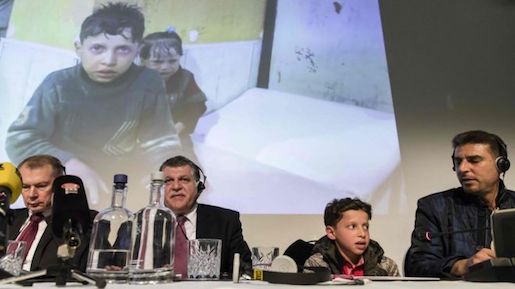
Instead, we are getting yet more revisions to a story that was originally presented as so cut-and-dried that it justified an act of military aggression by the US, UK and France against Syria, without authorisation from the UN Security Council – in short, a war crime of the highest order.
It is worth noting the BBC’s brief account. It has suggested that Diab was there, and that he is the boy shown in the video, but that he was not a victim of a gas attack. It implies that there were two kinds of victims shown in the video taken in Douma: those who were victims of a chemical attack, and those next to them who were victims of dust inhalation.
That requires a great deal of back-peddling on the original narrative.
It is conceivable, I suppose, that there was a chemical attack on that neighbourhood of Douma, in which people like Diab assumed they had been gassed when, in fact, that they had not been, and that others close by were actually gassed. It is also conceivable that the effects of dust inhalation and gassing were so similar that the White Helmets staff mistakenly filmed the “wrong victims”, highlighting those like Diab who had not been gassed. And it is also conceivable, I guess, that Diab and his family now feel the need to lie under Russian pressure about there not being a gas attack, even though their account would, according to this revised narrative, actually accord with their experience of what happened.
But even if each of these scenarios is conceivable on its own, how plausible are they when taken together. Those of us who have preferred to avoid a rush to judgment until there was actual evidence of a chemical weapons attack have been invariably dismissed as “conspiracy theorists”. But who is really proposing the more fanciful conspiracy here: those wanting evidence, or those creating an elaborate series of revisions to maintain the credibility of their original story?
If there is one thing certain in all of this, it is that the video produced as cast-iron evidence of a chemical weapons attack has turned out to be nothing of the sort.
April 29, 2018
Posted by aletho |
Fake News, False Flag Terrorism, Mainstream Media, Warmongering | France, Syria, UK, United States |
Leave a comment
The last big European effort to dissuade US President Donald Trump from abandoning the 2015 Iran nuclear pact ended without success Friday with the ‘working visit’ by German Chancellor Angela Merkel to the White House. Earlier in the week, French President Emmanuel Macron also tried his hand. Perhaps, all that remains is a phone call from British PM Theresa May to Trump.
Macron and Merkel met with no success. Macron floated an ingenious idea of linking the Syrian conflict, Iran’s ballistic missile program, Iran’s regional policies and the nuclear deal and negotiating a new package deal. But Trump didn’t sound enthusiastic. He’d rather tear up the Iran deal and move on. Macron estimated finally that Trump would act for “domestic reasons.” Mike Pompeo, the newly appointed secretary of state, also said Friday that the US is unlikely to remain in the deal.
At the joint press conference with Merkel at the White House on Friday, Trump was rhetorical and took a hard line. Merkel, while conceding that the 2015 pact might not have been a perfect deal, flagged that it was a “first step” that significantly slowed down Iran’s nuclear program and left scope for improvement – “one piece of the mosaic, one building block, if you like, on which we can build up this structure.”
Indeed, the remarks by Macron and Merkel vaguely hint at their acceptance that the 2015 pact needs to be re-negotiated. If so, they have caved in to Trump’s bullying. On the other hand, what they said does not reflect the common European Union position. The EU has never discussed the idea of a new Iran deal. The vast majority of EU countries seem perfectly pleased with the implementation of the 2015 deal and see no reason to reopen the agreement that was painstakingly negotiated. Any shift in the EU stance will need unanimity of opinion, which is highly unlikely to favor a re-negotiation of the 2015 deal.
The big question is what Iran’s reaction is likely to be to Trump’s decision to leave the nuclear deal. The Iranian Foreign Minister Mohammad Javad Zarif spoke on this in a conversation with Robin Wright at the New Yorker magazine. This is what Wright wrote:
- Tehran has three broad choices if Trump opts out, according to Zarif. In the first, Iran could withdraw from the deal, terminate compliance, and resume—even increase—its uranium enrichment… “America never should have feared Iran producing a nuclear bomb,” Zarif said. “But we will pursue vigorously our nuclear enrichment.”
- Iran’s second option exploits a dispute mechanism in the deal, which allows any party to file a formal complaint with a commission established to adjudicate violations. Iran has filed eleven complaints—to Federica Mogherini, the E.U.’s foreign-policy chief, who heads the commission—citing U.S. violations on three different counts, Zarif said. The process allows forty-five days for resolution. “The objective of the process is to bring the United States into compliance,” Zarif said.
- Iran’s third option is the most drastic: the country could decide to walk away from the Treaty on the Non-Proliferation of Nuclear Weapons, or N.P.T… In Tehran, debate is still intense about which option Iran should choose. “Iran is not a monolith,” Zarif said.
The growing impression is that the 2015 deal cannot be saved. But then, there is a flip side to it. One, Trump has shown that his strident rhetoric need not necessarily be followed by corresponding action. The North Korean example is in front of us. Two, Washington never really implemented the Iran deal. So, what difference does it make if Trump pulls out?
In the downstream, the US options are very limited. More US sanctions? Well, Iran has lived with US sanctions for four decades. Regime change? Just forget it. Military attack? Simply suicidal. Then, there are the ground realities. Iran is well entrenched in the so-called northern tier of the Middle East (Iraq, Syria and Lebanon) where the Shi’ite predominance is a geopolitical reality. Above all, there are other players in that region also who don’t like the US presence.
Importantly, Russia and China will never cooperate with Trump on the Iran file. The only significant variable, if at all, could be Europe’s implementation of the deal, which is of course crucial for Tehran. This was how Wright concluded: “I asked Zarif if there was a prospect, if the deal dies, that Iran would negotiate again with the United States. “Diplomacy never dies,” he told me. “But it doesn’t mean that there is only one avenue for diplomacy, and that is the United States.” Whatever Iran’s final decision, he said, it “won’t be very pleasant to the United States. That I can say. That’s a consensus.” Read Wright’s piece here.
April 28, 2018
Posted by aletho |
Economics, Wars for Israel | France, Germany, JCPOA, Sanctions against Iran, Syria, United States, Zionism |
Leave a comment


 Aletho News
