Yaser Murtaja and Marie Colvin

Freedom Rider: Yaser Murtaja and Marie Colvin
By Margaret Kimberley | Black Agenda Report | April 11, 2018
Yaser Murtaja was a Palestinian journalist acting in his professional capacity when he was murdered by the Israeli Defense Forces (IDF). He was covering the second Great Return March in Gaza and was clearly identified as press when an Israeli sniper fired a fatal shot.
Yaser Murtaja should not be forgotten. His death must be uppermost in our minds when the Syrian government is accused of deliberately murdering a journalist and is sued for $300 million in a United States court. Marie Colvin was covering the Syrian war in 2012 for the British newspaper The Sunday Times. She was killed when the Syrian army shelled the building where she and others were embedded with the Free Syrian Army, a group committed to regime change. The court filing claims that the Syrian government tracked Colvin’s movement and assassinated her. Ordinarily foreign governments can’t be sued in United States courts but as a designated “terrorist” state the rule does not apply to Syria.
War propaganda is the order of the day in the ongoing effort to continue war in Syria. President Bashar Assad has been accused of carrying out chemical weapons attacks against his people ever since the American backed effort began in 2011. We are told to believe that he would carry out these attacks on the same day that United Nations inspectors arrive or whenever he is winning on the battlefield.
The real issue is that Assad is still the president of Syria with the help of his Russian and Iranian allies. He has defeated the terrorists sent to unseat him and he and his allies are forces to be reckoned with. NATO governments know that their people will not support war against his country unless they believe that he is an evil dictator who gasses babies every day.
His opponents are armed with money and contacts at the highest levels of the American and European governments. There is an entire media industry devoted to disparaging him and in so doing making the case for continued war. The White Helmets are a fiction, a creation of al Qaeda, an organization we are otherwise told to hate and fear. Far from being disinterested rescuers the White Helmets are part of the terror network that has nearly destroyed Syria and killed thousands of people. They routinely stage footage of their rescues and of gas attacks but only the leftist media dare to point out that easily provable fact.
The White Helmets are not alone. Every anti-Assad lie comes with the seal of approval from the Syrian Observatory for Human Rights (SOHR). Despite the grandiose name the SOHR is just one man living in the U.K. named Rami Abdel Rahman. Rahman is a native Syrian who actually hasn’t been inside his homeland in 16 years.
This week the SOHR reports chlorine gas attacks carried out against the civilian population by the Assad government. The moment is very opportune but there is no evidence that the latest reported attack took place at all. The terrorists use these charges to regroup and to be given safe passage so that they may attack another day. The lies are not just propagandistic. They are tools for continuing this horrible conflict.
The corporate media share in the culpability. They have chosen sides and repeat verbatim every outlandish fiction that will make the case for imperialism. None of them allow a counter narrative to see the light of day. There are many knowledgeable people whose expertise would call into question charges of gas attacks and assassinated reporters. But they are disappeared from discourse and casual followers of the news have no idea that they exist.
The lawsuit in the Marie Colvin case is nothing but war propaganda. Her family will never collect from the Syrian government but that isn’t the point of this case. Is it meant to create a compliant population who will believe anything they are told and not ask questions when the United States starts a hot war with Syria and its Russian and Iranian allies.
Who will file a lawsuit on behalf of Yaser Murtaja? He died covering protests that Palestinians have a right to hold according to international law. But Israel doesn’t need to respect the law because of American financial and military support. If there were justice both of those governments would be sued or better yet their leaders would be tried at the Hague as war criminals.
The Israelis brag that they “know where every bullet lands.” This ghoulish statement is a confession that they knowingly shot and killed a member of the press corps. His family will have no right to sue that government or its patron the United States. There is no hand wringing for Murtaja in the corporate media or from liberals who think themselves humanitarian.
Marie Colvin was killed because she was covering a war zone and was embedded with a group devoted to Assad’s overthrow. Ms. Colvin had already lost the sight in one eye after covering another war in Sri Lanka. She knew the risks of her profession and continued to take them. There is no comparison between her death and Murtaja, a man who was trapped in Gaza with 2 million other people and who devoted himself to chronicling their oppression.
Some victims are considered worthy and others are thought to be unworthy. Some are ignored and others are elevated so that the rulers can get away with advocating evil deeds. Of course no one would have died in Syria if Barack Obama and Hillary Clinton hadn’t joined with NATO and monarchy states to destroy another nation after their gruesome success in Libya. Perhaps the next lawsuit should target them and their cronies. That would be true justice.
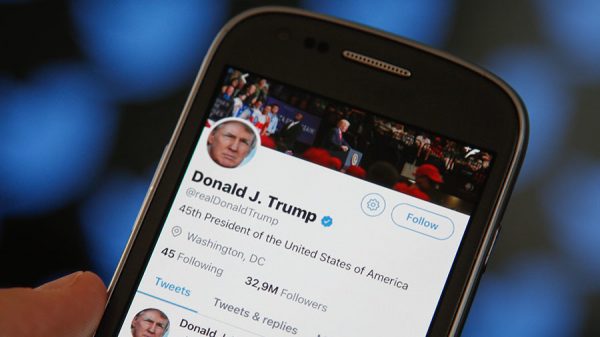
‘We don’t do Twitter diplomacy, need serious approach’ – Putin’s spokesman to Trump over Syria rant
© Jaap Arriens / Global Look Press
RT | April 11, 2018
Vladimir Putin’s spokesman Dmitry Peskov dismissed Donald Trump’s attempts to talk to Russia through a barrage of tweets on Wednesday, and warned that the US president risked worsening “an already fragile situation.”
“We don’t do Twitter diplomacy. We are proponents of a serious approach,” Peskov told the media in Moscow. “We still think it is important to avoid steps that could harm what is already a fragile situation.”
In his earlier missives, Trump veered between intimidation and encouragement towards Moscow. He warned Russia to “get ready” for “nice, new and ‘smart’” missiles as a result of supporting Bashar Assad, who he described as “a Gas Killing Animal who kills his people and enjoys it.” This suggested that a US military response to the alleged use of chemical weapons in Syria on April 7 is imminent.
However, Trump later wrote that there is “no reason” for the relationship between the Kremlin and the White House to be “worse now than it has ever been,” and asked “all nations to work together.” He also enjoyed a sideswipe at the “Fake & Corrupt Russia Investigation” for causing “much of the bad blood with Russia.”
We’re Not Going to War, Not Yet – Last Night’s Russian TV Analysis
By Gilbert Doctorow | Russia Insider | April 9, 2018
In an article posted on this morning’s Russia Insider entitled “Russia is Ready for War. Mood on Prime-time TV is Grim,” the Saker sets out a list of conclusions he found watching Russian television, presumably last night.
The program he watched seems not to be cited, though it is a safe guess it was Sunday Evening with Vladimir Solovyov.
I salute The Saker for being one of the mighty few colleagues in alternative news, not to mention mainstream news, who actually follows what the Russians are saying at the source: on their television programs directed at the domestic audience.
At the same time, while acknowledging the airing of the views he sets out in his essay, he has intentionally skewed his article to promote the negativism he brought with him to the write-up. My own take-away from that program was diametrically opposite: to find great encouragement that the US generals, especially Chairman of the Joint Chiefs of Staff Dunford, are not the OK Corral shoot-out boys some of us would like to paint them, even if one, Secretary of Defense Mattis, may be clueless.
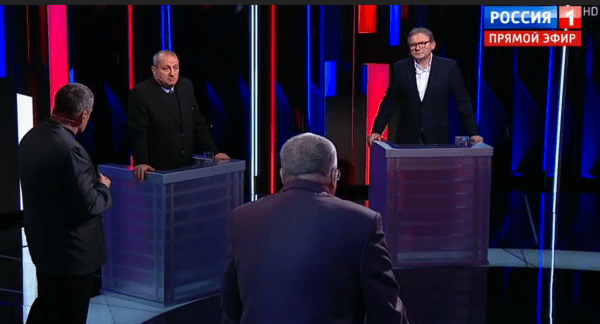
What I heard on the Solovyov program is that the US military know precisely the positions of Russian cruisers, submarines, aircraft and missiles in the Middle East region, that is to say, they understand that the Russians are on a war footing and fully prepared to execute the deadly counter strike promised by General Gerasimov several weeks ago if the US dares to cross the Russian red lines and launch a strike against Damascus or other locations where Russia has its armed forces embedded with the Syrians.
The US generals, unlike the US politicians and media and US administration, are risk-averse if the outcome may be catastrophic. Accordingly, the strike Trump has promised to “avenge” the utterly phony chemical attack in Douma, Eastern Ghouta, will have another vector, most likely to strike against Iran, which Trump held up as the co-supporters of “Animal” Assad.
Why Iran? Well, that falls entirely in line with Trump’s anti-Iranian stance in general and it will test the alliance between Russia, Turkey and Iran whose presidents last week reconfirmed their commitment to a jointly managed final political and military settlement in Syria. Indeed, there is no alliance between Russia and Iran, and the US can proceed as it sees fit in attacking Iran, subject of course, to Teheran’s ability and readiness attack US bases and armed detachments in its region in response.
I do not say that this alternative reading of the likely evolution of the Great Power confrontation in the Middle East is a happy one.
But it remains at the level of proxies and does not take us over the precipice to WWIII, as Saker’s and most other Western commentators in alternative media would have us believe.
US attack on Syria is futile but serves a purpose
By M K Bhadrakumar | Indian Punchline | April 11, 2018
The United Nations Security Council turned down a compromise resolution on Syria, proposed by Sweden and seconded by Russia seeking investigation on the alleged chemical attack in Douma. Five countries supported the resolution with two permanent members – United States and Britain – opposing it. Earlier, a resolution on the same lines which was supported by Russia and China was also opposed by the US and Britain.
This is a significant political and diplomatic victory for Russia insofar as only two other countries joined the US and Britain to oppose the Swedish resolution. Six countries abstained.
The big question is whether this development portends an impending US attack on Syria, bypassing the UN. The UN has refused to confirm there has been any attack at all. Russia and Syrian government insist there has been no attack and have approached the Organization for the Organization for the Prohibition of Chemical Weapons for an international investigation. The good thing is that the OPCW is deputing two teams of experts to go to Douma later this week. Russia has offered to give them full security protection.
So Trump has a major decision to make. Logically, punishment follows a crime that has been committed and it seems no crime has been committed. This appears to be a false flag operation – that is, a fabrication with a view to trigger a sequence of events. That was how the US invaded Iraq in 2003 and it is an established fact today that Saddam Hussein did not have any program to develop weapons of mass destruction, as then US Secretary of State Colin Power had misled the UN Security Council. (Powell later admitted that he was misled by his own administration.)
One difference in the present case is that Trump has been on record that he wants the American military presence in Syria to end. That stance and the present threat to launch an attack on Syria are contradictory. Because, a US attack on Syria will have serious repercussions, including possibly a showdown with Russia, which would mean a US drawdown in Syria may not be possible in a conceivable future.
Perhaps, Trump is indulging in doublespeak and the backdrop could be the criticality that has arisen over Robert Mueller’s investigation into his collusion with Russia, which has now dramatically expanded in scope. The FBI raid on the office of Trump’s attorney in the White House is a very serious development. Trump is just inches away from being implicated in the charges against him levelled by porn star Stormy Daniels. CNN says, “There could be dark and unprecedented times ahead.”
A US attack on Syria can distract attention from the stormy controversy that may arise if at this point Trump axes Mueller and derails the investigation against him. There are precedents when beleaguered American presidents resorted to diversionary tactic. Bill Clinton fired cruise missiles at Kandahar when the scandal over Monica Lewinsky peaked and he was facing the prospect of impeachment.
That brings us back to the alleged chemical attack in Douma last weekend. Who would have staged a false flag operation? The finger of suspicion points toward Israel’s role. Israel is desperately keen that the US should have a permanent military presence in Syria. To that end, Israel is fuelling tensions that will take matters to a point that a US withdrawal from Syria somehow gets stalled. This is also the impression conveyed by DebkaFile, the Israeli website with links to the intelligence services, which specializes in disinformation tactics.
The coincidental Israeli attack on a Syrian air base on Sunday had all the hallmarks of a deliberate act of provocation. Four Iranian military advisors were killed in the Israeli raid. Israel must be hoping against hope that the Iranians will retaliate, leading to a flare-up where the US would get pitted against Iran at some point. Such subterfuges are typical of Israel’s strategy. The point is, Israel lacks the capacity on its own to tackle the challenge of the expanding Iranian influence in next-door Syria.
Trump has reportedly cancelled a planned trip to Latin America. The New York Times has reported that Trump is weighing “more robust” military strikes against Syria. No doubt, tensions are rising. To my mind, however, Trump may not order an attack on Syria. Maybe it’s wishful thinking — frankly, I am a man of peace and am terrified of war — but I’ll explain why there is reason to believe still that sanity will ultimately prevail in Washington.
First, a US attack on the Syrian regime at this stage of the 7-year old war doesn’t make sense insofar as it cannot stop President Bashar Al-Assad on his tracks from attaining total victory. Bashar’s victory is a fait accompli. Period.
On the other hand, in order for the Syrian regime to be degraded to a point — like in Libya for example — and deposed from power, there has to be a massive western military intervention, including deployment of ground forces in tens of thousands. That seems improbable, given the level of disenchantment in Europe regarding Trump. So, the US has to go alone — at best with the (British) poodle. In such an enterprise, what does US hope to gain? Again, the chaos that follows will be beyond imagination.
Indeed, the risk of escalation is exceedingly high and that is not in the interests of Trump’s ‘America First’. By the way, hey, what about the “trade war” with China? What about the meet with Kim Jong Un? What about Afghanistan? What about Yemen? Above all, will another Middle Eastern war go down well in the US opinion? Will the US Congress support an attack on Syria when American interests are not directly facing threat?
Finally, the US cannot afford to overlook the explicit – and repeated – Russian warnings at various levels that an American attack on Syria will have grave consequences. Trump would know Vladimir Putin is “smart” and means business when he says something to the effect that Russia will ensure that what happened in Libya does not repeat. (TASS )
However, the Syrian conflict is approaching yet another new flashpoint. Make no mistake, Israel will have to pay a price for the killing of the Iranian 4 military advisors. The powerful Iranian statesman, Ali Akbar Velayati has has explicitly stated as much. Indeed, Israel is going to be in real fix if Trump now decides not to attack Syria.
Russian lawmakers plan to meet Syria’s President Assad
Press TV – April 11, 2018
A group of Russian lawmakers have announced a plan to meet Syrian President Bashar al-Assad while denying claims that the Syrian leader has left the Arab country.
Dmitry Sablin, a deputy in the Russian lower house of parliament, known as the State Duma, told Russia’s Interfax news agency that the lawmakers would meet Assad to discuss latest developments in Syria.
“We plan to meet him to discuss the situation and support the people of Syria in its fight against terrorism,” said Sablin without elaborating on the specific date of the planned meeting.
Sablin, who serves as the coordinator of a Russian parliamentary group for ties with Syria’s parliament, arrived in Damascus on Wednesday at the head of a delegation which seeks talks with the Syrian leadership and businessmen while on a mission to carry out a number of humanitarian efforts.
The announcement for meeting with Assad came hours after some reports suggested that the Syrian president had left Syria out of fears that the United States might launch a massive military attack on the country.
US President Donald Trump took to his Twitter page and called on Russia, which maintains a military presence in Syria to help Assad fight terror, to be ready for a potential US missile attack.
However, Sablin rejected claims that Assad had left the country with his family.
“Syrian President Bashar Assad is in Damascus,” said Sablin, reiterating that Assad has repeatedly resisted calls for leaving the country in the past.
The Russian lawmaker added that he “has met with Assad several times, including in 2014, when the situation in Syria was much worse.”
“Then, Assad said he would never leave Syria and would share his people’s fate,” said the lawmaker, adding, “His (Assad’s) family is also now in Damascus with their people.”
Any US missiles fired at Syria will be shot down, launch sites targeted – Russian envoy to Lebanon
RT | April 11, 2018
The Russian military reserves the right to shoot down missiles and destroy launch sites in the event of US aggression against Syria, Moscow’s envoy to Lebanon Alexander Zasypkin has warned.
Zasypkin stressed that “the Russian forces will confront any US aggression on Syria, by intercepting the missiles and striking their launch pads,” al-Manar TV website reported, citing the envoy.
Speaking to the channel, the ambassador also said that the allegations of a chemical attack were being used to justify “offensive acts” in Syria, while “the US and Western escalation against Syria will lead to a major crisis.”
The statement comes after Washington threatened a “forceful response” against Syria after an alleged chemical attack in the Damascus suburb of Douma on Saturday. The US was quick to pin the blame on the Syrian government, basing its accusations on unverified data and images, including reports from the infamous, rebel-linked White Helmets ‘civil defense’ group.
On Tuesday, the UN Security Council failed to pass three consecutive resolutions calling for an investigation into the alleged use of chemical weapons in Syria. A Russian-sponsored draft backing a fact-finding mission at the site by the Organization for the Prohibition of Chemical Weapons (OPCW) is the latest to have been rejected by the body.
As the initiative was voted down by the US, the UK, France and Poland; Russia’s UN envoy Vassily Nebenzia once again called for the West to “refrain from the plans which you might be harboring with regards to Syria.”
Earlier on Tuesday, the OPCW announced that is preparing deploy its team to Douma “shortly” to investigate the reports of an attack there. Earlier, Russian specialists at the site had found no traces of chemical weapons or any victims treated for chemical poisoning.
While US President Donald Trump is weighing up options, reports emerged signaling that Washington is beefing up its forces in the Middle East. On Monday, the guided-missile destroyer ‘Donald Cook’ departed the port of Larnaca in Cyprus, reportedly heading towards Syria. Meanwhile on Wednesday, the USS ‘Harry S. Truman’ aircraft carrier, accompanied by strike groups, is scheduled to set sail for a “regular” mission to the Middle East and Europe.
Meanwhile, Eurocontrol – an EU body tasked with handling air traffic over the continent – issued a Rapid Alert Notification, warning flight operators in the Eastern Mediterranean about “the possible launch of airstrikes into Syria with air-to-ground and/or cruise missiles within the next 72 hours.”
While the West is poised for a military response to the alleged chemical incident in Syria, Moscow is warning against further destabilization of the region. Russia hopes that all the sides will “avoid any steps which are not provoked by anything in reality and can substantially destabilize the already fragile situation in the region,” Kremlin spokesman Dmitry Peskov stated on Wednesday.
Nonsense about Syria gas attacks reveals US ideology of tyranny
By Stephen Gowans | what’s left | April 11, 2018
Ideologues of US power, notably those ensconced in the editorial offices of the New York Times and Wall Street Journal, believe that the United States has an imprescriptible right to exercise an absolutist tyranny over the world, to define the boundary between civilization and barbarism, and that Washington is unbound by international law, but free to wield it as a tool against the barbarians. In the ideology of US despotism, the compass of civilization includes states that submit to “US leadership”, a euphemized version of “US tyranny,” while states which favor an international order based on the UN Charter’s ideal of the sovereignty and equality of states (Syria, North Korea, Cuba, Iran and Venezuela are among the supporters of this alternative, democratic, order) are relegated to the category of barbarism. Once a state has been located outside of civilization, Western legal traditions—testing accusations against evidence and the assumption of innocence until culpability is credibly demonstrated— no longer apply. The “barbaric” state becomes guilty of all acts of which it is accused, regardless of whether there exists credible evidence to corroborate the accusation.
In a 9 April editorial “In Syria, Trump faces the limits of bluster” The New York Times attributes a global leadership role to the United States, which it urges the Trump administration to exercise by creating “an independent investigation that could lead to prosecution” of the Syrian leadership “in a tribunal like the International Criminal Court,” a court the United States itself rejects and refuses to be bound by.
The New York Times’ editors lay out steps Washington ought to take if “the Syrian regime’s guilt is determined,” but conclude all the same that the Syrian government is guilty on all charges, contrary to the reality that the US State Department, British Foreign Office, and its own reporters, have acknowledged that the chemical attack allegations against the Syrian government are unverified and unconfirmed. What’s more, the sources of the allegations are the White Helmets and Syrian American Medical Society, partisan outfits, funded by Western governments, and allied with anti-government insurgents, who have an interest in fabricating atrocities to defame their enemy and to justify continued and even elevated Western intervention in Syria.
Additionally, US Defense Secretary Jim Mattis, at a 2 February news conference, admitted that the Pentagon has no evidence that the Syrian military has ever used chemical weapons. This, however, didn’t stop the New York Times’ editors from declaring that Syria has failed to honor its agreement to destroy its chemical weapons under a 2013 pact or that it is responsible “for most of the 85 chemical attacks in the country over the past five years.” A newspaper which proclaims itself to live up to the highest standards of journalism, indeed, to set the gold standard, appears to have no trouble creating facts out of thin air.
The editors lay out steps the Trump administration should take once a legal imprimatur is conferred upon a pre-judgement of guilt. Inevitably, military action is called for. “If a Russian veto prevents Security Council action, then Mr. Trump needs to work with our allies, through NATO or otherwise,” the editors counsel—a call for the US administration to violate international law (again.)
“The use of poison gas,” the newspaper of record observes one paragraph later, “is a war crime under international law,” a curious observation given the editors’ dim view of international law as evidenced by their urging Washington to act without Security Council authorization in order to exercise “America’s traditional leadership role.” It should be recalled that the Third Reich, Fascist Italy, and Imperial Japan also claimed leadership roles, to say nothing of imperial Britain and imperial France, the latter of which is eager to rehabilitate its colonial tyranny over its former Syrian mandate under the guise of punishing the “barbarian” Assad for outrages against civilization.
The Pentagon has the world’s largest stockpile of weaponized poison gas. The point of having it is to possibly use it, despite its prohibition under the very same international law the New York Times condemns Syria (without evidence) of violating. Thus, the ideologues of US tyranny reveal that international law is a matter of significance only to countries the United States defines as its enemies (the barbarians), and not to the United States itself, which is free to act as it pleases against the barbarians, according to its own laws, as the guarantor of a global moral order. Needless to say, the idea that the United States, the principle source of disorder, suffering and decay in the world, has even a soupcon of moral authority, is risible, if not a sick joke—a truth of which most of the world’s population is only too aware.
In 1970, the United Nations General Assembly passed Resolution 2625, which, inter alia, declared that “States have the duty to refrain from propaganda for wars of aggression,” a resolution of apparently no significance to the New York Times, which is only too happy to spread propaganda for wars of aggression in the service of a US tyranny which, far from exercising moral authority, continues to spread its dark wings over the whole world, led by a madman at the top of a system of global oppression and exploitation, from which has sprung a program of neo-colonial warfare and escalating confrontation with China and Russia.
Taking the World to the Brink
By Rick Sterling | Consortium News | April 10, 2018
Western neoconservatives and hawks are driving the international situation to increasing tension and danger. Not content with the destruction of Iraq and Libya based on false claims, they are now pressing for a direct US attack on Syria.
As a dangerous prelude, Israeli jets flying over Lebanese airspace fired missiles against the T4/Tiyas Airbase west of Palmyra following reports on Sunday of a chemical weapons attack in Douma, a suburb of Damascus under rebel control.
As reported at Tass, the Chief of Russia’s General Staff, Valery Gerasimov, predicted the alleged use of chemicals almost a month ago. The report from March 13 says, “Russia has hard facts about preparations for staging the use of chemical weapons against civilians by the government forces. After the provocation, the US plans to accuse Syria’s government forces of using chemical weapons … furnish the so-called ‘evidence’ … and Washington plans to deliver a missile and bomb strike against Damascus’ government districts.”
Gerasimov noted that Russian military advisors are staying in the Syrian Defense Ministry’s facilities in Damascus and “in the event of a threat to our military servicemen’s lives, Russia’s Armed Forces will take retaliatory measures to target both the missiles and their delivery vehicles.”
The situation is clearly fraught with the risk of sliding into international conflict between the two biggest nuclear weapons powers with all that that implies. Civilization itself is being put in peril so that the West can continue supporting sectarian armed groups seeking to overthrow the Assad government, in violation of international law and the UN Charter.
The most powerful country in the world is now led by a real estate, hotel and entertainment mogul without political experience. Behind the scenes, there is an entrenched foreign policy establishment determined to maintain and reclaim U.S. unilateral “leadership” of the world. American leaders fear that the U.S. is losing influence, prestige and power around the world. Israel and Saudi Arabia are seeing their designs on regional dominance failing.
East Ghouta, Damascus
East Ghouta is a district of farms and towns on the north-east outskirts of Damascus. For the past six years, various armed factions controlled the area. On a nearly daily basis, they launched mortar and hell cannon missile attacks into Damascus, and have killed thousands of civilians. This author personally witnessed two such mortar attacks in April 2014.
By the end of March most of East Ghouta had been retaken by the government. With the peaceful evacuation of armed militants, civilians flooded into the humanitarian corridors and then government camps for the displaced. The campaign was proceeding quickly with minimal loss of life as the Russian Reconciliation officers negotiated agreements which allowed the militants to keep small weapons and be transported to Idlib in the north.
Journalist Vanessa Beeley documented the situation including the happiness and relief of many civilians as they finally made it to safety. One described the feeling as “like being reborn”. Robert Fisk of Britain’s Independent newspaper was on site and reported what he saw first hand in stories titled Watching on as Islamist fighters are evacuated from war-torn Eastern Ghouta and Western howls of outrage over the Ghouta siege ring hollow.
As reported at the Russian Reconciliation Centre, by the end of March, 105,857 civilians had moved into government controlled areas while 13,793 militants, plus 23,433 family members had been transported north. Those who wanted to stay, including former fighters, were welcomed. They could rejoin Syrian society with the same rights and obligations as other Syrians.
The last remaining opposition stronghold was the town of Douma, controlled by the Saudi-funded Jaish al Islam. Negotiations were prolonged because Jaish al Islam did not want to go to Idlib, which is dominated by another militant opposition group, Jabhat al Nusra also known as Hayat Tahrir al Sham. It is the al Qaeda affiliate in Syria.
The Chemical Incident
On Saturday, April 7, video and stories claiming a chemical weapons attack in Douma were broadcast. The video showed dozens of dead children. On Sunday the story grabbed western mainstream media headlines. U.S. President Trump quickly came to a conclusion: “President Putin, Russia and Iran are responsible for backing Animal Assad. Big price to pay”.
There has been no objective investigation. The media claims are based on statements and videos from members of the Syrian American Medical Society (SAMS) and the White Helmets. Both organizations receive significant funding from the US government and are not neutral as aid organizations should be. They both call for Western intervention in Syria.
Chemical weapons have emerged as the quick and easy justification for aggression. One year ago, in April 2017, it was the incident at Khan Shaykoun. That resulted in a US attack on a Syrian air base just days later. As reported here by Consortium News‘ late founder, Robert Parry, the subsequent investigation discovered that dozens of victims had shown up in hospitals in diverse locations and up to 100 kms away from the scene of the crime before the event happened. Indicative of apparent bias by the investigators, this red flag pointing to fraud was not probed further. If it was just a few victims or just one location, it might be a mistake in time record-keeping. However in this case there were dozens of discrepancies in multiple locations, clearly raising the possibility of fraud.
Now we have the incident in Douma. The armed opposition is in retreat. They are losing the war and are desperate. They have tried since 2012 to pressure the U.S. and NATO to intervene directly on their side. The rebels have access to chemical weapons in East Ghouta and they have a motive. They also have thousands of prisoners. This group put hundreds of prisoners, primarily women and children, in cages on the streets of Douma.
Who Benefits?
The timing of the chemical weapons incidents is also noteworthy. As documented here, one year ago on March 30, 2017, U.S. Ambassador to the UN Nikki Haley said U.S. policy was no longer focused on getting Assad out. Five days later the chemical incident at Khan Sheikhoun happened, followed quickly by blaming the Syrian government without evidence, then the U.S. attack on a Syrian air base and a then restoration of the demand that “Assad must go.”
On March 29 this year, Trump said that U.S. forces will withdraw from Syria “very soon.” This was followed by outcries from the media and political establishment. Once again, following Saturday’s incident, the U.S. is again threatening to intervene. The chemical weapons incidents have consistently resulted in the reversal of a proposed change in hostility toward Syria.
Neoconservatives and the supporters of ‘regime change’ foreign policy have various theories why the Assad government would perpetrate a chemical weapons attack. Senator John McCain says the Syrian President was “emboldened” by Trump’s call to withdraw. Juan Cole, an academic who promoted the assaults on Libya in 2011, has a different theory. He says “Chemical weapons are used by desperate regimes that are either outnumbered by the enemy or are reluctant to take casualties in their militaries. Barrel-bombing Douma with chem seems to have appealed to the regime as a tactic for this reason. It had potential of frightening the Douma population into deserting the Army of Islam.”
In contrast with his theory, chemical weapons were used extensively by the U.S. in Vietnam and Iraq when they were far from desperate. As evidenced in the flow of civilians into government held areas, most of the civilian population are happy to get away from the sectarian and violent Army of Islam (“Jaish al Islam”). Cole seems to be basing his theories on inaccurate western media coverage just as he did regarding Libya where sensational claims about a looming massacre in Benghazi were later shown to be fraudulent.
It’s clear who benefits from sensational media coverage about a chemical weapons incident: those who seek to want the U.S. to intervene militarily. Every time there is an incident, and well before an investigation has even begun, it is seized on by governments and organizations who’ve sought regime change in Syria since the start of the war, and perhaps even earlier.
Manipulating Public Opinion
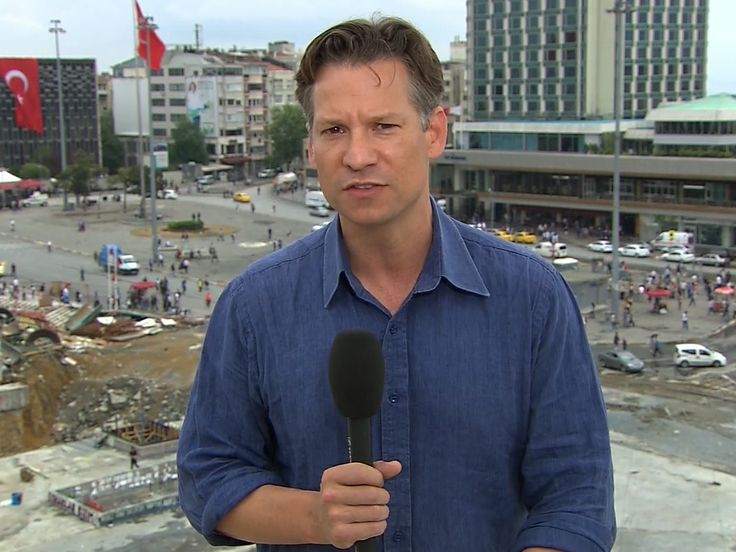
NBC chief foreign correspondent Richard Engel, exposed as part of hoax
The manipulation of western opinion about the Syrian conflict using fake events is not theory; it has been proven. A good example is the fake kidnapping of NBC reporter Richard Engel in December 2012. Engel and his media team were reportedly kidnapped and threatened with death by “shabiha” supporters of the Syrian president. After days in captivity the American team was supposedly rescued by Free Syrian Army “rebels” after a shootout. In 2015 it was confirmed this was a hoax perpetrated by the FSA and their American supporters. The entire charade was carried out by the “rebels”. The goal was to demonize the Assad government and its supporters, and to romanticize and increase support for the armed opposition. Neither Engel nor NBC confessed to the reality until it was about to be exposed years later, pointing to duplicity and collusion in the deception.
Four and half years ago, on August 21, 2013, the most famous chemical weapons incident occurred. The Syrian government was immediately accused of launching a sarin attack which killed hundreds of children and civilians. Over the next six months investigations were carried out. The conclusions of Seymour Hersh, Parry and the research site whoghouta.com concluded that the attack was almost certainly not from the government but actually from one of the ‘rebel’ factions with support from Turkish intelligence services. Two Turkish parliamentary deputies held a press conference and publicly revealed some of the evidence. The intent then, as now, was to provide justification and provocation for the US and NATO to bomb Syrian government installations.
The Drums are Pounding
Today there is the imminent possibility of a major attack based on the allegations of a clearly biased source, with international law and legal due process tossed aside. Why is violence being threatened before there is a serious, independent investigation of the chemical incident? If the accusations against Syria are true, why not let it be investigated, especially now that the area was liberated on Monday and safe access can be provided?
The drums of war are pounding. After over one year of incessant Russia bashing and disinformation, is the public ready to go to war with Russia over Syria? Neoconservative hawks and their Israeli and Saudi allies do not seem alarmed by this prospect. Their plans and predictions for Iraq, Libya and Yemen were delusional fantasies with the price paid in blood by the people of those countries and in treasure by Americans as well. Sadly, there has not been any accountability for the media and political establishment that promoted and launched those wars. Now they want to escalate the aggression by attacking Syria, causing vastly more blood to flow and risking confrontation with a country which can fight back.
Rick Sterling is an investigative journalist based in the San Francisco Bay Area. He can be contacted at rsterling1@gmail.com
Featured Video

Trita Parsi: Middle East Unraveling — Are We on the Path to World War?
or go to
Aletho News Archives – Video-Images
New Book
Trans agenda is ‘normalization of sadism’ – US author

RT | September 23, 2026
The US Democratic Party has embraced a transgender agenda that amounts to “the normalization of sadism,” author A.J. Rice has said, warning that radical trans policies would return if the party is allowed to regain power.
Speaking to RT’s America First host Scotty Nell Hughes about his new book, ‘The Curse of the Bearded Lady: How the Trans Mafia Whacked American Sanity’, Rice argued that activists have gained significant influence in schools, medicine, and corporate America while people who questioned the agenda have faced pressure to stay silent.
The author described the “trans mafia” as the sprawling network of people and institutions that have helped the movement gain influence. He singled out parts of academia, wealthy backers, and corporations, and stated that providers of transition-related treatment also have a financial incentive to keep young people in their care indefinitely.
Rice argued that the consequences of these policies ultimately fall on children who are being drawn toward gender-affirming medical treatments and on girls who are expected to share locker rooms or compete in sports with biological males.
He noted that while voters rejected the Democrats’ approach to gender in 2024, the party, which has been “captured by madness,” has since only doubled down and is seeking what is effectively “the normalization of sadism.” … Full report
Blog Roll
 Aletho News
- German chemicals giant reveals details of downsizing
- Refaat Al-Areer Was The Canary In The Coal Mine In Israel’s War On The Truth
- Israeli election committee bars candidate from Knesset race over Gaza war opposition
- French-Lebanese man files war crimes complaint over Israeli attacks
- Mahan Air Flight Lands in China Despite US Threat against Iranian Airlines
- US eyes $10bn fund to rebuild war-battered Gulf infrastructure
- Trump meets Rodríguez near Maduro’s prison as Venezuela’s oil flows to US
- Trita Parsi: Middle East Unraveling — Are We on the Path to World War?
- Iran FM meets with US envoy on UN meeting’s sidelines at American side’s insistence: Report
- Qatar PM calls for Gulf security framework with Iran, says war must be ‘wake-up call’
- If Americans Knew
- Caught on Tape: AIPAC CEO Boasted of Controlling Trump’s National Security Officials
- Why Hamas Attacked Israel in October 2023 – Israeli professor Ilan Papé
- They see them, then kill them: Israeli quadcopters track, deliberately target civilians in Gaza
- Winter could turn Gaza’s treacherous, war-damaged buildings into deathtraps
- Majority of Democratic Voters Want to Prosecute Both Biden and Trump Administration Officials Over Gaza
- As Gaza languishes, world leaders gather at the UN – Daily Update
- Sanctions are collective punishment: immoral and self-defeating
- Phosphorus Munitions Fired by Israel Burn Groves, Orchards in Southern Lebanon
- Israel Carries Out New Ceasefire Violations Across Gaza
- AI – Emphasis on the ‘I’: Israel Is Funding AI Chatbot Propaganda
- No Tricks Zone
- New Study: Earth And Venus Surface Warmth Largely Explained By Convection And Lapse Rate, Not CO2 Or Radiation
- 2025 Nature Paper Claiming Worsening Global Drought Gets RETRACTED …Heavily Flawed
- New Study: ‘Global Drought Shows No Detectable Recent Acceleration Under Climate Warming’
- Economic Masterminds: German Socialists Suggest Taxing Productivity Gains Stemming From Using AI
- The South China Sea Has Not Been Cooperating With The Climate Change Narrative
- Energy Crisis: Germany Enters Heating Season With Historically Low Gas Reserve Fill Levels
- New Study: The Antarctic Ice Sheet Gained Mass From 2020-2024 Due To Staggering Snow And Ice Accumulation
- Study: Ocean Heating Rates From Thousands Of Years Ago ‘Dwarf’ Modern Ocean Heating Rates
- Climate Extremists Target, Attack Large-Scale Power Grid Infrastructure In Germany!
- New Study: Antarctic Ice Melt Has Contributed Less Than 1 Centimeter To Sea Level Rise In The Last 30 Years

