New US Training Program for Syrian Rebels ‘Just Another Waste of Money’
Sputnik – 20.03.2016
The US Defense Department reportedly plans to launch a new train-and-equip effort in Syria. The new effort will focus on preparing a small contingent of rebels outside Syria.
The rebels will reportedly be trained in infantry tactics and then sent back to their homeland. The spokesman for the US-led military operation against Daesh, Colonel Steve Warren, said the new effort was part of the Pentagon’s adjustments to the train-and-equip program built on prior experience.
However, many details about the new program remain unclear, including its cost, the number of fighters it aims to train as well as the exact date of its launch, according to Foreign Policy magazine.
Michael Maloof, former Pentagon official and senior security policy analyst in the office of the Secretary of Defense, was not too optimistic about the Pentagon’s ability to learn from the mistakes, saying that his hopes for the new programs were pretty low.
“The program is very vague, no details are being given as to where the training will be conducted and smaller contingents doesn’t necessarily mean a success. The problem has been as to who would be available to fight ISIS as opposed to wanting to take down the government of Syrian President Bashar Assad. That has been the problem. Also what countries would actually conduct the training, before it was Saudi Arabia, Jordan and Turkey? Those countries generally are against the government of Syria as it now stands.”
“It is going to be questionable as to how effective this so-called revised program is going to be. I don’t hold much hope for it and it’s just another waste of money frankly at this point,” Maloof said.
Talking about what the Pentagon’s exact goal was for launching this new train-and-equip program, the official said, “The concept is to fight ISIS, but in reality the people that they are recruiting are Sunnis, they are sympathetic to the Sunni ISIS fighters and even though they may not agree with them wholeheartedly, they are Sunnis and Sunnis will not be fighting Sunnis. That’s just the way it goes.”
He further spoke about the reluctance of Turkey in going after ISIS and instead are venting against the Kurds. “The consequences of these actions are questionable and the success is highly dubious and I don’t hold much faith in them.”
Maloof also discussed Saudi Arabia’s position in this situation. He said, “Saudi’s don’t like ISIS either but they are bank rolling, funding them outside the Kingdom but if they start pointing inward that’s another problem for them because ISIS is fundamentally against monarchy.”
Mission Accomplished: Fallout Between Iran and Russia in Syria?
By Mahdi Darius NAZEMROAYA – Strategic Culture Foundation – 20.03.2016
Since the start of 2016 the mainstream media in the US and the countries that are in Washington’s sphere of influence have been talking about fallout between Russia and Iran over the conflict in Syria. These media reports continuously talk about Russia becoming afraid of Iran or vice-versa, Iran becoming afraid of Russia. These reports constantly talk about competition and rifts between the Iranian and Russian governments over Syria.
Here are two examples. The Financial Times reported that Iran should be afraid of Russia on February 24, 2016. A few weeks later, Bloomberg reported that the Russian military downsizing in Syria risks a rift with Iran in an article by Ilya Arkhipov, Dana Khraiche, and Henry Meyer, published on March 16, 2016.
For months, however, the steady streams of reports about a Russo-Iranian split have been utterly wrong. They are part of a campaign of misinformation (wrong information and analysis) and disinformation (propaganda). The relations between Moscow and Tehran are stable, and their cooperation is strategically oriented. In fact, Russia is supporting Iran against the US initiative at the United Nations Security Council to say that Iranian ballistic missile tests are a violation of Joint Comprehensive Action Plan (JCAP) signed between Iran and the US, Britain, France, Germany, China, and Russia (the P5+1 or EU3+3).
By the same token, other misleading and deceiving reports have been released about Iranian and Russian tensions. Some have been over the levels of Iranian oil production exports. Others have been about fallout between Moscow and Tehran over an Iranian transfer of Russian arms to Hezbollah in Lebanon. Many have also been about the deal and delivery of the Russian-manufactured S-300 anti-missile system to the Iranian military.
In regards to a Russo-Iranian rift over Iranian oil production, these reports focus on demands by Saudi Arabia and Russia that Iran cut back its oil production. Moscow, however, has said that Iran is a special cases and it understands that Iran is working to regain lost energy markets. It has exempted Iran from its call to cut back global oil exports under a global output freeze as part of an initiative to raise the price of oil. While visiting his counterpart in Tehran in mid-March 2016, Russian Energy Minister Alexander Novak even announced that the Russian government understands and accepts the Iranian position, which demands that Iran be allowed to regain its pre-sanction output levels.
In regards to Israeli media reports that there has been fallout between Iran and Russia over Russian arms being transferred to Hezbollah, no signs of this have manifested themselves empirically anywhere. The Russian government has made no statements against Iran. Nor have the Israeli reports been verified in any substantive way.
It was reported in Kuwait that the S-300 deal had been annulled on March 9, 2016. On the same day Sputnik interviewed an Iranian military spokesperson, who rejected the claim. While, from what the public knows, the delivery of the S-300 system to Iran by Russia has been delayed, this does not automatically insinuate tensions between Moscow and Tehran. Both Iranian and Russian officials have repeatedly denied reports saying that the deal has been cancelled. Delays have taken place due to legal provisions and technical matters, according to officials in Moscow and Tehran. Rostec, the government-owned national arms manufacturer of Russia, has even announced that the first orders of the S-300 will be delivered to Iran sometime running from August to September 2016.
Russo-Iranian Cooperation in Syria
About three weeks after a cease-fire agreement for Syria officially started (on February 27, 2016), Russian President Vladimir Putin announced that Russia would begin to partially withdraw from Syria on March 14, 2016. The next day the Russian military began downsizing its presence in Syria. This began being presented as a stumbling block between Tehran and the Kremlin.
Reports were published that claimed that Tehran was upset at the Russian move. The Russian withdrawal is portrayed in these reports as a surprise to the Iranian side. The Iranian government, however, has announced that the reduction of the Russian military force in Syria is a positive sign of success, which means that Iran and Russia have achieved their key objectives inside Syria. Moreover, if the Russian move hurt Iranian interests inside Syria, it would not have resulted in Israeli President Reuven Rivlin making a request on March 16, 2016 to Moscow to ensure that Iran and Lebanon’s Hezbollah do not benefit from the Russian decision to reduce its military presence.
Nor was Iran caught off guard by the Kremlin’s decision to reduce its military presence in Syria. Iranian and Russian generals and officials have been shuttling back and forth from one another’s capitals for months speaking on and strategizing over the conflict Syria. It is highly unlikely that Moscow’s decision to reconstitute its military position in Syria was not coordinated with either the Iranian or Syrian governments. Tehran, Moscow, and Damascus have been constantly consulting one another about the military operations in Syria.
If it was not for Iranian and Russian cooperation and resoluteness in Syria, the cease-fire agreement in Syria would not have materialized. The most recent wave of false reports about Russian and Iranian tensions in Syria are aimed at creating suspicion and managing the perception of US clients. This discourse is not only aimed at misleading people or targeting Iran and Russia, it is aimed at deceiving US clients and Syrian opposition figures in the Middle East about the reality of the situation on the ground in Syria, which is that the camps supported by the Iranians and the Russians in the Middle East are the ones on top.
Any ideas about some type of Russo-Iranian fallout are wishful thinking. Both powers are moving towards even deeper cooperation across the Eurasian landmass from the Mediterranean littoral and Iraq to the Caucasus and Central Asia. They are not only cooperating militarily together, but both Tehran and Moscow are also deepening their industrial, agricultural, financial, political, and economic ties too. This is no temporary alliance, but part of a long-term engagement and strategic partnership.
‘Turkey and EU make refugees a matter of bargaining – a violation of int’l treaties’
RT | March 19, 2016
The EU countries will receive educated and skilled people, and those who are not skilled and educated, they will remain in Turkey, Yasar Yakis, former Foreign Minister and a former ambassador to the UN Office in Vienna, Egypt, and Saudi Arabia, told RT.
RT: Why do you think that the “one in, one out” Turkish-EU refugee plan isn’t feasible? Who stands to benefit from this plan?
Yasar Yakıs: Both sides are going to benefit, but Turkey was in a position where it couldn’t do anything else but ask the cooperation of the European countries. Theoretically, one may think of a scenario whereby the EU could have closed their doors and not let any refugee come in from Turkey. Turkey, by trying to cooperate with the EU and with the initiative taken by Angela Merkel, at least they decided to share the responsibility of Turkey, open the doors, but of course with certain conditions, and this condition is “one in, one out.” But this doesn’t solve several problems that will entail such a decision. One of them is that the refugees who do not come from Syria, who come from distant countries, Afghanistan and the other countries, why on earth would Turkey accept them if they are already in European Union countries to receive also the refugees coming from the third countries… In my opinion, the deal shouldn’t have covered the refugees originating from countries other than Syria.
Second, since this Syrian crisis we do not see any light at the end of the tunnel; the Syrian crisis will continue for some time. Therefore, if there is nobody readmitted from Greece, the EU will be entitled to refuse any additional refugees coming from Turkey and going to the European Union countries, whereas Turkey will continue to receive refugees from Syria…
Third, the EU will receive refugees on the basis of a selection. That is to say, Syrian refugees having arrived in Turkey will submit their demand to be admitted as a refugee in the EU countries, and the EU countries will look at the qualification of the person. If they agree to receive, they will receive. It means they will receive educated and skilled people, and those who are not skilled and educated, they will remain in Turkey. For these reasons, it will work against Turkey’s interests in the long run.
RT: During the Brussels summit, ministers are also going to debate doubling the deal for the refugee crisis to €6 billion. Turkey was earlier accused of “blackmailing” and “holding the EU to ransom”, for example by UKIP’s Farage, Hungary’s Orban, by demanding money to stop the flood of migrants. How do you view such accusations?
YY: First of all, there are restrictions stemming from the international documents, international treaties, which forbid to make the life of the refugees a question of bargaining. What Turkey and the EU are doing is a violation of the international treaties that all the European countries have signed, and also Turkey has signed. This is one thing.
Secondly, the money that was allocated to Turkey will not be paid to Turkey. Turkey will have to submit to the EU projects. These projects will be financed by the EU – the money will not enter the Turkey’s treasury. There is another difficulty there. And if it is not spent in conformity with the EU relations, then the EU will be entitled to stop the payment.
RT: You said that certain EU member countries may find excuses not to implement the visa-free travel agreement with Turkey. Why do you think so? Why do you think the plan has been stalling so far? Who is being insincere here, Turkey or the EU?
YY: Both sides are sincere, but there are of course always ways for not abiding by the promise. There are two reasons for that. One is the number of the conditions that the EU put in order to start the negotiations. There were 72 conditions that Turkey had to fulfill, and 19 of them were fully fulfilled until recently. And something like 7 of them there was no progress at all. Now we have to see, whether Turkey will be fully compliant with all the 72 conditions.
Secondly, many countries were reluctant and they agreed to the deal only upon the pressure coming from Germany, and they will find other excuses in order not to abide by it. Greek Cypriots may be one of them. There are a lot of EU countries that are not satisfied with Turkey’s human rights records – fundamental rights of freedom. And they say that Turkey should not be given such concessions.
Thirdly, there are countries like France, who say that a refugee deal is one thing, Turkish accession process is another thing. Both of these two things should be assessed, evolve, and should continue to function according to their own rule without interacting between themselves.
RT: Is Turkey ready to accept even more migrants in exchange for visa-free regime with the EU and some €6 billion? Or maybe Europe will see the price tag rising, as Turkey keeps asking for money?
YY: The EU is not monolith, which means that they do not speak with the same language – all of them, 28. They all have different views, which differ slightly form the others. Many countries are looking for excuses, either for not giving money, or for abiding by these international treaties, which bans making the refugee deal a question of bargaining between the sending countries and receiving countries.
Thirdly, for the political reasons, like Greek Cypriots and other countries, as well, they are looking for excuses not to let Turkey’s accession process to the EU to continue. It cannot continue forever. It will be due to the two reasons stemming from Turkey, or stemming from the EU.
RT: Turkey says it’s fighting terrorists in its Kurdish areas, but human rights groups are concerned that civilians are being killed in the crackdown. Do you think civilian causalities can be, are justified by the fight against terror?
YY: For me no civilian causalities are justified. You have to take from the standpoint of a family, who sent their 22-year-old son to the military service, and this young man is fighting there. If you ask this family: “Do you agree that this fight against Kurds should continue, but you may also lose your son?” Most probably in many cases he will say: “No, I want my son! I want that my son’s life should not be given away in exchange of something, which is beyond my family’s concern. Of course, there are also some families in Turkey that say ‘for the security of my country I will sacrifice my son.’ But the majority will say ‘no.’
RT: Has Turkey’s international reputation suffered due to its crackdown on Kurds in Diyarbakir, Cizre etc.? And has Erdogan chosen the right strategy here?
YY: Turkey’s human rights record is going down. Turkey lost a lot of altitude in its international relations. Erdogan’s policy on the crackdown – I have to take it from the beginning. I appreciated it very much President Erdogan’s initiative to solve this Kurdish problem – at that time it was called ‘democratization project’ – so this was a very courageous, bold decision taken by President Erdogan… It is a pity now that this process has collapsed. I wish that Turkey should find one way of resuming the negotiations and continue this process…
Canada rejects the rule of international law and embraces international barbarity
By Mark Taliano | American Herald Tribune | March 18, 2016
The United Nations’ (UN) Security Council Resolution 2254 clearly states that the war in Syria demands a “Syrian-led, Syrian-owned political transition to end the conflict.” Additionally, it endorses “free and fair elections pursuant to the new constitution.”
In November, 2015, however, Canada defense minister Harjit Sajjan publically stated that “Assad must go”, basing his assessment on the “complexity of the problem” and “the horrible atrocities that have been committed to his (Assad’s) own people”. On both counts he is wrong: sustained evidence demonstrates that the foreign-backed mercenaries invading and destroying Syria are the culpable parties who are committing the atrocities. We also know that the invasion of Syria was planned well in advance, and that ISIS and its terror cohorts are deemed to be “strategic assets” by imperial war planners. Additionally, both historical evidence – the illegal invasions and destruction Iraq and Libya for example, and the US military doctrine of “unconventional warfare” present a clear case that the terrorist invaders are Western proxies. The West uses proxies to avoid culpability and to avoid “putting boots on the ground”.
Decoded, then, Sajjan’s assertion is an endorsement for illegal regime change – in a sovereign country led by a (hugely popular) elected president — and it is an incitement to terrorism.
In the context of the carnage, imposed by the West, on the Syrian peoples, an important question needs to be answered: What should Canada do?
A first step would be to reverse what Canada has already done.
Ken Stone, of the Hamilton Coalition To Stop The War, explained in a 2013 article, Canada’s Harper Government Supports Covert Mercenary War On Syria, Funds AL Qaeda Affiliated Rebels, what Canada was already doing to support illegal regime change in Syria:
1. Organizing the covert mercenary war against Syria through the Group of Friends of the Syrian People (“Friends of Syria Group”);
2. Establishing a regime of economic sanctions against Syria and hosting, in Ottawa, the Friends of Syria Group’s International Working Group on Sanctions;
3. Funding and supporting the so-called “rebel” side;
4. Planning for an overt western military action against Syria;
5. Working with Syrian-Canadians antagonistic to the Assad government;
6. Contributing to the demonization of Syrian President Bashar al-Assad and to the de-legitimation and isolation of his government.
In an interview with this writer, Stone explained what we should be doing:
We should withdraw our troops from the (illegal) US Coalition “against ISIS”; we should normalize diplomatic relations with Syria; we should end the (illegal) sanctions against Syria; we should withdraw from the “Friends of Syria Group”; and we should get out of NATO.
Canada needs an independent foreign policy within the framework of international law. The US coalition does not have UN Security Council approval, nor does it have the consent of the elected government of the independent sovereign nation of Syria. Merely “shifting assets” within the illegal coalition is not the answer, nor does it represent “real change”.
Currently, there are over 6 million internally displaced Syrians – those fleeing the invading mercenaries by seeking refuge in government-controlled areas – and over 4 million refugees. Thanks to Syria and its allies, including Russia and Iran, these people are now slowly returning home.
The return of refugees and displaced Syrians to their homes so that they can rebuild their country and their lives, is much preferable to the hardships that surviving refugees and displaced peoples are currently enduring.
Lifting sanctions would be a first important step in achieving this goal. We have already witnessed the devastating effects of (pre-war) sanctions against Iraq, which were directly responsible for the deaths of about five million children under age five and over one million others, so we should not tolerate sanctions against Syria. Propagandists pretend that the suffering of the Syrian people is Assad’s fault, but evidence demonstrates over and over again that we are responsible for the carnage, and illegal sanctions are part of the nexus of crimes creating the carnage. Instead of increasing spending with the framework of an illegal coalition, Canada should focus on legal, life-enhancing, humanitarian goals.
Current NATO efforts to illegally balkanize Syria should also be condemned. On a “macro” level, it is increasingly apparent that this criminal plan for a New Middle East, (as described by Professor Tim Anderson) is creating an overseas holocaust, and is pushing us to the brink of a third world war.
Instead of participating in this clearly fraudulent “war on terror”, the offshoot of the 9/11 neo-con coup d’etat, and the subsequent wars of aggression that have destroyed Libya, Iraq, Ukraine, and Syria, Canada needs to take a stand for humanity and justice.
An acceptance of a “Syrian solution” as stipulated by UN Security Council Resolution 2254, coupled with humanitarian aid – as opposed to illegal warmongering and selling military weaponry to ISIS’s chief financier, Saudi Arabia — would represent “real change”. Canada’s present course, disguised beneath a façade of humanitarianism, needs to be rejected.
How Propaganda Feeds War on Syria
By Rick Sterling | Consortium News | March 17, 2016
There has been a pattern of sensational but untrue reports that lead to public acceptance of U.S. and Western military intervention in countries around the world.
For instance, in Gulf War 1 (1990-91), there were reports of Iraqi troops stealing incubators from Kuwait, leaving babies to die on the cold floor. Relying on the testimony of a Red Crescent doctor, Amnesty Interenational ‘verified’ the false claims.
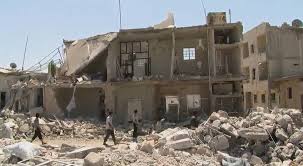
Scene of destruction after aerial bombing in Azaz, Syria, Aug. 16, 2012.
(U.S. government photo)
Ten years later, there were reports of yellow cake uranium going to Iraq for development of weapons of mass destruction.
One decade later, there were reports of Libyan soldiers drugged on viagra and raping women as they advanced.
In 2012, NBC broadcaster Richard Engel was supposedly kidnapped by a pro-Assad Syrian militia but luckily freed by Syrian opposition fighters, the “Free Syrian Army.”
All these reports were later confirmed to be fabrications and lies. They all had the goal of manipulating public opinion and they all succeeded in one way or another. Despite the consequences, which were often disastrous, none of the perpetrators were punished or paid any price.
It has been famously said, “Those who do not learn from the past are doomed to repeat it.” This report is a critical review of the so-called “Caesar Torture Photos” story. As will be shown, there is strong evidence the accusations are entirely or substantially false.
Overview of ‘Caesar Torture Photos’
On Jan. 20, 2014, two days before negotiations about the Syrian conflict were scheduled to begin in Switzerland, a sensational report burst onto television and front pages around the world. The story was that a former Syrian army photographer had 55,000 photographs documenting the torture and killing of 11,000 detainees by the Syrian security establishment.
The Syrian photographer was given the code-name “Caesar.” The story became known as the “Caesar Torture Photos.” A team of lawyers plus digital and forensic experts were hired by the Carter-Ruck law firm, on contract to Qatar, to go to the Middle East and check the veracity of “Caesar” and his story. They concluded that “Caesar” was truthful and the photographs indicated “industrial scale killing.”
CNN, London’s Guardian and LeMonde broke the story which was subsequently broadcast in news reports around the world. The Caesar photo accusations were announced as negotiations began in Switzerland. With the opposition demanding the resignation of the Syrian government, negotiations quickly broke down.
For the past two years the story has been preserved with occasional bursts of publicity and supposedly corroborating reports. Most recently, in December 2015 Human Rights Watch (HRW) released a report titled “If the Dead Could Speak” with significant focus on the Caesar accusations.
Following are 12 significant problems with the “Caesar torture photos” story:
- Almost half the photos show the opposite of the allegations.
The Carter Ruck Inquiry Team claimed there were about 55,000 photos total with about half of them taken by “Caesar” and the other half by other photographers. The Carter Ruck team claimed the photos were all “similar.” Together they are all known as “Caesar’s Torture Photos.”
The photographs are in the custody of an opposition organization called the Syrian Association for Missing and Conscience Detainees (SAFMCD). In 2015, they allowed Human Rights Watch (HRW) to study all the photographs which have otherwise been secret. In December 2015, HRW released their report titled “If the Dead Could Speak.”
The biggest revelation is that over 46 percent of the photographs (24,568) do not show people “tortured to death” by the Syrian government. On the contrary, they show dead Syrian soldiers and victims of car bombs and other violence (HRW pp 2-3). Thus, nearly half the photos show the opposite of what was alleged. These photos, never revealed to the public, confirm that the opposition is violent and has killed large numbers of Syrian security forces and civilians.
- The claim that other photos only show “tortured detainees” is exaggerated or false.
The Carter Ruck report says “Caesar” only photographed bodies brought from Syrian government detention centers. In its December 2015 report, HRW said, “ The largest category of photographs, 28,707 images, are photographs Human Rights Watch understands to have died in government custody, either in one of several detention facilities or after being transferred to a military hospital.” They estimate 6,786 dead individuals in the set.
The photos and the deceased are real, but how they died and the circumstances are unclear. There is strong evidence some died in conflict. Others died in the hospital. Others died and their bodies were decomposing before they were picked up. These photographs seem to document a war-time situation where many combatants and civilians are killed.
It seems the military hospital was doing what it had always done: maintaining a photographic and documentary record of the deceased. Bodies were picked up by different military or intelligence branches. While some may have died in detention; the big majority probably died in the conflict zones. The accusations by “Caesar.” the Carter Ruck report and HRW that these are all victims of “death in detention” or “death by torture” or death in “government custody” are almost certainly false.
- The true identity of “Caesar” is probably not as claimed.
The Carter Ruck Report says “This witness who defected from Syria and who had been working for the Syrian government was given the code-name ‘Caesar’ by the inquiry team to protect the witness and members of his family.” (CRR p12)
However if his story is true, it would be easy for the Syrian government to determine who he really is. After all, how many military photographers took photos at Tishreen and Military 601 Hospitals during those years and then disappeared? According to the Carter Ruck report, Caesar’s family left Syria around the same time. Considering this, why is “Caesar” keeping his identity secret from the Western audience? Why does “Caesar” refuse to meet even with highly sympathetic journalists or researchers?
The fact that 46 percent of the total photographic set is substantially the opposite of what was claimed indicates two possibilities: Caesar and his promoters knew the contents but lied about them expecting nobody to look. Or, Caesar and his promoters did not know the contents and falsely assumed they were like the others. The latter seems more likely which supports the theory that Caesar is not who he claims to be.
- The Carter Ruck Inquiry was faulty, rushed and politically biased.
The credibility of the “Caesar” story has been substantially based on the Carter-Ruck Inquiry Team which “verified” the defecting photographer and his photographs. The following facts suggest the team was biased with a political motive:
–The investigation was financed by the government of Qatar which is a major supporter of the armed opposition.
–The contracted law firm, Carter Ruck and Co, has previously represented Turkey’s President Recep Tayyip Erdogan, also known for his avid support of the armed opposition.
–The American on the legal inquiry team, Professor David M. Crane, has a long history working for the U.S. Defense Department and Defense Intelligence Agency. The U.S. government has been deeply involved in the attempt at “regime change” with demands that President Bashar “Assad must go” beginning in summer 2011 and continuing until recently.
–Crane is personally partisan in the conflict. He has campaigned for a Syrian War Crimes Tribunal and testified before Congress in October 2013, three months before the Caesar revelations.
–By their own admission, the inquiry team was under “time constraints” (CRR, p11).
–By their own admission, the inquiry team did not even survey most of the photographs
–The inquiry team was either ignorant of the content or intentionally lied about the 46 percent showing dead Syrian soldiers and attack victims.
–The inquiry team did its last interview with “Caesar” on Jan. 18, 2014, quickly finalized a report and rushed it into the media on Jan. 20, two days prior to the start of United Nations-sponsored negotiations.
The self-proclaimed “rigor” of the Carter Ruck investigation is without foundation. The claims to a “scientific” investigation are similarly without substance and verging on the ludicrous.
- The U.S. Central Intelligence Agency (CIA) is involved.
In an interview on France24, David Crane of the inquiry team describes how “Caesar” was brought to meet them by “his handler, his case officer.” The expression “case officer” usually refers to the CIA. This would be a common expression for Professor Crane who previously worked in the Defense Intelligence Agency. The involvement of the CIA additionally makes sense since there was a CIA budget of $1 billion for Syria operations in 2013. Crane’s “Syria Accountability Project” is based at Syracuse University where the CIA actively recruits new officers despite student resistance.
Why does it matter if the CIA is connected to the “Caesar” story? Because the CIA has a long history of disinformation campaigns. In 2011, false reports of viagra fueled rape by Libyan soldiers were widely broadcast in Western media as the U.S. pushed for a military mandate. Decades earlier, the world was shocked to hear about Cuban troops fighting in Angola raping Angolan women. The CIA chief of station for Angola, John Stockwell, later described how they invented the false report and spread it around the world. The CIA was very proud of that disinformation achievement. Stockwell’s book, In Search of Enemies, is still relevant.
- The accusers portray simple administrative procedures as mysterious and sinister.
The Carter Ruck inquiry team falsely claimed there were about 11,000 tortured and killed detainees. They then posed the question: Why would the Syrian government photograph and document the people they just killed? The Carter Ruck Report speculates that the military hospital photographed the dead to prove that the “orders to kill” had been followed. The “orders to kill” are assumed.
A more logical explanation is that dead bodies were photographed as part of normal hospital / morgue procedure to maintain a file of the deceased who were received or treated at the hospital. The same applies to the body labeling / numbering system. The Carter Ruck report suggests there is something mysterious and possibly sinister in the coded tagging system. But all morgues need to have a tagging and identification system.
- The photos have been manipulated.
Many of the photos at the SAFMCD website have been manipulated. The information card and tape identity are covered over and sections of documents are obscured. It must have been very time-consuming to do this for thousands of photos. The explanation that they are doing this to “protect identity” is not credible since the faces of victims are visible. What are they hiding?
- The Photo Catalog has duplicates and other errors.
There are numerous errors and anomalies in the photo catalog as presented at the SAFMCD website. For example, some deceased persons are shown twice with different case numbers and dates. There are other errors where different individuals are given the same identity number.
Researcher Adam Larson at A Closer Look at Syria website has done detailed investigation which reveals more errors and curious error patterns in the SAFMCD photo catalog.
9. With few exceptions, Western media uncritically accepted and promoted the story.
The Carter Ruck report was labeled “Confidential” but distributed to CNN, the Guardian and LeMonde. CNN’s Christiane Amanpour gushed over the story as she interviewed three of the inquiry team under the headline “EXCLUSIVE: Gruesome Syria photos may prove torture by Assad regime.” Critical journalism was replaced by leading questions and affirmation. David Crane said “This is a smoking gun.” Desmond de Silva “likened the images to those of holocaust survivors.”
The Guardian report was titled “Syrian regime document trove shows evidence of ‘industrial scale’ killing of detainees” with the subtitle, “Senior war crimes prosecutors say photographs and documents provide ‘clear evidence’ of systematic killing of 11,000 detainees”
One of the very few skeptical reports was by Dan Murphy in the Christian Science Monitor. Murphy echoed standard accusations about Syria but went on to say incisively, “the report itself is nowhere near as credible as it makes out and should be viewed for what it is: A well-timed propaganda exercise funded by Qatar, a regime opponent who has funded rebels fighting Assad who have committed war crimes of their own.”
Unfortunately that was one of very few critical reports in the mainstream media. In 2012, foreign affairs journalist Jonathan Steele wrote an article describing the overall media bias on Syria. His article was titled “Most Syrians back Assad but you’d never know from western media.” The media campaign and propaganda has continued without stop. It was in this context that the Carter Ruck Report was delivered and widely accepted without question.
- Politicians have used the Caesar story to push for more US/NATO aggression.
Politicians seeking direct U.S. intervention for “regime change” in Syria were quick to accept and broadcast the “Caesar” story. They used it to demonize the Assad government and argue that the U.S. must act so as to prevent “another holocaust,” “another Rwanda,” “another Cambodia.”
When Caesar’s photos were displayed at the House Foreign Affairs Committee in Congress, Chairman Ed Royce said “It is far past time that the world act…. It is far past time for the United States to say there is going to be a safe zone across this area in northern Syria.”
The top-ranking Democrat on the House Foreign Affairs Committee is Eliot Engel. In November 2015 he said, “We’re reminded of the photographer, known as Caesar, who sat in this room a year ago, showing us in searing, graphic detail what Assad has done to his own people.” Engel went on to advocate for a new authorization for the use of military force.
Rep. Adam Kinzinger is another advocate for aggression against Syria. At an event at the Holocaust Memorial Museum in July 2015, he said, “If we want to destroy ISIS we have to destroy the incubator of ISIS, Bashar al-Assad.”
The irony and hypocrisy is doubly profound since Rep. Kinzinger has met and coordinated with opposition leader Okaidi who is a confirmed ally of ISIS. In contrast with Kinzinger’s false claims, it is widely known that ISIS ideology and initial funding came from Saudi Arabia and much of its recent wealth from oil sales via Turkey. The Syrian Army has fought huge battles against ISIS, winning some but losing others with horrific scenes of mass beheading carried out by ISIS.
- The Human Rights Watch assessment is biased.
HRW has been very active around Syria. After the chemical attacks in greater Damascus on Aug. 21, 2013, HRW rushed a report which concluded that, based on a vector analysis of incoming projectiles, the source of the sarin carrying rockets must have been Syrian government territory. This analysis was later debunked as a “junk heap of bad evidence” by highly respected investigative journalist Robert Parry.
HRW’s assumption about the chemical weapon rocket flight distance was faulty. Additionally it was unrealistic to think you could determine rocket trajectory with 1 percent accuracy from a canister on the ground, especially from a canister on the ground that had deflected off a building wall.
In spite of this, HRW stuck by its analysis which blamed the Assad government. HRW Director Ken Roth publicly indicated dissatisfaction when an agreement to remove Syrian chemical weapons was reached. Roth wanted more than a “symbolic” attack on Syrian government forces.
Regarding the claims of “Caesar,” HRW seems to be the only non-governmental organization to receive the full set of photo files from the custodian. To its credit, HRW acknowledged that nearly half the photos do not show what has been claimed for two years: they show dead Syrian soldiers and militia along with scenes from crime scenes, car bombings, etc.
But HRW’s bias is clearly shown in how it handles this huge contradiction. Amazingly, HRW suggests the incorrectly identified photographs support the overall claim. They say, “This report focuses on deaths in detention. However other types of photographs are also important. From an evidentiary perspective, they reinforce the credibility of the claims of Caesar about his role as a forensic photographer of the Syrian security forces or at least with someone who has access to their photographs.” (HRW, p31) This seems like saying if someone lies to you half the time that proves they are truthful.
The files disprove the assertion that the files all show people who were tortured and killed. The photographs show a wide range of deceased persons, from Syrian soldiers to Syrian militia members to opposition fighters to civilians trapped in conflict zones to regular deaths in the military hospital. There may be some photos of detainees who died in custody after being tortured, or who were simply executed. We know that this happened in Iraqi detention centers under U.S. occupation. Ugly and brutal things happen in war times. But the facts strongly suggest that the “Caesar” account is basically untrue or a gross exaggeration.
It is striking that the HRW report has no acknowledgment of the war conditions and circumstances in Syria. There is no acknowledgment that the government and Syrian Arab Army have been under attack by tens of thousands of weaponized fighters openly funded and supported by many of the wealthiest countries in the world.
There is no hint at the huge loss of life suffered by the Syrian army and supporters defending their country. The current estimates indicate from 80,000 to 120,000 Syrian soldiers, militia and allies having died in the conflict. During the three years 2011-2013, including the period covered by the “Caesar” photos, it is estimated that over 52,000 Syrian soldiers and civilian militia died versus 29,000 anti-government forces.
HRW had access to the full set of photographs including the Syrian army and civilian militia members killed in the conflict. Why did they not list the number of Syrian soldiers and security forces they identified? Why did they not show a single image of those victims?
HRW goes beyond endorsing the falsehoods in the “Caesar story”; HRW suggests the cataloguing is only a partial listing. On page 5, the report says, “Therefore, the number of bodies from detention facilities that appear in the Caesar photographs represent only a part of those who died in detention in Damascus.”
On the contrary, the Caesar photographs seem to mostly show victims who died in a variety of ways in the armed conflict. The HRW assertions seem to be biased and inaccurate.
- The legal accusations are biased and ignore the supreme crime of aggression.
The Christian Science Monitor journalist Dan Murphy gave an apt warning in his article on the Carter Ruck report about “Caesar.” While many journalists treated the prosecutors with uncritical deference, he said, “Association with war crime prosecutions is no guarantor of credibility – far from it. Just consider Luis Moreno Ocampo’s absurd claims about Viagra and mass rape in Muammar Qaddafi’s Libya in 2011. War crimes prosecutors have, unsurprisingly, a bias towards wanting to bolster cases against people they consider war criminals (like Assad or Qaddafi) and so should be treated with caution. They also frequently favor, as a class, humanitarian interventions.”
The Carter Ruck legal team demonstrated how accurate Murphy’s cautions could be. The legal team was eager to accuse the Syrian government of “crimes against humanity” but the evidence of “industrial killing,” “mass killing,” “torturing to kill” is dubious and much of the hard evidence shows something else.
In contrast, there is clear and solid evidence that a “Crime against Peace” is being committed against Syria. It is public knowledge that the “armed opposition” in Syria has been funded, supplied and supported in myriad ways by various outside governments. Most of the fighters, both Syrian and foreign, receive salaries from one or another outside power. Their supplies, weapons and necessary equipment are all supplied to them. Like the “Contras” in Nicaragua in the 1980’s, the use of such proxy armies is a violation of customary international law.
It is also a violation of the UN Charter which says “All Members shall refrain in their international relations from the threat or use of force against the territorial integrity or political independence of any state, or in any other matter inconsistent with the Purposes of the United Nations”.
The government of Qatar has been a major supporter of the mercenaries and fanatics attacking the sovereign state of Syria. Given that fact, isn’t it hugely ironic to hear the legal contractors for Qatar accusing the Syrian government of “crimes against humanity”?
Isn’t it time for the United Nations to make reforms so that it can start living up to its purposes? That will require demanding and enforcing compliance with the UN Charter and International Law.
Rick Sterling is an independent research/writer and member of Syria Solidarity Movement. He can be contacted at rsterling1@gmail.com
Hillary is a Neocon
She has the record and the vision
Hillary is a Neocon – 03/15/2016
 “For this former Republican, and perhaps for others, the only choice will be to vote for Hillary Clinton. The party cannot be saved, but the country still can be.” —Robert Kagan
 “I have a sense that she’s one of the more competent members of the current administration and it would be interesting to speculate about how she might perform were she to be president.” —Dick Cheney
 “I’ve known her for many years now, and I respect her intellect. And she ran the State Department in the most effective way that I’ve ever seen.” —Henry Kissinger
Nobody Beats This Record
- She says President Obama was wrong not to launch missile strikes on Syria in 2013.
- She pushed hard for the overthrow of Qadaffi in 2011.
- She supported the coup government in Honduras in 2009.
- She has backed escalation and prolongation of war in Afghanistan.
- She voted for the 2003 invasion of Iraq.
- She skillfully promoted the White House justification for the war on Iraq.
- She does not hesitate to back the use of drones for targeted killing.
- She has consistently backed the military initiatives of Israel.
- She was not ashamed to laugh at the killing of Qadaffi.
- She has not hesitated to warn that she could obliterate Iran.
- She is not afraid to antagonize Russia.
- She helped facilitate a military coup in Ukraine.
- She has the financial support of the arms makers and many of their foreign customers.
- She waived restrictions at the State Department on selling weapons to Saudi Arabia, Algeria, Kuwait, United Arab Emirates, Oman, and Qatar, all states wise enough to donate to the Clinton Foundation.
- She supported President Bill Clinton’s wars and the power of the president to make war without Congress.
- She has advocated for arming fighters in Syria.
- She supported a surge in Iraq even before President Bush did.

NATO’s Most Censored Story
By Ronald Thomas West | March 16, 2016
This information has been forwarded on (via email) to the leadership of the German parliament, as well the German federal prosecutor’s office, the German constitutional court, and the International Criminal Court. One can only wonder how long the criminally complicit politicians will sit on their hands and do nothing. German politicians have known for quite sometime that BND (German CIA) head Gerhard Schindler lied to them when he stated Assad ordered the sarin gas attack at Ghouta, Syria in August 2013. As well, Germany has a provision of law under the principle of universal jurisdiction which could be used to prosecute these crimes and a constitutional loophole bigger than the Brandenberg Gate that allows passing on prosecutions in ‘the best interest of the state.’
When the Turkish government seized Today’s Zaman newspaper on 5 March 2016, it was only a matter of time before the Zaman English website was taken down. Today I checked and discovered the site has indeed been taken offline (and has been replaced with a Turkish language site featuring Erdogan’s government line.) Anticipating something like this, I’d saved a few stories together with screenshots; here is the most damning story and a prime motivation behind the criminal Erdogan administration’s act of taking over the most popular news outlet in Turkey. As the several NATO states shed what are clearly crocodile tears over Turkey’s suppression of a free press, none will point to stories such as this following; in fact there will be only relief that evidence NATO is doing business with & propping up war criminals will have been swept under the rug. Verbatim text of the screen shots (full story) pasted in, below:
21 October 2015
Two deputies from the main opposition Republican People’s Party (CHP) have claimed that the government is against investigating Turkey’s role in sending toxic sarin gas which was used in an attack on civilians in Syria in 2013 and in which over 1,300 Syrians were killed.
CHP deputies Eren Erdem and Ali Şeker held a press conference in İstanbul on Wednesday in which they claimed the investigation into allegations regarding Turkey’s involvement in the procurement of sarin gas which was used in the chemical attack on a civil population and delivered to the terrorist Islamic State in Iraq and the Levant (ISIL) to enable the attack was derailed.
Taking the floor first, Erdem stated that the Adana Chief Prosecutor’s Office launched an investigation into allegations that sarin was sent to Syria from Turkey via several businessmen. An indictment followed regarding the accusations targeting the government.
“The MKE [Turkish Mechanical and Chemical Industry Corporation] is also an actor that is mentioned in the investigation file. Here is the indictment. All the details about how sarin was procured in Turkey and delivered to the terrorists, along with audio recordings, are inside the file,” Erdem said while waving the file.
Erdem also noted that the prosecutor’s office conducted detailed technical surveillance and found that an al-Qaeda militant, Hayyam Kasap, acquired sarin, adding: “Wiretapped phone conversations reveal the process of procuring the gas at specific addresses as well as the process of procuring the rockets that would fire the capsules containing the toxic gas. However, despite such solid evidence there has been no arrest in the case. Thirteen individuals were arrested during the first stage of the investigation but were later released, refuting government claims that it is fighting terrorism,” Erdem noted.
Over 1,300 people were killed in the sarin gas attack in Ghouta and several other neighborhoods near the Syrian capital of Damascus, with the West quickly blaming the regime of Bashar al-Assad and Russia claiming it was a “false flag” operation aimed at making US military intervention in Syria possible.
Suburbs near Damascus were struck by rockets containing the toxic sarin gas in August 2013.
The purpose of the attack was allegedly to provoke a US military operation in Syria which would topple the Assad regime in line with the political agenda of then-Prime Minister Recep Tayyip Erdoğan and his government.
CHP deputy Şeker spoke after Erdem, pointing out that the government misled the public on the issue by asserting that sarin was provided by Russia. The purpose was to create the perception that, according to Şeker, “Assad killed his people with sarin and that requires a US military intervention in Syria.”
He also underlined that all of the files and evidence from the investigation show a war crime was committed within the borders of the Turkish Republic.
“The investigation clearly indicates that those people who smuggled the chemicals required to procure sarin faced no difficulties, proving that Turkish intelligence was aware of their activities. While these people had to be in prison for their illegal acts, not a single person is in jail. Former prime ministers and the interior minister should be held accountable for their negligence in the incident,” Şeker further commented.
Erdem also added that he will launch a criminal complaint against those responsible, including those who issued a verdict of non-prosecution in the case, those who did not prevent the transfer of chemicals and those who first ordered the arrest of the suspects who were later released.
UN Secretary-General Ban Ki-moon announced in late August that an inquiry had been launched into the gas attacks allegedly perpetuated by both Assad’s Syrian regime and rebel groups fighting in Syria since the civil war erupted in 2011.
However, Erdem is not the only figure who has accused Turkey of possible involvement in the gas attack. Pulitzer Prize winner and journalist, Seymour M. Hersh, argued in an article published in 2014 that MİT was involved with extremist Syrian groups fighting against the Assad regime.
In his article, Hersh said Assad was not behind the attack, as claimed by the US and Europe, but that Turkish-Syrian opposition collaboration was trying to provoke a US intervention in Syria in order to bring down the Assad regime.


Syria, Iraq: Should Borders Be Redrawn to Partition Sovereign States?
By Alexander KUZNETSOV – Strategic Culture Foundation – 16.03.2016
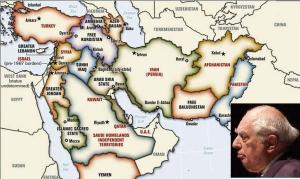 An article titled It’s Time to Seriously Consider Partitioning Syria published recently by Foreign Policy raises serious concerns.
The author writes that the war in Syria has devastated entire cities, the death toll is 470 thousand (there are no reliable statistics to confirm the figure) and 6 million people have become displaced. As a result, religious communities in Syria cannot live together in one state anymore. He believes that Syria should be divided into parts populated by Alawites (for some reason it includes Damascus) and Sunni Muslims. The options include a partition of the country into independent states or forming some kind of loose confederation like Bosnia and Herzegovina. James Stavridis is a four-star Admiral and former NATO Supreme Allied Commander, Europe. He is an influential person in military and political circles.
The Admiral made public his views on Syria soon after US State Secretary John Kerry referred to plan B in Syria in his testimony before the Senate Foreign Relations Committee on March 1.
According to the US top diplomat, he will move towards a plan B that could involve a partition of Syria if hostilities continue because the political forces cannot coexist in one state.
The idea of dividing Syria, Iraq and other states in the Middle East has been considered by US strategic thinkers since the 1980s. Bernard Lewis, the patriarch of American oriental studies, was the first to suggest it. For many years he has been a member of and consultant to the US Council on Foreign Relations (CFR). Formally an independent think tank, the Council exerts great influence on shaping US foreign policy.
In The Roots of Muslim Rage, an essay published in 1990, Bernard Lewis describes a ‘surge of hatred’ rising from the Islamic world that “becomes a rejection of Western civilization as such.” The thesis became influential.
The essay inspired Samuel Huntington, the author of the clash of civilizations hypothesis. Lewis is a widely read expert on the Middle East and is regarded as one of the West’s leading scholars specialized in that region. His advice has been frequently sought by policymakers, including the Bush Jr. administration in the early 2000s. Jacob Weisberg, a prominent US journalist, writes that Bernard Lewis was perhaps the most significant intellectual influence behind the invasion of Iraq in 2003.
In 1979, Bernard Lewis first unveiled his project aimed at reshaping the Middle East to the Bilderberg Meeting in Baden, Austria. The goal was to counter Iran after the Islamic revolution and the Soviet Union with its military deployed to Afghanistan the same year. According to him, the anti-Iranian policy was to include the incitement of an armed Sunni-Shia confrontation and support of the Muslim Brothers movement. The Soviet Union was to be countered by creating an «Arc of Crisis» in the vicinity of its borders. The national states of the Middle East were to be ‘Balkanized’ along religious, ethnic and sectarian lines.
The Lewis project was advanced further after the collapse of the Soviet Union. In 1992 the scholar’s article titled Rethinking the Middle East appeared in Foreign Affairs, the US leading forum for serious discussion of foreign policy and international affairs published by the Council on Foreign Relations.
There he presented a new map of the Middle East. The plan envisaged breaking Syria up into small fragments with the territories populated by the Druze and Alawites separated to become independent mini-states. Lewis wanted to establish new entities: a tiny state on the territory of Lebanon populated by Maronites, an independent Kurdistan comprising the Kurds-populated areas of Turkey, Iraq, Syria and Iran, an independent Shia state in Iraq, an Arab state in the Iranian province of Khuzestan – the major oil-producing region of Iran. The plans also envisaged the creation of independent Balochistan.
Bernard Lewis advocated a policy called ‘Lebanonization’. According to him, “A possibility, which could even be precipitated by Islamic fundamentalism, is what has late been fashionable to call ‘Lebanonization’. Most of the states of the Middle East – Egypt is an obvious exception – are of recent and artificial construction and are vulnerable to such a process. If the central power is sufficiently weakened, there is no real civil society to hold the polity together, no real sense of common identity… The state then disintegrates – as happened in Lebanon – into a chaos of squabbling, feuding, fighting sects, tribes, regions, and parties,” the scholar wrote.
The main goal of such projects is to prevent the emergence of regional forces able to challenge the hegemony of the United States [or Israel]. That’s what made the US add fuel to the fire of the Iran-Iraq war (1980-1988). Washington succeeded in making the war last for eight years. By provoking the hostilities, the US killed two birds with one stone: it prevented Iran from growing stronger and weakened Iraq ruled by the Arab Socialist Ba’ath Party.
The West launched Operation Desert Storm to keep Iraq weak. In 2003 it concocted a false pretext (the possession of weapons of mass destruction) to occupy Iraq and deprive it of sovereignty. By and large, the same fate awaited Syria.
In 1990 Syrian troops remained in Lebanon as peacekeepers in accordance with the Taif Agreement. The US gave its consent because Damascus took part in Operation Desert Storm against Iraq. Besides, the Syrian government of Hafez Assad effectively committed itself not to take hostile actions against Israel. In ten years the situation changed. Damascus launched the policy of strategic partnership with Iran. It supported the Lebanese Hezbollah movement. Washington changed its stance to say the Syrian military in Lebanon was an occupying force. Using the imposition of sanctions as a weapon, the United States made Syria withdraw from Lebanon. In 2011 the US started to undermine the Syria’s national sovereignty.
The most faithful US allies – Saudi Arabia for instance – have no guarantees they will not become part of such plans. Nowadays, the United States does not depend on the oil supplies from the Middle East. It has put an end to the policy of direct confrontation with Tehran. As a strategic partner, Riyadh is not as important as it used to be. It’s hardly a coincidence that US media outlets started to publish maps with Hejaz (a region in the west of present-day Saudi Arabia) drawn as part of Jordan with the eastern part of the Saudi Kingdom together with South Iraq shown as part of Shia Arab state. Actually, a genuine settlement to the problems faced by the Arab world is something quite opposite from what the United States has to offer.
The partition of the Middle East into tiny powerless states will give rise to new crises accompanied by ethnic and religious cleansing. It will lead to a ‘war of all against all’ (bellum omnium contra omnes) – the term coined by Thomas Hobbs.
In case of such a war, the small principalities will need someone for arbitration. Washington will offer itself for this role.
In the future, the creation of large Arab space (Grossraum) may lead the region out of the deep crisis it faces, but that’s a different and a very serious matter to be discussed some other time.
Featured Video

Death Spikes & Rising Cancer In Our Youth Explained
or go to
Aletho News Archives – Video-Images
From the Archives
Politicians lie
By Mazin Qumsiyeh | Popular Resistance | August 18, 2013
There is no way to say this truth nicely: Politicians lie. That includes Japanese, American, Egyptian, Israeli, and Palestinian politicians! Is there something more common sense than that? Yet, so many citizens around the world believe their own politicians or wistfully acknowledge lies but think it is part of the job needed to run things. They believe even when politicians contradict themselves blatantly. This phenomenon is rather remarkable. It is a dissonance and disconnect from reality that many seem oblivious to. It is very dangerous because it can lead to accepting rationales for going to war. These can be deadly wars that lead to millions of lives lost as happened in what was called World War 1 and WW2. Even when incredible and declassified evidence abound, politicians continue to lie and old mythologies refuse to die. Here are just a few of the countless lies told to us over the past few decades… continue
Blog Roll
 Aletho News
- From Unipolar Universalism to Multipolar Civilizational Distinctiveness
- RSF military group defects, joins Sudanese army: State media
- Ireland goalkeeper refuses to play ‘Israel’ as squad weighs boycott
- China pushes back against US on Cuba, Iran
- Ukrainian Soldiers, Potential Mercenaries: Have Gun, Will Travel!
- Burnham’s UN debut… A masterclass in British disinformation
- Iran flights continue despite US aviation sanctions
- Global Tipping Points Lead the World Into a State of Entropy
- The day-after at the White House: USA and Xi Jinping
- The Geopolitical Balance in the Red Sea: The UAE Being Displaced by New Players
- If Americans Knew
- Deconstructing Netanyahu’s pants-on-fire UN rant – Daily Update
- Trump betrayed voters with his campaign lies and prioritized a foreign country once he took office
- Netanyahu calls Israel’s war in Gaza ‘opposite of genocide’ in UN speech to near-empty hall
- Settler Kidnappings: Torture, Sexual Abuse and Terrorisation of Palestinian Abductees as Israel Deepens Annexation of West Bank
- Gaza winter nears as 162,000 tents become unusable, raising fears of humanitarian crisis
- Netanyahu says, “It’s the opposite of genocide”; UN says Gaza economy is world’s ‘most severe crisis on record’ – Daily Update
- Israel’s US-Backed Assault on Gaza Has Created the ‘World’s Most Severe Economic Crisis on Record’: UN
- ‘Protecting U.S. Citizens’… From Israel
- ‘This is where I live now, the back of a truck’: a day in the life of a grandmother in Gaza
- In UN Speech, Iran’s President Displays Pictures of Children Killed by US, Brings Attention to Israel’s Nuclear Arsenal
- No Tricks Zone
- New Study: Earth And Venus Surface Warmth Largely Explained By Convection And Lapse Rate, Not CO2 Or Radiation
- 2025 Nature Paper Claiming Worsening Global Drought Gets RETRACTED …Heavily Flawed
- New Study: ‘Global Drought Shows No Detectable Recent Acceleration Under Climate Warming’
- Economic Masterminds: German Socialists Suggest Taxing Productivity Gains Stemming From Using AI
- The South China Sea Has Not Been Cooperating With The Climate Change Narrative
- Energy Crisis: Germany Enters Heating Season With Historically Low Gas Reserve Fill Levels
- New Study: The Antarctic Ice Sheet Gained Mass From 2020-2024 Due To Staggering Snow And Ice Accumulation
- Study: Ocean Heating Rates From Thousands Of Years Ago ‘Dwarf’ Modern Ocean Heating Rates
- Climate Extremists Target, Attack Large-Scale Power Grid Infrastructure In Germany!
- New Study: Antarctic Ice Melt Has Contributed Less Than 1 Centimeter To Sea Level Rise In The Last 30 Years

