Israel expands occupation of Golan Heights as Assad’s government falls

The Cradle | December 8, 2024
Israel deployed tanks and troops to occupy the buffer zone in the occupied Syrian Golan Heights on 8 December following the fall of the Syrian government to foreign-backed extremist groups overnight.
The Israeli army announced its forces occupy “several points necessary for defense” in the buffer zone, citing the possibility of “armed men” entering the zone.
The buffer zone was established in 1974 as part of the ceasefire that ended the Yom Kippur War between Israel and Syria.
Foreign-backed extremist militants from Hayat Tahrir al-Sham (HTS) entered Damascus overnight after a lightning advance on the capital that began less than two weeks ago from their strongholds in Idlib Governorate.
Militants from HTS, formerly known as the Al-Qaeda-affiliated Nusra Front, quickly occupied the Aleppo countryside and city before moving south to capture Hama, Homs, and finally, Damascus.
The Syrian army withdrew from Homs and Damascus without putting up resistance.
The Israeli army claimed it “does not interfere in internal events” in Syria but will remain in the buffer zone “as long as necessary.”
Israeli troops entered the buffer zone under the pretext of an alleged threat from extremist militants.
Israeli Foreign Minister Gideon Saar claimed “armed forces” entered the buffer zone and attacked UN peacekeeping forces stationed in the area.
“Israel is concerned about violations of the 1974 Disengagement Agreement between Israel and Syria, which also pose a threat to its security, the safety of its communities, and its citizens, particularly in the Golan Heights region,” he wrote on X.
Israel captured the Golan Heights from Syria during the 1967 war, illegally occupying the area and annexing it in 1981.
Israel has bombed Syria hundreds of times since the start of the US-led covert war on Syria began in 2011. The bombing continued after the war ended in 2019, in what Israeli media dubbed the “battle between the wars.”
Israeli attacks intensified further after the start of the war in Gaza over a year ago. Israel claimed it was targeting weapons facilities used to support Hezbollah and the Islamic resistance in Lebanon.
What the Assad government’s dramatic fall means for Syria, region and resistance axis
By Seyyed Ali Reza | Press TV | December 8, 2024
Syrian President Bashar al-Assad’s government in Damascus has fallen to a cluster of militant groups that rampaged through the war-ravaged Arab country, starting from Aleppo last week.
The collapse of the Arab country began soon after a ceasefire was announced in Lebanon early last week, following nearly 70 days of unbridled aggression by the Israeli regime, which claimed thousands of civilian lives but failed to achieve any significant military objectives.
The marauding militant groups, led by Hayaat Tahrir al-Sham (formerly Jabhat al-Nusra), launched a lightning-fast offensive on Aleppo, followed by rapid advances into Idlib, Hama, and Homs, ultimately overrunning Damascus early on Sunday.
Despite initial resistance by the Syrian Arab Army, the government forces gradually retreated from key areas, enabling the militant groups—backed by Western and Arab states as well as the Israeli regime—to achieve stunning military advances toward Damascus.
The whereabouts of the deposed Syrian president remain unknown, with speculation rife that he is either holed up at a Russian military base inside Syria or has fled to the UAE or Russia.
Syria has always been, and remains, a vital cog in the Axis of Resistance—a status that will not change regardless of who takes control in Damascus. The country’s strategic importance remains undiminished.
Furthermore, despite the dramatic developments in Syria, the dynamics within the broader Axis of Resistance remain unaffected. Palestine continues to be the central issue for the alliance.
Syria has historically served as a conduit for supplying arms and other resources to Lebanese and Palestinian resistance movements. However, these movements have now achieved self-reliance, producing their own weapons, including missiles and drones.
Iran’s support for the Axis of Resistance will continue regardless of Syria’s leadership, with Palestine remaining the foremost priority for the Islamic Resistance and its regional allies.
Foreign Minister Abbas Araghchi’s recent diplomatic engagements across the region were aimed at ensuring that the primary issue of Palestine remains at the forefront amidst these developments.
“The principled stance of the Islamic Republic of Iran in supporting the people and resistance of Palestine and Lebanon against the occupation and aggression of the Zionist regime will continue with strength,” Araghchi stated during a meeting with senior Hamas leadership in Doha on Saturday.
He was in Doha to attend a regional conference on Syria with counterparts from Russia and Turkey.
The rapid fall of the Syrian government has left many questioning how it happened. The collapse has been described as even more dramatic than the Taliban’s takeover of Kabul nearly three years ago.
However, it did not happen overnight. The militant groups, led by HTS, had been doing groundwork for this moment for years in areas considered their strongholds, with external support.
The chaos in the region—exacerbated by Israel’s ongoing genocidal war on Gaza and aggression in Lebanon—provided them an opportunity to strike decisively. This is the moment they had waited for.
None of these militant groups stood up for Gaza or Lebanon, as many have rightly argued, primarily because they didn’t wish to antagonize the Tel Aviv regime. They remained focused on Syria.
Starting last week, Assad’s forces retreated with little resistance. There are several reasons for the Syrian Arab Army’s failure to withstand the militants’ advances, and one of them is the grave economic situation in the country that impacted every section of Syrian society.
Syria’s economic situation has deteriorated alarmingly over the years, particularly since the United States imposed crippling sanctions under the “Caesar Act” in December 2019. These sanctions compounded the challenges for the Assad government as it could not initiate economic reforms.
The United States also provided backing to many of the militant groups opposed to Assad’s regime, which has been widely documented in leaked cables and statements of top US officials.
Assad’s ouster, however, does not signify a return to stability for Syria, nor does it guarantee the lifting or easing of sanctions. The new rulers are not a cohesive entity but rather a coalition of militant groups with varying ideologies, affiliations, and political objectives.
Several regional countries, including Qatar, Turkey, Jordan, and Saudi Arabia, have directly or indirectly supported these militant groups that toppled Assad’s government for their own regional ambitions.
The new ruling coalition in Damascus is likely to face significant challenges, particularly in gaining international legitimacy—similar to the de facto Taliban government in Kabul.
There is also a strong possibility that these militant groups will eventually turn on each other, as their objectives are fundamentally misaligned. Each faction is likely to seek a larger share of power.
The Israeli regime, which thrives on regional insecurity and chaos, is expected to continue exacerbating the situation. Recent reports suggest that Israel has attempted to expand its invasion of Syrian territories beyond the already occupied Golan Heights, taking advantage of the ongoing turmoil.
While it is evident that these militant groups benefited from support provided by the Zionist regime, this support will not continue now that they have toppled Syria’s democratically elected government.
The coming days and weeks are critical that would determine which direction the region takes. However, one thing is for sure, the resistance axis remains intact and in a stronger position.
Seyyed Ali Riza is a Sydney-based writer who specializes in West Asia affairs.
Militant commander calls for Israeli support, strikes on Syrian troops
Press TV – December 7, 2024
A commander from the so-called Free Syrian Army (FSA) militant group has reportedly expressed hope for friendly relations with Israel, urging the occupying regime to extend both political and military support for their insurgency against the Syrian government.
In an article published on Friday, the Times of Israel quoted an unnamed FSA commander as stressing the need for a clear political stance from the Israeli regime.
“We have enough fighters on the ground. What we need from Israel is a clear political stance against the Assad regime,” he stated.
The commander also called for increased aerial support from the Israeli regime, suggesting that the regime should attack the forces in Syria “wherever it sees them.”
“We are trying to block them on the roads and ambush them, but Israel should also take action from the air,” said the commander.
Highlighting the potential for friendship, he noted that the armed group is open to alliances “with everyone in the region – including Israel.”
He also referenced recent Israeli airstrikes in Lebanon, stating that they have significantly aided the militant group in its advancements on Syrian soil.
“We are thankful to Israel for its strikes against Hezbollah,” he said, adding, “We hope that after the fall of Assad, Israel will plant a rose in the Syrian garden and will support the Syrian people.”
Asked about the future of Syria, the militant commander affirmed, “We will go for full peace with Israel, we will live side by side as neighbors,” insisting that the group has never made “any critical comments about Israel.”
His comments come as militants, having suffered setbacks due to years of retaliatory operations by the Syrian military and its allies, are attempting to regroup in northern Syria.
There are growing reports of substantial Western and Israeli support for anti-Damascus factions, including those affiliated with Hayʼat Tahrir al-Sham.
The Syrian military continues its extensive campaign, reversing some of the territorial gains by the militants.
Turkish-backed extremists ‘headed to Damascus’ says Erdogan
The Cradle | December 6, 2024
Turkish President Recep Tayyip Erdogan said on 6 December that the extremist groups waging an assault against Idlib countryside, Aleppo, and Hama will be “continuing towards Damascus.”
“We do not want escalation to continue in the region,” the Turkish president claimed.
“Idlib, Hama, and Homs are in the hands of the Syrian opposition, and they are continuing towards Damascus. We extended our hand to Bashar al-Assad but he did not respond,” he added.
Homs has not fallen to the extremists, despite Erdogan’s statements. Yet some militants have entered its countryside.
Since the assault began on 27 November, the extremist factions have captured several areas in the Idlib and Aleppo countryside, Aleppo city itself, and several areas in the countryside and city of Hama.
Over the past two years, Damascus and Ankara have been discussing a potential normalization of ties under a Russian-sponsored initiative.
Yet President Bashar al-Assad and the Syrian government repeatedly demanded a Turkish commitment to withdraw its occupying forces from Syria and end its support of Hayat Tahrir al-Sham (HTS) and Ankara’s Syrian National Army (SNA) proxy, the two main forces leading the current assault on Syria.
Sources cited by Al Mayadeen when the attack began late last month implied Ankara is using the assault to pressure Assad in normalization talks.
Turkiye was among the leading countries which supported the US-backed war against Syria that began in 2011. It has supported extremist groups for over a decade, and allowed for the incorporation of ISIS elements and other violent extremist groups – such as Jaish al-Islam – into the SNA force, which acts as its proxy in Syria.
The Syrian army said on 5 December that it “repositioned” and “redeployed” its forces outside the city of Hama to “preserve the lives” of civilians and not expose them to battles. HTS-led factions were able on Thursday to storm several areas in Hama city’s northeastern neighborhoods.
Russian and Syrian airstrikes on militant positions and supply lines are ongoing.
“Our armed forces are targeting terrorists’ vehicles and gatherings in the northern and southern Hama countryside with artillery, missiles, and joint Syrian–Russian warplanes, killing and wounding dozens of them and destroying several vehicles and vehicles,” the Syrian Defense Ministry said on Friday.
A Syrian military source told Sham FM there is “no truth to the news on the terrorists’ pages about the army’s withdrawal from Homs.”
“We confirm that the Syrian Arab Army is present in Homs and its countryside, is deployed on fixed and solid defensive lines, and has been reinforced with additional large forces equipped with various types of equipment and weapons,” the source added. The Defense Ministry confirmed this shortly after.
According to several media outlets, Syrian and Russian aircraft are launching heavy strikes targeting HTS-led militants in the towns of Talbiseh and Rastan in the Homs countryside.
Erdogan’s Idlib shock shadows “Kursk”
By Alastair Crooke | Strategic Culture Foundation | December 6, 2024
‘Doomsters’ is an occasional Russian expression used to categorise commentators that only see the ‘dark side to events’ (a vice quite prevalent during the Soviet era). Marat Khairullin, a highly respected Russian military analyst, says, “Today, a network of mercenary war bloggers has begun another round of moaning – this time about Syria, where apparently everything is lost for Russia”.
“Many see the events in Syria (and some add Georgia to the mix) as attempts to open additional fronts against our country. Perhaps that’s true. But in that case, it’s more appropriate to draw direct parallels with the reckless attack on Kursk, which left the Ukrainian armed forces in an almost hopeless position”.
Khairullin views the activation of this jihadist insurgency in Syria as a similarly ‘desperate’ act. The background is that the Syria-Russia-Iran coalition had – through the Astana negotiations – “cornered the remaining Syrian terrorists into a 6,000 sq. km enclave. Without delving into the details, it was a process reminiscent of the [Ukrainian] Minsk Agreements—both sides were utterly exhausted and thus agreed to a ceasefire. Importantly, all sides understood this was only a temporary truce; the contradictions were so profound that no one expected the conflict to end”.
Aleppo fell quickly these past days, as “one division of the Syrian National Army outright defected to the Islamists (read: Americans)”. The defection was a set up. Northern Aleppo was occupied by the Syrian National Army, fully controlled, armed and funded by Turkey, which dominates northern Aleppo.
The key, Khairullin says, is this crucial point: The land is flat criss-crossed by few roads:
“ … whomsoever controls the airspace controls the country. Last year, Russia formed a new aerial unit called the Special Air Corps, reportedly tailored for overseas operations. It consists of four aviation regiments, including a regiment of Su-35s. Currently, just two Su-35s are overseeing the entirety of Syria’s territory. Imagine the impact when 24 such aircraft are deployed. And Russia is fully capable of such a deployment”.
The second crucial point is that “Iran and Russia have drawn closer. At the start of the Syrian war, relations between the two were decidedly ‘neutral-hostile’. By late 2024 however, we now see a very strong alliance. Israel and the U.S., by violating the peace agreements through this Turkish insurrection, have provoked a renewed Iranian presence in Syria: Iran has begun to expand beyond its bases, redeploying additional forces into the country. This gives Assad and his allies a direct pretext to expel the American and Turkish proxies from Aleppo and Idlib. This isn’t speculation — it’s straightforward arithmetic”.
Syria, however, is a key component to the Israeli-American plan to remake the Middle East. Syria is both the supply-line for Hizbullah, as well as a hub of resistance to Israel’s “Greater Israel Project”. Now that the permanent ‘Anglo’ Security State unreservedly is backing Israel’s ambition to assert regional hegemony, the West has okayed Erdogan’s jihadist insurrection against President Assad. The aim is to split Iran from its allies, weaken Assad and to prepare for the putative Iran overthrow. Reportedly, the Turkish initiative was hurriedly brought forward, to fit with Israel’s ceasefire plan.
Khairullin’s point is that this Syria ‘ploy’ is akin to Ukraine’s “reckless attack on Kursk”, which diverted Ukrainian élite forces from the beleaguered Contact Line, and then marooned these forces in an almost hopeless position in Kursk. Instead of weakening Moscow (as intended), ‘Kursk’ inverted NATO’s original objective – by becoming opportunity to eradicate a major portion of Ukraine’s élite forces.
In Idlib, the Islamists (HTS), writes Khairullin, “had gained dominance – imposing a strict Wahhabi regime and infiltrating the Turkish-backed Syrian National Army. Both groups are patchwork organizations, with various factions fighting over money, border crossings, drugs, and smuggling. Essentially, it’s a cauldron—not very combat-effective but highly greedy”.
“Our Aerospace Forces obliterated all command centres (bunkers) of Tahrir al-Sham … and there is a strong likelihood that the entire leadership of the group has been decapitated”, notes Khairullin.
The Syrian Army’s main forces are advancing toward Aleppo; meanwhile, the Russian Air Force is bombing relentlessly; its Navy held a large drill off the Syria coast on 3 December with test launches of hypersonic and Kalibr cruise missiles; and Wagner and the Iraqi Hash’ad forces (Iraqi PM forces that are now part of the Iraqi army) are grouping on the ground in support of the Syrian Army.
Israeli Intelligence Chief’s lately have begun to scent problems with this ‘clever initiative’ that dovetails so exactly with Israel’s pause in the Lebanon fighting; With the supply route from Syria cut, Israel then – in theory – would be in a position to commence ‘Part Two’ of its attempted onslaught on Hizbullah.
But wait … Israeli Channel 12 reports the possibility that events in Syria are creating threats against Israel “where Israel would be required to act”.
Shades of ‘Kursk’ – rather than Hizbullah being weakened, Israel adds to its military commitments? Erdogan too, may have wrong-footed himself with this gamble. He has infuriated Moscow and Tehran, and is being flailed at home for siding with the U.S. and America against the Palestinians. Further, he has drawn no Arab support (apart from a Qatari studied ambivalence).
Yes, Erdogan has cards to play in the relationship with Putin (control of naval access to the Black Sea, tourism and energy), but Russia is an ascendant great power and can afford to play some hardball in negotiations with a weakened Erdogan. Iran also has cards to play: ‘You, Erdogan, equipped the jihadists with Ukrainian drones; We can deliver the same to the Kurdish Workers Party’.
In the background is the bellicose language emerging from Team Trump, some of whom take harshly aggressive and hardline positions. These Israel-Firster and hawkish appointees by Trump likely emit their bluster as much to project an image of Trumpist strength to the American public, as to project a substantive project.
Trump is known for waving a big stick – and when he has played that tune for a little while, he slips in from behind, to complete a deal.
So we have had (from Trump): “If the hostages are not released prior to January 20, 2025, the date that I proudly assume Office as President of the United States, there will be ALL HELL TO PAY in the Middle East”.
In the ‘Middle East’? To whom exactly is this addressed? And what does it suggest? (No mention of the thousands of Palestinian detainees and prisoners held by Israel)? Sounds more like Trump has sipped at the Israeli Kool-Aid: ‘All problems derive from Iran’; Israel is the innocent adrift a sea of regional malignity.
Trump’s disciples believe Trump will impose his will to achieve ‘quiet’ in the Middle East – and impose on Putin an end to the Ukraine War. They are convinced Trump can ‘cut a deal’ in the form of an offer to Putin that he cannot refuse. (For, ‘the current ‘owners of the world’ are never going to let China/Russia just waltz in, form BRICS and assume the position of World Hegemon’).
It is a return to the old formula of Zbig Brzezenski: Promise Putin normalisation with U.S. (and Europe) and full sanctions relief, and pull Russia back into the western sphere – severed from a besieged China and Iran (with BRICS scattered to the wind under threat of sanctions).
It fails, however, to take account of how much the world has transitioned in the intervening years since ‘Trump One’. Bluster simply doesn’t carry the effect it used to: America isn’t what it was; nor is it obeyed as it once was.
Does Trump understand this accelerating global metamorphosis (as Will Schryver puts it), that “the only deal to be made with Russia is that of agreeing to the terms Russia dictates”:
“That’s what happens in the real world when you win a big war. And make no mistake, in this war, the Ukrainians have been slaughtered, the U.S./NATO has been humiliated, and the Russians are emerging from it indisputably triumphant, and more powerful on the world stage than they have been since the peak of Soviet strength decades ago”.
In other words, ‘big stick; quick deal’ may not answer to the new world of today.
Putin, in response to a questioner at Astana on 29 November, repeated an earlier warning:
“Let me underscore the key point: the essence of our proposal [on Ukraine, given at the Russian Foreign Ministry] is not a temporary truce or ceasefire, as the West might prefer – to allow the Kiev regime to recover, rearm, and prepare for a new offensive. I repeat: we are not discussing freezing the conflict, but its definitive resolution”.
What Putin is saying – very politely – to the West is that: You still ‘don’t get it’. To seek a deal on Ukraine is to treat the symptom and to ignore a cure. The West has its policy back-to-front, in other words. Putin is clear: A definitive solution would be to delineate the frontier between Atlanticist security ‘interest’ and the security interests of the ‘World Island’ (in Mackinder’s terminology): i.e. to settle the security architecture between the ‘Heartland and the Rim-land’. Once that is done, Ukraine falls naturally into its place. It’s at the end of the agenda, not first.
One highly-regarded foreign policy sage, Professor Sergei Karaganov, explains (original only in Russian):
“Our [Russian] goal is to facilitate the U.S.’s incipient retreat, as peaceably as possible, from the position of global hegemon (which it can no longer afford) to the position of a normal great power. And to expel Europe from being any international actor. Let it stew in its own juices … The conclusion is obvious. We must end the current phase of direct military conflict with the West, but not the broader confrontation with it. Trump will offer to ease pressure on Russia (which he cannot guarantee) in exchange for Russia refraining from a close alliance with China. The Trump administration will propose a deal, alternating threats with promises … but the U.S. already understands that it cannot win. America will remain an unreliable partner for the foreseeable future. Fundamental normalization of our relations with the U.S. should not be expected in the coming decade. Trump’s hands are tied by the Russophobia fanned by liberals for years. The inertia of the Cold War is still quite strong, and so are anti-Russian feelings among most Trumpists”.
“The foremost goal of the current war should be the decisive defeat in Ukraine of Europe’s rising revanchism. This is a war to ward off World War III and to prevent the restoration of the Western yoke. The initial negotiating position is obvious, it has been stated and should not be changed: NATO’s return to its 1997 borders. Beyond that, various options are possible. Naturally, Trump will try to up the ante. So, we should act pre-emptively”, Professor Karaganov advises.
Recall too, that Trump is, at heart, a sworn disciple of the cult of American primacy; American greatness. “He will act accordingly … The Russians will dictate the terms of surrender in this [Ukraine] war because their strength affords them that privilege, and there is nothing the U.S. and its impotent European vassals can do to alter that reality. That said, a decisive strategic defeat is going to be a very bitter pill to swallow for this second Trump administration. Hopefully they won’t opt to set the world on fire in a fit of humiliated madness”.
Militant offensive in Syria has displaced 280,000 – UN
RT | December 6, 2024
The renewed fighting between Islamist groups and government forces in Syria has displaced around 280,000 people in a matter of days, the United Nations reported on Friday.
Samer AbdelJaber, who heads emergency coordination at the UN’s World Food Program (WFP), has warned that the number of refugees could swell to 1.5 million.
Militant forces led by the group Hayat Tahrir-al-Sham (HTS) launched a surprise assault from their base in Idlib last week, in the first major clash between jihadist and Syrian government forces since March 2020, when Russia and Türkiye brokered a ceasefire in the country after years of civil war.
Translated as the “Organization for the Liberation of the Levant,” HTS is sanctioned by the UN Security Council as a terrorist group.
“The figure we have in front of us is 280,000 people since November 27,” AbdelJaber told reporters in Geneva, warning that the latest mass displacement inside Syria was “adding to years of suffering.”
Over the past week, the militants have driven back Syrian troops and taken significant territory in the northeast of the country, capturing Aleppo, the second-largest city, which had been under government control since 2016. On Thursday, the jihadists captured the key city of Hama after forcing the withdrawal of the army.
Hama is strategically located in central Syria, about 200km from the capital Damascus; it is also approximately 50km north of the city of Homs.
According to media reports on Friday, thousands of people are fleeing Homs, Syria’s third-largest city, amid reports of the militants’ advance.
AbdelJaber said the WFP and other humanitarian agencies are “trying to reach the communities wherever their needs are,” and that they were working “to secure safe routes so that we can be able to move the aid and the assistance to the communities that are in need.”
He cautioned that “if the situation continues evolving [at the current] pace, we’re expecting collectively around 1.5 million people that will be displaced and will be requiring our support.”
Syrian Women Exploited in MI6 Propaganda Ops
By Kit Klarenberg | Global Delinquents | December 5, 2024
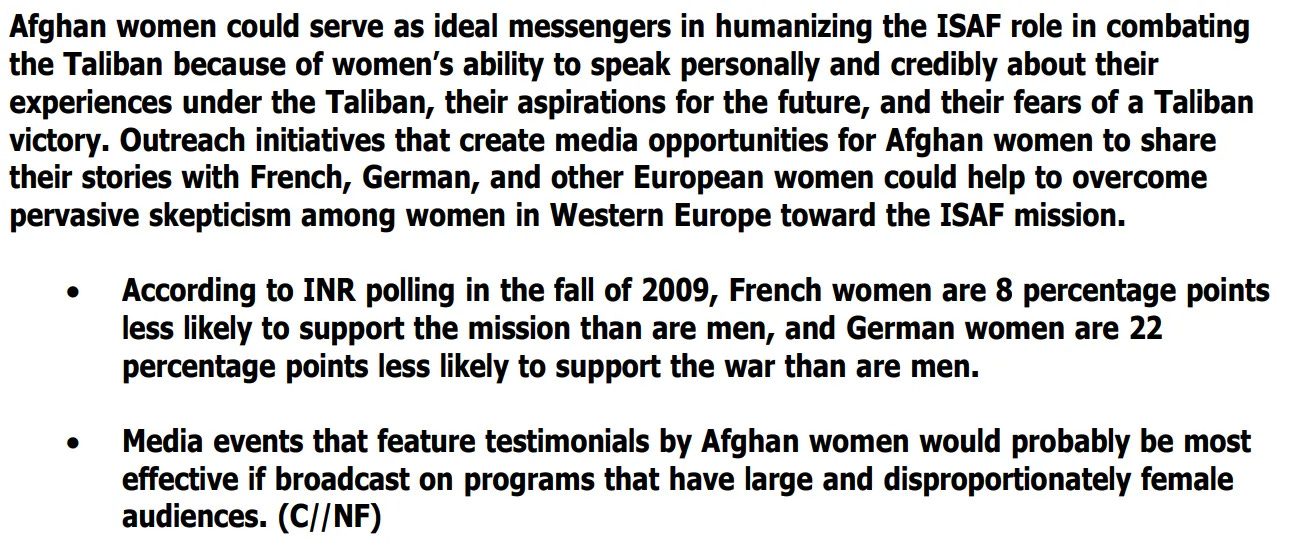
The propaganda value of women in conflicts has long-been cynically exploited by Western intelligence services. A leaked CIA memorandum from March 2010 on covert means of increasing flagging support for NATO’s Afghanistan mission noted women “could serve as ideal messengers” in “humanizing” the military occupation. This was due to their “ability to speak personally and credibly about their experiences under the Taliban, their aspirations for the future, and their fears of a Taliban victory”:
“Outreach initiatives that create media opportunities for Afghan women to share their stories… could help to overcome pervasive skepticism among women in Western Europe toward the mission. Media events that feature testimonials by Afghan women would probably be most effective if broadcast on programs that have large and disproportionately female audiences.”
Throughout the US occupation of course, Afghanistan remained one of the worst countries in the world to be a woman, by some margin. Roughly a year after that CIA memo was authored, Gay Girl in Damascus, a blog purportedly written by Syrian-American lesbian Amina Arraf, garnered significant mainstream attention. Widely hailed for her “fearless” and “inspiring” eyewitness reporting, she was lauded as a symbol of the “progressive” revolution erupting in the country.
In June 2011, Amina’s cousin announced on the blog Amina had been kidnapped by three armed men in the Syrian capital. In response, numerous Facebook pages were set up calling for Amina’s release and ‘liked’ by tens of thousands, #FreeAmina trended widely on Twitter, journalists and rights groups begged Western governments to demand her release, and the US State Department announced it was investigating Amina’s disappearance.
Six days later, it was revealed ‘Amina’ was in fact Tom MacMaster, a middle-aged American man living in Scotland, who had penned extensive lesbian literotica fantasies under that alter ego. While corporate news outlets quickly forgot all about the hoax they’d so comprehensively fallen for, their appetite for dubious human interest stories emanating from the crisis wasn’t diminished.
‘Huge Global Coverage’
In July 2019, an image of two young Syrian girls trapped in rubble in opposition-occupied Idlib attempting to haul their sister to safety as she dangled off the precipice of a dilapidated building, their father looking on in horror above, spread far and wide on social media.
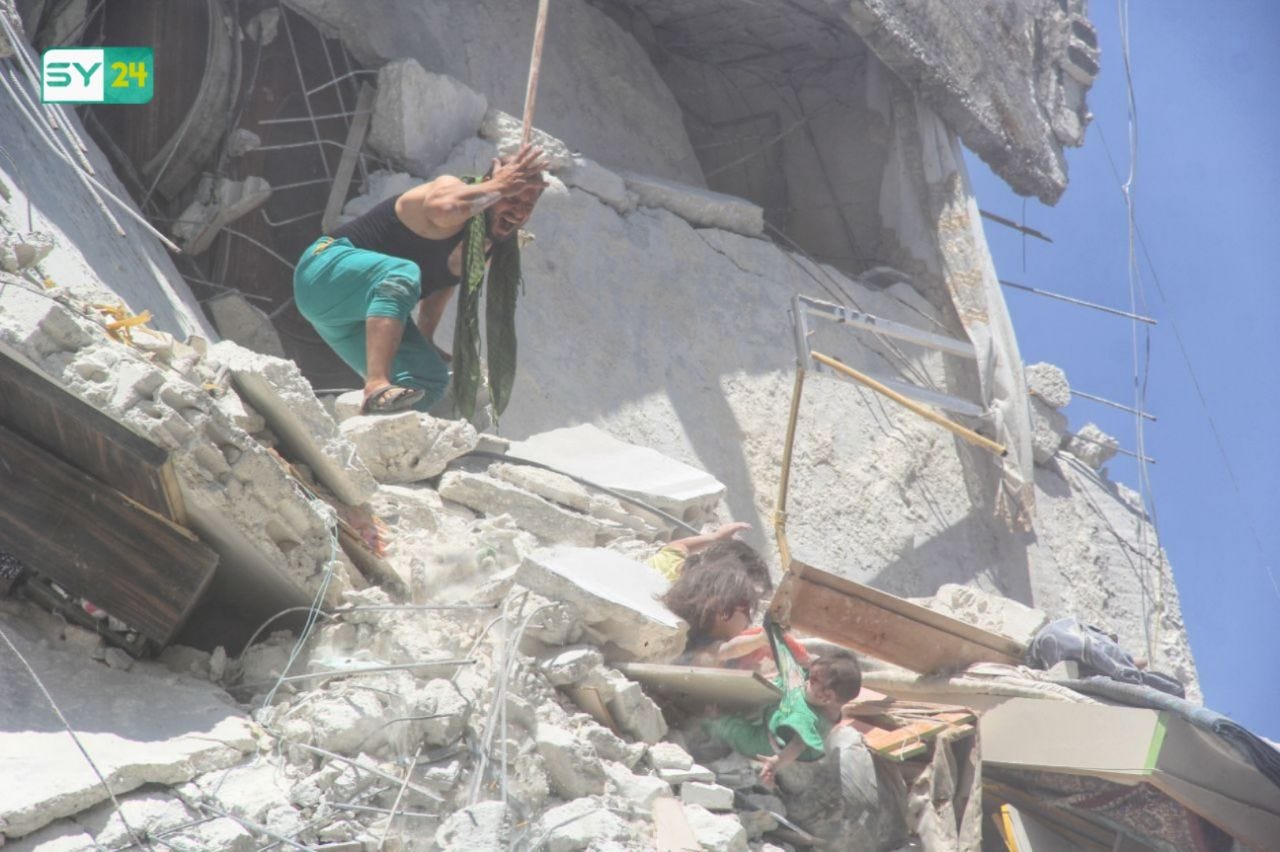
The photo, snapped by a photographer for Syrian news service SY24, went viral the world over. Unbeknownst to viewers though, SY24 was created and funded by Global Strategy Network, a prominent British intelligence cutout founded by Richard Barrett, former MI6 counter-terrorism director. In leaked submissions to the British Foreign Office, Global Strategy boasted of how its propaganda “campaigns” broadcast via SY24 generated “huge global coverage,” having been seen by “many hundreds of millions of people,” and “attracting comment as far as the UN Security Council.”
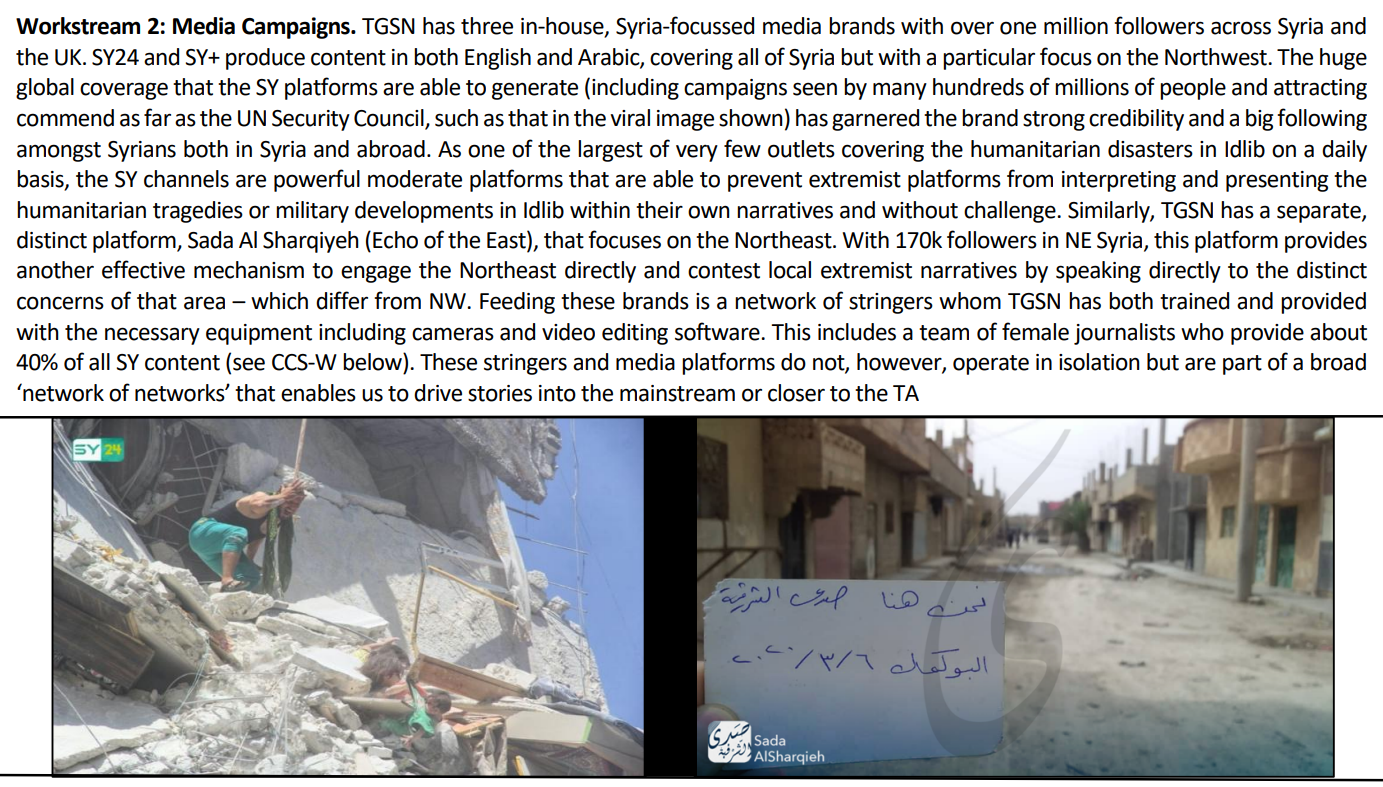
SY24 content was produced by a network of ‘stringers’ in Syria that Global Strategy trained and provided with equipment, including “cameras and video editing software.” The firm drew particular attention to a team of female journalists it had tutored, “who provide about 40 percent of all SY content,” and were part of “a broad ‘network of networks’” enabling the company “to drive stories into the mainstream.”
Global Strategy also established a dedicated centre for training female journalists to produce content for SY24 in Idlib, “accessing stories that male journalists cannot,” which were then shared on social media. It boasted that almost half of SY24’s followers were women, “a remarkably high ratio for Syria-focused platforms.”
Carefully cultivating an entirely misleading image of an inclusive, credible ‘moderate’ Syrian opposition was of paramount importance to British inelligence. It helped whitewash the barbarous nature of the various ‘rebel’ factions London was backing in the region, while simultaneously engendering support among Western citizens for regime change.
In order to engage the “international community” to this end, Global Strategy, in conjunction with ARK – a shadowy “conflict transformation and stabilization consultancy” headed by veteran MI6 officer Alistair Harris – planned “communication surges” around “key dates” such as International Women’s Day.
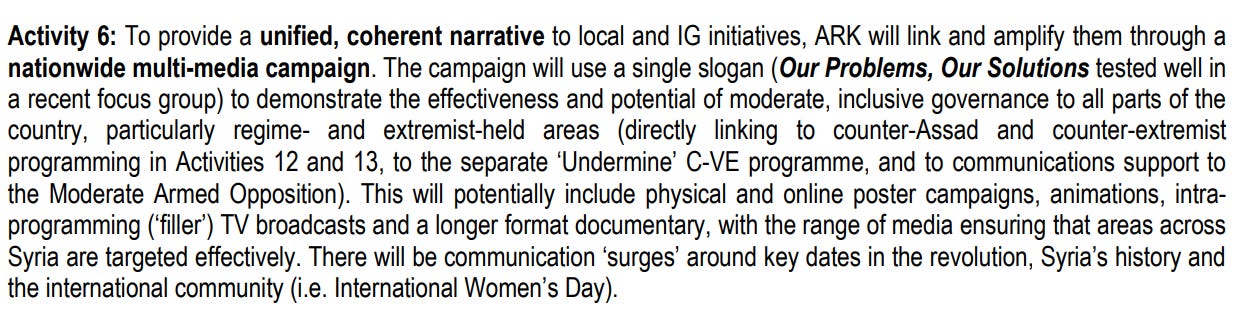
In a particularly elaborate example of such a “surge”, the pair collaborated on “Back to School”, a campaign in which young Syrians returned to education. Idlib City Council, opposition commanders, and other elements on the ground concurrently engaged in a “unified” communications blitz, using “shared slogans, hashtags and branding.” Rebel fighters were sent to “clear roads” and “enable children and teachers to get to schools,” all the while filmed by the pair’s voluminous local journalist network, footage of which was then “disseminated online and on broadcast channels.”
Ensuring “female teachers” received sizeable coverage in the Western media was a key objective of the campaign. Furthermore, in many leaked files, ARK boasted of the huge network of journalists it had trained and funded in Syria, who would cover such PR stunts, secretly orchestrated by the organisation. Their reports in turn fed to the firm’s “well-established contacts” at major news outlets including Al Jazeera, BBC, CNN, The Guardian, New York Times, and Reuters, “further amplifying their effect.”
‘Thrust by Tragedy’
Other documents make clear ARK well-understood the immense difficulties of promoting the role of women internally and externally during the crisis. One file on “[incorporating] the role of women in the moderate opposition” notes Syrian women in rebel-occupied areas faced “an almost overwhelming variety of problems,” and “the space for women to participate in public life has contracted significantly as the conflict has progressed.”
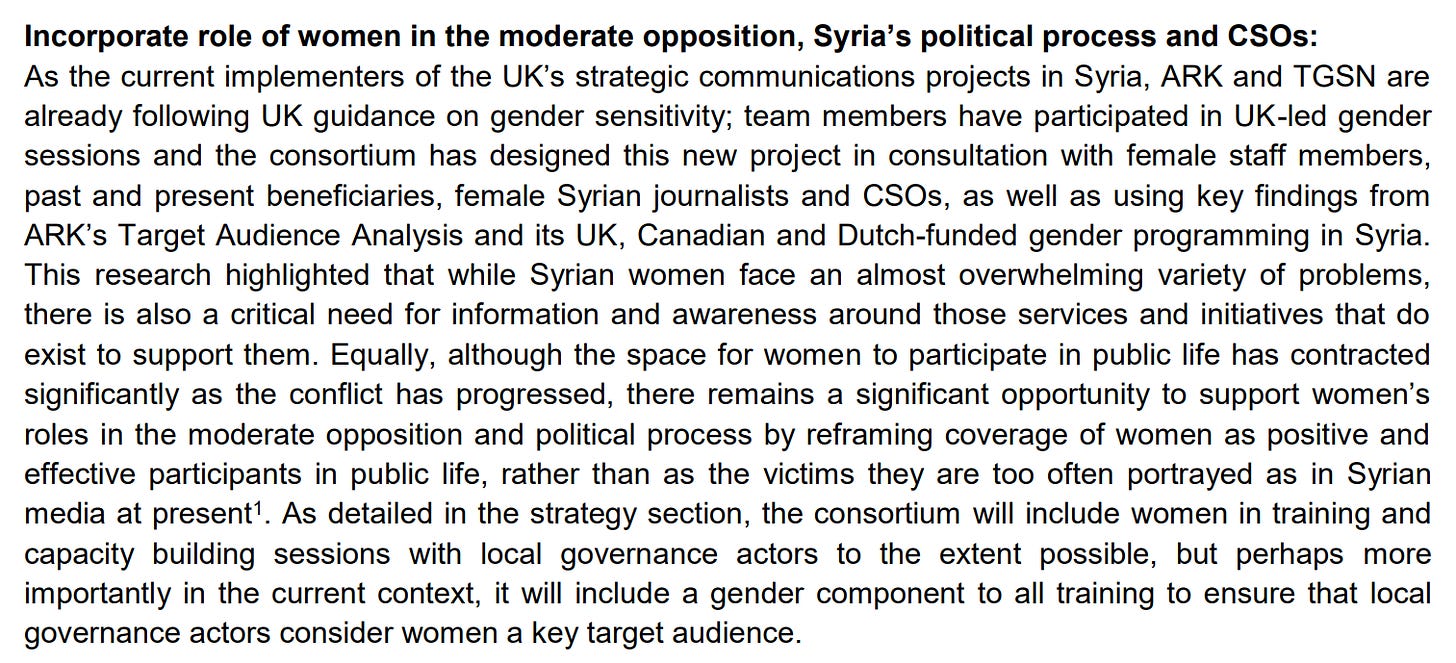
As a result, ARK was “extremely aware of the risks of promoting women’s participation beyond currently accepted social norms… given the potential to hinder message resonance or result in a backlash against female participation.” It therefore proposed to “subtly reframe the narrative of women… increasing the amount of coverage of their initiatives and opinions as the context allows.”
One means of “subtle reframing” was Moubader (which translates to “person who takes initiative”), a media asset created by ARK in 2015, comprising a “high-quality hard copy monthly magazine with widespread distribution across opposition-held areas of Syria,” with a website and Facebook page boasting almost 200,000 likes. Moubader was established by ARK to achieve “behavioural change” in readers. “Given the importance of broadcast television as a trusted source” in Syria, ARK also sought British intelligence funding to develop a Moubader TV programme, to “leverage stories and values to maximum effect and reach an even wider audience.”
Documents submitted to the Foreign Office by another intelligence cutout, Albany, similarly noted women’s access to education, healthcare, and economic opportunity had “been debilitated” during the crisis, which issues such as early marriage, child military recruitment, and “transactional sex” exacerbated. The UN defines the latter as “non-commercial sexual relationships motivated by an implicit assumption that sex will be exchanged for material support or other benefits.”
Still, Albany considered so many Syrian women having been “thrust by tragedy into head of household and breadwinner positions” over the course of the crisis as a golden opportunity to propagandize them and, in turn, their families, while promoting the ‘inclusive’ nature of the opposition, by creating and partnering with female civil society organizations and journalists.
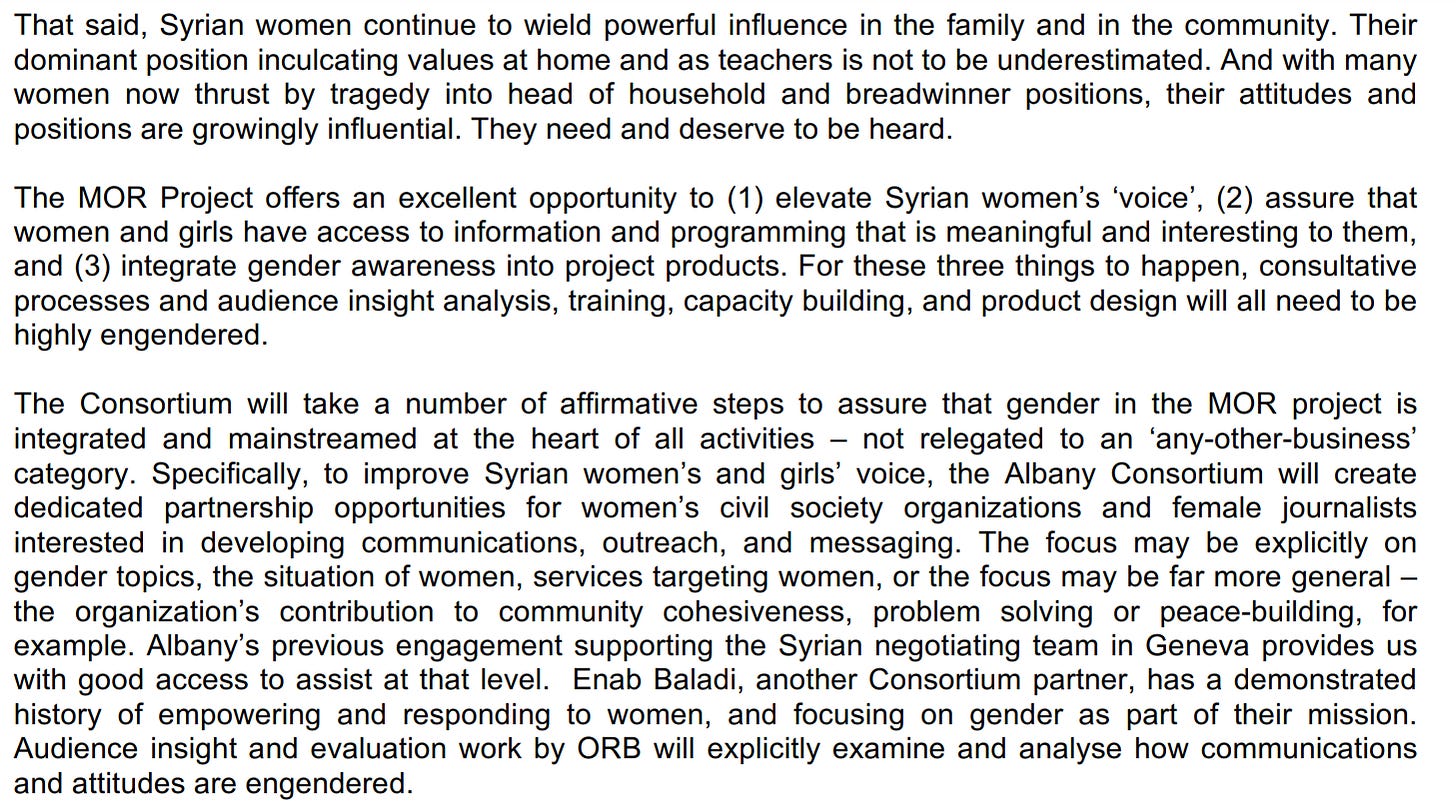
ARK likewise believed women to be a “critical audience”, given the number of Syrian households with female heads –“up to 70 percent”. So, the organisation sought to ensure they were well-represented in all its domestic and international “broadcast products”, as well as on social media.
‘Female Participation’
Unsurprisingly, the files do not acknowledge the increasingly hostile environment for women in Syria directly resulted from foreign efforts to destabilise and depose its government. ISIS and al-Nusra were and remain rightly notorious for their monstrous treatment of women in the areas they occupied, which included widespread rape, sexual violence and abduction.
However, many armed opposition groups backed by Britain and other foreign powers imposed stringent restrictions on women in the areas they occupied, requiring them to wear hijabs and abayas, doling out extreme punishments for failing to comply, imposing discriminatory measures prohibiting them from moving freely, working, attending school, and more.
There are indications British intelligence was in close quarters with such activities. For instance, in December 2017 BBC documentary Jihadis You Pay For alleged Foreign Office cash distributed on its behalf via contrator Adam Smith International in Syria ended up in the pockets of Free Syrian Police (FSP) officers who not only stood by while women were stoned to death, but closed surrounding roads to facilitate their murder.
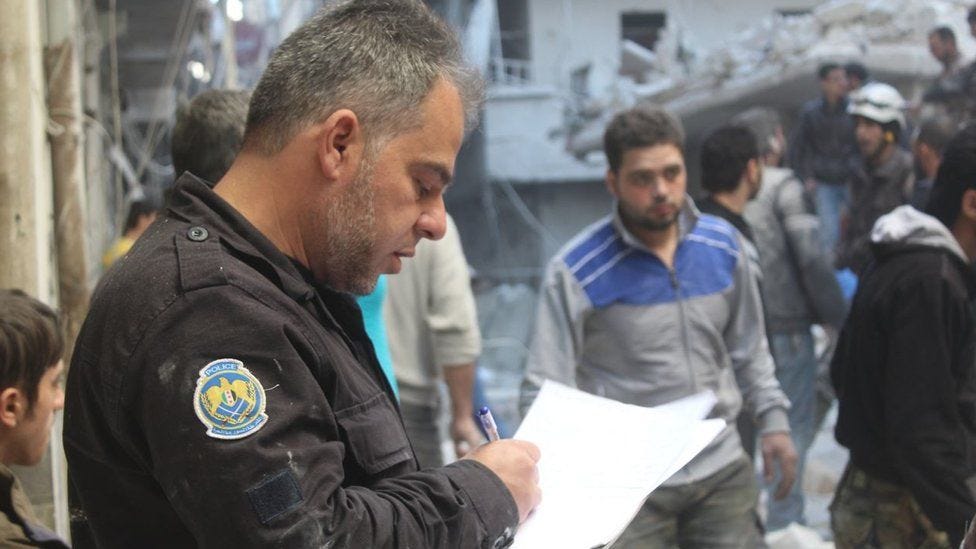
The ‘Free Syria Police’ at work
FSP, an unarmed shadow civilian police force operating in opposition-controlled areas, was created, funded and trained under the auspices of the British intelligence-funded Access to Justice and Community Security (AJACS) program. In a perverse irony, leaked Adam Smith International files relating to the project indicate it too sought to exploit women for propaganda purposes, applying a gender policy “to encourage female participation in justice and policing.” The company boasted of how, of the 1,868 police officers it trained under the scheme, six – 0.32 percent – were female.
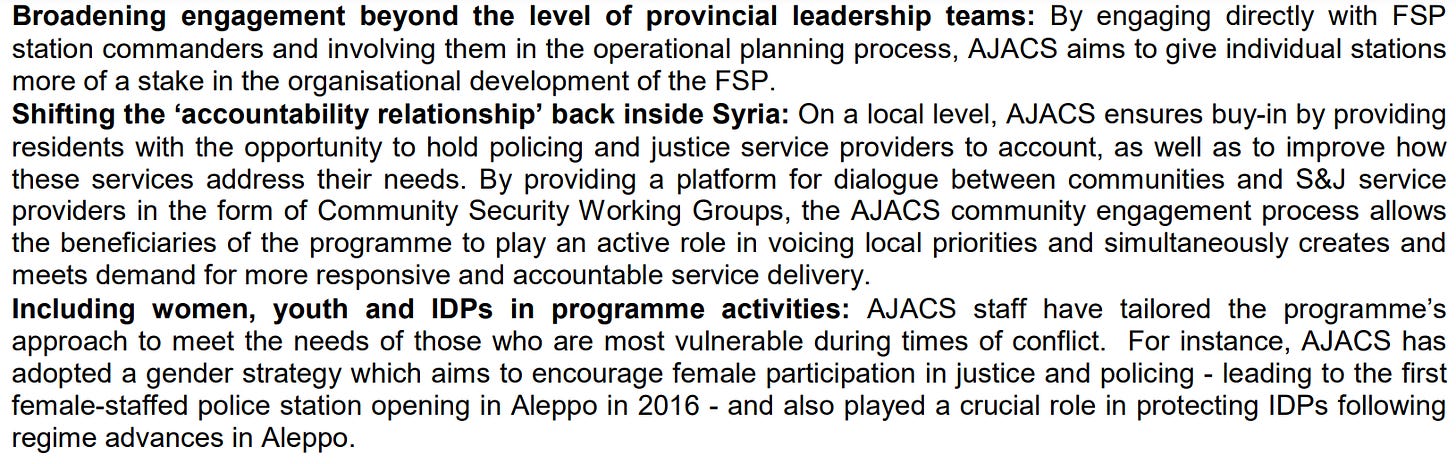
Quite some “revolution”. As Human Rights Watch noted in 2014, prior to the outbreak of civil war, women and girls across Syria were “largely able to participate in public life, including work and school, and exercise freedom of movement, religion, and conscience.” While the country’s penal code and laws governing issues such as marriage, divorce, and inheritance contained some discriminatory provisions, the country’s constitution guaranteed gender equality.
Iran calls on Ukraine to stop arming, supporting anti-Syria groups
Press TV – December 6, 2024
The Iranian Foreign Ministry has strongly warned Ukraine against supporting anti-Syria armed groups as reports run rife about Kiev’s providing military assistance and training for the outfits.
“Experience shows that coalescence with terrorism only promotes expansion of insecurity and violence across the world, and would afflict its (terrorism’s) supporters sooner or later,” said Mojtaba Damirchiloo, Head of the ministry’s Eurasia Department, on Friday.
He underlined the dangerous nature of the armed outfits in Syria, which were blacklisted by the United Nations Security Council a long time ago, saying deploying such groups towards destabilizing the West Asia region amounted to adoption of an immoral policy that contradicted all the principles of the international law.
In September, an informed Syrian source told Russia’s Sputnik news agency that a group of 250 Ukrainian forces had reached the Idlib Province in northern Syria to train the armed groups.
According to the source, the Ukrainian instructors were set to train members of the Hayat Tahrir al-Sham (HTS) group in production and modernization of drones. “More than 250 unmanned aerial vehicles (UAVs) were delivered to HTS in Idlib in batches in the form of components along with civilian goods,” it added.
Damirchiloo pointed to such accounts as well as some other reports about a number of Ukrainian officials engaging in “illegal arms trade” involving the weapons that have been delivered to the European country by the United States, describing such illegal activity as Kiev’s clear violation of its commitments to “preventing and confronting terrorism,” and demanding immediate cessation of such measures.
Earlier this week, members of the HTS were reported to have overrun many government-controlled areas and killed dozens of soldiers in northern Syria.
The Syrian military and its allied Russian forces then began extensive operations against the outfit, reportedly managing to reverse some of its gains.
Damirchiloo, meanwhile, decried Ukrainian officials’ “repetitive and unfounded” claims about, what they describe as, Iran’s role in the underway conflict in the European country.
The Ukrainian officials, he said, were coming up with such remarks as a means of chiming in with the genocidal Israeli regime and the United States, and securing Western financial and arms support.
Reiterating Iran’s position, he asserted, “The Islamic Republic has announced its opposition to warfare since the beginning, is not involved in the conflict in no way, and has invariably invited all parties to negotiate towards finding a diplomatic solution to their differences.”
Syrian Army foils US-backed SDF offensive in Deir Ezzor: Sources
Al Mayadeen | December 3, 2024
The clashes initiated today by militants belonging to the Deir Ezzor Military Council, affiliated with the Syrian Democratic Forces (SDF), toward the seven peaceful villages in Deir Ezzor, have ended, and the militants have withdrawn to the positions from which they launched their attack in northern Deir Ezzor, Al Mayadeen’s correspondent reported on Tuesday.
The Deir Ezzor Military Council stands for armed groups supported by US occupation forces, operating under the SDF and controlling areas north of the Euphrates River, where several US military bases are located.
Our correspondent further reported the complete withdrawal of the SDF militants after their failed attempt to advance toward the seven peaceful villages in northern Deir Ezzor, after American artillery at the Conoco field provided heavy fire cover for their assault.
Earlier, Al Mayadeen’s correspondent confirmed that US occupation forces had instructed Deir Ezzor Military Council militants to launch an attack on Syrian Army positions in the seven villages in the Deir Ezzor countryside, coinciding with an offensive by the terrorist Hay’at Tahrir al-Sham (HTS) group and other opposition factions on Aleppo, Idlib, and Hama countrysides.
The seven villages are located on the eastern bank of the Euphrates River, in the northern Deir Ezzor countryside. They are: al-Hussainiya, al-Salihiya, Hatla, Marrat, Mazloum, Khasham, and al-Tabiya, all of which are under the control of the Syrian Army.
Our correspondent added that Deir Ezzor Military Council militants had brought in mine-clearance vehicles and began removing the earthen berm on the Khasham front, northern Deir Ezzor.
Intense clashes were reported between Deir Ezzor Military Council militants and the Syrian Army on the outskirts of the towns of al-Salihiya, Marrat, and al-Tabiya in northern Deir Ezzor, where the US-backed militants shelled Khasham village in Deir Ezzor countryside with 12 mortar rounds.
Violent clashes were also reported between the militants and the Syrian Army on the al-Salihiya front in northern Deir Ezzor.
The Syrian Army units also captured 14 members of the SDF-affiliated Deir Ezzor Military Council during the attack that targeted the northeastern countryside of Deir Ezzor, Sputnik reported.
Moreover, SANA reported that the Syrian army is engaged in violent clashes with armed groups north and west of the town of Khattab in the northwestern countryside of Hama, with dozens of terrorists killed and wounded in the vicinity of the towns of Deir Ezzor and the northern countryside of Hama.
SDF attack aims to stop Resistance attacks on US occupation base
Sources told Al Mayadeen that the Americans’ goal in supporting the SDF’s attack is to stop the Resistance attacks on the Conoco base due to its proximity to these villages.
The attack was carried out under American cover and was thwarted by the army, allied forces, and locals, the sources confirmed.
According to the sources, the SDF initiated the attack by firing rockets and shells, which inflicted damage on the residents’ property.
The sources mentioned that the Syrian Army and allied forces repelled an attack by the SDF on the seven villages, north of Deir Ezzor, and forced them to withdraw.
Syrian Army repelling attack on liberated villages
Meanwhile, Syrian state TV said earlier the army and its allied forces were repelling an attack by the Deir Ezzor Military Council on the liberated villages in the al-Jazira region.
The Syrian army, along with allied forces, is also repelling an attack launched by SDF forces in the Deir Ezzor countryside, the Syrian Arab News Agency (SANA) reported.
On its part, the Syrian Ministry of Defense confirmed that Syrian and Russian airstrikes and missile strikes have targeted militant positions in the southern Idlib countryside and northern Hama, pointing out that the strikes resulted in dozens of fatalities and injuries among the militants, as well as the destruction of their vehicles and weapons.
Al Mayadeen’s correspondent later reported that the Syrian-Russian air forces destroyed a command center belonging to armed groups in the Khan Sheikhoun area in the southern Idlib countryside.
HTS militants launched a wide-scale offensive last Wednesday on areas in the countryside of Aleppo, Idlib, and Hama, managing to enter the city of Aleppo.
The Syrian Army subsequently established a defensive line in the northern Hama countryside and launched a counteroffensive against the militants, regaining control of villages and towns in the northern part of the province.
Qatar seeking solution
Commenting on the events, Qatari Foreign Ministry spokesperson Majed al-Ansari confirmed that “Doha is working with its partners in the region to find solutions to end the fighting in Syria.”
Qatari media quoted Al-Ansari as saying, “We emphasize that there should be a comprehensive solution in Syria based on international resolutions.”
Ensuing disagreements
In a related context, the sources told Al Mayadeen that disagreements erupted after HTS demanded that the so-called “National Army” militants evacuate the sites they had taken control of north of Aleppo.
The sources said that disagreements emerged between the HTS operations room and the “National Army’s” operations room over control positions in Aleppo and its countryside.
Iran says it’s ready to send troops to Syria
RT | December 3, 2024
Tehran would consider a full military deployment to aid Syria if the government in Damascus requests it, Iranian Foreign Minister Abbas Araghchi has said.
The comments came during an inteview that Araghchi gave to the Qatar-based outlet Al-Araby Al-Jadeed on his way back from Türkiye on Monday evening.
“If the Syrian government asks Iran to send troops to Syria, we will consider the request,” Araghchi was quoted as saying.
Tehran is preparing “a series of steps to calm the situation in Syria and find an opportunity to present an initiative for a permanent solution,” he added.
Militants of al-Qaeda affiliate Hayat Tahrir-al-Sham (HTS) and other Islamist groups launched a large-scale offensive from Idlib province towards Aleppo, Hama and Homs last week. Idlib has been under Turkish protection since a ceasefire negotiated with Russia in 2020.
The expansion of these terrorist groups “may harm Syria’s neighboring countries such as Iraq, Jordan, and Türkiye more than Iran,” Araghchi told the Qatari outlet.
Tehran is willing to “consult and dialogue” with Ankara to bridge their differences, Araghchi noted, but said that Iran demands a withdrawal of Turkish troops from Syria before any meeting between their presidents can take place. According to the Iranian foreign minister, this is a “reasonable” request.
Iran is “concerned about the collapse of the Astana process in Syria, because there is no easy alternative to it,” according to Araghchi. This was a reference to the deal signed in 2017 in the capital of Kazakhstan, in which the governments in Damascus, Ankara, Tehran, and Moscow pledged to work on resolving the Syrian conflict peacefully.
Araghchi also said he intended to visit Moscow to discuss the situation in Syria.
Turkish President Recep Tayyip Erdogan has said that Ankara supports “Syria’s territorial integrity and national unity” but that ending the conflict required a “consensus in line with the legitimate demands of the Syrian people.” His foreign minister, Hakan Fidan, said on Monday that the hostilities resumed because Damascus ignored the “legitimate demands of the opposition.”
Meanwhile, Russia has reiterated its support for Syrian President Bashar Assad and the government in Damascus.
The Russian expeditionary force, deployed to Syria in 2015 to help Damascus fight against Islamic State (IS, also known as ISIS) terrorists, has carried out a series of airstrikes against the attacking jihadists in support of the Syrian army.
Who is Massad Boulos, Tapped as Trump’s Advisor on Arab, Middle Eastern Affairs?
By Svetlana Ekimenko – Sputnik – 02.12.2024
Donald Trump lauded Massad Boulos as a “highly respected leader in the business world, with extensive experience on the International scene” in a post on his social media platform Truth Social on Sunday.
US President-elect Donald Trump has announced Massad Boulos as his pick for the position of senior advisor on Arab and Middle Eastern affairs.
Who is Massad Boulos?
Boulos is a Lebanese American businessman who is also father-in-law to Trump’s daughter, Tiffany.
Boulos helped Trump win back the swing state of Michigan by flipping Arab American voters frustrated with Joe Biden’s policies supporting Israel in its war on Hamas in Gaza and on Hezbollah in Lebanon, campaign officials told Reuters.
He assured Arab Americans during the election campaign that Trump was committed to ending the wars in the Middle East.
“Let’s move to peace, and let’s move to rebuilding Gaza and rebuilding Lebanon,” Boulos told Sky News in October, adding:
“We want Gaza to be prosperous. We want the Palestinian people to be prosperous, to live in peace, to live in harmony, side by side with the Israelis and full security on both sides.”
Trump’s in-law has ties to various factions in Lebanese politics, including the Free Patriotic Movement (Christian party aligned with Lebanese Shiite movement Hezbollah), and the Lebanese Forces Party, according to media reports.
He is familiar with Suleiman Frangieh, leader of the Christian Marada Movement and a candidate for Hezbollah’s faction in the 2022-2024 Lebanese presidential election, Reuters noted.
Massad Boulos, who has acted as a go-between for Trump and Mahmoud Abbas in the past, met with the Palestinian leader on the sidelines of the UN General Assembly in September, a senior Palestinian official told The Times of Israel. Abbas reportedly voiced willingness to work with Trump to reach a two-state solution to the Palestinian-Israeli conflict.
Boulos has friends who are close to Syria’s President Bashar Al-Assad, according to media reports.
Al-Tanf: The US stronghold in Syria and how it safeguards Israel
By Haidar Mustafa | The Cradle | December 2, 2024
On 10 September 2014, the US announced the formation of an international coalition with the participation of 86 countries to eradicate the terrorist group ISIS, which had declared the establishment of a “caliphate” in late June.
The coalition’s operations began in Syria and Iraq in early 2015. However, what unfolded was more than just a campaign against terrorism; it became a vehicle for advancing US strategic ambitions in West Asia – including the establishment of illegal military bases to secure influence and resources in eastern Syria, primarily to protect the interests of its key ally, Israel.
Exploiting the war for geostrategic gains
Washington leveraged the anti-ISIS campaign to pursue broader geostrategic goals, deploying roughly 2,000 troops into Syria – an occupation that violated international law and Syrian sovereignty. By 2016, US forces had established a presence at Al-Tanf, a strategically important base located at the tri-border area between Syria, Iraq, and Jordan. This position, south of the Euphrates River, overlooks a critical supply route from Tehran to Damascus and Beirut, which the US views as significant for regional control.
The Al-Tanf base was originally established in 1991 before the Second Gulf War, reactivated during the 2003 Iraq invasion, and then closed after US forces consolidated control in Iraq. It reopened in 2016 after ISIS was driven from the area.
Since then, Al-Tanf has served not only as a training ground for fighters of the CIA-backed Maghawir al-Thawra but also as a cornerstone of broader US interests, as Colonel Daniel Magruder Jr. noted in a 2020 Brookings Institution report entitled Al Tanf garrison: America’s strategic baggage in the Middle East.
According to Magruder, Al-Tanf was meant to facilitate the continued fight against ISIS, counter Iranian activities, and maintain leverage in negotiations over Syria’s future.
However, the base’s role went far beyond these stated goals. US occupation forces at Al-Tanf engaged in both offensive and defensive intelligence operations while also supporting armed groups against the Syrian government.
The base acted as a hub for the Military Operations Center (MOC), a joint effort with several states aimed at coordinating military activities in southern Syria, ultimately undermining Syrian sovereignty and its allies.
The real strategic goal: A buffer zone for Israel
Beyond its military role, Al-Tanf’s strategic location supports plans for a controlled buffer zone involving the nearby Rukban refugee camp. Military expert Major General Muhammad Abbas told The Cradle that this buffer would help US and Israeli objectives by creating a physical barrier between Syria and Iraq.
The base also facilitates Israeli operations in Syrian airspace, providing a logistical advantage for air force missions that circumvent Syrian air defenses. The collaboration between the US and the occupation state has been well documented, with Al-Tanf serving as a launching point for Israeli air strikes deep inside Syria – attacks that would be far riskier from other approaches due to Syrian anti-aircraft systems.
A 2021 report by the Washington Institute highlighted how the US occupying presence at Al-Tanf has directly benefited Israel, supporting its “battle between wars” – a strategic approach aimed at minimizing risk and exploiting weaknesses in Syrian defenses.
Speaking to The Cradle, political analyst Bassem al-Shehawi notes that the US presence in Syria has always aligned with safeguarding Israel, whether by severing geographical links between members of the Axis of Resistance or by deploying advanced radar and air defense systems to protect Tel Aviv’s interests.
Al-Tanf’s importance for the US and Israel
Crucially, it also facilitates Israeli air force attacks on targets deep inside Syria – attacks that could not have been carried out from above Lebanon or the occupied Golan Heights due to the distance involved. Since 2018, when Syrian air defenses shot down an Israeli F-16, Israeli forces have completely avoided entering Syrian airspace from the western side.
Shehawi adds that this base’s importance comes from its buffer zone and air umbrella, which have a radius of 55 kilometers. These were established due to the non-conflict understanding between Russia and the US regarding Syria. The base also played a role in confronting drone and missile attacks launched by Iran during Operations True Promise 1 and 2, whether by providing radar monitoring or attempting to shoot them down, similar to the role played by other US bases in Syria and the wider region.
A report published by Al-Monitor also confirms that Israeli fighter planes had previously used the corridor along the Jordanian–Syrian border and the airspace around Al-Tanf to penetrate Syrian airspace to launch strikes.
The significance of Al-Tanf was evident during the presidency of Donald Trump, who often spoke of pulling US troops out of Syria. However, the situation on the ground was more nuanced. Even as Trump made public declarations about withdrawing troops, officials within his administration, including former National Security Advisor John Bolton, ensured that key positions like Al-Tanf remained secure. Bolton stated that any withdrawal from Syria would be conditional on an agreement with Russia to replace US forces at Al-Tanf, thereby ensuring that Israeli security interests were safeguarded.
The future of the US occupation of Syria
With Trump poised to return to the White House next month, questions have resurfaced about the future of American military involvement in Syria. The expectation is that despite any renewed rhetoric about reducing military involvement, Al-Tanf will remain a key asset in maintaining US influence in Syria and the region.
In 2023, former Chief of the US Joint Chiefs of Staff Mark Milley visited Al-Tanf, emphasizing its importance for Israel’s security and confirming that there were no plans to withdraw. Al-Tanf will likely continue to play a key role in Washington’s West Asia strategy, even if it reduces its presence elsewhere in Syria.
The base serves as a strategic card – enabling continued influence, fostering instability, and complicating the region’s dynamics. Yet, a critical question remains: How sustainable is the US presence at Al-Tanf, given the growing resistance? With Iraqi and local Syrian factions increasingly targeting US positions, Washington’s ability to maintain control over Al-Tanf may weaken.
In time, Syria might leverage its own “Popular Resistance” to apply pressure, forcing US forces to eventually leave Syrian territory, as indicated earlier in the year with the tribal uprising in Deir Ezzor.
Featured Video

Racist Seinfeld Dances for Joy as Bibi Unveils His New Map
or go to
Aletho News Archives – Video-Images
TV Drama Review
Japanese drama projects Japan’s wartime atrocities onto Chinese characters

Global Times | October 25, 2026
By portraying Chinese characters as perpetrators of ruthless violence while casting Japanese Self-Defense Forces (SDF) intelligence operatives as defenders, the season 2 of the Japanese drama Vivant has recently drawn criticism from Chinese netizens, who argue that its depiction turns historical reality on its head while ignoring Japan’s wartime atrocities.
The TBS drama series – a spy suspense story in which an alleged unofficial intelligence unit of the SDF operates across the globe — has attracted a passionate fanbase. Its currently airing season 2 opened with a household rating of 18.8 percent, the highest for a TV drama this year, according toa commentary article by Japanese media Toyo Keizai.
What draws attention is the portrayal of the enemies in the series, the article noted. Scenes in which the Chinese organization subjects kidnapped members of the SDF unit to brutal torture are repeated with unrelenting intensity.
It is rare for Japanese TV dramas to explicitly portray a real-life country as the enemy, the article noted.
Japanese Prime Minister Sanae Takaichi also made a reference to the drama, saying that she has been recording Vivant and hopes to binge-watch it over the year-end and New Year holidays, according to Japanese media outlets.
China’s CCTV News report on Sunday revealed that the drama features scenes in which Chinese personnel cut off the fingers of and stab Japanese intelligence operatives in the abdomen. Such acts bear striking similarities to the torture inflicted on Chinese nationals by invading Japanese troops during the World War II.
The drama distorts the truth by attributing these atrocities to modern Chinese characters. Beneath the surface, it subtly glorifies Japan’s cross-border overseas operations, blurs the functional boundaries of the SDF and implicitly promotes an expansionist narrative, per CCTV News. … continue
Blog Roll
 Aletho News
- Iran FM Araghchi: “Hormuz Will No Longer Be the Same”
- EU facing trillion-euro debt hole while seeking more cash for Kiev
- How US, Europe, Persian Gulf states exhausted missile stockpiles, splurged billions to defend Israel
- Up in arms… Koreans reject U.S. empire’s plan to make South Korea the next Ukraine
- Iran, Turkey, Pakistan, Saudi Arabia could advance region-led security framework in Tehran: FM spox
- Netizens condemn Japanese drama for projecting Japan’s wartime atrocities onto Chinese characters
- Racist Seinfeld Dances for Joy as Bibi Unveils His New Map
- A West Bank War for Netanyahu’s Election Campaign, Could It Backfire?
- Yemen denounces European Parliament’s ‘hypocritical’ push to blacklist Ansarullah
- Qalibaf: UAE’s UN bid aims to ‘clear the runway’ for ‘Greater Israel’, whitewash genocide
- If Americans Knew
- An error has occurred; the feed is probably down. Try again later.
- No Tricks Zone
- Sudden Stratospheric Warming, Powerful El Niño Combination May Lead To Extreme Europe Cold, Energy Crisis!
- Two New Studies Find Thwaites Glacier Melt Cannot Be Driven By Human Activity Or A Warming Ocean
- E-Cars Reduce CO2 Emissions By Only 41% Compared To Internal Combustion Engine Vehicles
- Predictions Made By Renowned Climate Professor Over Past Decades Have Been Proven To Be Poor
- New Study Suggests Large Regions Of The Pacific Ocean Have Been Cooling For The Last 80 Years
- Germany’s Green Energy Debacle: High Energy Costs Force Kahla Porzellan to Close After 182 Years!
- New Study: 50 Years Of The Most Aggressive ‘Net Zero’ Policies Can Only Affect The Global Climate By 0.03°C
- US September “Heat” Was No Record…Many Records Set Decades Ago
- Latest European Green Energy Debacle; Portugal’s Largest Flagship Solar Park Insolvent!
- Green Energy Debacle: German Expert Professor Fritz Vahrenholt Warns Of Severe Economic And Social Consequences

