Burying key evidence, new OPCW report covers up Douma’s unsolved deaths
BY AARON MATÉ · THE GRAYZONE · MARCH 27, 2023
After censoring experts who found that the victims in Douma could not have been killed by chlorine gas, the OPCW’s new IIT report continues the cover-up and baselessly accuses the Syrian government.
[Note: this article contains graphic images.]
On April 7th 2018, gruesome images of an alleged chemical attack emerged from the Syrian town of Douma.
Dozens of dead bodies, including children and infants, appeared heaped in piles inside of an apartment building. Others lay on the street in front as if trying to escape deadly gas. Strikingly, many of the victims displayed copious foam oozing from the mouth and nose. Along with their proximity to a clear escape route, these visible symptoms suggested that something extraordinarily poisonous had killed them instantly.
US officials immediately promoted the allegations of insurgent-tied groups that the Syrian army had killed the victims with chlorine gas or the nerve agent sarin, or even a combination of both. One week later, the US, along with the UK and France, bombed Syria in purported retaliation.
In public statements, however, experts raised doubts that chlorine caused the deaths in Douma. Leaked documents later revealed that German military toxicologists consulted by the Organisation for the Prohibition of Chemical Weapons (OPCW) in June 2018 went further. The Germans told the OPCW that the circumstances of the fatalities – apparent immediate death and collapse in piles at the center of two rooms, a failure to escape, and rapid profuse foaming at the mouth and nose – were inconsistent with chlorine poisoning.
The Germans’ findings had profound ramifications. While the Douma victims’ signs of rapid foaming were not consistent with exposure to chlorine gas, they were consistent with nerve agent exposure. But by that point, the OPCW’s chemical analysis had ruled out sarin or any other nerve agent as the killer because none of these chemicals were found at the scene or in biomedical samples from alleged victims.
If the rapid and profuse frothing was not the result of a nerve agent or chlorine poisoning, the possibility existed that there was no chemical attack at all – and that insurgents staged the incident to frame the Syrian government. The OPCW would be dealing with a faked chemical attack that triggered US-led airstrikes on Syria, and the unexplained deaths of 43 men, women, and children.
As The Grayzone has reported, the OPCW censored the German toxicologists’ input in a cover-up of findings that undermined allegations of a Syrian army chemical attack in Douma. More than three years since that suppression was exposed, the OPCW has never offered a rebuttal to the initial toxicology assessment, nor an explanation for why it was concealed. They have simply buried it.
In a new report on Douma released in January, the OPCW finally purports to offer a counter-narrative. The OPCW’s Investigation and Identification Team (IIT) claims that the “symptoms of the victims” in Douma “are, overall, consistent with exposure to chlorine gas in very high concentrations.”
The IIT shares this judgment as part of an effort to allege that the Syrian army killed the dozens of victims by dropping a chlorine gas cylinder on the apartment building — identified as Location 2 — where their bodies were filmed. (The Grayzone addressed the IIT’s claims about chlorine gas in a previous article). The victims would have been trapped and killed “within minutes,” the IIT report suggests, from exposure to a very high concentration of chlorine gas. By extension, the profuse foaming observed in victims’ mouths and noses would also have to have occurred immediately, or at most, within minutes.
In a statement, US Secretary of State Antony Blinken and his British, French, and German counterparts hailed the IIT’s findings and touted what they called “the independent, unbiased, and expert work of the OPCW staff.”
To advance its argument, however, the IIT continues to erase the original German toxicologists’ conclusions and engages in multiple acts of scientific cherry-picking. These include the following:
– The IIT has brought in a new toxicologist, without explaining why, who has contradicted the previously consulted experts by claiming that the symptoms of the Douma victims “are consistent with chlorine exposure.” There is no attempt to explain why the new expert’s opinion is more valid than the views of the numerous toxicologists who went before.
– Unlike previous experts, the new toxicologist has avoided ruling on any consistency of the frothing observed in videos and photographs of the deceased victims with exposure to chlorine gas — a controversy at the very core of the Douma deaths.
– The toxicologist sidesteps the frothing issue by instead focusing on whether uncorroborated and cherrypicked accounts of alleged witnesses were consistent with a chlorine attack. The IIT also avoids disclosing whether it considered the accounts of alleged witnesses who claimed to have seen immediate foaming at the Douma apartment building where the dead victims were filmed.
– On the only occasion when the toxicologist does weigh in on a possible cause of the frothing seen in the images, it is only to make the obvious and irrelevant assertion that the oral and nasal foam-like secretions (as well as miosis, a symptom of nerve agent poisoning, and skin discoloration) were “unlikely to have been as a direct result of ‘dust’ inhalation.”
The result is a continued OPCW cover-up of what has proved to be the Douma probe’s most important question: whether chlorine gas killed the dozens of victims filmed at the scene. Rather than provide an answer, the IIT report avoids the science and obscures the cause of 43 unsolved deaths.
Erasing the experts
The IIT’s narrative of almost instantaneous death in Douma, where heavy frothing would have occurred in minutes, defies both the scientific literature and toxicology experts’ previous assessments.
No recognized chemical weapons specialist has affirmed that chlorine gas could have caused the profuse foaming observed in video footage in the short time that the IIT suggests it took for the victims to die.
The first expert to comment on Douma was Professor Alastair Hay, a toxicologist working in the field of chemical warfare and then-member of the OPCW’s Education and Outreach board. Hay has received the OPCW-The Hague Award for his contribution to the Chemical Weapons Convention. On April 10, 2018 – three days after the alleged chemical attack in Douma – Hay challenged the notion that the victims could have been killed by chlorine gas.
The victims’ symptoms were “much, much more consistent with nerve-agent-type exposure,” Hay told the Washington Post. “Chlorine victims usually manage to get out to somewhere they can get treatment.” But in Douma, the victims “have pretty much died where they were when they inhaled the agent. They’ve just dropped dead.” The Post’s headline reflected Hay’s analysis: “Nerve gas used in Syria attack, leaving victims ‘foaming at the mouth,’ evidence suggests.”
A United Nations investigation in June 2018, based largely on the accounts of alleged witnesses, likewise acknowledged — in a reference that certainly includes the profuse frothing — that some of the “reported symptoms” in Douma “are more consistent with the use of another chemical agent, most likely a nerve gas.”
That same month, the OPCW received an unequivocal assessment that ruled out chlorine gas. According to leaked documents, top German military toxicologists told OPCW investigators that chlorine could not have been the murder weapon in Douma. They argued that if the victims had been exposed to high concentrations of chlorine, it “was highly unlikely” that they “would have gathered in piles at the centre of the respective apartments at such a short distance from an escape from the toxic chlorine gas to cleaner air.”
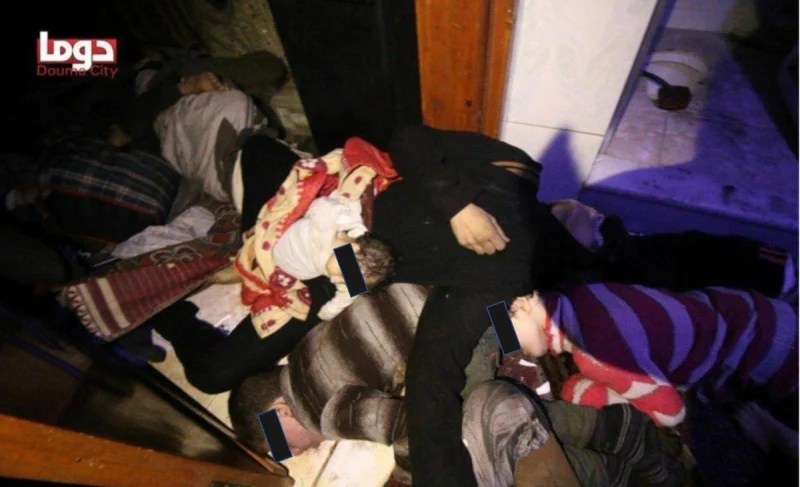
Image 1: In a photograph from Location 2, the dead victims are gathered in piles
The experts also pointed to “the onset of excessive frothing… observed in photos and reported by witnesses.” This was a reference to the images showing a profuse discharge of foam from victims’ mouths and noses. Some alleged witnesses interviewed by the OPCW also claimed that they saw the foaming develop quickly.
From the toxicologists’ point of view, such rapid foaming defied scientific logic. If the dead victims had been rapidly overcome by an incredibly high concentration of chlorine gas, there simply would not have been enough time for the foamy discharge observed on multiple bodies to develop.
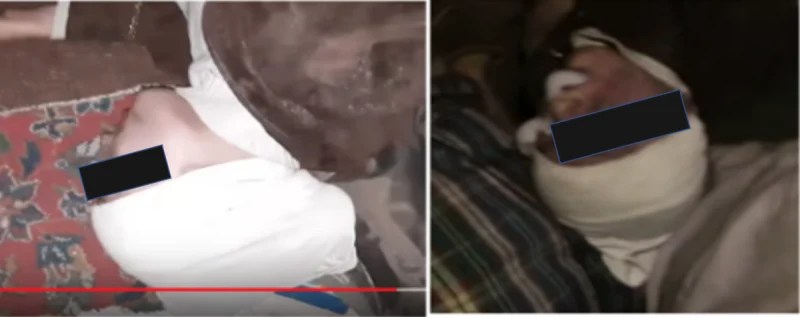
Image 2: A female victim displaying profuse foaming after her body had been moved
Accordingly, leaked minutes from that meeting state, “the experts were conclusive in their statements that there was no correlation between symptoms and chlorine exposure.”
The minutes, drafted by Douma team member Dr. Brendan Whelan, were approved by two other participants who had also traveled to Germany to meet with the toxicologists: Dr. Marc Blum, the Head of OPCW Laboratory; and Dr. Soumik Paul, the Head OPCW Health and Safety Branch. In a leaked email, Blum recalled that one of the Germans even raised “the possibility of a staged attack” in Douma because “the circumstances of death for the victims do not match chlorine.”
The OPCW leadership’s response to this conclusive assessment was to make it disappear. When the Douma team included the Germans’ input in their initial report, completed in late June 2018, senior officials went around them and erased all traces of it. The meeting itself was then memory-holed: in the OPCW Fact-Finding Mission’s (FFM) final report on Douma published in March 2019, a detailed timeline omits the team’s visit to Germany.
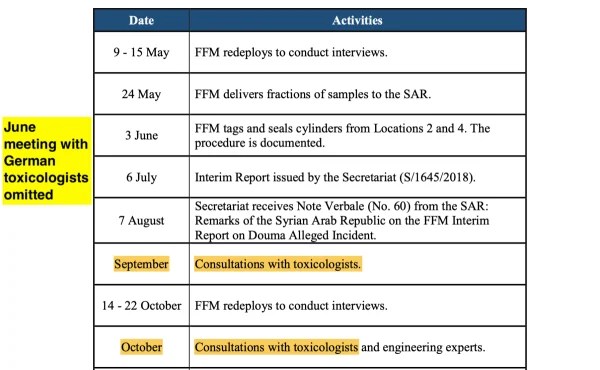
The “Mission Timeline” of the OPCW’s March 2019 Final Report omits the June 2018 mission to Germany, where expert toxicologists ruled out chlorine gas as the cause of death in Douma
The FFM’s March 2019 final report also revealed that after the German toxicologists’ findings were suppressed, the OPCW consulted five new toxicologists in September and October 2018. But oddly, no detail was provided on what these replacement toxicologists concluded, including on the key questions of how the victims could have been poisoned, and how the profuse frothing could have developed so rapidly.
Instead, the March 2019 report avoided these issues by stating that “it is not currently possible to precisely link the cause of the signs and symptoms to a specific chemical.” This ambiguous language obscured the fact that the German toxicologists initially consulted by the OPCW had unequivocally ruled out chlorine gas. What is certain is that the FFM report never claims that these five additional toxicologists contradicted the Germans whom they replaced. In fact, after noting that these five new experts were consulted, the FFM report made no further mention of them.
In a leaked April 2019 letter to the OPCW Director General, Dr. Whelan, the chief author of the Douma team’s censored original report, complained that the March 2019 final report had “shockingly omitted” the German toxicologists’ findings while evading any explanation for how the victims died from chlorine exposure. “To say that this selective use of expert opinions and facts is disturbing is an understatement,” Whelan wrote.
Challenged publicly to address the Douma probe’s suppressed findings, the long-awaited IIT report instead attempts to cover the OPCW’s tracks with more selective deceptions.
The cherry-picked cherry-picker
Just like the March 2019 FFM report, the IIT avoids the issues raised by the censored German experts entirely. But whereas the FFM stated that it was “not currently possible to precisely link” the Douma victims’ symptoms to chlorine, the IIT attempts to make it possible nearly four years later.
The IIT claims to have consulted a new “independent expert (toxicologist) not involved in previous assessments of the incident,” who concluded that the “symptoms of the victims are, overall, consistent with exposure to chlorine gas in very high concentrations.” No explanation is given for why the findings of this “new” and supposedly “independent” toxicologist should override those of the previously consulted experts. The IIT also does not present any additional evidence that would justify reversing the Germans’ conclusions.
The very fact that the IIT has declined to consult those experts from “previous assessments”– and present them with coherent counterarguments or fresh evidence, if it existed – suggests that the IIT sought out this one “new” assessment to overrule the inconvenient “previous” ones.
When this cherry-picked “independent expert” does make an assessment, more cherry picking ensues. Unlike the German toxicologists who based their assessment on both the images of the dead victims and the “symptoms and times of onset reported by” alleged witnesses, the IIT has limited the toxicologist’s scope of assessment to just the accounts of alleged witnesses.
The new toxicologist, the IIT states, was provided with “accounts and data from 55 individuals interviewed by either the FFM or by the IIT” and requested to “make their own evaluation of the reported symptoms” (emphasis added). The IIT tells us that “the toxicologist independently assessed the anonymised witness statements (obtained from affected persons or other eyewitnesses to the symptoms) against the symptoms that could be expected from chlorine exposure.” Ultimately, the toxicologist “reached the conclusion that the accounts of the victims and medical personnel were consistent with the rapid release of a high dosage of chlorine gas, which led to the rapid and high fatality rate documented at Location 2.”
Relying on witness accounts evades the central question of whether the frothing seen in videos was consistent with rapid chlorine poisoning. It also presumes that these accounts are reliable and have been corroborated, which there is no evidence of. And whereas the IIT claims that it “assessed the accounts, overall, to be consistent,” it omits that the Douma FFM’s initial investigators found those accounts to be anything but. In the interviews conducted in Syria and Turkey, the censored original report noted, “[t]wo broad and distinct narratives” emerged, one supporting the use of chemical weapons and the other not. Whose account was it then that was consistent with a “rapid release of a high dosage of chlorine gas”?
Even the reported symptoms from those cherrypicked witness accounts are themselves selectively assessed. When it comes to alleged witness accounts of what they observed at Location 2, nowhere in the IIT report is there any explicit mention of the “rapid and in some reported cases, immediate onset of frothing described by [alleged] victims,” as detailed in the FFM’s original censored report. There is thus no evidence that the reported rapid frothing formed part of the IIT toxicologist’s assessment. Instead, the IIT report informs us that: “Symptoms described by affected persons, rescuers, and treating medical personnel included shortness of breath, coughing, suffocation, dizziness, and skin irritation.” These symptoms all happen to match chlorine exposure; the omitted rapid frothing does not.
By focusing therefore only on the accounts of alleged witnesses – in particular, accounts from those who claimed there had been a chemical attack, and only those symptoms that are consistent with chlorine exposure – the IIT avoids answering the central question: whether the rapid onset of the profuse frothing observed in videos is consistent with exposure to chlorine.
Avoiding the inconsistency
In the few instances when the IIT’s toxicologist does appear to weigh in on the images of the foaming, they again deftly avoid the consistency question.
In a passage citing the toxicologist, the IIT states that “symptoms observed in affected persons, including miosis, skin discoloration, and oral and nasal foam-like secretions, are unlikely to have been as a direct result of ‘dust’ inhalation.”
No one has ever claimed that “dust inhalation” was the cause of the Douma victims’ observed miosis and “foam-like secretions.” Why then has the IIT’s toxicologist gone out of their way to rule out “dust inhalation” as the cause of the victims’ foam-like secretions, but failed to tell us whether these foam-like secretions could have been caused by chlorine gas? The most likely reason is that the IIT did not want its toxicologist to answer that question.
In another passage, the IIT notes that “imagery and videos” from Location 2 showed “clear signs of corneal opacity, discoloration of the skin, white/off-white foam-like oral and nasal secretions and miosis.” Yet rather than tell us whether those observed foam-like secretions are consistent with chlorine gas, the IIT again avoids an answer. Instead, the report only states that “the specialists consulted by the IIT confirmed that the reported and observed symptoms of oral opacity are typically caused by… exposure to a high concentration of chlorine gas.” (emphasis added) Given its omission, these same specialists have not confirmed that the observed “foam-like oral and nasal secretions” can be caused by exposure to chlorine gas.
On another occasion, the IIT — notably, not the toxicologist — does manage to explicitly state that the “rapid onset of symptoms… observed in videos and pictures” for “fatalities recorded on the stairs and landings” (emphasis added) at Location 2 are consistent with a “high and lethal volume of chlorine gas.”
Given that foaming was seen in videos and photos, the IIT report leaves the impression that it is referring to those “symptoms.” But in the images from the “stairs and landings” at the apartment building, none of the three dead victims show any frothing. This allows the IIT to create a false suggestion that the foaming seen in the videos is consistent with chlorine exposure. In reality, the IIT is weighing in on images where no foaming can be observed, but that readers would unlikely check.
In another rare instance where it makes any reference to foaming, the IIT states that chlorine gas can lead “to the oral and nasal secretion of a foam-like substance.” That chlorine gas can cause a “foam-like substance” is not in question: the censored original report noted that “excessive frothing from the mouth” has been “reported in cases of exposure to lethal doses of chlorine gas.” But with this uncontroversial claim, the IIT is again avoiding the issue raised by the original report, based on the findings of the German toxicologists, that the “rapid, and in some reported cases, immediate onset of frothing described by victims is not considered consistent with exposure to chlorine-based choking or blood agents.”
Suppressing science, denying justice
Left with the scientifically unfounded scenario in which chlorine gas caused immediate profuse foam discharge from the victims, the IIT has resorted to deceptive claims that no recognized expert in toxicology has been willing to support. Accordingly, beyond the US and its allies’ bombing of Syria on unsupported grounds and the co-option of the OPCW to whitewash it, the core crime in Douma remains unexplained.
In April 2018, dozens of slain civilians were photographed in that apartment building. Images of their lifeless bodies stirred global outrage. Approaching the fifth anniversary of this horrific incident, the chemical weapons watchdog tasked with investigating their deaths continues to bury its own findings and present a baseless explanation for what occurred. So long as the OPCW continues to suppress the science, 43 Douma victims and their families will remain without justice.
————
Thank you to Dr. Piers Robinson for his input on this article. https://berlingroup21.org/.
Links:
Syria reasserts its right to restore its sovereignty over Israeli-occupied Golan
Press TV – March 30, 2023
Syria has reasserted its “inalienable right” to restore its sovereignty to the Israeli-occupied Syrian territory of the Golan Heights, denouncing the US’s support for the regime that has emboldened it to prolong the occupation.
Syria’s permanent representative to the United Nations Office in Geneva, Ambassador Haider Ali Ahmed made the remarks, addressing a session of the Human Rights Council on the situation in the Middle East, the official Syrian Arab News Agency (SANA) reported on Wednesday.
The Israeli regime seized the Golan Heights from Syria during the 1967 Six-Day War and later occupied it in a move that has never been recognized by the international community. The regime has built dozens of settlements in the area ever since and has been using the region as a launch pad for its military operations against the Arab country.
“Israel commits a war crime by building colonies and settlements in the occupied Syrian Golan, and its colonization plans have witnessed an escalation since the end of 2021, when it announced the doubling of the number of settlers in the Golan over a period of five years,” the Syrian envoy said.
Ahmed also pointed to a plan by the occupying regime to install wind turbines in Golan, saying the scheme proved Tel Aviv’s intransigence in keeping up its colonial and racist practices in the Syrian territory.
“The time has come to start taking concrete steps to put an end to the Israeli regime’s occupation of Arab lands, which comes as a result of the support that the US and other countries provide to the Israeli occupation entity,” added the Syrian diplomat.
The United States has proven the Israeli regime’s biggest and most dedicated ally since 1948, when the regime claimed existence after occupying huge expanses of regional territories during a similar war.
With a cast-iron resolve, Washington has invariably provided sustained arms, logistical, and political support for Tel Aviv that has encouraged it to sustain the occupation and keep up its near-daily deadly crimes against the peoples of the occupied territories, foremost among them the Palestinians.
The Syrian official said the US’s continuing to provide this support despite the horrible crimes served as the greatest evidence of Washington’s contempt for the provisions of international law, the United Nations Charter, and international resolutions.
US is stirring up the Syrian cauldron
BY M. K. BHADRAKUMAR | INDIAN PUNCHLINE | MARCH 26, 2023
The circumstances surrounding the flare-up in Syria between the US occupation forces and pro-Iranian militia groups remain murky. President Biden claims that the US is reacting, but there are signs that it is likely being proactive to create new facts on the ground.
The US Central Command claims that following a drone attack on March 23 afternoon on an American base near Hasakah, at the direction of President Biden, retaliatory air strikes were undertaken later that night against “facilities used by groups affiliated with Iran’s Islamic Revolutionary Guards Corps.”
However, this version has been disputed by the spokesman of Iran’s Supreme National Security Council who accused Washington of “creating artificial crises and lying.” The Iranian official has alleged that “Over the past two days, American helicopters have carried out several sorties with the aim of increasing instability in Syria and transferred Daesh (Islamic State) terrorists in the territory of this country.”
He said Washington must be held accountable for such activities. The official warned that Tehran will give a prompt response to any US attack on whatever false pretext against Iranian bases that exist on Syrian soil at the request of Damascus for fighting terrorism.
Is the US deliberately ratcheting up tensions in Syria even as the China-brokered Saudi-Iranian rapprochement is radically changing the security scenario in the West Asian region in a positive direction?
There is optimism that Syria stands to gain out of Saudi-Iranian rapprochement. Already, the Saudi Foreign Ministry revealed on Thursday that talks are going on with Syria for resuming consular services between the two countries, which will pave the way for the resumption of diplomatic relations and in turn make it possible to reinstate Syria’s membership of the Arab League.
Saudi Arabia has established an air bridge with Syria to send relief supplies for those affected by the devastating earthquake in February.
The backdrop is that the normalisation of relations between Syria and its estranged Arab neighbours has accelerated. It must be particularly galling for Washington that these regional states used to be active participants in the US-led regime change project to overthrow the government of President Bashar al-Assad. The Saudi-Iranian rapprochement badly isolates the US and Israel.
From such a perspective, it stands to reason that the US is once again stirring up the Syrian cauldron. Lately, Russian aircraft have been reported as frequently flying over the US’s military base At Tanf on the Syrian-Iraqi border where training camps for militant groups are known to exist.
Israel too is a stakeholder in keeping Syria unstable and weak. In the Israeli narrative, Iran-backed militia groups are increasing their capability in Syria in the last two years and continued US occupation of Syria is vital for balancing these groups. Israel is paranoid that a strong government in Damascus will inevitably start challenging its illegal occupation of Golan Heights.
A key factor in this matrix is the nascent process of Russian mediation between Turkiye and Syria. With an eye on the forthcoming presidential and parliamentary election in Turkiye in May, President Recep Erdogan is keen to achieve some visible progress in improving the ties with Syria.
Erdogan senses that the Turkish public opinion strongly favours normalisation with Syria. Polls in December showed that 59 percent of Turks would like an early repatriation of Syrian refugees who are a burden on Turkish economy, which has an inflation rate of 90 percent.
Evidently, Turkiye is ending up as a straggler when the West Asian countries on the whole are coasting ahead to normalise their relations with Damascus. But the catch is, Assad is demanding the vacation of Turkish occupation of Syrian territory first for resuming ties with Ankara.
Now, there are growing signs that Erdogan may be willing to bite the bullet. The consummate pragmatist in him estimates that he must act in sync with the public mood. Besides, the main opposition party CHP always maintained that an end to the Syrian conflict needs to be anchored firmly on the principles of Syria’s unity and territorial integrity.
The influential Beirut newspaper Al-Akhbar has reported citing sources close to Damascus that Erdogan is weighing options that would meet Assad’s demand with a view to restore relations. The daily reported that one possibility is that Turkiye may propose a timetable for the withdrawal of its troops in Syria.
Significantly, Erdogan telephoned Russian President Vladimir Putin on Saturday and the Kremlin readout mentioned that amongst “topics concerning Russian-Turkish partnership in various fields,” during the conversation, “the Syrian issue was touched upon, and the importance of continuing the normalisation of Turkish-Syrian relations was underlined. In this regard the President of Türkiye highlighted the constructive mediatory role Russia has played in this process.”
Earlier, on Wednesday, Turkish Defense Minister Hulusi Akar held telephone talks with his Russian counterpart Sergei Shoigu to discuss developments in Syria where he underscored that the “sole purpose” of its deployment in northern Syria is to secure its borders and fight terrorism.
It is entirely conceivable that Erdogan has sought Putin’s help and intervention to reach a modus vivendi with Assad quickly. Of course, this is a spectacular success story for Russian diplomacy — and for Putin personally — that the Kremlin is called upon to broker the Turkish-Syrian normalisation.
The China-brokered Saudi-Iranian normalisation hit Washington where it hurts. But if Putin now brokers peace between two other rival West Asian states, Biden will be exposed as hopelessly incompetent.
And, if Turkiye ends its military presence in Syria, the limelight will fall on the US’ illegal occupation of one-third of Syrian territory and the massive smuggling of oil and other resources from Syria in American military convoys.
Furthermore, the Syrian government forces are sure to return to the territories vacated by Turkish forces in the northern border regions, which would have consequences for the Kurdish groups operating in the border region who are aligned with the Pentagon.
In sum, continued US occupation of Syria may become untenable. To be sure, Russia, Turkiye, Iran and Syria are on the same page in seeking the vacation of US occupation of Syria.
Thus, an alibi is needed for the US to justify that although dialogue and reconciliation is in ascendance in West Asian politics, Syria is an exception as a battleground against “terrorism.” The US is vastly experienced in using extremist groups as geopolitical tools.
The US’ real intention could be to confront Iran on Syrian soil — something that Israel has been espousing — taking advantage of Russia’s preoccupations in Ukraine. The Russian-Iranian axis annoys Washington profoundly.
The spectre that is haunting Washington is that the stabilisation of Syria following Assad’s normalisation with the Arab countries and with Turkiye will inexorably coalesce into a Syrian settlement that completely marginalises the “collective West.”
In retrospect, the unannounced visit by General Mark Milley, chairman of the US Joint Chiefs of Staff to northern Syria in early March falls into perspective. Milley told reporters traveling with him that the nearly eight-year-old US deployment to Syria is still worth the risk!
The time may have come for the militants, including ex-Islamic State fighters, who were trained in the US’s remote At Tanf military base to return to the killing fields for “active duty.”
Tass reported that on Friday, the terrorist group known as Hayat Tahrir al-Sham tried to break into the Aleppo region which has been under Syrian government control and relatively stable in the recent years.
US attack on Syrian army leaves several dead, occupation base bombed in response
The Cradle | March 24, 2023
The US occupation base in northeastern Syria’s Al-Omar oilfield was attacked with rockets on 24 March, just hours after the US army bombed several locations in the eastern city of Deir Ezzor on Thursday night.
The US bombing was in response to a drone strike on its base in northeastern Hasakah’s Kharab al-Jir military airport, which killed a US contractor and injured several others, CENTCOM said in a statement on Friday.
“This evening, we responded to an attack on our forces that killed an American contractor and wounded our troops and another American contractor by striking facilities used by groups affiliated with Iran’s Islamic Revolutionary Guards Corps,” CENTCOM said.
“We will always take all necessary measures to defend our people and always respond … We are postured for scalable options in the face of any additional Iranian attacks,” it added.
According to the London-based Syrian Observatory for Human Rights (SOHR), eleven ‘Iranian-backed militiamen’ were killed in the US strikes. SOHR claims that six were killed in strikes on a weapons depot in Deir Ezzor’s Harabish neighborhood, three were killed in strikes on the Al-Bukamal desert, while two were killed by strikes on the southern outskirts of Al-Mayadin town.
SOHR adds that among the wounded are serious injuries, and the death toll is expected to rise.
“Among the dead are two of Syrian nationality,” SOHR says. However, Iranian news outlet Press TV alleged that no Iranians were killed in the strike. Press TV cited local sources as saying that the strike on the Harabish neighborhood was against a rural development and grain center, not a weapons depot, adding that those who were killed were Syrian military forces.
US strikes have targeted and killed Syrian Arab Army (SAA) soldiers several times in the past, including in April 2018 after an alleged chemical attack in Douma that was attributed to the Syrian government.
The last US strike on alleged Iranian targets in Syria took place in 2022 and left a number of Syrian soldiers dead.
The US military occupation in Syria is illegal under international law and constitutes a clear violation of the country’s sovereignty.
As a result of this occupation, as well as the US army’s continuous looting of Syrian natural resources, attacks against Washington’s military bases in Syria have become regular occurrences.
Despite this, the US has shown no intent to end its presence in the country. At the start of the month, a US general illegally visiting Syria referred to the occupation as ‘worth the risk.’
Turkiye ‘reviewing options’ for Syria withdrawal: Report
The Cradle | March 23, 2023
Lebanese daily Al-Akhbar released a report on 23 March claiming that Turkiye is willing to make concessions regarding the fate of its military presence in Syria, and is reviewing options to set a timeframe for the withdrawal of its troops from the country.
This comes in light of Damascus’ repeated insistence that the continuation of normalization efforts between the two countries depends on this condition.
“Turkish officials are studying, at the present time, several options regarding the fate of the Turkish military presence in Syria and the possibility of setting a schedule to end it in connection with field, humanitarian and political developments,” Syrian opposition sources told Al-Akhbar.
According to these sources, Turkiye will present proposals on this matter to Russian and Iranian mediators and is hoping that Tehran and Moscow will be able to act as “guarantors” to convince Syria that Ankara will properly implement any agreement that is reached, “whatever the results of the Turkish presidential elections.”
Damascus said in January that Turkish President Recep Tayyip Erdogan is using the reconciliation with Syria as a ploy to secure himself in the upcoming election in Turkiye. Many have reinforced this, alleging that Erdogan wishes to use the normalization to portray himself as a champion in diplomacy, and as the solver of the Syrian refugee crisis in Turkiye.
Since the devastating earthquake that struck Turkiye and Syria at the start of last month, Erdogan’s chances at reelection have slimmed, according to the most recent polls.
Russia is currently working to set a date for a four-way meeting between the foreign ministers of Ankara, Damascus, Moscow, and Tehran, aimed at moving forward with the reconciliation. However, this meeting has so far failed to materialize, given Syria’s insistence on clear Turkish concessions.
According to Al-Akhbar, Turkiye’s newfound willingness to concede on the issue of its military presence is the reason behind the Turkish foreign minister’s latest claim that the meeting could be held “within days.”
US continues to use terrorists in Syria – Russia
RT | March 20, 2023
The US is still working with Islamic State terrorists and other Islamist groups to carry out attacks against Bashar Assad’s government forces in Syria, Russia’s Foreign Intelligence Service (SVR) chief, Sergey Naryshkin, has claimed.
According to an SVR report released on Monday, the US military’s Al-Tanf base in southern Syria is coordinating subversive activities, with the actions of terrorist groups being planned by representatives of the Central Command of the US Armed Forces as well as US intelligence officers.
The SVR stated that a special role has been assigned to the so-called Free Syrian Army, which consists of Kurdish and Arab detachments operating in the central and northeast parts of Syria. “Through them, the Americans and their British allies are working with the underground formations of Islamic State [IS, formerly ISIS] that still remain in remote areas of the country,” it was alleged.
“ISIS was instructed to incite hostilities in the Syrian south-west (the provinces of Suwayda and Deraa), in the central part of the country (Homs) and east of the Euphrates River (Raqqa, Deir ez-Zor). For this, it is planned to form several detachments of radicals with a total number of about 300 people. After special training, they will be involved in attacks on military facilities in Syria and Iran,” the statement added.
The SVR claims that the US also intends to use terrorists in the region around the capital, Damascus, to conduct tasks such as kidnapping Russian and Iranian servicemen.
In addition to coordinating the actions of Islamist groups, Washington is providing terrorists with weapons, according to the SVR. Several dozen four-wheel-drive pickup trucks with heavy machine guns, as well as a number of rocket systems such as NLAW ATGMs, TOWs, and Igla MANPADS are set to be handed over to fighters in the near future, the report alleged.
Washington’s actions put it “on the same level” as Islamic terrorists and IS militants, and is a manifestation of state terrorism, the SVR argued.
In February, the SVR reported that the US was using Islamist extremists to plan terrorist attacks in Russia and former Soviet republics. Washington has been training as many as 60 terrorists at the Al-Tanf base to make improvised explosive devices and use them to target diplomats, public officials, law enforcement officers, and military personnel, the intelligence service claimed.
How does the China-brokered Saudi-Iranian normalization affect Israel?
By Robert Inlakesh | RT | March 17, 2023
A key goal of both the Israeli and American governments is to foster the normalization of ties between Israel and Saudi Arabia, and part of the strategy to make this happen was to unite the two against what has been depicted as a common enemy, Iran. The Saudi-Iranian rapprochement now appears to have thrown a spanner in the works of such efforts, and hence enraged the Israelis.
After five rounds of talks throughout the span of two years, Iran and Saudi Arabia were unable to reach a compromise for the re-establishment of diplomatic ties, something China has now managed to broker in a shocking turn of events. Based upon the long rivalry between Tehran and Riyadh, US and Israeli policy towards Saudi Arabia has been based on combating a common enemy shared between all sides. Although the US government itself has not reacted with open animosity to the sudden change in regional dynamics, the Israelis are publicly interpreting this as a negative development.
In June 2022, the Wall Street Journal reported that a previously undisclosed meeting had taken place in Sharm el-Sheikh, Egypt, whereby a number of Arab nations, including Saudi Arabia, had met with the Israeli military chief of staff at the time, Aviv Kochavi. Part of the discussions that took place was allegedly geared towards forming an Israeli-Arab defense alliance. Although no such alliance was formed, it was largely speculated at the time that US President Joe Biden’s visit to both Israel and Saudi Arabia the following month would include discussions on this topic. Despite the failure of the US and Israel so far to put together such an alliance, it is clear that part of the strategy for achieving normalization has been to secure defense interests.
Across the Israeli political spectrum, from both the coalition government and opposition, finger pointing has been taking place, in attempts to pin the blame for the perceived failure of Israel to prevent Saudi-Iranian normalization. Israeli Prime Minister Benjamin Netanyahu has attempted to shift the blame onto the former government, an idea refuted by former Israeli Mossad head Efraim Halevy as “factually incorrect.” On the other hand, former Israeli PM Naftali Bennett has called the agreement “a serious and dangerous development for Israel.” Yair Lapid, another former PM and current leader of the opposition, also said it is an “utter and dangerous failure of the Israeli government’s foreign policy.”
The big question now is whether the Chinese-brokered normalization agreement will negatively impact potential normalization between Israel and Saudi Arabia. Reuters reported that, according to an unnamed senior Israeli official, the Saudi-Iranian deal will have no significant impact on Israeli-Saudi relations. It is also not clear whether the agreement has any clauses to do with Israeli normalization. According to Carmiel Arbit from the Washington-based Atlantic Council, the Saudis could be attempting to conduct a balancing act the way the United Arab Emirates has. The UAE, which signed its own normalization deal with Israel in 2020, has since 2019 managed to de-escalate tensions with Iran and is currently maintaining cordial ties with both sides.
It is not clear, however, whether the model of Abu Dhabi will be applicable for the Saudis. Riyadh, simply put, has a lot more to lose than the Emiratis, due to its wide regional entanglements and domestic constraints, and hence it has chosen to maintain a distance from the Israelis at this time. The internal political crisis in Tel Aviv may also play a crucial role in the Saudi decision to push forward with the normalization of ties with Iran, as instability within Israel, coupled with a potential escalation in the conflict with the Palestinian people, could severely hinder a formal diplomatic breakthrough.
One crucial result of Saudi-Iranian normalization, however, is not necessarily to do with Israel’s own relations with the Saudis. Combating Iran, specifically its nuclear program through coercive measures, is an active policy position on both sides of the political divide in Israel. Netanyahu placed the issue of combating Iran, even through direct force, at the forefront of his campaign to win the election late last year. Throughout the past unity coalition of Bennett and Lapid, the anti-Iran position also proved a cornerstone of Israeli regional policy.
Performing aggressive actions, such as a direct attack against Iranian nuclear facilities, could now be much more difficult for the Israelis to pull off, with Saudi Arabia taking a non-combative approach to Iran. Although the nuclear issue is perhaps the most pervasive issue for the Israeli public, Iran’s regional alliances and defense programs are the true threats posed to Israel. If Saudi-Iranian ties are able to flourish and the Chinese-brokered deal holds, this could mean that Riyadh’s efforts in Lebanon against Hezbollah could be curtailed, and this surely represents a concern for Israel.
Iran, through its relationships with regional political parties, governments, and localized militia forces, also possesses the ability to pull strings that could benefit Saudi Arabia if it reciprocates by doing the same. This is especially the case when it comes to the conflict in Yemen. One thing that Ansarallah, also known as the Houthis, have been able to prove in their efforts against the Saudi-led coalition since 2015 when the war began, is that they are capable of overcoming US-made defense equipment. Iran, as a close ally of Ansarallah, could aid in setting up a long-term truce or even lasting peace, which the likes of the US simply cannot offer. To end this war would be in the security interests of the Saudis, who will undoubtedly suffer if the violence resumes, especially if missiles and drones begin striking their vital infrastructure again.
Just as Beijing proved capable of fostering Saudi-Iranian normalization, Tehran could offer the ability to properly negotiate a peaceful solution in Yemen. However, it is simply too early to tell whether such a development will take place. What the deal undoubtedly does is prove the weakness in Israel’s regional capabilities, along with the waning influence of the US. Israel’s security concerns regarding Syria and Lebanon may be heightened if the Chinese-brokered agreement delivers a more peaceful approach inside both of these nations. Saudi Arabia could also re-establish ties with the Syrian government, as the UAE has already done, which could help Damascus on the road to recovery from its brutal war and current state of economic ruin. A strong and united Syria could in the future also pose a strategic threat to Israel. While Saudi-Israeli normalization is by no means off the table, the Saudi-Iranian agreement could pose a serious challenge regionally for Israel’s current policy approach.
Robert Inlakesh is a political analyst, journalist and documentary filmmaker currently based in London, UK. He has reported from and lived in the Palestinian territories and currently works with Quds News.
In a US-China confrontation, West Asia will bow out
By F.M. Shakil | The Cradle | February 24 2023
The prospect of a US-China war has entered the realm of reality. Increased provocations from US military and political officials regarding the status of Taiwan – which China considers to be part of its historic territory – have heightened the possibility of confrontation in recent years.
With only 13 out of 193 UN member states recognizing the government in Taipei as a separate entity, the global community’s reaction to a Washington-led assault over Taiwan’s status remains highly uncertain.
Today, the reaction of strategic West Asia to a hypothetical conflict between the two superpowers is up for grabs. However, given the region’s reluctance to take sides in the Russian-US stand off, it is likely to be equally hesitant to do so in the event of a US-China conflict.
In a memo released on 27 January, US General Mike Minihan, chief of the Air Mobility Command, wrote: “My instinct tells me we will fight in 2025.” General Minihan’s views align with Taiwanese Minister of National Defense Chiu Kuo-cheng’s statement in 2021 that China will be capable of launching a full-scale invasion of Taiwan by the same year.
In response to General Minihan’s remarks, Mike McCaul, chairman of the US House Representatives’ Foreign Affairs Committee, told Fox News: “I hope he is mistaken but I believe he is correct.” Adding fuel to the fire, US Senate Majority Leader Mitch McConnell said on 29 January, “The chances of conflict in the relationship with China over Taiwan are very high.”
A lot of hot air
Days after the US general issued a warning that Washington may engage in combat with Beijing in the next two years, tensions between the two countries were further exacerbated by the spoof-worthy Chinese spy balloon incident.
According to some senior Republicans and US military leaders, there is a growing concern that a full-scale conflict between the two superpowers is imminent, with the Asia-Pacific (AP) and South Asia (SA) regions likely to be the primary theaters of the conflict.
Jan Achakzai, a geopolitical analyst and former adviser to Pakistan’s Balochistan government, tells The Cradle that:
“The possibility of a war between the United States and China puts everyone on edge, especially the regions that are intricately linked with the US or China. Some nations will be compelled to choose between allying with the US in the case of war or keeping the status quo to lessen the possibility of hostilities.”
Russian involvement in West Asia
Despite nominal trade and geopolitical relations with Moscow, West Asian countries did not support Washington’s position in the conflict between Russia and Ukraine. However, Russia’s veto power at the UN Security Council does have a positive impact on its relationship with regional states, particularly for its ability to prevent expansionist and anti-Arab policies by other permanent council members.
Security and trade remain the two primary pillars of the relationship between Moscow and West Asia, and Russian President Vladimir Putin’s image has played a significant role in shaping these ties.
The UAE serves as a major financial hub for Russia, and Moscow may attempt to leverage its influence in the region to urge the UAE to reconsider US-imposed banking restrictions, if it feels that its interests are being compromised.
In addition, Algeria, Tunisia, Libya, Lebanon, and Egypt are among the countries that purchase wheat from Russia, which further solidifies economic ties between Russia and the Arab world.
Moreover, since joining the expanded Organization of the Petroleum Exporting Countries (OPEC+) in 2016, Russia and Saudi Arabia have worked closely to regulate oil output and price adjustments as part of OPEC+ agreements.
Putin’s public image has, in part, contributed to a surge in support for Russia in the kingdom. In 2018, when Riyadh faced international criticism over the Saudi-orchestrated murder of journalist Jamal Khashoggi, the Russian president made headlines by high-fiving and grinning at the then-isolated Saudi Crown Prince Mohammed bin Salman (MbS) during the G20 summit in Argentina.
Likewise, his prominent role in thwarting the NATO proxy war in Syria – a geopolitical game changer that, arguably, ushered in global multipolarity – has gained Putin fans across a region that has long suffered from western imperialist designs.
Where will West Asia stand?
Although still a hypothetical scenario, it is worth considering how West Asia would respond to a direct US-China conflict. Many prominent geopolitical analysts have speculated that if West Asia, and particularly the traditionally pro-US Arab states of the Persian Gulf, did not toe the US line against Russia – a significantly smaller regional trading partner than China – its loyalties to Washington in a potential US-China confrontation could be further strained.
Compared to Russia, China has significantly larger investments throughout West Asia. In 2021, bilateral trade between Beijing and the region amounted to $330 billion, with approximately 50 percent of China’s energy supply coming from the energy-abundant Persian Gulf.
China has conducted over $200 billion in trade alone with Saudi Arabia and the UAE. From 2005 to 2021, Beijing invested $43.47 billion in Saudi Arabia, $36.16 billion in the UAE, $30.05 billion in Iraq, $11.75 billion in Kuwait, $7.8 billion in Qatar, $6.62 billion in Oman, and $1.4 billion in Bahrain.
In addition to its investments in trade and energy, China has also invested enormous sums of money in West Asian and North African infrastructure and high-tech development projects via its multi-trillion dollar Belt and Road Initiative (BRI).
Beijing has entered into strategic cooperation agreements with Saudi Arabia, the UAE, Algeria, Egypt, and Iran, and has enlisted a total of 21 Arab nations in its ambitious, decade-long effort to revive the historic Silk Road and export its goods to markets throughout Europe and Africa. Currently, infrastructure developed by Persian Gulf nations serves as a transit point for two-thirds of Chinese exports to these continents.
Egypt is a crucial hub for the BRI, with the Economic-Technological Development Area in Egypt’s Suez Canal Economic Zone, near Ain Sokhna, representing one of the major projects for which the two nations signed contracts totaling $18 billion in 2018.
Iraq, the third-largest oil supplier to China after Saudi Arabia and Russia, has also received $10.5 billion from Beijing for BRI-related energy projects, and just this week, agreed to replace its dollar trade with Beijing for the Chinese yuan.
In West Asia, the US plays second fiddle to Beijing
Chinese collaboration with West Asia and North Africa is not confined to trade and economy; Beijing also provides defense equipment to several Arab nations. Since 2019, China and Saudi Arabia have reportedly collaborated on the production of ballistic missiles, and China also sells Saudi Arabia its HQ-17AE air defense system.
Chinese Wing Loong drones have been purchased by the UAE, and Iraq has placed an order for CH-4B drones. Jordan purchased CH-4Bs in 2016, while Algeria acquired CH-5s – the next generation of the CH-4B type – to expand its aviation capabilities in 2022. In addition, Saudi Advanced Communications and Electronics Systems Co. and China Electronics Technology Group are partnering to build a drone factory for local UAV production.
While US President Joe Biden’s administration’s relationship with Riyadh has been strained due to disagreements over human rights and energy policy, China is making significant strides in strengthening its ties with the country.
As Beijing draws closer to Saudi Arabia, the message to Washington from Riyadh is unambiguous: “The people in the Middle East [West Asia] are tired of other countries’ interference because they always come with troubles.”
Chinese President Xi Jinping received a royal welcome in Riyadh last December, marking a seismic shift in Sino-Arab relations and boosting China’s image throughout the Arab world. In contrast, US President Joe Biden’s visit to Jeddah in the summer of 2022 received a lukewarm reception. This may suggest that a recalibration of West Asian geopolitical alliances may be on the horizon.
Despite these trends, analyst Achakzai tells The Cradle that West Asia will behave similarly to the way it did during the Russian-Ukrainian conflict – even given China’s increasing business and military presence in the region and the US’s declining control over the oil-rich Arab monarchies.
“Depending on the current situation, the motives of the various states in the region may change and divide into two distinct groups: those who would support the US and those who would support a neutral position.”
China values economy over war
In the Asia-Pacific region, the US and its allies are engaged in a contentious relationship with China regarding maritime boundaries, international trade, human rights, and strategic security issues. Despite signing numerous security pacts with regional players, China appears to prioritize building and strengthening economic ties over military cooperation with Asian-Pacific states.
Due to a history of hostile confrontations and divergent geopolitical objectives, both the US and China seek to increase their military presence in the region. In response to China’s territorial claims in the South China Sea, the US has expanded its military footprint by signing commercial and defense agreements with the Asia-Pacific region.
The two nations have also been at odds over the Trans-Pacific Partnership (TPP), which many viewed as an effort to contain China’s economic and strategic influence in its own backyard. Additionally, tensions have escalated between Beijing and its neighbors, particularly over territorial disputes in the East and South China Seas.
These efforts have been emboldened by the 5-member Quadrilateral Security Dialogue (Quad), which is an informal strategic dialogue between the US, India, Japan, and Australia that seeks “to promote a free, open, and prosperous Indo-Pacific region.” According to Achakzai:
“Countries that have extensive defense agreements with the US, such as Japan, South Korea, and Australia, are most likely to help America. These nations, which have long benefited from their close connections to the US, must now contend with Chinese territorial ambitions in the region and the South China Sea. The nations having an informal security partnership with the US, such as the Philippines, are likely to back the United States in a confrontation.”
The analyst explained that Singapore, Thailand, and Malaysia are expected to remain neutral during the conflict due to their strong business and investment ties with China.
“Other countries in the Asia-Pacific region may feel obligated to support the US if China initiates the conflict. This may apply to countries like Indonesia and Vietnam, which have recently been under Chinese pressure and may need to choose a side to protect their own security,” he noted.
Time for US Pull-Out: GOP Congressman Warns About Risk of Kinetic Conflict With Russia in Syria
By Ekaterina Blinova – Sputnik – 23.02.2023
GOP Representative Matt Gaetz has introduced a resolution seeking to direct President Joe Biden to remove all US troops from Syria. The House must vote on Gaetz’s proposal within 18 days of its introduction due to the bill’s war powers status.
“[T]he purpose of my legislation is to force members of Congress to vote on record regarding whether they think we ought to continue Obama’s war in Syria. President Obama kicked off our involvement (…) and now we still find ourselves in the middle of a Syrian civil war with Russia and Turkey and Iran, all present in a very confined neighborhood,” Congressman Matt Gaetz, R-Fla., told the US press earlier this week.
Gaetz, a House Armed Services Committee member, filed the War Powers Resolution on February 22 after he learned that four US military servicemen and a working dog were wounded in a US and Syrian Democratic Forces (SDF) helicopter raid in northeastern Syria.
Speaking to the US press, Gaetz shared his concerns with regard to the US president’s ability to handle Syrian matters. The congressman quoted Biden’s August 2021 interview in which the president claimed that the US “[doesn’t] have military in Syria to make sure that we’re going to be protected.” However, according to the American media at the time of Biden’s comment, there were at least 900 troops in Syria who were helping their SDF proxies on the ground.
Gaetz has also drawn attention to reports alleging that Russian and US personnel get into very close proximity with one another. “[T]he risk of an accident or miscalculation or just misuse of authority could lead to direct kinetic conflict between the United States and Russia in Syria,” the lawmaker insisted.
In addition, Congress has never authorized the use of military force in Syria, the congressman argued. “America First means actually putting the people of our country first — not the interests of the military industrial complex,” he said.
Gaetz’s resolution has been filed under the War Powers Act of 1973, which was designed to limit the president’s authority to wage war and reasserted Congress’ authority over foreign wars. Notably, at the time of the 1973 bill’s introduction, then President Richard Nixon tried to veto it. However, Congress overrode his veto, and the resolution became law following the US pullout from Vietnam in early 1973.
If Gaetz’s legislative initiative passes, US military personnel must be removed from the Syrian Arab Republic within 15 days.
Meanwhile, the lawmaker lamented the fact that Democratic progressives who used to be anti-war activists have become “cheerleaders” for the US’s overseas conflicts. “‘The Squad’ used to be anti-war. Now, they’re waving their pom poms for NATO,” he said.
The representative believes that the upcoming vote on his resolution will show who the real patriot of America is and who continues to stick to Middle Eastern adventurism.
Biden’s predecessor, Donald Trump, was the first who sought to pull US troops out of Syria. Nonetheless, he later insisted that some of the contingent should stay in place to “protect” the Syrian oil fields occupied by the US-backed Kurdish-dominated SDF. Trump was also misled about the actual number of US servicemen in Syria. US Syria envoy Ambassador Jim Jeffrey admitted in November 2020 he was “always playing shell games to not make clear to our leadership how many troops we had there.”
Leaked files reveal Britain’s ambulances aided terrorists in war-torn Syria
By Kit Klarenberg | Press TV | February 20, 2023
On February 6, Syria and Turkey were rocked by devastating back-to-back earthquakes. Ever since, people in these countries and the region have been subjected to a particularly merciless – yet illuminating – crash course in Western double standards on humanitarian aid.
While aid and assistance have flowed into Istanbul and Damascus from all neighbors, initially many governments were reticent to dispatch anything at all to Syria, because US and EU sanctions made it illegal for planes to land in its airports.
It meant that those eager to provide humanitarian assistance could not dispatch it, for fear of dire repercussions. Such concerns were well-founded. Washington enforces sanctions with an iron fist, and any individual or state breaching them faces severe penalties.
Giving in to intense global public pressure, the US Treasury on February 10 enacted a 180-day waiver on certain sanctions imposed on Syria, to allow for vital earthquake relief to reach the country.
Still, neither Washington nor its constellation of international allies has provided any meaningful assistance to Damascus whatsoever, despite the death toll in the country grimly ratcheting daily.
Meanwhile, Israeli regime officials expressed the readiness to bomb Iranian aid deliveries arriving by land. And, in the end, they ended up bombing the people still recovering from the shock of a colossal human tragedy.
Complicating matters further, terrorist groups that still occupy portions of Syrian territories, such as Hayat Tahrir al-Sham (HTS) in the northwest, are blocking the government’s attempts to distribute provisions, a spokesperson for HTS in Idlib telling Reuters no shipments would be permitted to pass its checkpoints, on the basis, “we won’t allow the regime to take advantage of the situation to show they are helping.”
These pockets crisscross the country, an enduring and shameful legacy of the West’s failed decade-long dirty war against Damascus.
Almost never acknowledged by the mainstream media, their continued presence is particularly relevant to consider now, for they are relics of a time when the Western world was only too eager to invest vast sums to flood Syria with medical aid, albeit in service of “regime change”.
Healthcare as psychological warfare
In August 2016, a remarkable and never-before-disclosed covert British intelligence operation began near Amman, Jordan.
At a secret training site operated by London and Washington, British Foreign Office contractor Torchlight – which this journalist has repeatedly exposed for assisting Britain’s infiltration of security and spying agencies across West Asia – extensively tutored violent groups funded and armed by the spy agencies CIA and MI6 in providing medical assistance to terrorists and mercenaries.
Dubbed “MAO CASEVAC” (Moderate Armed Opposition Casualty Evacuation), the program ran the gamut from practical training for paramedics to the provision of multiple ambulances purchased from Qatar, advanced medical technology, elaborate communications systems to ensure the safe and timely transfer of injured “rebels” from the frontline, and the creation and maintenance of dedicated facilities to treat the wounded, at a cost of millions.
Internal documents related to the effort note that at the time it was launched, injured fighters relied “on inadequately prepared and supported self-help at the point of injury, followed by ad hoc systems and capabilities to evacuate and treat them in a hostile and austere environment,” with an overwhelming reliance on civilian hospitals and healthcare infrastructure.
Moreover, CIA and MI6-supported terrorist groups lacked “dedicated doctors”, and medical professionals locally, while willing to treat anyone whatever their ailments, remained “keen to maintain their independence” lest they be accused of serving as in-house doctors for armed actors.
These practitioners even lacked high-tech equipment such as scanners for detecting internal bleeding, and access to resources such as blood products.
So it was Torchlight that set about training 200 opposition actors every year for three years in all conceivable medical disciplines and equipping them accordingly.
While London was careful not to publicize the initiative’s existence in any way, its results were intended to be broadcast widely locally and internationally – for MAO CASEVAC’s objectives were as practical as they were psychological.
It was hoped that on top of saving lives and protecting the welfare of terrorists, their “morale and motivation” would all “be enhanced”, while “purpose, ethos and culture” would be instilled in them:
“If the MAO is able to provide this support then fighters will have greater confidence that they can be provided for in case of injury. Consequently, this will improve motivation, a sense of welfare, and the credibility of MAO troops, as well as reduce battlefield losses. This will add credibility to the MAO.”
As such, MAO CASEVAC was but one component of Britain’s wide-ranging information warfare campaign throughout the Syrian dirty war, designed to destabilize the democratically-elected government of Bashar al-Assad, while rebranding the murderous militant groups rampaging across the country as a “moderate” alternative. Its founding documents make these objectives very clear.
Noting that the British government sought to “foster a negotiated political transition” in Syria, these papers openly state that MAO CASEVAC’s aim was to “generate pressure” on the Assad government.
This was predicated on the notion that “regime change” required “an empowered opposition on the ground,” capable of convincing locals, Western citizens and international bodies that they were courageous freedom fighters on a righteous mission, rather than a ragtag bunch of crazed fundamentalists complicit in countless hideous atrocities, wholly dependent on foreign backing to survive in every way.
Of course, if the opposition could demonstrate to the world they were highly skilled in saving lives, it would go some way to cementing the perception of a professional, humanitarian-orientated force.
This was precisely the rationale behind the creation of the White Helmets – a terrorist group masquerading as a civil defense force – by the British intelligence agency.
‘Risk of ricochet’
Another indication of MAO CASEVAC’s darker nature is provided in Torchlight documents on risks related to its operation.
The training area in Jordan, provided to the company by British intelligence “at no cost to the project,” offered “accommodation, ablution, dining, classrooms, driving tracks, outside rural environment areas, and open space for equipment storage.”
However, the milieu was far from idyllic – medics would be trained alongside opposition fighters learning the art of killing, including the use of AK47s and other weaponry. The proximity between the two programs was such, Torchlight repeatedly warned of the “physical security risk” posed to their students by the site’s dual purpose:
“Another training conducted on the site involves live firing. Consequently, third-party personnel are in possession of weapons and live ammunition on the camp in addition to the Jordanian Security Personnel on site. Risk of ricocheting from the live firing ranges onto the driving range and wider area behind. There is likely to be an overlap of live firing and driving courses [emphasis added].”
If that wasn’t enough, Torchlight also forecast the threat of a “disaffected student” or Jordanian security operative “in possession of a weapon and ammunition” carrying out an armed attack on its staff and trainees to be “high” risk.
Absent was any consideration of students joining the al-Nusra Front and Daesh Takfiri group, and equipment being one way or another appropriated by these terrorist groups, although such considerations are writ large in leaked Foreign Office risk assessments of the fighter training program, which was likewise overseen by British intelligence cutouts.
However, the UK Foreign Office, which funded the program to the tune of $21 million over the same timeframe as MAO CASEVAC, with up to 600 fighters trained annually as a result, was intensely relaxed about those prospects. Any loss of equipment was to be “tolerated” to “a reasonable degree.”
The same was true of AJACS, a controversial British intelligence “aid” project that created the Free Syrian Police, which was run in coordination with Nour al-Din al-Zinki, a CIA-backed entity linked to heinous crimes against humanity, including the videotaped beheading of a Palestinian teenager in 2016.
The implementing contractor of that effort, the notorious Adam Smith International, simply didn’t consider it “cost-effective” to prevent their participation.
All of this begs the question of whether the real objective behind MAO CASEVAC and other interrelated British intelligence operations was to insidiously bolster and equip the most violent, deranged elements on the ground in Syria.
At the very least, it’s evident that whatever anxieties London may harbor today about humanitarian aid making its way to earthquake-hit Syria, an enemy state in dire need of respite, hasn’t historically applied to terrorist groups that further its interests in the country.
This may explain why they remain active there so long after the dirty war theoretically ended.
Featured Video
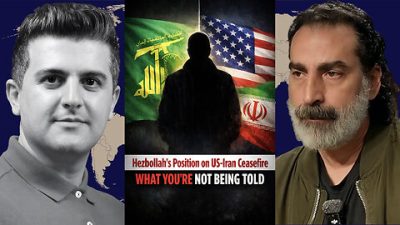
Laith Marouf: Hezbollah’s position on US-Iran ceasefire
or go to
Aletho News Archives – Video-Images
From the Archives
The Dirty Little Secret behind the “Global Terrorism Index”
The Omission of Israeli Terrorism in the Occupied Palestinian Territories
By Karin Brothers | Global Research | December 6, 2014
… The Israeli settlements — all of which are illegal – have been identified as a major impediment to peace. The refusal of a major “global” terrorism report to name the Israeli settlers as one of the groups most responsible for terrorism not only misrepresents a major source of regional violence but exposes the Global Terrorism Index as a propaganda tool that supports a U.S. agenda.
In recent years, governments have been attempting to thwart terrorism by blocking supportive fund-raising. When it comes to Israeli settlements, however, the US and Canada actually encourage fund-raising by giving organizations (such as Christian Friends of Israeli Communities (CFOIC) and the Jewish National Fund) financial support in the form of donor tax-deductions.
Charities which provide funds for the Israeli settlements should be regarded as terror-financing organizations. They should not only lose their tax-deductible status, but they should be banned because they support the violation of international humanitarian law. The terror-financing laws that are being strictly enforced for Muslim charities should be applied to Christian and Jewish charities as well. … Read full article
Blog Roll
 Aletho News
- The ‘Opposition Party’ Has Done Nothing to Stop the Iran War and Much to Goad Trump Into Continuing It
- Moscow backs Tehran on status of Lebanon in US-Iran deal
- How UK Regulator Ofcom Quietly Bypassed International Law to Police American Speech
- The Black Cube Files: How Former Mossad Operatives Flipped a Nation
- Laith Marouf: Hezbollah’s position on US-Iran ceasefire: What you’re not being told
- Israel’s priority lies in destroying chances of peace between Iran, US: Ex-UN nuclear chief
- Ceasefire for all or for none: Iran shuts Hormuz over Lebanon attacks
- Strait of Hormuz is Iran’s ‘nuclear weapon’ that forced US retreat: Medvedev
- Energy crisis will last for months – Kremlin envoy
- Europe’s quiet role in the war on Iran
- If Americans Knew
- This is ceasefire? Israel’s biggest massacre yet in Lebanon, another journalist killed in Gaza – Daily Update
- Tucker Carlson on Israel: This Is the Behavior of an Ally? Really?
- Gazans face a triple crisis: severe shortages of water and bread, healthcare in tatters
- NY Times reports how Netanyahu took the US into Iran War
- A sigh of relief over Iran, but Gaza and Lebanon in dire straits – Daily Update
- Thousands dead and neighborhoods razed to the ground: Aid agencies fear southern Lebanon is becoming the new Gaza
- The war the US is fighting for Israel could cost trillions
- ‘Cigarette Burns, Nail Wounds’: Toddler Tortured in Gaza to Coerce Father
- Trump Says US Sent ‘a Lot of Guns’ to Protesters in Iran
- Israeli forces destroy 17 UN peacekeeper cameras in south Lebanon
- No Tricks Zone
- An Inconvenient Tree: Uncovered In Alps… Europe Much Warmer Than Today 6000 Years Ago
- New Study Reports A 60% Slowdown In Greenland’s Ice Loss Rate In The Last Decade
- Low Intensity Tornado Wrecks Major Solar Farm, Creating A Potential Toxic Dump
- New Study Finds Warming Saves Lives…Cold Temperatures 12 Times More Deadly Than Excess Heat
- German Science Blog Accuses PIK Climate Institute Of Hallucinating Climate Tipping Points
- Devastating Assessment Of Comirnaty Vaccine By Former Senior Pfizer Europe Toxicologist
- New Study: CO2 Is ‘Effectively Negligible’ As An Explanatory Climate Change Factor Since 2000
- Former Pfizer Toxicologist Dr. Helmut Sterz Tells Bundestag Hearing Pfizer Vaccine Should Have Never Been Approved
- Energy Expert: Germany’s Nuclear Phaseout Was A “500 Billion Euro Mistake”
- New Research: South Australia’s Mid-Holocene Sea Surface Temperatures Were 4°C Warmer Than Today
 Aletho News