Syria blames terrorist gangs for massacre in Homs
Press TV – March 12, 2012
Syria’s information minister has blamed “terrorist gangs” for the massacre in the central city of Homs, describing the killings as part of plans to increase international pressure on the Damascus government.
Information Minister Adnan Mahmoud said on Monday that terrorist groups carried out the massacre in the Karm el-Zaytoun neighborhood of Homs to tarnish the image of the Syrian government.
“Terrorist gangs carried out the most horrible massacre in the Karm el-Zaytoun neighborhood of Homs … in order to incite international reaction against Syria,” Adnan Mahmoud told AFP news agency.
The Syrian minister also accused Saudi Arabia and Qatar of supporting “armed terrorist gangs” operating in Syria and hold them responsible for the killings in the country.
“Some of the countries backing armed terrorist gangs, such as Saudi Arabia and Qatar, are accomplices to the terrorism targeting the Syrian people… and bear responsibility for the bloodletting,” Mahmoud said.
At least 45 people, including women and children, were tortured and killed in Karm el-Zaytoun on Sunday night.
Relatives of a number of victims have announced that they were kidnapped by armed groups several months ago.
Opposition activists, however, have blamed the pro-government forces for the killings.
Russian, Arab League foreign ministers negotiate Syrian crisis
Press TV – March 10, 2012
Russia and the Arab League reach an agreement to settle the ongoing crisis in Syria, which rejects any foreign military intervention in the country.
Arab League foreign ministers and their Russian counterpart Sergey Lavrov, who met in the Egyptian capital Cairo, agreed on a plan that rejects foreign intervention and proposes stopping violence and sending humanitarian aid to Syria.
Participants in the meeting expressed support for former UN secretary general Kofi Annan’s mission aimed at starting dialogue between Damascus and the opposition to help resolve the unrest in the country, Lavrov said after the meeting.
Lavrov pointed out that Russia is supporting dialogue between the Syrian government and the opposition, while criticizing Western countries for supporting the opponents of Syrian President Bashar al-Assad’s government
The latest Arab League agreement comes despite earlier efforts against the Syrian government and its call for the deployment of troops to Syria.
Syria has been experiencing unrest since mid-March and many people have lost their lives in the violence.
The West and the Syrian opposition accuse the government of killing protesters. But Damascus blames ”outlaws, saboteurs and armed terrorist groups” for the unrest, insisting that it is being orchestrated from abroad.
Related articles
Marching Toward Syria with Eyes Cast Towards Iran
By Ben Schreiner | Dissident Voice | March 7th, 2012
While all the incessant warmongering directed toward Iran at the annual AIPAC policy conference in Washington was grabbing the headlines, the momentum for Western intervention into Syria continued to steadily build. All those neo-con “real men,” it appears, just might prefer to go to Tehran via Damascus.
Taking to the Senate floor on Monday, Arizona Senator John McCain, one of the first supporters of arming the Free Syrian Army, upped the ante by calling for a U.S.-led air campaign against Syrian military targets. McCain deemed such an escalation necessary to establish “humanitarian corridors.”
“The United States should lead an international effort to protect key population centers in Syria, especially in the north, through airstrikes on Assad’s forces,” the intervention-hungry McCain declared.
And as the Washington Post reported in late February, Obama administration officials have made it clear that “additional measures” might still be considered in order to oust Assad. That favored refrain of all options being on the table appears to be in effect in regards to Syria.
Indeed, for according to CNN, the Pentagon has already composed “detailed plans” for military action inside Syria. As the network reported, the Pentagon has especially focused on securing Syrian chemical weapons sites, with one scenario in particular calling “for tens of thousands of troops to potentially be used for guarding the installations.”
Although, according to a December email recently published by Wikileaks from the U.S. global intelligence firm Stratfor (known as a private C.I.A.), special operations forces from the U.S., U.K., France, Jordan, and Turkey are already on the ground in Syria. And as the email states, these forces are actively “training the Free Syrian Army.” Additional measures indeed!
Not wanting to be left behind in any march on Syria, the U.S. corporate media has largely begun to join the ranks of the recently ascendant intervention hawks.
In an editorial on Friday, the New York Times, although ruling out military force, called for providing greater tactical assistance to the Free Syrian Army. As the paper wrote: “The United States and its allies should consider providing the rebels with communications equipment, intelligence and nonlethal training.” Of course, a mission providing such tactical support would ultimately transform into more explicit military involvement.
Meanwhile, the Washington Post also editorialized on Friday for a more credible threat of force against Assad. As the paper wrote:
The Obama administration’s public arguments against the use of force in Syria are simply encouraging a rogue regime to believe it can act with impunity. Until he is faced with a credible threat of force, from the opposition or outsider powers, Mr. Assad’s slaughter will go on.
The Christian Science Monitor has likewise called for the U.S. to help “forcefully” end Assad’s rule.
Of course, the driving force behind such intense Western interest in Syria is Iran. Let there be no doubt, the ouster of Assad is not driven by some great humanitarian impulse, or “responsibility to protect.” Nor does the bloodletting and slaughter inside the country disturb U.S. elites. After all, the U.S. had no qualms with laying siege to Fallujah. Rather, all the contrived moralizing is being utilized in an attempt to garner support for imposing Syrian “regime change,” which would deal a strategic defeat to Tehran. It’s all nothing more than realpolitik. The Syrian people and their revolution are being cynically recruited as means to imperial ends, and thus would be wise to resist all foreign intervention.
For instance, when the Atlantic’s Jeffery Goldberg stated in a recent interview with President Obama, “But it would seem to me that one way to weaken and further isolate Iran is to remove or help remove Iran’s only Arab ally,” the president responded, “Absolutely.”
Similarly, former Mossad chief Efraim Halevy has argued, “The current standoff in Syria presents a rare chance to rid the world of the Iranian menace to international security and well-being.”
It’s target Iran, albeit on a Syrian battlefield. Therefore, that anti-Iran propaganda machine that is the U.S. media revs up.
Writing in the Washington Post, stenographers Joby Warrick and Liz Sly reported over the weekend that:
U.S. officials say they see Iran’s hand in the increasingly brutal crackdown on opposition strongholds in Syria, including evidence of Iranian military and intelligence support for government troops accused of mass executions and other atrocities in the past week.
The Post’s report was, of course, based solely on three anonymous U.S. officials. And as Warrick and Sly even admit in their piece, “such accounts are generally difficult to verify independently.” Thus they don’t.
On Monday, though, a similar piece of propaganda appeared at CNN. Penned by CNN Pentagon correspondent Barbara Starr, it also reports of Iranian infiltration into Syria, although Starr only relies on two anonymous U.S. officials. What hay a seasoned propagandist can make with such limited sources!
Yet amidst this mounting drive for Western intervention into Syria, President Obama spoke on Tuesday in an apparent attempt to tamp down all such notions, going so far as to call military intervention a “mistake.” As the president went on to state, “the notion that the way to solve every one of these problems is to deploy our military, that hasn’t been true in the past and it won’t be true now.”
Such reassurances aside, actions do, as the president himself implored in his AIPAC speech over the weekend, speak louder than words. And so while the president publicly posits that military intervention would be a mistake, his military readies for intervention into Syria, while continuing its larger ongoing build-up in the region.
The march towards Syria with eyes cast towards Iran continues on. For as Albeit Einstein once remarked, “You cannot simultaneously prevent and prepare for war.”
Ben Schreiner is a freelance writer living in Salem, Oregon. He may be reached at: bnschreiner@gmail.com.
Related articles
- Israel’s No.1 asset in the Senate calls for airstrikes against Syria (alethonews.wordpress.com)
The Syrian Mirage
From the Alawite Fantasy to the Surrealism of the UN
By PIERRE PICCININ | March 06, 2012
More than a year after civil unrest broke out and plunged part of Syria into the chaos of the ‘Arab Spring’, the Baath government remains firmly in control and the majority of the country is calm; almost untouched by an opposition which is scattered and confined to the cities of Homs and Hama, as well as a few towns on the Turkish and Lebanese border. The main reported cases of unrest are linked to regular attacks from Salafist bands which are of an extremely violent nature and more importantly, the Free Syrian Army. The latter counts amid its ranks numerous Qataris and Libyans, all whom have been trained in the art of urban guerilla warfare by the French army in refugee camps, which provide perfect bases from which to operate and orchestrate attacks.
How can one explain the resilience of this regime? A regime which is more or less in complete control despite facing what is usually described as a “revolutionary populist uprising”? One which is determined to overthrow the “Alawite dictatorship” from the political and economic realms of Syrian society, the so-called privilege of the Alawi, a community which accounts for no more than about 10% of the population?
Perhaps it is because the reality does not correspond to this over simplified equation.
Indeed, the communitarian and religious Syrian patchwork is far from closing ranks on the Alawi population. Moreover, this group, do not in fact monopolize the political landscape.
Therefore, even back in the 1980s, when Hafez Al-Assad, father of the incumbent president, Bashir, and author of the “Alawi coup d’état”, succumbed to serious health issues, he had designed a directorate of six members to run the Syrian government – All six were Sunnis.
Furthermore, all the prime ministers who have served in Bashir Al-Assad’s government have been Sunnis. Similarly key positions including the Ministers of Defence, Finance and Oil and the heads of the numerous police corps and the secret service do not depend on the Alawi community. The Druze, Christian, Shiite and Kurd minorities also benefit from governmental representation.
This would explain why the opposition is a fractious minority whose support base lies outside Syria’s borders rather than at the heart of the population.
In these circumstances it is understandable that Russia (and China), treading carefully in order to preserve her last card in the Middle East, resolutely opposes the pressure to sign up to the latest United Nations Security Council resolution. This would undoubtedly lead Syria into a scenario similar to Libya, where tens of thousands of civilians would perish as during the destruction of Sirte (and Russia has asked for there to be a UN commission to investigate these Atlantic war crimes).
The most striking element in this whole situation is that the UN has neither the right nor the objective, to decide the nature of a sovereign government, less still the identity of its head of state; meaning that the text proposed to the Security Council by the Arab league, calling for the departure of President Bashir Al-Assad, a text supported by Qatar with substantial French backing, is directly opposed to the basic principles of international law and completely surreal.
Furthermore, if the Baath regime is dictatorial and brutal, so are numerous factions of the opposition: an opposition which is seriously divided and made up of groups with conflicting objectives, none of which necessarily represent the Syrian population; for on the one hand there are the radical Islamic factions, who massacre their opponents and commit atrocities against the military (kidnappings, mutilations, decapitations…) but also civilians who refuse to support their objectives. This is why Russia has demanded that any UN resolution must be applied not only to the government forces but to all factions resorting to violence, including those supported by foreign states, specifically France and Qatar.
It would therefore seem that from an Alawite fantasy to the surrealism of the United Nations, Syria as depicted by the mass media certainly bears very little resemblance to the reality of the actual situation.
Pierre Piccinin is a professor of political science at the Ecole Européen de Bruxelles I.
Related articles
- Israel’s No.1 asset in the Senate calls for airstrikes against Syria (alethonews.wordpress.com)
Syrian Operations at Borders with Lebanon, French Officers Held in Homs
March 5, 2012
The Lebanese army on Sunday arrested a group of Syrian armed men who had entered Lebanese territory via the border town of al-Qaa, seizing a car and a large cache of weapons.
In addition, the Syrian forces started bombing the tunnel which connects the Syrian town Jose with the region of al-Qaa in the Lebanese territory.
“The tunnel was used, facilitated by “Future” party, to the smuggling of arms and fighters to Syria,” NNA reported.
In the same issue, al-Binaa newspaper reported that “39 armed Syrians were arrested by the Lebanese army in al-Qaa region.
In parallel, the Daily Star Lebanese paper reported Monday that “around 13 French officers are being held by Syrian authorities in central Homs city.”
“It was not clear why the officers were in Syria, when they had arrived or whether they were part of a larger contingent in the city,” the paper informed.
Stating that the “French Foreign Ministry spokeswoman said there was no confirmation of French armed forces being held in Syria,” the paper’s sources stressed that “Paris and Damascus were working to reach an agreement on what to do with the officers.”
Source: News agencies, Translated and Edited by moqawama.org
Homs in the hell of armed groups
By Silvia Cattori | February 29, 2012
Homs, now, is nothing but a sinister battlefield where government soldiers face armed groups which, according to independent witnesses about the true nature of the rebellion, are blindly firing cannon shots to sow terror and death, then pretending that only government forces are bombarding the city.
The Western media, for its part, continues to adduce as evidence the statements of local committees which spread propaganda of the armed “opponents”, in coordination with the Syrian Observatory of Human Rights, a London-based body created and funded by the rebellion-allied forces The Syrian Observatory of Human Rights — which collects the statements of various local committees in Syria — has been repeatedly denounced as nothing but a vulgar instrument of disinformation in the service of the revolt. Despite ample evidence of that, it remains the principal source of information from Syria – together with the famous “great reporters” — and the entire Western media are referring to it, spreading day after day the reports by this observatory.1
To understand what happens in Syria, it is therefore not possible to rely on the Syrian Observatory or on bloggers who are part of this rebellion. We also cannot rely on foreign correspondents who are, as we can see, systematically and from the heart and soul on the side of the armed “opponents”, qualifying them as “heroes” and presenting the battle that divides the Syrian people in an entirely Manichaean way: On one side the opposition which “struggles for democracy”, and on the other the terrible dictator.
Things are not like that. As demonstrated by a recent poll, as well as by the massive demonstrations in support of the Russian and Chinese veto at the UN, the vast majority of the Syrian people do not want this armed revolt, which seeks solely to legitimize NATO powers and several Arab states — notoriously known as champions of democracy, such as Qatar.
If you want to speak of “heroes” in Syria, then you should refer to all parties who are suffering, not only to the “heroes” recognized by the West …
How many Milan missiles were handed over to the rebels?
The number of Syrian citizens appealing to to their president for intervention of government forces is very high. This is especially true in Homs, where the situation is alarming because large sections of the population are held hostage by these groups occupying entire areas of the city — the neighborhoods of Baba Amr, Khaldiyeh, Karm el-Zeytoun — where the people have been calling for months for Damascus to rescue them.2
Their fate has become even more a source of anxiety since the same Milan anti-tank missile launchers delivered to the Libyan rebels during the Libyan campaign, less than a year ago, by France and Qatar, began to be used. We can remember how at the time Sarkozy and Bernard Henry Levy misled public opinion by putting the blame on forces loyal to Gaddafi for the use of these Milan missiles, which were taking a heavy toll on the people.
This is the same disturbing scenario repeating itself in Syria. Politicians, journalists and NGOs are once again taking a firm stand concerning the war, provoked by groups exploited by foreign powers. They attribute to the government forces, as was done in Libya and without proper inspection, the acts of barbarism perpetrated by the armed ‘opponents’ who are terrorizing the majority of the population.
For three weeks correspondents have been repeating that Homs has been unilaterally shelled by the Syrian army. On the contrary, the loyalist contingents attacked by the Milan missiles have suffered heavy losses since the beginning of their intervention. It is not clear whether the authorities in Damascus will be able to dislodge these groups with heavy weaponry from all quarters of the city.
Could the Syrian government not respond?
From the beginning of these battles it has been repeatedly demonstrated that the armed ‘rebels’ are trained, drilled and formed by foreign special forces and that among their ranks the opponents have elements acting on behalf of foreign powers whose presence in Syria is self-evident. Syrian television has recently disseminated pictures of Homs taken by a foreign “war photographer” who followed and filmed these armed “opponents” — the same ones glorified by the “great reporters” — who wildly launch rockets and missiles. An image has attracted attention: In a building, whose stairs are dirty with blood and destroyed furniture, a surprising graffiti with heavy meaning stood out on a wall: “From Misurata, after we have freed Lybia, we came to free Syria!”
Who is responsible for the massacres of Homs, and which objectives does he pursue?
These armed groups, whose most violent actions are attributed to Al Assad soldiers facing them, are systematically presented by the Western press as “foes” fighting for “democracy.”
Why do “great reporters” not bring evidence of Syrian victims of abductions, tortures and murders by these armed “opponents”?
Why has the President of Doctors without Borders recently contributed to this process of intoxication, showing as credible the testimonies of anonymous Syrians with covered faces — standing side by side with the rebels, and attributing to Al-Assad forces and to the hospitals’ doctors unspeakable acts of torture and injury of children?3
Who would believe in Bashar Al Assad’s interest in torturing his people, in raping children and girls? Who would believe that the majority of the Syrian people would continue supporting Bashar Al Assad if he was really such a bloody torturer as painted in the West for the purpose of war propaganda?
These incessant campaigns which defend the violent opposition, and not the people terrorized and oppressed by these rebels, are dangerous. They aim to bring grist to the foreign power’s mill — France, Great Britain, the United States, backed by Qatar and Saudi Arabia — which have been preparing for months the ground for a military intervention in Syria, and are just waiting for the green light by Obama.
Notes
[1] The Syrian Observatory of Human Rights – which collects the statements of various local committees in Syria – has been repeatedly denounced as nothing but a vulgar instrument of disinformation in the service of the revolt. Despite ample evidence of that, it remains the principal source of information from Syria – together with the famous “great reporters” – and the entire Western media are referring to it, spreading day after day the reports by this rip-of observatory.
[2] See: “Une Syrienne, dont le frère a été tué à Homs par des “opposants”, témoigne” (“A Syrian who had killed his brother in Homs by ’opponents’ witnesses”), story picked up by Nadia Khost, February 8, 2012.
(http://www.silviacattori.net/article2790.html)
[3] The role of NGOs that have contributed to the misinformation affecting Syria and thus increasing the risk of foreign intervention, and in particular Amnesty International and Medecins Sans Frontières will be the subject of further investigations.
~
Original article in French (23.02.2012):
http://www.silviacattori.net/article2861.html
Middle East: Stupid is the Order of the Day
By PETER LEE | February 29, 2012
The stupid Attack Iran obsession seems to have infected virtually all discussion of the Middle East.
Marc Lynch of G.W. University said something stupid… then Amnesty International said something stupid… and how about those stupid Islamic terrorist plots?
I have already written about Marc Lynch’s rather terminal and embarrassing misunderstanding of the jurisdiction of the International Criminal Court in the matter of Syria, a major problem since he presents threatening Assad and his cohorts with prosecution by the ICC as the cornerstone for his vision of coercive diplomacy.
Largely because of the insistence of the United States, the ICC does not enjoy universal jurisdiction. It cannot pursue crimes against humanity regardless of where they occur; it can only act 1) in the case of “state parties” – nations that have both signed and ratified the Rome Statute, thereby binding themselves to submit to the jurisdiction of the ICC or 2) when the UN Security Council decides that the superseding demands of world peace and security dictate that a malefactor, whether or not he or she belongs to a “state party” should be turned over to the court.
As long as Syria—a signatory but not ratifier of the Rome Statute—is shielded in the Security Council by Russia and China, Lynch’s riposte to Syrian recalcitrance, the threat of ICC prosecution, appears ludicrous.
Of course, there is always the possibility that the West will refuse to accept defeat and simply try to change the rules under which non-state-party despots are exposed to ICC jeopardy.
Andrea Bianchi and Stephanie Barbour try to do their best to expand the ICC’s reach, despite a rather sober sided piece of reporting by AP that highlights the limits to ICC jurisdiction in the matter of Syria:
“Experts said the list is likely to be more of a deterrent against further abuses than a direct threat to the Assad regime. Syria isn’t a member of the ICC so its jurisdiction doesn’t apply there, and Russia would likely block any moves in the U.N. Security Council to refer the country to the Hague-based tribunal.
“But Andrea Bianchi, a professor of international law at Geneva’s Graduate Institute, said anyone on the U.N. list might still be arrested and prosecuted if they traveled from Syria to a country that has signed up to the international court.
“‘Personally, if I were on that list I would worry,’ he said.
“Human rights group Amnesty International urged that the list be kept secret to prevent suspects from being tipped off.
“‘If in the future there is to be any potential to issue sealed arrest warrants the list has to remain confidential,’ said Stephanie Barbour, coordinator of the group’s campaign for international justice.”
Personally, if I was of the opinion that the ICC was basically an arbitrary tool against dictators that the United States and its allies doesn’t like, I guess I’d worry, too.
And if I was a professor at some Geneva institute of higher education, or a coordinator at AI, I’d be rather ashamed that I wasn’t spending some time highlighting the fact that the United States has gone even further than Syria in removing itself from the ICC’s jurisdiction.
But that’s just me.
Here in Connect-the-Dots-Istan, we were also struck by the parallels between the stupid Muslim assassin in Washington story and the stupid Iranian terrorists in Thailand, Georgia, and India story.
Foreign Policy tells us about the long and winding path to arrest of the Moroccan who tried to assassinate President Obama with a bogus suicide vest thoughtfully provided by the FBI:
A would-be suicide bomber was arrested on Capitol Hill today after accepting what he thought was an explosive vest from undercover agents. Roll Call’s Emma Dumain has the details:
“The arrest was the culmination of a lengthy and extensive operation,” the statement continued. “At no time was the public or Congressional community in any danger.”[…]
Local reports by Fox News describe the individual in custody as “a man, in his 30s and of Moroccan descent” who has been a target of a lengthy FBI investigation. Fox News reported that the suspect believed the undercover FBI agents assisting him were al-Qaida operatives.
Roll Call notes that the story is similar to that of Rezwan Ferdaus, who was arrested last September in the midst of a plot to attack the Capitol with a remote-controlled aircraft. Ferdaus was also in communication with FBI agents posing as al Qaeda members.
The case is also similar to that of Farooque Ahmed, who thought he was going to blow up the DC Metro system in 2010, Mohamed Osman Mohamud, who thought he was going to blow up a Christmas tree-lighting ceremony in Portland Oregon in 2010, David Williams, who thought he was going to blow up a Bronx synagogue in 2009, and the “Fort Dix Five,” who thought they were going to attack a New Jersey military base in 2006.
In each case, undercover FBI agents spent months communicating and providing fake resources to the suspects before springing the trap. …
The increasing frequency of these operations is bound to raise some questions about whether law enforcement agencies are pushing along the development of plots that the individuals involved might never have acted on without the long term encouragement of their “al Qaeda contacts.”
Now, I don’t have any special insights into the concurrent anti-Israeli bomb plots with Iranian principals that were simultaneously busted in Georgia, India, and Thailand, but Arshin Adib-Moghaddam wrote in Counterpunch to offer a perspective on the conspiracies:
Let’s assume that sections of the military and security apparatus in Iran are responsible for the string of bombings in Georgia, Thailand and India. What would be the motive? The argument that Iran is retaliating for the murder of five civilian nuclear scientists in Iran is not plausible. If Iran wanted to target Israeli interests, it has other means at its disposal. It is hard to imagine that the Iranian government would send Iranian operatives to friendly countries, completely equipped with Iranian money and passports – making the case against them as obvious as possible.
If the Iranian Revolutionary Guards are as professional, highly trained and politically savvy as we have been told repeatedly by Israeli politicians themselves, if they have successfully trained and equipped the cadres of Hezbollah and other movements with paramilitary wings in the region, then why would they launch such a clumsy and self-defeating operation?
And why India, Georgia and Thailand, three countries that Iran has had cordial relations with during a period when Iran is facing increasing sanctions spearheaded by the United States? A few days ago, India agreed a rupee-based oil and gas deal with Iran and resisted US pressures to join the western boycott of the Iranian energy sector. As a net importer of 12% of Iranian oil, India’s total trade with Iran amounted to $13.67bn in 2010-2011. What would be the motive for damaging relations with one of Iran’s major trading partners and regional heavyweights?
For Iran it doesn’t make sense to risk alienating India by launching an assassination attempt in the capital of the country. Similarly, Iran has good economic and political relations with Georgia and Thailand. Why would the leadership in Tehran risk a major crisis with these countries during this sensitive period when IAEA inspectors are moving in and out of Iran to investigate the country’s nuclear program?
Good, good questions. Especially when it was recently revealed that the Israeli intelligence agencies were mounting false flag operations, convincing Balochistan militants that their attacks against Iranian targets were being orchestrated by the CIA, not Mossad.
I would also not hesitate to draw the conclusion that US and Israeli security services have a sizable roster of extremist dingdongs on tap, available to incite and detain as the needs of public safety and anti-Muslim/anti-Iran diplomacy require.
PETER LEE has spent thirty years observing, analyzing, and writing on international affairs. Lee can be reached at peterrlee-2000@yahoo.com
Related article
- Washington DC: FBI Foils Own Terror Plot (Again) (alethonews.wordpress.com)
Questioning the Syrian “Casualty List”
By Sharmine Narwani | Al Akhbar | February 28, 2012
“Perception is 100 percent of politics,” the old adage goes. Say something three, five, seven times, and you start to believe it in the same way you “know” aspirin is good for the heart.
Sometimes though, perception is a dangerous thing. In the dirty game of politics, it is the perception – not the facts of an issue – that invariably wins the day.
In the case of the raging conflict over Syria, the one fundamental issue that motors the entire international debate on the crisis is the death toll and its corollary: the Syrian casualty list.
The “list” has become widely recognized – if not specifically, then certainly when the numbers are bandied about: 4,000, 5,000, 6,000 – sometimes more. These are not mere numbers; they represent dead Syrians.
But this is where the dangers of perception begin. There are many competing Syrian casualty lists with different counts – how does one, for instance gauge if X is an accurate number of deaths? How have the deaths been verified? Who verifies them and do they have a vested interest? Are the dead all civilians? Are they pro-regime or anti-regime civilians? Do these lists include the approximately 2,000 dead Syrian security forces? Do they include members of armed groups? How does the list-aggregator tell the difference between a civilian and a plain-clothes militia member?
Even the logistics baffle. How do they make accurate counts across Syria every single day? A member of the Lebanese fact-finding team investigating the 15 May 2011 shooting deaths of Palestinian protesters by Israelis at the Lebanese border told me that it took them three weeks to discover there were only six fatalities, and not the 11 counted on the day of the incident. And in that case, the entire confrontation lasted a mere few hours.
How then does one count 20, 40, or 200 casualties in a few hours while conflict continues to rage around them?
My first port of call in trying to answer these questions about the casualty list was the United Nations Office of the High Commissioner for Human Rights (OHCHR), which seemed likely to be the most reliable source of information on the Syrian death toll – until it stopped keeping track last month.
The UN began its effort to provide a Syrian casualty count in September 2011, based primarily on lists provided by five different sources. Three of their sources were named: The Violations Documenting Center (VDC), the Syrian Observatory for Human Rights (SOHR) and the Syrian Shuhada website. At that time, the lists varied in number from around 2,400 to 3,800 victims.
The non-UN casualty list most frequently quoted in the general media is the one from the Syrian Observatory – or SOHR.
Last month, SOHR made some headlines of its own when news of a rift over political viewpoints and body counts erupted. Two competing SOHRs claimed authenticity, but the group headed by Rami Abdul Rahman is the one recognized by Amnesty International.
OHCHR spokesman Rupert Colville stated during a phone interview that the UN evaluates its sources to check “whether they are reliable,” but appeared to create distance from SOHR later – during the group’s public spat – by saying: “The (UN) colleague most involved with the lists…had no direct contact with the Syrian Observatory, though we did look at their numbers. This was not a group we had any prior knowledge of, and it was not based in the region, so we were somewhat wary of it.”
Colville explains that the UN sought at all times “to make cautious estimates” and that “we have reasonable confidence that the rounded figures are not far off.”
While “also getting evidence from victims and defectors – some who corroborated specific names,” the UN, says Colville, “is not in a position to cross-check names and will never be in a position to do that.”
I spoke to him again after the UN decided to halt its casualty count in late January. “It was never easy to verify, but it was a little bit clearer before. The composition of the conflict has changed. It’s become much more complex, fragmented,” Colville says. “While we have no doubt there are civilian and military casualties…we can’t really quantify it.”
“The lists are clear – the question is whether we can fully endorse their accuracy,” he explains, citing the “higher numbers” as an obstacle to verification.
The Casualty Lists Up Close: Some Stories Behind the Numbers
Because the UN has stopped its casualty count, reporters have started reverting back to their original Syrian death toll sources. The SOHR is still the most prominent among them.
Abdul Rahman’s SOHR does not make its list available to the general public, but in early February I found a link to a list on the other SOHR website and decided to take a look. The database lists the victim’s name, age, gender, city, province, and date of death – when available. In December 2011, for instance, the list names around 77 registered casualties with no identifying information provided. In total, there are around 260 unknowns on the list.
Around that time, I had come across my first list of Syrians killed in the crisis, reportedly compiled in coordination with the SOHR, that contained the names of Palestinian refugees killed by Israeli fire on the Golan Heights on 15 May 2011 and 5 June 2011 when protesters congregated on Syria’s armistice line with Israel. So my first check was to see if that kind of glaring error appears in the SOHR list I investigate in this piece.
To my amazement, the entire list of victims from those two days were included in the SOHR casualty count – four from May 15 (#5160 to #5163) and 25 victims of Israeli fire from June 5 (#4629 to #4653). The list even identifies the deaths as taking place in Quneitra, which is in the Golan Heights.
It also didn’t take long to find the names of well-publicized pro-regime Syrians on the SOHR list and match them with YouTube footage of their funerals. The reason behind searching for funeral links is that pro-regime and anti-regime funerals differ quite starkly in the slogans they chant and the posters/signs/flags on display. Below, is a list of eight of these individuals, including their number, name, date and place of death on the casualty list – followed by our video link and further details if available:
#5939, Mohammad Abdo Khadour, 4/19/11, Hama, off-duty Colonel in Syrian army, shot in his car and died from multiple bullet wounds. Funeral link.
#5941, Iyad Harfoush, 4-18-11, Homs, off-duty Commander in Syrian army. In a video, his wife says someone started shooting in the mostly pro-regime al Zahra neighborhood of Homs – Harfoush went out to investigate the incident and was killed. Funeral link.
#5969, Abdo al Tallawi, 4/17/11, Homs, General in Syrian army killed alongside his two sons and a nephew. Funeral footage shows all four victims. The others are also on the list at #5948, Ahmad al Tallawi, #5958, Khader al Tallawi and #5972, Ali al Tallawi, all in Homs, Funeral link.
#6021, Nidal Janoud, 11/4/11, Tartous, an Alawite who was severely slashed by his assailants. The bearded gentleman to the right of the photo, and a second suspect, are now standing trial for the murder. Photo link.
#6022, Yasar Qash’ur, 11/4/11, Tartous, Lieutenant Colonel in the Syrian army, killed alongside 8 others in an ambush on a bus in Banyas, Funeral link.
#6129, Hassan al-Ma’ala, 4/5/11, policeman, suburbs of Damascus, Funeral link.
#6130, Hamid al Khateeb, 4/5/11, policeman, suburbs of Damascus, Funeral link.
#6044, Waeb Issa, 10/4/11, Tartous, Colonel in Syrian army, Funeral link.
Besides featuring on the SOHR list, Lt. Col. Yasar Qashur, Iyad Harfoush, Mohammad Abdo Khadour and General Abdo al Tallawi and his two sons and nephew also appear on two of the other casualty lists – the VDC and Syrian Shuhada – both used by the United Nations to compile their numbers.
Nir Rosen, an American journalist who spent several months insides Syria’s hot spots in 2011, with notable access to armed opposition groups, reported in a recent Al Jazeera interview:
“Every day the opposition gives a death toll, usually without any explanation of the cause of the deaths. Many of those reported killed are in fact dead opposition fighters, but the cause of their death is hidden and they are described in reports as innocent civilians killed by security forces, as if they were all merely protesting or sitting in their homes. Of course, those deaths still happen regularly as well.”
“And, every day, members of the Syrian army, security agencies and the vague paramilitary and militia phenomenon known as shabiha [“thugs”] are also killed by anti-regime fighters,” Rosen continues.
The report issued in January by Arab League Monitors after their month-long observer mission in Syria – widely ignored by the international media – also witnessed acts of violence by armed opposition groups against both civilians and security forces.
The Report states: “In Homs, Idlib and Hama, the observer mission witnessed acts of violence being committed against government forces and civilians…Examples of those acts include the bombing of a civilian bus, killing eight persons and injuring others, including women and children…In another incident in Homs, a police bus was blown up, killing two police officers.” The observers also point out that “some of the armed groups were using flares and armour-piercing projectiles.“
Importantly, the report further confirms obfuscation of casualty information when it states: “the media exaggerated the nature of the incidents and the number of persons killed in incidents and protests in certain towns.”
On February 3, the eve of the UN Security Council vote on Syria, news broke out that a massacre was taking place in Homs, with the general media assuming it was true and that all violence was being committed by the Syrian government. The SOHR’s Rami Abdul Rahman was widely quoted in the media as claiming the death toll to be at 217. The Local Coordination Committees (LCCs), which provide information to the VDC, called it at “more than 200,” and the Syrian National Council (SNC), a self-styled government in absentia of mainly expats, claimed 260 victims.
The next day, the casualty count had been revised down to 55 by the LCCs. (link: http://www.bbc.co.uk/news/world-middle-east-16883911)
Even if the count is at 55 – that is still a large number of victims by any measure. But were these deaths caused by the Syrian government, by opposition gunmen or in the crossfire between the two groups? That is still the question that needs to break through the deafening narratives, lists, and body counts.
In International Law, Detail Counts
While the overwhelming perception of Syrian casualties thus far has been that they are primarily unarmed civilians deliberately targeted by government forces, it has become obvious these casualties are also likely to include: Civilians caught in the crossfire between government forces and opposition gunmen; victims of deliberate violence by armed groups; “dead opposition fighters” whose attire do not distinguish them from regular civilians; and members of the Syrian security forces, both on and off duty.
Even if we could verify the names and numbers on a Syrian casualty list, we still don’t know their stories, which if revealed, may pose an entirely different picture of what is going on in Syria today
These questions are vitally important to understand the burden of responsibility in this conflict. International law provides for different measures of conflict: the two most frequently used gauges for this are the Principle of Necessity, i.e., using force only when it is necessary, and the Principle of Proportionality, i.e., the use of force proportional to the threat posed.
In the case of Syria – like in Bahrain, Yemen, Egypt and Libya – it is widely believed that the government used unnecessary force in the first instance. Syrian President Bashar Assad, like many of these Arab rulers, has as much as admitted to “mistakes” in the first months of protests. These mistakes include some shooting deaths and detaining a much larger number of protesters than expected, some of whom were allegedly tortured.
Let us assume, without question, that the Syrian government was over zealous in its use of force initially, and therefore violated the Principle of Necessity. I tend to believe this version because it has been so-stated by the Arab League’s observer mission – the first and only boots-on-the-ground monitors investigating the crisis from within the country.
However – and this is where the casualty lists come in – there is not yet nearly enough evidence, not by any measure acceptable in a court of law, that the Syrian government has violated the Principle of Proportionality. Claims that the regime has used disproportionate force in dealing with the crisis are, today, difficult to ascertain, in large part because opponents have been using weapons against security forces and pro-regime civilians almost since the onset of protests.
Assuming that the number of casualties provided by the UN’s OHCHR is around the 5,000-mark -the last official figure provided by the group – the question is whether this is a highly disproportionate number of deaths when contrasted directly with the approximately 2,000 soldiers of the regular Syrian army and other security forces who have been reportedly killed since April 2011.
When you calculate the deaths of the government forces in the past 11 months, they amount to about six a day. Contrast that with frequent death toll totals of around 15+ each day disseminated by activists – many of whom are potentially neither civilian casualties nor victims of targeted violence – and there is close to enough parity to suggest a conflict where the acts of violence may be somewhat equal on both sides.
Last Sunday, as Syrians went to the polls to vote on a constitutional referendum, Reuters reports – quoting the SOHR – that 9 civilians and 4 soldiers were killed in Homs, and that elsewhere in Syria there were 8 civilian and 10 security forces casualties. That is 17 civilians and 14 regime forces – where are the opposition gunmen in that number? Were none killed? Or are they embedded in the “civilian” count?
Defectors or Regular Soldiers?
There have also been allegations that many, if not most, of the soldiers killed in clashes or attacks have been defectors shot by other members of the regular army. There is very little evidence to support this as anything more than a limited phenomenon. Logically, it would be near impossible for the Syrian army to stay intact if it was turning on its rank-and-file soldiers in this manner – and the armed forces have remained remarkably cohesive given the length and intensity of the conflict in Syria.
In addition, the names, rank and cities of each of the dead soldiers are widely publicized by state-owned media each day, often accompanied by televised funerals. It would be fairly simple for the organized opposition to single out by name the defectors they include on their casualty lists, which has not happened.
The very first incident of casualties from the Syrian regular army that I could verify dates to 10 April 2011, when gunmen shot up a bus of soldiers travelling through Banyas, in Tartous, killing nine. This incident took place a mere few weeks after the first peaceful protests broke out in Syria, and so traces violence against government forces back to the start of political upheaval in the country.
“Witnesses” quoted by the BBC, Al Jazeera and The Guardian insisted that the nine dead soldiers were “defectors” who had been shot by the Syrian army for refusing orders to shoot at demonstrators.
Joshua Landis, director of the Center for Middle East Studies at the University of Oklahoma, debunked that version on his Syria Comment website. Another surviving soldier on the bus – a relation of Lt. Col. Yasar Qashur, #6022 on the SOHR list, whose funeral I link to above – denied that they were defectors too. But the narrative that dead soldiers are mostly defectors shot by their own troops has stuck throughout this conflict – though less so, as evidence of gunmen targeting Syrian forces and pro-regime civilians becomes belatedly apparent.
The VDC – another of the UN’s OHCHR sources for casualty counts – alleges that 6,399 civilians and 1,680 army defectors were killed in Syria during the period from 15 March 2011 to 15 February 2012. All security forces killed in Syria during the past 11 months were “defectors?” Not a single soldier, policeman or intelligence official was killed in Syria except those forces who opposed the regime? This is the kind of mindless narrative of this conflict that continues unchecked. Worse yet, this exact VDC statistic is included in the latest UN report on Syria issued last week.
Humanitarian Crisis or Just Plain Violence?
While few doubt the Syrian government’s violent suppression of this revolt, it is increasingly clear that in addition to the issue of disproportionally, there is the question of whether there is a “humanitarian crisis” as suggested by some western and Arab leaders since last year. I sought some answers during a trip to Damascus in early January 2012 where I spoke to a select few NGOs that enjoyed rare access to all parts of the country.
Given that words like “massacre” and “slaughter” and “humanitarian crisis” are being used in reference to Syria, I asked International Committee of the Red Cross (ICRC) Spokesman Saleh Dabbakeh how many calls for urgent medical assistance his organization had received in 2011. His response was shocking. “Only one that I recall,” said Dabbakeh. Where was that, I asked? “Quneitra National Hospital in the Golan,” he replied, “last June.” This was when Israeli troops fired on Syrian and Palestinian protesters marching to the 1973 armistice line with the Jewish state. Those same protesters that ended up on SOHR’s casualty list.
A Syrian Arab Red Crescent (SARC) worker confirmed that, recalling that his organization treated hundreds of casualties from the highly-publicized incident.
As the level of violence has escalated, however, the situation has deteriorated, and the ICRC now has received more calls for medical assistance – mainly from private hospitals in Homs. The SARC today has nine different points in Homs where it provides such assistance. The only two places they do not currently serve are the neighborhoods of Bab Amr and Inshaat “because the security situation does not allow for it – for their own safety, there is fighting there.”
During a phone call last Thursday, one NGO officer, explained that the measure for a “humanitarian crisis” is in level of access to basic staples, services and medical care. He told me off the record that “There is a humanitarian crisis in (i.e.) Baba Amro today, but not in Syria. If the fighting finishes tomorrow, there will be enough food and medical supplies.”
“Syria has enough food to feed itself for a long time. The medical sector still functions very well. There isn’t enough pressure on the medical sector to create a crisis,” he elaborated. “A humanitarian crisis is when a large number of a given population does not have access to medical aid, food, water, electricity, etc – when the system cannot any longer respond to the needs of the population.”
But an international human rights worker also cautions: “the killing is happening on both sides – the other side is no better.”
People have to stop this knee-jerk, opportunistic, hysterical obsession with numbers of dead Syrians, and ask instead: “who are these people and who killed them?” That is the very least these victims deserve. Anything less would render their tragic deaths utterly meaningless. Lack of transparency along the supply-chain of information and its dissemination – on both sides – is tantamount to making the Syrian story all about perception, and not facts. It is a hollow achievement and people will die in ever greater numbers.
Sharmine Narwani is a commentary writer and political analyst covering the Middle East. You can follow Sharmine on twitter @snarwani.
Related articles
Syrian opponent Mamoun Al-Homsi’s Israel connection
The Arab Digest | February 27, 2012
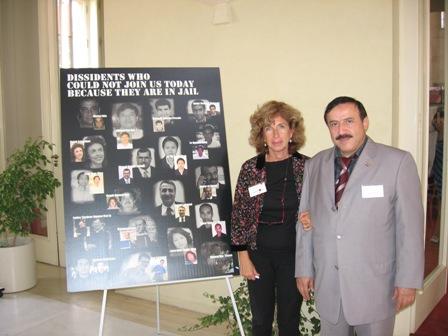
The Arab Digest had previously reported on Syrian Opposition member, Mamoun Al-Homsi, and his call for ethnic cleansing of minorities in Syria. Well, new questions emerge on his politics and suspicious ties with Israel.
Mamoun Al-Homsi is pictured above at the Prague Security Conference (NeoCon) with the Israeli-Italian right wing politician and hardline Zionist, Fiamma Nirenstein. Nirenstein who is a neocon Zionist has spent much of her life in an illegal East Jerusalem Settlement called Gilo where she still maintains a home.
Nirenstein is known for translating books of Nathan Sharansky, Bernard Lewis and Ruthie Bloom; she led efforts on behalf of the Israeli government to thwart the Palestinian bid for full UN membership and Statehood.
She is also known for hardline Zionist quotes like “every Jew in the world is an Israeli even if he’s not aware of it. Anyone who doesn’t know it is making a big mistake” and “morally speaking, there mustn’t be negotiations with Hamas, which thinks that Jews are the sons of monkeys and pigs. You can’t negotiate with cannibals, who eat human beings”. Her stances drove Luisa Morgantini, the Vice President of the European Parliament to write an article in 2007, criticizing her hawkish stances, it was titled “Fiamma Nirenstein and the conspiracy of treacherous Palestinians who do not want peace.”
Nirenstein spends her year between an Italian residence and the East Jerusalem settlement with her husband, Israeli photographer Ofer Eshed.
The question remains, what was Homsi doing with her in Prague?
Homsi has also met her and U.S. based Farid Ghadri, a pro-Israeli opposition figure, in Rome where they discussed Syria. Nirenstein later wrote a post about her meeting with the two, expressing her deep worries over Hezbollah’s capabilities and Syria’s arsenal of rockets, capable of reaching Israel.
PS. The photo’s credit is for Alessandro Lattanzio who kindly translated our earlier article on al-Homsi to Italian. Here is his post in Italian along with the photo.
~
See also from Arab Digest:
A Syrian dissident calls for the ethnic cleansing of minorities!
Rhetoric in Syria’s revolution took a dangerous Sectarian shift with former Syrian MP and opposition activist Mamoun Homsi, 56, making ethnic cleansing threats against minorities. He clearly stated that in Syria, “there will be no minorities”, and called for the obliteration of the ruling Allawite community. … continue
Related articles
- Friends (Enemies) of Syria Conference (alethonews.wordpress.com)
Illegitimate GCC monarchs oppose democratic reforms in Syria
Press TV – February 27, 2012
Syria has made its first major democratic reform by holding a national referendum to decide on a new constitution and electoral process in the country.
Press TV has interviewed Mr. Wadah Al-Khatib, a political analyst in Damascus about the national significance and international consequence of Monday’s public referendum in Syria that would enable the formation of a democratic parliament. What follows is an approximate transcription of the interview.
Press TV: As the Syrian people are trying to bring about changes in the country, in your perspective why are outside entities continuing to interfere in this process?
Al-Khatib: First all, outside entities have no business interfering in a referendum on a constitution in any country. I think it’s just a sample of the type of strong interventionist policies that the US has been carrying out for a good part of the 20th century and the beginning of this century.
Outside parties that are against the referendum on a new constitution have been defined by your report – we’re talking about the Persian Gulf monarchies most of which have no constitutions and the whole process of voting does not exist and countries that have historically not been very good friends of the Syrian people or of the other Arabs.
And the US, for example, not approving or not accepting the concept of a referendum on a constitution, that contradicts its very foundations on which the US was created.
I think it’s more about what they don’t want to see in Syria, which is a move towards a political process that involves various spectrums of opinion of the Syrian society. I think they do not want to see this under the current leadership and this is why they’re not happy.
Press TV: Let’s look at US officials from the president down, they have openly said that they will use all means available to bring down Syrian President Bashar al-Assad. What do you think that means? Do you think that includes bombings, assassinations, creating chaos – what do you get from that phrase, ‘all means available’?
Al-Khatib: It could mean, in a different time, military intervention. We’re talking in 2012 in a rather difficult election year for President Obama. It will be interesting to see how the US would try to intervene or the possible ways during the ensuing months. In a couple of months Mr. Obama will be very busy just trying to keep himself in office.
The US has been intervening in this crisis from the very beginning we think through the provision of funds and training in arms to various members and various armed groups that have been working and functioning in Syria and I think in the very near future we’re going to see evidence of that.
I think at this point what we’re hearing from the US is nothing but political posturing in an election year. The conference we saw in Tunis a couple of days ago was a perfect example – Secretary of State Hilary Clinton avoided any direct reference to military intervention during the conference, which made the Saudi foreign minister not very happy.
So, I think the Americans will be very loud in the next few months, but I seriously doubt that they will actually commit the mistake at this point of being militarily on the ground or even trying a bombing campaign.
Press TV: Let’s look at the concept of people putting Syria first – Let’s look at the violence that we have seen inside of the country and probably the question for many would be; a legitimate opposition, would they be involved in also the type of violence that we have seen?
We know that at least 2,000 security personnel are among the dead and it would seem that a nationalist of any country that they really would not benefit from this type of chaos. What is your take in general on that so-called opposition during this?
Al-Khatib: I think a legitimate opposition would seek a transfer of power through the ballot box. The fact that there are certain people who claim to be a so-called national opposition have been trying through violent means to change the government and to smother the country really discredits their claim for a more democratic say that they’re trying to create.
I think there are people in Syria who are opposed to the government and who seek in peaceful ways to express their opposition and this is the only legitimate opposition that anyone can think of.
People who carry guns and kill those who disagree with them are hardly entitled to speak about democracy and to seek a change of government and unfortunately we have seen a lot of this in Syria in the last 11 months. But I have to say that in the last couple of weeks the security situation has improved dramatically up to the referendum held today.
Related articles
- Syrians head to polls in referendum on new constitution (alethonews.wordpress.com)
- ‘Some Arab states against political solution to Syria unrest’ (alethonews.wordpress.com)
- China: US has no moral right to ‘protect’ Arabs (rt.com)
89% vote in favor of new Syrian Constitution
RT | 27 February, 2012
Syria’s Interior Minister has announced that 89 per cent of those who took part in the referendum have voted in favor of a new constitution. The new law puts an end to five decades of one-party rule among other reforms put forward by President Assad.
Interior Minister Ibrahim al-Shaar announced the results of the referendum at a press conference on Monday.
According to the minister, out of 14,580,000 Syrians eligible to vote some 8,376,000, or about 57 per cent, actually came to the polling stations and voted, RT’s Maria Finoshina reports from Damascus.
Al-Shaar said that the opposition groups tried to hamper the vote in some troubled areas like Homs and Idlib. Armed rebels did not allow some people to get to the polling stations he said.
Those who live in such troubled regions had a chance to vote at polling stations which had been set up out of areas where clashes with the armed opposition still continue. Syrians who live in neighboring countries voted at stations set up near the borders.
“We are satisfied with the results,” al-Shaar said, as cited by Finoshina. “The Syrian people have made their choice.”
The adopted constitution includes 14 new and 47 amended articles. The reforms put forward by President Assad are designed to stop the bloody uprising and pave the way for free elections in the country.
An unprecedented referendum on a new draft constitution took place in Syria on Sunday. Syrians took an active part in the crucial vote and the officials said turnout was very high.
Despite the fact that the opposition boycotted the referendum, calling it an empty gesture, and called for mass protests, there were no public order violations in Damascus during the vote.
Western politicians considered the referendum to be a farce, with US Secretary of State Hillary Clinton calling it “a cynical ploy” and German Foreign Minister Guido Westerwelle describing it as a “sham vote.”
Meanwhile, on Monday the European Union has slapped the Syrian government with its toughest set of sanctions yet. They include an asset freeze on officials, and a ban on importing precious metals and minerals from the country.
More than a year since the uprising in Syria began, violence is still raging on in some parts of the country, including the flashpoint city of Homs, where dozens were reported killed during the weekend.
Related articles
- President Assad Sets Date for Constitution Referendum, Russia Welcomes (alethonews.wordpress.com)
Featured Video
Can the U.S. Afford to Annihilate Iran?
or go to
Aletho News Archives – Video-Images
From the Archives
Sanctions, War and the Policy of Dual Containment
By SASAN FAYAZMANESH | March 17, 2008
It is now nearly three decades since the Unites States adopted the policy of dual containment of Iran and Iraq. While much has been written about the containment of Iraq, there has been very little in-depth analysis of this policy when it comes to Iran. In a book that is going to be released on March 31, 2008, entitled The United States and Iran: Sanctions, Wars and the Policy of Dual Containment (Routledge), I attempt to address this shortcoming by investigating when and why the US policy of containment of Iran came about, how it evolved, and where it stands today.[1] To the extent that Israel has been involved in US policy making, the study will also include the role that Israel has played in the containment of Iran. Also, since the fate of Iran has been inextricably linked to that of Iraq, occasionally the investigation will overlap with the containment of Iraq.
The policy of dual containment of Iran and Iraq originated during the Carter Administration, but it was not until the Clinton Administration that the expression “dual containment” became popular. … continue
Blog Roll
 Aletho News
- Can the U.S. Afford to Annihilate Iran? /Seyed M. Marandi
- Elmo Sold mRNA Jabs to Your Toddler. Now They Are “Off-Label.”
- British state targets Palestine Action with yet another crooked trial
- Americans are paying the price to preserve Israel’s nuclear hegemony
- Resistance factions are necessary to ensure a permanent US Iraq withdrawal
- How Israel destabilizes the Middle East: Denying sovereignty and the right to exist
- Europe’s Establishment Is Embracing War – and Losing Voters
- NATO chief advocates war of aggression
- No Vote, No Representation, No State: Democracy, Israeli Style
- Zionist Bought Senate Blocks Information About American Citizens Killed By Israel
- If Americans Knew
- Israeli Soldiers Abduct At Least 22 Across Occupied West Bank
- Eight Palestinians Killed in Israeli Attacks on Gaza
- Israeli former leaders and security chiefs threaten legal action over ‘Jewish terrorism’
- Israel map in LA Times ad includes all land from the river to the sea
- Inside Lebanon’s 200-page dossier on Israeli war crimes
- Flydubai, genocide, settler violence, Trump abuse of power to deport – Daily Update
- Counting Antisemitic Incidents: What the ADL Audit Reveals — and Obscures
- Mamdani releases plan to combat antisemitism and hate crimes in New York City
- Iran’s Revolutionary Guards Publish Letter to the American People
- DMFI launches $1 million ad campaign supporting Virginia’s Elaine Luria
- No Tricks Zone
- Green Energy Debacle: German Expert Professor Fritz Vahrenholt Warns Of Severe Economic And Social Consequences
- Two More Paleo Reconstructions Affirm Meters-Higher Sea Levels Across Ireland, Brazil 7000-6000 Years Ago
- New Study: Earth And Venus Surface Warmth Largely Explained By Convection And Lapse Rate, Not CO2 Or Radiation
- 2025 Nature Paper Claiming Worsening Global Drought Gets RETRACTED …Heavily Flawed
- New Study: ‘Global Drought Shows No Detectable Recent Acceleration Under Climate Warming’
- Economic Masterminds: German Socialists Suggest Taxing Productivity Gains Stemming From Using AI
- The South China Sea Has Not Been Cooperating With The Climate Change Narrative
- Energy Crisis: Germany Enters Heating Season With Historically Low Gas Reserve Fill Levels
- New Study: The Antarctic Ice Sheet Gained Mass From 2020-2024 Due To Staggering Snow And Ice Accumulation
- Study: Ocean Heating Rates From Thousands Of Years Ago ‘Dwarf’ Modern Ocean Heating Rates


