Syria Lashes out at Riyadh “Compliance with Washington at Expense of Saudi People”
Al-Manar | August 18, 2018
Syria on Friday denounced Saudi financial support to the US-led international coalition’s role in northern Syria, stressing that such move indicates Riyadh’s compliance with the US administration at the expense of the Saudi people.
Syrian foreign ministry slammed Saudi authorities as “plotters against the interests of the Arab nation,” stressing that the Saudi support is in defiance of the UN Security Council resolutions related to the crisis in Syria.
US State Department announced earlier on Thursday, that Riyadh was offering a $100 million contribution “for ongoing, Coalition-supported stabilization efforts in areas liberated from ISIS in Syria,” referring to the Takfiri ISIL group.
SANA news agency quoted an official at the Syrian foreign ministry as saying: “This flawed Saudi decision comes within the framework of the Saudi authorities’ full compliance with the US administration at the expense of Saudi people who is suffering from poverty and dire economic recession.”
“The US-led coalition has killed thousands of Syrian children and women and attacked positions of the Syrian Arab Army dozens of times to prevent it from fighting Daesh (ISIS) terrorist organization east of Syria and elsewhere, as it destroyed Syrian infrastructure which has cost the Syrian people hundreds of billions of dollars in a direct US support for terrorist organizations,” the Syrian source said.
“The criminal coalition does not deserve this support from any country in the world because its main goal is to fragment the region and impose Zionist hegemony on all its countries.”
Meanwhile, the source stressed that the Saudi support “is morally unacceptable as it comes to prevent the Syrian Arab Army from achieving further victories over terrorism in northern Syria in an exposed attempt to prolong the crisis and support the forces that threaten Syria’s unity and territorial integrity.”
The source concluded by saying: “Syria condemns these despicable policies of the Saudi authorities and demands them to stop these terrible and dangerous policies, adding that “Syria reiterates its call on all the Coalition’s member states to withdraw from it without delay because it serves only terrorists and murderers and threatens security and peace in the region and the world,” according to SANA.
What Do The Winners In Syria Want?
ORIENTAL REVIEW – 17/08/2018
After the liberation of the provinces of Daraa and Quneitra, the Syrian civil war entered a new phase. The available land that was up for grabs by any new liberator — without the need for negotiations with outside actors — was shrinking (one section of the desert under ISIL control does not count – it will soon be cleared out). Only Idlib is left, which is controlled (albeit only in spots and to a limited extent) by Turkey, as well as the environs of al-Tanf and the Kurdish regions located within the American protectorate. And their liberation must be preceded by diplomatic agreements with the protector states.
Decentralization without the Kurds
Negotiations with Turkey took place in Sochi at the very end of July. Those were conducted by Russia and Iran, because Damascus and Ankara have officially severed their diplomatic ties. The Syrian authorities emphasize that the territory of Idlib will eventually be returned to Damascus’s jurisdiction.
No one’s arguing with that. Turkey is not planning on an eternal occupation of Syrian territory, because any benefits from that would be completely outweighed by the financial, PR, and potential military costs Ankara would incur. At some point, the Turkish troops will be forced to quit Syria. But Erdogan has no desire to pull out for free and is demanding a number of conditions be met in return.
These conditions are obvious yet at the same time contradictory. On one hand, Ankara wants to maintain its leverage over post-war Syria, so it is pressing for the local communities (some of which in northwestern and western Syria hold pro-Turkish sentiments) to be granted more rights and powers. On the other hand, the Turks do not want those rights and powers to be extended to the Syrian Kurds, whom Erdogan currently views as one of te biggest threats to Turkey’s national security.
At present it is not possible to meet Turkey’s demands – the constitutional committee is just now getting down to work, and no one understands how to exclude the Kurds from the decentralization process anyway. And ultimately the Iranians are not particularly eager to yield any zones of influence to the Turks — it is clear to everyone that for the foreseeable future, Tehran and Ankara will very likely be competing for the upper hand in the Middle East. In turn, the Turkish authorities are threatening that if Moscow and Tehran give Damascus the green light to conduct a military operation in Idlib without taking Ankara’s interests into account, then Turkey will abandon its attempts to find a resolution under the auspices of the Astana negotiations and could potentially resume military and political assistance to the militants, which might even include sending aid in the form of the Turkish army.
The weak link
As a result, a compromise was apparently reached in Sochi. Damascus, Tehran, and Moscow agreed to temporarily postpone the offensive in Idlib and give Turkey some latitude to handle the threats posed by certain terrorist groups in the region (for example, Hay’at Tahrir al-Sham, which is the latest reincarnation of the al-Nusra Front). In order to do battle against them, the Turks have already established a coalition of militants under Ankara’s control.
However, this compromise is not likely to last long. First of all, because Turkey has thus far been conspicuously unable to cope with the situation (as can be seen, for example, in the regular drone attacks on the Hmeimim air base that originate in Idlib), and there is no guarantee that the situation will change. Second, Damascus is already engaged in a dialog with the Kurds (who have finally become firmly convinced that the Americans will continue to sell them out to the Turks) over the idea of reconciling in exchange for the promise of decentralization. In this, the interests of Damascus and Ankara are partially aligned – the Kurds will not be granted any broad autonomy – but the Syrian authorities are prepared to concede some extremely limited autonomy. And if the Turks object, then – faced with the choice between compromising with the Kurds vs. satisfying the Turks, the Syrians are likely to choose the Kurds.
The Kurds will be chosen because — and this is the third reason — Turkey is the weakest link in the Syrian “triumvirate.” The end of the civil war is not far off, and if Iran and Russia are seeing their own positions strengthening as that day draws nearer, Turkey, on the other hand, is growing weaker. This is being expedited by the rapidly unraveling relationship between Erdogan and the West, as a result of which the Turkish president has been left in a state of semi-isolation, and he cannot afford to damage his relations with Moscow and Tehran as well. Therefore, it is possible that once the desert enclave and the concentration of troops near Idlib have been cleared out in the autumn, the Syrian army will find some pretext for an offensive in the rebel province, and Turkey will remain on the sidelines. The best Ankara can hope for is to have some minor concessions granted.
Syria without Iran?
As for the US — it played no role in the talks in Sochi. “We are sorry that our American colleagues chose to absent themselves from the work aimed at achieving a long-term political settlement in Syria,” noted Alexander Lavrentiev, Russia’s special envoy to Syria. “We remain confident that mutually acceptable solutions can only be worked out through an open dialog.”
However those can also be worked out through a “closed” dialog, which is something that is held regularly (including during the meeting between Putin and Trump). Washington’s position is easy to understand. Donald Trump is ready to pull American troops out of the environs of al-Tanf (in southern Syria), because now that Syrian troops have liberated Deir ez-Zor and the province of Daraa, that base of operations is no longer needed. Trump is also prepared to entertain the possibility of abandoning support for the Syrian Kurds, because they are ill-suited for their role as a force to hold Iran in check and are also creating a host of problems with the Turks.
The only question is — what does Washington want in return? Some media outlets have been circulating the idea that the US and its partner Israel are demanding Iran’s complete withdrawal from Syria. But everyone is well aware that this is unrealistic — the losers cannot order the winner to admit defeat. So it will most likely be an issue of the Iranians having to accept responsibility for pulling their troops and military bases out of the area near the Golan Heights, and Russia having to be responsible for ensuring that Tehran abides by this condition.
So far the negotiations seem to be in their early stages, and one of the key obstacles is the uncertainty of the US and Israel that the Russians will be able to shoulder the responsibility for Iran’s compliance with its obligations once the US troops have been gone from Syria for one, two, or three years. The West believes that Russia’s continued presence in Syria will be on shaky ground, since Iran regards the country as its own domain and will push for outside forces to leave, even friendly ones.
Moscow partially shares this concern (despite being on friendly terms with Tehran), and that is precisely why it is trying to do all it can to use diplomacy to resolve the issue with the Turks themselves, while also pulling Europe into the process of returning the Syrian refugees and restoring the country’s infrastructure. After all, the more outside actors there are in Syria, the less chance that the Iranian leaders in that country will become an undesirable dominating force (which would inevitably happen otherwise). And it makes it even more likely that the process of national reconciliation — which will take more than just a year or two — will culminate in not just an end to the civil confrontation, but also in the long-term peaceful coexistence of the varied peoples and religious sects within Syria.
The US’ Rebuff Of Russia’s Cooperation Request In Syria Shows Its Cynicism
By Andrew KORYBKO – Oriental Review – 13/08/2018
The head of the Russian Armed Forces General Staff Valery Gerasimov asked his closest American counterpart Joseph Dunford to assist his country in jointly stabilizing Syria.
Reuters reported that the proposal to cooperate on the repatriation of refugees and reconstruction projects in the Arab Republic was met with an “icy reception” by US decision makers, though this could have been expected considering that Washington had previously said that any assistance that it might provide to the government-controlled areas of Syria would be tied to the implementation of UNSC 2254’s constitutional reform and new elections. Furthermore, President Assad declared in late June that his government wouldn’t accept reconstruction funds from the same countries that contributed to destroying his own, though if the leaked details of Gerasimov’s message to Dunford are to be believed, then Russia’s assessment is that Damascus “lacks the equipment, fuel, other material, and funding needed to rebuild the country in order to accept refugee returns”, hence the reason for reaching out to the US.
While there were high hopes that Presidents Putin and Trump might have reached an understanding on Syria during last month’s Helsinki Summit, it appears as though expectations might be dashed after this latest setback. The US veritably has an interest in focusing its reconstruction efforts and post-war development projects on the Kurdish-controlled proxy state in the northeastern agriculturally and energy-rich corner of the country that it’s already deployed roughly two thousand troops to, so there’s a certain logic to rebuffing the latest Russian offer. Even though the Kurds and Damascus have reportedly entered into talks with one another, this is unlikely to lead to the dissolution of the US’ protectorate and will probably find a way to “formalize” it through mutually acceptable “compromises” that figure into the ongoing constitutional reform process.
Although the leaking of Gerasimov’s proposal to Dunford was probably done by Trump’s “deep state” enemies in a desperate attempt to undermine what they may have feared was the President’s “secret deal” with Putin, it inadvertently harms the US’ soft power standing because it confirms that America doesn’t really care about the welfare of the Syrian people or the return of refugees from the region and beyond in spite of its repeated statements to the contrary over the years. Making humanitarian and developmental assistance conditional on political factors is Machiavellian to the core but unsurprising to those who have a solid understanding of the cynicism behind American strategic planning. It’s also proof that the US is indirectly weaponizing refugees and developmental assistance in order to advance its objectives, something that its supporters have always denied but which is now beyond debate.
The Israeli Buffer Zone On The Syrian Territory Will Have To Wait
By Khaled AL-KASSIMI | ORIENTAL REVIEW | August 4, 2018
On May 18th 2017, 27 Syrian army vehicles drove within 18 miles of al-Tanf, which breached the U.S.-declared 34-mile radius of the army convoy’s operations resulting in the U.S. forces striking the Syrian Army. It should be noted that al-Tanf (an American military base) operated by U.S. special forces trains a number of rebel groups referred to by the U.S. as Vetted Syrian Opposition (VSO) also known as the Southern front which includes over 50 militant groups such as the Revolutionary Commando Army (RCA). When the U.S struck the Syrian army, the Wall Street Journal’s Yaroslav Trofimov reported that “The U.S. attack at al Tanf is significant not because the U.S. has once again struck Assad’s forces, but because it did so in defense of Syrian rebels”. It is important to remember these past events because on June 24th 2018, the U.S. announced that it will not be backing its proxies on the ground with air force – in contrast to last year. This event highlights that the Syrian Arab Army (SAA) and its allies have made substantial geostrategic gains in the past year.
While the Battle of Daraa is symbolically important – since it is the province where the Syrian (foreign) intervention by proxy first took place in 2011 with the help of Former U.S. ambassador to Syria Robert S. Ford – the Battle for southern Syria should not be analyzed as the “final” battle simply because the U.S. announced “that it will not back up its anti-government proxies in the south”. The SAA and its allies still have a long way to go in liberating areas located in Northern and Eastern Syria which remain under the control of the SDF (Syrian Democratic Forces) and extremist rebel factions – funded and trained by American officers. This is by no means an overstatement considering Major General Igor Konashenkov saying that Russia has intelligence that the Free Syrian Army is going to stage a “chemical attack” in the village of Haql al-Jafara and accuse the Syrian government of conducting it.

According to Syrian government military sources, almost a year ago in July 2017 a group of Israeli military and intelligence personnel travelled to Syria’s West Daraa countryside with the objective of meeting rebel commanders from the Southern Front such as Liwa Jaydour, Jaysh al-Ababil, and the Revolutionary Commando Army (RAC) to discuss future cooperation and collaboration in battles. Another meeting also took place on September 2017 in the Quneitra border town of Rafid between Israeli intelligence personnel and militia commanders concerning the establishment of a 50km buffer zone stretching east of Golan Heights into Syrian (Southern) territory – absorbing Quneitara, As Suwayda and Daraa. The Times of Israel on July 6th 2017 notes “Prime Minister Benjamin Netanyahu called Russian President Vladimir Putin on Thursday as part of ongoing Israeli efforts to convince Russia and the United States to establish a demilitarized buffer zone in southern Syria…Israel is pushing for an agreement that would prevent “Hezbollah or other Iranian-backed militias” from operating in the area, which would extend some 30 miles (48 kilometers) beyond the Israeli-Syrian border [sic] on the Golan Heights”.
On June 26th 2018 Russia declared the ceasefire it brokered on July 2017 between Jordan, Israel, and U.S in Southern Syria (de-confliction/de-escalation zone i.e No Fly Zone) as null since Israel targeted an Iranian weapon depot around Damascus Airport, and mercenaries also targeted a Syrian military command post in Suwayda (southernmost province in Syria). The Russian defense ministry took both of these events as clear action in violation of the agreement. With the ceasefire no longer in place, a Syrian-Russo offensive has begun regaining the southern geographical space of Syria. Recent reports reveal that some rebels are surrendering and that the SAA is making substantive gains in Izraa, Nahitah, Sama Al Hadeidat in Daraa and ongoing advances are underway to take Busra al sham in East Daraa. Questions that remain unanswered concern how long will the IDF “turn a blind eye” to the SAA regaining southern provinces such as Quneitara bordered with Israel and the Golan Heights?; and will the U.S. withdraw from its base in Al Tanf base which Al Muallem and Al Assad have vehemently opposed and categorized as colonialism?.
It should be highlighted that with the U.S. abandoning its proxies in Southern Syria, we can deduce that Israel will have to “pause” its “Greater Israel” ambitions in wanting to absorb Southern Syrian territory, and la pièce de résistance – claim the Golan Heights as Sovereign Israeli territory. During a visit to Israel’s northern border according to the Jerusalem Post (JP) on July 4th 2018, General Eisenkot discussed the readiness of the Northern Command with its commander Maj. Gen. Yoel Strick and the 366th Division’s commander Brig. Gen. Amit Fisher. “The IDF is monitoring the situation in Syria and is prepared for a variety of scenarios to preserve the security on Israel’s border,” read a statement given by the IDF’s Spokesperson’s Unit. On July 1st 2018 the Israeli government reinforced its border with the Golan Heights by positioning armored and artillery forces near the border with Syria in light of a situational assessment by the Northern Command.
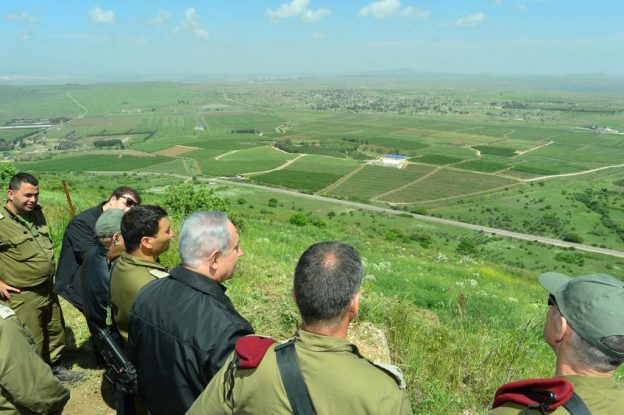
Benjamin Netanyahu is seen during a security tour in the Golan Heights, near Israel’s northern border with Syria
The SAA territorial advancements in the past year highlight that the SAA has the upper hand on the battle field. However, we should also remember that the southern battle is not the final battle, even though it is a vital battle since it includes an offensive that will be combating over 15,000 mercenaries. Contrary to Mr. Robert Fisk’s article in the Independent on June 26th 2018, I think it is too early to state that the battle for southern Syria will go down in history as a moment where “the US has given up on the overthrow of Assad in Syria” because it “abandoned its proxies in southern Syria”. Another battle that should be increasing in intensity in the next few weeks and/or after the southern battle is concluded is the battle to reclaim Northern (East) Syria – a territory under the Syrian Democratic Forces (SDF) and U.S. rebel factions.
The Syrian government including Liwa al-Baqir convened a major meeting of tribal notables from across Syria on June 2 in order to build support for operations against the U.S. in Eastern Syria. Syrian state media claimed the meeting included representatives from seventy clans from Aleppo, Ar-Raqqa, Hasakah, Daraa, and Deir ez-Zor Provinces. According to the Institute for the Study of War unconfirmed reports suggest that the SDF arrested dozens of additional tribal representatives traveling to the meeting from SDF-held Hasaka Province in Northern Syria. Tribal representatives at the meeting denounced the presence of the U.S., France, and Turkey in Syria and called for tribal mobilization to fight them on behalf of Assad. Multiple new pro-regime militia units of unclear size and capability reportedly formed subsequent to the meeting. These units may have joined Liwa al-Baqir with support from Russia and Iran. Not to mention reports released the week of July 15th 2018 highlighting that rebels in Southern Syria are being transported to the Northern part of Syria.
More recent news on July 29th 2018 highlights that the Syrian Democratic Council [the SDF political arm] held a two day meeting with the Syrian government headed by President Bashar Al Assad. Officials belonging to the SDF, which hold large swathes of land in northern Syria discussed the future of the autonomous regions it set up in northern and northeastern Syria. The SDF has made a series of deals with Damascus in recent years, notably in Aleppo when the SAA decimated Syrian Arab rebel groups making a final stand to hold the city. The SDF also came to an agreement with the Syrian government during the Turkish incursion into the then-Kurdish-held Afrin canton in Syria’s north-west corner, allowing Kurdish fighters to cross regime-held territory in a doomed bid to repel Turkish troops and their allies. The SDF, whose military is largely funded by the US as a counter-IS initiative, holds more than 27 percent of the country’s territory, according to the Syrian Observatory for Human Rights. It is still not clear whether rebel troops in northern Syria will be in accord with the SDF and SAA in relinquishing land they have usurped in the past 7 years and have it under the control of Damascus headed by President Bashar Al Assad. Also, according to a statement by SDF spokesperson Leilwa al-Abdullah, SDF forces pushed IS fighters into retreat from an area of 3,100 square-kilometers to a small slither of territory close to the strategic border town of Abu Kamal. A local SDF commander, speaking to Syria Direct said that the “crackdown on the border area” had gone ahead in coordination with Iraqi forces and international coalition airpower.
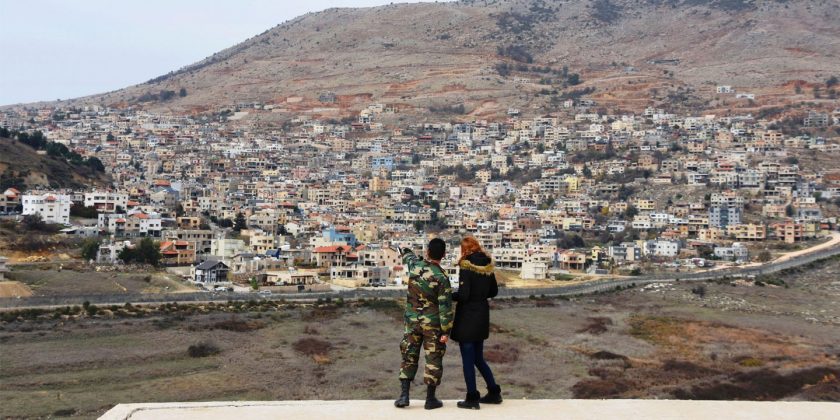
The Golan Heights
Still, recent territorial gains by the SDF may have little bearing on talks with the Syrian government, which could be unwilling to actually cede territorial control or administrative authority to Kurdish-majority forces. Sihanouk Dibo, from the majority-Kurdish leftist Democratic Union Party (PYD), acknowledged that any future talks could be “long and arduous because the Damascus regime is very centralized.” Whether centralized or not, the Syrian Government has historically been committed to the modality of Greater Syria with Damascus being the locus in decision making and autonomous regions conducting provincial policies relating to their provincial preferences. As stated by President Al Assad “Despite the ethnic diversity within each nation, the social fabric of the region by and large is one”. In other words, a region of the historical Bilad Al Sham/Greater Syria space will not be relinquished since the Levant possesses a unified social fabric and most importantly because the Barzani Clan in Iraq is a dangerous example of how U.S. imperialism with its allies can defend decentralization for the sake of geostrategic interest.
Therefore, in regards to the Syrian peace process, peace cannot be implemented when the UNSC resolution 2254 adopted in 2015 – including the P5 – continues to be violated. The delegates meeting at the June 13th U.N-led peace process in Geneva reiterated the importance of the clauses in the resolution which included that a nationwide ceasefire can only occur when member states are serious in halting the funding and training of mercenary entities. The members also reiterated the basis for a Syrian-led and Syrian-owned political transition in order to end the conflict in Syria. The meeting in Geneva did not highlight anything novel that the meetings in Astana or Sochi didn’t already outline. The meeting laid out the so-called four “baskets of reform” for a political settlement of the crisis. They include the drafting of a new constitution, parliamentary elections, the creation of a non-sectarian transitional government and the fight against mercenaries and terrorists. But the talks have made little progress so far as opposition members have failed to find an agreement over the fate of President Bashar al-Assad – a condition that the opposition has long wanted to include in the draft.
It is quite ironic that the Syrian Opposition is adamant in wanting to include a clause that stipulates that the current Syrian president is not allowed to run for president after 2020 and/or practice politics in Syria… it is ironic because while some opposition members discuss the importance of democracy being the foundation for peace in Syria, it is precisely democracy which re-elected President Bashar Al Assad in 2014.
Khaled AL-KASSIMI is a Doctoral candidate in the Department of Political Science at McMaster University in Canada. His research interest relates to the fields and approaches contoured by Critical Security Studies, Development Studies, International Relations, and Decolonial Studies.
Zionist Media: ‘Israel’ Involved in Assassination of Syrian Scientist Aziz Azbar
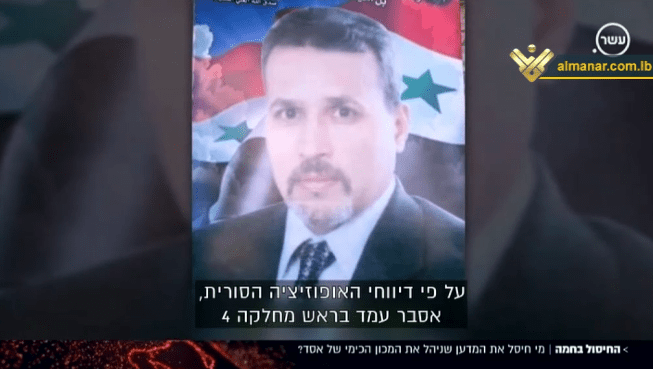
Al-Manar | August 6, 2018
Israeli media outlets reported Monday that the Zionist Mossad intelligence agencywas involved in the assassination of Syrian scientist Aziz Azbar, head of the Syrian Scientific Research and Studies Center, in the city of Masyaf in Hamah province on Saturday.
The Zionist media reports stressed that this operation comes in the context of the secret war on the axis-of-resistance to prevent it from developing its military capabilities, adding that Mossad has returned to play a direct role in eradicating ‘Israel’s’ enemies in several countries.
It is worth noting that Azbar, who holds a Ph.D. in atomic physics and a Ph.D. in liquid rocket fuel from France, was mourned on Monday in his hometown.
Syrian scientist assassinated in car bombing: Report
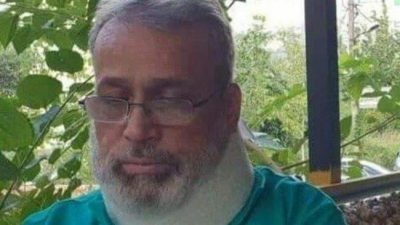
Syrian scientist Aziz Azbar
Press TV – August 5, 2018
A Syrian scientist has reportedly been assassinated in a car bomb attack after he survived Israeli attacks on his research center.
Aziz Azbar, the head of the Syrian Scientific Research and Studies Center in the city of Masyaf, was killed along with his driver in a bombing Saturday night, Syrian and Lebanese news outlets reported.
The scientific center, run by Azbar, had been the target of at least two Israeli aerial assaults over the past months.
Israel frequently attacks military targets inside Syria in an attempt to prop up terrorist groups that have been suffering defeats against Syrian government forces.
Israel has also been providing weapons to anti-Damascus militants as well as medical treatment to Takfiri elements wounded in Syria.
Western countries accuse the Syria government of possessing chemical weapons, an allegation rejected by Damascus.
Syria surrendered its chemical stockpile in 2013 to a mission led by the UN and the Organization for the Prohibition of Chemical Weapons (OPCW).
Damascus has repeatedly accused Saudi Arabia, Qatar, and Turkey of providing militants with banned weapons.
Tehran Reveals Terms of Its Withdrawal From Syria
Sputnik – 04.08.2018
Iran might decrease its military presence in Syria and even leave altogether after the situation in the war-torn country normalizes and the fight against terrorism there brings significant results, Iranian Foreign Ministry spokesman Bahram Qassemi said.
“As soon as we see that Syria is close to certain stability, and the fight against terrorism is close to its end, and significant results have been reached, of course, we might decrease the presence of our advisors in Syria or even withdraw from the country,” Qassemi said in an interview with the Iranian Pupils Association News Agency (PANA) as quoted by the Iranian Foreign Ministry’s website on Saturday.
Tehran would maintain its presence in Syria as long as Damascus wants it to, Qassemi pointed out. The diplomat noted that fighting terrorism was one of the Iranian forces’ tasks in Syria, apart from granting support to the war-torn country’s government.
In July, Iranian Supreme Leader’s Top Adviser for International Affairs Ali Akbar Velayati said Tehran would be present in Syria and Iraq at the request of these countries’ legitimate governments and would not leave despite the threats voiced by the United States.
Israel has also repeatedly expressed security concerns over the Iranian presence next to its borders in Syria. Velayati has noted that the Iranian presence in Syria was coordinated with Moscow and Damascus and did not have to be agreed upon with Israel.
Iran, alongside Russia and Turkey, is a guarantor state of the Syrian truce. Syrian President Bashar Assad has said that only Iranian officers, not troops, were operating in his country.
Turkey in panic as Assad seeks to reclaim occupied territory
By M K Bhadrakumar | Indian Punchline | August 1, 2018
The meeting of the senior diplomats from Russia, Iran and Turkey in Sochi on Tuesday was prima facie meant to hasten the Astana process on a Syrian settlement. But in reality, it took place in the backdrop of reports that Syrian forces, which have liberated the southwestern provinces of Quneitra (facing Golan Heights) and Daraa (on the Jordanian border) will now proceed to assault the northwestern province of Idlib on the Turkish border.
Ankara has warned that any such move by Damascus will prompt Turkey to pull out of the Astana process altogether in protest. Turkey’s fear is that unlike in the southern provinces, the terrorist groups that control Idlib may fight it out, which would lead to large-scale violence and an exodus of refugees and militants across the border into Turkey. Idlib is estimated to have a population close to 2.5 million. Importantly, though, Turkey seeks to maintain its presence in Idlib, thanks to its enduring links with many of the extremist groups ensconced there. Turkey is equally adamant that the Kurds should not spread their influence into Idlib close to eastern Mediterranean coast.
Turkish President Recep Erdogan personally took up the matter with Russian President Vladimir Putin twice during the past fortnight, demanding that Moscow should restrain Damascus from launching any operations in Idlib. After the meeting in Sochi today, Russian presidential envoy on Syria Alexander Lavrentyev was quoted as saying, “I’d rather refrain from speaking about the city’s (Idlib’s) storming or a pending operation. There are too many rumors and they are ungrounded. Any large-scale operation in Idlib is out of the question.”
He seemed to hint that Russia and Turkey are trying to find a way to influence the terrorist groups to surrender (which was how Daraa and Quneitra were liberated without fighting.) To quote Lavrentyev, “We still hope that the moderate opposition and our Turkish partners, who took responsibility for stabilising this region, will manage it.” But he added, “The threat coming from this zone is still significant.” (In the past 10 days, Russia had shot down as many as four drones launched by the militants from Idlib targeting the Russian military near the Hmeymim airbase.)
On the other hand, Damascus has insisted that it intended to liberate Idlib. All indications are that preparations have begun for a big military operation. The militant groups in Idlib are estimated to be over 50,000 strong and are drawn from Turkish, Uzbek, Chechen, Turkistani and Arab fighters from the Persian Gulf.
Overshadowing the Idlib issue, there is another development that worries Turkey – the direct talks between the Syrian Kurds (previously aligned with the US) and Damascus for reaching a modus vivendi regarding northern Syria up to the Euphrates in the east. The Kurds hope to reconcile with the Assad government in pursuit of their common interest to force Turkey to vacate the large chunks of Syrian territories occupied by it in military operations in the recent years.
Contradictions are galore. For one thing, Russia encourages the newfound proximity between Syrian Kurds and Assad regime. Russia is also keen to vanquish the jihadi fighters who migrated to Syria from North Caucasus and Central Asia. Again, Moscow is one with Damascus on preserving Syria’s unity and territorial integrity at any cost.
On the other hand, it is of supreme importance for Moscow that Turkey is somehow assuaged so that the Astana process as such doesn’t get derailed. At the same time, Russia also places store on its working relationship with Turkey at the bilateral level that is steadily deepening and assuming a strategic character, especially with the downswing in Turkish-American relations lately. The business ties between Russia and Turkey are also flourishing with Russia winning multi-billion dollar contracts in energy projects.
Realpolitik aside, however, morally or legally Turkey has no business to stop the Assad regime from regaining control of the entire Syrian territory. Turkey has blood on its hands by fostering al-Qaeda groups and Islamic State. Equally, Turkish occupation of Syrian territory is untenable on any ground. In reality, Turkey overreached, hoping that it could exploit the US-Russia tensions to bargain with both superpowers and maximize its returns in a Syrian settlement. But President Trump has instead begun tightening the screws on Erdogan lately. Equally, Ankara didn’t expect the stunning victory of the Syrian-Russian operations in southwestern Syria.
There will be growing pressure on Turkey to pull out from Syrian territory in the coming months. Evidently, an American withdrawal from Syria in a near future is on the cards. The Syrian Kurds’ move to reconcile with Damascus is the sure indicator that their American mentors are exiting the war. In short, the US’ capacity to create new facts on the ground in favor of Turkey is virtually zero. This puts Turkey under immense pressure to negotiate a deal with Russia on the best terms available.
To be sure, Assad’s tenacity to reclaim all lost territories is not to be doubted. Make no mistake, he will liberate Idlib, no matter what it takes, and he will thereafter head east towards Jarablus, Azaz, al-Bab and Afrin — territories that are under Turkish control — as well as areas near the Euphrates front line that have been under the control of the Kurdish groups backed by the US. It seems some skirmishes have already begun in the region adjacent to Idlib between Syrian government forces and terrorist groups. Read a report by FARS news agency, here.
Russia swats away Israeli bluster on Syria
By M K Bhadrakumar | Indian Punchline | July 25, 2018
The Russian version of the visit by Foreign Minister Sergey Lavrov and Chief of Staff General Valery Gerasimov to West Jerusalem on July 23 became available, finally, on Wednesday in the nature of a terse TASS report quoting a ‘military-diplomatic’ source in Moscow as saying that the visiting Russian officials “looked into the tasks of completing the anti-terrorist operation in Syria’s South.”
An unnamed Israeli official had earlier floated a story that Prime Minister Benjamin Netanyahu did some tough talking with Lavrov and “rebuffed” a Russian offer to create a 100-kilometre buffer zone adjacent to Golan Heights. Netanyahu reportedly insisted that he won’t be satisfied with anything short of Iran ending its presence in Syria conclusively.
The first indication that the talks didn’t go well came when Israel shot down a Syrian jet on July 24 in Quneitra bordering Golan. It was a calculated act of belligerence by Israel. (The Islamic State fighters who are present in the region have since released the photograph of the wreckage and the mutilated body of the Syrian pilot.)
The TASS report today punctures the Israeli version that the two Russian officials were deputed by President Vladimir Putin specially to discuss with Netanyahu the future of Iranian presence in Syria. (It now transpires that the Russian officials were on a tour of Israel, Germany and France.) The Israeli bravado can only be seen as a desperate ploy to cover up its humiliating defeat in Syria with the terrorist groups that were its proxies surrendering lock, stock and barrel in Daraa and Quneitra to the Syrian-Russian forces – especially the hasty exfiltration of the controversial group known as the White Helmets to Jordan via Golan Heights with the logistical help from the Israeli military.
Quite obviously, Moscow does not want to get entangled in the Israel-Iran tensions. This is also the American assessment of the Russian thinking, as articulated by the Director of the National Intelligence Agency Daniel Coats on Thursday:
“We have assessed that it’s unlikely Russia has the will or the capability to fully implement and counter Iranian decisions and influence (in Syria.) Russia would have to make significantly greater commitments [in Syria] from a military standpoint, from an economic standpoint. We don’t assess that they’re keen to do that.”
Nonetheless, the Israeli propaganda has gone overboard in attempting to create a wedge between Russia and Iran. (Read a fine piece, here, by Moon of Alabama on the Israeli disinformation campaign.) This couldn’t have gone down well in Moscow. At any rate, the Russian Foreign Ministry came out on July 24 with some sharp criticism of the move by the Israeli parliament (six days earlier) to adopt a bill known as Basic Law: Israel as the Nation-State of the Jewish People.
The operation by the Syrian forces (backed by Russian allies) to liberate Quneitra succeeded beyond expectations once Washington signaled that the extremist groups entrenched in the southern provinces bordering Jordan and Israel should not expect any American intervention to bail them out.
Damascus is now turning its attention to the liberation of the northwestern province of Idlib. It will be a major confrontation due to the presence of a large number of foreign terrorists in Northwestern Syria. The Iranian media reported that a Russian flag ship Ro-Ro Sparta was spotted crossing the Bosporus en route to Syria’s Tartus, carrying military cargo mostly ammunition, shells and missiles and that the reinforcements are meant for the Syrian Army’s “upcoming assault” on Idlib province.
Kurds reach deal with Damascus to end Syria conflict
Press TV – July 28, 2018
An alliance of Kurdish and Arab militants in Syria says it has come to an agreement with the Syrian government to develop negotiations to end violence in Syria.
The announcement was made after the so-called Syrian Democratic Council (SDC), the political wing of the Syrian Democratic Forces (SDF), sent a delegation to Damascus for talks with Syrian officials earlier this week. The SDF, itself, is a US-backed coalition of mainly Kurdish militants.
The SDC said in a statement Saturday that it had agreed with the government of the Syrian President Bashar al-Assad to form committees that would “chart a roadmap to a democratic, decentralized Syria.”
The SDC delegation visited Damascus for the first time after President Assad said that he was “opening doors” for negotiations with Syrian Kurds that he said had “apparently become wary” of their unpredictable ally – the United States.
The Kurds then expressed readiness to hand over control of the Eastern Euphrates to the government after Washington withheld its support for the Kurdish militants in the northern Syrian cities of Manbij and Afrin.
The SDC’s co-chair Riad Darar said on Friday the talks with Damascus were aimed at “working towards a settlement for northern Syria,” as it was time to “solve our problems ourselves.”
The group, which is being supported by Washington, has already managed to form an autonomous administration in northern Syria during the country’s seven-year conflict.
Washington’s conflicting plans in Syria, however, have now prompted the Kurdish militants to turn to the government in Damascus.
Their presence in the area near the Turkish border has been a source of tension between the US and Turkey.
Ankara, which considers the Syrian Kurdish militants as an extension of Kurdistan Workers’ Party (PKK) terrorists, has even threatened to “destroy all terror nests,” near the Syrian border.
It has vowed not to allow Kurdish groups to dominate Turkish border with Syria.
Refugees gather in Shebaa for return to Syria
On Saturday, hundreds of Syrian refugees residing in Hasbaya’s Shebaa and western Bekaa gathered in a schoolyard in Shebaa, waiting for buses departing to Syria, provided by the Syrian government.
The state-run National News Agency estimated that nearly 900 refugees assembled at Shebaa High School at 9 a.m., while General Security was present on site checking the names of the departees.
The buses are set to stop at the Masnaa border point before crossing into Syria. The group marks the fourth to depart from Lebanon.
Several groups had previously departed, particularly from the northeastern town of Arsal in initiatives organized by General Security.
Featured Video
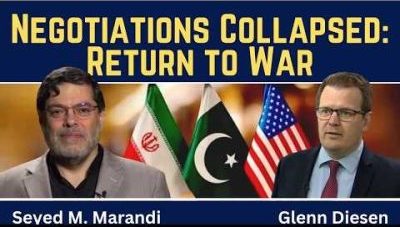
Seyed M. Marandi: Negotiations Collapsed – Return to War
or go to
Aletho News Archives – Video-Images
From the Archives
The US-Iran Scenario That Most Scares Israel
By Ali Haydar | Al-Akhbar | October 9, 2013
Israeli Prime Minister Benjamin Netanyahu issued a series of threats toward Iran and its interlocutors in the West, including the US, as serious negotiations on Iran’s nuclear program seem more plausible.
As a possible rapprochement looms between the US and Iran, Netanyahu has attempted to impose impossible Israeli conditions on the negotiators, such as the full dismantling of Iran’s nuclear program, not to mention threatening military force.
Whatever the deal that could materialize between Iran and the West, Israel is going to find itself before an open-ended path. One can foresee three possible scenarios… continue
Blog Roll
 Aletho News
- UK, Spain reject Trump’s new scheme to blockade Hormuz Strait
- Russian frigate ‘resurfaces’, chases off NATO pirates days after Kiev ‘sank’ it
- Ukraine Targets Russian Merchant Fleet With NATO Intel Support – Presidential Aide
- Russia’s ‘shadow fleet’ makes mockery of UK naval power
- Ukraine plans to attack Russian ships with Norwegian support
- US’s ‘Very Foolish’ Double Blockade of Hormuz Strait Makes Absolutely No Sense: Here’s Why
- China issues rules on countermeasures against foreign states’ unlawful extraterritorial jurisdiction
- Seyed M. Marandi: Negotiations Collapsed – Return to War
- Tomorrow’s naval blockade showdown
- ‘Israel’ attacks civilians to hide its embarrassing military failures & out of pure sadism
- If Americans Knew
- Israeli prison authorities are blocking hundreds of solidarity postcards being sent to female Palestinian prisoners
- ‘I wished for death’: Sexual violence in Israel’s prisons is an ‘organized state policy’
- Israeli army shoots, kills 9-year-old girl in her Gaza classroom
- Israel is attacking Lebanon to sabotage the Iran ceasefire, but the media is hiding its true motivation
- Israel’s restriction of aid into Gaza leads to critical shortages in bread, baby formula, and water
- Critical shortages in Gaza, Lebanon in ruins, “piracy” in Iran – Daily Update
- US-Iran ceasefire negotiations make zero progress – Daily Update
- Pro-Israel ‘Thinktanks’ and Individuals who Influence U.S. Foreign Policy
- Mearsheimer reveals how Israel dictates US policies on Iran, Gaza – video
- After killing 350+, Israel still has a “score to settle” with Lebanon before ceasefire – Daily Update
- No Tricks Zone
- Cave Discovery Reveals Today’s Desert Climates Were Recently Far Warmer, Wetter, Teeming With Life
- German Expert: Heat Dome Led To Record Temps In Western USA…Warmer In 1934, 1936
- New Study: No Linear Warming Or Glacier Retreat Along Northern Antarctic Peninsula Since 1980s
- An Inconvenient Tree: Uncovered In Alps… Europe Much Warmer Than Today 6000 Years Ago
- New Study Reports A 60% Slowdown In Greenland’s Ice Loss Rate In The Last Decade
- Low Intensity Tornado Wrecks Major Solar Farm, Creating A Potential Toxic Dump
- New Study Finds Warming Saves Lives…Cold Temperatures 12 Times More Deadly Than Excess Heat
- German Science Blog Accuses PIK Climate Institute Of Hallucinating Climate Tipping Points
- Devastating Assessment Of Comirnaty Vaccine By Former Senior Pfizer Europe Toxicologist
- New Study: CO2 Is ‘Effectively Negligible’ As An Explanatory Climate Change Factor Since 2000
 Aletho News