Erdogan, Putin to Meet Monday in Sochi as Turkey Moves More Weapons into Syria
21st Century Wire | September 15, 2018
Turkey’s President Recep Tayyip Erdogan is scheduled to meet Russia’s President Vladimir Putin in Sochi on Monday, amid reports of a heavy Turkish arms drop into Syria in recent days.
The two leaders last met at a summit earlier this month in Tehran, and this next meeting will come just days after the Turkish army sent more ‘arms and ammunition’ into Syria’s Idlib and Hama provinces, according to a report by the Syrian Observatory for Human Rights (SOHR) released on Saturday.

The independent media outlet Muraselon is also citing multiple reports of both Turkish weapons and troops moving into these regions, including to areas under the control of the ‘rebel’ coalition National Liberation Front (NLF) – a collection of unsavory characters and the main rival of Hay’at Tahrir Al-Sham (HTS) in Idlib, according to IRIN:
Turkey’s favourite is the NLF, which is led by Fadlallah al-Hajji, a Muslim Brotherhood ally. The NLF includes Turkey-friendly Islamists like Ahrar al-Sham, the Noureddine al-Zengi Brigades, Failaq al-Sham, Jaish al-Ahrar, and groups that fought under the Free Syrian Army banner, like the Victory Army and the 2nd Coastal Division.
Big but brittle, the NLF is held together by Turkish sponsorship and shared enemies: al-Assad’s government, Syrian Kurdish groups, and hardline jihadists.
Turkey’s escalated military presence and heavy arms drop into known jihadist havens ahead of the upcoming Sochi meeting is unwelcome, and presents the potential risk for a military showdown in the future between Turkish and Syrian/Russian forces – something that all sides have warned against but Turkey’s apparent ‘double-dealing’ isn’t helping.
The Bluffer’s Guide to Bombing Syria
The Dirty Dozen: 12 lies they tell you to anaesthetise you for the upcoming bombing of Syria
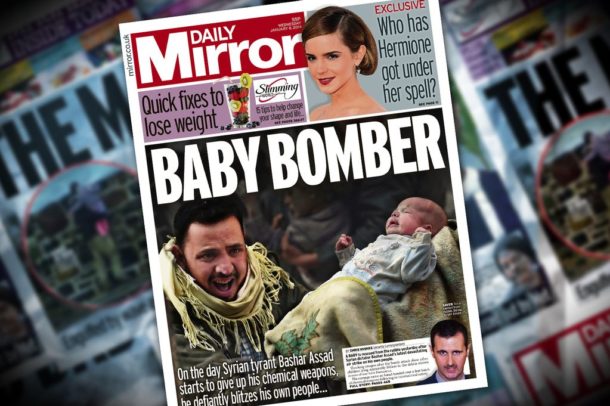
By Peter Ford | 21st Century Wire | September 14, 2018
The propaganda mills of the British and American governments – spokespersons, media, think tanks – are working overtime churning out ‘talking points’ to justify the upcoming large scale bombing of Syria on the pretext of use of prohibited weapons.
Here is a guide from a former insider to the top dozen of these lies.
1. There are more babies than jihadis in Idlib. As it happens this gem of moral blackmail is untrue. There are twice as many jihadis (about 100,000) as babies (0-1 year) (55,000). What is this factoid meant to say anyway? Don’t try to free an area of jihadis because you might harm a lot of children? The Western coalition scarcely heeded that consideration in razing Mosul and Raqqa in order to crush ISIS. They are still pulling babies out of the rubble in Raqqa.
2. The reports [of the imminent chemical weapons ‘attack’] must be true because Assad has done it before. False. Since 2013 when Asad gave up chemical weapons under supervision of the Organisation for the Prohibition of Chemical Weapons (OPCW) the OPCW have not visited the sites of alleged attacks in jihadi-controlled areas but have accepted at face value ‘reports’ from pro-jihadi organisations like the White Helmets and the Syrian American Medical Society, along with ‘evidence’ from hostile intelligence agencies. In the case of the one site the OPCW did visit, Douma, their report said they found no evidence of sarin, no untoward traces in any of the blood samples taken from ‘alleged victims’ (their term), no bodies and only ambiguous evidence of use of chlorine.
3. The OPCW report on Douma was flawed because the Russians and Syrians caused delay. False. As documented in the OPCW report, delay was caused by UN bureaucracy and jihadi snipers. The inspectors do not say their findings were to any significant degree invalidated by the delay.
4. Assad uses chemical weapons because they frighten large numbers of people into fleeing. False. They don’t. This desperate argument is trotted out to counter the fact that Assad would have to be stupid to use chemical weapons knowing what the result would be and that he would derive minimal military benefit. To date, not one of the alleged chemical attacks has precipitated an exodus any greater than flight caused by the legendary ‘barrel bombs’. The inhabitants of Douma by their own testimonies given to Western journalists were even unaware there might have been an attack until they heard about it in the media.
5. The OPCW won’t be able to investigate because it won’t be safe. A feeble excuse to preempt calls for establishing facts before bombing. The Turks escort Western journalists into Idlib. They have hundreds of troops there and the jihadis kowtow to them because they control all logistics. The Turks could escort OPCW. And wouldn’t the jihadis be keener than anybody for the inspectors to visit if their claims were true?
6. The upcoming strikes are not aimed at regime change. False. The plan is to decapitate the Syrian state with attacks on the presidency. Failing that the aim is to make Idlib a quagmire for the Russians. Anything to deprive Asad and Putin of victory, regardless of whether it prolongs the war.
7. It’s all Russian disinformation. Yeah, like the arms inspectors before the Iraq war who said no WMD in Iraq. Reality: the Russians have got great intelligence on what Western powers with their jihadi clients are up to and are calling out the phoney moves.
8. There won’t be enough time for parliamentary debate. Pull the other one. Reality: the government are terrified of a rerun of 2013 when Labour and 30 brave Tory MPs voted against bombing, causing Cameron and then Obama to back off.
9. MPs can’t be told what is planned because it would jeopardise the safety of service personnel. How low can you stoop? Feigning concern for flyers when it’s really just about keeping the people in ignorance of how big the strikes are going to be.
10. There are going to be massacres, a bloodbath, or ‘genocide’. False. We heard all this hysteria before Aleppo, before Eastern Ghouta and before the campaign in the South. All vastly exaggerated. The Syrian Arab Army has not been responsible for a single massacre, while the jihadis have been responsible for many (source: quarterly reports of the UN Independent Commission of Inquiry on Syria).
11. People have nowhere to go. False. The Russians have opened safe corridors but the jihadis are not allowing people to leave. They can still leave for the northern border strip which Turkey controls, where there are camps, and many (including jihadi fighters) will be able to cross temporarily into Turkey.
12. We can’t tell you which armed groups we support because it would make them targets for Assad. Really? You think he doesn’t know? Isn’t it because you are terrified it will come out that we have been supporting some real head-choppers?
***
Author Peter Ford is a retired British Diplomat who was Ambassador to Bahrain from 1999-2003 and Syria from 2003-2006.
While all eyes are on Syria’s Idlib, US continues to decimate Yemen
By Darius Shahtahmasebi | RT | September 14, 2018
The US is ready to defend Syria from a brutish assault launched by Syria’s own government and its allies – or so Washington wants you to believe. In the backdrop, Yemen continues to burn in silence.
On September 3, US ambassador to the UN, Nikki Haley – eloquent diplomat that she is – retweeted a tweet from the warmonger in chief that is the US president, with the caption “All eyes on the actions of Assad, Russia and Iran in Idlib.” This is the same US administration who just facilitated the bombing of a school bus in Yemen, slaughtering at least 40 children in the process.
Maybe, just maybe, Nikki Haley should keep her eyes on herself.
If the world did direct its eyes to what is taking place in Yemen, they would know that the United Nations has just warned of an “incalculable human cost” in the works, as the US and its allies press forward with an offensive to retake the Yemeni port city of Hodeida from the Houthi rebels.
That’s right. The US, currently waving its arms in despair about human rights abuses and chemical weapons attacks that have not even taken place in Syria yet, is supporting a major offensive of its own that will lead to a humanitarian crisis of monumental proportions.
Yemen, a country already deeply in crisis, relies on the port of Hodeida for at least 70 percent of its humanitarian aid. It therefore makes sense from a humanitarian perspective to turn its location into a major war zone, am I right?
The small minority of people who are inclined to care about innocent Yemenis need not fret though. US Secretary of State Mike Pompeo has just this week certified that the Saudi-led coalition is taking sufficient steps to protect civilians. According to Pompeo, the Gulf nations involved are “undertaking demonstrable actions to reduce the risk of harm to civilians.”
“They are taking steps, in the view of the US government and this administration, in the right direction,” State Department spokeswoman Heather Nauert told a briefing, according to Reuters. “We see them taking steps. Is it perfect? No absolutely not. Do we see them doing what they can to mitigate civilian casualties? Absolutely we do.”
Thank God – I was getting worried there for a second. The US-backed Saudi-led coalition may be killing children as if they were ants, but they are taking steps to mitigate the number of children they are killing at the same time.
A seven-page memo sent to Congress and obtained by the Intercept further confirmed Pompeo’s delusional thinking, as the memo called Saudi Arabia and the UAE “strong counterterrorism partners.” Never mind that just last month, the Associated Press reported the US and its allies were actually recruiting Al-Qaeda fighters to join the coalition.
Oops.
While the Trump administration is taking a horrifying and bloody war and taking it to new depths, the truth of the matter is that this war did not begin under Donald Trump. The war in Yemen, the Arab world’s poorest nation, fast becoming the world’s worst humanitarian crisis, was started by none other than peace-prize laureate Barack Obama himself.
But why did this war start, and why has the US continued to support it?
In an overlooked interview with the Real News’ Aaron Maté, Rob Malley, President of the International Crisis Group and former Special Assistant to President Obama, gave a disturbing glimpse into who actually pulls the strings on US foreign policy.
According to Malley:
“To try to understand what the Obama administration was about, and I’ve tried to- just to try to, to explain it to myself, to try to understand how we got to where we are, let’s not forget at the time we were in the middle of these negotiations with Iran, trying to reach a nuclear deal which was extremely unpopular with our traditional allies in the region, from Israel to Saudi Arabia to the UAE and others. And the Saudis came to us and said that they were about to intervene in Yemen, to attack the Houthis that had toppled the legitimate government of the internationally recognized government at the time. And they asked for our assistance…”
“So there was on the one hand a number of voices expressing concern about that. But on the other hand were many people saying the relationship with Saudi Arabia is almost at breaking point. They believe we’d betrayed their trust for a number of reasons. But Iran, Iran negotiating the Iran deal, or the negotiations over the Iran deal was one of them. We needed to protect that deal and make sure that we could get it done, because if we didn’t have a deal there was a risk of a war with Iran. And so I think the decision was made in the end by President Obama to say we’re going to be, to support parts of this war…”
Only a peace prize laureate could pull off a feat like that. But all joking aside, the human cost of the war in Yemen is nothing short of shameless.
On October 8, 2016, an aerial bombardment targeted a crowded funeral in Sana’a, the capital of Yemen, the aftermath of which was aptly described as a “lake of blood.” According to the UN, more than 140 Yemenis were killed and at least 525 others were injured.
To date, the US-backed Saudi-led coalition has struck well over 100 hospitals, as well as wedding parties, refugee camps, food trucks, factories, transport routes, agricultural land, residential areas, and schools, to name a few. Yes, you read that right. Yemen, with only 2.8 percent of its land being cultivated, is actively targeted by the US-backed coalition. According to Martha Mundy, professor emeritus at the London School of Economics, “to hit that small amount of agricultural land, you have to target it.”
Prior to spiralling into chaos, Yemen was already dependent on imports for 90 percent of its staple foods and almost all of its fuel and medical supplies. Putting aside the mass amount of violence that the US-backed coalition has enacted, the rest of Yemen’s population is suffering due to the Saudi-imposed blockade, which has put half the population at risk of starvation. According to the UN, over 462,000 children under the age of five are suffering from severe acute malnutrition.
This is done completely on purpose. At the end of August this year, Saudi Arabia’s Crown Prince, Mohammed Bin Salman, threatened that he would continue targeting women and children in Yemen and allegedly said that he wants to “leave a big impact on the consciousness of Yemeni generations.”
“We want their children, women and even their men to shiver whenever the name of Saudi Arabia is mentioned,” the Crown Prince reportedly said.
The idea, advanced by Pompeo and his cohorts at the State Department, that the coalition has taken steps to avoid civilian casualties is by all accounts, complete nonsense. As the New York Times openly acknowledged:
“The first problem was the ability of Saudi pilots, who were inexperienced in flying missions over Yemen and fearful of enemy ground fire. As a result, they flew at high altitudes to avoid the threat below. But flying high also reduced the accuracy of their bombing and increased civilian casualties,” American officials said.
“American advisers suggested how the pilots could safely fly lower, among other tactics. But the airstrikes still landed on markets, homes, hospitals, factories and ports, and are responsible for the majority of the 3,000 civilian deaths during the yearlong war, according to the United Nations.”
In addition to supplying billions of dollars’ worth of arms to the Saudi kingdom, US personnel provide overwhelming assistance to the Saudi-led coalition to help bring Yemen to its knees by sitting in the Saudi’s command and control center, providing lists of targets, refuelling planes, running intelligence missions, and so forth.
If Donald Trump is so concerned with migrants and refugees, perhaps he should stop creating them. If he really cares about ‘America first’ and making America great again, perhaps racking up notches to America’s war crime belt is not the way to go. Legal experts have already warned the US government that its complicity in these attacks can make them a co-belligerent in Saudi Arabia’s vast, extensive list of war crimes. This warning has fallen completely on deaf ears and has not helped at all in deterring the Trump administration from continuing some of Barack Obama’s worst policies; and even now the US continues to shelter the Saudi-led coalition so that it can continue its bloodthirsty policies unabated.
Make no mistake, if the US pulled its support for Saudi Arabia, Yemen’s suffering could stop tomorrow.
Watch out for Assad though; I heard he was about to retake a Syrian city from an Al-Qaeda affiliate. Remember Al-Qaeda, the notorious terror group the US claimed was the mastermind behind the September 11 attacks? Apparently, the entire US government doesn’t, as it allies itself with Al-Qaeda in just about every battlefield that counts.
In the meantime, ordinary Yemenis continue to suffer by the millions. If you can absorb all of this and still believe the US is genuinely concerned about human rights abuses in places like Syria, then you probably deserve what’s to come next.
Marines hold eight days of drills with militants in southern Syria
Press TV – September 14, 2018
US marines have held eight days of unprecedented military exercises with US-backed militants in southern Syria in an attempt to send a “strong message” to Iran and Russia, a senior military official said.
Colonel Sean Ryan, a US military spokesman, described the drills as “a show of force,” saying that the Pentagon had notified Russia through “deconfliction” channels to prevent “miscommunication or escalate tension”.
“The exercise was conducted to reinforce our capabilities and ensure we are ready to respond to any threat to our forces within our area of operations,’” he noted.
The eight days of drills ended this week at the US military outpost in Tanf, located 24 km to the west from the al-Tanf border crossing between Syria and Iraq in Homs Governorate, said Colonel Muhanad al Talaa, the commander of the US-backed Maghawir al Thawra militant group.
He told Reuters the war games were the first such exercises with live-fire air and ground assault, involving hundreds of US troops and militants operating against the government of President Bashar al-Assad.
Thawra claimed the drills were meant to send what he described as “a strong message to Russia and Iran” that the Americans and the militants intended to stay and confront any threats to their presence.
The US presence in Tanf military base is illegal and lacks the permission of the Syrian government. Damascus, Moscow, and Tehran have repeatedly denounced the American military presence in Syria and called on the US to withdraw its marines from the base. However, the US has so far refused to pull its forces out, and even moved to deploy hundreds of more marines in Tanf earlier this month.
The new forces have reportedly joined “special operations troops already based in the garrison” and are going to participate in the drills amid an escalation of US-Russian tensions in Syria and Russia’s military exercises in the Mediterranean.
Meanwhile, CNN cited several US military officials as saying last Friday that Russia had warned the Pentagon twice in the past weeks that its forces, together with Syrian troops, were prepared to wage an attack on terrorists in the area where dozens of US troops are stationed – including those in Tanf garrison.
Reacting to Moscow’s warnings, US military officials “bluntly warned Russia and Syria not to go forward with an attack within a 35-mile-wide security zone that the US maintains around Tanf,” Task & Purpose further reported.
The US illegally built the military outpost in early 2016 under the pretext of fighting Daesh terrorists, but it has declared a 55 km-radius “deconfliction zone” off-limits to others, providing a safe haven for at least 50,000 militants and their families in the Rukban camp that lies within it.
This is while US President Donald Trump had previously stated that he wanted American troops out of Syria as soon as possible and has also called for redirecting millions of dollars meant to help rebuild Syria to other military projects.
Russian and Iranian military forces are in Syria at the official request of the Syrian government. This is while the US has involved itself in the Syrian conflict through an overt campaign meant to train and support anti-Damascus terrorists. The government of President Bashar al-Assad has repeatedly denounced the American military presence in the country and called on Washington to end what it has described as an “uninvited aggression” against Syria.
Former British Ambassador to Syria, Peter Ford, Warns of Pending War Propaganda on Commission of Inquiry Report to UNHRC
In Gaza | September 13, 2018
Peter Ford, former British Ambassador to Syria:
You will be seeing lurid accounts in the Western media of the latest report to the UN Human Rights Council from the Independent Commission of Inquiry on Syria. This was issued on 12 September.
In particular it is being stated that the report vindicates claims that weaponised chlorine was used in Douma. This is not what the report (text below) actually says.
If you read the actual report – you have to reach section 92 so obviously few hacks will do that – you will see that it is carefully worded.
The inspectors, who unlike OPCW did not actually visit the site, ‘received a vast body of evidence suggesting that..’ (of course they did, from the jihadis and from hostile intelligence services); ‘they received information on [deaths and injuries] (which is not the same as seeing bodies or examining victims); they ‘recall that weaponisation of chlorine is prohibited’ (but do not actually say that Syrian forces used it in Douma).
Besides the text of the relevant part of the report I have added the paragraph on Raqqa and the ‘indiscriminate attacks and serious violations of international law’ by the coalition of which the UK is part, including the bombing of a school and killing of 40 people.
You will note also the acknowlegement that ISIS exploited hospitals in Raqqa (as other jihadi groups have done in every part of Syria). Naturally the media and our government will not want to discuss that paragraph of the report.
**
Excerpt from the text of the report by the Independent Commission of Inquiry on Syria:
92. Throughout 7 April, numerous aerial attacks were carried out in Douma, striking various residential areas. A vast body of evidence collected by the Commission suggests that, at approximately 7.30 p.m., a gas cylinder containing a chlorine payload delivered by helicopter struck a multi-storey residential apartment building located approximately 100 metres south-west of Shohada square. The Commission received information on the death of at least 49 individuals, and the wounding of up to 650 others.
93. While the Commission cannot make yet any conclusions concerning the exact causes of death, in particular on whether another agent was used in addition to chlorine that may have caused or contributed to deaths and injuries, it recalls that the weaponization of chlorine is prohibited under customary international humanitarian law and under the Convention on the Prohibition of the Development, Production, Stockpiling and Use of Chemical Weapons and on Their Destruction, ratified by the Syrian Arab Republic in 2013.
95. The Commission also continues to investigate aerial attacks launched against ISIL positions in Raqqah city between June and October 2017, which destroyed much of the city and displaced nearly the entire population. The Commission is concerned that the widespread destruction wrought upon Raqqah city included indiscriminate attacks and other serious violations of international humanitarian law. Significant challenges continue to arise, including with regard to how ISIL prevented civilians from documenting attacks as a matter of policy, how chaos often left victims and witnesses unable to identify whether a given attack was carried out by aerial or ground operations, and how ISIL terrorists embedded themselves and their military installations in numerous civilian infrastructures, including hospitals, thus significantly complicating investigations.
96. The Commission further notes that the coalition led by the United States acknowledged on 28 June that it had killed 40 civilians during its aerial attack against Al-Badiya school in Mansurah, Raqqah on the night of 20 to 21 March 2017
Iranian Bots and the Facebook Stasi: Manufacturing Consent for the Endless War
By Helen Buyniski | Helen of desTroy | September 3, 2018
If at first you don’t succeed, try, try again. The American Empire doesn’t handle failure well, and their repeated failures to oust Syrian president Bashar al-Assad have driven them into a frenzy where good judgment and logic are a thing of the past. Russian military intelligence predicts a false-flag chemical attack in Idlib which will be pinned on the Assad regime and used to justify “retaliation” orders of magnitude greater than April’s Tomahawk tantrum. This time, if the words of the Wicked Witch of the UN are any indication, Iran and Russia will also be blamed. While the US has mostly abandoned hope for regime change in Syria, it will not look a gift horse in the mouth, and is gathering aircraft carriers and bombers to the region while pumping out tear-jerking propaganda about Idlib residents fearing for their lives. If the false flag fails, they can always send those bombers to Iran…
Such an attack is very much on the table, with the groundwork being laid in the pro-war press. John Bolton promised the MEK, a “corrupt, criminal cult” of Iranian exiles which bribed its way off the State Department’s list of terrorist organizations in 2012, regime change by 2019, and the clock is ticking. Attempts to foment a color revolution have failed repeatedly, because Iranians aren’t stupid and remember what happened the last time the US overthrew their government. But Benjamin Netanyahu has been baying for Iranian blood for almost three decades, and Bolton cares little for more clear-headed military personnel’s warnings that invading Iran would be a costly, unwinnable nightmare – Real Men Go To Tehran, as they used to say in the halcyon days of the Axis of Evil.
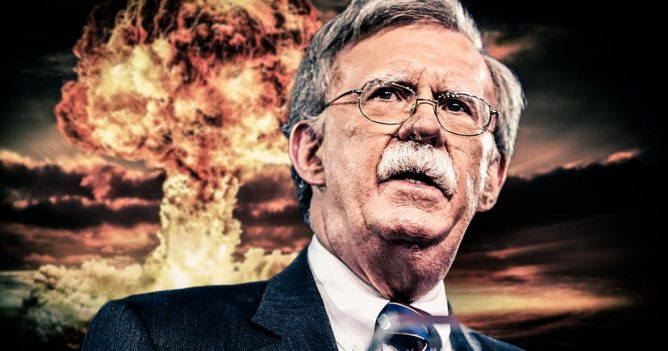
Prelude to War: Iranian Bots
The ruling class understands Americans are wary of another Middle Eastern war and must be convinced they’re under attack. Hence the new bogeyman, just in time for Election 2018: Iranian Meddling. Twitter, Facebook, and Google took time out from deplatforming anti-establishment commentators to delete over a thousand accounts between them after cyber-security firm FireEye released a report detailing a far-reaching “Suspected Iranian Influence Operation.” With only “moderate confidence,” FireEye pointed to “coordinated inauthentic behavior” geared toward “shaping a message favorable to Iran’s national interests” as the smoking gun. Washed-up former intelligence operatives Ron Hosko and Larry Pfeiffer (ex-FBI and ex-CIA, respectively) smugly added that if we hadn’t let Russia get away with their (still unproven) interference in the 2016 election, Iran would never have been so emboldened as to pour $12,000 of cold, hard cash into this social media offensive in order to portray itself favorably to western audiences.
Facebook, eager to behave, took down 652 offending accounts before the government could even react to the news. FireEye’s report points accusingly to the accounts’ promotion of “anti-Saudi, anti-Israeli, and pro-Palestinian themes, as well as support for specific US policies favorable to Iran,” implying Facebook users should be suspicious of anyone else espousing these views (and warning Iranian and Palestinian sympathizers and other pro-peace activists to shut up, or they’re next). An important step in laying the groundwork for an unpopular war is to “other” and ultimately demonize the enemy, and FireEye’s suggestion that those with pro-Iranian views aren’t even real humans is classic wartime propaganda for the digital age. In addition to three groups of Iranian accounts, FireEye claims it caught some Russians “attempt[ing] to influence politics in Syria and the Ukraine.” This group “was linked to sources that Facebook said the US had linked to Russian military intelligence.” How many hops of truth distortion are too many for even the terminally credulous establishment media?
Perhaps anticipating users’ bewilderment – the offending accounts had broken no laws, were promoting no political candidates, and in many cases had not even bought ads – Zuckerberg explained around a mouth full of jackboot that “These were accounts that were misleading people about who they were and what they were doing. We ban this kind of behavior because authenticity matters. People need to be able to trust the connections they make on Facebook.” Lest users make the mistake of trusting Facebook, however, he added that the company would be “working more closely with law enforcement, security experts and other companies,” turning over more user data than ever in its quest to make privacy obsolete. When law enforcement calls on Facebook to create a backdoor in its Messenger program – thus defeating the purpose of “encrypted chat” – does anyone really expect Zuckerberg to stand fast for privacy rights?

Not to be outdone, Twitter deleted 770 accounts based on the FireEye report, noting that only 100 of these ostensibly Iranian accounts had misrepresented their location and not even all of these had shared “divisive social commentary,” while a single account had purchased $30 in ads. This means over 600 Twitter accounts were deleted for the crime of geography alone (collateral damage?). But Twitter has always gone above and beyond the call of duty, announcing in May that to promote “healthy” conversations it would begin de-ranking users for engaging in “suspicious behavior.” Users who tweeted at many accounts, had multiple complaints against them, or retweeted material tweeted by banned accounts were shadowbanned indefinitely as persona non grata. Since November, Twitter and Facebook have both been turning over information on users who post “divisive” content of the sort promoted by “Russia-linked accounts” to congressional investigators even though a creator of “Russian bot tracker” Hamilton68 admits the accounts his tool tracks are not necessarily bots, or even Russian – “some are legitimately passionate people,” as if passion is an un-American trait.
Last year, the FBI launched a Foreign Intelligence Task Force to work with US tech firms to combat “foreign influence actors.” With bots and their ilk operating all over the world, the decision to single out Russia and Iran has obvious foreign policy motivation (Bolton also claims that China and North Korea are up to no good on social media). All of this avoids naming the elephant in the room. Even though Israel meddles loudly and proudly in US elections, Facebook openly collaborates with Netanyahu’s government. Beyond removing posts and banning accounts, Facebook even turns over user information to Israeli authorities to facilitate prosecution of Palestinian activists for “incitement,” sometimes over nothing more than a “like” or a “share.” Adding insult to injury, Israel’s Ministry of Strategic Affairs has weaponized the diaspora’s ennui – often caused in no small part by young Jews’ discomfort with the crimes their government commits in their name – with the social media equivalent of a Predator drone. Act.IL is an app that allows the user to participate in the “brigading” (mass-reporting for spurious violations) of hapless strangers for “incitement” – supporting the BDS movement, say, or implying that Palestinians are human rather than a “lawn” to be “mowed.” In a rare case of instant karma, the app was found to be leaking users’ email addresses. A nation where the government and citizen “enforcers” are working together to silence dissent sounds like an authoritarian nightmare, but this is our “democratic” Middle Eastern ally.
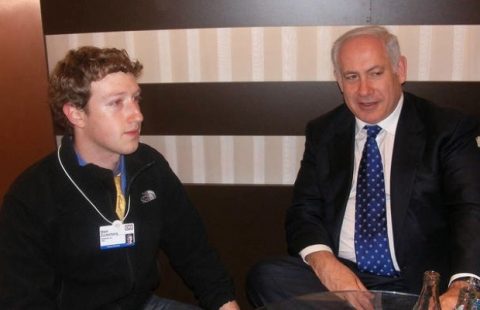
Origins of Totalitarianism
Israel is the missing link that explains how “sowing discord” – an offense few Americans had ever heard of until 2016 – entered our national vocabulary. The modern “fake news” panic has its roots in the totalitarian tradition. Words like “inciting,” “fomenting,” and “sowing” “discord” and “subversion” are very versatile weapons in the hands of authoritarian regimes. This language was previously uncommon in the US, but its emergence became inevitable when the “new Pearl Harbor” of 9/11 opened the door to the creation of the modern American police state. Social media are now just extra bars on the cage – the tools we once believed could liberate us, during the promising early months of Occupy Wall Street and the Arab Spring, are now used to silence us. The US, following a blueprint for legal censorship set by post-WW2 Europe, is taking on the totalitarian trappings of China, of Burma, of the central Asian “stans” and of Saudi Arabia. Kazakhstan calls it “inciting national discord,” with the variations “ethnic discord” and “religious discord” applicable as needed to whatever activist, journalist, or trade unionist the regime needs to put on ice for a few years. It’s called “inciting religious hatred” or “ethnic hatred” in Azerbaijan, which also permanently bans 5 major media outlets for reasons of “national security.” Uzbekistan arrests journalists for “extremism.” China targets activists of all stripes for “inciting subversion.” Burma, which is cracking down hard on the press as it seeks to keep its Rohingya ethnic cleansing quiet, criminalizes “speech that is likely to cause fear or harm and incites classes or groups to commit offenses against each other.” Egypt detains lawyers, journalists and activists under charges of “propagating false news.” Saudi Arabia recently put a Shi’a religious leader to death for “sowing discord” and “undermining national unity.” American dissenters, this is your future.
I have already explained how the Great Deplatforming represents the triumph of the repressive concept of Hate Speech over Free Speech, and how this – not Trump blustering about that wall he’ll get around to building someday – is what fascism looks like. The US government uses friendly corporations as workarounds for the constitutional limits on its power. This technique was deployed against the Second Amendment in Citibank and Bank of America’s post-Parkland refusal to process financial transactions from firearm manufacturers, and is being deployed against the First Amendment here. Such corporate-state fascism is very effective, and the ruling class has seen fit to share it with the other “Five Eyes” intelligence partners, all of whom share information gathered by their Panopticon surveillance agencies. This week, ministers from the US, UK, Canada, Australia and New Zealand met in Australia to condemn hostile nations who “sow discord, manipulate public discourse, bias the development of policy, or disrupt markets” through their manipulation of social media platforms; they also implored Big Tech to allow law enforcement “targeted” access to users’ encrypted data. Flexing the thuggish muscles of the world’s greatest carceral state, the group acknowledged “individual rights must be protected” (and presumably snickered before adding) “privacy is not absolute” and warning that encryption was being exploited by criminals.
The Iranian Meddling affair is a perfect distraction from the real malfeasance at Facebook, where Zuckerberg is bringing back Stasi-style crowdsourced secret policing. The company is assigning “trust ratings” to users based in part on their willingness to report their friends for posting “fake news,” fostering a climate of distrust and fear meant to instill reflexive self-censorship. As in East Germany, the central authorities can’t possibly police everyone all of the time, and it is much more advantageous for them to outsource surveillance to the people, since one who cannot trust his neighbor will not unite with him to overthrow the state. Accordingly, Facebook admits that “some users” abuse Facebook’s reporting system, dubbing stories or users they don’t like “fake news” – but don’t worry about those miscreants, because Facebook compensates for their actions with thousands (!) of other measures that go into calculating the trust rating. No user can see his or her own report – that would be telling – so we’re encouraged to tread carefully to avoid running afoul of the ever-shifting Rules. Jordan Peterson, conservatism’s favorite intellectual, delivers his marching orders in a video he posted last week – “nothing is ever simple,” he pleads as he tells his fans that he’s reached an understanding with Zuckerberg, a “very straightforward person” who really just wants to keep his users safe from bad guys like ISIS recruiters. And Iran. Because they’re terrorists, you know?
The police state is no longer necessary when you have internalized the police. “Media censorship is a shift in the flow of information, while self-censorship is a shift in consciousness.” When the government has convinced citizens to do its job – reporting friends and neighbors for “hate speech,” “sowing discord,” and “incitement” on social media, for example – a free society is impossible.
On the Brink with Russia in Syria Again, 5 Years Later
By Ray McGovern | Consortium News | September 12, 2018
The New York Times, on September 11, 2013, accommodated Russian President Vladimir V. Putin’s desire “to speak directly to the American people and their political leaders” about “recent events surrounding Syria.”
Putin’s op-ed in the Times appeared under the title: “A Plea for Caution From Russia.” In it, he warned that a military “strike by the United States against Syria will result in more innocent victims and escalation, potentially spreading the conflict far beyond Syria’s borders … and unleash a new wave of terrorism. … It could throw the entire system of international law and order out of balance.”
Three weeks before Putin’s piece, on August 21, there had been a chemical attack in the Damascus suburb of Ghouta and Syrian President Bashar al-Assad was immediately blamed. There soon emerged, however, ample evidence that the incident was a provocation to bring direct U.S. military involvement against Assad, lest Syrian government forces retain their momentum and defeat the jihadist rebels.
In a Memorandum for President Barack Obama five days before Putin’s article on September 6, the Veteran Intelligence Professionals for Sanity (VIPS) had warned President Barack Obama of the likelihood that the incident in Ghouta was a false-flag attack.
Despite his concern of a U.S. Attack, Putin’s main message in his Op-Ed was positive, talking of a growing mutual trust:
“A new opportunity to avoid military action has emerged in the past few days. The United States, Russia and all members of the international community must take advantage of the Syrian government’s willingness to place its chemical arsenal under international control for subsequent destruction. Judging by the statements of President Obama, the United States sees this as an alternative to military action. [Syria’s chemical weapons were in fact destroyed under UN supervision the following year.]
“I welcome the president’s interest in continuing the dialogue with Russia on Syria. We must work together to keep this hope alive … and steer the discussion back toward negotiations. If we can avoid force against Syria, this will improve the atmosphere in international affairs and strengthen mutual trust … and open the door to cooperation on other critical issues.”
Obama Refuses to Strike
In a lengthy interview with journalist Jeffrey Goldberg published in The Atlantic much later, in March 2016, Obama showed considerable pride in having refused to act according to what he called the “Washington playbook.”
He added a telling vignette that escaped appropriate attention in Establishment media. Obama confided to Goldberg that, during the crucial last week of August 2013, National Intelligence Director James Clapper paid the President an unannounced visit to caution him that the allegation that Assad was responsible for the chemical attack in Ghouta was “not a slam dunk.”
Clapper’s reference was to the very words used by former CIA Director George Tenet when he characterized, falsely, the nature of the evidence on WMD in Iraq while briefing President George W. Bush and Vice President Dick Cheney in December 2002. Additional evidence that Ghouta was a false flag came in December of 2016 parliamentary testimony in Turkey.
In early September 2013, around the time of Putin’s Op-Ed, Obama resisted the pressure of virtually all his advisers to launch cruise missiles on Syria and accepted the Russian-brokered deal for Syria give up its chemical weapons. Obama had to endure public outrage from those lusting for the U.S. to get involved militarily. From neoconservatives, in particular, there was hell to pay.
Atop the CNN building in Washington, DC, on the evening of September 9, two days before Putin’s piece, I had a fortuitous up-close-and-personal opportunity to watch the bitterness and disdain with which Paul Wolfowitz and Joe Lieberman heaped abuse on Obama for being too cowardly to attack.
Five Years Later
In his appeal for cooperation with the U.S., Putin had written these words reportedly by himself:
“My working and personal relationship with President Obama is marked by growing trust. I appreciate this. I carefully studied his address to the nation on Tuesday. And I would rather disagree with a case he made on American exceptionalism, stating that the United States’ policy is ‘what makes America different. It’s what makes us exceptional.’ It is extremely dangerous to encourage people to see themselves as exceptional, whatever the motivation. There are big countries and small countries, rich and poor, those with long democratic traditions and those still finding their way to democracy. Their policies differ, too. We are all different, but when we ask for the Lord’s blessings, we must not forget that God created us equal.”
In recent days, President Donald Trump’s national security adviser, John Bolton, has left no doubt that he is the mascot of American exceptionalism. Its corollary is Washington’s “right” to send its forces, uninvited, into countries like Syria.
“We’ve tried to convey the message in recent days that if there’s a third use of chemical weapons, the response will be much stronger,” Bolton said on Monday. “I can say we’ve been in consultations with the British and the French who have joined us in the second strike and they also agree that another use of chemical weapons will result in a much stronger response.”
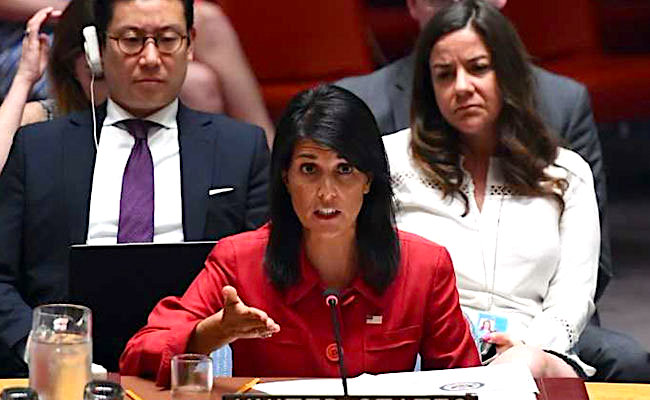
Haley: Already knows who did it. (UN Photo)
As was the case in September 2013, Syrian government forces, with Russian support, have the rebels on the defensive, this time in Idlib province where most of the remaining jihadists have been driven. On Sunday began what could be the final showdown of the five-year war. Bolton’s warning of a chemical attack by Assad makes little sense as Damascus is clearly winning and the last thing Assad would do is invite U.S. retaliation.
U.S. Ambassador to the UN, Nikki Haley, with remarkable prescience has already blamed Damascus for whatever chemical attack might take place. The warnings of direct U.S. military involvement, greater than Trump’s two previous pin-prick attacks, is an invitation for the cornered jihadists to launch another false-flag attack to exactly bring that about.
Sadly, not only has the growing trust recorded by Putin five years ago evaporated, but the likelihood of a U.S.-Russian military clash in the region is as perilously high as ever.
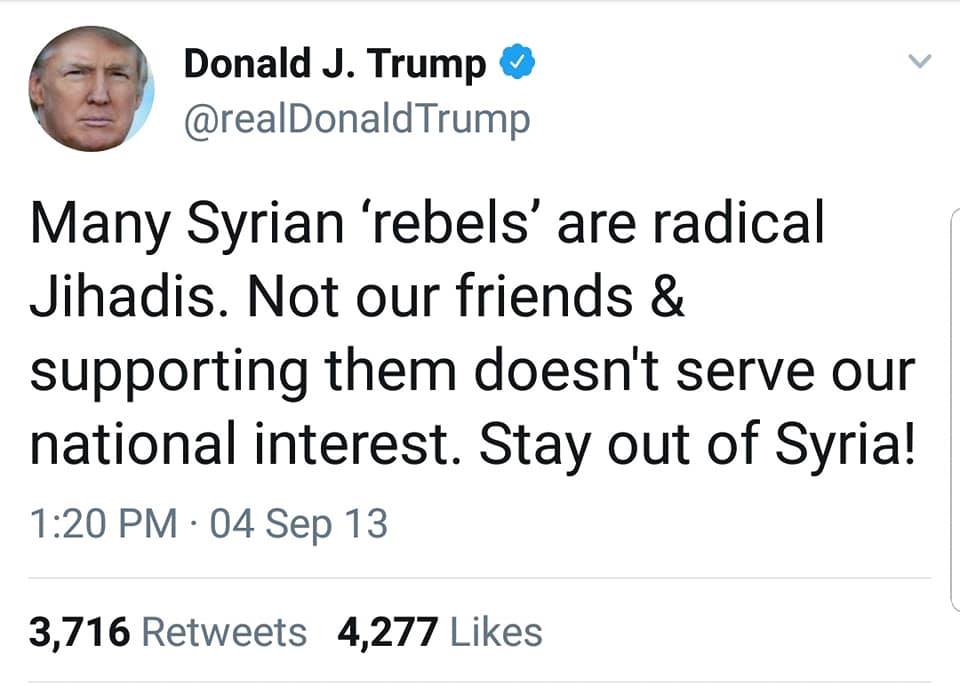
Seven days before Putin’s piece appeared, Donald Trump tweeted: “Many Syrian ‘rebels’ are radical Jihadis. Not our friends & supporting them doesn’t serve our national interest. Stay out of Syria!”
In September 2015 Trump accused his Republican primary opponents of wanting to “start World War III over Syria. Give me a break. You know, Russia wants to get ISIS, right? We want to get ISIS. Russia is in Syria — maybe we should let them do it? Let them do it.”
Last week Trump warned Russian and Syria not to attack Idlib. Trump faces perhaps his biggest test as president: whether he can resist his neocon advisers and not massively attack Syria, as Obama chose not to, or risk the wider war he accused his Republican opponents of fomenting.
Ray McGovern works with Tell the Word, a publishing arm of the ecumenical Church of the Saviour in inner-city Washington. He was an Army Infantry/Intelligence officer and then a CIA analyst for a total of 30 years, and was a Presidential briefer from 1981 to 1985.
Beyond Orwellian: Myth of UK’s ‘non-intervention’ in Syria
By NeilClark | RT | September 12, 2018
A new House of Commons Foreign Affairs Committee Report calls on the UK government to launch an inquiry into its ‘non-intervention’ in Syria. This is gaslighting on a massive scale, because there’s been intervention aplenty.
What do you understand by the term ‘non-intervention‘? Not intervening in something, I presume? It’s clear that the Foreign Affairs committee has another definition which is the complete opposite. In their ‘Through the Looking Glass’ world, ‘non-intervention’ actually means ‘intervention’. Bombing the country in question, funding, supplying and training ‘rebel’ groups to attack government forces, imposing sanctions and doing everything possible to keep the conflict going, are all examples of ‘inaction’, it seems.
“The decision not to intervene in Syria has had very real consequences for Syrians, their neighbors, the UK and our allies,” the report declares. Actually it was the decision to intervene which did that. Syria would be in a far better state if the UK and its regional allies had genuinely not meddled, illegally, in the internal affairs of a sovereign nation.
Let’s recap Britain’s role in the conflict. The former French Foreign Minister Roland Dumas claimed in an interview on French television that two years before the war began, UK officials had told him they were “preparing something” in Syria. “This was in Britain not in America. Britain was organizing an invasion of rebels into Syria,” Dumas said.
If the idea of Britain conspiring to overthrow the Syrian government sounds far-fetched, then consider this. We already know that in 1956/7 there was a joint UK/US plan to do just that. It involved agent provocateurs being deployed to stage a number of incidents, which would then be used as a pretext for invasion and ‘regime change’.
“Once a political decision is reached to proceed with internal disturbances in Syria, CIA is prepared, and SIS [MI6] will attempt, to mount minor sabotage and coup de main incidents within Syria, working through contacts with individuals.”
“The two services should consult, as appropriate, to avoid overlapping or interfering with each other’s activities,” the plan said.
If Dumas is correct, something very similar was in the offing in 2009/2010 too. Perhaps the government just dusted down the old 1950s blueprint.
It didn’t take Britain too long, when the violence started in Syria in 2011, to call for President Assad to step down. In fact ‘Assad must go’ became an obsession for the UK’s political elite, a goal they seemed determined to pursue at any cost and irregardless of the fact that among the forces opposed to Assad were al-Qaeda affiliates and other extreme sectarian groups. In June 2012, an Israeli website suggested that British Special Forces were already operating inside Syria.
Two months later, Foreign Secretary William Hague announced that Britain was to give an ‘extra’ £5m (on top of £1.4m) to Syrian opposition groups, including radio and satellite equipment. Again, how can this be classed as ‘non-intervention’?
Also that August, it was reported that the Syrian ‘rebels’ were receiving ‘aid’ from British intelligence. The Sunday Times quoted an opposition official who said that the British authorities “know about and approve 100%” intelligence from their Cyprus military bases, being passed through Turkey to the rebel troops of the Free Syrian Army (FSA).”
Writing in the Independent one year later, Kim Sengupta revealed that Britain had handed over equipment worth £8m to Syrian ‘rebels’, including “five 4×4 vehicles with ballistic protection; 20 sets of body armour; four trucks (three 25 tonne, one 20 tonne); six 4×4 SUVs; five non-armoured pick-ups; one recovery vehicle; four fork-lifts; three advanced “resilience kits” for region hubs, and VSATs (small satellite systems for data communications.”
Throughout 2013, the UK was doing all it could to escalate the conflict by pushing other EU countries to agree to arming the Syrian ‘rebels’. “It is difficult to imagine a more hopeless or stupid policy from our head of diplomacy”, wrote Neil Hamilton, (that’s the former Conservative MP and not the actor who played Commissioner Gordon in the 1960s Batman TV series), in a Sunday Express article entitled ‘Hague on path to Syrian hell’.
Things came to a head in August 2013, as Prime Minister David Cameron asked for Parliamentary support to bomb Syria. It was clear by then, that air strikes, at the very least, were needed if Assad was to be ousted. The war lobby were confident of a ‘Yes’ vote but Labour, led by Ed Miliband, voted against. Miliband correctly said that the House of Commons (for once) had spoken “for the people of Britain.”
It was this decision which is always cited as a ‘great mistake’ by the Syria hawks but they ignore what went off before, and after it. The UK government had been thwarted but they continued to push for ‘regime change’. Cameron finally got Parliamentary approval to bomb Syria in December 2015, (this time on the basis of fighting Islamic State (IS, formerly ISIS/ISIL) which had gained ground in Syria largely because of the policies of the US/UK and their allies), but the BBC reported in July 2015 that air strikes on the country carried out by British pilots had already taken place. News of this only emerged after a Freedom of Information Request.
Between December 2015 and June 2016 there were a total of 51 British air strikes in Syria. This year, there has been further bombing, including the targeting of military bases near Damascus and Homs in April.
“We believe that the consequences of inaction can be every bit as serious as intervening,” the Foreign Affairs committee report states.
How can we explain this extraordinary attempt to portray Britain’s extensive and well-documented operations in Syria as ‘not intervening’? After all so much is on the public record, including, on the Ministry of Defence website, details of RAF air strikes.
A look at the membership of the Foreign Affairs Committee is illuminating. Its chair, Tom Tugendhat, Tory MP for Tonbridge and Malling, is a hardcore neocon and a former member of the Intelligence Corps. Peter Oborne, the highly respected political commentator, wrote about the ‘neocon coup’ that took place on the committee last year and warned us of its consequences. But how many were paying attention?
Other members of Tugendhat’s committee include Ian Austin, the Labour MP who likened Russia’s holding of the World Cup to Nazi Germany’s hosting of the 1936 Olympic Games, and who told Jeremy Corbyn to “sit down and shut up” when he was criticizing the Iraq war.
Then we have Chris Bryant, a signatory to the statement of principles of the uber neocon Henry Jackson Society and Priti Patel, who stepped down from the Cabinet in 2017 when it was revealed she had undisclosed, unofficial meetings with Israeli ministers. In fact, if we look at the composition of the committee and compare it to the far more balanced one under the chairmanship of Crispin Blunt, (which produced a critical report on the UK government’s intervention in Libya in 2016) it’s no surprise we’ve got the document we have.
Neocons know that after the disasters of Iraq and Libya, ‘interventionist’ foreign policies have been utterly discredited. So, the only way out is to portray Syria, however ludicrously, as an example of UK ‘non-intervention’, in the hope that some people might fall for it and support ‘rectifying’ the ‘inaction’ at some point in the near future. Perhaps in response to a non-independently verified chemical weapons attack in Idlib, later this month? The Foreign Affairs Committee report, which makes George Orwell’s 1984 look quite understated, is perfectly timed for that.
Read more:
‘Straight out of the RT propaganda machine’: MP attacked for urging UK military restraint in Syria
RT | September 12, 2018
Labour’s Emily Thornberry has come under fire on social media for simply asking the UK government not to rely on “open source intelligence from terrorist groups” in the event of a reported chemical attack in Syria.
Thornberry, Labour’s shadow foreign secretary, asked the government if they would consult Parliament before taking military action over reports of chemical weapon attacks in areas controlled by Al-Qaeda proxy Hayat Tahrir al-Sham (HTS), a US-proscribed terrorist organization.
This prompted hysterical responses on social media, with one Twitter user claiming: “This is UK Labour guided by the spirit of Thomas Mair” – the far-right activist who murdered Thornberry’s fellow Labour MP Jo Cox. Another accused Thornberry of providing cover for Syrian President Bashar Assad’s alleged crimes.
Notice the pro-Kremlin, Islamophobic dogwhistle; notice the casual smearing of Syrian first-responders; and notice the complete absence of concern for the 3 million civilians trapped in Idlib. This is @UKLabour guided by the spirit of Thomas Mair. https://t.co/86Ql5aGYy8
— Idrees Ahmad (@im_PULSE) September 10, 2018
There were numerous references to this news organization, with accusations Thornberry was doing the work of “propaganda” outlets such as RT and Sputnik. There was even a charge of “genocide denying” leveled at the MP.
In turn, Thornberry’s position drew levels of support from both left-wing and right-wing critics of UK military involvement in Syria.
HTS are thought to have some 10,000 fighters in the last rebel stronghold – Idlib province, a region in Syria’s northwest along the Turkish border.
Upon reports of a potential chemical attack, Thornberry urged the UK to wait “until the chemical weapons inspectors, the OPCW [Organisation for the Prohibition of Chemical Weapons], have visited those sites under the protection of the Turkish government, independently verified those reports and attributed responsibility for any chemical weapons used.”
“Relying on so-called open source intelligence provided by proscribed terrorist groups is not an acceptable alternative,” she said.
The US’s Choice: WWIII or Saving Face in Syria
By Tom LUONGO | Strategic Culture Foundation | 11.09.2018
Sometimes when I step back from the overwhelming flow of geopolitical insanity I’m reminded of the old adage that coming close only counts in horseshoes and hand grenades.
To which, I always add, “And nuclear war.”
I’ve been watching the build up to the operation to liberate Idlib in Syria which includes the endless neocon and Israeli moral preening warning Assad against using chemical weapons with a sense of detachment. And I keep thinking to myself, “Do they really think we’re that stupid?”
Three times the chemical weapons canard has been used to justify further aggression against Syria and three times a full-blown U.S. invasion has been averted. First by Vladimir Putin’s deft diplomacy and General Dunford’s refusal to implement a ‘no-fly zone’ in 2013 and then during the Trump years with ineffectual air strikes on Syrian airbases.
How much of that ineffectuality of those airstrikes were designed by Defense Secretary James Mattis to avoid a wider conflagration and how much was Russian EW/missile defense is anyone’s guess.
The truth most likely lies somewhere in the middle.
That is why everyone who is worrying about the U.S.’s blustering over Syria’s Idlib campaign needs to take a big step back and think the scenario through.
Because the neoconservatives and Israel are forcing the situation to its crisis point, thinking they can manipulate the headlines and the levers of power to still eke out a victory in Syria that will allow them to continue on their quest to destroy Russia first and conquer the rest of Asia after that.
And they are willing to blackmail us with the threat of WWIII over 50,000 head-chopping mercenaries to get their cookie.
However, when you factor in the men actually in charge of the U.S. military chain of command, Trump and Mattis, and you realize the lengths to which Mattis’ field commanders have gone to avoid direct confrontation with Russian forces, you come to the conclusion that the men who will actually fight this war the neoconservative provocateurs and laptop bombardiers are clamoring for won’t actually pull the trigger.
The reasons for this are manifest.
First, the potential for the conflict to go nuclear is too high for rational men to take that chance. Mattis and Russian Defense Minister Sergei Shoigu are hard-bitten, no-nonsense men. Neither underestimates the other’s resolve to defend their men and national interests.
So, once the shooting starts expect it to get ugly quick. Therefore it is unlikely to get to that point.
Second, there is no profit in that kind of escalation for the people who profit from war. The banks and the military weapons makers thrive in low-intensity, frozen conflicts which keep sales flowing and governments indebted to pay for them.
In an age of nuclear weapons, proxy wars fought by mercenaries with drones are far more profitable than any large-scale invasions. I hate to say this but from a discounted cash flow perspective Lockheed-Martin wants predictability to cover their quarterly dividends to shareholders more than they want to bring about the supposed Zionist plan for Greater Israel.
Sorry to burst everyone’s conspiracy theories.
Third and most importantly, the U.S. cannot afford a non-nuclear confrontation with Russia that punctures the illusion of U.S. military superiority. Too much of the world’s confidence in the dollar itself rests in the U.S.’s ability to project power and defend its interests militarily.
This confidence is a mixture of that military capability and the U.S.’s traditional position of a country with an excellent legal framework within which to do business. It is fashionable among geopolitical critics, myself included, to get caught up in the rhetoric and projection of a sclerotic and weakening United States, but legally it is still one of the best places on earth to do business.
But, as Martin Armstrong pointed out recently, Trump’s domestic opposition has openly declared sedition against him this week in the New York Times. Former Secretary of State, John Kerry, is doing the talk show circuit calling for a constitutional crisis over Trump allegedly being unfit for office. And George Soros is paying protesters to disrupt the confirmation hearing of Brett Kavanaugh to the Supreme Court.
If allowed to run its course to impeachment in the event of the Republicans losing control of the House in November, this would be a death blow to the U.S.’s reputation as a nation of laws rather than a nation of men. The U.S. dollar would not recover from such a blow to its credibility, especially in light of Trump’s nearly-unhinged use of sanctions and threats of tariffs, weaponizing the dollar indiscriminately.
And this is why Vladimir Putin openly showed his hand to the world in March. Strategically, he let everyone know that any confrontation between Russia and the U.S. would result in the U.S losing its status as the world’s pre-eminent military power.
This is why the neocons and the U.S./U.K. Deep State have been so adamant in accelerating its provocations against Russia. They have to present us with the Faustian bargain of WWIII before Russia has these weapon systems fully deployed.
It’s also why Trump and Mattis are allowing them to have their head. It feeds Trump’s “Art of the Deal” strategy for negotiations while also allowing him the opportunity to save face after Idlib is liberated regardless of whether another chemical weapons attack is staged.
I think we won’t see one here.
The way out of Syria for the U.S. with its face-saved is to thunder and bluster, threaten fire and brimstone just like Trump did with Kim Jong-un and use that to explain why Assad showed restraint and didn’t use chemical weapons this time.
I can even see Trump tweeting something about three strikes and he would be out.
Once Idlib is liberated Mattis will happily begin pulling vulnerable troops out of al-Tanf and Afghanistan. That’s why I believe he went there to the surprise of the CIA house-organ Washington Post last week.
And then the neocon and Israeli muddying of the waters will move to the Geneva talks, but we’ll cross that Rubicon when it approaches.
Featured Video
Seyed M. Marandi: Toward Total War in the Middle East
or go to
Aletho News Archives – Video-Images
From the Archives
The Geopolitics behind the War in Yemen (I)
By Mahdi Darius NAZEMROAYA | Strategic Culture Foundation | 30.03.2015
The United States and the Kingdom of Saudi Arabia became very uneasy when the Yemenese or Yemenite movement of the Houthi or Ansarallah (meaning the supporters of God in Arabic) gained control of Yemen’s capital, Sanaa/Sana, in September 2014. The US-supported Yemenite President Abd-Rabbuh Manṣour Al-Hadi was humiliatingly forced to share power with the Houthis and the coalition of northern Yemenese tribes that had helped them enter Sana. Al-Hadi declared that negotiations for a Yemeni national unity government would take place and his allies the US and Saudi Arabia tried to use a new national dialogue and mediated talks to co-opt and pacify the Houthis.
The truth has been turned on its head about the war in Yemen. The war and ousting of President Abd-Rabbuh Manṣour Al-Hadi in Yemen are not the results of «Houthi coup» in Yemen. It is the opposite. Al-Hadi was ousted, because with Saudi and US support he tried to backtrack on the power sharing agreements he had made and return Yemen to authoritarian rule. The ousting of President Al-Hadi by the Houthis and their political allies was an unexpected reaction to the takeover Al-Hadi was planning with Washington and the House of Saudi. … continue
Blog Roll
 Aletho News
- Israeli lobby seeks to bind US fate to ‘Israel’: Araghchi
- Pakistan-Iran talks secure LNG shipment to Islamabad through Hormuz
- Black Sea grain crisis puts global wheat supplies under pressure
- IRGC air defenses destroy another US MQ-1 drone over Strait of Hormuz
- Imran Khan’s entire immediate family detained in Pakistan ahead of mass protest demanding his release
- EU nation detains former presidential frontrunner
- Leaked: Britain’s Sham Conviction Of Hashim Thaci
- Seyed M. Marandi: U.S. Strike Imminent – Toward Total War in the Middle East
- Russia Voted Under Fire. Washington Is Loading the Tankers.
- 12 Things Your Oncologist Was Trained Not to Tell You
- If Americans Knew
- Israeli Attacks in Gaza Kill at Least Seven Palestinians Over Three Days, including Woman and Child
- Trump’s militarization of Washington DC as he pursues Israel’s war against Iran
- Why Israel Fears This Searing New Documentary
- Huckabee aide solicited cash gifts from Israelis
- This isn’t sci-fi, AI is already killing people
- ‘The Most Brutal Thing’: Investigation Reveals Execution of Elderly Woman in Rafah
- Inside Israel’s ‘soft’ ethnic cleansing plan for Gaza through the eyes of its victims
- New online database tracks pro-Israel political donations in the United States
- Israeli president pardons soldier convicted for killing wounded Palestinian
- Singer Ed Sheeran says his ‘heart broken’ by Gaza devastation, addresses Macklemore controversy
- No Tricks Zone
- 2025 Nature Paper Claiming Worsening Global Drought Gets RETRACTED …Heavily Flawed
- New Study: ‘Global Drought Shows No Detectable Recent Acceleration Under Climate Warming’
- Economic Masterminds: German Socialists Suggest Taxing Productivity Gains Stemming From Using AI
- The South China Sea Has Not Been Cooperating With The Climate Change Narrative
- Energy Crisis: Germany Enters Heating Season With Historically Low Gas Reserve Fill Levels
- New Study: The Antarctic Ice Sheet Gained Mass From 2020-2024 Due To Staggering Snow And Ice Accumulation
- Study: Ocean Heating Rates From Thousands Of Years Ago ‘Dwarf’ Modern Ocean Heating Rates
- Climate Extremists Target, Attack Large-Scale Power Grid Infrastructure In Germany!
- New Study: Antarctic Ice Melt Has Contributed Less Than 1 Centimeter To Sea Level Rise In The Last 30 Years
- Fear Of Debate: Alarmist German Climate Scientist Calls On Mainstream Media To Discredit Skeptic Voices
 Aletho News