Kester Ratcliff’s International Assadist Directory Is His “Contribution to the War Effort”

By Sara Abed | American Herald Tribune | August 31, 2018
After more than seven years of war, which have brought death and destruction, pain and suffering, and every form of terrorism imaginable to the Syrian people, the war is finally entering its final stage. The much-anticipated battle of Idlib will commence soon. The plan to liberate every inch of Syria, which has been stated numerous times by President Bashar Al Assad, is underway.
RT states, “Syrian forces are gearing up to take the last terrorist stronghold. The US is boosting its military presence, and Russia is warning of a false-flag chemical attack. RT looks at the alignment of forces ahead of the battle for Idlib. American warships, cruise missile delivery systems, strategic bombers and other hardware have arrived in the Mediterranean and in the Persian Gulf earlier this week. Washington is denying that any buildup is taking place, but Moscow says the assets are being gathered for a massive strike against the Syrian government.”
The Syrian people have been through unimaginable circumstances, brought on by a western manufactured insurrection, both on the ground and in the media. One would think, that bringing this war to an end, and allowing Syrians to rebuild their lives, would be an objective shared by all humanitarians and activists, but unfortunately, that is far from the case.
Propagandists who pose as humanitarians and activists, while ironically supporting terrorist aligned militant groups, have once again amplified their coordinated media efforts to spread misinformation ahead of the final big battle in Syria.
Timing is crucial
Journalist and book author Brandon Turbeville writes, “As mainstream media doubles down in its coordinated propaganda against the Syrian government and in support of direct Western military intervention, the alternative media has been going up against unprecedented censorship on the part of the social media and Internet corporate giants at the same time. For that reason, it is becoming harder and harder to find accurate sources of information regarding Syria as well as all other topics in a general Internet search. While readers of the alt media before Google’s purge and censorfest took place have largely remained, the amount of people being exposed to new information and an alternative to government and corporate propaganda has been drastically reduced.”
“Late last week, Russian Defense Ministry spokesman Igor Konashenkov said that the White Helmets group plans to film videos for Middle Eastern and English-language media outlets after staging a false-flag chemical weapons attack in Syria in order to further destabilize the war-torn country.” Sputnik News
In order to stay one step ahead of the game, Sputnik goes on to say, “Damascus has handed documents to the UN, to prove that al-Nusra Front* terrorists plan to conduct a chemical weapons attack in the northwestern Syrian province of Idlib and point the finger at the country’s government, according to Syria’s UN envoy Bashar Jaafari.”
International Assadist Directory
Kester Ratcliff a “Former Project Researcher at University of Bristol” who studies “Top Programme Evolutionary Biology MSc at RUG Groningen” and has previously studied “Animal Behaviour and Welfare Science at University of Bristol”, according to his Facebook page, has created what he calls a “references directory on 151 public figures who have expressed support and/or whitewashed the Assad regime, with examples and references.” He stated, “The purpose of this list is to facilitate finding the references to see and to show people who genuinely don’t know what is true and who to trust about Syria why the people on this list should not be trusted as sources.” Let’s take a moment to digest that last quite bold sentence. The people he cherry picked for his directory should not be trusted according to Ratcliff.
Who is Kester Ratcliff?
Ratcliff dedicated a substantial amount of time and effort to smearing Vanessa Beeley who has extensive experience working on-the-ground in Syria. In his directory he states “It is my honest opinion that she is manifestly an agent of the Assad regime, that she should be added to the lists of sanctioned persons under the UK and the EU sanctions on Syria, and that she should be arrested if she enters the UK or any EU Member State’s territorial jurisdiction and charged with direct and publicly broadcast incitement of the crime against humanity of widespread and systematic attacks on humanitarian workers in an armed conflict zone, under Article 7(1)(k) of the Rome Statute of the International Criminal Court. She responded to Ratcliff’s tweet, with the question on everyone’s mind “Who are you?”
In 1978, a popular English rock band by the name of “The Who” released a song titled Who Are You? One of the lines is, “I remember throwing punches around and preaching from my chair”. What oddly perfect description of Ratcliff, who makes accusations against people he has never met, talked to, or even interacted with, all from the comfort of his chair.
Others on social media asked questions such as what expertise does Ratcliff bring to the table? How qualified is he to tell a broad audience who is trustworthy and who is not when it comes to the Syrian conflict? I am paraphrasing but the point is the same.
One might imagine, that this self-proclaimed “political thinker” (per his Medium bio) must have a background that qualifies him to give an opinion on journalists, political commentators, and other public figures who have contributed written or oral material during the course of over seven years of a western manufactured insurrection in Syria.
However, the questions certainly outnumber the answers in this case. What we can gather is that Ratcliff has never stepped foot in Syria, and relies on second-hand information, such as that from refugees whom he met and coached during his time in Greece.
The ever-evolving man of many interests
Ratcliff gives us more insight into who he is in the few articles he has written and published on various sites. In an essay published by Medium titled “Suffering and the Construction of Authority” Ratcliff wrote about his mother “I had a mentally ill and abusive mother, grew up as effectively her sole carer. During my teenage years, the most fundamental issue we fought about and the most frequently was that she demanded I should ‘respect her authority’ merely because of her conventional position as my parent, which I could not do because she was actually completely untrustworthy, unreliable and, literally, insane, and in fact I had to practically care for her like a parent would, when I was a child. Practically our roles were reversed, but she insisted on the ‘authority’ conventionally attached to her position. Needless to say, I absolutely refused.”
Ratcliff goes on to say, “That developmental experience made me extra sensitive, vigilant and radically opposed to all forms of authoritarianism in every area of human life. ‘Authoritarianism’ is the idea of ‘authority’ existing for its own sake, inherently possessing its authority, in an alienated way, rather than it being a characteristic of a relationship, in which authority is given and received (inter-subjectively) for certain mutually beneficial purposes.”
You can read more about his views on authority in his essay on Medium where his bio reads: EvoBio MSc student at RUG in Groningen, refugee solidarity volunteer, activist, political thinker.
Ratcliff shares with us the next chapter of his life in the same essay, “At 18, I ‘ran away’ to a Buddhist monastery, in North East Thailand, spent three and half years in Thailand, in monasteries of the Ajahn Chah lineage, and three years in branch monasteries in Australia. Thai Theravada Forest Tradition has its own problems with traditionalist authoritarianism and inter-cultural clashes. There are deep internal conflicts in the international monastic ‘community’ about Thai traditionalism, individualist autocratic authority of abbots, Thai collectivist authoritarianism, the forest tradition’s claims to radical scriptural orthopraxy, then exposed to European traditions of textual and historical criticism, and the trigger issue for an almost-schism in the midst of these underlying issues was the revival of full ordination for nuns. I very much sided with the radically scripturally orthopraxic side of that conflict, essentially because I could not trust a person then, so the scriptural advice “we take refuge in the Dhamma (the Buddha’s teaching), not in a person” (MN108/ MA 145) was important to me. I studied intensely too: communal monastic legal history (I also taught monastic law for a while), sociology of early Buddhism, and observed and introspected on authority.”
He wrote about his Buddhist monk experience for Buddha Channel in an article titled Kester Ratcliff —” Monastic lineages and the Vinaya: Which is Buddhist?” ”I used to be a monk for six and half years in the Thai Forest Tradition, my name then was Bhikkhu Santi. As well as a lot of meditation, in those six years I also did a lot of study and particularly Vinaya, and especially the two main neglected areas -the Bhikkhuni Vinaya and the communal legal procedures (adhikarana-samatha-dhammas).
Ratcliff shares an interestingly similar perspective about the abbots, as that of his mother in the same article.

*(Kester Ratcliff’s Monastic passport Source: Facebook page)
“However, I found the abbots I was expected to trust untrustable -firstly, because they demanded it too much -if somebody is truly trustworthy, they don’t need to say “you should respect me” or anything of that sort, they would be confident that they are trustworthy enough to just be themselves quietly; like getting a toddler to come in for a hug, you have kneel down, open your arms, and wait for the kid to run into your arms; grabbing or shouting don’t work.”
Ratcliff writes about his experience as a monk and how his journey led him to join the Quakers in an article on his website titled “Mulesika -Seeking the Roots”. “Personally my journey has led me to join the Quakers, last year, now that I’m a layman in a family-oriented life. I no longer call myself a Buddhist, and I can use conventional regional religious terminology like ‘God’ quite comfortably (with a massive footnote explaining that I don’t mean anything supernatural or having sabhava). I find I fit much better in the Quaker community, and one of the most obvious differences for me from my experience of the TFT is that the Quaker ‘institution’ treats people as full adults (maybe even a bit too much, because we mostly seem to attract people in their 40s onwards!), but I needed a change and it’s the furthest opposite extreme if you have religious allergy to hierarchicalism and enforced prolongation of adolescent-type dependence.”
Working with Refugees
-Ratcliff wrote an article titled Systemic legal issues for refugees in Europe and affected by Europe globally in which he states this is “A list of in-depth sources with connecting notes about the major systemic legal problems confronting refugees as they try to reach a place of safety. The major issues are in order of encounter from a refugee’s point of view.”
-On Ratcliff’s Facebook profile it states that he manages a group called Visas for Asylum or Safe Passage to EU.
-Ratcliff writes about his work with HIAS on his blog Silence of Eternity:
“HIAS is a refugee legal aid NGO from America, with operations in 14 countries and an implementing partner for the USA resettlement programme through UNHCR. It’s a Jewish organisation, founded in 1881 in the USA, originally was for Jews escaping persecution in Europe, but now serves any human person in the same sort of situation – http://www.hias.org/
Specifically what I plan to do in Chios next week and the week after:
-
Help physically set up the information tent – I’m not sure whether to take my power tools as well as my legal textbooks, but I have both here;
-
Try to set up a psychosocially safe, private and dignified environment in which to ask people to recall what happened to make them flee their homes and countries;
-
Discuss with them through the Guide I’ve prepared on how to prepare for asylum interviews, clarify their answers with them, and write down their statements ready for them to take in with them to their interviews (this should assist both the refugees and EASO/ the Greek Asylum Service, making the process both fairer and more efficient for everyone).
-
If there’s enough time, practice mock interviews with people.
-
Connect people whose cases I can’t deal with as a non-lawyer to the network of pro bono refugee legal aid lawyers I’m in contact with now, across NGOs.
-
Get a more detailed realistic sense of what’s needed and what works, to feed into the design of the HIAS Greece legal aid programme.”
-Ratcliff wrote a comment in response to an article written by the Sun titled “SYRIA CRIME WAVE: Hundreds of Syrians in UK arrested over string of offences including rape and child abuse, in which he stated “… I have reported it to IPSO as unfactual and discriminatory and to my local police force as a crime under S.23 of the Public Order Act 1986 for publication and distribution of material with intent or likely to stir up racial hatred, and written to my MP to ask her to write to the CPS asking them to seriously consider prosecuting you this time. I believe the journalists and their editors responsible for this publication, as well as the directors ultimately responsible for everything that happens in the whole company, should be convicted for incitement to racial or religious hatred, sentenced to the maximum term of 7 years imprisonment, and all of them should be banned from ever holding the directorship of any company ever again.”
The sole purpose of sharing this article and Ratcliff’s comment is to show that his calls for people to be convicted and imprisoned are nothing new.
In response to an article titled “Spiritual influence” and elections Ratcliff wrote “… the duty to vote and participate in social democracy is a serious public duty which also ought to be considered a religious obligation.”
Ratcliff is in his final-year as an undergrad student of Animal Behaviour & Welfare Science at Bristol University in the Veterinary Sciences School. His current dissertation project revolves around modelling how parasites influence the collective movement patterns that emerge in sheep flocks, using comparative evidence from research in fish.
This brief history based on public information that Ratcliff has generously offered via multiple media platforms might give us some insight about him, but leaves us with more questions than answers. Why has a relatively unknown individual in the Syrian conflict, taken on this task of quietly collecting information on 151 people, and placing a target on each and every one of their backs?
Hi Kester. I’m doing some research into the motives of war propagandists and war narrative protectors. Were you asked to create this list, or did you do so in the hopes of generating a paid opportunity, possibly by attracting attention from organisations like Atlantic Council?
— Angelis Dania (@NeotipPro) August 29, 2018
Ratcliff’s “contribution” to the Syrian war effort
Ratcliff states on a Facebook post that this is his “contribution to the war”. That’s an important point to take note of. Ratcliff is feeling the euphoric effects of overnight fame, but has also made it clear that he does not want people to focus on him as a person or his typos or his lack of credentials. No, it would be best to just blindly accept everything he has stated, without giving it much thought.

Ratcliff knew that this directory would cause a storm of backlash based on some of his facebook posts.
Ratcliff had the help of a retired lawyer friend, and two journalists that helped check his “monster article”, in addition he checked it himself a “bazillion” times and remarkably still managed to misspell a number of names and get many facts wrong.

Ratcliff doesn’t want this to be about him, he says “It’s not really about me”.

Filled to the Brim with Errors, Misspellings, and Inaccuracies
Ratcliff takes a lot of pride in his directory. On Facebook, he stated, “I have checked it very carefully, and endeavored to be fair. Despite hating them, I will not remove anyone or change what I have said about them, in spite of any amount of harassment, so don’t even bother trying, but if there is any real factual inaccuracy I will of course immediately correct it.”
Notice how much emotion he expresses towards those he has chosen to blacklist. He doesn’t merely disapprove of their viewpoints, but he hates them as individuals. Emotions can certainly cloud a person’s judgment, and by the looks of it, Ratcliff has no reservations sharing his feelings publicly about individuals whom he has never met or interacted with for the most part. The hate he mentions must have developed during the time that he was lurking in the background, watching and taking notes of who should make his list of untrustworthy sources, as he refers to them.
Ratcliff wrote in a public Facebook post on his page about the typos.

For someone who claims to have checked his directory “very carefully,” it sure was filled to the brim with inaccuracies, and even people’s names were misspelled. Their very identity was wrong. If Ratcliff doesn’t care much for spelling people’s names correctly what else has he not given much thought to in his directory?
Medium email and article suspension
Medium has served as a platform for a number of Ratcliff’s essays and incoherent drivel.
Here are just two examples of Ratcliff’s literary balderdash:
–Example of OSINT on 21stcenturywire Vanessa Beeley’s latest Assadist propaganda against the White Helmets – which Ratcliff states is “an incomplete draft from 22 June 2017. I’m publishing it now just in order to send it to another researcher.” He also states “One of Vanessa Beeley’s useful idiots challenged me to “prove it” — obviously they won’t read this or think about it or stop repeating lies, because they don’t believe in objective factual truth, but for the record, here is some proof”.
–Definition and discussion of the meaning and importance of ‘Bullshit’. He states “I wrote this long definition and discussion of ‘bullshit’ to enable me to write a much shorter and simpler paragraph defining it in a major article later.”
His latest contribution has since been suspended by Medium. Their reasons for suspension can be seen in the following tweet.
The “Assadist” list of @KesterRatcliff has been removed from Medium for the reasons as below 👇🏻
Now, if any harm happens to me due to this inciting article, I’ll held Kester full responsibility cos I consider it a green light to Islamist cells in Europe to target these names pic.twitter.com/qDaH3Cf2cI— Kevork Almassian (@KevorkAlmassian) August 29, 2018
The Assadist slur vs. Pro-Assad
According to Merriam Webster the definition of a sadist is one characterized by sadism: a person who takes pleasure in inflicting pain, punishment, or humiliation on others. Sadism is defined as the derivation of sexual gratification from the infliction of physical pain or humiliation on another person.
This clarifies why some choose to use the slur Assadist rather than simply saying Pro-Assad when insulting those who have committed one or more of the following “crimes”:
1. questioning the official narrative
2. doubting the truthfulness of mainstream media
3. speaking up against foreign intervention, imperialism, and terrorism
4. and lastly the most contentious of all according to characters such as Ratcliff… wait for it… actually supporting the elected president of Syria! President Bashar Al Assad ::horrifying gasp::
If these reasons truly qualify one to be called an Assadist then Ratcliff should have included the millions of people around the world who support the legitimate president of Syria Dr. Bashar Al Assad.
Of course using the term Assadist is not original or creative on Ratcliff’s part, nor is he the first to create such a ridiculous list, which could also have dangerous ramifications for those on it. Others have tread these murky waters before Ratcliff, just google Assadist and you’ll see a selection of unimpressive ramblings.
– Louis Proyect wrote about Assadists on his blog The Unrepentant Marxist. In one of his entries titled Young Assadist Academics Nursing their Wounds he stated the following “One of the most depressing things about the six years of war in Syria, besides the obvious destruction of life and property, is the trail of intellectual damage left behind by investigative journalists, leftist leaders, and academics who bend the truth or outright lie in order to defend the mafia state. History will certainly remember people such as Seymour Hersh, Theodore Postol, and Tariq Ali as being ethically and intellectually challenged no matter how virtuous they were in the past.”
One can’t help but wonder if Ratcliff could be Proyect’s protégé? Either way, whether he is or not, doesn’t matter much, but it is interesting to see the similarities between the two, especially their love of using the same slurs and list-making passion.
What a useful tool their contributions must be to terrorist aligned opposition groups who are seeking to shut down dissenters especially during this last phase of a war… which they have clearly lost.
Media Responses to Ratcliff’s Directory
Ratcliff has been sharing articles written in response to his directory on his social media accounts with uber-enthusiasm. Overnight fame can be exhilarating and Ratcliff is enjoying every millisecond of his five minutes of fame.
Ratcliff’s greatest accomplishment thus far, could very well be getting the attention of RT which resulted in not one, but three articles being published in a span of two days, in response to his Assadist directory.
– August 27th: Chomsky, Hersh and… Boris Johnson? Twitter pundits ponder odd ‘Assadist’ blacklist “An obscure blog post, that accuses journalists and intellectuals of inciting “crimes against humanity” for their views on Syria, has received glowing reviews from verified Twitter pundits, despite its factually dubious claims. Featured on an unfrequented Medium blog, the “International Assadists References Directory” lists 151 people and organizations who have allegedly “expressed support and/or whitewashed the Assad regime.” The eclectic compilation of “Assadists” features individuals and groups of all political stripes and backgrounds, from the Greek nationalist political party Golden Dawn to Pink Floyd frontman Roger Waters. Notable journalists such as Seymour Hersh, John Pilger, Peter Hitchens, Glenn Greenwald and Patrick Cockburn are also listed as reckless Assad apologists.”
– August 28th: Don’t tell him, Pike! The laughable (yet sinister) list of ‘International Assadists’
Neil Clark wrote “A newly-compiled directory of 151 ‘International Assadists’ is both hilarious – for all the mistakes in it, but disturbing too, as it represents a McCarthyite attempt to police the debate on Syria.”
He goes on to say “By Ratcliff’s own admission you don’t even have to be ‘pro-Assad’ to be included in his ‘International Assadists Reference Directory’. His definition of ‘Assadist’ is incredibly wide – so wide in fact that it even includes those who have supported air strikes on Syrian government targets. Here he quotes Ratcliff as having written “All pro-Assad people are Assadists (they repeat Assadist propaganda claims), but not all Assadists are in their own view pro-Assad,” he explains in the introduction. In other words, if you repeat anything on Syria that he regards as an “Assadist propaganda claim”, you’re an Assadist. Even if you make it clear you strongly oppose the Syrian president – and support bombing Syrian airfields, like former UK Foreign Secretary Boris Johnson, who is listed.”
– August 28th ‘Assadist list’ nothing more than McCarthyism paired with ‘hoodwink’ science George Galloway wrote “Yet I have made the Assadist List, compiled by a student scribbler, a Kester Ratcliff, whose name needn’t detain us for long. He is his masters’ voice and his masters are whom we should focus on.”
Responses from some of the “Assadists” in Ratcliff’s directory
You mean the regurgitation of already written, unoriginal, logical fallacy and patent lies based smears prior? Yes, seems Kester is looking for an opening with NATO’s Atlantic Council or #Bellingcrap.
— Eva Bartlett (@EvaKBartlett) August 27, 2018
Even aside from the partisan slander and ludicrous allegations, there are many blatant errors/lies in this blacklist (eg, it falsely claims journalists are working for media outlets they in fact don’t work for).@Brian_Whit should be ashamed for endorsing this malicious garbage.
— Ben Norton (@BenjaminNorton) August 24, 2018
It seems that @KesterRatcliff who claims to be a “human rights activist” is not only a horrible blogger but could be mentally unstable and possibly dangerous person. pic.twitter.com/VcNaDOvJzn
— Kevork Almassian (@KevorkAlmassian) August 30, 2018
The deranged author of this shabby and slanderous McCarthyite blacklist has expressed his desire for the criminal prosecution of most on it for their speech and journalism. He names @VanessaBeeley as one person he’d especially like to throw in jail. https://t.co/is3s9Psq1v https://t.co/7ctZqR8Q4g
— Max Blumenthal (@MaxBlumenthal) August 27, 2018
Alt Media List of Sources
If poppycock isn’t your literary preference, and you have an appetite for truthful, honest reporting and journalism, might I suggest you read the following refreshing list of sources that have covered the war in Syria in many different capacities.
Brandon Turbeville is an exceptional journalist and accomplished author of seven books. Turbeville has first-hand experience from visiting Syria which only adds to the verity of his articles. Turbeville has published 1000’s of articles on a wide variety of subjects including health, economics, government corruption, and civil liberties. He has created an incredibly useful directory that should be read and shared by those who value the truth: You Want A Real List? Directory Of Accurate Alt Media Sources On Syria. Turbeville wrote “… with disturbed “researchers” and various shadowy organizations creating silly lists of “Assadists” “Fake News,” and “Russian propaganda,” I thought it might be useful to create a list of my own, containing a number of the same names, in order to provide a list of researchers, journalists, and activists who have been working to expose the true agenda behind what is happening in Syria today in hopes that my readers will also find their work and find access to additional sources of information which certainly will not be available in the mainstream press. This, of course, is in addition to my own work.”
To conclude on a positive note, the reality on the ground shows that the foreign-backed militants have failed miserably in their pursuit of unseating President Assad and completely leveling the jasmine-scented country.
The will of the Syrian people has proven to be stronger than bombs and propaganda. In a last-ditch effort to shift the outcome of this war, misguided mouthpieces and paid propagandists alike will make a lot of noise, but that’s really all it is.
Their futile attempts at prolonging the war by demonizing people they disagree with is nothing more than a distraction. Ultimately their actions cannot and will not disturb the unrivaled unity of the majority of the Syrian people.
“Kester Ratcliff” – these are the people us Syrians, living in #Syria, despise the most. Self-righteous, self-proclaimed “Human Rights Activists”, that create character-assassination hit lists like this to defame and discredit anyone that speaks out against regime-change wars. https://t.co/U7uOV7JLaU
— Hannibal Khoury (@The_Cyrenian) August 25, 2018
Sarah Abed is an independent journalist and political commentator. Her articles can be read at the Rabbit Hole.
Supporters of Apartheid Israel Abuse Sydney Anti-War Student
By Tim Anderson | American Herald Tribune | September 2, 2018
Media, parliamentary, academic and other supporters of apartheid Israel have abused University of Sydney doctoral student Jay Tharappel for his outspoken support of Yemen, opposition to Israel and his consistent stance against the long wars 0n Syria and Korea.
Much of the western media falsely pretend that the massively internationalized war on Syria is a “civil war”. Most also refuse to recognize the simple fact that, over the past 65 years, the USA has never agreed to a peace agreement with North Korea.
The personal attacks on Jay reveal a shallow recognition of free speech in Australia. It is extraordinary that so much abuse has been heaped on one dissident voice. Demands for censorship of his political comments have come from various sources, but many of them supporters of the apartheid state of Israel.
First came the bully and smear media, from Murdoch’s Daily Telegraph, and from Channel Seven. The Murdoch tabloid, in a torrent of personal abuse, attacked Jay for rejecting the false chemical weapons claims against Syria, in April 2017. It then falsely claimed that Jay’s criticism of Murdoch journalist Kylar Loussikian was a racist attack.
In August 2018 Channel Seven manufactured another scandal about Jay, falsely claiming that a Yemeni badge he wore in China was ‘anti-semitic’. One part of that badge, seen on Jay’s shirt in one of my social media posts, said ‘death to Israel’.
The photo was simply one of the friends at lunch. Channel Seven, using the false translation “death to Israeli”, claiming it was a racist incitement. I posted in response that the Channel Seven piece ‘promotes ignorance, apartheid, and war’.
In fact ‘death to Israel’ is a political statement by the Yemeni group Ansarallah, which calls for an end to apartheid Israel, the regime that is reported to have killed a Palestinian child every three days for the past 18 years. The Australian government sells arms to the Saudis to bomb Yemen, as they ignore that terrible war and try to suppress any news about Yemen.
Later, the University of Sydney told the Sydney Morning Herald that I was “under investigation” for refusing to take down that photo of Jay and friends at lunch. After a Sydney Morning Herald [allegation] against me, I made a social media statement explaining my position.
For Channel Seven’s principal sources journalist, Bryan Seymour used two people (to represent “many in the Jewish and Muslim community”). First was a well-known supporter of Israel, Vic Alhadeff. Vic was previously a chair of the NSW Community Relations Commission but resigned in 2014 after posting in support of Israel’s bloody reign of terror in Gaza.
The other was Jordanian-Australian Jamal Daoud, who claimed to represent a Palestinian group but is best known for his repeated attacks on those who support Syria. He has abused many supporters of Syria as ‘spies’ and ‘prostitutes’. In 2017 he took an Israeli propagandist to Syria, and since then has been wanted for questioning in Syria. Earlier, in 2015, he began an online petition to challenge a security ban on him entering Lebanon.
The corporate media came back to abuse Jay after he wrote a thoughtful piece on his visit to North Korea (DPRK) in the student newspaper Honi Soit. The article defended independent Korea while it described in some detail what he had seen there. On social media pages, many appreciated the unusual article, while others responded with censorial outrage.
The Daily Telegraph added another abusive piece, which copied much of Jay’s article while adding invective. Even the state-owned ABC wrote in support of the demand that the article be taken down, simply because it was seen as too favorable to North Korea.
Why the hysteria over criticism of Israel? Well, both the Murdoch media and Channel Seven have deep business links with Israel’s occupation forces, including those who regularly demolish Palestinian homes in their ethnic cleansing purges.
Pro-Israel figures and some Jewish media in Australia predictably and falsely tried to conflate Jay’s and my opposition to Israel with anti-Jewish racism. I have made my position on Israel and racism very clear on many occasions, most recently in an article called The Future of Palestine.
A selection of pro-Israel types jumped on the bandwagon. They included federal Labor MP Tim Watts, who attacked Jay’s article and Honi Soit, saying ‘everyone associated with this article ought to be ashamed’.
Everyone associated with this article ought to be ashamed https://t.co/SJ1jDeMqrP
— Tim Watts MP (@TimWattsMP) August 26, 2018
When he was criticized for picking on a student newspaper he said, by way of justification, that he was trying to get at me (‘the professor’).
I’m picking on the professor that has long been enabling this dangerous rubbish
— Tim Watts MP (@TimWattsMP) August 26, 2018
In fact, Tim Watts is yet another supporter of apartheid Israel. In late 2015 he went on an Israeli-government paid junket to Israel, in a group led by conservative minister Christopher Pyne. The group seemed to toe the Israeli line because Palestinian minister Dr. Sabri Saidam described them as “rude” and “not well educated” on Palestine.
Subsequently, Tim Watts took his Israel connection seriously. He strongly recommended the book ‘My Promised Land’ by Ari Shavit, which explains how Israel created “something unique and quite endearing” in a tough neighborhood.
This “unique and quite endearing” creation was described by an authoritative 2017 report to the United Nations as an ‘apartheid state’ and therefore ‘a crime against humanity’. US academic lawyers Richard Falk and Virginia Tilley wrote that “the situation in Israel-Palestine constitutes an unmet obligation of the organized international community to resolve a conflict, partially generated by its own actions”.
Professor Ariadne Vromen, a professor in Government at the University of Sydney, and opponent of the BDS campaign against Israel, jumped in, inexplicably, attacking the former Syrian Ambassador to Australia Tammam Sulayman. Ambassador Sulayman is now Syria’s envoy to North Korea, and it was he who invited us to visit that country.
Ariadne claimed that Ambassador Tammam had failed her research design course, 15 years ago. “He didn’t pass first year”, she said. After some criticism, she removed her post.

Of course, it is inappropriate for academics to abuse students or former students, or to humiliate them for their grades or results. In this case, Ariadne’s comments were also false. When I enquired, Ambassador Sulayman spelled out to me the reason why he had left Ariadne’s class and his doctoral studies at the University:
“Of course I didn’t complete at that time with Ariadne because [his supervisor, another academic] started the war on me and I complained against her to the university. So I stopped everything … in my [thesis] preface I stated there is no linkage between the secular Baath party and al Qaeda … but she said ‘that does not exclude links between Saddam and al Qaeda’, and I said but we are talking about the Baath party … Then she started returning every paper I sent her … she is a clear Zionist … It is silly for [Ariadne] to say that I didn’t finish even one year without mentioning the reason.”
Professor Vromen’s abuse of a former student and ambassador is strange. Why would an academic jump in to abuse a former student, in the context of an abusive media campaign against another student? What is wrong with honest discussion?
Unfortunately, this is not an isolated incident. The University of Sydney is well known for harboring pro-apartheid-Israel academics. It hosts a research project backed by US Government-funded agencies, called ‘The Electoral Integrity Project’. That project rates the electoral democracy of many countries. As it happens, they rate Israel’s ‘democracy’ very highly (17/127), even though the Jewish state is notorious for its institutionalized racism.
In 2007-08 the University of Sydney accepted a large grant from the American Australian Association, to establish a ‘United States Studies Centre’. This was mostly Australian Government money but came at the suggestion of media mogul Rupert Murdoch. The idea of the Centre came from a desire to repair the damage done to the image of the USA in the wake of its 2003 invasion of Iraq. I wrote an article about this scandal, back in 2010.
Washington remains the major funder and arms provider to apartheid Israel, providing the racist state with more than three billion dollars every year, mostly in military subsidies.
US Threats to Strike Syria Won’t Stop Damascus From Idlib Op – Syrian FM
Sputnik – 02.09.2018
Following the liberation of Daraa in the south, Idlib remains the “world’s largest open prison” for some three million people and the last terrorist stronghold in Syria.
“Anything that is actively promoted by the US will not affect the determination of the Syrian people and Syrian army’s plans to clear Idlib and finally put an end to terrorism in Syria,” Syrian Foreign minister Walid Muallem said in an interview.
According to him, the US accusations about alleged plans regarding chemical attacks have become questionable in the eyes of public opinion and are just an excuse for a possible attack on Syria.
“We, the people and leadership of Syria, would like to end the conflict today, but the intervention of Western countries headed by the US makes it difficult,” Muallem said.
Muallem emphasized that the US presence in Syria is illegal and Washington can in no way justify it.
“The US presence has claimed the lives of thousands of Syrian and every time terrorists were besieged by the Syrian Arab Army, Washington provided them with protection. It became clear that Washington’s main objective was to prolong the crisis in Syria in the interests of Israel,” the minister said.
On August 22, US National Security Adviser John Bolton stated that Washington and its partners would respond in a “swift and appropriate manner” to any verified chemical weapons use in Idlib or elsewhere in Syria.
Separately, US State Department spokeswoman Heather Nauert said that the United States “will respond to any verified chemical weapons use in Idlib or elsewhere in Syria… in a swift and appropriate manner.”
The Russian Defense Ministry, when commenting on the situation, accused the US and its allies of attempting to use a chemical weapons provocation planned by militants in Idlib as a pretext to launch an attack on Syrian government forces.
In August, Russian officials warned of a conspiracy by terrorists to launch an alleged chemical attack in order to provoke Western retaliation against the Syrian government.
According to Russian Defense Ministry’s spokesman Maj. Gen. Igor Konashenkov, a group of militants, who had been prepared by the Olive Group, had conspired to stage the rescue of victims of a chemical weapons attack in Idlib.
After media reports alleging a chemical attack had been carried out in the Syrian city of Douma in April, Western countries immediately accused the Syrian government of being behind the attack.
Following the accusations, the US, the UK, and France launched over 100 missiles on multiple targets in the country in response to the alleged use of chemical weapons.
Damascus denied the accusations and said that the Jaish al-Islam terror group had staged the attack to encourage foreign intervention in Syria.
Is the Next US Aggression on Syria Already Scheduled?

Photo credit: Atılgan Özdil, Anadolu Agency
The Saker • Unz Review • August 31, 2018
The things that please are those that are asked for again and again
HoraceBomb, Bomb, Bomb, Bomb, Bomb Iran
John McCainPresident Putin, Russia and Iran are responsible for backing Animal Assad. Big price…
Donald TrumpIt is difficult to have a dialogue with people who confuse Austria and Australia
Vladimir Putin
Bis repetita
It appears that we are coming back full circle: the AngloZionists are again, apparently, preparing to use the very same White Helmets (aka “good terrorists”) to execute yet another chemical false flag attack in Syria and again blame the government forces for it. The Russians are, again, warning the world in advance and, just as last time, (almost) nobody gives a damn. And there are even reports that the US is, yet again, considering imposing a (totally illegal) no-fly zone over Syria (I have not heard this once since Hillary’s presidential campaign). And just like last time, it appears that the goal of the US is to save the “good terrorists” from a major governmental victory.
It appears that my prediction that each “click” brings us one step closer to the “bang!” is, unfortunately, coming true and while the Empire seems to have given up on the notion of a full-scale reconquest of Syria, the Neocons are clearly pushing for what might turn out to be a major missile strike on Syria. The fact that firing a large number of missiles near/over/at Russian forces might result in a Russian counter-attack which, in turn, could lead to a major, possibly nuclear, war does not seem to factor at all in the calculations of the Neocons. True, the Neocons are mostly rather stupid (as in “short-term focused”) people, with a strong sense of superiority and a messianic outlook on our world. However, it baffles me that so few people in the US and the EU are worried about this. Somehow, a nuclear war has become so unthinkable that many have concluded that it can never happen.
The other thing which the Neocons seem to be oblivious to is that the situation on the ground in Syria cannot be changed by means of missile strikes or bombs. For one thing, the last US attack has conclusively shown that US Tomahawks are an easy target for the Syrian (mostly antiquated) air defenses. Of course, the US could rely on more [advanced] AGM-158 JASSM which are much harder to intercept, but no matter what missiles are used, they will not effectively degrade the Syrian military capabilities simply because there are so few lucrative targets for cruise missile strikes in Syria to begin with. Considering that the US knows full well that no chemical attack will take place (or even could take place, for that matter, since even the US have declared Syria chemical weapons free in 2013) the White House might decide to blow up a few empty buildings and declare that “the animal Assad” has been punished I suppose. But even if completely unopposed a US missile attack will make no military sense whatsoever. So this begs the question of what would be the point of any attack on Syria? Sadly, the rather evident answer to that is that the upcoming missile strike has less to do with the war in Syria and much more to do with internal US politics.
Russian and Syrian options
There are a few differences too. The biggest difference is that this time around the Russian naval task force in the eastern Mediterranean is much bigger than last time: 15 ships including two advanced frigates, the Admiral Grigorovich and the Admiral Essen (see a detailed report here: https://www.almasdarnews.com/article/russia-sends-largest-naval-fleet-ever-to-syrian-waters/ ) and two 636.3-class advanced diesel-attack submarines. That is a lot of anti-ship, anti-air and anti-submarine firepower and, even more crucially, a lot of advanced early warning capabilities. Since the Russian and Syria air defense networks have been integrated by single automated fire system this means that the Syrians will very accurately “see” what is taking place in and around the Syrian airspace (this is especially true with the Russians keeping their A-50U AWACs on 24/7 patrol).
What has me most worried are the various reports (such as this one) which says that US Secretary of State Mike Pompeo told Russian Foreign Minister Sergei Lavrov last week that “Moscow would be held responsible” if any chemical attack occurs. If by “Moscow will be responsible” the crazies in Washington DC mean “morally responsible”, then this is just the usual nonsense. But I am afraid that with certified nutcases like Bolton and Pompeo in charge, the US might be considering attacking Russian personnel in Syria (not necessarily at the well defended Khmeimin or Tartus bases). These guys could easily target various installations or Syrian military units where Russian personnel are known to be deployed and declare that they were not deliberately targeting Russians and that the Russians hit were “clearly involved” with the Syrian chemical weapon forces. The US has already targeted Russian nationals for kidnapping and detention, they might start killing Russian nationals next and then place the responsibility for these deaths on the Kremlin. You don’t think so? Just think “Skripal” and you will see that this notion is no so far fetched.
The Russians do have options, by the way. One thing they could do is place 6 (modernized) MiG-31s on quick alert in southern Russia (or, even better, in Iran) and keep a pair of them on combat air patrol over Syria (or over Iran). Combined with the “eyes” of the A-50U, these MiG-31s could provide the Russians with a formidable capability, especially against the US B-1B deployed in Qatar or Diego Garcia. So far, the MiG-31s have not seen action in Syria, but if intercepting a large number of cruise missiles becomes the mission then they would offer a much more flexible and capable force than the very small amount of Su-35 and Su-30 currently based in Khmeimim.
But the key to protecting Syria is to beef-up the Syrian air defenses and early warning capabilities, especially with advanced mobile air defense systems, especially many short-to-medium range systems like the Tor-M2 and the Pantsir-S2. Until this goal is achieved, the US and Russia will remain in a most dangerous “Mexican standoff” in which both parties are engaged in what I call a “nuclear game of chicken” with each party threatening the other side while counting on its own nuclear capability to deter a meaningful counter-attack or retaliation. This is extremely dangerous but there is very little Russia can do to stop the US leaders from coming back to that same strategy over and over again. So far the Russians have shown a truly remarkable level of restraint, but if pushed too far, they next step for them will be to retaliate against the US in a manner which would provide them with what the CIA calls “plausible deniability” (I discussed this option over a year ago in this article). If attacked directly and openly the Russians will, of course, have no other option left than to hit back. And while it is true that the Russian forces in and near Syria are vastly outnumbered by US/NATO/CENTOM forces, the Russians have a massive advantage over the US in terms of long range cruise missiles (see Andrei Martyanov’s analysis “Russia’s Stand-Off Capability: The 800 Pound Gorilla in Syria” for a detailed discussion of this topic).
None of the above is new, the world has been been stuck in this situation for well over a year now and there still appears to be no end in sight. Unfortunately, I can only agree with Ruslan Ostashko: only a massive military defeat or a no less massive economic collapse will stop the folks who “who confuse Austria and Australia” to give up their insane quest for world hegemony by violence.
Bizarre Israeli Analyses of Syrian Curriculum Circulate in the Middle East
By Andre Vltchek – New Eastern Outlook – 30.08.2018
My friend, a senior UN official based in Amman, Jordan, recently received a newsletter from an Israeli institution – “IMPACT-se”. Their report was called, ‘modestly’, “Reformulating School Textbooks During the Civil War”.
It is full of analyses of the Syrian curriculum.
Interesting stuff, without any doubt: Manipulative, negative, but interesting. It made it to many other places in the Middle East; to Lebanon, for instance, where even the word “Israel” is hardly ever pronounced.
Predictably, being compiled in Israel, the report trashes Syria, its ideology, and the determined anti-imperialist stand of President al-Assad.
However, that may backfire. Excerpts that are quoted from the Syrian curriculum would impress both education experts, as well as the general public, if they were to get their hands and eyes on them. And I am trying to facilitate precisely that, in this essay.
What the report found outrageous and deplorable, others could find very reasonable and positive. Let’s read, here is what the “IMPACT-se” is quoting, while ringing alarm bells:
“Saddam Hussein took power, and his period witnessed a number of wars in the Arab Gulf area. The first was with Iran, called the First Gulf War (1980–88), which occurred through incitement by the US, in order to weaken both countries. History, Grade 12, 2017–18, p. 105.”
Well put, isn’t it? But it gets much better, philosophically. Imagine, this brilliant intellectual stuff is actually served to all Syrian children in their public schools, while in Europe and North America; kids are fed with neo-colonialist mainstream propaganda. No wonder that Syrian children are much better versed in what is happening in the world. No wonder that millions of Syrian refugees are now ready to return home, after the abuse they received abroad, and after realizing how indoctrinated and brainwashed by Western propaganda, the people all over the world are.
“IMPACT-se” continues quoting the Syrian curriculum, naively thinking that the words engraved there, will terrify the entire world:
“This competition and struggle worsened as the capitalist system developed and new occupying forces such as the US, took control over international politics. It exploited its scientific, technological, economic and military supremacy in order to expand its influence and [gain] control over the capabilities of the peoples of the world. This was done in cooperation with its allies, to increase its presence in the international arena as the only undisputed superpower. National Education, Grade 8, 2017–18, p. 81.(The US) strives to maintain its supremacy by monopolizing developing technology, controlling wealth and energy sources in the world, most importantly oil, and forcing its hegemony on the international community. National Education, Grade 8, 2017–18, p. 82.
This could be easily written by the progressive economist Peter Koenig, by the international lawyer Christopher Black, or, why not, by myself.
The people, who worked on the Syrian curriculum, combined two things brilliantly: 1) indisputable facts, 2) elegant simplicity! Actually, this curriculum should be offered not only to the Middle East kids, but all over the world.
Look how skillfully and honestly it summarizes modern history:
“After the disappearance of international balance and unipolar hegemony took control of the world, the US began searching for excuses to justify its intervention in other countries. It occupied Afghanistan in 2002, under the pretext of fighting against “terrorism” in order to realize its political and economic goals. One of the goals was to build an advanced military base close to countries which the US considers to be dangerous (Russia, China, India, Iran and North Korea). In addition, Afghanistan had many assets (such as iron ore and gas). In 2003, the US—helped by a group of countries—declared war on Iraq under the pretext that Iraq was holding weapons of mass destruction and aiding terrorism. The occupation came after an unjust siege and air strikes over Iraqi cities and institutions, without authorization from the UN general assembly and the Security Council. National Education, Grade 8, 2017–18, p. 82
Making the world become one form, one structure and one model, which is the most powerful model now controlling the world, economically and militarily—the American model. The hegemony of the capitalist system . . . turning the world into a consumer market for Western products and ideas, while stripping the nation of its principles, customs and traditions, abolishing its personality and identity, first diluting and then gradually eliminating nations and cultures. National Education, Grade 12, 2017–18, p. 31.”
According to “IMPACT-se”, this is supposed to scare random readers, providing proof how evil the ‘regime in Damascus’ is!
The opposite is true.
An international (non-Western) educator, who is presently based in the Middle East, explained to me over a cup of coffee. I think that this statement is actually a good summary of what many others that are studying the Syrian curriculum really feel:
“Education reflects the vision of a given society. The heart of what a society expects from its citizens is in the curriculum. Having carefully read the analysis of the new Syrian curriculum and textbooks reinforces my strong conviction of how great a society Syria really is.”
*
Let us see the ‘other side’; those who are critical of Syrian education, those who are making a living from such criticism and from antagonizing the system.
ESCWA (United Nations Economic and Social Commission for Western Asia), based in Beirut, Lebanon, has an initiative defined as ‘the future of Syria for the peace-building phase’. This ‘process’ involves Syrian experts from all walks of life.
But who are these experts? In 2018, during the expert’s meeting on education, the list included these specialists:
– Former professors (education and law) of Aleppo University
– Former professor of Damascus University
– Head of an education NGO in Lebanon
– Academics and researchers now based in Turkey and Germany
– Independent consultants
Clearly, if at this meeting any participants were Syrians, they were ‘former some things’. Meaning exiles, anti-government cadres, and mostly pegged to some Western organization (predominantly the organizations based in France or Germany). Not one person from the legitimate government of Syria was invited! A typical Western approach: “about them, without them”.
And these people who are serving Western interests, are supposed to help to define a component on education which is considered vital to “reconciliation and social cohesion in post-war Syria”.
Predictably, instead of promoting reconciliation, the speeches were full of hate, bitter and aggressive, anti-Syrian and pro-Western. ‘Experts’ used terminology such as: ‘Hegemony of the Syrian regime’, ‘The Ba’ath Party is only concerned about ideology, never giving Syrians an identity’ (they were actually demanding that religions would serve as ‘identity’, replacing the presently secular Syrian state), ‘We need to talk about the truth of what happened in 2011, what led to the war in 2011. Without that nothing makes sense’ (but the ‘truth about 2011’ in their minds has definitely nothing to do with the fact that the West encouraged the anti-government rebellion, injected jihadi cadres and triggered the brutal civil war aimed at overthrowing a social state).
Their main point seems to be: ‘The war has strengthened the culture of hatred’.
Correct, but not because of the Syrian state, but, because of people like those ‘experts’!
What do they really want? Religion instead of secularism, capitalism instead of socialism, and of course, the Western perception of ‘democracy’, instead of a patriotic and pan-Arab independent vision of the state.
*
No matter how one turns it, the Syrian education system, including its curriculum, appears to be greatly superior to those in the neighboring countries. Perhaps that is why it is being placed under scrutiny and under attack.
After all, wasn’t the main goal of the West, in 2011 and after, to destroy yet another socialist, internationalist state that was primarily serving its people?
And the state of Israel? What is “IMPACT-se” mainly complaining about? What is irking it most, in the Syrian curriculum? Perhaps this, in its own words and analyses:
“The Syrian curriculum bases Syrian national identity on the principles of a continued struggle to realize one Arab Nation that includes all Arab states, constituting one country, the “Arab Homeland.” The textbooks present the borders dividing the Arab states as artificial, having been imposed by European colonialism.”
For most of us, this is actually, not bad, is it?
Or possibly this:
“The current borders are political ones, drawn through the policy of the colonial powers that had controlled the region, especially France and Britain. They do not overlap the natural borders that used to separate the Arab Homeland from the neighboring countries. So, important changes took place in these borders to the benefit of those countries and to the detriment of the Arab land. Geography of the Arab Homeland and the World, Grade 12, 2017–2018, p. 13.”
What is incredibly impressive, is, how the Syrian curriculum addresses the Soviet period of its close ally – Russia:
“We shall become acquainted with the reality of Russia prior to the Communist Revolution, and the causes which led to its political, economic, social and intellectual renaissance, from World War I until the dissolution of the Soviet Union and the establishment of the Russian Federation in 1991. History, Grade 8, 2017–18, p. 98.
The Socialist Revolution in Russia broke out in order to confront the imperial regime. It declared the establishment of the first socialist country in 1917. [The Revolution] was based on the rule of the workers and the peasants, and it had a global impact, as it supported national liberation movements. History of the Modern and Contemporary World, Grade 11, 2017–18, p. 168.
Gorbachev took over the leadership of the state and party in 1988, and aspired to implement a plan of economic, social and ideological reconstruction. However, the imperialistic countries conspired against the destiny of the Soviet Union and took advantage of the administrative corruption and the circumstances of multiple nationalities, leading to its dissolution in 1991 and the establishment of the Russian Federation in its place. History, Grade 8, 2017–18, pp. 99–100”
Actually, if I could, if I were to be allowed to, I’d love my publishing house (Badak Merah) to publish the Syrian curriculum, or at least its part on history and politics, for everyone outside Syria to read.
What the Israeli “IMPACT-se” sees as alarming or negative, most of people all over the world and particularly in the Arab region, would definitely perceive as truthful, optimistic and worth fighting for.
Are the experts from “IMPACT-se” so naïve that they do not realize it? Or is there something else going on? Perhaps we will never find out.
No matter what: thank you for reminding us of the great Syrian curriculum! It clearly shows how great a nation Syria is!
Andre Vltchek is philosopher, novelist, filmmaker and investigative journalist. He’s a creator of Vltchek’s World in Word and Images, and a writer that penned a number of books, including Revolutionary Optimism, Western Nihilism.
Syria Presents Proof on Chemical Weapons Terror Attack Preparations – UN Envoy
Sputnik – August 30, 2018
Late last week, Russian Defense Ministry spokesman Igor Konashenkov said that the White Helmets group plans to film videos for Middle Eastern and English-language media outlets after staging a false-flag chemical weapons attack in Syria in order to further destabilize the war-torn country.
Damascus has handed documents to the UN to prove that al-Nusra Front terrorists plan to conduct a chemical weapons attack in the northwestern Syrian province of Idlib and point the finger at the country’s government, according to Syria’s UN envoy Bashar Jaafari.
Iran’s Fars news agency cited Jaafari as saying that any aggression against Syria “would be an aggression against a United Nations founding state, as well as against global peace and security, and would amount to supporting terrorism.”
He recalled that Syria did not have chemical weapons, reiterating Damascus’ adherence to its obligations related to the Organization for the Prohibition of Chemical Weapons (OPCW).
Jaafari emphasized that Damascus condemns any use of chemical weapons and considers it “to be immoral.”
His statement came after Russian Deputy Foreign Minister Sergey Ryabkov said that Moscow had urged Germany and the US to influence the armed opposition in Syria’s Idlib province amid possible provocations pertaining to the use of chemical weapons in the area.
Ryabkov referred to the al-Nusra Front, which he suggested was plotting “a very serious provocation” in the Idlib area with the use of chemical weapons. According to him, the White Helmets group in Syria will film a video of this “chemical weapons attack” in order for the US and its allies to use it as a pretext for massive airstrikes on Syria.
Earlier, Alexei Kondratyev, deputy chair of the Russian Upper House’s Defense and Security Committee, told Sputnik that Moscow was concerned about Washington’s military build-up in the Mediterranean near the Syrian coast.
“The United States is strengthening its naval task force in the Mediterranean Sea not far from Syria. This is done to prepare for the strike. So, it should be expected that in the event of a provocation and a decision to deliver strikes against Syria, the missiles will be launched both from the air, and from the sea,” he pointed out.
Kondratyev made the remarks as USS The Sullivans, a destroyer with 56 cruise missiles on board, arrived in the Persian Gulf late last week, while a US В-1В bomber carrying 24 air-to-surface cruise missiles was deployed at Al Udeid air base in Qatar.
While the White Helmets, a Syrian humanitarian non-government organization, claims to have saved tens of thousands of lives, Moscow and Damascus insist that the group had ties with terrorists and extremists.
On April 14, the US, Britain and France launched 103 cruise and air-to-surface missiles at government facilities in Syria, in response to the alleged April 7 chemical attack in the Damascus suburb of Douma. Most of the missiles were intercepted by Syrian air defenses.Russia’s President Vladimir Putin denounced the missile strikes as an act of aggression against a sovereign country as neither Russian experts nor local residents in Douma confirmed that any chemical attack had actually taken place there.
Last Sunday, Syrian Ambassador to Russia Riyad Haddad confirmed that Damascus eliminated all of its chemical arsenal in 2013 and that Syria “never used and will not use chemical weapons.”
READ MORE:
State Department Says US Will Respond to Chemical Weapons Use in Idlib, Syria
Macron: France Ready to Conduct New Strikes on Syria if Chemical Weapons Used
Syria Got Rid of Chemical Weapons, OPCW Confirmed Destruction — Russian FM
Syria and Iran Sign Defense Agreement: Defying Outside Pressure
By Peter KORZUN | Strategic Culture Foundation | 29.08.2018
Iranian Defense Minister Amir Hatami visited Damascus Aug. 26-27 in order to have a new military cooperation agreement signed. The move is evidently a response to US and Israeli demands to withdraw Iranian forces from Syria. No details have been provided about the document’s content but it’s logical to surmise it contains a list of mutual obligations in the event that the Iranian military is attacked in Syria.
The deal mentions Iran’s role in the reconstruction of Syria’s defense industry, thus ending any hopes that its military presence in that country will end. According to the Iranian defense chief, the “defense and technical agreement” provides for the continued “presence and participation” of Iran in Syria. He added that an agreement had been reached with Syria that Iran would have “presence, participation, and assistance” in the reconstruction and that “no third party will be influential in this issue.”
The agreement was signed just as the Russia-Turkey-Iran summit was announced, which is scheduled for Sept. 7 in Tehran. Such events normally require thorough preparations. The parties are expected to reach an agreement on further joint steps to achieve progress in Syria. It’s important to align their positions before the UN talks in Geneva, which are slated for Sept. 11-12. UN Special Envoy Staffan de Mistura has invited the “big three” to participate. They can come up with joint initiatives while the US has nothing to offer but its demands for Iran’s withdrawal. It risks being left out in the cold, while diplomatic efforts initiated by other states bear fruit.
This turn of events will hardly be welcome news for those who would like to stymie the peace efforts and impose their own conditions for reaching any settlement of the problem.
The need to end Iranian assistance to Lebanon’s Hezbollah was emphasized during last week’s visit of US National Security Adviser John Bolton to Israel. The parties did not declare war on Iran, but there is no way to stop the supplies from reaching Hezbollah in Lebanon without cutting off the land routes going through Syria. The US official insisted before the visit to Israel that the withdrawal of Iran’s forces from Syria is a prerequisite to any resolution of the conflict.
The US and its allies in Syria find it important to scuttle Syria’s plans to liberate the province of Idlib from the rebels. A false-flag chemical attack is expected to be staged soon, to create a pretext for military action. Once Syria and Iran are in the same boat, it makes no difference which of them is attacked first or where. There have been media reports that a large-scale military operation is in the works and can be expected in August or September.
There is no way to know what exactly Mr. Bolton discussed with the Israeli authorities during his visit to Jerusalem on Aug. 19 but the reports about the military activities at the US al-Shaddadi base in the Syrian province of al-Hasakah emerged soon afterward. The facility has been reported to have been updated to enable the landing and takeoff of heavy cargo aircraft. Ayn al-Arab (Kobani) has also been expanded. In August, shipments of ammunition and military hardware were delivered to several US-controlled facilities in Syria and Iraq. Radars have been transported to the SDF-controlled areas east of the Euphrates River.
Meanwhile, several thousand militants with heavy weaponry and armored vehicles in Syria’s Idlib province are getting ready to launch an offensive against government-controlled regions of Hama and Aleppo. The attack will be targeted at Syrian as well as Iranian and pro-Iranian forces that have been invited in by the Syrian government.
It looks like plans are underway to force Syria to plunge into turmoil once again. In reality, the combat actions have already started. The US and Israel conducted their first joint operation against the Iranian Revolutionary Guards Quds Force and the Iraqi Shiite Khata’ib Hezbollah, their allies, on Aug. 23 near Abu Kamal, which is situated on the highway between Syria and Iraq. President Trump has said so many times and on so many occasions that he wants the Americans to leave Syria but US foreign policy is known for its flip-flops. Whatever is said today may be forgotten tomorrow.
This time, Lebanon may become a new front. It’s widely believed that a war between Israel and Hezbollah is inevitable. In February, US and Israeli troops held an exercise to practice for a potential war with Hezbollah in Lebanon, a country that holds a military agreement with Russia. The offshore drilling contracts Lebanon has signed with other countries, without solving its border dispute with Israel, are spurring the war preparations.
Syria and Iran have defied pressure and demonstrated their resolution not to bow but to protect their right to make independent decisions. They are offering a challenge. If the defense agreement just signed between those two allies provokes a military conflict, it will most certainly spill over to other countries, such as Yemen, Lebanon, and Iraq. It would lead to a long, protracted, and costly war.
US army accuses RT of ‘ridiculous misinformation’ over Syria, but not UN or NBC
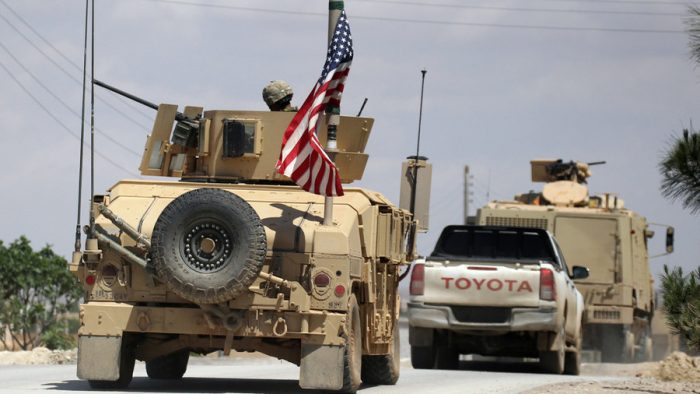
FILE PHOTO. © Aboud Hamam / Reuters
RT | August 28, 2018
A US Army colonel has accused RT of ‘ridiculous misinformation’ for reporting a Russian government suggestion that Islamic State is operating inside a US-controlled zone in Syria, despite the UN and NBC reporting the same.
On Thursday, Russian Foreign Ministry spokesperson Maria Zakharova told journalists that Moscow has received information that armed members of Islamic State (IS, formerly ISIS) and the Al-Qaeda proxy group Jabhat al-Nusra had found shelter in the Rukban refugee camp, located in the southwest Al-Tanf region of Syria, and that the US knows the terrorists are there.
Don’t be distracted by ridiculous misinformation from @RT_com. The #Coalition is focused on #defeatISIS mission & we continue to work with @MaghaweirThowra to secure the #AlTanf region in southern #Syria. @CJTFOIR@oirdcomsshttps://t.co/8vcbh82CVD
— OIR Spokesman (@OIRSpox) August 26, 2018
Army Colonel Sean Ryan who is the spokesman for Operation Inherent Resolve (OIR), the snappy name for the US-led coalition against IS, took to the one battleground that really matters, Twitter. He accused RT of ‘ridiculous misinformation’. It’s not entirely clear which part of the report he believes is misinformation; the fact that the Foreign Ministry said the statement in the first place, that terrorists are operating in Rukban, or that the US knows all about it.
If he’s got a problem with the information coming from Russia’s Foreign Ministry, then he should direct his objections that way. It is generally accepted in the world of journalism that quoting the statement of a government official is not ‘misinformation’, it’s actually just reporting the news. Attempting to undermine good faith reporting, well that actually is ‘misinformation’.
More worrying would be if Colonel Ryan is saying the US actually knows nothing about terrorists operating in and around the Rukban refugee camp, because that would make the US military the only organisation in the region that hasn’t noticed. That’s even more concerning when you consider the stated US goal of being in Syria is to fight IS rebels.
For the benefit of Colonel Ryan, here are a few people who have noticed the slightly dodgy looking gun-toting terrorists who appear to be putting together cells under their noses.
NBC’s Bill Neely was given access to the area around the Rukban camp, but he reported that his Jordanian helicopter pilot refused to fly over it “for fear of being shot down by ISIS cells in the camp.”
The NBC report goes on to quote the commander of Jordan’s army in the area as saying “militants there have whole weapons systems … small arms, RPGs, anti-aircraft.” Brigadier General Sami Kafawin describes how the militants “consider the camp a safe haven. We consider it an imminent threat.”
Jordan is a US ally at the last time of checking, perhaps Colonel Ryan should phone someone up there.
Earlier this month, the UN named the Rukban refugee camp as being among hotspots ripe for the reemergence of IS. For the sake of Colonel Ryan, he can find a link to the UN report here.
The camp is close to the Jordanian border which was closed because of constant terrorist activity. It doesn’t take a genius to work out that terrorists working in such a remote region might see some opportunities in a nearby camp of 80,000 desperate people.
So, what’s really going on here? When a report from RT is branded misinformation by a US colonel who is responsible for less-than-transparent operations in a distant part of Syria, readers may be well advised to read the contents of that report, and future reports, very carefully. Serving military leaders are not well known for being open with information. However, it’s nice to see that Colonel Ryan is getting some of his news from RT.com.
Publicly criticising outlets like RT has nothing to do with pointing out misinformation, but everything to do with undermining different sources of information which are not singing to your tune.
RT has written to Colonel Ryan in an attempt to clarify his comments, but has not received a reply at the time of writing. It can’t be ruled out that he hasn’t noticed the email.
Read more:
5 timely reminders that the media think you are an idiot…

By Kit | OffGuardian | August 28, 2018
The corporate media think we are stupid. All of us. They have as much respect for our intellect or ability to reason as they do for the truth. This is displayed, in size 20 font, on the front page of every newspaper every single day. They paint a picture of an absurd world, and expect us all to nod along with it, blithely accepting their stories as true, no matter what laws of reason – or even physics – they bend to suit their purpose.
The world in the newspaper and on the television is not real in any true sense of the word. Merely a crazy fun-house mirror reflection of the truth. Important features shrunk to nothing, tiny flaws blown up out of proportion. Apparently solid shapes that – on inspection – are nothing but strange plays of light and shadow.
With that in mind, let’s remind ourselves of the kind of completely bonkers things we’re all expected to believe.
1. The Inherent silliness of “ISIS”
This section was going to be more specific, but as I looked back over recent history, there was no single absurdity that highlighted how stupid the ISIS story was.
ISIS was, and is, silly. A few bullet points to demonstrate this – and a reminder that these are not exaggerated in any way. These are, supposedly, facts:
- They were making $1-$3 million PER DAY smuggling oil out of Syria, in convoys kilometres long that the US air force either couldn’t find or wouldn’t bomb because of “risks to civilians”. How they had the technical expertise to extract and process this oil was never explained.
- They minted their own currency.
- They published end-of-year reports, like a business, and kept detailed accounts on flash drives and USB sticks. Despite this, no ISIS bank accounts were ever seized, monitored or shut down.
- They had multiple social media accounts, YouTube channels – often described as “ISIS linked social media accounts” – these accounts weren’t locked, blocked or deleted. The registered owners weren’t arrested. They had their own twitter app which was impossible to block and created their own social network.
- They had their own TV channel, with an animated logo, a waving flag, in the corner of their videos. Think on this – somebody, somewhere, made that logo.
- They had fleets of Toyotas, which we’re supposed to believe they just sort of… acquired. They are all clean, new and undamaged. They are all colour-matched too, of course. There are red ones, white ones, black ones and tan ones. With and without logos painted on the hood. They deployed these trucks in photo-shoots and “viral” videos, the theoretical production of which simply boggles the mind. A bunch of black Toyota’s crossing the desert doesn’t look like much, but think about the actual logistics of making the video. They had to drive up to this spot, drop off the camera crew and equipment, drive back over the horizon, properly time their entrance by synchronizing all the driving and spacing the trucks out evenly, drive past the camera crew waving their flags… then drive back and pick up the camera men and equipment. All of this in the middle of a war zone.
- Of course all their videos had the same music, the ISIS theme, which was Arabic voices singing in close harmony. We’re supposed to believe that – somewhere in the heart of their war-torn empire – a bunch of crazy zealots gathered round a microphone to sing a capella melodies about “death to the west”, while a frustrated technician muttered to himself about “levels” and how Muhammad is flat on the high note. This spawned their own genre of music, which NME did a story on.
It’s so… stupid. And yet the media says it, and expects us to believe it.
ISIS – the all-powerful death cult, the existential threat to Western democracy, on the verge of “regional dominance”. There was a map and everything – world domination by 2020.
Despite all this, ISIS – the untouchable hydra of evil – completely fell apart as a force in the region just months after Russia and Iran got involved in the Syrian war.
Why was this?
Could it be that ISIS were just a media creation – the PR arm of the CIA’s jihadist proxy army – and, in truth, barely existed as fighting force? Existing, rather, to give Western powers an excuse to conduct air strikes on Syrian territory?
Or could it be that the MSM realised that 10,000 insane, bloodthirsty zealots taking time out of their devout holy war to have design meetings about coinage, or shoot music videos in Dune buggies, rings rather hollow?
It’s all a bit silly isn’t it?
2. The Syrian government Is collectively suicidal
Several times, in the last couple of years, Western leaders have made remarkably prescient statements – something along the lines of “We will not tolerate the use of chemical weapons on civilians”, or “We will act if chemical weapons are used”. In fact, in just the last few days both the US and France have reissued these warnings.
Despite these warnings, and though it offers him literally zero strategic advantages of any kind, Assad keeps deploying his super-secret chemical weapons against civilians… just because. He’s winning the war, it’s pretty much over, the only thing that could swing it against him is NATO, and he keeps deliberately inciting them to attack him.
There’s only 2 explanations for that – either he, and his government, are low-key suicidal, or it never happened, and the propagandists in the media truly believe we are completely stupid.
Then there’s the photographs.
Syria knows they have been in America’s crosshairs for years, since well before the start of the Arab spring. They are aware of Israel’s designs on Syrian land, and more than familiar with the US modus operandi re: “humanitarianism”. They KNOW the worst thing they could do is give America, and their NATO allies, even the whisper of a war crime to get indignant about.
… and yet we’re supposed to believe, not only that the regime tortured and executed tens of thousands of “peaceful protestors” for absolutely no reason, but they also kept a carefully photographed and catalogued record of their crimes.
This was brought up in the Guardian today, the famous “Caesar Photographs”, photos of 11,000 people the Assad government tortured and killed, all properly catalogued and numbered and then – conveniently – leaked by some unknown “former guard” and displayed in London like some morbid art exhibition.
The identity of the “leaker” remains a mystery, and there is literally zero evidence the photographs are a) from Syria or b) real.
Does this version of events sound even slightly reasonable?
3. Amnesty International used echolocation to recreate a Syrian prison
They really did. They have some guys claiming to be Syrian resistance members who were held in one of Assad’s “torture prisons”, but they were either blindfolded or in darkness the whole time, so in order to map out the interior of the prison… Amnesty International played sounds to them, to see if they sounded the same. I truly wish I was joking:
Inmates were constantly blindfolded or forced to kneel and cover their eyes when guards entered their cells, so sound became the key sense by which they navigated and measured their environment – and therefore one of the chief tools with which the Forensic team could reconstruct the prison layout. Using a technique of “echo profiling”, sound artist Lawrence Abu Hamdan was able to determine the size of cells, stairwells and corridors by playing different reverberations and asking witnesses to match them with sounds they remembered hearing in the prison.
There’s no reports as to why exactly the men were locked up, how they got away, why they were released and not executed like everyone else OR – indeed – where they acquired their bat-like super hearing.
… But we do now have a 3D model of Assad’s “torture prison”. We even know which room is the crematorium too, because it looked like the snow on the roof had melted in one satellite photo… and the only thing that makes a roof hot is the burning corpses of dissidents.
The whole process is part of a completely made up recently developed field known as “forensic architecture”. In simple terms, it seems “forensic architecture” is looking at the outside of a building – or indeed a photograph of the outside of a building – and guessing what’s inside. While this might seem difficult, pointless, or even insane to most people… to the mainstream media it is worth of thousands of words of coverage and, indeed, winning media awards.
Does any of that really make any sense to you?
4. Jeremy Corbyn hates the Jews
Jeremy Corbyn is soft – maybe, arguably – too soft for the job that history has violently hoisted on to his shoulders, but soft none the less. He rides his bike to work, wears cardigans, is a vegetarian. He has campaigned for peace and against war his entire life. He was arrested for protesting apartheid whilst Margaret Thatcher was calling Nelson Mandela a terrorist, he spoke out against Pinochet while the General was a darling on both sides of the Atlantic.
He has won two international peace prizes.
The idea that, during a public career dedicated to the socialist ideals of decency and fairness, he was secretly thinking “Bloody Jews!” the whole time is completely absurd. Insultingly absurd, and there is not a single piece of evidence to suggest otherwise. There is nothing more to be said on the matter.
5. Russiagate
This is the big one, currently. The grand-daddy of the nothingburgers. Russiagate never happened. There was no collusion, no cheating or vote hacking or pay-offs. They have found literally zero evidence anything ever took place, seizing upon tiny anecdotal scraps and blaring them out in FULL CAPS HEADLINES to make a case in the court of public opinion that would never stand in an actual court.
Where “Russiagate” is different from most invented media schlock however, is the sheer weight of counter evidence. For most media fiction you can say “Well, there’s very little evidence to support that” (see Corbyn = anti-Semite as a classic example). With Russiagate you can go even further: There is a ton – A TON – of evidence to the contrary, clear-cut evidence that Russia (and Putin) have nothing to do with Trump being President. The media refuse to acknowledge this evidence, directly and contemptuously challenging the public’s ability to reason.
Below is a list of unchallenged, non-controversial facts about Russiagate:
- The only proven, admitted, wrong-doing in the 2016 Presidential election was carried out by the DNC, who rigged the primaries so Clinton would be the democratic candidate. This was later admitted to by members of the DNC.
- The e-mails which first brought this to light were published by WikiLeaks, there is no proven link between WikiLeaks and the Russian government.
- Julian Assange, founder of WikiLeaks claimed the e-mails were from an internal leak, not the result of a hack.
- The “Trump-Russia” dossier, a collection of (possibly fabricated) dirt put together by British ex-spy Christopher Steele, was paid for by the DNC and Clinton’s campaign.
These facts, alone, should bring Russiagate down… but there’s more. Since becoming President, Donald Trump has:
- Armed the Ukrainian coup government.
- Bombed Syria.
- Torn up the Iran deal.
- Sanctioned Russia over the Skripal case.
- Sanctioned Russia over “election interference”.
- Expelled Russian diplomats.
- Killed over 200 Russian “mercenaries” in Syria.
These are policies that not only run counter to ALL of Russia’s interests, but very nearly brought us to the brink of World War 3.
And yet we’re told, over and over, to ignore our own logical minds and believe that Trump is Putin’s “puppet”. That Trump is “soft” on Russia.
Why would a product of Russian collusion pursue policies harmful to Russia? How many Russians need to die before we accept that Trump is anything but soft?
The media line on this issue is insane, and dangerous. In refusing to acknowledge the actual truth – that the US Deep State is pushing for conflict with Russia – the media are dragging us toward apocalypse, smiling happily to themselves as they go.
They are either all delusional morons, think WE are all delusional morons, or – most probably – both.
The inmates are running the asylum, declaring the rest of us insane because none of us are hearing voices.
This is why the media is in decline, why the BBC is losing its audience and the newspapers have plummeting readership, because people are tired of being treated like idiots and herded like cattle. We’ve made a collective decision to cut the bullshit out of our lives. The world is heading towards a split, two parallel universes running together – the real world, where reasonable pragmatic people get on with the struggles of life, and the media world, where fake people write about pretend events in newspapers nobody reads.
The media has become that manipulative spouse who lies and cheats and tells you it’s all your fault. A narcissistic gaslighter who just will not change.
It’s time to make a clean break.
Iran president to host Syrian, Turkish counterpart for Syria talks
Press TV – August 27, 2018
The presidents of Iran, Russia, and Turkey will hold their third round of tripartite summit in Iran next week in an attempt to find ways to end the ongoing crisis in Syria, Turkish state television says.
Iranian President Hassan Rouhani will host his Turkish and Russian counterparts Recep Tayyip Erdogan and Vladimir Putin, respectively, on September 7, state-run TRT Haber television said on Monday.
Private NTV television also said the summit would be held in the northwestern Iranian city of Tabriz as Iran, Russia and Turkey are acting as guarantor states for a peace process in Syria.
The three presidents have previously held summits in the Russian resort city of Sochi in November 2017 and in the Turkish capital Ankara in April.
At the end of their meeting in Ankara on April 4, the Iranian, Russian and Turkish presidents reaffirmed their commitment to work toward achieving a sustainable ceasefire between warring sides in Syria and bringing peace and stability to the war-torn Arab country.
Rouhani, Putin and Erdogan, “reaffirmed their determination to continue their active cooperation on Syria for the achievement of lasting ceasefire between the conflicting parties and advancement of the political process envisaged by UN Security Council Resolution 2254,” said a joint statement issued at the end of the summit.
Addressing their summit in Sochi on November 22, Rouhani lauded the defeat of the Daesh terror group in Iraq and Syria, but underlined the need for continued battle against terrorism until the eradication of all Takfiri terrorist outfits in Syria.
He blamed foreign interference for the conflict in Syria, saying certain countries claiming to be advocates of democracy wrecked havoc in the Arab country to achieve their goals in the region.
Erdogan had previously said that he planned to host a summit in Istanbul on September 7 on the crisis in Syria with Putin, French President Emmanuel Macron and German Chancellor Angela Merkel.
However, press reports over the last weeks have indicated that such a meeting was increasingly unlikely and was set to be replaced by the latest three-way summit in Iran.
A UN spokeswoman said on Friday that United Nations Special Envoy Staffan de Mistura had invited Iran, Russia and Turkey to talks due to be held in Geneva next month on forming Syria’s Constitutional Committee.
“Special Envoy de Mistura continues his consultation on the establishment of a Syrian-led, Syrian-owned and UN facilitated Constitutional Committee within the framework of the Geneva process and in accordance with Security Council Resolution 22-54 2015,” Alessandra Vellucci said at a news conference.
In a meeting with Syrian President Bashar al-Assad in Damascus on Sunday, Iran’s Defense Minister Brigadier General Amir Hatami hailed the steadfastness of the Syrian people and government forces in their battle against terrorism, expressing confidence that they will achieve a final victory in this path.
“Not only regional people, but people around the world are indebted to the fight carried out against terrorists in Syria,” Hatami said.
About Half of Syrian Al-Diabiya Residents Return Home After City Liberation
Sputnik – 27.08.2018
AL-DIABIYA About half of the residents of the Syrian city of Al-Diabiya in Damascus province have returned to their homes after the city was freed from the militants, the local administration said on Monday.
“Before the war, there were 70,000 people living in Al-Diabiya. Now 35,000 have already returned,” Abdullah Ahmad, the head of the city administration, said.
The official added that the authorities were restoring the infrastructure in order to facilitate the residents’ return.
“Our task is to restore everything for the normal life and to improve living conditions here as soon as possible. People should understand that they are not asked to return to the debris. Electricity is already supplied and we are also working on distributing food,” Ahmad said.
Syria has been devastated by years of violent civil war which had prompted millions of people to flee hostilities from the areas where they lived to other locations in Syria and outside the country. The United Nations estimates, there are over 5.6 million Syrian refugees abroad and about 6.6 million displaced across the crisis-torn country.
Featured Video
Seyed M. Marandi: Toward Total War in the Middle East
or go to
Aletho News Archives – Video-Images
From the Archives
The Geopolitics behind the War in Yemen (I)
By Mahdi Darius NAZEMROAYA | Strategic Culture Foundation | 30.03.2015
The United States and the Kingdom of Saudi Arabia became very uneasy when the Yemenese or Yemenite movement of the Houthi or Ansarallah (meaning the supporters of God in Arabic) gained control of Yemen’s capital, Sanaa/Sana, in September 2014. The US-supported Yemenite President Abd-Rabbuh Manṣour Al-Hadi was humiliatingly forced to share power with the Houthis and the coalition of northern Yemenese tribes that had helped them enter Sana. Al-Hadi declared that negotiations for a Yemeni national unity government would take place and his allies the US and Saudi Arabia tried to use a new national dialogue and mediated talks to co-opt and pacify the Houthis.
The truth has been turned on its head about the war in Yemen. The war and ousting of President Abd-Rabbuh Manṣour Al-Hadi in Yemen are not the results of «Houthi coup» in Yemen. It is the opposite. Al-Hadi was ousted, because with Saudi and US support he tried to backtrack on the power sharing agreements he had made and return Yemen to authoritarian rule. The ousting of President Al-Hadi by the Houthis and their political allies was an unexpected reaction to the takeover Al-Hadi was planning with Washington and the House of Saudi. … continue
Blog Roll
 Aletho News
- HE SAVED LIVES. NOW HE FACES PRISON.
- Israeli lobby seeks to bind US fate to ‘Israel’: Araghchi
- Pakistan-Iran talks secure LNG shipment to Islamabad through Hormuz
- Black Sea grain crisis puts global wheat supplies under pressure
- IRGC air defenses destroy another US MQ-1 drone over Strait of Hormuz
- Imran Khan’s entire immediate family detained in Pakistan ahead of mass protest demanding his release
- EU nation detains former presidential frontrunner
- Leaked: Britain’s Sham Conviction Of Hashim Thaci
- Seyed M. Marandi: U.S. Strike Imminent – Toward Total War in the Middle East
- Russia Voted Under Fire. Washington Is Loading the Tankers.
- If Americans Knew
- Israeli Attacks in Gaza Kill at Least Seven Palestinians Over Three Days, including Woman and Child
- Trump’s militarization of Washington DC as he pursues Israel’s war against Iran
- Why Israel Fears This Searing New Documentary
- Huckabee aide solicited cash gifts from Israelis
- This isn’t sci-fi, AI is already killing people
- ‘The Most Brutal Thing’: Investigation Reveals Execution of Elderly Woman in Rafah
- Inside Israel’s ‘soft’ ethnic cleansing plan for Gaza through the eyes of its victims
- New online database tracks pro-Israel political donations in the United States
- Israeli president pardons soldier convicted for killing wounded Palestinian
- Singer Ed Sheeran says his ‘heart broken’ by Gaza devastation, addresses Macklemore controversy
- No Tricks Zone
- 2025 Nature Paper Claiming Worsening Global Drought Gets RETRACTED …Heavily Flawed
- New Study: ‘Global Drought Shows No Detectable Recent Acceleration Under Climate Warming’
- Economic Masterminds: German Socialists Suggest Taxing Productivity Gains Stemming From Using AI
- The South China Sea Has Not Been Cooperating With The Climate Change Narrative
- Energy Crisis: Germany Enters Heating Season With Historically Low Gas Reserve Fill Levels
- New Study: The Antarctic Ice Sheet Gained Mass From 2020-2024 Due To Staggering Snow And Ice Accumulation
- Study: Ocean Heating Rates From Thousands Of Years Ago ‘Dwarf’ Modern Ocean Heating Rates
- Climate Extremists Target, Attack Large-Scale Power Grid Infrastructure In Germany!
- New Study: Antarctic Ice Melt Has Contributed Less Than 1 Centimeter To Sea Level Rise In The Last 30 Years
- Fear Of Debate: Alarmist German Climate Scientist Calls On Mainstream Media To Discredit Skeptic Voices
 Aletho News