A 30 page investigative report on the “Caesar Torture Photos” has been released and is available online here. The following is a condensed version of the report. Readers who are especially interested are advised to get the full report which includes additional details, photographs, sources and recommendations.
Introduction
There is a pattern of sensational but untrue reports that lead to public acceptance of US and Western military intervention in countries around the world:
* In Gulf War 1, there were reports of Iraqi troops stealing incubators from Kuwait, leaving babies to die on the cold floor. Relying on the testimony of a Red Crescent doctor, Amnesty Interenational ‘verified’ the false claims.
* Ten years later, there were reports of yellow cake uranium going to Iraq for development of weapons of mass destruction.
* One decade later, there were reports of Libyan soldiers drugged on viagra and raping women as they advanced.
* In 2012, NBC broadcaster Richard Engel was supposedly kidnapped by pro-Assad Syrian militia but luckily freed by Syrian opposition fighters, the “Free Syrian Army”.
All these reports were later confirmed to be fabrications and lies. They all had the goal of manipulating public opinion and they all succeeded in one way or another. Despite the consequences, which were often disastrous, none of the perpetrators were punished or paid any price.
It has been famously said “Those who do not learn from the past are doomed to repeat it.” This report is a critical review of the “Caesar Torture Photos” story. As will be shown, there is strong evidence the accusations are entirely or substantially false.
Overview of ‘Caesar Torture Photos’
On 20 January 2014, two days before negotiations about the Syrian conflict were scheduled to begin in Switzerland, a sensational report burst onto television and front pages around the world. The story was that a former Syrian army photographer had 55,000 photographs documenting the torture and killing of 11,000 detainees by the Syrian security establishment.
The Syrian photographer was given the code-name ‘Caesar’. The story became known as the “Caesar Torture Photos”. A team of lawyers plus digital and forensic experts were hired by the Carter-Ruck law firm, on contract to Qatar, to go to the Middle East and check the veracity of “Caesar” and his story. They concluded that “Caesar” was truthful and the photographs indicated “industrial scale killing”. CNN, London’s Guardian and LeMonde broke the story which was subsequently broadcast in news reports around the world. The Caesar photo accusations were announced as negotiations began in Switzerland. With the opposition demanding the resignation of the Syrian government, negotiations quickly broke down.
For the past two years the story has been preserved with occasional bursts of publicity and supposedly corroborating reports. Most recently, in December 2015 Human Rights Watch (HRW) released a report titled “If the Dead Could Speak” with significant focus on the Caesar accusations.
Following are 12 significant problems with the ‘Caesar torture photos’ story.
1. Almost half the photos show the opposite of the allegations.
The Carter Ruck Inquiry Team claimed there were about 55,000 photos total with about half of them taken by ‘Caesar’ and the other half by other photographers. The Carter Ruck team claimed the photos were all ‘similar’. Together they are all known as ‘Caesar’s Torture Photos’.
The photographs are in the custody of an opposition organization called the Syrian Association for Missing and Conscience Detainees (SAFMCD). In 2015, they allowed Human Rights Watch (HRW) to study all the photographs which have otherwise been secret. In December 2015, HRW released their report titled “If the Dead Could Speak”. The biggest revelation is that over 46% of the photographs (24,568) do not show people ‘tortured to death” by the Syrian government. On the contrary, they show dead Syrian soldiers and victims of car bombs and other violence (HRW pp2-3). Thus, nearly half the photos show the opposite of what was alleged. These photos, never revealed to the public, confirm that the opposition is violent and has killed large numbers of Syrian security forces and civilians.
2. The claim that other photos only show ‘tortured detainees’ is exaggerated or false.
The Carter Ruck report says ‘Caesar’ only photographed bodies brought from Syrian government detention centers. In their December 2015 report, HRW said, “The largest category of photographs, 28,707 images, are photographs Human Rights Watch understands to have died in government custody, either in one of several detention facilities or after being transferred to a military hospital.” They estimate 6,786 dead individuals in the set.
The photos and the deceased are real, but how they died and the circumstances are unclear. There is strong evidence some died in conflict. Others died in the hospital. Others died and their bodies were decomposing before they were picked up. These photographs seem to document a war time situation where many combatants and civilians are killed. It seems the military hospital was doing what it had always done: maintaining a photographic and documentary record of the deceased. Bodies were picked up by different military or intelligence branches. While some may have died in detention; the great majority probably died in the conflict zones. The accusations by ‘Caesar’, the Carter Ruck report and HRW that these are all victims of “death in detention” or “death by torture” or death in ‘government custody” are almost certainly false.
3. The true identity of “Caesar” is probably not as claimed.
The Carter Ruck Report says “This witness who defected from Syria and who had been working for the Syrian government was given the code-name ‘Caesar’ by the inquiry team to protect the witness and members of his family.” (CRR p12) However if his story is true, it would be easy for the Syrian government to determine who he really is. After all, how many military photographers took photos at Tishreen and Military 601 Hospitals during those years and then disappeared? According to the Carter Ruck report, Caesar’s family left Syria around the same time. Considering this, why is “Caesar” keeping his identity secret from the western audience? Why does “Caesar” refuse to meet even with highly sympathetic journalists or researchers?
The fact that 46% of the total photographic set is substantially the opposite of what was claimed indicates two possibilities:
* Caesar and his promoters knew the contents but lied about them expecting nobody to look.
* Caesar and his promoters did not know the contents and falsely assumed they were like the others.
The latter seems more likely which supports the theory that Caesar is not who he claims to be.
4. The Carter Ruck Inquiry was faulty, rushed and politically biased.
The credibility of the “Caesar” story has been substantially based on the Carter-Ruck Inquiry Team which “verified” the defecting photographer and his photographs. The following facts suggest the team was biased with a political motive:
* the investigation was financed by the government of Qatar which is a major supporter of the armed opposition.
* the contracted law firm, Carter Ruck and Co, has previously represented Turkey’s President Erdogan, also known for his avid support of the armed opposition.
* the American on the legal inquiry team, Prof David M. Crane, has a long history working for U.S. Dept of Defense and Defense Intelligence Agency. The U.S. Government has been deeply involved in the attempt at ‘regime change’ with demands that ‘Assad must go’ beginning in summer 2011 and continuing until recently.
* Prof Crane is personally partisan in the conflict. He has campaigned for a Syrian War Crimes Tribunal and testified before Congress in October 2013, three months before the Caesar revelations.
* by their own admission, the inquiry team was under “time constraints” (CRR, p11).
* by their own admission, the inquiry team did not even survey most of the photographs
* the inquiry team was either ignorant of the content or intentionally lied about the 46% showing dead Syrian soldiers and attack victims.
* the inquiry team did their last interview with “Caesar” on January 18, quickly finalized a report and rushed it into the media on January 20, two days prior to the start of UN sponsored negotiations.
The self-proclaimed “rigor” of the Carter Ruck investigation is without foundation. The claims to a ‘scientific’ investigation are similarly without substance and verging on the ludicrous.
5. The U.S. Central Intelligence Agency (CIA) is involved.
In an interview on France24, Prof. David Crane of the inquiry team describes how ‘Caesar’ was brought to meet them by “his handler, his case officer”. The expression ‘case officer’ usually refers to the CIA. This would be a common expression for Prof. Crane who previously worked in the Defense Intelligence Agency. The involvement of the CIA additionally makes sense since there was a CIA budget of $1Billion for Syria operations in 2013.
Prof. Crane’s “Syria Accountability Project” is based at Syracuse University where the CIA actively recruits new officers despite student resistance.
Why does it matter if the CIA is connected to the ‘Caesar’ story? Because the CIA has a long history of disinformation campaigns. In 2011, false reports of viagra fueled rape by Libyan soldiers were widely broadcast in western media as the U.S. pushed for a military mandate. Decades earlier, the world was shocked to hear about Cuban troops fighting in Angola raping Angolan women. The CIA chief of station for Angola, John Stockwell, later described how they invented the false report and spread it round the world. The CIA was very proud of that disinformation achievement. Stockwell’s book, “In Search of Enemies” is still relevant.
6. The prosecutors portray simple administrative procedures as mysterious and sinister.
The Carter Ruck inquiry team falsely claimed there were about 11,000 tortured and killed detainees. They then posed the question: Why would the Syrian government photograph and document the people they just killed? The Carter Ruck Report speculates that the military hospital photographed the dead to prove that the “orders to kill” had been followed. The “orders to kill” are assumed.
A more logical explanation is that dead bodies were photographed as part of normal hospital / morgue procedure to maintain a file of the deceased who were received or treated at the hospital.
The same applies to the body labeling / numbering system. The Carter Ruck report suggests there is something mysterious and possibly sinister in the coded tagging system. But all morgues need to have a tagging and identification system.
7. The photos have been manipulated.
Many of the photos at the SAFMCD website have been manipulated. The information card and tape identity are covered over and sections of documents are obscured. It must have been very time consuming to do this for thousands of photos. The explanation that they are doing this to ‘protect identity’ is not credible since the faces of victims are visible. What are they hiding?
8. The Photo Catalog has duplicates and other errors.
There are numerous errors and anomalies in the photo catalog as presented at the SAFMCD website.
For example, some deceased persons are shown twice with different case numbers and dates.
There are other errors where different individuals are given the same identity number.
Researcher Adam Larson at A Closer Look at Syria website has done detailed investigation which reveals more errors and curious error patterns in the SAFMCD photo catalog.
9. With few exceptions, Western media uncritically accepted and promoted the story.
The Carter Ruck report was labeled “Confidential” but distributed to CNN, the Guardian and LeMonde.
CNN’s Christiane Amanpour gushed the story as she interviewed three of the inquiry team under the headline “EXCLUSIVE: Gruesome Syria photos may prove torture by Assad regime”. Critical journalism was replaced by leading questions and affirmation. David Crane said “This is a smoking gun”. Desmond de Silva “likened the images to those of holocaust survivors”.
The Guardian report was titled “Syrian regime document trove shows evidence of ‘industrial scale’ killing of detainees” with subtitle “Senior war crimes prosecutors say photographs and documents provide ‘clear evidence’ of systematic killing of 11,000 detainees”
One of the very few skeptical reports was by Dan Murphy in the Christian Science Monitor. Murphy echoed standard accusations about Syria but went on to say incisively, “the report itself is nowhere near as credible as it makes out and should be viewed for what it is: A well-timed propaganda exercise funded by Qatar, a regime opponent who has funded rebels fighting Assad who have committed war crimes of their own.”
Unfortunately that was one of very few critical reports in the mainstream media.
In 2012, foreign affairs journalist Jonathan Steele wrote an article describing the overall media bias on Syria.. His article was titled “Most Syrians back Assad but you’d never know from western media”. The media campaign and propaganda has continued without stop. It was in this context that the Carter Ruck Report was delivered and widely accepted without question.
10. Politicians have used the Caesar story to push for more US/NATO aggression.
Politicians seeking direct US intervention for ‘regime change’ in Syria were quick to accept and broadcast the ‘Caesar’ story. They used it to demonize the Assad government and argue that the US must act so as to prevent “another holocaust’, ‘another Rwanda’, ‘another Cambodia’.
When Caesar’s photos were displayed at the House Foreign Affairs Committee in Congress, Chairman Ed Royce said “It is far past time that the world act…. It is far past time for the United States to say there is going to be a safe zone across this area in northern Syria.”
The top ranking Democrat in the House Foreign Affairs Committee is Eliot Engel. In November 2015 he said “We’re reminded of the photographer, known as Caesar, who sat in this room a year ago, showing us in searing, graphic detail what Assad has done to his own people.” Engel went on to advocate for a new authorization for the use of military force.
Rep Adam Kinzinger is another advocate for aggression against Syria. At an event at the Holocaust Memorial Museum in July 2015 he said, “If we want to destroy ISIS we have to destroy the incubator of ISIS, Bashar al-Assad.”
The irony and hypocrisy is doubly profound since Rep Kinzinger has met and coordinated with opposition leader Okaidi who is a confirmed ally of ISIS. In contrast with Kinzinger’s false claims, it is widely known that ISIS ideology and initial funding came from Saudi Arabia and much of its recent wealth from oil sales via Turkey. The Syrian Army has fought huge battles against ISIS, winning some but losing others with horrific scenes of mass beheading.
11. The Human Rights Watch assessment is biased.
HRW has been very active around Syria. After the chemical attacks in greater Damascus on August 21, 2013, HRW rushed a report which concluded that, based on a vector analysis of incoming projectiles, the source of the sarin carrying rockets must have been Syrian government territory. This analysis was later debunked as a “junk heap of bad evidence” by highly respected investigative journalist Robert Parry. HRW’s assumption about the chemical weapon rocket flight distance was faulty. Additionally it was unrealistic to think you could determine rocket trajectory with 1% accuracy from a canister on the ground. To think you could determine flight trajectory from a canister on the ground that had deflected off a building wall was preposterous.
In spite of this, HRW stuck by its analysis which blamed the Assad government. HRW Director Ken Roth publicly indicated dissatisfaction when an agreement to remove Syrian chemical weapons was reached. Mr. Roth wanted more than a ‘symbolic’ attack.
In light of the preceding, we note the December 2015 HRW report addressing the claims of Caesar.
HRW seems to be the only non-governmental organization to receive the full set of photo files from the custodian. To its credit, HRW acknowledged that nearly half the photos do not show what has been claimed for two years: they show dead Syrian soldiers and militia along with scenes from crime scenes, car bombings, etc…
But HRW’s bias is clearly shown in how they handle this huge contradiction. Amazingly, they suggest the incorrectly identified photographs support the overall claim. They say, “This report focuses on deaths in detention. However other types of photographs are also important. From an evidentiary perspective, they reinforce the credibility of the claims of Caesar about his role as a forensic photographer of the Syrian security forces or at least with someone who has access to their photographs.” (HRW, p31) This seems like saying if someone lies to you half the time that proves they are truthful.
The files disprove the assertion that the files all show tortured and killed. The photographs show a wide range of deceased persons, from Syrian soldiers to Syrian militia members to opposition fighters to civilians trapped in conflict zones to regular deaths in the military hospital. There may be some photos of detainees who died in custody after being tortured, or who were simply executed. We know that this happened in Iraqi detention centers under U.S. occupation. Ugly and brutal things happen in war times. But the facts strongly suggest that the ‘Caesar’ account is basically untrue or a gross exaggeration.
It is striking that the HRW report has no acknowledgment of the war conditions and circumstances in Syria. There is no acknowledgment that the government and Syrian Arab Army have been under attack by tens of thousands of weaponized fighters openly funded and supported by many of the wealthiest countries in the world.
There is no hint at the huge loss of life suffered by the Syrian army and supporters defending their country. The current estimates indicate from eighty to one hundred and twenty thousand Syrian soldiers, militia and allies having died in the conflict. During the three years 2011 – 2013, including the period covered by Caesar photos, it is estimated that over 52,000 Syrian soldiers and civilian militia died versus 29,000 anti-government forces.
HRW had access to the full set of photographs including the Syrian army and civilian militia members killed in the conflict. Why did they not list the number of Syrian soldiers and security forces they identified? Why did they not show a single image of those victims?
HRW goes beyond endorsing the falsehoods in the ‘Caesar’ story; they suggest it is a partial listing. On page 5 the report says, “Therefore, the number of bodies from detention facilities that appear in the Caesar photographs represent only a part of those who died in detention in Damascus.”
On the contrary, the Caesar photographs seem to mostly show victims who died in a variety of ways in the armed conflict. The HRW assertions seem to be biased and inaccurate.
12. The legal accusations are biased and ignore the supreme crime of aggression.
The Christian Science Monitor journalist Dan Murphy gave an apt warning in his article on the Carter Ruck report about ‘Caesar’. While many journalists treated the prosecutors with uncritical deference, he said, “Association with war crime prosecutions is no guarantor of credibility – far from it. Just consider Luis Moreno Ocampo’s absurd claims about Viagra and mass rape in Muammar Qaddafi’s Libya in 2011. War crimes prosecutors have, unsurprisingly, a bias towards wanting to bolster cases against people they consider war criminals (like Assad or Qaddafi) and so should be treated with caution. They also frequently favor, as a class, humanitarian interventions.”
The Carter Ruck legal team demonstrated how accurate those cautions were. They were eager to accuse the Syrian government of “crimes against humanity” but the evidence of “industrial killing”, “mass killing”, “torturing to kill” is dubious and much of the hard evidence shows something else.
In contrast, there is clear and solid evidence that a “Crime against Peace” is being committed against Syria. It is public knowledge that the “armed opposition” in Syria has been funded, supplied and supported in myriad ways by various outside governments. Most of the fighters, both Syrian and foreign, receive salaries from one or another outside power. Their supplies, weapons and necessary equipment are all supplied to them. Like the “Contras” in Nicaragua in the 1980’s, the use of such proxy armies is a violation of customary international law.
It is also a violation of the UN Charter which says “All Members shall refrain in their international relations from the threat or use of force against the territorial integrity or political independence of any state, or in any other matter inconsistent with the Purposes of the United Nations”.
The government of Qatar has been a major supporter of the mercenaries and fanatics attacking the sovereign state of Syria. Given that fact, isn’t it hugely ironic to hear the legal contractors for Qatar accusing the Syrian government of “crimes against humanity”?
Isn’t it time for the United Nations to make reforms so that it can start living up to its purposes? That will require demanding and enforcing compliance with the UN Charter and International Law.
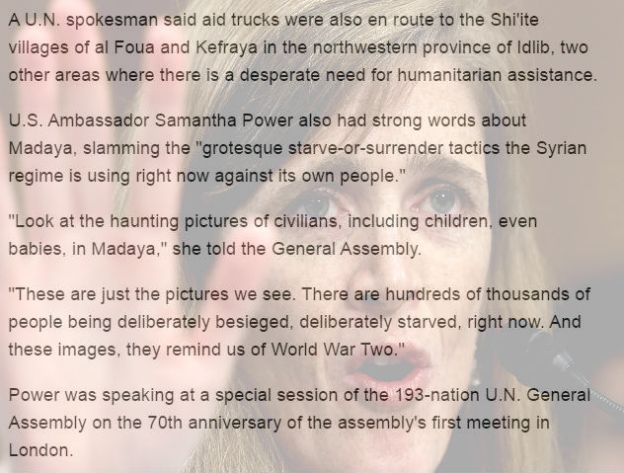
[note holocaust association already introduced by Samantha Powers in relation to #Madaya propaganda storm]
“I have looked through the report, it has all the characteristics of previous UN Human Rights reports on Syria. The timing is extremely suspect – released just as the Syrian army closes in on Aleppo.
We have seen a great spike in propaganda in the past few days, against Russian air strikes and over the number of civilians building up on the Syrian border, said to be 35,000, but 70,000 are said to be coming and yesterday the Turkish deputy PM spoke of 600,000 on the way. All this can be seen as the possible prelude to establishing a buffer zone – we can’t look after any more in Turkey, so the only answer is to look after them inside Syria ….
The UN Human Rights Council speaks of 500 interviews. There is no mention of who these people are, how the UN HRC got their names and where they were interviewed. The HRC’s answer is that names cannot be released but at the same time we cannot accept as credible any report that does not/will not provide such information.
There is absolutely no means of verifying it and given the HRC’s previous record, its word cannot be trusted. You might remember Navi Pillai’s hysterical statements about Syria when she was head of this council . I had a run-in with one of the committee members when i criticised a report on Syria for the same reasons I am giving here. It made many lurid accusations without providing a skerrick of reliable information. In a very heated discussion she admitted what was not in the report, that most of the people interviewed were in Turkey or Jordan, and, I would imagine, in the refugee camps.
I have no doubt that being in a Syrian prison is very unpleasant experience, perhaps as unpleasant as being in prison at Abu Ghraib, but extermination is an extremely powerful word and to make an accusation of a policy of extermination without providing the evidence anyone would need to know to back it up, exposes, I think, the true agenda of this group of people.
Watch how its now going to be used by governments and groups like HRW. ” ~ Jeremy Salt
On Thursday, December 18, 2014, The Guardian published The race to save Peter Kassig by Ali Younes, Shiv Malik, Spencer Ackerman and Mustafa Khalili. To refresh memories here is the preface to the story:
The American aid worker was killed by his Isis captors on 16 November. Here, for the first time, is the story of an extraordinary effort to secure his release, which involved a radical New York lawyer, the US government, and the world’s most revered jihadi scholar.
Listen to The Guardian team tell of the daring and extraordinary effort to secure Kassig’s release.
The radical New York lawyer in question is Stanley Cohen, ‘one of America’s most controversial lawyers’. In January he begins an 18-month prison sentence after pleading guilty to a charge from the US Internal Revenue Service. The Guardian article tells a gripping tale of how Cohen put together a team of Islamic scholars and al-Qaeda fellow-travellers to negotiate the release of Peter Kassig from Islamic State’s captivity—only to be thwarted at the last minute by an ill-timed intervention by Jordan’s secret service.
Clearly it’s an important story deserving of a wide readership. How curious then that The Guardian first broke the story just before Christmas, when readers are busy with other things, and that since then corporate news media in the United States have ignored it. On Twitter it’s another matter. Cohen is lauded as a hero for selflessly attempting a rescue mission while the authorities did nothing and his prison cell beckoned. There is talk of a film deal. The Pardon Stanley Cohen movement has more of a spring in its step.
All well and good, then.
And yet, to my ears, ‘The race to rescue Peter Kassig’ does not ring true. Lest it be sanctified by Hollywood without the bother of critical evaluation, I want to register some questions and comments so that we might better understand the fate of Peter Kassig. I fear that Guardian readers, the article’s authors, and even Stanley Cohen, have been taken advantage of by altogether more diabolical forces.
1. Let’s start at the beginning: Where is the evidence that Peter Kassig was ever held captive by ‘Islamic State’ or that they decapitated him? This is so widely assumed that the question is seldom asked. It should be. Questioning assumptions should be a starting point for investigative journalists. If he is to be ‘rescued’ we ought to ask, From whom and where?
Surely the 15 minute video ‘Although the disbelievers dislike it’ is all the evidence we need, even if few have seen it? I do not think so. I’ve studied it carefully and can find evidence only of the Tarantino-like film making skills of whoever created this little masterpiece of deception. (See ISIS Lessons in Terror Marketing: How to Change the World by Deception). No one is decapitated in that video; not anyone of those Syrian servicemen; not Peter Kassig. It’s all camera angles, special effects and clever editing.
What about Kassig’s severed head at the feet of ‘Jihadi John’ in the final segment of that video? It certainly looks like a severed head and it resembles Kassig’s and this is proof of what exactly? The props department of most major theatre and opera companies can produce a severed head on demand, even of a specific individual. Here the Royal Shakespeare Company shows how it is done. Props departments have their counterparts in film; they’re called digital artists. Look carefully: ‘Kassig’s head’ is a digitally inserted prop. It’s not proof of Kassig’s death. It’s proof that someone is attempting to deceive us.
Questions such as these are not asked because ‘we are passive consumers of the pornography of violence’ (Will Self, The Guardian, 2014-12-23). Effectively, public opinion defers to the testimony of ‘Jihadi John’. So when he says ‘This is Peter Edward Kassig, a US citizen of your country’ it surely must be true. From this shaky assumption Ali Younes, Shiv Malik, Spencer Ackerman and Mustafa Khalili set forth on their investigation.
2. Strictly speaking, the byline of ‘The race to save Peter Kassig’ should be ‘Stanley Cohen as told to Younes et al’ for the entire account is based on what Cohen told them he recalled, felt and did. The article reads like an extract from a novel, in which Cohen is the protagonist and Younes et al attempt to breath some life into the character by seeing the world through his eyes. For example, Cohen ‘had other things on his mind’; ‘as he returned from court’; ‘To Cohen, it seemed like fate’; ‘Cohen saw something of himself.’ And so on. The entire article is written like this.
Investigative journalism surely calls for more critical distance from those it investigates. This is especially important since three of the central players in this drama are anonymous and we have no way of checking their account: the FBI official (‘Mike’), the federal prosecutor and an ex-Guantanamo, ‘Kuwaiti member of al-Qaida’ (‘Food’). Essentially, Cohen speaks for them and the coauthors document what he says. The article’s rhetorical style leaves readers no room to make up their own minds about what happened.
3. Even fictional narratives must be plausible; this article stretches plausibility to its limit.
(a) Readers are asked to believe that the United States, with its vast intelligence and diplomatic resources, has no one capable of negotiating with Islamic State for the release of one of its citizens—apart from this maverick Jewish soon-to-be imprisoned lawyer. If so, what’s the point of those ‘diplomats’ in that vast US ‘embassy’ in Baghdad?
(b) How plausible is it that Cohen was given a free hand to negotiate with Islamic State? Let’s look at what he so nearly did with it. According to the article, he concluded that the only way to achieve Kassig’s release was to bring about rapprochement between Turki al-Binali and Abu Muhammad al-Maqdisi; or, put another way, to bring about reconciliation between ISIS and al-Qaeda. No kidding. And this would be a good thing? The life of this one American would be worth this exorbitant price would it? Apparently so. The US intelligence and diplomat community, it would seem, was indifferent to this prospect, which, but for the bungling interference of Jordan’s secret service in arresting al-Maqdisi, would have come about.
(c) How likely is it that Jordan’s secret service would act contrary to the wishes of their American counterparts, especially on a mission of such vital importance?
(d) Why would anyone reasonably expect ‘Islamic State’ to be so magnanimous as to free Kassig just so it could have the pleasure of dedicating his release ‘to Muslim political prisoners around the world, including those in Guantánamo’, as Cohen suggested? What is there in ‘Jihadi John’s’ demeanour that suggests this? Yet this prospect, apparently, was enough for Islamic State to agree that Kassig would not be harmed ‘while Cohen was still engaged on the ground.’
(e) The ‘tentative proposal for Kassig’s unilateral release’ was put together by Cohen with the help of three anonymous characters—the FBI official (‘Mike’), the federal prosecutor and an ex-Guantanamo, ‘Kuwaiti member of al-Qaida’ (‘Food’). Why would they want to conceal their involvement in this noble but tragic rescue mission, when others with more to lose are named?
(f) Turki al-Binali is an elusive character. Just 30-years old, but ‘Isis’s chief scholar’ ‘who has his own English language Facebook page’ and ‘the only person who could stay Jihadi John’s knife with a single edict.’ (‘Jihadi John’, then, is in charge.) Just as ‘Jihadi John’ is a man whose face we have not seen and whose voice is not authenticated, Turki al-Binali is encountered more in the virtual realm than in the flesh. No one actually sees him during these negotiations nor is there any mention of where he is physically located. It’s all done via WhatsApp.
(g) Why would the venerable Abu Muhammad al-Maqdisi, newly released from 5 years in a Jordanian prison, want to jeopardize his freedom by messaging with al-Binali, Islamic State’s ‘scholar-in-arms’, over such a harebrained scheme and then have his private conversations published in a national newspaper for the whole world to gawp at? Incredibly, he takes the word of Cohen, who he has just met, and his anonymous FBI handler (‘Mike’).
(h) In fact, it’s not clear why al-Maqdisi, ‘who may be the world’s most revered living jihadi scholar’, would agree to meet with Cohen in the first place, let alone immediately invite this stranger into his home. ‘The flat was tidy: on the floor were children’s toys and, on the walls, framed religious quotations.’ This is as close as we come to an explanation:
When Cohen told Mike about his travel plans, the FBI official was surprised. “He said ‘Maqdisi is going to meet with you?’” Cohen recalled. “I said ‘Yeah, he’s waiting for me.’ He said ‘Go’.”
As easy as that then. Could the following help explain this instant cordiality? In an article published in the Arab Daily News, October 28, 2014, one of the authors of ‘The race to save Peter Kassig’, Ali Younes, writes of an interview he conducted with the said Abu Mohamad al-Maqdisi. (There they are together in two photographs, friendly as anything). Younes reveals that he had spoken with al-Maqdisi ‘on several occasions in the past few weeks’. This is the very period that Cohen claims to have been communicating with al-Maqdisi. It surely wasn’t the case that one of the authors of ‘The race to save Peter Kassig’ was a party to these negotiations? We would have been told. Wouldn’t we?
(i) According to ‘The race to save Peter Kassig’ al-Maqdisi and al-Binali tried to reach an agreement on the release of Kassig, not by meeting face-to-face, speaking on the phone or even by writing letters, but via WhatsApp (‘one of Isis’s favoured modes of communication’).
By now it was evening, and for the next two hours or so, Maqdisi and Binali messaged each other on WhatsApp. Their exchange was “very warm,” Cohen says. Maqdisi jokingly called Binali “my ungrateful son” and Binali messaged back and said, “Abu Muhammad [Maqdisi] is my father. All these other sheikhs [in Isis] are my uncles.” Binali was eager to show off: he prefaced some of his messages by saying there was a drone overhead or there had just been an air strike, to impress Maqdisi. He also sent his former teacher a picture of himself wearing an ammunition vest and holding a Qur’an.
Quite touching. These are Cohen’s recollections, mind, not al-Maqdisi’s or al-Binali’s.
Maqdisi told Cohen that he’d had an additional WhatsApp discussion with Binali. They made progress towards a personal rapprochement and had even started to resolve their religious differences. Tomorrow, Maqdisi said, he planned on specifically broaching the subject of Kassig with him.
I cannot even imagine the bookish al-Maqdisi using WhatsApp. Is this really how Jihadi scholars do business these days? They are so trusting. Neither could know for sure who he was messaging with. Having ‘made progress towards a personal rapprochement’ they were to ‘resolve their religious differences’—by WhatsApp. This is how the reconciliation between Islamic State and al-Qaeda was to be achieved? This is how the fate of this young man was to be decided? This is the very best the United States could do to rescue him?
Incidentally, where was al-Binali during these exchanges? This isn’t mentioned in the article. Did Cohen or anyone on his team see him or know where he was? Other than by his appearances on WhatsApp, Twitter and Facebook, how would the skeptical know that the elusive al-Binali actually exists?
For these and other reasons I am not at all persuaded by ‘The race to save Peter Kassig’. I do, however, have a more plausible explanation of the events depicted in the article. As I have argued at length elsewhere, the suite of Islamic State beheading videos (of Foley, Sotloff, Henning and Haines, along with ‘Although the disbelievers dislike it’) are works of military deception (MILDEC) aimed primarily at Western public opinion. No one dies in those videos. Their immediate objective was to facilitate Anglo-American military reengagement in Iraq (unthinkable only a few months ago) by goading an emotional reaction among Brits and Americans. Mission accomplished. Their broader objective is to disguise the real forces behind Islamic State and their motives. Things are not as they seem. I do not know for sure who is behind these particular Islamic State beheading videos, other than that it is not ‘Islamic State’, but if a faction within US/UK intelligence did not create them they surely know who did.
To return to the fate of Peter Kassig and the ‘race’ to save him.
Whenever an American hostage meets an untimely demise the US feels obliged to tell us of the heroic efforts they made to save him or her, only to be foiled by circumstances beyond their control. It happens every time. For simulated hostages there are simulated rescue attempts. The day after the release of the Foley beheading video, for example, ‘senior Obama administration officials’ told of an unsuccessful secret operation to rescue Foley and several other Americans held captive in Syria. The Syrian government said it never happened. ‘The race to save Peter Kassig’ tells of the diplomatic equivalent of these heroically unsuccessful military rescue missions. Even if some or all of the participants were sincere, it was a simulated rescue that was designed to fail. Jordanian and American intelligence are like heart and lung on these matters. They work in unison. If Maqdisi was arrested just as the deal was about to be sealed it’s because the US wanted it.
No actual diplomats would fall for this pantomime, but an amateur one facing prison might. No seasoned journalists would fall for it either; they would raise questions such as the above. So what happened to these Guardianistas ? The accompanying audio (by Phoebe Greenward) tells us that the ‘race’ began with ‘a series of emails obtained by the Guardian.‘ ‘Obtained’ suggests some active investigation. A more accurate word I suggest is ‘fed’ (given to Shiv Malik). By whom? And why to a British rather than an American newspaper? Mustafa Khalili’s first response when he read them—’disbelief’—was correct. But these journalists were so intoxicated by the romance of what they read that their investigation lapsed into fleshing out a narrative on the bare bones of those emails, the whole lot marinated in sentiment. The name for this is ‘creative nonfiction’, not investigative journalism.
The correct answer to ‘What happened to Peter Kassig?’ is ‘We don’t know’. This is a more honest position than seeing beheadings where there are none and taking ‘Jihadi John’s’ word as gospel. To answer the question, researching how ‘The race to save Peter Kassig’ came to be would be a good start.
Dr. Richard Marsden
Faculty of Humanities and Social Sciences
Athabasca University
Alberta, Canada T9S 3A3
… We have become so concerned about humanity’s slow response to this challenge that we have decided we must clearly set out what we see as the only viable path forward. As scientists we do not take advocacy positions lightly, but we believe the magnitude of climate change now presents an unprecedented moral challenge that compels us to speak out.
… The voluntary measures put on the table at Paris by over 100 nations are a welcome step, but unless there are strong measures to reduce emissions beyond 2030, global emissions would remain at a high level, practically guaranteeing that young people inherit a climate running out of their control. A new and intensified approach is clearly needed.
Everyone agrees that the most urgent component of decarbonisation is a move towards clean energy, and clean electricity in particular. We need affordable, abundant clean energy, but there is no particular reason why we should favour renewable energy over other forms of abundant energy. Indeed, cutting down forests for bioenergy and damming rivers for hydropower – both commonly counted as renewable energy sources – can have terrible environmental consequences.
Nuclear power, particularly next-generation nuclear power with a closed fuel cycle (where spent fuel is reprocessed), is uniquely scalable, and environmentally advantageous. Over the past 50 years, nuclear power stations – by offsetting fossil fuel combustion – have avoided the emission of an estimated 60bn tonnes of carbon dioxide. Nuclear energy can power whole civilisations, and produce waste streams that are trivial compared to the waste produced by fossil fuel combustion. There are technical means to dispose of this small amount of waste safely. However, nuclear does pose unique safety and proliferation concerns that must be addressed with strong and binding international standards and safeguards. Most importantly for climate, nuclear produces no CO2 during power generation.
To solve the climate problem, policy must be based on facts and not on prejudice. The climate system cares about greenhouse gas emissions – not about whether energy comes from renewable power or abundant nuclear power. Some have argued that it is feasible to meet all of our energy needs with renewables. The 100% renewable scenarios downplay or ignore the intermittency issue by making unrealistic technical assumptions, and can contain high levels of biomass and hydroelectric power at the expense of true sustainability. Large amounts of nuclear power would make it much easier for solar and wind to close the energy gap.
The climate issue is too important for us to delude ourselves with wishful thinking. Throwing tools such as nuclear out of the box constrains humanity’s options and makes climate mitigation more likely to fail. We urge an all-of-the-above approach that includes increased investment in renewables combined with an accelerated deployment of new nuclear reactors.
For example, a build rate of 61 new reactors per year could entirely replace current fossil fuel electricity generation by 2050. Accounting for increased global electricity demand driven by population growth and development in poorer countries, which would add another 54 reactors per year, this makes a total requirement of 115 reactors per year to 2050 to entirely decarbonise the global electricity system in this illustrative scenario. … Full article
George Monbiot – columnist with The Guardian newspaper in the UK, and author of Heat: How to Stop the Planet Burning. “Atomic energy has just been subjected to one of the harshest of possible tests, and the impact on people and the planet has been small. The crisis at Fukushima has converted me to the cause of nuclear power.”
Tom Wigley – of Climate-Gate infamy, he’s a senior scientist in the Climate and Global Dynamics Division of the University Corporation of Atmospheric Research. “We need nuclear power to solve this problem … people don’t realise just how bad climate change is.”
James Hansen – author of Storms of My Grandchildren.
Barry W Brook – is the Director of Climate Science at Adelaide University, and Sir Hubert Wilkins Chair of Climate Change, is on the board of the Science Council for Global Initiatives and the International Awards Committee of the Global Energy Prize.
Gwyneth Cravens – novelist and journalist, author of Power to Save the World: The Truth About Nuclear Energy.
Ted Nordhaus – Chairman of the Breakthrough Institute, political strategist and author of Break Through, Why We Can’t Leave Saving The Planet To Environmentalists.
Mark Lynas – author of The God Species: How the Planet Can Survive the Age of Humans, also a frequent speaker around the world on climate change science and policy. “Let me be very clear. Without nuclear, the battle against global warming is as good as lost.”
Tom Blees – author of Prescription for the Planet (the seemingly “intractable” problem of nuclear waste is “nothing of the kind”) has “probably done more than anybody to move people to the cause of nuclear power.” Tom also heads the Science Council for Global Initiatives.
Professor Gerry Thomas – of the Imperial College, London, “I am very pro-nuclear as I realise that we have an unwarranted fear of radiation.”
James Lovelock – celebrated father of the Gaia principle.
Fred Pearce – an environment writer with The Guardian newspaper in the UK, and author of The Last Generation: How nature will take her revenge for climate change.
Stewart Brand – a prominent pro-nuclear “environmentalist” and author of Whole Earth Discipline: Why dense cities, nuclear power, transgenic crops, restored wildlands and geoengineering are necessary.
Ken Caldiera – with the Department of Global Ecology, Carnegie Institution, recently co-authored an open letter to the environmental movement urging them to bring their support behind the development of new nuclear power.
Kerry Emmanuel – with the Massachusetts Institute of Technology. He is known for his work on attribution of climate change to hurricane events.
Rachel Pritzker – is the founder and president of the Pritzker Innovation Fund. Rachel currently chairs the advisory board of the Breakthrough Institute.
Suzanne Hobbs-Baker – the brain behind Pop Atomic Studios, an organisation which uses the power of visual and liberal arts to “enrich” the public discussion on atomic energy.
Ed Davey – UK Secretary of State for Energy and Climate Change, “When I have listened to the arguments of pro-nuclear Liberal Democrats in recent years, the one argument I found increasingly difficult to answer is the climate-change argument, because climate change poses a real and massive danger to our planet. Not keeping a genuinely low-carbon source of electricity as an option looks reckless when we don’t know the future.”
Western media has published yet another doom and gloom article on Crimea, repeating a worn theme that surely, by now, the people of Crimea must be reconsidering their vote 21 months ago to secede from Ukraine and rejoin the Russian Federation.
The article was published in the New York Times on Dec 1 and is titled, ‘Months after Russian annexation, hopes start to dim in Crimea‘. This one has to skate around a new, added twist to the Crimea story: the electricity and commercial road transport blockade that has been mounted by small numbers of the extreme-right in Ukraine but endorsed by the governing regime in Kyiv while Western governments turn a blind eye.
The article begins:
SHCHYOLKINO, Crimea–When residents in this typical Soviet factory town voted enthusiastically to secede from Ukraine and to become Russians, they thought the chaos and corruption that made daily life a struggle were a thing of the past. Now that many of them are being forced to cook and boil drinking water on open fires, however, they are beginning to reconsider.
The article employs time-honored methods for when a pre-determined, negative theme is required and important facts must be obscured.
One, find disgruntled citizens in the street and cite them. That’s not difficult to do–is there a country in the world without many unhappy citizens? The Times writer cites two such people in his article.
Two, make it appear that the disgruntled citizen(s) speaks for large numbers of his or her fellow citizens.
Three, negative imagery is important. Thus we read in the Times article, “Twenty months after the Kremlin annexed the Black Sea peninsula amid an outpouring of patriotic fervor by the ethnic Russian population, President Vladimir V. Putin’s promise in April 2014 to turn it into a showcase of his rule now seems as faded as Crimea’s aging, Soviet-era resorts.” Very evocative–‘aging, Soviet-era resorts’. This recalls the decades of New York Times reporting of aged-looking buildings in Cuba during the decades of the U.S. embargo of the island. The embargo made it difficult for Cuba to manufacture or obtain paint and building materials; such things as public health care, public education, international aid and solidarity, and national defense took priority. So yes, this writer visited Cuba three times during the 1990s and, indeed, many buildings in Havana looked aged. But the spirit of the people and the outlook for the country was anything but tired and worn out. To my eyes, the people were much more spirited and forward looking compared to what I experienced in wealthy Canada.
Four, the key word in all reporting of Crimea is “annex”, as per the above citation. The people in Crimea voted overwhelmingly in March 2014 for secession from Ukraine, following a violent, right-wing coup against the elected president of that country (a president for whom a large majority of Crimeans had voted in 2010). The secession referendum was organized by the elected and constitutional Crimean legislature, whose legality contrasted sharply with the illegal, coup regime which came into power in Kyiv on Feb 21, 2014. Crimeans have affirmed in survey after survey that they are satisfied with the secession decision. Yet, Crimeans are presented in the Times as hapless people who have been “annexed” by Russia. The Times reference to the secession as happening “amid an outpouring of patriotic fervor” suggests that the people were so swept away by fervor as to be too dumb to realize what was really taking place. They were not choosing a future of their own free will; no, they were undergoing “annexation” without even being aware.
Five, blame the victims for their plight. Thus we read in the Times article , “… people here are not sure whom to blame more for their predicament: the Crimean Tatar activists and Ukrainian nationalists who cut off Crimea’s link to the Ukrainian power grid or the local government officials who claimed to have enough power generators stored away to handle such an emergency.” Here we have an absurd spectacle of the Crimean government being blamed for failing to foresee and prepare for the day that right-wing extremists in Ukraine would blow up the electricity transmission lines serving the peninsula. Even more recklessly, the Crimean government failed to foresee that the blowing up of transmission lines by right-wing terrorists (oops, “cutting off of Crimea’s links” by “activists”) would be endorsed and escalated by the regime in Kyiv and that Western governments would turn a blind eye and Western media would largely be silent.
Six, and finally, choice of headline to convey the negative message is key. In this case, we have “hopes start to dim”. In reality, the Times headline joins a long parade of such headlines. Pick a typical, negative word, use it alongside the word “Crimea” in an internet search, and, voilà, you arrive in a world of negativity over prospects for Crimea. Here is a small sample of the trade in negative Crimea headlines and stories:
Crimea’s football fans shiver at prospect of their team playing in Siberia (The Guardian, March 2014)
Why Russia’s Crimea move fails legal test, (BBC, March 2014)
Crimea after annexation: ‘We feel utterly discouraged,’ resident says (Belsat TV, in Belarus, April 2014)
Crimea euphoria fades for some Russians (Reuters, July 2014)
Tourism suffers in Crimea as Ukraine shuns breakaway region (Washington Post, Aug 2014)
Kremlin preparing to combat demos as signs of Crimea-fatigue appear, (‘Euromaidan Press‘, Sept 2014)
Human rights in decline in Crimea (Human Rights Watch, Nov 2014)
To many in Crimea, corruption seems no less at home under Russian rule, New York Times, Aug 2015)
Oddly–well, not so oddly–the last article in this list was about Crimean citizens trying to take back into public control Black Sea waterfront land which had been lost during Crimea’s time in post-1991 Ukraine.
Funnily enough, the Times article concludes with a quotation from a Crimean woman that is supposed to show that Russians are naïve and habitual complainers who always blame others for their failings and shortcomings. But the quotation is the closest thing to truth in the entire article (leaving aside the suggestion that the extreme rightists in Ukraine who blew up electricity lines are “Tatars”):
As often happens in Russia, some blame Washington rather than Moscow or Kiev.
“If it wasn’t for the Americans, none of it could have happened. The Tatars, who are supported by the United States, would not do a thing,” said Tatyana Bragina, 57, an energetic woman who also once worked construction at a nearby, unfinished nuclear plant.
“Please write that we are not desperate. On the contrary, we are full of joy,” Ms. Bragina said, standing near a black iron kettle boiling away in the courtyard of her apartment block.
Russian legislator Konstantin Kosachev has said that Kyiv’s electricity and road-transport blockades against Crimea constitute a “gesture of final farewell” to Crimea.
Russia is racing to construct electricity, natural gas, road and rail links to Crimea across the 3 km wide Kerch Strait, which separates the Sea of Azov from the Black Sea. The first of the electricity will begin to flow in a few weeks. Crimea will be fully supplied with electricity by the summer 2016. Soon after that, it will be producing its own electricity courtesy of the gas pipeline under construction. By 2019, the road and rail bridge will begin to operate.
According to the corporate media when Russian bombs kill, they kill people. On the other hand, US and NATO bombs kill terrorists and extremists. That some collateral damage is caused in the process is only natural and hardly worth the column inches of mentioning. After all’s said and done ‘you can’t make an omelet …’ The fact that one person’s collateral damage is another person’s grandmother is highly regrettable and easily deniable. As one loving grandmother once remarked, “the price is worth it”.
The Guardian’s Mark Tran goes on to describe the jihadists holding the town of Ariha in Northwest Syria as ‘insurgents’. That’s novel way of describing al-Qaida-led rebels, which is how one article in the Telegraph described them on May 29th of this year. Headlined “Al-Qaeda-led rebels take Idlib’s last Syria regime bastion” an accompanying photo shows a tank flying the flag of ISIS. In fairness, the caption doesn’t say the photo was taken in Ariha, there again, neither does it say it wasn’t.
Another article published by the Guardian on July 4th this year carried the headline “Syrian mosque blast kills at least 25 with al-Qaida links”. Note the headline omits the word ‘people’. Are we supposed to think there were no ‘people’ killed in that attack? Just 25 somethings; every last something a signed up member of a terrorist group linked to al-Qaida, I suppose. Back then the Guardian told us: “Syrian Observatory, which tracks the war, said the explosion in Salem mosque in Ariha, also killed a senior non-Syrian member of the hardline jihadist organisation.” In less than six months, and with a bit of Russian bombing, we are expected to swallow the unlikely idea that “hardline” members and somethings of a “jihadist organisation” have morphed into “people” and “insurgents”. People or insurgents, whatever they are now, one thing we can be sure of is that they must certainly be moderate ones.
The recent Frankie Boyle article in the Guardian contained his usual mix of dark humour and on-point political satire. However, most people who follow the Syrian situation closely know his summary of the “civil war”, and assertion that “nobody likes Assad”, to be inaccurate.
Unfortunately efforts to point this out in the comments were met with the Guardian’s usual response to fact-based constructive criticism:
As you can see, Mr Purkayastha’s comment is civil, constructive, on topic and backed up with sources. And yet…
Seems like question the agenda doesn’t abide by their “community standards”. Thanks to Bill Purkayastha for bring this to your attention. If you have had similar experiences at the Guardian, or any MSM web-site, please let us know.
In a report compiled by Luke Harding, Shaun Walker and Julian Borger, entitled “MH17 report suggests efforts were made to cover up causes of disaster”, and published October 13, the Guardian claimed the Dutch report on the downing of MH17 alleged there was evidence of a “bungled autopsy” and attempt to “remove foreign objects” from the body of the first officer. The implication was that this had been done in order to conceal the cause of the crash, and the further implication was of course that Russia and the rebels had been involved.
The report by the Dutch safety board said that more than 120 objects, “mostly metal fragments”, were found in the body of the first officer, who had sustained “multiple fractures”.. When Dutch experts identified the captain’s body they found it had already “undergone an external and internal examination to remove foreign objects”.
Despite apparent attempts to remove shrapnel, “hundreds of metal objects were found”, the report said, as well as bone fractures and other injuries.
After this appeared a rebuttal was posted BTL, by the CiFer known as Pigswiggle, who showed conclusively the report made no such claim, or anything remotely like such a claim.
This is a really bizarre inference from the report.
[…]
The report is merely explaining that the Captain from Team A was not chosen by the public prosecutor as one of the bodies for further “detailed examination.” The Dutch authorities “found” that the Captain’s body “had already ‘undergone an external and internal examination to remove foreign objects,’” because it was part of the investigation procedure that all the bodies were subjected to (as described in the preceding paragraphs of the report). The Guardian is attempting to accuse Russia of a “cover up” based on the investigative actions of the Netherlands Forensic Institute. Indeed, according to the report, the persons responsible for having removed foreign objects from the Captain was a team of “120 forensic specialists from the National Forensic Investigations Team (LTFO) from the Netherlands and 80 forensic specialists from Australia, Belgium, Germany, the United Kingdom, Indonesia, Malaysia, and New Zealand.”
The Guardian needs to correct this story. It is highly embarrassing to it and its journalists.
Following this, and other complaints, October 14 the Guardian issued what amounted to a retraction:
and reworded the offending part of the article to read:
The report by the Dutch safety board said that more than 120 objects, “mostly metal fragments”, were found in the body of the first officer, who had sustained “multiple fractures”. Dutch experts performed an “external and internal examination on the the captain’s body” and removed “hundreds of metal fragments”. They also observed bone fractures and other injuries.
Shaun Walker even tweeted the retraction:
We made a change to this story. There’s enough confusion/disinfo already so apologies for inadvertently adding to it
Some cynical commenters have pointed out this “error” has had the result of spreading a false and baseless rumour of Russian evidence-tampering around the web. A rumour that the foot-noted retraction will do little to quell – especially since they did not see fit to also change their grossly misleading headline, which as of 20:00 BST October 14 still reads thus:
Which means to all intents and purposes the lie is left to stand, “retraction” or no.
Is this ethical journalism?
Anyone who wants to register their opinion on this and/or ask for further correction can write to the Guardian here:
Robert Stuart, the indefatigable challenger of the media narrative through his analysis of the BBC’s “Saving Syria’s Children” program, is now taking on the Guardian. Below we publish his recent letter to the Graun’s complaints department regarding its use of a photo it claimed was a Syrian “barrel bomb”, but which is apparently no such thing.
Please share this as widely as possible and feel free to write your own emails or letters to the Guardian if you feel it is appropriate.
From: Robert Stuart
Sent: 07 October 2015 16:07:44
To: guardian.readers@theguardian.com
I wish to complain that the above print and web article breaches the Guardian News & Media’s Editorial Code, which states (p8):
The Press must take care not to publish inaccurate, misleading or distorted information, including pictures.
I. An image in the article is captioned “An unverified photo of an unexploded barrel bomb alleged to contain napalm gel.”
As several comments below the online version of the article note [1] the image in fact quite clearly shows an opposition “Hell Cannon” mortar device. Numerous images [2] and videos [3] of these munitions, which are fashioned from domestic cooking gas canisters, in the hands of opposition fighters in Syria can readily be found online.
II. A correction to the web article states:
This article was amended to [sic] 13 August 2015 to remove a description of the Syrian Civil Defence as “aligned to the opposition”. The SCD argue that they are a neutral organisation and not aligned to any political group.
Rick Sterling, co-founder of Syria Solidarity Movement, observes [4]:
White Helmets is the newly minted name for “Syrian Civil Defence”. Despite the name, Syria Civil Defence was not created by Syrians nor does it serve Syria. Rather it was created by the UK and USA in 2013. Civilians from rebel controlled territory were paid to go to Turkey to receive some training in rescue operations. The program was managed by James Le Mesurier, a former British soldier and private contractor whose company is based in Dubai.
Sterling adds:
The trainees are said to be ‘nonpartisan’ but only work in rebel-controlled areas of Idlib (now controlled by Nusra/Al Queda) and Aleppo.
The White Helmets work primarily with the rebel group Jabat al Nusra (Al Queda in Syria). Video of the recent alleged chlorine gas attacks starts with the White Helmet logo and continues with the logo of Nusra. In reality, White Helmets is a small rescue team for Nusra/Al Queda.
But White Helmets primary function is propaganda. White Helmets demonizes the Assad government and encourages direct foreign intervention.
Numerous images and videos posted online make shockingly and abundantly plain the partisan and non-peaceful character of the Syrian Civil Defence/White Helmets. [5]
I suggest therefore that the amendment of the original, accurate, description of the Syrian Civil Defence as “aligned to the opposition” also breaches the Guardian Editors’ Code in respect of accuracy.
(From 10:23) “Glad tidings have reached us in Jisr al-Shghor on the hands of our mujahedeen brothers, may Allah strengthen them and make them steadfast on the correct way, and soon Insha’Allah the strongholds of the Assad regime in Latakya and Damascus will be liberated”. (Still images here http://on.fb.me/1EtnlBF and here http://on.fb.me/1X6iQTL).
(From 11:11) “Now we secure the families and transfer them to a safe place, outside of Jisr al-Shughor and we also search for injured civilians, as for the dead bodies, we put them in bodybags after identifying them so we can send [news of them] to their families. Finally we collect the bodies of the Shabiha (Assad regime militia) and throw them in the trash.” (Still image here: http://on.fb.me/1FcDMNw).
A quick scan of today’s major press outlets in the US, Britain and Israel reveals the Empire’s continuing attempt to conceal the full depth and extent of its culpability for the last three years of bloodshed and destruction in Syria.
To begin with today’s Guardian, which carries an article on Syria that still claims “Officially, Russia has staunchly backed Assad through the four-and-half-year Syrian war, insisting that his removal cannot be part of any peace settlement.“ The major news purveyed in the article are the details of a 2012 plan Russia had proposed to avoid the escalation of violence in Syria, which had by that point taken some 7,000 lives — a proposal rejected by the US, Britain, and the rest of the self-declared “Friends of Syria” group of countries.
Relying on the Guardian, today’s Washington Post also cites Martti Ahtisaari, Finnish diplomat and Nobel laureate, and his revelation that “in February 2012, when the conflict had claimed under 10,000 lives, Russia’s envoy to the United Nations outlined a peace plan that could have led to Syrian President Bashar al-Assad’s exit from power.”
Reporting the same news, Isreal’s Haaretz similarly claims that “Russia supposedly proposed President Bashar Assad step down in 2012 as part of a larger Syrian peace deal, but was ignored by the West that thought opposition forces would oust the embattled dictator first” [emphasis mine].
Note the hedging and the rhetoric of doubt and uncertainty evident in the phrasing above. In reality, there is, as I will show, nothing of a mere supposition about it.
As early as June 6, 2012, in fact, Bloomberg had reported that “Russia is signaling that it no longer views President Bashar al-Assad’s position as tenable and is working with the U.S. to seek an orderly transition.” As Bloomberg also pointed out over 3 years ago, on June 1, 2012, speaking to the international press, Putin himself had indicated Russia’s commitment to finding a solution which would avert the possibility of a full-scale war in Syria. That solution, as he hinted, could involve Assad’s stepping down:
“We aren’t for Assad or for his opponents. We want to achieve a situation in which violence ends and a full-scale civil war is avoided.”
It is highly improbable that literally everyone at the Guardian’s, Washington Post’s, and Haaretz’s newsdesks suffers from such enormous memory deficits as to have forgotten the original reports on Russia’s flexibility regarding Assad from 2012. It seems much more likely, in fact, that Matti Ahtisaari’s statements are now being offered to the public as breaking news because the UK and the US administrations, in particular, are facing serious international embarrassment — and opprobrium at home — for having unnecessarily prolonged bloodshed in Syria and, by refusing Russia’s 2012 offer, both financially and practically facilitated the death of over 200,000 Syrians in the proxy-war they’ve been supporting there. Not incidentally, this also makes them directly responsible for the greatest refugee crisis of the last 50 years, now threatening stability and security in Europe.
The official Western narrative, pushed by the Anglo-American and EU mainstream media since 2011, has almost invariably claimed Russian intransigence on the issue of Assad. That narrative is now in tatters. The Guardian, Washington Post and Haaretz articles of the last 24 hours demonstrate that what now needs to be air-brushed from our view is the fact that it was always only a narrative – an anti-Russian, pro-war propaganda story the Western press knowingly imposed on the public.
There were always chinks in that story, of course. In June 2012, the Guardianitself had carried an item headlined “Russia backs Assad’s departure ‘if that is what Syrians want’,” with the subheading:
Foreign minister’s comments suggest that Moscow’s backing for Syrian president is weakening
Russia has indicated that it will no longer stand in the way of the departure of Syria’s President Bashar al-Assad if that is what Syrians want.
and went on to quote Lavrov saying that “If the Syrians agree [on Assad’s departure] between each other, we will only be happy to support such a solution.”
The current attempt to re-write history – all Ahtisaari has now revealed are some of the actual details of the Russian plan the US and EU rejected in 2012, not the fact that Moscow clearly signalled its flexibility on Assad long ago — stands as just another starkly pointed instance of bad faith on the part of the Western press.
Yesterday in the Guardian Nick Cohen could be found using his talents to shill for more lovely humanitarian war.
Nothing odd about that. The MSM almost always shills for war nowadays, and very few of its star columnists have a problem with writing queasy equivocations or faux moral outrage pieces in support of “western intervention.” It apparently doesn’t trouble their consciences at all. Nor do they feel in any way responsible for the subsequent mass slaughter of innocents that usually follows swiftly on. Maybe they are so deluded they really believe western air forces drop nothing but blankets for children. Who knows, or even much cares what their phony rationales might be. Cohen’s piece is largely just another one of these “won’t someone please do the right thing and murder more brown people,” hack pieces, but there’s a couple of things we should probably draw attention to. Namely:
On the one side was Bashar al-Assad, chief capo in a hereditary tyranny. He joined Saddam Hussein in becoming one of only two leaders to have used chemical weapons against civilians since the end of the Second World War.
Firstly, this article ignores the fact there is still absolutely no confirmed evidence Assad even has any chemical weapons left. Nor any confirmed evidence he ever used such weapons. Like the Russian invasion of Ukraine these pseudo-truths exist merely as assertions in the media, ‘verified’ by non-interrogation, rather than by supporting data.
But it’s the second assertion that really should get some kind of award for “most breathtaking use of a total falsehood in pursuit of state-sponsored murder”.
“… He joined Saddam Hussein in becoming one of only two leaders to have used chemical weapons against civilians since the end of the Second World War….”
What? Is Cohen saying Agent Orange wasn’t used against civilians by the US in Vietnam? White phosphorus (defined by the US Defense Dept as a ‘chemical weapon‘ since the first Gulf War) wasn’t used against civilians by the US in Fallujah? Or by Israel in Gaza?
If Cohen really doesn’t know about any of this then he’s not qualified to write in a paper of record. If he does know about all of this – then why is he pretending it didn’t happen? And why is the Guardian prepared to put its reputation behind letting him do it?
The hubris is incredible. How in the age of Google can these people continue to think their masterly word is going to be enough to make us all forget the inconvenient truths? Or is the frantic “Germans bayoneted Belgian babies” style of propaganda just more evidence that they know their latest bid to get us all to back war in Syria is another failure?
I am unreservedly delighted at Jeremy Corbyn’s election. He made a quite excellent speech, specifically rejecting an attack on Syria, marketization in the NHS and the new anti-union legislation. Hopefully the scale of his victory will give pause to the Blairites who will realise they are not as all-important as they thought.
There is no doubt whatsoever that the vast majority of the Labour establishment, as represented by the people in that hall, are hostile to Corbyn. The question now is whether Corbyn can overhaul party mechanisms in such a way as to bring the opinions of the membership to bear on policy and override that right wing “elite” who have been in charge of the party.
The first few weeks are key. Most Blairites are above all careerists. If they think Corbyn can carry through his personal dominance into control of policy and party mechanisms, then many of the Blairites will look at their constituency members and suddenly discover they had left-wing principles after all. If the Blairites think that a resistance and undermining campaign against Corbyn will succeed (and there will certainly be one), they will go for that. In short, most “Blairites” are out for themselves and will join what they perceive will be the winning side Corbyn’s winning margin, and the fact he won overwhelmingly among full members, gives him a very strong base.
I have shared anti-war and pro-Palestinian platforms with Jeremy, and have the greatest respect for him. I also expect that he will have the strength to stand against both the smothering blandishments and the attacks of the neo-con establishment. The “Corbyn’s election is a disaster” narrative is being pushed by the BBC relentlessly in every question and comment – for example they just asked Ed Miliband “In retrospect was it a mistake for you to resign the day after the election?”, the clear sub-text being that Corbyn’s election was undesirable.
Ever since I realised that Blair’s New Labour was entirely subservient to the neo-con agenda I have regarded Labour as the enemy, as a fake opposition so close to the Tories as to make no difference. I viewed its leadership as utterly unscrupulous careerists fully signed up to a vicious pro-wealthy agenda at home and completely subservient to US/Israeli foreign policy abroad. This new careerism tied in very nicely with a pre-existing rotten borough corruption in Scotland and Northern England. I utterly detested the Labour Party.
So it is difficult for me to find the Labour Party led by a man whom I know, much respect, and with whom I disagree on almost nothing except Scottish independence. I also continue to believe that once consolidated, Jeremy will make it clear he has no hostility to Scottish independence and will support a second referendum whenever the Scottish government wants it.
But the problem is that the Labour Party hierarchy, and particularly their parliamentary party, is still full of people who are neo-cons, Red Tories, appallingly corrupt, careerists and in several cases war criminals. To know what attitude to adopt to the Labour Party must depend on how the battle for control of the party pans out. The scale of Corbyn’s victory, and the total rejection of the direct interference of Tony Blair, give Corbyn a great start. Those Blairite bastions – the Guardian and the BBC – are spluttering incoherently.
Jeremy Corbyn has just won the battle for party leadership. But the battle for control of the Labour Party just started.
By Donald Neff | Washington Report On Middle East Affairs | January 1996
On January 4, 1948, Jewish terrorists drove a truck loaded with explosives into the center of the all Arab city of Jaffa and detonated it, killing 26 and wounding around 100 Palestinian men, women and children.[1] The attack was the work of the Irgun Zvai Leumi – the “National Military Organization,” also known by the Hebrew letters Etzel – the largest Jewish terrorist group in Palestine. The Irgun was headed by Revisionist Zionist Menachem Begin and had been killing and maiming Arabs, Britons and even Jews for the previous ten years in its efforts to establish a Jewish state.
This terror campaign meant that at the core of Revisionist Zionism there existed a philosophical embrace of violence. … continue
This site is provided as a research and reference tool. Although we make every reasonable effort to ensure that the information and data provided at this site are useful, accurate, and current, we cannot guarantee that the information and data provided here will be error-free. By using this site, you assume all responsibility for and risk arising from your use of and reliance upon the contents of this site.
This site and the information available through it do not, and are not intended to constitute legal advice. Should you require legal advice, you should consult your own attorney.
Nothing within this site or linked to by this site constitutes investment advice or medical advice.
Materials accessible from or added to this site by third parties, such as comments posted, are strictly the responsibility of the third party who added such materials or made them accessible and we neither endorse nor undertake to control, monitor, edit or assume responsibility for any such third-party material.
The posting of stories, commentaries, reports, documents and links (embedded or otherwise) on this site does not in any way, shape or form, implied or otherwise, necessarily express or suggest endorsement or support of any of such posted material or parts therein.
The word “alleged” is deemed to occur before the word “fraud.” Since the rule of law still applies. To peasants, at least.
Fair Use
This site contains copyrighted material the use of which has not always been specifically authorized by the copyright owner. We are making such material available in our efforts to advance understanding of environmental, political, human rights, economic, democracy, scientific, and social justice issues, etc. We believe this constitutes a ‘fair use’ of any such copyrighted material as provided for in section 107 of the US Copyright Law. In accordance with Title 17 U.S.C. Section 107, the material on this site is distributed without profit to those who have expressed a prior interest in receiving the included information for research and educational purposes. For more info go to: http://www.law.cornell.edu/uscode/17/107.shtml. If you wish to use copyrighted material from this site for purposes of your own that go beyond ‘fair use’, you must obtain permission from the copyright owner.
DMCA Contact
This is information for anyone that wishes to challenge our “fair use” of copyrighted material.
If you are a legal copyright holder or a designated agent for such and you believe that content residing on or accessible through our website infringes a copyright and falls outside the boundaries of “Fair Use”, please send a notice of infringement by contacting atheonews@gmail.com.
We will respond and take necessary action immediately.
If notice is given of an alleged copyright violation we will act expeditiously to remove or disable access to the material(s) in question.
All 3rd party material posted on this website is copyright the respective owners / authors. Aletho News makes no claim of copyright on such material.