Russia resumes participation in grain deal – Defense Ministry
Samizdat – November 2, 2022
Russia has resumed its participation in the Türkiye and UN-mediated deal on the export of Ukrainian grain via the Black Sea, the Defense Ministry announced on Wednesday.
Moscow agreed to reverse the suspension after receiving written guarantees from Kiev that it would not use the safety corridor provided by Russia for military purposes, the statement said.
“At this time, the Russian Federation considers the issued guarantees sufficient,” the ministry noted.
Moscow’s decision to suspend participation in the arrangement was announced last week after the Russian military accused Ukraine of using the corridor for a drone attack on the port of Sevastopol.
The statement on Wednesday credited the UN and Türkiye for securing the written pledge from Kiev. The scheme, which was first negotiated in July, is technically a set of two trilateral agreements between the two mediators and Russia and Ukraine respectively.
Moscow has long expressed concern about the implementation of the deal, which was touted by Kiev and its Western backers as necessary to curb surging prices in the global food market. Contrary to its stated goal, many of the shipments were sent to rich European countries rather than struggling nations elsewhere in the world, Russia said.
Moscow also blamed the UN for failing to have the US and its allies lift economic sanctions against Russian maritime traffic, which is necessary for shipping Russian food and fertilizers to other nations. It was also part of the terms of the Black Sea grain initiative.
The attack on Sevastopol happened early on Saturday last week and involved unmanned aerial and naval craft, which were detected and intercepted by the Russian Navy, according to statements by the defense ministry.
It claimed that the British military assisted Ukraine in planning and executing the operation. It further claimed that the same Royal Navy unit was involved in an attack on the Nord Stream pipelines in the Baltic Sea in September.
The UK Ministry of Defence responded by accusing its Russian counterpart of peddling false claims of “epic scale.”
The EU’s energy security now rests in Turkey’s hands
Europe has sought to bypass Russian gas with disastrous results. Turkey is set to reap the benefits.
By Karin Kneissl | The Cradle | October 24 2022
“Geography is the constant of history,” is a quote attributed to the German statesman Otto von Bismarck. Today, those words ring true as we witness geography altering global politics, finance, and alliances.
The geostrategic importance of Turkey has rarely been as clear to European politicians as it has been in recent months, as the continent grapples with a burgeoning energy crisis this coming winter.
Whether it is grain exports from the Black Sea region or the flow of energy supplies from the eastern producing countries, the Bosphorus and the links to Eurasia are once again playing a decisive geopolitical role, as they so often have throughout history. The fact is, Turkey is now crucial for the security of Europe.
Pipeline politics
On the occasion of Turkish President Recep Tayyip Erdogan’s meeting with his Russian counterpart Vladimir Putin in Sochi at the beginning of August 2022, the focus was mainly on bilateral cooperation in energy matters.
Putin told journalists after the tete-a-tete that Europeans should be grateful to Ankara for its gas supplies due to the reliability of the TurkStream pipeline.
Last year, Russian natural gas accounted for around 45 percent of European gas imports. But that share has fallen to less than 10 percent after supplies were halted via the eastbound Yamal-Europe pipeline and suspected US-backed operatives blew up Nord Stream, which also curtailed exports via Ukraine.
The Russian-Turkish TurkStream gas pipeline project was announced in December 2014 after Moscow realized that the long-planned SouthStream project – meant to deliver Russian natural gas via the Black Sea directly to European Union (EU) member state Bulgaria – was not feasible.
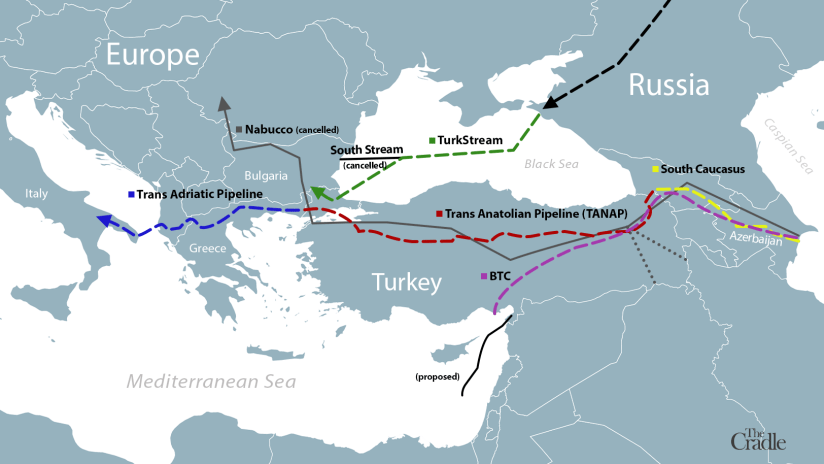
Russian energy giant Gazprom and the Italian energy company ENI were the main partners in the consortium. However, following the Crimean crisis in March 2014, the EU Commission blocked this major infrastructure project, citing competition rules.
As far as Moscow was concerned, this arrangement had already been completed in the form of terminals and pipeline routes. Thousands of work contracts had been issued between Bulgaria and Hungary at the time.
Construction was scheduled to begin in June 2014, but Brussels alluded to apparent violations of competition rules in the awarding of contracts by the Bulgarian authorities and brought everything to a halt.
Turkey as a Russian energy hub
Nine months later, during a joint press conference with Erdogan in Ankara, Putin remarked that “If Europe does not want to carry it out, then it will not be carried out.” Putin then announced the TurkStream project, which was formally launched in early 2020.
One pandemic and a war later, the world has experienced and continues to experience rising natural gas prices, while Russian-Turkish energy cooperation is intensifying. On 19 October, Erdogan said he had agreed with Putin to set up a comprehensive hub for Russian natural gas built in Turkey from where Europe could meet its energy needs.
“If Turkey and our potential buyers are interested, we could consider building another gas pipeline and creating a gas hub in Turkey for sale to third countries, especially in Europe,” Putin proposed. In addition, a gas exchange could also be created in Turkey to determine prices, he added.
Neither the EU nor the US have welcomed these developments or, in some cases, faits accomplis. Turkey makes no secret of the fact that it wants to expand its status in the China-led Shanghai Cooperation Organisation (SCO) and will probably soon become the tenth member of this important regional organization.
It should be noted that the SCO’s statutes stipulate energy and security – especially the fight against terrorism – as its essential agenda. The EU, it must be said, is only just discovering the importance of these issues.
Attempts to bypass Russian gas
In the recent past, governments and energy companies have looked to Turkey as an alternative to the existing transit routes for oil and gas between the east and west. In 2005, the 1750 km long Baku-Tbilisi-Ceyhan (BTC) pipeline was opened, transporting Caspian oil across the Caucasus to the Turkish Mediterranean port.
Crucially, this route had the backing of Washington, reinforcing the close connection between politics and the oil business. As per an apt saying from the early 20th century US oil industry: “The oil business is too important to leave it to the oil people.”
The Nabucco pipeline project, intended to reduce Europe’s reliance on Russia’s gas, consisted of a consortium of six corporations based on the initiative of the Austrian partly state-owned OMV. The project was supported politically and financially by the European Commission, with the premise being that natural gas would be supplied from the Caspian region via Turkey to Central Europe to the Baumgarten hub in Austria.
Billions were spent on marketing this project between 2002 and 2014. However contractual agreements surrounding the deal never materialized. Though inconceivable now, Iran was also initially planned as an alternative supplier, yet these efforts failed from 2005 onwards due to UN Security Council sanctions on Iran from 2008 until the present.
Additionally, supply contracts with Iraq and Turkmenistan were targeted in vain, although these arguably had a lot to do with complete mismanagement. In the case of Turkmenistan, countless advisory opinions were commissioned on the status of the Caspian Sea under international law, sea, or lake, and the possible transit pipelines for landlocked Turkmenistan.
A failed strategy
After many years of mere marketing and a lot of hot air between Brussels and Vienna around the Nabucco project, OMV’s partners finally backed out in 2014. It was clear that there was no natural gas available.
In my book “Der Energiepoker” (The Energy Poker) I wrote in 2006: “If the managers had not gone to the State Opera to see Verdi’s Nabucco, but had seen the operetta by Johann Strauss “Wiener Blut” (Viennese Blood), then this natural gas pipeline would have been given a more appropriate name.
Now, in view of the Nord Stream 2 pipeline boycotted by the EU, OMV is facing further setbacks, as the contracts with take-or-pay clauses were drafted in such a way that payment would have to be made for the Russian natural gas, even if there was no physical delivery. These conditions apparently apply until 2040.
EU will buy Russian energy indirectly
While the EU wants to bypass Russian energy sources for political reasons, Turkey, India, and China, among others, will gladly fill in the consumer void. As described, Turkey already benefited in 2014 from the SouthStream project, which became TurkStream. The EU ultimately lost out, while Ankara stood to gain, with the EU presently buying Russian natural gas via Turkey.
This energy route is set to expand even further once the Russian natural gas hub in Turkey is established. Turkey thus becomes the safeguard of the EU’s energy security. While this was the case a few years ago with non-Russian natural gas and oil, it now looks as if Russia is merely adapting its role for the European market on a regional basis.
For some years, Ankara aligned its prospective role as a hub for BTC and the Nabucco project with its EU accession ambitions. Now it seems that Turkey will become a member of the SCO much faster, and despite its NATO membership, part of the security cooperation with Russia and China.
The EU is more dependent than ever on the goodwill of those it once created obstacles for, and Turkey and Russia are no exception. The coming months will show with all their force just how irresponsibly the EU governments handled the continent’s energy security needs.
Russia’s homage to Nord Stream pipelines
BY M. K. BHADRAKUMAR | INDIAN PUNCHLINE | OCTOBER 22, 2022
David Brinkley, the legendary American newscaster with a career that spanned an amazing fifty-four years from World War II once said that a successful man is one who can lay a firm foundation with the bricks others have thrown at him. How many American statesmen ever practised this noble thought inherited from Jesus Christ remains doubtful.
Russian President Vladimir Putin’s stunning proposal to Turkish President Recep Erdogan to build a gas pipeline to Turkiye to create an international hub from which Russian gas can be supplied to Europe breathes fresh life into this very “Gandhian” thought.
Putin discussed the idea with Erdogan at their meeting in Astana on October 13 and since spoke about it at the Russian Energy Week forum last week where he proposed creating the largest gas hub in Europe in Turkey and redirecting the volume of gas, the transit of which is no longer possible through the Nord Stream, to this hub.
Putin said it may imply building another gas pipeline system to feed the hub in Turkiye, through which gas will be supplied to third countries, primarily European ones, “if they are interested.”
Prima facie, Putin does not expect any positive response from Berlin to his standing proposal to use the string of the Nord Stream 2, which remained undamaged, to supply 27.5 billion cu. metres of gas through the winter months. Germany’s deafening silence is understandable. Chancellor Off Scholz is terrified about President Biden’s wrath.
Berlin says it knows who sabotaged the Nord Stream pipelines but won’t reveal it as it affects Germany’s national security! Sweden too pleads that the matter is far too sensitive for it to share the evidence it has collected with any country, including Germany! Biden has put the fear of God into the minds of these timid European “allies” who have been left in no doubt what is good for them! The western media too is ordered to play down Nord Steam saga so that with the passage of time, public memory will fade away.
However, Russia has done its homework that Europe cannot do without Russia gas, the present bravado of self-denial notwithstanding. Simply put, the European industries depend on cheap, reliable supplies of Russian gas for their products to remain competitive in the world market.
Qatar’s energy minister Saad al-Kaabi said last week that he cannot envisage a future where “zero Russian gas” flows to Europe. He noted acerbically, “ If that’s the case, then I think the problem is going to be huge and for a very long time. You just don’t have enough volume to bring (in) to replace that (Russian) gas for the long term, unless you’re saying ‘I’m going to be building huge nuclear (plants), I’m going to allow coal, I’m going to burn fuel oils.’”
Quintessentially, Russia plans to replace its gas hub in Haidach in Austria (which Austrians seized in July.) Conceivably, the hub in Turkiye has a ready market in Southern Europe, including Greece and Italy. But there is more to it than meets the eye.
Succinctly put, Putin has made a strategic move in the geopolitics of gas. His initiative rubbishes the hare-brained idea of the Russophobic European Commission bureaucrats in Brussels, headed by Ursula von der Leyen, to impose a price cap on gas purchases. It makes nonsense of the US’ and EU’s plans to put down Russia’s profile as a gas superpower.
Logically, the next step for Russia should be to align with Qatar, the world’s second biggest gas exporter. Qatar is a close ally of Turkey, too. At Astana recently, on the sidelines of the summit of the Conference on Interaction and Confidence-Building Measures in Asia (CICA), Putin held a closed-door meeting with the Emir of Qatar Sheikh Tamim bin Hamad Al Thani. They agreed to follow up with another meeting soon in Russia.
Russia already has a framework of cooperation with Iran in a number of joint projects in the oil and gas industry. Russian Deputy Prime Minister Alexander Novak recently disclosed plans to conclude an oil and gas swap deal with Iran by the end of the year. He said that “technical details are being worked out – issues of transport, logistics, price, and tariff formation.”
Now, Russia, Qatar and Iran together account for more than half of the world’s entire proven gas reserves. Time is approaching for them to intensify cooperation and coordination on the pattern of the OPEC Plus. All three countries are represented in the Gas Exporting Countries Forum (GECF).
Putin’s proposal appeals to Turkiye’s longstanding dream to become an energy hub at the doorstep of Europe. Unsurprisingly, Erdogan instinctively warmed up to Putin’s proposal. Addressing the ruling party members in the Turkish parliament this week, Erdogan said, “In Europe they are now dealing with the question of how to stay warm in the coming winter. We don’t have such a problem. We have agreed with Vladimir Putin to create a gas hub in our country, through which natural gas, as he says, can be delivered to Europe. Thus, Europe will order gas from Turkey.”
Apart from strengthening its own energy security, Turkiye also can contribute to Europe’s. No doubt, Turkiye’s importance will take a quantum leap in the EU foreign policy calculus, while also strengthening its strategic autonomy in regional politics. This is a huge step forward in Erdogan’s geo-strategy — the geographic direction of Turkish foreign policy under his watch.
From the Russian viewpoint, of course, Turkiye’s strategic autonomy and its grit to pursue independent foreign policies works splendidly for Moscow in the present conditions of western sanctions. Conceivably, Russian companies will start viewing Turkiye as a production base where western technologies become accessible. Turkiye has a customs union agreement with the EU, which completely removes customs duties on all industrial goods of Turkish origin. (See my blog Russia-Turkey reset eases regional tensions, Aug 9, 2022)
In geopolitical terms, Moscow is comfortable with Turkiye’s NATO membership. Clearly, the proposed gas hub brings much additional income to Turkiye and will impart greater stability and predictability to the Russia-Turkey relations. Indeed, the strategic links that tie the two countries together are steadily lengthening — the S-400 ABM deal, cooperation in Syria, the Akkuyu Nuclear Power Plant, Turk-stream gas pipeline, to name a few.
The two countries candidly admit that they have differences of opinion, but the way Putin and Erdogan through constructive diplomacy keep turning adverse circumstances into windows of opportunity for “win-win” cooperation is simply amazing.
It does need ingenuity to get the US’ European allies to source Russian gas without any coercion or boorishness even after Washington buried the Nord Stream gas pipelines in the depths of the Baltic Sea. There is dramatic irony that a NATO power is partnering Russia in this direction.
The US foreign policy elite drawn from East European stock are rendered speechless by the sheer sophistication of the Russian ingenuity to bypass without any trace of rancour the shabby way the US and its allies — Germany and Sweden, in particular — slammed the door shut on Moscow to even take a look at the damaged multi-billion dollar pipelines that it had built in good faith in the depths of the Baltic Sea at the insistance of two German chancellors, Gerhard Schroeder and Angela Merkel.
The current German leadership of Chancellor Olaf Scholz looks very foolish and cowardly – and provincial. The European Commission’s Ursula von der Leyen gets a huge rebuff in all this which will ultimately define her tragic legacy in Brussels as a flag carrier for American interests. This becomes probably the first case study for historians on how multipolarity will work in the world order.
US is recalibrating the power dynamic in East Mediterranean. Can South Asia be far behind?

File Photo
BY M. K. BHADRAKUMAR | INDIAN PUNCHLINE | OCTOBER 2, 2022
A mild flutter ensued after External Affairs Minister S Jaishankar’s recent meeting with his Turkiye counterpart Mevlut Cavusoglu on the sidelines of the UN General Assembly session in New York on September 21 when it came to be known that Cyprus figured in their discussion. Jaishankar highlighted it in a tweet.
The Indian media instinctively related this to Turkish President Recep Erdogan making a one-line reference to the Kashmir issue earlier that day in his address to the UN GA. But Jaishankar being a scholar-diplomat, would know that Cyprus issue is in the news cycle and the new cold war conditions breathe fresh life into it, as tensions mount in the Turkish-Greek rivalry, which often draws comparison with the India-Pakistan animosity, stemming from another historical “Partition” — under the Treaty of Lausanne (1923) that ended the Ottoman Empire.
The beauty about peace treaties is that they have no ‘expiration date’ but the Treaty of Lausanne was signed for a period of a hundred years between Turkiye on one side and Britain, France, Italy, Greece, and their allies on the other. The approaching date heightens the existential predicament at the heart of Turkiye’s foreign policy.
The stunning reality is that by 24th July 2023, Turkey’s modern borders become “obsolete”. The secret articles of the 1923 Treaty, signed by Turkish and British diplomats, provide for a chain of strange happenings — British troops will reoccupy the forts overlooking the Bosphorus; the Greek Orthodox Patriarch will resurrect a Byzantine mini state within Istanbul’s city walls; and Turkey will finally be able to tap the forbidden vast energy resources of the East Mediterranean (and, perhaps, regain Western Thrace, a province of Greece.)
Of course, none of that can happen and they remain conspiracy theories. Nonetheless, the “end-of-Lausanne” syndrome remains a foundational myth and weaves neatly into the historical revisionism that Ataturk should have got a much better deal from the Western powers.
All this goes to underline the magnitude of the current massively underestimated drama, of which Cyprus is at the epicentre. Suffice to say, Turkey’s geometrically growing rift with Greece and Cyprus over the offshore hydrocarbon reserves and naval borders must be properly understood in terms of the big picture.
Turkiye’s ruling elite believe that Turkey was forced to sign the Treaty of Sevres in 1920 and the “Treaty of Lausanne” in 1923 and thereby concede vast tracts of land under its domain. Erdogan rejects any understanding of history that takes 1919 as the start of the 1,000-year history of his great nation and civilisation. “Whoever leaves out our last 200 years, even 600 years together with its victories and defeats, and jumps directly from old Turkish history to the Republic, is an enemy of our nation and state,” he once stated.
The international community has begun to pay attention as Turkiye celebrates its centenary next year, which also happens to be an election year for Erdogan. In a typical first shot, the US State Department announced on September 16 — just five days before Jaishankar met Cavusoglu — that Washington is lifting defence trade restrictions on the Greek Cypriot administration for the 2023 fiscal year.
Spokesman Ned Price said, “Secretary of State Antony J. Blinken determined and certified to Congress that the Republic of Cyprus has met the necessary conditions under relevant legislation to allow the approval of exports, re-exports, and transfers of defence articles.”
The US move comes against the backdrop of a spate of recent arms deals by Cyprus and Greece, including a deal to purchase attack helicopters from France and efforts to procure missile and long-range radar systems. Turkiye called on the US “to reconsider this decision and to pursue a balanced policy towards the two sides on the Island.” It has since announced a beefing up of its military presence in Northern Cyprus.
To be sure, the unilateral US move also means indirect support for the maritime claims by Greece and the Greek Cypriot administration, which Turkiye, with the longest continental coastline in the Eastern Mediterranean, rejects as excessive and violates its sovereign rights and that of Turkish Cypriots.
Whether these developments figured in Jaishankar’s discussion with Cavusoglu is unclear, but curiously, India too is currently grappling with a similar US decision to offer a $450 million military package to Pakistan to upgrade its nuclear-capable F-16 aircraft.
Indeed, the US-Turkey-Cyprus triangle has some striking similarities with the US-India-Pakistan triangle. In both cases, the Biden administration is dealing with friendly pro-US governments in Nicosia and Islamabad but is discernibly unhappy with the nationalist credo of the leaderships in Ankara and New Delhi.
Washington is annoyed that the governments in Ankara and New Delhi preserve their strategic autonomy. Most important, the US’ attempt to isolate Russia weakening due to the refusal by Turkiye and India to impose sanctions against Moscow.
The US is worried that India and Turkiye, two influential regional powers, pursue foreign policies promoting multipolarity in the international system, which undermines US’ global hegemony. Above all, it is an eyesore for Washington that Erdogan and Prime Minister Modi enjoy warm trustful personal interaction with Russian President Vladimir Putin.
The photo beamed from Samarkand during the recent SCO summit showing Erdogan arm in arm with Putin must have infuriated President Biden. Modi too displayed a rare moment of surging emotions when he told Putin at Samarkand on September 16,
“The relationship between India and Russia has deepened manifold. We also value this relationship because we have been such friends who have been with each other every moment for the last several decades and the whole world also knows how Russia’s relationship with India has been and how India’s relationship with Russia has been and therefore the world also knows that it is an unbreakable friendship. Personally speaking, in a way, the journey for both of us started at the same time. I first met you in 2001, when you were working as the head of the government and I had started working as head of the state government. Today, it has been 22 years, our friendship is constantly growing, we are constantly working together for the betterment of this region, for the well-being of the people. Today, at the SCO Summit, I am very grateful to you for all the feelings that you have expressed for India.”
Amazingly, the western media censored this stirring passage in its reports on the Modi-Putin meeting!
Notably, following the meeting between Modi and Erdogan in Samarkand on Sept. 16, a commentary by the state-owned TRT titled Turkiye-India ties have a bright future ahead signalled the Erdogan government’s interest to move forward in relations with India.
India’s ties with Turkiye deserve to be prioritised, as that country is inching toward BRICS and the SCO and is destined to be a serious player in the emerging multipolar world order. Symptomatic of the shift in tectonic plates is the recent report that Russia might launch direct flights between Moscow and the Turkish Republic of Northern Cyprus, a state supported and recognised only by Ankara. (Incidentally, one “pre-condition” set by the Biden administration to resume military aid to Cyprus was that Nicosia should roll back its relations with Moscow!)
Without doubt, the US and the EU are recalibrating the power dynamics in the Eastern Mediterranean by building up the Cyprus-Greece axis and sending a warning to Turkiye to know its place. In geopolitical terms, this is another way of welcoming Cyprus into NATO. Thus, it becomes part of the new cold war.
Can South Asia’s future be any different? Turkiye has so many advantages over India, having been a longstanding cold-war era ally of the US. It hosts Incirlik Air Base, one of the US’ major strategically located military bases. Kurecik Radar Station partners with the US Air Force and Navy in a mission related to missile interception and defence. Turkey is a NATO power which is irreplaceable in the alliance’s southern tier. Turkey controls the Bosphorus Straits under the Montreux Convention (1936).
Yet, the US is unwilling to have a relationship of mutual interest and mutual respect with Turkiye. Pentagon is openly aligned with the Kurdish separatists. The Obama administration made a failed coup attempt to overthrow Erdogan.
Iran to buy, swap 15 mcm per day of Russia’s gas via Azerbaijan
Press TV – September 19, 2022
Iran will import Russian gas through pipelines from Azerbaijan under arrangements agreed in a major deal between Tehran and Moscow two months ago, according to a report published in the local media.
The semi-official Fars news agency said in a Monday report that Iran will buy some 9 million cubic meters (mcm) per day of gas from Russia and will take delivery of another 6 mcm per day under a swap deal for the purpose of delivery to Russian gas customers to the south of Iran.
The report cited data from an internal report of the Iranian Oil Ministry and said the purchase and swap arrangements are related to a $40 billion deal signed in July between Iran’s state oil company the NIOC and Russia’s Gazprom.
Earlier reports had indicated that Iran could take delivery of Russian gas from Turkmenistan for the purpose of swap delivery to Turkey and Iraq.
However, the new data suggest Iran will use the 15 mcm per day of gas supply from Russia to strengthen its domestic supply network in the densely populated regions in the northwest while being able to export increased amounts of natural gas to Turkey and Iraq through pipelines in the west of the country.
Iran is already in a gas swap arrangement with Turkmenistan and Azerbaijan under which it consumes gas received from Turkmenistan in its northeastern regions and delivers the same amount of gas to Azerbaijan.
The Fars report said Iran will deliver the equivalent of 6 mcm per day of gas to Russian customers in the south in the form of liquefied natural gas (LNG). It added that Gazprom will be a partner in the liquefaction process.
CIA Threatens Turkish Businessmen Over Trade With Russia
Samizdat – 26.08.2022
ANKARA – The Central Intelligence Agency (CIA) used intimidation against Turkish businessmen involved in trade with Russia, prying into their real estate contracts with Russians, Turkish daily Yeni Safak reported on Friday.
According to the newspaper, the CIA Turkey chief called and “openly threatened” the officials of construction companies with links to housing purchases made by Russian entities and individuals. The CIA official reportedly interviewed Turkish businessmen, asking them about the number of houses sold to Russians, the currency used in transactions and other confidential details.
Another instance of “meddling” in Turkish internal affairs includes a letter which, according to Yeni Safak, US Deputy Treasury Secretary Wally Adeyemo sent to Turkish Industry and Business Association (TUSIAD). The letter, reportedly dated this Monday, threatened to impose sanctions on TUSIAD members that were doing business with Russia.
Adeyemo also held a phone call with Turkish Deputy Finance Minister Yunus Elitas last Friday, in which he raised concerns that Russian entities and individuals are attempting to use Turkey to circumvent sanctions imposed by the West.
The US and a number of aligned countries began imposing sanctions on Russian individuals and entities in response to the launch of Russia’s special military operation in Ukraine in late February. So far, Turkey has not joined the sanctions regime against Moscow.
Turkey says it will enforce anti-Russia sanctions
Samizdat | August 21, 2022
Turkish Deputy Finance Minister Yunus Elitas has told US Deputy Treasury Secretary Wally Adeyemo that Ankara won’t allow the “breaching” of American sanctions on Moscow but that its “balanced” position on the Ukraine conflict remains unchanged.
Elitas and Adeyemo spoke by phone on Friday, several weeks after the Financial Times reported that Western officials are “increasingly alarmed” at Turkey’s growing trade ties to Russia, and are considering ways to retaliate if these ties help Russia bypass EU and US sanctions.
According to a readout of Friday’s call from the US Treasury Department, “Adeyemo raised concerns that Russian entities and individuals are attempting to use Turkey to evade sanctions put in place by the United States and 30 countries.”
Adeyemo also “reiterated the United States’ interest in the success of the Turkish economy” and “the integrity of its banking sector.” This statement could be perceived as a threat, considering that the officials quoted by the FT suggested that Western nations could potentially instruct their corporations and banks to pull out of Turkey over the supposed sanctions evasion.
The Turks appear to be cooperating. According to its own readout of the call, Turkey’s Finance Ministry said that “Elitas confirmed that Turkey’s position has not changed regarding the current processes and sanctions, but that it would not allow the breaching of sanctions by any institution or person.”
Turkish President Recep Tayyip Erdogan has previously described his position on the conflict in Ukraine as “balanced.” While Turkey has condemned Russia over the conflict and has sold some weapons to Ukraine, it is the only NATO member that has not sanctioned Moscow or closed its airspace to Russian flights.
Turkey continues to import Russian oil and gas, and following a meeting between Erdogan and Russian President Vladimir Putin earlier this month, the countries agreed to increase their bilateral trade to $100 billion by 2030 and cooperate on energy projects and counterterrorism initiatives. Erdogan and Putin also agreed that Turkey would pay for some of its gas imports from Russia in rubles.
Erdogan has also positioned himself as a middleman between Ukraine and Russia. Turkey hosted ultimately unsuccessful peace talks in March but later helped broker an agreement to resume shipments of grain to world markets via the Black Sea.
‘Dirty bomb’ in Ukraine would affect nine countries
Samizdat – August 16, 2022
A total of nine countries could be contaminated if the Russian-controlled Zaporozhye nuclear power plant in southern Ukraine is hit by multiple launch rocket systems, a former chief inspector of the USSR’s nuclear authority told RT.
Russian troops established control of the Zaporozhye NPP, Europe’s largest facility of the kind, early on in the course of military operations in Ukraine. Since then, Russia has repeatedly accused Kiev of launching artillery and drone strikes on the facility. Ukrainian officials claimed that the Russians were shelling themselves to discredit Kiev.
In an interview published on Tuesday, Vladimir Kuznetsov warned that if the plant is hit by volley fire, with numerous missiles striking the storage facility that holds spent nuclear fuel, chances are that more than one container would be damaged. This scenario would entail radiation escaping “into the environment – hence the contamination of not only the industrial site but also the Dnepr river which is nearby,” the expert noted.
Kuznetsov also pointed out that such a strike would most likely be accompanied by a fire, and “God knows where the wind would send the combustion products.”
The former chief inspector surmised that should 20 to 30 containers be breached in such an attack, the “radiation would affect approximately nine countries: Turkey, Bulgaria, Romania, Slovakia, the Czech Republic, Poland, the Baltic states and obviously Western Ukraine.”
Russian forces took over the Zaporozhye nuclear power plant in early March, within the first two weeks of Moscow’s military campaign against its neighbor.
In recent weeks, the Russian military has accused Ukraine of deliberately targeting the facility multiple times and warned that a major nuclear disaster, akin to that at Chernobyl in 1986, or even worse, could happen if such attacks continue unchecked.
Kiev, meanwhile, denies these allegations and claims that it is Russian forces that are shelling the power plant to frame the Ukrainian military – a point of view shared by the US and EU. The UN has called the attacks “suicidal” and proposed sending an International Atomic Energy Agency delegation to the site to provide “technical support” and help avoid a further escalation.
On Tuesday, local government administration member Vladimir Rogov told Russian media that Ukrainian forces had fired multiple rockets directly at the coolant systems and nuclear waste storage site inside the facility.
Since the storage site is out in the open, any hit would result in the release of nuclear waste ranging from dozens to hundreds of kilograms and lead to contamination of the area, the official explained.
“In plain language, that would be like a dirty bomb,” said Rogov.
Russia-Turkey reset eases regional tensions
BY M. K. BHADRAKUMAR | INDIAN PUNCHLINE | AUGUST 9, 2022
The 4-hour meeting on Friday at Sochi between President Vladimir Putin and President Recep Erdogan promises to be a defining moment in regional politics. The single biggest takeaway from the Sochi meet is, of course, the “win-win” economic partnership between Russia and Turkey that helps Russia, on the one hand, to continue to interact with the world market circumventing Western sanctions, while, on the other hand, is a boon for the Turkish economy.
Turkey is a member of the European Uinion’s Customs Union and it is no secret that there is a lot of Russian money floating around in the wake of the western sanctions. If that money can be turned into investments in Turkey to set up production units with western technology and market access, creating jobs and revving up the country’s economy, it is a “win-win”. This is one thing.
At Sochi, Putin and Erdogan agreed on phasing out the use of dollar in their transactions. Part of Turkey’s purchase of Russian gas will be settled in rubles, which will of course strengthen the Russian currency. Equally, the Sochi meeting tasked 5 Turkish banks to accept Russia’s Mir payment system, which Moscow developed following Russia’s exclusion from the SWIFT.
At its most obvious level, the Mir system enables Russian nationals, especially tourists, to freely visit Turkey. Indeed, the West’s prying eyes can also be kept out. A Bloomberg News report last week suggests that sensitive money transactions that are beyond western scrutiny may already be taking place. Basically, Turkey helps Russia to mitigate the effect of western sanctions while taking care that it won’t face any collateral sanctions either!
Quite obviously, all this is only possible within a matrix of political understanding. The 4-hour conversation in Sochi was almost entirely conducted in one-on-one mode. Erdogan cryptically remarked later that his talks with Putin would benefit the region. He did not elaborate.
Conceivably, there are three major areas where the matrix will be felt in immediate terms— Syria, Black Sea and Transcaucasia. Turkish and Russian interests crisscross here.
In the Black Sea, Turkey, as the custodian of the Montreux Convention Regarding the Regime of the Straits (1936), has a key role to play with regard to the passage of warships in times of war through the the Dardanelles strait, the Sea of Marmara, and the Bosporus strait. The current implications are self-evident.
Again, in Transcaucasia, Turkey can play a stabilising role, which Moscow expects, given Ankara’s influence in Baku. However, when it comes to Syria, a complex tapestry appears. The Turkish press has reported that Erdogan is planning to have a call with Syrian President Bashar al-Assad.
Putin has been encouraging Erdogan to think on these lines as the best way to address Turkey’s border security issues in northern Syria — by directly communicating with Assad instead of launching military incursions.
Putin’s vision is that the moribund Adana Agreement (1998) still has a lot of unused potential, where Damascus had guaranteed the containment of militant Syria-based Kurdish separatist groups. The “Adana spirit” evaporated once the Obama administration lured Erdogan into its regime change project in 2011 to overthrow Assad. Until that time, Erdogan and Assad, including their families, had enjoyed a warm friendship.
However, circumstances today are propitious for a rapprochement between Erdogan and Assad. First, Assad has successfully beaten back — thanks to Russian and Iranian backing — the US-led jihadi project in Syria. Damascus has liberated most of the regions from jihadi groups and the residual issue concerns the US occupation of a third of Syrian territory in the north and east.
Assad has consolidated the government’s staying power for years to come. Second, Assad is steadily gaining regional acceptance too among Syria’s Arab neighbours. Syria is seeking membership of the SCO alongside Egypt, Saudi Arabia, Bahrain and the UAE. Third, Turkish-American relations have soured in recent years since the CIA-backed military coup in 2016 to overthrow Erdogan.
One main factor today is the US’ politico-military alliance with the militant Syrian Kurds who are its foot soldiers and aspire to establish a Kurdish homeland in northern Syria bordering Turkey under American protection. Erdogan is deeply suspicious of US intentions.
Fourth, stemming from the above, Turkey sees eye to eye with Moscow and Tehran (and Damascus) in their demand for the vacation of US occupation of Syria (which is neither mandated by the UN nor is at Syrian invitation.) Fifth, Russia and Iran have contacts with Syrian Kurdish groups but a reconciliation between the Kurds and Damascus cannot gain traction so long as the US military presence continues.
Quite obviously, any endeavour to cut this Gordian knot will have to begin with the reconciliation between Erdogan and Assad. It is in Turkish interests to strengthen Damascus and promote a Syrian settlement, which will ultimately make the US occupation of Syria untenable and open the pathway for pacifying the Kurdish regions in northern Syria.
Meanwhile, in a development that has bearing on Syria’s security, Russia today launched an Iranian military satellite from its Baikanur Cosmodrome. It is a Russian-built Kanopus-V Earth-observation satellite that will boost Iran’s capability to conduct continuous surveillance on locations of its choosing, including military facilities in Israel.
Moscow negotiated the satellite deal in secret with Iran’s elite Islamic Revolutionary Guard Corps (which is involved in Syria) and experts from Moscow have trained IRGC’s ground crews in the satellite’s operation.
Russia’s ties with Israel have sharply deteriorated lately due to Israel’s involvement in Ukraine as a participant in Pentagon’s “coalition of the willing”. Moscow is probably expelling the hugely influential Jewish Agency, which has kept an office in Moscow since the Gorbachev era.
Moscow’s criticism of Israeli missile strikes against Syria has noticeably sharpened lately. Russian-Israeli relations will languish for the foreseeable future. Israel seems acutely conscious of its growing isolation. President Isaac Herzog reached out to Putin today but it turned out to be an inconclusive conversation. Moscow will be extra-vigilant, given the Biden Administration’s strong nexus with Israeli PM Lapid.
Suffice to say, together with Israel’s fraught ties with Moscow and Ankara and the deep antagonism toward Tehran, a Turkish-Russian-Iranian condominium in Syria is the last thing that Israel wants to see happening at the present juncture. Israel is the odd man out, what with the Abraham Accords losing its gravitas.
Putin’s initiatives to create axis with Turkey and Iran respectively mesh with the broader trend of the region reshaping itself through processes dominated by the countries within the region against the backdrop of the US retrenchment.
US is Willing to Sell Weapons to Turkey Only with Strings Attached
By Vladimir Platov – New Eastern Outlook – 05.08.2022
Turkish National Defense Minister Hulusi Akar, while answering questions from Anadolu agency journalists, announced negotiations with the United States on the purchase of F-16s to be held on August 15. As the readers may recall, earlier Ankara requested from Washington 40 F-16 fighters of the Block-70 version and 80 modernization kits for the F-16 aircraft of previous modifications already in service with the Turkish Air Force. The desire to purchase additional F-16s was voiced by Ankara after Turkey was excluded from the American program for the production of fifth-generation F-35 fighters due to the rapprochement between Turkey and Russia.
Washington has, for a number of years now, been putting on the back burner this issue of Turkey’s modernization of its Air Force by purchasing new models of American combat aircraft, under the pretext that five years ago Ankara acquired the Russian S-400 air defense system, instead of the American Patriot missile system, despite the United States’ imperative demands not to do so and the threat of sanctions.
However, note that Turkey’s position on the procurement of the S-400 was not hasty and had a clear justification from Ankara.
Initially, Turkey actually intended to acquire the American Patriots, but the deal was disrupted twice (in 2013 and 2017) because Washington refused to provide Ankara with secret technologies related to the production of this system. In addition, the United States burdened this deal with a number of restrictions and demands, in particular, on provision of full information about each shot and the tasks of the complexes. Furthermore, the service life of Patriot systems was also limited by Turkey’s obligation to return them to the US army after its expiration and purchase new ones. Turkey deemed these demands to be non-starters. Besides, the Russian S-400s were almost twice as cheap as the American Patriots, and more advanced.
But there was another reason, namely, Erdoğan’s lack of confidence in the truth of Washington’s “friendly attitude towards him.” The validity of such suspicions was confirmed, in particular, by the events of the summer of 2016, when a coup was attempted in Turkey. The helicopters attacking Erdoğan’s presidential palace in Ankara belonged to the NATO command and took off from the Incirlik air base in Turkey controlled by the United States and NATO. At the same time, Turkey’s air defense could not protect Erdoğan using Patriot systems, which the United States had withdrawn from this country shortly before. No less suspicious is the fact that no NATO country came to the aid of the Turkish president, and that in a series of many attempts at military coups in Turkey’s history, the United States has always been behind them clearly pursuing its goals and objectives with regard to Turkey.
As a result, Erdoğan preferred the Russian S-400 air defense system to the American Patriots, thus gravely complicating relations with Washington. The anti-Turkish sentiments in the United States manifested themselves, in particular, in the freezing in 2020 by four key members of the US Congress of all major sales of American weapons to Turkey, in an attempt to strengthen the American pressure on Erdoğan.
This pressure continues to this day. For example, last month, the House of Representatives of the US Congress approved the amendment proposed by Democrat Chris Pappas (representing the state of New Hampshire) prohibiting the US administration from selling to Turkey or issuing an export permit for new F-16 aircraft or components until the US President provides Congress with confirmation that such a transfer of equipment meets the national interests of the United States. In addition, taking into account Washington’s recent reorientation towards supporting Greece in the Eastern Mediterranean instead of Turkey, the White House, according to this amendment, must provide confirmation that F-16s will not be used by Turkey to the detriment of Greece.
The same month, the Chairman of the US Senate Foreign Affairs Committee, Robert Menendez, went even further in setting conditions for Ankara, by demanding that Turkey sever relations with Russia for the purchase of F-16 fighter jets, since Washington intends to sell its military equipment only to those countries that “share the values of the United States.”
This pressure from Washington was met in Ankara very critically and the prevailing mood among the Turks on this issue was fully reflected by the Turkish television TRT Haber, which stressed that Ankara does not accept any conditions when purchasing F-16s from the United States. At the same time, it was clarified that at the upcoming negotiations with the United States on August 15, issues of strategic partnership between the two countries will be discussed, “Turkey’s theses will be clarified, and it will be emphasized that sales under conditions are unacceptable.”
At the same time, Turkish National Defense Minister Hulusi Akar announced the possibility of new alternatives and solutions in the event of a failure of negotiations with the United States on the purchase of F-16 fighters. He clearly hinted that Turkey’s multifaceted relations with Russia, which have recently been developing quite favorably, also include joint work on the creation of a new generation military aircraft common to the two countries on the basis of the Russian Su-57 jet.
Ankara’s harsh reaction to Washington’s preliminary demands for the development of US-Turkish military cooperation can also be explained by the fact that the latest US anti-Turkish sanctions also affected Ismail Demir, one of the main Turkish functionaries in the field of national security. He was put on the sanctions list because of his participation in purchasing Russian S-400s, and now it was he who very harshly warned Washington that if the United States refuse to sell the F-16s, Turkey would turn to Russia again, this time to buy advanced aircraft. In particular, Ismail Demir, who heads the country’s Defense Industry Department, earlier announced on Turkish Kanal 7 that Turkey can buy Su-35 and Su-57 fighter jets from Russia if the United States refuses to sell F-16 aircraft to Ankara.
‘US-led effort to isolate Russia failed’
Samizdat – August 5, 2022
The US-led drive to isolate Russia through sanctions has not succeeded, as half the countries in the Group of Twenty leading global economies refused to sign on, Bloomberg reported on Friday.
According to the publication, senior officials from leading Western nations are surprised by the lack of support within the wider G20, despite their efforts to make the case for restrictions against Russia.
Argentina, Brazil, China, India, Indonesia, Mexico, Saudi Arabia, South Africa, and Turkey have not joined the sanctions that were adopted by the US, UK, EU, and their allies Australia, Canada, Japan, and South Korea. Some nations, like China and South Africa, have openly criticized the restrictions. The G20 nations account for around 85% of global economic output.
According to Bloomberg, the reasons for the lack of support include strong trade ties, historical affinities to Moscow, and a distrust of former colonial powers.
Turkey to host gymnastics summit after Norway refused to allow Russians
Samizdat | July 29, 2022
The dates of the International Gymnastics Federation’s (FIG) 2022 Congress have been confirmed after Turkey stepped in to host the event. The event was moved from original host Norway after it refused to allow Russian and Belarusian delegations.
The Congress will take place on November 11 and 12 in Turkey’s largest city, with the development coming following approval from the FIG’s Executive Committee.
Turkey will now host the Congress for the second year running, with Antalya receiving last year’s gathering which saw Morinari Watanabe elected for a second successive term as the FIG’s president.
Istanbul saved the day after the FIG announced earlier this week that its previous choice of Sandefjord in Norway could no longer host the congress.
This came as a result of political pressure, with the Norwegian Gymnastics Federation pulling out after recommendations from Norway’s Ministry of Culture and Equality plus the Norwegian Olympic and Paralympic Committee and Confederation of Sports (NIF) to block the attendance of Russian and Belarusian officials.
In a statement on Friday, the FIG apologized for the change and said it was “aware of the challenges caused by this unforeseen situation for all the national Gymnastics federations that were already duly registered for this Congress.”
“The FIG is very sorry for the inconvenience, and can only thank the delegations again for their understanding and valuable collaboration,” it added.
Russia and its ally Belarus have been frozen out of many international sports since the military operation in Ukraine was launched in late February, with numerous federations banning their athletes, teams and clubs following an International Olympic Committee (IOC) recommendation to do so.
These bans have sometimes extended to officials too, but delegations from the two countries have been allowed to take part in congresses such as those held by FIFA in football as well as the FIG.
Nellie Kim of Belarus is one of three FIG vice-presidents, while Russia’s Vassily Titov is a board member. Both countries have officials on various FIG committees.
As opposed to Norway and its Scandinavian neighbors, Turkey has been friendlier towards Russia while also playing an active role in mediation efforts between the country and Ukraine.
Featured Video

Your Enslavement Begins in Gaza: The ‘Board of Peace’
or go to
Aletho News Archives – Video-Images
From the Archives
The US: The Century of Lost Wars
By James Petras | Global Research | September 12, 2018
Introduction
Despite having the biggest military budget in the world, five times larger than the next six countries, the largest number of military bases – over 180 – in the world and the most expensive military industrial complex, the US has failed to win a single war in the 21st century.
In this paper we will enumerate the wars and proceed to analyze why, despite the powerful material basis for wars, it has led to failures. … continue
Blog Roll
 Aletho News
- Israel designates five Palestinian media outlets as ‘terrorist organizations’
- Israel, not America, first: Carlson’s Huckabee interview lays bare US foreign policy priorities
- Israeli troops executed Palestinian aid workers at ‘point blank range’: Report
- Iran war What if today’s Iran is resigned to a long, hellish war with the US?
- Why Israel Is Escalating Its War Crimes Against Lebanon
- Iran in the face of the armed diplomacy of imperialism
- The US build-up around Iran constitutes strategic war option, not ‘deterrence’
- Iran to US: Sanctions and war failed; try diplomacy and respect
- China supplies Iran with radar, surveillance tech to track US stealth aircraft: Report
- Zelensky rejects territorial concessions to Russia
- If Americans Knew
- Maria Farmer: Epstein Victim Reveals Explosive Information Covered Up by Media
- Average of five Palestinians killed by Israel every day in Gaza since ceasefire – Not a ceasefire Day 136
- Palestinian church leaders admonish Christian Zionist Mike Huckabee – Not a ceasefire Day 135
- Ominous messaging from Trump’s “Board of Peace” – Not a ceasefire Day 134
- ‘Christians Out’: Jerusalem Church Tagged With Hate Graffiti, Police Investigating
- Israeli Settlers Kill American Teen
- ‘We returned from hell’: Palestinian journalists recount torture in Israeli prisons
- No mercy for Gaza in Ramadan – Not a ceasefire Day 133
- The Israeli Government Installed and Maintained Security System at Epstein Apartment
- Tucker Carlson interrogated in Israel, has passport seized after interviewing US ambassador
- No Tricks Zone
- New Research Reaffirms Clouds, Aerosols, And Surface Solar Radiation Are ‘Driving The Climate System’
- Germany: Electric Car Catches Fire At Charging Station, Sets Off Local “Inferno”, Widespread Damage
- New Study: Canada’s New Brunswick Was 1°C Warmer Than Today During The Medieval Warm Period
- Coal Power Back In Trend As Globe Tries To Keep Pace With Growing Demand For Power
- New Study: A 4°C Warmer Beaufort Sea Had ‘No Sea Ice’ 11,700 – 8200 Years Ago
- Unfudging The Data: Dutch Meteorological Institute Reinstates Early 20th Centruy Heat Waves It Had Erased Earlier
- German Gas Crisis…Chancellor Merz Allegedly Bans Gas Debate Ahead of Elections!
- Pollen Reconstructions Show The Last Glacial’s Warming Events Were Global, 10x Greater Than Modern
- Germany’s Natural Gas Storage Level Dwindles To Just 28%… Increasingly Critical
- New Study Rebuts The Assumption That Anthropogenic CO2 Molecules Have ‘Special’ Properties
 Aletho News