The West Ignores Turkey’s Illegal Deployment of Troops to Syria’s Idlib – Russian Military
Sputnik – March 4, 2020
MOSCOW – The West continues to ignore the deployment of troops by Turkey to Syria’s Idlib in violation of international law, spokesman for the Russian Defence Ministry Maj. Gen. Igor Konashenkov said.
“No one in the West notices the actions of the Turkish side, which, in violation of international law, has deployed a strike force the size of a mechanised division to Syria’s Idlib in order to ‘enforce the Sochi agreements at any cost'”, Konashenkov said in a statement.
The spokesman stressed that public threats to destroy all units of the Syrian government forces and return the M5 highway to terrorist control are viewed by the United States and Europe as “Ankara’s legitimate right to defence”.
Meanwhile, Damascus has been unfairly accused by the West of alleged “war crimes”, “humanitarian catastrophe”, and “flows of millions of refugees” in Idlib, Konashenkov added.
The Russian Defence Ministry’s spokesman also slammed Western nations’ claims about their concerns over the humanitarian situation in the Syrian province of Idlib as “total cynicism”, adding that the Russian military is providing all the necessary assistance to Syrians.
“Amid the total cynicism and the West’s fake concerns over the humanitarian situation in the Idlib de-escalation zone, only the Russian centre for reconciliation of the opposing sides and the legitimate Syrian government deliver to the liberated areas all the needed assistance for local residents daily”, Konashenkov said.
“Syrians, tormented by terrorists, were not even aware of the existence of numerous pseudo-protectors in Europe and the United States, and of the prodigal humanitarian assistance, which was allegedly delivered over the past years”, the Defence Ministry’s spokesman went on to say.
Under the 2018 agreements, also known as the Sochi accords, the Turkish military was given the right to establish a dozen observation posts in the militant-controlled Idlib region and obliged to separate jihadist militias from other armed anti-government groups willing to engage in peace talks with Damascus. The agreements also stipulated the need for Turkey to take “effective measures” to ensure a lasting ceasefire in the region. Russia has recently accused Turkey of failing to live up to these commitments.
Presidents Putin and Erdogan are expected to meet in Moscow on Thursday to discuss the Idlib crisis.
Mr President! Pompeo wants a US War in Syria!
Sic Semper Tyrannis | February 29, 2020
“This was and remains a bad idea,” said one of the people familiar with the discussions. Turkey and the U.S. have a history when it comes to the Patriot. Over Washington’s objections, Ankara last year received an advanced Russian S-400 missile-defense system that the U.S. considers a threat to the F-35 fighter jet and NATO air defenses. The U.S. had offered the Patriot as an alternative, but Turkey has committed to the Russian system. As a result, Washington kicked Turkey out of the F-35 program, for which it was both a customer and manufacturing partner. A DoD spokesperson declined to comment. A spokesperson for Jeffrey referred POLITICO to a statement from Secretary of State Mike Pompeo, who on Friday condemned the attack and called on the Syrian government and its Russian and Iranian backers to cease their assault on Idlib. He noted that the U.S. is “reviewing options to assist Turkey against this aggression.” – Politico
Idlib Governorate is Syrian territory. The Syrian government is a member state of the UN. The Russians are assisting the Syrian government at the request of that government. “Fatih” Sultan Erdogan has introduced thousands of Turkish Army troops into northern Syria in what amounts to a neo-Ottoman land grab.
He has a major problem in that so far, neither the Turkish Army (TSK) nor their Sunni jihadi allies are fighting very well. They have managed to re-capture the town of Saraqib on the four lane highway between Damascus and Aleppo, but for how long? The SAA and their militia allies are massing to re-take the town.
To the west nearly all of Idlib Governorate south of the M-4 east-west highway is within artillery fire of the advancing SAA and at the northern end of the al-Ghaab Plain the spearheads are apparently within 6 miles of the M-4. Assuming that the M-4 is the Turkish Main Supply Route (MSR) out of Hatay Province to the west, an SAA interdiction of that major road will imperil the Turkish led force around Saraqib. The Turks will then either withdraw from Saraqib or attack any SAA blockage of the M-4 or both. In classic militaryspeak, the Turks would be said to have been “turned out” of their position at Saraqib by the SAA move onto the M-4 to the west. The resulting engagement would be a desperate fight. In the midst of this situation the Russian Aerospace expeditionary force would be heavily engaged.
Mike Pompeo, Jeffrey, his henchman, and all the neocons in and out of the Borg (foreign policy establishment) want the US to become directly involved in this battle by providing Turkish forces in Syria air defense from US manned Patriot missile batteries. The Turks could not man the systems themselves if we provided them. They also want the US to declare a “no-fly zone” over Idlib Governorate. Such a zone would be a declaration that the US and little friends would shoot down any military aircraft flying over this piece of Syrian territory without US permission. This would be an act of war by the United States and would cause a de facto state of war to exist between the US and Russia.
The US Department of Defense thinks that such engagement on our part is a stupid neocon conception that has it roots in Israeli desire to destroy the Syrian Government, preferring to have a zone of warring factions where Syria once was, a Hobbesian scene of desolation and a war of all against all, The Israeli idea is as stupid as that of the neocons.
President Trump, the Commander in Chief of the US armed forces, holds the sole power to decide. Let us hope that he decides well.
https://www.politico.com/news/2020/02/28/turkey-patriot-missiles-pentagon-118256
Iran and Hezbollah warn Turkey: all your forces are in our line of fire
Iranian Advisory Center in Syria: we call on Turkish forces to act rationally for the benefit of the Syrian and Turkish peoples
Al-Manar, February 29, 2020
The Iranian Advisory Center in Syria, which takes part in the fighting in northern Syria, issued a press release through the news agency U-News in reaction to the recent confrontation between the Syrian army and the Turkish army. It should be noted that the Iranian Advisory Center is made up of the group of Iranian experts who advise the Syrian State and its armed forces, and that this is the first statement it has issued since the beginning of the war in Syria.
Full text of the statement
In reaction to the latest confrontation between the Syrian Arab Army and the Turkish Army, it is important for us to inform the public of the following:
First: We fought alongside the Syrian Arab army and supported it, at the request of the Syrian State, to open the M5 highway, with a Syrian force led by elements of the Iranian Revolutionary Guards and of Hezbollah, and with the participation of factions of the Resistance within the force; and we have helped civilians and residents of the liberated villages.
Second: Protected by the Turkish army, the armed (terrorist) groups attacked the positions of the Syrian army, and so we participated in the fighting aimed at preventing the M5 highway to fall again in their hands.
Third: Since the beginning of the presence of our forces, the Turkish positions located in the Syrian territories have been in the sight of our forces, whether they comply with the Astana Agreements or violate them, but the elements of the Resistance did not strike these Turkish forces out of deference to the decision of their (respective) leaders, and this decision remains in effect until now.
Fourth: Four days ago, foreign elements, Tajiks from the Turkestan Party, elements from the Al-Nusra Front, as well as other terrorist factions, carried out a large-scale attack on the positions of the Syrian army. Our forces directly supported the Syrian Army to prevent the liberated areas from falling into their hands.
Fifth: Despite the defensive nature of the action of our forces, the Turkish army targeted our elements and our forces from the air, with precision missiles and artillery support, which prompted us to send mediators to the Turkish army to end its attacks and renounce this approach
Sixth: Our mediators announced to the Turkish army that the terrorists attacked our positions with their support, that our forces are there to confront the terrorists, and that we are on the side of the Syrian army for this mission; but unfortunately, the Turkish military ignored this request and continued its bombing, and a number of our fighters (Iranian & Hezbollah’s) were martyred.
Seventh: Syrian army artillery responded by striking the source of the fire; for our part, we did not retaliate directly, and once again, we announced to the Turkish army through mediators that we have no objective or decision to confront the Turkish army and that our leadership is determined to reach a political solution between Syria and Turkey.
Eighth: We have informed our forces since morning not to target Turkish forces inside Idlib in order to spare the lives of their soldiers, and our forces have not opened fire, but the Turkish army continues to shell the points and locations of the Syrian army (where we are also located) with artillery fire.
Ninth: The Iranian Advisory Center and the fighters of the Resistance front call on the Turkish forces to act rationally in the interest of the Syrian and Turkish peoples, reminding the Turkish people that their sons (soldiers) have been in our sights for one month and that we could have targeted them in revenge, but we did not do so in accordance with the orders of our leaders; we call on them to pressure the Turkish leadership to rectify its decisions and avoid spilling the blood of Turkish soldiers.
Tenth: Despite the current difficult circumstances, we reaffirm our continuing position alongside the people, the State and the army in Syria in their fight to defeat terrorism and preserve their full sovereignty over the Syrian territories, and we all call on actors to be rational and aware of the great risks of continuing the aggression against Syria.
Iranian Advisory Center in Syria
Translation: resistancenews.org
Israel Sends Condolences for Turkish “Martyrs”. Erdogan Expands War to Hezbollah, Iran
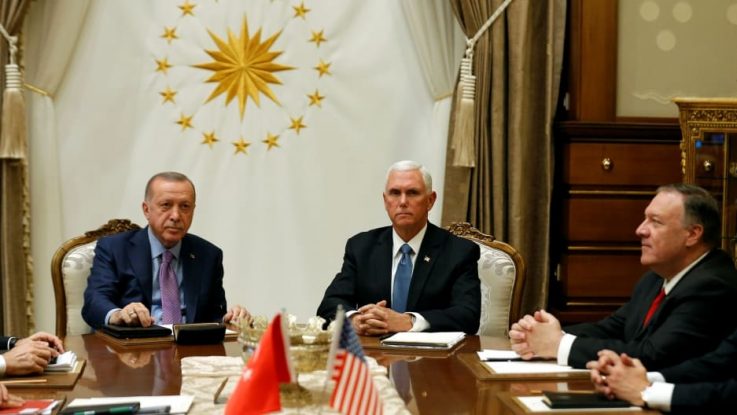
By Marko Marjanović | Anti-Empire | February 29, 2020
In the aftermath of the (probably Russian) strike that killed 33 Turkish soldiers in Syria late (10pm) Thursday Israel sent its condolences for the Turkish “martyrs”, ie using Islamic terminology:
Israel sends its condolences to Turkey over the killing of Turkish soldiers in Idlib.
“We are deeply saddened by the martyring of Turkish soldiers”
Interesting that they used “martyr” in Turkish https://t.co/X8SCOo3nWO
— Ragıp Soylu (@ragipsoylu) February 28, 2020
In fact, earlier that same day as Turkey was hitting the Syrian army heavily around Saraqib Israel snuck in two attacks on the other country:
Israeli helicopters struck Syrian military positions in the Quneitra province in the Syrian Golan Heights and wounded three Syrian soldiers, Syria’s official news agency SANA reported overnight Thursday.
Earlier Thursday, Syrian state TV reported that an Israeli drone fired a missile at a car in southern Syria, killing one person whom it named as a “civilian.” Several other media outlets aligned with Syrian President Bashar Assad’s regime said that the man was a local policeman.
Soon after Turkey expanded its Syria strikes to Hezbollah:
Turkish strikes using drones and smart missiles late on Friday that hit Hezbollah headquarters near Saraqeb killed nine of its members and wounded 30 in one of the bloodiest attacks on the Iran-backed group in Syria ever according to a commander in the regional alliance backing Damascus.
Sure the Shia Lebanese Hezbollah is fighting on the other side in Syria so hitting them would have some tactical value (at a great cost in other ways), but even at the time I wondered if that wasn’t really more a dog whistle to Tel-Aviv and the Israel supporters in DC and the US at large.
Apart from State Department apparatchiks and their hack boss Pompeo, Turkey had found itself very lonely in its new Syria adventure. The asked-for US-manned Patriot missiles to somehow wrestle the control of Idlib skies from Russia aren’t materializing.
But start hitting Hezbollah and suddenly you’ve got the attention of the powerful pro-Israel currents in the US, as well as of Israel itself.
My suspicion was confirmed Saturday when it became clear the Turks had hit Iranians as well:
Statement by Iran’s “advisory mission in Syria”: Turkish army is still shooting at our positions and bases. We call on Turkey to show rational behavior. The Turkish nation’s children are within range of our military forces.
(First statement by Iranian command in Syria, I guess)
— Reza Khaasteh (@Khaaasteh) February 29, 2020
The use of the word “children” above is a misleading translation, the Iranian communique spoke about “sons”, which naturally refers to Turkish troops.
Iranian embassy in Syria: “The Iranian government informed Erdogan that it would respond with full force to the Turkish points if it continued to bomb our forces and the Syrian army.”
— Rojava Network (@RojavaNetwork) February 29, 2020
Iran issued a warning to Erdogan to knock it off or his troops will face the consequences but you get the feeling that may be exactly what Erdogan is trying to provoke. Get the pathologically anti-Iranian Trump administration to see Turkey’s ‘safe-zone-for-bin-Ladenites’ Idlib invasion as an anti-Iranian enterprise and the prospects of American backing look quite a bit brighter.
#Turkey was informed in details of the position of Hezbollah and the Iranian brigades along with the Syrian army but decided to ignore the information and continued bombing these positions over and over again.
It is now clear that Turkey is in the battle with his army to stay.
— Elijah J. Magnier (@ejmalrai) February 29, 2020
Keep in mind that neither #Iran nor #Hezbollah ever attacked the Turkish army until this hour. It is #Turkey that took the initiative to bomb the Iranian-led forces and Hezbollah HQ and military hospital.
— Elijah J. Magnier (@ejmalrai) February 29, 2020
US Demands Russia ‘Immediately Ground Warplanes’ Over Syria
Sputnik – February 29, 2020
The situation in the northwestern Syrian renegade province of Idlib escalated again on Thursday after Syrian forces responding to a Nusra Front assault accidentally struck Turkish positions, killing 33 troops and injuring dozens more. The attack prompted the UN Security Council to call an emergency meeting on the situation in Syria.
The US “fully supports” Turkey’s right “to respond in self-defence” to the “unjustified” attacks on Turkish forces in Idlib, Syria which killed nearly three dozen troops Thursday, US Permanent Representative to the UN Kelly Craft has said.
“We call on the Russian Federation to immediately ground its warplanes. And we call for all Syrian forces and their Russian backers to withdraw to the ceasefire lines first established in 2018,” Craft said, speaking at the UN Security Council’s emergency meeting on Syria on Friday.
“The United States is not here today to listen and discuss. We are here to speak directly and without qualification,” Craft warned. “In the days ahead, the United States’ commitment to our NATO ally, Turkey, will not waver,” the ambassador added.
Calling the Astana format for Syrian peace talks “broken beyond repair,” Craft said that the US wants “an immediate, durable, and verifiable ceasefire in northwest Syria,” and urged the UN to “play a central, active role if we are to avoid even greater escalation.”
Responding to Craft, Russian Permanent Representative to the UN Vasily Nebenzya pointed out that the incident involving the deaths of Turkish military personnel took place outside Turkey’s observation post base, and stressed that Syria has the right to target terrorists. Nebenzya recalled that the Nusra terrorists in control of large swathes of Idlib have dramatically increased their attacks against civilians and the Syrian military in recent weeks, giving the Syrian Army the right to respond.
The Syrian Ambassador to the UN Bashar al-Jaafari, meanwhile, accused Turkey of aggression, and alleged that Ankara was using its observation posts to provide assistance to the terrorists. Al-Jaafari also accused the UK of calling Friday’s Security Council meeting to try to discredit the Astana format.
Black Thursday
Turkish and Syrian forces became engaged in a shooting war in the restive Idlib region earlier this month, after a Syrian artillery attack on one of Turkey’s dozen observation posts killed over half-a-dozen Turkish troops, resulting in a wave of Turkish attacks on Syrian forces. On Thursday, Nusra terrorists launched a large-scale offensive on Syrian Army positions, with Syrian forces responding, with 33 Turkish troops killed in Syria’s counterattack. Shortly thereafter, the Russian military’s Syrian monitoring mission reported that Turkish troops were mixed in among the Nusra militants as the latter came under artillery attack.
On Saturday, the Russian Foreign Ministry stated that Moscow and Ankara had committed to reducing tensions on the ground in Idlib. The same day, however, Turkish President Recep Tayyip Erdogan told reporters that he had asked Russian President Vladimir Putin to “get out of our way” and to leave Turkey “face to face” with the Syrian government.
The ‘Stolen Province’: Why Turkey Was Given A Corner Of Syria By France 80 Years Ago
Sputnik – February 29, 2020
Turkey’s President Recep Tayyip Erdogan is becoming more and more embroiled in a direct fight with Syria over Idlib Province. The fighting is directly across the border from Hatay, a province which was given to Turkey in 1939 after a disputed referendum.
Turkey has lost a total of 54 soldiers in Idlib province this month as Syria’s President Bashar Assad and his Russian allies have accused Turkey of failing to honour a deal to separate extremist groups from other fighters in the region.
The Syrian Army now controls the southern half of Idlib province but the fighting has increased the stream of refugees attempting to cross the border into the Turkish province of Hatay.
The border between Syria and Turkey is a relatively straight line from east to west until it reaches the Orontes river.
Then it suddenly dips and heads southwards for about 80 miles, before turning west again and meeting the Mediterranean just beyond Mount Kilic.
Strategically this little corner of the Levant – known as Liwa Iskanderoun to the Syrians – is vitally important to the Turkish state.
Now called Hatay province, it contains the cities of Antakya and Iskanderun – previously known as Antioch and Alexandretta – and the port of Dortyol, which was known as Chork Marzban to its Armenian population before the genocide which finally ended in 1923.
In that same year the founder of modern Turkey, Kemal Ataturk, signed the Treaty of Lausanne, which enshrined the boundaries of the Turkish state.
Those borders remain exactly the same today – except for Hatay province, which suddenly joined Turkey in 1939.
Syria, Lebanon and much of the Middle East had been part of the Ottoman Empire until it collapsed after being defeated in the First World War.
Under the Treaty of Lausanne, Hatay was part of the French mandate of Syria and Lebanon but just before the Second World War broke out, Paris suddenly decided to hold a referendum and Hatay voted to become part of Turkey.
Syria became independent in 1945 – with Lebanon as a separate state – and refused to recognise Hatay as part of Turkey.
But little was said about it until the conflict in Syria began to draw in President Erdogan and the Turkish armed forces several years ago.
Syrian media began to highlight the suspicious and controversial way Hatay, or Liwa Iskanderoun, was given to the Turks.
In the late 1930s, France was growing increasingly worried about an impending war with Hitler’s Germany and French diplomats were desperately trying to sign up potential allies in Europe and the Middle East.
Ataturk died in 1938 and his successor, Ismet Inonu, was keen to continue his Turkish nationalist fervour.
So when the French suggested a treaty of friendship during the upcoming war, Inonu was willing to accept, on one condition that Turkey recover Hatay.
France agreed, but was technically breaching the Treaty of Lausanne, so in order to give it a fig leaf of respectability, the French suggested a referendum.
Hatay was at the time a mixture of nationalities – Turks, Turkmen, Sunni Arabs, Alawites (Alevis), Armenians and even some Greeks – with no clear majority, but Ankara is widely believed to have bussed in Turks from other parts of Anatolia and rigged the result of the referendum.
Relations between Turkey and Syria were strained for decades over the issue of Hatay but they began to improve in the 1990s as Turkey sought Syrian help in combating Kurdish guerrillas.
Just before the Syrian civil war broke out in 2011, an agreement was signed to build a $28 million Syrian-Turkish Friendship Dam on the Orontes River.
But construction was postponed by the conflict and now Turkey and Syria have had a falling out, with Erdogan furious at Assad for daring to target Turkish troops even though they were siding with jihadist rebels.
Even NATO is unwilling to touch Turkey’s Idlib mess with a ten-foot pole
By Scott Ritter | RT | February 28, 2020
Having been hit by the Syrian Air Force in Idlib, Turkey has called on NATO’s protection, but as much as the alliance would like a fight with Assad and his ally Russia, it’s refused to back Ankara’s questionable adventure.
Turkey engaged NATO in Article 4 consultations, seeking help regarding the crisis in Syria. The meeting produced a statement from NATO condemning the actions of Russia and Syria and advocating for humanitarian assistance, but denying Turkey the assistance it sought.
The situation in Idlib province has reached crisis proportions. A months-long military offensive by the Syrian Army, supported by the Russian Air Force and pro-Iranian militias, had recaptured nearly one-third of the territory occupied by anti-Assad groups funded and armed by Turkey. In response, Turkish President Recep Tayyip Erdogan dispatched thousands of Turkish soldiers, backed by thousands of pieces of military equipment, including tanks and armored vehicles, into Idlib to bolster his harried allies.
The result has been a disaster for Turkey, which has lost more than 50 soldiers and had scores more wounded due to Syrian air attacks. For its part, Russia has refrained from directly engaging Turkish forces, instead turning its attention to countering Turkish-backed militants. Faced with mounting casualties, Turkey turned to NATO for assistance, invoking Article 4 of the NATO charter, which allows members to request consultations whenever, in their opinion, their territorial integrity, political independence or security is threatened.
Dangerous precedents
Among the foundational principles of the NATO alliance, most observers focus on Article 5, which declares that an attack against one member is an attack against all. However, throughout its 75-year history, Article 5 has been invoked only once – in the aftermath of 9/11 – resulting in joint air and maritime patrols, but no direct military confrontation. The wars that NATO has engaged in militarily, whether in Kosovo, Afghanistan, Libya or Iraq, have all been conducted under Article 4, when NATO made a collective decision to provide assistance in a situation that did not involve a direct military attack on one of its member states.
With that in mind, Turkey’s decision to turn to Article 4 was a serious undertaking. For additional leverage, Ankara linked the NATO talks with a separate decision to open its borders to refugees seeking asylum in Europe, abrogating an agreement that had been reached with the European Union to prevent uncontrolled migration into Europe through Turkish-controlled territory and waters. Through this humanitarian blackmail, Turkey sought to use the shared economic and political costs arising from the Syrian situation as a bargaining chip for NATO support.
A failed gamble
The best Turkey could get from its Article 4 consultation, however, was a lukewarm statement by Jens Stoltenberg, the NATO secretary general, condemning Syria and Russia while encouraging a diplomatic resolution to the fighting in Syria that focused on alleviating the unfolding humanitarian crisis regarding refugees. This is a far cry from the kind of concrete military support, such as the provision of Patriot air defense systems or NATO enforcement of a no-fly zone over Idlib, Turkey was hoping for.
The provision of military support under Article 4 is serious, involving as it does the entire weight of the NATO alliance. This was underscored by recent comments made by the Supreme Commander of Allied Forces in Europe, US General Tod Wolters, which linked NATO’s nuclear deterrence posture to current Article 4 NATO operations in Afghanistan and Iraq. At a time when NATO is focused on confronting Russia in the Baltics, opening a second front against the Russians in Syria is not something the alliance was willing to support at this time.
While the US was vocal in its desire to support Turkey at the consultations, NATO is a consensus organization, and the complexities of Turkey’s Syrian adventure, which extend beyond simple Russian involvement to include issues involving the legality of Turkey’s presence inside Syria, and the fact that many of the armed groups Turkey supports in Idlib are designated terrorist organizations, precluded a NATO decision to intervene on Turkey’s behalf. Having failed in its effort to get NATO support in Syria, Turkey is now left with the Hobson’s choice of retreating or doubling down. Neither will end well for Turkey, and both will only further exacerbate that humanitarian disaster taking place in Idlib today.
Scott Ritter is a former US Marine Corps intelligence officer. He served in the Soviet Union as an inspector implementing the INF Treaty, in General Schwarzkopf’s staff during the Gulf War, and from 1991-1998 as a UN weapons inspector. Follow him on Twitter @RealScottRitter
Turkey, Russia tiptoe toward ‘unnecessary war’
By M. K. BHADRAKUMAR | Indian Punchline | February 28, 2020
A military confrontation between Turkey and Syria has erupted in Syria’s northwestern province of Idlib. Latest reports say that at least 34 Turkish soldiers were killed on Thursday in a Syrian air attack. A Turkish retaliation commenced last night itself.
The Syrian airstrike in Idlib took place in an area between the towns Baluon and Al-Bara, and was in response to Syrian rebels backed by the Turkish military recapturing the strategic town of Saraqeb earlier on Thursday.
Earlier in the week, through the past 3-day period, Syrian forces had seized about 60 towns and villages in the southern Idlib area and the adjoining province of Hama.
The backdrop is the warning by Turkey that by the end of February, Syria should vacate the territories in Idlib captured from the terrorist groups in recent months and retreat to the ceasefire line agreed between Turkey and Russia as per the Sochi agreements of 2018, failing which it will be pushed back by force.
The denial by Kremlin spokesman Dmitry Peskov on Thursday that any meeting between President Vladimir Putin and his Turkish President was being scheduled over Idlib was a definitive signal that Moscow anticipated that a showdown with the Turkish military was imminent. Erdogan had claimed that a meeting with Putin was on cards on March 4.
Evidently, Moscow has taken note of Erdogan’s increasingly belligerent statements, especially his assertion that Turkish intervention in Idlib is in accordance with the Adana Agreement of 1998 between Ankara and Damascus on the mutual commitments regarding border security, which is of course an ingenious interpretation of the 21-year old accord that neither Russia nor Syria will accept.
The Russian line has perceptibly hardened, based on the assessment that ongoing Syrian military operations in Idlib must be taken to their logical conclusion, namely, the defeat of the al-Qaeda affiliates ensconced in the province, which is also what Damascus demands.
Turkey senses that the ongoing consultations with Russia are only providing time for Moscow and Damascus to advance their operations in Idlib.
The eruption on Thursday adds a new dimension to the military balance. Russia will back Syria. The air space over Idlib is under Russian control.
On the other hand, Turkey recently deployed anti-aircraft guns in Idlib that threaten Russian and Syrian jets supporting the ground operations.
Turkey feels emboldened by the assessment that the killing of General Qasem Soleimani in a US drone strike in Baghdad in January has thrown the Iran-backed militia groups into disarray while Syrian government forces are overstretched.
Turkey also assumes that Russian forces will not get involved in the fighting on the ground. These Turkish assumptions are going to be put to severe test in the coming days and weeks.
However, the big question is about the extent to which the US is prepared to support Turkey militarily. Washington did not accede to a recent Turkish request for deploying the Patriot missile system in Turkey as a deterrent against Russia. Will there be a rethink on this? Ankara and Washington are in constant touch with each other.
The US state department is yet to react on the clashes in Idlib on Thursday. But unnamed US officials told the Turkish news agency Anadolu, “We stand by our NATO Ally Turkey and continue to call for an immediate end to this despicable offensive by the Assad regime, Russia and Iranian-backed forces. As the President and the Secretary have said, we are looking at options on how we can best support Turkey in this crisis.”
Following the latest developments on Thursday, Turkish Foreign Minister Mevlut Cavusoglu spoke to NATO secretary-general Jens Stoltenberg over the phone. Possibly, Turkey proposes seeking NATO support / intervention. Will Turkey invoke Article 5 of the NATO Charter, which states that an attack on one member of the alliance is an attack on all of its members?
The Turkish ruling party’s spokesman has said, “We call on NATO to [start] consultations. This is not [an attack] on Turkey only, it is an attack on the international community. A common reaction is needed. The attack was also against NATO.”
However, as things stand, the probability is low, since a NATO and / or US intervention, would mean military confrontation with Russia, which neither the Trump administration nor the western alliance would want. The Russian assessment also seems to be that the West will huff and puff for a while but will eventually calm down and desist from getting entangled with Erdogan’s Syrian project.
The point is, the western world also has its grievances against Erdogan and is wary of his mercurial nature. The Trump administration has far from forgiven Erdogan’s strategic defiance to buy the S-400 AMB system from Russia.
Having said that, Turkey can always leverage the Syrian refugee flow to compel an EU intervention, especially by Germany.
The crunch time comes if a direct Turkish-Russian military conflict ensues. Of course, in such an eventuality, NATO will be hard-pressed to ignore an important member country of the alliance being at war.
Erdogan believes that he’s holding a strong hand. Russia on the other hand cannot afford a retreat in Idlib, as that could well lead to a quagmire in Syria with assorted foreign powers using the al-Qaeda groups as proxies to challenge the Russian bases.
The complex alignments bring to mind the Crimean War (1853-1856) which was also a geopolitical struggle like the Syrian conflict.
The Crimean War had its genesis in Russia pressuring the Ottomans with a view to winning control of the Black Sea so that it could gain access to the Mediterranean Sea, which in turn threatened British commercial and strategic interests in the Middle East and India and prompted France to cement an alliance with Britain and to reassert its military power.
The Crimean War was a classic example of an unnecessary conflict bearing out A.J.P. Taylor’s thesis of wars caused by blundering politicians and diplomats — where the causes are trivial but the consequences aren’t. The Jamestown Foundation, which is wired into the US intelligence and defence establishment, has a commentary titled Russia and Turkey Drift Toward War, here.
Russian missile frigates passing through Turkish straits amid Idlib escalation
RT | February 28, 2020
A pair of advanced Russian missiles frigates is passing through the Turkey-controlled straits while en-route to the Mediterranean. It comes as dilomatic tensions between Moscow and Ankara over Syria’s Idlib are not letting down.
The ‘Admiral Grigorovich’ and its sister ship ‘Admiral Makarov’ are among the more modern assets of the Russian Navy, capable of firing the advanced Kalibr-NK cruise missiles. Part of the Russian Black Sea fleet, they are currently moving to join Russia’s naval forces in the Mediterranean as part of a scheduled rotation.
“The third frigate of the class, the ‘Admiral Essen’ has been on a mission in the Mediterranean Sea since December 2019,” a spokesman for the fleet said as cited by Interfax news agency.
Their passage through the Dardanelles and the Bosphorus, the straits controlled by Turkey, comes at a period of heightened tension between the Ankara and Moscow. Turkey blames Russia’s ally Syria for the deaths of its soldiers in the Syrian Idlib Governorate. The worst incident happened on Thursday, when 33 Turkish soldiers were killed by a Syrian airstrike, according to Ankara.
Moscow says Turkey failed to report the location of its troops in Idlib and allowed them to get mingled with terrorist forces, which led to the tragic outcome. Turkish officials insist that Russia was informed about the deployment, and deny the presence of militants in the area where the strike had happened.
Moscow, for its part, has maintained that Turkey still fails to separate so-called moderate opposition from terrorists in the Idlib de-escalation zone.
Turkey has the right to deny passage through its straits to any nation’s warships if it decides its security demands it. But no reports immediately indicated that the Russian frigates would be turned back.
Erdoğan Unleashes New Migrant Crisis in Europe
By Paul Antonopoulos | February 28, 2020
At least 33 Turkish soldiers who were illegally operating in Syria’s Idlib province were killed and another 35 injured by a Syrian military attack on Thursday night. The attack came just days before Turkish President Recep Tayyip Erdoğan’s end of month deadline for the Syrian Army to forfeit the large swathes of area it has liberated from Turkish-backed jihadists and to return to positions it held at the beginning of the year. The powerful assault suggests that the Syrian Army has no intentions to withdraw from any positions it holds on its own land and is willing to engage the Turkish military, even under threat of a full-scale war.
Although Russia has denied any involvement in the attack, hundreds of Turks congregated at the Russian consulate in the middle of the night chanting “Russian Killers, Putin Killer.” Despite this, Ankara has ignored the emotions of the people and thus far has only blamed the Syrian government for the “nefarious attack against heroic soldiers in Idlib who were there to ensure our national security,” as described by Turkish director of communications Fahrettin Altun in a statement.
Of course, this is a long stretch to claim that Turkey is in Idlib to ensure natural security as they are the main backers of terrorist organizations like ISIS and the Al-Qaeda affiliated Al-Nusra and Turkistan Islamic Party. Although they claim the Kurdish People’s Protection Units are a threat to Turkey’s national security, they have no presence in Idlib, meaning the notion that Turkey’s national security is under threat in Idlib has to be rejected and rather this is part of a project for a neo-Ottoman Empire.
Although Turkish Foreign Minister Mevlüt Çavuşoğlu spoke to NATO Secretary General Jens Stoltenberg following the Syrian attack in the hope of invoking Article 5 and forcing NATO members into Erdoğan’s adventurism in Idlib, Article 6 explicitly excludes Article 5 being invoked in areas outside of NATO members territory. As Article 5 cannot be invoked, Stoltenberg made a weak condemnation against both Syria and Russia and said “defusing the tension, all sides should prevent this terrible situation and humanitarian conditions in the region from getting worse.”
Despite cold relations over the past few years, the U.S. has continued taking advantage of tense relations between Moscow and Ankara with a State Department representative saying “We stand by our NATO Ally Turkey and continue to call for an immediate end to this despicable offensive by the Assad regime, Russia, and Iranian-backed forces.” This was followed up by U.S. ambassador to NATO, Kay Bailey Hutchison, saying that Turkey should see “who is their reliable partner and who isn’t” and expressed her “hope that President Erdoğan will see that we are the ally of their past and their future and they need to drop the S-400.” Washington is taking every opportunity to firmly put Turkey back into the NATO sphere even if it is acting independent of NATO and after Ankara’s short-lived flirtation with multipolarity.
Even though Antonio Guterres, Secretary General of the United Nations, repeated his call for a ceasefire in Idlib following the attack, the Syrian Army are unlikely to halt their operation to clear the northwest province of Turkish-backed terrorist forces. Rather, as Erdoğan’s deadline approaches, the Turkish president is likely to weaponize the high casualty rate of Turkish soldiers in Idlib to justify a direct war with Syria and get the general population into an emotional frenzy, bypassing any calls for a ceasefire that will likely be rejected by Syria anyway.
Although NATO made a weak response to Turkey, the EU also responded weakly by offering condolences as Erdoğan opens his country’s borders for 72 hours, allowing tens of thousands of illegal immigrants to flood to the borders of Greece and Bulgaria, violating the 2016 EU-Turkey refugee deal. Effectively Erdoğan has once again weaponized refugees to blackmail the EU despite the latter having no involvement in Idlib. Spearheading this migrant flow into Europe in response to the Syrian attack on Turkish soldiers is the Turkish Intelligence Agency MIT who were directly transporting illegal immigrants with buses to the border regions. Erdoğan hopes that by flooding Europe with illegal immigrants it will force the EU to become more involved in Idlib against the Syrian government and Russia.
However, as many EU members are also NATO members, it is unlikely to work as frontline EU states like Greece and Bulgaria will only have more hostile relations with Turkey and are not wanting to get involved in Syria for the sake of Erdoğan’s dreams. Close ally of Erdoğan, Nationalist Movement Party (MHP) Chairman Devlet Bahçeli, and Justice and Development (AK) Party Spokesman Omer Çelik, demanded overnight that NATO become involved. But as Turkey is going to flood two NATO members with illegal migrants and violates Greek airspace on a daily basis, it is unlikely to find widespread support.
Although Washington is taking every advantage of Turkey’s spat with Russia to mend relations, it is also unlikely that the U.S. will want to risk a potential conflict with Russia over Idlib and Erdoğan, and will probably limit its support to intelligence, weapons and diplomacy if Turkey is to go to war with Syria. But what is for certain, Turkey will not find massive support for any adventurism in Syria from NATO as it hopes to achieve and rather it will make many NATO members criticize Turkey’s one-sided and aggressive policy towards Syria.
Paul Antonopoulos is a Research Fellow at the Center for Syncretic Studies.
Featured Video

U.S. General Caine Warns: STRIKING IRAN is a HUGE RISK
or go to
Aletho News Archives – Video-Images
From the Archives
Stealth Bombers and Bunker Busters
A retrospective analysis of the so-called 12-Day War, and the triumphantly celebrated Operation Midnight Thunder
By William Schryver | imetatronink | November 28, 2025
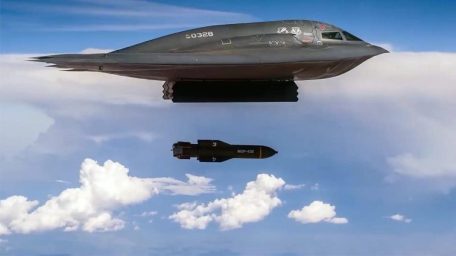
The GBU-57 is a big fat gravity bomb with fins. To achieve effective precision, a B-2 bomber must drop it on its intended target from no further than about five nautical miles — essentially right on top of the target.
Its penetration depth is claimed to be 200 feet. But that capability has NEVER been tested against a seriously hardened deep-underground target encased in layers of high-performance concrete, and topped with a few dozen meters of solid rock. In that sort of real-world scenario, the GBU-57 would be lucky to drill down 50 feet, if that.
It was always ridiculous silly talk to suggest the GBU-57 was the wonder weapon it was made out to be. There is a good reason the US only produced a couple dozen of them and then stopped: they understood its acute limitations in a non-permissive combat environment.
And, notwithstanding the hyperbolic Israeli propaganda, there was never any credible evidence that Iranian medium- and long-range air defenses against fixed-wing aircraft were attrited to any significant degree. And Iranian short-range air defenses were increasingly effective against long-range Israeli drones with each passing day.
As for the B-2: it is a big fat subsonic aircraft. It flies at airliner speeds. A strike on Fordow would entail flying at least 500 miles in and out of Iran. … continue
Blog Roll
 Aletho News
- Zelensky Refused to Discuss Druzhba Pipeline Issue – Fico
- U.S. General Caine Warns: STRIKING IRAN is a HUGE RISK /Glenn Diesen & Lt Col Daniel Davis
- Israel designates five Palestinian media outlets as ‘terrorist organizations’
- Israel, not America, first: Carlson’s Huckabee interview lays bare US foreign policy priorities
- Israeli troops executed Palestinian aid workers at ‘point blank range’: Report
- Iran war What if today’s Iran is resigned to a long, hellish war with the US?
- Why Israel Is Escalating Its War Crimes Against Lebanon
- Iran in the face of the armed diplomacy of imperialism
- The US build-up around Iran constitutes strategic war option, not ‘deterrence’
- Iran to US: Sanctions and war failed; try diplomacy and respect
- If Americans Knew
- Footage Shows Israeli Troops Waiting in Ambush, Then Opening Fire on a Palestinian Teen
- The US is on the brink of a major new war that Trump has not even bothered explaining
- Latest Epstein document dump is one more cover-up
- No Protection, No Justice: US Citizens Killed with Impunity by Israel
- Maria Farmer: Epstein Victim Reveals Explosive Information Covered Up by Media
- Average of five Palestinians killed by Israel every day in Gaza since ceasefire – Not a ceasefire Day 136
- Palestinian church leaders admonish Christian Zionist Mike Huckabee – Not a ceasefire Day 135
- Ominous messaging from Trump’s “Board of Peace” – Not a ceasefire Day 134
- ‘Christians Out’: Jerusalem Church Tagged With Hate Graffiti, Police Investigating
- Israeli Settlers Kill American Teen
- No Tricks Zone
- New Research Reaffirms Clouds, Aerosols, And Surface Solar Radiation Are ‘Driving The Climate System’
- Germany: Electric Car Catches Fire At Charging Station, Sets Off Local “Inferno”, Widespread Damage
- New Study: Canada’s New Brunswick Was 1°C Warmer Than Today During The Medieval Warm Period
- Coal Power Back In Trend As Globe Tries To Keep Pace With Growing Demand For Power
- New Study: A 4°C Warmer Beaufort Sea Had ‘No Sea Ice’ 11,700 – 8200 Years Ago
- Unfudging The Data: Dutch Meteorological Institute Reinstates Early 20th Centruy Heat Waves It Had Erased Earlier
- German Gas Crisis…Chancellor Merz Allegedly Bans Gas Debate Ahead of Elections!
- Pollen Reconstructions Show The Last Glacial’s Warming Events Were Global, 10x Greater Than Modern
- Germany’s Natural Gas Storage Level Dwindles To Just 28%… Increasingly Critical
- New Study Rebuts The Assumption That Anthropogenic CO2 Molecules Have ‘Special’ Properties
 Aletho News