Whither Afghanistan? Getting Out Is Harder Than Getting In
By Philip Giraldi | Strategic Culture Foundation | July 22, 2021
The inability of the United States to comprehend what it was becoming involved in when, in the wake of 9/11, it declared a Global War on Terror, has to be reckoned one of the singular failures of national security policy over the past twenty years. Not only did the wars in Afghanistan and Iraq make bad situations worse, but the fact that no one is Washington was able to define “victory” and think in terms of an exit strategy has meant that the wars and instability are still with us. In their wake has been hundreds of thousands of deaths and trillions of dollars spent to accomplish absolutely nothing.
As a result, Iraq is unstable and leans more heavily towards America’s adversary Iran than it does to Washington. The Iraqi Parliament has, in fact, asked U.S. forces to leave the country, a request that has been ignored both by Donald Trump and Joe Biden. Trump actually threatened to freeze Iraqi bank assets to pressure the Iraqis into accepting the continued U.S. occupation. At the same time, American troops illegally present in neighboring Syria, continue to occupy that country’s oil fields to deprive the government in Damascus of much needed resources. Neither Iraq nor Syria threatens the United States in any way.
Given that history, it should be no surprise that the withdrawal from the twenty year-long nation building project in Afghanistan, long overdue, is not quite going as smoothly as the Pentagon and White House apparently planned. U.S. forces pulled out of their principal base in the country, Bagram Air Base, in the middle of the night without informing the incoming Afghan base commander. A frenzy of looting of the left behind equipment followed.
The Taliban are racking up victory after victory against U.S. and NATO trained Afghan government forces who have the disadvantage of having to defend everywhere, making them vulnerable to attacks on an opportunity basis. The Taliban now plausibly claim to control 85% of the countryside, to include crossing points into Pakistan and several important towns and provinces. They recently shocked observers by executing 22 Afghan Army commandos who had run out of ammunition and surrendered. The U.S. government is quietly expecting a similar fate for the thousands of Afghans who collaborated with the regime installed by Washington and is hurriedly arranging for visas to get the most vulnerable out, eventually seeking to resettle them in friendly Middle Eastern countries as well as in the U.S..
By one estimate as many as 18,000 Afghans worked for U.S. forces and they also have families that will have to go with them. There is particular concern that former interpreters, who would have been privy to decision making by Washington, will be most particularly targeted. The Biden White House has responded finally to the urgency of the issue – lives are at stake – by approving special flights to remove the most vulnerable to a third country for processing before determining if they can be allowed to take up residence in the United States or elsewhere.
To be sure, the struggle to rid the world of the wrong kind of terrorists has left the United States weaker and more unfocused than it was in 2001. China, Russia and Iran are already maneuvering to fill the impending power vacuum in Central Asia by coming to terms with the likely Taliban takeover, which might come sooner than Joe Biden expects. If some kind of Afghan coalition government does emerge, it will belong to Russia and China, not the U.S..
Meanwhile, the U.S. military itself, under the Biden Administration, is weaker and more riven by controversy than ever before. A recent 23-page report suggests that since Defense Secretary Lloyd Austin’s February order to “stand down” the entire U.S. military for commanders to address “extremism” in its ranks morale has sunk and many top soldiers have either retired or quit in disgust. During his confirmation hearings, Austin pledged that he would “rid our ranks of racists and extremists” but the reality is quite different, with the witch hunt in the ranks and endless promotion of diversity even hurting normal military readiness training.
By next month the U.S. military presence in Afghanistan will be reduced to a battalion of infantry to guard the Embassy and CIA station in Kabul, which is itself not sustainable unless some kind of workable Afghan government coalition can be achieved. Given the recent Taliban successes, that outcome appears to be increasingly unlikely. Maintaining the Embassy will also require a viable lifeline to the city’s airport and talks are underway with Turkey to determine if Ankara will be willing to base a stay behind battalion to maintain the air link. The Taliban have already announced that a Turkish presence at the airport will be unacceptable and warned Turkey that there would be revenge attacks against any remaining NATO troops after the U.S. pulls out. Their spokesman issued a statement declaring that “The continuation of Turkey’s occupation will provoke feelings of hatred and enmity in our country towards Turkish officials, and will harm bilateral relations.”
The U.S. is also seeking an over the horizon offensive capability once the military has formally left Afghanistan. The intention would be to be able to strike targets in Afghanistan if a new government forms any alliances with terrorist groups that potentially threaten the United States, as unlikely as that might be. At the present time, there are few options as the U.S. would not be able to launch cruise missile or airstrikes through the neighboring countries that surround Afghanistan to the south, east and west, though a long-distance strike from warships in the Persian Gulf is technically possible.
To the north there are, however, former Soviet central Asian states, the so-called “‘Stans,” that might be suitable for hosting some arrangement to base American equipment, aircraft and a caretaker force. Tajikistan, Kazakhstan, or Uzbekistan might be amenable to such a development, but both Tajikistan and Kazakhstan are members of the Russian-led Collective Security Treaty Organization (CSTO). On Monday, Russian Foreign Minister Sergey Lavrov said that any U.S. presence in a CSTO country would need the approval of the alliance, which the Kremlin will veto. One might suggest that there is mistrust about the reliability of Joe Biden and company as a strategic partner, even though there is widespread concern that Afghanistan might become a rogue state. Nevertheless, Washington’s bullying in Iraq, Syria and also against Iran has failed to convince anyone that the U.S. Air Force would make a good neighbor.
So getting out of Afghanistan will be a lot trickier than going in. The U.S. clearly wants to have some ability to intervene using air resources if the Taliban take over and misbehave, but that just might be a fantasy as the door is closing on options while China is waiting for its own door to open to bring the Afghans into their New Silk Road. And there is no escaping the fact that the entire Afghan adventure was one hell of a waste of lives and resources. Next time, maybe Washington will hesitate to charge in, but given the lack of any deep thinking going on in the White House, I suspect we Americans could easily find ourselves in yet another Afghanistan.
Russia’s about-face on Syria’s Idlib is the opening gambit of a larger diplomatic chess game
By Scott Ritter | RT | July 17, 2021
The Russian vote at the UN Security Council in favor of extending a humanitarian air corridor into Syria has been touted by the US government as a victory of American diplomacy. Moscow might have other ideas.
In a rare display of diplomatic cooperation, the US and Russia agreed last week on a one-year extension of the UN Security Council authorization for humanitarian aid supplies to reach northern Syria through the Bab al-Hawa crossing on the border with Turkey.
The Biden administration had made the extension of this authorization its highest priority when it came to US-Syrian policy. For its part, Russia had long been hesitant to allow such an extension, insisting it should be replaced by cross-line humanitarian deliveries.
It’s been alleged that the Bab al-Hawa crossing point was being used to resupply Islamic militant groups opposed to the Syrian government of President Bashar Assad that are operating inside Idlib province, which borders Turkey.
Russia’s vote in favor of the extension for up to 12 months took many observers by surprise, given Moscow’s past objections.
The US media called it a victory for the Biden administration, underscoring the importance of the June summit meeting between the US president and his Russian counterpart, Vladimir Putin, in Geneva, Switzerland. The US made Syria, and in particular the issue of continued access by humanitarian organizations to refugee camps located in Idlib, a high priority at that meeting. The fact that Moscow and Washington have reached a compromise on the operation of the Bab al-Hawa crossing, from the perspective of Russia, was a clear sign regarding the efficacy of the Geneva process.
“We hope that it might be a turning point that is indeed in line with what Putin and Biden discussed in Geneva,” Russia’s UN Ambassador Vassily Nebenzia told reporters after the vote.
The situation, however, is far more complicated than the zero-sum diplomatic game being promoted in the US mainstream media. Idlib isn’t just a repository of internal refugees from the decade-long civil conflict that has wracked Syria since 2011 – it is the final redoubt of foreign-backed Islamic militants who have been waging a bloody fight against the Russian-backed Syrian government. The Islamic militant groups, many of which are allied with Al-Qaeda, once controlled much of the Syrian countryside and were operating in the suburbs of the Syrian capital of Damascus.
The decision by the Russian government to intervene militarily on the side of Assad in September 2015 helped turn the tide against the Islamic militant forces. Over the course of the next three years, the Syrian army, backed on the ground by Hezbollah and pro-Iranian militias, and in the air by the Russian Air Force, was able to recapture all of the militant-held territory save for the last remaining bastion in Idlib.
The situation inside Idlib is complex, with the various factions among the Islamic militants fighting among themselves to establish primacy. Many of these groups, including Al-Qaeda affiliate Hayat Tahrir al-Sham (HTS), are reportedly reliant upon foreign support for their survival and have been linked to both Turkey and the US in terms of serving as an anti-Assad proxy force. Recent claims by the exiled Turkish mafia leader Sedat Peker regarding the alleged shipment of “billions of dollars” worth of military equipment disguised as humanitarian aid to HTS and other anti-Assad groups operating inside Idlib only reinforced the concerns of the opponents to keeping the Bab al-Hawa crossing open.
There is a real humanitarian crisis ongoing inside Idlib, where millions of Syrian citizens remain housed in refugee camps that are little more than tent cities erected in open fields. The refugees are totally dependent upon international aid groups for the essentials of life, including food, water, shelter and medicine. With the restoration of central government control over much of Syria, however, and the willingness on the part of the Syrian government to resettle these refugees back in their original homes without any threat of retribution or retaliation, there is a growing sentiment among the Russian and Syrian government that the refugees have become little more than political pawns used by Syria’s many enemies, including Turkey and the US, to create the perception of a despotic regime while fostering continued instability inside Idlib that serves as an engine to motivate and recruit new anti-Assad fighters.
This reality served as the core argument underpinning the Russian objection to keeping the Bab al-Hawa crossing open. There is another reality, however, which also guided the Russian decision, namely the lack of a viable military solution to the problem of Idlib. Russia and the Syrian government are committed to a course of action that has the Syrian government asserting control over the totality of Syrian sovereign territory – including Idlib.
While Russia and Syria continue to conduct airstrikes against Islamic militant positions inside Idlib, and the Syrian army and its allies likewise exert pressure on Islamic militant forces on the ground, the feeling in both Moscow and Damascus is that the problem of Idlib cannot be resolved through force of arms unless one is willing to unleash a bloodbath that would cause more problems than it would solve.
The key to a solution in Idlib is for both Turkey and the US to recognize the futility of continuing to use it as a base of anti-Assad activity, and to finally give up on their dreams of regime change in Damascus. Such a policy change, however, will not happen overnight and will require considerable diplomatic cooperation on the part of all parties involved – including Russia. The Russian agreement to keep the Bab al-Hawa crossing open for another year, when seen in this light, represents the opening round of a lengthy diplomatic battle over the future of Idlib, Syria and the Middle East as a whole.
Scott Ritter is a former US Marine Corps intelligence officer and author of ‘SCORPION KING: America’s Suicidal Embrace of Nuclear Weapons from FDR to Trump.’ He served in the Soviet Union as an inspector implementing the INF Treaty, in General Schwarzkopf’s staff during the Gulf War, and from 1991-1998 as a UN weapons inspector.
US neocons Bolton & PNAC lay down weapons of war for protest signs with their new ‘Turkish Democracy Project’
By Helen Buyniski | RT | July 5, 2021
The aging neocons who have been practicing regime change ops in the Middle East for decades are now launching a project targeting Turkey – perhaps in honor of the deceased Don Rumsfeld.
Erdogan’s Turkey has long been something of a thorn in Washington’s paw, given its ongoing refusal to buy inferior US military equipment (it was booted from the US’ F-35 program for insisting on buying Russian S-400 missiles, making the Americans who still store their nukes at Incirlik somewhat nervous), its refusal to place the good of Israel above its own benefit, and its rumblings of discontent regarding the US’ pleas for support (or at least safe passage) to its Syrian ‘moderate rebel’ militant groups, which Ankara considers to be little more than terrorists.
Under the government of President Recep Tayyip Erdogan, Turkey has become quite recalcitrant indeed, far from the ideal domesticated state keen to babysit American nukes and stage American missiles in exchange for coveted membership in the deteriorating NATO structure (not long ago fetchingly described by French President Emmanuel Macron as “brain dead”). Clearly what it needs is a shot in the bottom from that great big needle marked ‘Democracy’ – and who better to deliver that than the good old boys from the Project for a New American Century, many of them the old same men who led and lied the US, blindfolded, into the chaos of Iraq.
Enter the Turkish Democracy Project, a non-profit organization which – it should be clear from the name – has nothing to do with democracy or, really, Turkishness. The group’s website is about as subtle as a nuclear bomb, blaming President Recep Tayyip Erdogan for “dramatically alter[ing] Turkey’s position in the international community and its status as a free and liberal democracy” and calling for “a nonprofit, non-partisan, international policy organization that opposes its destabilizing behavior, supports genuine democratic reform, and holds the forces of corruption and oppression within Turkey to account.” In other words: “We want a piece of your country. Resist and be annihilated.”
It’s not that the US thinks Turkey is stupid. But they believe, and are likely correct, that the US will never have as good a time as now to strike. With its military still feared by many parts of the world (even though its bark is at this point far worse than its bite, and its image still suitably ferocious to put much of the actual war-fighting business to fleeing instead of fighting), the main business must be – if the US expects to do something other than flee home with its tail between its legs – “shock and awe.”
But given that these shock and awe tactics will be taking place in the Middle East, an area which has seen the worst the US can throw at its enemies over the last 20 years of perpetual warfare and realizes all the money in the world can’t give even the largest military on Earth the stamina of the gods, it’s likely these dyed-in-the-wool bloodshed-artists will have to change with the times. To invade a militarily competent nation like Turkey – especially one which, inconveniently, happens to be backed by NATO – is unlikely to be a walk in the park, no matter how many phony war crimes the PNAC crew manage to cook up. Gas attacks have become cliche, and any talk of “weapons of mass destruction” will elicit a chortle at best.
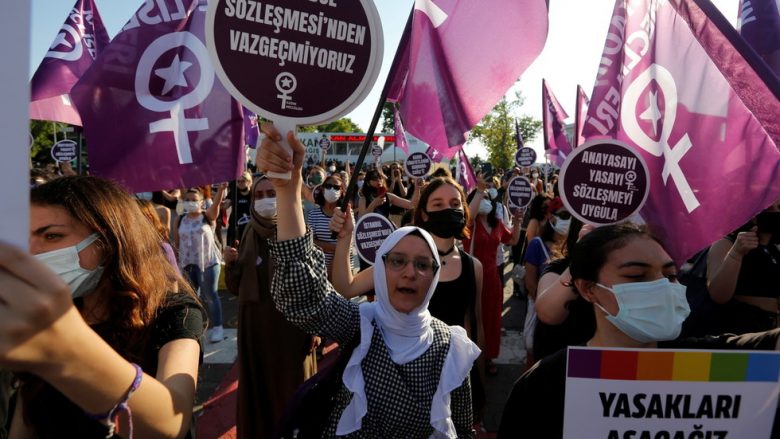
So the TDS, if recent events are any indication, has instead gotten to work with the kind of color revolution-style events that have largely replaced shock and awe in other regime-change hotspots. They’re cheap, they’re easy, and in this case – a protest in Istanbul against Turkey’s withdrawal from the Istanbul Convention? – they require exactly zero imagination. It’s much easier to con the rest of NATO if you don’t have to make them think.
Thousands of activists took to the streets on Thursday, either on their own or hailing from various NGOs, denouncing Turkey’s withdrawal from the European human rights treaty known as the Istanbul Convention. Erdogan’s executive order removing Turkey from the treaty, first adopted back in March, argued the country’s women are protected by domestic laws rather than the international human rights treaty – which he argued had been “hijacked” by the LGBTQ+ community.
The hoary old PNAC boys behind the TDS likely couldn’t believe their luck when something like this fell into their lap. But will they be able to modernize?
The group’s CEO is Mark Wallace, who’s also the CEO of United Against Nuclear Iran – another unsubtly named regime-change operation (and a regime change that has failed repeatedly). An old hand at overthrowing Middle Eastern nations the old-fashioned way, Wallace held several positions with the George W. Bush administration while the nation was attempting to crush Iraq (apparently shocked the children had run forward with IEDs instead of handfuls of wildflowers to welcome their new rulers).
Indeed, numerous fellow veterans of the Iraq regime change effort and abortive attempts to overthrow Iran have bubbled up in the swamp gas to give regime change in Turkey a go. Wallace is joined by other bottom-feeders like former Connecticut senator Joe Lieberman and UANI intel chief Norman Roule, as well as glorified mustache-carrier, would-be thug, and former Trump national security adviser John Bolton. Former Bush adviser Frances Townsend is there, as is former associate deputy director of operations for the CIA (and Blackwater vet) Robert Richer. At least a few members of the shadowy pro-Israel Foundation for the Defense of Democracies were listed and then memory-holed, and Bush’s brother Jeb is there, a speech bubble forever hovering above his head reading “please clap.”
Oddly enough, however, the only currently listed actual employee aside from CEO Wallace is a (presumably) former assistant English professor at Princeton University. No, that’s not suspicious at all. Carry on, I’m sure Turkey will welcome you (and your desired partitioning of the country) with open arms!
With Erdogan still trustingly paying his country’s NATO dues, Ankara is unlikely to expect any sort of real attack, though the leader is likely on guard, given former President Trump’s on-again, off-again announcement to clear out US soldiers from Syria. He is likely to be on the lookout for foreign meddlers among the protesters, however. And Erdogan’s allies with their ears to the ground both inside and outside Turkey have already pegged this absurd attempt at bringing back ‘democracy’ for what it really is. While some have linked it to the infamous Gulen movement, referring to the cleric who most recently was accused of trying to overthrow Erdogan in 2016, Gulen’s movement itself seems to have ties to the same ‘Greater Israel’ plan to redraw the lines on the map of the Middle East, a plan Israeli military strategist Oded Yinon devised decades ago (and which the neocons appear to have used as their foreign policy guide ever since). Former Turkish opposition lawmaker Aykan Erdemir, senior director for Turkey at the FDD, was accused of being connected to Gulen in 2017 and had his assets seized, strengthening the case for the connection between Gulen’s organization and the notoriously pro-Israel FDD.
But with all of NATO’s heads turned to this human rights drama, surely the other countries in the alliance also participating in the drawing-and-quartering of Syria won’t expect a military attack on Turkey as well – not without some warning. The map of Greater Israel shows Turkey losing a mere corner of their land compared to Syria, which takes quite a beating – one which Turkey clearly expects to be a part of, having already staked its claim effectively to certain border regions of Syria under the logic of keeping the Kurdistan Workers’ Party (PKK) away. But this is all temporary, and eventually the region must settle into its new form. An Israel-first arrangement will not go down well with any of the other combatants, and, unlike the US and its European partners, Turkey won’t just sit on its hands and sigh wistfully while its share of the Syrian pie is handed to the US by way of Tel Aviv.
Because that’s who the ultimate beneficiary of this mess is supposed to be. Named after the Israeli military strategist who devised it, the Yinon project hopes to balkanize the Middle East and assemble the shards into a single nation consisting of the choicest morsels of those countries in between the Euphrates and the Nile rivers. Iraq has already been cut in half, Syria has shrunk dramatically even as the war goes on, and Egypt is run by a pliant leader who will do what the US and Israel tell him – as General Wesley Clark said over a decade ago, the plan was to take out seven countries in five years. They’re running a bit behind, but never underestimate the abilities of a bunch of old war criminals with nothing to lose.
Helen Buyniski is an American journalist and political commentator at RT. Follow her on Telegram.
The Istanbul Canal opens the path for further NATO pressure against Russia
By Paul Antonopoulos | July 2, 2021
A new mega-project has been launched – the Istanbul Canal, connecting the Marmara and Black Seas. It will be an alternative to the Bosporus Strait, and thus challenges the Montreux Treaty and opens the path for further NATO pressure against Russia.
However, there is major opposition to the project, not only from local environmentalists who fear that harm will outweigh the benefits and local economists who do not see the feasibility of the project, but also foreign states. Regional countries are concerned that the 1936 Montreux Convention Regarding the Regime of the Straits and Turkey’s compliance with its obligations in the Black Sea will be undermined.
“Today we are opening a new page for Turkey’s development, laying the first stone by building a bridge over the Istanbul Canal,” said Turkish President Recep Tayyip Erdoğan at the bridge ground-breaking ceremony on June 26. “We see Canal Istanbul as a project to save the future of Istanbul … to ensure the safety of life and property of Istanbul’s Bosporus and the citizens around it.”
Erdoğan ensured that all the necessary studies, including the impact of construction on the environment, have already been carried out. Along with the canal, that Erdoğan admitted was a “crazy project,” there will be residential quarters, parks, tourist facilities and a technology development zone.
The Turkish president justified his “crazy project” because, as he claimed, “every year, 45,000 ships sail across the Bosporus. Every big ship poses a risk. They carry different cargoes, any accident will be a threat, which could lead to fires and destruction, including cultural property.”
It is planned to take six years and $15 billion, but the real figure was estimated at a recent developer’s conference in France to be $65 billion. It is the largest infrastructure initiative in Turkish history and is meant to be a part of Erdoğan’s legacy.
Istanbul Mayor Ekrem İmamoğlu has spoken out against the project and even called for a referendum. Environmentalists are worried that the Black Sea could become shallow and the Marmara Sea ecosystem disrupted. More importantly from a local perspective, Istanbul’s water supply is also under threat as the canal will absorb freshwater supplies.
However, the biggest issue surrounding the canal from an international perspective is the fate of the Montreux Treaty governing movements between the Black Sea via the Bosporus and Dardanelle Straits. According to the treaty, there is free movement for merchant shipping and Turkey cannot charge a toll. Turkey does control the movement of non-Black Sea warships though. According to the treaty, non-Black Sea warships cannot stay in the Black Sea for more than three weeks, and their total tonnage should not exceed 45,000 tons.
In April, admirals and former admirals of the Turkish Navy were arrested after writing an open letter urging the Turkish president to not go ahead with his “crazy project,” fearing how it would impact the Montreux Treaty. Erdoğan quickly assured that the treaty will remain valid, but fears remain that the Istanbul Canal will allow Ankara to bypass its positions, especially as Turkey is a serial violator of treaties, such as the Lausanne Treaty.
Turkey says that the project is not related to the treaty and does not comply with it in principle because the construction is artificial. The Istanbul canal is a completely different channel that may become an issue for the Montreux Treaty in the future. Black Sea countries are opposed to the canal, with the exception of Ukraine and Georgia. These two countries would actually like an increase in NATO participation in the Black Sea.
At the same time, Romania, Bulgaria and Greece object to any changes to the Montreux Treaty. Although Greece is not a Black Sea state, it is located at the mouth of the Dardanelle Strait. However, the three countries are NATO members and the country that would be most affected by any change in the treaty or status quo is Russia, especially in light of last week’s provocation by Britain near Crimea. Moscow does not want non-Black Sea countries, especially NATO members, to circumvent the treaty and increase the presence of their naval forces – but Turkey will open a path towards this with the opening of the canal. The U.S., Britain, and other leading NATO believe the Montreux Treaty is outdated as it restricts the number of ships in the Black Sea in their effort to maintain pressure against Russia.
Turkish Foreign Minister Mevlüt Çavuşoğlu said on Wednesday at a joint press conference with his Russian counterpart Sergey Lavrov that there will be no changes to the Montreux Treaty. However, it is of course easy to make such a claim before construction has ended. Turkey is quite capable of resorting to manipulation as the status of the new channel has not yet been indicated. The very fact of the debate shows that Ankara aims to become a more significant player, not only in the region but also on the world stage.
Paul Antonopoulos is an independent geopolitical analyst.
Russian forces block US military patrol in northeast Syria
Press TV – June 22, 2021
Russian forces have blocked an American military convoy, comprising four armored vehicles, in Syria’s northeastern Hasakah province.
Russia’s RT television network reported on Monday that Russian personnel had stopped the US military patrol along the M4 highway, some 10 kilometers west of the town of Tall Tamr.
Informed sources said the US convoy was forced to return because it had violated security protocols between Moscow and Washington.
Russia said the US had not given prior notice regarding its troops’ movements in Hasakah.
Hasakah is occupied by American soldiers and the so-called Syrian Democratic Forces (SDF), a US-backed anti-Damascus alliance of mainly Kurdish militants. Turkey also controls areas in the province and elsewhere following military operations in northern Syria.
Russia has been helping Syrian forces in ongoing battles across the conflict-plagued state, mainly providing aerial support to ground operations against foreign-backed terrorists.
The Russian military assistance, which began in September 2015 at the request of the Damascus government, has proved effective as Syrians continue to recapture key areas from Takfiri elements.
However, the United States has deployed forces and military equipment in Syria without any authorization from Damascus or the UN.
It has long been training militants and stealing Syria’s oil, ignoring repeated calls by Damascus to end its occupation of the country.
Russia: US exacerbated humanitarian situation in Syria
In another development on Monday, Russian Foreign Minister Sergei Lavrov complained that the humanitarian situation in Syria has been aggravated by the US through its illegal sanctions and occupation of the eastern bank of the Euphrates River.
“They are looting hydrocarbons and other mineral resources, and use the money they earn on that to finance projects that are seen by many as encouraging separatism and provoking dissolution of the Syrian state,” he said after talks with Helga Schmid, the secretary general of the Organization for Security and Cooperation in Europe (OSCE).
He also warned against attempts by the United States and some European countries to hamper the return of Syrian refugees, noting that the Western assistance goes to camps in Jordan, Turkey and Lebanon so as “to make the refugees stay there as long as possible.”
Lavrov further expressed Moscow’s readiness to discuss the humanitarian situation in Syria with the Western states if they recognize their responsibility in this regard.
“If the set of these factors is recognized as impacting the humanitarian situation in Syria, we are ready to discuss that as a whole. But our Western partners should categorically refuse from one-sided interpretations of these or those problems, and recognize their responsibility for the general situation in Syria’s humanitarian sphere,” he said.
Biden agreed to Turkey defending Kabul airport, says US official
MEMO | June 18, 2021
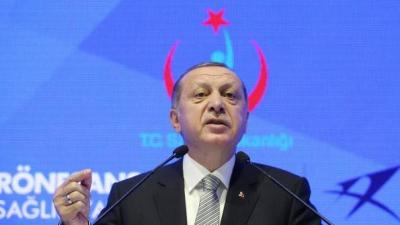
US President Joe Biden and Turkish President Recep Tayyip Erdogan have agreed on Turkey’s offer to take a leading role in the defence of Afghanistan’s Kabul Airport, the US National Security Advisor has revealed.
Speaking to reporters yesterday, Jake Sullivan said that the two leaders discussed the situation in Afghanistan during their meeting on the sidelines of the NATO summit on Monday. According to Sullivan, Erdogan sought certain unspecified US assistance for Turkey in return for the deployment of Turkish troops at the airport following the withdrawal of US and NATO forces from the country. Biden apparently accepted this.
“The clear commitment from the leaders was established that Turkey would play a lead role in securing Hamid Karzai International Airport,” explained Sullivan. “And we are now working through how to execute to get to that.”
The security of the airport in Kabul is seen as vital for the operation and continuation of diplomatic missions to Afghanistan. It would serve as the safest exit point for diplomats in the event of a potential security breakdown in the country, such as the Taliban’s defeat of Afghan government forces.
Last week, however, the Taliban also warned Turkey to withdraw its troops and said that its military presence at the airport would not be welcome. “Obviously we take seriously the concern that the Taliban or other elements in Afghanistan will attack the Western or the international presence,” said Sullivan. “We do not believe that what the Taliban has said publicly should or will deter the efforts underway right now to establish that security presence.”
The agreement between Ankara and Washington comes after years of strained relations between the two over a myriad of issues. A primary dispute remains Turkey’s purchase of the Russian S-400 air defence system, which the US and other NATO members condemned due to the system’s potential breach of the alliance’s security.
Sullivan addressed that issue, revealing that there was no progress and the two leaders maintained their respective positions. “They discussed it. There was not a resolution of the issue. There was a commitment to continue the dialogue on the S-400 and the two teams will be following up on that coming out of the meeting.”
The only Turkish boots on the ground in Palestine are on Israeli soldiers’ feet
By Omar Ahmed | MEMO | June 14, 2021
When last month’s ceasefire was agreed between Israel and Palestinian resistance factions in Gaza, the head of the Hamas political bureau, Ismail Haniyeh, thanked Iran for its support. “The Islamic Republic of Iran did not hold back with money, weapons, and technical support,” he said. Haniyeh also thanked Qatar for its pledge to rebuild Gaza after the latest devastating military offensive by Israel, which lasted eleven days and nights last month.
Similar sentiments were conveyed by the leader of Hamas in Gaza, Yahya Sinwar. “All our thanks go to the Islamic Republic of Iran for its consistent support over the years to Hamas and other resistance factions,” he explained. He also briefly recognised support from Qatar, Turkey, and Kuwait.
Apart from Sinwar’s passing reference to Turkey, expressions of gratitude to Ankara were noticeable by their absence. This was despite the frequent pro-Palestinian rhetoric and denunciations of Israel by President Recep Tayyip Erdogan. The last time that Haniyeh thanked Turkey publically was back in 2016 over its aid efforts in Gaza.
It was clear that, after the latest onslaught on the Palestinian people, the resistance chose to recognise Iran’s help where it matters most, in the field with the armed resistance and, to a lesser extent, Qatar’s assistance for the reconstruction of Gaza.
Why has Turkey been left out, despite being a friend of Palestine? It could be something to do with the uncomfortable truth that despite Ankara’s stance towards Palestinian national liberation, it maintains important diplomatic and trade ties with Israel. The Palestinian factions know this very well. National liberation, as I have written before, will ultimately rest on a military solution, which is why Iranian support has been singularly recognised by the factions.
The status quo of the secular Turkish republic is one that is supportive of Israel. It was the first Muslim-majority country to recognise the statehood of Israel a year after its creation in occupied Palestine in 1948. The rise of Erdogan and the Justice and Development Party (AK Party) over the past two decades has, admittedly, coincided with diplomatic tensions between Ankara and Tel Aviv, especially after the Gaza flotilla attack in 2010.
While political ties have unquestionably deteriorated over the years and reached a new low with Israel’s desecration of Al-Aqsa Mosque last month, business ties haven’t. According to the Turkey-based, pro-Kurdish news agency Mezopotamya Ajansi, “When the AK Party came to power, the trade volume between Israel and Turkey was 1.4 billion dollars, today it is 6.5 billion dollars.”
The report cites data from the Turkish Statistical Institute (TUIK) and says that Israel was ranked as the third-highest importer of Turkish goods last year, for a total value of $4.7 billion.
Political ties between the two countries are served by their respective embassies, which remain open. Turkey appointed a new ambassador to Israel after the downgrade in ties and withdrawal of its envoy in 2018 in protest of the deadly attacks on Gaza that year. At the end of last year, Erdogan said that Turkey would like better relations with Israel but claimed that Palestine is the “red line”. The latest and ongoing aggression, however, suggests that this is not the case.
An interesting development last month, though, was the Turkish proposal to establish an international force to protect Palestinians from future Israeli attacks. This was followed by the signing of a security agreement between Turkey and the Palestinian Authority earlier this month, modelled on a similar pact made with Libya’s Government of National Accord (GNA). Some have questioned what support Turkey can offer the Palestinian people beyond charitable donations, and to what extent such a hypothetical international force could really protect them. Hence, it remains to be seen if and how this security agreement will be implemented.
What is clear, is that Turkey won’t risk political, military, and economic consequences in any moves that directly affect the security of Israel. Iran knows only too well that its flagrant support of non-state actors opposed to Israeli and Western interests comes at a hefty price in terms of sanctions and attempts to isolate it. Faced with its own economic problems, Turkey will be reluctant to go down such a lonely route, even if both regional powers are arguably supporting Palestine out of ulterior motives.
In any case, the trade will continue as usual, and the only Turkish boots on the ground in occupied Palestine will be worn by Israeli soldiers. As media outlets in Turkey have reported in the past, Turkish-made military boots have been supplied to the Israeli army: “YDS is a leading supplier of boots, assault vests, and bags to armies across the world. Israeli soldiers are among those who use Yakupoğlu garments.” Tension between Israel and Turkey, said one CEO, does not affect business.
The next Palestinian uprising will inevitably involve more support from Iran, and only Arab states and non-state groups aligned with Tehran are vehemently opposed to the occupation state. Reinforcing this, Haniyeh is reportedly planning visits to both Iran and Lebanon, which will include meetings with Supreme Leader Ayatollah Sayyid Ali Khamenei in Tehran and Hezbollah’s Secretary-General, Sayyid Hassan Nasrallah in Beirut. He is expected to travel after his meetings in Cairo over stalled prisoner exchange negotiations with Israel, owing to the latter’s political uncertainty. With a new Israeli government now in place, though, that may change.
Report on Turkey smuggling weapons to Al-Qaeda in Syria shows why Russia’s desire to halt ‘aid’ was right
By Eva Bartlett | RT | June 4, 2021
New allegations that aid trucks to Syria from Turkey carried weapons for terrorists have surfaced. But it’s unlikely to convince those in the West to change their tune that Russia was wrong to want border crossings closed.
In July 2020, there were those who self-righteously railed at Russia for allegedly denying humanitarian aid to Syrians. They screamed that in calling for crossings to be closed, Russia was attempting to starve and choke civilians in need of assistance.
The Russian mission to the UN, however, maintains that ample aid is delivered from within Syria, via various agencies, including the UN. It argues that delivering aid from outside of Syria is no longer necessary, since most of the country has returned to peace and security. I haven’t come across a Russian representative who has stated so, but wonder if another reason Russia wanted cross-border ‘aid’ from Turkey halted was because it knew weapons were being smuggled to terrorists in Syria?
On May 30, Sedat Peker, a Turkish mobster and former ally to Turkish President Recep Erdogan, published a new video in a series he has been releasing on criminal activities among Erdogan’s inner circle. In this latest video, Peker spoke of the weapons and vehicles sent to Al-Qaeda in Syria, and that the contractor behind these shipments was a company called SADAT, run by Erdogan’s former chief military advisor.
“Our trucks went under the name of Sedat Peker Aid Convoy. We knew other trucks that went on my behalf carried weapons. This was organized by a team within SADAT. No registration, no paperwork applied to these shipments that crossed directly [to Syria],” said Peker.
The revelations should not come as a surprise. In January 2013, the late journalist Serena Shim, as I wrote, exposed how terrorists and arms were smuggled into Syria from Turkey, noting World Food Organization trucks were being used. In October 2014, Shim was killed in a car accident, shortly after telling Press TV she feared for her life and that Turkish intelligence had accused her of being a spy. Her family, and inquiring journalists, believed it was down to Turkish foul play, noting the official story of Shim’s death changing. The US government didn’t investigate the suspicious death of one of its citizens in Turkey.
As Shim reported, if WFO trucks were at one point used to smuggle arms into Syria, can you blame Russia or Syria if they are indeed sceptical of supposed ‘aid’ entering from Turkey?
But whenever the issue of aid crossing into Syria is brought up at the UN Security Council, the narrative is usually to ‘blame Russia’. Hysterical headlines aside, is it really likely that Russia, with the world’s eyes on its every move, is actually trying to starve civilians in Syria? It is Russia, remember, that has demined vast areas of Syria formerly occupied by terrorist factions in order for local people to be able to return to their areas. It is also Russia that delivered aid to Raqqa, the city completely flattened by the US and allies in the pretext of fighting terrorism.
Syria’s cross-border mechanism (CBM) began in 2014, when – due to the presence of terrorist groups – aid couldn’t be delivered from within the country. The Security Council established the CBM, with four crossings into Syria: two from Turkey, one from Iraq, the last from Jordan. In December 2019, all except the Bab al-Hawa crossing from Turkey were closed down, with aid being coordinated via Damascus.
But as Russian representatives at the UN pointed out in a statement in July 2020, by then the situation had changed, with most of Syria back under the control of the government. Sending aid to those who need it can be done from within the country. Western media suggested that Syria would use the closure of crossings to starve its civilians, but the reality is that Damascus has consistently cooperated in sending aid, while the US has in the past stymied aid delivery.
Russia’s statement also noted, “The UN still has no presence in Idlib de-escalation zone which is controlled by international terrorists and fighters. It’s not a secret that the terrorist groups control certain areas of the de-escalation zone and use the UN humanitarian aid as a tool to exert pressure on [the] civil population and openly make profit from such deliveries.”
But amid a round of finger pointing, the West and allies continued to criticise Russia for wanting to end the CBM. In response, the Russian Federation’s representative to the UN Security Council wondered whether the UN’s OCHA (Office for the Coordination of Humanitarian Affairs) could go to Idlib to see if terrorists occupying that region were respecting the Declaration of Commitment some had signed regarding aid deliveries.
This was a valid point, given that in areas previously occupied by terrorists, most civilians never saw the ample aid sent in by Syria and agencies. Terrorist groups controlled and hoarded the aid, from east Aleppo to Madaya to al-Waer, to eastern Ghouta. So it was by no means a stretch of the imagination to assume the same might play out in Idlib, particularly since the terrorists included factions from the aforementioned regions, who were bussed to Idlib as the cities and towns finally returned to peace.
The Russian statement also addressed frenzied Western claims that the other closed crossings were the only means to send aid to civilians in the north-east of Syria. It read, “In total, since the beginning of 2020 when ‘Al Yarubiyah’ was closed, more humanitarian aid has been delivered to the north-east of Syria than in previous years.”
Still the narrative continued, though, and in March 2021, the dictator of Human Rights Watch, Ken Roth, tweeted about “Putin starving Syria”, resurrecting the cries over the unnecessary, and closed, crossings. But his claim prompted an angry response from some.
So who is actually starving civilians in Syria? Aside from terrorists hoarding food and denying it to the local people, there are more significant reasons for their preventable suffering. And these are the West’s sanctions against them, particularly the June 2020 Caesar Act.
Last year, James Jeffrey, the then US Special Representative for Syria Engagement, was quoted as saying the latest sanctions would contribute to the fall of the Syrian pound. What a wonderful way to “protect” Syrians. In US parlance, “protect” means “starve.”
As I walk around Damascus, I ask about the cost of food, and whether people can afford to feed their families. Most say their salaries aren’t sufficient: food prices have skyrocketed, salaries have not. Most describe adopting a more vegetarian diet – chicken and meats are too expensive to have more than once a month, or at all.
Furthermore, there is the US occupation forces’ thieving or destroying of Syrian resources. On that, Dr. Bashar Ja’afari, in his former post as Syria’s permanent representative to the UN, in June 2020, said, “When the United States daily steals 200,000 barrels of oil from the Syrian oil fields, 400,000 tons of cotton, 5,000,000 sheep and sets fire to thousands of hectares of wheat fields, and deliberately weakens the value of the Syrian pound, and when it imposes coercive economic measures aiming to choke the Syrian people and occupying parts of the Syrian lands, and when the US representative expresses her concern over the deteriorating situation of the Syrian citizen’s living conditions the logical question will be are not these acts the symptoms of political schizophrenia?”
But as usual the US and its allies blame Russia and Syria for the suffering in Syria, whitewashing their own very long litany of crimes there.
Although the smuggling of weapons and terrorists via Turkey has been openly known for years, it’s rather amusing that it takes a petty mobster, and not Western media or leadership, to draw new attention to it. No, as terrorists use those weapons to fight the Syrian government (and rival terrorist factions, and civilians), the West is only concerned about blaming Russia and Syria. Ten years of lies and war against the people of Syria just aren’t enough for America and its allies.
Eva Bartlett is a Canadian independent journalist and activist. She has spent years on the ground covering conflict zones in the Middle East, especially in Syria and Palestine (where she lived for nearly four years).
Turkey: security cooperation with US government ‘has ended’
MEMO | May 24, 2021
Joint training and intelligence-sharing between Turkey and the US have reportedly been ended gradually since 2016, Middle East Eye has reported. The move was apparently part of a process initiated by Turkish Interior Minister Suleyman Soylu.
According to the London-based news outlet, which cited Turkish sources close to the prominent minister, he suspended a number of joint programmes and cooperation gradually due to the fallout between Ankara and Washington since he took office five years ago. The activities suspended include joint training by Turkish and US police forces, early access to intelligence on suspects, and other intelligence information usually shared between the two.
Despite those restrictions, the suspensions were largely limited to the early access to shared data and intelligence that the US had previously enjoyed. “It didn’t completely impede the cooperation with the American authorities, because they were able to receive the relevant information once the investigations have been completed and submitted to the courts,” one anonymous official is quoted as saying.
The increasingly strained relations between the US and Turkey over the past few years have long been known, but Soylu’s suspensions also apparently had a personal touch. He and other ministers were twice sanctioned temporarily by Washington, first in 2018 because of the detention of American Pastor Andrew Brunson, and then again the year after over the Turkish operation against Kurdish militants in northern Syria.
Furthermore, officials such as Soylu have long suspected the US of having a hand in the failed coup attempt by segments of the Turkish military in 2016, especially due to Washington’s refusal to extradite the suspected mastermind of the coup, Fethullah Gülen. On Wednesday last week, Soylu openly voiced those suspicions, stating that the coup attempt “happened with an order from them [the US].”
During a televised speech he also accused the United Arab Emirates of involvement. “The UAE and the US are the perpetrators of 15 July [the coup]. The UAE is the most important operational partner of the US.” In that same TV appearance, Soylu also revealed that he refused to grant a meeting with US Ambassador David Satterfield. “I won’t award him any appointment. I would only do it if they begin to show respect to this country,” he insisted.
Leaked documents prove UK funded anti-Damascus groups: Assad’s top aide
Press TV – May 9, 2021
A senior aide to Syrian President Bashar al-Assad has accused the United Kingdom of funding anti-Damascus groups to stoke further unrest in the Arab country and said Western states were exerting pressure on Syrian officials to dissent from the government.
Bouthaina Shaaban, Assad’s political and media adviser, made the remarks in a video conference organized by the German Schiller Institute on Saturday, entitled “The Moral Collapse of the Trans-Atlantic World Cries Out for a New Paradigm,” Syria’s official news agency SANA reported.
Shaaban said Syria has been waging a “double-edged” war over the past decade, one on the ground against terrorists wreaking havoc in the country and the other against a Western-backed drive for inciting dissent within government ranks.
“All that happened in Syria of destruction, death, and displacement, were because of Western intelligence institutions which, in cooperation with Turkey, trained thousands of terrorists to achieve a single goal which is destroying Syria,” the presidential aide said, adding that the West was dealing with Syria as if it were still under their colonization, ignoring its deep-rooted history and values.
Shaaban also said leaked British documents revealed that the United Kingdom “officially funded” groups of Syrian dissidents who called themselves “witnesses” to launch street movements and provide news for Western media outlets.
Assad’s political and media adviser told the video conference that, “Western governments were pressing Syrian officials to dissent and bribing some of them with money to join those against the Syrian government, assuring them the political system is going to fall and collapse.”
Syrian government troops and their allies have managed to retake some 80 percent of the war-ravaged Arab country’s territory from the Takfiri terrorists.
The Syrian army is fighting to drive out the remaining militants, but the presence of US and European forces in addition to Turkish troops has slowed down its advances.
The United States has also imposed crippling sanctions on Damascus. The Syrian government has repeatedly denounced Washington’s unilateral sanctions as “crimes against humanity,” saying the Western sponsors of terrorism must pay the price for their atrocities against the Syrian nation.
Featured Video
Iran spent $1 million to wipe out $30 billion in data center plans, and take down Amazon in the ME
or go to
Aletho News Archives – Video-Images
From the Archives
A short history of British torture
ICC | December 2005
When the House of Commons was debating how much to increase the time limit for detention without trial the question of torture came up. Officially this was limited to the nice considerations of whether it was all right to send people to places where torture is used and whether Britain can use information collected by the use of torture in other countries. This discussion gave an impression of democratic Britain as the home of civilised behaviour where the very idea of torture is repugnant to our legislators – unlike, say, the US with its secret CIA jails… In reality, the British state has a long history of using and developing a whole range of torture techniques. … continue
Blog Roll
 Aletho News
- Iran spent $1 million to wipe out $30 billion in data center plans, and take down Amazon in the ME
- Zionist billionaire pressure to silence Macklemore sparks exodus from Ed Sheeran tour
- House Votes to End Iran War for Third Time
- North Korea Slams US Plan for ‘AUKUS 2.0’ with South Korea and Japan
- Prolonging US-Iran Conflict Not Meeting Interests of Int’l Community – China’s Wang Yi
- EU bans former Zelensky aide from parliament
- NATO-backed Kosovo separatist ‘responsible for war crimes’
- US destroying international space law
- SCO Calls for Binding Global Deal to Prevent Arms Race in Space
- Iran & Its Allies Are Threatening Every Route for Saudi Oil
- If Americans Knew
- U.S. Makes, Israel Takes: The Real Story of U.S.-Israeli Military Cooperation
- Night raids rise in Palestine
- Tucker Carlson interviews Norman Finkelstein about Gaza
- Groups urge Americans to support Van Hollen legislation on Israel’s killing of Americans & Palestinians
- Trump administration plans to send 40,000 tons of bombs to Israel: report
- Sanctions Target Iran’s Government, But Kill Hospitalized 23-Year-Old Woman
- An alternative view on the book “Israel’s Lobby: America in the Grip of a Foreign Power”
- Ed Sheeran’s band Beoga, other opening acts quit tour after Macklemore was dropped over his pro-Palestinian comments
- The assassination attempt on President Trump in Butler and the various Israeli connections to it
- “We Want That the Whole Land Be Jewish”
- No Tricks Zone
- New Study: ‘Global Drought Shows No Detectable Recent Acceleration Under Climate Warming’
- Economic Masterminds: German Socialists Suggest Taxing Productivity Gains Stemming From Using AI
- The South China Sea Has Not Been Cooperating With The Climate Change Narrative
- Energy Crisis: Germany Enters Heating Season With Historically Low Gas Reserve Fill Levels
- New Study: The Antarctic Ice Sheet Gained Mass From 2020-2024 Due To Staggering Snow And Ice Accumulation
- Study: Ocean Heating Rates From Thousands Of Years Ago ‘Dwarf’ Modern Ocean Heating Rates
- Climate Extremists Target, Attack Large-Scale Power Grid Infrastructure In Germany!
- New Study: Antarctic Ice Melt Has Contributed Less Than 1 Centimeter To Sea Level Rise In The Last 30 Years
- Fear Of Debate: Alarmist German Climate Scientist Calls On Mainstream Media To Discredit Skeptic Voices
- End-Of-August Arctic Sea Ice Extent Hasn’t Fallen In 20 Years, Official Data Show!
 Aletho News