The US State Department has called on the Turkish authorities to remove its drilling vessels from the territorial waters around Cyprus and to cease immediately any “unlawful activities”.
The demand comes as Turkey has established a significant presence in the waters off the Mediterranean island; Turkey’s Yavuz, Fatih and Barbaros research vessels are drilling in search of natural gas and energy reserves. Yesterday, Turkish Foreign Minister Mevlut Cavusoglu announced that a fourth Turkish ship, the Oruc Reis research vessel, is en route to the area.
In response to questions from the Greek-language news outlets Hellas Journal and Cyprus News Agency, the State Department said that, “This provocative step raises tensions,” and that only the government of Southern Cyprus can consent to the drilling and any other activities within its Exclusive Economic Zone (EEZ). Turkey claims that the EEZ also belongs to the northern administration of the island, the Turkish Republic of Northern Cyprus (TRNC), which it supports.
The State Department added that the development of natural resources in the Mediterranean should promote cooperation and lay the foundation for sustainable economic prosperity and energy security. The comments echo those made by the US Ambassador to Cyprus, Judith Garber, in early June, in which she expressed her deep concerns over Turkey’s drilling operations and urged it to halt the exploration for energy reserves in the surrounding waters. “Resources should be equitably shared between both communities in the context of an overall settlement,” the ambassador insisted. “It is our earnest hope that such resources will soon benefit a united Cyprus.”
The US demand follows increasing tensions in the eastern Mediterranean region over the past couple of months, after the Turkish vessels were sent in retaliation for a deal struck by Greece, Southern Cyprus and Israel in early June, in which the three states agreed to build a pipeline harnessing the reserves of natural gas off the southern shores of the island. The “EastMed” pipeline, which is estimated will produce a profit of $9 billion over eighteen years, will supply gas from the eastern Mediterranean region all the way to countries in Europe.
The tripartite deal, backed by the US, angered Turkey and prompted it to demand equal access to the resources, a share of the reserves for itself and the TRNC, and a stake in the deal, which was rejected. Turkey then insisted that it will continue its drilling activities off the shores of Cyprus until its offer has been accepted, and that it is determined to protect the rights of the island’s Turkish population and northern Cypriots.
Since Turkey’s seizure of the northern part of Cyprus in 1974 for the protection of its Turkish inhabitants, the two sides have faced disputes and tensions, as well as an attempt to hold talks. In 2017, these talks collapsed but, despite this, the Greek Cypriot side has continued to explore energy resources around the island.
READ:
Turkey to establish naval and air bases in Northern Cyprus
The EastMed pipeline is another front in the encirclement of Turkey
August 20, 2019
Posted by aletho |
Economics, Wars for Israel | Israel, Turkey, United States |
Leave a comment
The Turkish Defense Ministry has condemned Syria for attacking its convoy in the Syrian province of Idlib. Damascus said the vehicles were transporting weapons and ammo to “terrorist forces.”
Ankara said three people were killed and 12 others injured on Monday after the Syrian airstrike, which targeted a Turkish military convoy travelling between two observation points in northern Syria. The statement said all victims were civilians, without explaining how they were involved in a military operation.
Ankara said the attack violated the agreement between Russia, Turkey and Iran, which paved the way to a relative de-escalation in the protracted war in Syria, the Turkish news agency Anadolu reported.
Idlib province is the last major part of Syria largely controlled by various armed groups, some of them hardcore jihadists. On request from Russia, the Syrian government agreed not to use force to retake the region to avoid casualties among civilians, who have blood ties with Turkey.
Ankara is supposed to prevent hostilities from reigniting, with a series of observation posts spread along the provincial border to monitor the situation. The plan however never fully worked, with regular flare-ups happening between various armed groups and the Syrian Arab Army.
The nature of the attacked convoy is perceived differently by the Syrian side, however. The Syrian news agency SANA said it was carrying weapons and ammunition to “terrorist forces” in the town of Khan Sheikhoun. It’s located in the southern part of Idlib province on a highway connecting the cities of Aleppo and Hama.
Lately there has been heavy fighting near Khan Sheikhoun between Damascus forces and the group controlling the city, predominantly the Islamist group Hayat Tahrir al-Sham (HTC), formerly known as Nusra Front.
August 19, 2019
Posted by aletho |
Aletho News | Syria, Turkey |
Leave a comment

Turkey and Iran have restarted a train service between Ankara and Tehran after a four-year hiatus, in a further blow to US sanctions.
The Trans Asia Express, carrying passengers and freight, left Tehran railway station for the Turkish capital on Wednesday during a ceremony attended by senior officials.
Head of the Islamic Republic of Iran Railways (IRIR) Saeed Rasouli flagged off the first train service which will run on a weekly basis every Wednesday.
According to Mehr news agency, the five-car train carrying 200 passengers took about 60 hours to arrive in Ankara on Saturday.
The decision to resume the service came in May after meetings between Iranian and Turkish officials. Trains between the eastern Turkish city of Van near the Iranian border and Tehran resumed in late June.
The new service involves two train travel segments and a ferry journey. The IRIR train leaving Tehran will have a layover in the Iranian city of Tabriz before heading to Lake Van in eastern Turkey.
Passengers will then ride a ferry across the lake before taking a train operated by Turkey’s state railway agency to Ankara.
The service marks yet another milestone in burgeoning trade ties between Iran and Turkey whose leaders have dismissed unilateral American sanctions on the Islamic Republic.
Washington has been tightening the screws on Tehran’s main source of income, aiming to cut Iran’s oil sales to zero, after President Donald Trump reimposed sanctions on the Islamic Republic in November.
According to data released by Tehran Chamber of Commerce Industries Mines and Agriculture on Monday, Turkey imported $2.2 billion worth of goods and services from Iran in the first quarter of the Iranian year which began in March.
The figure marked a five-fold jump compared to the similar period in 2018, it said.
Tehran and Ankara have repeatedly reiterated their resolve to increase annual trade to a target of 30 billion dollar, around triple current levels.
Earlier this year, Iranian deputy industry minister Mohsen Salehinia said Iran and Turkey were negotiating the possibility of setting up joint industrial parks.
“The Turks are demanding cheap Iranian energy for joint production and in case we manage to reach a conclusion with the ministry of energy, a joint town will be set up,” he told a news conference in Tehran.
On Sunday, President Hassan Rouhani of Iran and his Turkish counterpart Recep Tayyip Erdogan called for expansion of cooperation in various areas in a phone conversation.
Iran is one of the biggest oil suppliers for Turkey, which is almost completely reliant on imports to meet its energy needs. It also imports natural gas from Iran, the country’s second largest supplier after Russia.
Turkey has said it is looking into establishing new trade mechanisms with Iran, like the Instex system set up by European countries to avoid US sanctions reimposed last year on exports of Iranian oil.
President Erdogan has previously slammed the sanctions, saying they are destabilizing for the region.
His country is also facing US sanctions over Ankara’s purchase of Russian S-400 missile defense systems, which has seriously strained relations between the NATO allies.
August 13, 2019
Posted by aletho |
Economics | Iran, Sanctions against Iran, Turkey |
Leave a comment
By Sara Abed | August 11, 2019
After three days of intense negotiations in Ankara, US and Turkish officials reached an agreement on Wednesday to create a joint operations center and set up a safe zone east of the Euphrates in north eastern Syria. Deal details have not yet been disclosed.
This last minute deal between Washington and Ankara is in response to Turkish President Recep Tayyip Erdogan’s announcement on Sunday that Turkey was prepared to carry out a unilateral cross-border operation to push back Kurdish militias on the Syrian Turkish border east of the Euphrates river, if Washington didn’t cut ties with the Kurdish militias and create a safe zone in northern Syria.
The two NATO allies agreed that the Turkish based joint operations center would be created as soon as possible to address Turkey’s security concerns. The safe zone would become a “peace corridor”, and efforts would be made so that Syrian refugees could return home.
However, wanting peace is just a front for Erdogan’s true motives. The Syrian government categorically rejects the deal as a blatant attack on Syria’s territorial sovereignty and warns of Erdogan’s real reasons for establishing a so-called safe-zone on Syrian soil.
The Syrian Foreign Ministry said “The agreement constitutes a partnership between the US and Turkey over aggression against Syria that would serve the interest of the Israeli occupation entity. It also reflects how evasive and misleading the policies of the Turkish regime are.”
On Thursday an official Syrian source at the Ministry of Foreign Affairs told SANA “Syria expresses categorical rejection of the agreement announced by the US and Turkish occupations on establishing the so-called [safe zone] which constitutes a blatant aggression against the sovereignty and territorial integrity of the Syrian Arab Republic and a flagrant violation of the principles of international law and the UN Charter.”
Turkey is using the excuse of protecting its borders against the US-backed Kurdish People’s Protection Units (YPG) and the Syrian Democratic Forces (SDF) who Turkey views as the Syrian branch of the Kurdistan Workers’ Party (PKK), to fulfill its long-term mission of expanding its territory by invading and balkanizing its sovereign neighbor.
Many nations including the United States, who designated the PKK as a terrorist group in 1997, and Turkey who has been in conflict with the PKK since their inception in 1984, consider them to be a terrorist organization.
Another Turkish goal is to replace the indigenous diverse ethnic population in northern Syrian with extremists that are sympathetic to Erdogan, like we have seen in Afrin and other towns on Turkey’s border in northern Syria.
Erdogan’s plans for invasion and annexation will put Christian minorities in danger, some of whom can trace their lineage back to the original inhabitants of this land. However, Kurdish militias have also targeted them by using forced conscription and other Daesh-like intimidation tactics. The Kurdish Connection: Israel, ISIS And U.S. Efforts To Destabilize Iran explains more about how Kurdish militias have been used by the US to achieve their own objectives in the Middle East.
A statement issued by the Syrian Ministry of Foreign Affairs states “This agreement has very clearly exposed the US-Turkish partnership in the aggression against Syria which serves the interest of the Israeli occupation entity and the Turkish expansionist ambitions and it unequivocally exposed the misleading and evasiveness which govern the policies of the Turkish regime.”
“Syria calls on the Arab people to be aware of the dangers of the expansionist ambitions of the Turkish regime which is spreading the killing and chaos in different parts of the Arab world from Syria to Libya and the Sudan and it will not stop till it will satisfy its illusions on reviving the Ottoman Sultanate,” the source said.
The Syrian Ministry of Foreign Affairs representative concluded by saying that “Syria calls on the international community and the UN to condemn the US-Turkish flagrant aggression which constitutes a dangerous escalation and poses a threat to peace and security in the region and the world and hinders all positive efforts for finding a solution to the crisis in Syria.”
All the major players involved in the proxy war in Syria, including Turkey, Russia, and Iran want the US to leave, except of course the US-backed Kurdish SDF which are just a rebranding of the YPG.
US President Donald Trump has expressed interest multiple times in a swift troop withdrawal, and to let the local regional players figure things out. However, the war hawks surrounding him in Washington, along with the Pentagon have derailed his plans since last December. They have stressed that US interests need to be protected by having a long-term presence in the oil-rich, agriculturally rich, breadbasket of Syria, to keep an eye on Iran while protecting their ally, Israel.
As I have stated previously establishing an independent Kurdish state in Syria is just part of the decades-long Israeli-American plan to weaken and divide all the nations neighboring Israel.
Although it might seem like Russia has been uncharacteristically quiet this week regarding the latest developments with Turkey and the US in north eastern Syria, Russia has consistently stood by the Syrian government’s right to protect its territorial integrity and sovereignty.
Whether its occupation and annexation by the Kurds or Turks, Kurdification or Turkification, the Syrian government and military categorically reject any infringement on their land, and have adamantly stated they will take back every inch of Syrian territory from terrorists or occupiers.
August 11, 2019
Posted by aletho |
Ethnic Cleansing, Racism, Zionism | Israel, Middle East, Syria, Turkey, United States, Zionism |
Leave a comment
Syria on Thursday lashed out at US and Turkey over a deal to establish so-called ‘safe zone’ in northern Syria, stressing that such agreement constitutes ‘blatant aggression’ against the country’s sovereignty.
In a statement issued on Thursday, Syrian foreign ministry said Damascus “expresses absolute rejection of the agreement announced by the US and Turkish occupiers on establishing the so-called ‘safe zone’ which constitutes a blatant aggression against the sovereignty and territorial integrity of the Syrian Arab Republic and a flagrant violation of the principles of the international law and the UN Charter.”
“This agreement has very clearly exposed the US-Turkish partnership in the aggression against Syria which serves the interest of the Israeli occupation and the Turkish expansionist ambitions,” SANA news agency quoted a source at the Syrian ministry as saying.
Turkish and US officials agreed on Wednesday to establish a joint operations center to coordinate efforts to carve out a buffer zone in northern Syria, in order to manage tensions between Ankara and US-backed Kurdish forces in Syria, according to statements from both governments.
Syria, meanwhile, slammed some Kurdish, saying they “have been misled and accepted to become a tool in this aggressive US-Turkish project” and “bear a historical responsibility” in this regard.
“It is time to reconsider their calculations and to stand by the side of all the Syrians and the Syrian Arab Army in defending the sovereignty of the Syrian Arab Republic and its territorial integrity,” the source added.
In recent weeks, Turkish media have repeatedly shown images of military convoys heading for the border area, carrying equipment and fighting units.
Turkey has already carried out two cross-border offensives into Syria, including one in 2018 that saw it and allied militias overrun the majority Kurdish Afrin enclave in the northwest.
August 8, 2019
Posted by aletho |
Illegal Occupation | Middle East, Syria, Turkey, United States |
Leave a comment
Sarah Abed | August 7, 2019
In what would be Turkey’s third cross-border military operation in Syria since the war began, in as many years, Erdogan announced on Sunday that he would be launching a military operation east of the Euphrates river, to push back Kurdish militias on Turkey’s southern border.
Although Erdogan did not set a timeframe, preparations have been underway for well over a month. Increased deployment of Turkish military forces along with weaponry, and tanks, etc. have been reported by various sources, on the Turkish side of the southern border with Syria.
Preparations are also underway by Kurdish militias, to counter any possible Turkish aggression. Both sides have said that if the other attacks they will be ready to respond.
The same announcement, regarding a military operation east of the Euphrates, was made by Erdogan over nine months ago, but was then called off due to talks with US President Donald Trump who agreed to set up a safe zone on Turkey’s border to appease Erdogan. However, this never came into fruition, and a buffer zone was not created because of a difference of opinion on the depth. Erdogan now feels the US is stalling, and his latest threats seem to indicate that his patience is running thin.
Some believe that the chances of Erdogan carrying out his mission this time, are higher because he has notified Russia and the US, in advance of his plan.
However, if Turkey carries out this third operation, the outcome will most likely not be a swift defeat and take over by Turkish armed forces and their terrorist ally the Free Syrian Army (FSA) like we have seen in the past. The stakes are also much higher due to the presence of US troops, intelligence officers and US personnel stationed in northeastern Syria.
On Tuesday, U.S. Defense Secretary Mark Esper said that “the U.S. intends to prevent any unilateral invasion by Turkey into northern Syria, saying any such move by the Turks would be unacceptable.” Esper seemed hopeful that negotiations and talks would lead to some sort of agreement but did not disclose what that could be.
Some speculate that specific airstrikes targeting Kurdish militia installations are more likely to occur, than a unilateral land invasion. The demographics are such that all of the various ethnicities whether they be Syrian Muslims, Assyrians, Armenians, Kurds, Arameans, etc. would most likely bond together against any Turkish aggression.
The first cross-border Turkish operation Euphrates Shield in 2017, focused on targeting a “terror corridor” made up of Daesh and Kurdish fighters further east from Afrin along its southern frontier with Syria. After completing that operation, Turkey set up local systems of governance in the swath of land captured, stretching from the area around Azaz — located to the northeast of Afrin — to the Euphrates River and protected by Turkish forces present there.
The second, Operation Olive Branch, which began January 2018 and was completed in two months with Afrin being captured by the Turkish Armed Forces and their ally the Free Syrian Army. They quickly established control over Afrin and all of the villages that had remained under the control of Kurdish YPG (the People’s Protection Unit) north and northwest of the city. Many YPG fighters and their families fled to government-held parts of Aleppo.
In primarily the second operation, YPG fighters felt abandoned and betrayed by the US who stated that they would not get involved and seemingly allowed Turkey to carry out its operations without much objection. There was a noticeable silence from Russian and Syrian forces as well.
In order to understand Turkey’s contentions with the Kurdish militia’s it’s important to clarify the major players. The YPG is a Kurdish-majority militia that is the military wing of the Democratic Union Party (PYD), a Kurdish democratic confederalist political party in northeastern Syria. The YPG is the Syrian offshoot of the Kurdistan Workers Party (PKK), which is an organization based in Turkey and Iraq that has been engaged in armed conflicts with the Turkish state since 1984.
Turkey considers all these Kurdish organizations to be terrorists and has urged the United States for years to sever ties with them and has demanded a buffer zone. Both the United States and Turkey view the PKK as a terrorist organization.
The United States justified its military and economic support for the YPG by claiming they were the most reliable fighters in Syria against Daesh. Kurdish factions have been used throughout history to create chaos in the Middle East.
To disassociate the YPG from the PKK, General Raymond Thomas, the commander of the United States Special Operations Command (SOCOM), revealed — at a Security Forum on July 21, 2017 at the Aspen Institute — that he personally discussed the importance of changing its name with the YPG. As he states in this video, he was impressed that they included the word “democratic” in their rebranding: their new name, the Syrian Democratic Forces (SDF), would help them enter into political negotiations, where they had been excluded previously owing to their association with the PKK.
Recently tensions have been high between the United States and Turkey over the latter’s purchase of the S-400 missile defense system from Russia which the former disapproved of and then subsequently removed the latter from the F-35 fighter jet program. The United States has also threatened to impose sanctions if Turkey activates the S-400 system which Erdogan has stated they have every intention of doing by April 2020.
On Monday, an American military delegation met with Turkish officials in Ankara to continue negotiations and discuss an alternative Turkish military operation which wouldn’t threaten U.S. troops stationed in the area. The U.S. is urging Turkey not to carry out its proclaimed mission.
Sarah Abed is an independent journalist and analyst.
August 7, 2019
Posted by aletho |
Illegal Occupation, Militarism | Syria, Turkey, United States |
Leave a comment
Ever since Imran Khan became the 22nd Prime Minister of Pakistan in August 2018, the winds have changed. While his predecessors, though generally leaning eastwards, have often wavered between the US and the China orbit, Khan is in the process of clearly defining his alliances with the east, in particular China. This is for the good of his country, for the good of the Middle East, and eventually for the good of the world.
A few days ago, RT reported that China, in addition to the expansion of the new port in Gwadar, Balochistan, has entered into agreements with Pakistan to build a military/air base in Pakistan, a new Chinese city for some half a million people, as well as several road and railway improvement projects, including a highway connecting the cities of Karachi and Lahore, reconstruction of the Karakoram Highway, linking Hasan Abdal to the Chinese border, as well as upgrading the Karachi-Peshwar main railway to be completed by the end of 2019, for trains to travel up to 160km/hour.
This rehabilitation of dilapidated Pakistani transportation infrastructure is not only expected to contribute between 2% and 3% of Pakistan’s future GDP, but it offers also another outlet for Iranian gas/hydrocarbons, other than through the Strait of Hurmuz, for example, by rail to the new port of Gwadar which, by the way, is also a new Chinese naval base. From Gwadar Iranian hydrocarbon cargoes can be shipped everywhere, including to China, Africa and India. With the new China-built transportation infrastructure Iranian gas can also be shipped overland to China.
In fact, these infrastructure developments, plus several electric power production projects, still mostly fed by fossil fuel, to resolve Pakistani’s chronic energy shortage, are part of the Chinese Belt and Road Initiative (BRI), also called the New Silk Road. They are a central part of the new so-called China-Pakistan Economic Corridor (CPEC) which was first designed in 2015 during a visit by China’s President Xi Jinping, when some 51 Memorandums of Understanding (MoU) worth then some US$ 46 billion were signed. Pakistan is definitely out of the US orbit.
Today, in the CPEC implementation phase, the projects planned or under construction are estimated at over US$ 60 billion. An estimated 80% are direct investments with considerable Pakistani participation and 20% Chinese concessionary debt. Clearly, Pakistan has become a staunch ally of China and this to the detriment of the US role in the Middle East.
Washington’s wannabe hegemony over the Middle East is fading rapidly. See also Michel Chossudovsky’s detailed analysis “US Foreign Policy in Shambles: NATO and the Middle East. How Do You Wage War Without Allies?”
A few days ago, Germany refused Washington’s request to take part in a US-led maritime mission in the Strait of Hormuz, under the pretext to secure hydrocarbon shipments through this Iran-controlled narrow water way. In reality it is more like a new weaponizing of waterways, by controlling what ships do what to whom and applying “sanctions” by blocking or outright pirating of tankers destined for western ‘enemy’ territories.
Foreign Minister Heiko Maas announced last Wednesday in Warsaw, Poland, that there “cannot be a military solution” to the current crisis in the Persian Gulf and that Berlin will turn down Washington’s request to join the US, British and French operation “aimed at protecting sea traffic in the Strait of Hormuz, and combating so-called “Iranian aggression.”
This idea of the Washington war hawks was conceived after Iran’s totally legal seizure of the British-flagged Stena Impero oil tanker, after it rammed an Iranian fishing boat a couple of weeks ago. However, nothing is said about the totally illegal and US-ordered British piracy of the Iranian super tanker Grace I off the coast of Gibraltar in Spanish waters (another infraction of international law), weeks earlier. While Grace I’s crew in the meantime has been released, the tanker is still under British capture, but western media remain silent about it, but lambast Iran for seizing a British tanker in the Strait of Hormuz.
Germany remains committed to the 2015 Joint Comprehensive Plan of Action, JCPOA (the Iran nuclear deal), from which the United States unilaterally withdrew a year ago, and Germany will therefore not intervene on behalf of the US.
Add to this Turkey – a key NATO member both for her strategic location and NATO’s actual military might established in Turkey – moving ever closer to the east, and becoming a solid ally of Russia, after having ignored Washington’s warnings against Turkey’s purchasing of Russian S-400 cutting-edge air defense systems. For “sleeping with the enemy”; i.e., moving ever closer to Russia, the US has already punished Turkey’s economy by manipulating her currency to fall by about 40% since the beginning of 2018. Turkey is also a candidate to become a member of the Shanghai Cooperation Organization (SCO), and so is Iran.
Turkey has become a de facto lame duck as a NATO member and may soon officially exit NATO which would be a tremendous blow to the North Atlantic Alliance and may tempt other European NATO nations to do likewise. Probably not overnight, but the idea of an ever more defunct NATO is planted.
All indications are that the future, economically and security wise – is in the East. Even Europe may eventually ‘dare’ making the jump towards better relations with primarily Russia and Central Asia and eventually with China.
And that especially if and when Brexit happens, which is by no means a sure thing. However, just in case, the UK has already prepared bilateral trade relations with China, ready to be signed, if and when, the UK exits the EU.
Will the UK, another staunch US ally, jump ship? Unlikely. But dancing on two weddings simultaneously is a customary Anglo-Saxon game plan. The Brits must have learned it from their masters in Washington, who in turn took the lessons from the Brits as colonial power for centuries, across the Atlantic.
Western, US-led war on Iran is therefore unlikely. There is too much at stake, and especially, there are no longer any reliable allies in the region. Remember, allies — shall we call them puppets or peons — are normally doing the dirty work for Washington.
So, threatening, warning and annoying provocations by the US with some of its lasting western allies may continue for a while. It makes for good propaganda. After all, packing up and going home is not exactly Uncle Sam’s forte. The western alliance is no longer what it used to be. In fact, it is in shambles. And Iran knows it.
Peter Koenig is an economist and geopolitical analyst. He is also a former World Bank staff and worked extensively around the world in the fields of environment and water resources. He lectures at universities in the US, Europe and South America. He writes regularly for independent media. He is the author of Implosion – An Economic Thriller about War, Environmental Destruction and Corporate Greed – fiction based on facts and on 30 years of World Bank experience around the globe.
August 3, 2019
Posted by aletho |
Militarism | NATO, Pakistan, Sanctions against Iran, Turkey |
Leave a comment
Israel secretly lobbied the US to block Turkey from purchasing its F-35 fighter jets in an effort to maintain its military edge in the region, according to Israeli media reports.
Tel Aviv began urging the White House to drop Ankara from its F-35 program soon after Turkish President Recep Tayyip Erdogan approved the purchase of the S-400 missile defence system from Russia, Israeli Channel 12 reported yesterday.
“It put pressure on Washington to cancel the sale of advanced aircraft to Turkey,” it said.
Turkey was suspended from the F-35 program in July, with the US administration claiming the Russian S-400 would compromise the security of its F-35 jets. Turkey denies the claim, adding that for years it tried unsuccessfully to buy US Patriot missile defence before it turned to the S-400s.
While US President Donald Trump has resisted penalising Turkey over the S-400 issue, there has been pressure from Congress as well as his own administration to take measures against Turkey, including sanctions.
In the last two years, Israel started purchasing F-35s from the US, making it the only country in Middle East to own this type of fighter jet.
The Israeli government has signed agreements with US defence contractor Lockheed Martin to purchase at least 50 F-35 aircraft using US aid.
The aircraft will be delivered in batches of twos and threes through 2024.
August 2, 2019
Posted by aletho |
Ethnic Cleansing, Racism, Zionism | Israel, Turkey, United States |
Leave a comment
The cold war brewing in the East Mediterranean over the vast hydrocarbon reserves in the region is already ‘multipolar’. Egypt, Israel, Cyprus, Greece, the United States and Turkey figure as the main protagonists. Then, in mid-July, the European Union grew out of its observer status and joined as active participant. Furthermore, as July ends, Russia is tiptoeing toward the theatre — not quite an actor yet but willing to be one if a role becomes available.
Last weekend, in a seemingly innocuous remark, the Russian Energy Minister Alexander Novak dropped the hint that Russian oil companies can roll out exploration in offshore Mediterranean energy fields in cooperation with Turkey. As he put it, “Russian companies have successfully implemented energy projects in the Mediterranean Sea. For example, Rosneft is working at Zohr [gas field in Egypt]. If these projects benefit all the parties from the commercial point of view, Russian companies can decide on cooperation with Turkey in the East Mediterranean.”
Novak saw it as a business proposition but is certainly savvy enough to know, being an influential Kremlin politician, that the geopolitics of oil and gas, be it in the Arctic or the Black Sea or the Persian Gulf and East Mediterranean, is integral to his country’s foreign policy. What made Novak’s remark particularly significant is not only that he singled out Turkey as Russia’s potential partner in East Mediterranean, but also that he made the remark in an exclusive interview with the Turkish official news agency Anadolu, which the Russian state news agency Tass promptly featured as a news report.
Russia’s locus standii is not in doubt, being an energy superpower and Turkey’s number one energy supplier. Surely, a partnership in the East Mediterranean can only further consolidate the entente between Russia and Turkey, which only recently acquired a new template of defence cooperation following Turkey’s bold decision to press ahead with the purchase of the Russian S-400 missile defence system despite the threat of US sanctions and notwithstanding Turkey’s NATO membership.
Interestingly, Novak’s remark comes at a time when the multi-vectored regional rivalries in the East Mediterranean pit Turkey against Cyprus (which is backed by Greece and Israel and enjoys US support.) The fierce rivalries spawned by the discovery of massive offshore hydrocarbon reserves in the East Mediterranean by Israel and Cyprus are hopelessly intertwined today with Turkey’s traditionally adversarial relationships with Greece and Cyprus.
The unresolved Cyprus question lurks just below the surface, dating back to 1974 when the then military junta in Athens orchestrated a coup’ d’etat in Nicosia in a bid to unify the two countries and Turkey subsequently intervened in Cyrus militarily and occupied one-third of the island in the north inhabited by the ethnic Turkish Cypriots, which has since become a de facto Turkish protectorate.
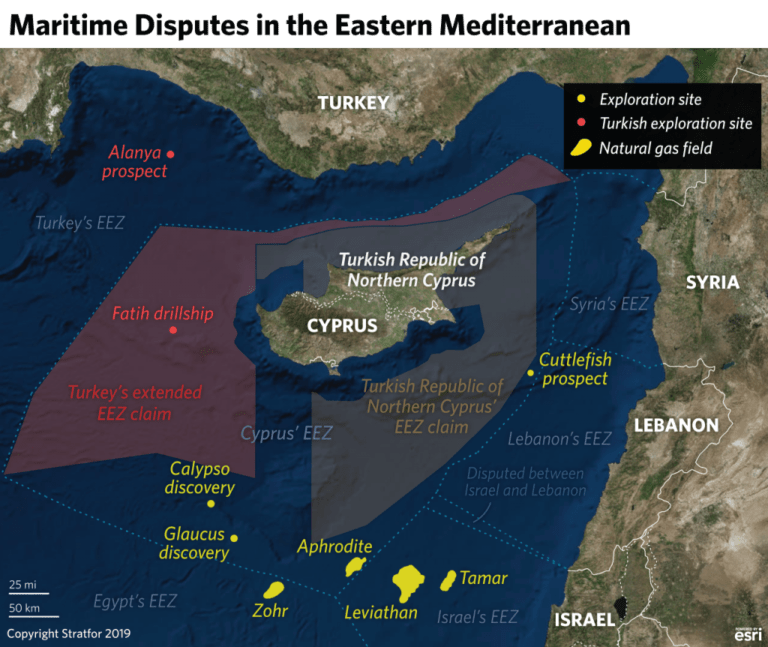
In sum, Turkey has a very serious territorial dispute with Cyprus and will not brook the latter’s unilateral moves to appropriate the massive hydrocarbon reserves in East Mediterranean in waters Ankara regards either belonging to the Turkish Cypriots as well or as falling within its exclusive economic zone (EEZ).
Suffice to say, a Cyprus settlement is the core issue here, but the Greek Cypriot opinion is disinterested in re-unification of the island. (The EU granted Cyprus full membership shortly after the ethnic Greek population voted against reunification, rejecting the settlement plan of then UN secretary general Kofi Annan.)
What complicates matters further is that Turkey has poor relations with Israel, which has banded together with Greece and Cyprus in a sort of tripartite alliance against Turkey lately (with Washington’s blessings.) The US resents Turkey’s independent foreign policies and American oil majors (ExxonMobil) are involved in prospecting / exploiting East Mediterranean’s oil and gas in the seas claimed by Cyprus.
ExxonMobil announced in February that it has made the world’s third-biggest natural gas discovery in two years off the coast of Cyprus in the Eastern Mediterranean at the Glaucus-1 well. The region is already known for some of the world’s largest such discoveries. The discovery could represent a natural gas resource of approximately 5 trillion to 8 trillion cubic feet.
Besides, the US geo-strategic objective is to market the energy supplies from East Mediterranean in Europe, which would erode Russia’s dominance as energy supplier while also enabling Israel to tap a big source of income.
Turkey is pretty much isolated today in the East Mediterranean rivalries, as Ankara intensifies its own exploration for natural gas in the region. After Cyprus after began its exploration (ExxonMobil) with the US ships providing security, Ankara despatched two drill ships to the seas and Turkey’s Naval Forces Command is providing “full and continuous protection” to the drilling vessels, with the help of unmanned aerial vehicles, watercraft, assault boats and submarines.
Turkey held a big naval exercise in in the eastern Mediterranean, Aegean and Black Sea in May asserting its rights not only in Cyprus, but also in Greece. Turkey claims its continental shelf not only takes in portions of Cyprus’s EEZ, but extends westwards to Crete in Greece’s EEZ. This in effect means that Turkey seeks to share the coastal energy resources of both Cyprus and Greece.
A time-bomb is ticking. Washington has repeatedly warned Turkey. In mid-July the EU foreign ministers also came down hard on Ankara, calling its actions “illegal”, punishing it by reducing EU’s assistance to Turkey for 2020 by €145.8 million, inviting European Investment Bank to review its lending activities in Turkey (€358.8 million last year) and threatening to “continue to work on options for targeted measures” (read sanctions.)
Turkey has defiantly rejected the EU intervention, but will feel its isolation mitigated if Russia stretches a helping hand at this juncture. The point is, the storm clouds gathering in East Mediterranean could have serious geopolitical ramifications. In a developing scenario of the West versus Turkey, which is already there, Moscow will be making a profound statement if Russian oil companies join hands with Turkey.
Any such Turkish-Russian collaboration will be a game changer for regional politics — in Syria, Levant, the Black Sea, etc. It coincides with a moment when the Pentagon just caricatured Russia in a strategy report last month as a “revitalised malign actor”, which, in league with China, “frequently jointly oppose US-sponsored measures at the United Nations Security Council” and works for a multipolar world order in which the US is “weaker and less influential.”
Indeed, any Turkish-Russian cooperation in the East Mediterranean will dovetail with global politics. Read a Xinhua report from the weekend titled China, Russia vow to strengthen cooperation, promote world stability.
July 29, 2019
Posted by aletho |
Economics | Israel, Russia, Turkey, United States |
Leave a comment
President Trump’s statement on July 17 to block the sale of the advanced F-35 jet to Turkey and to remove Turkey altogether from the fighter jet programme marks an inflection point in the Turkish-American relations.
The development has profound implications for India as well, which is also procuring the S-400 Triumf anti-ballistic missile system from Russia.
Trump timed his decision on Turkey accepting the delivery of components of the Russian S-400 system last Friday. Washington is not holding back until the system has been fully delivered or deployed (in April next year, according to Turkey) or even for Turkish military personnel to receive training for Russia to operate the system. Washington estimates that it’s a done deal, a fait accompli.
Trump’s main argument is that S-400 is a “Russian intelligence collection platform that will be used to learn about its [F35] advanced capabilities.” He regretted that Turkey didn’t accept the US’s counteroffers “to meet its legitimate air defense needs” — specifically, its “multiple offers” on the Patriot system.
Trump brought the NATO into his argument, saying that the S-400 “undermines the commitments all NATO Allies made to each other to move away from Russian systems” and will have “detrimental impacts on Turkish interoperability with the Alliance”.
However, he went on to acknowledge Turkey’s record as a “longstanding and trusted partner and NATO Ally for over 65 years”, the great value Washington still attaches to its strategic relationship with Turkey, and the two countries’ relationship as NATO allies, which is “multi-layered, and not solely focused on the F-35.”
Trump concluded, “Our military-to-military relationship is strong, and we will continue to cooperate with Turkey extensively, mindful of constraints due to the presence of the S-400 system in Turkey.” Trump’s message is that this is the irreducible minimum he’s compelled to do under the circumstances. He eschewed any accusatory tone.
Importantly, Trump didn’t mention a word about sanctions under the legislation known as Countering America’s Adversaries Through Sanctions Act (2017) or CAATSA, which threatens third countries with sanctions over any “significant transactions” — defined as deals above $15 million — with Russian defense industry.
But then, it is useful to recall that even while signing the CAATSA into law in August 2017, Trump had stated that he believed the legislation was “seriously flawed — particularly because it encroaches on the executive branch’s authority to negotiate.” He said he’d implement it “in a manner consistent with the President’s constitutional authority to conduct foreign relations.”
So, Erdogan was right when he claimed after meeting Trump on the margins of the G20 in Osaka that the latter reassured him that there would be no sanctions. In Erdogan’s words, “We heard from him [Trump] that there won’t be anything like this [sanctions]. It is out of the question that such a thing takes place between two strategic allies. I believe it cannot happen.”
Indeed, Trump himself at a press conference in Osaka had refused to blame Turkey for its S-400 deal with Russia and instead flagged that Ankara was forced into the deal by the Obama administration. Trump added: “So what happens is we have a situation where Turkey is very good with us, very good, and we are now telling Turkey that because you have really been forced to buy another missile system, we’re not going to sell you the F-35 fighter jets?”
“It’s a very tough situation that they’re [Turkey] in, and it’s a very tough situation that we’ve been placed in, the United States. With all of that being said, we’re working through it, but it’s not really fair. Because they bought a Russian system, we’re not allowed to sell them billions of aircraft. It’s not a fair situation.”
To be sure, the CAATSA also gives Trump much discretion to waive sanctions on countries that buy Russian weapons. The waiver language was reportedly included to accommodate allies India and Vietnam. Now, isn’t Turkey an ally, too? But US Secretary of State Mike Pompeo told the Washington Post on Sunday he was confident the president would levy sanctions as CAATSA requires. “The law requires that there be sanctions and I’m confident that we will comply with the law and President Trump will comply with the law,” Pompeo said.
What explains Pompeo’s hawkish line on Turkey? Principally, in the Washington Beltway the Israeli lobby is hyperactive among think tankers, politicians, media people, etc. Under Erdogan, Turkey’s relations with Israel nosedived, as he openly began supporting the Hamas. Erdogan has likened Israel more than once to Nazi Germany, triggering hot exchanges with PM Benjamin Netanyahu. Israel has vowed to demonise Erdogan and take him down somehow.
Indeed, can India draw comfort from the above? Some tentative conclusions can be drawn. For a start, the crunch time comes by early 2021. The latest news from Moscow is that the issues concerning the mode of payments by India have been resolved and deliveries of S-400 Triumf missile systems are “planned to start after 2020 in accordance with the agreement.”
At any rate, there is nothing like an Indophobia prevalent in the US even if there are differences in the relationship. Trump will have a hard time imposing sanctions against India after being indulgent toward Turkey. The lawmakers are not going to cry for India’s blood if Trump grants a waiver. Basically, Trump has an aversion toward CAATSA, too.
The minions in his administration or the hangers-on in the think tanks (such as Ashley Tellis at the Carnegie, for example) periodically threaten India with CAATSA. But do they speak for Trump? (In fact, Erdogan said Trump told him in Osaka not to take them seriously.) Clearly, many of these minions who wave the Damocles’ sword at India have their own axe to grind, since they act as dalals for US arms manufacturers and keep hustling the Modi government to grant more arms deals to placate Trump. But in reality, for almost the same reasons that the US cannot do without its alliance with Turkey, India too is not easily replaceable in the US’ Indo-Pacific network of partnerships.
India has much to learn from Erdogan’s way of handling the issue. He stuck to his guns after carefully weighing that the S-400 ABM system’s induction boosts Turkish defence capability. He is even prepared to forgo the F-35. Analysts estimate that Turkey may simply turn elsewhere to procure weapons. Moscow has already indicated openness to selling its latest fighter jet, the Su-57 to Turkey.
The Turkish Foreign Ministry has warned that Washington’s decision on the F-35 jet will “irreparably damage relations” and that the unilateral move “neither complies with the spirit of alliance nor is it based on legitimate grounds.” The statement added, “It is unfair to remove Turkey, one of the main partners in the F-35 program.”
The cardinal lesson India can learn from Erdogan is that defending national interests will always come at a high price, especially when a superior power is involved. Turkey has a long history, situated on the outskirts of the western world, with searing experiences to recount through centuries. India too has a painful colonial history. (See an analysis by the European Council on Foreign Relations titled Unhappy anniversary: Turkey’s failed coup and the S-400.)
July 18, 2019
Posted by aletho |
Aletho News | India, Turkey, United States |
Leave a comment
The loss of Istanbul to an opposition candidate in Turkey’s recent local elections was hyped up by many American commentators, especially pro-Israeli analysts, as marking the end of President Recep Erdogan’s 17-year long dominance in the country’s politics ever since his stunning victory in the 2002 general election.
The main agenda behind the doomsday predictions and the ‘psywar’ was to rattle Erdogan, soften him up and force him to jettison his staunchly anti-Zionist policy and his open support for the Palestinian cause, his proximity to Russian President Vladimir Putin — overall, his independent foreign policies. In particular, Washington targeted Erdogan’s decision to purchase the S-400 missile system from Russia.
However, Erdogan has sprang a surprise on the US by going ahead with the S-400 deal, openly defying the threat of sanctions. The delivery of the missile began five days ago and almost every day, Russian military transport aircraft are landing in Ankara ferrying consignments related to the S-400 ABM system.
Not only that, Erdogan is giving the Americans the middle finger by announcing that President Trump has told him in a private conversation in Osaka on the margins of the recent G20 summit that there isn’t going to be any sanctions, no matter what the US officials would be saying.
According to Bloomberg, Trump’s team has settled on a sanctions package and plans to announce it later this week once POTUS approves it. On the other hand, Erdogan said on Sunday that Trump has the authority to waive sanctions on Turkey and “since this is the case, it is Trump who needs to find the middle ground.”
But US Secretary of State Mike Pompeo firmly told the Washington Post in an interview published late on Sunday that “the law requires that there be sanctions and I’m confident that we will comply with the law and President Trump will comply with the law”.
It seems Erdogan is playing chicken. He disclosed over the weekend that the Russian system will be deployed and ready only by April next year. At the same time, he has also mentioned the possibility of ‘co-production’ of the Russian system in Turkey. In his words, “The S-400s are the strongest defence system against those who want to attack our country. God willing, we are doing this as a joint investment with Russia, and will continue to do so.”
Certainly, Erdogan doesn’t look as if he is cowed down by the defeat of his party’s candidate in the mayoral election in Istanbul. He is unperturbed by the propaganda against him by the US media and think tankers. Nor is his behaviour showing as if he is on the run.
All factors taken into account, it cannot be ruled out that Trump may waive or postpone the sanctions against Turkey, a country where the US president has significant business interests. What can be predicted with certainty is that Erdogan will react strongly to any US sanctions.
Erdogan has several options on the table — ranging from evicting the US military from its bases in Turkey (which of course will entail the removal of the 60 nuclear bombs as well) to the launch of the much talked about military operations against the Kurdish militia in northern Syria.
In the latter case, if Turkey decimates the Kurdish fighters, the US will be left with no proxies / allies in Syria and any form of continued American military presence in the Euphrates region will become difficult to maintain. That of course will hit Israeli interests very badly. The Pentagon is already nervous.
All the evidence suggests that Erdogan has made a strategic decision that Turkey’s future lies in Eurasian integration and the current sparring is a shadow play. His recent meeting with Chinese President Xi Jinping soon after the G20 summit on Osaka — and in Beijing — and his strong endorsement of Chinese policies on the Uighur problem can only be seen as a deliberate, well-calculated move to ensure that there are no contradictions in Turkey’s gravitation to the East.
In particular, Erdogan visualises that China’s Belt and Road presents just the alternative he needs to revive the Turkish economy and withstand western pressure. The Chinese Communist Party tabloid Global Times commented that Erdogan’s meeting with the Chinese leadership “marked political consensus between China and Turkey on a deeper level of understanding. China’s policies on Xinjiang are part of its internal affairs that no other country has a right to interfere with. Erdogan’s remarks on the Xinjiang question are the premise and guarantee for upgrade of bilateral cooperation.”
In an op-ed in the Global Times on the eve of his arrival in Beijing, Erdogan wrote, “Turkey shares China’s vision when it comes to serving world peace, preserving global security and stability, promoting multilateralism, and upholding the principle of free trade. The world seeks a new, multipolar balance today. The need for a new international order, which will serve the interests of all humanity, is crystal clear. Turkey and China, the world’s most ancient civilisations, have a responsibility to contribute to building this new system.”
Clearly, Erdogan couldn’t care less anymore about US sanctions. Read a commentary by Xinhua entitled Erdogan’s visit sign of aligned Turkish-Chinese interests: experts.
July 16, 2019
Posted by aletho |
Aletho News | Middle East, Turkey, United States |
Leave a comment
Additional S-400 air defense components have arrived in Turkey, as Washington remains unusually silent while reportedly contemplating the proper timing and degree of pain it wants to inflict on its NATO ally for disobedience.
An Ilyushin Il-76 cargo plane landed at Murted Turkish Air Force base just outside Ankara on Saturday with the latest batch of the S-400 parts, the country’s Defense Ministry confirmed, a day after three gigantic Antonov An-124 jets delivered the first components of the defense system. The cargo was welcomed by a large number of military personnel and offloaded by heavy-duty military trucks into secure hangars.
Despite the lack of immediate reaction from Washington, the White House currently working on a sanctions package which will be invoked under the Countering America’s Adversaries through Sanctions Act (CAATSA), sources familiar with the matter told Bloomberg. The content and the degree of the punitive measures has reportedly already been carefully debated between State Department and National Security Councils officials together with the Pentagon.
Now, it is up to Trump to sign off on the package, which however is unlikely to come before the end of next week, as the administration allegedly wants to “wait until after Monday’s anniversary” of the Turkey military coup attempt as to “avoid fueling further speculation” about Washington’s possible involvement.
Turkey’s President Recep Tayyip Erdogan blamed the failed July 15, 2016 rebellion on a cleric living in the US under CIA protection, and – amid souring relations with Washington which accused him of a brutal and undemocratic crackdown on the coup plotters – began increasingly turning towards Russia for defense supplies.
July 13, 2019
Posted by aletho |
Aletho News | Russia, Turkey, United States |
Leave a comment


 Aletho News