Netanyahu’s D.C. trip: All optics, no outcomes – Israeli media
Al Mayadeen | April 8, 2025
Israeli Prime Minister Benjamin Netanyahu met with US President Donald Trump at the White House on Monday, becoming the first foreign leader to personally appeal for relief from newly imposed US tariffs that have caused global concern.
Trump welcomed Netanyahu outside the West Wing with a fist pump before both entered the Oval Office for their meeting. In an unusual move, a planned joint press conference was canceled at the last minute without any explanation. During Netanyahu’s previous visit, the two had addressed the media in the Oval Office and held a formal press event.
In the wake of the visit, Israeli media burst with speculation and criticism over how Netanyahu’s White House trip ended in humiliation, as he left with no gains and was publicly sidelined by President Trump—highlighting his waning influence and deepening reliance on Washington.
Trump’s curveballs leave Netanyahu swinging
Israeli media likened Netanyahu’s White House visit to a political strikeout. Borrowing a baseball metaphor, commentators said Trump pitched a series of curveballs on issues vital to “Israel”—from security and trade to regional geopolitics—and Netanyahu missed every single one.
Furthermore, observers in “Israel” were quick to highlight the stark contrast in Netanyahu’s behavior during this meeting compared to past interactions with US presidents.
While he had often been confrontational and assertive, this time, seated beside Trump under the cameras’ scrutiny, Netanyahu merely smiled and absorbed the blows in silence.
The optics were hard to ignore: A figure once known for his strong stance was now reduced to a passive observer, underscoring his political vulnerability, diminishing influence over Trump, and growing dependence on the US president’s whims, as per the Israeli press.
Netanyahu cast as a prop, not a partner
Israeli commentators noted that while the private tone between the two leaders may have differed behind closed doors, the public optics told a harsher story. In coverage across Israeli outlets, Netanyahu was described as more of a stage prop than a strategic partner—ironically echoing his own past jab about being treated like “a flowerpot.” For over 30 minutes, Trump answered questions solo, with Netanyahu largely sidelined and silent.
Israeli media also pointed to the bitter irony of Netanyahu boasting about being the first foreign figure invited to Washington after the announcement of sweeping US tariffs on over 60 countries, including “Israel”. The prime minister had hoped to secure ‘a diplomatic victory’—perhaps a tariff exemption—but left with nothing to show.
In a moment of performative diplomacy, Netanyahu promised Trump he would “eliminate the trade deficit with the US,” a vow many doubt he can fulfill. Trump, unfazed, deflected the gesture by reminding everyone of America’s $4 billion annual military aid to “Israel”: “We give Israel four billion dollars a year. That’s a lot. By the way—congratulations. That’s not bad,” he quipped.
A diplomatic misfire
Israeli media were quick to contrast Netanyahu’s incompatible moods during his recent meetings with US President Donald Trump. Just two months ago, he stood ‘triumphantly’ beside Trump when the US president unveiled his “Riviera in Gaza” plan. But this time, Israeli outlets noted, the atmosphere was decidedly different.
Trump’s surprise announcement of direct talks with Iran visibly rattled Netanyahu, who had expected tougher rhetoric or a potential military commitment. Instead, he offered a subdued response, calling for a deal to dismantle Iran’s nuclear program “completely, as in the case of Libya.”
The Israeli press also highlighted Netanyahu’s concerns over Turkiye’s growing influence in Syria, yet Trump’s response was less than reassuring. Trump downplayed Netanyahu’s concerns with a lighthearted monologue about his close relationship with Erdogan, even suggesting that he could resolve Turkiye-related issues as long as Netanyahu “acted logically.”
Israeli commentators were left questioning the purpose of Netanyahu’s visit, with many concluding that it was a diplomatic failure. They argued that Netanyahu returned from Washington empty-handed—his influence diminished and his political position further weakened.
David’s Corridor: Israel’s shadow project to redraw the Levant
Through ‘David’s Corridor,’ Israel aims to forge a geopolitical artery stretching from occupied Golan to Iraqi Kurdistan, reshaping West Asia
By Mahdi Yaghi | The Cradle | April 4, 2025
In recent years, the Zionist idea of “David’s Corridor” has surfaced in Tel Aviv’s strategic and political discourse on the reshaping of its geopolitical influence in the Levant. Though the Israelis have made no official announcement, analysts have pointed to this corridor as a covert project aimed at linking Kurdish-controlled northern Syria – backed by the US – to Israel via a continuous land route.
The so-called David’s Corridor refers to an alleged Israeli project to establish a land corridor stretching from the occupied Syrian Golan Heights through southern Syria to the Euphrates River. This hypothetical route would traverse the governorates of Deraa, Suwayda, Al-Tanf, Deir Ezzor, and the Iraqi–Syrian border area of Albu Kamal, providing the occupation state with a strategic overland channel into the heart of West Asia.
A biblical blueprint
Ideologically, the project is rooted in the vision of “Greater Israel,” an expansionist concept attributed to Zionism’s founder, Theodor Herzl. The vision draws on a biblical map extending from Egypt’s Nile to Iraq’s Euphrates.
Dr Leila Nicola, professor of international relations at the Lebanese University, tells The Cradle that David’s Corridor embodies a theological vision requiring Israeli control over Syria, Iraq, and Egypt – a triad central to both biblical lore and regional dominance. Regional affairs scholar Dr Talal Atrissi echoes this view, believing that developments in Syria have lent new geopolitical realism to Israel’s historical ambitions.
Unsurprisingly, the proposed corridor is a lightning rod for controversy, seen by many as a strategic bid to expand Israeli hegemony. Yet significant barriers stand in its way. As Atrissi notes, the corridor cuts through volatile terrain, where actors like Iraq’s Popular Mobilization Forces (PMF) remain formidable spoilers. Even a minor act of sabotage could disrupt the project, particularly given the absence of a stable regional environment needed to sustain such a sensitive and expansive route.
Strategically, David’s Corridor aligns with Israel’s enduring policy of cultivating ties with regional minorities – Kurds, Druze, and others – to offset hostility from Arab states. This decades-old “peripheral alliance” strategy has underpinned Israeli support for Kurdish autonomy since the 1960s. The project’s biblical symbolism of expanding “Israel” to the Euphrates, and its strategic calculus, combine to make the corridor both a mythological promise and a geopolitical asset.
Nicola further contextualizes this within the framework of the “ocean doctrine,” a policy Israel pursued by courting non-Arab or peripheral powers like the Shah’s Iran and Turkiye, and forging alliances with ethnic and sectarian minorities in neighboring states.
The doctrine aimed to pierce the Arab wall encircling Israel and extend its geopolitical reach. David’s Corridor fits snugly within this paradigm, drawing on both spiritual mythology and strategic necessity.
Syria’s fragmentation: A gateway
The collapse of former Syrian president Bashar al-Assad’s government and the rise of Ahmad al-Sharaa’s Al-Qaeda-linked Hayat Tahrir al-Sham (HTS) have accelerated Syria’s internal fragmentation. Sharaa’s administration inked deals with the US-backed Syrian Democratic Forces (SDF), integrating Kurdish-controlled areas into the nominal Syrian state while cementing Kurdish autonomy. In Suwayda, a separate agreement preserved Druze administrative independence in exchange for nominal state integration.
But Atrissi warns that such sectarian autonomy, even if pragmatic for containing tensions in the short term, risks entrenching divisions and inviting foreign meddling. He notes that the trauma of massacres on Syria’s coast has left minorities, especially the Alawites, deeply skeptical of the central authority in Damascus, pushing them toward local power arrangements. Israel, with its historical penchant for minority alliances, sees an opportunity to entrench its influence under the guise of protection.
Israel’s longstanding partnership with Iraqi Kurdistan is a case in point – a strategic relationship that offers a blueprint for replication in Syria. David’s Corridor, in this reading, is less a logistical imperative and more a political ambition. Should conditions allow, the occupation state may leverage the corridor to encircle Iran and redraw regional fault lines.
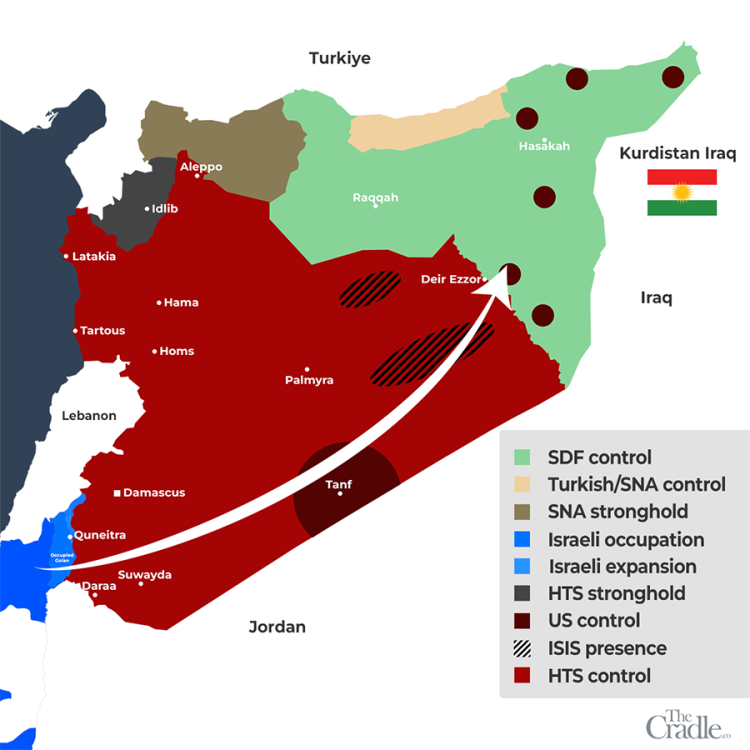
A map of the proposed David’s Corridor
A corridor of influence, not infrastructure
From Tel Aviv’s perspective, southern Syria is now a strategic vacuum: Syria’s army is weakened, Turkiye is entangled in its own Kurdish dilemmas, and Iran is overstretched. This power void offers fertile ground for Israel to assert dominance, particularly if regional dynamics continue to favor decentralized, weak governance.
Despite Washington’s reduced military footprint, the US remains committed to containing Iran. Key outposts like the Al-Tanf base on the Syrian–Iraqi border are instrumental in severing the so-called Iranian land bridge from Tehran to Beirut.
Nicola argues that while David’s Corridor is not an explicit US policy, Washington is likely to support Israeli initiatives that align with American strategic goals:
“The United States does not mind Israel implementing the project if it serves its interests, even though it is not part of its immediate strategy. It focuses on reducing Iran’s influence and dismantling its nuclear program, while supporting the path of regional normalization with Tel Aviv.”
The 2020 Abraham Accords, by easing Israel’s diplomatic isolation, have created additional maneuvering space. David’s Corridor – once a fantasy – now appears more plausible amid the regional flux.
Israeli leaders have sent unmistakable signals. On 23 February, Israeli Prime Minister Benjamin Netanyahu rejected any Syrian military presence south of Damascus, insisting on demilitarized zones in Quneitra, Deraa, and Suwayda under the pretext of protecting Syria’s Druze minority.
Israeli Foreign Minister Gideon Saar openly advocated for a federal Syria – a euphemism for fragmentation. Defense Minister Israel Katz vowed that Israeli troops would remain indefinitely in Mount Hermon and the Golan, and called for the dismantling of Syria into federal entities. Media leaks of corridor maps have only fueled speculation.
These moves have triggered outrage in southern Syria, with protests erupting in Khan Arnaba, Quneitra, Nawa, Busra al-Sham, and Suwayda. Yet, as Nicola notes, the new Syrian leadership appears remarkably disinterested in confronting Israel, and Arab states remain largely indifferent, even as the project edges toward realization. Turkiye, by contrast, stands firmly opposed to any Kurdish-led partition of Syria.
Geopolitical stakes and final frontiers
Ultimately, David’s Corridor signals a broader Israeli project to reengineer Syria’s geopolitics: isolate the south militarily, bind the Kurds in alliance, shift the balance of power, and carve a corridor of influence through fractured terrain.
Israel’s objectives are layered. Militarily, the corridor provides strategic depth and disrupts Iran’s land routes to Hezbollah. It enables the flow of arms and intelligence support to allies, especially Kurdish forces.
Economically, it opens a potential oil pipeline from Kirkuk or Erbil – Kurdish-majority, oil-rich areas – to Haifa, bypassing Turkish routes and maritime threats from actors like Yemen’s Ansarallah-allied army. Politically, it solidifies Israeli–Kurdish ties, undermines Syrian and Iraqi sovereignty, and advances the vision of Greater Israel, with the Euphrates as a symbolic frontier.
Yet the corridor is not without risk. It threatens to deepen the region’s instability, antagonize Syria, Turkiye, Iran, and Iraq, and trigger new fronts of resistance. Whether Israel can realize this project depends on the fluid regional calculus and its ability to maneuver within it.
David’s Corridor may still be a project in the shadows – but its implications are already casting a long one across the region.
How Syria’s HTS is quietly dismantling the Palestinian cause
The Cradle | March 25, 2025
Since the fall of the Syrian government on 8 December, the direction of the new interim administration, headed by Ahmad al-Sharaa, has become increasingly clear. Politically, militarily, and legally, Damascus now appears aligned with Washington’s long-standing vision of dismantling the Palestinian cause.
This alignment is taking shape on three key fronts: first is the Palestinian Authority (PA), resistance factions such as Hamas, the Palestinian Islamic Jihad (PIJ), and other factions splintered from the Palestine Liberation Organization (PLO). Second, is the UN Relief and Works Agency (UNRWA) tasked specifically to aid Palestinian refugees in the region, and third, are the camps housing Palestinian refugees and displaced Syrians.
Two developments underscore this shift. First, both Turkiye and Lebanon have blocked Palestinians holding Syrian documents from returning to Syria on the same basis as Syrian nationals. Second, US media has revealed ongoing talks between Washington and Damascus over the possibility of Syria absorbing tens of thousands of displaced Gazans, in exchange for sanctions relief or a broader political arrangement, particularly in the aftermath of the Coastal Massacres earlier this year.
Front 1: The PA and the resistance factions
More than four months into the transition to new governance, one thing is clear: former Al-Qaeda affiliate leader Ahmad al-Sharaa, now Syria’s president, is keeping Hamas at arm’s length. Despite repeated requests by Khaled Meshaal – head of Hamas’s political bureau abroad – to visit Damascus, the interim authorities have stalled, aiming to avoid direct confrontation with Israel or the US.
This new Syrian posture takes place in the midst of an ongoing genocide against the Palestinian people and the occupation state’s aim to eliminate their Islamic resistance.
The Cradle has learned that communication between Hamas and the new authorities is largely being channelled through Turkish intermediaries. Ankara is reportedly facilitating the relocation of several Hamas military officials to Idlib, the stronghold of Sharaa’s Hayat Tahrir al-Sham (HTS) militants.
In contrast, Sharaa – who met with Palestinian Prime Minister Mohammad Mustafa in January – has formally opened channels with the PA’s diplomatic mission in Damascus, recognizing it as the official representative of the Palestinian people.
The visiting delegation included senior officials from Fatah and the PLO, most notably Mahmoud Abbas’s son, who arrived to reclaim properties previously held by anti-Fatah factions under former Syrian president Bashar al-Assad’s government.
On the night the Assad government collapsed, Popular Front–General Command (PFLP-GC) Secretary-General Talal Naji and Palestine Liberation Army (PLA) Chief-of-Staff Akram al-Rifai sought refuge at the PA embassy. Palestinian ambassador Samir al-Rifai reportedly received a sharp rebuke from Abbas for granting them shelter. As for the rest of the faction leaders, each of them remained at home.
The day after HTS forces entered Damascus, they launched a wave of closures targeting Palestinian faction offices. Those belonging to Fatah al-Intifada, the Baath-aligned Al-Sa’iqa movement, and the PFLP-GC were shuttered, with their weapons, vehicles, and real estate seized.
The Democratic Front for the Liberation of Palestine (DFLP), which had maintained a lower profile during the Syrian war, was allowed to continue operating – though under observation.
On 11 and 12 December, several faction leaders convened at the Palestinian embassy in the presence of PLA leader Rifai to discuss their future. They attempted to arrange a formal meeting with Sharaa via Syria’s Foreign Ministry. Instead, a messenger from HTS – identified as Basil Ayoub – arrived at the embassy and demanded full disclosure of all faction-owned assets, including real estate, bank deposits, vehicles, and weapons. No political engagement would be possible, he said, until a comprehensive inventory had been submitted.
The factions complied by drafting a letter declaring that their holdings were lawfully acquired and that they were prepared to limit their activity to political and media outreach, in full alignment with Syria’s new posture. The fate of the letter to Sharaa and its response are unknown.
Decapitation campaign: arrests, confiscations, and settlements
What followed was a systematic decapitation of the Palestinian factional structure in Syria.
In early February, Fatah al-Intifada’s Secretary-General Abu Hazem Ziad al-Saghir was arrested at his home. After hours of interrogation and a raid on his office – where documents reportedly linked him to Iran’s Islamic Revolutionary Guard Corps (IRGC) – he was released.
A week later, he was re-arrested and held at a newly established detention site behind the Abbasid Stadium. A financial settlement was reached: $500,000 in exchange for his release and deportation to Lebanon. At the request of the committee, the movement’s Central Committee issued a statement terminating Saghir’s duties and dismissing him from the movement. However, Saghir issued a counterstatement from Lebanon, transferring the movement’s General Secretariat there and dismissing those who had made the decision to remove him.
The Palestinian Baathist faction, Al-Sa’iqa, fared no better. Its Secretary-General Muhammad Qais was interrogated and stripped of the group’s assets. Though he was not in command during the Battle of Yarmouk and thus escaped harsher punishment, HTS ordered the removal of the term “Baath” from all official materials. A statement soon emerged from within the occupied territories denouncing Qais as a “regime remnant,” suggesting a growing internal split.
HTS also clamped down hard on the PFLP-GC, whose Secretary-General, Talal Naji, was placed under house arrest and interrogated multiple times. All the group’s offices, vehicles, and weapons were confiscated, their headquarters shuttered, and its members beaten and humiliated. Their radio station, Al-Quds Radio, was seized, and their Umayyah Hospital is reportedly next in line.
The “Nidal Front” – a breakaway faction of the Palestinian Popular Struggle Front (PPSF), a left-wing group within the PLO – was the most controversial of its dealings. At the beginning of the events, Khaled Meshaal was able to mediate for the Front’s Secretary-General, Khaled Abdul Majeed, and protect him and his organization. However, in February, Abdul Majeed fled to the UAE.
His personal residence and vehicles – reportedly privately owned – were seized along with 50 million Syrian pounds (less than $5,000) in assets. Forced to resign by HTS, he handed over authority to a central committee operating out of Damascus and Beirut.
The DFLP has so far escaped the brunt of these purges, and its offices and vehicles remain untouched by the new administration, possibly because it had no ties to Iran or Hezbollah. The Popular Front for the Liberation of Palestine’s (PFLP – different from the PFLP-GC) main office in the Taliani area of Damascus remains open but inactive, while the rest of its offices have been shut down.
As of now, the PIJ, whose fighters have been on Gaza’s frontline battling Israel since 7 October 2023, remains in its Syrian offices. The faction’s representative has not been summoned for questioning, despite Israel bombing an apartment used by the group’s Secretary-General, Ziad al-Nakhala.
However, key PIJ military figures relocated to Baghdad on the night Damascus fell to HTS. Their activities inside Syria appear largely to have been reduced to conducting funerals for fighters who were killed in battle in southern Lebanon, albeit exclusively inside Palestinian refugee camps.
The Yarmouk camp in Damascus had already witnessed a series of protests in the first days of February, most notably gatherings demanding the closure of the headquarters of pro-regime organizations and the accountability of those involved in the arrest and killing of camp residents. The events escalated into an attempt to set fire to the headquarters of the PIJ’s Quds Brigades, with some youths and children throwing firecrackers at the building. Meanwhile, a demonstration erupted in protest against the decision to reopen the offices of the Al-Sa’iqa brigades in the Al-A’edin camp,
Front 2: Palestinian refugee camps in Syria
The crackdown on political groups has created a leadership vacuum in Syria’s Palestinian camps. Living conditions – already dire – have deteriorated further. In early February, protests erupted in several camps over Israel’s brutal attacks on the occupied West Bank’s Jenin Camp, following the PA delegation’s visit and the Syrian government’s formal recognition of Ramallah’s authority. Many feared this shift would accelerate plans for permanent resettlement of the refugees. At the same time, residents say they were coerced into public rallies in support of Sharaa’s self-declared presidency.
On 24 February, the Community Development Committee in Deraa began collecting detailed personal data from camp residents under the pretext of improving service delivery. A similar census was launched days earlier in Jaramana, but the purpose and funders of these efforts remain unclear.
Into this vacuum stepped Hamas. Through affiliated organizations like the Palestine Development Authority, Hamas began distributing food and financial aid, often via operatives embedded within HTS. This effort came as services once offered by the PIJ – including transportation, communal kitchens, and medical support – were halted. Even the Palestinian-Iranian Friendship Association’s headquarters in Yarmouk was taken over and repurposed by HTS elements.
Other actors, such as the Jafra Foundation and the Palestinian Red Crescent, continue to operate despite significant constraints. Their efforts have been insufficient to meet demand, particularly as the local economy continues to collapse. Most refugees rely on informal work, and with much of the economy paralyzed, daily survival has become precarious.
Of particular concern is a reported settlement proposal, conveyed through Turkish mediation. It allegedly offers Palestinians in Syria three options: Syrian naturalization, integration into a new PA-affiliated “community” under embassy supervision, or consular classification with annual residency renewals. The implicit fourth option is displacement, mirroring what happened to Palestinians in post-US invasion Iraq.
Front 3: UNRWA, sidelined and undermined
Though the new Syrian authorities have not openly targeted UNRWA, their lack of cooperation speaks volumes. UNRWA no longer appears to be viewed as the primary institution responsible for Palestinian affairs in Syria.
In Khan Eshieh Camp, a local committee working with the new administration petitioned the Damascus Governorate to prepare a municipal plan for rehabilitating the camp’s infrastructure. The implication was clear: Syrian authorities are preparing to take over camp management from UNRWA, following the Jordanian model.
Meanwhile, the Immigration and Passports Department resumed issuing travel documents for Palestinian refugees in January, a bureaucratic move that revealed the new government’s intention to reassert control. Around the same time, the Palestinian Arab Refugee Association in Damascus suspended its operations following a break-in that reportedly disrupted pension payments to retired refugees.
Despite limited resources, Hamas and the PIJI remain a point of concern for the occupation state. A recent Yedioth Ahronoth report claimed that both groups are attempting to rebuild military capacity inside Syria, with the intention of targeting settlements near the occupied Golan Heights and northern Galilee. While the report acknowledged no confirmed troop movements south of Damascus, it warned that operational planning is underway.
A close examination of Sharaa’s behavior and the new regime in Damascus reveals no apparent dissolution of these two organizations’ operations, as the Israelis claim. All that is taking place are temporary measures until a “big deal” is reached with the Americans, one of whose provisions will be the official and popular status of the Palestinians. Unless the country descends into chaos, one of the expected outcomes will be a clear Israeli ground military intervention under the pretext of removing the Palestinians from the border.
Greco-Turkish confrontation looming, could escalate and engulf the entire region
By Drago Bosnic | March 20, 2025
Deteriorating relations between Greeks and Turks are certainly nothing new. The two peoples have had on-and-off wars for over 900 years, spanning Asia Minor/Anatolia, the Aegean Sea/Eastern Mediterranean and Southeast Europe. The tensions haven’t really subsided even after both Greece and Turkey joined NATO in 1952.
Just three years later, there was the Istanbul pogrom during which Ankara intentionally targeted the ancient city’s native Greeks (along with other minorities). Then there was the 1974 invasion of Cyprus that effectively resulted in an undeclared war between Greece and Turkey.
The end of the (First) Cold War saw another round of escalation that reached its peak in the mid-1990s. Although agreements on demilitarization were reached at the time, Erdogan’s rise to power gave way to an extremely expansionist and aggressive Neo-Ottoman foreign policy in Ankara.
Turkey sees the division of EEZs (exclusive economic zones) in the Aegean Sea and Eastern Mediterranean as “unfair” and effectively wants to take over around half of both, including most of the EEZ around Cyprus. This wasn’t such a burning issue before the discovery of huge deposits of oil and natural gas. However, ever since, Ankara has been trying to establish control over these resources, almost exclusively in an aggressive manner, causing issues with all of its maritime neighbors in the region.
This resulted in continued militarization on both sides, with Greece (re)establishing bases on the Aegean islands, while Turkey keeps strengthening its offensive potential. Athens is particularly interested in reinforcing its ASDEN (the Supreme Military Command of the Interior and Islands). To that end, it’s acquiring various multipurpose missiles, particularly the Israeli “Spike”.
This includes the “Spike” NLOS (Non Line Of Site). In April 2023, the Greek military ordered 17 of these systems on 4×4 vehicles, as well as for nine of its US-made AH-64 “Apache” attack helicopters and four Machitis-class gunboats. Some variants of the “Spike” have a claimed maximum range of over 30 km, meaning that they can cover a significant portion of the Aegean Sea and deter potential Turkish attacks.
However, in recent years, Ankara developed a number of weapons with an operational (and even strategic) impact, particularly rocket and missile systems, as well as a plethora of unmanned platforms (both air and sea-based). Namely, in the aftermath of the July 2016 coup, Erdogan effectively purged the Turkish military of any disloyal elements, resulting in a virtual paralysis of the Navy and Air Force. The issue of manpower shortages was then resolved with a focus on unmanned systems.
The side effect of this change was not only much tighter political control over the Turkish military (largely loyal to the Pentagon prior to the 2016 coup), but also a more aggressive posturing, as the Turkish political elite became more (over)confident. This resulted in the escalation of various regional wars and conflicts, spanning from the South Caucasus to Lybia.
Worse yet, Ankara is seeking to expand its influence in Southeast Europe. To that end, it’s preparing to ratify military agreements with several countries, including Albania, North Macedonia and the narco-terrorist entity in the NATO-occupied Serbian province of Kosovo and Metohia. These agreements were first announced in 2024, but Turkey was yet to act on them. For its part, Greece sees this as an attempt to encircle it with enemies, with Ankara establishing a strategic presence and expanding influence behind Athens’ back.
Greece is quite concerned by these developments. Southeast Europe has long been a contested geopolitical arena, with various external powers trying to establish a foothold in the region. Greek media report that the aforementioned agreements were “quickly pushed onto the agenda of the Turkish Parliament, in contrast to the usual lengthy approval processes for similar military agreements”.
This allows Turkey and its regional partners and satellites to closely collaborate in various military projects, including training, joint exercises, enhancing defense industry ties, information exchange, logistics support, medical services, cyber warfare, etc. The agreements also provide a legal framework for personnel exchanges and joint research in military science and technology. Ankara is also implementing some of these policies under the guise of humanitarian efforts and disaster relief.
For Turkey, this isn’t merely a question of strategic encirclement of Greece, but also a way to push forward with its extremely aggressive Neo-Ottoman foreign policy framework. Ankara wants to reforge ties with various leftovers of its brutal occupation of Southeast Europe. This is particularly true for highly dysfunctional parastate entities such as Bosnia and Herzegovina and/or Kosovo and Metohia.
Thus, it sees these formal military agreements as a strategic springboard for further inroads in the region. This includes sales of unmanned systems and other military products. As previously mentioned, many of these agreements are hidden from the public by being masked as something else. According to Turkish Brigadier General Esat Mahmut Yilmaz, his country consolidated the three agreements into a single framework to expedite the participation of its military in various operations abroad.
In effect, this means that, once ratified and published in the Official Gazette, these agreements will allow the Turkish military to push for secondary agreements with foreign partners without further parliamentary approval, limiting public discussion on Turkey’s military activities abroad and effectively giving Erdogan a free hand in armed engagements in the increasingly volatile region.
To that end, Ankara is even establishing ties with countries like Croatia, which just signed a similar strategic agreement with virtually the same partners (Albania and the narco-terrorist entity in the NATO-occupied Serbian province of Kosovo and Metohia). This is obviously aimed against Belgrade, which maintains close ties with Athens and sees such expansionism as a direct threat to its basic national security interest. Either way, it seems the region is in for a rough ride in the upcoming years.
Drago Bosnic is an independent geopolitical and military analyst.
Demonstrations in American, European cities condemning Israeli crimes in Gaza
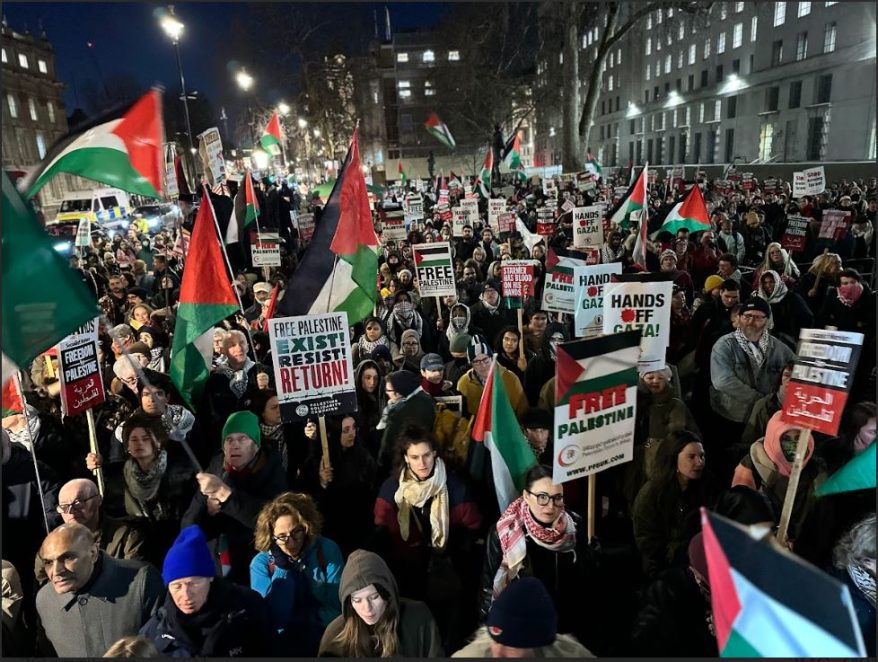
Thousands gathered outside the British government headquarters in London on Tuesday evening
Palestinian Information Center – March 19, 2025
Thousands of pro-Palestinian activists marched through the streets of American and European cities to condemn the resumption of the Israeli occupation’s war of extermination against the Gaza Strip that resulted in the martyrdom and injury of hundreds, most of whom children and women.
The marches began in cities like Seattle in Washington State, San Francisco in California, and Milwaukee in Wisconsin, protesting the U.S. administration’s approval of violating the ceasefire agreement, as shown in footage shared by pro-Palestinian pages on social media.
Participants in the protests demanded a ban on arming Israel while it commits genocide in Gaza, as well as the release of Palestinian student Mahmoud Khalil.
In Minneapolis, dozens of pro-Palestinian demonstrators gathered outside the Israeli consulate, holding signs demanding an end to the genocide in the Gaza Strip.
The Minneapolis demonstration, announced just four hours prior to its gathering, garnered significant attention as it coincided with rush hour in the city.
In France, demonstrators in Place de la République in Paris condemned Israel’s breach of the ceasefire agreement and the resumption of attacks on the Gaza Strip.
The protesters called for an end to the war on Gaza, an immediate end to the blockade of the Strip, halting Israeli genocide in Gaza, holding Netanyahu and occupation leaders accountable, and boycotting Israel.
In Italy, clashes erupted between police and pro-Palestinian demonstrators in Milan, where hundreds called for a permanent ceasefire in Gaza amidst stalled ceasefire talks between Israel and Hamas.
Footage shows columns of red smoke filling the air, while the sounds of explosions echoed through the Italian city’s streets. Protesters were seen marching, raising Palestinian flags and signs that read “Hands off the West Bank” and “Glory to the martyrs, freedom for the prisoners,” before being attacked by police forces.
In the Dutch capital Amsterdam, another demonstration was held in support of Gaza and against the genocide being committed by Israel against Palestinians.
Cities like Ankara, Istanbul, Diyarbakır, and other Turkish cities also witnessed demonstrations condemning the Israeli massacres against residents of the Gaza Strip.
Protesters accused Israel of committing genocidal crimes through its ongoing aggression against the Gaza Strip and called on the international community to hold it accountable for these crimes.
Turkish organizations, including the Anadolu Youth Association, the Humanitarian Relief Organization, and the Turkish Institutions Coalition for Jerusalem, called for organizing supportive demonstrations for the Gaza Strip in various Turkish cities and for the continuation of the boycott against Israel and products from supporting companies.
The whitewashing of Western crimes in Syria
By Sonja van den Ende | Strategic Culture Foundation | January 18, 2025
After the fall of Syria and the partial collapse of the Axis of Resistance, a predictable smear campaign has been launched in Western media, which, like for Russia, is based on distortion and lies.
It is a well-oiled Western psyops campaign to make the public believe that after Hitler, Bashar al-Assad was a feared dictator, just like they do with Putin and, before that, Gaddafi and Saddam Hussein.
The world was surprised when, on December 8, 2024, the most feared terrorists took over the old Syria, a semi-secular state form, and immediately turned it into a caliphate.
But for the American imperial planners, their European allies, and their terrorist proxies, including those in Ukraine, there was no surprise. They knew about it. The NATO-sponsored terrorist militia was trained by the CIA in Idlib, and provided with drones by Ukraine, drones that are produced in Ukraine, from semi-finished products from a company in the Netherlands called Metinvest B.V.
Large parts of the Syrian army did not defect, as the Western media and so-called experts claim. About 9,000 soldiers are still held captive in the Syrian desert, or in the Sednaya prison, held by the terrorists.
Not only the terrorists but the American army is in charge everywhere in Syria. American rulers secretly prepared for the occupation of Syria, as they did with Iraq. They primed the terrorists in Idlib for the final offensive with Operation Dawn of Freedom.
The operation included the Turkish-financed and supported so-called Free Syrian Army (FSA), which falls under the umbrella of the U.S., also known as the Syrian National Army. As early as 2016, Turkey began to assemble a new coalition of so-called Syrian rebel groups, including many former FSA fighters, in an attempt to create a more cohesive and effective opposition force. This coalition consists of the terrorists most feared by the Syrian people, who have been massacring civilians since 2011. Among others, the Syrian National Army includes Chinese Uyghurs, notorious for their brutality among head-choppers.
Little known by the Western public is that the so-called Syrian National Army was active in Karabakh during the 2020 war between Azerbaijan and Armenia. Turkey provided military support to Azerbaijan by supplying the terrorists of the Syrian National Army. This proxy army of international mercenaries, controlled by the U.S. and Turkey, has been fighting in Ukraine for the NATO-backed Kiev regime. The most brutal of its senior members is Abu al Shishani, who has been hiding in Ukraine for years – despite his U.S. handlers declaring him dead in 2017.
Of course, the Western terrorist sponsors wash their hands of blood. After all, there are supposed to be no real U.S. “boots on the ground” in Syria, they will argue, but there is an army base coordinating the terrorists who fight for them. The same applies to Turkey.
Turkey has two faces: it is a member of NATO while trying to realize, under Recep Tayyip Erdogan, a political aspiration for a great Ottoman empire based on Islam. Some say it is utopian or a lie, but it is not. The Syrian people know this very well; for 14 years, this has been going on and, unfortunately, has come true.
Then there is the other “superpower” in the region, the tiny Zionist apartheid project called Israel. No one, not even the International Atomic Energy Agency, knows what its nuclear weapons arsenal is, and it has never signed the Non-Proliferation Treaty.
Since 2022, Israel has become a fully-fledged fascist regime, the most ultra-right government in the history of the colonialist project, which carries out the agenda of the settlers. These settlers are dangerous terrorists and, like ISIS (Daesh), use religion, racism and murder as weapons against all other beliefs and opinions. Yet the United States and its European lackeys continue to brazenly back the Zionist rogue state. The U.S. has supplied it with $20 billion in military aid over the past year despite the genocide in Gaza.
One of the seven political parties that govern Israel is the Otzma Yehudit Party. This party advocates for the deportation of those they consider to be the “enemies of Israel”, such as the Arabs. The party has been described in the international press and also in Israel itself as an extremist, ultra-nationalist, fascist, and racist organization.
One of the supporters of this party is Daniella Weiss, who watched with her extremist settler friends as “Gazans” were murdered on a boat off the coast of Gaza and cheered. She and her group are invited to the inauguration of Donald Trump, who himself is a Zionist and his entire incoming administration consists of nothing but Zionists.
After the attack of the U.S. and Turkish-sponsored terrorists in the north of Syria, Israel attacked the south, in Dara’a, which was agreed upon, planned and coordinated with the U.S. and Turkey. Dams and bridges were blown up, and large-scale bombardments on the Syrian army were carried out. Large parts of the army were captured and imprisoned, left in the desert, or the former prison Sednaya. They surrendered; the superior force was too great. Remnant army forces, mainly from the “Tiger Forces”, are fighting the terrorists in the hills around Hama and Latakia.
The Western media was there suspiciously quickly, after a day or so, visiting Sednaya for photo-ops. All kinds of so-called Western journalists arrived in Syria, mainly to promote the narrative that the terrible regime was gone, Syria was “free”, and Assad had turned the former Sednaya prison into a “human slaughterhouse”.
Many fake stories, especially by CNN, about so-called prisoners who were hung on ropes, photos were distributed, which later turned out to be photos from a museum in Iraq. There were also stories about prisoners in underground dungeons, yet no proof of this has ever been found.
Certainly, everything was prepared for the “journalists”; they were already waiting in Jordan, primed to cross into Syria when the “surprise fall” happened.
Years ago, there was a report made by Amnesty International called the “Slaughter House”, but now, in 2025, no evidence has been found for this fake report. What has become clear is that a large number of the prisoners were ISIS (Daesh) members, who have now been released and are imposing a terror regime on minorities such as the Alawites, Christians, and Kurds.
The West is now professing innocence and wants good relations with what they call the new government. All kinds of Western politicians have visited the terrorist leader Abu Mohammed al-Golani. He is dressed up in a new suit and his beard is trimmed. The West wants to send the Syrian refugees back from Europe. There are also flight connections again. The airport of Damascus is changed into a mosque. Is the new caliphate going to send its terrorists on holiday? To do what? Commit attacks, perhaps? Russia, in particular, must be careful, especially after the mass murder at the Crocus City shopping complex last March when 145 people were killed by Daesh-linked terrorists. Many terrorists in the new Syria are from the Caucasus and have years of experience.
Transferring terrorists to Idlib after the fall of Aleppo in 2016 was never a good idea. History has proven it.
The U.S. and its European partners want to freeze the conflict in Donbass, which can result in the same problem as in Syria. That was the biggest mistake by Assad and the former government, which took too humane a position on terrorists.
Did Syria’s new leaders fake an ‘ISIS plot’ to attack the Sayyeda Zainab shrine?

Sayyida Zainab Shrine (January 2025)
The Cradle | January 17, 2025
Syria’s new interim government, led by former Al-Qaeda in Iraq leader Ahmed al-Sharaa (previously known as Abu Mohammed al-Julani) has claimed its security services thwarted an attempt by ISIS to bomb the Sayyida Zainab shrine in the southern suburbs of Damascus.
The shrine, attributed to the granddaughter of the Prophet Mohammed and daughter of Imam Ali Ibn Abi Talib is an especially revered site for Shia Muslims worldwide. Known as the Heroine of Karbala, this year, her martyrdom anniversary was commemorated on 15 January, coinciding with the Islamic date 15 Rajab.
According to news website Shia Waves, “Local sources reported a noticeable decrease in the number of visitors to the shrine compared to previous years, attributed to Syria’s ongoing security challenges and political turmoil.”
However, a closer analysis of the details provided by Syrian state media suggests the plot to bomb the shrine was fabricated. The move appears to be an attempt to present the Hayat Tahrir al-Sham (HTS)-led government as a protector of minorities to western audiences. This portrayal contrasts sharply with its ongoing sectarian cleansing campaigns in Alawite areas of the country.
The would-be false flag also serves the interests of the new Syrian government’s external sponsors. By exaggerating the ISIS threat, it provides the US with a pretext to maintain its illegal military occupation in Syria. Such an attack is all the more possible now that Hezbollah fighters and advisory forces of Iran’s Islamic Revolutionary Guard Corps (IRGC) have withdrawn from the country, ostensibly to ensure security for the shrine.
US forces currently occupy key oil fields in the north and east of the country and maintain a strategic base at Al-Tanf on the Syria-Iraq-Jordan border. The narrative of an ISIS threat ensures continued justification for these deployments and the exploitation of Syria’s resources.
Additionally, the conspiracy helps establish a narrative of ISIS culpability in advance. This could pave the way for blame to be assigned to the group if any party—whether elements within the Syrian government pursuing the Wahhabi project of targeting Shia and Sufi shrines, or foreign intelligence agencies seeking to destabilize Syria—decides to destroy the Sayyeda Zainab shrine. Such an event would create further chaos, deepening sectarian divides and serving the interests of those looking to fragment and destabilize Syria.
A staged plot
On 11 January, an unnamed official in Syria’s General Intelligence Service claimed four members of the ISIS cell planning an attack on the shrine were arrested.
Syria state TV showed images of the men, blindfolded and standing against a wall in casual civilian clothes, claiming the group consisted of Lebanese nationals and Palestinian-Lebanese. Images also showed a number of grenades and an anti-tank mine that were allegedly to be used for a suicide attack.
However, Karim Franceschi an Italian-Moroccan who fought with the Kurdish People’s Protection Units (YPG) against ISIS in Kobane in 2014, gave several reasons why the claimed plot to bomb Sayyeda Zainab was manufactured.
Franceschi observed that ISIS attacks on Sayyida Zaynab in Damascus in the past have used parked vehicles—plastic bags, cars, or motorcycles to plant bombs, rather than suicide bombers.
Further, the TM-57 anti-tank mine allegedly meant to be used in the suicide attack was rigged with the wrong fuse.
“Instead, a crude cord and igniter setup—meant for a suicide vest—is shown. This makes no sense. Using a full mine, with its specific anti-tank explosion radius, is inefficient. HTS knows this, making it clear this setup was staged for propaganda. There is no way ISIS or HTS with their extensive knowledge expertise with explosives would make something this sloppily,” Franceschi writes.
Previous ISIS attacks were not so sloppy. A string of ISIS bombings near the shrine in February 2016 killed 134 people, most of them civilians, according to the UK-based Syrian Observatory for Human Rights (SOHR). In January 2016, another attack on the shrine claimed by ISIS killed 70 people.
Julani’s PR offensive
One reason for faking the plot is clear based on the statement issued by the unnamed Syrian intelligence official. He told state media the intelligence service is seeking to protect the country’s minorities, by “putting all its capabilities to stand in the face of all attempts to target the Syrian people in all their spectrums.”
The AP promoted this narrative further, reporting that although HTS leader Sharaa was a former leader in Al-Qaeda, which was notorious for calling for committing massacres against Shia in Iraq, he “has preached religious coexistence since assuming power in Damascus.”
Sharaa needs to preach co-existence and protection of minorities to have economic sanctions lifted. Crippling sanctions were imposed on Syria by the US and EU to strangle the economy and impoverish millions of Syrians in an effort to topple the previous government of Bashar al-Assad. Yet even with Assad gone, the “pointlessly cruel” sanctions remain.
Sharaa has admittedly introduced several reforms to improve life for average Syrians, including ending mandatory military service for Syrian men (which at times lasted up to eight years for meager pay), reducing draconian customs fees on imported products such as cell phones, and removing the checkpoints which slowed travel and forced Syrians to pay bribes or risk being arrested and disappearing into the prison system for arbitrary reasons.
But the lifting of the sanctions and allowing for normal economic activity is crucial for Sharaa to maintain popular support, especially given the unpopularity of his and his government’s efforts to establish a fundamentalist Islamic State in the country.
Maintaining leverage through sanctions
Just as the US and EU used sanctions for leverage against Assad, they are doing the same against Sharaa. The Intercept noted that just hours before Assad fell, and when it was obvious Sharaa and HTS would take power in Damascus, the US Congress moved to extend sanctions, rather than simply let them expire.
“Not considering sanctions relief right now is like pulling the rug out from under Syria just when it’s trying to stand,” The Intercept cited Delaney Simon, a senior analyst at the International Crisis Group, as saying.
Now, EU governments cite the threat to minorities from Sharaa’s security forces, which are comprised of multiple formerly Al-Qaeda linked groups with records of committing massacres against Syria’s Alawites, Druze, and Christians, as an excuse to keep sanctions in place or to reimpose them as “snapback” sanctions in the future.
Considering that the members of the US Congress most responsible for imposing the sanctions, such as French Hill and Joe Wilson, are also rapid pro-Israel supporters, it can be assumed that Sharaa will be asked in the future to sign a peace deal with Israel giving up the occupied Golan Heights to the Zionist entity in exchange for the sanctions being lifted completely and the possible return of recently occupied Syrian territory under Sharaa’s watch.
The spate of sectarian killings
By preaching religious coexistence and claiming to protect the Sayyeda Zainab shrine, Sharaa is also achieving another goal: providing cover for the ongoing campaign of sectarian cleansing that is taking place in Alawite areas of the country, including parts of Homs and the Hama and Latakia country sides.
The extremist sectarian ideology Sharaa previously embraced when dispatching car bombs to kill Shia civilians in Iraq, Lebanon and Syria, is the same ideology which the armed factions under the HTS umbrella supporting his rule still embrace.
Militants affiliated with the new Syrian government, including many foreign jihadists from Uzbekistan, Chechnya, and China (Turkmenistan), are kidnapping and murdering members of Syria’s Alawite community based on their religious identity in various parts of Syria.
As a result, reports of sectarian killings by HTS or affiliated militants in Homs, Latakia, and Tartous continue to flood social media.
Syria expert Joshua Landis wrote on X that “Alawites have been attacked, many who have no history of wrongdoing in military or military service whatsoever. Today, there were demonstrations in the Sunni district of Latakia, cursing Alawites.”
Some Alawites are therefore demanding international protection, Landis notes, which further opens the door to the partition of Syria, a key Israeli goal.
To provide just one example, an Alawite man, Sheikh Ali Deeb, and his wife were killed in rural Salamiyah in the village of Dniba during an HTS search operation on 8 January. Their bodies were found on a side road connecting the village of Dniba to the neighboring village of Snida.
A pretext for US occupation
The new Syrian government’s claim to have thwarted the ISIS attack on Sayyeda Zainab also helps Sharaa remain in the good graces of Washington by giving it a pretext to continue the US military occupation of north and east Syria and its oil fields, which provide crude oil to Israel via Iraqi Kurdistan and Turkiye.
In Iraq, the US perfected the strategy of supporting and even creating Al-Qaeda groups (with Kurdish assistance), to justify its invasion and military occupation of the country.
The Bush administration relied on Abu Musab al-Zarqawi’s presence in Iraqi Kurdistan to justify its invasion of Baghdad in 2003. Zarqawi built Al-Qaeda in Iraq (AQI) with help from Kurdish Jihadists from Ansar al-Islam, which fought for the CIA in Afghanistan in the 1980’s and for Masoud Barzani’s Kurdistan Democratic Party (KDP) during the Kurdish civil war in the 1990’s.
Zarqawi’s car and suicide bombs targeting Shia pilgrims continued to justify the US occupation after the pretense of Saddam Hussein’s possession of WMDs collapsed.
A decade later, the US military provided weapons to ISIS to conquer large swathes of western Iraq, including Mosul, the country’s second largest city. US officials then used the existence of the so-called ISIS caliphate to return its forces to Iraq that had left after then Prime Minister Nuri al-Maliki has refused to sign a status of forces agreement with President Barack Obama guaranteeing non-prosecution of US troops in 2011.
Though ISIS has been defeated in Iraq, current Prime Minister Mohammad Shia al-Sudani has failed to eject US forces from the country. US officials continue to claim they are still needed to fight ISIS, even though Sudani has repeatedly claimed the terror group no longer poses a threat that Iraqi forces cannot deal with on their own.
The Israeli/Wahhabi project
In a more extreme scenario, it is possible that Sharaa and/or his backers in foreign intelligence agencies may facilitate the destruction of the Sayyida Zainab shrine itself, while blaming it on ISIS. By claiming to thwart fake attacks on the shrine now, HTS is establishing a convenient narrative to claim innocence in the future if an attack does take place.
Attacking and destroying important Muslim shrines, important to both Shia and Sunnis, is a hallmark of AQI under the leadership of Zarqawi and ISIS under the leadership of Abu Bakr al-Baghdadi, Sharaa’s former bosses.
Zarqawi’s AQI is widely viewed as responsible for destroying the golden dome of the Al-Askari Shrine, home to the 10th and 11th Shia Imams, in Samarra in Iraq.

Al Askari shrine (January 2025)
To the delight of the Israelis and neoconservatives in the Bush administration—who sought the partition of the country, as outlined in the Yinon Plan and Clean Break documents—the 2006 attack almost ignited a full-blown sectarian war between Iraq’s Sunni and Shia communities. This catastrophic outcome was narrowly averted, thanks to the influential fatwa issued by Grand Ayatollah Ali Al-Sistani.
Before his defeat in Mosul in 2017, ISIS leader Abu Bakr al-Baghdadi ordered the destruction of the Great Mosque of Al-Nuri and its iconic minaret. ISIS also destroyed the Al-Nabi Yunus Mosque, home to a tomb thought to belong of the Prophet Jonah, claiming that revering the shrine was idolatrous.
Blowing up the Sayyeda Zainab Shrine in Damascus, whether for fundamentalist religious goals or for the sake of creating strategic chaos, would help ensure that the sectarian violence that engulfed Iraq and threatens to engulf Syria now, becomes a reality.
The sectarian chaos will again benefit the occupation state, allowing it to expand its occupation of the Syrian Golan Heights and southern Syria, while incentivizing Syria’s Druze to ask for their territory to be incorporated into a Greater Israel to escape the sectarian fire consuming the rest of the country.
Alawites on Syria’s coast may turn north to Turkiye to request protection, or even annexation, if the extremist threat continues. Ankara will in turn be happy to incorporate Syrian territory, along with its offshore gas fields, as part of its ambitions to advance its neo-Ottoman ambitions and become an energy hub and transit point for West Asia gas headed to Europe.
Above all it is crucial to keep in mind that Israel, the US, Turkiye and others that orchestrated the HTS conquest of Syria do not have the well being of Syrians in mind. Many Syrians are happy to have Assad gone, but the future remains fragile and the risk of sectarian war and partition now looms large.
Türkiye confirms attempt to attack key gas pipeline
RT | January 15, 2025
Turkish Energy and Natural Resources Minister Alparslan Bayraktar has confirmed that an attempted attack took place on the TurkStream natural gas pipeline last weekend.
The Russian Defense Ministry had earlier reported that Ukraine targeted the compressor station in Russia’s Krasnodar Region, which supplies gas to TurkStream. The attempted sabotage took place on Saturday and involved nine kamikaze drones launched by Ukrainian forces. According to the ministry, the attack was largely thwarted. One fixed-wing drone crashed close to a gas meter and caused minor damage, which was swiftly addressed by the facility’s personnel, it said.
Speaking to journalists at the Turkish parliament on Wednesday, Bayraktar confirmed that an attack had taken place and provided assurance that the pipeline’s operations had not been affected.
“There was no interruption in gas flow after the attack. The pipeline continues to deliver gas at the same capacity,” he said.
TurkStream is a critical energy corridor, transporting natural gas from Russia to Türkiye under the Black Sea. It also remains the sole route supplying Russian natural gas to southern and southeastern Europe after Ukraine refused to extend a gas transit agreement with Moscow this year.
In 2024, gas shipments via the pipeline increased by 23%, reaching 16.7 billion cubic meters (bcm). The pipeline comprises two sections: one serving Türkiye’s domestic needs, while the other transits gas to Bulgaria through the Strandzha station. This Balkan route extends through Bulgaria and Serbia to Hungary, with connections facilitating the distribution of Russian gas to other EU states. With a total capacity of 31.5 bcm annually, TurkStream plays a vital role in regional energy security.
Russian officials have accused Kiev of attempting to sabotage the energy link on multiple occasions in recent years. In response to the latest attack, Kremlin spokesman Dmitry Peskov accused Ukraine of continuing with its policy of “energy terrorism.”
READ MORE: Lavrov blames US for TurkStream attack
During a press conference on Tuesday, Russian Foreign Minister Sergey Lavrov suggested that the US may have been involved in an attempt to sabotage the gas facility.
“I have a firm belief that the US needs no competitor in any fields, starting with energy,” Lavrov stated.
What will a “European Armenia” bring?
By Erkin Oncan | Strategic Culture Foundation | January 14, 2025
The Armenian government has approved a draft law to initiate the country’s accession process to the European Union (EU). This proposal will be discussed in parliament before being put to a referendum.
European Parliament rapporteur Miriam Lexmann celebrated this development, stating, “I wholeheartedly welcome the Armenian government’s decision to begin the EU accession process.”
However, the Russian side has reacted negatively to this decision. Kremlin spokesperson Dmitry Peskov declared that Armenia cannot simultaneously be a member of both the EU and the Eurasian Economic Union (EAEU).
Russian Deputy Prime Minister Alexey Overchuk also commented, “We interpret this as the beginning of Armenia’s withdrawal from the Eurasian Economic Union. The Russian Federation will shape its economic policy toward Armenia accordingly,” comparing EU membership to “purchasing a ticket for the Titanic.”
Armenia’s Journey Towards Europe
Armenia and the EU have a long history of interaction.
In 1996, Armenia signed a Partnership and Cooperation Agreement with the EU, and in 2001 it became a member of the Council of Europe. Moreover, Armenia has benefited from the TACIS program, a European Commission initiative that provided technical assistance to former Soviet states to adapt to market-oriented economic systems.
In 2004, Armenia strengthened its ties with the EU under the European Neighbourhood Policy (ENP), joined the Eastern Partnership initiative in 2009, and, despite joining the Eurasian Economic Union in 2013, approved the Comprehensive and Enhanced Partnership Agreement (CEPA) with the EU in 2017. In 2018, the Velvet Revolution brought Nikol Pashinyan to power, accelerating democratic reforms.
Armenia has now become the seventh former Soviet country to initiate European integration. This political shift mirrors the tug-of-war between the EU and EAEU, as well as NATO and the Collective Security Treaty Organization (CSTO).
Can Armenia Join the EU?
Although Armenia is not geographically part of Europe, like Georgia, it strives to align itself with “European values and cooperation processes.” From a European perspective, Armenia’s significance stems not from its adherence to these values but from its geographic proximity to Russia and Iran.
EU membership is a challenging and lengthy process—a path that only three former Soviet states (Estonia, Latvia, and Lithuania) have successfully completed. Other countries like Ukraine, Moldova, and Georgia have long been politically shaped by their EU aspirations, experiencing intense internal conflicts between pro-Russian and pro-EU factions, often tied to so-called “color revolutions.” These parallels suggest that Armenia’s membership process could also stretch over many years. Furthermore, Armenia’s economic ties with Russia present significant challenges.
According to data from the Armenian Statistical Committee covering January-April 2024, trade between Armenia and Russia increased 3.1 times, while trade with EU countries decreased by 24.3%. During this period, Armenia’s trade volume with Russia reached $6.3 billion, whereas its trade volume with the EU was $695.5 million—making trade with Russia nearly nine times greater than that with the EU. Military ties between Armenia and Russia also remain a major topic of public debate.
For Armenia to fully “Europeanize,” it must entirely overhaul its economic system. However, the insistence of both the EU and Pashinyan’s administration on this path could lead to a deep economic crisis and political instability. This might result in Armenia entering the EU as a weakened state, perceived as a burden by EU leadership.
The EU’s primary objective appears to be not Armenia’s full membership but the continuation of the accession process, using it to advance strategic interests. A “European” Armenia would serve as a geopolitical defeat for Russia.
Broader Implications
Discussions around Armenia’s regional and international dynamics are often shaped in Turkey by nationalist narratives sown by imperialist forces, perpetuating historical prejudices that undermine solidarity among neighboring peoples. However, developments in Armenia carry significant clues about the future of the broader region.
Erkin Öncan, Turkish journalist focusing on war zones and social movements around the world.
Twitter: https://twitter.com/erknoncn Telegram: https://t.me/erknoncn
Ukraine attempted drone strike on Russian gas supply to NATO states – Moscow
RT | January 13, 2025
Ukraine has launched an unsuccessful drone attack on Russian energy infrastructure which delivers natural gas to Türkiye , the Defense Ministry in Moscow reported on Monday.
The attempted sabotage took place on Saturday and involved nine kamikaze drones, which Ukrainian forces launched at the Russkaya gas compressor station near the village of Gaikodzor in Russia’s Krasnodar Region, according to a statement from the ministry.
The site is crucial for the operation of the TurkStream pipeline, which delivers natural gas from Russia to Türkiye under the Black Sea. Several nations in southern Europe, including EU member Hungary, use the Turkish route to receive supplies. Kiev’s attack was “aimed at stopping the supply of gas to European nations” through the neutral intermediary, the Russian Defense Ministry stated.
The Ukrainian attack against the Russkaya station was largely thwarted, the military added. One fixed-wing drone crashed close to a gas meter and caused minor damage, which was swiftly fixed by the facility’s personnel, it said. The incident caused no interruption in supplies, the statement stressed.
Kiev has refused to renew a transit contract with Russia which expired at the start of this year, and which had involved Russian gas being supplied to EU countries through Ukrainian territory. Slovakia, one of the nations affected by the decision, has accused Ukraine of causing an energy crisis.
Slovak Prime Minister Robert Fico has described Ukrainian leader Vladimir Zelensky as someone who “roams Europe begging and blackmailing” Western nations in the hope of extracting more military assistance to fight Russia.
Zelensky previously accused Fico of striking “shady deals” with Moscow and of undermining the EU’s “unity” in the confrontation with Russia. He also claimed the Slovak secret services should investigate Fico for corruption.
The TurkStream pipeline was launched in January 2020 and has an annual capacity of 31.5 billion cubic meters. Its underwater section extends for around 930km, while the Russkaya station serves as the point of exit on Russian soil. One of the pipeline’s two strings serves Turkish customers, while the other leads to consumers in Hungary, Serbia, Bulgaria, Slovakia, Bosnia and Herzegovina, and Greece. Russian officials have accused Kiev of attempts to sabotage the energy link on multiple occasions in recent years.
How the West Destroyed Syria
By Rick Sterling | Dissident Voice | January 11, 2025
Peter Ford served in the UK Foreign Ministry for many years including being UK Ambassador to Bahrein (1999-2003) and then Syria (2003-2006). Following that, he was representative to the Arab world for the Commissioner General of United Nations Relief and Works Agency. He was interviewed by Rick Stering on Jan 6, 2025.
Rick Sterling: Why do you think the Syrian military and government collapsed so rapidly?
Peter Ford: Everybody was surprised but with hindsight, we shouldn’t have been. Over more than a decade, the Syrian army had been hollowed out by the extremely dire economic situation in Syria, mainly caused by western sanctions. Syria only had a few hours of electricity a day, no money to buy weapons and no ability to use the international banking system to buy anything whatsoever. It’s no surprise that the Army was run down. With hindsight, you might say the surprise is that the Syrian government and Army were successful in driving back the Islamists. The Syrian Army forced them into the redoubt of Idlib four or five years ago.But after that point, the Syrian army deteriorated, became less battle ready on the technical level and also morale.
Syrian soldiers are mainly conscripts and they suffer as much as any ordinary Syrian from the really dreadful economic situation in Syria. I hesitate to admit it, but the Western sanctions were extremely effectively in doing what they were designed to do: to bring the Syrian economy down to its knees. So we have to say, and I say this with deep regret, the sanctions worked. The sanctions did exactly what they were designed to do to make the Syrian people suffer, and thereby to bring about discontent with what they call the regime.
Ordinary Syrians didn’t understand the complexities of geopolitics, and they blamed the Syrian government for everything: not having electricity, not having food, not having gas, oil, high inflation. Everything that came from being cut off from the world economy and not having supporters with bottomless pockets.
Syria was being attacked and occupied by major military powers (Turkey, USA, Israel). Plus thousands of foreign jihadis. The Syrian army was so demoralized that they really were a paper tiger by the end of the day.
RS: Do you think the UK and the US were involved in training the jihadis prior to the December attack on Aleppo?
PF: Absolutely. The Israelis also. The leader of Hayat Tahrir al Sham (HTS), Ahmed Hussein al Sharaa (formerly known as Mohammad abu Jolani) almost certainly has British advisors in the background. In fact, I detected the hand of such advisors in some of the statements made in impeccable English. The statements had Americanized spelling, so the CIA are in there too. Jolani is a puppet, a marionette saying what they want him to say.
RS: What’s the current situation, a month after the collapse?
PF: There are skirmishes here and there, but broadly, the Islamists and foreign fighters are ruling the roost. There are pockets of resistance in Latakia where the Alawite are literally fighting for their lives. Much of the fighting is about the attempts by HTF, the present rulers to confiscate weapons. The Alawites are resisting and there are pockets of resistance in the South where there are local Druze militias.
HTS is spread thinly on the ground. They are facing problems in asserting themselves. Although they had a walkover against the Syrian army, they never actually had to do much fighting. I would guess they only have about 30,000 fighting men and spread across Syria, that is not a lot. There’s an important pocket of resistance in the Northeast where the Kurds are. The Kurdish American allies are resisting. The so-called Syrian National Army, which is a front for the Turkish army, may go into a fully fledged war against the Kurdish forces. But that’s going to depend partly on what happens after the inauguration of the new US president, how Trump deals with the situation.
RS: What are you hearing from people in Syria?
It is not a pretty story. HTS and their allies have been parading showing their dominance, flying ISIS and Al-Qaeda flags. They have been bullying, intimidating, confiscating and looting. Surrendering Christian as well as Alawite soldiers have been given summary justice, roadside executions being the norm. Christians in their towns and villages are just trying to hunker down and pray. Literally. I’m sorry to say the senior Christian clerics, with one or two noble exceptions, have opted for appeasement and effectively betrayed their communities. The senior leadership at the Orthodox Church, in particular Greek Catholic church, have had themselves photographed with dignitaries of the jihadi regime.
They are turning the other cheek. It’s quite a contrast with the Alawite. But they have no choice. You may remember that the slogan of the jihadi armies during the conflict was, “Christians to Beirut, Alawite to the grave.” HTS is going through the motions of having meetings with clerics and making soothing noises. All the while their henchmen are driving around in trucks flying ISIS flags. What I’m hearing is very depressing.
The regime is leaving the Alawites totally abandoned. You barely read a word in the west in media about the plight of the Alawite and not much more about the Christians.
RS: Western media have demonized Bashar al Assad and even Asma Assad. What was your impression of Bashar and Asma when you met them? What do you think of accusations they accumulated billions of dollars?
PF: The accusations are completely spurious. I know some members of the Assad family, some of them have lived for many years in Britain. They lived in very modest personal circumstances. If Assad had been a billionaire, like they’re saying, some of that would’ve trickled down. I can guarantee you that has not been the case. These accusations also go against the impressions that I picked up when I was seeing the Assads when I was an ambassador there. They appreciated the good things of life the same as everybody else, but they didn’t come across as the Marcos type. Nothing at all like that. It is all lies, made up to serve the deeper agenda.
The media kicking of Bashar and Asma is really distasteful. It’s pointless. He’s disappointed his few remaining followers, although it was unrealistic, I believe, for them to expect more. But the fact is that he ran when others were not able to run, and many of those have been killed, or they’re hiding or they’ve escaped to Lebanon in some cases where they’re also hiding. He did get out with his skin, but to beat up on him as the media are doing is really distasteful and pointless. It is akin to this new genre of political pornography, Assad porn, the torture stories, the hyped up narrative about prison and graves being opened up. Actually, by the way, most of those graves are war dead. They were not people who’d been tortured to death as the media pretends. Hundreds of thousands of people died in the conflict over more than a decade, and many of them were buried in unmarked graves. But the western media are reveling in this new genre of Assad porn.
This is all being whipped up to make Western audiences more accepting of the way the West is getting into bed with Al-Qaeda. The more they demonize Assad and harp on the misdeeds of the Assad regime, and the more likely we are to swallow and be distracted away from the hideous atrocities being carried out right now.
Western leaders are kissing the feet of a guy who’s still a wanted terrorist and who has been a founder member of ISIS for God’s sake, as well as a founder member of Al-Qaeda in Syria. It is morally distasteful and shaming.
Joulani needs the west desperately now. Otherwise, he will face the same fate as Bashar Asad. If the economy continues on its trajectory of the years, then Joulani will be dead meat in fairly short order. He has to deliver massive rapid economic improvement to survive as leader. And this is what it’s all about. His strategy, obviously, is to milk his status as a puppet of the West in order to secure not just reconstruction aid, but that’s for the long term, but more immediately sanctions relief, the electricity flowing again, the oil.
Let’s not forget that the oil and gas of Syria is still effectively in the hands of the United States, which through its Kurdish puppets, controls a segment of the economy, which used to be worth, I think, 20% of serious GDP and provide essential oil for fuel, cooking, everything. He’s got to get his hands on that and get sanctions lifted. That’s what so much of it is about. But he has one major problem: Israel. Israel’s not buying it. Israel is the exception. All the western front is tumbling over itself to go and kiss the feet of the sultan of Damascus. But the Israelis are sucking their teeth, saying they don’t trust the guy.
Israel is destroying the remnants of the Syrian army and its infrastructure. Meanwhile they grab more Syrian land. They want to keep Syria on its knees indefinitely by insisting that Western sanctions not be lifted. I sense there’s a battle royal going on in Washington between what we might call the deep state, which would favor lifting sanctions and the Israel lobby, which is resisting that for selfish Israeli reasons. Given that the Israeli lobby wins these tussles nine times out of 10, the outlook may not be that great for the Jolani regime.
RS: What are your hopes and fears for Syria? What’s the nightmare scenario and what’s the best possible?
PF: I’m very pessimistic. It is very hard to see a silver lining in what has happened. Syria has been taken off the table as a Middle East player. The old Syria has died effectively. Syria was the last man standing among the Arab countries that supported the Palestinians. There was no other. There were militias like Hezbollah plus Yemen but there were no states other than Syria. Syria is now gone, and the jihadis are saying, telling the world they don’t care. By the way, this is an example of how the Israelis will not take yes for an answer. The jihadis keep telling the world, “We love Israel. We don’t care about the Palestinians. Please accept us. We love you.” And the Israelis won’t take yes for an answer.
The best hope for the Syrian people is that they may get some respite. It is possible to imagine a scenario where the Syrian people are able to recover, at least economically a scenario under which sanctions are lifted, under which Syria, the central government recovers control of its oil and grain, where fighting has stopped, where it doesn’t have to pay anything to keep up an army because it’s not trying. They might be able to put everything into reconstruction.
So it is possible to imagine a scenario where Syria loses its soul, but gains more hours of electricity. That is possibly the most likely scenario. But there are major obstacles as we discussed, Israel standing in the way of sanctions, lifting pockets of resistance in discipline among the jihadi ranks, Turkey rampaging against the Kurds and ISIS which is still not a completely spent force. So the outlook is obviously cloudy. We should take stock in a month’s time when we see the early days of the new regime in Washington on which so much will depend.
RS: In Trump’s first term he tried to remove all US troops from east Syria but his efforts were ignored. Perhaps that could have made a big difference?
PF: Yes, it could have been a total game changer. If Syria had access to its oil, it wouldn’t have had the fuel problem, the electricity problem. It could have changed the history of the region.
Now, the US is increasing the number of soldiers and bases in Syria. And they recently assassinated an ISIS leader which might have played a role in sparking the recent terrorist attack in the US. All of this makes it much harder now for Trump to withdraw US forces because it will be seen as a retreat, a reward for ISIS.
I argued for years that the sanctions were manifestly not working. But in the end they did. It’s like a bridge. It gets undermined and then suddenly it breaks. There was no single cause. It was just the culmination and things reached a tipping point.
Countdown to the European Collapse
By Lucas Leiroz | Strategic Culture Foundation | January 4, 2025
Finally, energy cooperation between Russia and Europe is (almost) completely over. After nearly three years of sanctions and sabotage, the bilateral Moscow-EU energy partnership suffered its greatest historical blow. Kiev fulfilled its promise not to extend its contract with Gazprom, which was allowing the arrival of Russian gas to Europe, then creating an extremely uncomfortable energy insecurity situation for its own “partners” in the European Union.
On the morning of the first day of 2025, the Russian Federation stopped supplying gas to European buyers via Ukraine. Even amidst the conflict, the Russian Gazprom and Ukrainian Naftogaz had kept in operation an energy transit agreement signed in 2020, which expired on the last day of 2024. Previously, Kiev had already announced it was unwilling to renew the contract with Gazprom, although some European countries repeatedly asked Ukraine to do so.
Despite the sanctions imposed on Russia since 2022, some European countries continued benefiting from the import of Russian gas, particularly Slovakia and Hungary – nations that refused to participate in the Western-sponsored anti-Russian boycott – as well as Austria, a country historically neutral in Europe’s geopolitical and military disputes. Other nations, even adhering to the sanctions, continued hypocritically receiving Russian gas, such as Italy, Poland, Romania, and Moldova. There were also cases of gas resale, with receiving nations re-exporting the commodity to countries seeking to bypass the sanctions.
With the end of the Ukrainian route, all these states lost any guarantee of a safe energy source – precisely during winter, the time of year when gas consumption in Europe is at its highest. Obviously, there are currently energy reserves that may be enough to cope with the challenges of the current season, but the situation will progressively become more critical over time. European nations will have to find new sources of gas or expand the use of the only two remaining routes for Russian gas (via Turkey and the Black Sea). Recent indicators show a substantial rise in gas prices among Asian exporters. Ankara is also expected to take the opportunity to gain more profits from its pipeline.
There is currently hope among Europeans for a cheap gas supply through the long-awaited Qatari-Turkish pipeline project via Syria. With the fall of Bashar al Assad’s legitimate government, energy giants from Turkey and the Gulf have revived the proposal, although they are waiting for domestic pacification in Syria by the Al-Qaeda junta to begin the construction. Some optimistic analysts in Europe believe this would be the antidote to Europe’s dependency on Russian gas – or Asian and American, as in the current circumstances.
The main problem with this hope is believing in the goodwill of the Western hawks to “pacify Syria.” Without Assad, Damascus became a “failed state,” with territory divided between different factions in constant hostilities. It is unlikely this will change – simply because, despite the tactical operators of the Syrian crisis (Turkey and Qatar) wanting pacification, the strategic mentors (Israel and the USA) are not interested. Tel Aviv prefers a polarized and war-torn Syria, unable to do anything to prevent territorial progress in the Golan and beyond. Washington, which is subservient to Israeli interests through the international Zionist lobby, is interested in the same – along with, of course, fostering Kurdish terrorists to worsen the internal Syrian situation even further.
In other words, Western analysts still do not understand that the decision-makers of the unipolar axis simply do not want to solve Europe’s problems. It is not in the US’ interest that its “partners” in Europe regain cheap energy and a strong industrial base. For Washington, the collapse of Europe is not a tragedy but a strategic goal, whose roots lie in the science of geopolitics itself. According to the fundamentals of Western geopolitics, Russian-European integration would be disastrous for the US-UK Atlantic axis. Therefore, in the face of Russia’s imminent military victory and Moscow’s rehabilitation as a Eurasian geopolitical power, the Americans and the British have adopted a “scorched earth” strategy in Europe.
Sanctions, the terrorist attack on Nord Stream, and the closure of the Ukrainian route to Europe are events that are part of the same strategic context: in all these cases, Anglo-American strategists want to provoke an energy collapse in Europe to enable deindustrialization and the subsequent economic and social crisis. The final goal is a ruined Europe, not only unwilling but also incapable of establishing any future strategic ties with Moscow.
With the fall of the Ukrainian gas route, it can be said that the US won an important battle in its economic war against Europe. The total collapse is merely a matter of time.
Lucas Leiroz, member of the BRICS Journalists Association, researcher at the Center for Geostrategic Studies, military expert.
Featured Video
Seyed M. Marandi: Negotiations Collapsed – Return to War
or go to
Aletho News Archives – Video-Images
From the Archives
The US-Iran Scenario That Most Scares Israel
By Ali Haydar | Al-Akhbar | October 9, 2013
Israeli Prime Minister Benjamin Netanyahu issued a series of threats toward Iran and its interlocutors in the West, including the US, as serious negotiations on Iran’s nuclear program seem more plausible.
As a possible rapprochement looms between the US and Iran, Netanyahu has attempted to impose impossible Israeli conditions on the negotiators, such as the full dismantling of Iran’s nuclear program, not to mention threatening military force.
Whatever the deal that could materialize between Iran and the West, Israel is going to find itself before an open-ended path. One can foresee three possible scenarios… continue
Blog Roll
 Aletho News
- Seyed M. Marandi: Negotiations Collapsed – Return to War
- Tomorrow’s naval blockade showdown
- ‘Israel’ attacks civilians to hide its embarrassing military failures & out of pure sadism
- Any Foreign Military Vessel Approaching Hormuz Under Any Pretext ‘Will Be Dealt With Severely’: IRGC
- Diplomats slam US negotiators’ performance in Iran talks
- Trump Refuses Exit Ramp, War with Iran will Continue
- Trump Says US Naval Blockade in Strait of Hormuz Will Begin Shortly
- US, Iran end 21-hour talks without agreement
- US IRAN TALKS: Who Are the Crazy Ones Here? /Lt Col Daniel Davis
- Talks with the US end without a deal over excessive US demands: Iran
- If Americans Knew
- Critical shortages in Gaza, Lebanon in ruins, “piracy” in Iran – Daily Update
- US-Iran ceasefire negotiations make zero progress – Daily Update
- Pro-Israel ‘Thinktanks’ and Individuals who Influence U.S. Foreign Policy
- Mearsheimer reveals how Israel dictates US policies on Iran, Gaza – video
- After killing 350+, Israel still has a “score to settle” with Lebanon before ceasefire – Daily Update
- Military aid to Israel emerges as the latest political litmus test for Democrats
- The only Palestinian children’s rights organization closes following years-long Israeli campaign against it
- ‘I Can’t Forget the Smell’: Lebanese Reel After Israel Kills Over 300 in Single Day
- DNC Shoots Down Resolutions Calling Out AIPAC and Limiting Arms to Israel
- TCN: Is Israel Blackmailing President Trump?
- No Tricks Zone
- Cave Discovery Reveals Today’s Desert Climates Were Recently Far Warmer, Wetter, Teeming With Life
- German Expert: Heat Dome Led To Record Temps In Western USA…Warmer In 1934, 1936
- New Study: No Linear Warming Or Glacier Retreat Along Northern Antarctic Peninsula Since 1980s
- An Inconvenient Tree: Uncovered In Alps… Europe Much Warmer Than Today 6000 Years Ago
- New Study Reports A 60% Slowdown In Greenland’s Ice Loss Rate In The Last Decade
- Low Intensity Tornado Wrecks Major Solar Farm, Creating A Potential Toxic Dump
- New Study Finds Warming Saves Lives…Cold Temperatures 12 Times More Deadly Than Excess Heat
- German Science Blog Accuses PIK Climate Institute Of Hallucinating Climate Tipping Points
- Devastating Assessment Of Comirnaty Vaccine By Former Senior Pfizer Europe Toxicologist
- New Study: CO2 Is ‘Effectively Negligible’ As An Explanatory Climate Change Factor Since 2000
 Aletho News