In early October, Israeli-Ukrainian Boris Wolfman was arrested in Russia. He is charged with masterminding a criminal organ trafficking scheme. His capture, wholly ignored by the Western media, raises the prospect that at long last, some justice will be served in a number of major organ trafficking scandals, dating back many years. Wolfman’s apprehension also highlights Tel Aviv’s little-scrutinised role as the world’s centre of illegal organ harvesting and trafficking. Grimly, the Gaza genocide may have greatly facilitated this perverse commerce.
Ever since October 7th, credible allegations have widely circulated that Zionist Occupation Forces are illegally harvesting the organs of slain Palestinians. In November 2023, the Euro-Med Monitor published a report documenting how Israeli soldiers confiscated dozens of corpses from major hospitals in Gaza, to the extent of digging up and raiding mass graves built in their grounds to accommodate the never-ending influx of slaughtered civilians. While some bodies were subsequently handed over to the Red Cross, many were and remain withheld.
Euro-Med Monitor records how many corpses exhibited clear indications of organ harvesting, including missing cochleas and corneas, as well as hearts, kidneys, and livers. Since then, the Zionist entity has released token numbers of murdered Palestinians at intermittent intervals to their surviving relatives. Frequently, the bodies are decomposed beyond recognition, making conducting professional autopsies – and identifying whether organs have been stolen – difficult if not impossible. Sometimes, the corpses are frozen solid, again greatly complicating medical examinations, and potentially obscuring organ theft.
The 1949 Fourth Geneva Convention mandates respect for the dignity of dead civilians, and explicitly prohibits the looting or mutilation of their bodies during wartime. However, the Zionist entity has not only failed to ratify the treaty, but expressly rejects its applicability to Gaza and the illegally-occupied West Bank. Moreover, repulsive local laws and legal precedents unique to Tel Aviv grant authorities the power to refuse to release dead Palestinians to their families.
Their bodies can be used as grisly bargaining chips – or their organs looted with impunity. For decades, the Zionist entity has been the illicit organ trade’s international nucleus. While Palestinians have long-raised alarm over Tel Aviv’s theft of their fallen comrades’ organs, it was not until the early 2000s that the practice was officially admitted. Yehuda Hiss, head of “Israel’s” Abu Kabir Institute, openly boasted of harvesting skin, bones, and other human materials during autopsies. He was never punished, suggesting his macabre activities were state-sanctioned.
This interpretation is amply reinforced by former Institute employee Meira Weiss’ 2014 work Over Their Dead Bodies. She reveals how, during the First Intifada 1987 – 1993, ZOF officials directed the centre “to harvest organs from Palestinians using a military regulation that an autopsy must be conducted on every killed Palestinian.” This gave them free rein to seize whatever they wished from bodies in their care. Institute apparatchiks nostalgically referred to these years as the “good days”, as they could pilfer organs “consistently and freely”.
Disturbingly, the Gaza genocide’s catastrophic death toll may represent the dawning of a new era of “good days” for the Zionist entity’s organ trade. Wolfman’s arrest, and the collapse of the conspiracies he oversaw, are unlikely to dent Tel Aviv’s operations in the field. He was but one player in a world-spanning nexus of Israeli traffickers. In the manner of a hydra, Wolfman’s removal will simply lead to others taking his place. After all, the returns are high, and risks mysteriously low.
‘Organ Broker’
In July 2015, the European Parliament issued a landmark report on organ trafficking. Its introduction notes, “before 2000, the problem of trafficking in human organs…was primarily limited to the Indian subcontinent and Southeast Asia.” However, the report noted that following the turn of the millennium, “trafficking in organs has seemingly started to spread globally, to a large extent driven by Israeli doctors.” The document went on to detail a number of high-profile organ trafficking cases.
In all but one, the evidentiary trail led directly back to the Zionist entity. An accompanying map of international organ trade routes places Tel Aviv at the very core, with its citizens both being leading customers, and heading the gangs that supply organs to overseas buyers. One cited case was the exposure in 2003 of a leading South African hospital performing over 100 illegal transplants on overseas patients – “the majority” from “Israel”.
Local law enforcement uncovered how a criminal syndicate led by well-connected Israeli Ilan Perry recruited poor, desperate individuals from Brazil, Romania, and elsewhere who were willing to sell their organs for a token sum, then transported them to South Africa. Customers would pay vast amounts for the transplants – Perry, the “organ broker”, and his associates would pocket the bulk, with the rest paid to ‘donors’ and hospital staff to perform the illegal procedures, then keep quiet about the connivance.
Another cited case is the Medicus Clinic scandal in Pristina, Kosovo. It erupted in October 2008, when a young Turkish man collapsed at the city’s airport. After a fresh surgical scar was found on his abdomen, he explained his kidney had been removed at the clinic, leading to a police raid. Medicus was already on local law enforcement’s radar due to the profusion of foreigners arriving in Pristina with letters of invitation to the clinic for heart treatment, which Medicus was not known to provide.
Subsequent investigations revealed Israeli Moshe Harel and Turkish doctor Yusuf Sonmez – known as “the world’s most renowned organ trafficker” – were responsible for sourcing clientele, who paid in excess of $100,000 for transplants. The surgeries were primarily conducted by local Kosovo Albanian medical professionals. Patients spent a short period in recovery before being discharged, provided with “information on their treatment to present to doctors in their home countries.” Donors did not enjoy such charity.
As the EU report notes, suppliers were forced to sign documents attesting they were donating their organs “voluntarily to a relative or altruistically to a stranger.” These documents were written in Albanian, and not translated to them. While in some cases they were promised fees of up to $30,000, “a number of them received only part of the money and some nothing at all.” Those given a portion were told they’d get the remainder “on condition that they themselves would recruit other ‘donors’.”
‘Notable Price’
Boris Wolfman was also centrally embroiled in Medicus. While a wanted man in multiple jurisdictions and subject to an Interpol red notice, he remained at large in Turkey for years until his recent deportation to Russia. Incredibly, he kickstarted another organ trafficking venture in the meantime, exploiting vulnerable Kenyans for small sums, selling their kidneys et al. to wealthy buyers from Germany and “Israel” for up to $200,000. As in Kosovo, donors were not given the money promised, or provided with appropriate medical care post-procedure.
It remains to be seen what, if any light, his prosecution will shed on the wider criminal network in which he operated, or whether the Zionist entity might be directly implicated in Wolfman’s venture. Still, that he is facing trial at all is somewhat miraculous. His confederates in the Medicus horror have proven suspiciously impervious to legal repercussions for their monstrous activities. Sonmez likewise lived freely and openly in Turkey for some years after the conspiracy’s unravelling, despite facing criminal charges in multiple countries.
Turkish prosecutors sought to jail him for 171 years, but Sonmez never served a day in prison, and appears to have vanished without a trace. Meanwhile, Harel was arrested by Israeli police in 2012, only to be released. He was nabbed again in Cyprus six years later on an Interpol warrant, but demands from Kosovo authorities he be extradited inexplicably appear to have not been acted upon. Whether the pair’s continuing liberty is indicative of state protection is an open, obvious question.
The Zionist entity’s 21st-century Holocaust in Gaza, and disastrously failed wars against Hezbollah and Iran, have “exacted a notable price” on its finances, Focus Economics has recorded. For example, tourism – once a core component of “Israel’s” income – has shrunk from millions of visitors annually to almost literally zero. “A full recovery could take multiple years and is likely dependent on a permanent end to hostilities with Hamas, Hezbollah and Iran,” the outlet forecasts – fantastically, given the Resistance cannot peacefully coexist with Tel Aviv.
Meanwhile, the Zionist entity continues to suffer mass brain drain, foreign investor flight, diplomatic isolation, and a huge drop in confidence among its largest overseas trading partners. Grotesquely, organ trafficking might represent one of Tel Aviv’s few dependable profit sources at this stage. With thousands of Palestinians both dead and alive in its custody, “Israel” certainly has ample resources to fuel the trade. Mainstream blackout on Wolfman’s long-overdue arrest may indicate the entity’s overseas puppet masters are relaxed about the prospect.
November 15, 2025
Posted by aletho |
Ethnic Cleansing, Racism, Zionism, Supremacism, Social Darwinism, War Crimes | Human rights, Israel, Palestine, Turkey, Zionism |
Leave a comment
On 7 March, Syrian security forces and affiliated armed factions perpetrated the massacre of more than 1,500 Alawite civilians, including many elderly, women, and children, in 58 separate locations on the Syrian coast.
Though the killings were executed by sectarian forces loyal to Syrian president Ahmad al-Sharaa (Abu Mohammad al-Julani), a former Al-Qaeda commander, the path to the massacre was paved by a covert Israeli strategy aimed at inciting an Alawite uprising.
Israel’s plan hinged on pushing Alawites into the “trap” of launching an armed rebellion, with false promises of external support, only to give Sharaa’s forces the pretext to carry out the mass slaughter of Alawite civilians in “response.”
Israel’s goal was consistent with its long-standing aim, articulated in the infamous Yinon Plan: to dismantle Syria and reshape it into “weak, decentralized ethnic regions,” following former Syrian president Bashar al-Assad’s fall.
Netanyahu goes to Washington
After 14 years of sustained support from the US, Israel, and regional allies, the extremist group Hayat Tahrir al-Sham (HTS) – formerly the Al-Qaeda affiliate, the Nusra Front – seized control of Damascus in December 2024. Its leader, Julani, rebranded as Ahmad al-Sharaa, swiftly assumed the presidency.
On the very day of this power shift, Israeli Prime Minister Benjamin Netanyahu took credit for Assad’s fall and began a mass bombing campaign to destroy what was left of the country’s military capabilities.
However, toppling Syria’s government and destroying its army was not the end of Israel’s plan for Syria.
On 9 January, Netanyahu’s cabinet met to discuss organizing an international conference to “divide Syria into cantons,” Israeli news outlet i24 News reported.
“Any proposal deemed Israeli will be viewed unfavorably in Syria, which necessitates an international conference to advance the matter,” the outlet noted.
In other words, to be successful, Israel’s project to divide Syria needed to originate, or seem to originate, from Syrians themselves.
Less than a month later, on 2 February, Netanyahu visited Washington to present a “white paper” regarding Syria to US officials.
After Netanyahu’s visit, Reuters reported that “Israel is lobbying the United States to keep Syria weak and decentralized, including by letting Russia keep its military bases there to counter Turkey’s influence.”
The Times of Israel later commented that Israel was lobbying the “US to buck Sharaa’s fledgling government in favor of establishing a decentralized series of autonomous ethnic regions, with the southern one bordering Israel being demilitarized.”
Reports later leaked into political circles about a meeting two days later, on 4 February, between US officials and a representative of the most influential Druze religious leader in Syria, Sheikh Hikmat al-Hijri, in Washington, DC.
Al-Jumhuriya reported that according to Syrian and American sources with direct knowledge of the meetings, discussions revolved around “a plan for an armed rebellion against the government of Ahmad al-Sharaa.”
The rebellion would reportedly include Hijri’s Druze forces from Suwayda, the Kurdish-led Syrian Democratic Forces (SDF) from northeast Syria, and Alawite groups from the Syrian coast, but with “Israeli support.”
When asked about the meeting, Hijri’s representative confirmed to Al-Jumhuriya that it had taken place but stated that the proposal for a rebellion had not come from the Druze.
“The proposal originated from a state, not from any Syrian faction,” Hijri’s representative clarified, in a likely reference to Israel.
Inventing the insurgency: Meqdad Fatiha
Just two days later, on 6 February, an Alawite resistance group, the “Coastal Shield Brigade,” was allegedly formed.
A video announcing the group’s establishment claimed its fighters would respond to sectarian massacres carried out by HTS-led security forces against Alawites since December, including in the village of Fahel, where 15 former officers in the Syrian army were killed, and the village of Arzeh, where 15 people were killed as well, including a child and an elderly woman.
In both villages, former officers in Assad’s army had given up their weapons and completed a reconciliation process with the new authorities in Damascus, but were nevertheless murdered in their homes by militants linked to Syria’s new extremist-led security forces.
The Coastal Shield Brigades was allegedly led by Meqdad Fatiha, a former member of the 25th Special Forces and the Republican Guard of the Assad government.
Activists on social media circulated the video, which allegedly showed Fatiha declaring the establishment of the brigade from a base in the Latakia Mountains.
However, there was no evidence that the group was real. Fatiha’s face was covered by a black balaclava in the video, making it impossible to verify whether he was really the person speaking. This was odd, given that his appearance was already known from his Facebook profile.
The theatrics pointed to an intelligence fabrication – likely Israeli – designed to present the illusion of an organic Alawite insurgency.
A meeting in Najaf?
Just five days later, the narrative of an organized Alawite insurgency was reinforced by reports in Turkiye Gazetesi, an Islamist-leaning pro-government newspaper in Turkiye.
The report claimed that Iranian generals and former commanders in the Syrian army under Assad had met in the Shia holy city of Najaf in Iraq to plan a major uprising against Sharaa in Syria.
The scheme reportedly involved Druze factions, the Kurdish-led SDF, Alawite insurgents on the coast, Lebanese Hezbollah, and, improbably, ISIS.
Large amounts of weapons were allegedly being sent by land from Iraq and by sea from Lebanon to the Syrian coast, the report added.
“Some surprising events were expected to occur in Syria in the near future,” the Iranian generals allegedly in attendance said.
While “surprising events” did occur one month later with the massacre of Alawites on 7 March, the reports of the Najaf meeting are likely fabricated.
It is unlikely that a Turkish newspaper would have access to a detailed account of a secret meeting taking place between top Iranian generals and former Syrian officers.
It is also unlikely, and even ridiculous, that Iran and Hezbollah would be coordinating with their long-time enemy, ISIS, or with the US-backed SDF.
Kurdish-Syrian commentator Samir Matini amplified the narrative through widely viewed livestreams, pushing the idea of “surprising events” to come. The aim: to pin Israel’s plan on Iran and Hezbollah and create a smokescreen of chaos.
Sectarian killings fuel resistance
Amid the propaganda claiming a foreign-backed Alawite insurgency was being organized, Julani’s security forces stepped up attacks against Alawite civilians in the coastal region.
Syrian journalist Ammar Dayoub reported in Al-Araby al-Jadeed that Alawites were often targeted solely based on their religious identity, rather than because they were “remnants of the regime.”
Dayoub observed that “these violations have targeted people who opposed the previous regime, and young people who were only children in that period, as well as academics and women.”
In response to the sectarian killings, Alawites began to defend themselves.
One key event occurred on 8 January, when armed men linked to the Damascus government killed three Alawite farmers in the village of Ain al-Sharqiyah in the coastal region of Jableh. The men were working their lands across from the Brigade 107 base when they were killed.
In response, a local man named Bassam Hossam al-Din gathered a group of local men, arming them with light weapons. They attacked members of Julani’s internal security forces, known as General Security, killing one and abducting seven more, before barricading themselves in an Alawite religious shrine.
The General Security launched a campaign against them, swiftly killing Hossam al-Din and his group.
A former intelligence officer of the Assad government, speaking with The Cradle, says these killings motivated him and others to fight back:
“All this fueled enormous resentment in the area, which grew worse day by day. After Bassam Hossam al-Din’s death, some people here – including former government military personnel and civilians – began to gather.”
Crucially, they were “encouraged by reports and promises [of help] they received from outside.”
They were told they would receive support, including by sea, from the US-led international coalition, in coordination with the Druze in Suwayda and Kurds in northeastern Syria.
“They were given hope of escaping this miserable situation,” the former intelligence officer tells The Cradle.
In the following weeks, Alawites continued to clash with Syrian security forces in an effort to defend themselves from raids and arrests.
In late February, Alawite insurgents attacked a police station in Assad’s hometown of Qardaha, located in the mountains overlooking the coastal town of Latakia.
According to Qardaha residents and activists who spoke to Reuters, “the incident began when members of security forces tried to enter a house without permission, sparking opposition from residents.”
“One person was killed by gunfire, with locals accusing the security forces of the shooting,” Reuters added, further suggesting that local Alawite men were acting in self-defense.
What happened in Datour?
The simmering conflict escalated further on 4 March. Reuters reported that, according to Syrian state media, two members of the Defense Ministry had been killed in the Datour neighborhood in Latakia city by “groups of Assad militia remnants,” and that security forces had mounted a campaign to arrest them.
One Datour resident told Reuters there had been heavy gunfire in the early hours and that security forces in numerous vehicles had surrounded the neighborhood.
A security source speaking with the news agency blamed the violence on a “proliferation of arms” among former security and army personnel who had refused to enter into reconciliation agreements with the new authorities.
The source said that local Alawite leaders had, in some cases, cooperated with security forces to hand over former personnel suspected of committing crimes during the period of Assad’s rule in hopes of staving off “crack downs and potential civil unrest.”
Testimonies from residents of Datour collected by Syrians for Truth and Justice (STJ) indicated that security forces carried out random arrests in Datour and indiscriminately fired at civilian homes, resulting in several deaths, including that of a child.
The campaign was “marked by sectarian rhetoric and intense hate speech directed against the Alawite sect,” STJ added.
A source from Datour speaking with The Cradle reveals that Julani’s government used a prominent local Alawite family to create the proliferation of weapons needed to justify a crackdown.
The Aslan family had previously been close to Maher al-Assad, Bashar’s brother and commander of the army’s elite 4th Division, but quickly established good relations with the new government after it came to power in December.
It became common to see General Security members from Idlib spending time at the Aslan-owned businesses on Thawra Street at the entrance to Datour.
When residents complained to the General Security about criminal activity by the Aslan family, such as stealing money and confiscating homes, the General Security took no action against the family.
The source speaking with The Cradle says that on 4 and 5 March, members of the Aslan family distributed weapons to Alawite men in the neighborhood, encouraging them to take up arms against the General Security.
This was, of course, strange given the close relationship between the Aslans and the General Security, as well as because such a rebellion had little chance of success.
“Why would the Aslan family distribute weapons to fellow Alawites in Datour while knowing a rebellion would fail?” the source asks.
What happened in Daliyah?
On 6 March, a major clash erupted in the Alawite villages of Daliyah and Beit Ana, which lie adjacent to one another in the mountains of the Jableh countryside.
Sources from Daliyah speaking with The Cradle confirm that a large General Security convoy entered the village that morning to arrest a local man, Ali Ahmad, who had written posts against the Julani government on Facebook.
General Security members took Ahmad from his work at the local mini bus station and executed him at the entrance of the village.
The General Security members then entered the nearby house of a retired army officer, Taha Saad, in the adjacent village of Beit Ana, killing his two adult sons.
In response to the killings, local men from the village gathered light weapons and attacked the General Security members. After the General Security called for reinforcements, a convoy of 20 vehicles arrived to assist the government forces in the fight.
The sources in Daliyah speaking with The Cradle state that around 20 members of the General Security and 17 men from the village were killed in the gun battle.
As the clashes continued, Damascus sent helicopters to drop bombs on Daliyah and Beit Ana until a Russian plane forced the helicopters to withdraw.
Julani’s army escalated further by firing artillery at multiple Alawite villages in the mountain areas from the military academy in Rumaylah on the coast, near Jableh city.
A source from Jableh speaking to The Cradle says that the bombings made Alawites “go crazy,” especially because Daliyah is home to an important Alawite religious shrine.
The massacre and its beneficiaries
When the Russian plane appeared over Daliyah and Beit Ana, “People thought that this was ‘the moment,’ so they rose up on that basis,” stated the former intelligence officer speaking with The Cradle.
Alawite insurgents attacked General Security and army positions in various areas across the coast, including Brigade 107 near Ayn al-Sharqiyah, where Bassam Hossam al-Din’s group abducted the General Security members before being killed in January.
“There was no Meqdad Fatiha or anyone else from outside, no Iranians or any others. It was purely a popular force rising up against this situation,” the former intelligence officer explains.
However, they were emboldened by promises of outside help from the US-led coalition, the Druze, and the Kurds.
The clashes at the Brigade 107 base lasted all night, but the Alawite insurgents paused the attack early the next morning, on 7 March, thinking that coalition forces would come to their aid and bomb the brigade.
“They waited two hours, but no strikes came, no support arrived. Their morale collapsed, they realized it was all lies, just a trap,” the source goes on to say.
After the fighting stopped, disillusionment spread, and the Alawite insurgents attacking the base withdrew and returned to their villages.
Al Jazeera’s role
As the fighting still raged on 6 March, Al Jazeera repeated the false reports from Turkish media claiming Alawite insurgents were receiving massive external support from Iran, Hezbollah, the Kurdish SDF, and even Assad.
The news outlet’s propaganda gave Damascus the pretext to mobilize not only formal members of military units from the Ministry of Defense, but also many informal armed factions who responded to calls from mosques to fight “jihad” against Alawites.
On the morning of 7 March, convoys of military vehicles filled with tens of thousands of Sharaa’s extremist fighters began arriving at the coast.
Because the Alawite insurgency was weak and disorganized, with no help from abroad, it was not able to provide any protection to Alawite civilians as the massacres unfolded.
Facing no resistance, Julani’s forces began systematically slaughtering any Alawite men they could find, as well as many women and children, in cities, towns, and villages across the coast, including in Jableh, Al-Mukhtariyah, Snobar, Al-Shir, and the neighborhoods of Al-Qusour in Baniyas and Datour in Latakia.
The massive scope and systematic nature of the massacres, involving such large numbers of armed men in so many locations, suggests pre-planning by Julani and his Defense Minister, Murhaf Abu Qasra – a former commander-in-chief of the HTS military wing.
A media creation
The mobilization of Julani’s forces was also aided on 6 March by new videos appearing online claiming to show Meqdad Fatiha and members of the Coastal Shield Brigade vowing to fight against the new government.
In one video, the man claiming to be Fatiha was masked (this time dressed like a character from the popular video game, Mortal Kombat, and standing against a blank background), making it impossible to know who he was and whether he was in the mountains of Latakia or in a television studio in Tel Aviv or Doha.
In a separate video, Fatiha was masked and dressed just like an ISIS militant beheading Christians on video in Libya in 2015, leading to speculation the video was fake and had been created using artificial intelligence (AI).
Another video was later released in which Fatiha appeared without a mask, saying that previous videos of him were indeed real, and not created using AI. However, the new video also appeared fake, his face, shoulders, and eyes moving in an unnatural way as he spoke.
During multiple visits to the Syrian coast, The Cradle was not able to find any Alawites who expressed support for Fatiha or believed his group was real.
The source from Daliyah states that, “No one here supports Meqdad Fatiha. We all believe he works for Julani. The Coastal Shield Brigade is fabricated.”
A former Alawite officer in Assad’s army from the Syrian coast tells The Cradle, “We only see videos of Meqdad Fatiha online. We believe he is just a media creation.”
After showing The Cradle his rotting teeth, the former officer remarks, “Do you think we are getting help from Iran or Hezbollah? I don’t even have money to fix my teeth.”
An Alawite woman whose husband and two grown sons were murdered on 7 March suggests to The Cradle that Fatiha is a fictitious person, only existing on Facebook and created by the authorities to justify the massacres.
“Who is he? Julani created him. It’s a lie,” she explains.
General Security fatalities
The mobilization of Sharaa’s extremist forces from across the country was also aided by claims that Alawite insurgents had killed 236 members of the General Security in attacks on 6 April.
Some General Security members were certainly killed, but Syrian authorities never provided any evidence for this large number, suggesting it was vastly inflated to heighten sectarian anger. When Reuters requested the names or an updated tally, Syrian officials refused to provide them.
In one case, the pro-HTS “Euphrates Shield” Telegram channel published a photo collage allegedly showing General Security members killed by “regime remnants” during the fighting.
However, one of the fighters shown in the photos quickly posted a story on his Instagram with a “laugh out loud” emoji to show he was still alive, the Syrian Democratic Observatory showed.
Israeli ambitions
On 10 March, before the victims of the massacres had been buried, i24 News published a letter claiming to be written by Alawite leaders, asking Netanyahu to send his military to protect them.
“If you come to the Syrian coast, which is predominantly Alawite, you will be greeted with songs and flowers,” the letter stated.
It also called on Israel to unite against the “Islamic tide led by Turkiye,” while asking for help in separating from “this extremist state.”
When Israel secretly “greenlit” Julani’s massacre of Druze in Suwayda in July, the goal of dividing Syria was further advanced. Many Druze are aware of the covert relationship between Damascus and Tel Aviv, but, fearing extermination, feel they have little choice but to call on Israel for protection and to establish an autonomous region in south Syria.
Three weeks after the massacres of Alawites in March, an Israeli general quietly admitted that sectarian violence in Syria benefits Tel Aviv.
“This thing where everyone is fighting everyone, and there’s an agreement with the Kurds one day, and a massacre of the Alawites the second day, and a threat to the Druze on the third day, and Israeli strikes in the south. All this chaos is, to some extent, actually good for Israel,” stated Tamir Hayman while speaking with Israeli Army Radio.
“Wish all sides good luck (but) do it quietly. Don’t talk about it,” the general added.
October 30, 2025
Posted by aletho |
Deception, Ethnic Cleansing, Racism, Zionism, Fake News, False Flag Terrorism, Mainstream Media, Warmongering, Wars for Israel | Al Jazeera, Israel, Syria, Turkey, Zionism |
Leave a comment
For decades, Turkey was considered a pillar of NATO’s eastern flank — a key piece on the chessboard of containing Russia. Since joining the alliance in 1952, the country has played a dual role: on one hand, a strategic partner of the West; on the other, a regional power with ambitions of its own. This balance was always unstable — and now, it is beginning to undergo substantial change.
What was once whispered behind closed doors is now being openly voiced by central figures in Turkish politics. In September 2025, an unexpected statement from the leader of the Nationalist Movement Party (MHP), Devlet Bahçeli, sent shockwaves through Ankara and beyond: he openly proposed the formation of a strategic alliance between Turkey, Russia, and China, directly opposing what he called the “US-Israel evil coalition.”
Though shocking to some Western observers, this proposal did not emerge in a vacuum. According to analyst Farhad Ibragimov, Bahçeli’s remarks mark “the deepest ideological shift in Turkish nationalism since the Cold War.” A nationalism traditionally aligned with the West now appears skeptical — if not openly antagonistic — to the Washington-led structure.
It is important to note that Bahçeli is not alone in this shift. The idea is echoed with enthusiasm by other sectors of Turkish political life, such as Doğu Perinçek, leader of the Patriotic Party. For him, this reorientation is neither a tactical maneuver nor a veiled threat to NATO — it is, rather, a “civilizational project.” In his words, it is a historic decision: either Turkey remains a satellite of the Atlantic powers, or it fully integrates into the Eurasian civilization, alongside Russia, China, and Iran.
In this context, the suggested alliance should not be seen merely as a military or diplomatic pact, but as an attempt to redefine Turkey’s role in the 21st century. The proposal carries an implicit — and at times explicit — critique of the decadent, domineering, and unsustainable liberal world order.
President Recep Tayyip Erdoğan’s position has been more ambiguous. He stated he was “not fully familiar” with Bahçeli’s idea, but added: “Whatever is good, let it happen.” This phrase summarizes Erdoğan’s strategy in recent years: keeping the country in a bargaining position, flirting with Moscow and Beijing while still participating in Western institutions. However, there are signs that even this balancing act may be giving way to more definitive choices.
The growing instability in the Middle East, the erosion of European institutions, and constant pressure from the U.S. have pushed Turkey toward a new posture. As Perinçek aptly put it, “this is not a choice, but a necessity.” Remaining within the Atlantic system, in his view, offers no guarantees of sovereignty, economic development, or territorial security.
Although short-term technical obstacles remain, Turkey’s path toward Eurasian integration is not only viable — it is necessary. The country’s economic dependence on the West, inherited from decades of participation in the liberal-globalist architecture, is not a fixed destiny — but a chain that must be broken. Remaining in NATO, far from providing security, leaves Ankara a passive target of American strategy. In contrast, a strategic alliance with Moscow, Beijing, and Tehran — while demanding structural adjustments — offers something the Atlantic has never guaranteed: full sovereignty, mutual respect, and active participation in building a new international order based on multipolarity.
More than a geopolitical alignment, the proposals of Bahçeli and Perinçek carry a profound civilizational dimension. By drawing closer to Russia, China, and Iran, Turkey is not merely seeking strategic partners but also reconnecting with the historical and cultural space of Turkic populations within those countries — from the Arctic-Siberian frontiers in Sakha to the Uyghur Autonomous Region of Xinjiang and Iranian Azerbaijan. This reconnection creates fertile ground for a broader alliance that could also involve the Central Asian republics — Kazakhstan, Uzbekistan, Turkmenistan, Kyrgyzstan — and Mongolia itself. This is, therefore, not just a political axis, but an identity-based one, capable of forming a cohesive civilizational bloc with shared roots and converging interests in the face of the moral and structural decline of the liberal West.
The trend is clear: a significant part of Turkey’s political and military elite no longer believes the country’s future lies in Brussels or Washington. Instead, they look to the heart of Eurasia — where emerging powers are gradually drawing the contours of a new multipolar world.
At this moment, Turkey seems to be standing in front of a mirror: it can continue acting as a peripheral extension of Western will, or it can take a more independent course. The statements from Bahçeli and Perinçek may be just the beginning of a turn that, if consolidated, will shift the geopolitical balance of the region for decades to come.
October 19, 2025
Posted by aletho |
Economics | China, Iran, NATO, Russia, Turkey, Zionism |
Leave a comment
Russia has accused the United Kingdom and Ukraine of attempting coordinated sabotage operations against the TurkStream gas pipeline, a vital conduit transporting Russian natural gas to Turkey and European markets.
During the 57th Shanghai Cooperation Organization (SCO) session in Uzbekistan, Federal Security Service (FSB) Director Alexander Bortnikov revealed some of the details behind the plot.
According to Bortnikov, British instructors from the Special Air Service (SAS) and the Secret Intelligence Service (MI6), in coordination with Ukrainian intelligence, are actively planning a series of attacks targeting Russian energy infrastructure. These operations reportedly include drone strikes on the TurkStream pipeline, as well as attacks on the Caspian Pipeline Consortium, a multi-national venture with Russian, Kazakh, and US shareholders.
Bortnikov said that the UK has been directly involved in training and coordinating these sabotage groups.
“Together with MI6, they are coordinating Ukrainian sabotage groups to carry out raids in Russia’s border regions, targeting critical infrastructure using drones, unmanned boats, and combat divers,” FSB Director Alexander Bortnikov stated.
The FSB director further revealed that British intelligence orchestrated Ukraine’s SBU “Spider Web” operation conducted on June 2, 2025, prior to Ukraine–Russia talks in Istanbul. Bortnikov said the UK managed a propaganda campaign exaggerating the operation’s impact and attributing it solely to Ukraine. In addition, Russian authorities reported a series of FPV drone attacks in June on airfields across Murmansk, Irkutsk, Ivanovo, Ryazan, and Amur regions.
Failed attacks on TurkStream
These remarks follow earlier reports of Ukrainian plans to target TurkStream. In November 2024, German media outlet Der Spiegel reported that former Ukrainian Armed Forces Commander Valerii Zaluzhny had proposed a plan codenamed “Diameter,” modeled on the 2022 Nord Stream sabotage, to target the pipeline. The plan reportedly failed, and no independent evidence has confirmed its execution.
Russia has also intercepted multiple drone attacks on TurkStream infrastructure in January 2025, which were described by Moscow as acts of “energy terrorism,” though the facilities continued normal operations. Additionally, Russian forces shot down three more Ukrainian drones in early March following another attempted strike on a TurkStream compressor station.
TurkStream remains a strategic energy artery for Europe, delivering Russian natural gas to Turkey and several European nations. Any disruption to its operation could have serious consequences for regional energy security.
October 16, 2025
Posted by aletho |
Deception, War Crimes | Russia, Turkey, UK, Ukraine |
Leave a comment
For decades, Turkish nationalism marched under the NATO flag. But now, one of Türkiye’s most influential right-wing leaders is calling for a turn East – toward Russia and China. His proposal may mark the country’s clearest ideological break with Atlanticism since joining the Alliance.
In September, Türkiye’s political landscape was shaken by a statement that many experts called sensational and potentially transformative. Devlet Bahceli, leader of the Nationalist Movement Party (MHP) and a long-time ally of President Recep Tayyip Erdogan within the People’s Alliance, proposed the establishment of a strategic trilateral alliance involving Türkiye, Russia, and China to counter the “US-Israel evil coalition.”
Bahceli emphasized that such an alliance is “the most suitable option, considering reason, diplomacy, the spirit of politics, geographical conditions, and the strategic environment of the new century.” The proposal extends far beyond the usual nationalist agenda, positioning Türkiye as a player capable of initiating new formats of international cooperation.
To grasp the importance of this statement, we must note the historical context. Turkish pan-Turkism has traditionally been oriented toward the West, and nationalists were seen as staunch defenders of the pro-Atlantic course. In this light, Bahçeli’s call for an alliance with Moscow and Beijing marks a symbolic break from that tradition, reflecting growing distrust toward NATO and the US within Türkiye’s political landscape.
Bahceli’s comments are not random. Over the past few years, he has steadily ramped up his criticism of the West, advocating for Türkiye’s sovereign development “beyond blocs and alliances.” But this is the first time he has explicitly named Russia and China as preferred partners.
Reactions inside Türkiye were mixed. Right-wing circles called Bahceli’s words “revolutionary,” while leftists saw them as confirmation of a broader anti-Western consensus. Internationally, the statement underscored Ankara’s growing distance from Western power centers and its gradual rhetorical shift toward the East and Greater Eurasia.
Shortly afterward, Erdogan made a cautious comment, saying he was “not fully familiar” with Bahceli’s initiative but adding, “Whatever is good, let it happen.” The ambiguity is typical for Erdogan, who avoids publicly rejecting the ideas of key allies while keeping his political options open.
On one hand, the president is wary of provoking open conflict with Western partners, given Türkiye’s economic vulnerabilities. On the other, his comments suggest that Bahçeli’s initiative could serve as leverage – a way to pressure the US and EU by signaling that Ankara might strengthen ties with Moscow and Beijing.
A day later, Bahceli clarified his position, saying, “We know what we are doing. Türkiye should not be the implementer of regional and global projects put forward by others, but rather must be the leading actor of its own unique projects.”
In other words, Bahçeli not only intensified his anti-Western rhetoric but also asserted Türkiye’s claim to be an independent power center in the emerging multipolar world order. His stance reflects the desire of part of Türkiye’s leadership to move from being a peripheral NATO ally to a pioneer of alternative alliances in Eurasia.
From NATO loyalism to Eurasian realism
For decades, Türkiye was one of NATO’s most loyal allies. Since the Cold War, the Turkish elite believed that integration into Euro-Atlantic structures was the only viable strategy. A world order based on American leadership seemed stable and predictable.
Erdogan shared similar views when he first became prime minister in 2002. But as global competition intensified, disagreements with Washington deepened, and multipolar trends gained momentum, he realized that the unipolar system could not last. Türkiye, he concluded, must adapt – and play a role in shaping the new order.
Seen in this light, Bahceli’s proposal is more than nationalist fervor. It reflects an understanding among parts of Türkiye’s leadership that the country’s future lies in greater strategic autonomy and in building ties with alternative centers of power. His words echo those within Erdoğan’s circle who believe Türkiye can assert itself only through closer engagement with Russia and China.
This shift reveals how Türkiye’s elites have moved from trusting the stability of a Western-centric system to recognizing its limits – and searching for new frameworks in which Ankara can act as a key player rather than a subordinate.
Redefining Türkiye’s place in the world
Bahceli’s remarks highlight deep shifts within Turkish nationalist circles and Ankara’s growing readiness to reconsider its global role. He argues that neither China nor Russia is Türkiye’s enemy, despite efforts by Western ideologues to claim otherwise. Instead, he sees the West as the true obstacle – determined to prevent Türkiye from becoming an independent power center and confining it to a role of “watchdog” in the Middle East.
In his latest statement, Bahceli stressed the need for a new strategy:
“We believe that Türkiye, located at the center of Eurasia, which is the strategic focus of the 21st century, should pursue multidimensional and long-term policies aimed at strengthening regional peace and stability and developing cooperation opportunities, especially with countries in the Black Sea and Caspian Basin, including Russia, China, and Iran. Considering the changing and complex structure of international relations, producing permanent and comprehensive solutions to global issues such as terrorism, illegal migration, and climate change is a responsibility that no country can achieve alone.”
Essentially, Bahceli is saying that Türkiye must transcend old constraints and stop being a tool in the hands of external forces. His stance embodies a new paradigm: only through an independent, multilateral, and Eurasian policy can Türkiye become a true architect of regional stability and a major player in the future global order.
The end of oscillation
Türkiye has long oscillated between Atlantic alignment and independent ambition. These cycles rarely evolved into a lasting doctrine. But the current geopolitical environment is forcing Ankara to make a choice.
Economic dependency, regional instability, and Israel’s aggressive behavior – including attacks on Iran and Qatar – have created a sense of urgency. In Ankara, some now fear that Türkiye itself could become a target.
Globally, the old unipolar order is losing balance, and an alliance with Russia and China may offer Türkiye not guarantees, but strategic advantages – especially in securing its autonomy and status as an independent power center.
At the UN General Assembly, US President Donald Trump urged Erdogan to stop buying Russian oil and even floated bringing Türkiye into the anti-Russia sanctions regime. For Ankara, that would mean economic damage and deeper dependence on the West – a risk the leadership is no longer willing to accept.
Bahceli’s initiative, and Erdogan’s carefully measured reaction, mark a pivotal moment. Türkiye is beginning to institutionalize its search for an alternative political philosophy – one grounded in multipolarity, strategic pragmatism, and a redefined vision of its place in the 21st century.
Farhad Ibragimov – lecturer at the Faculty of Economics at RUDN University, visiting lecturer at the Institute of Social Sciences of the Russian Presidential Academy of National Economy and Public Administration
October 11, 2025
Posted by aletho |
Ethnic Cleansing, Racism, Zionism, Militarism | China, Israel, NATO, Russia, Turkey, Zionism |
Leave a comment
Turkiye is moving to cover more than half of its natural gas demand by 2028 through domestic production and increased US liquefied natural gas (LNG) imports, decreasing reliance on Iran and Russia, according to analysts cited by Reuters on 8 October.
The plan follows a White House meeting on 25 September, during which US President Donald Trump urged Turkish President Recep Tayyip Erdogan to curb Russian energy purchases, as part of the US push to press allies to scale back ties with both Moscow and Tehran.
Ankara’s strategy centers on expanding LNG terminals and boosting local output through the state-owned energy firm, Turkish Petroleum Corporation (TPAO).
According to Turkiye’s Energy Exchange (EPIAS), the country’s LNG terminals can now import up to 58 billion cubic meters (bcm) of gas each year, enough to meet its entire domestic demand.
Domestic production and contracted LNG imports are projected to exceed 26 bcm annually from 2028, compared with 15 bcm this year.
That would account for more than half of Turkiye’s 53 bcm gas demand, sharply reducing its need for Russian and Iranian pipeline supplies.
“Turkiye has been signalling that it will take advantage of the [global] LNG abundance,” said Sohbet Karbuz of the Paris-based Mediterranean Organisation for Energy and Climate (OMEC).
Although Russia remains Turkiye’s largest supplier, its share of the market has fallen from over 60 percent two decades ago to 37 percent in the first half of 2025.
Moscow’s long-term pipeline contracts – covering 22 bcm annually via Blue Stream and TurkStream – are nearing expiry. Iran’s 10 bcm contract ends next year, while Azerbaijan’s 9.5 bcm deals run until 2030 and 2033.
To replace these, Ankara has signed $43 billion worth of LNG agreements with US suppliers, including a 20-year deal with Mercuria in September.
Turkish Energy Minister Alparslan Bayraktar said in a recent interview that Turkiye “must source gas from all available suppliers,” which includes Russia, Iran, and Azerbaijan, but noted that US LNG offers cheaper alternatives.
Analysts believe Ankara will likely burn Russian and Iranian gas domestically while re-exporting imported LNG and its own output to Europe, where a full ban on Russian energy is expected by 2028.
Turkiye’s state energy company BOTAS has already begun small-volume exports to Hungary and Romania as part of its efforts to become a regional gas hub.
October 9, 2025
Posted by aletho |
Deception, Economics, Russophobia | Russia, Turkey, United States |
Leave a comment
Russia’s seaborne crude exports have remained near a 16-month high over the past four weeks, showing little impact from US President Donald Trump’s efforts to pressure global buyers into halting imports from Moscow, Bloomberg reported on Tuesday.
According to vessel-tracking data through Saturday compiled by the outlet, average daily shipments held steady at 3.62 million barrels, matching the highest level since May 2024. The continued flow comes despite targeted US efforts to persuade countries to curb imports.
Trump has pressured the EU, India, and China to stop purchasing Russian oil, describing the move as an effort to advance a potential Ukraine peace settlement. Moscow has criticized Washington’s strong-arm tactics, saying that sovereign nations have the right to choose their trade partners.
New Delhi’s continued purchases of Russian oil have in particular drawn the ire of the US. In August, Washington imposed 25% punitive tariffs on India on top of the earlier 25% tariff imposed after the two countries failed to reach a trade deal. India has refused to scale back imports from Russia and described Washington’s policy as economic coercion.
China has taken an even firmer stance, with its Ministry of Commerce reaffirming intentions to deepen energy cooperation with Russia. The ministry says Beijing will defend its interests as the US pushes G7 nations to impose 100% tariffs on Chinese imports.
European buyers are also resisting. Hungary and Slovakia, which are both reliant on pipeline shipments, have cited economic and logistical obstacles to ending Russian oil imports. Turkish imports have remained steady as well, averaging around 300,000 barrels per day.
Meanwhile, the redirection of oil from Russian refineries damaged by Ukrainian drone strikes may be contributing to the continued export volumes, according to Bloomberg. Export terminal capacity, however, could become a limiting factor if strikes intensify, the outlet adds.
In the most recent week, 36 tankers carried 26.75 million barrels of Russian crude, a rise from the previous week’s 23.69 million, Bloomberg data shows. The total value of exports in the week to September 28 rose by $240 million to $1.57 billion.
October 1, 2025
Posted by aletho |
Economics | China, India, Russia, Turkey, United States |
Leave a comment
President Donald Trump is set to host a high-level meeting with a select group of Arab and Muslim leaders on Tuesday in New York to discuss the ongoing Israeli genocide in Gaza. The summit, to be held on the sidelines of the UN General Assembly, comes as Western governments declared their recognition of the State of Palestine and amid growing international condemnation of Israel’s war crimes.
Two Arab officials confirmed to Axios that leaders from Saudi Arabia, the United Arab Emirates, Qatar, Egypt, Jordan and Turkey have been invited to the closed-door meeting, which will take place at 2:30pm Eastern Time.
The summit is expected to precede Trump’s meeting with Israeli Prime Minister Benjamin Netanyahu, scheduled for 29 September at the White House. Sources familiar with the preparations said Arab leaders will call on Trump to pressure Netanyahu to end the assault on Gaza and to abandon plans to annex the illegally occupied West Bank.
Washington’s agenda reportedly includes a proposal for Arab and Muslim countries to contribute to a post-war stabilisation plan in Gaza, including potential troop deployments to replace the Israeli occupation forces. However, such proposals are expected to meet resistance unless a political framework guaranteeing Palestinian sovereignty is agreed.
Trump is also expected to hold a second meeting on Tuesday with leaders of the Gulf Cooperation Council (GCC), including Oman, Bahrain and Kuwait, to address broader regional concerns including Israel’s escalation in the region.
The unprovoked attack on Doha two weeks ago by Israel was met was global condemnation. Qatar reportedly demanded an apology before the resumption of negotiations.
Israel’s strike triggered an emergency summit of Arab and Muslim countries in Doha, and was swiftly followed by a new Saudi-Pakistani security pact—widely interpreted as a response to growing doubts about Washington’s reliability as a security guarantor in the Gulf.
Israeli intransigence is also threatening to unravel the hallmark foreign policy initiative of Trump’s previous presidency: the so-called Abrahm Accords. The UAE has reportedly warned that any annexation of the West Bank could lead to the collapse of the agreement which saw a number of Arab states normalise ties with the occupation state. The White House has not issued an official statement in response to the reports.
September 22, 2025
Posted by aletho |
Ethnic Cleansing, Racism, Zionism, War Crimes, Wars for Israel | Israel, Qatar, Saudi Arabia, Turkey, United States, Zionism |
Leave a comment
By Linnea Lueken | Climate Realism | September 3, 2025
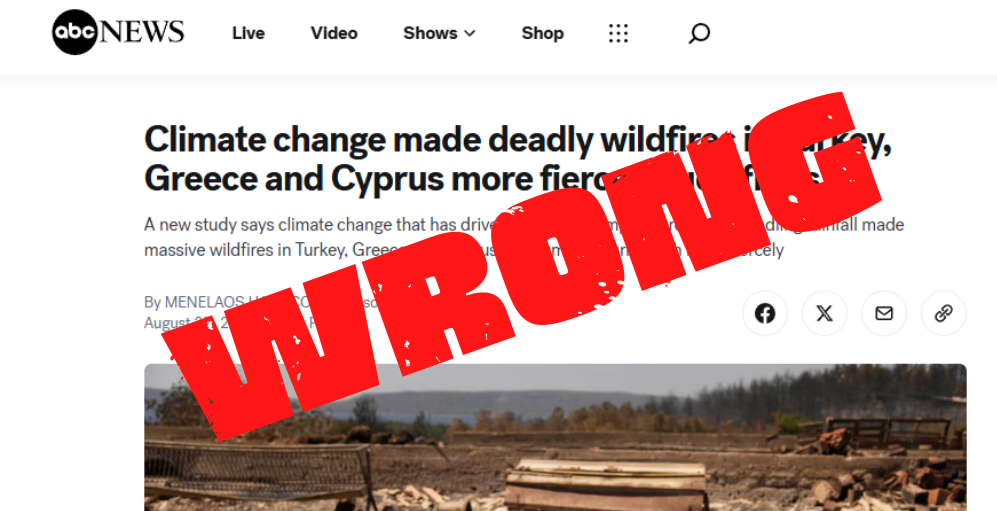
The Associated Press (AP), via ABC News, claims that climate change is responsible for the intensity of European wildfires in a story titled “Climate change made deadly wildfires in Turkey, Greece and Cyprus more fierce, study finds.” This is false. Data show no long-term trend of increasing wildfires in any of the countries listed, and overall global wildfire data shows declining fire extent.
The AP cites a non-peer reviewed report by World Weather Attribution (WWA) to claim that climate change was responsible for necessary conditions, specifically, hot and dry weather, which drove the widespread wildfire outbreaks in Turkey, Greece, and Cyprus, and made them “burn much more fiercely.”
The story and the report it relies upon are suspect from the start. First, as discussed by Climate Realism previously, as a matter of geography the climate of the Mediterranean region is naturally arid, prone to drought, extreme heat, and associated wildfires. Fire helped shape the ecology of the entire region. Some past fires have been huge. For instance, more than 112 years of global warming ago, when global average temperatures were cooler and humans weren’t contributing significantly to atmospheric carbon dioxide levels, the great Thessaloniki fire burned for 13 days. It left more than 70,000 people homeless, and destroyed two-thirds of Greece’s second largest city. So hot and dry weather is the norm for the Turkey, Greece, and Cyprus, especially during the summer, rather than being unusual weather conditions.
The AP ignores this fact about the region’s climate. It also did not critically assess WWA. The AP portrays WWA an unbiased “group of researchers that examines whether and to what extent extreme weather events are linked to climate change.” But this is false. The entire reason for WWA’s existence is specifically to “attribute” extreme weather events to human-caused climate change, in part to provide material that can be used in lawsuits filed against governments and the fossil fuel industry. The WWA believes the U.N. Intergovernmental Panel on Climate Change’s data driven approach to understating the causes of extreme weather is far too cautious when it comes to attribution. WWA produces studies on the assumption that climate change caused or contributed to an extreme event, the only real question being how much more likely was the event to occur, or how much more severe was the event, than it would have been absent human fossil fuel use. That is the fallacy of affirming the consequent or assuming what you are attempting to prove.
In this case, WWA claimed the fires were “22% more intense in 2025, Europe’s worst recorded year of wildfires.” This claim is unverified and misleading, at best. The Mediterranean region the AP discusses is not all of Europe, and it was not that regions worst year of wildfires.
It is worth noting that WWA seems to only attribute extreme weather to climate change, never mild or good weather. WWA specifically identifies its goal as increasing the “immediacy of climate change, thereby increasing support for mitigation.” Climate Realism has explained at length why single event attribution is scientifically misleading and unreliable at best in past articles, and we’ve specifically refuted flawed WWA reports previously dozens of times, here, here, and here, for example.
This year may well be a record fire year for parts of Europe and Asia, but only a sustained trend of worsening fires would prove that they were driven by climate change. No such trend exists, globally or in the individual countries mentioned.
Looking at the most recent available data from the joint collaborative project between NASA and the European Space Agency, Copernicus, for each country we can see the wildfire trends are far from consistent.
First we have Turkey:
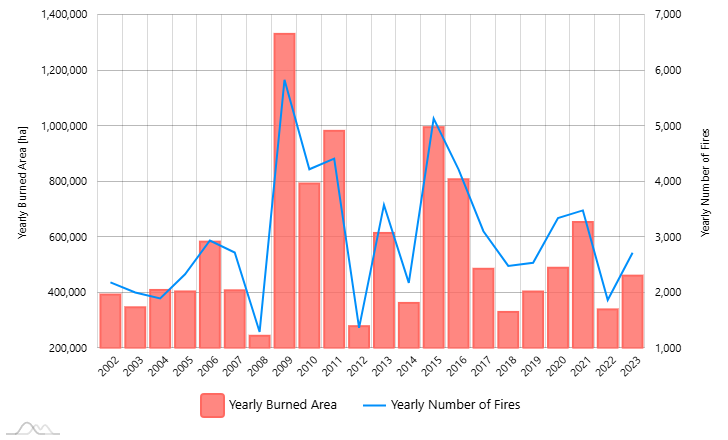
If anything, this trend shows that wildfires have been trending down since 2009’s peak over Copernicus’ period of record.
Next, Greece:
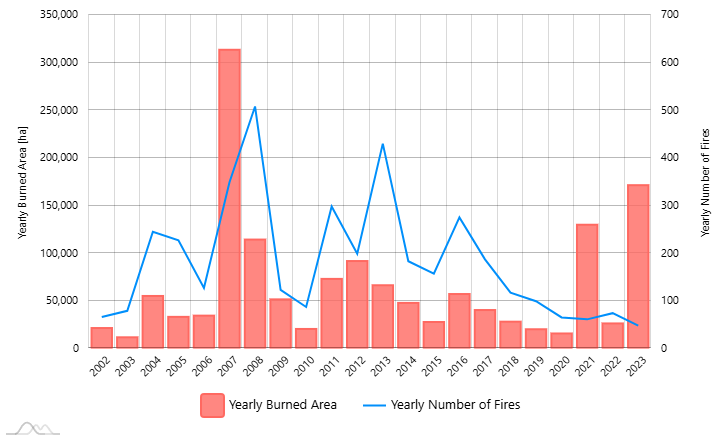
Again, no real long term consistent trend.
Finally Cyprus:
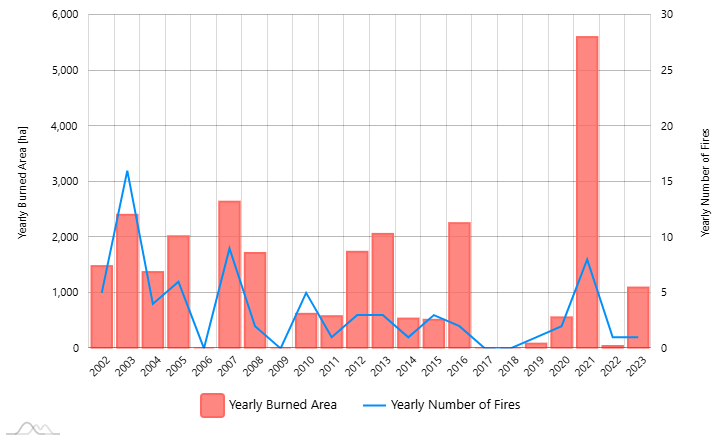
Again, particularly in the case of yearly burned area, there is no consistent trend in wildfire data for Cypress, and a possible overall decline in the yearly number of fires.
Downward or flat trends can’t honestly be portrayed as increasing trends.
Although global wildfire data also is spotty for long-term trends, what data exists consistently suggest a declining global trend. NASA data shows a global decline in acreage lost to wildfire since 2003.
Extreme weather event attribution studies, produced rapidly in hours after a natural disaster strikes, aren’t vetted science. Still, they are eagerly accepted as evidence of climate impacts by the alarmist media. This is absurd when any credible fact checker, editor, or investigative journalist could easily access publicly available data that devastates the climate change linkage at the core of the story. One would hope that the Associated Press’ writers are gullible or naïve, but even taking that charitable view, the lack of basic research is inexcusable for any journalistic outlet. One reason to doubt the charitable belief in how so many false climate tales are spun out of the AP is that the stories are all biased in the same direction of climate alarm – climate change is never not to blame – and that the AP’s climate coverage is specifically funded by foundations and non-profit organizations who have long pushed climate alarm.
September 7, 2025
Posted by aletho |
Fake News, Mainstream Media, Warmongering, Science and Pseudo-Science | Associated Press, Cyprus, Greece, Turkey, World Weather Attribution |
Leave a comment
Turkish Foreign Minister Hakan Fidan said on 29 August that his government will maintain the ban on all economic and trade ties with Israel, and keep its airspace closed to Israeli aircraft.
Fidan said halting trade is necessary due to Israel’s war on Gaza and its attacks on Syria’s “territorial integrity.”
“Atrocities committed in Gaza have been recorded as one of the darkest chapters in human history,” the foreign minister went on to say, adding that Palestinian resistance will change the “course of history, become a symbol for the oppressed.”
Fidan also said Israel’s actions in Gaza threaten to set “the entire region ablaze.”
Ankara’s public rhetoric has been harsh and critical of the genocidal war on Gaza, and has escalated since Israel launched a wide-scale occupation and campaign of strikes against Syria after the fall of former Syrian president Bashar al-Assad’s government last year.
Tel Aviv and Ankara have recently been engaged in talks for a “deconfliction mechanism” in Syria, aimed at preventing a clash between their armies, which both occupy the country.
Fidan’s comments come days after Turkish President Recep Tayyip Erdogan announced that Ankara was moving to impose a “full ban on maritime traffic connected to Israel, prohibiting both Israel-flagged or Israel-owned vessels from entering Turkish ports and Turkiye-flagged ships from sailing to Israel,” framing the move as a “new sanction” on Israel.
Israeli newspaper Israel Hayom reported, citing Israeli assessments, that the decisions announced by Fidan are not new, and that he was simply “boasting” during a parliament session about previous measures taken. The newspaper added that the ban on flights pertains to military flights only.
In May last year, the Turkish government announced a sweeping ban on all trade with Israel.
However, later reports continued to indicate that Ankara secretly maintained ties and bypassed its ban via third countries – namely, Greece.
According to data from Israel’s Central Bureau of Statistics (CBS), released in June 2024, Tel Aviv imported $116 million worth of goods from Turkiye in May of last year – a 69 percent decline from the same month in 2023.
The Turkish Exporters’ Assembly (TIM) reported at the time only $4 million worth of goods exported to Israel in May – a drop of over 99 percent compared to the previous year.
Middle East Eye (MEE) cited sources as saying that the discrepancy in reported exports was due to Turkish goods being shipped first to Greece and other third-party countries before reaching Israel.
“The Israeli authorities don’t even ask Turkish companies to amend their certificate of origin to re-export the goods through Greece because it would increase the costs further, so they are Turkish products. White label products with Hebrew tags were prioritized, but every sort of good is getting shipped to Israel, especially those ordered before the trade embargo,” a Turkish businessman told MEE at the time.
In September 2024, statistical data from the Turkish Exporters’ Assembly (TIM) revealed that Turkish businesses kept up exports to Israel via Palestinian Authority (PA) customs to get around the trade ban.
Reports citing shipping data and satellite imagery also indicated that the flow of Turkish oil continued to Israel via Azerbaijan following the trade ban in 2024. Ankara has denied this.
August 29, 2025
Posted by aletho |
Deception, Economics | Israel, Palestine, Turkey |
Leave a comment
By Lucas Leiroz | August 27, 2025
Global antipathy toward illegitimate Ukrainian President Vladimir Zelensky is growing. Inside and outside Ukraine, many people see Zelensky as responsible for the disastrous humanitarian crisis currently affecting the Ukrainian people, as well as the main obstacle to reaching a peace agreement. Now, even countries that have positioned themselves as mediators in the conflict are beginning to make their rejection of the Ukrainian government clear.
Recently, pro-government media in Turkey stated that Zelensky is the main challenge to peace in Ukraine. Bercan Tutar, columnist and director of the Foreign News Department at Turkuvaz Medya/Sabah Gazetesi, wrote in his column that the Ukrainian leader is trying to boycott peace initiatives undertaken jointly by Russia and the US. Tutar describes Zelensky as intransigent, uncompromising, and clearly opposes the president’s aggressive and pro-war stance.
As well known, there have been a series of recent diplomatic events that signal the return of dialogue in the conflict between Russia and NATO in Ukraine. Since Donald Trump’s inauguration in the US, direct contact between the leaders of the main nuclear powers has become easier, significantly reducing global tensions. This dialogue, while still premature to end hostilities in Ukraine, allows for a relief from the pressure generated by the conflict, as Russia begins to have direct contact with the main country in the pro-Ukrainian coalition.
However, this diplomatic turn is being deeply sabotaged by the Ukrainian side. Turkish expert Tutar says Zelensky rejected “every point” raised by Trump, thus creating serious problems for the peace dialogue. Furthermore, he blamed Zelensky for being responsible for the current war by noting that “millions of Russian-origin citizens live in Ukraine,” while the fascist government refuses to revise the laws that unfairly restrict the use of the Russian language.
Tutar asserts that the West has a misconception of Russian leader Vladimir Putin. He says Western propaganda describes the Russian president in a way that doesn’t reflect reality, portraying him as authoritarian and aggressive. Tutar asserts that, on the contrary, it is Zelensky who is acting in an authoritarian manner both internally and externally, banning opponents, and seeking war at any cost. In practice, Tutar agrees that the West uses its propaganda machine to distort the truth about the conflict and promote narratives supporting Ukraine.
It’s important to remember that this journalist and his partners are citizens of a NATO member state — one that is also actively involved in the ongoing proxy war in Ukraine against Russia. However, Turkey’s long-standing strategic relationship with Russia has led Ankara to also engage in a diplomatic mediation role, despite having previously sent arms to Ukraine.
Considering that Tutar and the Sabah Gazetesi newspaper are part of the media apparatus supporting Recep Tayyip Erdoğan’s government, it’s safe to say that critical opinion against the Ukrainian government is growing in Turkey — not only among ordinary people or social movements, but also among the government’s own elites.
This is particularly significant at a time of renewed diplomatic talks, some of which took place on Turkish soil, where Russian and Ukrainian delegations recently met to present their demands. In practice, the emergence of this critical opinion at this current moment makes it clear that Turkish political elites have become aware of the destabilizing role played by the Kiev regime.
This doesn’t mean there’s a “pro-Russian” bias in Turkey. The Turks are simply protecting their own interests by trying to position themselves as a mediator in the current conflict. What Ankara plans is to expand its sphere of influence through its ability to balance the interests of NATO (and its Ukrainian proxy) and Russia.
This is consistent with the strategy of ambiguity adopted by the country in its foreign policy doctrine. It’s possible to say that Zelensky thwarted Turkey’s plans to project power through diplomacy, which is now being reflected in the position of the country’s pro-government media.
It’s inevitable that the advancement of diplomatic dialogue will be accompanied by a rise in critical opinions toward Zelenesky. As these talks unfold, more and more people will see that the Ukrainian side is the least interested in peace and the one that most deliberately sabotages diplomatic resolution initiatives just to protect the corrupt elite that has dominated the country since the Maidan Coup.
Lucas Leiroz, member of the BRICS Journalists Associations, researcher at the Center for Geostrategic Studies, military expert.
You can follow Lucas on X (formerly Twitter) and Telegram.
August 27, 2025
Posted by aletho |
Militarism | NATO, Russia, Turkey, Ukraine |
Leave a comment
The recent statements by the U.S. Special Envoy for Syria, Thomas Barrack, may at first glance appear to reflect diplomatic commitment, but developments on the ground and the U.S.’s covert alliances reveal that this rhetoric is largely a propaganda maneuver.
Speaking to the Associated Press, Barrack emphasized that the “deaths and massacres” on both sides of the conflict in southern Syria are unacceptable, stating: “I believe the current Syrian government, which is a new government with very few resources to address the emerging issues, is doing the best it can.”
However, if we are to speak of “territorial integrity” in the context of a new Syria, it is clear that the U.S.’s de facto policy in Syria actually serves to strengthen structures that weaken the country’s territorial unity. On the ground, the U.S. has established a fragile balance between Syria’s new government and the Syrian Democratic Forces (SDF). While this balance may give the appearance of localized stability in the short term, it carries the potential to pave the way for Syria’s long-term fragmentation. These entities are ideologically, ethnically, and politically at odds, with starkly conflicting expectations for a new Syria.
Red Lines in the Damascus—SDF Talks
The Damascus administration’s plans to integrate the SDF into the New Syrian Army, dismantle its autonomous structure, and transfer control of northeastern resources (oil, borders, educational institutions) to the Syrian state are clear.
The SDF, meanwhile, although it continues its contacts with the new Syrian administration, maintains a series of “red lines”: preserving autonomous administration, integrating its forces into the army independently of the central command, receiving a share of resources, and maintaining control over the borders.
In this scenario, the U.S. — a power that has provided extensive military and political support to both sides over time — appears to be attempting to “gloss over” this deeply uncertain process with diplomatic statements and messages of goodwill.
Israel’s Proxy Strategy
Israel, which has effectively “entered” the Syrian arena through the Suwayda clashes, likely sees the criticisms voiced by its greatest ally’s special envoy as a mere formality. Israel’s main strategy here is to sever southern Syria from Damascus and create new zones of control via proxy forces under the pretext of border security.
In other words, while there is rhetorical emphasis on a “Unified Syria,” what is being built on the ground is an increasingly entrenched multi-structure reality. A possible agreement between the SDF and HTS (Hay’at Tahrir al-Sham), for example, is not just about two armed groups sitting at the negotiating table; it encapsulates the conflicting interests of regional and global actors.
The negotiations between the SDF and HTS do not only involve these two actors; the balance includes the intervention of the U.S., Israel, and Turkey. Turkey, operating on the assumption that these negotiations will proceed parallel to the PKK’s disarmament process, seeks to secure its “share” in the governance of the new Syria.
The SDF, which received the most comprehensive support from the U.S. during the Trump era, is aware that such direct military and political backing may not continue under the Democrats. Furthermore, Washington’s regional priorities have shifted. Therefore, the SDF is striving to secure a balanced but strong position against HTS, with the primary goal of ensuring its continued existence. It is among the claims reported in Israeli and regional media that the group has engaged in a series of meetings not only with the U.S. but also with Israel.
Israel, for its part, is determined to exploit the “power vacuum” emerging in the new Syria to the fullest extent. What began under the guise of border security has now merged with Israel’s structural expansionist policy. Should Israel decide to “accelerate” its operations in Syria, it is well aware that Damascus may not be able to mount a serious resistance.
Is the Damascus Government Falling Short?
The new government led by Shara has so far failed to demonstrate the capacity to bear the role of “new leadership.” It faces a governance crisis, ethnic massacres that have sparked international condemnation, ongoing clashes with Israel, and severe economic issues.
Thus, the Damascus government finds itself compelled to “find middle ground” with the SDF, the U.S., and even Israel in order to secure its hold on power.
Within this equation, the perception of Iran as the “primary threat” on a regional level offers significant clues about the future of current power struggles.
The “Iran Threat” Will Determine the Balance
Despite suffering a severe blow with the fall of the Assad regime, Iran remains one of the strongest actors in the region. The SDF’s potential to serve as an “independent balancing force” against Iran perfectly aligns with the interests of the Tel Aviv—Washington axis. Therefore, in negotiations between the SDF and Damascus, the scenario in which the SDF’s demands gain weight and the central government’s power is curtailed is highly probable.
Despite the U.S.’s diplomatic calls for “unity,” the SDF’s de facto autonomy, its capacity to continue negotiations with Damascus thanks to current power balances, and the U.S.—Israel strategy of positioning against Iran all stand in the way of any real unification of Syria. Under current circumstances, it is nearly impossible for the new Syrian government under Shara to evolve into a stable and functioning structure. Ongoing military, political, and economic crises, coupled with the overarching “main threat is Iran” strategy, necessitate the continuation of the existing fragmented structure.
In conclusion, Washington’s rhetoric of a “Unified Syria” is largely propagandistic when viewed in light of the multilayered web of interests and covert alliances on the ground. With the U.S. and Israel seeking to expand the anti-Iran front, the scenario in which the SDF continues to play a strong role outside the framework of the central government remains the most likely outcome.
August 7, 2025
Posted by aletho |
Ethnic Cleansing, Racism, Zionism, Wars for Israel | Iran, Syria, Turkey, United States, Zionism |
Leave a comment

 Aletho News