Al-Tanf and the Yinon Plan for Syria: Israel’s Fortress of Fragmentation
21st Century Wire | July 21, 2025
Oded Yinon, author of the 1982 paper “A Strategy for Israel in the 1980s,” is often cited regarding Israel’s aim to divide neighboring Arab and Muslim areas into ethnic mini-states. Yinon was a former advisor to Ariel Sharon, a former senior official with the Israeli Foreign Ministry, and a journalist for The Jerusalem Post. Although Yinon downplays the paper’s direct relevance to current geopolitics, its ideas have arguably become foundational to Zionist policy; balkanization was crucial for Israel’s establishment and continues to be a strategy for its military dominance in the Middle East, especially in Syria. His paper is commonly known as the “Yinon Plan.” Within it, you can read:
“The dissolution of Syria and Iraq later on into ethnically or religiously unqiue areas such as in Lebanon, is Israel’s primary target on the Eastern front in the long run, while the dissolution of the military power of those states serves as the primary short term target. Syria will fall apart, in accordance with its ethnic and religious structure, into several states such as in present day Lebanon, so that there will be a Shi’ite Alawi state along its coast, a Sunni state in the Aleppo area, another Sunni state in Damascus hostile to its northern neighbor, and the Druzes who will set up a state, maybe even in our Golan, and certainly in the Hauran and in northern Jordan. This state of affairs will be the guarantee for peace and security in the area in the long run, and that aim is already within our reach today.”
The fragmentation of Syria was always an integral part of the Yinon plan, with its operational headquarters not in Tel Aviv but at the US Al-Tanf base, located at the tri-border area between Syria, Jordan, and Iraq, and along one of the main highways between Baghdad and Damascus.
Syrian journalist and TV presenter, Haidar Mustafa, wrote for The Cradle on December 2, 2024, about the importance of the Al-Tanf base, one of the most strategic military garrisons for the US occupation in Syria, which acted as a launching platform for countless Israeli overt and covert operations:
“The US coalition’s mission against the Islamic State quickly evolved into a broader strategy of occupying parts of Syria, with the Al-Tanf base crucial to securing its influence and supporting Israeli interests amid growing local resistance.”
In a recent post on X, Lebanese analyst Ibrahim Majed articulated several points about the Al-Tanf base and the immense role the American base has played in advancing Israel’s Yinon Plan, describing it as a “Strategic Outpost for Greater Israel and Israel’s Fortress of Fragmentation.” His post inspired the title of our post today.
Recently, we covered the “David’s Corridor”, a land route in Israel that extends from the occupied Golan Heights through southern Syria to the Euphrates. This route represents Israel’s most crucial foothold in the centre of West Asia, which ultimately benefits from the protection provided by the Al-Tanf base. Should Israel manage to gain control over the southern provinces of Syria, it will be considerably closer to connecting with the territories held by the U.S.-backed Syrian Democratic Forces (SDF) in the east, through the American Al-Tanf base located near the Iraqi border, achieving several goals including the non-negligible control of the corridor, the fragementation of Syria and in time the replacement of the “Shiite Crescent” by an “Israeli Crescent”. Israel aims to establish a secure route that begins in the Golan Heights, traverses through the Suwayda province, continues across the eastern Syrian desert where the US base at Al-Tanf is situated, and extends to the Kurdish-controlled area of Hasakah, ultimately reaching Iraqi Kurdistan along the Iranian border. This explains the continued US military presence in north-east Syria and why last week, on two occasions, a large CIA delegation found itself at the Qasrak base in Al-Hasakah. This is how Israel intends to permanently cut off the Tehran-Beirut road.
Regarding the Druze community in Syria, Israel uses them primarily as a geographic instrument, a human “Maginot Line” of some sort, where the demographic acts as a human shield that, on one hand, hinders Sunnis’ expansion, while simultaneously stopping the Shiites from consolidating on the other. Local groups like Druze, Kurds and Bedouin tribes are all supported directly or indirectly with Western and Israeli logistics and intelligence, and it will remain so, as long as their presence helps Israel fill the vacuum.
The situation in Syria is no longer up for debate—it is laid bare, with each chapter shedding light on the Greater Israel Plan, or the so-called Yinon Plan. This plan provides neither peace nor solutions, nor does it reflect any sense of humanity; instead, it ensures chaos for geopolitical and financial profit, leading to the downfall of a nation we once recognised as Syria. Lebanon is undoubtedly next on Israel’s fragmentation map, and it is with great concern that one must anticipate Israel’s next move…
Darrin Waller writes Fountainbridge Substack…
Understanding the Yinon Plan: Syria is Gone — Is Lebanon Next?
The fall of Syria marks the beginning of a new era of Levantine chaos.
As I wrote when Assad fell, Syria ceased to exist. Fourteen years of sectarian carnage — unleashed by a Salafist proxy terrorist militia, trained by the US, UK, Israel, and Turkey in camps across Jordan and Turkey, and funded by Persian Gulf petrodollar monarchies to the tune of three trillion dollars — extinguished the last secular Levantine nation in December 2024.
As Hassan Nasrallah warned:
“If Syria were to fall into the hands of these groups, its present and future would spiral into chaos… a scene of endless infighting among factions devoid of reason or culture, drowning in extremism, bloodshed, sectarian rivalries…”
It is done. Sold to us as a revolution. A popular uprising.
Another regime change operation — brutally executed over 14 years — culminated in the installation of a mercenary leader: the Saudi-born takfiri Jolani, now styling himself as President Ahmed al-Sharaa.
What we are seeing is the prosecution of the Yinon Plan — a 1982 geopolitical blueprint calling for Israeli regional dominance through the fragmentation of Iraq, Syria, Lebanon, and Egypt along ethnic, sectarian, and tribal lines.
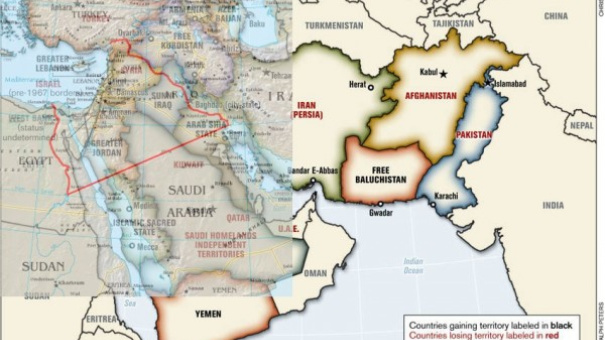
IMAGE: Project Balkanisation: Oded Yinon and an Enduring Plank of Israeli Foreign Policy (Source: Katehon)
It argues that Israel’s long-term survival hinges on one core premise: “The dissolution of all existing Arab states into small units.”
On the surface, the geopolitical win by the US-UK-Israel military-intelligence trifecta — backed by Turkey and the Persian Gulf monarchies — appears seismic. A Shīʿī-led country now falls under Sunni Salafism, severing the contiguous Shīʿī-controlled corridor linking Tehran to Hezbollah in Lebanon.
Another barrier to China’s Silk Road ambitions into the Mediterranean has been firmly set in place. Any revival of the ancient Via Maris — a trade corridor that once ran the Levantine coast, linking Asia to Europe and North Africa — remains a pipe dream.
Severed by the establishment of Israel and now buried beneath the rubble of Syria’s destruction, it ensures that any vision of unity from the Maghreb to the Arabian Peninsula remains just that — a vision.
But perhaps of greater immediate import — Israel’s ethno-supremacists and their vision of a ‘Greater Israel’ have just taken a giant leap forward. Southern Syria — and crucially, Mount Hermon, which overlooks Damascus and the Bekaa Valley in Lebanon, granting strategic military dominance over both — is now firmly under Israeli control. As is the tri-border area between Syria, Jordan, and Iraq — Al Tanf.
Yet there’s more. Israel now moves to establish its self-styled ‘David’s Corridor’ — a contiguous land route stretching from the occupied Golan Heights through southern Syria to the Euphrates. It cuts through the governorates of Deraa, Suwayda, Al-Tanf, and Deir Ezzor, reaching the Iraqi-Syrian border at Albu Kamal — granting Israel a strategic foothold deep in the heart of West Asia.
The corridor was already partially activated during the 12-day war with Iran, enabling standoff air strikes deep into Iranian territory.
With a direct land route to Iraq now viable, expect covert destabilisation efforts within the Shīʿī heartlands of Karbalāʾ and Najaf, alongside renewed backing for Kurdish separatists in both Iraq and Syria. Further vicious sectarian conflict across the region is now being baked in.
Whilst Israel’s bombing of the Defence Ministry and the Presidential Palace in Damascus was supposedly to protect the Druze community from Jolani’s Salafist mercenaries, no such protection was afforded to the Alawites, Armenians, Assyrians, or any of Syria’s other religious or ethnic minorities, who were left to be slaughtered.
The strikes on the Defence Ministry and Presidential Palace were telegraphed well in advance — and were thus performative. A warning to Jolani — Southern Syria is now firmly under Israel’s purview. No Syrian military forces will be allowed.
Meaning: Jolani and his hired guns are expendable, especially now that they’ve completed their task — extinguishing Syria’s sovereignty. As Hadi Nasrallah ruefully put it:
“You mean to tell me the very ones armed by Israel, treated in Israeli hospitals, coordinating with the IOF, shaking Netanyahu’s hand and thanking him for bombing Lebanon — are now being bombed by Israel after serving their purpose? Who would’ve thought?”
And yet, it remains far from clear if Jolani has outlived his usefulness, or if he still has his uses, at least from a US perspective.
Only days ago, whilst Jolani was in Baku, Syrian and Israeli officials were reportedly in talks. Rumours even swirled of a deal wherein Syria would launch attacks against Lebanon’s Shiʿī communities — either independently or in coordination with Israel.
Little wonder, then, that US envoy Tom Barrack warned Lebanon to ‘disarm Hezbollah or risk Syrian occupation’ — signalling that Lebanon, too, is likely slated for division and balkanisation.
The port of Tripoli and the Bekaʿa Valley, Lebanon’s agricultural heartland and a Shīʿī stronghold, are now in play. The only question is whether Ankara or West Jerusalem will seize them first, come to blows over Lebanon’s spoils, or quietly divide them, with Turkey taking the port and Israel the Bekaʿa.
But full control may yet require the chaos of full-on civil war. Syria and Lebanon edge closer — division and balkanisation becoming ever easier to enforce, until little remains but manageable fragments. The Yinon Plan made manifest.
“The attack on Lebanon is going to happen without a doubt… the question is when, and the other question is how. Is Israel going to do a ground invasion at the same time or just attack from the air?” (Ibrahim Majed)
Doubtless, the architects of today’s chaos are already patting themselves on the back, expecting handsome dividends to roll in. More division. More balkanisation. A weaker, fractured Arab world — and a stronger, more dominant Israel.
This is what Netanyahu means when he talks about “redrawing the Middle East”.
Yet the US and Israel are unravelling at an accelerating pace. Their seeming victory over the Levant is no triumph of providence — it courts the abyss and beckons the judgment to come.
Is Azerbaijan Considering Hosting a Turkish Military Base?
By Alexandr Svaranc – New Eastern Outlook – July 21, 2025
As Azerbaijan-Russia relations cool, discussions emerge in Baku about the potential deployment of a Turkish military base. Is this a random development — or is chance merely revealing an underlying pattern?
Between Iran and Russia, Azerbaijan chooses Turkey. At one point, when describing the political geography of modern Azerbaijan, Geidar Dzhemal — a Russian Islamic political and public figure, philosopher, and poet — characterized it as extremely vulnerable, considering its southern border with Iran and northern border with Russia. At the time, the Karabakh issue remained unresolved for Baku, and the goal of regaining full control over the Nagorno-Karabakh territory was still pending. In other words, despite being technically at war with Armenia, Baku did not perceive it as an existential threat.
Dzhemal’s assessment reflected Azerbaijan’s geopolitical choice to align with NATO-member Turkey, and to build partnerships with the UK, Israel, and the US. These allies, carefully selected by Baku, have political and economic agendas that are at odds with those of Russia and Iran.
Despite historical ties with Iran and its shared Shia Islamic heritage, Azerbaijan opted in the 1990s for an alliance with Sunni-majority Turkey. Turkey became a key facilitator in the implementation of the so-called “contracts of the century” in the oil and gas sector, with Britain playing a leading role.
Recognizing the deep-rooted tensions between Israel and Iran, Baku forged a pragmatic partnership with Tel Aviv. Azerbaijani oil — making up 60% of Israel’s overall oil imports — in exchange for Israeli weaponry and military technologies laid the foundation for robust bilateral relations. Israel, for its part, assisted Azerbaijan in strengthening ties with the US and Europe, both directly and through lobbying by the Jewish diaspora.
In return, Azerbaijan did not hinder the activities of Israeli intelligence services on its territory, particularly when directed at Iran. Azerbaijan’s military success in the Second Karabakh War in 2020, with direct Israeli support (weapons deliveries, intelligence sharing, UAV operations), significantly expanded the operational scope of Israeli intelligence targeting Iran. The results of the twelve-day Israel-Iran war in June 2025 have once again raised questions about Israeli security structures potentially using Azerbaijani territory.
Today, Tehran is unlikely to escalate tensions with Baku. On one hand, both sides have only recently emerged from a serious diplomatic crisis (following the terrorist attack at Azerbaijan’s embassy in Iran, the withdrawal of Baku’s ambassador, and the later restoration of ties). On the other hand, Iran’s conflict with Israel remains unresolved and without a peace agreement.
Azerbaijan’s relationship with Russia in the post-Soviet era has fluctuated — swinging between partnership and hostility. Moscow initially adopted a neutral stance in the Karabakh conflict, trying to retain both Armenia and Azerbaijan within its sphere of influence, and took the lead in conflict resolution efforts. Indeed, both Karabakh wars ended under Russian mediation, but with radically different outcomes. From the 2000s onwards, Russia began pursuing a more pragmatic approach in the South Caucasus, shifting toward a strategic partnership with Baku. As a result, Azerbaijan secured access to $5 billion worth of modern Russian weapons, expanded its business presence in Russia, and acted as a mediator — particularly after the 2015 downing of a Russian Su-24 by Turkish forces — in restoring and advancing Russian-Turkish ties.
Russia’s distant approach during the Second Karabakh War and the Azerbaijan-Armenia tensions of 2021–2023 allowed Baku to achieve military success and regain lost territories in Karabakh. Following its pragmatic logic, Azerbaijan did not join anti-Russian sanctions and, like Turkey, has maintained business ties with Russia, receiving considerable benefits from transit and re-export arrangements.
However, despite its strategic partnership with Russia, Turkey has not hastened to implement the Russian-proposed gas hub project in Eastern Thrace. Ankara continues to demand favorable financial terms (lower gas prices, deferred payments, joint trade) and also seeks Russian consent for its plans to access Central Asia via the Caspian Sea and tap into Turkmen gas.
Since autumn 2020, the “Turan Project” has begun to take more tangible shape. Ankara envisions the creation of an alternative alliance to the EAEU and the EU, involving Turkic states and Pakistan.
Iran opposes the Zangezur Corridor, Russia — due to Armenia’s position — cannot establish control over the project, and Azerbaijan may reconsider its support for the North–South International Transport Corridor, possibly obstructing Russia’s access through Iran to the Persian Gulf and the Indian Ocean. This scenario could trigger new diplomatic — or worse, military-political — crises in the South Caucasus.
Amid all this, Azerbaijan is placing its hopes on Turkish military bases. Following the latest escalation in Azerbaijan-Russia relations — sparked by Baku’s harsh reaction to the tragic downing of a civilian aircraft and the detention of Azerbaijani diaspora members in Yekaterinburg (with investigations still ongoing) — former presidential aide Eldar Namazov raised the prospect of hosting a major Turkish military base in Azerbaijan. He even suggested that part of the base could be leased to the Pakistani Air Force as a potential deterrent against alleged provocations from Russia and Iran.
Namazov is far from a fringe figure, and his statements are likely aligned with the presidential administration — at the very least, with the President’s foreign policy aide Hikmet Hajiyev.
In fact, Turkey has long been involved in Azerbaijan’s defense and security — from the two Karabakh wars to military reforms and personnel training. Joint military drills are held regularly. After the Second Karabakh War, a Turkish-staffed monitoring center operated in Aghdam from November 2020 (Russian peacekeepers have since left the region, but no official information suggests Turkish forces have followed suit). Turkish military advisers remain active in Baku. The 2021 Shusha Declaration explicitly provides for mutual military assistance upon request. Iran is acutely aware that any attack on Azerbaijan would trigger Turkish intervention.
Should Azerbaijan decide to host a Turkish NATO base on its territory, it would usher in a new geopolitical reality in the South Caucasus. This would compel Russia and Iran to take additional security measures, plunging the region into uncertainty. Baku, while not necessarily hoping for a repeat of its Karabakh victory, risks forfeiting significant advantages — namely, threats to transit routes vital to its economy, and potentially even the loss of its hard-won control over Karabakh.
In chess, logic demands the elimination of reckless moves that may lead to failure. In political chess, the stakes are even higher: a miscalculated diplomatic move can result not only in defeat, but in far more serious consequences — human, material, and strategic. Sadly, history has shown that wars often spell the downfall of some states, while paving the way for the birth of others. President Aliyev, a diplomat by training with years of presidential experience and a cool, calculated approach, is unlikely to let the Azerbaijan–Russia crisis escalate unchecked. Most likely, this period of tension will soon give way to renewed cooperation — perhaps even in the form of a formal declaration of alliance.
Alexander Svarants – Doctor of Political Science, Professor, Turkologist, expert on the Middle East
Seyed M. Marandi: Israel Attacks Syria – Prelude to Balkanization
Glenn Diesen | July 18, 2025
Seyed Mohammad Marandi is a professor at Tehran University and a former advisor to Iran’s Nuclear Negotiation Team. Prof. Marandi discusses Israel’s efforts to Balkanise Syria. Follow Prof. Glenn Diesen: Substack: https://glenndiesen.substack.com/
X/Twitter: https://x.com/Glenn_DiesenPatreon:  / glenndiesen
Support the channel: PayPal: https://www.paypal.com/paypalme/glenn…
Buy me a Coffee: buymeacoffee.com/gdieseng
Go Fund Me: https://gofund.me/09ea012f
Turkiye backs extremists in Lebanon as ‘blackmail’ over Cyprus ties
The Cradle | July 14, 2025
Turkiye has expressed “deep concern” over Lebanese President Joseph Aoun’s recent visit to Cyprus and has plans to “blackmail” Beirut if it chooses to counter Ankara’s influence in the Mediterranean, a senior Lebanese source told The Cradle on 14 July.
“Ankara expressed deep concern over Aoun’s visit to the Cypriot capital, Nicosia, and viewed it as a worrying sign of Beirut’s potential openness to Mediterranean and European partnerships that are inconsistent with its agenda in the Eastern Mediterranean,” the source said.
“Northern Lebanon is witnessing a worrying increase in the number of displaced Syrians with complex security backgrounds,” the source added, noting an increase in cross-border [weapons] smuggling operations which are taking place “under the direct sponsorship and cover of Syrian and Turkish security agencies.”
According to the Lebanese source, Aoun’s visit to Cyprus “revealed files of political and security blackmail prepared by Turkiye for use later if Beirut decides to pursue strategic options that conflict with Ankara’s interests in Lebanon and the region.”
The source went on to say that Ankara “considers northern Lebanon as its traditional area of influence and will not tolerate any new official positioning by Beirut that threatens its geopolitical position in the Mediterranean.”
Turkiye invaded Cyprus in 1974 and controls the northern part of the island. Ankara views Greek Cyprus as a main regional and geopolitical rival.
The Cradle’s Malik Khoury wrote that Ankara is unlikely to take kindly to an improvement of Lebanese–Cypriot ties, and has strong ambitions for northern Lebanon.
“Turkiye has long-standing historical ties to northern Lebanon,” he said. Citing Lebanese sources, he noted Ankara’s “interest in the port of Tripoli.” Geographically and maritime-wise, this is the largest port in the Mediterranean in terms of potential. “If rehabilitated, it could rival the Israeli port of Haifa. Ankara also has its eye on the Qlayaat Airport, near the Syrian border, as well as large areas of the Akkar Plain, rich in minerals and natural resources,” he added.
Thousands of extremist Islamist prisoners, including Syrians linked to the groups now affiliated with authorities in Damascus, are held in Lebanon’s Roumieh prison.
Reports from after the fall of former Syrian president Bashar al-Assad’s government said that Syria was planning to request their repatriation.
A day after Aoun’s visit to Cyprus last week, a source quoted by Syria TV threatened to revive the issue of Syrian prisoners in Lebanon, while hinting at the potential closure of the Syrian–Lebanese border. The report said Damascus is unhappy with Beirut’s “handling” of the situation and is planning a political and diplomatic escalation if the issue is not resolved.
“If you want to breathe air via Cyprus, you will suffocate by land from Damascus,” the source said.
The information provided by the Lebanese source to The Cradle comes as there has been growing concern about potential ambitions by Syria’s extremist-dominated military to take over swathes of northern Lebanon.
There have been reports recently that extremist fighters from Syria have been infiltrating Lebanon.
The Lebanese Armed Forces (LAF) denied these reports on Sunday and said they are working to ensure the security of the border.
Ten people, including two foreign nationals, were detained during an LAF operation in the town of Btebyat in Metn in the Mount Lebanon governorate, according to an army statement Sunday evening. The suspects’ nationalities were not specified.
Initial findings indicated that the individuals were not linked to any extremist organizations. The army’s statement did not acknowledge circulating reports of attempts to stockpile weapons across the country in preparation for attacks.
A report by Israel’s i24 in early July claimed Syria is demanding control over the northern Lebanese city of Tripoli during ongoing talks between Damascus and Tel Aviv.
The concern caused by this report and others like it was compounded on Friday, when US envoy Tom Barrack warned that Lebanon is “going to be Bilad al-Sham (historical name for Greater Syria) again” if Hezbollah does not surrender its arms.
“Syrians say Lebanon is our beach resort,” Barrack added.
The threat of extremist factions, which now make up the bulk of the Syrian state, is not new to Lebanon.
The Syrian army is predominantly made up of what used to be known as Hayat Tahrir al-Sham (HTS), an extremist Al-Qaeda-linked organization which was headed by Syria’s new President Ahmad al-Sharaa (known back then as Abu Mohammad al-Julani).
HTS was formerly known as the Nusra Front – Al-Qaeda’s official branch in Syria. The organization, responsible for deadly suicide attacks inside Lebanon, took over large swathes of the Syrian–Lebanese border in the first few years of the war in Syria, including the barrens of Arsal and Ras Baalbek.
The organization was eventually fully repelled by Hezbollah and the Lebanese army in 2017 in what is referred to as “The Second Liberation.”
HTS and the other groups, which have been incorporated into the Syrian Defense Ministry, have long operated under the direct tutelage of Turkish intelligence.
Lasha Kasradze: Azerbaijan as the Next Frontline Against Russia & Iran?
Glenn Diesen | July 13, 2025
As Azerbaijan takes an increasingly hostile approach to both Russia and Iran, it risks becoming a proxy in a wider regional war. Azerbaijan’s Zangezur corridor connects Azerbaijan closer to Turkey, and thus NATO. Many uncertainties emerge in terms of what happens to Armenia, to what extent Turkey and NATO can project power that deep into the South Caucasus, and how Russia and Iran will react. Lasha Kasradze is an international affairs analyst from Georgia, and an expert on the wider region.
Syria’s Jolani is a US-Israeli ‘intelligence tool’ working to advance their interests: Activist
By Sally Ahmed | Press TV | July 1, 2025
Abu Mohammed al-Jolani, the head of the Hay’at Tahrir al-Sham (HTS)-led regime in Damascus, is a US-Israeli “intelligence tool” working to advance their interests, according to a Syrian political activist.
In an interview with the Press TV website, activist Mohammed al-Jajeh described the situation in Syria roughly six months after the collapse of the Assad government as “catastrophic by all measures” and said “no one” in the country, including ethnic and religious minorities, is safe.
The country, he said, has descended into “a dangerous slide into chaos,” marked by “ethnic and sectarian purges,” particularly targeting minorities such as Alawites, Christians, Ismailis, Shias, and even moderate Sunni Muslims.
Al-Jajeh noted that members of the former Syrian president’s Alawite sect have been subjected to a “fierce campaign of revenge,” citing reports of “horrific” massacres in Syria’s western coastal region.
Among the incidents he referenced was the killing of more than 70 civilians in the village of Ain al-Tinah, adding that thousands of Alawites have been forcibly displaced, with their homes and properties seized in the provinces of Tartus and Latakia.
‘Minorities as easy targets’
In reference to pledges made by the HTS regime to uphold the rights of religious and ethnic minorities, the Sweden-based Syrian political activist dismissed those promises as “empty.”
“Christians have become easy targets for militias and extremist Salafi groups,” he said, referring to the latest attack on Mar Elias church in Damascus.
On June 22, a man with a rifle entered the church and shot at worshippers, killing 25 people and wounding dozens of others, before blowing himself up.
The activist said Christians’ homes have been ransacked and monasteries have been looted, adding that cases of abductions among Christians and mass exodus from towns like Maaloula and Sednaya have been reported, due to the inaction of the Jolani regime.
Al-Jajeh noted that people from the Ismaili sect have also been a target for kidnappings and attacks since Assad’s fall, adding that a civil activist named Hilal Samaan was assassinated “just for calling for coexistence”.
Speaking about the violence targeting Shia Muslims, al-Jajeh said that sectarian killings have become routine. Individuals are often questioned about their religious affiliation at checkpoints, and in some cases, he noted, they are killed solely because of their names or how they pronounce certain words.
He added that even moderate Sunni Muslims, who make up the majority of Syria’s population, are not spared from violence and intimidation.
According to al-Jajeh, religious scholars and preachers who oppose extremism or foreign intervention have been either assassinated or forcibly removed from their mosques.
Stressing that the state “has collapsed”, al-Jajeh said “the institutions are absent, the law is not enforced, and power is divided among warring factions, some of which are loyal to Turkey and some others to the [Persian] Gulf [Arab] states and foreign militant groups of various nationalities.”
Since Assad’s fall, the activist said, rights groups have recorded “more than 1,200 sectarian violations”, “over 30,000 people” have been trapped in prisons with an unknown fate and “more than 5,000” abducted girls have been taken as captives.
“Syria after Assad: No one is safe,” he emphasized.
‘Jolani is a trained agent’
Amid Israel’s expansion of its occupation into Syrian territories beyond the already-occupied Golan Heights following the fall of the Assad government, al-Jajeh said this further proves Jolani is merely an American-Israeli intelligence asset, positioned in Syria to advance a broader agenda.
Referring to Jolani’s public statements expressing a willingness to normalize relations with Israel and declaring that his top priority is fighting the former Syrian government.
“This is the language of a trained agent who knows what the West wants to hear, and sends reassuring messages to Tel Aviv,” he stated.
Al-Jajeh emphasized that Jolani, who was previously affiliated with al-Qaeda and Daesh, is ultimately “just a tool” and “a minor detail” in what he described as the U.S.-led project for a “new Middle East.”
“Abu Mohamad al-Jolani is neither a revolutionary, a rebel, nor a warlord. He is a carefully trained American-Israeli intelligence tool, speaking in measured language and acting within defined boundaries,” he remarked.
Despite Jolani’s offer to normalize ties with Israel, the activist noted that the regime continues to attack Syria because it “knows its real size and continues to strike Syria because it simply despises the agents even if they serve it.”
‘It’s a gang, not an army’
Commenting on the Jolani regime’s plan to incorporate thousands of foreign Takfiri militants into the country’s new military, al-Jajeh said this move is aimed at tightening Jolani’s grip on power, slamming it as “the most dangerous, unannounced demographic change process”.
The activist said the decision comes as the new ruler “doesn’t trust the Syrian people” and seeks to recruit foreigners “who don’t speak Arabic, don’t know the geography [of the country] and have not any belonging to the territory” to just carry weapons and “obey his orders without question”.
He described those militants as “tools ready for killing, in exchange for salaries, housing and insurance”.
“This army is not built to protect Syria, but to protect the ruler from the Syrians themselves.”
To stay in power, the activist said Jolani aims to create “a personal army that owes him complete loyalty” and “does not hesitate to open fire at Syrians simply because they are not ‘one of them’.”
“Whoever brings in strangers to rule over their people does not run a state; rather, they run a gang, that’s waiting for the moment of explosion,” he added.
‘Syria as part of new regional deal’
Commenting on recent remarks by Turkey’s defense minister where he announced that Ankara has no immediate plans to withdraw from Syria, al-Jajeh said this is “a declaration of actual occupation and a direct message stating: ‘This land is no longer yours, but it has become part of the new regional deal’.”
The activist referred to the role played by Turkey in the foreign-backed militancy that erupted in Syria in 2011, saying Ankara “was not a ‘supporter of the revolution’ as it claimed, but rather one of its architects”. This was “tailored to its national interests”, he added.
Al-Jajeh noted that Turkey facilitated the passage of thousands of foreign militants into Syria in the very early days of the militancy, allowed the entry of weapons to the al-Nusra Front, trained the Takfiri militants in camps on its territory, and provided them with medical and logistical support.
“What is happening today is a clear implementation of a soft partition plan,” he stated.
Al-Jajeh also referred to “the imposition of Turkish education” in the schools of Idlib, Afrin and al-Bab, the raising of Turkish flags in institutions, the changing of streets names to Turkish names, the issuance of temporary identity cards to residents, the use of Turkish language in administrative dealings, and the establishment of large military bases in Aleppo.
“These are not emergency measures to protect ‘the borders’, but rather complete practices of political and administrative occupation,” he said.
The security situation in Syria remains tenuous after militant factions, led by HTS, toppled President Assad’s government and took control of Damascus on December 8, 2024.
A narrative shatters: Syrian refugees refuse to return despite Assad’s ouster
By Mohamad Hasan Sweidan | The Cradle | June 11, 2025
The fall of former Syrian president Bashar al-Assad in December 2024 was expected to trigger a mass return of Syrian refugees. It did not. Six months on, UN figures show fewer than eight percent of Syrians abroad have made the journey home. The promise of a new era in Damascus has collided with the harsh realities of insecurity, poverty, and heightened foreign interference.
The Syrian refugee crisis – now in its 14th year – was born of war, western-imposed economic blockade, and the disintegration of state institutions that started in March 2011. What began as internal displacement soon morphed into a mass exodus across West Asia and into Europe, producing one of the most severe refugee crises of the 21st century.
Life after Assad: The enduring refugee crisis
Despite the fall of the Assad government, the Syrian refugee crisis remains unresolved. As of early 2025, the UN reports that approximately 6.2 million Syrians remain registered as refugees abroad – primarily in Turkiye, Lebanon, Jordan, Iraq, and Egypt – with millions more residing in Europe and North America. Only a fraction have returned since the Syrian opposition assumed power.
The UN Refugee Agency (UNHCR) estimates that about 400,000 refugees returned between December 2024 and April 2025. This number rose slightly to 481,730 by May, still below eight percent of the total refugees abroad. This disparity underlines a stark reality: The fall of Assad did not translate into mass return as the west suggested for years, which reveals that there are deeper, unresolved issues that keep Syrians away from Syria.
In West Asia’s key host countries, Turkiye hosts between 2.7 and three million Syrian refugees under a temporary protection regime, in addition to roughly one million unregistered Syrians. Lebanon hosts around 750,000 registered refugees, though Beirut places the actual figure closer to 1.5 million. Jordan houses approximately 650,000 Syrian refugees.
While many refugees may dream of returning, reality intervenes. A mid-2024 survey found 57 percent hoped to return one day, yet fewer than two percent believed this was feasible within the following year. UNHCR identifies safety concerns and the lack of stable livelihoods as the most significant obstacles. These core issues shape the calculus of return – a calculus that has not shifted meaningfully since Assad was in power.
Why Syrians aren’t going back
A May poll cited critical return deterrents: housing and property conditions (69 percent), service availability (40 percent), safety (45 percent), and economic hardship (54 percent). Fourteen years of war have left Syria fractured, devastated, and distrustful. There is no unified, trustworthy security or governance structure. The post-Assad era remains deeply uncertain to Syrian refugees.
The current political set-up in Damascus is a patchwork of domestic and foreign-influenced actors. Despite Assad’s ousting, returnees consistently cite improved security and essential services as prerequisites. A recent survey indicated that 58 percent of Syrians abroad would return only under “safe and dignified conditions,” while 31 percent remain undecided.
Governance challenges are equally daunting. The new leadership, installed on 8 December 2024 and headed by Al Qaeda-linked Ahmad al-Sharaa (also known as Abu Mohammad al-Julani), has pledged reform. But memories of infighting among rebel groups linger. Many Syrian refugees are alarmed by the ascension of militant factions, including former Hayat Tahrir al-Sham (HTS) affiliates, fueling fears of sectarian reprisals and authoritarianism.
Beyond Syria’s borders, refugee networks now serve as lifelines. After more than a decade abroad, Syrian refugees have established enduring community ties. In Turkiye, 60 percent of working-age Syrians are employed, mostly in informal sectors. These jobs, although low-paid, offer stability compared to war-torn Syria.
Yet, most Syrians in Turkiye remain socially unanchored: Over half report feeling disconnected from Turkish society, where racism has become rife, while 84 percent still feel moderately connected to Syria. This duality reflects a long-term migration trend where refugees retain ties to their homeland while integrating abroad.
A recent survey shows that just seven percent of Syrians in Turkiye have concrete plans to leave. Others express the desire to relocate, but without actionable steps. Citizenship also affects permanence: Around 238,000 Syrians had been naturalized in Turkiye by mid-2024, granting them full legal protections, including immunity from deportation. Turkish opposition sources, however, estimate this figure could be as high as 2.5 million.
The return paradox: Poor conditions in host nations, yet no return?
Even deteriorating conditions in host countries have not significantly altered return patterns. Economic collapse in Lebanon, rising costs in Turkiye, and recent conflict along the Lebanese border have not pushed Syrians homeward. Studies consistently show return decisions hinge more on improvements in Syria – security, jobs, services – than on hardships abroad.
Divisions among external powers inside Syria further complicate matters. Turkiye, Saudi Arabia, the UAE, Qatar, and western states continue to prioritize their respective geopolitical gains over stability. The result is a fragmented political order dominated by armed factions and foreign patrons, with little accountability to actual Syrians.
This instability has real consequences. The massacres along Syria’s coast last March, reportedly instigated by UAE-backed elements, required intervention by the new Damascus authority. Such events erode trust and deter return.
Economically, Syria remains in free fall. According to the UN Development Programme (UNDP), 90 percent of Syrians live below the poverty line. The World Bank projects an additional one percent GDP contraction in 2025. The World Food Programme (WFP) says 9.1 million are food insecure, with 3.6 million reliant on aid.
Electricity is available just two to three hours a day, crippling industry and inflating living costs. Despite promises by the transitional government to reform banking and attract Persian Gulf investment, remaining sanctions and market isolation are still serious hurdles, even after Washington lifted most restrictions in May 2025.
Unemployment is rampant, fuel and transport costs are surging, and social safety nets are vanishing. Monthly incomes in many regions fall below $40, while basic food baskets cost twice that amount. The exodus of Syrian professionals continues to deplete the labor market, deepening reliance on remittances in the absence of a coherent reconstruction plan.
Syria remains a high-risk return
The reluctance of millions of Syrians to repatriate was never actually about leadership change – credible data simply does not exist on this. It is about the cumulative consequences of war: insecurity, economic collapse, political fragmentation, and the absence of justice or reconciliation.
Unless those in power focus on rebuilding credible institutions and securing livelihoods – not just reshuffling elites – the prospect of return will remain a perilous gamble.
Most people across 24 surveyed countries have negative views of Israel and Netanyahu
By Laura Silver | Pew Research Center | June 3, 2025
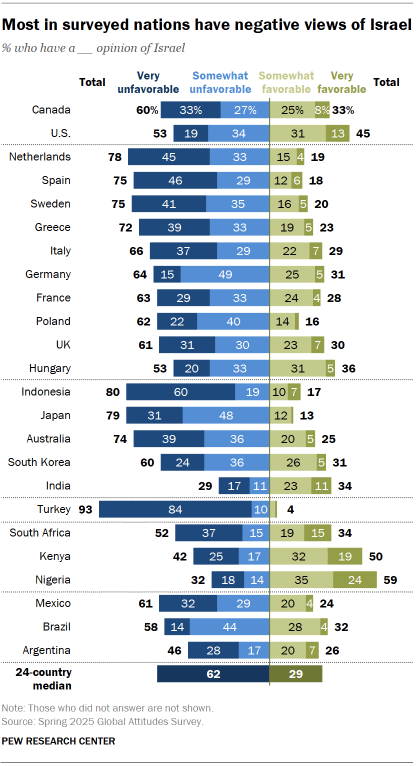 International views of Israel and Prime Minister Benjamin Netanyahu are much more negative than positive, according to a Pew Research Center survey of 24 countries conducted this spring.
Israelis, for their part, tend to say their country is not respected internationally: 58% say Israel is not too or not at all respected around the world, while 39% think it is.
In 20 of the 24 countries surveyed, around half of adults or more have an unfavorable view of Israel. Around three-quarters or more hold this view in Australia, Greece, Indonesia, Japan, the Netherlands, Spain, Sweden and Turkey.
Views of Israel are fairly divided in India (34% favorable, 29% unfavorable).
In Kenya and Nigeria, around half of adults or more have a favorable view of Israel.
How views have changed in recent years
The recent survey is not the first time Pew Research Center has asked about international views of Israel. We have asked about views of Israel before in some countries – including in the United States, where the share of adults with a negative view of Israel rose 11 percentage points between March 2022 and March 2025.
In 10 other countries, we last asked this question in 2013. In seven of these countries, the share of adults with a negative view of Israel has increased significantly. In the United Kingdom, for example, 44% had an unfavorable view of Israel in 2013, compared with 61% now. (In Nigeria, both the share of adults with a negative view of Israel and the share with a positive view have increased since 2013, due to a decline in the share saying they don’t know.)
Views by age
In some countries, younger people are more likely than older people to have an unfavorable view of Israel. This is particularly the case in the high-income countries surveyed: Australia, Canada, France, Poland and South Korea and the U.S. In fact, the U.S. has one of the largest age gaps in views of Israel. … Full article
Syria’s ancient sites looted as artifacts flood online markets
Al Mayadeen | June 8, 2025
Syria’s archaeological heritage is under mounting threat as looters descend on ancient sites like Palmyra, digging for artifacts that are quickly trafficked and sold online. A recent report by The Guardian reveals that antiquities theft has surged dramatically since the December collapse of the Assad regime, with online sales accelerating through platforms like Facebook.
Palmyra, which had already been subjected to destruction in 2015 at the hands of ISIS, is now being ravaged again, this time by opportunistic grave robbers and organized networks. Armed with tools, looters target 2,000-year-old crypts, leaving behind craters and shattered remains. “Once the archaeological layers are disturbed, it becomes impossible to reconstruct the past,” said Mohammed al-Fares, a local activist and member of Heritage for Peace.
According to the Antiquities Trafficking and Heritage Anthropology Research Project (ATHAR), more than 30% of the 1,500 documented Syrian antiquities cases since 2012 have occurred in just the last few months. The group says this is the largest and fastest wave of trafficking they’ve recorded from any country to date.
Western demand driving artifact theft
ATHAR co-director Katie Paul highlighted the role of social media, especially Facebook, in facilitating these illicit transactions. Despite Facebook’s 2020 ban on antiquities trading, Paul says the platform still hosts dozens of active groups selling ancient coins, mosaics, and statues, many operating in public view. In one case, a seller livestreamed from an excavation site, asking viewers for digging advice.
“This is the fastest we’ve ever seen artifacts move,” Paul noted. “What used to take a year now takes just two weeks.”
Many looters are ordinary Syrians driven by poverty, but others are part of criminal operations using heavy machinery to excavate entire sites. Videos from areas like Tall Shaykh Ali show rows of deep, uniform pits, which are evidence of professional digging. Once removed, antiquities are smuggled to neighboring countries such as Jordan and Turkey, then laundered with fake paperwork before entering Western auction houses and museums.
Syria’s interim government has responded with limited tools, threatening looters with prison time and offering rewards for turning in artifacts, though enforcement remains weak. With 90% of the population living in poverty and the country still recovering from 15 years of war, authorities face immense challenges in protecting cultural sites.
Experts like Paul and ATHAR co-founder Amr al-Azm argue that the ultimate solution lies outside Syria. “We focus too much on the supply side,” Azm said. “If there were no demand in the West, there would be far less incentive to destroy Syria’s heritage.”
Turkey Proposes Law to Censor and Delete Unapproved Quran Translations
By Cindy Harper | Reclaim The Net | June 2, 2025
A legislative push in Turkey is drawing sharp rebuke over what many view as a direct assault on religious freedom: a proposed law that would empower the state’s top religious institution to confiscate and destroy Quran translations it deems theologically unacceptable.
The bill, recently approved by the Turkish Parliament’s Planning and Budget Committee, would grant the Directorate of Religious Affairs (Diyanet) the authority to initiate legal action against any Quran translation it considers to contradict Islam’s “core principles.” If the Diyanet-appointed board flags a translation, it could petition a court to halt its publication, remove existing copies, and in the case of online content, block or delete it entirely.
Under the proposed changes, the judicial process offers little protection to publishers. Even if an appeal is filed within the mandated 15-day window, the order to destroy or suppress the materials would go into effect immediately. If no challenge is mounted or if the appeal fails, the targeted translation would be permanently eliminated.
Independent MP Mustafa Yeneroğlu condemned the move, warning it opens the door to ideological policing of scripture. “This turns the Diyanet into a censorship body,” he stated, asserting that religious interpretation should not be filtered through a government-approved lens. “No one has the right to classify the Quran according to an official ideology as ‘acceptable’ or ‘objectionable.’”
Yeneroğlu also flagged the bill’s broad language as a threat to legal consistency, calling the criteria for banning a translation dangerously vague. He argued that the measure undercuts constitutional protections on religious practice by allowing the state to determine what constitutes correct belief.
The proposed law fits within a wider campaign by Turkish authorities to tighten control over religious narratives. Since the failed 2016 coup attempt, the government has systematically purged books and materials associated with the Gülen movement, including numerous religious texts and commentaries. Though Ankara blames the group for orchestrating the coup, its followers and Fethullah Gülen himself have denied any role in the events.
The Diyanet, with a budget exceeding that of many key ministries, is already deeply entrenched in regulating religious life, overseeing sermons in more than 80,000 mosques and issuing official religious rulings. This new legislation would allow it to silence divergent interpretations by labeling them as doctrinal violations, bypassing any real public or theological debate.
Should the bill pass the full parliament, where the ruling AKP and its allies maintain a legislative majority, it would cement the Diyanet’s power to act as a gatekeeper of permissible religious thought. Such a move risks criminalizing theological diversity under the guise of defending orthodoxy, with minimal legal safeguards to protect against misuse.
Lawmakers are expected to begin formal discussions on the bill in the near future.
Are US-Israel ‘special relations’ about to end?
By Murad Sadygzade | RT | May 19, 2025
Last week, US President Donald Trump embarked on his first official overseas tour since taking office, choosing to visit three key Gulf nations – Saudi Arabia, Qatar, and the United Arab Emirates.
This itinerary was both unexpected and, in many ways, unprecedented. Unlike his predecessors, who traditionally began their foreign policy engagements with visits to long-standing Western allies, Trump opted to prioritize America’s Arab partners, deliberately bypassing Israel – Washington’s principal strategic ally in the region. This marked the first time in decades that a sitting US president visiting the Middle East consciously excluded it from the agenda.
This decision signaled a potential recalibration of Washington’s priorities in the region. Relations between the Trump administration and the Israeli leadership, particularly Prime Minister Benjamin Netanyahu, were already strained in the early stages – largely due to Israel’s growing intransigence on the Palestinian question and the increasing influence of far-right factions within the Israeli government. Faced with mounting frustration over Israel’s hardline policies, the White House appeared to pivot toward a more pragmatic, less confrontational, and economically advantageous partnership with the Gulf monarchies.
However, the rationale behind this shift extended beyond political calculation. Saudi Arabia, the UAE, and Qatar have long played a pivotal role in sustaining American influence in the Middle East – not only because of their strategic geography but also due to their substantial investments in the US economy and multi-billion-dollar arms contracts. For a business-minded president eager to showcase the profitability of foreign policy through economic deals, these nations represented ideal counterparts.
The lavish receptions afforded to Trump during his Gulf tour might have been dismissed as mere pageantry were it not for their deeper symbolic resonance. The true significance of the visit lay in what it revealed about broader geopolitical currents: namely, the transformation of the Gulf monarchies from regional players into increasingly assertive global actors.
Saudi Arabia, the UAE, and Qatar are no longer content with being perceived as passive participants in American-led regional frameworks. Instead, they are positioning themselves as independent centers of power in an emerging multipolar world order. Their growing international stature stems from several interrelated factors.
First, these countries have embraced ambitious and forward-looking development strategies, investing heavily in infrastructure, clean energy transitions, technological innovation, and global finance. No longer simply hydrocarbon exporters, they are becoming hubs of digital transformation, international logistics, Islamic finance, and global policy discourse on issues ranging from security to sustainable development.
Second, the Gulf states have pioneered a distinctive model of governance that blends traditionalism with modernization. While maintaining deep-rooted commitments to Islamic and tribal values, they have achieved remarkable progress in building diversified and globally competitive economies. This synthesis has not only enabled them to thrive amid intensifying global competition but, in some respects, to outpace certain Western nations grappling with internal divisions and economic stagnation.
Equally noteworthy is the political resilience of these monarchies. Western narratives often portray them simplistically as ‘absolute monarchies,’ failing to appreciate the internal mechanisms of governance that underpin their stability. In reality, the political architecture of the Gulf is more accurately described as ‘sheikhism’ – a system rooted in consensus among tribal and familial elites, structured around a balance of obligations, reciprocal loyalties, and ongoing consultation. This model, which integrates Islamic principles such as shura (consultation) with practical statecraft, has proven remarkably adaptive and resilient.
In this context, Saudi Arabia, the UAE, and Qatar can no longer be viewed merely as privileged US allies or energy suppliers. They are emerging as autonomous actors in global politics – capable of forging regional alliances, shaping international agendas across energy, media, and technology, and mediating in global conflicts. Their evolving role reflects not dependence on external security guarantees, but the outcome of deliberate, long-term strategies to consolidate sovereignty, enhance prestige, and assert influence in the 21st century.
Money above all: Trump’s deal-based diplomacy
President Donald Trump’s visit to the Gulf states was far more than his first foreign trip as head of state. It was a bold, highly symbolic debut of a new US foreign economic doctrine rooted in pragmatism, transactionalism, and strategic capitalism. Unlike previous administrations, which typically foregrounded diplomacy, security alliances, and value-based partnerships, Trump approached this tour as a high-stakes business deal. His mindset was that of a dealmaker, not a traditional statesman. The objective was clear: to restore America’s economic dominance by leveraging the vast wealth and strategic ambitions of the Middle East’s richest monarchies.
Trump’s campaign slogan, “Make America Great Again,” found tangible expression in this tour. His mission was to bring back jobs, reindustrialize key sectors, boost the US high-tech ecosystem, and enhance national competitiveness – all fueled by a surge in foreign direct investment. In this pursuit, the oil-rich, capital-heavy Gulf monarchies – endowed with massive sovereign wealth funds and seeking greater global visibility – emerged as ideal partners.
In Saudi Arabia, Trump signed an unprecedented economic package worth over $600 billion, including the largest arms deal in US history – $142 billion covering missile defense systems, advanced aviation platforms, cybersecurity capabilities, and military-grade AI technologies. Equally significant was the launch of a new tech alliance: Saudi-based DataVolt committed $20 billion to build data centers and energy facilities in the US, while a consortium led by Nvidia, AMD, and Amazon Web Services will co-develop an AI innovation hub within the Kingdom. A $50 billion venture fund was also established to support US-based startups in renewable energy and cybersecurity.
In Qatar, the results were even more staggering: agreements totaling $1.2 trillion, the largest single-country deal package in US diplomatic history. Central to this was Qatar Airways’ order for 210 Boeing aircraft valued at $96 billion, making it the most lucrative deal ever for the American aerospace giant. Qatar also pledged tens of billions of dollars for joint ventures in quantum computing, smart energy networks, and STEM education programs for engineers and IT specialists in the US. In a provocative symbolic gesture, Qatar proposed gifting President Trump a custom-built Air Force One, sparking intense debate in the American media landscape.
In the United Arab Emirates, new agreements totaling $200 billion were signed – in addition to a previously negotiated $1.4 trillion package. Key components included the construction of an aluminum plant in Oklahoma, expansion of oil and gas infrastructure with US firms, and a landmark $100 billion commitment to American companies specializing in artificial intelligence over the next three years.
In total, Trump’s Gulf tour yielded over $2 trillion in contracts and investment pledges – an economic windfall of historic proportions. But beyond the numbers, the trip marked a fundamental redefinition of American foreign policy: from projecting power through military force and ideological alignment, to securing influence through economic penetration and transactional partnerships. Trump unveiled a new image of the US – not as a global policeman, but as a global entrepreneur. A nation that negotiates not with declarations, but with data, contracts, and employment metrics.
This new model resonated deeply with the Gulf monarchies themselves, which are undergoing profound transformations. Once reliant solely on oil exports, these states are rapidly evolving into tech-driven economies with ambitions to become global hubs of innovation, finance, and logistics. In Trump’s America, they found not just a security guarantor, but a strategic co-architect of a post-oil economic order – one where capital, innovation, and mutual profit outweigh traditional diplomatic protocol and ideological rhetoric.
Trump’s message was unambiguous: the era of foreign policy as charity is over. What now matters are mutual returns, strategic alignments, and economic gains. The Gulf states, driven by their own visions of modernization and diversification, eagerly embraced this shift. Together, they reimagined international relations not as a sphere of obligations, but as a marketplace of opportunities.
What about Israel?
One of the most significant – albeit unofficial – outcomes of Donald Trump’s Middle East tour could be discerned even before the journey began: the US President conspicuously bypassed Israel. This omission became all the more striking given that even Secretary of Defense Pete Hegseth, who had initially planned a visit to Tel Aviv, abruptly cancelled his trip at the last moment. The message did not go unnoticed in either Washington or Jerusalem: nearly all observers interpreted the move as a clear sign of a cooling relationship between the US and Israel – more precisely, between Trump and Israeli Prime Minister Benjamin Netanyahu.
The rift between the two leaders appears less personal than strategic, rooted in diverging visions of the region’s future. Tensions had been mounting for months. The first major flashpoint came when Trump unilaterally announced the withdrawal of American forces from operations against Yemen’s Houthi rebels, citing the group’s supposed commitment to halt attacks on Red Sea shipping lanes. The decision, made without prior consultation with Israel – which continues to endure daily rocket fire from the Houthis – dealt a blow not only to diplomatic norms but also to the foundational trust between Israel and its closest ally.
An even more sensitive issue has been the quiet resumption of US contacts with Iran. With Oman acting as mediator, Washington has been exploring the outlines of a possible new nuclear agreement. Meanwhile, Israel remains steadfast in its conviction that no negotiations with Tehran should occur until decisive military action is taken against its nuclear and military facilities – a show of force intended to compel concessions. Netanyahu failed to persuade Trump of this hardline approach, and the US president has increasingly charted his own, more flexible course.
Tensions have also sharpened over the future of Syria. Israel refuses to recognize the country’s new leader, Ahmad al-Sharaa, branding him a former al-Qaeda affiliate and a dangerous actor. Israeli airstrikes on Syrian territory continue, the buffer zone in the Golan Heights remains under Israeli control, and the Druze population has formally been placed under Israeli protection. While Israel promotes the vision of a weak, decentralized Syria, Washington is embracing the opposite: al-Sharaa was invited to meet with Trump in Saudi Arabia, and following those talks, the US signaled its intent to lift sanctions on Damascus. Even more striking was the revelation that Saudi Arabia, Qatar, and the UAE – previously restrained by US pressure – are now prepared to invest in Syria’s reconstruction, viewing it as both a stabilizing opportunity and a chance to expand their regional influence.
Israeli frustration has been further stoked by Washington’s evolving stance on the Palestinian issue. Despite Israel’s ongoing military operation in Gaza, Trump has increasingly expressed a desire – even a demand – for a resolution to the conflict. His Gaza reconstruction plan, unveiled in February, sent shockwaves through Washington: it proposed the complete depopulation of Palestinians from the enclave and the transformation of the territory into a luxury international resort zone under US control. Not only was this radical proposal never coordinated with Israel, but it also raised fundamental questions about the future of the US-Israel alliance.
To make matters more complex, credible reports have emerged that the US has been engaged in direct negotiations with Hamas, without informing Israel. The recent release of an American citizen, IDF soldier Idan Alexander, who was captured in October 2023, was reportedly achieved through these covert channels – of which the Israeli government only became aware through its own intelligence services.
Against this backdrop, speculation is growing that the White House is seriously considering formally recognizing an independent Palestinian state. Such a move would not be a mere diplomatic gesture – it would reshape the strategic architecture of the Middle East. Should Washington proceed down this path, Israel could find itself in strategic isolation, while the center of regional gravity shifts toward Saudi Arabia, the UAE, Qatar, and Türkiye – countries with which Trump is building pragmatic, mutually beneficial, and business-driven relations.
None of these states demand unconditional support from Washington, meddle in its internal politics, or leverage domestic crises for influence. More importantly, they offer Trump what he values most: investment, trade, strategic partnership based on reciprocal interest, and freedom from ideological constraints.
Thus, a new geopolitical reality is taking shape before our eyes. In this emerging landscape, Donald Trump appears less inclined to view Israel as an indispensable ally and more drawn to politically agile, economically potent, and regionally assertive actors across the Arab world – and Türkiye. If rumors of Palestinian state recognition prove true, it will mark the end of the long-standing era of “special relations” between the US and Israel and signal the dawn of a new chapter in American Middle East policy – one governed not by ideological loyalty, but by unambiguous political and economic rationality.
Murad Sadygzade is President of the Middle East Studies Center, Visiting Lecturer, HSE University (Moscow).
Russia, Ukraine prepare for peace by getting ready for war
By M. K. BHADRAKUMAR | Indian Punchline | May 17, 2025
May 16 will stand out as a turning point, for good or bad, in the Ukraine conflict. The main thing is, Russia-Ukraine ‘peace talks’ have resumed in Istanbul and will hopefully carry forward the threads of the draft agreement negotiated in March 2022. But caveats must be added. The fact that it took Turkish President Recep Erdogan three hours to persuade Ukrainian president Volodymyr Zelensky to green light the negotiations speaks for itself.
On the other hand, Zelensky showed remarkable flexibility by violating his own presidential decree banning any such negotiations on the part of Ukrainian officials other than himself with Russian officials. Turkey showed again that it remains a significant influencer in the Ukraine conflict.
The result was an extraordinary spectacle. Reports mention that the Russian delegation had not one but three meetings, in fact — with a Turkish-American team followed by a Turkish-American-Ukrainian team and culminating in an exclusive huddle with the Ukrainian team.
The ‘bilateral’ Russian-Ukrainian negotiations reportedly touched on the topics of ceasefire options in the Ukraine conflict; a major prisoner exchange; a potential meeting between Zelensky and Russian president Vladimir Putin; an agreement in principle to hold a follow-up meeting and so on.
The Ukrainian media reported that the Russian side repeated their demands for Kiev’s forces to vacate the remaining parts of the four eastern and southern regions that Moscow has annexed. Ukraine of course rejected the demand. Indeed, these talking points at the Istanbul meeting would have been a plateful for a meeting that lasted only for an hour and forty minutes.
Turkiye has joined as a stakeholder, as the pacemaking in Ukraine provides an opportunity for it to work closely with the US, which could have positive fallouts for the two main discords that put strains on it in the recent years — Syria and the Kurdish problem. The Kurdistan Workers’ Party (PKK) has taken a historic decision on May 12 to give up armed struggle and dissolve itself, which opens the possibility to end decades of political violence in Turkiye. The ‘peacemaker president’ in the White House can help Ankara to mediate a Kurdish settlement.
Turkiye has promoted the US’ normalisation with the Islamist government in Damascus. Trump’s meeting with Syrian President Ahmed al-Sharaa in Riyadh on Wednesday alongside the lifting of Washington’s sanctions against Syria, which shake up the geopolitics of the Middle East, will bring Turkiye and the US on the same page.
Notably, all this is happening against the backdrop of a ‘westernist’ tilt in the Turkish foreign policies during the past year following Erdogan’s re-election as president. Traditionally, the equations between Trump and Erdogan remained cordial and friendly. Suffice to say, Trump can expect Erdogan’s cooperation in the peacemaking in Ukraine talks, where the Turkish leader’s excellent equations with Zelensky are an added factor, which was on display in Ankara yesterday.
Erdogan held Zelensky’s hand through thick and thin. The high-tech Turkish drones supplied to Ukraine, which are to be manufactured locally, will significantly boost Kiev’s military capability. Turkiye, as the inheritor of the Ottoman legacy, is home away from home for an influential Tatar community. Tatar language is an Oghuz language descended from Ottoman Turkish. In fact, Turkey has refused to recognise Crimea as part of Russia. Ukrainian Defence Minister, a close associate of Zelensky, is an ethnic Tatar.
Moscow understands all this. Putin hastened to put behind the friction in Russo-Turkish relations in the downstream of the regime change in Syria last December to reach out to Erdogan on May 11 to discuss the direct talks between Russia and Ukraine in Istanbul. The Kremlin readout said Erdogan “expressed his full support for Russia’s proposal and emphasised his willingness to provide a venue for the talks in Istanbul. The Turkish side will offer all possible assistance in organising and holding talks aimed at achieving sustainable peace… The leaders have also expressed mutual interest in further expanding the bilateral ties in trade and investment and, in particular, implementing joint strategic projects in energy.”
Erdogan is a difficult interlocutor to handle but Putin has been largely successful in keeping the relationship stable and (mostly) predictable. The Turkish factor can be a game changer if at some point Zelensky ceases to be the captive of the CoW4 (the four European musketeers of the so-called ‘coalition of the willing’ — Britain, France, Germany and Poland.) Trust Erdogan to shift gears to an activist role.
On the whole, Russia has scored a diplomatic victory insofar as its initiative on ‘Ukraine direct talks without preconditions’ has found acceptability with Trump. The format of yesterday’s talks implied a resumption of the Russian-Ukrainian talks in Istanbul in 2022. Putin manoeuvred brilliantly to scatter the game plan of the CoW4 which strove to pull aside Trump incrementally and become party to continuing the war in Ukraine.
The CoW4 felt encouraged lately by a certain perception that Trump may impose draconian sanctions if Russia lacked sincerity of purpose. But so far, Trump has remained engaged with Putin. Last week, Trump stated that a breakthrough in the Ukraine conflict will be possible only out of a summit between him and Putin. Suffice to say, the dramatic happenings in Turkey yesterday signify a setback to the CoW4.
The leader of the Russian delegation and presidential aide Vladimir Medinsky (who also headed the Russian team at the talks in Istanbul in 2022) has told the media that Moscow is “satisfied” with the results of the talks and is ready to “resume contacts” with Kiev.
That said, Moscow will not let down its guard either. Putin held a briefing session on May 15 with the permanent members of the Security Council, Russia’s highest policymaking body, to deliberate on the upcoming Istanbul talks, which was attended by the members of the Russian negotiating group. The Kremlin readout stated that Putin “set tasks and charted the negotiating position” of the Russian delegation in Istanbul.
On the other hand, the Kremlin also asserted simultaneously that no matter the talks in Istanbul, Russia’s military operations in Ukraine shall continue. With immaculate timing, Putin chose May 15 to also make the stunning announcement of the appointment of Colonel-General Andrey Mordvichev (nicknamed “General Breakthrough”) as the Commander of the Russian Ground Forces.
Gen. Mordvichev has a tough reputation as the commander of the 8th Guards Combined Arms Army of Russia’s Southern Military District, which was heavily involved in the devastating 2022 siege of Mariupol, and in the Battle of Avdiivka in 2023-2024, a turning point in the conflict in Ukraine. Gen. Mordvichev’s appointment comes amidst reports claiming that Russia is preparing to launch a major new offensive in Ukraine. Ukraine claims that over 600,000 Russian troops are presently deployed in Ukraine.
But then, Zelensky is also moving on a dual track. Ukraine’s Finance Minister Sergeii Marchenko, 43, told a high-level panel at the European Bank for Reconstruction and Development annual meeting on March 14 in London, “To prepare for peace, you have to get ready for war. We have to plan. You may call me a cynic, but actually I’m just a Finance Minister.”
Featured Video

Iran & Its Allies Are Threatening Every Route for Saudi Oil
or go to
Aletho News Archives – Video-Images
From the Archives
A short history of British torture
ICC | December 2005
When the House of Commons was debating how much to increase the time limit for detention without trial the question of torture came up. Officially this was limited to the nice considerations of whether it was all right to send people to places where torture is used and whether Britain can use information collected by the use of torture in other countries. This discussion gave an impression of democratic Britain as the home of civilised behaviour where the very idea of torture is repugnant to our legislators – unlike, say, the US with its secret CIA jails… In reality, the British state has a long history of using and developing a whole range of torture techniques. … continue
Blog Roll
 Aletho News
- NATO-backed Kosovo separatist ‘responsible for war crimes’
- US destroying international space law
- SCO Calls for Binding Global Deal to Prevent Arms Race in Space
- Iran & Its Allies Are Threatening Every Route for Saudi Oil
- ‘40,000 tons of bombs’: Report shows Trump planning ‘largest bomb transfer in modern US history’ to Israel
- Amazon says cloud infrastructure in Bahrain, UAE ‘beyond saving’
- How Europe became an accessory to CIA torture
- Trump says Iran urgently seeks deal, Tehran sets conditions for talks
- The Andean Shadow Army
- Russia Wants to End Ukraine Conflict – Lavrov
- If Americans Knew
- Groups urge Americans to support Van Hollen legislation on Israel’s killing of Americans & Palestinians
- Trump administration plans to send 40,000 tons of bombs to Israel: report
- Sanctions Target Iran’s Government, But Kill Hospitalized 23-Year-Old Woman
- An alternative view on the book “Israel’s Lobby: America in the Grip of a Foreign Power”
- Ed Sheeran’s band Beoga, other opening acts quit tour after Macklemore was dropped over his pro-Palestinian comments
- The assassination attempt on President Trump in Butler and the various Israeli connections to it
- “We Want That the Whole Land Be Jewish”
- BREAKING: Building collapse in Gaza kills at least 20 as they sleep – Daily Update
- ‘School is Life’: 1.5 Million Palestinian Children Face Fourth Year of Shattered Education
- Pentagon admits Iran war caused ammunition shortages, cost US $33.4bn
- No Tricks Zone
- Economic Masterminds: German Socialists Suggest Taxing Productivity Gains Stemming From Using AI
- The South China Sea Has Not Been Cooperating With The Climate Change Narrative
- Energy Crisis: Germany Enters Heating Season With Historically Low Gas Reserve Fill Levels
- New Study: The Antarctic Ice Sheet Gained Mass From 2020-2024 Due To Staggering Snow And Ice Accumulation
- Study: Ocean Heating Rates From Thousands Of Years Ago ‘Dwarf’ Modern Ocean Heating Rates
- Climate Extremists Target, Attack Large-Scale Power Grid Infrastructure In Germany!
- New Study: Antarctic Ice Melt Has Contributed Less Than 1 Centimeter To Sea Level Rise In The Last 30 Years
- Fear Of Debate: Alarmist German Climate Scientist Calls On Mainstream Media To Discredit Skeptic Voices
- End-Of-August Arctic Sea Ice Extent Hasn’t Fallen In 20 Years, Official Data Show!
- News-Making Nepal Region Has Had As-Warm Or Warmer Periods Than The 2000s In The 1600s, 1700s, 1800s
 Aletho News