Why is the US using Jordan as the main base in possible Iran attack?
By Ali Jezzini | Al Mayadeen | January 23, 2026
US forces have amassed in Jordan ahead of a possible war on Iran, aiming to shift early retaliation away from Israelis, and exploit US airpower, while risking strategic miscalculation and overreach.
Over the past week, the United States has significantly reinforced its military footprint in West Asia amid rising tensions with Iran, deploying F-15 fighter jets and KC-135 tanker aircraft to Jordan’s Muwaffaq Salti Air Base as part of a broader repositioning of airpower ahead of a potential attack on Iran.
This buildup, which can be tracked using publicly available satellite images, comes against the backdrop of Iranian warnings to retaliate against American bases in the region should Washington — or its allies — launch an attack on Iranian territory. It also follows movements of US forces and dependents at several regional posts as a staging for possible offensive operations. The intensification of US deployments has thrust installations like Muwaffaq Salti, long a strategic node in Western forces’ deployment in West Asia, into the spotlight as both a potential launch point for attacks and a possible target in any wider conflict.
Why Jordan’s Muwaffaq Salti Air Base?
Part of the United States’ increasing focus on Jordan’s Muwaffaq Salti Air Base is not simply due to its distance from Iran’s most accurate short-range ballistic missiles, approximately 800–900 kilometers from Iran’s borders, but also because it may be intended to function as a primary Iranian target, or punching bag, in any initial phase of a wider war.
What follows is an attempt to analyze American strategic thinking, though it does not claim that events will necessarily unfold in this precise manner. From Washington’s perspective, “Israel” remains the crown jewel of the imperial order, an extension of US polity itself. During the most recent phase of confrontation, “Israel” encountered serious difficulties intercepting Iranian ballistic missiles, threats it now equates with nuclear weapons in strategic gravity. This urgency explains the current haste, as Iranians ought to possess much greater defensive capabilities in the future, coupled with the baptism by fire they endured during the June 12-day war.
Destroying Iran’s missile program outright is unrealistic, since large parts of the supply and production chains are dispersed in highly fortified underground facilities. As a result, targeting the Islamic system itself, seeking regime change, and sustaining what the US deems as acceptable costs may appear more logical to American planners. In their calculation, such an outcome would justify heavy losses, provided it ends the conflict definitively.
Israeli claims regarding the self-sufficiency and effectiveness of their air defenses are among the most exaggerated on earth. In reality, NATO intelligence and military capabilities played a decisive role in interception efforts, operating out of Jordan. This included US, Jordanian, and French air forces taking off from Jordanian bases, in addition to extensive intelligence, logistics, and aerial refueling missions done by NATO countries, including the UK.
Israeli leadership attempted to strike early under ideal surprise conditions before defensive gaps accumulated and before they were drawn into a prolonged escalation cycle they could not sustain. Even internal measures, such as preventing Israeli settlers from leaving during the war, reflected an acute awareness of how fragile the situation could become if panic spread; that kind of optics is strategically disastrous for a regime that sells itself as secure, resilient, and permanent.
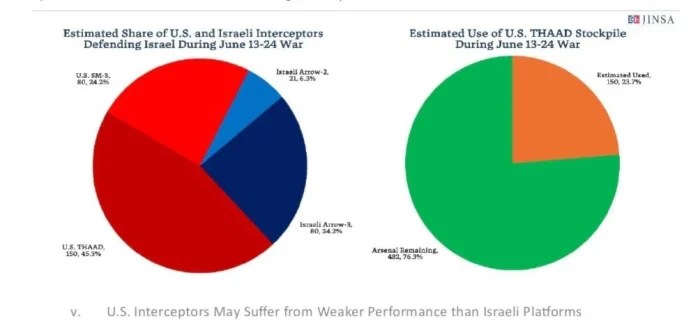
Most interception during the last confrontation in June 2025 was conducted by US naval assets using SM-3 interceptors and THAAD systems. Roughly 25 percent of all THAAD interceptors ever produced were reportedly consumed in that single episode. The persistent exaggeration of Israeli offensive and defensive capabilities, while significant but short-winded, serves two purposes:
- First, it counters the internal Israeli narrative that the United States “saved Israel” after October 7, a deeply sensitive issue tied to Israeli national security self-perception that panics at the idea of having such a level of dependency on the US.
- Second, it preserves an image of invincibility before regional actors, enhancing the regime’s deterrence.
Returning to Jordan: American planners show little concern for Jordanian costs or the consequences for the base itself, which is situated around 70km from the capital Amman. From this perspective, it may even be deemed acceptable for the US if Iran expends part of its ballistic arsenal striking the base, even at the cost of Jordanian casualties.
The American assumption is that they would then be able to launch a major air campaign to destroy Iranian missile production, storage, and launch sites. This would pave the way for an Israeli entry into a second phase of the war, one in which it would no longer face missile volumes it cannot absorb, as it almost did in the June war, as it was running out of interceptors after a presumed US airpower success in weakening the system and reducing launch capacity.
From Iran’s standpoint, directly starting with “Israel” may actually be more rational. An Israeli participation in any war appears almost inevitable, either immediately or at a later stage, for multiple reasons.
Despite the massive US buildup, which includes more than 36 F-15Es, an aircraft carrier, and several destroyers with capabilities to launch cruise missiles, Israelis still retain greater immediate regional firepower than the United States, but it seeks to avoid sudden, large-scale damage to its own infrastructure.
American intentions likely go beyond limited bombings, assassinations, or “decapitation” strikes, as seen previously, if their attack would make sense in terms of weighing gains and possible losses. They may include direct strikes targeting the Iranian leadership, severe economic and energy infrastructure degradation, and long-term destabilization designed to enable internal regime change, added to the sanctions.
The withdrawal of American aircraft from Gulf bases was not only due to their vulnerability to short-range, high-precision weapons that Iran’s arsenal is full of, but also to protect Gulf oil production in the event of war. Gulf states, for their part, would publicly distance themselves from hostilities to shield their economies and prevent market shocks, particularly to avoid upsetting Trump amid any market volatility.
While it is possible to disrupt US operations at Muwaffaq Salti Air Base, expending large numbers of ballistic missiles there, missiles that could instead strike high-value counter force and counter value Israeli targets, may be less strategically viable than other options if the US is prepared to escalate toward total confrontation regardless. Completely and permanently disabling the base would be difficult, and the strategic outcome would likely remain unchanged.
American planners appear convinced that Iran will avoid targeting Jordanian state infrastructure or attempting to destabilize the Jordanian monarchy, as such actions can be used for counterpropaganda. They assume Iran will focus on Western and Israeli forces, confining hostilities to sparsely populated desert areas that Jordan can absorb.
Jordan, governed by a monarchy heavily dependent on Western and Gulf countries’ political and economic support, appears to share this assessment. King Abdullah likely believes his rule faces no serious internal risk and that alignment with Western strategy is the safer course, as his country was credited for being “Israel’s” shield against Iranian drones in the June 2025 war.
Under this framework, the US would launch an air campaign using aircraft operating from Jordan to strike western Iran, while carrier-based aircraft in the Arabian Sea attempt to open corridors toward central Iran from the Gulf. This would allow heavy bombers from Diego Garcia to penetrate deeper and strike strategic targets. The Israeli occupation would then enter at a later stage.
The simplest counter-strategy is to do precisely what the Americans do not expect, and to inflict maximum cost. The theory that remains largely unrefuted: Trump is risk-averse. As Western media itself jokes, TACO (Trump Always Chickens Out), he dislikes long wars, favors last-minute, flashy interventions, and avoids sustained attrition. This suggests a vulnerability: American short-termism and reluctance to absorb prolonged pain, particularly when multiple theaters remain active.
Some may ask why Iran does not simply launch a preemptive strike. This is a clear option, but not an uncomplicated one. An initial Iranian strike could rally American public opinion behind a longer war, granting Trump broader authority, resources, and popular support. While it would disrupt US planning and cause early damage, it might ultimately strengthen Washington’s domestic position. By contrast, an American-initiated war, prolonged, unpopular, and costly, would be far more vulnerable to internal pressure, especially if American losses mount.
Adding to the complexity, two Emirati Il-76 cargo aircraft reportedly landed in Tel Aviv before flying on to Turkmenistan. These aircraft are known to be used by the UAE to supply proxy forces with weapons, particularly in Sudan and Somalia, raising the possibility that they were transporting drones or intelligence equipment for regional operations.
The picture remains highly complex, and it is entirely possible that nothing will happen. Still, based on current force deployments and escalation patterns, the probability of a US attack appears to have risen beyond a 50-50 threshold.
This analysis reflects what American planners may be thinking, not what will necessarily occur. It should be noted that after the previous war, many US and Israeli officials declared that Iran’s nuclear and missile programs had been torpedoed, and the system effectively destroyed, assessments that quickly proved false. Now, only months later, they appear to believe that an even more violent war is required to achieve what the last one supposedly already accomplished.
On the other hand, if endurance is possible and the United States is forced to retreat, Trump TACOs or abandon Israelis mid-conflict — an outcome not inconceivable under a president like Trump — the cumulative effects of “Israel’s” recent dominance and coercion across the region may yet be reversed.
As mentioned earlier, the US buildup is not sufficient to start a prolonged attack against Iran with the high goals of regime change. The buildup still does seem as defensive posturing shielding the Israelis, so a chance the Israelis might initiate and use the limited US and Western buildup as a shield is still significant. A scenario similar to what happened in the last war, but that does entail Israeli losses in the opening phase.
Conclusion
What emerges from this assessment is a US strategy built on supposed escalation control, risk displacement, and the assumption that others will behave within predefined limits. Washington appears to believe it can shape the battlefield geographically, pushing early phases of the war away from the fragile “Israel”, absorbing initial retaliation through peripheral bases, and then intervening decisively to reshape the balance before handing the fight back to Israelis under more favorable conditions. This is not a strategy aimed at victory in the classical sense, but at managing exposure and buying time.
The weakness in this thinking lies in its dependence on predictability. It assumes Iran will refrain from actions that collapse the carefully constructed sequencing of the war, that regional systems will remain stable under strain, and that American political leadership will tolerate the costs long enough to reach a decisive point. None of these assumptions is guaranteed. If any one of them fails, the entire escalation ladder becomes unstable.
Ultimately, the outcome of any confrontation will not be decided by the opening phase or by claims of technological superiority, but by endurance, political cohesion, and the ability to impose sustained costs on an adversary unwilling to absorb them.
The United States may possess overwhelming firepower, but it remains constrained by limited strategic patience and domestic vulnerability. If those constraints are effectively exploited, the very war designed to resolve the Iranian question may instead deepen American entanglement and erode the regional order it seeks to preserve.
Leaked files tie Epstein to Israel-UAE backchannel and possible kompromat
MEMO | January 15, 2026
The notorious sex offender Jeffrey Epstein, widely believed to be an Israeli intelligence asset, played a behind-the-scenes role in nurturing the secret relationship between Israel and the United Arab Emirates (UAE) years before the 2020 Abraham Accords, newly leaked communications reveal.
The revelations emerge from newly obtained material published by Drop Site News as part of an ongoing investigation into Epstein’s political and intelligence connections. The documents, spanning more than a decade, shed light on Epstein’s long-standing friendship with Sultan Ahmed bin Sulayem, the powerful head of the UAE’s DP World, and suggest that Epstein used his connections to promote Israeli commercial, military and surveillance technology in Emirati‑controlled logistics hubs.
Leaked emails show that Epstein not only facilitated strategic ties between Israel and the UAE, but also operated in a context ripe for the gathering or circulation of compromising material—so-called kompromat—on powerful elites. In one exchange, Sulayem joked about wanting “some PUSSYNESS” rather than “BUSINESS” in reference to a mutual female contact. Epstein responded approvingly: “praise Allah, there are still people like you.”
Epstein, who was later found to have registered a neighbouring private island in Sulayem’s name, also forwarded sexually explicit material from a separate scandal involving a Liberian official to JPMorgan executive Jes Staley—further showing his role in distributing content of a compromising nature among political and financial elites.
These instances, coupled with Epstein’s facilitation of meetings and shared travel among Israeli, Emirati and Western intelligence-linked figures, have raised serious questions about whether personal vulnerabilities were exploited to advance geopolitical objectives.
The leaks show Epstein’s efforts to insert Israeli strategic interests into UAE-led economic expansion across the Red Sea and Horn of Africa, including in Somaliland and Djibouti. These moves are thought to be essential in laying the groundwork for the UAE’s more recent push to recognise Somaliland as an independent state, a move formally backed by Israel last month.
The emails further reveal Epstein’s attempt to broker investment from Emirati elites in Israeli cybersecurity firm Carbyne, which later received backing from the UAE following the Abraham Accords. The company was founded by a former officer of Israel’s Unit 8200, the military’s elite signals intelligence division responsible for electronic surveillance, cyber operations and mass data collection on Palestinians and other regional targets.
Carbyne has since received millions of dollars in investment from Emirati‑linked entities, raising concerns that surveillance and data‑gathering technologies closely associated with Israeli military intelligence are being embedded within port operations and security infrastructure under UAE control.
Evidence of Epstein arranging high-level meetings between former Israeli Prime Minister Ehud Barak and Sulayem further demonstrates his role in establishing personal connections that would later underpin formal diplomatic ties.
In one such exchange, Epstein emailed Barak suggesting, “He is the right hand of Maktoum. I think you should meet,” referring to Sheikh Mohammed bin Rashid Al Maktoum, the ruler of Dubai and the UAE’s vice president and prime minister. Barak would later go on to serve as chairman of Carbyne.
Drop Site reports also highlight Epstein’s apparent efforts to provide Emirati elites with access to elite Israeli medical care, using personal contacts to connect Sulayem’s family with neurologists in Israel. This level of trust, the investigation notes, served as a platform for deeper strategic cooperation.
The timing of Epstein’s involvement is significant. Following his 2009 conviction, he re-emerged into elite circles and intensified efforts to build influence across political, financial and intelligence networks. One of Epstein’s key associates, Sulayem, would go on to become a vocal proponent of normalising ties with Israel, including publicly backing the recognition of Somaliland.
This revelation comes amid growing scrutiny of how the Abraham Accords were shaped not just by public diplomacy but by decades of covert networking, influence operations and shared intelligence priorities between Israel and Abu Dhabi. The UAE has long sought regional dominance through military and commercial control of key sea lanes, a vision increasingly aligned with Israel’s own strategic ambitions.
Drop Site hints at the possible use of kompromat and coercion as tools of statecraft by Israeli agencies operating through proxies like Epstein. While no direct evidence of blackmail has yet emerged, the deeply personal nature of Epstein’s relationships and the sensitive political contexts involved raise serious concerns.
As Israel continues to entrench its military presence in Somaliland, with UAE support, the long-term consequences of these covert partnerships are becoming ever more apparent, not just for Palestinians but for the future of the Horn of Africa.
Is a New Saudi-Led Axis Forming against the UAE & Israel?
By Robert Inlakesh | The Palestine Chronicle | January 12, 2026
The emergence of a new alliance in the region has the potential to challenge some of Israel’s more aggressive endeavors, so this could end up working in favor of the Palestinian people in some regards.
Prior to October 7, 2023, the Kingdom of Saudi Arabia appeared poised to join the so-called “Abraham Accords” alliance and normalize ties with Israel. Now it appears to be forming new alliances and even undermining Israeli interests, pursuing a different regional cooperation agenda. Where this leads will be key to the future of the region.
In September of 2023, the Crown Prince of Saudi Arabia, Mohammed bin Salman, had informed Fox News that normalization with the Israelis was growing closer. This development came as then-US President Joe Biden had been seeking to broker such an agreement, which appeared to be his administration’s planned crowning achievement in the foreign policy realm.
The Hamas-led Al-Aqsa Flood operation changed the regional equation entirely. Riyadh, instead of normalizing ties with the Israelis and seeking concessions from the United States in order to enter into a regional alliance against Iran, began considering a different option entirely.
Israel’s weakness in the face of the Hamas-led attack was one message to the entire region, which was that if it could not even take care of its own security issues against a guerrilla army equipped with light weapons, then how could an agreement with Tel Aviv ensure the security of its allies? Another element to the developments in Gaza was that Israel decided to commit a genocide in order to restore its image in the region and in a gambit to “solve the Gaza question”.
This behavior, combined with attacks on nations across the region, evidently served to set normalization talks back and pushed Saudi Arabia to reaffirm its commitment to the Arab Peace Initiative of the 2000s—in other words, no normalization without a viable Palestinian State.
Then came the Israeli bombing of neighboring Qatar, a message to all Gulf nations that Israel is ready to act against any of their territories. It was even reported that Israel’s missiles flew over Saudi airspace in order to reach their target.
Since then, Saudi Arabia has been busy attempting to secure its interests and has signed a security pact with Pakistan as part of this effort. It is very likely that a large driving element behind this deal was to ensure that a future Iran-Israel war would not impact them directly. The Saudis are also currently working to strengthen their ties with Iran.
Yet Riyadh didn’t stop with Pakistan; it is now reportedly in high-level talks with Turkey in an attempt to bring them into the fold of their security agreement, in what is being labeled a Middle East NATO project. While it is perhaps too soon to predict the outcome of these talks and where such an agreement would lead, it suffices to say that there is certainly a realignment going on in West Asia.
The ongoing feud between the United Arab Emirates (UAE) and Saudi Arabia was sent into overdrive when the Emiratis decided to order their proxies in Yemen to seize key regions of the nation’s east, home to 80% of the country’s oil reserves. These Southern Transitional Council (STC) separatists, backed by the UAE, took over the Mahra and Hadramaut provinces, posing a major security risk to the Saudis and Omanis.
In reaction to the UAE’s meddling, Riyadh decided to take the gloves off in Yemen and crushed the STC entirely. But the backlash against Abu Dhabi was not limited to the end of their proxy militia’s role in Yemen; instead, there was a media war in the UAE that aimed to expose its crimes across West Asia and in Africa, as well as a prepared economic blow.
As a result, there was a diplomatic fallout between the UAE and Algeria, over Abu Dhabi allegedly backing separatist movements there, and later the government of Somalia even rescinded its agreements with the Emiratis, following UAE-Israeli meddling in their affairs, in regard to the recognition of Somaliland as a State.
If Riyadh and Ankara do end up forming some kind of security alliance, it will likely also include Qatar. It would then prove interesting to see how they all coordinate on issues like Libya and Sudan. The Emiratis not only back the Rapid Support Forces militants in Sudan, who stand accused of committing genocide and mass rape, but long threw their weight behind warlord Khalifa Haftar in Libya.
This would also mean that the UAE’s role in Syria could be undermined or completely terminated, as it could also be forced from other areas of influence, like Iraq, too. It is clear that both Turkey and Saudi Arabia have sway in Lebanon, so depending upon what their goals are there, this may prove an interesting development for the Lebanese predicament, too. The same goes for Egypt and beyond.
One thing to keep in mind is that such an alliance would not equate to an Axis of Resistance-style opposition to the Israelis. Although Riyadh may see it fit to teach its Emirati neighbors a lesson, the likelihood of any serious conflict with the Israelis is thin.
It is true that the Israelis, aided by their UAE lapdogs, are pursuing an ultra-aggressive policy in the region, especially against Ankara. Yet this competition is not one between warring nations seeking to defeat each other decisively; it is viewed, at least for now, as a competition instead. Turkey maintains its relations with Israel; the Saudis, on the other hand, have not formally recognized Tel Aviv, but have long been in communication with their Israeli counterparts.
An alliance of this nature does not serve as a new support system for any resistance front in the region; instead, it seeks to achieve security and to escape the grip of the emerging “Greater Israel” project. At this stage, it has become abundantly clear that there are no promises of a prosperous future through aligning fully with the Israelis; instead, Tel Aviv will aggressively pursue its interests against every nation in the region and doesn’t respect any agreements it signs. The recent Emirati-Israeli actions demonstrate this perfectly.
Ultimately, the emergence of a new alliance in the region has the potential to challenge some of Israel’s more aggressive endeavors, so this could end up working in favor of the Palestinian people in some regards.
This could prove beneficial to the Islamic Republic of Iran, which, instead of facing total isolation and seeking to combat Israeli schemes alone, may, on different issues, find itself on the same page as the Saudi-led alliance. Some analysts have posited that Tehran may eventually join such a security pact, although it is way too early to say if such a development is even on the cards.
Overall, we should not expect Riyadh to do a total one-hundred-and-eighty-degree foreign policy shift, nor should that be expected of Ankara; after all, they are US allies and maintain close relations with Washington. The real question is whether the United States is willing to push back against such an alliance for the sake of Israel, which is when things will really begin to get interesting.
– Robert Inlakesh is a journalist, writer, and documentary filmmaker. He focuses on the Middle East, specializing in Palestine.
UAE begins ‘hurried evacuation’ from Somali air base: Report
The Cradle | January 12, 2026
The UAE has begun evacuating security personnel and heavy military equipment from Somalia, after officials in Mogadishu reportedly suspended Emirati use of their territory and airspace for military operations, Middle East Eye (MEE) reported on 12 January.
The Somali government informed the Emiratis that “all their military activities in Somalia, including the use of airspace and the landing of cargo military aircraft in Bosaso, Berbera and Mogadishu, had been suspended,” a senior Somali official told MEE, speaking on condition of anonymity.
The official said the UAE now appears to be evacuating its security personnel and military equipment to neighboring Ethiopia.
Citing flight-tracking data and two eyewitnesses, MEE reported that an average of six IL-76 cargo aircraft have arrived and departed the air base in Bosaso – the port city in Somalia’s Puntland – each day over recent days.
One source speaking with the UK news outlet described the flights as “resembling a hurried evacuation.”
“Unlike previous operations, where incoming cargo would be immediately transferred to another aircraft on standby, these planes have been arriving over several days, loaded with heavy military equipment, and departed without delay,” a source at Bosaso air base told MEE, describing the activity as highly unusual.
The UAE has long used Somalia as a rear operational base for its military engagements in both Sudan and Yemen. It had been using Bosaso’s port and airport in recent years to send weapons, mercenaries, and supplies to Sudan’s paramilitary Rapid Support Forces (RSF), which is fighting a civil war against Sudan’s military.
Bosaso is part of a cluster of airfields the UAE has constructed in an effort to dominate the southern end of the Red Sea, the Bab al-Mandab Strait, and the Gulf of Aden.
According to a source in Somalia’s federal government, Mogadishu has revoked the agreement allowing the UAE to use the Bosaso air base and other facilities in the country.
Somali authorities opened an investigation into Emirati activities at Bosaso after the UAE used the air base to help a Yemeni separatist leader escape to the Gulf nation.
The separatist leader, Aidarus al-Zubaidi, is the president of the UAE-backed Southern Transitional Council (STC).
He was wanted by Saudi Arabia amid fighting between the STC and Saudi-backed forces in Yemen that began in December. The UAE was supporting the STC’s bid to take territory from the Saudi-backed Presidential Leadership Council (PLC) in hopes of creating an independent state in southern Yemen.
Zubaidi was supposed to travel to Saudi Arabia for talks to end the violence, but the UAE secretly helped him escape to Abu Dhabi. He first traveled by ship to the breakaway region of Somaliland, then boarded a plane at the Bosaso air base to travel to the UAE.
After helping Zubaidi escape, the Somali government informed the Emiratis that all their military activities in Somalia were suspended.
Saudi Arabia and the UAE are increasingly competing for influence in both Yemen and Somalia.
The UAE is closely aligned with Israel, which has supported Somaliland in its effort to gain formal independence from Somalia.
In contrast, Saudi Arabia has supported Somalia’s unity and established closer relations with officials in Mogadishu.
Saudi officials held an Organisation of Islamic Cooperation conference on Somalia over the weekend and rallied the Arab League and Gulf Cooperation Council (GCC) to issue statements in support of Somalia’s unity after Israel recognized Somaliland.
Somaliland and the ‘Greater Israel’ project
By Robert Inlakesh | Al Mayadeen | January 7, 2026
More than a simple recognition of Somaliland, “Israel” is hatching a scheme alongside its Emirati allies aimed at a regional expansion agenda. For the so-called “Greater Israel” vision to come alive, dominance must be secured not only across West Asia and North Africa, but also throughout the Horn of Africa.
The recent decision by the occupying entity in “Tel Aviv” to recognize Somaliland as a State has triggered outrage across Africa and much of the Islamic World, while drawing condemnations from most Arab capitals, with the notable exception of Abu Dhabi.
For the most part, analysts have pointed to “Israel’s” desire to use Somaliland as a staging ground for aggression against Yemen as a primary motivation behind the move. Some have further noted that officials of the Zionist regime have expressed interest in ethnically cleansing Gaza’s people and forcibly transferring them to Somaliland. While these factors evidently inform Israeli decision-making, they do not exhaust its strategic calculus; yet the conspiracy goes much deeper.
On November 24, 2025, the influential Israeli think-tank Institute for National Security Studies (INSS) released a report detailing both the benefits and drawbacks of recognizing Somaliland. While the report acknowledged multiple strategic incentives for such a move, it ultimately advised against proceeding before the United States had done so.
The INSS had advocated against the move, hedging that such a declaration would further isolate “Israel” within the framework of the so-called “Abraham Accords”, triggering backlash on the international stage regarding the issue of Palestinian statehood.
So what changed since the Israeli think tank report?
Understanding the Israeli thinking here, such a move would not be made if they saw it as a net negative. Instead, the recognition was offered in a very public and brazen manner. In order to make sense, we therefore have to look at the broader picture.
To begin with, the normalization drive [“Abraham Accords”] has clearly stalled, at least in terms of any major developments in this regard. The last country to enter into the fold of the broader Trump administration-led normalization movement was Kazakhstan. For context, Astana already normalized ties with the Zionist regime back in 1992.
Although US President Donald Trump announced Kazakhstan’s declaration as a development of great significance, the move was clearly seen as a weak attempt at keeping the normalization project alive amid the conspicuous absence of Saudi Arabia. In parallel, an increasingly desperate Israeli entity has launched what it calls the “Isaac Accords”, a separate normalization project with Latin American nations that are client regimes of the US.
In other words, the Israelis were not actually in a position where they necessarily viewed recognition of Somaliland as an impediment to their normalization agenda. In fact, through projecting power in the Horn of Africa, they may even see it as an advancement of this project, especially given that some 6 million people who identify as belonging ethnically to Somaliland are Muslims.
Another element of the move is to assert their dominance and to lash out internationally over the wave of recognition, last September, for the state of Palestine.
In addition, the elephant in the room here is that the Israelis are currently pursuing a joint agenda with the United Arab Emirates, particularly in both the Horn of Africa and Northern Africa. This alliance seeks to co-opt sectarian movements, separatist groups, and to weaponize warlords in order to reshape the continent as a whole.
The Emirati and Israeli agendas are one in this regard. They are inseparable and connected on almost every conceivable level, this is to the point that the de facto head of intelligence operations for the UAE has long been a man named Mohammed Dahlan, well known for his alleged involvement with Mossad and the CIA; particularly in Africa.
The UAE’s proxy in Yemen, the Southern Transitional Council (STC), seized the Hadhramaut and al-Mahra provinces from Saudi-backed forces in early December, bringing around 80% of Yemen’s oil resources under their control. The STC’s militants have even been trained by “Israel”. The UAE’s move, which would not have come without Zionist backing, now threatens the stability of the Arabian Peninsula and triggered major backlash from Riyadh.
While “Israel” is reportedly seeking to build up a military presence near the strategically located port of Berbera in Somalia’s Somaliland, the UAE began constructing the Berbera airbase as early as 2017, securing access to it for a period of 25 years. Similarly, the UAE–Israeli alliance has extended to the establishment of a joint military presence on Yemen’s strategically located island of Socotra.
It is speculated that the Emirati-backed STC, in southern Yemen, may launch an offensive aimed at capturing the Ansar Allah-controlled port city of Hodeidah, likely receiving Israeli aerial support. The coastline of Somaliland lies only 300 to 500 kilometers from Ansar Allah-controlled lands, making such an air campaign much more manageable than launching strikes from occupied Palestine.
Furthermore, turning to “Israel’s” agenda in Somalia itself, it is clear that this is a calculated move that targets Türkiye. Ankara maintains enormous influence in Somalia and remains a strong proponent of the “One Somalia” agenda. Therefore, at a time of heightened regional tensions, especially in Syria, where both Turkish and Israeli forces are seeking to carve out zones of influence and establish red lines, “Tel Aviv’s” move appears to be another attempt to land a strategic blow on Ankara.
Together, the Emiratis and Israelis are adamant about combating the Muslim Brotherhood and any Islamic governments or groups that voice their concerns for the Palestinians, which is why they are lobbying Western governments so hard on these issues and running non-stop propaganda campaigns against so-called “radical Islam”.
In reality, the Israeli-UAE-backed militias in Yemen are riddled with al-Qaeda-linked fighters and hardline Takfiri Salafists. The STC’s toughest fighting force, known as the Southern Giants Brigades, is reportedly led by the core of experienced militants who are former al-Qaeda fighters. In Gaza, meanwhile, the UAE and the Zionist Entity are also backing five separate proxy militias with alleged links to ISIS.
The Emiratis and Israelis are huge fans of these Salafist militants, who are totally obedient to them and adopt a mass Takfir doctrine that they use to justify the mass slaughter of Muslims. This was the same exact strategy adopted inside Syria by the Zionists, using Wahhabi extremists to do their bidding, while dividing the Muslim World and paving the way for their expansionist agenda.
If the Zionist Entity is to achieve “Greater Israel”, the common misconception is that they wish to directly occupy the entire region between the River Nile and the Euphrates. According to the Zionist vision, they would rule as an empire instead, whereby they enter into formal alliances with countries broken up into ethno-regimes and sectarian rump States. Divide and conquer.
So, dividing Somalia, in order to help the Emirati proxy-militias secure a southern Yemeni State, is precisely in line with the Zionist agenda. They will attempt to rule these territories through proxy support, using their puppets to destroy the Palestinian cause. In the case of Somaliland, if they are to succeed, they would also certainly attempt to ethnically cleanse the population of Gaza there. In other words, Somaliland recognition isn’t a small, isolated move; it is a piece being strategically positioned on their wider chessboard.
Pakistan, the Gulf, and the high cost of Zionist alignment
By Junaid S. Ahmad | MEMO | January 6, 2026
Geopolitics is most dangerous not when it erupts, but when it reorganises quietly — when the ground shifts beneath familiar alliances while elites continue to speak the language of yesterday. The Gulf today is in precisely such a moment. What once masqueraded as a coherent bloc has fractured into rival power models, incompatible strategic visions, and diverging relationships to empire, Israel, and popular legitimacy. And Pakistan, true to form, is responding not with strategic intelligence but with institutional reflex — confusing obedience with balance and habit with foresight.
The rift between Saudi Arabia and the United Arab Emirates is no longer a matter of speculation or diplomatic gossip. It is an open contradiction — political, military, and infrastructural. Yemen has exposed it. Israel has radicalised it. The United States, particularly under Trumpism, has weaponised it. And Pakistan’s ruling elite — military and civilian alike — has chosen to drift toward the most toxic pole of this fracture while reassuring itself that it is merely being “pragmatic.” It is not. It is being complicit.
Two Gulf projects, one moral abyss
Saudi Arabia and the UAE are still lazily grouped together by analysts who mistake shared authoritarianism for shared strategy. This is intellectual malpractice. The two monarchies are pursuing fundamentally different regional projects.
Saudi Arabia’s current posture — hardly virtuous, often cynical, and deeply reactionary — nevertheless reflects a begrudging recognition of reality. After years of disastrous interventionism, Riyadh wants consolidation. It wants borders quieted, fires contained, and regional fragmentation slowed. Its outreach to Iran, cautious engagement with the
Houthis, and growing hostility to separatist militias are not gestures of enlightenment but acts of self-preservation. Endless chaos undermines Saudi ambitions at home.
The Emirati project is the opposite — and far more dangerous. Abu Dhabi does not seek order through states; it seeks domination through fragments. Ports, islands, militias, mercenaries, logistics corridors, surveillance hubs — these are its tools. Sovereignty is irrelevant. Fragmentation is not a failure; it is a business model.
If Saudi Arabia is a reactionary status-quo power, the UAE is a hyperactive destabiliser — an empire of nodes, happy to burn regions so long as trade flows and leverage compounds.
Yemen: Where the lie finally died
Yemen is where the fiction of Gulf unity collapsed beyond repair. What began as a joint intervention has devolved into a struggle over whether Yemen will exist at all as a state. The House of Saud — bloodied, embarrassed, and exposed — now insists on a unified Yemeni authority capable of enforcing borders and agreements. The UAE has invested
instead in carving out a southern enclave: separatist militias, port control, island bases, and economic chokeholds.
For Riyadh, this is existential. A fragmented Yemen exports instability directly into Saudi territory and sabotages any negotiated settlement with the Houthis. For Abu Dhabi, fragmentation is leverage — control of chokepoints matters more than Yemen’s survival as a polity.
That Saudi Arabia has now openly bombed weapons shipments linked to UAE-backed forces and issued public warnings is extraordinary. Gulf disputes are traditionally smothered in silence. When they go kinetic and public, it signals not a spat but a structural rupture. Pakistan’s establishment sees this — and chooses denial.
Israel: The cancer at the core
To understand the Emirati recklessness, one must confront the real axis around which it revolves: Apartheid, genocidal Israel.
The Abraham Accords were not peace agreements; they were an integration pact into Zionist regional supremacy. Israel does not merely occupy Palestine; it exports a model — militarised impunity, surveillance capitalism, permanent war dressed as security. The UAE did not normalize with Israel reluctantly. It embraced Israel as a force multiplier.
Israel provides Abu Dhabi with access to Washington’s coercive machinery, advanced surveillance, cyberwarfare, and a propaganda ecosystem that converts mass death into “stability.” In return, the UAE provides geography, ports, islands, mercenaries, and political insulation — doing Israel’s dirty work where Tel Aviv prefers not to appear.
Sudan. Somaliland. Socotra. Cyprus. The Red Sea. These are not isolated projects; they are components of a Zionist–Emirati expansion strategy designed to insulate Israel from economic pressure and accountability while strangling any resistance corridor before it matures.
Israel is the disease. The UAE is its most enthusiastic carrier.
Pakistan’s elite: Zionism in uniform and suits
Pakistan’s tragedy is not that it lacks options. It is that its ruling elite lacks dignity.
Rather than reassess its position amid this fracture, Pakistan’s military–civilian elite clings to the rhetoric of “balance” while deepening structural entanglement with the Emirati–Israeli axis. Ports, airports, logistics terminals, military-linked corporations — these are not neutral investments. They are instruments of alignment.
Pakistan’s generals and their civilian accessories imagine they are playing geopolitics. In reality, they are being used as infrastructure — cheap, deniable, disposable. Their behaviour is not naïveté. It is covert Zionism: collaboration without confession, obedience without ideological honesty. They mouth solidarity with Palestine while embedding Pakistan’s economy and security apparatus deeper into a regional order built to protect Israel from consequences. This is not pragmatism. It is moral and strategic bankruptcy.
Venezuela: When empire drops the mask
The illusion that empire prefers subtlety should have died long ago. Venezuela put the lie to it.
When sanctions failed and proxy pressure proved insufficient, the United States escalated —directly. US special forces were involved in a scandalous operation that culminated in the kidnapping of Venezuelan President Nicolás Maduro. This was not deniable proxy warfare. It was naked imperial contempt for sovereignty.
And what happens if Washington’s decapitation move fails at complete regime change in Caracas? Silence. Zero accountability. Empire simply moves on.
This is the future Pakistan’s elite is courting. When alignment fails to deliver stability, the costs will not be borne by Washington, Tel Aviv, or Abu Dhabi. They will be borne by Pakistan. Empire does not protect collaborators. It discards them.
Saudi Arabia: A lesser evil, still an evil
Saudi Arabia deserves no absolution. The House of Saud remains a reactionary monarchy, structurally hostile to popular sovereignty and deeply entangled with empire. Its version of “stability” is still oppression — merely quieter than the Emirati inferno.
Yet the difference matters. Saudi Arabia understands that Zionist expansionism generates perpetual instability. The UAE celebrates it. Riyadh conceals its servitude; Abu Dhabi flaunts it.
Pakistan’s elite has chosen to tilt slightly more towards the louder master.
Trumpism: Empire without shame
Hovering over this landscape is Trumpism — the ideological nakedness of empire. Trump dispenses with liberal hypocrisy entirely. Loyalty is transactional. Morality is a joke. Strongmen are preferred to institutions. Israel is sacred. Everyone else is expendable.
The UAE fits this worldview perfectly: ruthless, efficient, unburdened by public opinion. Pakistan’s rulers mistake proximity to this axis for relevance. In truth, it entrenches their subordination.
When things go wrong — as they inevitably will — Trumpism will shrug. Pakistan will bleed.
The reckoning Pakistan is avoiding
The Gulf is not merely fracturing; it is sorting. States will be forced to choose — between sovereignty and fragmentation, between justice and normalisation, between dignity and managed submission.
Pakistan’s establishment has already chosen. It just lacks the courage to admit it. History will not judge Pakistan for failing to be the Mafia Don of West Asia. It will judge it for failing to recognise a moral and strategic crossroads when it stood directly upon it.
The UAE will continue to burn regions in service of Zionism. Israel will continue its genocidal project. The United States will continue to kidnap, sanction, and discard. Saudi Arabia will continue to pretend restraint equals virtue.
And Pakistan — unless it breaks from habit — will continue confusing servitude for strategy.
Proxy Regime: Understanding the UAE-Israeli Conspiracy in Yemen, Saudi Arabia
By Robert Inlakesh | The Palestine Chronicle | January 2, 2026
The reason why the recent feud between the UAE and Saudi Arabia in Yemen is important is that it paves the way to a totally different reality on the ground.
The United Arab Emirates (UAE) and Saudi Arabia were once viewed as a unified power in Yemen; any semblance of such an alliance is now crumbling. As Riyadh and Abu Dhabi remain at loggerheads, it is clear that Tel Aviv is a key driver of the escalation across Yemeni territory.
Saudi Arabia had recently released a sternly worded statement condemning their Gulf neighbors in the United Arab Emirates, following the armed takeover of the Hadramaut and al-Mahra provinces by the Emirati-backed Southern Transitional Council (STC) forces. Saudi airstrikes were also launched, largely on soft targets as a warning, which prompted the UAE to announce the withdrawal of all its forces from the country.
The war in Yemen is one of the most underreported and misrepresented conflicts in the region, which often makes it difficult to decipher what is truly transpiring. What is important to understand here is that Abu Dhabi’s role inside Yemen is in large part driven by Israeli interests, which will not only potentially lead to blowback against the UAE itself, but also aims to destabilize the entire Arabian Peninsula. This is part and parcel of forging a way forward toward the “Greater Israel Project”.
The reason why the recent feud between the UAE and Saudi Arabia in Yemen is important is that it paves the way to a totally different reality on the ground. In 2015, the Ansarallah movement took over the Yemeni capital of Sana’a and received the backing of roughly two-thirds of the nation’s armed forces in doing so.
As a revolutionary Islamic movement, Ansarallah’s seizure of power was interpreted as an immediate challenge to the rulers across Arabia. Considering the long history of violence between Yemen and Saudi Arabia in particular, it was no surprise that tensions immediately rose. Yet, the Saudi-led coalition that initiated the war on Yemen to overthrow the newly ushered in Ansarallah leadership (often incorrectly referred to as “the Houthis”), was not driven by its own interests alone.
In fact, the US, UK, and Israel were in the picture from the very start and it was former American President Barack Obama who gave the green light for the war, which eventually resulted in the deaths of around 400,000 people. Saudi Arabia, for its part, decided to back the deposed president of Yemen, Abd Rabbuh Mansour Hadi, using his position and control over what is called the “internationally recognized government” of Yemen as its excuse for legitimacy for action inside the country.
The United Arab Emirates had instead thrown its weight behind southern separatists in Yemen’s south, with the goal of securing the strategic port city of Aden. Prior to 1990, Yemen was divided between north and south, yet there has always been the presence of separatist elements there. Without delving into the nation’s long history, the British had strategically occupied southern Yemen, utilizing the strategic port of Aden as a tool of empire; the UAE clearly sees the geostrategic weight of this location also.
After years of horrifying war, mass starvation due to the Saudi-US-imposed blockade, and a situation that began to come to a stalemate, by early 2022 Yemen’s Ansarallah-led government had not only established a strong, rooted rule, but the Yemeni Armed Forces under its command had clearly made breakthroughs in military technology. It had launched devastating long-range drone and missile attacks against not only Saudi Arabia, but also the UAE, even making a point of striking the Emiratis while Israeli President Isaac Herzog visited.
It wasn’t long until a ceasefire was reached, brokered by the United Nations, one that has largely held until now. Following the ceasefire, in April of 2022, the Saudi government created what is known as the Presidential Leadership Council (PLC). The PLC’s leader, sometimes referred to as the internationally recognized president of Yemen, is a man named Rashad al-Alimi, presiding over an eight-member council that is not elected by the Yemeni people.
The PLC, or “internationally recognized government,” was then based in Aden, and three of its seats were granted to members of the Emirati proxy group called the STC, the separatist militia that Abu Dhabi backed to seize Aden. Despite promising prosperity to the people in southern Yemen and not being under the same sanctions as Ansarallah’s government in Sana’a, the living conditions in the south continued to deteriorate and have since led to countless protests and even riots.
In early December, the STC suddenly swept over the eastern provinces of al-Mahra and Hadramaut, even forcing some Saudi-backed PLC officials to flee Aden. The Emirati proxy separatists have since openly declared their intent to divide Yemen and separate southern Yemen from the north, which is controlled by Ansarallah. This takeover meant that some 80% of the country’s oil resources fell into the hands of the Emirati-backed STC.
The takeover of these provinces also proved a massive threat to both Saudi and Omani security in the eyes of their leadership. The primary armed faction that fights for the southern separatist cause is called the “Southern Giants Brigades”, a large element of which are Salafist extremists, with former Al-Qaeda fighters forming the most experienced core of the militant organization.
Just as the UAE has been backing ISIS-linked gangs in the Gaza Strip to fight Hamas, it utilizes Salafist extremists in Yemen to fight its battles for it also. Evidently, such a powerful militia force is viewed rightly as a threat to regional stability.
Riyadh saw these recent developments as a major challenge to its regional project and stability. Not only because of the potential issues along its border, but also the birth of a new reality on the ground inside Yemen that will further weaken the “internationally recognized government” that they back.
If the UAE’s proxy forces succeed, despite the Emiratis withdrawing their own forces, then the STC will push for separation and undermine the Saudis’ role entirely. There is also a good chance that the Emirati proxy forces will launch an offensive aimed at seizing the Red Sea port city of Hodeidah from Ansarallah. Israel was seeking this outcome in early 2025, when it convinced the Trump administration to fight Ansarallah on its behalf, an attack which resulted in a resounding failure.
The Israelis not only maintain close ties with the Emirati-backed STC but have also directly participated in training their forces. Israel and the UAE have also established joint military positions in areas of Yemen, like the island of Socotra.
Recently, Israel became the first country to recognize Somaliland as a nation. Little attention has been paid to the fact that the UAE has quietly recognized Somaliland also; in fact, the UAE-Israeli cooperation and support for the separatist movement in Somalia goes well beyond recognition.
The Somaliland connection is key here. Some analysts have mentioned the value of the Berbera Port area to Israel and focused on the Israeli desire to build a military presence there for the sake of attacking Yemen. While this is true, it was actually the UAE that began to build the Berbera airbase in Somaliland back in 2017 and has invested greatly in establishing a military foothold there.
The UAE-Israeli alliance to establish dominance in North Africa and the Horn of Africa is directly tied to Yemen. So much so that the Emiratis used militants from Sudan’s Rapid Support Forces (RSF)—who are currently carrying out genocidal acts against the people of their own country—to fight in Yemen against Ansarallah.
All of this being said, if the UAE proxy forces succeed, it will certainly prove a major issue and lead to enormous bloodshed, yet the STC will not likely defeat Ansarallah, even with high-altitude air support provided by Israel. In fact, once Saudi Arabia is effectively out of the picture, Ansarallah will have one primary enemy to confront with full force: the United Arab Emirates.
The UAE, unlike Saudi Arabia, is a tiny country that is primarily made up of immigrants and foreign workers; it does not have a capable military, despite its Hollywood-style parades that it uses to try and demonstrate this. A sustained missile and drone attack campaign from the Yemeni Armed Forces will very likely be enough to force the UAE to wave the white flag.
Even if some kind of agreement is eventually reached as a result of the UAE being battered into submission—one that does not bring about an Ansarallah takeover that unifies the country—the Saudis will end up having to sign an agreement with Sana’a to properly end the conflict.
Riyadh understood this all well, which is why it quickly acted to draw red lines. It is more in Saudi Arabia’s interests to keep the status quo for now, because the UAE’s moves could end up creating a nightmare situation for it in the future. Saudi Arabia does not want a strong, unified Yemen under the control of Ansarallah; it will only accept a Yemeni leadership that bows to it, and like past Yemeni governments, bows to the West, while refusing to utilize the nation’s immense resource wealth and harness the power of its location.
Israel, on the other hand, most certainly will not accept a united Yemen under Ansarallah’s rule, but is adamant about “making them pay” for daring to impose a Red Sea blockade and fight in defense of Gaza. Therefore, the Israelis are willing to work with the UAE to totally destabilize the region in order to take a stab at dealing a major blow to Ansarallah and asserting their dominance.
It is unclear where exactly this is all heading, but it is possible that we may eventually see a drastic change in the situation on the ground, one which will perhaps lead to Saudi Arabia adopting a different posture toward the UAE altogether. It also appears that Tel Aviv is angry about Riyadh refusing to normalize ties, which could well have factored into this latest move. It is important to consider that the Emiratis will not move a fingernail without Israeli approval in this regard; they are, in essence, a proxy regime of Tel Aviv at this point.
– Robert Inlakesh is a journalist, writer, and documentary filmmaker. He focuses on the Middle East, specializing in Palestine.
Israeli-UAE Aggression In Yemen Could Backfire Enormously
By Robert Inlakesh | The Palestine Chronicle |December 26, 2025
Although the Yemeni Armed Forces have halted their ballistic missile and drone attacks against Israel, adhering to the Gaza ceasefire, officials in Tel Aviv are continuing to insist that their front against Sana’a is not over.
Meanwhile, the United Arab Emirates (UAE) backed Southern Transitional Council (STC) has been busy seizing territory from Saudi-backed forces and signalling an intent to declare southern Yemen’s independence. Far from simply domestic disputes between armed groups, these developments will have major regional implications.
On December 3, the STC seized Hadramout province from forces aligned with Saudi Arabia, followed by a takeover of al-Mahra province. The UAE-backed separatists even went a step further, with a number of officials declaring their intent to break away and declare southern Yemen an independent state.
For context here, the UAE and Saudi proxies in Yemen were operating a joint governing body out of southern Yemen’s port city of Aden. For years, the Saudi-led coalition had attempted to prop up deposed Yemeni President, Abdrabbuh Mansur Hadi, with the backing of the US, UK, and Israel. Hadi was therefore referred to as the “internationally recognised” leader of the Yemeni State, when in reality he had no such power.
Despite the glaringly obvious fact that Ansarallah had set up and was operating a government in the nation’s capital, enjoying a lot of popular support, the United Nations continued to play along with the West’s demands to recognise Saudi’s puppet proxy regime. In 2022, Riyadh then created what is known as the Presidential Leadership Council (PLC), which was endowed with the powers of the Presidency and serves as the “internationally recognised government”.
The head of the PLC is a man named Rashad al-Alimi, who is an unelected leader and is part of the eight-member body. As of May 2023, three of the eight seats in the PLC were handed to officials belonging to the UAE-backed STC, which recently ran Saudi-backed officials out of Aden.
The STC’s recent territorial gains have posed an active security threat to Saudi Arabia and Oman, deepening the ongoing feud between Abu Dhabi and Riyadh. The UAE, for its part, also appears to have been sizing up an offensive campaign against Ansarallah at some stage, as it acts in coordination with the Israelis.
The recent developments in Yemen have triggered anxiety amongst Zionist analysts in Washington, as they see a UAE-Saudi conflict in Yemen between their proxies as detrimental to the fight against Ansarallah in Sana’a. In line with this way of thinking, the Washington Institute for Near East Policy (WINEP) recently published a Policy Analysis piece arguing that such a UAE-Saudi conflict should be avoided and instead both should focus on Ansarallah.
It is clear that the primary goal of the Israelis is to see their Emirati allies use the STC to try and seize the port city of Hodeidah, thus securing dominance over the Red Sea. This is important to Tel Aviv as it means weakening the Yemeni Armed Forces and preventing them from being able to effectively impose a blockade on their ships. Israel even pushed the Trump administration to launch a war in Yemen for over a month in an attempt to break the blockade in the Red Sea, which resulted in resounding failure.
The Zionist think-tank WINEP has warned that any conflict between Saudi proxies and Emirati proxies could open the door for Ansarallah’s forces to seize the oil-rich region of Marib, a major catastrophe for the Israelis and Americans. Yet, so far, no UAE-Saudi understandings appear to have come about to find any solution to their competition in Yemen.
Instead, the major agreement that was just brokered came between the Yemeni government in Sana’a and Saudi Arabia, the largest prisoner exchange deal since the beginning of the war. This meant agreeing upon the release of 1,700 Ansarallah detainees in exchange for 1,200 opposition prisoners.
Another important clarification is that the Ansarallah government is often labelled “the Houthis” in the Western media, and the Saudi proxy opposition is called the “Yemeni government”. This can sometimes get confusing, but it is important to point out that this propagandistic rhetoric is used to shape the conflict in a way that reflects Western bias, not the objective reality on the ground.
Some will try to argue that the Saudi proxy opposition is the “internationally recognised government” according to the United Nations, which is true, but again, this has little bearing on the reality on the ground. There simply aren’t enough powerful States or even smaller nations that are willing to bat for recognising the government in Sana’a, therefore the West and their Arab allies have managed to prevent any reflection of reality reaching the United Nations or even the international media.
At this phase, the UAE’s STC appears to be in control of the majority of opposition-held territory in Yemen, greatly undermining Saudi Arabia’s role. However, the STC is not exactly a movement with the popular support to sustain and operate a lasting, or stable, southern Yemeni State. The STC has faced countless protests against their rule, after failing to deliver even basic services to the people living under its control. Blatant corruption, combined with criminal activities and a lack of basic governing skills, has left people with very little. Even in the Hadramout and al-Mahra provinces, there is significant opposition that could lead to their swift overthrow.
Amidst this, if the STC decides to commit to offensives against the Yemeni Armed Forces of Ansarallah, the strategy to defeat the UAE-proxy forces is rather simple. Ansarallah will not only most likely batter these armed militants on the ground, but need only direct drone and missile fire towards the real headquarters of the STC, Dubai. If ballistic and cruise missiles, along with drones, flood Dubai and Abu Dhabi, the Emirati plot will quickly collapse.
When it comes to Saudi Arabia, it is a much larger nation and has the capacity to endure a lot more than the much smaller Emirates, making Riyadh a more formidable foe than Abu Dhabi. If the STC proxy forces become the main opposition and Saudi Arabia can no longer maintain any significant foothold in Yemen, the recipe for Yemeni unification becomes much simpler.
A war between Ansarallah and the STC has a very easy solution: flooding the UAE with missiles and drones for a sustained period, which will force them to give up and depart from Yemen. If this happens, Riyadh will have no choice but to reach a broader agreement with Sana’a, effectively ending the war altogether.
In the eyes of the Israelis and the United States, this outcome would be a catastrophe. If Ansarallah, even under a power-sharing styled agreement, reigned supreme over all of Yemen and became its officially recognised leadership, it would significantly increase its power and pose an even greater threat to Israel. In Tel Aviv’s eyes, this would be Iran 2.0 in the Arab World, an Islamic government that is openly hostile to Israel and a staunch supporter of the Palestinian resistance.
No matter which way you slice it, the US and Israel have no answer for the predicament they face in Yemen. The only option is to try and keep the nation in perpetual war, tightening the sanctions and ensuring immense suffering amongst its civilian population, all to avoid the inevitable rise of an Ansarallah-controlled Yemeni State, equipped with a military arsenal that will continue to develop.
UAE-backed militia in Yemen reaches out to Israel for alliance against ‘common foes’: Report
The Cradle | December 18, 2025
The UAE-backed Southern Transitional Council (STC) has reached out to Tel Aviv and pledged to recognize Israel in the event that its goal of an independent, secessionist state in south Yemen is achieved, Hebrew media reported.
According to Israel’s Broadcasting Corporation (KAN), the STC has called on Israel to support “independence” in southern Yemen, and that this would enhance a common agenda between the two sides.
A diplomatic source close to the STC was cited as saying by KAN that Israeli support for the secessionist cause in southern Yemen could contribute to “protecting maritime routes in the Gulf of Aden and Bab al-Mandab, in addition to combating the smuggling of Iranian weapons to Ansarallah and the terrorist cells affiliated with the Muslim Brotherhood that cooperate with Sanaa.”
The source added that the STC needs Israeli backing in military, security, and economic fields in order to form a “new state,” stressing that the two share “common enemies.”
The STC announced on 15 December the start of a new military operation in the southern Yemeni province of Abyan, tightening its grip on the south.
In recent weeks, UAE-backed STC forces have captured the provinces of Hadhramaut and Al-Mahra, and have seized the presidential palace in the southern city of Aden – where both the STC and the Saudi-backed Presidential Leadership Council (PLC) have been based for the past several years.
This prompted Saudi military forces to withdraw from Aden. Riyadh has since called for an immediate withdrawal of the STC from the areas it has captured – a demand which was rejected by the Emirati-backed group during negotiations last week.
The STC now controls practically all the territory that makes up the secessionist state it aspires to form along the borders of the pre-1990 southern Democratic Republic of Yemen.
The country will “never be unified again,” the STC has told western diplomats, according to a report by The Times from last week.
The report also revealed that the STC has sent delegates to meet with Israeli officials recently and discussed their “common cause” with Tel Aviv. The KAN report was not the first to reveal contact between Israel and the STC.
In December 2023, Hebrew media cited a source close to STC as saying that Israel will earn itself a partner in the fight against Ansarallah if it recognizes the secessionist aspirations of the STC.
The UAE was a major partner in the Saudi-led war launched against Yemen and the Ansarallah-led government in Sanaa, which began in 2015.
Despite this, Riyadh and Abu Dhabi have been embroiled in a rivalry for control and influence in Yemen over the past few years. Critics accuse both countries of seeking to divide Yemen to control its natural resources and strategic ports within their respective spheres of influence.
Since the start of the war, the UAE and Israel have established a joint occupation of the islands surrounding Yemen.
In 2023, Saudi Arabia and the Ansarallah-led government in Sanaa were close to reaching a peace deal. The agreement was never finalized or implemented, and the Saudi military continues to shell Saada and other border areas.
Despite this, the peace process halted a major Ansarallah and Yemeni Armed Forces (YAF) offensive against Marib province, which would have brought Sanaa’s forces to the borders of Hadhramaut and Shabwa.
The STC reportedly took a firm stance against the peace talks between Saudi Arabia and Ansarallah at the time.
After the start of the STC advance across Yemen several weeks ago, Saudi-backed tribal forces called for “all forms of resistance” against the UAE-backed militia.
According to The Guardian, up to 20,000 Saudi-backed troops are gathering on the border. Forces backed by the kingdom are also reportedly withdrawing from their positions in Aden and redeploying elsewhere.
Riyadh supports a tribal alliance of armed factions known as the Hadhramaut Protection Forces. It also backs the Muslim Brotherhood-linked Islah Party and the forces of Yemen’s internationally-backed government – the PLC.
While the PLC and STC are at odds with one another, the two are closely linked. Aidarous al-Zubaidi, the deputy head of the PLC, also serves as the president of the STC.
“We hope this can be resolved peacefully, but what happened in Hadhramaut is a dangerous development and negatively impacts the legitimate state institutions. Irregular forces not under state control have invaded stable and secure governorates throwing everything into chaos. Saudi Arabia is determined that these forces must leave and return to their own places. The legitimate government is being fragmented, and the only beneficiary of these intensified divisions will be the Houthis,” said Islah Party Secretary-General Abdulrazak al-Hijri, adding that Ansarallah “[does] not see Yemenis as people” but rather as “slaves.”
His comments contradicted reports from last year that Sanaa and the Islah Party improved their relations after Ansarallah began pro-Palestine operations against Israel.
The UAE’s reverse trajectory: From riches to rags
By Dr Zakir Hussain | MEMO | December 18, 2025
One of the most enduring and widely quoted dialogues in Indian cinema is: “Do not throw stones at others’ houses when your own house is made of glass.” Unfortunately, this wisdom appears to be lost on the United Arab Emirates. Instead of exercising restraint and responsibility, the UAE has increasingly been accused of conspiring with, financing, and backing a wide range of actors and armed groups that have contributed to chaos, instability, and even genocidal violence in several countries.
Over the years, the UAE has steadily expanded the scope of its controversial activities—from Libya and Sudan in North Africa to other mineral-rich Muslim-majority African countries, and further eastward to Afghanistan and Yemen. Its involvement in the Palestinian context also raises serious concerns, as there appears to be no clear moral or political limit to its actions. These interventions have not promoted peace or stability; rather, they have intensified conflicts, deepened humanitarian crises, and prolonged wars.
What makes this approach particularly perplexing is that the UAE itself lacks a credible and robust defensive shield to protect its own territory. It does not possess the capability to fully defend its iconic skyscrapers and critical infrastructure even against relatively unsophisticated, low-cost drones. A coordinated volley of such drone strikes would be sufficient to cause panic among the millionaires and billionaires who have invested heavily in Abu Dhabi and Dubai. Capital, after all, is highly sensitive to risk, and fear alone can trigger massive capital flight.
Against this backdrop, it is difficult to comprehend why Mohammed bin Zayed has chosen to indulge in a strategy of regional destabilisation and proxy warfare. History clearly demonstrates that mercenaries neither win wars nor sustain long, decisive military campaigns. They fight only as long as their financial incentives are met, avoid heavy casualties, and withdraw the moment the cost-benefit equation turns unfavourable.
The UAE has already experienced the consequences of such adventurism in Yemen, where its involvement against the Houthis proved costly and ultimately unproductive. The episode exposed the limits of Emirati military power and underscored its lack of preparedness for prolonged, brutal conflicts. The Emiratis have shown remarkable efficiency in event management, diplomacy branding, and global image-building, but they are ill-suited for sustained warfare or managing the complex realities of civil wars and insurgencies.
Despite these lessons, the UAE continues to deploy mercenaries, supply arms, and push destabilising agendas that risk mass civilian suffering. Such actions not only tarnish its international standing but also make the future of the UAE increasingly uncertain. More importantly, they significantly raise the vulnerability of those who have invested billions and billions of dollars in the country—particularly in real estate and financial assets that depend heavily on perceptions of safety and stability. The UAE has attracted the largest number of high net worth people since the Ukraine war started.
According to one estimate, in 2025 alone, approximately 9,800 high-net-worth individuals moved to the UAE. In 2024, the total number of millionaires who moved to the UAE from Russia, Africa, and the UK is around 130,000, thus fuelling its status as a premier global wealth hub. The reasons are zero tax, stability, and safety, lifestyle.
However, the overindulgence of MBZ and misuse of the sovereign wealth fund is likely to negate all the toil and troubles endured by the forefathers of the Emirates since 1972.
As an Indian, my concern is both professional and moral. A large number of Indians have invested substantial sums in the UAE, especially in real estate. It is therefore necessary to issue a timely warning and provide a realistic assessment of emerging risks, so that Indian interests can be protected before irreversible damage occurs.
I remain open to offering constructive suggestions and responsible assessments, with the sole objective of safeguarding long-term stability and protecting the legitimate interests of investors and the expatriate community.
Emirati, Israeli disinformation campaign frames Sudan conflict as Christian persecution: Report
Press TV – November 21, 2025
Far-right Emirati and Israeli social media influencers have engaged in a coordinated digital campaign to falsely claim that Christians were being killed by “Islamists” in Sudan, a new report has revealed.
Sudanese investigative platform Beam Reports said that after the Rapid Support Forces (RSF) paramilitary group seized control of el-Fasher in Darfur nearly a month ago, misleading content about the nature of events began to surface online in a “synchronised manner.”
Beam found that several accounts took to social media to re-use images of RSF abuses against civilians in el-Fasher and frame them as “Islamist violence against Christians.”
The outlet accused Amjad Taha, an Emirati analyst, of being the architect of the campaign. He reportedly posted several claims about alleged Islamists in Sudan, which were then amplified by other accounts.
For several months, the Emirati figure has led the charge on social media to link Sudan’s armed forces with the Muslim Brotherhood and Islamic resistance movement Hamas in Gaza.
Amjad Taha claimed that Sudan’s army had “killed 2 million Christians, displaced 8 million, and raped 15,000 women, while leftists stay busy attacking the UAE… a nation where church bells ring freely.”
However, none of the numbers cited were supported by credible sources or verified reports, according to the investigation.
The Emirati influencer also said that a Sudanese army officer had “eaten a man’s heart after killing him and his children.” Again, no evidence was provided, but such claims were amplified by Emirati, Israeli, and far-right accounts.
According to the report published by Beam, the objectives of the coordinated campaign included shifting blame of atrocities away from the RSF, recasting Sudan’s war as a religious conflict to “evoke foreign sympathy,” and flooding the online space with fabricated content to confuse media coverage.
One such example was American influencer Nima Yamini, who shared images from el-Fasher and claimed they showed “Christians slaughtered in Sudan – and no one talks about it,” adding that massacres against Christians were so severe that you can “see blood from space.”
In reality, blood splatters seen from space were from areas of el-Fasher where the RSF were reported to have shot residents.
In a different post, far-right Polish politician Dominik Tarczynski shared a purported image of a mother and child in el-Fasher with the false caption: “Sudan: genocide of Christians by the Islamists.”
In 2023, a conflict broke out between the Sudanese army and the RSF, far from religious lines, which has resulted in the deaths of tens of thousands, displaced over 12 million people, and led the International Rescue Committee to characterize it as “the largest humanitarian crisis ever documented.”
Sudanese authorities have repeatedly said the RSF enjoys unconditional support from the United Arab Emirates (UAE), with Khartoum taking legal action against the country at the International Court of Justice (ICJ) in April.
A report by British daily newspaper The Guardian late last month revealed that British-made weapons and military equipment are being supplied by the UAE to militants from the RSF.
Furthermore, Khartoum-based writer and strategic affairs analyst Makkawi Elmalik also said in October that what is happening in Sudan “is not a regular military battle, but a systematic extermination committed by the RSF, supported by the UAE and Israel.”
He further stated that both the UAE and the Israeli regime have participated in planning the militia’s attacks on civilians in the Sudanese city and provided them with weapons and intelligence.
HTS strips Russia of Syria port deals; hands Tartus to UAE, Latakia to France
Press TV – November 14, 2025
Syria has formally handed over operations of Tartus port, the second largest port in the country, to the logistics company DP World from the United Arab Emirates under a 30-year, $800-million concession.
DP World officially commenced operations months after signing a 30-year $800-million concession agreement Syria’s General Authority for Land and Sea Ports.
“We are committed to applying DP World’s global expertise to build a modern and digitally enabled port that will grow trade, create opportunities and firmly position Tartus as a key trade hub in the Eastern Mediterranean,” said Fahad al-Banna, the newly appointed chief executive of DP World Tartus.
Under the agreement, DP World would upgrade the port’s infrastructure, expand handling and storage capacity, and invest in bulk-handling systems.
This comes as the Hay’at Tahrir al-Sham (HTS)-led regime in Syria in June decided to annul a 2019 agreement between former President Bashar al-Assad’s government and Russia’s Stroytransgaz, saying the company breached its contract by failing to invest a promised $500 million in modernizing Tartous.
Along with Tartus, a separate 30-year concession was also inked with French shipping company CMA CGM to run Latakia port, the largest port city in the country.
The shift comes after US President Donald Trump announced in May that all US sanctions on Syria would be lifted.
Trump made the announcement in the Saudi capital, Riyadh, during his visit to the kingdom, where he met Abu Mohammed al-Jolani, the leader of the Hay’at Tahrir al-Sham (HTS)-led regime in Syria, who expressed readiness to normalize ties between Damascus and Israel.
Once affiliated with al-Qaeda and Daesh, al-Jolani seized power in Syria following a rapid onslaught by his militant group, Hay’at Tahrir al-Sham (HTS), which ousted the government of President Bashar al-Assad in December 2024.
Featured Video
Total War – Attacking Nuclear Plants, Desalination & Infrastructure
or go to
Aletho News Archives – Video-Images
From the Archives
Strike on Israel Shows US Bases Near Iran Are ‘Achilles Heel’
By Svetlana Ekimenko – Sputnik – 14.04.2024
Fears of a greater Middle East escalation were triggered after Iran launched a massive drone and missile attack against Israel, aided by Hezbollah and the Yemeni Houthis. Iran said the attack was in response to Israel’s bombing of the Iranian consulate in Damascus, Syria, which killed seven members of the elite Revolutionary Guard Corps.
Iran’s massive retaliatory attack on Israel from its own territory is a sign that the conflict could “escalate out of control.”
Michael Maloof, a former senior security analyst in the office of the US secretary of defense, told Sputnik that the first ever direct Iranian attack on Israel set a dangerous precedent.
“My concern is that this could easily escalate into something not only between Iran and Israel, but beyond the Middle East region,” he said.
Iran’s assault, which it stated was an act of “self-defense” after the Israeli strike on its consulate in Damascus, was originally intended to be a “limited” one, said Maloof.
Iran first sent in “swarms of drones with lights on as a sign of psychological warfare,” but sending in cruise and ballistic missiles by Tehran was a “distinct escalation,” said Maloof.
The scale of Iran’s attack on Israel suggests that Tehran was sending a message, demonstrating that it possesses “extraordinary capabilities,” said Maloof. … continue
Blog Roll
 Aletho News
- Pakistan PM backs Iran’s right to self-defense amid tensions
- Hungary blasts ‘fake’ EU accusation
- SAFE Debt Trap: Poland’s €43.7 Billion Bet on Unipolar Illusion
- War on Iran threatens global Gulf capital flows: FT analysis
- Mossad De Facto Admits To Inciting Riots In Iran
- Tehran: World grown thoroughly exhausted with US-Israeli ‘false flag storylines’
- Trump ‘stuck between a rock and a hard place’, lacks Iran war strategy: Ex-CIA chief
- Trump’s bombardment of fake news so far is working quite well. But where is it heading?
- Iran to Mine Sea Lanes in Persian Gulf in Case of Attack – Defense Council
- Barak blasts Netanyahu: ‘Stop lying – you can’t destroy Iran’s nuclear, missile capabilities’
- If Americans Knew
- From Sde Teiman, the truth about Israel’s military justice system has been set free
- Child denied life-saving bone marrow transplant by Israel ‘because he is from Gaza’
- Raffi Berg: BBC Middle East Editor Exposed as CIA, Mossad Collaborator
- Jerusalem Archbishop Rebukes Netanyahu’s Statements on Christianity
- US to embed Palantir AI across entire military: Report
- Israeli-US war on Iran to drag on “a few more weeks” – Not a ceasefire Day 164
- Lebanon deaths top 1,200; Palantir AI to be embedded across US military – Not a ceasefire Day 163
- Israel’s assassination game: Take all pragmatists off the board
- Food shortages return to Gaza as Israel tightens aid restrictions under the cover of its war on Iran
- Trump demands trillions in payments from Gulf countries, billions from Harvard – Not a ceasefire Day 162
- No Tricks Zone
- New Study: CO2 Is ‘Effectively Negligible’ As An Explanatory Climate Change Factor Since 2000
- Former Pfizer Toxicologist Dr. Helmut Sterz Tells Bundestag Hearing Pfizer Vaccine Should Have Never Been Approved
- Energy Expert: Germany’s Nuclear Phaseout Was A “500 Billion Euro Mistake”
- New Research: South Australia’s Mid-Holocene Sea Surface Temperatures Were 4°C Warmer Than Today
- Storing Green Energy To Last Germany 10 Days Would Require A 60-Million Tonne Battery
- New Studies: UK Sea Levels Were 4 Meters Higher Than Today During The Mid-Holocene
- Destructive Green New Deal: German Energy And Metal Group Warns Of Drastic Crisis
- New Study Documents A 20-Year Pause In Arctic Sea Ice Decline – Driven By Internal Variability
- Wake-up Call: Survey Shows Majority Of Germans Now Favor Postponing Climate Targets!
- Televised! Leading German Political Candidate Tells Schoolchildren CO2 Makes Sun Hotter!
 Aletho News