Why Algeria finally shut the door on the UAE
Abu Dhabi’s alliance with Tel Aviv has pushed its rivalry with Algiers from quiet hostility into open regional confrontation
By Anis Raiss | The Cradle | September 14, 2026
On 10 September 2026, Algeria severed diplomatic relations with the UAE, giving the Emirati ambassador in Algiers 48 hours to leave. From midnight the following day, Algerian airspace was closed to UAE-registered aircraft, although commercial flights to and from Algiers were exempt until the end of the year.
The rupture had been signaled in advance. During a televised interview in July, Algerian President Abdelmadjid Tebboune described a Gulf state he declined to name in five words: “Wherever they set foot, blood flows.” He was referring to its role in Libya, Sudan, and Yemen.
Abu Dhabi answered within hours through Anwar Gargash, diplomatic advisor to Emirati President Mohammed bin Zayed (MbZ). Relations between states, he wrote, are managed “through reason, communication and clarity of interests, not through riddles and signals that require decoding.”
One week earlier, a UN fact-finding mission on Sudan had found “reasonable grounds to believe” that external networks, including some operating through the UAE, were supplying the Rapid Support Forces (RSF) in Darfur with fighters, weapons, and training.
The source of Algiers’s anger was therefore no riddle. Algeria had become the third government in nine months to take direct action against Abu Dhabi’s regional reach.
Abu Dhabi’s nine-month reckoning
The sequence began on 30 December, when a Saudi-led coalition struck weapons and vehicles that had arrived at Yemen’s Mukalla Port aboard two ships from Fujairah. Riyadh called its national security a red line and accused Abu Dhabi of arming Southern Transitional Council (STC) separatists who had swept into Hadhramaut and Al-Mahra.
The UAE denied that the shipment contained weapons but announced the withdrawal of its remaining forces after Yemen’s Saudi-backed presidential council issued a 24-hour ultimatum. A week later, STC leader Aidarous al-Zubaidi reportedly fled by sea toward Somaliland, then flew through Mogadishu before reaching Abu Dhabi.
Five days after that flight, Somalia’s federal government annulled its agreements with the UAE covering ports, security cooperation, and defense. Mogadishu cited “strong evidence” of actions undermining the country’s sovereignty, national unity, and political independence. The decision included Berbera, Bosaso, and Kismayo, although enforcement in Somaliland and Puntland remained uncertain. Two regional diplomats told Bloomberg that Saudi officials had pressed Mogadishu to act.
The same pattern surfaced in Sudan through an 83-page Human Rights Watch (HRW) report published in May, which found evidence that the Abu Dhabi-based Global Security Services Group appeared to have hired hundreds of Colombian contractors who fought alongside the RSF around El-Fasher.
On 3 September, the UN mission reported that as many as 2,000 former Colombian soldiers may have joined the conflict, some of whom had trained at a military-style facility in Ghayathi in the UAE before operating drones and artillery in Darfur. Abu Dhabi dismissed the findings as a “false media campaign.”
Kabylie enters Israel’s periphery map
Kabylie is the Amazigh mountain region east of Algiers, home to several million people with their own language and a long history of friction with the central state. Its separatist wing, the Movement for the Self-Determination of Kabylie (MAK), operates from Paris and was designated a terrorist organization by Algiers in 2021.
Algerian state media now alleges that UAE diplomats have been in contact with the movement, although no supporting evidence has been made public. Even a Semafor column written by a former Emirati government official conceded that point. The Kabylie project does, however, have documented patrons elsewhere.
On 14 December 2025, MAK’s government-in-exile proclaimed a “Federal Republic of Kabylie” at a ceremony in Paris. Twelve days later, Israel recognized Somaliland, becoming the first UN member to do so.
On 14 January 2026, Dan Illouz, a Likud member of the Knesset of Moroccan Jewish descent, tabled an urgent motion calling for a study of recognition for Kabylie and described Algeria as part of the “Iranian evil axis.”
The Jerusalem Institute for Strategy and Security had already advocated “principled political support, leading over time to diplomatic recognition.” Ferhat Mehenni, the folk singer who founded MAK and styles himself as its president-in-exile, had addressed Knesset members as early as 2012.
The Somaliland precedent is where Abu Dhabi and Tel Aviv converge. The UAE became the first Gulf state to normalize relations with Israel in 2020, while its port operator DP World holds a 30-year concession at Berbera, Somaliland’s main harbor, alongside a longstanding Emirati security presence.
When Arab and Islamic states issued a joint statement condemning Israel’s recognition, the UAE declined to sign. Reports have since pointed to an Emirati role in facilitating the move, leaving the breakaway territory recognized by Tel Aviv anchored to infrastructure controlled from Abu Dhabi.
These moves draw on a doctrine older than the states now applying it. David Ben Gurion’s periphery strategy sought to contain the Arab core through alliances with non-Arab states and minorities on its edges, including Iran under the Shah, Turkiye, Ethiopia, and Kurdish movements. Israel recognized Somaliland in December, and Kabylie reached the Knesset agenda the following month.
Rabat arms the western flank
The corridor linking Abu Dhabi and Tel Aviv passes through Rabat, where, in November 2020, two months after the UAE signed the Abraham Accords, Abu Dhabi became the first Arab government to open a consulate in Laayoune, in occupied Western Sahara, whose independence Algeria has supported since 1975. Morocco restored its own relations with the occupation state one month later.
Military procurement soon gave that alignment material form. In early January 2026, the third session of the Morocco–Israel Joint Military Committee met in Tel Aviv to set the year’s work plan, while Israeli officials described Morocco to the Jerusalem Post as Israel’s most important security partner in Africa.
Rabat operates IAI’s Barak MX air defense system, Elbit’s ATMOS howitzers, and Hermes 900 drones. In November 2025, BlueBird Aero Systems, half-owned by IAI, opened a plant in Benslimane, outside Casablanca, to produce SpyX loitering munitions, described as the first facility of its kind in North Africa.
Spanish defense outlet Escudo Digital has also reported that Israeli-built surveillance and strike drones are stationed at Mahbes, a forward airstrip in Western Sahara close to the Algerian border. If accurate, it would place Israeli platforms within reach of Tindouf, where the Sahrawi refugee camps and Polisario leadership are based.
The economic leg of this alignment extends south through Morocco’s Atlantic Initiative, which offers landlocked Mali, Niger, Burkina Faso, and Chad access to the sea through the $1.6 billion Dakhla Atlantic Port, reported to be 70 percent complete in November 2025.
The port lies in the same occupied territory where the Emirati consulate stands. On 24 July 2026, Bamako reaffirmed its commitment to the corridor, 13 days after restoring diplomatic relations with Algiers. Normalization has thus acquired its own infrastructure, running from the Gulf through the Maghreb and into the Sahel.
Algeria raises the military stakes
Algeria’s answer has centered on air power rather than competing corridors. Footage that surfaced in February 2026 appeared to show an Su-57 over northern Algeria, reinforcing reports that Algiers had become the first foreign operator of Russia’s fifth-generation fighter – a development that would alter the military balance in the Maghreb.
United Aircraft Corporation (UAC) had announced the delivery of two aircraft to an unnamed foreign customer in November 2025. Su-35 deliveries were reported to have begun in January 2025, followed by a fresh batch of Su-34 bombers in June 2026, even as Russia’s own air force continued to absorb wartime losses.
The hardware was accompanied by a senior Russian commander whose presence surfaced on 9 May 2025, when the Russian embassy in Algiers published photographs of a Victory Day wreath-laying led by an unnamed “head of the group of Russian military specialists in Algeria.”
Kommersant identified him as Sergei Surovikin, an assessment later echoed by British military intelligence. Surovikin had directed Russia’s Syrian air campaign, commanded its forces in Ukraine through the Kherson withdrawal, and vanished after the Wagner mutiny of June 2023. Moscow sent one of its most notorious commanders to Algiers without naming him in the caption.
Washington responded on 3 February 2026, when Robert Palladino, head of the State Department’s Bureau of Near Eastern Affairs, told the Senate Foreign Relations Committee that Algeria’s Su-57 purchase was “problematic” and could trigger CAATSA sanctions.
Marco Rubio – who is now the US secretary of state – had demanded sanctions over Algeria’s Russian arms purchases in 2022. Regional alignments do not divide cleanly. Moscow and Abu Dhabi both back Khalifa Haftar in Libya, while Russia’s Africa Corps supports the Malian junta whose drone Algeria shot down in April 2025. Across Western Sahara and the Maghreb, however, the fault lines are more clearly drawn.
The defense of Abu Dhabi
Abu Dhabi’s official response expressed hope that the break would be “temporary.” A fuller defense appeared the next day in Semafor‘s Gulf section, where a column said the government had “run out of enemies to blame for the dismal state of its economy.”
It portrayed Algeria’s decision as a domestic maneuver, arguing that Algiers needed a new adversary after decades of blaming Morocco and had chosen a wealthy, distant state unlikely to retaliate. The Kabylie allegation was treated as a pretext for rallying the street.
Absent from that account were Mukalla, Mogadishu, El-Fasher, and Ghayathi, along with the Saudi strike on an alleged Emirati shipment, Somalia’s annulment of its agreements with Abu Dhabi, and the UN mission’s findings on UAE-linked networks in Darfur eight days before the column appeared. The nine-month record that helps explain Algiers’s actions went unmentioned.
The column’s author, Tareq Alotaiba, is a fellow at Harvard’s Belfer Center and a master’s student at Georgetown. According to his biography, he previously spent 12 years working in economic policy, foreign affairs, and national security for the Abu Dhabi and UAE federal governments. Algiers has its own weaknesses, including a parliamentary election turnout of 21.24 percent in July, the lowest recorded since independence. The column did not mention that figure either.
Algeria’s break with Abu Dhabi marks growing resistance to the network of ports, proxies, and separatist movements through which Emirati and Israeli power is projected across the region. Tel Aviv’s periphery doctrine depends on such footholds and on governments prepared to host them. Algiers has closed one more door.
Iran, UAE seek to restore ties after US war on Iran
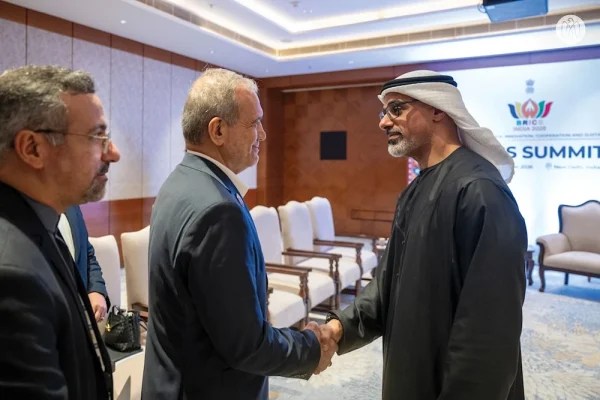
Al Mayadeen | September 13, 2026
Iranian President Masoud Pezeshkian said following the BRICS summit in India that Iran and the UAE want to restore relations following the US war on Iran.
“For the first time since the war and the incidents that occurred in the Persian Gulf, we had a constructive exchange with the crown prince of Abu Dhabi,” Pezeshkian said a day after a meeting with Abu Dhabi Crown Prince Khaled Bin Mohamed Bin Zayed Al Nahyan on the sidelines of the BRICS summit.
The Iranian President added that “it was agreed that we would turn the page, look to the future and build it together.”
Pezeshkian and Abu Dhabi’s Crown Prince met on the sidelines of the BRICS summit in New Delhi on Saturday, where the two discussed “regional and international issues, de-escalation, stability, and efforts to advance regional peace and development,” per the Abu Dhabi Media Office.
Why the Israelis are so afraid of a liberated Yemen
By Robert Inlakesh | Al Mayadeen | September 12, 2026
The liberation of Yemen by a staunchly pro-Palestinian movement is a nightmare scenario for the Zionist Project in the region, it ensures that the cause of occupied al-Quds will remain alive and that a new power will emerge to champion it. To the Israelis, what they are looking at is like the birth of a new Iran in the Arab World.
For long the Ansar Allah-led government of Yemen had been underestimated and treated as little more than a nuisance, one that Saudi Arabia and the United Arab Emirates were handed the task of dealing with. In 2022, this dynamic began to shift, as the Yemeni Armed Forces demonstrated advanced missile and drone capabilities that shook vital targets in Saudi Arabia, even reaching as far as the United Arab Emirates.
The stalemate of the Marib offensive of 2021 may have also worked to deceive the US-Israeli alliance in the region, who clearly failed to take the armed forces of the Ansar Allah-led government in Sanaa seriously. However, Riyadh did end up taking them seriously in early 2022, as did Abu Dhabi, hence their decision to agree to a United Nations mediated temporary ceasefire.
Since then, Yemen’s leadership has become the only government on earth to directly order its military to open fire on the Zionist entity in order to support the people of Gaza. From the very beginning of the Genocide, the Yemeni Armed Forces began firing missiles at the Israelis, before imposing a blockade on them in the Red Sea.
These measures would have been notable had they come from any nation, let alone one that had suffered 400,000 deaths in brutal conflict and suffered through an illegal and inhumane siege themselves. There was nothing material that the Ansar Allah-led government sought to gain from its tangible and unapologetic support of the Palestinian Resistance in the Gaza Strip, which is what made it all the more unpredictable in the eyes of the US-Israeli alliance.
Because Sanaa had been so underestimated, the Israelis and the US were essentially left blind inside of Yemen, not having anywhere near the required intelligence to deal a serious blow to Ansar Allah. Instead, the Zionist regime did the predictable thing: it bombed civilian targets and then called in its US allies to launch three separate military operations in an attempt to break the blockade established in support of Gaza.
Yemen is a nation that, if fully liberated from the proxy forces of Saudi Arabia and the United Arab Emirates, would undoubtedly dedicate its foreign policy to opposing the Zionist entity and supporting the Palestinian Resistance. This alone is a major threat to the Israeli regime.
Yet, it will also mean something else. It will be the only Arab country that has an independent government which is not allied with the United States. In other words, it will serve as an example to the entire region and will represent the spirit of Arabism. For Riyadh, Damascus, Amman, Cairo and beyond, this is a major problem, because once the example is set, their own populations could begin getting ideas about what their future should look like.
Yemen’s liberation will represent the only truly successful revolution of the Arab Spring. In the case of every other example, the nation has ended up under US domination, with the latest example being the case of Syria.
A Yemen that can gain access to its own resources, live free of blockade and have influence over the Bab al-Mandab Strait could become a major powerhouse, especially while allied with the Islamic Republic of Iran. It is a major gain for the regional resistance to US imperialism and an enormous strategic loss to the Zionist regime, along with a blow to the Washington-backed Arab dictatorships.
The only means of combating the gains made on the ground by the Yemeni Armed Forces, is to try and spread as much sectarianism throughout the region as possible. This, the Gulf Arab regimes and US-Israeli alliance, may believe to be an effective means of combating the revolutionary fervor of the Arab public who have been greatly agitated by the Gaza Genocide.
Part of the reason why the majority of the Arabic-language media, along with the entirety of the Western corporate media refer to the Ansar Allah-led government as the “Houthi rebels” is for this very reason. They hope to paint the movement as a band of Shia rebel fighters that are “proxies of Iran”. It works to both delegitimize the Yemeni Armed Forces and government based in the Capital City of the country, while also selling a false sectarian narrative.
To the great misfortune of the US-Israeli-Arab aligned bloc, their attempts to pull the wool over the eyes of the public is wearing thin. The Gaza Genocide exposed where everyone stands, and now the truth is clear for everyone to see.
Leaked chemical dossier reveals Israel’s role in Sudan’s civil war: Report
Press TV – September 11, 2026
A dossier of evidence alleging chemical weapons use by the Sudanese Armed Forces (SAF) was compiled by Israeli intelligence and shared with Western media outlets in a coordinated operation to discredit the army and bolster its paramilitary rival, a report says.
The dossier, described by the New York Times and Washington Post over the weekend as “shared by a Middle Eastern intelligence agency,” contained nearly 150 documents, bomb blueprints, images, videos, voice notes and several thousand intercepted text messages allegedly detailing how a secretive SAF unit developed and produced chlorine bombs over six months in 2024.
Multiple Sudanese and US sources told Middle East Eye that the “Middle Eastern intelligence agency” is Israeli, and that the dossier was nearly identical to one Israel handed to the US government before Washington sanctioned Abdel Fattah al-Burhan, leader of the SAF, in January 2025.
A former US official described the interception of vast numbers of messages as “an advertisement for Pegasus,” the spyware developed by Israeli cyber-intelligence firm NSO Group to infiltrate mobile phones.
“The thing that is shocking is how much Mossad has been tracking this,” one Sudanese security analyst, who could not be named, told Middle East Eye.
“I knew Mossad had interests in Sudan… but the level and depth and length of surveillance suggests that Israel is more involved in Sudan than we think.”
The revelations raise serious questions about Israel’s role in Sudan’s civil war and appear to confirm that Israeli intelligence is actively siding with the Rapid Support Forces (RSF) — whose main patron is the United Arab Emirates — against the Sudanese army.
On 13 September 2024, the RSF released a statement accusing the army of firing “toxic” missiles on al-Jaili, a crucial oil refinery north of Khartoum controlled at the time by the paramilitary.
There were no confirmed deaths in the attack, and there are no other confirmed occasions in which the SAF used chlorine bombs. The dossier does not contain medical evidence or testimony from any victims.
In a statement shared with Middle East Eye, the Sudanese government clarified that Sudan is a state party to the Chemical Weapons Convention and “has remained committed to its provisions and procedures, including the non-production, non-stockpiling and non-use of chemical weapons.”
It said that “all chlorine stocks in the country are designated exclusively for water purification, civilian industrial uses and energy, and it stands ready to demonstrate this before any competent international body.”
Israeli sources involved in the Zionist regime’s decision-making in the Horn of Africa have previously sought to develop and maintain relationships with a variety of different players, rather than backing one side or another.
“The Israeli love story with Hemedti intensified in 2021,” one North African analyst told Middle East Eye, referring to RSF head Muhammad Hamdan Dagalo Musa. The RSF chief was believed at the time and afterwards to have developed ties with Mossad.
In the leadup to Sudan’s war, then-Israeli foreign minister Eli Cohen met Burhan as part of what the Israelis called a “historic diplomatic visit” intended to pave the way for the finalization of a peace agreement. The war scuppered this.
But Hemedti maintained his ties with Israel, whose key ally the UAE continued to support the Sudanese paramilitary — charges Abu Dhabi still denies, despite mounting evidence, including from the United Nations.
“This feels like they are picking sides,” a former US official said of Israel, the dossier and the RSF. “The intelligence they shared with Washington succeeded in getting Burhan and the SAF sanctioned.”
“The Israel-UAE relationship has only grown deeper,” the source said.
Last month, Africa Intelligence reported that two of Hemedti’s brothers, Abdul Rahim and Algoney, had travelled secretly to Tel Aviv in May 2025 and again in February this year to meet with Israeli intelligence and foreign ministry officials.
The dossier’s Israeli origins fit a broader pattern of Israeli intelligence operations aimed at shaping narratives, influencing Western media and undermining governments that refuse to align with its regional agenda.
By feeding selectively leaked and unverified material to American newspapers, Israeli intelligence has succeeded in manufacturing a chemical weapons scandal that has been used to justify sanctions against Sudan’s army leadership while its rival — accused of genocide by the UN — receives continued support from Israel’s Persian Gulf allies.
Algeria cuts ties with UAE over interference, destabilization
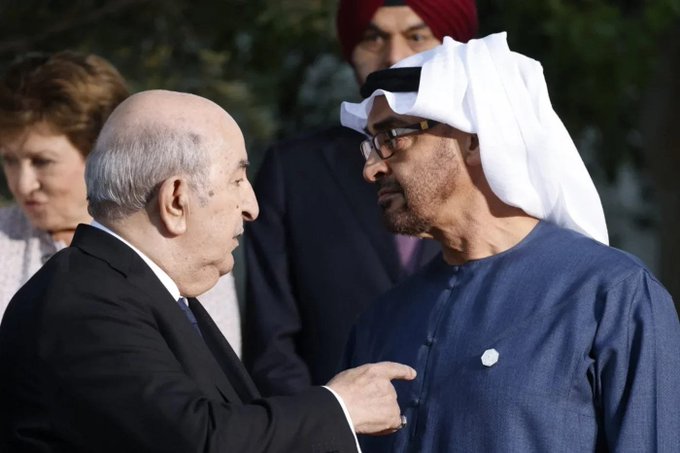
The Cradle | September 10, 2026
Algeria announced on 10 September that it will sever its diplomatic relations with the UAE in response to “provocative or hostile actions” and after “exhausting all means to preserve bilateral relations.”
The Algerian Foreign Ministry said in a statement that the government had decided to “sever diplomatic relations with the United Arab Emirates” after exercising “great restraint and a high sense of responsibility.”
The statement said Algiers had repeatedly warned Abu Dhabi of the “grave consequences” if such actions persisted.
The ministry reported that the UAE ambassador to Algeria was officially informed of the decision and given a 48-hour deadline to comply.
Last year, Algerian President Abdelmadjid Tebboune described his country’s relations as warm with all Gulf states except one, in a veiled reference to the UAE.
He described relations with Saudi Arabia, Kuwait, Oman, and Qatar as “fraternal,” while accusing the unnamed country of interfering in Algeria’s internal affairs and seeking to destabilize it.
Tensions escalated in February when Algeria began proceedings to cancel an air services agreement with the UAE signed in Abu Dhabi in May 2013.
The cancellation came amid reports that the UAE was seeking to support the Movement for the Self-Determination of Kabylie (MAK), a separatist group in northern Algeria, which Algiers considers a terrorist organization.
Relations between the two countries have deteriorated in recent years amid the UAE’s efforts to destabilize states and fuel civil wars across West Asia and North Africa in partnership with Israel.
In April 2024, Algerian President Abdelmadjid Tebboune referred to the UAE when he stated that, “Wherever there is conflict, the money of this state [the Emirates] is there – in Mali, Libya, and Sudan.”
The UAE has also strongly backed Morocco in its bid to annex Western Sahara, while Algeria supports the Polisario Front, which fights for self-determination in the territory.
The UAE also supported Morocco’s normalization with Israel as part of the Abraham Accords, which Algeria opposed.
Since gaining independence from France in 1962, Algeria has consistently supported the Palestinian cause, in part due to both countries’ shared history of resisting foreign colonial occupation.
Algiers cut ties with Morocco after Rabat normalized relations with Israel under US auspices in December 2020, viewing the deal as a direct threat to Algeria’s borders and security.
“Morocco’s military exercises with Israel contradict the principles of good neighborliness that we have always tried to uphold,” stated President Tebboune in an interview with French media.
Eight Arab and Muslim states reject Israeli displacement plans for Gaza
Palestinian Information Center – September 6, 2026
GAZA – Eight Arab and Muslim countries have condemned remarks by far-right Israeli ministers Itamar Ben Gvir and Israel Katz on plans to forcibly displace Palestinians from the Gaza Strip.
The foreign ministers of Egypt, Saudi Arabia, Jordan, the United Arab Emirates, Indonesia, Pakistan, Türkiye and Qatar said in a joint statement released on Sunday that such Israeli plans violate international and humanitarian law and pose a direct threat to the Palestinian people’s legitimate and inalienable rights.
The ministers voiced rejection of any Israeli attempt to displace Palestinians from or within the occupied territory, warning against transforming extremist rhetoric on forced displacement into official state policy.
The ministers warned that the displacement of Gazans would destabilize the region and derail global peace efforts, undermining US president Donald Trump’s plan to end the Gaza war, which clearly rejects forced population transfers.
The ministers stressed that Gaza is an integral part of the occupied Palestinian territories, calling for preserving the unity of Gaza, the West Bank and east Jerusalem.
They reiterated their countries’ support for a two-state solution establishing an independent Palestinian state along the June 4, 1967 lines, with east Jerusalem as its capital.
They urged the international community and UN Security Council to oppose Israeli attempts to impose a new demographic or geographic reality in the occupied Palestinian territories.
Israel provides covert intelligence, security assistance to Sudan’s RSF militia: Report
The Cradle | August 30, 2026
The leadership of the Rapid Support Forces (RSF), a militia accused of genocide in Sudan, has maintained secret, high-level security and intelligence contacts with Israel since before the start of the civil war in 2023, Africa Intelligence reported on 28 August.
According to the report, RSF leader Mohamed Hamdan Dagalo, known as Hemedti, secretly visited Tel Aviv in May 2025 and February 2026 for meetings with the Israeli Foreign Ministry’s Africa Division and Israeli intelligence officers.
Hemedti was joined by his two brothers, Abdul Rahim, the RSF’s second-in-command, and Algoney, on both trips.
Links between the RSF, which is fighting against the Sudanese Armed Forces (SAF), and Israel have emerged previously.
In 2022, Israeli newspaper Haaretz and Dutch investigative news outlet Lighthouse reported that a jet linked to former Israeli intelligence officer Tal Dilian delivered sophisticated EU-made phone-surveillance and hacking equipment to the RSF.
Dilian is the founder of the Intellexa network, a private intelligence firm based in Cyprus.
While Israel provides security and intelligence assistance to the RSF, the UAE remains the RSF’s principal backer.
Abu Dhabi provides the Sudanese militia with heavy weapons, drones, armored vehicles, ammunition, logistics, transit routes, and foreign mercenaries, in particular from Colombia.
The US government, UN, and various rights groups have documented that the RSF committed genocide in Sudan.
Last month, a coalition of rights groups led by the Raoul Wallenberg Center for Human Rights petitioned the International Criminal Court (ICC) to open an investigation into senior UAE officials and other regional figures for complicity in the genocide of non-Arab tribes in Sudan.
The submission accused them of enabling genocide, war crimes, and crimes against humanity by supplying the RSF and the SAF with weapons, money, and mercenaries, and knowingly assisting crimes carried out by a group.
Sudanese survivors filed a separate request naming Emirati Vice President Mansour bin Zayed Al-Nahyan over his role in financing and supplying the RSF.
That filing sets out murder, torture, and rape, including fighters driving vehicles over fleeing civilians. It points to the fall of El-Fasher on 26 October 2025, where UN reports record 6,000 people killed in three days.
The UK has also covertly assisted the RSF.
London has licensed around $565 million worth of weapons sales to the UAE across the past three years, including British-manufactured equipment that has repeatedly ended up in the hands of the RSF.
Nathaniel Raymond of Yale’s Humanitarian Research Lab told the House of Commons that British officials disregarded two years of real-time intelligence on the coming slaughter, which killed an estimated 60,000 people.
Raymond testified that the UK “prioritized HMG’s economic, security, and diplomatic relationships with the UAE above preventing the intentional starvation, forced displacement, and the genocidal slaughter” of civilians.
US cuts Banque Misr UAE from financial system over Iran sanctions
Al Mayadeen | August 28, 2026
The United States has cut Banque Misr’s UAE branch off from the US financial system over alleged violations of Washington’s sanctions on Iran, the US Department of the Treasury said Friday.
The move comes days after US Treasury Secretary Scott Bessent announced “Operation Economic Outcast”, a campaign aimed at isolating the Islamic Republic and countries accused of supporting it by targeting potential sources of revenue available to Tehran.
On Wednesday, Iranian Foreign Minister Abbas Araghchi sent a letter to the UN leadership and member states, calling on them to condemn what he described as an attempt at economic coercion.
Experts say the US move to cut Banque Misr’s UAE branch from the US financial system falls well short of the broader measures threatened by Treasury Secretary Scott Bessent under “Operation Economic Outcast,” limiting its impact to a single branch rather than imposing sanctions on the bank itself.
Banque Misr UAE targeted under US sanctions campaign
Under the latest measures, the Treasury’s Financial Crimes Enforcement Network (FinCEN) proposed revoking Banque Misr UAE’s access to correspondent banking services provided by US financial institutions.
“Under Operation Economic Outcast, the U.S. Department of the Treasury’s Financial Crimes Enforcement Network (FinCEN) proposed a rule that would revoke Banque Misr UAE’s correspondent banking access to U.S. financial institutions,” the Treasury said in a press release.
The department alleged that the UAE-based banking institution had worked with front companies used by Iran’s Ministry of Defense and the Islamic Revolution Guard Corps to circumvent US sanctions.
Treasury alleges Iran sanctions evasion
The Treasury also announced separate sanctions targeting Reza Mohammad Taeedi, manager of Bank Melli’s branch in Dubai, and Hong Kong-based Kameng Trading Limited.
According to the department, Taeedi and the trading company aided Iranian nationals who were already subject to US sanctions.
Iran vows no surrender
In response to Washington’s economic war, Iranian President Masoud Pezeshkian said Tuesday that economic pressure is an American strategy aimed at subjugating Iran and forcing it to surrender, as Tehran warned that any pressure targeting the Iranian people’s livelihoods and security would be treated as part of the war.
Pezeshkian made the remarks during a meeting with Iraqi Supreme Judicial Council President Faiq Zidan, saying Iran’s adversaries had recognized their inability to subdue the Iranian people militarily and had therefore shifted toward creating social and economic problems inside the country.
“Iran will not surrender,” Pezeshkian stressed, rejecting economic pressure as a means of forcing Tehran to submit.
Iranian business still active in UAE despite US ‘Economic D-Day’: WSJ

Al Mayadeen | August 28, 2026
Iranian commercial and financial activity continues across Dubai despite Washington’s push to sharply restrict Tehran’s access to regional markets and financial networks, The Wall Street Journal reported.
According to the newspaper, Iranian banks, airlines, restaurants, and businesses remain active in the United Arab Emirates even after US Treasury Secretary Scott Bessent announced what he called an “Economic D-Day” campaign aimed at countries and companies maintaining economic links with Iran.
Bessent had specifically demanded the closure of overseas branches of Bank Melli Iran, but the bank’s operations in Dubai appeared unchanged this week.
At one Bank Melli branch in Dubai’s old city, around a dozen tellers were continuing to serve Farsi-speaking customers, according to the report. Employees said they had received no instructions ordering the branch to cease operations.
“We put our trust in God on what happens next,” an Iranian bank employee said.
Bank Melli has operated in the UAE since 1969 and currently maintains two branches in Dubai.
US waves secondary sanctions
The continued activity comes despite the UAE Foreign Ministry announcing last week that the country was suspending trade, commercial exchanges, and financial transactions with Iran amid mounting US pressure.
Washington has warned governments and companies that continued dealings with Tehran could expose them to secondary sanctions.
“It is no longer acceptable to operate in the gray spaces of this conflict,” Bessent said. “These measures broaden secondary sanctions risk for anyone foolish enough to continue conducting business with this regime.”
Iranian economic networks remain embedded in Dubai
According to the WSJ, the gap between the public announcements and conditions on the ground reflects the depth of economic ties connecting Iran and the UAE, particularly Dubai.
Iranian businesses have operated in the emirate for decades, while hundreds of thousands of Iranians are believed to live in the UAE and use Dubai as an important gateway to international finance and trade.
Iranian airlines also continue to operate direct services between Iran and the Emirates. UAE carriers Emirates, Etihad, and FlyDubai are not currently flying directly to Iranian destinations, although some reportedly continue to use Iranian airspace.
The newspaper also found Iranian restaurants and cafes operating normally in Dubai, with Iranian residents interacting openly with Emirati customers.
Earlier restrictions eased
Some restrictions imposed earlier in the year appear to have eased as well.
During a broader crackdown in the spring, UAE authorities closed the Iranian Hospital and Iranian Club, temporarily restricted Iranian passport holders from entering or transiting the country and revoked visas belonging to some Iranian residents.
The hospital and club remain closed, but Iranians interviewed by the newspaper said widespread visa cancellations appear to have stopped and some previously withdrawn visas have since been restored.
Iranian residents are nevertheless preparing for the possibility of tighter financial restrictions. Some told the newspaper they could turn to the traditional hawala transfer system if formal banking links with Iran are eventually disrupted.
Severing Iran-UAE trade seen as difficult
Economic ties between the two countries are extensive.
Around $28 billion in trade passed between Iran and the UAE in 2024, according to World Trade Organization figures cited by the newspaper.
Neil Quilliam, an associate fellow at Chatham House, said the economic relationship cannot easily be dismantled.
“The Gulf Arab state economies are so closely integrated and intertwined with the Iranian economy, you can’t just simply sever economic trade and activity overnight,” Quilliam said. “The U.A.E., and Dubai in particular, have always managed to continue to do trade, even when the maximum pressure is on. Cutting off that trade will be cutting off their nose, basically.”
Dubai has also long been identified by US authorities as a major center for financial activity linked to Iran.
The UAE also hosts the second-largest number of individuals and companies sanctioned by the US Treasury over alleged Iran-related activity after China, according to Levitt.
Washington faces competing interests in UAE
The report noted that pushing Abu Dhabi to fully sever its economic relationship with Tehran could create complications for Washington because of the UAE’s broader strategic importance to the United States.
The Emirates hosts US military facilities, maintains close security relations with Washington, and was the first Gulf Arab state to sign the US-brokered “Abraham Accords” establishing formal diplomatic relations with “Israel”.
The country has also emerged as a major source of investment in US sectors including artificial intelligence.
Those interests give Washington incentives to preserve strong relations with Abu Dhabi even as it demands tougher enforcement against Iranian commercial networks.
For Emirati authorities, maintaining some economic channels with Iran may also be viewed as a means of reducing regional tensions.
“There will be some in the U.A.E. who say, ‘Whatever the price of calm, that is what we need to do,’ ” Levitt said. “Better to do that by allowing them to access banking and supply chains through our country than not,” he said of the Emirates’ thinking on Iran.
Dubai faces an additional economic calculation because, unlike oil-rich Abu Dhabi, its economy relies heavily on trade, finance, tourism, and international capital flows.
The WSJ report therefore suggests that despite Washington’s escalating sanctions threats and the UAE’s public commitment to restrict economic links with Tehran, deeply established Iranian financial and commercial networks in Dubai remain difficult to dismantle.
After 6 months of war, why aren’t oil prices even higher?
By Sam Fraser | Responsible Statecraft | August 25, 2026
For decades, the potential closure of the Strait of Hormuz has been considered the ultimate doomsday scenario for global oil markets. So, when Iran effectively closed the Strait earlier this year in response to the joint U.S.-Israeli assault, many analysts warned that oil prices could skyrocket to record highs.
The logic was straightforward. Prior to the war, about 20% of the global oil supply transited the Strait. A loss of supply on this scale could easily have pushed oil prices to $150 or even $200 per barrel — but it didn’t. Instead, prices peaked around $120 per barrel in April and have largely stayed below $100 since June.
To understand the dynamics that have so far prevented an even higher price spike, and to get a sense of where oil supply and prices may be headed as the conflict drags on, I spoke with Rory Johnston, a leading oil markets analyst and the author of the Commodity Context blog. Our conversation has been edited for length and clarity.
Sam Fraser: Let’s talk about why we haven’t seen the $150-200 per barrel oil prices that you warned about early in the war. You’ve pointed to a few reasons, including China’s massive import cuts. As we understand it, what has China done with their oil imports and how have they managed it?
Rory Johnston: It’s a bit of a mystery. At this stage, what we know for sure is that China reduced its crude oil imports by over five million barrels a day, roughly 45% of their total pre-war import appetite. For China, there’s two endpoints of that crude oil balance: into a refinery or into storage. We know that China had been building up a massive volume of strategic reserves prior to the war.
Essentially half of the 5 million barrels a day reduction can be explained roughly by reductions in refining runs in China. The remainder is a question of balancing in and out of stockpiles. Some of it would’ve been likely a drawdown of less visible or underground stockpiles. And the other portion of it is the halting of that prior pace of stockpile building. The main debate is how much each of these factors is contributing. If, let’s say, 80% of that remainder is a halt to prior purchases that were building strategic stocks, that is a bearish outcome for oil prices because it means that Beijing doesn’t need to replace those volumes anytime soon. But if they are aggressively drawing down less visible strategic stocks right now, that’s a much more bullish interpretation because it means they can’t keep going on forever and they’re going to need to replace those stockpiles.
On the refined product side, they cut refining runs by about 2.5 to 3 million barrels a day. What are they doing with that prior flow of diesel, jet fuel, et cetera? And that’s where we start to get even more speculative. Above-ground storage tanks for refined products don’t have floating roofs. We can’t independently verify their fill.
It comes down to the apparent consumption and the apparent available supply of these fuels within China. For gasoline and diesel, each of those supplies have apparently fallen by about 20%, which is a stark reduction. There’s no evidence that people in China are just driving a fifth less. If they aren’t actually cutting back that much on consumption, where is the fuel coming from? Prior to the war, we suspected that China was also building strategic reserves of refined fuels. Again, we can’t verify that, but if they had built that up, they could be drawing it down. We’re then faced with that same question as in crude oil, how much of this is a cessation of prior stock building and how much of this is the drawdown of existing stock?
For reference, the last moment we saw anything like this in terms of apparent consumption collapse was COVID zero in 2022 when the country was entirely locked down.
Fraser: So we can say that stockpiles of refined products must exist, but we have no insight into their size or how much is being drawn down or how sustainable those drawdowns would be?
Johnston: Correct. There are mixed estimates, but I think they are at best estimates. It’s funny, I think in some ways the lack of verifiable data allows people to speak very confidently about what’s happening in China, because there’s no data to rebut virtually any argument. That’s just allowing people to run with it without any kind of real pushback.
Fraser: How have we seen the Chinese buying patterns change since the U.S.-Iran Memorandum of Understanding and since it collapsed?
Johnston: What we saw following the MOU was a surge of exiting cargoes from Hormuz. The vast majority of that seems to have routed towards China. What we saw was that, at the very bottom, Chinese crude oil imports fell to around 6 million barrels a day in June. And then those spiked back up to more than 10 million barrels a day in July, or at least that was the high point in July. Roughly a month later, those imports are back down around six. You’ve seen a rollover back to where we stood pre-MOU.
Fraser: Do we know how long this import suppression can continue?
Johnston:. Let’s say this has been entirely a drawdown of stocks, which seems implausible. Even then, they have more than a billion barrels of crude oil stocks that we know about for sure. If they want to support the market to their maximum ability, they can do that for months further. But in doing so, they would deplete the entirety of the energy security blanket they’ve spent almost two decades constructing.
Fraser: Let’s move on to the strategic petroleum reserve releases by the U.S. and other partners. To what degree have those been instrumental in keeping prices from going a lot higher?
Johnston: It’s part of the suite that the world has kind of engaged in to blunt those effects. This is the largest release of strategic stocks on record. Depending on the exact month you’re talking about, it has potentially been over 3 million barrels a day of incremental supply coming from OECD SPRs. Without that, the market would’ve been much tighter and we likely wouldn’t have experienced the same relief even with China’s import cut at the same time.
Fraser: Last week the U.S. SPR dipped under 300 million barrels. There’s a lot of discussion of what the physical limits on those stockpiles are given that they’re stored in salt caverns. They need a certain amount of fill to maintain structural integrity. Are we anywhere close to pushing up against the U.S. ability to continue drawing down from those stockpiles?
Johnston: I do not believe we are. I think that you have probably at least another 200 million barrels that can be readily drawn down. With the required fill level, absolutely it would be a massive issue if you just drew it down and left a vacuum in there. It would implode on itself. But they don’t do that. They one-to-one replace a barrel of crude oil extracted with a barrel of saturated brine. So theoretically it should maintain the same fill. The issue for SPRs is not necessarily fill level, but number of refill and empty cycles. It’s the actual up-and-down motion that disturbs and further erodes the walls and structural integrity.
I think that the SPR caverns can get below 100 million barrels of fill before we run into any issues.
Fraser: So if we continued the current rate of drawdown, that would take us well into next year.
Johnston: Correct.
Fraser: Over the course of the war, Trump or someone in his administration will make a statement about how diplomacy is progressing or about how much oil is coming out of the strait. And even if those are quickly disproven, there is a downward impact on prices. So why do these traders keep listening to Trump? Has there been a change in the reaction of markets over the course of this war?
Johnston: You definitely get smaller drawdowns to these kinds of jawboning attempts today than you would have, say, in March and April, where there are multiple days that you saw $15 to $20 per barrel reductions in the span of a day.
When you look at the history of oil, there’s a tendency on these geopolitical events to overdo it. That’s a natural kind of fear-driven phenomenon. In some ways Trump has short-circuited that normal behavior in oil markets. Because while you’re right that it’s never coming true, the price action is coming true. At the end of the day, for prices to go higher, you need traders to bid higher. And if they bid higher and they get blown out of the water and they lose their jobs, they’re going to be replaced by someone that doesn’t bid higher on geopolitical risk. It has successfully arrested the upside volatility. But if we keep getting tighter, markets will continue to respond higher; we just won’t get those runaway phenomena that we would’ve seen historically.
Fraser: Since the start of the war, we’ve seen Saudi Arabia and the UAE successfully use pipelines as an alternative route to get oil out of the Gulf. How much oil are those getting out at this point? And has the Houthi blockade of Saudi shipping in the Red Sea had a meaningful effect on this?
Johnston: The total volume coming out of Emirates at Fujairah and then the west coast of Saudi Arabia and the Red Sea rose to about 6-7 million barrels. It was about 2-3 million before, so that was an incremental change of 4-5 million barrels.
To your question with the Houthis, it has absolutely been having an effect. As soon as they started attacking Saudi ships, the entire Red Sea fleet went dark. Everyone turned off their transponders, making it much harder to verify flows out of Saudi Arabia. Verifiable transits of Saudi tankers through the Bab al-Mandab have gone functionally to zero. They still are probably getting some out, but we’re also seeing evidence of flows north into the Mediterranean. Pre-war flows here were around a million barrels a day, give or take. That’s jumped over the past week or two to around 2.5 million barrels a day, presumed Saudi flow.
Over the past two weeks, we’ve also seen Saudi Arabia begin loading tankers in the Gulf again, which they hadn’t done since the collapse of the MOU. And the question is, does Riyadh know something? Is something big going to break in the Hormuz negotiations? Or are they being forced back into the Gulf? You’re seeing reports now that they are participating in the Emirati-led shuttle trade, ship-to-ship transfers in the Gulf of Oman. It seems likely that some of that is displaced barrels coming back from the Red Sea. So Saudi Arabia is needing to diversify away from its diversification. There’s a poetic side to it.
Fraser: Pulling all these factors together, where are we left in terms of a kind of global supply shortage? And what kinds of price impacts can we expect if that persists over the next few months?
Johnston: It’s very hard to estimate global balance right now. My bet would be 2-4 million barrels a day undersupplied on a global basis.
The rub on top of that is that we now have a parallel crisis that’s emerging on the refining side of the slate. So even if we’ve sorted out what was happening on the crude oil side, we have the Ukrainian hammering of Russian refineries, the attacks in the Black Sea, the reduction in U.S. exports now that stocks have drawn down, and China is not exporting refined products either. All together this further tightens global refined product markets.
If this persists and we keep drawing down crude oil stocks, the crude oil price is going to keep rising. On top of that, we could see refined product prices independently going higher. So that’s just an amplification. For consumers, it’s refined product prices and not crude oil that are going to drive those economic issues.
Fraser: So even though these factors we’ve discussed have kept oil prices down so far, and the biggest of these can persist for a while, we could still be looking at those extremely elevated prices by a few months from now.
Johnston: Easily. We’re already feeling it. Refined prices are already at demand-destructive levels. It’s just a question of whether they are at sufficiently demand-destructive levels. It’s the same fundamental concern I would’ve had back in April, playing out on a much longer timeline and now more on the product side than the entire oil complex.
Sam Fraser is a writer based in New York City. He holds a Master’s in International Finance and Economic Policy from Columbia University’s School of International and Public Affairs, where his studies focused on the changing global trade system. Previously, Sam worked as Senior Communications Associate and Publications Manager at the Quincy Institute.
BRICS+ Series: Why the Egypt-UAE Energy Partnership Signals a New Phase for the Global South

By Chloe Maluleke and Dr Iqbal Survé | IOL | July 3, 2026
The latest discussions between Egypt and the United Arab Emirates on expanding natural gas production in the Nile Delta represent more than another investment agreement in the energy sector. They illustrate a broader transformation underway across the Middle East and North Africa (MENA), where energy security, technological capability and regional capital are increasingly being mobilised from within the Global South rather than relying exclusively on Western financing and expertise.
For decades, energy partnerships in the MENA region largely followed a familiar pattern. Resource-rich states exported hydrocarbons while multinational energy companies from Europe and North America supplied technology, finance and operational expertise. That model is gradually evolving. Today’s agreements increasingly reflect cooperation between emerging economies that possess complementary strengths and shared strategic interests.
Egypt occupies a unique position in this transition. It is simultaneously an African, Arab and Mediterranean nation, giving it significant geopolitical value. While its domestic gas production has fluctuated in recent years because of declining output from mature fields and rising domestic consumption, Cairo remains determined to restore its status as a regional energy hub. The country’s existing liquefied natural gas (LNG) export infrastructure, strategic location along the Suez Canal and established pipeline connections position it as a gateway linking African producers with European and Asian markets.
The UAE, meanwhile, has become one of the Global South’s most influential sources of investment capital. Emirati sovereign wealth funds and state-backed energy companies are increasingly deploying finance across Africa and the wider Middle East, extending beyond traditional oil investments into renewable energy, logistics, ports and advanced extraction technologies. This reflects Abu Dhabi’s long-term strategy of securing energy assets while diversifying its international investment portfolio.
The proposed expansion of geological exploration in Egypt’s Nile Delta therefore serves multiple strategic purposes. It seeks to increase Egypt’s domestic gas output, reduce reliance on costly imports and strengthen export capacity. Equally important, it demonstrates how regional investors are assuming greater responsibility for financing critical energy infrastructure within their own neighbourhood.
For the MENA region, such cooperation strengthens economic resilience during a period of heightened geopolitical uncertainty. Conflicts across the Middle East, disruptions to shipping routes and volatile commodity prices have reinforced the importance of reliable regional supply chains. Expanding domestic production reduces vulnerability to external shocks while allowing countries greater flexibility in balancing domestic demand with export commitments.
The initiative also reflects the growing importance of technological modernisation in hydrocarbon production. Advanced drilling techniques, digital reservoir management and improved recovery methods are enabling countries to maximise output from existing fields without relying solely on new discoveries. Technology transfer has become as strategically valuable as financial investment, particularly for countries seeking to optimise mature energy assets.
The implications extend well beyond North Africa. Across the Global South, governments are increasingly pursuing development strategies centred on South-South cooperation. Rather than depending exclusively on traditional development partners, countries are building networks of investment, expertise and infrastructure with fellow emerging economies. This approach aligns with a broader effort to reshape international economic governance around more diversified partnerships.
For BRICS, the Egypt-UAE partnership reinforces several long-standing objectives. Egypt’s accession to BRICS expanded the grouping’s presence in Africa and the Arab world, strengthening its representation across key energy-producing regions. Although the UAE is not geographically located within North Africa, its growing investment footprint across the continent complements BRICS’ broader emphasis on infrastructure financing, industrial development and economic integration among developing economies.
The partnership also supports BRICS’ vision of enhancing energy security through diversified production and investment channels. As global energy markets become increasingly fragmented by geopolitical tensions, emerging economies are seeking to reduce exposure to concentrated supply chains and external political risks. Regional cooperation between BRICS members and partner economies helps create a more distributed and resilient energy architecture.
However, challenges remain. Expanding natural gas production requires sustained investment, regulatory certainty and environmental stewardship. Natural gas is frequently presented as a transition fuel capable of supporting economic development while renewable energy capacity expands, yet long-term climate commitments will continue to shape investment decisions. Egypt and the UAE will therefore need to balance immediate energy security objectives with growing international pressure to accelerate decarbonisation. [emphasis added]
Ultimately, the significance of the Egypt-UAE energy discussions lies not simply in additional gas wells or increased reserves. They reflect a deeper shift in how emerging economies are organising capital, technology and political partnerships. As the Global South assumes a more active role in financing its own development, regional cooperation is becoming an increasingly important pillar of economic resilience. In that sense, the Nile Delta may represent not only a source of natural gas, but also a symbol of a changing global economic order in which the future of energy is being shaped as much by cooperation within the Global South as by traditional centres of power.
Dr Iqbal Survé is a past chairman of the BRICS Business Council and co-chairman of the BRICS Media Forum and the BRNN.
Chloe Maluleke is an Associate at BRICS+ Consulting Group, Russia & Middle East Specialist.
From Tehran to Riyadh: How Israel Draws the Red Lines America Can’t Cross

By Jamal Kanj | MEMO | July 30, 2026
Israel dragged America into another war, then sat back on the spectator bench and watched U.S. taxpayers foot the bill. Borrowed money burned into bombs. Billions more bled out at gas stations and in inflation, all to reopen a strait that was open before Donald was duped into fighting Benjamin’s war. Now Benjamin Netanyahu watches from a safe distance, gloating as missiles fly between the U.S. forces and Iran in a war he spent years pushing Washington to fight.
At home, flag-draped caskets of American soldiers arriving home from a war Israel instigated and American soldiers carried out. In Congress, Secretary of War Pete Hegseth stood before the Senate requesting more money to keep the war running.
Lawmakers asked to sign the check for a war they never voted to authorize, fought for aims Washington did not set, with no accounting of when — or how— it ends.
In occupied Palestine, Israeli Finance Minister Bezalel Smotrich tells a settler conference that “Israel has no interest in joining the campaign . . . a confined campaign between Iran and the United States, is the correct [situation] and best for us [Israel].” In layman language, let’s sit and watch Americans die and pay for our war.
Exhibit A: the U.S. military is depleting its own missile-defense stockpiles defending its bases across the region, while Israel hoards its interceptors in reserve. Israel isn’t spending down its stockpile. It’s waiting for the moment American stocks run dry and the Gulf states are left exposed. When that moment comes, Israeli interceptors will become prized leverage, offered to the UAE and the rest of the Gulf at a price.
Last Sunday on Fox News, Netanyahu outlined to America his goals for the war against Iran. A foreign prime minister, on American airwaves, essentially setting the terms and the finish line for an American war, fought by American pilots, funded by American taxpayers, and now apparently concluded at Israel’s discretion. Whatever Trump negotiates, whatever Washington decides, Netanyahu has already told America it doesn’t matter. He isn’t waiting to end the war on Israel’s terms. He’s informing it.
But it is not only America’s war policy that runs through Tel Aviv. It is diplomacy and commerce too. When Washington signed a civilian nuclear cooperation agreement with Saudi Arabia, and the deal was announced, ink dry, both governments on record. Within a day, President Trump reversed course, declaring the agreement was contingent on Saudi normalization with Israel.
Israeli officials do not even try to be diplomatic on how they run Washington policy. Before Trump added the new condition, Israel’s Culture and Sports Minister, Miki Zohar, told Army Radio that “Israel has been clear with the United States about its red lines.” Those are the words of a government that understands it holds a veto pen, set red lines, and where America listens.
Think about it, an Israeli minister speaks openly of red lines over an American commercial and strategic agreement with one of the world’s largest oil exporters, a country central to Gulf security architecture Washington has spent decades building. It did not matter that the Saudi deal serves American energy and strategic interests. It mattered only that Tel Aviv had not yet signed off.
The issue isn’t whether Israel tries to shape American war strategy, or whether its leaders draw red lines Washington isn’t allowed to cross. The real question is why American leaders, across the political spectrum, permit a strategically insignificant country to wield such extraordinary influence over the foreign policy of the world’s only superpower.
Israeli red lines prompted America’s Israel-first loyalists to abruptly discover the agreement was a nuclear proliferation threat. For decades, they have defended, excused, or ignored Israel’s undeclared nuclear arsenal. Yet the prospect of a Saudi civilian nuclear program suddenly provokes moral outrage. The issue was never stopping nuclear proliferation. It was about sequencing. They would be willing to kosher a Saudi civilian nuclear program the day after, not before, it recognizes Israel.
If Arab capitals want an American relationship that serves their own security and economic interests, they need to stop mistaking proximity for leverage. For years the strategy has been to buy access, funneling billions to powerful intermediaries like Jared Kushner, treating him as the private door into the Oval Office.
But Kushner is no neutral broker. He is an Israel-first advocate who built his post-White House fortune partly on Arab capital while shaping Middle East policy on Israel’s behalf and now uses his wealth to finance Jewish-only colonies built on stolen Palestinian land.
The United Arab Emirates lived this irony in hard numbers. Kushner sold Abu Dhabi on the Abraham Accords with a promise attached: normalize with Israel, and the most advanced American fighter jet in the world would follow, a $23 billion sale of fifty F-35s. The UAE delivered its half instantly, recognition, embassies, open skies. Washington delivered Israel every benefit of that deal. The jets never came. Years of “technical requirements,” stalled reviews, and quiet reversals later.
Trump wants to sell Saudi Arabia the promise of a commercial agreement, but deliver Israel an immediate recognition. The Arab cow gets milked for capital, investment, and diplomatic goodwill, and when the moment comes to deliver, the payoff is led instead to the Israeli altar. Every dollar spent courting Kushner, every concession made in good faith, has purchased not access but the illusion of it, never enough to collect on.
Arab regimes must understand that neither buying access to the president through Israel-first loyalists like Kushner, nor hosting the American bases that fight wars designed in and for Tel Aviv, will change U.S. policy — not while Israel holds the lobby power to dictate red lines American leaders dare not cross.
Featured Video
Racist Seinfeld Dances for Joy as Bibi Unveils His New Map
or go to
Aletho News Archives – Video-Images
TV Drama Review
Japanese drama projects Japan’s wartime atrocities onto Chinese characters

Global Times | October 25, 2026
By portraying Chinese characters as perpetrators of ruthless violence while casting Japanese Self-Defense Forces (SDF) intelligence operatives as defenders, the season 2 of the Japanese drama Vivant has recently drawn criticism from Chinese netizens, who argue that its depiction turns historical reality on its head while ignoring Japan’s wartime atrocities.
The TBS drama series – a spy suspense story in which an alleged unofficial intelligence unit of the SDF operates across the globe — has attracted a passionate fanbase. Its currently airing season 2 opened with a household rating of 18.8 percent, the highest for a TV drama this year, according toa commentary article by Japanese media Toyo Keizai.
What draws attention is the portrayal of the enemies in the series, the article noted. Scenes in which the Chinese organization subjects kidnapped members of the SDF unit to brutal torture are repeated with unrelenting intensity.
It is rare for Japanese TV dramas to explicitly portray a real-life country as the enemy, the article noted.
Japanese Prime Minister Sanae Takaichi also made a reference to the drama, saying that she has been recording Vivant and hopes to binge-watch it over the year-end and New Year holidays, according to Japanese media outlets.
China’s CCTV News report on Sunday revealed that the drama features scenes in which Chinese personnel cut off the fingers of and stab Japanese intelligence operatives in the abdomen. Such acts bear striking similarities to the torture inflicted on Chinese nationals by invading Japanese troops during the World War II.
The drama distorts the truth by attributing these atrocities to modern Chinese characters. Beneath the surface, it subtly glorifies Japan’s cross-border overseas operations, blurs the functional boundaries of the SDF and implicitly promotes an expansionist narrative, per CCTV News. … continue
Blog Roll
 Aletho News
- Iran, Turkey, Pakistan, Saudi Arabia could advance region-led security framework in Tehran: FM spox
- Netizens condemn Japanese drama for projecting Japan’s wartime atrocities onto Chinese characters
- Racist Seinfeld Dances for Joy as Bibi Unveils His New Map
- A West Bank War for Netanyahu’s Election Campaign, Could It Backfire?
- Yemen denounces European Parliament’s ‘hypocritical’ push to blacklist Ansarullah
- Qalibaf: UAE’s UN bid aims to ‘clear the runway’ for ‘Greater Israel’, whitewash genocide
- Pakistan reopens Iran border after boosting security: Report
- Why are so many Brazilians voting for Flávio Bolsonaro?
- Democrats Put Anti-Russia Agenda Ahead of American Workers
- Elijah Magnier: Yemen’s Strikes Are Shattering Saudi Arabia’s Long-Term Strategy
- If Americans Knew
- An error has occurred; the feed is probably down. Try again later.
- No Tricks Zone
- Sudden Stratospheric Warming, Powerful El Niño Combination May Lead To Extreme Europe Cold, Energy Crisis!
- Two New Studies Find Thwaites Glacier Melt Cannot Be Driven By Human Activity Or A Warming Ocean
- E-Cars Reduce CO2 Emissions By Only 41% Compared To Internal Combustion Engine Vehicles
- Predictions Made By Renowned Climate Professor Over Past Decades Have Been Proven To Be Poor
- New Study Suggests Large Regions Of The Pacific Ocean Have Been Cooling For The Last 80 Years
- Germany’s Green Energy Debacle: High Energy Costs Force Kahla Porzellan to Close After 182 Years!
- New Study: 50 Years Of The Most Aggressive ‘Net Zero’ Policies Can Only Affect The Global Climate By 0.03°C
- US September “Heat” Was No Record…Many Records Set Decades Ago
- Latest European Green Energy Debacle; Portugal’s Largest Flagship Solar Park Insolvent!
- Green Energy Debacle: German Expert Professor Fritz Vahrenholt Warns Of Severe Economic And Social Consequences

