US, UK preparing for fresh escalation in Yemen: Ansarullah
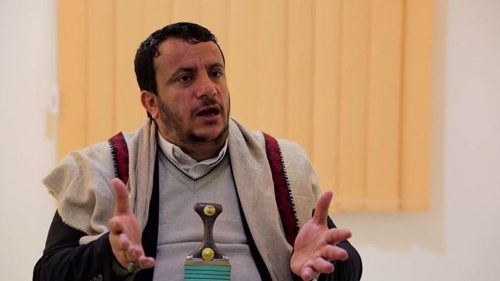
Ali al-Qahoum, a member of the Yemeni popular resistance Ansarullah movement’s Political Bureau (Courtesy of al-Mayadeen)
Press TV – November 6, 2022
Yemen’s popular resistance Ansarullah movement warns about the United States and the UK’s fresh malicious intentions in the war-ravaged country.
Ali al-Qahoum, a member of Ansarullah’s Political Bureau, raised the alarm during an exclusive interview with Lebanon’s al-Mayadeen television network on Sunday.
There is “a direct US military presence in Yemen, and an influx of US forces, specifically in Hadhramaut,” he said, referring to Yemen’s biggest province, which spans from the country’s center towards its eastern areas.
“There is also an influx of British forces into al-Mahrah,” he added, referring to Yemen’s second-largest province that neighbors Hadharamaut to the east.
The US and the UK were preparing for a fresh round of escalation in Yemen, he further warned without elaborating.
The Western countries have been contributing heavily and unabatedly to a war of aggression that a Saudi Arabia-led coalition has been waging against Yemen since 2015.
The coalition has been seeking, unsuccessfully though, to restore Yemen’s power to the country’s former Western- and Riyadh-aligned officials. The war has killed hundreds of thousands of Yemenis and spawned the world’s worst humanitarian crisis.
Washington and London have been providing the coalition with direct arms, logistical, and political support, including through outfitting it with precision-guided ammunitions that the Saudi-led forces have been using amply against Yemen’s civilian population.
Al-Qahoum said new US and British military delegations had arrived in Yemen earlier this week.
Reporting on Wednesday, Yemen Press Agency cited informed local sources as saying that Hadhramaut’s Provincial Governor, Mabkhout bin Madi, had held a face-to-face meeting with the US delegation in his office.
The Ansarullah official, however, asserted that despite the Western states’ apparent preparations for a new flare-up in Yemen, “the Yemenis are ready to defend their dignity and every inch of their country.”
“Ansarullah has military capabilities that preserve Yemen’s sovereignty and independence,” he added.
British nuclear submarine caught fire
RT | November 7, 2022
One of the British Navy’s Vanguard-class nuclear submarines was forced to abort a “top secret mission” after it sustained fire damage, according to a Sunday article published by The Sun.
According to the outlet’s sources, it took the efforts of the entire 130-plus crew, including many who were off-duty, to put out an electrical fire aboard the HMS Victorious, which was carrying Trident 2 nuclear ICBMs at the time of the incident.
While the fire was reportedly contained relatively quickly, the emergency situation declared by the ship’s captain forced the ship to shoot to the surface at an undisclosed location in the North Atlantic to vent out toxic fumes.
A Navy source reportedly explained to The Sun that “every seagoing member of the Royal Navy is a qualified fire-fighter,” and that this ensured that British ships and submarines were able to quickly respond to such incidents without affecting operational outputs.
Nevertheless, the damage caused by the fire prompted the submarine’s captain to abandon an unspecified “top secret mission” and order the vessel to return to base at HMNB Clyde in Faslane, Scotland.
The Sun noted that the 30-year-old vessel, which cost over $3 billion, is one of the Royal Navy’s four non-stop nuclear deterrent patrols. A Royal Navy spokesperson told the paper that the incident has not affected the continuous at-sea deterrent, but declined to provide any further details on submarine operations.
The climate scaremongers: Health chief’s nonsensical warning of doom
By Paul Homewood | TCW Defending Freedom | November 4, 2022
We are used to silly, irresponsible climate scare stories from the BBC and the papers, but when they come from the chief executive of the UK Health Security Agency it is quite another matter.
According to the Guardian last week: ‘The climate crisis poses a “significant and growing threat” to health in the UK, the country’s most senior public health expert has warned.
‘Professor Dame Jenny Harries, the chief executive of the UK Health Security Agency, said there was a common misconception that a warmer climate would bring net health benefits due to milder winters. But the climate emergency would bring far wider-reaching health impacts, she said, with food security, flooding and mosquito-borne diseases posing threats.
‘Referring to the recent floods in Pakistan, Harries said the UK needed to build resilience to protect the population from the health impacts of extreme weather events. “Colleagues from Pakistan . . . are suffering from the impacts of flooding. They are dealing with stagnant water, higher risks of sewage overflowing into publicly accessible water spaces,” she said. “We are seeing some of the things that could be happening in the UK”.’
She went on to repeat the fake claims that this summer’s heatwave had killed 2,800 people, a claim already exposed as a sham on TCW. And she warned us that we would have to stay indoors in the middle of the day in summer, and have longer summer holidays for schools. She even ridiculously claimed that we would soon have outbreaks of dengue fever.
The comparison with Pakistan is utterly absurd, and there’s no evidence that summers in England are getting wetter, or for that matter drier.

Indeed, even her claim that we would soon be having Mediterranean summers is just as ridiculous. The simple fact is that even this summer was not as hot as 1976. The average summer temperature may have increased, as cold summers become less frequent, but even with the wall-to-wall sunshine we had this year, summers show no sign of breaking through that 16C barrier:

By contrast, average summer temperatures in the south of France are typically six or seven degrees higher.
Harries’s comments about dengue are particularly misleading. The spread of dengue globally has not been because of climate change, as one of the world’s leading experts on infectious diseases, Professor Duane Gubler, has explained.
According to him, the principal drivers are urbanisation, globalisation and lack of effective mosquito control. The mosquitoes which carry the virus thrive in urban habitats, where dengue quickly spreads, while air travel provides the ideal mechanism for transport of viruses to new cities, regions and continents. The result, he says, is epidemic dengue.
The World Health Organisation also notes that the mosquito which has brought the dengue virus to Europe is actually adapted to cold weather: ‘Aedes albopictus, a secondary dengue vector in Asia, has spread to North America and more than 25 countries in the European Region, largely due to the international trade in used tyres (a breeding habitat) and other goods (e.g. lucky bamboo). Aedes albopictus is highly adaptive and, therefore, can survive in cooler temperate regions of Europe.’
Britain is no stranger to mosquito-borne diseases such as dengue. Large epidemics of dengue have been recorded here and elsewhere in Europe since the 18th century. One massive epidemic, estimated at one million cases with at least 1,000 deaths, occurred in Greece in 1927-28. Climate change has nothing to do with the spread of dengue.
And what about this ‘food security’ Harries is waffling on about? Agricultural output has been rising since the BSE scare of the 1990s:

https://www.fao.org/faostat/en/#compare
If the professor is worried about Britain’s food security, maybe she should be objecting to the government’s plans to rewild large swathes of our countryside, to attack the dairy and meat industry and to build solar farms on prime agricultural land.
BBC’s Arctic warming trick
ACCORDING to a BBC report, Svalbard, the Norwegian archipelago deep inside the Arctic Circle, is heating at six times the global average. (The BBC and Guardian now routinely call it ‘heating’ rather than ‘warming’, though I don’t think the Svalbarders would call average annual temperatures of 1C ‘hot’!)
The report, Svalbard: The race to save the fastest-warming place on Earth, states: ‘Svalbard is home to the world’s northernmost permanent settlement, Longyearbyen, which is estimated to be heating at six times the global average. So what is being done to save it?
‘Svalbard’s church is a blood-red wooden building with bright white trim – the most northerly place of worship in the world. Its priest, Siv Limstrand, has been here for only three years but is shocked by the impact of climate change she has witnessed in that time. “Every Sunday when we gather for worship, a part of our intercessions is always about climate change and its threats,” explains Limstrand. “We know that the clock is ticking.”
‘You feel on borrowed time here in what successive scientific studies have found is the fastest-warming place on Earth. Experts from the Norwegian Polar Institute are among those who calculate it is heating six times faster than the global average. The consensus is that the temperature in Svalbard has jumped 4C in the past 50 years. Wildlife and human life are now in a struggle to survive. This is why Limstrand’s congregation is praying for help.’
Obviously a priest who has been there three years is an expert on Svalbard’s climate!
But as this is the BBC, they tell you only half the story. In line with most of the Arctic, Svalbard was virtually as warm as now in the 1930s and 40s, as the chart for Bjoernoeya (Bear Island) shows:

https://www.ecad.eu/indicesextremes/customquerytimeseriesplots.php
In between, as the chart highlights, Svalbard went through a drastic cooling episode in the 1960s and 70s. It is from this unusually cold base period that the BBC claim their 4C of warming. That extreme cold interval affected much of the Arctic, and had a particularly catastrophic effect on countries like Iceland. Trausti Jonsson, senior researcher at the Iceland Met Office, lived through those times and said this:
‘In 1965 there was a real and very sudden climatic change in Iceland (deterioration). It was larger in the north than in the south and affected both the agriculture and fishing – and therefore also the whole of society with soaring unemployment rates and a 50 per cent devaluation of the local currency,’
Going further back in time, ice core studies have shown that Svalbard was as warm as now, if not warmer, in the 1300s, before temperatures plunged in the Little Ice Age. The 1800s were the coldest period of the lot in the last 1,000 years.
There is nothing unprecedented or unusual about Svalbard’s climate nowadays. But the BBC would rather the inhabitants return to the freezing days of the 1960s!
Why Does the UKHSA Vaccine Surveillance Report Never Mention Side-Effects?
BY AMANUENSIS | THE DAILY SCEPTIC | NOVEMBER 3, 2022
In the past few months I’ve read newspaper articles warning of the increased risk of death following gardening, stress at work, solar flares, sleeping in front of the television, hot weather, cold weather, shock of high energy bills, the price of food, laughing too much and sleeping in the wrong position – these recent warnings add to the multitude of stories on the health consequences of our dietary choices, sedentary lifestyle and climate change. If that wasn’t scary enough, we’ve also seen efforts to educate the public about how common sudden deaths are in younger adults and teenagers. Given this background of suddenly emerging risks to life resulting from our modern lifestyle, it is clearly very important to fully understand all risks that might be emerging resulting from the Covid vaccines, no matter how trivial.
With the above in mind, it is perhaps rather surprising that the Vaccine Surveillance Report from the UKHSA has never actually mentioned vaccine side-effects or complications. Sure, the word ‘safe’ is typically used a few times in each report, but there’s never been a mention of side-effects and their rates. They don’t even like to use the term ‘rare side-effects’ – as far as the Vaccine Surveillance Reports are concerned the vaccines are simply ‘safe’. They’ve never reported any of the data from the Yellow Card side-effect reporting system, nor mentioned any of the increasing numbers of scientific studies reporting on an increasing number of ‘complications’ after receiving the various vaccines.
I suppose at this point I could stop – since side-effects aren’t covered in the Vaccine Surveillance Reports, and this is a series of posts reviewing the UKHSA Vaccine Surveillance Reports, there’s nothing to discuss. However, vaccine side-effects and complications are important, so I hope that I can be forgiven for exploring this aspect of the vaccines a little further in this post.
Over the past 18 months there have been many studies which have found worrying high side-effect rates following vaccination. The results of these studies have been discussed in multiple places across the internet, and many of these studies have been covered by the Daily Sceptic. The only common theme has been the remarkable insistence by authorities worldwide on ignoring the results of these studies, except where the evidence has become overwhelming and they are forced into some response.
The vast array of side-effects found by these investigative studies is now too voluminous to cover completely here, so instead I’ll focus on a few specific side-effects and discuss the response to these new findings.
Thrombocytopenia and blood-clotting related problems
The first inkling that there might be a risk of thrombocytopenia (low blood platelet count) after vaccination came in January 2021, a mere month after the vaccinations started, after a doctor in New York died of complications following acute thrombocytopenia about two weeks after being given the Pfizer vaccine. Pfizer responded with a statement that this definitely wasn’t anything to do with their vaccine, despite acute thrombocytopenia being relatively rare and the doctor not being in a risk group. In the months that followed, many more cases of thrombocytopenia and other blood clotting disorders occurred, from Pfizer and the other vaccine offerings, but the official response remained coincidence. Eventually the volume of problems became too large to ignore, and in June 2021 the U.K. authorities decided that those aged under 40 shouldn’t be offered the AstraZeneca vaccine. I found this restriction to the AstraZeneca vaccine a bit odd, as the other vaccines appeared to have similarly high rates of clotting problems in the weeks following vaccination, but it appears that the authorities had chosen their demon to blame. Of course, older adults weren’t too keen to be told that they were going to have to take these risks, and demand for the AstraZeneca vaccine plummeted. A few months later the AstraZeneca vaccine was only made available to those who were unable to take the Pfizer vaccine (the only alternative in the U.K. at that time). Even though the known problems of clotting related disorders post-vaccination are bad enough, it isn’t clear if the instances of severe clotting related problems (resulting in hospitalisation) are also accompanied by higher numbers of clotting problems below the clinical threshold (‘microclotting’), or whether these mild cases might have longer term consequences. Another area of post-vaccine effects that demands more research.
Myocarditis
The risk from myocarditis first appeared in a leaked report out of Israel in April 2021 suggesting worryingly high rates occurring in younger males. Quite why it was deemed necessary for this safety-related information to be kept secret isn’t clear, but authorities worldwide responded quickly once the information was leaked to reassure everyone that this risk was very very low and that the vaccines were very very safe (and effective, of course). While the official line is that post-vaccination myocarditis is rare, studies keep on finding higher and higher incidence rates, particularly in the young male risk group. Indeed, in August a scientific paper describing the impact of Covid vaccination in Thailand suggested that the conditions suggestive of myocarditis and pericarditis after vaccination were found in over 29% of vaccine recipients aged between 13 and 18 years of age, and a similar result has since been described after vaccination in Switzerland. The longer term impact of these ‘mild problems related to the heart’ aren’t yet known.
Period related problems
All clinical studies into side-effects are mindful of the need to treat any issues related to sexual function carefully – individuals are less likely to seek medical attention when it comes to sex-related problems and those related to our reproductive systems in general. Thus it should have been a huge red-flag when anecdotal reports of heavy or missed periods following vaccination started to appear early in 2021. Alas, our authorities simply responded with the usual ‘it definitely isn’t the vaccines’ and ignored the problem. The complex situation regarding reporting of side-effects related to reproductive function is nicely illustrated by the number of problems reported to the Yellow Card side-effect reporting system – early May 2021 saw a huge increase in reporting of side-effects related to menstruation. The reason? Most likely, an article on the problem on BBC Radio 4’s Women’s Hour in late March, in which listeners were urged to report any problems into the Yellow-Card system. It is very disappointing that our side-effect reporting system could be so heavily influenced by a radio programme in this way. Really there should have been active monitoring of post-vaccination complications and side-effects, but the inadequate Yellow Card system is all we had. Official guidelines now state that problems related to menstruation are relatively rare but even if they do occur they’ll be of no consequence whatsoever and women shouldn’t worry about taking the vaccines. Eventually we’ll find out if this reassurance was correct.
What’s also troubling is the way that the only side-effects that are discussed in the traditional media are the ones that have been officially recognised (albeit under duress). What about the increase in hospital consultant activity for stroke victims over the last 18 months?

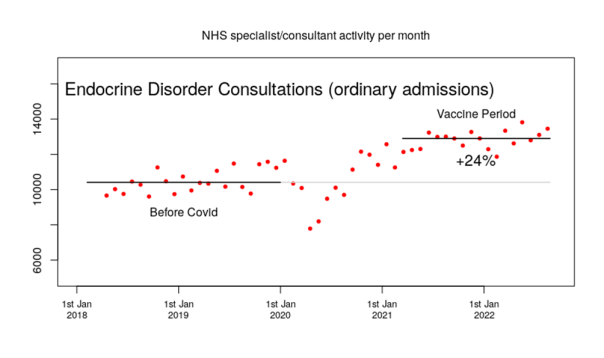
Or the increase in consultant activity for hormonal problems?
Or the increase in referrals for suspected cancers?

Like the significant increase in excess deaths that we’ve seen this year, there seems to be much going on but little interest on the part of our authorities to investigate these issues at all. Maybe they’re all the result of the lockdowns, maybe they’re due to Covid itself, maybe it was the vaccines, and perhaps it is all just a massive coincidence – but it simply isn’t good enough to decide that it can’t possibly be the vaccines and refuse to even discuss undertaking the research that might clarify the situation.
At least in recent weeks we’ve had an increase in calls for some robust investigations to be undertaken, such as discussed in the Daily Sceptic in mid October. Then again, we’ve also had the brief hour-and-a-half spent a week ago by the House of Commons to debate the issues around vaccine safety. Despite some MPs detailing concerns about the safety of the vaccines, the Chair was quick to respond with empty reassurances and the debate ended with a statement urging people to get vaccinated to protect themselves, others and the NHS. I fear that there’ll be quite some way to go before the full impact of the vaccines is accepted by our authorities.
An important aspect of the rate of side-effects and complications is the impact on the risk-benefit analysis used by our authorities to determine who should take the vaccines. The risk of side-effects should be tolerable so long as the benefit offered by any medical product is greater than the risks. Since the vaccines were introduced back in December 2020 we have seen marked changes both in the risks posed by the vaccines (more side-effects and complications have come to light) and the benefits offered (the vaccines clearly offer little protection against infection, their protection against hospitalisation and death appears to be rather less than claimed, and at the same time Covid appears to have evolved to become much less virulent). In addition, nearly everyone in the Western world will now have had a Covid infection, resulting in at least some natural immunity. Unfortunately, our authorities have never actually published any of their risk-benefit analyses and how the ratio changes with age and morbidity, so we can’t tell how new information on risks and benefits has changed the calculation. Then again, I suppose it is easier to be inconsistent if you never actually tell anyone what factors your decisions are based upon.
One of the big problems regarding the Covid mRNA vaccines in particular is that there were only sparse data published on how long the mRNA would remain active in the body and where it would end up (pharmacokinetics and biodistribution). Originally the reassuring voices told us that the mRNA would break down within hours, and that the mRNA vesicles would remain close to the point of injection. However, evidence has emerged in the months since our authorities proceeded to inject everyone in the world that has suggested that the mRNA remains active for many weeks following vaccination, that it travels to multiple organs in the body and that the pharmaceutical companies knew this prior to the vaccines being released. Even worse, a recent study has suggested that the mRNA is present in breast milk for a short time following vaccination (for fairness I must point out that our authorities still think that it is completely and utterly safe for recently vaccinated mothers to continue breastfeeding). I find it concerning that we’re only now starting to find out the full complexity of the interaction of the mRNA vaccines with the body.
Recent studies have estimated the current rate of serious short-term side-effects after the Covid vaccines at around one in 800. I find this number interesting, as I suspect that this is as bad a side-effect rate as could be found for a supposedly benign or prophylactic treatment. I estimate that an incidence rate of around one in 1,000 marks the point at which problems become apparent even to a casual observer, provided sufficient numbers are given the medical product. If a side-effect rate for a benign or prophylactic treatment is worse than this people would notice and demand that the medicine or medical treatment is withdrawn. Thankfully, there aren’t too many examples of terrible medical mistakes – probably the most famous example is Thalidomide, where around one in 1,000 mothers who took the drug gave birth to a child with serious physical malformations. Even so, it took three years before the nature of the problem was understood and Thalidomide was withdrawn from sale. It is perhaps interesting to note that at least in the early stages of the problem being recognised the blame was put on the nuclear tests that had occurred in previous years – was this the 1950s equivalent of ‘climate change’?
Where serious side-effects are more common than this for a supposedly benign product, the response is typically more rapid. The famous example here is Elixir Sulphanilamide, a treatment for bacterial infections created in the 1930s that caused over 100 deaths in the few weeks that it was for sale. The problem with Elixir Sulphanilamide was that it hadn’t been tested before release and the manufacturers hadn’t realised that a primary component was highly toxic. The owner of the company that made the elixir famously denied responsibility, stating that “we have been supplying a legitimate professional demand and not once could have foreseen the unlooked for results”. It was this scandal that led to the creation of the FDA in the USA, along with stringent requirements for the testing of new medical products. After the disaster it was demanded that never again would a medical treatment be released and given to many thousands of people without being fully tested to explore all potential problems (and not simply the ‘looked-for’ problems). As a side note, the outcome of the Elixir Sulphanilamide scandal was that the scientist who developed the formula committed suicide as a result of the extreme guilt of causing so much harm, while the company that released the medicine without testing was given a nominal fine. The manufacturer went on to produce further drugs (and profits) and after a succession of takeovers is now part of the pharmaceutical giant GlaxoSmithKline. Funny how it all works.
Next time I’ll discuss one of the most wildly enthusiastic aspects of the Vaccine Surveillance Report – the predictions made by computer-models of the reduction in infections, hospitalisations and deaths offered by the vaccines.
Amanuensis is an ex-academic and senior Government scientist. He blogs at Bartram’s Folly.
How Doctors and Nurses Betrayed Patients – and Themselves
Dr. Vernon Coleman | 21st Century Wire
NOTE: This article was first published over two years ago – on 12.7.20. Sadly, it remains perfectly valid today.
A growing number of doctors and nurses appear to be waking up and questioning the absence of any science behind the coronavirus hoax.
That’s very nice, and I congratulate them.
But what the devil took them so long?
Why did they wait so long to speak out?
Their silence betrayed their patients, their profession and themselves.
Only a complete moron could have thought that this manufactured ‘crisis’ necessitated the closure of hospitals and GP surgeries.
How could doctors stand by seeing cancer patients deprived of essential treatment? The NHS should have been stoned not clapped.
There was never any greater risk than there is with the flu every year.
Indeed, the figures show that the ordinary flu bug has always posed a much bigger risk than the coronavirus.
So far this year the coronavirus has affected 10 million people worldwide.
The flu can affect 1 billion people in the same period.
And the mortality rates for the two are almost identical.
We don’t close down hospitals and clinics whenever the flu appears.
So, obviously, this was a politically motivated closure of hospitals, shops, businesses and so on. And doctors should have seen that.
And just as the closure of hospitals will result in far more deaths than covid 19 so the wearing of masks will result in far more deaths than could possibly be saved. Wearing a mask reduces blood oxygen levels. I have seen car drivers with masks on. I’ve even seen bus drivers wearing masks. These things reduce blood oxygen. There will, before long, be a disaster with a bus crashing because the driver was wearing a mask and became hypoxic.Why else do you think governments everywhere admit that people with respiratory or heart problems don’t have to wear a mask?
And the stupid rules about social distancing were never justified. There was never any science to support them.
Anyone who believes in the twin heresies of social distancing and masks is, by definition, either certifiably insane, a cretin or on the dark side of the human race. Most are left wing, pro EU fascists and believers in the climate change nonsense.
Doctors and nurses who are now waking up to the fact that they’ve been tricked are claiming that they were told that if they spoke out they would be punished.
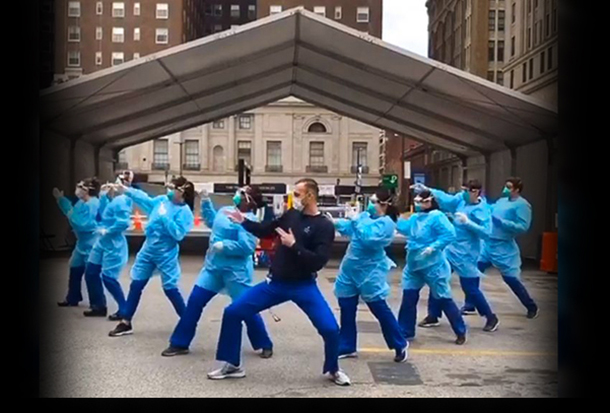
DANCING NURSES: In 2020, exhibitionist medical staff in the US, UK, Australia, New Zealand and Canada took to social media and proceeded to make a mockery of a locked-down populace who were ordered to stay at home to in order to ‘save the healthcare system from being overloaded.’
Well, it’s true that the authorities are punishing doctors who dare to question the official line. I know of a doctor in the UK who was struck off the medical register for questioning the coronavirus story. And in the USA Dr Scott Jensen, a doctor who is also a state senator, is being investigated for making statements about the similarity of the coronavirus to the flu and about the way death certificates were being signed.
And it is also true that simple and effective remedies have been banned or demonised simply so that we could all be prepared for the vaccine.
But if most of the doctors in a big hospital spoke out no bureaucrat would dare to strike them all off the register. If 500 doctors stood up for the truth it would be impossible to take away all their licenses.
`I work in a hospital,’ wrote one brave NHS employee. ‘So far none of the nurses, doctors or domestics has been off sick. And patients with the coronavirus are transported all around the hospital, to X-ray, to CT scan and to the ward and yet mysteriously no one gets infected.’
What sort of spineless people are working in health care these days? That’s the sort of excuse popular with lesser war criminals.
Still, looking on the slightly bright side, some of them are waking up and now realise that the coronavirus hoax was exactly that – a piece of political trickery, conceived and executed by people with hidden agendas. The damage done by the hospital closures will be massive. And the mental issues caused by the fear will be long-lasting – even permanent. Millions are suffering from severe depression as a result of the lies that have been told. Suicide rates are going to rocket.
Any doctors who are still social distancing and wearing masks outside the operating theatre should be ashamed of themselves. They, like much of the rest of the population, have been made fools of and if they had any professional pride left they would be red-faced, embarrassed by their own gullibility and ashamed of how easily they’ve been made part of a wicked conspiracy and made to look like fools.
Now is the time for the medical and nursing professions to stand up and to demand some answers and explanations from the leaders of their professions and from the administrators who gave the orders which have led to tens of thousands of unnecessary deaths.
They should also insist that hospitals are now opened fully, and that patients are told that there is nothing to fear.
For although a growing number of doctors now realise that the coronavirus scare is hoax there are still hospitals and administrators who are behaving as though we were in the middle of an outbreak of the bubonic plague.
The latest piece of lunacy in the NHS is for the people in charge to suggest that patients who want treatment at an Accident and Emergency department should telephone and make an appointment.
NHS England’s national medical director has reportedly told the House of Commons health and social care committee that the health service wanted patients to telephone first and be given a timed slot to attend the A&E department.
I’ve heard everything now.
Patients who are desperate for help, bleeding, in pain, with bones sticking out at funny angles will be expected to telephone and make an appointment to be seen in the accident and emergency department. Triage will, it seems, now be done by teenagers on the telephone. What qualifications will they have? GCSE in woodwork, perhaps?
Distraught relatives will have to telephone and fix an appointment before going to the hospital. Is the plan simply to kill more patients? Did the hospital closures not kill enough?
I will tell you what is going to happen.
Everyone is going to ring for an ambulance. And who can blame them?
As for hospitals, well even the Royal College of Physicians admits that many NHS services will not get back to full capacity for more than a year.
Millions of patients will wait too long. Patients in pain will have to wait for more than a year for treatment. Waiting times will be obscenely long. Tens of thousands will not be seen until it is too late. Tens of thousands of people who could have lived will die.
Around the world the death toll from the hoax will be measured in millions.
Comparatively few will have died of the coronavirus.
The vast majority will have died because they were shut out, abandoned or too frightened to seek help.
And the medical and nursing professions have to take responsibility for all that pain, that sorrow and those deaths.
Doctors should not have accepted the unscientific gibberish behind the coronavirus hoax. Before allowing hospitals to be shut down they should have asked questions. It was never difficult to see that mistakes were being made.
Doctors and nurses betrayed their patients and their professions but they also betrayed themselves.
Too many were happy to accept the weekly applause and the praise when they knew that they deserved neither.
It is time now for the healing professions to make amends.
They should make it clear to the administrators and the politicians that they are no longer prepared to accept the coronavirus nonsense.
They should demand their government’s medical advisors be sacked. They should demand that all members of the elite, medical establishment be sacked too.
They should demand that social distancing be abandoned and that masks should be burned.
They should tell the public that there is nothing to fear.
And they should be prepared to work long hours to clear the backlog of patients as quickly as possible.
There really is no choice.
If doctors and nurses do not stand up then they will be truly unworthy.
This article was originally a script for a YouTube video in July 2020. The video was taken down almost as quickly as it was put up.
Vernon Coleman’s book Coleman’s Laws: Twelve Essential Medical Secrets Which Could Save Your Life is available as an eBook and a paperback on Amazon. His book Superbody: How to Boost Your Immune System is also available as a paperback and an eBook.
Ukrainian Starlink units go dark over funding issues – media
RT | November 4, 2022
Some 1,300 Starlink satellite terminals went offline in Ukraine last week due to a failure to pay the military’s internet bills, deepening fears that the country will no longer be able to afford the pricey satellite service, two sources familiar with the situation told CNN on Friday.
The terminals, all part of a block purchased from a British company in March, began to go dark on October 24 for lack of funding, causing a “huge problem” for the military that depended upon them. Aware the bill was coming due and that they would be unable to pay it, the Ukrainian Ministry of Defense asked its UK allies for $3.25 million to cover the monthly cost and rotated the terminals out of use so they wouldn’t wink out at a critical moment. However, their request was turned down.
Starlink parent company SpaceX alerted the Pentagon in September that it could no longer pay the full cost of Ukraine’s Starlink usage, asking Washington to pick up the slack, according to CNN. With approximately 25,000 Starlink terminals in Ukraine, Musk estimated the military’s use of the service would cost nearly $400 million over the next 12 months. Fewer than 11,000 were being paid for at the time he wrote to the Pentagon.
Musk then appeared to change his mind about footing the bill for the service a few days later, tweeting “We’ll just keep funding Ukraine for free.”
However, a senior defense official told CNN SpaceX has continued negotiating with the Pentagon, adding that officials are eager to get Musk to commit resources in writing because they fear he will change his mind.
He has reportedly refused to operate Starlink in Crimea, fearing this would invite an escalation from Moscow, while Western media have accused him of hindering the network’s operation by Ukrainian troops in Russian-controlled areas, which Musk denies. Last month, he warned that even though the company has “diverted massive resources toward defense” as the Russian military attempts to take the system out, “Starlink may still die.”
Moscow believes Starlink is a legitimate target, reasoning that the US and its allies have been using “elements of the civilian space infrastructure, including commercial, for military purposes.” Because this “essentially constitutes an involvement in military action through a proxy,” the “quasi-civilian” satellite network is fair game, Russian diplomat Konstantin Vorontsov told the UN last month.
UN Security Council votes against probe into US biolabs
Samizdat – November 3, 2022
The UN Security Council has rejected Russia’s call for an international investigation into claims that the US used laboratories in Ukraine to develop biological weapons.
While China backed Russia’s proposal, the US, Britain, and France voted against it, and the ten rotating council members abstained.
Russia insists that the US and Ukraine have been violating the 1972 international convention that bans the development, production, and stockpiling of biological weapons. According to Moscow, several laboratories in Ukraine were working on a secret “military-biological” program, which involved studies and the stockpiling of samples of anthrax, cholera, and other infectious diseases.
Washington and Kiev both deny developing biological weapons. Ukrainian President Vladimir Zelensky said in March that the laboratories were conducting “ordinary scientific research.”
During the vote in the Security Council on Wednesday, US envoy, Linda Thomas-Greenfield, argued that the Russian proposal for a probe is “based on disinformation, dishonesty, bad faith, and a total lack of respect for this body.”
Thomas-Greenfield reiterated that the activities under the Pentagon’s Cooperative Threat Reduction (CTR) program in Ukraine and other former Soviet states “are not for military purposes.”
The US Mission to International Organizations in Geneva, Switzerland said in April that the CTR’s goal in Ukraine was to help the country “consolidate and secure pathogens and to continue to ensure Ukraine can detect and report disease outbreaks before they pose security or stability threats.”
Dmitry Polyansky, Russia’s deputy envoy to the UN, meanwhile, said he was “deeply disappointed” by the vote. He said “the Western countries are simply afraid” of an international investigation into the issue.
Moscow Has Info on UK’s Transfer of Unmanned Underwater Drones to Kiev Ahead of Sevastopol Attack
Samizdat – 03.11.2022
The Foreign Ministry summoned Britain’s ambassador to Russia on Thursday in connection with last week’s Ukrainian attack targeting Russian military and civilian vessels in Sevastopol. The act of terrorism prompted Moscow to temporarily freeze its participation in the Black Sea grain export deal with Kiev.
Moscow summoned British Ambassador to Russia Deborah Bronnert in connection with London’s suspected involvement in the October 29 attack on the Russian Black Sea Fleet, the Foreign Ministry has revealed.
In a statement, the Ministry indicated that it had information that London transferred a number of unmanned underwater drones to Kiev, and that British specialists have been actively involved in the training and supply of Ukrainian special operations forces, including those involved in sabotage operations at sea.
Moscow warned that Britain’s actions threaten to escalate the security crisis and lead to “unpredictable and dangerous consequences,” and that such “hostile provocations” on London’s part were “inadmissible” and must be stopped immediately.
“If such acts of aggression, fraught with [the UK’s] direct involvement in the conflict, continue, the entire responsibility for their disastrous consequences and the growth of tensions in relations between our states will lie entirely on the British side,” the Foreign Ministry said.
The Russian Black Sea Fleet port of Sevastopol repelled a massive drone attack on October 29, shooting down multiple UAVs and remote-controlled surface vessels in Sevastopol Bay. According to Russia’s Defense Ministry, the warships attacked included ships providing security for the so-called ‘grain corridor’ – the secure maritime route agreed by Moscow and Kiev this summer through which cargo vessels carrying grain from Ukrainian ports through the Black Sea for export abroad.
The Russian military later retrieved drone wreckage from the sea floor to examine the remains, finding Canadian-made navigation modules installed on the maritime drones. Preparations for the drone attack were carried out under the guidance of British specialists in the Ukrainian port city of Ochakov, according to the Russian MoD. Russia destroyed a multi-million pound British-built and financed military base in Ochakov in a missile strike in February during the opening stages of its military operation in Ukraine.
The Sevastopol attack is the second time in weeks that Moscow has called out London on terrorism-related charges. Last week, Russia’s Defense Ministry concluded that the Royal Navy took part in the planning, organization and execution of the late September attacks on the Nord Stream natural gas pipeline network.
On Tuesday, Russian Foreign Ministry spokeswoman Maria Zakharova asked London to explain the mysterious “It’s done” iPhone text message reportedly sent by now former Prime Minister Liz Truss to US Secretary of State Antony Blinken just moments after Nord Stream was struck.
Earlier this year, Ukrainian and Western media reported that Moscow and Kiev appeared to be on the brink of a peace agreement this spring, but that (now former) British Prime Minister Boris Johnson was quickly dispatched to the Ukrainian capital to scuttle any potential agreement.
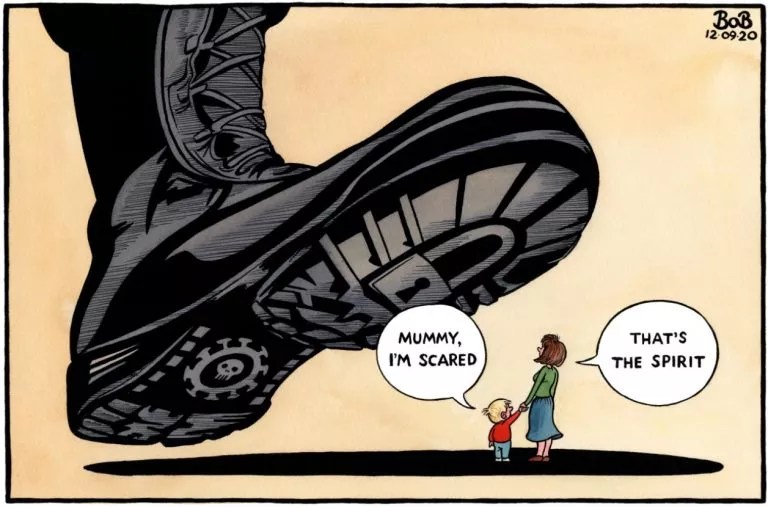
All Those Responsible Must Pay a Price for Terrorising and Harming the People They Are Meant to Serve
BY DR GARY SIDLEY | THE DAILY SCEPTIC | NOVEMBER 2, 2022
I belong to a privileged generation. Not that I was raised in affluence; far from it. Born in 1958, to a mother who worked all her life as a weaver in the textile industry and a father employed as a maintenance mechanic at the local factory, I lived on a council estate for the first decade of my life. Money was tight, holidays were basic and infrequent, and treats – in the form of confectionary – were rare, usually restricted to a Turkish Delight chocolate bar each Sunday evening. Although I never realised it until I was 62, I was, however, part of a cohort who possessed something sacrosanct, something so very precious and – deplorably – something future generations may never enjoy again: individual freedom.
To be clear, the world I have lived in has been far from perfect. My era has been one incorporating fundamental inequalities and injustices, widespread poverty, discrimination and – particularly in my young-adult years – a recurring risk of physical assault. But despite this context, each of us took for granted a range of basic human rights: to meet with whomever we wished; to leave our homes whenever we chose; to eat whatever we wanted; to express opinions others might not agree with; to take risks, make mistakes and learn sometimes painful lessons; to wear whatever we wanted; to work to improve our career prospects and earn more money to enhance our lives and those of our families; and to decide what drugs and other medical interventions to accept. When cheap flights emerged in the 1970s and 80s, the whole world became wonderfully accessible.
My perception (probably a naïve one) of successive Labour and Conservative Governments was that, although often inept and guilty of policy errors, they broadly sought to improve the lives of their citizens and could at least be relied upon to protect us against external malignant forces. Furthermore, it seemed that the life-spans of our elected politicians were dependent upon keeping us – their constituents – satisfied by acting primarily in the interests of U.K. citizens.
But 30 months ago, this illusion was shattered.
I knew something was awry as early as February 2020. By March the same year my early-warning detector would not rest. While the media, politicians and the science ‘experts’ informed us – incessantly – that a uniquely lethal pathogen was spreading carnage across the world, and unprecedented and draconian restrictions on our day-to-day lives were essential to prevent Armageddon, I wasn’t buying it. I formed the view that a momentous event, unparalleled in my lifetime, was unfolding, but it was not primarily about a virus.
Why, at that point in time, did I recognise that something sinister was underway while almost everyone else I met seemed to be swallowing the dominant narrative? It is a difficult question to answer. Perhaps my time in the early 1980s as a psychiatric charge nurse in an NHS hospital, occasionally interfacing with the ‘infection control’ department, gave me insight into how this professional group operate. Although well-meaning, their advice regarding how to minimise the spread of contagion on a ward often seemed impractical, revealing an apparent inability to see the bigger picture. Or maybe my in-depth knowledge of risk assessment (gleaned in my doctoral thesis during my time as a clinical psychologist) had impressed upon me how woefully inaccurate we are in gauging the relative threat levels posed by various hazards inherent in our environment. What I did know for sure was that Big Pharma – arguably the most corrupt industry in the world – would exploit the emerging ‘crisis’ for its own ends. And how right I was.
The list of state-driven human rights abuses we have endured under the pretence of ‘keeping us safe’ and the (ominous) ‘greater good’ is long: prohibition of travel; confinement in our homes; social isolation; closure of businesses; denial of access to leisure activities; de-humanising mask mandates; directives (scrawled on floors and walls) dictating which way to walk; an arbitrary ‘stay two metres apart’ rule; exclusion from the weddings and funerals of our loved ones; the seclusion and neglect of our elderly; school shutdowns; children’s playgrounds sealed off with yellow and black tape; muzzled children and toddlers; students denied both face-to-face tuition and a ‘rites-of-passage’ social life; and coerced experimental ‘vaccines’ that turned out to be more harmful and less effective than initially claimed. Equally egregious were the strategies deployed to lever compliance with these restrictions, namely psychological manipulation (‘nudging’), pervasive censorship across the media and academic journals and the cancellation and vilification of anyone brave enough to speak out against the dominant Covid narrative. All-in-all, a state-driven assault on the core of our shared humanity.
As the state-orchestrated infringement of our basic human rights continued, I felt compelled to act in ways that were far outside of my comfort zone. The 61-year-old man who had never been on a protest march until summer 2020, and who had innocently assumed that most of society’s leaders were decent people who tried to do what was right, had changed. I found myself walking with tens of thousands of others along Regent Street, London, screaming “Freedom!” I pushed “Back to Normal” leaflets through the letterboxes of hundreds of my neighbours. I stood on the corner of our local shopping street with a placard held aloft stating, “Say No To Vaccine Passports”.
Throughout 2020 and 2021, I struggled to find reasons for the irrational, masochistic Covid restrictions and the ubiquitous infringement of our basic human rights. My explanations evolved. Initially I clung to the ‘panic and incompetence’ rationale, that our governments had been spooked by the images coming out of China – remember the videos of people falling dead in the streets – and the mono-focused, blinkered and catastrophic prophecies of our so-called epidemiological experts. As the atrocities persisted, this explanation was rendered inadequate, and it morphed into an ‘opportunistic agendas’ account where activists – promoting green aspirations, digitalised IDs, social credit systems, a cashless society, universal income, a biosecurity state – had exploited the anxieties associated with the emergence of a novel respiratory virus. By 2021 these conclusions, in turn, seemed insufficient to explain the persistence of the horrors we were enduring and it – belatedly – became clear that globalist and ‘deep state’ powers were at work, striving to realise their inhuman aspirations. My further reading about the activities of World Economic Forum, the United Nations, the European Union, the World Health Organisation, the Bill & Melinda Gates Foundation, the Wellcome Trust, Anthony Fauci and Big Pharma, and others, confirmed this emerging conclusion.
As the Covid event fades from media attention (replaced by a focus on similarly dehumanising and totalitarian responses to environmental threats, the war in Ukraine and the imminent cost-of-living crisis) it is intriguing to reflect upon its residual effects.
I continue to mourn what I have lost, a process associated with a complex mix of fluctuating emotions. For two years, our Government, aided and abetted by state-funded scientists, denied us opportunities for fun and human connection, stymied our freedoms and orchestrated a systematic campaign to coerce us to both accept experimental ‘vaccines’ and to slavishly cover our faces with cloth or plastic. Consequently, I feel anger and disgust towards many of our politicians, epidemiological ‘experts’ and behavioural scientists who were complicit with this shameful period in our history. And I now distrust all sources of information, whether it be the media, the ‘scientific’ world or public health experts. Without an anchor for truth, I float – incredulous – in an ocean of mainstream-generated misinformation.
My 60-plus years of naivety have been shattered. I believe only those few who have shown selfless integrity throughout the Covid debacle. Also, I am now sceptical about much of the green agenda: state-funded scientists lied to us about Covid so why wouldn’t they show the same self-serving dishonesty about the climate?
Closer to home, it is clear my life has changed. I feel disappointment and irritation towards many people who I previously respected and liked, such as friends who colluded with the catastrophically damaging Covid restrictions because of fear, ignorance or a desire to avoid hassle and condemnation. Many relationships are now more distant. On the rare occasions we meet there is often an ‘elephant in the room’, and when the Covid issue is touched upon I typically feel frustrated that many do not want to consider the implications of what has been inflicted upon us.
I feel similarly towards mental health colleagues who, for years, I had stood alongside and respected, collectively fighting the tyranny of biological psychiatry (its human rights infringements, coercion, overuse of drugs and vilification of those who questioned them) but who failed to recognise a much bigger tyranny when it emerged in 2020. While a handful of this anti-psychiatry lobby did soon recognise the totalitarian threat inherent to the Covid response, most bought into the dominant narrative. Heated disagreements ensued with a few, followed by ongoing mutual resentment; for most we just avoid each other.
But the residual effects of the Covid debacle are not all negative. New friendships have emerged with people from across the political spectrum. Based on a mutual respect, enduring bonds have formed with fellow sceptics both locally (through the Community Assembly and the Stand in the Park initiatives) and nationally via joint endeavours in HART, Smile Free, and PANDA. And it was uplifting to recently discover – via a chance meeting in the local pub – that the family I had lived across the road from for the last seven years, yet had rarely spoken to, had always been as sceptical as me about the dominant Covid narrative.
Furthermore, I have noticed that my behaviour has changed in subtle ways. I now make more of an effort to smile and gain eye contact with – unmasked – strangers. Similarly, when greeting acquaintances, I’m more inclined to hug or shake hands as compared to pre-2020 levels of bodily contact. (Non of that fist-bump and elbow-touch nonsense for me.) It’s as if I’m striving to compensate for the human connection deficit that we’ve accrued over the last 30 months. Or perhaps I’m making a defiant metaphorical one-finger salute to any onlookers who still adhere to the risk-averse and dehumanising dominant Covid narrative?
While we continue to drown in a sea of propaganda, censorship and coercion, who knows what the future might hold?
One thing is for sure: We must never forget what the political leaders and public health specialists inflicted upon us. Whether the reason was weakness, groupthink, conflict of interest or unadulterated corruption, the miscreants must all be held to account and pay a price for terrorising the people they are meant to serve. This assertion is not fuelled by a primitive desire for retribution – well, not primarily – but by an expectation that, if the guilty are not named and shamed, the same totalitarian impositions will be repeated again and again.
The conviction sheet is a long one. It includes political leaders at home (Boris Johnson, Keir Starmer, Nicola Sturgeon, Mark Drayford) and abroad (including Justin Trudeau, Emmanuel Macron, Joe Biden and Jacinda Ardern); Bill Gates and his various funding agencies; SAGE scientists who danced to the tune of their academic and political paymasters; the behavioural science ‘nudgers’ at the helm of the worldwide psychological manipulation strategy; the professional organisations that have manifestly colluded with the state-driven tyranny (including the British Medical Association and the British Psychological Society); the conflicted drug regulators (such as the MHRA); the powerful, profit-driven pharmaceutical companies, deploying their financial clout to influence health policy decisions; and the mainstream media, who have slavishly peddled the dominant Covid narrative while dismissing alternative viewpoints.
To successfully expose the wrongdoings of such powerful individuals and institutions is a big ask. Realistically, only bottom-up resistance and protests from millions of ordinary people could achieve this aim, and in this regard there are reasons for optimism. Truth will – eventually – reveal itself. Despite the ongoing censorship and manipulation, public dissent to the attempted imposition of a biosecurity state is becoming increasingly visible. Masking in the community is – at the time of writing – practised only by an eccentric minority. The net harms of Covid restrictions are more widely recognised. Ordinary citizens increasingly claim they will not be locked down and separated from their loved ones ever again. And – perhaps more importantly – the ‘safe and effective’ vaccine narrative is crumbling, as indicated by more and more people rejecting the jabs.
If we do not wish to live in a ‘transhuman’ society devoid of personal freedoms, where our day-to-day decisions – where we go, what we say, what we eat, how we spend our money, what drugs we ingest – are determined by the state’s version of the ‘greater good’, we must all continue to show visible dissent to the globalists’ new world order.
Together, I believe we can defeat the biggest threat to Western values witnessed in my lifetime. And even if we don’t succeed, history will show that at least we tried.
Dr. Gary Sidley is a retired NHS Consultant Clinical Psychologist and co-founder of the Smile Free campaign. He blogs at Coronababble
Who’s afraid of US troops in Ukraine?
BY M. K. BHADRAKUMAR | INDIAN PUNCHLINE | NOVEMBER 2, 2022
Very innocuously, the Biden Administration has ‘sensitised’ the world opinion that American troops are indeed present on Ukrainian soil in Russia’s immediate neighbourhood. Washington made a “soft landing” with an unnamed senior Pentagon official making the disclosure to the Associated Press and the Washington Post.
The official gave an ingenious explanation that the US troops “have recently begun doing onsite inspections to ensure” that Ukraine is “properly accounting” for the Western weapons it received. He claimed that this was part of a broader US campaign, announced last week by the State Department, “meant to make sure that weapons provided to Ukraine don’t end up in the hands of Russian troops, their proxies or other extremist groups.”
In effect, though, President Biden is eating his own word not to have ‘boots on the ground’ in Ukraine under any circumstances. There is always the real danger that the clutch of Americans on tour in Ukraine may come under fire from the Russian forces. In fact, the US deployment comes against the backdrop of intense Russian missile and drone attacks currently on Ukraine’s critical infrastructure.
Plainly put, wittingly or unwittingly, the US is going up the escalation ladder. So far, the US intervention involved deployment of military advisors to the Ukrainian military command, supply of intelligence in real time, planning and execution of operations against Russian forces and allowing American mercenaries to do the fighting, apart from steady supply of tens of billions of dollars worth weaponry.
The qualitative difference now is that the proxy war may turn into a hot war between the NATO and Russia. The Russian Defence Minister Sergey Shoigu estimated today at a joint board meeting of the Russian and Belarusian defence ministries that the number of NATO forces in Eastern and Central Europe had risen by two and a half times since February and might increase further in the near future.
Shoigu underscored that Moscow understands fully well that the West is pursuing a concerted strategy to destroy Russia’s economy and military potential, making it impossible for the country to pursue an independent foreign policy.
He flagged that NATO’s new strategic concept suggested moving from containing Russia “through forward presence” to creating “a full-scale system of collective defence on the eastern flank,” with the bloc’s non-regional members deploying troops to the Baltic countries, Eastern and Central Europe, and new multinational battalion tactical groups being formed in Bulgaria, Hungary, Romania and Slovakia.
It may not be a coincidence that Washington acknowledged the presence of its military personnel in Ukraine at a point when the Russians have alleged the participation of British intelligence in the recent sabotage act on the Nord Stream pipelines and the drone strikes on Saturday at the base of Russia’s Black Sea Fleet at Sevastopol. There are grey areas in the so-called special relationship between the US and the UK.
The US-UK calculus has been to get the Russians bogged down in a quagmire in Ukraine and to incite an insurrection within Russia opposing ‘Putin’s war.’ But it has miserably failed. The US sees that over 300,000 trained ex-military personnel from Russia are being deployed to Ukraine for launching a major offensive to end the war in the coming 3-4 months.
That is to say, the roof is coming down on the entire edifice of lies and deceptive propaganda that formed the western narrative on Ukraine. The defeat in Ukraine could have disastrous consequences for the US’ image and credibility as a superpower not only in Europe but on the global stage, undermine its leadership of the transatlantic alliance and even disable NATO.
The Biden Administration made a terrible mistake in assuming that the war would lead to a regime change in Russia ensuing from the collapse of the Russian economy under the weight of western sanctions. On the contrary, even the IMF admits that the Russian economy has stabilised.
The indicators show that the Russian economy will be registering growth by next year. The comparison with the western economies that are sinking into high inflation and recession is far too glaring to be missed by the world audience.
Suffice to say, the US and its allies have run out of sanctions to hit Russia. The Russian leadership, on the other hand, is consolidating by pushing ahead with the shift to a multipolar world order and a de-dollarised international financial system. If these processes proceed further, it will dent the status of the American dollar as “world currency.”
Fundamentally, it is the capitalist system itself which is responsible for this crisis. We are currently suffering under the effect of the longest and deepest crisis the system has known since the redivision of the world that took place in World War II. The imperialist western powers are once again preparing for war to redivide the world in the hopes of getting out of their crisis, much as they prepared prior to World War II.
The big question is what Russia’s response is going to be. It is all but certain that Moscow hasn’t been caught by surprise at the revelation in Washington regarding the presence of US troops in Ukraine. It is highly unlikely that Russia will resort to knee-jerk reaction.
The so-called ‘counter-offensive’ by Ukraine has fizzled out. It made no significant territorial gains or gained any breakthrough. But it suffered heavy casualties in the thousands and huge losses in military equipment. Russia has gained the upper hand and it is conscious of that. All along the frontline, that is becoming evident.
On the other hand, the fact remains that neither the US and Britain nor their NATO allies are in a position to fight a continental war. Therefore, it will be entirely up to the American troops moving around in the steppes of Ukraine to stay out of trouble and keep their body and soul together in such harsh winter conditions without electricity, heating or a decent body wash. Who knows, the Pentagon may even work out a ‘deconfliction’ mechanism with Moscow!
That said, seriously, the auditing of US weaponry on Ukrainian soil per se is not a bad thing at all. Ukraine is a notoriously corrupt country, after all. There is real danger that the weapons supplied by the US may reach Europe and turn that beautiful manicured garden into a jungle (like Ukraine or America) — to borrow the colourful metaphor used recently by Josep Borrell, EU’s foreign policy chief.
Moscow Wants Answers Over Truss’ Alleged ‘It’s Done’ SMS to Blinken Moments After Nord Stream Blasts
Samizdat – 01.11.2022
Russian Foreign Ministry spokeswoman Maria Zakharova wants answers regarding the mysterious “It’s done” iPhone message allegedly sent by then-Prime Minister Liz Truss to the US secretary of state moments after the sabotage attacks against the Nord Stream network in late September.
“To be honest, I don’t care who got this information and how. I’m interested in London’s answer to the following question: Did Prime Minister Liz Truss of Britain send a message to US Secretary of State Antony Blinken immediately after the Nord Stream gas pipeline was blown up with the words ‘It’s done’?” Zakharova asked in a Telegram post Tuesday.
The spokeswoman suggested that “millions of people around the world” were waiting for answers to the question of how the planet’s energy security was undermined, “and what role the Anglo-Saxons played in this terrorist attack.”
On Monday, a US defense and national security news outlet reported that among the information suspected to have been leaked from Truss’s “hacked cell phone” was the aforementioned text message between the now former UK leader and the US top diplomat.
Internet entrepreneur and free speech activist Kim Dotcom mentioned the “It’s Done” message in a Twitter thread Sunday, shortly after British media ran a piece on Truss’s hacked phone.
“iCloud admin access rocks,” sarcastically Dotcom wrote, referring to the Apple service allowing for iPhone text messages, files, photos and other information to be saved ‘to the cloud’ and accessed by authorized computers (thus making user files vulnerable to hacking). “It’s not just the Five Eyes that have backdoor admin access to all Big Tech databases,” Dotcom added, referencing the intelligence alliance of Anglosphere nations including the US, the UK, Canada, Australia and New Zealand. “Russia and China have sophisticated cyber units too.”
“The funny thing is Govt officials with top security clearance still prefer using iPhones over their NSA & GCHQ issued encrypted shit-phones,” Dotcom wrote.
A series of explosions knocked out three of the four strings of the Nord Stream network on September 26. Western officials and media immediately began singing in unison that Russia blew up its own $20 billion pipeline infrastructure for reasons unknown. The Kremlin accused the West of an “unprecedented act of state terrorism” involving Nord Stream, but did not name any specific states, with President Vladimir Putin only hinting involvement by the “Anglo-Saxons” (typically a reference to Brits and Americans in Russian usage).
After a month-long investigation, the Russian Ministry of Defense revealed Saturday that Britain’s Royal Navy took part in the planning, organization and carrying out of the Nord Stream attack.
The damage to the Nord Stream network has robbed Central and Western Europe of a major traditional source of natural gas ahead of the winter heating season. Yamal-Europe and Soyuz, two major Russian overland pipelines delivering natural gas to Europe, have also been halted, or experienced a major drop in usage, sparking questions about the region’s energy security. Late last month, French President Emmanuel Macron complained that Paris’s American allies had jacked up the price on natural gas deliveries to Europe, and that Europeans were being made to pay “3-4 times” more than Americans for the same gas. “That is unfair. These are double standards,” Macron complained.
Featured Video

The Truth About the Trump Shootings with Ken Silva
or go to
Aletho News Archives – Video-Images
From the Archives
Trans ‘milk’ as good as the real thing – NHS
RT | February 18, 2024
The drug-induced nipple secretions of trans women are as good as mothers’ breast milk for babies, the University of Sussex Hospitals NHS Trust claimed in a letter to campaigners made public in a report by British think tank the Policy Exchange on Sunday.
The healthcare trust’s medical director, Rachel James, argued that the off-label prescription drug cocktail men transitioning to female take in order to produce milk was “similar to the natural hormones which encourage lactation to develop when the baby is newly born.”
“The evidence which is available demonstrates that the milk is comparable to that produced following the birth of a baby,” James wrote in the letter, sent to Children of Transitioners last August.
Biological men who wish to lactate must first take hormones to grow milk glands and then take high doses of either domperidone or metoclopramide to stimulate milk production. Neither drug is approved for this use, though they are occasionally prescribed off-label to biological women who have trouble lactating.
However, domperidone’s own manufacturer, Janssen, warns patients the drug “may cause unwanted side effects affecting the heart in a breastfed baby” and “should be used during breastfeeding only if your physician considers this clearly necessary.” … continue
Blog Roll
 Aletho News
- Seyed M. Marandi: U.S. Strike Imminent – Toward Total War in the Middle East
- Russia Voted Under Fire. Washington Is Loading the Tankers.
- 12 Things Your Oncologist Was Trained Not to Tell You
- Anthrax Attacks Paved Way for COVID-Era ‘Junk Drugs and Vaccines’
- How Real Is the Impact of Western Sanctions on Israel?
- France, You Are Guilty: How Paris Turned Western Sahara into the Maghreb’s Powder Keg
- 2025 Nature Paper Claiming Worsening Global Drought Gets RETRACTED …Heavily Flawed
- Your Milk Is Not the Problem
- The Truth About the Trump Shootings with Ken Silva
- ARE PATIENTS BEING PROPERLY INFORMED ABOUT OZEMPIC?
- If Americans Knew
- Salah Sarsour’s Legal Team Says DHS Has Not Met Its Burden to Prove He Is Deportable
- An analysis of tax forms by The Intercept show Kraft’s charity and LLC have donated to Friends of the IDF and AIPAC’s super PAC.
- Israeli attacks kill four Palestinians in Gaza – Daily Update
- Inside Gaza’s death trap of collapsing, bombed-out buildings
- The everyday items Israel bans from Gaza every day
- Inside the siege, the ruined buildings of Gaza – Daily Update
- Debunking The Claim That Macklemore Has A “History Of Antisemitism”
- CPJ demands release of arrested Palestinian-US journalist near Bethlehem
- Robert Kraft: The Billionaire Friend of Netanyahu Pulling The Strings Behind the Macklemore/Ed Sheeran Blow Up
- Columbia Administered Fund Gives Big Money to Pro-Israel Groups
- No Tricks Zone
- 2025 Nature Paper Claiming Worsening Global Drought Gets RETRACTED …Heavily Flawed
- New Study: ‘Global Drought Shows No Detectable Recent Acceleration Under Climate Warming’
- Economic Masterminds: German Socialists Suggest Taxing Productivity Gains Stemming From Using AI
- The South China Sea Has Not Been Cooperating With The Climate Change Narrative
- Energy Crisis: Germany Enters Heating Season With Historically Low Gas Reserve Fill Levels
- New Study: The Antarctic Ice Sheet Gained Mass From 2020-2024 Due To Staggering Snow And Ice Accumulation
- Study: Ocean Heating Rates From Thousands Of Years Ago ‘Dwarf’ Modern Ocean Heating Rates
- Climate Extremists Target, Attack Large-Scale Power Grid Infrastructure In Germany!
- New Study: Antarctic Ice Melt Has Contributed Less Than 1 Centimeter To Sea Level Rise In The Last 30 Years
- Fear Of Debate: Alarmist German Climate Scientist Calls On Mainstream Media To Discredit Skeptic Voices
 Aletho News