A growing number of young healthy adults are mysteriously dying. Watch Jefferey Jaxen and Del try to make sense of, what is now being called, “Sudden Adult Death Syndrome” (SADS).
The Vaccine Injury Compensation Program (VICP) is overwhelmed and understaffed with the amount of injury claims being filed from the Covid-19 Vaccines. The program is now on life support and is on the verge of collapse.
The CDC has walked back it’s initial recommendation to mask for Monkeypox, which triggered a firestorm of criticism from the medical and scientific communities.
June 12, 2022
Posted by aletho |
Science and Pseudo-Science, Timeless or most popular, Video | CDC, COVID-19 Vaccine, Monkeypox, UK, United States |
Leave a comment
“It is possible that lockdown will go down as one of the greatest peacetime policy failures in modern history” – Professor Douglas Allen[1]
In March 2021, we wrote two sections in ‘Covid-19 the evidence’, namely ‘Economic impacts – the true cost of lockdown’ and ‘Lockdowns – do they work?’. Over a year later, we have revisited not only the financial costs of lockdowns but also the societal costs, the impact on healthcare and the lack of evidence for overall benefit.
Assessing the economic costs of lockdowns and other Covid-19 restrictions is not easy, partly because the pandemic itself would have impacted economic activity independent of Government restrictions. However, we do now have considerable evidence that both voluntary behaviour change and government restrictions have significant economic effects.[2],[3] Further, voluntary changes tend to have most impact on the activity of groups most vulnerable to Covid, whilst Government restrictions have a disproportionate effect on those least vulnerable. This means that not only do most mandatory restrictions have a significant economic impact, but any benefits in terms of reductions in hospitalisations or deaths are minimal.[4]
Many of the immediate economic consequences of lockdowns were masked by the eye-watering amount of money spent by governments on furlough and business support schemes. Given the limited evidence that stay-at home measures and business closures have any significant impact on infection rates[5], the question needs to be asked whether the billions spent paying business to shut down and people not to work could have been used better by building up capacity in the health system. The stay at home message of “protect the NHS” may have been no more than elaborate code for don’t highlight years of dwindling funding that failed to keep pace with growing population and demand in health care, with the NHS entering the pandemic with spending per GDP at the lowest level since 2009.[6]
Although furlough and business support schemes have had success in limiting the impact on unemployment, the longer-term economic consequences of lockdowns are now becoming clear. The lack of spending opportunities during lockdown contributes to a build-up of personal and corporate savings. As restrictions have eased, people begin to spend these savings and, combined with the supply chain issues that have built up in the meantime, sustained inflation is the inevitable result. Even worse, having spent about £70 billion[7] paying healthy people not to work via the furlough scheme and some £150 billion in total on support measures[8], the ability of the government to respond to this lockdown-induced cost-of-living crisis via either tax cuts or increased benefits, is limited due to the hit to public finances caused by lockdown-induced government spending.
It is perhaps no surprise that a series of research papers looking at data from Australia[9], the UK[10], Canada[11] and the US[12], have concluded that the costs of lockdowns exceed any plausible estimate of the benefits many times over.
The pandemic saw one disease prioritised over all others. It is now painfully clear that the “all others” are set to suffer with longer and larger health consequences than those of the covid-19 crisis itself. The report issued by the BMA is terrifying in every sense.[13] At the start of the pandemic 4.24m were waiting for elective treatment this now stands at 6.18m. Ridsdale makes the point “stay home” may well have contributed to excess deaths as people died at home without access to care and government policy prioritised covid above all other health concerns[14]. This figure of 6.18m masks and continues to mask the lack of referrals that occurred. There is no reason to suppose demand has dropped for elective care, yet, since the pandemic there have been 4.51 m fewer elective referrals. The latest figures show some 300,000 are waiting over a year for treatment. Again, this figure is masked by GPs under referring, reporting their ability to make referrals is severely constrained, yet the patients are still sitting at primary care level needing care. If the elective surgical figure continues to remain well below pre pandemic levels, NHS waiting lists will only continue to rise. Add to this routinely soaring long waits of over 12 hours at emergency department level and the gap between target time for cancer surgery and actual time to getting surgery increasing, the health picture created by covid prioritisation in the UK is frightening.
Lockdowns created isolation from our social and working worlds. The latest report from MIND states “Isolation and loneliness have made people’s mental health worse – with young people particularly badly affected.”[15] Similar can be said for older people especially those in care homes. The unintended consequences of removing activity, family and social interaction from the elderly may be more serious than the direct disease consequences of covid, with isolation being listed as cause of death in a number of care homes in the USA.[16]
Given what we now know, it is hard to disagree with the conclusion of Professor Doug Allen’s analysis of lockdown costs and benefits in Canada that “lockdown will go down as one of the greatest peacetime policy failures in modern history.” 1
References
- https://doi.org/10.1080/13571516.2021.1976051
- www.sciencedirect.com/science/article/pii/S0047272720301754?dgcid=rss_sd_all
- https://direct.mit.edu/rest/article-abstract/doi/10.1162/rest_a_01108/107399/Do-Stay-at-Home-Orders-Cause-People-to-Stay-at
- https://link.springer.com/article/10.1007/s42973-021-00077-9
- https://onlinelibrary.wiley.com/doi/10.1111/eci.13484
- https://www.health.org.uk/news-and-comment/charts-and-infographics/health-spending-as-a-share-of-gdp-remains-at-lowest-level-in
- Coronavirus Job Retention Scheme: statistics – House of Commons Library (parliament.uk)
- https://commonslibrary.parliament.uk/research-briefings/cbp-9309/#:~:text=Current%20estimates%20of%20the%20cost,per%20person%20in%20the%20UK
- https://link.springer.com/content/pdf/10.1007/s40592-021-00148-y.pdf
- https://www.cambridge.org/core/journals/national-institute-economic-review/volume/87652BB968C8244B2E478DAA353C7DF9
- https://doi.org/10.1080/13571516.2021.1976051
- https://sites.krieger.jhu.edu/iae/files/2022/01/A-Literature-Review-and-Meta-Analysis-of-the-Effects-of-Lockdowns-on-COVID-19-Mortality.pdf
- https://www.bma.org.uk/advice-and-support/nhs-delivery-and-workforce/pressures/nhs-backlog-data-analysis
- http://dx.doi.org/10.1136/bmj.m3515
- https://www.mind.org.uk/media/8962/the-consequences-of-coronavirus-for-mental-health-final-report.pdf
- https://www.nbcnews.com/news/us-news/hidden-covid-19-health-crisis-elderly-people-are-dying-isolation-n1244853
June 12, 2022
Posted by aletho |
Economics, Science and Pseudo-Science | Australia, Canada, Covid-19, UK, United States |
Leave a comment
Adverse Reactions for Novel Covid-19 Vaccines More Numerous Than for Similar Products by Factor of Between 10 and 169
BATH, UK — A new report prepared by the World Council for Health (WCH) has confirmed that data on adverse drug reactions from the experimental Covid-19 vaccines exist in an amount sufficient for the recall of similar products in the past.
The report was prepared to determine whether sufficient pharmacovigilance data exist on official and public databases (WHO VigiAccess, CDC VAERS, EudraVigilance, and UK Yellow Card Scheme) to establish a safety signal on the novel Covid-19 injections.
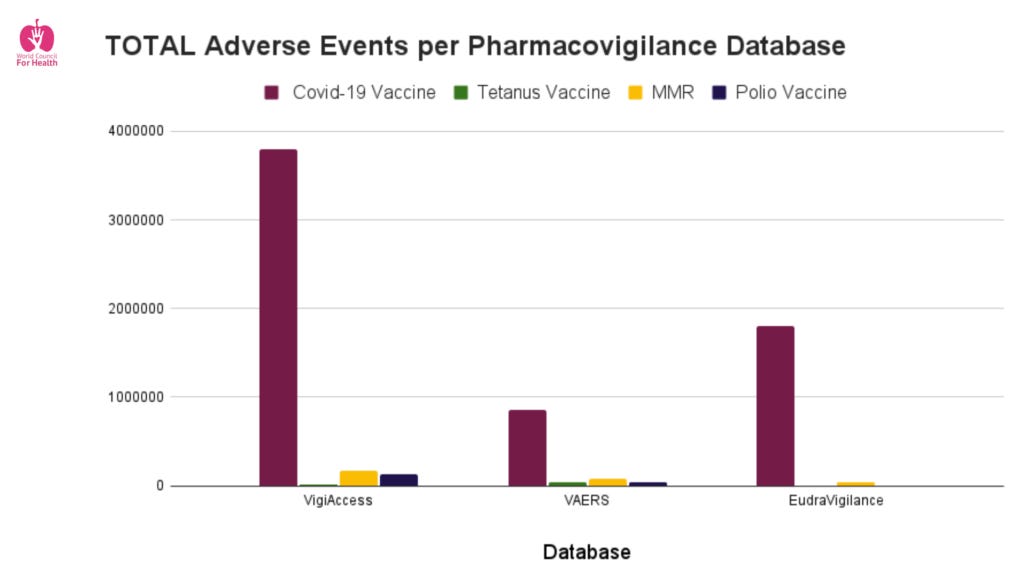
On all databases, it was found that adverse drug reaction (ADR) reports linked to Covid-19 injections are more numerous than other similar products by a factor of between 10 and 169 (see graph below). Many of the ADR reports are serious in nature and there exists sufficient evidence of associated harm on these databases to indicate a product recall.
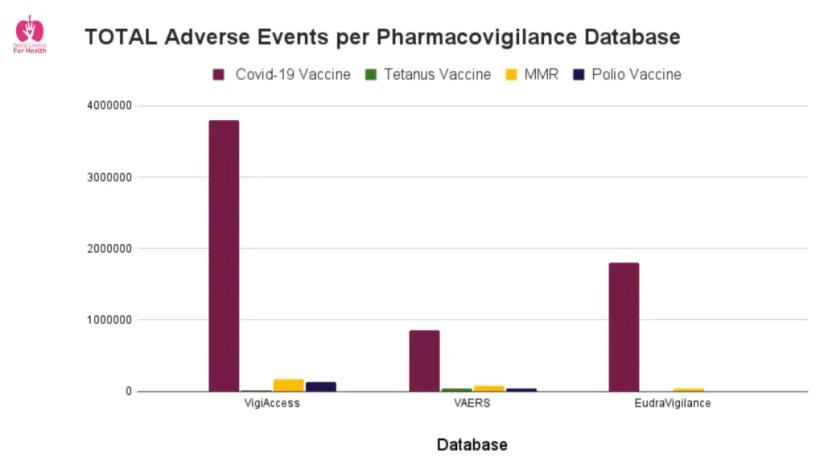
Total Adverse Events per Pharamacovigilance Database
In total, more than 40,000 deaths are linked to the novel Covid-19 vaccines in the official databases analysed.
In addition, the WCH pharmacovigilance report found that several thousand adverse drug reactions on official databases are related to the use of the experimental Covid-19 vaccines among young boys and girls for whom the vaccine had not been approved at the time.
The purpose of pharmacovigilance databases is to provide a signal of safety, and not to prove causality. To ensure that harms are detected in time, suspicion that an event is linked to the administration of the medicine is enough to register an event. “There is no need to prove that the medicine caused the adverse reaction, just the suspicion is good enough,” Dr. June Raine, head of the UK’s Medicines and Healthcare products Regulatory Agency, said in 2006. When sufficient pharmacovigilance data show a signal of harm, administration of the product should be ceased, the product recalled, and the safety signal investigated.
It should also be noted that such systems of passive surveillance result in significantly fewer ADR reports than active surveillance reporting. As a result, the actual number of adverse events that occurred in temporal relation to Covid-19 injections is likely to be much higher than revealed by the available official data.
In December 2021, World Council for Health called on regulators and governments around the world to immediately cease use of all experimental Covid-19 injections.
Dr. Tess Lawrie, co-founder of the World Council for Health, calls for people to come together to raise awareness of vaccine injury so that those harmed can get the help they deserve. “It is concerning that a grassroots organisation has had to do this work and point out that none of these experimental vaccines are safe according to publicly available official data. Why have the regulators not done their job and protected us?“
***
World Council for Health Covid-19 Vaccine Pharmacovigilance Report: https://worldcouncilforhealth.org/resources/covid-19-vaccine-pharmacovigilance-report/
World Council for Health Calls for an Immediate Stop to the Covid-19 Experimental “Vaccines”: https://worldcouncilforhealth.org/campaign/covid-19-vaccine-cease-and-desist/
World Council for Health Statement on Covid-19 Vaccines: https://worldcouncilforhealth.org/news/2021/12/covid-19-vaccines/14001/
World Council for Health Statement on Risk of Myocarditis in Children: https://worldcouncilforhealth.org/news/2022/01/risk-of-myocarditis-in-children/18570/
Contact: Dr. Katarina Lindley at katarina@thewc4h.org
June 12, 2022
Posted by aletho |
Science and Pseudo-Science | COVID-19 Vaccine, European Union, UK, United States |
Leave a comment
The runaway train that refuses to be knocked off course
When the JCVI considered covid vaccines for children in July 2021, they stated, “JCVI is of the view that the health benefits of universal vaccination in children and young people below the age of 18 years do not outweigh the potential risks”. Even in September 2021, they still said, “A precautionary approach was agreed given the very low risk of serious disease in those aged 12 to 15 years without an underlying health condition that puts them at increased risk.” As HART bulletin readers will know, the Chief Medical Officers eventually recommended the vaccine for 12-15s, in the vain hope of reducing school closures, which of course could have been achieved by simply stopping routine testing of asymptomatic school children and the sending home of healthy contacts.
Roll on to February 2022, when a ‘non-urgent offer’ was made of Pfizer vaccine for 5-11-year-olds, JCVI stated, “This advice on the offer of vaccination to 5 to 11-year olds who are not in a clinical risk group is considered by JCVI as a one-off pandemic response programme. As the COVID-19 pandemic moves further towards endemicity in the UK, JCVI will review whether, in the longer term, an offer of vaccination to this, and other paediatric age groups, continues to be advised.”
If any of our readers has seen this review, we would be pleased to know, as it might help us clarify the surprising appearance of Covid-19 on the NHS routine immunisation programme. Placing an unlicenced preparation onto the routine schedule is unprecedented. It raises serious questions of the legality, given the conditional authorisation was predicated on there being an emergency. It is also of course a subtle way of making parents think this vaccine is just run-of-the-mill. The current low uptake (53% of 12-15s and a mere 8.5% of 5-11s) suggests that at present, parents are well aware that covid-19 vaccines are not the same as other vaccines, either in terms of the risk of the disease for children or in terms of drug safety. They will also be well aware that lots of their triple vaccinated adult friends and family, have been catching covid regardless.
Not content with slipping this drug into the schedule under cover of the 4-day Jubilee holiday, the Local Government Association has been pushing behavioural psychology techniques to increase vaccine uptake in the young. Their opening gambit is, “Younger generations are more likely to be vaccine hesitant partly because they perceive themselves to be at lower risk of developing a severe form of COVID-19”. Surely, this is not a ‘perception’, it is a ‘fact’, which should surely have been viewed as a blessing, rather than an annoyance.
It gets worse: “Highlight the pro-social benefits of vaccination
Behavioural Insight: Emphasising the pro-social benefits of vaccination is particularly effective among young people. Prosocial benefits include achieving herd immunity and protecting others, especially those that are vulnerable and cannot get vaccinated. Combining both informational and emotional content can be effective.” Another one for the fact checkers – the JCVI say, “the benefits to the wider population are highly uncertain.”
And worse: “Highlight social norms about vaccination
Behavioural Insight: Highlighting that there are growing intentions to get vaccinated, that most people are getting vaccinated and that they approve doing so, can effectively encourage vaccine take up. Since young people tend to be more susceptible to peer influence, it is likely that social norms can be particularly effective when targeting this group.
Potential application: Emphasise Social norms in communications targeted towards young people. Make vaccination visible to other young people by setting up vaccination centres in university campuses or schools. Launch an ‘I will get vaccinated’-pledge on social media.”
And faintly ridiculous: “Second vaccine jab compliance
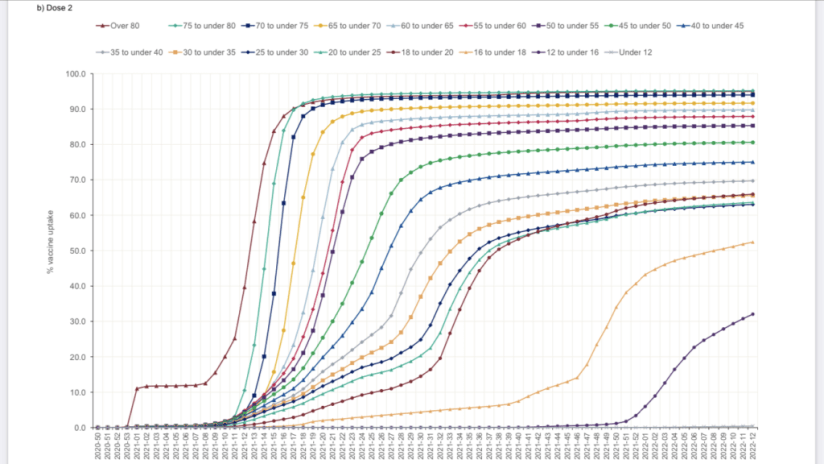
Ensuring residents take their second vaccine dose could be a challenge with which councils can support PHE and the NHS. This could be especially the case if news on vaccine efficacy and new strains undermines the perceived value of the second jab.” Again, the use of the word ‘perceived’ implies that the ‘news’ on vaccine efficacy and new strains is somehow irrelevant to informed consent. No wonder the powers that be don’t want people to see this graph from week 13 of 2022, dropped from the more recent weekly vaccine reports.
June 11, 2022
Posted by aletho |
Deception, Science and Pseudo-Science | COVID-19 Vaccine, UK |
Leave a comment
Urging leftists to support the Ukraine proxy war, Bernie Sanders aide Matt Duss whitewashes the US role, attacks The Grayzone, and advocates dangerous militarism.
The unanimous vote by progressive lawmakers for the $40 billion Ukraine funding bill has been followed by a near-unanimous refusal to defend it. To date, no member of the Congressional Progressive Caucus – with the sole exception of Cori Bush – has publicly explained why they chose to hand over billions of dollars to the weapons industry and intensify a proxy war against nuclear-armed Russia.
Amid this resounding silence, Matt Duss, a foreign policy adviser to Sen. Bernie Sanders, has stepped in to fill the void. In a New Republic article titled “Why Ukraine Matters for the Left,” Duss attempts to convince fellow progressives that the “provision of military aid” to Ukraine “can advance a more just and humanitarian global order.” Duss has only praise for a Biden administration that, in his view, “should be applauded for its judicious reaction to the Ukraine crisis.” By contrast, Duss opts to launch an attack on dissident journalists, myself included, who don’t share his enthusiasm.
To make his case, Duss omits an abundance of inconvenient facts, betraying either considerable ignorance of the Ukraine-Russia conflict or a deliberate effort to distort it.
While apologia for US hegemonic projects is normal in DC foreign policy circles, Duss’ contribution is particularly noteworthy given his painstaking attempt to cast himself as an outsider. “Our political class,” Duss states, “advocates military violence with a regularity and ease that is psychopathic.” Duss’ comment is both accurate and wildly ironic, given his choice to advocate our political class’s military violence in Ukraine — with the remarkable ease that he identifies in others as psychopathic.
When it comes to how the Biden administration has handled the Ukraine crisis, Duss cannot identify a single fault. “The Biden team clearly did not seek this war,” Duss claims, and “in fact… made a strenuous, and very public, diplomatic effort to avert it.”
Duss does not explain what the administration’s “strenuous” diplomacy entailed, perhaps because even its top officials now openly admit that none existed.
In an interview with War on the Rocks, State Department counsellor Derek Chollet was asked if NATO expansion into Ukraine was “on the table” in pre-invasion contacts with Russia. “It wasn’t,” Chollet replied. The White House, Chollet explained, “made clear to the Russians that we were willing to talk to them on issues that we thought were genuine concerns they have that were legitimate in some way,” including “arms control.” (emphasis added) But when it comes to “the future of Ukraine” and its potential NATO membership, Chollet said, this was deemed a “non-issue.”
To Duss, the Biden administration’s (openly admitted) refusal to even discuss Russia’s core demands – and to only entertain issues that it deemed to be “legitimate” on Russia’s behalf – is apparently a “strenuous diplomatic effort.” If “diplomacy” amounts to enforcing US hegemony, as many in DC seem to believe, then Duss would have a case. But in the rest of the world, where diplomacy entails constructive dialogue with a semblance of parity, he does not.
Duss also takes aim at the argument, advanced by prominent leftists including former Brazilian President Lula da Silva, that a US-European pledge that Ukraine won’t join NATO “would have solved the problem” with Russia.
To refute Lula, Duss stresses that “in the weeks leading up to the war, U.S. allies, specifically German Chancellor Olaf Scholz and French President Emmanuel Macron, signaled clearly” that Ukraine’s NATO ascension “was not going to happen.” According to Duss, it is Putin who sabotaged their efforts by invading, and who “has now made that discussion moot.”
Duss omits what also happened in the weeks leading up to the war. While Germany and France did indeed float a proposal to keep Ukraine out of NATO, it was Ukraine – with US backing – that rejected it. According to an account in the Wall Street Journal, Scholtz proposed to Volodymyr Zelensky on Feb. 19 – five days before Russia’s invasion — that Ukraine “renounce its NATO aspirations and declare neutrality as part of a wider European security deal,” signed by both Putin and Biden. But Zelensky rejected Schultz’s plan, a response that “left German officials worried that the chances of peace were fading.” In dismissing the Germans’ NATO proposal, Zelensky joined the Biden White House, as State’s Derek Chollet acknowledged and other Biden officials made clear in public.
Ignoring US-Ukrainian rejectionism, Duss then declares that “it seems absurd to suggest that even an ironclad public pledge from President Biden that Ukraine would never be accepted into NATO would have convinced Putin to draw back the 180,000 troops he had placed on Ukraine’s borders.” Perhaps, but that very public pledge happened to be the centerpiece of Germany’s last-minute diplomatic effort – one that Duss himself invoked, and that Zelensky (along with Biden) chose to reject.
Duss’ whitewashing of the Biden administration’s rejection of diplomacy before the Russian invasion carries over to the period since.
Since Russia’s invasion, Duss says, the White House has “acted with restraint and care not to get drawn into a wider war with Russia.” While it is true that Biden has opted not to start World War III – in other words, has opted not to trigger a global suicide pact — he has done anything but act with “restraint.” One day before Duss’ article was published, Biden authorized the delivery of medium-range advanced rocket systems to Ukraine. These rockets have the capacity to strike inside of Russia; the US is acting on Ukraine’s assurance that it won’t.
Duss may support undermining diplomacy in Ukraine and shipping off billions of dollars worth of heavy weaponry instead, but this can only be described as “restraint” if the sole measure is an immediate — rather than merely prospective — nuclear holocaust.
Duss is so impressed with Biden’s handling of the war that he cannot even detect a tangible path that could end it. “As of this writing,” Duss declares, “I have seen no evidence of a settlement in the offing—as in, a deal that Putin would actually entertain, let alone accept—that we’re refusing to ‘push for.'”
If Duss cannot see evidence of a realistic settlement that Russia could accept, then he is being willfully blind. Russia’s explicit proposals, issued before the war and after, including two weeks into the invasion, called on Ukraine to “cease military action, change its constitution to enshrine neutrality, acknowledge Crimea as Russian territory, and recognise the separatist republics of Donetsk and Lugansk as independent states.”
It is worth noting that the latter is Russia’s only new condition: for the eight years before the February invasion, Russia formally accepted the Minsk accords, which, to end the Donbas war, would have kept the Donetsk and Lugansk regions inside Ukraine’s borders, with limited autonomy.
Duss is free to argue that Russia’s terms for ending the war are unacceptable. But to pretend that Russia has not even laid out those terms, is to essentially advocate that the war never end.
By omitting Russia’s stated terms for a settlement, Duss also allows himself to erase one of the invasion’s key causes: the 2014 Maidan coup, and the ensuing eight-year Donbas war that had left more than 14,000 people dead by the time Russian forces crossed the border on February 24th.
In his 2500+ word piece, Duss makes no mention of the Donbas war and how it began: the 2014 ouster of a democratically elected Ukrainian president, with new leadership selected by Washington; the coup government’s assault on Ukraine’s ethnic Russian and anti-coup citizens, who launched a rebellion in the Donbas; the critical role of fascists and neo-Nazis in the Maidan coup and the Donbas war since; the fascist-led sabotage of the 2015 Minsk accords, which could have put an end to the conflict. By omitting this history, Duss can also omit how the US has helped undermine the Minsk agreements by siding with Ukrainian’s far-right and choosing to use the Donbas war to “fight Russia over there” (Adam Schiff) and “make Russia pay a heavier price,” (John McCain), because Ukraine’s “fight is our fight.” (Lindsey Graham).
After ignoring Russia’s stated grounds for a peace settlement, Duss goes on to disingenuously claim that the Ukrainian government has been pushing for one.
“Ukraine presented Russia with a far-reaching set of proposals over a month ago, including a commitment to ‘permanent neutrality,’” Duss claims. “Volodomyr Zelenskiy continues to offer to negotiate directly with Putin to end the war.”
It is true that Ukraine presented Russia with a 10-point plan in late March. But Duss omits what happened immediately after: while Russia “signaled its preliminary support,” (RAND analyst Samuel Charap) Ukraine’s Western backers sabotaged it, and Zelensky acquiesced. In early April, Ukrainian and Russian officials were finalizing details for a Zelensky-Putin summit. But UK Prime Minister Boris Johnson traveled to Kiev and ordered him to halt diplomacy. Citing sources close to Zelensky, Ukrayinska Pravda reports that Johnson informed his Ukrainian counterpart that Putin “should be pressured, not negotiated with.” Johnson also relayed that even if Russia and Ukraine chose to sign security guarantees, the UK and its allies would not take part – rendering any such agreement worthless.
Zelensky clearly received the message, as Duss’s own source makes clear. When Duss claims that Zelensky “continues to offer to negotiate directly with Putin to end the war,” he links to a Reuters article that reveals such an “offer” to be hollow. Zelensky, Reuters reports, said he would only negotiate with Putin if Russia first withdrew entirely from Ukraine – an obvious non-starter. “Get out of this territory that you have occupied since February 24,” Zelensky said. “This is the first clear step to talking about anything.” Zelensky also “ruled out suggestions… that Ukraine should make concessions for the sake of securing a peace agreement that would allow Putin to save face.”
Thus, returning to Duss’ rendering, Zelensky’s “far-reaching proposals” were immediately rescinded under Western orders, and Zelensky’s “offer to negotiate” was premised on a condition that would have made negotiations impossible.
None of this is to suggest that Russia was justified in launching an invasion of Ukraine. To defend the use of force, which has been so catastrophic, Russia has to meet a high burden of evidence that, in my view, it has not. But one does not need to defend Russia’s invasion to see through Duss’ attempt to whitewash the US role in provoking and prolonging it.
Tellingly, Duss is openly hostile to journalists who have reported on the context that he has omitted. Out of nowhere, Duss introduces an attack on The Grayzone, the Max Blumenthal-founded news outlet that I work for. While Duss has nothing but praise for Biden, he has nothing but ad hominems for us (“pernicious authoritarian agitprop,” “atrocity-denying grifters” “click-baiting provocateurs”). After sharing this vitriol, he then immediately declares that engaging with us is “wasting time.”
I feel the same way about his juvenile name-calling, but interested readers can judge for themselves whether his insults are supported by facts. (He links to two “sources,” one a Medium blog post that, true to the neo-McCarthyite norm, peddles innuendo that The Grayzone is funded by Russia, among other smears).
If Duss is genuinely concerned about wasting time, he also might reflect on why he devotes ample space to paying lip service to progressive principles, only to ultimately endorse policies that flagrantly violate them. “Centering opposition to U.S. imperialism and militarism is an entirely appropriate starting point,” Duss states. Yet Duss’ desired end point would see leftists center U.S. imperialism and militarism, with disastrous results: among them, prolonging a proxy war against a nuclear armed power, threatening a worsening global food crisis, and sentencing more Ukrainians to death.
Even putting aside US complicity in the Ukraine proxy war and its dangers for the planet, progressives like Duss might wish to consider the likely political consequences. One obvious guide is the election of 2016, when Donald Trump won over a significant portion of voters by claiming to oppose the military interventionism that Duss is now urging progressives to embrace. Having seemingly learned nothing from 2016, Democrats in 2022 are again ceding anti-war sentiment to Republicans, 68 of whom voted against the $40 billion Ukraine bill in the House and Senate (versus zero Democrats).
As at least some Republicans vote against the proxy war, Biden has defended the domestic pain caused by his Ukraine proxy war by blaming “Putin’s Price Hike” and trying to argue that “defending freedom is going to cost.” Biden’s defense of “freedom” in Ukraine is now costing him a transatlantic flight to grovel at the feet of the Saudi autocracy, in the hopes of staving off a humiliating cost in the November midterms.
Continuing his mealy mouthed approach, Duss both claims to support diplomacy while simultaneously declaring it to be unattainable. The US, he says, “should certainly be actively engaged in finding a diplomatic path to end the war, and avoid committing to maximalist aims that could foreclose one.” But yet, according to Duss, “for the moment that path is unclear.”
If the path toward peace for Ukraine is unclear to Duss, then that can only be because he has chosen to erase the factual background and the diplomatic solutions on offer, thereby reinforcing the “maximalist aims” that he claims to oppose. Duss’s proxy war apologia will certainly win him a warm reception in establishment DC circles. For the US progressive movement, Ukraine, and the rest of the planet, it only spells disaster.
June 10, 2022
Posted by aletho |
Deception, Militarism, Progressive Hypocrite, Russophobia | Russia, UK, Ukraine, United States |
Leave a comment
So the Covid Pass was not just for Christmas. Despite all the rhetoric of ‘living with Covid’, the Civil Service seeks two deputy directors for further development of this digital health certification (one a ‘delivery lead’, the other a ‘service management’ role). Seemingly a coronavirus outbreak is being exploited to usher in technocratic surveillance whereby the state will know our every movement. And given the excuse of another pandemic, or perhaps a climate-related emergency, such movement will be readily curtailed.
Looking back, we can see how society was primed by the authorities and mainstream media for the language of a ‘new normal’. The term ‘lockdown’, first used in a US prison setting, began to appear in British newspapers several years ago, typically in hyperbolic Daily Express reports of an incident in a railway station or department store. Was this predictive priming? Soon after Covid-19 emerged, the media were warning of ‘Long Covid’. As we now know, mRNA vaccines were already patented, and perhaps this syndrome was a prepared disguise for the likely litany of vaccine injuries; every symptom under the sun was included.
‘Long Covid’, though, may have a different and darker meaning. The Covid-19 regime has set a precedent, and draconian infection controls could be reinstated at any time. Anyone who thinks Covid-19 is over is very naïve. In places as diverse as Portugal, Finland, North Korea and New York the disease has returned to the headlines, with summer surges feared owing to holidaying, festivals and other socialising (otherwise known as fun). The virus will never officially disappear, and a largely compliant public will accept public health controls while dissidents will be forced to comply or suffer the consequences.
Vaccine passports, like Covid, are ready to pounce again. They were introduced in a limited way in England, while the devolved administrations of Scotland, Wales and Northern Ireland went much further. Nicola Sturgeon, a leader who basked in the glow of ‘saving Scots’ lives’, imposed restrictions long before and after the allegedly reckless rulers in Westminster.
It was as recently as January this year that the Scottish government expanded the use of vaccine passports. Adults needed to show proof of being fully vaccinated (less than four months since last jab) or a negative test before admission to nightclubs, unseated indoor events with more than 500 people, unseated outdoor events with over 4,000, and any event with more than 10,000 in attendance.
Many commentators believed that the SNP was using Covid-19 as a wedge in its independence drive, but the Labour assembly in Wales was just as extreme. In January Big Brother Watch launched a judicial review against Welsh ministers for its vaccine passport regime. Lawyer Shirin Marker of Bindmans LLP said: ‘In maintaining the Covid Pass Scheme, the Welsh government is exercising an unprecedented level of control over the rights and freedoms of the public. In these circumstances, it is essential that the Welsh government is transparent about what evidence they have relied upon to impose the scheme. Unfortunately, to date, such evidence has not been forthcoming.’
I suspect that decisions were made at UK level to use the Celtic fringes to test the water. Whereas the Scots and Welsh were manipulated by national consciousness, the awkward English have too many Samuel Bamfords against the establishment. And another Peterloo could turn the tide. Remember the poll tax riots, after the policy was introduced in Scotland with little resistance.
While he was still fooling us with Churchillian rhetoric, Boris Johnson repeatedly expressed his opposition to identity cards, an authoritarian creep of Tony Blair’s government. In the Daily Telegraph in 2004 he wrote: ‘There is the loss of liberty, and the creepy reality that the state will use these cards – doubtless with the best possible intentions – to store all manner of detail about us, our habits, what benefits we may claim, and so on.’
Yet as Prime Minister throughout the Covid-19 debacle, Johnson has keenly promoted the ‘build back better’ agenda espoused by the World Economic Forum. He agrees with WEF leader Klaus Schwab that we cannot return to the ‘old’ normal. While the British people feel they have left Covid-19 behind, at least for now, Johnson’s administration is spending public money to advance the Covid Pass. He will know of plans on a global scale, about which we can merely speculate. The enthusiasm of ministers for a new pandemic treaty, which would override national democracy, shows that we remain in the ratchet. What was Michael Gove doing at the recent Bilderberg meeting in Washington?
The blurb in the job advertisement states that the Department of Health and Social Care, which is administering the Covid Pass, is ‘central to the government’s response to Covid-19, the biggest challenge the country has faced in a lifetime’. Really? If there had been no constant barrage of sensational media messages in the last two years we would have carried on our lives regardless. Many of us know more victims of vaccine injury than of the virus itself.
Referring to the Prime Minister’s ‘Living with Covid’ strategy, the advert notes that ‘the NHS Covid Pass will be required at events and for international travel for the foreseeable future’. Living with Covid means never letting Covid go. And it is obviously not only about health, as this boast indicates: ‘Covid Pass is an award-winning DHSC programme undertaking a complex transition while continuing to deliver a vital citizen service in a changing health landscape.’
Digital surveillance here we come. But is it even more than that? Why are governments around the world so determined to inject us with repeated vaccines against a mostly mild and unremarkable respiratory virus? Are we being genetically engineered, and for what purpose? I can’t answer that, but clearly more jabbing is planned. In some countries the vaccine passport had slots for eight or ten doses, like a coffee loyalty card. Vast sums have been spent on stocks of Pfizer and Moderna vials.
I wonder how the interview panel would answer if applicants ask how many jabs they would be expected to take. Or is this post at a level high enough for vaccine immunity? For the plebs, however, Covid will be very long indeed.
June 10, 2022
Posted by aletho |
Civil Liberties, Deception | Covid-19, COVID-19 Vaccine, Human rights, UK |
Leave a comment
Samizdat | June 9, 2022
A court in Donetsk has sentenced to capital punishment three people, who came to Ukraine to join the Ukrainan forces against Russia. British citizens Aiden Aslin and Shaun Pinner, as well as Moroccan citizen Saadun Ibrahim, were found guilty of mercenarism and attempt to seize power by force by the Donetsk People’s Republic (DPR) on Thursday.
Under the laws of the DPR, forcible seizure of power carries a penalty of 12-20 years behind bars, but could be escalated to capital punishment due to wartime aggravating circumstances. Being a mercenary is punishable by a prison sentence of three to seven years.
The DPR, which was recognized by Russia as a sovereign state, tried the three foreigners on several criminal charges. They pleaded guilty to joining a terrorist orgainzation and attempting to forcefully topple the government in Donetsk, but denied being mercenaries hired by Kiev.
The three fighters were captured in or near Mariupol, a port city that the DPR claims as part of its sovereign territory. It saw weeks of intensive fighting and a blockade of remaining Ukrainian troops at a steelmaking plant.
London demanded that its citizens were treated as prisoners of war under the Geneva Conventions despite not formally being at war with the DPR. The Donetsk government said it considered them mercenaries, who are not granted the same privileges as regular combatants, since they were not part of any regular army.
June 9, 2022
Posted by aletho |
Aletho News | DPR, UK |
Leave a comment
HAS the thought ever occurred to you that when you travel by air you are nothing more than a piece of meat with a credit card as far as airline management is concerned?
All over the Western world we are hearing reports of flight cancellations, airport chaos and stranded passengers. We see it in Britain, and we saw it over the US Memorial Day weekend at the end of last month. Why?
There is no doubt that the lockdown response to the Covid pandemic devastated international travel, causing aircraft to be mothballed in airline ‘boneyards’. Those aircraft not put into storage were sold, often for their parts. Several airlines declared bankruptcy.
Crew and ground staff were laid off or sacked. British Airways alone shed 10,000 employees. Many took the opportunity to retire early.
Now, savaged by rotten Government decisions, the industry is desperately trying to come back to life.
While chaos reigns, the UK’s imbecile transport minister, Grant Shapps, blames the airlines, not the government he belongs to. They cut too many jobs during the pandemic, he has the cheek to say. What were they meant to do? It wouldn’t surprise me if his woke opposite number in the US, Secretary of Transportation Peter Buttigieg, is blaming racism, the needs of the LGBT community or any other vacuous reason he can find.
None of these foolish transport ministers and the governments behind them shows any signs of telling the truth, merely shifting the blame.
Of course airlines will trot out all sorts of excuses too in their determination to appear to provide a service and get flight bookings on aircraft that might not exist, or if they do, will not have a crew to fly it. How can they do this when they still don’t have the ground staff to check you in and process your luggage? They could be said to be behaving like conmen, the victim being the stranded or disappointed traveller.
The elephant in the room concerning staff shortage and specifically pilot shortage is Covid vaccination.
Pilots are not fools, and many took very seriously what they read and studied on the ‘vaccines’, in particular that they had no reliable short-term or long-term safety profile, and that early evidence showed they were liable to cause health problems. When airlines and governments started to impose vaccine mandates on air crew, many pilots retired or were sacked for refusing to comply.
That is not the only problem: of those who did comply, often reluctantly, and are still flying you around, many are suffering vaccine-induced side effects. No one knows the exact numbers, but the US Freedom Flyers pilots’ association say they have received hundreds of reports. These are pilots who would fail a medical because of their health conditions but are still flying.
Who is really to blame? We will know when various court cases against airlines and governments all over the world about an unsafe vaccine being mandated to pilots and aircrew reach their conclusions. Notably, the Dutch Airline Pilots Association (VNV) have won their court case against mandated vaccinations for new pilots.
The bottom line is that any pro-lockdown, pro-vaccine government is to blame. The political leaders of the West who imposed these programmes bear a heavy burden. They have allowed many to be killed and injured by an unsafe vaccine. They have destroyed businesses and livelihoods, and created social and economic chaos.
In the case of the airlines, their message ‘get jabbed to protect others’ could not have proved more contrary to the outcome. Far from protecting the pilots or the passengers, it has catastrophically compromised them.
That is why we have a pilot crisis, and it’s going to get worse for some time.
June 9, 2022
Posted by aletho |
Aletho News | COVID-19 Vaccine, Human rights, UK |
Leave a comment
HOW can a government that locked us down, collapsed our businesses, imposed a useless mask compliance regime, misled us about the severity of Covid while stifling information about safe, effective treatments in order to force through emergency use approval for ‘vaccines’ and nudge us towards experimental treatments that not only failed to prevent transmission, but caused irreversible damage and death, be in any position to decide what constitutes ‘harm’?
Yet here comes the Online Safety Bill, threatening not only hefty fines from free-press-suppressing Ofcom, but also prison time for anybody judged to have caused psychological harm leading to ‘serious distress’. Harmful content could include online bullying and abuse, advocacy of self-harm and the spreading of misinformation (defined as information that is false, but not created with the intention of causing harm) disinformation (information that is false and created to harm a person, social group, organisation or country) and malinformation (information that is based on reality, used to inflict harm on a person, organisation or country).
Section 53 (c) of the Online Safety Bill determines offending content to be anything that ‘presents a material risk of significant harm to an appreciable number of children in the United Kingdom’.
Like a vaccine then, or masks, or not seeing your friends, or not being able to go out, or attend school and with the added fear that by being ‘selfish’ and not taking a vaccine you didn’t need, you could kill your granny, mum, dad and teacher. Little wonder 374,646 children and young people contacted mental health services last month. The number of adults contacting mental health services in the same period was 1,054,003.
Harms with a less clear legal definition include ‘Coercive Behaviour’ (a government speciality), ‘Disinformation’ (Gates-funded MSM, WHO and all those ‘fact-checkers’ sponsored by the usual suspects), ‘Intimidation’ (jabs for jobs) and ‘Advocacy of Self-Harm’ (‘vaccines’).
The Bill, which also ‘protects’ adults – in case, God forbid, we might have the temerity to think for ourselves – empowers Ofcom to block users, control, moderate and take down content. Criminal sanctions currently in ‘reserve’ could be imposed on tech giants if they fail to clean up their acts or do not ‘allow Ofcom access to their algorithms’ – algorithms that show ‘how easily, quickly and widely content may be disseminated by means of the service’. In other words, Ofcom has been given free rein to make any significant change to a risk profile and make their own assessment as to the level of risk of harm to adults and how quickly such perceived-to-be-harmful content can be spread. So if Ofcom decides – as with YouTube’s Covid-19 Misinformation Policy (slight conflict of interests since Google Ventures invested in the AZ ‘vaccine’) which defines medical misinformation as any content that ‘contradicts guidance from the WHO or local health authorities’ – that ivermectin can cause harm, they can take down any mention of ivermectin (even if the only damage caused by ivermectin is to the profits of the pharma criminals) regardless of the fact Ofcom does not employ immunologists, epidemiologists or virologists.
As for ‘hate speech’, defined as ‘all forms of expression which spread, incite, promote or justify hatred based on intolerance on the grounds of . . . belief . . . or opinion’, would Piers Morgan’s ‘Anti-vaxxers really are a bunch of spineless pussies’ tweet, or Noam Chomsky’s insistence that the unvaccinated be segregated and that getting food was ‘their problem’, qualify as hate speech? Of course not. Their views are in line with The Agenda.
Adults don’t need Ofcom chief executive Dame Melanie Dawes deciding for them what they can or can’t watch (I use a VPN for Russia Today, Melanie) any more than they need Bill Gates telling them what they can eat (synthetic burgers) or Nadine Dorries pushing through the government’s idea of what constitutes harm or safety. Offence is taken, not given. If I wish to be offended, that’s my choice.
If the government genuinely cared about harm, they’d have carried out risk assessments to weigh up the pros (none) and cons (it was) of locking down the country. They wouldn’t have wilfully terrified the public when they knew full well Covid wasn’t a risk, as they themselves were partying like it was 1984.
Had Nadine ‘I’m A Celebrity . . . Get Me Out of Here’ Dorries cared about ‘harm’ she’d have voluntarily answered one of the 50 letters and emails sent to her by one of her own vaccine-injured constituents instead of having to be pressured into a response by a lobbying group taking up the cause of the vaccine-injured.
If the government cared one iota for the electorate, the vaccine rollout would surely have been halted following a September 2021 meeting in which Tess Lawrie, Dolores Cahill, Mike Yeadon and other doctors and scientists presented damning evidence to Sir Graham Brady of the 1922 Committee which illustrated how a mass rollout of the Covid-19 ‘vaccines’ for children would lead to children being maimed, killed and sterilised.
Such disregard for the electorate runs throughout government. There was a full house for Zelensky’s Churchill-plagiarising extravaganza compared with a paltry five MPs for the reading of Sir Christopher Chope’s Private Member’s Bill aimed at reforming the government’s Vaccine Damages Payment Scheme (VDPS).
Despite more than 2,000 deaths and approaching a million and half injuries (including blindness, strokes and paralysis) reported to MHRA’s Yellow Card scheme (set up following the thalidomide scandal) no compensation has yet been paid. As the VDPS doesn’t consider death as a qualifier for the 60 per cent disability requirement needed to pay out the paltry £120,000 to cover a lifetime of injury, clearly they’re already trying to wriggle out of it.
Before the Online Harms Bill goes any further, it might be a good idea to decide who is the best legal arbiter to rule on what unequivocally constitutes mis-, dis- or mal-information and who in the government (if anyone) has the moral authority or psychological capacity to judge what represents psychological ‘harm’ either to a child or an adult.
If the Online Safety Bill does pass, first in the dock should be the government.
June 7, 2022
Posted by aletho |
Civil Liberties, Deception, Full Spectrum Dominance, Science and Pseudo-Science | Covid-19, COVID-19 Vaccine, UK |
Leave a comment
The Israeli regime is openly putting pressure on the United Nations’ nuclear watchdog to censure Iran’s peaceful nuclear energy program.
“We expect the IAEA (the International Atomic Energy Agency’s) Board of Governors to place a clear warning light in front of the regime in Tehran, and make it clear that if it continues in its defiant nuclear policy, it will pay a heavy price,” the regime’s Prime Minister Naftali Bennett said on Tuesday, addressing the Knesset (Israeli parliament), The Times of Israel reported.
The comments came a day after the board started a five-day meeting in Vienna.
The event is set to adopt an anti-Iran resolution, drafted by Britain, France, Germany, and the United States to accuse the Islamic Republic of withholding cooperation with the agency.
Various media reports and official sources have warned about the existence of the Israeli regime’s footprints across the process that has led to the emergence of the draft resolution.
Raising even more suspicion was a Friday flying visit to the occupied territories by the IAEA’s Secretary-General Rafael Grossi, and his meeting there with Bennett, with some reports even sounding the alarm about the watchdog and Tel Aviv’s “collusion” against Iran.
“He (Grossi) arrived for a snap visit in Israel, and I made Israel’s stance clear — that we are operating and will continue to maintain our freedom of action to act against Iran’s nuclear program as long as necessary… nothing ties our hands,” Bennet said.
The Israeli regime has, over years, conducted several sabotage operations against Iran’s nuclear facilities and assassinated at least seven Iranian nuclear scientists.
The regime’s vicious anti-Iran campaign comes while Tel Aviv, itself, continues to be the sole possessor of nuclear arms in the Middle East region, with a stockpile of hundreds of atomic warheads. Due to the cover provided by the US and Europeans, however, the regime has refused to open up its nuclear sites to the IAEA’s inspectors and join the Nuclear Non-Proliferation Treaty (NPT).
“When it comes to nuclear weapons, we live in a world of double standards,” Frank N. von Hippel, an American physicist, who is a professor and co-director of the Program on Science and Global Security at Princeton University, told Press TV.
“This unequal situation cannot persist indefinitely: Either we get rid of nuclear weapons or nuclear weapons will get rid of us,” he added.
June 7, 2022
Posted by aletho |
Wars for Israel | France, IAEA, Israel, Sanctions against Iran, UK, United States, Zionism |
Leave a comment
A report commissioned by the United Kingdom (UK) government says the entire country will need to ban most air travel within ten years and all air travel by 2050 to abide by impossibly lofty climate change laws.
“In her last significant act as Prime Minister, Theresa May changed the UK’s Climate Change Act to commit us to eliminating all greenhouse gas emissions in the UK by 2050. This decision is based on good climate-science, was a response to a great wave of social protest and has been replicated in 60 other countries already,” the Absolute Zero report commissioned by the UK government explains.
According to the authors of the report, the only way that the UK government can meet their Absolute Zero obligations is to phase out all air travel, implementing an outright ban in 2050 until such a time as the government can conceive of a means of producing planes that produce zero greenhouse gases at any point during an aircraft’s production or use.
It shouldn’t need to be stated, but this is absolutely impossible.
Nonetheless, the authors say that “All airports except Heathrow, Glasgow and Belfast [will] close” between 2020-2029 and “All remaining airports [will] close” by 2050.
The authors continue, saying that under the current legislation, the following changes to daily life will need to be taken as all will be illegal in 2050: stop using aeroplanes; end all shipping; take the train, not the car; rideshare; use an electric vehicle; reduce energy consumption, including and especially heating; reduce fertilizer use; reduce cement and steel use and imports, etc.
The authors say that progressively limiting red meat consumption will also be necessary, as lamb and beef will be outlawed in the UK by 2050.
“In addition, obeying the law of our Climate Change Act requires that we stop doing anything that causes emissions regardless of its energy source. This requires that we stop eating beef and lamb – ruminants who release methane as they digest grass – and already many people have started to switch to more vegetarian diets,” the report reads.
This is quite an astounding proposal, as the authors say that under the climate change legislation, all fertilizer use will need to be “greatly reduced,” as will all processed foods, and the total energy required to cook or transport food must be reduced by 60 per cent of today’s levels.
So, the UK will not produce meat, will not use fertilizer to produce vegetables, will reduce other food imports to avoid greenhouse gas emissions, and will not produce or import processed food as a substitute.
It isn’t clear what, if anything, the authors and the government expect the people of the United Kingdom will eat in 2050. By all accounts, this appears to be a policy of misery and death.
June 5, 2022
Posted by aletho |
Malthusian Ideology, Phony Scarcity | UK |
Leave a comment
Great Britain has adopted an ambitious climate and energy policy. By 2050 all CO2 emissions are to be eliminated from the British Isles and Prime Minister Johnson wants to make Great Britain a model country for the energy transition. As early as 2019, the British climate targets were formulated in a comprehensive report entitled “Absolute Zero”.
The report is updated at irregular intervals. This time the tone of the authors has changed. They are now pointing out that the ambitious goals can only be achieved through drastic adjustments and changes in behavior.
The report offers a formidable refutation of the case that a solution to the climate emergency exists in the form of breakthrough technologies. The report’s lead author, Julian Allwood, Professor of Engineering and the Environment at the University of Cambridge, stressed that no new technologies were available to replace our current energy needs.
“In the age of climate emergency, one of the central myths that breeds complacency is that breakthrough technologies will gallop to the rescue, when instead we require radical action,” Allwood said.
Specifically, in order to meet its Absolute Zero commitments, the UK government has no choice but to phase out all air travel by 2050 and then impose a total ban – until a way is found to produce aircraft that do not generate greenhouse gases at any time during manufacture or use.
The authors further specify their forecast to the effect that “all airports except Heathrow, Glasgow and Belfast should be closed between 2020 and 2029” and “all other remaining airports should be closed by 2050”.
But that’s not all. If the current legislation remains in force, further drastic changes in daily life would have to be made, since they would be illegal in 2050: no longer use airplanes; cease all shipping traffic; use the train instead of the car; use carpooling; use an electric vehicle; reduce energy consumption, including heating; reduce the use of fertilizers; reducing the use of cement and steel, imports etc. It will also be imperative to limit or ban the consumption of red meat as lamb and beef will be banned in the UK in the future.
“Additionally, to comply with the Climate Change Act, we must refrain from anything that causes emissions, regardless of the energy source. This requires that we refrain from eating beef and lamb,” the report states.
German-speaking public kept in the dark
It’s also worth taking a look at “Absolute Zero” for Germans, because the German climate protection requirements are very similar to the British ones. The only thing is that the inevitable consequences of a draconian climate policy are being hidden from voters.
In Austria, skyrocketing fuel prices and a decidedly car-hostile traffic policy are paralyzing car traffic. But those who switch to the train and prefer public transport are often left out in the rain these days in the truest sense of the word.
Since the introduction of the climate ticket, there are no longer enough seats on the trains. Hundreds of people traveling and commuting have already been expelled from the train because there is no space for them. Instead of purchasing new train sets and expanding the offer with foresight, it was simply made cheaper in accordance with the green doctrine and on behalf of Black-Green coalition, in order to celebrate this catastrophe with higher utilization figures as a “success” in the end.
Parking space brawls
In Vienna, this policy has led to even further extremes. The shortage of parking spaces there recently led to a mass brawl among Ukrainians.
The problem is home-made: For years it has been observed how the previous city administrations kept reducing parking spaces. This happened in part through opting for “bicycle parking spaces” or art installations that are not used by anyone and are only noticed by drivers looking for a parking space.
With the Ukraine crisis, the move was made to allow refugees to park for free, wherever they wanted, until May.
They were then deprived of this luxury and Range Rovers, Porsches and other expensive wheels now vie for the already scarce parking spaces. In line with the “sustainability” of Agenda 2030, people are first deprived of their freedom and self-determination of individual transport, in order to then banish them to train stations from which they cannot be transported to any destination due to a lack of capacity.
Fly-shaming
In Sweden, a movement was formed in 2018 to have a hundred thousand people sign up and pledge not to fly for a year. That led to ‘flight-shaming’ [flygskam]. As a result, if one looks at national statistics on take-offs in Sweden, the domestic ones have fallen and the government has responded by promising to invest more in rail as an alternative to aviation. Except that trains do not cross oceans.
Led by a small group of celebrities, including Olympic winter gold medallist Bjorn Ferry and the musician Malena Ernman, who also happens to be climate activist Greta Thunberg’s mother, their “commitment” to give up flying forced Swedes to comply.
The Facebook group’s Jag flyger inte – för klimatets skull [I’m not flying – for the sake of the climate] campaign managed to lower the number of international flights at Swedish airports by 4 percent within a year.
June 5, 2022
Posted by aletho |
Civil Liberties, Malthusian Ideology, Phony Scarcity, Science and Pseudo-Science | Human rights, UK |
Leave a comment


 Aletho News