Former minister blasts pro-Israel lobby over ‘disgusting interference’ in British politics
MEMO | April 9, 2021
Former Foreign Office Minister Sir Alan Duncan has accused pro-Israel lobbyists of “the most disgusting interference” in British politics, and of negatively influencing the country’s foreign policy in the Middle East. The veteran politician has also claimed that Conservative Friends of Israel (CFI) went “ballistic” and blocked him from taking on a new post covering the region’s affairs.
Duncan, a former Conservative MP and government minister, makes the sensational claims in his newly published memoir, In The Thick of It: The private diaries of a minister (published by William Collins, 2021). Speaking to journalist Michael Crick about his book for the MailPlus website, the 64 year-old blasted CFI and its undue influence in British politics.
Conservative Friends of Israel, he said, had injected a “Netanyahu-type view of Israeli politics into our foreign policy,” referring to Israel’s right-wing prime minister. He claimed that it had applied pressure on Theresa May’s government to prevent him becoming Middle East minister at the Foreign Office.
In his book, Duncan claims that his new role was agreed until the then Foreign Secretary Boris Johnson alerted him to the fact that CFI “are going ballistic”. He insists that he was blocked from taking the post because he believes in the rights of the Palestinians.
In one diary entry Duncan is scathing about Conservative MPs’ fawning over Benjamin Netanyahu during his visit to Britain. He was “ashamed” of the British government, accusing officials of allowing Netanyahu to “peddle pro-settlement propaganda”.
Duncan described to Crick the culture of fear created by CFI. “A lot of things do not happen in foreign policy or in government for fear of offending them because that’s the way it’s put to them by the CFI.”
He warned: “It’s a sort of buried scandal that has to stop… they will interfere at a high level in British politics in the interests of Israel on the back of donor power in the UK.” Ultimately, he pointed out, the influence of the pro-Israel lobby group came at the expense of the Palestinians.
Duncan has been a major target for the pro-Israel lobby. In 2017, an Al Jazeera documentary sensationally exposed the operations of pro-Israel lobbyists working with the Israeli Embassy in London to “take down” a minister of the Crown. Duncan, fellow Conservative MP Crispin Blunt and former Labour leader Jeremy Corbyn were marked out as targets. Writing for Al Jazeera at the time, Robert Grenier, a retired, 27-year veteran of the CIA’s Clandestine Service, warned against what he called the “insidious threats” of the pro-Israel lobby.
Read also: Conservative Friends of Israel urge UK to oppose ICC’s war crimes investigation
Keeping us masked forever? The Davos set’s dystopian ambitions are very clear
By Neil Clark | RT | April 9, 2021
The WEF’s promotion of a Chinese ‘smart face mask’ that tracks every breath its wearer takes is further evidence that the changes to Western society over the last 12 months of Covid are intended to be permanent.
“It’s only for when you pop into Tesco’s to do your weekly shop, what‘s your problem with that, you selfish ‘right-wing’ libertarian?” That’s how the introduction of mandatory face-masks was sold to us in Britain last summer, by its virtue-signalling, “Look at me, I’m such a good citizen” supporters.
Masks would be temporary – restricted to shops – and as soon as the Covid threat had passed they would be dispensed with, like social distancing. Anyone who said these measures were designed to be permanent – and were part of the global elite’s plan to keep the plebs muzzled up forever – was dismissed as a ‘crank’ and ‘a conspiracy theorist’.
Well, nine months on, and where are we?
The UK government has issued a ‘road map’ for taking us – with the speed of a 150-year-old Galapagos Island tortoise on sleeping tablets – out of lockdown. But there’s no mention of when masks and social distancing will be dispensed with.
Could that be because there’s no intention of masks and social distancing ever being dispensed with? It certainly appears that way.
Since last July, we’ve seen the mask mandate expanded. You are now asked to wear them not just in shops, but in all indoor areas, unless exempt. Even school children have to wear them in class. That decision was supposed to be reviewed at Easter, and, guess what, the government has just extended the school mask mandate until the summer. In addition, football fans will be expected to wear masks when they’re finally allowed back into grounds this spring at ‘trial’ events.
‘Following the science’? Hardly. We shouldn’t forget that in the week that masks were first introduced last summer, deaths with Covid literally reached zero.
The BBC’s Health Correspondent Deborah Cohen asked the World Health Organisation if their change of advice on masks had been due to political lobbying, and they did not deny.
Why, if masks were so important in preventing transmission, weren’t we told to wear them last March and April? In fact, government scientists advised us not to wear them.
Now, it seems not only must we wear them, but we need to get used to them being a permanent part of daily life in the ‘New Abnormal’. In their recent paper, ‘Evaluating England’s Road Map out of Lockdown‘, published on the UK government’s website, the Imperial College Covid-19 Response team state: “Whilst the impact of Test Trace Isolate, mask wearing, hand hygiene and COVID security on ‘R‘ is difficult to quantify it will be vital to emphasise the importance of normalising and ensuring adherence to all measures even after ‘full lifting’ is achieved.” Got that? Masks need to stay even after Boris Johnson says ‘Lockdown is over‘.
It’s in this context that the World Economic Forum’s (WEF) enthusiastic promotion of the Chinese ‘smart face mask’ needs to be seen. It apparently reminds users when to wash it and checks if they’re wearing it properly. If too much carbon dioxide builds up inside, a phone alert reminds the wearer to catch a few breaths of fresh air. If the user forgets to put it on, the same phone app sends them a reminder to mask up.
This is not about public health, but all about making sure that measures introduced ostensibly to stop the spread of Covid-19 become permanent. Yes, once again the much-derided ‘crackpot conspiracy theorists’ of 2020 have been proved right.
Remember how last summer, the WEF was promoting a ‘Common Pass‘ health passport scheme, not just for international travel but for access to domestic events too? It would never happen, we were told. That’s ‘David Icke stuff’, was the condescending brush-off. Well, that too has come to pass – no pun intended.
To find out why all this is happening, all we have to do is to follow the money trail. All the way to Davos. What does the pro-permanent mask Imperial College have in common with the pro-permanent mask WEF? Answer: the pro-permanent mask Bill Gates.
Last month, Gates himself likened putting on a face mask to putting on a pair of trousers. “I just don’t think wearing a mask is such a deep inconvenience. I mean we ask people to wear pants. You know, why was this politicised?” Back in November, he made the same comparison. “We ask you to wear pants and, you know, no American says — or very few Americans say — that that’s, like, some terrible thing.”
But is masking up whenever we go out really the same as putting on a pair of trousers, to use the English term?
Of course it isn’t. Unless you’re Batman or The Lone Ranger, or another Saturday morning cinema superhero, or indeed a bank-robber, wearing a mask in public isn’t normal, and no amount of WEF-spin makes it so. But what walking about with pieces of black cloth over our mouths and noses does do, is maintain the levels of fear in the community.
If cases and deaths with Covid have plummeted to zero, but we want to make people live as if there is a permanent pandemic, to keep control over them, and to introduce ‘Covid-certification’ to restrict where they can and cannot go, how else can we keep Project Fear going without masks? It’s the only way we’d know that these were not ‘normal’ times. Which is, of course, precisely why they were introduced when deaths had dwindled to very low numbers.
Smart masks? The really smart thing is to get wise to the WEF’s dystopian agenda.
Neil Clark is a journalist, writer, broadcaster and blogger. His award winning blog can be found at http://www.neilclark66.blogspot.com.
Alex Salmond declines to blame Russia for Salisbury incident
Press TV – April 7, 2021
The leader of the pro-independence Alba Party, Alex Salmond, has steadfastly refused to toe the British government’s line on the alleged poisoning of a Russian double agent in England in 2018.
Former Russian military intelligence officer, Segei Skripal, who betrayed his country by working for the UK’s MI6, was allegedly poisoned, alongside his daughter Yulia, with what the British government says was the Novichok nerve agent.
The alleged attack took place in the medieval cathedral city of Salisbury on March 04, 2018. Both Skripal and his daughter survived the alleged attack.
Speaking to BBC Good Morning Scotland on April 07, Salmond refused no less than four times to blame Russia for the alleged attack.
Faced by Salmond’s defiance, the show’s presenter, Gary Robertson, tried to undermine the former First Minister’s position by pointing out that he produces a show for the Russian TV network RT.
But Salmond hit back by saying: “I produce, along with Tasmina Ahmed-Sheikh, a program for Slainte Media which is then broadcast on the RT platform, as they’re perfectly entitled to do”.
“I can tell you from personal experience – I don’t know what your experience at the BBC is – not a single word of editorial instruction or even suggestion has been made to me from anyone at RT and the program stands on its own merits”, the former leader of the Scottish National Party (SNP) added.
Salmond and fellow Alba Party candidate Ahmed -Sheikh (who is a former SNP MP), host “The Alex Salmond Show” each week on RT.
On another subject, Salmond suggested that evidence of Russian interference in recent US elections was “very slight”.
Salmond’s position on these sensitive issues will alarm the British establishment which has identified Russia as an “active threat” to UK national security in its newly-released Integrated Review of Security, Defense, Development and Foreign Policy.
Both the Alba Party and the SNP are committed to closing down the headquarters of the Royal Navy in Scotland.
The Faslane naval base, formally called Her Majesty’s Naval Base, Clyde, hosts the UK’s nuclear weapons capability.
Hospital Medical Director: Sickness in NHS staff after Covid Vaccination is “Unprecedented”
The Daily Expose | April 4, 2021
The Medical Director of a hospital in the United Kingdom has bravely spoken out against the failure to report the reality of morbidity caused by the Covid-19 vaccination roll-out across the United Kingdom to NHS staff.
Dr Polyakova, who is the Medical Director of a hospital in Kent has said that the “levels of sickness after vaccination is unprecedented” among NHS staff, confirming that some are even suffering neurological symptoms which is having a “huge impact on the health service functioning”.
The doctor, who progressed into medical management of the hospital over the past three years says that she is struggling with the “failure to report” adverse reactions to the Covid vaccines among NHS staff, and clarified that the young and healthy are missing from work for weeks after receiving a dose of either the Pfizer or AstraZeneca experimental vaccine.
“Some even require medical treatment” Dr Polyakova said, “Whole teams are being taken out as they went to get the vaccine together”.
In response to the arising question of making Covid-19 vaccination compulsory for NHS staff, Dr Polyakova said –
“Mandatory vaccination in this instance is stupid, unethical and irresponsible when it comes to protecting our staff and public health. We are in the voluntary phase of vaccination, and staff are being encouraged to take an unlicensed product that is impacting on their immediate health.
“I have direct experience of staff contracting Covid after vaccination and probably transmitting it. It is clearly stated that these vaccine products do not offer immunity or stop transmission.
“So why are we doing it? There is no longitudinal safety data available and these products are only under emergency licensing. What is to say that there are no longitudinal adverse effects that we may face that may put the entire health sector at risk?”
Both the Pfizer and AstraZeneca jab are only licensed for emergency use, as confirmed by Dr Polyakova. This means that the manufacturer of the vaccine, in this case either Pfizer or AstraZeneca, are not liable for any injury or ill-effect that may occur in the recipient of their product.

The Medical Director didn’t stop their though as she went on to attack the coercion and mandating of experimental medical treatments for NHS staff, comparing it to a Nazi dystopia –
“Flu is a massive annual killer, it inundates the health system, it kills young people, the old the comorbid, and yet people can chose whether or not they have that vaccine (which had been around for a long time). And you can list a whole number of other examples of vaccines that are not mandatory and yet they protect against diseases of higher consequence.
“Coercion and mandating medical treatments on our staff, of members of the public especially when treatments are still in the experimental phase, are firmly in the realms of a totalitarian Nazi dystopia and fall far outside of our ethical values as the guardians of health.
“I would never debase myself and agree, that we should abandon our liberal principles and the international stance on bodily sovereignty, free informed choice and human rights and support unprecedented coercion of professionals, patients and people to have experimental treatments with limited safety data. This and the policies that go with this are more of a danger to our society than anything else we have faced over the last year.
“What has happened to “my body my choice?” What has happened to scientific and open debate? If I don’t prescribe an antibiotic to a patient who doesn’t need it as they are healthy, am I anti-antibiotics? Or an antibiotic-denier? Is it not time that people truly thought about what is happening to us and where all of this is taking us?”
We couldn’t have said it better ourselves.
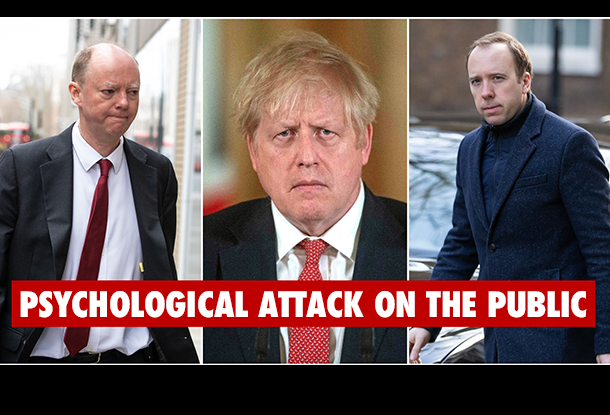
SAGE Document Reveals ‘Covert’ Propaganda to Scare British Into Staying Home in Lockdown
21st Century Wire | April 6, 2021
Once again, the UK government has been shown to have used ‘covert tactics’ in order to scare UK residents into staying at home for lockdown by increasing the ‘perceived threat’ of COVID’ rather than genuine science-backed risk assessment data, and also used ‘hard-hitting emotional messages’ designed to cower the public into complying with the government’s arbitrary diktats.
Due to the heightened level of public outrage, mainstream media outlets are finally being forced to admit what they have been systematically covering-up now for 12 months – that Government have been involved in active psychological and information warfare measures against their own population.
In a document presented to the UK government’s ‘SAGE’ confab, a scientific group meant to advise government on pandemic policies, it was revealed how technocrats sought to increase the ‘perceived threat’ of COVID-19 using aggressive psychological ‘hard-hitting emotional messages’ in order to brainwash the public into compliance.
Upon hearing the official admission, some psychology professionals have turned their sights on Downing Street, accusing bureaucrats of using “covert psychological strategies” in order to hype-up the threat of the virus, and offering no context as to the actual risk posed to the general public.
Government officials are accused of creating ‘a state of heightened anxiety’ which led to many people becoming ‘too frightened to attend hospital’.
This rebuke of the government’s active measures is given further credence by the fact that the majority of hospital beds in the UK remained largely empty in 2020, especially during the first few months of the ‘pandemic.’ This is especially relevant because it was at this same time when the government and mainstream media were relentlessly pushing out the idea that health services were ‘under threat’ of being overrun by Covid, only it never happened.
As a result of the government’s fear campaign, along with the overall throttling of the NHS, there have been an estimated 4.66 million people left waiting many months to begin even routine treatment, as well as thousands of pre-cancer screening appoints abandoned or pushed back – all because of the constant ramping-up of the fear of Covid.
The question still remains: will cabinet ministers be held to account for this unprecedented over-reach of state power?
The Mail Online reports…
Experts fear Britons have been the subject of an experiment in the use of tactics which operate ‘below their level of awareness,’ it was said.
They have now made a formal complaint to an organisation which will rule on whether Government advisers are guilty of a breach of ethics.
Downing street denies this, claiming it simply presented the facts.
Complainants point to a document handed to the Scientific Advisory Group for Emergencies last March, when the pandemic began to rapidly grow in Britain.
The paper, written by Scientific Pandemic Influenza Group on Behaviours, said: ‘A substantial number of people still do not feel sufficiently personally threatened; it could be that they are reassured by the low death rate in their demographic group, although levels of concern may be rising.
‘The perceived level of personal threat needs to be increased among those who are complacent, using hard-hitting emotional messaging. To be effective this must also empower people by making clear the actions they can take to reduce the threat.’
The document, seen by the Telegraph, allegedly then gave 14 options for improving compliance including ‘use media to increase sense of personal threat’, which they said would be highly effective but runs the risk of ‘negative’ side effects.
SAGE members have since claimed the British public have been ‘subjected to an unevaluated psychological experiment without being told that is what’s happening.’
They added that SPI-B reports are often not ‘challenged’ by SAGE because many of those involved are ‘not very well equipped to evaluate it.’
‘When someone from SPI-B is saying we need to ramp up the fear and keep it ramped up – there wasn’t much questioning of that at the beginning and most of the questioning came from external sources, not from within.’
SPI-B is described as providing behavioural science advice aimed at anticipating and helping people adhere to interventions that are recommended by medical or epidemiological experts.
(…) Last November, Sir Patrick Vallance admitted he had ‘regrets’ over frightening people with a doomsday dossier that forecasted as many as 4,000 Covid-19 deaths a day over winter and was used to justify a second national lockdown.
Number 10’s top scientific adviser made the comments alongside Professor Chris Whitty, England’s chief medical officer, after the pair were hauled before MPs to defend SAGE’s modelling that also predicted hospitals would be overrun with virus patients by the end of this month.
During the grilling by members of the House of Commons Science and Technology Committee, Labour MP Graham Stringer asked Sir Patrick if he believed he had frightened people with the bleak deaths data presented during Saturday night’s press briefing.
The Chief Scientific Adviser said: ‘I hope not and that’s certainly not the aim… I think I positioned that as a scenario from a couple of weeks ago, based on an assumption to try and get a new reasonable worst-case scenario. And if that didn’t come across then I regret that.
UK school textbooks slammed as “propaganda” for Israel
MEMO | April 2, 2021
Two UK school textbooks on the Middle East have been “significantly altered” following intervention from leading advocates of the Zionist state in favour of the Israeli narrative. The alterations, slammed as “propaganda under the guise of education” and “not fit for purpose” have raised serious concerns over the textbook, prompting a pause in further distribution.
Details of the extensive “biased” and “misleading” alterations were exposed by a report, by Professors John Chalcraft and James Dickins, Middle East specialists in History and in Arabic, respectively, and members of the British Committee for the Universities of Palestine (BRICUP).
Their eight-page report uncovered” dangerously misleading” changes to the books published by Pearson, titled Conflict in the Middle East and The Middle East: Conflict, Crisis and Change, both by author Hilary Brash and are read by hundreds of thousands of GCSE students annually. GCSEs are the academic qualifications studied for by UK high school students to the age of 16.
The alterations were made last year following intervention by the Board of Deputies of British Jews (BoD) working together with UK Lawyers for Israel (UKLFI). Both are amongst the most vocal pro-Israeli groups in the UK.
Describing the scale of the alterations the report noted that there are changes on almost every page, often multiple changes. “In CME (with 84 pages of history) we have counted 294 changes, in MECCC (with 104 pages of history) over 360,” said the report. “There are thus on average more than three changes per page, and the re-writing on some pages is particularly extensive. Alterations have been made to text, timelines, maps and photographs, as well as to sample student essays, and to the questions that students are asked to answer”.
Multiple examples of the changes are highlighted in the report. In one example the original version says that “international law states that a country cannot annex or indefinitely occupy territory gained by force”. This is the overwhelming international legal consensus. The revised version replaces this with: “Some argue that international law states that a country cannot annex or indefinitely occupy territory gained by force”. This change, according to the report’s authors “clearly replaces an accurate and unambiguous description of the internationally accepted legal position by a ‘fudge’ that implicitly throws doubt on that position”.
In the original version of the domestic GCSE textbook there are 10 references to Jewish terrorism and 32 to Palestinian terrorism (in each case including use of ‘terror’, ‘terrorist’ or ‘terrorism’). After revision there are 4 references to terrorism by Jewish groups, and 61 references to terrorism by Palestinian ones.
Concluding the report, the authors said that they had “found the process to have been biased and the outcome misleading. The outcome is two textbooks that distort the historical record, failing to offer students a balanced view of the conflict. These books, we conclude, are not fit for purpose. School children should not be supplied with propaganda under the guise of education”.
Leading experts on the Middle East have raised serious concerns over the alterations. Eugene Rogan FBA, Professor of Modern Middle Eastern History at the University of Oxford said: “Given Britain’s historical responsibility, it is particularly important that the subject be taught in a way that is impartial and objective. It is a betrayal of such objectivity to allow Israel advocates the opportunity to edit teaching materials without giving Palestine advocates an equal opportunity to provide input. The result can only undermine confidence in the impartiality of the teaching of an intensely complex and sensitive issue.”
Neve Gordon, Professor of International Law and Human Rights at Queen Mary University of London, said: “Through their rigorous analysis of two GCSE text books, Professors John Chalcraft and James Dickins uncover how hundreds of revisions have been inserted in order to modify and distort historical and political facts relating to Israel/Palestine. Their report suggests that when accredited publishing houses allow lobbying groups to help develop high-school curriculum, knowledge is replaced by indoctrination and our children are encouraged to adopt biased thinking.”
Khaled Fahmy FBA, Professor of Arabic Studies at the University of Cambridge, said: “While it is laudable that Middle Eastern history books are regularly revised and updated, the manner in which these two school textbooks have been revised is shocking and unacceptable. School textbooks should be revised based on the advice and expertise of academics and scholars, not by reviewers selected by an organisation of lawyers whose rationale is advocating for a foreign country.”
In a statement to Middle East Eye, Pearson said “We stand by our texts but had already taken the decision to pause further distribution while we discuss further with stakeholders.”
The Lockdowners Have Their Own Conspiracy Theories
By Phillip W. Magness | AIER | April 2, 2021
A bizarre Covid-19 conspiracy theory appears to have taken root among the epidemiologists and public health officials who still support lockdowns. According to their claims, the UK government’s pandemic response was secretly captured at some point in the fall of 2020 by lockdown critics including Great Barrington Declaration co-author Sunetra Gupta, her Oxford colleague Carl Heneghan, and Sweden’s state epidemiologist Anders Tegnell.
Seizing on an article in the Times of London, supporters of this theory allege that Gupta and her colleagues convinced UK Prime Minister Boris Johnson and Chancellor Rishi Sunak to abandon a so-called “circuit breaker” lockdown during an audience in late September. Had the UK gone back into lockdown around the beginning of October instead of a month later – proponents of this theory maintain – it would have avoided its disastrous second wave over the fall and winter months.
Even the basic narrative flies in the face of empirical reality. In November 2020 and again in January 2021, the UK went through two successive rounds of draconian lockdowns of the exact type that Gupta and her colleagues advised against. Championed by Johnson as a way to avert the second wave, these policies utterly failed at their stated purpose. On November 5th, the date the second lockdown took effect, the UK’s death toll stood at 48,000. Over the next four months, three of them spent under recurring lockdowns, the UK’s fatality numbers exploded to over 120,000.
Equally telling, the timing of the UK’s fall/winter wave almost perfectly matched that of Sweden, which remained open throughout the same period – except the UK’s results under lockdowns were visibly worse. As a growing body of scientific literature attests, lockdowns did practically nothing to contain the pandemic. Instead, the performance of this policy shows no discernible advantage over states and countries that opted against suspending the basic operations of daily life, and in many cases lockdown countries actually did worse than those that remained open.
Still, proponents of the newest UK conspiracy theory hold that something very different would have happened if only Johnson had enacted an earlier lockdown around the beginning of October instead of November 5th. Its underlying narrative has gained an unusually intense following among public health activists and pundits in the UK.
Deepti Gurdasani, an epidemiologist at Queen Mary University in London and a principal organizer of the pro-lockdown John Snow Memorandum, has aggressively promoted the alleged wresting of pandemic policy away from the lockdowners as an explanation for why the UK’s second and third lockdowns failed. As early as December, Gurdasani blasted Downing Street for supposedly listening to the “dangerous ideology” of Gupta, Heneghan, and Tegnell, which “has cost thousands of lives” and sought to replicate the “dangerous” Swedish strategy. Never mind that Sweden, without lockdowns, has a much lower deaths-per-million residents total (1,303 as of April 1st) than the UK (1,890) under three harsh lockdowns.
The same narrative has become a favorite of Devi Sridhar, an anthropologist and Snow Memorandum co-signer who frequently appears in the UK media to advocate the fringe “Zero Covid” strategy (the same one that claims we need more lockdowns to prevent future lockdowns, apparently unaware of the contradiction that entails). Attempting to explain why her own lockdown approach did not work, Sridhar wrote on January 5th that “Chancellor Sunak invited Heneghan, Gupta & Tegnell to advise on strategy. That says it all.”
Other variants of the same conspiracy theory permeate the UK’s pundit ranks. Far-left Guardian columnist Owen Jones repeated it in a December column targeting Sunak and the scientists for allegedly delaying the lockdowns until it was “too late to bring coronavirus rates down to anywhere near the level needed to suppress the virus.”
A little over a month later, Sam Bowman, a right-leaning self-described “neoliberal,” penned an almost identical argument to Jones in the same newspaper, writing “Sunak was reported as having been the decisive voice in government against an autumn lockdown that might have brought cases low enough to make things like test-and-trace viable,” all because of “Sunetra Gupta, Carl Heneghan and Anders Tegnell being invited to speak via Zoom at Downing Street.”
Note that none of these commentators are even willing to consider the possibility that lockdowns do not deliver on their promises, or that Britain’s dismal performance under the policies they advocated is a direct testament to their failure as public health measures. The validity of lockdowns has become an axiom to them, and the only conceivable reason they do not work must be some form of malfeasance preventing them from working the way the epidemiology models claim they should. Sunak and the three dissenting scientists accordingly became a natural scapegoat for Britain’s dismal public health performance over the winter months.
Is there even a kernel of truth behind the lockdowner’s UK conspiracy theory? Gupta, Heneghan, and Tegnell did meet with Downing Street via Zoom on September 20th to voice their opposition to lockdowns in general – a position they have consistently held throughout the pandemic. Unfortunately, as Gupta has explained and as the next four months repeatedly demonstrated, the Prime Minister largely ignored their advice.
The conspiracists’ alleged “smoking gun” is a series of minutes from the UK government’s SAGE advisory committee on September 21st, which included a “circuit-breaker lockdown” among a “short-list” of policies “that should be considered” in response to rising Covid-19 cases. Apparently in their minds, being “considered” equates to adoption, and the fact that Johnson did not lock down the very next day is proof that the dissenting scientists had wrested the reins of the UK’s pandemic policy from those who advocated lockdowns, delaying the necessary response until November 5th after which it was too late.
There are multiple immediate problems with this narrative. First off, Wales tried a “circuit breaker” lockdown that almost exactly followed the proposal being considered by the SAGE committee, announcing it on October 19 and implementing it a few days later. Although it had a lead of almost two weeks before the rest of Britain went into lockdown in November, Wales’s per capita case numbers followed the same trajectory as the rest of the country, including the sharp spike in late December and early January. Far from working as intended, Wales’s “circuit breaker” lockdown only slightly shifted the timing of this pattern. Its maximum daily peak of 87 cases per 100,000 residents nearly matched England’s peak of 96, and its curve for Covid-19 fatalities followed the same pattern as the rest of Britain.
Equally telling, a number of the conspiracy theory adherents themselves were singing a very different tune when these events were unfolding. Gurdasani, Sridhar, and other lockdown advocates of the John Snow Memorandum crowd want you to believe that they were patiently counseling the government to adopt an early lockdown between the end of September and mid-October, only to see their advice deflected by Downing Street due to the interference of Gupta and the other dissenting scientists. The record reveals a very different story.
On September 24, only three days after the SAGE meeting minutes, an interesting editorial appeared in the leading British medical journal. Written by Karl Friston, a frequent collaborator with Gurdasani and fellow John Snow Memorandum organizer, the editorial advocated a “third way beyond lockdown or herd immunity” premised on implementing a contact tracing regime over the next few weeks. Far from raising alarms about the immediate need for another lockdown, Friston attempted to assure calm.
“We have already developed a substantial population immunity (around 8% in the UK) and our physical distancing policies remain adaptive and effective,” he explained, arguing that a contact tracing regime could synergistically harness and augment their effectiveness. As far as the fall case surge went, he predicted a comparatively mild trajectory: “When one models what is likely to happen…in terms of viral spread and our responses to it—a plausible worst-case scenario is a peak in daily deaths in the tens (e.g., 50 to 60) not hundreds, in November.” As it happens, the UK topped 400 deaths per day during the November lockdown, and surged to 1,200 deaths per day at the peak of the January lockdown.
Just over two months later, Friston joined Gurdasani and several other Snow Memorandum signers in an letter to the Lancet that blamed the UK’s second wave on failing to heed pro-lockdown advice that they now claimed as their own, even as it conflicted with their public messaging from September that downplayed the very same recommendation. Writing in hindsight and with a liberal amount of revisionism, they recast themselves as proponents of an earlier lockdown all along: “On Sept 21, 2020, the Scientific Advisory Group for Emergencies (SAGE) advised the UK Government to institute a circuit breaker in England to suppress the epidemic. Instead, the government opted for several weeks of ineffective local tiered restrictions, and cases continued to rise exponentially.”
A similar messaging came from the “Independent SAGE” group – a private organization of scientists who now generally support the lockdown approach, but also spent the early fall advocating less-restrictive measures that would supposedly avoid another lockdown. On September 20th, the same day that Gupta and the other scientists met with Downing Street, the Independent SAGE group (not to be confused with the official SAGE group despite their shared name) released a 10-point plan “to avoid a national lockdown.”
The scheme warned of a point “when the situation is so far out of control that the only possible response will be a second national lockdown,” but advised “we can only avoid it if we take urgent action” as recommended by the group. They sought a variety of restaurant restrictions limited to outdoor dining, plus the same testing and contact tracing programs espoused by Friston. Six months later, Independent SAGE member Kit Yates is now faulting the anti-lockdown scientists for Johnson’s failure to implement a policy last September that his own group purported to oppose and sought to forestall.
Indeed, what we see when we look to the words of these lockdowner scientists and pundits is nothing short of a conscious attempt to rewrite their own positions from the time period when the conspiracy theory that they’ve now adopted was allegedly playing out. As I documented last fall, the overwhelming media narrative from late September and early October explicitly deflected attention away from the prospect of a second lockdown. Scientists such as Gupta, Heneghan, and the Great Barrington Declaration (GBD) signers, they vigorously maintained, were arguing with a “strawman” of renewed lockdowns that nobody was seriously proposing or considering anymore.
A typical version of this narrative appeared inWired UKon October 7th as part of a media attack on the GBD. “The kind of lockdown that the Great Barrington Declaration seems to be railing against hasn’t been in place in the UK since mid-June,” argued the magazine’s science editor Matt Reynolds. Even in UK cities that were under local restrictions, “pubs, restaurants and schools are still open and it’s hard to find people who are advocating for a return to the lockdown we saw in March.” Reynolds continued: “When the Great Barrington Declaration authors declare their opposition to lockdowns, they are quite literally arguing with the past.”
Similar messages appeared throughout the UK media at the time, each insisting that lockdowns were no longer on the table. On October 11th, Guardian columnist Sonia Sodha wrote “The [Great Barrington] declaration sets itself up against a straw proposal that nobody is arguing for – a full-scale national lockdown until a vaccine is made available.” By October 30th, Sodha was already contradicting herself and revising her own history, tweeting “Wish we’d had a circuit breaker lockdown when SAGE first recommended it.” By mid-December, she was touting the conspiracy theory about Gupta, Heneghan, and Tegnell’s Zoom meeting with Downing Street. More recently, she’s become an advocate of de-platforming the same scientists from British media channels for their anti-lockdown heresies.
Sridhar’s own navigation of the lockdown question followed a similar course. Although she now chastises opponents of the “circuit breaker” lockdown proposal from the events of September 20-21 and faults them for Britain’s second wave, Sridhar wrote a bizarre op-ed in the Guardian on October 10th purporting to oppose “continual lockdowns.” Much like the Zero Covid messaging she would later adopt, its argument is confused and self-contradictory, meandering from touting the model of Taiwan, which never locked down, to New Zealand, which continues to use aggressive lockdowns to suppress even the slightest outbreak. But it also sought to signal her opposition to the specter of renewed lockdowns, which could be avoided – she insisted – by adopting less-stringent localized restrictions and an extensive contact tracing regime.
Sridhar would doubtless insist that her own re-adoption of lockdown advocacy about a month later arose from a failure to heed her earlier advice, as opposed to a more fundamental error with the lockdown approach. Even then, it’s difficult to square her mid-October position with her newfound claim to have recognized the wisdom of a national lockdown some 2 to 3 weeks earlier than the October 10th op-ed, only to see it derailed by the scientists who spoke to Downing Street. Like the Independent SAGE group’s September 20th manifesto, Sridhar was either far less attached to a second lockdown at that point in time than she now insists, or she was engaging in deception about her intentions.
The most astounding attempt at revisionism, however, came from Gurdasani – the Snow Memorandum organizer who has since tried to scapegoat the UK’s Covid failures on Gupta, Heneghan, and Tegnell over the September Zoom conference. She now depicts herself as an early lockdown advocate whose advice from September was shoved aside and ignored. Yet as late as October 26, Gurdasani was still pushing the same “lockdowns are a strawman” line that had dominated the previous month of UK media coverage.
Writing for the Byline Times, a London-based blog that has pushed multiple unhinged conspiracy theories of its own about the Great Barrington Declaration, Gurdasani described lockdowns as “a strawman that the science is not only not advocating for, but very keen to avoid.”
Gurdasani was in the middle of a publicity campaign for the John Snow Memorandum at the time, its own language having been carefully crafted to present its recommendations as a strategy “to prevent future lockdowns” by relying on nondescript localized “restrictions” and a contact tracing regime. As Gurdasani and another Snow Memorandum signer told the Byline Times’ readership, “Unfortunately, the proponents of herd immunity have had a huge impact on responses to the pandemic, effectively creating the lockdown strawman,” insisting that this presented a “dangerous false dichotomy.”
With Gurdasani stressing that she was keen to avoid future lockdowns – a “strawman” in her own words – as late as October 26th, one begins to wonder how she could have supported the very same “strawman” over a month earlier on September 20th, the date on which the dissenting scientists allegedly wrested control of the UK’s pandemic response. Perhaps the lockdowners’ latest conspiracy theory has another as of yet undisclosed twist to it, this one involving a time machine.
The AstraZeneca Jab IS Killing People & It’s Being Covered Up
By Richie Allen | March 31, 2021
Last night Germany suspended use of the Oxford/AstraZeneca jab for people under 60. The German medicines regulator found 31 cases of a type of rare blood clot among the nearly 2.7 million people who had received the vaccine. Let’s be clear, that’s 31 cases they know of.
Canada has withdrawn it for use in the under-55’s. This morning, AstraZeneca is insisting that the benefits of taking its vaccine far outweigh the risks. This is nonsense.
The great great majority of people will not get coronavirus and of those who do get it, the great great majority will have mild or no symptoms. To be blunt, you’d have to be nuts to take it. You might as well play Russian roulette.
Two weeks ago, Norway’s chief physician, Professor Pål Andre Holme concluded that three healthcare workers were killed by the AZ vaccine. He said a powerful immune response could only have been triggered by the jab.
“We have the reason. Nothing but the vaccine can explain why these individuals had this immune response”, he said.
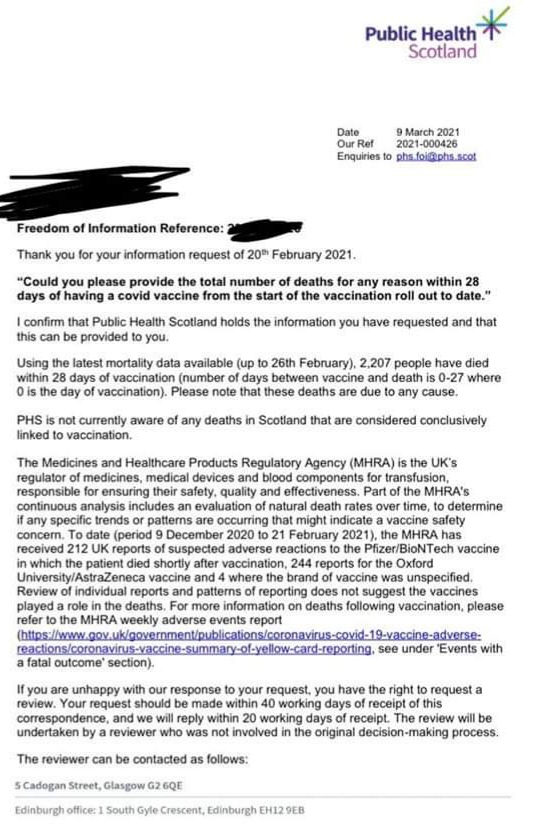
Someone calling themselves Mr. Page, sent a Freedom of Information (FOI) request to Public Health Scotland on February 20th. Mr. Page wanted to know how many people died within 28 days of receiving a covid vaccine.
Here’s the response from Public Health Scotland:
Thank you for your information request of 20th February 2021. (entitled)“Could you please provide the total number of deaths for any reason within 28 days of having a covid vaccine from the start of the vaccination roll out to date.”
I confirm that Public Health Scotland holds the information you have requested and that this can be provided to you.
Using the latest mortality data available (up to 26th February), 2,207 people have died within 28 days of vaccination (number of days between vaccine and death is 0-27 where0 is the day of vaccination).
Please note that these deaths are due to any cause.
PHS is not currently aware of any deaths in Scotland that are considered conclusively linked to vaccination.
Public Health Scotland says that up until February 26th, 2,207 people have died within 28 days of having a vaccine, but says they are not aware of any death “conclusively linked to vaccination.”
Public Health England (PHE) has had dozens of FOI requests from citizens asking the same question, that is, how many have died within 28 days of having a jab? PHE has yet to respond to any of the requests.
Last week, two Conservative MP’s asked Health Secretary Matt Hancock the same question. He nearly had a heart attack. He had no information to hand.
The AstraZeneca vaccine is killing people. There’s no doubt about that. The coverup has already started. Share this information with everyone you know who is considering having a jab.
UK Now Considering Digital Face Scanning to Enter Pubs
By Paul Joseph Watson | Summit News | March 29, 2021
The UK government is funding companies that are producing technology which will utilize digital face scans to check people’s vaccination status and allow or block them from entering pubs, stadiums and other venues.
“Britons could have their faces scanned to allow them to access pubs, gigs and sports events under one government-funded plan being drawn up for vaccine passports,” reports the London Times.
Two companies – Mvine and iProov – are working together on the system after being given a £75,000 grant by the government having already worked with the NHS on facial recognition technology in the form of the contact tracing app.
The technology is being proposed as a solution to concerns that presenting vaccination status via an app on a phone will be too slow when multiple people are entering a busy venue.
“Whoever is standing on the door of the pub is going to have to scan the certificate, read the name and date of birth, then ask the person for an ID document, check that the name and date of birth on the ID document are the same, squint at the photograph on the ID document and then make sure that the person in front of them is that person,” iProov CEO Andrew Bud said. “To which the answer is, that’s not going to happen.”
Bud said that the facial recognition system would reduce this process to a matter of seconds, streamlining the system.
“It speeds the process up and it absolves people of what would otherwise be a very heavy responsibility,” he added.
After months of promising that there would be no domestic vaccine passport, every indication is now that the government is going ahead with it.
Millions of Brits will refuse to submit to digital face scans to go about their everyday business, but the vast majority are likely to accept it without question, creating a two tier society where those who resist the biosecurity surveillance state will remain in a de facto permanent state of lockdown.
This again underscores the fact that the ‘vaccine passport’ is a digital identity card that citizens will be expected to carry at all times and use whenever they want to engage in basic commerce or other normal leisure activity.
Featured Video
HE SAVED LIVES. NOW HE FACES PRISON.
or go to
Aletho News Archives – Video-Images
From the Archives
NATO Sanctions and the Coming Global Diesel Fuel Disaster
By F. William Engdahl – New Eastern Outlook – 11.04.2022
Amid the ongoing global inflation crisis, NATO heads of state and mainstream media repeat a mantra that high energy prices are a direct result of Putin’s actions in Ukraine since end of February. The reality is that it is the western sanctions that are responsible. Those sanctions including cutting SWIFT interbank access for key Russian banks and some of the most severe sanctions ever imposed, are hardly having an impact on the military actions in Ukraine. What many overlook is the fact that they are increasingly impacting the economies of the West, especially the EU and USA. A closer look at the state of the global supply of diesel fuel is alarming. But Western sanctions planners at the US Treasury and the EU know fully well what they are doing. And it bodes ill for the world economy.
While most of us rarely think about diesel fuel as anything other than a pollutant, in fact it is essential to the entire world economy in a way few energy sources are. The director general of Fuels Europe, part of the European Petroleum Refiners Association, stated recently, “… there is a clear link between diesel and GDP, because almost everything that goes into and out of a factory goes using diesel.” … continue
Blog Roll
 Aletho News
- Trita Parsi: Middle East Unraveling — Are We on the Path to World War?
- Iran FM meets with US envoy on UN meeting’s sidelines at American side’s insistence: Report
- Qatar PM calls for Gulf security framework with Iran, says war must be ‘wake-up call’
- China condemns US extortion of Iranian airlines, rejects Washington’s ‘illegal’ sanctions threats
- Italy to move military personnel from Taif base after missile strike
- Finland’s Stubb tells European leaders to calm down
- Defeating Russia on battlefield impossible – Fico
- Finland’s Gender Clinic Reversal
- Massachusetts Wants Mental Health Visits, Why Does Government Use ‘Health’ to Enter Our Homes & Families?
- US lawmaker admits American people footing bill for Trump’s failed aggression against Iran
- If Americans Knew
- Sanctions are collective punishment: immoral and self-defeating
- Phosphorus Munitions Fired by Israel Burn Groves, Orchards in Southern Lebanon
- Israel Carries Out New Ceasefire Violations Across Gaza
- AI – Emphasis on the ‘I’: Israel Is Funding AI Chatbot Propaganda
- Israel Blocking Hundreds of Wheelchairs for Injured Children From Entering Gaza
- Israel Is Expanding and Upgrading Compounds for Palestinian Militias in Gaza
- The Palestinian-American Residents of This West Bank Town Are Wondering: Where Is Trump?
- Gaza desperately needs tents, wheelchairs, fuel… and everything else (Israel blocks it all) – Daily Update
- Israeli Attacks in Gaza Kill at Least Seven Palestinians Over Three Days, including Woman and Child
- Trump’s militarization of Washington DC as he pursues Israel’s war against Iran
- No Tricks Zone
- 2025 Nature Paper Claiming Worsening Global Drought Gets RETRACTED …Heavily Flawed
- New Study: ‘Global Drought Shows No Detectable Recent Acceleration Under Climate Warming’
- Economic Masterminds: German Socialists Suggest Taxing Productivity Gains Stemming From Using AI
- The South China Sea Has Not Been Cooperating With The Climate Change Narrative
- Energy Crisis: Germany Enters Heating Season With Historically Low Gas Reserve Fill Levels
- New Study: The Antarctic Ice Sheet Gained Mass From 2020-2024 Due To Staggering Snow And Ice Accumulation
- Study: Ocean Heating Rates From Thousands Of Years Ago ‘Dwarf’ Modern Ocean Heating Rates
- Climate Extremists Target, Attack Large-Scale Power Grid Infrastructure In Germany!
- New Study: Antarctic Ice Melt Has Contributed Less Than 1 Centimeter To Sea Level Rise In The Last 30 Years
- Fear Of Debate: Alarmist German Climate Scientist Calls On Mainstream Media To Discredit Skeptic Voices

