Iran’s seizes UK tanker in counter-escalation
By M. K. BHADRAKUMAR | Indian Punchline | July 21, 2019
The seizure of a British oil tanker by the Islamic Revolutionary Guards Corps on July 20 in the Strait of Hormuz has all the hallmarks of a retaliatory act in the downstream of the seizure of an Iranian tanker by the British Navy exactly two weeks ago on July 4 off Gibralter.
On July 16, Iran’s Supreme Leader Ali Khamenei had warned, “Iran will respond to the vicious Britain’s piracy. Iran’s response will come at the right time and the right place.” Four days alter, IRGC struck. An IRGC statement gave a detailed account of what happened. Footage of the incident has also been released — just as Britain did.
Iran is taunting Britain and making it look foolish. Britain is now left with no option but to negotiate. And the outcome of any negotiations can be easily foretold — Britain will have to unceremoniously set free the Iranian tanker.
Quite obviously, the seizure of the Iranian tanker by Britain was done in tandem with the hardliners in Washington and it is by now clear that the EU distanced itself from it. Britain’s dilemma now will be that all its ships in the Strait of Hormuz are in Iran’s crosshairs.
Yesterday’s incident was a calculated act by the IRGC, enacted right under the nose of a British warship, which was escorting the tanker. When the warship threatened to open fire, IRGC retorted that it would also retaliate with fire. Thereupon, an Iranian helicopter dropped masked men on the British tanker and took control of it. The intention is to make the Brits look impotent and stupid. (See the Press TV commentary The Royal Navy: From Piracy to Impotence.)
In a broader perspective, therefore, it appears that Iran may have underscored that its earlier threat must be taken very seriously — that if its oil exports ever got intercepted or blocked, then no one will be allowed to export oil via the Strait of Hormuz.
****
On July 17, Iran’s semi-official news agency Fars News had carried an interview with me (in Persian) on the seizure of the Iranian oil tanker by Britain and its likely consequences as well as the related issues of the Iran-EU cogitations over the mechanism known as INSTEX, which Brussels has put in place to circumvent US sanctions against Iran.
In the context of yesterday’s incident in the Straits of Hormuz, my interview with the Fars correspondent Mahdi Khodabakhsh may be of interest. The English translation of the interview follows:
‘Indian diplomat: British action against Iran on behalf of the United States.’
QUESTION: As you know, some days ago UK royal navy seized a Tanker containing Iranian crude oil off Gibraltar. UK claimed it was bound to Syria which is under sanctions. Do you think UK’s move was legal? What does the international law say about it?
ANSWER: As far as I can gather from media reports, the legality of the British action is highly questionable. Syria is not under any UN sanctions and under international law, there is no embargo on oil supplies to that country.
QUESTION: How do you see the development and what effect it can have on Iran relations with EU? (also considering recent JCPOA tensions)
ANSWER: This is an act of blatant provocation with a view to inciting an Iranian reaction that could in turn be used as an alibi for some other downstream action by the US. I cannot see how the EU can endorse the British action because the group has no such policy to enforce a naval blockade of Syria. At least, I have not seen any EU country endorsing the British action so far. There are also signs that UK is seeking some sort of a patch-up with Iran, while saving face, because the international opinion did not support the British action.
QUESTION: In your opinion would it be proper for Iran – in this tense situation – to react to the UK’s move and do something retaliatory? If No, why is that; and if Yes what could the response be?
ANSWER: I have no doubt that Iran views the British belligerence with utmost seriousness and there will be consequences. Having said that, in my opinion, it is only proper that Iran has refused to be provoked into any knee-jerk response but is taking its own time. There could be a range of responses that Iran could consider, but importantly, Iran should only give a measured response that does not provide excuses for the US for doing something reckless or aggressive. The US or the so-called B Team, to my mind, has most likely instigated the British action. This is a surcharged atmosphere and Iran has so far acted with restraint and dignity — and rationally.
QUESTION: As we know, Iran started taking a second step in reducing its obligations under JCPOA from yesterday due to Trump’s unilateral withdrawal from the deal and of course because Iran did not benefit from economic relief. So how do you think the EU and other remaining parties in JCPOA will react to these steps by Iran? Are they going to trigger the dispute mechanism and snap-back lifted UN sanctions?
ANSWER: The EU foreign ministers meeting in Brussels on Monday reportedly took the decision that the situation does not warrant any move to trigger the dispute mechanism or to demand snap-back sanctions.
QUESTION: Yesterday EU ministers held a meeting in Brussels with a focus on the Deal however many of the diplomats including French, Britain, German, Dutch, Finnish Foreign Ministers and even Mogherini called on Iran to stay committed unilaterally to the JCPOA but say nothing about US withdrawal. Do you think with this trend,the JCPOA will survive? Considering the European partners’ inaction against US sanctions on Iran and its unilateral withdrawal from the deal, despite the 14 month period Iran given to them for some efforts; do you think that the EU really wants the JCPOA? Are they sincere in what they say about the Iran deal? The UK, Britain and France tried to put together a mechanism to evade US sanctions for trading with Iran called INSTEX. However Tehran says it was not fruitful. How do you elaborate its effectiveness to benefit Iran from JCPOA economic relief? Is the US capable of sanctioning the whole INSTEX?
ANSWER: The EU is walking a fine line. It is unrealistic to expect the US’ European allies — make no mistake, there are still allies — to publicly condemn Washington even if they disagree fundamentally on the Trump administration’s decision to withdraw from the JCPOA. Clearly, the EU is keen that the JCPOA survives and there should be no doubt on that score. One can see that the EU is on the defensive, as it realises that the EU and the E3 have not been able to fulfil their obligations under the JCPOA. What they are trying to do, in my opinion, is to mitigate to some extent Iran’s losses. As of now, there is a visible shortfall. The issue is not about sincerity but about politics, which is the art of the possible.
The INSTEX has just become operational. The EU foreign policy chief Mogherini is on record that the mechanism is fleshing out some business proposals already. She also said that certain non-EU third parties have shown interest in the INSTEX. These are encouraging signs. To my mind, these are early days and it is difficult to pass final judgment. Mogherini claimed that the E3 are also discussing the feasibility of oil trade being included in the INSTEX mechanism.
As things stand, the US may see the INSTEX as contravening its sanctions and the ‘maximum pressure’ policy. But then, on the other hand, the US is also interested that the JCPOA survives (according to Mogherini.) Therefore, a pragmatic US attitude toward INSTEX cannot be ruled out, either. As I said earlier, this is an evolving situation.
Iran Confiscated British Oil Tanker According to International Law: Official
Al-Manar | July 20, 2019
The Guardian Council Spokesman Abbasali Kadkhodaei said that Iran’s measure to seize a trespassing British oil tanker was carried out according to the rule of reprisal in the international law.
“The rule of reprisal is a recognized concept in international law and it is used in the face of another country’s illegal measures. The correct action of Iran’s government to encounter illegal economic war and seizure of oil tankers is an example of this rule and it is carried out according to the international law,” Kadkhodaei tweeted on Saturday.
In a statement on Friday, the IRGC said that the vessel named “Stena Impero” had been captured “at the request of Hormozgan Ports and Maritime Organization when passing through the Strait of Hormuz, for failing to respect international maritime rules.” The oil tanker was transferred to the coast to undergo the required legal proceedings, the statement added.
An unnamed Iranian maritime official said the ship had breached international maritime regulations by passing through a prohibited maritime passage in the Strait, turning off its tracking signals and ignoring warnings issued by Iranian authorities. “The tanker had turned off its tracker and ignored several warnings by the IRGC before being impounded,” the source said.
On July 4, British Royal Marines in Gibraltar stormed the Iran-operated 300,000-tonne Grace 1 and detained it, accusing it of carrying oil to Syria in possible violation of the European Union’s sanctions on the Arab country. Iran condemned the move as “piracy” and summoned Britain’s ambassador in protest over it.
Britain says seizures of UK vessels by Iran are ‘unacceptable’
RT | July 19, 2019
UK Foreign Secretary Jeremy Hunt has warned Iran of consequences for seizing two vessels in the Gulf, one of which has now been released. London’s response will be “robust” but not military, he said.
“We will respond in a way that is considered but robust,” Hunt told journalists, adding that the UK hopes to resolve the crisis through diplomacy and “is not looking” at military options.
Hunt said that he has already discussed the incident with US Secretary of State Mike Pompeo and looks forward to talking to his Iranian counterpart, Mohammad Javad Zarif. Denouncing the seizures as “unacceptable,” Hunt argued that Tehran would be “the biggest loser” if “freedom of navigation is restricted.”
Hunt said that there are no British citizens among the crew members of either ship. He also added that the British ambassador in Tehran has already contacted the Iranian Foreign Ministry in an attempt to resolve the situation.
Earlier on Friday, the Islamic Revolutionary Guard Corps – Iran’s elite military force – said it has seized the British oil tanker Stena Impero in the Strait of Hormuz over failure to “respect the international maritime rules.” The vessel sailing to Saudi Arabia was seen changing its course and heading north towards the Iranian island of Qeshm, marine tracking data showed.
The company owning the vessel, Stena Bulk, said it lost contact with the ship and that it was approached by “unidentified” small vessels before changing course.
Later the same day, another tanker owned by a British company – Norbulk Shipping UK Ltd – the Liberian-flagged ship Mesdar – also suddenly changed its course to Saudi Arabia and sailed to the Iranian mainland. This time, Tehran has not officially confirmed its seizure.
The tanker was apparently released later in the day, with tracking data showing the vessel changing course and heading westward and away from Iran late on Friday. The Iranian private Tasnim news agency reported that the British-owned Mesdar was cleared to continue its course, after having received a warning from the authorities over safety and environmental issues.
Norbulk has confirmed that the ship has resumed its travel towards Saudi Arabia, adding that the crew was “safe and well.”
“Communication has been re-established with the vessel and Master confirmed that the armed guards have left and the vessel is free to continue the voyage. All crew are safe and well,” the company said in a statement.
Tehran and London have been locked in a bitter row ever since a super tanker Grace 1 carrying Iranian crude oil was seized by the British marines in the Strait of Gibraltar on suspicion of violating the EU sanctions against Syria.
Tehran denied these accusations while calling the Gibraltar’s justification of detention laughable. Iran also accused the UK of acting on behalf of the US.
Washington has long sought to pressure Tehran into concessions on its nuclear and missile programs while repeatedly vowing to bring its oil exports down to zero with sanctions. It has also recently sent a naval group led by the aircraft carrier USS Abraham Lincoln to rehearse a possible strike against Iran while calling to form a “coalition” ostensively to defend the freedom of navigation.
We all deserve an investigation into BBC Panorama’s propaganda
By Nasim Ahmed | MEMO | July 17, 2019
The British public were subjected to an hour of anti-Palestine propaganda by the BBC last week when it aired a Panorama programme on the “anti-Semitism” row within the Labour Party. The public service broadcaster appeared to be doing very little public service when it unleased what was, by any reasonable assessment, a media broadside taken straight from the disinformation rule book.
Received by the mainstream media as though it were the final say on the anti-Semitism row that has rocked the Labour Party since Jeremy Corbyn became leader in 2015, the public have been duped into submitting to the dominant narrative. The political party that was born out of a desire to fight inequality and headed now by a leader whose record of fighting for social justice and equality is second to none is, we are led to believe, institutionally anti-Semitic.
The main characters used to “prove” this thesis in Panorama dominate the who’s who of people in the anti-Palestine lobby groups in Britain. Such basic information was omitted because it did not serve the presenter’s agenda. By failing to disclose the clearly relevant affiliations of the individuals involved in the programme, including the fabricated claims of anti-Semitism by one of the so called whistle-blowers, the BBC has basically admitted that their connections to the Israeli Embassy in London and anti-Palestine lobby groups like BICOM and Labour Friends of Israel completely discredits the “evidence” put forward.
The BBC producers also ignored the fact that there are dozens of Jewish Labour members and Jewish groups that totally reject allegations of the kind made in the programme. None were interviewed by Panorama veteran John Ware, who is developing a track record of being anti-Palestine and very pro-Israel; hardly the neutral journalism that one would expect from the BBC. Nor did Ware point out that there are Jews among the Labour Party members suspended or expelled for alleged anti-Semitism.
It has been claimed that the programme had such disregard for the truth that it resorted to doctoring quotes in an attempt to drive its point home. It presented an email by Labour’s director of communications Seumas Milne, for example, which gave the impression that senior Labour officials were interfering in the party’s disciplinary process. The BBC version of Milne’s email was, “Something’s going wrong, and we’re muddling up political disputes with racism… I think going forward we need to review where and how we’re drawing the line.” The Labour Party has released the full email, which shows that Milne was responding to a request from a former Labour staff member for a view on a complaint. He was talking specifically about Jewish people being accused of anti-Semitism and the unedited text of his email is this: “Having identified the subject of the complaint as a ‘Jewish activist, the son of a Holocaust survivor’… if we’re more than very occasionally using disciplinary action against Jewish members for anti-Semitism, something’s going wrong and we’re muddling up political disputes with racism.” This gives a very different meaning to the one put out on Panorama.
One has to wonder if the BBC, like the members of the Jewish Labour Movement interviewed in the programme as “whistle-blowers”, thinks that Jews supportive of Labour and refuting allegations of anti-Semitism are “the wrong type of Jew”. Is it just a coincidence that members of the Jewish community ignored by the BBC are very critical of Israel and its brutal occupation of Palestine and those given a voice by the public broadcaster are strongly anti-Palestinian?
Perhaps the BBC’s most glaring omission and disservice to the viewing public was its abject failure to give any background to the “whistle-blowers” who also featured prominently in the 2017 Al Jazeera documentary on the pro-Israel lobby. The two hour documentary detailed how the Israeli Embassy provided covert assistance to supposedly independent groups within the Labour Party; how jobs at the embassy were being offered to groom young Labour activists; and how concerned the embassy was with removing not just Foreign Office Minister Sir Alan Duncan, but also Crispin Blunt MP, the chair of the Foreign Affairs Select Committee (both of whom are Conservative MPs), as well as Labour leader Corbyn.
Anti-Palestinian activists were captured on camera boasting about “taking down” British ministers; how easy it is to get most Conservative MPs to do the bidding of pro-Israel activists; and giving details of how they would write prepared questions for MPs to ask the Prime Minister in parliament. “If you do everything for them,” they explained, “it’s harder for them to say, ‘I don’t have the time, I won’t do it’.”
The four-part Al Jazeera documentary along with its US version marked a watershed moment in exposing the workings of the anti-Palestinian lobbies on both sides of the Atlantic. The Lobby – USA was made by Al Jazeera’s investigations unit, but ironically it was never broadcast by the Qatari channel, after a massive censorship push by the anti-Palestine lobby.
Unsurprisingly, despite their questionable activities being exposed on camera, anti-Palestinian groups cried foul by accusing Al Jazeera of anti-Semitism. Their complaint was investigated by Britain’s media regulator, Ofcom. In its lengthy ruling, Ofcom noted that the complaints received “raised a range of issues about the programme including that they were anti-Semitic and were not duly impartial.” Other complaints “considered that the programme was materially misleading.”
The latter allegation was dismissed by Ofcom without further investigation, following information received from Al Jazeera. With respect to the other complaints, it found that Al Jazeera was not in breach of the obligation to have “due impartiality”, and similarly rejected claims of anti-Semitism. A second attack on the programme was inevitable, and it seems that Panorama’s “shock and awe” tactic has provided such an opportunity, generating the kind of social panic required to silence legitimate opinions and dismiss counter-narratives as anti-Semitism and conspiracy theories.
The Jewish Chronicle was attuned to the public paralysis and did exactly that, launching into a full-on attack on Al Jazeera’s documentary by labelling anyone who defended Labour using facts uncovered in the programme as “conspiracy theorists” which, let’s admit it, is another way of saying that they are anti-Semitic. Panorama’s broadcast was timed perfectly for the community newspaper which, along with anti-Palestinian groups, has been waiting for the opportunity to discredit The Lobby. If the sort of revelations contained therein were made by anyone connected to Russia, or any other state for that matter, there would be calls for investigations into such open foreign interference in Britain’s democracy. It is significant that no such calls have ever been made in political circles for any investigations into Israel’s efforts — captured on camera, remember — to disrupt the British democratic process.
Why did John Ware and Panorama ignore the findings of the Al Jazeera documentary, especially given that it was vindicated by Ofcom? That’s a mystery. Viewers should have been told about the “whistle-blowers” and their backgrounds as well as their connections to the State of Israel and the anti-Palestine lobby. And that the allegations made against them by Al Jazeera were noted by the media regulator not to have been “made on the grounds that any of the particular individuals concerned were Jewish” and that “no claims were made relating to their faith”. Ofcom went on to say that it did not “consider that the [Al Jazeera] programme portrayed any negative stereotypes of Jewish people as controlling or seeking to control the media or governments.”
Ofcom concluded further: “Rather, it was our view that these individuals featured in the [Al Jazeera] programme in the context of its investigation into the alleged activities of a foreign state [the State of Israel acting through its UK Embassy] and their association with it.”
One is not a “conspiracy theorist” for citing evidence from a serious documentary vindicated by the media regulator to expose falsehoods in a BBC programme that one suspects would not survive the level of scrutiny placed on non-mainstream media organisations, including Al Jazeera. At the very least, the British public whose licence fees pay for the BBC — including up to 600,000 Labour Party members —have a right to know if the Corporation is indeed serving the public or simply peddling propaganda in the best interests of a foreign state rather than impartial journalism.
By Way of DecEpstein
By Gilad Atzmon | July 16, 2019
Yesterday, prosecutors revealed that Jeffrey Epstein kept a fake Saudi passport in his home’s safe along with diamonds and piles of cash. It also emerged last week that Epstein invested millions in a deal with former Israeli Prime Minister Ehud Barak. Barak acknowledged to the Daily Beast that he, like other world leaders, visited Epstein’s Island and that he was first introduced to Epstein by Shimon Peres, former Israeli prime minister and president.
Barak’s high-tech company financed by the arch sex trafficker is called Carbyne. The Israeli enterprise develops “call-handling and identification capabilities for emergency response services,” essentially it seeks total access to your phone, its GPS system and its camera. This shouldn’t take us by surprise. By now we know that Epstein was very excited by cameras.
In a world with functioning media, the Guardian, the New York Times, the Washington Post and every other Mainstream Media (MSM) outlet would compete mercilessly to dig out the dirt all the way from Epstein’s Island to Tel Aviv but, it seems our MSM is doing the opposite. It conceals the shame. It invests its energy into diverting attention from that which has become obvious to the wider public: Epstein wasn’t just a disgusting paedophile. It is likely that he was serving an intelligence agency and perhaps more than just one.
Four days ago one of the most courageous writers around, former CIA analyst Philip Giraldi, produced a detailed article dealing with the obvious question: was Epstein an Israeli spy? Giraldi ends his piece: “it will be very interesting to see just how far and how deep the investigation into Epstein and his activities goes. One can expect that efforts will be made to protect top politicians like Clinton and Trump and to avoid any examination of a possible Israeli role. That is the normal practice, witness the 9/11 Report and the Mueller investigation, both of which eschewed any inquiry into what Israel might have been up to. But this time, if it was indeed an Israeli operation, it might prove difficult to cover up the story since the pedophile aspect of it has unleashed considerable public anger from all across the political spectrum.”
I admire Giraldi and would like to think that he is correct here. In Britain, however, the Independent Inquiry into Child Sexual Abuse, pretty much collapsed when Lord Janner, became a centre of its focus. Lord Janner was a former chairman of the BOD, a Body that claims to represent British Jews. He was also the founder of the Holocaust Memorial Trust. Some people, so it seems, are either above the law or beyond scrutiny.
We may have to admit that in a world where the Labour Party is terrorised, in the open, by a foreign lobby, in a world where Penguin press stops publishing a book because it referred to the Rothschilds as an ‘influential Jewish family,’ in a world where the British national broadcaster is reduced into a Zionist propaganda unit, no one in proximity to power dares to look into the possibility that the intelligence agency of a close ally might have invested millions if not billions of dollars in the formation of a spectacular blackmail apparatus that abused underage children through sex trafficking.
If Epstein wasn’t a lone operator, it is time to ask what his senders had in mind when they formed such a sex trafficking operation. Did they think of the possible consequences if the network were exposed? Did Ehud Barak or Shimon Peres consider the possible implications of their association with a convicted sex offender? Did they care about the possible ramifications to world Jewry, or Israel’s reputation, or Israel’s political affairs and its relationships with the USA? Did they have a plan B? Or maybe you don’t need a plan B in a world where the political class is deeply compromised and the mainstream media as a whole does little but veil the truth.
UK govt unveils plan to teach school kids about ‘fake news’… What could go wrong?
RT | July 15, 2019
The British government is planning a new initiative which will aim to help schoolchildren distinguish real information from ‘fake news’ — in an eyebrow-raising move which could be described as a little bit Orwellian.
British Secretary of State for Education Damian Hinds unveiled the new plan, warning that teachers need to better prepare students for the risks posed by “fake news” online, the Independent reported.
From 2020, British kids in both primary and secondary schools will learn about “confirmation bias” and “online risks” as part of a compulsory section of the curriculum. As part of the plan, teachers will help children identify techniques used for “persuasion” and be told “when to seek support.” They will also learn about the reasons why someone might wish to “bend the truth” in the first place.
A concerned Hinds warned that the internet makes it easier for both state actors and individuals to “spread falsehoods.” One area in particular which the government is looking at is “misleading content” regarding vaccinations. Without “firm action,” the proliferation of allegedly misleading information online will “get a lot worse,” he said.
Hinds recalled that propagandists have sought to “manipulate the truth” since “ancient times.” Indeed, this is something any British government official should be well aware of, since it’s well-known that the British mainstream media — including the BBC and British newspapers — have historically been infiltrated by intelligence agents from MI5 and MI6. One could probably safely assume that such inconvenient information will be left off the agenda, however, with the British program more likely to focus on the evils of propaganda emanating from Britain’s geopolitical adversaries.
Aside from the obvious question of whether governments are best placed to create a curriculum on fake vs. real news, there’s also the added dilemma of whether teachers should be responsible for imparting wisdom on media manipulation to children, when so much of the task of deciphering the news these days comes down to pure opinion. What one teacher might regard as real, another might view as fake.
Presumably, for example, Hinds would regard an institution like the BBC as a “trusted” source — and yet many others of a different political persuasion would likely disagree. The initiative raises the question of who exactly should be allowed to set the standards of ‘truth’ and ‘trusted’ when it comes to media. This is usually only the role of government in dystopian novels.
It’s not the first time Western governments or government-linked initiatives have sought to ‘educate’ the public about fake news through arguably sketchy means. The CIA-linked NewsGuard app has managed to get itself automatically installed on Microsoft’s Edge mobile browser, warning users away from “unreliable” whistleblowing and alternative news sites and directing them firmly toward mainstream sources that don’t often question establishment narratives.
A cynic might suggest such that the British government’s latest plan amounts to a form of state indoctrination of children to support the ‘correct’ narratives to serve its agenda from an early age.
Also on rt.com:
No need to install: Microsoft has controversial fake news filter NewsGuard built into mobile browser
Why The BBC acts as a Propaganda Outlet for Israel– An Insider View
By Gilad Atzmom | July 14, 2019
The BBC’s Panorama channel ‘investigation’ into Labour’s ‘anti-Semitism’ was so blatantly one sided its broadcast as ‘news’ demanded an explanation. In an attempt to grasp why the British national broadcaster fails to fulfil its core mission to report the news in as unbiased a manner as possible, I interviewed a former senior editor for the BBC. The editor, a 35 year veteran of the BBC, reveals the culture that has steered the BBC into its present position as a Zionist mouthpiece.
In acting as a whistle blower, the former editor risks severe consequences. In Britain leading journalists have been locked behind bars and under threat of extradition for reporting information whose truthfulness has not even been challenged.
Sadly, this danger is heightened under the present toxic political atmosphere in Britain, as demonstrated by its purging of a major political party and its tolerance for abuse of its judicial system to deter and punish anyone who dares to question the Zionist narrative.
Q: When did the BBC become openly biased?
A: The BBC has always been biased towards Israel, and its bias has been well documented. The reasons for this bias have long been the subject of serious academic studies, the best known of which is Greg Philo’s and Mike Berry’s More Bad News from Israel. In fact, in 2006 an independent report commissioned by the BBC’s own governing body concluded that the BBC’s coverage of the Israeli-Palestinian conflict “does not consistently constitute a full and fair account of the conflict but rather, in important respects, presents an incomplete and in that sense misleading picture.”
Q: Who and what drove this cultural and political direction within the corporation?
A: There are a number of drivers behind this biased BBC culture. The most important is the fact that a small number of hardline Zionists occupy key positions at the top and middle levels of the corporation, as well as at the shop-floor level, by which I mean the people who select what to publish or broadcast on a daily basis and who provide editorial steer to journalists. This has been widely publicised and has been in the public domain for some time — see, for example, this http://tinyurl.com/ydhjzeek, these (a) http://tinyurl.com/y7mjtkc6, (b) http://tinyurl.com/y7k39vsh, and (c) http://tinyurl.com/y3x9nktl. Also see this http://tinyurl.com/y6ne4apn and this http://tinyurl.com/y7l88zwl.
Q: What about political impartiality, supposedly a core BBC value?
A: Unfortunately, there are many examples of such pro- Israel hype, some blatant and others who slant the news by use of emphasis and/or omission. For instance, there was Sarah Montague’s interview with Israel’s defence minister, Moshe Ya’alon, in March 2015, Head of Statistics’ Anthony Reuben’s reflection on fatalities in Gaza (http://tinyurl.com/ycc9p8d4), and the utilization of Gil Hoffman, an Israeli army reservist and chief political correspondent for the Jerusalem Post to write for the BBC News website (http://tinyurl.com/yanppk93) to mention but a few.
Q: Does the broadcaster have the means or inclination to fix itself ?
A: In my opinion, the chances of the BBC fixing itself is about zero. Apart from what I have said above, it is a cowardly, spineless organisation. Not only does it always pursue the path of least resistance by selecting to broadcast what is least likely to upset the Zionist lobby, but it is also deadly afraid of what the Daily Mail might say about its output. Very often, and by that I mean almost on a daily basis, one would hear senior managers ask at the morning agenda-setting editorial meetings, “What would the Daily Mail say about that?” Invariably, they would choose what is least likely to be picked up and criticised by the Daily Mail. Please remember, this is a public broadcaster that is funded by taxpayers (yes, the License Fee is a tax) and is supposed to “Educate, Inform and Entertain”, not propagandise on behalf of Israel.
Q: Some of the so-called Labour ‘Whistleblowers’ were exposed by Al Jazeera as Israeli Lobby assets. Is it possible that the BBC was so bold as to interview these characters hoping that no one would notice or was it simply a matter of a clumsy decision making? Can the BBC match the journalistic dedication of organisations such as RT or Al Jazeera?
A: There is no chance whatsoever that the BBC would do anything approximating Al Jazeera TV’s programme on Israeli infiltration of the Labour Party (http://tinyurl.com/yad6fslm). The BBC is institutionally pro-Zionist and institutionally spineless.
Q: You worked in the corporation for 35 years, did you notice a deterioration in the quality of people hired? Was there a change in employees’ attitudes and their willingness to express themselves freely and critically?
A: I worked for the BBC’s English-language outlets as an editor and senior editor for 35 years. Since the early 1990s there has been growing intolerance of criticism of editorial management decisions, even in internal forums which internal BBC propaganda claims are meant for staff to speak freely. This applies across the board on all matters. But certainly with regard to Israel and Zionism, any questioning of BBC impartiality would attract accusations of anti-Semitism and would certainly spell the end of one’s career, no matter how privately and confidentially such criticism is conveyed.
US, UK Intel Services Prepare Fakes About Putin’s Inner Circle Via Soros, Browder Entites – Source
Sputnik – July 13, 2019
According to a military diplomatic source, the defamation campaign repeats the Panamagate scenario in 2015 when Western media published dossiers about tax havens implicating various political leaders.
UK and US intelligence services are currently in an active phase of the anti-Russian campaign aiming to discredit individuals from the inner circle of the Russian president, as well as the leadership of the Defence Ministry.
“As part of the undisguised provocative actions, specialists from the American and British intelligence agencies fabricate fakes about the Russian leadership”, the source stated.
The source noted that aggressive actions could be seen in the information space, and provocations were no longer being concealed.
The fake information will wind up in the media controlled by foundations established by influential financiers such as George Soros and William Browder, according to the report. The source added the defamation campaign will also engage news agencies openly funded by US authorities, naming Radio Freedom and Current Time among others.
According to the report, the campaign follows the Panamagate template by disseminating biased information through non-commercial organisations affiliated with the State Department.
The source underlined that the fakes about the Russian leadership constitute direct interference in Russia’s internal affairs.
“As in the case with the Panama dossier, despite the absurdity of the accusations, the White House predictably uses fakes to justify sanctions. Such actions are direct interference in the internal affairs of the Russian Federation aimed to destabilise the country, weaken the economic potential of Russia and form the levers of political influence on its leadership”, the source added.
Millions of documents known collectively as the Panama Papers were leaked in 2016 from Panama-based law firm Mossack Fonseca. The leaked data exposed a large number of offshore operations and shell companies, and implicated multiple highly-placed individuals from across the world.
US pours oil into fire in Gulf, mum’s the word for India
By M. K. BHADRAKUMAR | Indian Punchline | July 12, 2019
The illegal seizure of an Iranian oil tanker off Gibralter by the British Navy last Friday is fast acquiring farcical character. Britain acted at the behest of the US; in turn, the US probably acted at the behest of the ‘B Team’. So far, only one top US official has expressed joy over the incident — National Security Advisor John Bolton, who is of course the member-secretary of the B Team. None of the other three members of the B Team — Israeli PM Benjamin Netanyahu or either of the two Gulf Crown Princes (bin Salman and bin Zayed)) has waded into the controversy.
The original intention behind the Anglo-American operation was clearly to provoke the Iranians into some retaliatory action. But Iran refused to be provoked and is biding its time. Had Iran acted impulsively or rashly, a military conflagration might have ensued, which would have provided just the alibi for a large-scale US military strike at Iranian targets. Even Article 5 of the NATO Charter on collective security might be invoked. The B Team has been angling for just such a window of opportunity. The US defence secretary’s last visit to Brussels was a mission to rally NATO support for a military strike against Iran.
Now, Iran is savvy enough to figure out the Anglo-American game plan. Tehran is indignant and has warned of consequences, but all in good time. Since Iran refused to be provoked, Britain made a false allegation that Tehran made an abortive attempt to “intimidate” a British oil tanker. Tehran, of course, furiously denied the allegation. Meanwhile, there is a parallel move by the US to assemble a ‘coalition of the willing’ ostensibly to protect oil tankers in the Strait of Hormuz, an Iranian waterway. Therein hangs a tale.
The false allegation by Britain has been promptly seized by the US Navy to press ahead with its master plan to establish military escorts for shipping in the Strait of Hormuz. General Mark Milley, who has been nominated to become chairman of the US Joint Chiefs of Staff, has been quoted as saying on July 11 during testimony before the Senate Armed Services Committee in Washington that the Pentagon is working to put together a coalition “in terms of providing military escort, naval escort to commercial shipping.” In his words, “I think that that will be developing over the next couple weeks.” Milley characterised the project as an assertion of a fundamental principle of “freedom of navigation”, a coinage Washington uses arbitrarily in its “Indo-Pacific” rule book.
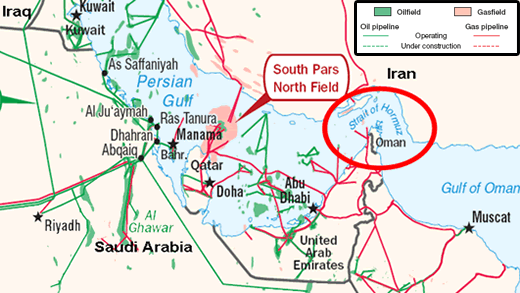
The Strait of Hormuz, located betweenIran and Oman connects the Persian Gulf with the Gulf of Oman and the Arabian Sea and is the world’s most important oil chokepoint.
It doesn’t need much ingenuity to figure out that the US intends to take control of the Strait of Hormuz — although the strait is Iranian-Omani waters under international law. As the narrowest point of the Strait of Hormuz is twenty-one nautical miles, all vessels passing through the Strait must traverse the territorial waters of Iran and Oman. The rights of passage for foreign vessels under international law will consequently be subject to either the rules of non-suspendable innocent passage or transit passage depending on the applicable legal regime.
The topic has come before the International Court of Justice. The ICJ confirmed the customary international law rule, used in international navigation, that foreign warships have the right of innocent passage in straits during peacetime, which means that during peacetime the coastal state could only prohibit the passage of any foreign-flagged vessel if its passage was non-innocent.
However, the grey area here (which the US wants to challenge) is that Iran has the legal right as a coastal state to prevent transit or non-suspendable innocent passage of ships if the ship that is in engaged in passage through the strait constitutes a threat or actual use of force against Iran’s sovereignty, territorial integrity, or political independence, or could be acting in any other manner in violation of the principles of international law embodied in the Charter of the United Nations.
In strategic terms, therefore, by precipitating the seizure of the Iranian oil tanker, the US and Britain are proceeding on a track to create a pretext to challenge Iran’s rights over the Strait of Hormuz and to take control of the strait. This is also contingency planning in advance insofar as under international law, if the US were to attack Iranian territory without a decision of the UN Security Council, the question would arise whether the provisions for transit passage under UNCLOS would continue to apply to the Strait of Hormuz or whether Iran could invoke the laws of war and take action against tankers, especially if they are deemed to be assisting the enemy.
Suffice to say, it is possible to see that what might have appeared as a maverick or silly act by Britain off Gibralter when it seized the Iranian tanker could actually be the tip of a calibrated project aimed at imposing effectively a naval blockade against Iran. Indeed, this forms the latest chapter in the US’‘maximum pressure’ policy against Iran.
By the way, a second leg of the current project is also to seize control of the strategic shipping lanes via the the Bab al-Mandab (off Yemen), which leads to the Suez Canal. (The narrow Bab al-Mandab connects the Red Sea with the Gulf of Aden and the Arabian Sea.)
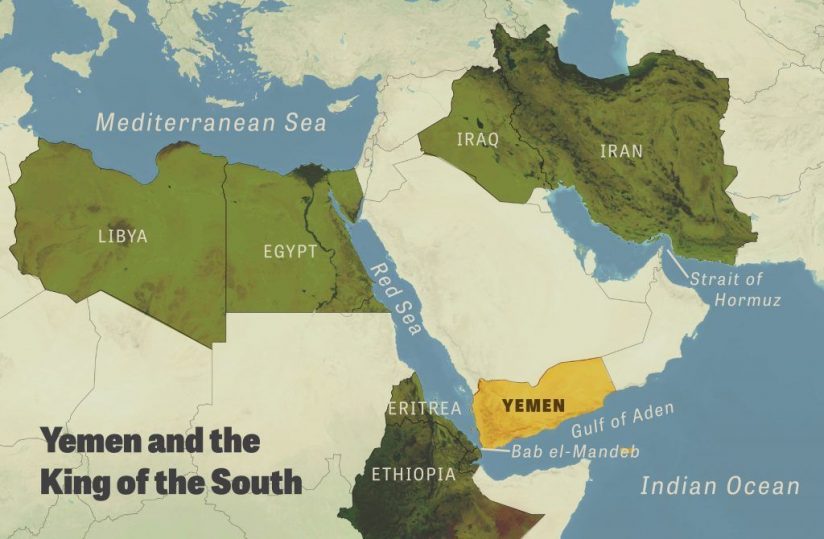
The chokepoint of Bab el-Mandab off Yemen connecting Indian Ocean to the Suez Canal via Red Sea
The US control of the Bab al-Mandab will mean that Iran’s use of the Suez Canal will come under intense US monitoring. The US has a military base in Djibouti facing the Bab al-Mandab. (Against this backdrop, the bitterly-fought war in Yemen falls into perspective, too.)
Of course, all this constitutes acts that are in gross violation of international law and the UN Charter and India should keep miles away from the Anglo-American project to impose naval blockade against Iran on whatever pretext.
Indeed, India will be called upon to take some tough decisions in the period ahead vis-a-vis the emergent situation in the Persian Gulf. First and foremost, India should stay clear of the US-led project to establish military escorts for ships in the Persian Gulf. There are reports that the Indian Navy has deployed two ships with helicopters in the Gulf of Oman. Presumably, this deployment will not form part of the US-led naval flotilla to intimidate and blockade Iran.
Second, there is a strong likelihood of the US invoking its privileges under the Logistics Exchange Memorandum of Agreement to gain access to Indian military facilities for the purpose of refuelling and replenishment of its ships. At the signing of the LEMOA in 2016, much criticism was expressed by Indian experts that it was a “strategic mistake”. In an impassioned plea, Bharat Karnad wrote in August 2016: “It (LEMOA) is, perhaps, the most serious strategic mistake made by the country in its nearly seven decades of independent existence.” Karnad’s criticism forewarning the serious consequences has turned out to be prescient. (here)
The LEMOA’s text remains secret. The Indian public doesn’t even know if India has an option to reject any US demarche for access to our military bases for their ships in a situation such as today’s when war clouds are gathering in our extended neighbourhood and Washington is stepping up preparations for a military operation against Iran, a friendly country with which India has had profound civilisational ties and common concerns in the contemporary regional setting.
The government will be betraying India’s medium and long-term national interests if it provides the US Navy with back-up facilities in its military bases at present under the LEMOA.
Third, most important, Delhi is maintaining deafening silence — for reasons best known to the policymakers — over the gathering storms in the Persian Gulf region. Damn it, over 7 million Indians live and work in that region. Even if one were to overlook that these Gulf-based NRIs give significant budgetary support to the Indian economy, running into billions of dollars annually through their remittances, the government owes it to its citizens to leave no stone unturned to ensure their physical safety and security. Tens of millions of their relatives in India depend on them critically for livelihood.
Shouldn’t the government say something to the effect that India opposes a war situation in the Persian Gulf and that the Trump administration should act with utmost restraint? If this is not a foreign policy issue of consequence for the Prime Minister to articulate, what else could be? Other countries such as Russia, China and the US’ close allies have spoken on the Persian Gulf crisis.
What explains the government’s cowardice? Fear of Trump? Are our elites far too compromised with the B Team? Faustian deal with Netanyahu (who is reportedly heading for Delhi to meet PM)? Or, plain Ostrich Approach of seeing no evil, hearing no evil or speaking no evil if it is about Uncle Sam? At any rate, what kind of impression of a regional power of India is it that the government is projecting? Shame on India!
London proudly hosts press freedom forum, defends right to spy on journos in Strasbourg the same day
RT | July 11, 2019
On Wednesday an international conference on press freedom was launched in London. Ironically on the same day Her Majesty’s government was defending its mass surveillance on communications, including those of journalists.
The Global Conference for Media Freedom, co-organized by the governments of the UK and Canada, was launched with much fanfare in the British capital, with some 1,000 representatives from around the world present. Some media professionals were barred from the grand event (namely this media, RT and another Russian outlet Sputnik to be precise), but of course it didn’t stop hosts from declaring appreciation of the role that a free press plays in a free society.
Halfway across Europe in Strasbourg on the same day lawyers representing the British government were defending its right to spy on electronic communication of people before the Grand Chamber of the European Court of Human Rights (ECHR).
The case was brought before the court by 16 organizations and individuals defending civil and journalistic liberties, including the Bureau of Investigative Journalism. They argued that mass snooping, first revealed by NSA whistleblower Edward Snowden, violated the right to privacy and the right to freedom of expression – the latter being fundamental for journalistic work.
“This may be the most important case with regard to the protection of journalistic communications and the protection of our sources to be heard in the past 20 years,” Rachel Oldroyd, managing editor of the Bureau said.
“As journalists we must be able to speak freely to our sources without fear of surveillance. The UK government’s system of mass collection and storage of all our communications is a severe threat to this cornerstone of our profession and a severe intrusion upon the freedom of the press.”
“It is ironic that on the very day the Bureau is making this case against the British government’s surveillance regime in the highest court in Europe, the same government is hosting a global summit on press freedom.”
In September 2018 the ECHR ruled that Britain didn’t have necessary safeguards in place to ensure that its mass surveillance complied with the European Convention on Human Rights after which the case was referred to the Grand Chamber. The hearing on Wednesday lasted almost three hours, but the date for delivering the judgement is yet to be announced.
Meanwhile the media freedom conference in London continued into its second day on Thursday with panels like ‘Taking a Stand: How We Defend Media Freedom’ and ‘Strengthening Media Freedom across the Commonwealth’ on the agenda. Do tell.
IRGC rejects US claim of Iran attempt to seize UK tanker in Persian Gulf
Press TV – July 11, 2019
Iran’s Islamic Revolution Guards Corps (IRGC) has dismissed a claim by US officials that its naval forces tried to stop a British tanker in the Persian Gulf.
Early on Thursday, two American officials, who were speaking to Reuters on the condition of anonymity, claimed that five boats believed to belong to the IRGC had approached the tanker British Heritage at the northern entrance of the Strait of Hormuz and ordered it to stop.
The Iranian boats dispersed, said one of the sources, after the UK’s Royal Navy frigate HMS Montrose, which had been escorting the tanker, “pointed its guns at the boats and warned them over radio.”
The other official also called the alleged incident an act of “harassment and an attempt to interfere with the passage.”
However, the IRGC rejected the US officials’ claim, stressing that Iranian boats were carrying out their normal duties.
“Patrols by the IRGC’s Navy vessels have been underway in the Persian Gulf based on current procedures and missions assigned to them with vigilance, precision and strength,” said the Public Relations Department of the IRGC Navy’s Fifth Naval Zone in a statement.
“In the past 24 hours, there has been no encounter with foreign ships, including British ones,” it added.
The statement further noted that the IRGC Navy’s fifth zone has the power to act “decisively and swiftly” and seize foreign vessels in the area it is tasked with patrolling if an order is issued to that effect.
Similarly, Britain claimed Thursday that three Iranian vessels had tried to block the passage of its tanker but backed off.
“HMS Montrose was forced to position herself between the Iranian vessels and British Heritage and issue verbal warnings to the Iranian vessels, which then turned away,” a British government representative said.
Zarif: Such claims have no value
Iran’s Foreign Minister Mohammad Javad Zarif also reacted to the allegations, saying they are merely meant to create tensions.
Those who make such claims attempt to “cover up their weak point,” he added. “Apparently the British tanker has passed. What they have said themselves and the claims that have been made are for creating tension and these claims have no value.”
The claims came two weeks after British marines illegally seized an Iranian oil tanker in the Strait of Gibraltar under the pretext that the vessel had been suspected of carrying crude to Syria in violation of EU sanctions against the Arab country.
Reports, however, said the seizure took place at the request of the US.
The Islamic Republic condemned the illegal seizure as “maritime piracy” and summoned the British ambassador on three occasions to convey its protest at the confiscation.
Featured Video

EUROPE FEARS RUSSIA’S NEXT MOVE / Ian Proud
or go to
Aletho News Archives – Video-Images
New Book
New Book: No Autoimmunity The Body Doesn’t Attack Itself
Lies are Unbekoming | September 24, 2026
 The label for Humira, once the best-selling drug in the world, lists its risks in plain print. One of them, in the label’s own words, is new “autoimmune” disease.
A drug prescribed for a condition labelled autoimmune carries a warning that it can cause a condition labelled autoimmune. That contradiction sits in every box, on a folded paper almost nobody reads.
My new book starts there.
No Autoimmunity: The Body Doesn’t Attack Itself
For seventy years, “your body is attacking itself, and we don’t know why” has ended the conversation for people diagnosed with multiple sclerosis, lupus, rheumatoid arthritis, Hashimoto’s, Type 1 diabetes, Crohn’s and psoriasis. More than eighty conditions now carry the autoimmune label. The diagnosis comes with a prescription for life. It almost never comes with a question about cause.
This book asks the question and answers it from the framework’s own records: its drug labels, its journals, its regulatory filings, and its own experiments. … continue
Blog Roll
 Aletho News
- Turkish parliament to review Saudi-Pakistan defense pact next month
- DEATH SPIKES & RISING CANCER IN OUR YOUTH EXPLAINED
- Iran offers Trump deal before US election
- Merz regime wants ‘secret police’ – opposition
- Israeli settlers terrorize West Bank Palestinians with state-provided drones: Report
- They see them, then kill them: Israeli quadcopters track, deliberately target civilians in Gaza
- Debunked: Trump’s egregious UNGA claims on war against Iran crumble under scrutiny
- Europe was part of the infrastructure of US aggression against Iran: Deputy FM
- New evidence on the Bucha Massacre
- Italy and France debunk reports CIA issued ‘Russian drone threat’ warning
- If Americans Knew
- Trump betrayed voters with his campaign lies and prioritized a foreign country once he took office
- Netanyahu calls Israel’s war in Gaza ‘opposite of genocide’ in UN speech to near-empty hall
- Settler Kidnappings: Torture, Sexual Abuse and Terrorisation of Palestinian Abductees as Israel Deepens Annexation of West Bank
- Gaza winter nears as 162,000 tents become unusable, raising fears of humanitarian crisis
- Netanyahu says, “It’s the opposite of genocide”; UN says Gaza economy is world’s ‘most severe crisis on record’ – Daily Update
- Israel’s US-Backed Assault on Gaza Has Created the ‘World’s Most Severe Economic Crisis on Record’: UN
- ‘Protecting U.S. Citizens’… From Israel
- ‘This is where I live now, the back of a truck’: a day in the life of a grandmother in Gaza
- In UN Speech, Iran’s President Displays Pictures of Children Killed by US, Brings Attention to Israel’s Nuclear Arsenal
- Israel displaces hundreds of Palestinians amid wave of demolitions in West Bank
- No Tricks Zone
- New Study: Earth And Venus Surface Warmth Largely Explained By Convection And Lapse Rate, Not CO2 Or Radiation
- 2025 Nature Paper Claiming Worsening Global Drought Gets RETRACTED …Heavily Flawed
- New Study: ‘Global Drought Shows No Detectable Recent Acceleration Under Climate Warming’
- Economic Masterminds: German Socialists Suggest Taxing Productivity Gains Stemming From Using AI
- The South China Sea Has Not Been Cooperating With The Climate Change Narrative
- Energy Crisis: Germany Enters Heating Season With Historically Low Gas Reserve Fill Levels
- New Study: The Antarctic Ice Sheet Gained Mass From 2020-2024 Due To Staggering Snow And Ice Accumulation
- Study: Ocean Heating Rates From Thousands Of Years Ago ‘Dwarf’ Modern Ocean Heating Rates
- Climate Extremists Target, Attack Large-Scale Power Grid Infrastructure In Germany!
- New Study: Antarctic Ice Melt Has Contributed Less Than 1 Centimeter To Sea Level Rise In The Last 30 Years

