UK to impose full ban Lebanon’s Hezbollah as terrorist group, Israel urges EU to follow move
Press TV – February 25, 2019
The British government is to impose a full ban on activities of the Lebanese Resistance Movement Hezbollah as London becomes increasingly irritated by the group’s political and military success in the Middle East.
UK Home Secretary (interior minister) Sajid Javid said on Monday that the government will designate the entire Hezbollah organization as a terrorist entity as of Friday subject to the approval of the parliament.
Javid, an extreme right-wing politician of the Pakistani origin, said the UK government was no longer able to maintain a distinction between Hezbollah’s political and military activities and thus will include the group’s political unit in its blacklist.
“Hezbollah is continuing in its attempts to destabilize the fragile situation in the Middle East – and we are no longer able to distinguish between their already banned military wing and the political party,” said Javid, adding, “Because of this, I have taken the decision to proscribe the group in its entirety,” he added in a statement.
Britain has become increasingly angered by Hezbollah’s role in an anti-militancy campaign in Syria, where London has for the past eight years supported terrorist groups opposed to the government of President Bashar al-Assad.
Hezbollah has played a major role in helping Assad purge the Syrian territory from terrorist groups. The intervention, once criticized inside Lebanon, has helped the resistance movement increase its political clout as the group now controls three ministries, a first on the history of the Lebanese government.
The Israeli regime swiftly welcomed Javid’s announcement with Israeli Security Minister Gilad Erdan saying in a tweet that the European Union, which unlike the United States has opposed designation of Hezbollah as terrorist entity, should follow suit.
There was no official reaction from Hezbollah although lawmakers representing the group in the Lebanese parliament said UK decision was a “violation of sovereignty”.
UK’s move to outlaw Hezbollah in its entirety would mean that anyone expressing support for the religiously-oriented organization could end up in UK jail for up to 10 year.
Italy to Strengthen Control Over Gold Reserves Amid Venezuela’s Problems With UK
Sputnik – 23.02.2019
Soon after the incident involving the Bank of England withholding Venezuelan gold reserves, an Italian lawmaker suggested clearly defining the state’s ownership over its gold reserves in a new law. His move was supported by Italian representative in the EU parliament Marco Zanni, whom Sputnik Italia has asked to comment on the proposed law.
Marco Zanni, an EU lawmaker from the Lega party, told Sputnik that the law, recently proposed by member of Italian Chamber of Deputies Claudio Borghi is aimed at defining the ownership status of gold reserves kept in the Bank of Italy. The latter currently holds 2,400 tonnes of the precious metal, which is roughly equals to 90-100 billion euros, in Italian reserves.
Zanni points out that Italy and its citizens must secure their ownership over reserves that are kept in de-facto private banks. The EU lawmaker also added that he had called for the European Central Bank to confirm that member states’ gold reserves are only stored in its system, and not owned by the ECB or any other bank.
The European parliamentarian stressed that no law defines the rights of an entity holding Italian gold reserves right now. Zanni indicated that most of the Italian precious metal is kept in the US and in the Bank of England. The Bank of Italy only annually receives a certificate from these banks, confirming that the gold remains intact. The lawmaker points out that Italy “doesn’t even have the capability of sending an inspection team” that could verify if the gold is indeed still there.
Zanni believes that such practices must be changed and the state must obtain direct control over its gold reserves, especially considering the recent problems that Venezuela encountered when trying to repatriate its gold reserves from the UK.
“We have Venezuela as an example, which requested to repatriate a small part of its gold reserves and is now facing difficulties because the state that holds them [the UK] is coming up with various pretexts to avoid returning that gold”, he said.
London has distanced itself from the Bank of England’s decision to refuse Venezuela’s request to repatriate its gold, noting that the bank is an independent body. Venezuelan President Nicolas Maduro expressed hope in an interview with the BBC that the UK is not robbing his country “of the gold that legally belongs to the central bank of Venezuela”.
The freezing of the Venezuelan gold took place amid US efforts to block Maduro’s access to the country’s foreign assets, including money and a foreign subsidiary of the Venezuelan state oil producer PDVSA — CITGO.
British Intel Tried to Make N Irish Gang ‘Shoot Up’ School, Documentary Claims
Sputnik – 23.02.2019
A new documentary, based on an interview with a self-confessed member of the Glennane Gang, gives some insights into allegations that British military intelligence was behind a shocking murder plot to cause the situation in Northern Ireland to “spiral out of control”.
In a documentary, Unquiet Graves: The Story of the Glennane Gang, John Weir, a former officer from the Royal Ulster Constabulary (RUC), alleges that British intelligence tried to persuade paramilitary group Ulster Volunteer Force (UVF) to attack a Catholic primary school at Belleeks in County Armagh.
Weir claimed that the UVF was urged to kill children and teachers in retaliation for the 1976 Kingsmill massacre, in which gunmen stopped a minibus carrying twelve workmen and shot them; only one person survived despite having been shot 18 times.
“The plan that was decided on was to shoot up a school in Belleeks”, he said, adding that the British intelligence plot was to make the situation in Northern Ireland “spiral out of control”.
The film, directed by Sean Murray and narrated by Oscar-nominated actor Stephen Rea, tells the story of the Glenanne Gang, a secret informal alliance of Ulster loyalists who conducted bombing attacks against Irish nationalists and Catholics in the 1970s frequently working in collusion with RUC officers and Ulster Defence Regiment soldiers.
Murray said that conversations with Weir, a self-confessed member of the Glennane Gang, suggest that the intelligence plan was to foment a “civil war”:
“From their vision such a war would be quite short; they thought they could have a quick, short and sharp process of cleansing out the IRA”.
The UVF refused to carry out the attack, Weir said.
“A lot of this local people will be well aware of but internationally I think it is going to be dumbfound audiences. Collusion has left a dark and terrible stain on the North of Ireland, the pain that’s been caused to thousands of people here is incredible. If there is ever going to be a healing process on this island, if we’re ever going to move forward in reconciliation, people need to be able to tell their stories, but more importantly we need truth from the state about their role in the conflict”, Murray said.
Unquiet Graves will be shown in independent cinemas in Ireland and will be broadcast by RTÉ in May; it will also be shown in the United States, Canada, Europe, and Australia. The documentary will also be available on iTunes, Google Play and Amazon Prime, Murray said.
Jussie Smollett and Jewish Hoaxes
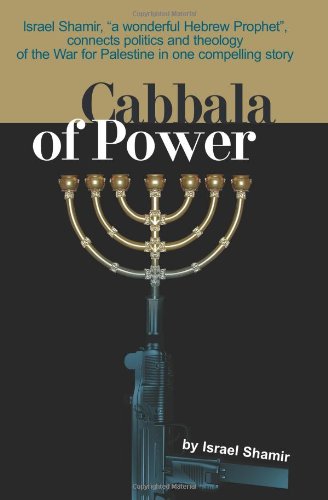
By Israel Shamir • Unz Review • February 22, 2019
The Jussie Smollett hoax and its debunking may yet change the trend of baseless accusations. God knows, the hoaxers went too far, and it’s high time for correction. The concise list of hoaxes would be too long for this essay, but here is a small list of very recent ones. They were met by public outrage and media indignation, for very little reason, and now we may expect a downward market correction, due to overpriced stock.
Some unlikely persons already attempt to capitalise on the expected reaction in order to channel it to the preferred direction – in a very unlikely medium. Mr Noah Rothman, an editor of Commentary magazine, condemned in The New York Times the imprudent haste of media falling for the hoax. Come on, really! The NY Times is a leading propagator of similar hoaxes. Whenever there is a story of a suffering diversity person, The New York Times usually takes it and plays it to its full extent. And when the hoax is revealed, usually the newspaper mentions it on page 46, at the bottom. So why is this night different, as the Jews ask on Passover night?
Mr Rothman is all against hoaxes by coloured and gay persons, that’s why. He mentions a few of them and adds his complaint: “There have been no similar national paroxysms amid a sharp uptick in violence targeting New York City’s Jewish population… The real tragedy … that hate crimes are, in fact, on the rise in the Trump era, particularly against Jews”. He does not mind hoaxes, he minds blacks arousing paroxysms of anguish at the expense of the Jews. The Americans and Europeans should feel sorry for Jews and anger for their adversaries, and every cry and tear for a black is a waste of a good cry and tear.
Among hoaxes he mentions, there is not a single one by a Jew, yet Jews are the leading perpetrators of hoaxes. Michael Kader of Ashkelon, Israel with over two thousand hoaxes to his account claiming attacks on Jewish community centres and synagogues is the shining example, but there are plenty of them. A Jewish woman had made a hoax bomb threat to a synagogue. A Jewish man spray-painted swastikas on his own house.
For Rothman, Jews are always innocent victims, as opposed to uppity blacks, who are guilty. This bias is a hallmark of Commentary Magazine, flagship of the Neocons, and the Neocon movement was established with a highly prejudiced attitude towards the blacks. Their open anti-black racism has been their entry card into white society.
The very word ‘racism’ has been grossly devalued, like the word ‘rape’. Nowadays having mutually consensual sex amounts to rape in case of buyers’ remorse, like in the case of Julian Assange, while standing still in front of a Native American drummer is defined as ‘racism’ (BTW, Nick Sandmann, the Covington Catholic student, is suing the perpetrator of this hoax, the Washington Post ). When everything is ‘racism’, nothing is. However, racism (and rape) could be a real thing. The most racist anti-black rant you can find on an American internet site is not on a KKK nor a Stormfront nor a Hollywood Nazi page, but on the Commentary site. It was written by Norman Podhoretz, its editor-in-chief, and published in 1963, that is, 55 years ago.
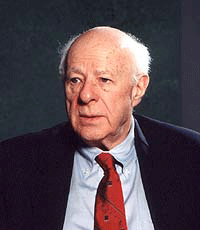
Norman Podhoretz
In the article My Negro Problem—And Ours the founder of the Neocon movement admits of “hating the Negroes with all my heart”. He tells of his mother who “in Yiddish cursed the goyim and the Schwartzes, the Schwartzes and the goyim.” All American whites are sick in their feelings about Negroes, he asserts. He admits that he “grew up fearing and envying and hating Negroes” and this feeling hasn’t gone. “Now do I fear them and envy them and hate them still? The answer is yes, but not in the same proportions and certainly not in the same way… I know it from the disgusting prurience that can stir in me at the sight of a mixed couple; If I were to be asked today whether I would like a daughter of mine ’to marry one,’ I would have to answer: ’No, I wouldn’t like it at all. I would rail and rave and rant and tear my hair.’”
Disgusting prurience – neither more, nor less! David Duke’s views are moderate compared to Norman Podhoretz’s, but Duke is ostracized while Podhoretz was a leading light of his generation. Podhoretz nursed a special hatred of Black Muslims, while Duke was friendly with them. Despite his admitted hate of the blacks, Podhoretz felt “the insane rage … at the thought of Negro anti-Semitism”. It is fine for him to hate them, but if they hate him, it is a reason for ‘insane rage’.
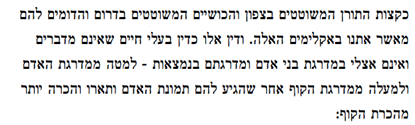
Podhoretz’s views, obnoxious as they were, derive from the traditional Jewish view as stated by Maimonides (Guide for the Perplexed, 3:51), namely “the Blacks are like dumb animals; they are not fully human; they are positioned below humans, but they are above monkeys for their appearance is like human and their mind is better than that of monkeys”.
With such views, you understand why some Jewish scribes like Mr Rothman hate Black hoaxes – and here they find an echo chamber within some White groups. They just do not mention Jewish hoaxes.
However, black and gay hoaxes are annoying, that’s all. Jewish hoaxes are very dangerous and expensive. Michael Kader’s hoaxes cost the American taxpayer a great deal, for his bomb threats were translated into hundreds of millions of dollars of grants for Jewish NGOs. These funds were given by the Department of Homeland Security (DHS) “because the Jews are the most commonly targeted religious group in the United States.” Now we know that the Jews were targeted by their coreligionist from Ashkelon, but the funds have not been returned, with apologies. There are no statistics for the total Jewish share in the DHS’s $50 billion annual budget, but my guess it is a large one.
Presenting a frivolous remark of the freshman senator Ilhan Omar as an “antisemitic attack” is another kind of Jewish hoax, or “The Growing Anti-Semitism Scam”, in words of our colleague Philip Giraldi.
 Similar scams were practiced this week in England and France with powerful results. In England, seven (now eight) Jewish and Judeophile MPs have stormed out of the Labour Party claiming Labour has been ‘infected’ with ‘anti-Jewish racism’. Since Jeremy Corbyn was elected to lead the party, it became the most numerous one in Western Europe. It became popular because it regained its ties with the British worker. And immediately its philosemitic Blairite wing began to campaign against the new leader.
Their campaign is based on the Jewish hoax of Corbyn’s alleged antisemitism and racism. This hoax is as baseless as that of Jussie Smollett’s but far more dangerous. You can watch the Al Jazeera film The Lobby Part 3 and see how an encounter between an elderly lady pro-Palestinian Labour-supporter and the head of Labour Friends of Israel was misrepresented as an “antisemitic onslaught”. Actually, Smollett is a rather innocent bloke; he bayed for sympathy, while Joan Ryan, an MP and the chair of Labour Friends of Israel has collected over million dollars from Israel Embassy’s slush fund.
The scammers want to sabotage the British people’s desire to throw off the shackles of Brussels. Their “Independent [from Brits, not from Israel] Group” is against Brexit, for NATO, for nuclear weapons, for wars overseas, for neoliberalism, and that is quite aside from the Jewish and Israeli issues. They are being joined by a few ex-Tories of similar persuasion. (My British friend heartily approved of this step, for “all the rotten apples should be in one basket”).
A Labour MP said it was “possible” that Israel is a financial backer of the breakaway Independent Group of MPs, but almost immediately recanted and apologised for the suggestion.
Many reviews of the British Labour split explain it by Corbyn’s pro-Palestinian views. Corbyn and his allies also prefer this explanation.
Another, more plausible explanation crosses the bounds of the permissible in civilised society. What the heck, let us cross it.
The British Jews overwhelmingly vote for Tories; the Jews are for Remain in the EU; Jews are for banks and international institutions. Corbyn’s Labour stands for its direct opposite. These are words of Jeremy Corbyn just before his election: They, the world’s bankers, International Monetary Fund, European Union, they are utterly united in what they want. Utterly united in deflation, suppressing the economy, and creating unemployment. The word “Jew” or “Israel” wasn’t mentioned even once, but British and American Jews think that ‘bankers’, ‘IMF’ and ‘EU’ are them. They are what they are, in the words of Speaker Nancy Pelosi.
The State of Israel is important for them, perhaps the Bible, Talmud and talith are precious, but only on Saturdays. While their identification with banks, globalism, neoliberal practice is their daily routine. Marx advised to pay attention to the Weekday Jew, rather than to the Saturday Jew. This advice is still valid.
Corbyn has no problem with Jews qua Jews; everybody in the Socialist movement is used to Jews. He is against Israeli anti-Palestinian policies, and there are Jews of such views, too (though we take a lot of beating). But being against Israeli policies AND against bankers, IMF and EU means threatening the Weekday Jew’s bread and butter.
Thirty years ago, in the formative years of Jeremy Corbyn, Jews were more to the left, and then such a policy had been possible. But now the Jews have moved to the right, or to the moneyed centre for bankers, and they would have a problem with Corbyn even if he were studying Talmud daily.
The struggle of the Seven against ‘antisemitism’ has nothing to do with their alleged anti-racism. Angela Smith, a UK MP who quit the Labour Party over alleged racism, next day was caught on live TV appearing to refer to people from black, Asian and minority ethnic backgrounds as having a “funny tinge”.
Our colleague and friend Jonathan Cook of Nazareth noticed that the departing MPs are united not only by their uncritical attitude to Israel, but also by “their enthusiasm for foreign wars, for the enrichment of a narrow neo-liberal elite; [they] are ambivalent about austerity policies, and are reticent at returning key utilities to public ownership”. In other words, they are for neo-liberalism, and complaints of antisemitism serve as a cover for it.
You can read my piece Love Labours Lost explaining this rightwards shift of Jews and dismay of British Labour at the loss of erstwhile allies.
In France, the Jews greatly improved on Smollett. A French Jewish scribe Alain Finkielkraut (let us call him f-Kraut for short) had been insulted by a kuffiyeh-wearing Palestinian who marched with other brave Gilets Jaunes along a Parisian street. It was a minor event; the scribe was not beaten or roughly handled in any way; he was called ‘a dirty Zionist’, not a big deal. He is a Zionist, no doubt. Other people in the street even invited f-Kraut to join them. Pretty much a non-event. If I was writing about every occasion I was called an ‘enemy of Israel’ or ‘enemy of the Jewish people’, I’d write of nothing else for lack of time. But the reaction in France was like a million Smolletts.
“A few insults directed against a certain essayist called “philosopher” by the media are infinitely more serious than the loss of an eye by a young student in philosophy of twenty years who had done absolutely nothing wrong” – acerbically commented our friend Jean Bricmont (a partner and co-author of the columnist Diana Johnstone).
Indeed, the same day Macron’s henchmen knocked out an eye of a young Gilet Jaune; they had left another one lacking an arm; thousands were attacked by gas in what was perhaps the biggest gas assault in Europe since Ypres. But the MSM took up the case of Finkielkraut and made a Kristallnacht out of it. They claimed f-Kraut was called a “dirty Jew” and that he was almost lynched, but saved by police. (Both claims are not true; though there were cases of journalists being roughed up at the demos, and calling someone a Jew is not an offence at all, but in this case it didn’t even happen).
While doing a full Smollett, the media and President Macron went after the Gilets Jaunes, describing them as antisemites and Nazis. Thus a non-event was turned into a huge affaire; and the first real popular movement in France since 1968 was besmirched. On the same occasion, Macron explicitly equalled anti-Zionism with antisemitism and made it a criminal offence.
In addition, some unknown Smolletts painted swastikas on the Jewish cemetery, as is their wont whenever Jews wish to show they are being persecuted. I have little doubt these swastikas are painted by persons hired by this or that Jewish organisation, or by Macron’s men who wanted to amplify the f-kraut non-event.
Tens of thousands of gullible French attended a rally for f-Kraut and against antisemitism. “The fawning eagerness of the political class rushing to demonstrate against something that hardly exists”, – noted a French writer. The French political class paid no attention when a church was desecrated. But for a Jew whom somebody dissed on a street – they all marched. Media published denunciations of Yellow Vests, and Macron made a lot of political capital out of it. In purely political terms, the fallout of the f-Kraut affair could be compared to Trump’s impeachment in the wake of the Smollett shenanigans.
Mind you, this f-kraut deserved to be insulted all right. He is a French Norman (“I hate Niggers!”) Podhoretz. He spoke of “Black hatred for France”, said that “Gaza has too many children, and they have no place in the world”; ridiculed Black football players of France for being black; he is an enemy of Palestinians and of Muslims, and he does not care much for the French people either. He is known for his claim “What is good for the Jews is good for France”, for his call for segregation between Jews and Palestinians. It is amazing that a Jew with such views is considered to be “on the left”, and he is invited to TV and newspaper interviews, though he is more racist than French nationalists like Le Pen or Soral. He also wrote a nasty piece against the Gilets Jaunes, but the GJs have insulted him far less than he deserves.
In England and in France, as well as in the US, the Jews became a symbol of the present neo-liberal regime, as the scams and hoaxes make it apparent. This is more important for people here than the issue of Palestine, and unavoidable reaction to neo-liberalism will cause collapse of this Jewish role and incidentally will bring equality of Jew and Gentile to Israel/Palestine.
 Israel Shamir can be reached at adam@israelshamir.net
The End of Truth as We Know It – Or Knew It
By Jeremy Salt | American Herald Tribune | February 21, 2019
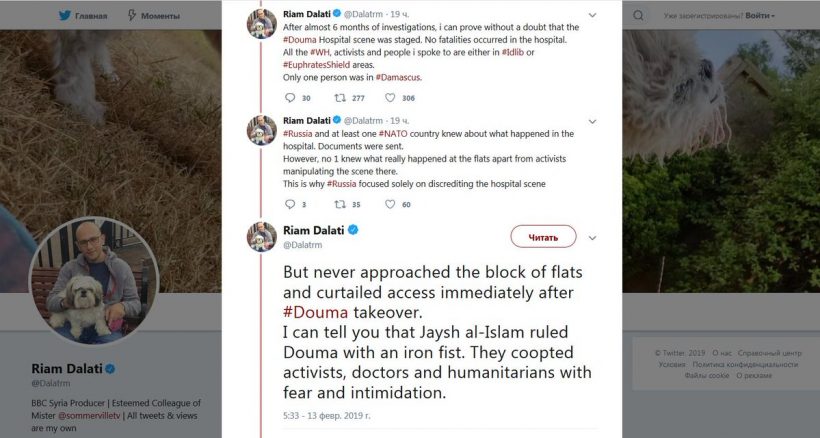
The claim (or admission) by the BBC journalist Riam Dalati that the alleged sarin attack on Douma in April 2018, was staged was received by the Russian embassy in London with glee. “Remarkable that the British MSM chose to ignore it’, whoever it was at the embassy wrote. ‘No breaking news, no articles, nothing.’
Remarkable? Not at all, given the endless track record of the media in ignoring news that does not suit its agenda. The real interest lies in the fact that an insider has owned up. His personal opinion only, according to the BBC, which along with the rest of the media, had taken the initial version of the alleged attack for granted, thus setting Syria up for the cruise missile strike by the US, Britain, and France which soon followed.
‘I can prove without a doubt that the Douma hospital scene was staged,’ Dalati wrote. Well, enough of the evidence has already been produced to prove that. As for the sarin, in July 2018, the OPCW (Organization for the Prevention of Chemical Weapons) put out an interim report indicating that whatever was used at Douma was not sarin, but most probably chlorine.
The next question is ‘used by whom?’ Again the evidence suggests that the yellow gas cylinders shown in the media propaganda blitz were not dropped from an aircraft but planted at the scene by the ‘activists’ who faked the whole episode.
The OPCW now seems to be reaching the point where it will release its full report. What it might contain opens the doors to endless speculation. It has already indicated that it found traces of chlorine and it may point an accusing finger at ‘the regime’ but without having the proof that it did it.
So expect something ultimately inconclusive, i.e. there is evidence of chlorine having been used, the Syrian regime might have used it but we really can’t say, leaving enough room for western governments to argue that they were right to bomb on the basis of the facts that were known at the time and for E. Higgins and company to argue that their version has not been disproved.
With Idlib, the last redoubt of the takfiris in Syria, now the focal point of political maneuvers and possibly military action, any credibility given by the OPCW to the accusations against the Syrian military might encourage the takfiris to try again, most likely in Idlib province, the location of the alleged chemical weapons attack in Khan Shaikhun in April, 2017. Without having the proof, the US launched a missile strike against a Syrian air base by way of retaliation.
Another faked attack would give the US and its law-breaking friends the pretext needed to disrupt or forestall any Syrian military campaign to drive the takfiris out of Idlib, which, far from having quietened down following the ‘de-escalation’ agreement reached by Turkey, Iran and Russia, is now an even hotter hothouse of takfiri activity.
The main group, Hayat Tahrir al Sham (HTS) basically still Jabhat al Nusra/Al Qaida in Syria despite the name change, and its allies have routed their ‘moderate’ enemies and taken control of between 70 to 90 per cent of the province, including Idlib city, which lives under a harsh form of sharia law.
The HTS collective has tens of thousands of armed fighters on call. So does the rival Turkish-supported National Liberation Front. The entire province is awash with arms and armed groups refusing to adhere to any agreements drawn up in Astana or Sochi and saying they will fight to the last.
Along with the fighting men are the civilians, the families of the takfiris and the normal civilian population of the province who are helpless in the face of the violence and intimidation all around them and the scheming of powerful actors far from the scene.
At present nothing is clear. The US is apparently planning to withdraw troops from northern Syria but has not withdrawn them. Erdogan and Putin have met to discuss what the US is up to, as well as the situation in Idlib and Turkey’s desire to set up a buffer zone running 460 kms and 32 kms deep along the Syrian border (on the Syrian side). Russia and Iran have so far refused to support the idea.
The buffer zone would be set up against the Kurdish People’s Protection Units (YPG), aligned with Turkey’s Kurdistan Workers’ Party (PKK) and ‘terrorists’ in the view of the Turkish government but not in the eyes of the US, which, of course, has been using the Kurds in pursuit of its own strategic interests
Turkey has recently been committing itself to the territorial and political integrity of Syria, raising an obvious question: if this is the case, why did you make such strenuous attempts to destroy both over the past eight years?
The US is on the brink of defeat in Syria. Not just defeat but defeat by Russia, which is why Trump’s plan to withdraw is facing furious criticism at home by neocons who want more war, somewhere, anywhere, and ‘liberals’ who hate Trump and will buy into almost anything that brings him down. In their views on Syria, Iran, Hizbullah, Hamas and now Venezuela the two groups are indistinguishable, even if they also affect to hate each other.
Idlib will be liberated sooner or later. If the takfiris are insisting that they will fight to the last drop of their blood that is because they have nowhere else to go. The foreigners among them can’t go back to their own countries. Turkey does not want them on its side of the border although, as the Syrian Kurds claim, it might allow them to move into Afrin, occupied by the Turkish army in March 2018. As fighters or police, they would have their uses. What happens to them when Afrin is finally returned to the hands of the Syrian state is an issue for the future.
But back to Douma. Was the district being bombed at the time a chemical weapons attack was alleged? Of course, it was. It had been taken over by one of the most murderous takfiri groups in Syria, Jaysh al Islam, and the army was shelling Douma to drive them out. What government and what army would not be constitutionally bound to do the same?
Douma was not under siege by the Syrian army, as the corporate media kept telling the world. It was being held hostage by a murderous armed group, for which the presence of civilians, deterring the army from a full-on ground military assault, was a prized asset. Civilians died in the shelling but the most likely cause of the breathing difficulties suffered by those given genuine medical treatment was smoke and dust inhalation. Jaysh al Islam and the White Helmets converted their distress into a chemical weapons attack and then ran around a clinic spraying water over everyone to prove the point.
The arguments will continue over the provenance of the yellow cylinders that gave Eliot Higgins something else to do. These were normal industrial gas cylinders that had been filled with chlorine which could only be released if someone opened the valve with a monkey wrench or if the valve had opened on impact. That a Syrian military helicopter would drop these cylinders in the hope that somehow the valve would open or break on landing is surely nonsensical.

The valves were intact so how the chlorine could have got out of the cylinders without someone manually opening them remains unexplained by those making the claim that the cylinders were dropped from a helicopter. There was no evidence of anyone in the house where the cylinders were found having been affected and as someone has observed, even the chickens running around nearby were unharmed. In short, the whole scenario screams one word: fake.
One thing not to be forgotten is that when the takfiris finally were pushed out of Douma, a makeshift chemical weapons factory, complete with how-to-make instructions and receipts for the machinery and chemical compounds received, was found underground in an elaborate network of tunnels.
Neither the factory nor the tunnels, nor the brutal nature of the takfiris holding Douma, or their previous crimes, including their previous alleged use of chemical weapons were items for show or discussion in the media.
Neither was the story one of armed fanatics taking over a district close to a national capital and holding its citizens hostage. Neither was the story one of foreign governments and the armed groups they were supporting besieging an entire country. The facts were reversed so that it was the Syrian government and army laying siege to its own people and killing them with chemical weapons.
Over the past eight years, the propaganda onslaught by these governments and the corporate media has been total. No authoritarian state or dictatorship could have done a better hatchet job on public opinion but these arch manipulators of public opinion are self-described liberals.
Therein lies their advantage. The citizens of an authoritarian state don’t believe their government or their media in the first place but western media consumers still cling to the illusion of a free press guarding their interests and are thus sucked in all the time. ‘Free for whom?’ and ‘Whose interests is the media really guarding?’ are questions that are rarely asked except by seekers after truth pushed to the margins of public debate.
The worst excesses of the takfiris – Islamic State beheadings, the throwing of people off the roofs of high buildings, the drowning of caged captives in a swimming pool and the burning of a Syrian soldier – had to be reported because they were indescribably inhuman and could not be ignored but the mundane terrorism of groups just a cut below the Islamic State in barbarity was either underplayed, ignored or blamed where possible on the Syrian military.
In the eyes of the media these groups were not terrorists but rather the ‘opposition’ or ‘rebels’ standing up to the ‘regime,’ its barrel bombs and its chemical weapons attacks, all of them, the best evidence suggests, launched by the takfiris with the intent of incriminating the Syrian government and bringing on a US-led air war.
Roughly about the same time as Riam Dalati was uttering his truth on his tweet, a Berlin-based outfit calling itself the ‘Global Public Policy Institute’ was putting out a report on chemical weapon use in Syria entitled ‘Nowhere to Hide: The Logic of Chemical Weapons Use in Syria.’
This ‘institute’ counted the number of such attacks in Syria, 336, of which number it attributed 98 percent to the ‘Assad regime’ and the rest to the Islamic State. The fact that it uses the word ‘regime’ to describe the legitimate government of Syria is the first tell-tale sign of where this report is going to lead.
The next is the sources of information, ‘our friends and partners,’ as the GPPI calls them: the Syrian Archive, the Syrian American Medical Society (SAMS) Mayday Rescue, the White Helmets, the Syrian Network of Human Rights, the VDC (Violations Documentation Centre) and Human Rights Watch, every single one of them fully engaged in propaganda attacks on the Syrian government if not actually embedded (like the White Helmets) with the takfiri groups.
The 47 pages of this report are beautifully laid out. The graphics and maps are meticulously done. As a school project, the GPPI would get 10 marks for presentation but nothing for content. On the basis of ‘evidence’ coming from such tainted sources, what makes the authors think that any reasonably well-informed person could believe their claims, and how is it that well-established German charitable foundations can hand over money for the production of such garbage?
The Syrian crisis has spawned an industry of parasites, feeding off its agony. There is no shortage of money for anyone smart enough to harvest it by giving the media what it wants and setting themselves up as a conduit for government propaganda. There is a market for lies and deceit and the laws of supply and demand being what they are, the demand is being met.
There is a truth here about the media that needs to be said. It was never truly independent, never the watchdog of the people’s interests in all seasons but it was arguably a lot better than what it has become. The explanation for this state of affairs lies partly in the death of the independent proprietor and the monopoly corporatization of the media. The proprietor’s or the board’s interest is now immeasurably greater than those of the independent owner who used to wander around the editorial floor once a week to make sure everything was ok and the staff was happy.
The corporation is global, not local, with interests that the small independent owner would hardly be able to comprehend because the leading newspaper or the television station is usually just one small part, and mostly a lesser part, of an empire that spans communications in all its branches. Conflict of interest, affecting news presentation, is inbuilt.
If the newspaper has value, it lies in its use as a weapon against or for a government depending on what the government is willing to give in return. Rupert Murdoch is the past master in using the media this way. Even if they lose money, he will keep his flagship papers going.
In the past 20 years, we have seen an abrogation of journalistic integrity for which it is hard to find a parallel in modern history. The Vietnam war was launched and maintained on the basis of lies but it did not take long for journalists to emerge who challenged the official narrative and exposed it for what it was. Compare this with Iraq and the way the media ran with the official narrative on ‘weapons of mass destruction’ from the beginning until the very one, when not one could be found.
Seymour Hersh was the leading example of journalistic integrity in Vietnam (which is not to minimize the reporting of others in the small group exposing the official lies) and, amazingly enough, is still the leading example half a century later.
For his audacity in challenging the accusation that the Syrian government was responsible for the apparent chemical weapons on the outskirts of Damascus in August 2013, and showing that it was the so-called rebels, supported by outside governments, who were most probably responsible for this atrocity, Hersh was pushed to the margins of mainstream journalism in his own country and eventually out of it altogether.
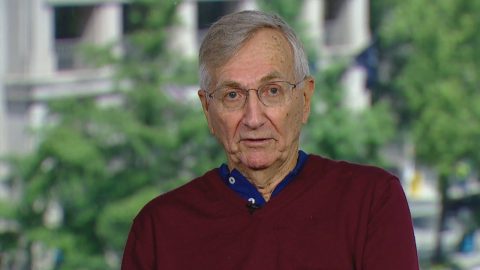
*(Seymour Hersh)
Syria is only part of a broad mosaic of ill intent, however. It was attacked in the first place because it was a strategic ally of Iran. Russia’s twin successes, in deflecting US penetration of Ukraine and making the Americans look stupid in Syria, was followed by allegations of Russian interference in the 2016 US elections. There was no proof then and there is no proof now but the same empty accusations are being repeated by the same columnists, anchors and talk show hosts all the time.
We are now facing a multi-pronged assault on truth in which governments and the corporate media are partners. On both sides of the Atlantic, they have lined up against the renewed primary enemy, Russia, wherever it is and whatever it does.
Russia lost the Democrats the US elections. Russia stole Crimea from Ukraine.
Russia saved the Syrian dictator from defeat. Russia is supporting the dictator Maduro. Russia trades with Iran. Russia does not regard Hizbullah and Hamas as terrorists as we do. Russia does not give open-ended support to Israel but rather regards it as a primary fomenter of disorder in the Middle East.
Russia poisoned the Skripals, of course. Skripal senior was a former double agent, double-crossing Russia while working for British intelligence. There is no obvious reason why Russia would want a washed-out former spy dead but of course, it had to be Russia that daubed the door handle of his house with Novichok. There was no proof, but who else could it be but Russia, and if you say ‘British intelligence,’ setting up a new round of Russia-bashing, then wash your mouth out with soap.
Mysterious Russian figures turn up in Salisbury. The British government says they are agents, stopping off at the Skripals’ house to put a few drops of Novichok on the door handle before sauntering off down the main street to look into the window of a shop selling collectibles and rare stamps.
They seemed to be enjoying themselves. They seemed in no hurry at all to get away from the scene of the crime and take the first plane back to Moscow, but isn’t that exactly the way well-trained Russian agents would behave?
Somewhere along the way they dropped what was left of their Novichok into a rubbish bin, cunningly concealed in a hi-tech perfume bottle, Nina Ricci, ‘Premier Jour.’ Enough still left to kill 4000 people, said the newspapers, but failing to kill the Skripals and killing only poor Dawn Burgess, who pulled it out of the bin and apparently sprayed or dabbed herself with some.
We don’t really know who these Russians were and what they were doing in Salisbury but we need proof, not accusations and suppositions, and the British government does not have it. We can reach conclusions on the basis of what we know or think we know but the lies told by the British government over the attack on Iraq in 2003, plus the death/murder of the UN weapons inspector David Kelly five months after the war was launched, are sufficient reasons not to believe or trust anything this government says.
This new cold war is drifting steadily towards the brink of a hot one. The US is confronting Russia through missile bases, economic sanctions and interference in the politics of states around Russia’s borders.
Trump has just announced the withdrawal of the US from the Intermediate-range Nuclear Forces (INF) treaty, accusing Russia of breaching it and saying ‘we will move forward with developing our own military response options.’
In fact, Russia had already accused the US of violating the treaty. In May, 2018, the US/NATO opened a missile base in Romania where, Russia claimed, the US had simply transferred the launchpad for the Aegis integrated naval weapons system, which utilizes Tomahawk cruise and intermediate range missile banned by the INF treaty, from sea to land.
These missiles have a range of 300-3400 miles and their apparent positioning in Romania was naturally regarded as a direct threat by Russia.
The withdrawal of the US from the INF and Trump’s threat that the US will ‘move forward’ by developing its own options raises the apprehension in Russia that the US will station other cruise and intermediate range missiles in Europe once it finds willing partners.
In his state of the union address, Putin said that such missiles could reach Russia in 10 to 12 minutes and warned of a symmetrical response, if the US deployed them in Europe, directed not just at the US but at the states hosting its missiles.
To those contemplating such measures, he said: ‘Let them count the speed and range of our missiles. That is all I ask.’
It is not just Russia that the US is threatening, however, but China. If China held naval exercises off the US or British coasts the world would quickly be facing another 1962 Cuba crisis, only much more dangerous, but the US and Britain give themselves the right to hold such exercises off the Chinese coast in the South China Sea.
As for Venezuela, the US has reverted to the crude gunboat imperialism of the late 19th century (not that gunboat imperialism ever went away). ‘Do what we want or else’ is the message sent to Maduro and the Venezuelan people. What the US wants is the resurrection of the 1823 Monroe Doctrine, and the complete domination of Latin America, including open access to its resources.
In essence, the imperialism of the 21st century is the same as the imperialism of the 20th or the 19th centuries. In the 1940s and 1950s the people of Asia, the Middle East and Africa struggled to lift the yoke of occupation, economic domination and the plundering of their natural resources off their necks. In the third millennium, they are still struggling, especially in the Middle East and Latin America.
The members of the ‘western’ collective fight among themselves but always fall into line when the alpha dog barks at them. Considerations of right and wrong, law, ethics, morality and justice are irrelevant. The alpha dog has barked and the pack must obey. Riam Dalati’s exposure of media deceit is interesting but still a mere detail on a very large and dirty canvas as the ‘west’, its governments and its media, tries to maintain control of a world fast slipping from its hands.
Jeremy Salt has taught at the University of Melbourne, Bosporus University (Istanbul) and Bilkent University (Ankara), specialising in the modern history of the Middle East. His most recent book is “The Unmaking of the Middle East. A History of Western Disorder in Arab Lands” (Berkeley: University of California Press, 2008.)
MP who fabricated anti-Semitism scandal leaves Labour, citing ‘culture of racism and anti-Semitism’
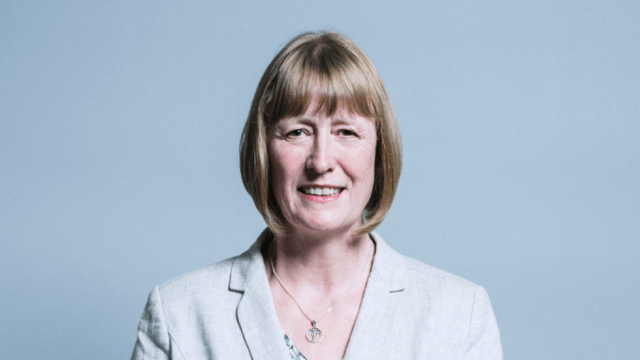
RT | February 20, 2019
The latest Labour MP to jump ship over alleged racism and anti-Semitism is Joan Ryan, which is curious, because it was she who was exposed as having created an alleged anti-Semitism scandal within the Labour Party.
Ryan announced she was joining the Independent Group because of the “culture of anti-Jewish racism and hatred for Israel” within the party under leader Jeremy Corbyn on Tuesday.
Ryan is chair of the Labour Friends of Israel (LFI), which was exposed as having ties to the Israeli government and exerting influence on UK politics in a 2017 Al Jazeera documentary into the Israel lobby in the UK.
Al Jazeera’s undercover reporter filmed Ryan creating what would later be framed as an anti-Semitism scandal at the Labour conference in 2016. Labour member Jean Fitzpatrick approached a stand to ask questions about Labour’s support of a two-state solution with Israel and Palestine and was soon dismissed by Ryan.
Ryan later claimed the woman had made “anti-Semitic tropes” about Israel’s influence and banking, but the footage showed she made that up.
In September, Ryan lost a no confidence vote brought against her by her local parliamentary constituency over her smearing of Labour leader Jeremy Corbyn, but said she would not step down.
In the Al Jazeera footage, Ryan also talks to a then-senior officer of the Israeli embassy who tells her he has secured “more than one million pounds” in Israeli government funding for an LFI trip to Israel. Out of the six Labour MPs to quit the party, six are listed supporters of Labour Friends of Israel.
Social media users were quick to point out the irony of an MP leaving a party over anti-Semitism when she created a false anti-Semitism claim from within the Labour Party.
Rats Begin Leaving the Labour Ship
By Stuart Littlewood | American Herald Tribune | February 20, 2019
A group of seven perpetually-whingeing MPs has quit the UK Labour Party to go independent. They are Chuka Umunna, Luciana Berger, Chris Leslie, Angela Smith, Mike Gapes, Gavin Shuker and Ann Coffey. Their gripes are various but boil down to disgruntlement with Jeremy Corbyn and his leadership especially over Brexit and anti-Semitism.
Stop the War Coalition observes that the seven “have voted for war, foreign military intervention and the renewal of Trident throughout their political careers. A warmongering foreign policy is central to the so-called values they talked about in today’s launch and is arguably the main unifying strand of their political ideologies.”
STWC points out that the four of them who sat in Parliament in 2003 (Ann Coffey, Mike Gapes, Chris Leslie and Angela Smith) all voted for the Iraq War and have continually supported the policy of military intervention. With seven fewer warmongers in the Labour Party, says STWC, “now is a chance to redouble our efforts to ensure that Labour is never dragged into any more catastrophic wars and is a party rooted in peace.”
Momentum, a large pro-Corbyn pressure group dedicated to “transforming Labour”, take a swipe at the deserters’ new ‘independent’ status and especially Chris Leslie and Chuka Umunna. “Just when Labour has the flailing Tories on the ropes, they have decided to leave the fight. Whatever they say, their real goal is simply to stop Jeremy Corbyn’s Labour Party coming to power and prevent a transformation of this country for the many, not the few.
“They are even reportedly planning to deliberately stand in marginal seats where splitting part of the Labour vote would have the most effect – that effect being that the Tory wins. In short, they are trying to create a Blairite spoiler party.
“Leslie and Chuka have been undermining the leadership from the very moment Jeremy was elected…. They will do everything they can to sabotage Labour now, and we know they’ll have major donors and corporate backing already lined up.”
Without the party ‘brand’ they are nothing
According to the BBC Ms Berger said Labour had become institutionally anti-Semitic and she was “embarrassed and ashamed” to stay. “I am leaving behind a culture of bullying, bigotry and intimidation.”
Chris Leslie said Labour under Corbyn had been “hijacked by the machine politics of the hard left”.
Mike Gapes said he was “sickened that Labour is now perceived by many as a racist, anti-Semitic party” and “furious that the Labour leadership is complicit in facilitating Brexit”.
Angela Smith had previously told Channel 4 News: “Labour MPs are being pushed to the very edge by the attitude of the leadership on Key issues such as Brexit and anti-Semitism.”
And the ever-talkative Chuka Umunna said they had taken the first step and urged other Labour MPs – and members of other parties – to join them in building a new politics. “It is time we dumped this country’s old-fashioned politics and created an alternative that does justice to who we are today and gives this country a politics fit for the here and now – the 21st Century.”
Jeremy Corbyn responded by expressing disappointment that the MPs felt unable to continue working for the policies that “inspired millions” at the 2017 election.
Some in the media are comparing the Seven with the Gang of Four who quit the Labour Party in 1981 to form the SDP. But they don’t bear comparison. The Four (Roy Jenkins, David Owen, William Rodgers and Shirley Williams) were high-calibre and talented. Even they couldn’t make a real political breakthrough. These Seven are small fry. At least five of them (Berger, Umunna, Leslie, Gapes and Smith) are listed supporters of Israel and presumably endorse its military occupation of Palestinian lands and vicious oppression of the Palestinian people; and they spend much of their time stooging for that racist regime while complaining about racism within the Labour party. As for Umunna, Wikipedia reports him as saying that his moral values come from Christianity, which is strange given his admiration for Israel and, as far as I’m aware, his reluctance to publicly condemn its horrendous crimes against the indigenous people in the place where Christianity was born.
Furthermore none of the seven respects the British people enough to implement their democratic wish to leave the EU – all are agitating for a second referendum.
While there’s much to complain about with Labour’s leadership and among the many airheads not yet purged, the party is well shot of troublemakers who just walk out. The danger is that the Not-So-Magnificent Seven will serve as a magnet for other malcontents with little regard for British interests, only their own warped ambition.
Corbyn’s reaction on Labour’s Facebook page was to say: “I am disappointed that these MPs have felt unable to continue to work together for the Labour policies that inspired millions at the last election and saw us increase our vote by the largest share since 1945.”
And Shadow Chancellor John McDonnell felt the “honourable thing for them to do” would be to stand down as MPs and seek re-election to Parliament in by-elections without the Labour ticket. However, it seems the seven intend to remain super glued to their Parliamentary seats, calling themselves The Independent Group and practising “new politics”.
Less than two years ago these quitters won their seats with the Labour machine’s support and on a Corbyn manifesto that stirred the blood and vastly increased Labour’s standing. They should reflect on the fact that without party help and without the party brand they are nothing.
On the other hand I suspect it won’t be long before we see this breakaway as another milestone in the wider conspiracy to frustrate the chances of a Corbyn government by dark forces with a belligerent agenda in the Middle East and an eye on other juicy targets.
Two years ago I and others were urging Corbyn to detach himself from the Labour Party’s Blairite ‘rump’ that was out to destroy him, to take his huge army of supporters and start a new party with a clean sheet and without the unpleasant baggage that lumbers modern Labour. The process now seems to be happening the other way round. The baggage is leaving.
And the seven desertions are likely to attract more in coming weeks.
When is a British Person Not British?
By Craig Murray | February 20, 2019
The attitude to immigrants which is betrayed by the stripping of citizenship from Shamima Begum is truly appalling. A British citizen, born in the UK, is deemed to be a citizen of another country they have never seen, because their immigrant parents came from there. To refuse to accept first generation Britons are Britons, as in Windrush, was bad enough. To claim that second generation Britons are not British, but rather citizens of where their ancestors “came from”, is racism pure and simple.
Begum is not a sympathetic figure. Savid Javid could not have found an easier target for his macho display of vindictiveness, guaranteed to win plaudits from the bigots whose votes Javid needs for his looming Tory leadership bid. Javid knows full well his decision will eventually be overturned by the courts, but he has already achieved his political objective of personal self-aggrandisement.
I do not know everything Begum has personally been doing in Syria and to what extent she has been culpable in any of the crimes of the Saudi backed jihadist group Daesh, originally launched by the CIA as a counterweight to Shia influence in Iraq. Begum, as with other members of the ISIS community in Syria, ought initially to be subject to any legal proceedings by the Syrian authorities on behalf of the Syrian people against whom such dreadful crimes were committed. If of no interest to the Syrian justice system or once any sentence has been completed, she should be returned to the UK and then subject to investigation as to whether any UK crimes were committed. All these processes need to take into account that she arrived in Syria as a minor, has been subject to indoctrination, and may well have severe mental health issues.
In a situation where the government is falling over itself to bring members of the UK-funded jihadist support group the White Helmets to the UK, having no claim to British citizenship; in a situation where jihadist activity in Syria was entirely dependent on finance, supplies and air support from the US, UK, and its Gulf State allies; in a situation where the Royal Navy had evacuated the Manchester bomber en route back to the UK after his Western backed terrorist jaunt in Libya; in a situation where the Manchester, Westminster and London Bridge terrorists all had extensive pre-existing relationships with the British security services; in all these circumstances, the decision to crack down to general applause on a bewildered East London child is a sickening example of the lack of ethics in modern politics.
UK: Daniel Finkelstein admits powerful Jews engage in secret political plotting
Diversity Macht Frei | February 20, 2019
Yet another case study in hypocrisy from the Chosen People.
First, here’s an incident they were complaining about a few days ago.
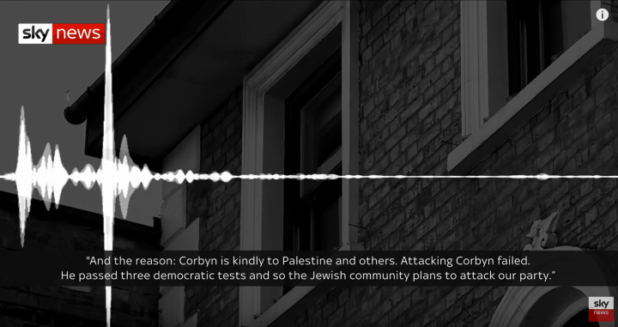
A local Labour party member, Sir Michael Duncan, complains that the “Jewish community plans to attack our party.”
Jews then attacked his party, claiming that his statement that they planned to attack his party was antisemitic and false.
Jew Mike Katz complained:
“Talking about an undemocratic elite, talking about the Jews acting as a whole community to attack the Labour party, that really plays into some of the oldest antisemitic tropes about Jews being conspiratorial, acting in secrecy, as some sort of cult, to try and influence politics”.
Yet top Jew, milord Daniel Finkelstein offered an interesting revelation in a recent Times article as he reflected on the departure of the monstrous Luciana Berger from the Labour party.
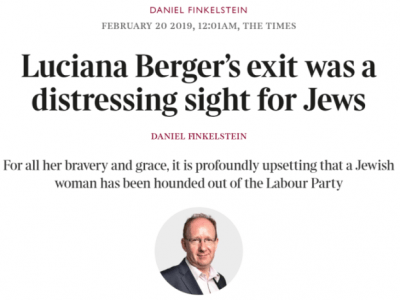
Yesterday, in modern Britain, a young woman was driven out of Britain’s biggest progressive party by people who hate Jews and by other people who won’t do anything about it. Set against that, so much else just seems blah.
I attend meetings of the Jewish community where we discuss the problem and what to do about it. The room is full of dynamic people used to getting things done. There’s plenty of strength there and determination and brains too. Yet we all feel numb.
Finkelstein made a similar admission about Jewish collective political strategising a few years ago. Of course there were no consequences, just as there will be none now. Danny the Fink (his chosen Twitter handle) won’t lose his job or be accused of promoting “antisemitic tropes” by acknowledging that a clique of powerful Jews meet in secret to plot political change. But poor Sir Michael Duncan, who earned a knighthood by making distinguished contributions to engineering, doing something real, building things, will probably now be chased from his political party by mere artful wordsmiths and manipulators for the crime of noticing that a hostile elite is pursuing an agenda of its own, disconnected from the interests of the country it is living in.
The best illustration of the power of the Jews is that they can tauntingly admit something in one of their own articles one day then destroy your life for pointing it out the next. We are living in an ethno-tyranny.
What “community standards” did this comment breach? #18
OffGuardian | February 20, 2019
The following comment – posted to twitter by Craig Murray – was censored by The Guardian. Which of the well-publicised CiF “community standards” did they breach?
Removed comment, posted under this live news feed earlier today:

Screen shot of where it used to be:

For those of you unfamiliar with the video Craig linked to, or the story connected with it: In 2017 Joan Ryan MP was secretly recorded having conversations with employees of the Israeli embassy, in which she appeared to be accepting large amounts of money in order to influence other MPs.:
This recording was released as part of the Al Jazeera documentary The Lobby. In the same documentary is this clip where an Israeli embassy employee discusses a plan to “take down” Jeremy Corbyn.
Seven of the eight (so far) Labour defectors were members of the Labour Friends of Israel. Joan Ryan was the chair.
But back to Craig’s comment, and its removal: Which of the Guardian’s “community standards” did it break?
- Does it “misrepresent the Guardian and its journalists”?
- Is it “persistent trolling or mindless abuse”?
- Is it “spam-like”? Or “obviously commercial”?
- Is it “racism, sexism, homophobia or hate-speech”?
- Is it “extremely offensive of threatening?”?
- Is it “flame-wars based on ingrained partisanship or generalisations”?
- Is it not “relevant”?
If none of the above – why was it taken down?
Featured Video

Death Spikes & Rising Cancer In Our Youth Explained
or go to
Aletho News Archives – Video-Images
From the Archives
Politicians lie
By Mazin Qumsiyeh | Popular Resistance | August 18, 2013
There is no way to say this truth nicely: Politicians lie. That includes Japanese, American, Egyptian, Israeli, and Palestinian politicians! Is there something more common sense than that? Yet, so many citizens around the world believe their own politicians or wistfully acknowledge lies but think it is part of the job needed to run things. They believe even when politicians contradict themselves blatantly. This phenomenon is rather remarkable. It is a dissonance and disconnect from reality that many seem oblivious to. It is very dangerous because it can lead to accepting rationales for going to war. These can be deadly wars that lead to millions of lives lost as happened in what was called World War 1 and WW2. Even when incredible and declassified evidence abound, politicians continue to lie and old mythologies refuse to die. Here are just a few of the countless lies told to us over the past few decades… continue
Blog Roll
 Aletho News
- Ukrainian Soldiers, Potential Mercenaries: Have Gun, Will Travel!
- Burnham’s UN debut… A masterclass in British disinformation
- Iran flights continue despite US aviation sanctions
- Global Tipping Points Lead the World Into a State of Entropy
- The day-after at the White House: USA and Xi Jinping
- The Geopolitical Balance in the Red Sea: The UAE Being Displaced by New Players
- Iraqi resistance group vows to stage airport sit-ins over Iran aerial blockade
- Turkish parliament to review Saudi-Pakistan defense pact next month
- DEATH SPIKES & RISING CANCER IN OUR YOUTH EXPLAINED
- Iran offers Trump deal before US election
- If Americans Knew
- Deconstructing Netanyahu’s pants-on-fire UN rant – Daily Update
- Trump betrayed voters with his campaign lies and prioritized a foreign country once he took office
- Netanyahu calls Israel’s war in Gaza ‘opposite of genocide’ in UN speech to near-empty hall
- Settler Kidnappings: Torture, Sexual Abuse and Terrorisation of Palestinian Abductees as Israel Deepens Annexation of West Bank
- Gaza winter nears as 162,000 tents become unusable, raising fears of humanitarian crisis
- Netanyahu says, “It’s the opposite of genocide”; UN says Gaza economy is world’s ‘most severe crisis on record’ – Daily Update
- Israel’s US-Backed Assault on Gaza Has Created the ‘World’s Most Severe Economic Crisis on Record’: UN
- ‘Protecting U.S. Citizens’… From Israel
- ‘This is where I live now, the back of a truck’: a day in the life of a grandmother in Gaza
- In UN Speech, Iran’s President Displays Pictures of Children Killed by US, Brings Attention to Israel’s Nuclear Arsenal
- No Tricks Zone
- New Study: Earth And Venus Surface Warmth Largely Explained By Convection And Lapse Rate, Not CO2 Or Radiation
- 2025 Nature Paper Claiming Worsening Global Drought Gets RETRACTED …Heavily Flawed
- New Study: ‘Global Drought Shows No Detectable Recent Acceleration Under Climate Warming’
- Economic Masterminds: German Socialists Suggest Taxing Productivity Gains Stemming From Using AI
- The South China Sea Has Not Been Cooperating With The Climate Change Narrative
- Energy Crisis: Germany Enters Heating Season With Historically Low Gas Reserve Fill Levels
- New Study: The Antarctic Ice Sheet Gained Mass From 2020-2024 Due To Staggering Snow And Ice Accumulation
- Study: Ocean Heating Rates From Thousands Of Years Ago ‘Dwarf’ Modern Ocean Heating Rates
- Climate Extremists Target, Attack Large-Scale Power Grid Infrastructure In Germany!
- New Study: Antarctic Ice Melt Has Contributed Less Than 1 Centimeter To Sea Level Rise In The Last 30 Years

