Labour politicians are outraged and calling for a probe after a report that a McCarthy style charity has received £2 million in government money and targeted Jeremy Corbyn, straying from tackling so-called Russian disinformation.
The Institute for Statecraft, based in Scotland, initially seems to be a small organization which claims to counter alleged Russian propaganda by forming communities of journalists and influencers who use social media to push back on any so-called disinformation.
However, leaked documents provided to the Daily Record show that the organization’s Integrity Initiative isn’t as grassroots as it appears on the surface. In fact, it’s apparently funded with £2 million of Foreign Office cash and run by British military intelligence specialists.
What’s more is that the newspaper has reported that it launched its own investigation which found “worrying evidence” that the organization’s official Twitter account has been used to attack Jeremy Corbyn, his Labour Party, and other officials within the party.
And of course, there were some anti-Russia comments thrown in for good measure – such as one tweet which quoted a newspaper article calling Corbyn a “useful idiot” with “open visceral anti-Westernism [that] helped the Kremlin cause, as surely as if he had been secretly peddling Westminster tittle-tattle for money.”
“What he has done, wittingly or unwittingly, is work with the Kremlin agenda,” a newspaper report retweeted by the Integrity Initiative tweet states.
Although the Integrity Initiative’s apparent mission was first revealed last month, the Daily Record’s Sunday report about its targeting of Corbyn and the Labour party has left the party’s members more than a little angry.
“It is simply outrageous that the clearly mis-named ‘Integrity Initiative’ – funded by the Foreign Office to the tune of £2.25 million over the past two years – has routinely been using its Twitter feed to disseminate personal attacks and smears against the Leader of the Opposition, the Labour Party and Labour officials,” Emily Thornberry MP, Labour’s Shadow Foreign Secretary said in her statement.
Labour MP Chris Williamson also chimed in, calling any such activity “unacceptable in any democracy.”
The question of whether MSM will eventually pick up the story remains unknown, especially since it has a tendency to turn a blind eye to anyone claiming to fight the good fight against “aggressive” Russia.
The Integrity Initiative’s spokesman Stephen Dalziel has said he is “not aware” of any Corbyn attacks on the official social media account. “I’m not the one who controls the Twitter account. If it was criticism of one of our politicians, then that shouldn’t be on there.”
December 9, 2018
Posted by aletho |
Deception, Russophobia | Institute for Statecraft, UK |
Leave a comment
Alternative news sources have come under sustained attacks
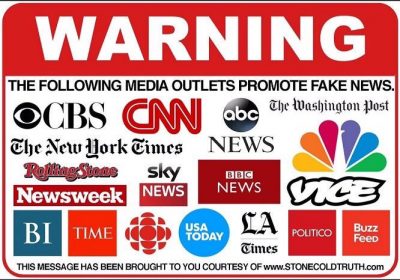
The New York Times unveiled a new slogan early in 2017 titled, “The truth is more important now than ever.” It has acquired a seemingly noble motto but a perhaps contentious one if we examine the Times’ recent history. Two international law specialists, Howard Friel and Richard Falk, published a book after the 2003 Invasion of Iraq called The Record of the Paper, which has scarcely been reviewed.
Friel and Falk focused on the Times due to the newspaper’s importance. The authors point out that in 70 Times editorials on Iraq – from September 11, 2001 to March 20, 2003 – the words “international law” and “UN Charter” were never mentioned. The “truth” did not seem terribly “important” as the Times stood idly by in the destruction of Iraq.
Such was the barrage of propaganda directed at the American public that 69% believed Saddam Hussein was “personally involved” in the September 11 attacks. That is a significant achievement in manipulation. The poll results must have been news to the Iraqi dictator himself, a forgotten one-time American ally.
Why Hussein would take it upon himself to orchestrate a surprise attack on the United States, of all nations, is anyone’s guess. Perhaps if he had a death wish but as later events proved he was not the suicidal type.
The Times was not alone in its position of selling the Iraq war to the American people, as television networks from Fox News to CBS and CNN were overwhelmingly pro-war. Fox News, owned by Rupert Murdoch – who strongly backed the illegal conflict – placed a permanent US flag in the corner of the screen. Fox employees were compelled to describe the invasion as “Operation Iraqi Freedom”, with hundreds of thousands of Iraqis later being killed.
The pattern continues into other illegitimate interventions as the liberal Guardian newspaper championed the demolition of Libya in 2011, with editorials imploring, “The quicker Muammar Gaddafi falls, the better.” The Guardian encouraged NATO “to tip the military balance further against Gaddafi”, while later that year summarising that “it has turned out, so far, reasonably well” – by that point thousands had been killed.
In 2015 Ian Birrell, then deputy editor of the Independent, still assured his readers, “I would argue that Britain and France were right to step in [in Libya]. The failures came later on.” Apparently it was fine for two old imperial powers to “step in” to shatter a sovereign nation, then afterwards absolve the invaders of blame with “the failures” only coming “later on”.

Sceengrab from The Independent
It’s a rare thing indeed to hear a prominent commentator question the balance of Western mainstream coverage. The same voices can be heard piping up when alternative news sources take a different line not so palatable to their tastes.
Nick Cohen, writing in the Guardian, accused the network Russia Today (RT) of being a “propaganda channel” and that Russia was “prostituting journalism”. In the following sentence, Cohen describes the BBC and New York Times as being “reputable news organisations”.
Cohen firmly supported the Iraq war, writing at the time that “the Left betrays the Iraqi people by opposing war”, and “an American invasion offers the possibility of salvation”. He was deemed not to be “prostituting journalism” in backing this violation of international law, nor when later supporting other interventions in Libya and Syria.
The BBC’s reputation, which Cohen previously claimed to be “reputable”, was dealt a blow when it was revealed by Cardiff University that the network “displayed the most ‘pro-war’ agenda of any broadcaster” with its coverage on the Iraq invasion.
Steven Erlanger of the New York Times described RT as “an agent of Kremlin policy” used to “undermine Western democracies” and to “destabilise the West” – failing to back up the claims with any evidence. To gain perspective on these attacks, it may be worth pointing out a key excerpt from the First Amendment of the US Constitution: “Congress shall make no law… abridging [curtailing] the freedom of speech, or of the press.”
This law does not exist in Western democracies but attempts at limiting freedom of expression continue apace, while attacks on alternative media outlets by institutions of power grow. It has reached a point whereby the French president Emmanuel Macron, shortly after assuming office, publicly attacked legitimate news sources of “behaving like deceitful propaganda”.
Perhaps the hidden concern about RT, for example, is its continued increase in both popularity and scope – with the channel enjoying a total weekly viewership of 70 million people and rising. RT is available to viewers in Western heartlands such as Britain and the US, with eight million Americans watching the station each week. It represents quite an achievement that a channel with the word “Russia”, featured in its title, can attract viewers in their millions, despite the growing anti-Russian sentiment espoused by the powers-that-be.
It is revealing that elite figures like Hillary Clinton have lamented in the past, “We are in an information war and we are losing that war.” For the first time in history, populations have broad access to alternative news angles – points of view that they likely find of a more balanced nature. Gone is the unchallenged monopoly on the public mind.
December 7, 2018
Posted by aletho |
Book Review, Fake News, Mainstream Media, Warmongering | New York Times, The Guardian, UK, United States |
Leave a comment
The insanity runs deep in Washington but it has also briefly surfaced at Simi Valley in California at the Reagan National Defense Forum, which ran through last weekend. United States Secretary of Defense James “Mad Dog” Mattis was the keynote speaker on Saturday. He had a few interesting things to say, the most remarkable of which was the assertion that Russia had again sought to interfere in the 2018 midterm elections, which were completed last month.
Mattis, a Marine general who is sometimes considered to be the only adult in the room when the White House national security team meets, claimed that the bilateral relationship between Washington and Moscow had “no doubt” deteriorated still further due to the Russian activity, which he described as the Kremlin “try[ing] again to muck around around in our elections last month, and we are seeing a continued effort along those lines” with Russian President Vladimir Putin making “continued efforts to try to subvert democratic processes that must be defended. We’ll do whatever is necessary to defend them.”
Mattis did not address President Donald Trump’s cancellation of a meeting with Putin at the G20 summit in Buenos Aires, Argentina, a move which he reportedly supported. The cancellation was reportedly based on what has been described as an act of aggression committed by the Russian military against three Ukrainian naval vessels seeking to transit the Kerch Strait, which since the annexation of Crimea has been completely controlled by Moscow. The Ukrainians were aware of the Russian protocols for transiting through the area and chose to ignore them to create an incident, possibly as part of a plan to disrupt the Trump-Putin discussions. If that is so, they were successful.
Mattis was somewhat taciturn relating to his accusation regarding Moscow’s meddling. He provided absolutely no evidence that Russia had been interfering in the latest election and there have been no suggestions from either federal or state authorities that there were any irregularities involving foreigners. There was, however, considerable concern over possible ballot and voting manipulation at state levels carried out by the major political parties themselves, suggesting that if Mattis is looking for subversion of democratic processes he might start looking a lot closer to home.
The U.S. government has issued a general warning that “Americans should be aware that foreign actors — and Russia in particular — continue to try to influence public sentiment and voter perceptions through actions intended to sow discord.” Law enforcement and intelligence agencies have reportedly been working with private sector internet social networking companies, to include Twitter and Facebook, to shut down Russian and Iranian accounts in attempt to forestall any interference in either the campaigning or voting processes. Some Russians have even been indicted in absentia based on flimsy evidence but as they are in Russia they cannot be tried. One Russian student, Maria Butina, is still in jail in Virginia based on conflicting and flimsy evidence and it is not clear when she will be able to defend herself in court.
Beyond the general anti-Russia hysteria being encouraged by the media and congress, there are a number of problems with the Mattis assertion. First of all, beyond the fact that no actual evidence has been presented, it is irrational to assume that Russian intelligence services would waste their effort and burn their resources to attempt to accomplish absolutely nothing. Russia was not on the ballot last month and no candidates were running on any platform that would benefit Moscow in the slightest. To get caught “mucking around” would invite more sanctions and justify an increasingly hostile response from Washington, hardly a price that Putin would be willing to pay for little or nothing tangible.
Second, the intense investigations being carried out by the Robert Mueller Special Counsel’s office have to this point developed no information suggesting that Russia did anything in 2016 beyond the low-level probing and manipulating that every major intelligence agency does routinely to get a window into what an adversary is up to. To be sure, several Team Trump associates will likely be going to jail, but their crimes so far have consisted of perjury or tax fraud. Some, like former Trump lawyer Michael Cohen are seeking desperately to find a way to implicate the president in some grander scheme, but if there is anything actually there it has yet to be identified to the public.
Third, based on the evidence produced so far, the only two countries that may have cooperated with either Trump or the Deep State to influence the results of the 2016 election are Israel, which sought Trump intercession at the United Nations, and Britain, which may have engaged in a plot by the British intelligence and security services to conspire with CIA Director John Brennan to elect Hillary Clinton.
So, there we go again. Another vague accusation against Russia to convince the American public that there is a powerful enemy out to get us. And lest there be any shortage of enemies Mattis also mentioned always dangerous Iran, saying “… we cannot deny the threat that Iran poses to all civilized nations.” And, by the way, Mattis in his speech strongly supported an increased “defense” budget to deal with all the threats, saying somewhat obscurely that “Fiscal solvency and strategic solvency can co-exist.” Sure. In the wonderful world of Washington, more money can fix anything.
December 6, 2018
Posted by aletho |
Mainstream Media, Warmongering, Russophobia | Hillary Clinton, UK, United States |
Leave a comment
RT reported that the UK’s so-called “National Data Analytics Solution” will see an algorithm process whichever of 30 separate data points have been recorded about a person in local and national police databases in order to predict which members of the population are most likely to commit a crime or be victimized by one, after which the state will dispatch local health and social workers to offer “counseling” to them in an attempt to prevent the computer’s envisioned scenario from transpiring. This program is being likened to the 2002 film “Minority Report” and carries with it a vibe of China’s controversial “social credit” system, albeit without any “rewards” being offered for law-abiding behavior. In fact, one can actually make the claim that instead of the UK copying China to a degree, it was actually China that learned from the UK seeing as how the island nation’s mass surveillance system used to be far ahead of the communist nation’s one.
The problem with “pre-crime” technology, however, is that it straddles the fine line between security and liberty in what is supposed to be a “democracy”, therefore making it uncomfortably out of place in the UK while being much more natural to implement in centrally controlled societies like China’s. While the European country insincerely pretends to be a “democracy” in the Western sense of how this system is commonly assumed to function, the East Asian one makes no such pretenses and is proud of having a different organizational model, which should be doubly disturbing for any British citizen because it means that their “democratically elected government” is actually less forthcoming about its nationwide surveillance strategy than comparatively more centralized China’s is. No value judgement is being made about either country’s governing system, but the purpose of this comparison is to point out the surprising similarities between the two that are usually lost on most observers.
For as much as China is demonized for taking proactive security measures against Uighurs who the state fears are at risk of succumbing to terrorist ideologies, the UK will essentially be channeling the same spirit of this strategy through its “National Data Analytics Solution” with what can only be assumed are the ethno-socio minority groups in the country that are statistically more at risk of committing crimes or being victimized by them. The difference, however, is that drawing attention to this doesn’t serve the US’ geopolitical interests because it has nothing to gain by destabilizing the UK and possibly imposing sanctions against it for supposedly violating these subjects’ “human rights”, unlike its stance towards China in this respect. While many are fretting that “East Asia” is pioneering the way for Orwell’s 1984 to come to life, they’d do well to consider just how much “Oceania” has already done to make this a reality too.
The post presented is the partial transcript of the CONTEXT COUNTDOWN radio program on Sputnik News, aired on Friday Nov 30, 2018.
December 5, 2018
Posted by aletho |
Civil Liberties, Full Spectrum Dominance, Islamophobia, Timeless or most popular | Human rights, UK |
Leave a comment
The biggest threats to America come from its “friends”
One of the local Washington television stations was doing a typical early morning honoring our soldiers schtick just before Thanksgiving. In it soldiers stationed far from home were treated to videolinks so they could talk to their families and everyone could nod happily and wish themselves a wonderful holiday. Not really listening, I became interested when I half heard that the soldier being interviewed was spending his Thanksgiving in Ukraine.
It occurred to me that the soldier just might have committed a security faux pas by revealing where he was, but I also recalled that there have been joint military maneuvers as well as some kind of training mission going on in the country, teaching the Ukrainian Army how to use the shiny new sophisticated weapons that the United States was providing it with to defend against “Russian aggression.”
Ukraine is only one part of the world where the Trump Administration has expanded the mission of democracy promotion, only in Kiev the reality is more like faux democracy promotion since Ukrainian President Petro Poroshenko is clearly exploiting a situation that he himself provoked. He envisions setting himself up as a victim of Moscow to aid in his attempts to establish his own power through a security relationship with Washington. That in turn will help his bid for reelection in March 2019 elections, in which his poll numbers are currently running embarrassingly low largely due to the widescale corruption in his government. Poroshenko has already done much to silence the press in his county while the developing crisis with Russia has enabled him to declare martial law in the eastern parts of the country where he is most poorly regarded. If it all works out, he hopes to win the election and subsequently, it is widely believed, he will move to expand his own executive authority.
There also has to be some consideration the encounter with the Russians on the Kerch Strait was contrived by Poroshenko with the assistance of a gaggle of American neoconservative and Israeli advisers who have been actively engaged with the Ukrainian government for the past several years. The timing was good for Poroshenko for his own domestic political reasons but it was also an opportunity for the neocon warmongers that surround Trump and proliferate inside the Beltway to scuttle any possible meeting between a vulnerable Donald Trump and Vladimir Putin at the G20 gathering in Argentina.
The defection of Trump’s lawyer Michael Cohen, together with the assumption that a lot of anti-Trump dirt will be spilled soon, means that the American president had to be even more cautious than ever in any dealings with Moscow and all he needed was a nod of approval from National Security Adviser John Bolton and Secretary of State Mike Pompeo to cancel the encounter. A heads-of-state meeting might not have solved anything but it certainly would be better than the current drift towards a new cold war. If the United States has only one vitally important relationship anywhere it is with Russia as the two countries are ready, able and apparently willing to destroy the world under the aegis of self-defense.
Given the anti-Russian hysteria prevailing in the U.S. and the ability of the neocons to switch on the media, it should come as no surprise that the Russian-Ukrainian incident immediately generated calls from the press and politicians for the White House to get tough with the Kremlin. It is important to note that the United States has no actual national interest in getting involved in a war between Russia and Ukraine if that should come about. The two Eastern European countries are neighbors and have a long history of both friendship and hostility but the only thing clear about the conflict is that it is up to them to sort things out and no amount of sanctions and jawing by concerned congressmen will change that fact.
Other Eastern European nations that similarly have problems with Russia should also be considered provocateurs as they seek to create tension to bind the United States more closely to them through the NATO alliance. The reality is that today’s Russian Federation is not the Soviet Union and it neither aspires to nor can afford hegemony over its former allies. What it has made very clear that it does want is a modus vivendi where Russia itself is not being threatened by the West.
Recent military maneuvers in Poland and Lithuania and the stationing of new missiles in Eastern Europe do indeed pose a genuine threat to Moscow as it places NATO forces on top of Russia’s border. When Russia reacts to incursions by NATO warships and planes right along its borders, it is accused of acting aggressively. One wonders how the U.S. government would respond if a Russian aircraft carrier were to take up position off the eastern seaboard and were to begin staging reconnaissance flights. Or if the Russian army were to begin military exercises with the Cubans? Does anyone today remember the Bay of Pigs?
When it comes to international conflicts context is everything. Seeing the incident between Russia and Ukraine in Manichean terms as an example of Moscow’s aggressive instincts is satisfying in some circles, but it does not in any way reflect the reality on the ground. Internal politics of the two countries combined with deliberate fabrications that are expected to generate a certain response operate together to create a largely false narrative for both international and domestic consumption. Unfortunately, narratives have consequences: in this case, the sacrifice of the possibly beneficial meeting between Trump and Putin.
The same dynamic works vis-à-vis Washington’s other enemy du jour Iran. In the case of Russia, useless “friend” Ukraine is pulling the strings while regarding Iran it is conniving Israel and Saudi Arabia. Iran has been accused of being the world’s leading sponsor of terror, of destabilizing the Middle East, and of having a secret nuclear weapon program that will be used to attack Israel and Europe. None of those assertions are true. The terrorism tag comes from the country’s relationship with Hezbollah, which is only a terrorist group insofar as it is hostile to Israel and pledged to resist any future Israeli invasion of Lebanon. Washington and Israel have pushed the terrorism label for Hezbollah, but most Europeans have begun to disregard the designation since the group has become a part of the Lebanese government.
And regarding destabilizing the Middle East, that has largely been the end result of actions undertaken by the United States, Israel and the Saudis, while the alleged Persian nuclear weapons program is a fantasy. If someone in the U.S. national security apparatus had any brains the United States would work to improve relations with Iran real soon as the Iranians would in the long run quite likely prove to be better friends than those rascals who are currently running around using that label.
And there are other friends in unlikely places. Beleaguered British Prime Minister Theresa May is wailing loudly against a Trump threat to reveal classified documents relating to Russiagate. The real problem is that the documents apparently don’t expose anything done by the Russians. Rather, they seem to appear to reveal a plot by the British intelligence and security services working in collusion with then CIA Director John Brennan to subvert the course of the 2016 election in favor of the Deep State and Establishment favorite Hillary Clinton. How did that one work out?
So how about it? Teenagers who get in trouble often have to ditch their bad friends to turn their lives around. There is still a chance for the United States if we keep our distance from the bad friends we have been nurturing all around the world, friends who have been convincing us to make poor choices. Get rid of the ties the bind to the Saudis, Israelis, Ukrainians, Poles, and yes, even the British. Deal fairly with all nations and treat everyone the same, but bear in mind that there are only two relationships that really matter – Russia and China. Make a serious effort to avoid a war by learning how to get along with those two nations and America might actually survive to celebrate a tricentennial in 2076.
December 4, 2018
Posted by aletho |
Aletho News | CIA, Hillary Clinton, Middle East, NATO, Russia, UK, Ukraine, United States |
Leave a comment
United Kingdom’s anti-Russian propaganda operations are a sign that Western values related to freedom of expression are on the decline, former Canadian diplomat Patrick Armstrong told Sputnik.
On Monday, the international hacktivist group Anonymous released a new package of documents of the anti-Russian UK Integrity Initiative project. In particular, the documents include fake proof of Russian interference in the 2017 Catalan independence referendum disseminated among Spanish politicians and media.
The revelations undermined the credibility of the United Kingdom’s and Western media, Armstrong pointed out. “Only a couple of decades ago we were boasting about Western values of freedom of speech and thought,” Armstrong said. “Not today.”
These United Kingdom operations marked another step in “the decline of the West,” Armstrong added, as its rulers try to counter any discussion they disagree with by portraying it as fake news.
“Our rulers are determined that their stories must not be challenged and thus they try to shut down all discussion. Accept, Believe, Repeat. Anything else is ‘fake news,’” Armstrong said.
According to the first document leaked by Anonymous last month, the project was in fact a “large-scale information secret service” sponsored and created by London.
However, the latest leak suggests that “the British government goes far beyond and exploits the Integrity Initiative to solve its domestic problems inside the United Kingdom by defaming the opposition.”
Until his retirement, Armstrong was a Canadian diplomat who was a specialist on the Soviet Union and Russia. He previously served as political counselor in the Canadian Embassy in Moscow.
December 4, 2018
Posted by aletho |
Deception, Fake News, Mainstream Media, Warmongering, Russophobia | UK |
Leave a comment
MOSCOW – The United Kingdom seems to be seeking to expand its military presence in Ukraine in the run-up to the March presidential election in the country, the Russian Embassy in London said, commenting on media reports about the UK psychological warfare units allegedly stationed in Ukraine.
On Sunday, BBC News Russian reported that 1,200 servicemen of the British Army’s 77th Brigade, a top-secret unit that deals with electronic and psychological warfare, are currently stationed in Ukraine. According to the broadcaster, the UK servicemen in Ukraine have three main areas of activities: carry out military tasks on the Internet, as well as psychological and information operations.
“Earlier, we had information about the [United Kingdom] dispatching its military experts to train the Ukrainian military to conduct special operations against civilians of Donetsk and Lugansk. Now it turns out that the UK presence has expanded through, as BBC reports, conducting psychological and information operations in this country. As we see, it all happens in the run-up to the presidential election in Ukraine,” the embassy said in a statement on Sunday.
If the information is correct, the new units represent a “new element of a large-scale UK military presence in Ukraine,” the embassy noted.
“Once, the United Kingdom supported the coup in Kiev and the coming to power of the so-called ‘government of the winners’ in violation of the country’s constitution. Now we are witnessing a special operation, whose scale and consequences are yet to be assessed,” the embassy added.
The British army’s 77th Brigade is a combined regular and army reserve unit responsible for using “legitimate non-military levers” as a means “to adapt behaviors of the opposing forces.”
December 3, 2018
Posted by aletho |
Deception | UK, Ukraine |
Leave a comment
If you’re one of the millions of human beings who, despite a preponderance of evidence to the contrary, still believe there is such a thing as “the truth,” you might not want to read this essay. Seriously, it can be extremely upsetting when you discover that there is no “truth” … or rather, that what we’re all conditioned to regard as “truth” from the time we are children is just the product of a technology of power, and not an empirical state of being. Humans, upon first encountering this fact, have been known to freak completely out and start jabbering about the “Word of God,” or “the immutable laws of quantum physics,” and run around burning other people at the stake or locking them up and injecting them with Thorazine. I don’t want to be responsible for anything like that, so consider this your trigger warning.
OK, now that that’s out of the way, let’s take a look at how “truth” is manufactured. It’s actually not that complicated. See, the “truth” is … well, it’s a story, essentially. It’s whatever story we are telling ourselves at any given point in history (“we” being the majority of people, those conforming to the rules of whatever system wields enough power to dictate the story it wants everyone to be telling themselves). Everyone understands this intuitively, but the majority of people pretend they don’t in order to be able to get by in the system, which punishes anyone who does not conform to its rules, or who contradicts its story. So, basically, to manufacture the truth, all you really need is (a) a story, and (b) enough power to coerce a majority of people in your society to pretend to believe it.
I’ll return to this point a little later. First, let’s look at a concrete example of our system manufacturing “truth.” I’m going to use The Guardian‘s most recent blatantly fabricated article (“Manafort held secret talks with Assange in Ecuadorian embassy“) as an example, but I could just as well have chosen any of a host of other fabricated stories disseminated by “respectable” outlets over the course of the last two years. The “Russian Propaganda Peddlers” story. The “Russia Might Have Poisoned Hillary Clinton” story. The “Russians Hacked the Vermont Power Grid” story. The “Golden Showers Russian Pee-Tape” story. The “Novichok Assassins” story. The “Bana Alabed Speaks Out” story. The “Trump’s Secret Russian Server” story. The “Labour Anti-Semitism Crisis” story. The “Russians Orchestrated Brexit” story. The “Russia is Going to Hack the Midterms” story. The “Twitter Bots” story. And the list goes on.
I’m not going to debunk the Guardian article here. It has been debunked by better debunkers than I (e.g., Jonathan Cook, Craig Murray, Glenn Greenwald, Moon of Alabama, and many others). The short version is, The Guardian‘s Luke Harding, a shameless hack who will affix his name to any propaganda an intelligence agency feeds him, alleged that Paul Manafort, Trump’s former campaign manager, secretly met with Julian Assange (and unnamed “Russians”) on numerous occasions from 2013 to 2016, presumably to conspire to collude to brainwash Americans into not voting for Clinton. Harding’s earth-shaking allegations, which The Guardian prominently featured and flogged, were based on … well, absolutely nothing, except the usual anonymous “intelligence sources.” After actual journalists pointed this out, The Guardian quietly revised the piece (employing the subjunctive mood rather liberally), buried it in the back pages of its website, and otherwise pretended like they had never published it.
By that time, of course, its purpose had been served. The story had been picked up and disseminated by other “respectable,” “authoritative” outlets, and it was making the rounds on social media. Nonetheless, out of an abundance of caution, in an attempt to counter the above-mentioned debunkers (and dispel the doubts of anyone else still capable of any kind of critical thinking), Politico posted this ass-covering piece speculating that, if it somehow turned out The Guardian‘s story was just propaganda designed to tarnish Assange and Trump … well, probably, it had been planted by the Russians to make Luke Harding look like a moron. This ass-covering piece of speculative fiction, which was written by a former CIA agent, was immediately disseminated by liberals and “leftists” who are eagerly looking forward to the arrest, rendition, and public crucifixion of Assange.
At this point, I imagine you’re probably wondering what this has to do with manufacturing “truth.” Because, clearly, this Guardian story was a lie … a lie The Guardian got caught telling. I wish the “truth” thing was as simple as that (i.e., exposing and debunking the ruling classes’ lies). Unfortunately, it isn’t. Here is why.
Much as most people would like there to be one (and behave and speak as if there were one), there is no Transcendental Arbiter of Truth. The truth is what whoever has the power to say it is says it is. If we do not agree that that “truth” is the truth, there is no higher court to appeal to. We can argue until we are blue in the face. It will not make the slightest difference. No evidence we produce will make the slightest difference. The truth will remain whatever those with the power to say it is say it is.
Nor are there many truths (i.e., your truth and my truth). There is only one truth … the official truth. The truth according to those in power. This is the whole purpose of the concept of truth. It is the reason the concept of “truth” was invented (i.e., to render any other “truths” lies). It is how those in power control reality and impose their ideology on the masses (or their employees, or their students, or their children). Yes, I know, we very badly want there to be some “objective truth” (i.e., what actually happened, when whatever happened, JFK, 9-11, the resurrection of Jesus Christ, Schrödinger’s dead cat, the Big Bang, or whatever). There isn’t. The truth is just a story … a story that is never our story.
The truth is a story that power gets to tell, and that the powerless do not get to tell, unless they tell the story of those in power, which is always someone else’s story. The powerless are either servants of power or they are heretics. There is no third alternative. They either parrot the truth of the ruling classes or they utter heresies of one type or another. Naturally, the powerless do not regard themselves as heretics. They do not regard their “truth” as heresy. They regard their “truth” as the truth, which is heresy. The truth of the powerless is always heresy.
For example, while it may be personally comforting for some of us to tell ourselves that we know the truth about certain subjects (e.g., Russiagate, 9-11, et cetera), and to share our knowledge with others who agree with us, and even to expose the lies of the corporate media on Twitter, Facebook, and our blogs, or in some leftist webzine (or “fearless adversarial” outlet bankrolled by a beneficent oligarch), the ruling classes do not give a shit, because ours is merely the raving of heretics, and does not warrant a serious response.
Or … all right, they give a bit of a shit, enough to try to cover their asses when a journalist of the stature of Glenn Greenwald (who won a Pulitzer and is frequently on television) very carefully and very respectfully almost directly accuses them of lying. But they give enough of a shit to do this because Greenwald has the power to hurt them, not because of any regard for the truth. This is also why Greenwald has to be so careful and respectful when directly confronting The Guardian, or any other corporate media outlet, and state that their blatantly fabricated stories could, theoretically, turn out to be true. He can’t afford to cross the line and end up getting branded a heretic and consigned to Outer Mainstream Darkness, like Robert Fisk, Sy Hersh, Jonathan Cook, John Pilger, Assange, and other such heretics.
Look, I’m not trying to argue that it isn’t important to expose the fabrications of the corporate media and the ruling classes. It is terribly important. It is mostly what I do (albeit usually in a more satirical fashion). At the same time, it is important to realize that “the truth” is not going to “rouse the masses from their slumber” and inspire them to throw off their chains. People are not going to suddenly “wake up,” “see the truth” and start “the revolution.” People already know the truth … the official truth, which is the only truth there is. Those who are conforming to it are doing so, not because they are deceived, but because it is safer and more rewarding to do so.
And this is why The Guardian will not be punished for publishing a blatantly fabricated story. Nor will Luke Harding be penalized for writing it. Luke Harding will be rewarded for writing it, as he has been handsomely rewarded throughout his career for loyally serving the ruling classes. Greenwald, on the other hand, is on thin ice. It will be instructive to see how far he pushes his confrontation with The Guardian regarding this story.
As for Julian Assange, I’m afraid he is done for. The ruling classes really have no choice but to go ahead and do him at this point. He hasn’t left them any other option. Much as they are loathe to create another martyr, they can’t have heretics of Assange’s notoriety running around punching holes in their “truth” and brazenly defying their authority. That kind of stuff unsettles the normals, and it sets a bad example for the rest of us heretics.
December 3, 2018
Posted by aletho |
Fake News, Mainstream Media, Warmongering, Russophobia, Timeless or most popular | Luke Harding, The Guardian, UK, United States |
Leave a comment
A review of Slavery, Secession, & Civil War: Views from the United Kingdom and Europe, 1856-1865 (Scarecrow Press, 2007) by Charles Adams.
At long last Charles Adams’s new book, Slavery, Secession, & Civil War: Views from the United Kingdom and Europe, 1856-1865, has been published. I’ve been anxiously waiting for this book for about five years. The book contains about 500 pages of excerpts from European (mostly British) magazines and journals on the events leading up to the war, the war itself, and the nature of the Lincoln regime. This is a most valuable effort since the mainstream Northern press was censored during the war. Foreign writers, however, “were not arrested and imprisoned,” as they were in the North, writes Adams. “They were not silenced by armed soldiers, mobs, or censorship of the mails,” and “their editors were not hauled off to prison,” to mention just a few of the more totalitarian acts of the Lincoln regime. Even today, writes Adams, the “gatekeepers” of “Civil War” history are “still making war on the South” by distorting history.
Although it is a very long book, I could not put it down. Nineteenth-century English commentators on the war were remarkably astute, well informed, and articulate in expressing their views—so astute as to make your typical mainstream “Lincoln scholar” of today sound like an uneducated boob. There were supporters of both North and South in the European press, although many Northern supporters switched sides once they began observing the behavior of Dishonest Abe and his regime. They all opposed slavery very strongly, but those who supported the Southern cause believed that the North’s invasion of the Southern states had nothing to do with freeing the slaves.
During the 1856-1860 period, writes Adams, quite a few British editors “saw the separation of the North and South as a good thing,” and believed that “slavery had no significant part in the conflict.” For example, Chamber’s Journal of Popular Literature, Science and Arts, one of the “workingman’s journals,” wrote on March 21, 1857, that a major source of conflict was that Northern business interests wanted the South to “consent to the high protective tariff,” and if they did, “anti-slavery agitation would stop.” “Antislavery agitation” meant opposition to the extension of slavery, not Southern slavery. Pretending to want to “check the progress of slavery” in this way “has been only a disguise under which to advance the interests of the [Republican] party.”
This publication also noted that the black population of the North was generally treated as inhuman. “In scarcely any of the large cities of the North did they [blacks] escape violence” at the hand of whites. It was hardly likely, therefore, that Northern whites would fight a war and die by the hundreds of thousands purely for the benefit of black strangers, as has been taught to generations of American school children.
The Edinburgh Review was a prominent British journal that observed in 1858 that “abolition was not a policy of the North,” and that secession would actually spell the end of slavery because it would no longer be propped up by the federal government’s Fugitive Slave Act. This view was echoed by other high-quality British publications such as Fraser’s Magazine and The Saturday Review, among others. Thus, the most prominent British journals agreed on the eve of the War with a statement that Alexander Stephens would make five or six years later, that slavery was actually “more secure” in the union than out of it.
A British publication called The Quarterly Review ran a long article in April 1857 on the New York State Disunion Convention. The stridently pro-North Westminster Review, founded by philosophers James Mill (father of John Stuart Mill) and Jeremy Bentham, also wrote that “Massachusetts was, we believe, the first State which organized Disunion Associations.”
Who has ever run across that fact in an American history book?! The magazine also wrote of a Massachusetts secession convention that was held around the same time in the town of Worcester.
Perhaps the most influential pro-South journal in England was All the Year Round, edited by Charles Dickens. Writing on “The American Disunion” on September 6,1861, Dickens recognized that the opposition to slavery extension in the territories was not based on moral, but political and economic grounds. It was “a question of political power between North and South” because of the Three-Fifths Clause of the Constitution, which added three persons to a state’s population count for every five slaves. This inflated the South’s representation in Congress, which in turn allowed the South to effectively oppose the North’s corporatist or mercantilist agenda of high tariffs, corporate welfare, and a government-ran central bank.
The Morrill Tariff was the main cause of the war as Dickens saw it. “Union means so many millions a year lost to the South [due to high protective tariffs on manufactured goods]; secession means the loss of the same millions to the North. The love of money is the root of this as of many, many other evils.” “The quarrel between the North and South,” Charles Dickens believed, “is … solely a fiscal quarrel.” (Dickens entertainingly wrote of how Lincoln “came across as a bit of a country bumpkin” to those Europeans who had met him.)
The Quarterly Review agreed wholeheartedly with Dickens, calling the protectionist tariff a “revolting tribute” paid to Northern businessmen by Southerners who “had been groaning for years under the crashing bondage of Northern protectionists.” This publication also noted that the Republican Party platform of 1860 supported the “inviolate rights of the states,” especially “the right of each State to order and control its own domestic institutions” (i.e., slavery); that Lincoln strongly supported his party’s platform; and that he also supported the notorious Corwin Amendment to the U.S. Constitution, which would have enshrined slavery in the Constitution explicitly. (The Amendment passed the House and Senate before Lincoln’s inauguration, with exclusively Northern votes.) These are all facts that few, if any, American school students are ever made aware of but which were well known all around the world in the 1860s.
The Athenaeum, a London journal that published such famous authors as T.S. Eliot, George Santayana, and Thomas Hardy, echoed Dickens’s views regarding the economic causes of the war, and excoriated Lincoln as a dictator and a tyrant. “President Lincoln … suspended the writ of habeas corpus. He has muzzled the press and abridged the freedom of speech…. He has, without authority of law and against the Constitution … plunged the country into war, murdered … citizens, burned … houses…. He has seized unoffending citizens [of the North], and, … has imprisoned them in loathsome dungeons.” Moreover, “under the tyrant’s plea, he is proceeding to do a great many acts and things which would more become the savage and the brute.”
Blackwood’s Magazine, which is still being published, argued in 1861 that “slavery had no significant part in the conflict.” The union, through the Fugitive Slave Act, protected slavery, said Blackwood’s, repeating the view of other British journals that secession would actually lead to the demise of slavery by nullifying that federal law. The tariff laws, on the other hand, were “ruinous to the South.” They were “the chief complaint of the South,” and “have been for thirty years oppressive and unjust.” As for Lincoln, “He may possibly be a good attorney,” the magazine wrote, “though we should never have selected him as a legal adviser.”
By 1862, Blackwood’s was denouncing the Lincoln regime as “[M]onstrous, reckless, devilish.” ‘The North seeks to make the South a desert—a wilderness of bloodshed and misery,” and all for money. “The North would league itself with Beelzebub, and seek to make a hell of half the continent.” Lincoln had “inaugurated dictatorship” and “abolished liberty” in the North. ‘Taxes had been imposed, debt incurred, and paper money issued, to the fullest amount possible.” All of this is what today’s court historians call “a new birth of freedom.”
The events of the War proved to Blackwood’s that the “Yankees” of New England “do not care a straw for the Constitution,” for “they have sacrificed both legality and liberty long ago.” Nor did the Yankees “care a cent for the abolition of slavery on the day when the South inaugurated the war by the attack on Fort Sumter.” “With Mr. Lincoln at their head,” they “would have rejoiced exceedingly if the whole race could be transported to their native Africa.”
The prestigious Economist magazine, which is still one of the preeminent publications in the world, editorialized in 1861 that what motivated the North was its obsession for empire. “They have dreamed of omnipotence and immortality; and they feel, with angry disappointment and bitter humiliation, that such a disruption as now seems almost consummated is a deplorable end to all these ambitious hopes and all this … self-glorification.” The magazine published both pro-North and pro-South articles during the course of the war, and its analysis was always very astute.
Fraser’s Magazine, a high-quality publication that won high praise from Charles Dickens, editorialized that “it appears impossible to sympathize with the North” because the North was motivated not by humanitarianism or constitutionalism, but “jealousy, fanaticism, and wounded national vanity.”
By 1865, some British journals, such as MacMillan’s magazine, were expressing fears that the U.S. government, having destroyed the Confederacy, would turn on England next. England had traded with the Confederates, and after the war the Republican Party regime did arrogantly demand “reparations” from Great Britain for this “sin.” Thus, MacMillan’s asked, “Will [the U.S. government] be tempted to employ these [military] forces in an attack upon any foreign country?—and if so, will England be the country attacked?”
Quite a few British publications understood the War as the final showdown between the true federalists (Jeffersonian states’ rights advocates) and the nationalists that animated the American government from its founding. The North British Review, for example, wrote in May of 1861 that “The whole South stand upon State rights, or a nearly sovereign exercise of power; and a majority in the North sustains Federalism, or the delegation of a portion of that power to the national Government.”
Summing up American events in 1862, the Review wrote that the essence of the War was that “twenty million say to the other ten millions, ‘You shall continue to live under a government you detest, you shall submit to laws you wish to change, you shall obey rulers you repudiate and abjure.’” Only a “‘nisi riius’ [trial] lawyer could deny the right of a state to secede,” the magazine wrote, in what appears to have been a slap at Dishonest Abe the old railroad industry’ trial lawyer.
The Review had nothing but seething contempt for the Lincoln regime. “Mr. Seward has been one of the most signal failures ever known,” it wrote in 1862. And “Mr. Stanton has made up for want of real vigour and talent, by a lawless, fitful, and ineffective violation of the civil rights of every [Northern] citizen whom he fancied he could oppress with impunity.” Furthermore, “looking over all the … chief Federal authorities … never was a country so miserably served.”
Nor was the Review fooled by the Emancipation Proclamation. It clearly understood that by applying only to “rebel territory,” the Proclamation freed no one. It was denounced as “perhaps the most grotesquely illogical and inconsistent decree ever issued by a government.” It catalogued numerous reasons why it believed the Proclamation was “a blunder and a crime.” The real cause of the War, the Review believed, was so that “a mighty conception of universal empire may be realized.”
The humorous journal Punch published hundreds of editorial cartoons related to the War. One particularly eye-catching one reproduced by Adams is entitled “The Federal Phoenix,” published in December of 1864. A giant Lincoln head is the head of a “phoenix,” a mythical bird of ancient Egypt which, according to Adams’s account, “was consumed voluntarily by fire and rose again from its own ashes to a youthful life.”
There is a blazing fire in the cartoon, and the crumbling logs in the fire represent the old Jeffersonian republic of the founders that was facing imminent destruction. Written on the logs are “low tariff and world trade”; “United States Constitution”; “states’ rights”; “habeas corpus”; and “free press.”
The Quarterly Review went so far as to say that “there was little difference … between the government of Mr. Lincoln and the Government of Napoleon III.” The reason given for this harsh condemnation was that in the Northern states “scarcely any dared to oppose” the party in power for fear of “a charge of treason”; there has been “the manipulation of elections”; “pitiless conscription”; and “disregard of personal liberty” (in the North, mind you). Moreover, “There is no Parliamentary authority whatever for what has been done. It has been done simply on Mr. Lincoln’s fiat.” He declared himself dictator, in other words, all in the name of promoting “freedom.”
This magazine was just getting started: “Mr. Lincoln is a poor plagiarist in the art of tyranny. There is nothing striking or original in his proceedings; his plan is just like that of any Old-world despot, to crush out adverse opinion by sheer force.” These awful precedents created a situation whereby “it is now the undisputed law of the United States that a President may suspend civil liberty whenever and for as long as he thinks fit.” Wilson, FDR, and George W. Bush, among others, have all proven this prediction to be prescient.
The prestigious Times (of London) turned against the North as the war proceeded, editorializing that the North was fighting for “nothing more than the old idea of Empire and national grandeur expressed in more specious language.” It harshly condemned the Republican Party for putting “empire above liberty” and having “resorted to political oppression and war rather than suffer any abatement of national power.”
Adams includes a few excerpts from French, Spanish, and Italian publications as well, but they seem quite feeble compared to the extraordinarily well-informed and incredibly well-written British essayists that he surveys.
The most striking thing to me about this collection of essays is how so many of them supported the Southern cause simply because the writers were aware of many of the essential facts about Lincoln, his regime, and the War—facts that most Americans seem completely unaware of. They all knew about his promise of everlasting support for Southern slavery, his eagerness to codify it in the Constitution, his dictatorial destruction of personal liberty in the North, and his waging of a barbaric war on the civilians of the South. They also knew that the Republican Party was the party of political plunder, and that it fully intended to plunder the South economically with protectionist tariffs and corporate welfare funded by a central bank, among other schemes.
These and many other facts have been swept under the rug by generations of American “gatekeepers” in academe and elsewhere. Most Americans today are so ignorant of this period of history that all they know about it is a few of Dishonest Abe’s political slogans and a little nineteenth century Republican Party propaganda. This propaganda is repeated over and over and over again in the public schools, by all the “Lincoln scholars,” and by (mostly) contemporary Republican Party politicians and their media mouthpieces.
The Lincoln Myth is the ideological cornerstone of the American empire and its sole claim to moral authority. Thanks to Charles Adams, we now know that during Lincoln’s time there were a great many highly educated and articulate Europeans who saw this spectacular bundle of lies for what it was.
This article was originally published in the Volume 26, Number 3 issue of Southern Partisan magazine.
December 2, 2018
Posted by aletho |
Book Review, Civil Liberties, Timeless or most popular | UK, United States |
Leave a comment
One of the tell-tale signs that an action or actions are being covered up is that the explanations given for them keep shifting — basically because the ones previously given do not comport with reality. Yet with each new shift, more reality contortions are seen and more questions raised. Objective reality is a kicker, isn’t it?
This is basically what the BBC Panorama programme — Salisbury Nerve Agent Attack: the Inside Story — did. It’s account of Detective Sergeant Nick Bailey is a case in point. Let me once again state that I do not know what Mr Bailey’s role was in the events of 4th March. What I do know with absolute certainty, however, is that the account he gave on the Panorama programme was completely at odds with many previous accounts we have heard from both the media and public officials of high rank. For instance:
- The British Prime Minister, Theresa May, stated a few days after the incident that, “In particular, my thoughts are with DS Nick Bailey, one of the first responders, who remains in a serious condition in hospital.” And the then Home Secretary, Amber Rudd, stated of Mr Bailey that he was “one of the first responders on Sunday, acting selflessly to help others.” It’s all very odd, though, since according to Mr Bailey not only was he not a first responder, he wasn’t even at the bench at the same time that the Skripals were said to be there.
- According to media reports drawing on testimony from Mr Skripal’s neighbours, police arrived at 47 Christie Miller Road at 5pm on 4th March. I assume that they entered the property, or at least tried, as I cannot imagine they just turned up to admire the curtains. Yet according to the Panorama programme, Mr Bailey was the first official to attempt to enter the house, and this was around midnight.
Now I know that we live in days when subjective truth is trying very hard to knock objective truth off its perch, but this won’t do. A=A and A will never = non-A. If Mr Bailey was a hero first responder at the bench when the Skripals were there — as the Prime Minister, the Home Secretary and other officials claimed — then he cannot not have been at the bench when the Skripals were there, can he? His being there as a first responder, and his not being there as a first responder cannot both be true, can they? Like I say, objective reality really is a kicker, and it’s clear that someone’s being economical with the actualité. And yet no one on that programme had the honour to explain why we’d been told something, and were now being told something completely incompatible.
But I want to focus on another attempt at reality bending, which the programme engaged in, and in so doing unwittingly put to rest the cornerstone of the whole Metropolitan Police and Government narrative of how the poisoning occurred. I am referring to the claim that the poisoning of Sergei and Yulia Skripal occurred at the door handle of his house. As far as I am concerned, thanks to the Panorama programme that explanation is now dead, kaput, expired, gone West, shuffled off its mortal coil, and is now pushing up the daisies to join the choir invisible. As dead as a doornail handle is an expression I might find myself using from this time forth.
How so?
Well, first let me preface my comments by stating that the explanation was already on a life support machine before the BBC came anywhere near it. Even before the programme, there were a number of absurdly improbable things that you needed to believe to accept this explanation, including:
- That two highly trained GU assassins would walk in broad daylight down a cul-de-sac, to place the world’s most deadly chemical on the handle of a door, before going into town to do some window shopping.
- That the house, bought for Mr Skripal by MI6, for whom he was still working, did not have CCTV installed around the front door.
- That Sergei and Yulia Skripal were so unaffected after being contaminated by the world’s deadliest nerve agent that they went into town for a meal and a drink.
- That they managed to contaminate a table in Zizzis to such an extent that it had to be burned, yet strangely enough they apparently didn’t contaminate other items or people they came into contact with prior to this, such as the door handle of the restaurant, the door handle of The Mill pub, and — most crucially — the three boys who fed ducks with them, despite reports that one of those boys actually took a piece of the bread from Mr Skripal’s hand and ate it.
- That both Sergei and Yulia Skripal somehow managed to touch the outside door handle upon leaving the house — a thing so ridiculous that even the makers of the Panorama programme couldn’t bring themselves to show it in their reconstruction, instead just showing the actor playing Mr Skirpal touching it.
- That it took investigators more than two weeks to point to the door handle as the location of the poisoning, even though Mr Bailey had visited the house, which therefore made it one of only two places where both he and the Skripals had been, and so one of only two locations where the source of the poison could have been.
- That the Government very conveniently discovered an FSB manual, allegedly describing how nerve agent could be applied to a door handle, just prior to the door handle being claimed as the location of the poisoning.
Add to this that Panorama confirmed the Skripals were at home at the time of the alleged attack, with Mr Skripal’s car in the driveway, and I think it would take a brave or a foolish man — take your pick — to believe that the Skripals were poisoned at their door handle.
But there was much more than this. The programme decided to go overboard on certain claims about the substance used, only to then find itself with the impossible task of trying to explain why it is that we didn’t see what we should have seen if these claims are true. Here, for instance, are five claims about the toxicity of the substance in question — “Novichok” — that the programme made known to its viewers:
“It’s very unique in its ability to poison individuals at quite low concentrations.” – Porton Down Professor Tim speaking about Novichok.
“The Russians called it Novichok. Thought to be 10X more toxic than any nerve agent created before or since.” – Jane Corbin.
“To kill a person, you need only 1mg. To be sure, 2mg.” – Vil Mirzyanov, who worked on the Foliant project.
“The Russians weaponised Novichok for the battlefield. The tiniest dose can be fatal.”– Jane Corbin.
“It’s difficult to say, you know, possibly into the thousands.” – Deputy Assistant Commissioner Dean Haydon when asked how many people could have been killed by the substance in the bottle.
Got that? The takeway points that the BBC wanted you to know are:
- “Novichok” is extraordinarily deadly.
- A tiny dose of just 2mg is enough to produce certain death in a person.
- The two suspects had enough of the substance in the bottle to kill 1,000s of people.
So let’s see how these claims stack up against what actually happened.
A crucial question to ask is how much “Novichok” was sprayed on the door handle? Since we don’t know this for certain, we are going to have to come up with a reasonable estimate, based on two things: firstly, we must give an estimate of how many miligrams of “Novichok” there is in a millilitre, and secondly how much would have been sprayed on the door handle.
On that first point, it is of course impossible to say exactly, without knowing the precise properties of the substance. However, most nerve agents have a liquid density of just over 1,000 kg/m3 (Tabun = 1,080 kg/m3; Sarin = 1,100 kg/m3; Soman = 1,020 kg/m3 ; VX = 1,008 kg/m3 (see here for details)), and so assuming that “Novichok” is somewhere in this range, and taking 1,000 kg/m3 as a conservative estimate, this would mean that in a 5.5ml bottle, there might have been as much as 5,500mg. According to Vil Mirzyanov, this is enough to potentially kill between 2,750 and 5,500 people.
As I say, these are estimates, but it does comport with Deputy Assistant Commissioner Haydon’s claim of there being enough of the substance in the bottle to kill “into the thousands”.
Next up is the question of how much “Novichok” would have been sprayed on the door handle of Mr Skripal’s house? Atomisers generally tend to spray between about 1/10th and 1/15th of a millilitre with every spray. And so even if we assume that the door handle was sprayed just once, if 1ml of the substance is approximately 1,000mg, this would mean that somewhere between 67-100mg would have been sprayed onto the door handle. Enough to kill getting on for 100 people, according to the Panorama programme.
I realise that the calculations I have given are not exact, but actually they don’t need to be. The claim that the Novichok in the bottle could have killed thousands, which was made by the Deputy Assistant Commissioner of The Met, along with the claim made by Mr Miryzanov that 2mg is enough to lead to the certain death of a person, are enough to know that the amount sprayed on the door handle would have been enough to kill dozens of people, and into the hundreds if multiple sprays were used.
But of course it didn’t. So how did the programme attempt to get around this glaring anomaly? Cue Mr Mirzyanov once again:
“Maybe the dose was not high enough. Salisbury was rainy and muggy. Novichok breaks down in damp conditions, reducing its toxicity. It’s the Achilles Heel of Novichok.”
So this is the BBC explanation — and I might add the official explanation since the programme was clearly made with the approval of the Metropolitan Police — for why this most deadly of substances did not kill the Skripals:
- Maybe the dose wasn’t high enough
- Novichok loses its toxicity in damp conditions.
Okay, let’s rip this folly to pieces once and for all.
On the first point, the idea that the dose was too low is impossible. The programme had Mr Mirzyanov assuring us that just 2mg was enough to cause certain death. But of course the amount sprayed on the handle would have been many times higher than this.
And it cannot be claimed that maybe it dripped off onto the doormat. Firstly, part of the Government’s case rests upon the Russians apparently testing “Novichok” on door handles. Well, if it was prone to drip off, do you think they wouldn’t have somehow realised this and eliminated it as a possible method? But much more crucially, Mr Skripal allegedly had enough of the substance on his hand to contaminate so many places in the city that they had to be cordoned off and closed for months. No, the “Maybe the dose wasn’t high enough” claim is utter nonsense, especially coming from Mr Mirzyanov who had already claimed that 2mg of the substance would lead to certain death.
What of that second explanation, that the “Novichok” may have lost its toxicity? Unfortunately for the weavers of the door handle yarn, there are a number of impossibly huge problems with this:
Firstly, the official claim only allows for the “Novichok” to be on the door handle between 12:10pm and 13:30pm – that is, 80 minutes maximum before the alleged contamination.
Secondly, during that time, there was no rain or snow — in fact it was fairly sunny — and so the only thing that the substance would have come into contact with was the air.
Thirdly, given that this substance, which according to the programme was developed for battlefield use, was in contact with nothing more than air for just 80 minutes, can any rational person believe that it was possible in this very short time for oxidation and hydrolysis to occur to such an extent that its toxicity went from having the potential to kill in the tens or even hundreds to killing nobody?
Fourthly, even if there had been some degradation by exposure to 80 minutes in the air(which is absurd), there would still be many milligrams of the substance remaining to kill people.
Fifthly, however according to a statement from the OPCW on 4th May no such degradation took place:
“The samples collected by the OPCW Technical Assistance Visit team concluded that the chemical substance found was of high purity, persistent and resistant to weather conditions.”
Here’s the crux of this matter: The BBC went out of its way to tell us that the substance allegedly sprayed on the door handle of Mr Skripal’s house was so deadly that it:
a) Only needed 1-2mg to kill people and that
b) There was enough in the bottle to kill thousands.
Yet, because it killed neither Sergei nor Yulia Skripal, who allegedly touched it less than an hour-and-a-half after it was applied, the programme then went out of its way to tell us that the reason for this was either:
a) The dose was too low or
b) The substance lost its toxicity due to the damp conditions
But both these explanations are not just highly improbable — they are impossible.
The dose could not have been too low, since the atomiser would clearly have sprayed far more than the 2mg apparently needed to be certain of killing a person. This is also attested by how much Mr Skripal apparently contaminated various places in Salisbury.
The substance could not have lost its toxicity in just 80 minutes in clement weather conditions, such that instead of certainly killing a person with a dose of just 1-2mg, it killed none of those who became contaminated by it. This is also attested by the OPCW claim that more than two weeks later they found a substance of “high purity” and “resistant to weather conditions”, which means that the BBC and The Met are essentially asking us to believe that the substance lost its toxicity in 80 minutes, only to regain it two weeks later.
And so having overreached themselves with the claims of the potency of the substance sprayed on the door handle, and the minuscule amount needed to kill a person, the BBC and The Met have come up with two explanations as to why these claims don’t comport with what actually happened. And yet both of these explanations are utterly impossible, and frankly utter nonsense. As I said at the start, objective reality really is a kicker, isn’t it?
I have remarked many times during these pieces that I am not indulging in some conspiracy theory here. All I have done above is taken the words and claims of certain officials, and analysed them against their own statements, or those made by other officials. And the result is that the idea that the Skripals were poisoned at the door handle of 47 Christie Miller Road by a substance called “Novichok”, which apparently only needs 1-2mg to kill one person, is shown to be an absolute impossibility. As an idea, it is done for, passed on, expired, bitten the dust and bought the farm. As dead as a door handle.
December 1, 2018
Posted by aletho |
Deception, False Flag Terrorism | BBC, UK |
Leave a comment
Watch this video on BitChute / DTube / YouTube or Download the MP3 AUDIO or MP4 VIDEO
PART THREE – A NEW WORLD ORDER
February 21, 1916.
A week of rain, wind and heavy fog along the Western Front finally breaks and for a moment there is silence in the hills north of Verdun. That silence is broken at 7:15 AM when the Germans launch an artillery barrage heralding the start of the largest battle the world had ever seen.
Thousands of projectiles are flying in all directions, some whistling, others howling, others moaning low, and all uniting in one infernal roar. From time to time an aerial torpedo passes, making a noise like a gigantic motor car. With a tremendous thud a giant shell bursts quite close to our observation post, breaking the telephone wire and interrupting all communication with our batteries. A man gets out at once for repairs, crawling along on his stomach through all this place of bursting mines and shells. It seems quite impossible that he should escape in the rain of shell, which exceeds anything imaginable; there has never been such a bombardment in war. Our man seems to be enveloped in explosions, and shelters himself from time to time in the shell craters which honeycomb the ground; finally he reaches a less stormy spot, mends his wires, and then, as it would be madness to try to return, settles down in a big crater and waits for the storm to pass.
Beyond, in the valley, dark masses are moving over the snow-covered ground. It is the German infantry advancing in packed formation along the valley of the attack. They look like a big gray carpet being unrolled over the country. We telephone through to the batteries and the ball begins. The sight is hellish. In the distance, in the valley and upon the slopes, regiments spread out, and as they deploy fresh troops come pouring in. There is a whistle over our heads. It is our first shell. It falls right in the middle of the enemy infantry. We telephone through, telling our batteries of their hit, and a deluge of heavy shells is poured on the enemy. Their position becomes critical. Through glasses we can see men maddened, men covered with earth and blood, falling one upon the other. When the first wave of the assault is decimated, the ground is dotted with heaps of corpses, but the second wave is already pressing on.
This anonymous French staff officer’s account of the artillery offensive that opened the Battle of Verdun—recounting the scene as an heroic French communications officer repairs the telephone line to the French artillery batteries, allowing for a counter-strike against the first wave of German infantry—brings a human dimension to a conflict that is beyond human comprehension. The opening salvo of that artillery barrage alone—involving 1,400 guns of all sizes—dropped a staggering 2.5 million shells on a 10 kilometer front near Verdun in northeastern France over five days of nearly uninterrupted carnage, turning an otherwise sleepy countryside into an apocalyptic nightmare of shell holes, craters, torn-out trees and ruined villages.
By the time the battle finished 10 months later, a million casualties lay in its wake. A million stories of routine bravery like that of the French communications officer. And Verdun was far from the only sign that the stately, sanitized version of 19th century warfare was a thing of the past. Similar carnage played out at the Somme and Gallipoli and Vimy Ridge and Galicia and a hundred other battlefields. Time and again, the generals threw their men into meat grinders, and time and again the dead bodies lay strewn on the other side of that slaughter.
But how did such bloodshed happen? For what purpose? What did the First World War mean?
The simplest explanation is that the mechanization of 20th century armies had changed the logic of warfare itself. In this reading of history, the horrors of World War One were the result of the logic dictated by the technology with which it was fought.
It was the logic of the siege guns that bombarded the enemy from over 100 kilometres away. It was the logic of the poison gas, spearheaded by Bayer and their School for Chemical Warfare in Leverkusen. It was the logic of the tank, the airplane, the machine gun and all of the other mechanized implements of destruction that made mass slaughter a mundane fact of warfare.
But this is only a partial answer. More than just technology was at play in this “Great War,” and military strategy and million-casualty battles were not the only ways that World War I had changed the world forever. Like that unimaginable artillery assault at Verdun, the First World War tore apart all the verities of the Old World, leaving a smouldering wasteland in its wake.
A wasteland that could be reshaped into a New World Order.
For the would-be engineers of society, war—with all of its attendant horrors—was the easiest way to demolish the old traditions and beliefs that lay between them and their goals.
This was recognized early on by Cecil Rhodes and his original clique of co-conspirators. As we have seen, it was less than one decade after the founding of Cecil Rhodes’ society to achieve the “peace of the world” that that vision was amended to include war in South Africa, and then amended again to include embroiling the British Empire in a world war.
Many others became willing participants in that conspiracy because they, too, could profit from the destruction and the bloodshed.
And the easiest way to understand this idea is at its most literal level: profit.
War is a racket. It always has been.
It is possibly the oldest, easily the most profitable, surely the most vicious. It is the only one international in scope. It is the only one in which the profits are reckoned in dollars and the losses in lives.
A racket is best described, I believe, as something that is not what it seems to the majority of the people. Only a small “inside” group knows what it is about. It is conducted for the benefit of the very few, at the expense of the very many. Out of war a few people make huge fortunes.
In the World War [I] a mere handful garnered the profits of the conflict. At least 21,000 new millionaires and billionaires were made in the United States during the World War. That many admitted their huge blood gains in their income tax returns. How many other war millionaires falsified their tax returns no one knows.
How many of these war millionaires shouldered a rifle? How many of them dug a trench? How many of them knew what it meant to go hungry in a rat-infested dug-out? How many of them spent sleepless, frightened nights, ducking shells and shrapnel and machine gun bullets? How many of them parried a bayonet thrust of an enemy? How many of them were wounded or killed in battle?
–Major General Smedley Butler
As the most decorated Marine in the history of the United States at the time of his death, Smedley Butler knew of what he spoke. Having seen the minting of those tens of thousands of “new millionaires and billionaires” out of the blood of his fellow soldiers, his famous rallying cry, War Is A Racket, has resonated with the public since he first began—in his own memorable words—”trying to educate the soldiers out of the sucker class.”
Indeed, the war profiteering on Wall Street started even before America joined the war. Although, as J.P. Morgan partner Thomas Lamont noted, at the outbreak of the war in Europe “American citizens were urged to remain neutral in action, in word, and even in thought, our firm had never for one moment been neutral; we didn’t know how to be. From the very start we did everything we could to contribute to the cause of the Allies.” Whatever the personal allegiances that may have motivated the bank’s directors, this was a policy that was to yield dividends for the Morgan bank that even the greediest of bankers could scarcely have dreamed of before the war began.
John Pierpont Morgan himself died in 1913—before the passage of the Federal Reserve Act he had stewarded into existence and before the outbreak of war in Europe—but the House of Morgan stood strong, with the Morgan bank under the helm of his son, John Pierpont Morgan, Jr., maintaining its position as preeminent financier in America. The young Morgan moved quickly to leverage his family’s connections with the London banking community and the Morgan bank signed its first commercial agreement with the British Army Council in January 1915, just four months into the war.
That initial contract—a $12 million purchase of horses for the British war effort to be brokered in the US by the House of Morgan—was only the beginning. By the end of the war, the Morgan bank had brokered $3 billion in transactions for the British military—equal to almost half of all American supplies sold to the Allies in the entire war. Similar arrangements with the French, Russian, Italian and Canadian governments saw the bank broker billions more in supplies for the Allied war effort.
But this game of war financing was not without its risks. If the Allied powers were to lose the war, the Morgan bank and the other major Wall Street banks would lose the interest on all of the credit they had extended to them. By 1917, the situation was dire. The British government’s overdraft with Morgan stood at over $400 million dollars, and it was not clear that they would even win the war, let alone be in a position to repay all their debts when the fighting was over.
In April 1917, just eight days after the US declared war on Germany, Congress passed the War Loan Act extending $1 billion in credit to the Allies. The first payment of $200 million went to the British and the entire amount was immediately handed over to Morgan as partial payment on their debt to the bank. When, a few days later, $100 million was parceled out to the French government, it, too, was promptly returned to the Morgan coffers. But the debts continued to mount and throughout 1917 and 1918, the US Treasury—aided by the Pilgrims Society member and avowed Anglophile Benjamin Strong, president of the newly-created Federal Reserve—quietly paid off the Allied powers’ war debts to J.P. Morgan.
DOCHERTY: What I think is interesting is also the bankers’ viewpoint here. America was so deeply involved in the war financing. There was so much money which could only really be repaid as long as Britain and France won. But had they lost, the loss on the American financial stock exchange’s top market—your great industrial giants—would have been horrendous. So America was deeply involved. Not the people, as is ever the case. Not the ordinary citizen who cares. But the financial establishment who had, if you like, treated the entire thing as they might a casino and put all the money on one end of the board and it had to come good for them.
So all of this is going on. I mean, I personally feel that the American people don’t realize just how far duped they were by your Carnegies, your J. P. Morgans, your great bankers, your Rockefellers, by the multi-multimillionaires who emerged from that war. Because they were the ones who made the profits, not those who lost their sons, their grandsons, whose lives were ruined forever by war.
After America officially entered the war, the good times for the Wall Street bankers got even better. Bernard Baruch—the powerful financier who personally led Woodrow Wilson into Democratic Party headquarters in New York “like a poodle on a string” to receive his marching orders during the 1912 election—was appointed to head the newly-created “War Industries Board.”
With war hysteria at its height, Baruch and the fellow Wall Street financiers and industrialists who populated the board were given unprecedented powers over manufacture and production throughout the American economy, including the ability to set quotas, fix prices, standardize products, and, as a subsequent congressional investigation showed, pad costs so that the true size of the fortunes that the war profiteers extracted from the blood of the dead soldiers were hidden from the public.
Spending government funds at an annual rate of $10 billion, the board minted many new millionaires in the American economy—millionaires who, like Samuel Prescott Bush of the infamous Bush family, happened to sit on the War Industries Board. Bernard Baruch himself was said to have personally profited from his position as head of the War Industries Board to the tune of $200 million.
The extent of government intervention in the economy would have been unthinkable just a few years before. The National War Labor Board was set up to mediate labor disputes. The Food and Fuel Control Act was passed to give the government control over the distribution and sale of food and fuel. The Army Appropriations Act of 1916 set up the Council of National Defense, populated by Baruch and other prominent financiers and industrialists, who oversaw private sector coordination with the government in transportation, industrial and farm production, financial support for the war, and public morale. In his memoirs at the end of his life, Bernard Baruch openly gloated:
The [War Industries Board] experience had a great influence upon the thinking of business and government. [The] WIB had demonstrated the effectiveness of industrial cooperation and the advantage of government planning and direction. We helped inter the extreme dogmas of laissez faire, which had for so long molded American economic and political thought. Our experience taught that government direction of the economy need not be inefficient or undemocratic, and suggested that in time of danger it was imperative.
But it was not merely to line the pockets of the well-connected that the war was fought. More fundamentally, it was a chance to change the very consciousness of an entire generation of young men and women.
For the class of would-be social engineers that arose in the Progressive Era—from economist Richard T. Ely to journalist Herbert Croly to philosopher John Dewey—the “Great War” was not a horrific loss of life or a vision of the barbarism that was possible in the age of mechanized warfare, but an opportunity to change people’s perceptions and attitudes about government, the economy, and social responsibility.
Dewey, for example, wrote of “The Social Possibilities of War.”
In every warring country there has been the same demand that in the time of great national stress production for profit be subordinated to production for use. Legal possession and individual property rights have had to give way before social requirements. The old conception of the absoluteness of private property has received the world over a blow from which it will never wholly recover.
All countries on all sides of the world conflict responded in the same way: by maximizing their control over the economy, over manufacturing and industry, over infrastructure, and even over the minds of their own citizens.
Germany had its Kriegssozialismus, or war socialism, which placed control of the entire German nation, including its economy, its newspapers and, through conscription—its people—under the strict control of the Army. In Russia, the Bolsheviks used this German “war socialism” as a basis for their organization of the nascent Soviet Union. In Canada, the government rushed to nationalize railways, outlaw alcohol, institute official censorship of newspapers, levy conscription, and, infamously, introduce a personal income tax as a “temporary war time measure” that continues to this day.
The British government soon recognized that control of the economy was not enough; the war at home meant control of information itself. At the outbreak of war, they set up the War Propaganda Bureau at Wellington House. The bureau’s initial purpose was to persuade America to enter the war, but that mandate soon expanded to shape and mold public opinion in favour of the war effort and of the government itself.
On September 2, 1914, the head of the War Propaganda Bureau invited twenty-five of Britain’s most influential authors to a top secret meeting. Among those present at the meeting: G.K. Chesterton, Ford Madox Ford, Thomas Hardy, Rudyard Kipling, Arthur Conan Doyle, Arnold Bennett and H.G. Wells. Not revealed until decades after the war ended, many of those present agreed to write propaganda material promoting the government’s position on the war, which the government would get commercial printing houses, including Oxford University Press, to publish as seemingly independent works.
Under the secret agreement, Arthur Conan Doyle wrote To Arms! John Masefield wrote Gallipoli and The Old Front Line. Mary Humphrey Ward wrote England’s Effort and Towards the Goal. Rudyard Kipling wrote The New Army in Training. G.K. Chesterton wrote The Barbarism of Berlin. In total, the Bureau published over 1,160 propaganda pamphlets over the course of the war.
Hillaire Belloc later rationalized his work in service of the government: “It is sometimes necessary to lie damnably in the interests of the nation.” War correspondent William Beach Thomas was not so successful in the battle against his own conscience: “I was thoroughly and deeply ashamed of what I had written for the good reason that it was untrue … the vulgarity of enormous headlines and the enormity of one’s own name did not lessen the shame.”
But the Bureau’s efforts were not confined to the literary world. Film, visual art, recruitment posters; no medium for swaying the hearts and minds of the public was overlooked. By 1918, the government’s efforts to shape perception of the war—now officially centralized under a “Minister of Information,” Lord Beaverbrook—was the most finely-tuned purveyor of propaganda the world had yet seen. Even foreign propaganda, like the infamous Uncle Sam that went beyond a recruitment poster to become a staple of American government iconography, was based on a British propaganda poster featuring Lord Kitchener.
Control of the economy. Control of populations. Control of territory. Control of information. World War One was a boon for all of those who wanted to consolidate control of the many in the hands of the few. This was the vision that united all those participants in the conspiracies that led to the war itself. Beyond Cecil Rhodes and his secret society, there was a broader vision of global control for the would-be rulers of society who were seeking what tyrants had lusted after since the dawn of civilization: control of the world.
World War One was merely the first salvo in this clique’s attempt to create not a re-ordering of this society or that economy, but a New World Order.
GROVE: What World War One allowed these globalists, these Anglophiles, these people who wanted the English-speaking union to reign over the whole world, what it allowed them to do, was militarize American thinking. And what I mean by that is there was a whistle blower called Norman Dodd. He was the head researcher for the Reese committee that looked into how nonprofit foundations were influencing American education away from freedom. And what they found was the Carnegie [Endowment] for International Peace was seeking to understand how to make America a wartime economy, how to take the state apparatus over, how to change education to get people to continually consume, how to have arms production ramp up.
And then once this happened in World War one, if you look at what happened in the 1920s you’ve got people like Major General Smedley Butler who is using the US military to advance corporate interest in Central and South America and doing some very caustic things to the indigenous people, insofar as these were not American policies really before the Spanish-American War in 1898. Meaning that going and taking foreign military action was not part of the diplomatic strategy of America prior to our engagement with the British Empire in the late 1800s. And as it ramped up after Cecil Rhodes’s death. So what these people gained was the foothold for world government from which they could get through globalism, what they called a “New World Order.”
The creation of this “New World Order” was no mere parlor game. It meant a complete redrawing of the map. The collapse of empires and monarchies. The transformation of the political, social and economic life of entire swathes of the globe. Much of this change was to take place in Paris in 1919 as the victors divvied up the spoils of war. But some of it, like the fall of the Romanovs and the rise of the Bolsheviks in Russia, was to take place during the war itself.
In hindsight, the fall of the Russian Empire in the midst of the First World War seems inevitable. Unrest had been in the air since Russia’s defeat by the Japanese in 1905, and the ferocity of the fighting on the eastern front, coupled with the economic hardship—which hit Russia’s overcrowded, over-worked urban poor particularly hard—made the country ripe for revolt. That revolt happened during the so-called “February Revolution” when Czar Nicholas was swept from power and a provisional government installed in his place.
But that provisional government—which continued to prosecute the war at the behest of its French and British allies—was competing for control of the country with the Petrograd Soviet, a rival power structure set up by the socialists in the Russian capital. The struggle for control between the two bodies led to riots, protests and, ultimately, battles in the street.
Russia in the spring of 1917 was a powder keg waiting to explode. And in April of that year, two matches, one called Vladimir Lenin and one called Leon Trotsky, were thrown directly into that powder keg by both sides of the Great War.
Vladimir Lenin, a Russian communist revolutionary who had been living in political exile in Switzerland, saw in the February Revolution his chance to push through a Marxist revolution in his homeland. But although for the first time in decades his return to that homeland was politically possible, the war made the journey itself an impossibility. Famously, he was able to broker a deal with the German General Staff to allow Lenin and dozens of other revolutionaries to cross through Germany on their way to Petrograd.
Germany’s reasoning in permitting the infamous “sealed train” ride of Lenin and his compatriots is, as a matter of war strategy, straightforward. If a band of revolutionaries could get back to Russia and bog down the provisional government, then the German Army fighting that government would benefit. If the revolutionaries actually came to power and took Russia out of the war altogether, so much the better.
But the curious other side of this story, the one demonstrating how Lenin’s fellow communist revolutionary, Leon Trotsky, was shepherded from New York—where he had been living well beyond the means of his income as a writer for socialist periodicals—through Canada—where he was stopped and identified as a revolutionary en route to Russia—and on to Petrograd, is altogether more incredible. And, unsurprisingly, that story is mostly avoided by historians of the First World War.
One of the scholars who did not shy away from the story was Antony Sutton, author of Wall Street and the Bolshevik Revolution, whose meticulous research of State Department documents, Canadian government records and other historical artifacts pieced together the details of Trotsky’s unlikely journey.
ANTONY C. SUTTON: Trotsky was in New York. He had no income. I summed his income for the year he was in New York; it was about six hundred dollars, yet he lived in an apartment, he had a chauffeured limousine, he had a refrigerator, which was very rare in those days.
He left New York and went to Canada on his way to the revolution. He had $10,000 in gold on him. He didn’t earn more than six hundred dollars in New York. He was financed out of New York, there’s no question about that. The British took him off the ship in Halifax, Canada. I got the Canadian archives; they knew who he was. They knew who Trotsky was, they knew he was going to start a revolution in Russia. Instructions from London came to put Trotsky back on the boat with his party and allow them to go forward.
So there is no question that Woodrow Wilson—who issued the passport for Trotsky—and the New York financiers—who financed Trotsky—and the British Foreign Office allowed Trotsky to perform his part in the revolution.
SOURCE: Wall Street Funded the Bolshevik Revolution – Professor Antony Sutton
After succeeding in pushing through the Bolshevik Revolution in November of 1917, one of Trotsky’s first acts in his new position as People’s Commissar for Foreign Affairs was to publish the “Secret Treaties and Understandings” that Russia had signed with France and Britain. These documents revealed the secret negotiations in which the Entente powers had agreed to carve up the colonial world after the war. The stash of documents included agreements on “The Partition of Asiatic Turkey” creating the modern Middle East out of the remnants of the Ottoman Empire; “The Treaty With Italy” promising conquered territory to the Italian government in exchange for their military aid in the campaign against Austria-Hungary; a treaty “Re-Drawing the Frontiers of Germany” promising France its long-held wish of reacquiring Alsace-Lorraine and recognizing “Russia’s complete liberty in establishing her Western frontiers;” diplomatic documents relating to Japan’s own territorial aspirations; and a host of other treaties, agreements and negotiations.
One of these agreements, the Sykes-Picot Agreement between Britain and France, which was signed in May 1916, has grown in infamy over the decades. The agreement divided modern-day Turkey, Jordan, Iraq, Syria and Lebanon among the Triple Entente and, although the revelation of the agreement caused much embarrassment for the British and the French and forced them to publicly back away from the Sykes-Picot map, served as the basis for some of the arbitrary lines on the map of the modern-day Middle East, including the border between Syria and Iraq. In recent years, ISIS has claimed that part of their mission is to “put the final nail in the coffin of the Sykes-Picot conspiracy.”
Other territorial conspiracies—like the Balfour Declaration, signed by Arthur Balfour, then acting as Foreign Secretary for the British Government, and addressed to Lord Walter Rothschild, one of the co-conspirators in Cecil Rhodes original secret society—are less well-known today. The Balfour Declaration also played an important role in shaping the modern world by announcing British support for the establishment of a Jewish homeland in Palestine, which was not under British mandate at the time. Even less well known is that the document did not originate from Balfour but from Lord Rothschild himself, and was sent to fellow Round Table conspirator Alfred Milner for revision before being delivered.
GROVE: So this was Lord—he’s known as Lord Walter Rothschild, and professionally he’s a zoologist. He inherits a lot of wealth and a very high status family. He pursues his art and his science and his scientific theories and research and he has zoological museums and he’s collecting specimens. And he’s famously the Rothschild that’s riding the the giant tortoise and leading him around with a piece of lettuce on his stick, and there’s a piece of lettuce hanging out of the tortoises mouth. And I’ve always used that: here’s the metaphor for the bankers, like they’re leading people around with stimulus-response, this turtle, this tortoise can’t ask questions. It can’t question its obedience. So that’s Lord Rothschild.
Why is he important? Well he and his family are some of the early financiers and backers of Cecil Rhodes and promoters of his last will and testament. And in the question of America being brought back into the British Empire, there are newspaper articles—there is one in 1902 where Lord Rothschild is saying, you know, “this would be a good thing to have America back in the British Empire.” He’s also the Lord Rothschild to whom the Balfour Declaration is addressed.
So in 1917 there’s a letter of agreement sent from the British government—from Arthur Balfour—to Lord Rothschild. Now Lord Rothschild and Arthur Balfour, they know each other. They have a long history together and there’s a lot of Fabian socialists in this whole story of what led up to World War One. Specifically with Balfour, he’s acting as an agent of the British government, saying “We are gonna give away this land that’s not really ours, and we’re gonna give it to you guys in your group.” The problem is the British had also promised that same land to the Arabs, so now the Balfour Declaration is going against some of the foreign policy plans that they’ve already promised to these other countries.
The other interesting thing about the Balfour Declaration is it just had its hundredth anniversary so they last year had a site that had the whole history of the Balfour Declaration. You could see the originals from Lord Rothschild and going to Lord Milner for changes and coming through Arthur Balfour and then being sent back as an official letter from the monarchy, basically. So that’s interesting. But there’s also interviews where the current Lord Rothschild—Lord Jacob Rothschild—comments on his ancestors’ history and how they brought about the Jewish state in 1947-48 because of the Balfour Declaration.
So there’s a lot of history to unpack there but most people again they’re not aware of the document let alone the very interesting history behind it let alone what that really means in the bigger story.
Over two decades after Cecil Rhodes launched the secret society that would engineer this so-called “Great War,” the likes of Alfred Milner and Walter Rothschild were still at it, conspiring to use the war they had brought about to further their own geopolitical agenda. But by the time of the armistice in November 1918, that group of conspirators had greatly expanded, and the scale of their agenda had grown along with it. This was no small circle of friends who had embroiled the world in the first truly global war, but a loosely-knit network of overlapping interests separated by oceans and united in a shared vision for a new world order.
Milner, Rothschild, Grey, Wilson, House, Morgan, Baruch and literally scores of others had each had their part to play in this story. Some were witting conspirators, others merely seeking to maximize the opportunities that war afforded them to reach their own political and financial ends. But to the extent that those behind the WWI conspiracy shared a vision, it was the same desire that had motivated men throughout history: the chance to reshape the world in their own image.
INTERVIEWER: Just tell us again: why?
SUTTON: Why? You won’t find this in the textbooks. Why is to bring about, I suspect, a planned, controlled world society in which you and I won’t find the freedoms to believe and think and do as we believe.
SOURCE: Wall Street Funded the Bolshevik Revolution – Professor Antony Sutton
DOCHERTY: War is an instrument of massive change, we know that. It is an instrument of massive change in particular for those who are defeated. In a war where everyone is defeated, then it’s simply an element of massive change and that’s a very deep, thought-provoking concept. But if everyone loses, or if everyone except “us”—depending on who the “us” are—loses, then “we” are going to be in a position to reconstruct in our image.
RAICO: Altogether in the war, who knows, some 10 or 12 million people died. People experienced things—both in combat and the people back home understanding what was happening—that dazed them. That stunned them. You know, it’s almost as if for a few generations, the peoples of Europe had been increased, sort of like a flock of sheep by their shepherds. Through industrialization. Through the spread of liberal ideas and institutions. Through the decrease of infant mortality. The raising of standards of living. The population of Europe was enormously greater than it had ever been before. And now the time came to slaughter some part of the sheep for the purposes of the ones who were in control.
SOURCE: The World at War (Ralph Raico)
For the ones in control, World War One had been the birth pangs of a New World Order. And now, the midwives of this monstrosity slouched towards Paris to take part in its delivery.
THE END (OF THE BEGINNING)
All over the world on November 11, 1918, people were celebrating, dancing in the streets, drinking champagne, hailing the armistice that meant the end of the war. But at the front there was Many soldiers believed the Armistice only a temporary measure and that the war would soon go on. As night came, the quietness, unearthly in its penetration, began to eat into their souls. The men sat around log fires, the first they had ever had at the front. They were trying to reassure themselves that there were no enemy batteries spying on them from the next hill and no German bombing planes approaching to blast them out of existence. They talked in low tones. They were nervous.
After the long months of intense strain, of keying themselves up to the daily mortal danger, of thinking always in terms of war and the enemy, the abrupt release from it all was physical and psychological agony. Some suffered a total nervous collapse. Some, of a steadier temperament, began to hope they would someday return to home and the embrace of loved ones. Some could think only of the crude little crosses that marked the graves of their comrades. Some fell into an exhausted sleep. All were bewildered by the sudden meaninglessness of their existence as soldiers – and through their teeming memories paraded that swiftly moving cavalcade of Cantigny, Soissons, St. Mihiel, the Meuse-Argonne and Sedan.
What was to come next? They did not know – and hardly cared. Their minds were numbed by the shock of peace. The past consumed their whole consciousness. The present did not exist-and the future was inconceivable.
–Colonel Thomas R. Gowenlock, 1st Division, US Army
Little did those troops know how right they were. As the public rejoiced in the outbreak of peace after four years of the bloodiest carnage that the human race had ever endured, the very same conspirators that had brought about this nightmare were already converging in Paris for the next stage of their conspiracy. There, behind closed doors, they would begin their process of carving up the world to suit their interests, laying the groundwork and preparing the public consciousness for a new international order, setting the stage for an even more brutal conflict in the future, and bringing the battle-weary soldiers’ worst fears for the future to fruition. And all in the name of “peace.”
The French General, Ferdinand Foch, famously remarked after the Treaty of Versailles that “This is not a peace. It is an armistice for 20 years.” As we now know, his pronouncement was precisely accurate.
The armistice on November 11, 1918 may have marked the end of the war, but it was not the end of the story. It was not even the beginning of the end. It was, at best, the end of the beginning.
TO BE CONTINUED. . .
November 30, 2018
Posted by aletho |
Economics, Militarism, Timeless or most popular, Video | France, UK, United States, WWI |
Leave a comment
The Anglophone Israel Lobby benefits from its ability to mold the media narrative while at the same time using financial incentives to corrupt the political class. For those who do not succumb to the corruption, there is always the option of direct pressure, which in the United States and Britain consists of targeted interference in the political system to remove critics either through promotion of scandal or by supporting well-funded alternative candidates in the following election. In the United States, this has led to the removal of a number of congressmen who had dared to criticize the Jewish state, terrifying the remainder into silence. All of this goes on with little or no debate in the media or in congress itself.
There are signs, however, that the general tolerance of Israeli misbehavior might be ending. The election of at least three Democratic Congresswomen Ilhan Omar, Rashida Tlaib and Alexandria Ocasio-Cortez who might be willing to discuss Israel in something less than worshipful ways is a minuscule shift in the alignment of the Democratic party, where Jewish money dominates, but it reflects the views of the party’s grass roots where a recent poll demonstrates that surveyed Democrats favor Israel over Palestine by a margin of only 2%, twenty-seven per cent versus twenty-five per cent with the remainder of responders favoring neither side.
Much more significant is last week’s announcement by Senator Rand Paul that he intends to place a “hold” on the current package of $38 billion in military aid to Israel, which means he can filibuster the issue in the Senate to delay its passage. Paul, who, like his father, is a skeptic regarding foreign aid in general, did not cite any specific issues connected to the aid package, but critics have long noted that Israel is in fact ineligible for any foreign aid from the United States because it has an undeclared nuclear arsenal consisting of at least 200 weapons. For that reason, providing aid to Israel is illegal under the Symington Amendment of 1961 as well as due to the fact that Tel Aviv has rejected signing the Nuclear Non-Proliferation Treaty (NPT.
Paul’s action is extremely courageous as he is the first Senator since William Fulbright to dare to say anything negative about the Jewish state. Fulbright was, of course, punished by the Israel Lobby, which committed major resources to defeating him when he next came up for reelection. Another U.S. Senator Charles Percy was so bold as to maintain that Palestinian Arabs might actually have “rights” also found himself confronted by an extremely well-funded opponent who defeated him for reelection, so Paul’s action is far from risk free. In fact, the Israel Lobby is already reacting hysterically to the “hold,” as is the Israeli government, and one can be sure that all their massive resources will be used to punish the senator.
Another area where one might have expected more pushback from Americans is the lack of any serious resistance from Christian groups to the process whereby the conservative Likud dominated Netanyahu government is seeking to turn Israel into a purely Jewish state. That too is changing due to Israeli behavior. Even though Israel boasts that it provides a safe haven for Christians to practice their religion, reports occasionally surface suggesting something quite different. Jewish Zealots spit on Christian clergy and curse them out in the streets without any fear of repercussions. Some clergy have been harassed and even assaulted by Jewish extremists. Churches and religious foundations are frequently vandalized or defaced with obscene graffiti and the Israeli government has also confiscated or destroyed church property.
America’s Presbyterian Church has led the charge in criticizing Israeli brutality. At its June General Assembly it passed a resolution condemning Israeli apartheid. Its Office of Public Witness has been in the forefront in calling on Israel to cease and desist. An Action Alert issued this summer entitled “Tell Congress: 70 years of suffering is enough! Stop the killing, hold Israel accountable, and support human rights for all” denounced the slaughter of unarmed Palestinian demonstrators in Gaza by the Israeli Army.
Now it is the turn of the Quakers in Britain, who have banned any investment by the church in companies that exploit the “military occupation of Palestinian territories by the Israeli government.”, prompting a furious response from Jewish leaders. It is the first British Church to do so and leaders of the group have compared their action to taking steps against apartheid and the slave trade.
It is certainly a turnabout to see anyone taking on Israel and its all too often invincible lobby. What is significant is that Christian churches and even some congressmen have begun to speak out in spite of the knowledge that immense Jewish power in the United States and Britain will make them pay a price for doing so. May the realization that Israel’s interference in friendly countries damages their democracy finally reach a point where some people in Congress, the media and even in the White House will begin to listen.
November 29, 2018
Posted by aletho |
Corruption, Ethnic Cleansing, Racism, Zionism, Timeless or most popular | Israel, Rand Paul, UK, United States, Zionism |
Leave a comment

 Part One, The Record, treats the history of garlic as evidence. From the clay garlic bulb placed in an Egyptian grave nearly six thousand years ago, through the Ebers Papyrus, through Hippocrates, Dioscorides, Pliny and Galen, the Arab physicians under Avicenna, the medieval herbals, Culpeper, and the plague years, to the last era in which Western physicians prescribed garlic as a matter of course, which ran from 1850 to 1945. It closes with the living traditions that never stopped using it, and with the folklore of charms, vampires and the evil eye.
 Aletho News

